e99 Online Shopping Mall

Geometry.Net - the online learning center Help  
Home  - Science - Cognitive Science (Books)

  1-20 of 100 | Next 20
A  B  C  D  E  F  G  H  I  J  K  L  M  N  O  P  Q  R  S  T  U  V  W  X  Y  Z  

click price to see details     click image to enlarge     click link to go to the store

$32.60
1. Cognitive Science: An Introduction,
$68.20
2. Embodiment and Cognitive Science
$50.00
3. Readings in Philosophy and Cognitive
$79.86
4. Contemporary Debates in Cognitive
$22.87
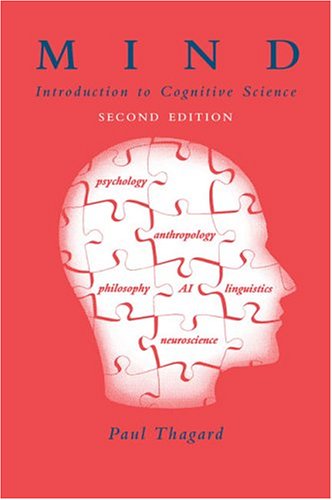
5. Mind: Introduction to Cognitive
$48.99
6. Cognitive Science: An Introduction
$15.00
7. Economic Theory and Cognitive
$49.99
8. Cognitive Psychology: Applying
$33.23
9. The Foundations of Cognitive Science
$10.98
10. What Is Cognitive Science? (Bradford
$88.16
11. Cognitive Science: An Interdisciplinary
$9.95
12. Mind Readings: Introductory Selections
$9.00
13. Taking Sides: Clashing Views on
$9.00
14. Mind: Introduction to Cognitive
 
$40.20
15. Cognitive Models of Science (Minnesota
$18.00
16. An Invitation to Cognitive Science,
$48.95
17. What is Cognitive Science
$192.00
18. Mind As Machine: A History of
$21.40
19. Heidegger, Coping, and Cognitive
$15.00
20. Current Directions in Cognitive

1. Cognitive Science: An Introduction, Second Edition
by Neil A. Stillings, Steven W. Weisler, Christopher H. Chase, Mark H. Feinstein, Jay L. Garfield, Edwina L. Rissland
Paperback: 544 Pages (1995-03-17)
list price: US$40.00 -- used & new: US$32.60
(price subject to change: see help)
Asin: 0262691752
Average Customer Review: 4.5 out of 5 stars
Canada | United Kingdom | Germany | France | Japan
Editorial Review

Book Description
This edition available outside North America ONLY ... Read more

Customer Reviews (3)

5-0 out of 5 stars A great introduction for a low price
This old book is a great introduction to all of the fields that make up cognitive science at a relatively low price, although it could use an updated edition. It takes a computational perspective as it surveys the various areas, and that is good for someone coming from a scientific field. It covers psychology, philosophy, linguistics, and artificial intelligence, relating them all to the field of cognitive science. In spite of the complexity of each of these individual areas, there really are no hard prerequisites for reading it. However, I would recommend you have at least an upper-level undergraduate knowledge of two of the fields covered in order to better see the total interconnection of all the fields. The book probably goes into the most depth in the areas of natural language processing and vision because these are the most computationally complex. This book is not the last word on any of the fields it covers, but it will get you started. I highly recommend it in spite of its age. The following is the book's table of contents:

Chapter 1 What Is Cognitive Science?
1.1 The Cognitive View
1.2 Some Fundamental Concepts
1.3 Information Processes Can Be Analyzed At Several Levels
1.4 Computers In Cognitive Science
1.5 Applied Cognitive Science
1.6 The Interdisciplinary Nature of Cognitive Science

Chapter 2 Cognitive Psychology: The Architecture of the Mind
2.1 The Nature of Cognitive Psychology
2.2 The Notion of Cognitive Architecture
2.3 A Global View of The Cognitive Architecture
2.4 Propositional Representation
2.5 Schematic Representation
2.6 Cognitive Processes, Working Memory, and Attention
2.7 Mental Images
2.8 Automatic and Controlled Processes
2.9 The Acquisition of Skill
2.10 The Connectionist Approach to Cognitive Architecture

Chapter 3 Cognitive Psychology: Further Explorations
3.1 Concepts and Categories
3.2 Memory
3.3 Reasoning
3.4 Problem Solving

Chapter 4 Artificial Intelligence: Knowledge Representation
4.1 The Nature of Artificial Intelligence
4.2 Knowledge Representation

Chapter 5 Artificial Intelligence: Search, Control, and Learning
5.1 Search and Control
5.2 Learning

Chapter 6 Linguistics: The Representation of Language
6.1 The Study of Linguistic Knowledge
6.2 Phonology
6.3 Syntax
6.4 Universals

Chapter 7 Neuroscience: Brain and Cognition
7.1 Introduction to the Study of the Nervous System
7.2 Organization of the Central Nervous System
7.3 Neural Representation
7.4 Neuropsychology
7.5 Computational Neuroscience

Chapter 8 Philosophy: Foundations of Cognitive Science
8.1 Philosophy in Cognitive Science
8.2 The Enterprise of Cognitive Science
8.3 Ontological Issues
8.4 Epistemological Issues
8.5 The State of Cognitive Science

Chapter 9 Language Acquisition
9.1 Milestones in Acquisition
9.2 Theoretical Perspectives

Chapter 10 Semantics
10.1 Semantics and Cognitive Science
10.2 Meaning and Entailment
10.3 Reference
10.4 Sense
10.5 Problems in Possible-Worlds Semantics
10.6 Cognitive and Computational Models of Semantic Processing

Chapter 11 Natural Language Processing
11.1 Preliminaries
11.2 On the Role of Grammar in Language Processing
11.3 Connectionist Models
11.4 On the Role of Discourse
11.5 More on the Role of General Knowledge
11.6 Production
11.7 Conclusion

Chapter 12 Vision
12.1 The Problem of Vision
12.2 Low-Level Visual Processes
12.3 Intermediate Processes and Representations in Vision
12.4 High-Level Visual Processes
12.5 The Architecture of Visual Computation

4-0 out of 5 stars An introduction, but not a gentle one...
What do you expect from a cognitive science book, which neatly separates all the major fields (Cognitive Psychology, Artificial Intelligence, Linguistics, Neuroscience, Philosophy, Language Acquisition, Semantics, Natural Language Processing, Vision), into chapters? First of all, it is not a mile-wide inch-deep book. Quite the contrary, it has remarkable detail, and it's definitely not an easy book for the beginner. However the fragments are not well-connected to each other, and there are no threads of thought one can follow through the text. Probably the most important problem of cognitive science is the gap between the disciplines, and the lack of a common terminology. The authors have adopted an information-processing view, and overstepped this problem rather than solving it. The result is a biased book, which is really nice if you like the information theoretic approach (like I do), but as a course-book, I suggest it as the supplementary reading.

5-0 out of 5 stars fascinating
Cognitive Science: An Introduction - 2nd Edition is a fascinatingundergraduate text that accurately shows all of the subsets of thecognitive sciences.Cognitive Science: An Introduction - 2nd Editionintroduces the advanced undergraduate student to cognitive science subsetssuch as cognitive psychology, cognitive anthropology, cognitivecomputational intelligence, cognitive linguistics, cognitive nurro-science,and the philosophy of the cognitive sciences.The diagrams in CognitiveScience: An Introduction - 2nd Edition are very vivid to demonstrateexactly what a philosophers/scientists sees in the subject matter of thecognitive sciences.The undergraduate text provides a very a empiricalperspective of the cognitive sciences that differs directly from theclassical transcendental perspective of cognition that the philosopherImmanuel Cant demonstrated in the Critique Of Pure Reason. The cognitivesciences can be very difficult to understand, but Cognitive Science: AnIntroduction - 2nd Edition is one of the best resources to explore the newempirical study of the science of the process of thought.

Please feelfree to send questions or comments to mmount@essex1.com ... Read more


2. Embodiment and Cognitive Science
by Jr, Raymond W. Gibbs
Hardcover: 346 Pages (2005-12-19)
list price: US$75.00 -- used & new: US$68.20
(price subject to change: see help)
Asin: 0521811740
Average Customer Review: 4.5 out of 5 stars
Canada | United Kingdom | Germany | France | Japan
Editorial Review

Book Description
This book describes the many ways that the mind and body are closely interrelated, and how human thought and language are fundamentally linked to bodily action. The embodied nature of mind is explored through many topics, such as perception, thinking, language use, development, emotions, and consciousness. People's embodied experiences are critical to the ways they think and speak and, most generally, understand themselves, other people, and the world around them.This work provides a strong defense of the idea that embodied action is critical to the study of human cognition.Download Description
This book explores how people's subjective, felt experiences of their bodies in action provide part of the fundamental grounding for human cognition and language. Cognition is what occurs when the body engages the physical and cultural world and must be studied in terms of the dynamical interactions between people and the environment. Human language and thought emerge from recurring patterns of embodied activity that constrain ongoing intelligent behavior. We must not assume cognition to be purely internal, symbolic, computational, and disembodied, but seek out the gross and detailed ways that language and thought are inextricably shaped by embodied action. Embodiment and Cognitive Science describes the abundance of empirical evidence from many disciplines, including work on perception, concepts, imagery and reasoning, language and communication, cognitive development, and emotions and consciousness, that support the idea that the mind is embodied. ... Read more

Customer Reviews (2)

4-0 out of 5 stars Technically oriented
This book is aimed mainly at workers in the field and in related aspects of brain functioning. It is solid, important and well worth reading.

5-0 out of 5 stars Embodiment Established
This book definitively establishes the fact that not only is the mind "in" the body, the mind is the body.We think with our whole nervous system.Proprioception, peripheral nerves, bodily motions, all are major parts of cognition and experience. Not only do we think with our bodies, we can't think without them.Our thought is our action in the world.
Gibbs' superb uniting of neurology, psychology, linguistics, philosophy, and common sense simply buries Descartes (of mind-body dichotomy fame) under mountains of data and theoretically sophisticated interpretation. No one will ever again be able to argue that the mind is an abstract, disembodied entity trapped in flesh. This book is in the great tradition of Tolman, Hebb, and Merleau-Ponty, and should be transformational to anyone who hasn't already gotten the message.Even for me (a veteran reader in this field and lifelong non-Cartesian) the book was transformative.I learned a startling amount about everything from brain cells to babies (the latter are far more aware of their relationship with the world and its objects and trajectories than I thought).Already familiar with George Lakoff's work, I learned rather less about metaphor (discussed rather too repetitiously), but even here Gibbs has much to say, including a convincing interpretation of the bizarre sense of self captured in such phrases as "I'm not myself today" and "I'm so busy I'm beside myself."
I notice a tendency in American culture for women to see their bodies as something outside of their "selves," and even neuter in sex, as when a friend of mine who had cancer (mercifully cured) said "I felt my body had let me down, and I was sort of mad at it."I could never think of my body as neuter, or as an opponent.Neither, I think, could most men.But once a bunch of us were discussing this over lunch; in general, things broke along the above gender lines, but a highly analytic mathematician said he could think of his body as something foreign, while a notably accomplished and talented dancer said she could never imagine such a thing--she was firmly in her definitely gendered body.So experience and culture affect body images and body philosophies.This has been discussed a great deal in recent years.Gibbs wisely avoids getting mired in that endless literature, but I suppose the next stage in embodied cognition is to bring it all in.Meanwhile, everyone interested in cognition or consciousness should read Gibbs' book.
... Read more


3. Readings in Philosophy and Cognitive Science (Bradford Books)
Paperback: 700 Pages (1993-11-19)
list price: US$50.00 -- used & new: US$50.00
(price subject to change: see help)
Asin: 0262571005
Average Customer Review: 4.0 out of 5 stars
Canada | United Kingdom | Germany | France | Japan
Editorial Review

Book Description
This collection of readings shows how cognitive science can influence most of the primary branches of philosophy, as well as how philosophy critically examines the foundations of cognitive science. Its broad coverage extends beyond current texts that focus mainly on the impact of cognitive science on philosophy of mind and philosophy of psychology, to include materials that are relevant to five other branches of philosophy: epistemology, philosophy of science (and mathematics), metaphysics, language, and ethics.

The readings are organized by philosophical fields, with selections evenly divided between philosophers and cognitive scientists. They draw on research in numerous areas of cognitive science, including cognitive psychology, developmental psychology, social psychology, psychology of reasoning and judgment, artificial intelligence, linguistics, and neuropsychology. There are timely treatments of current topics and debates such as the innate understanding of number, children's theory of mind, self-knowledge, consciousness, connectionism, and ethics and cognitive science. ... Read more

Customer Reviews (1)

4-0 out of 5 stars Cognitive Science for Philosophers
This excellent book gives an overview of current events in cognitive science that are relevant for philosophers. It sometimes goes into considerable technical detail - but the details are always the important ones - important for philosophy that is. If you are interested in the Philosophy of mind, this is a definite recommendation. ... Read more


4. Contemporary Debates in Cognitive Science (Contemporary Debates in Philosophy)
Hardcover: 360 Pages (2006-05-15)
list price: US$93.95 -- used & new: US$79.86
(price subject to change: see help)
Asin: 1405113049
Canada | United Kingdom | Germany | France | Japan
Editorial Review

Book Description
This volume introduces central issues in cognitive science by means of debates on key questions.

  • The debates are written by renowned experts in the field.
  • The debates cover the middle ground as well as the extremes
  • Addresses topics such as the amount of innate knowledge, bounded rationality and the role of perception in action.
  • Provides valuable overview of the field in a clear and easily comprehensible form.
  • ... Read more

    5. Mind: Introduction to Cognitive Science, , 2nd Edition
    by Paul Thagard
    Paperback: 278 Pages (2005-04-01)
    list price: US$32.00 -- used & new: US$22.87
    (price subject to change: see help)
    Asin: 026270109X
    Average Customer Review: 5.0 out of 5 stars
    Canada | United Kingdom | Germany | France | Japan
    Editorial Review

    Book Description
    Cognitive science approaches the study of mind and intelligence from an interdisciplinary perspective, working at the intersection of philosophy, psychology, artificial intelligence, neuroscience, linguistics, and anthropology. With Mind, Paul Thagard offers an introduction to this interdisciplinary field for readers who come to the subject with very different backgrounds. It is suitable for classroom use by students with interests ranging from computer science and engineering to psychology and philosophy.

    Thagard's systematic descriptions and evaluations of the main theories of mental representation advanced by cognitive scientists allow students to see that there are many complementary approaches to the investigation of mind. The fundamental theoretical perspectives he describes include logic, rules, concepts, analogies, images, and connections (artificial neural networks). The discussion of these theories provides an integrated view of the different achievements of the various fields of cognitive science.

    This second edition includes substantial revision and new material. Part I, which presents the different theoretical approaches, has been updated in light of recent work the field. Part II, which treats extensions to cognitive science, has been thoroughly revised, with new chapters added on brains, emotions, and consciousness. Other additions include a list of relevant Web sites at the end of each chapter and a glossary at the end of the book. As in the first edition, each chapter concludes with a summary and suggestions for further reading. ... Read more

    Customer Reviews (1)

    5-0 out of 5 stars CRUM: Computational Representational Understanding of the Mind
    The linguistic-analysis tradition in philosophy had achieved ascendancy in twentieth-century philosophy of science. But it has been characterized by a nominalist view, which admits a two-level semantics consisting of only (1) the linguistic symbol, such as word, and (2) the objects or individual entities the symbol references.Nominalism recognizes no mediating third level consisting of the idea, concept, "intension", proposition, or any other mental reality between linguistic signs and nonlinguistic objects.

    The two-level semantics is also the view typically held by the Positivist philosophers, who rejected mentalism in psychology, and who like B.F. Skinner prefer behaviorism.However Thagard, like Herbert Simon, explicitly rejects the behavioristic approach in psychology and advocates cognitive psychology, which recognizes mediating mental realities.

    The two-level semantics is also characteristic of philosophers such as Quine who accept the Russellian predicate calculus.This calculus of symbolic logic contains a notational convention that uses quantification to express existence claims.It therefore fabricates an Orwellian-likenominalist newspeak in which predicate terms are semantically vacuous, unless they are placed in the range of quantifiers, such that they reference some kind of entities called either "mental entities" or Platonic "abstract entities."The philosopher Nelson Goodman for example therefore divides all philosophers into nominalists and Platonists.Not surprisingly the Russellian symbolic logic was adopted by the Logical Positivists.Oddly Thagard does not reject the Russellian symbolic logic, although it is not clear that he recognizes the ontological implications of its notational conventions.

    In this book, Mind: Introduction to Cognitive Science (1996), intended as an undergraduate textbook, Thagard states that the central hypothesis of cognitive science is that thinking can best be understood in terms both of representational structures in the mind and of computational procedures that operate on those structures. He labels this central hypothesis with the acronym "CRUM", by which he means "Computational Representational Understanding of Mind."This hypothesis assumes that the mind has mental representations analogous to data structures and computational procedures analogous to algorithms, such that computer programs using algorithms applied to data structures can model the mind and its processes.

    Readers interested in more commentary on Thagard are invited to read my book titled History of Twentieth-Century Philosophy of Science at my web site philsci with free downloads.See especially BOOK VIII.

    Thomas J. Hickey
    ... Read more


    6. Cognitive Science: An Introduction to the Study of Mind
    by Jay Daniels Friedenberg, Gordon Silverman
    Paperback: 560 Pages (2005-09-12)
    list price: US$67.95 -- used & new: US$48.99
    (price subject to change: see help)
    Asin: 1412925681
    Average Customer Review: 2.0 out of 5 stars
    Canada | United Kingdom | Germany | France | Japan
    Editorial Review

    Book Description
    This landmark textbook introduces students to everything that the worlds great thinkers think about thought. Throughout history, different fields of inquiry have attempted to understand the great mystery of mind and answer questions like: What is mind? How does it operate? What is consciousness? Only recently have these efforts in traditional and cutting edge disciplines become more united in their focus. Cognitive Science: An Introduction to the Study of Mind is the comprehensive result of the authors' drawing together of this work.

    Jay Friedenberg and Gordon Silverman survey significant theoretical models of the human mind from a variety of disciplinary perspectives. They achieve coherence between these different approaches by the use of a parallel structure to organize each chapter and by deploying a common set of themes to explore the different perspectives. The overall approach is multidisciplinary, theoretical, and historical. Other texts on cognitive science are empirical in nature, built around classic experiments illustrating major phenomena in perception, memory, and other areas. This book, by contrast, introduces students to the theoretical models and ideas underlying such empirical work. Experiments are discussed, but primarily to illustrate the specific characteristics of a model.

    Key Features:

    • Includes numerous ancillaries to promote the book's effective usea companion student website at www.sagepub.com/CSstudy featuring online student-friendly exercises, E-flash cards, and interactive quizzes; and an Instructors CD-ROM with a test bank, chapter outlines, PowerPoint slides, a sample syllabus, and ideas for student projects
    • After introducing a major perspective, an "Evaluating" section discusses the strengths and weaknesses of that perspective
    • "Thought Balloons" in margins further encourage students to think critically about key concepts
    • "In-Depth" boxes elaborate on specific models, illustrating them in concrete terms, and "Minds On" exercises help students to familiarize themselves with key concepts in a hands-on fashion
    • Student study is assisted via key terms (which are boldfaced and defined in context when first introduced), suggestions for further reading, and end-of-chapter "Food for Thought" discussion questions
    • Covers all the traditional concerns of cognitive science together with analysis of newer areas such as robotics and the evolutionary approach


    Unlike other texts on the market which are either outdated or pitched at a much higher level, Cognitive Science is the perfect introductory textbook for cross-disciplinary courses on the mind in psychology, linguistics, philosophy, and computer science. ... Read more

    Customer Reviews (3)

    1-0 out of 5 stars Excuse my language, but this book sucks
    I totally agree with the previous negative review, so I'll just add my own disappointments here. I am currently taking a cognitive science course, and this is the textbook we're using. It's new this year, and I have a hunch it won't be on the menu for next semester.

    It seems like at least a third of the text in this book is dedicated to sentences like this:"We have just now read [topic A], which was [description of topic A], and next we will cover topic B, and after that we'll cover topic C."This fluff/dust makes the book hard to read, and there is very little "meat" in between.

    Here's an actual quote that made me laugh out loud this morning:(page 167)
    "Computerized Axial Tomography (CAT).This technique was first developed in the 1970s. [short explanation of what it is, then new paragraph: ] Positron Emission Tomography (PET). This imaging proceedure (developed in the 1980s) was developed later than computerized axial tomography." Well, how about that,they even attempt to teach me about time:the 1980s came after the 1970s!!

    Don't buy this book.

    4-0 out of 5 stars Comprehensive and Useful
    I read "Cognitive Science An Introduction to the Study of Mind" not for a course requirement, but because I was interested in the topic. The book provided a comprehensive and readable account of this new field. It explained ideas in a way that I could follow, not having had any specialized training in the different areas. The figures effectively broke up the text and helped to explain and expand upon concepts introduced in the chapters. The exercises and web links at the chapter endings invite to reiterate and explore topics in greater detail. There was also a web site with practice exams and electronic flash cards. I can see that it would be useful for an undergraduate if assigned for a course.

    1-0 out of 5 stars DO NOT USE THIS TEXTBOOK
    What a horrible book. If you are a professor looking for a textbook for an interdisciplinary cognitive science class, absolutely DO NOT use this one. If you want to learn anything about the subject, DO NOT buy it. This horrible excuse for a textbook was written by a couple of psychologists who obviously don't know the first thing about philosophy, AI, computer science, or any of the other topics they attempt to address. An inordinately large amount of text is devoted to a complete history of psychology, while philosophical issues crucial to the field are given the short shrift.

    Not only is the material in the book of reprehensible quality, it is presented in an embarrassingly slipshod manner. I can't imagine how a publisher could print this book and still respect themselves. The illustrations from the book consist of clip art and worse, and consistently look pixelly and distorted. As if it weren't bad enough that the material is second-rate, it's cheaply presented with useless and confusing diagrams and tables.

    All in all, my undergraduate class could have put together a better text. Throughout the course we were consistently correcting and refuting the text. Our professor only ordered it for the class because he had not read it. This book is a waste of time, money, trees, effort, and space. Avoid it at all costs. ... Read more


    7. Economic Theory and Cognitive Science: Microexplanation (Bradford Books)
    by Don Ross
    Paperback: 454 Pages (2007-03-30)
    list price: US$23.00 -- used & new: US$15.00
    (price subject to change: see help)
    Asin: 0262681684
    Average Customer Review: 5.0 out of 5 stars
    Canada | United Kingdom | Germany | France | Japan
    Editorial Review

    Book Description
    In this study, Don Ross explores the relationship of economics to other branches of behavioral science, asking, in the course of his analysis, under what interpretation economics is a sound empirical science. The book explores the relationships between economic theory and the theoretical foundations of related disciplines that are relevant to the day-to-day work of economics -- the cognitive and behavioral sciences. It asks whether the increasingly sophisticated techniques of microeconomic analysis have revealed any deep empirical regularities -- whether technical improvement represents improvement in any other sense. Casting Daniel Dennett and Kenneth Binmore as its intellectual heroes, the book proposes a comprehensive model of economic theory that, Ross argues, does not supplant but recovers the core neoclassical insights and counters the caricaturish conception of neoclassicism so derided by advocates of behavioral or evolutionary economics.

    Because he approaches his topic from the viewpoint of the philosophy of science, Ross devotes one chapter to the philosophical theory and terminology on which his argument depends and another to related philosophical issues. Two chapters provide the theoretical background in economics, one covering developments in neoclassical microeconomics and the other treating behavioral and experimental economics and evolutionary game theory. The three chapters at the heart of the argument then apply theses from the philosophy of cognitive science to foundational problems for economic theory. In these chapters economists will find a genuinely new way of thinking about the implications of cognitive science for economics and cognitive scientists will find in economic behavior a new testing site for the explanations of cognitive science. ... Read more

    Customer Reviews (1)

    5-0 out of 5 stars An exploration of the fundamental blocks of economic science. Big subject, over-academic treatment.
    Don Ross explores the tangled and much-argued relationship between economic theory and cognitive science and manages the feat of creating a cohesive perspective. Ever since the 1970s and the psychology experiments of Kahnemann & Tversky (which went on to win a Nobel Prize in economics - Kahnemann confessed he'd never in his life so much as studied Economics 101) the precepts of economics, based on the "rational man" have been under attack and the philosophical basis has been questioned. Is economics the product of atomised individual actions - or a social construct?

    What Don Ross does here is stand back and look at the fundamentals of economic theory, and attempts to cohesively tie things together. Is there a neat fit between the way humans tick and the way markets tick?

    The authority (and humour) of Ross' voice elevates this book above the sometimes shrill pop-marketplace of ideas, and this volume, all 450 pages of it, really sets out to establish a new milestone in economics: knocking down old theories and assumptions, and building out of this rubble a new platform.

    I don't think it succeeds. I feel Ross would have achieved a lot more if he had used a wider research scope. For the most part Ross' book is a meta-analysis of the work of other economic theorists including Philip Mirowski, Paul Samuelson and the author's own hero Daniel Dennett, and it really could have benefitted, if the author had incorporated, with little additional effort, more insights from the rapidly evolving ground of Cognitive Science. A shame, because the title of the book, and the subheading, promises this. As it turns out Ross doesn't appear comfortable delving into the realities of the human mind, and he prefers to wander back to the Departments of Economics and Philosophy where he clearly feels at ease.

    My second criticism is that he has produced some very, very heavy reading. Ross has some awful writing habits that could have done with a firm editor. So I blame the publisher as much as Don Ross. A good editor would surely have pulled out these things:

    - Strange metaphors (Tarzan anyone?) that distract rather than illuminate.
    - Constant use of acronyms (RPT, OISF, EGT...) which effectively encode rather than clarify the meaning of his long sentences.
    - Academic jargon. Example: "Eliminativism." This books is aimed squarely at his peers rather than at the intelligent public. The old My Fair Lady song "Why can't the English learn to Speak?" came to mind. "Why can't intelligent academics learn to communicate?"

    My guess is that Ross has been inspired by Dennett's own writing style, which is damned lively, but this author hasn't quite pulled it off.

    So I have very mixed views on this book. Even so, it deserves wider reading in the finance sector where the quants too often ignore the realities and irregularities of the humans who make up the market. But fasten your seatbelts. This is not an easy read. ... Read more


    8. Cognitive Psychology: Applying the Science of the Mind (2nd Edition)
    by Greg L. Robinson-Riegler, Bridget Robinson-Riegler
    Hardcover: 608 Pages (2007-07-26)
    list price: US$123.60 -- used & new: US$49.99
    (price subject to change: see help)
    Asin: 0205531393
    Average Customer Review: 3.0 out of 5 stars
    Canada | United Kingdom | Germany | France | Japan

    Customer Reviews (1)

    3-0 out of 5 stars so bnoring
    so boring, so so boring to read and follow.. they knew about cog psyc, but forget how to communicate the information appropriately. ... Read more


    9. The Foundations of Cognitive Science
    Paperback: 904 Pages (1993-08-23)
    list price: US$62.00 -- used & new: US$33.23
    (price subject to change: see help)
    Asin: 0262660865
    Canada | United Kingdom | Germany | France | Japan
    Editorial Review

    Book Description
    What is cognitive science? Foundations of Cognitive Science answers this question in a way that gives a feeling for the excitement, ferment, and accomplishments of this new field. It is the first broad treatment of cognitive science at an advanced level.

    Complete and authoritative, Foundations of Cognitive Science covers the major architectures; provides background in philosophy, linguistics, cognitive psychology, and neuroscience; and deals with methods for studying both brain and mind. All of the chapters have been written especially for the book by the leading scholars in the field.

    Michael I. Posner is Professor of Psychology at the University of Oregon. ... Read more


    10. What Is Cognitive Science? (Bradford Books)
    by Barbara Von Eckardt
    Paperback: 477 Pages (1995-03-02)
    list price: US$40.00 -- used & new: US$10.98
    (price subject to change: see help)
    Asin: 026272023X
    Average Customer Review: 3.0 out of 5 stars
    Canada | United Kingdom | Germany | France | Japan
    Editorial Review

    Book Description
    In this richly detailed analysis, Barbara Von Eckardt lays the foundations for understanding what it means to be a cognitive scientist. She characterizes the basic assumptions that define the cognitive science approach and systematically sorts out a host of recent and the controversies surrounding them.

    Von Eckardt takes issue with those who argue that there is no agreed-upon research paradigm and agreed-upon set of assumptions or methods in cognitive science, and with those who believe that the field should not be so committed. She argues that there is indeed a framework of shared commitments that includes basic questions guiding research, substantive assumptions constraining how those questions are to be answered, and methodological assumptions about how to find those answers.

    A Bradford Book ... Read more

    Customer Reviews (1)

    3-0 out of 5 stars Thought provoking but tedious.
    Von Eckardt presents many important ideas to consider about the nature of cognitive science as a field, but once you get past the introduction of these ideas, the discussion of them is quite tedious.Chapter 1 is a sufficient treatment for most readers.Additionally, in her focus on "adult, normal, typical cognition," von Eckardt ignores much of the scope of cognitive science in her treatment. ... Read more


    11. Cognitive Science: An Interdisciplinary Approach
    by Carolyn Sobel
    Hardcover: 327 Pages (2001-01-05)
    list price: US$92.81 -- used & new: US$88.16
    (price subject to change: see help)
    Asin: 0767402138
    Average Customer Review: 3.5 out of 5 stars
    Canada | United Kingdom | Germany | France | Japan
    Editorial Review

    Book Description
    This engagingly written introduction to the cognitive sciences examines the historical and contemporary issues and research findings of the core cognitive science disciplines, including cognitive psychology, neuroscience, language, philosophy, and artificial intelligence. For each of the core disciplines of cognitive science, the historical development and classic research studies are presented in one chapter and current research development and issues follow in a second chapter. The student is given insight into the way each discipline has contributed to the growth of cognitive science and what directions research is taking in the future. This text assumes no background on the part of the reader. ... Read more

    Customer Reviews (2)

    2-0 out of 5 stars cog sci
    Required for a class.Not a big fan of this one.rather boring

    5-0 out of 5 stars A stunning achievement
    This is a tour de force.Five discipines are presented, both historically and currently, illuminating the current state of the cognitive sciences and how these disciplines got to their present levels of achievement. ... Read more


    12. Mind Readings: Introductory Selections on Cognitive Science
    Paperback: 336 Pages (1998-03-27)
    list price: US$32.00 -- used & new: US$9.95
    (price subject to change: see help)
    Asin: 0262700670
    Canada | United Kingdom | Germany | France | Japan
    Editorial Review

    Book Description
    Mind Readings is a collection of accessible readings on some of the most important topics in cognitive science. Although anyone interested in the interdisciplinary study of mind will find the selections well worth reading, they work particularly well with Paul Thagard's textbook Mind: An Introduction Cognitive Science, and provide further discussion on the major topics discussed in that book. The first eight chapters present approaches to cognitive science from the perspective that thinking consists of computational procedures on mental representations. The remaining five chapters discuss challenges to the computational-representational understanding of mind.

    Contributors: John R. Anderson, Ruth M. J. Byrne, E. H. Durfee, Chris Eliasmith, Owen Flanagan, Dedre Gentner, Janice Glasgow, Philip N. Johnson-Laird, Alan Mackworth, Arthur B. Markman, Douglas L. Medin, Keith Oatley, Dimitri Papadias, Steven Pinker, David E. Rumelhart, Herbert A. Simon. ... Read more


    13. Taking Sides: Clashing Views on Controversial Issues in Cognitive Science (Taking Sides)
    by Marion Mason
    Paperback: 464 Pages (2004-05-28)
    list price: US$29.38 -- used & new: US$9.00
    (price subject to change: see help)
    Asin: 0072953284
    Canada | United Kingdom | Germany | France | Japan
    Editorial Review

    Book Description
    This debate-style reader is assembled to introduce students to controversies in cognitive science. The scientific quest to understand human thinking and to imitate thinking artificially with computer software is surrounded by controversies from theory to application. The readings represent the arguments of leading cognitive scientists, researchers, and psychologists. They reflect opposing viewpoints and the issues have been selected for their substance, vitality, and relevance. By requiring students to analyze these issues and reach considered judgments, Taking Sides actively develops critical thinking, research, and presentation skills. For additional support for this title, visit our student website: www.dushkin.com/online ... Read more


    14. Mind: Introduction to Cognitive Science
    by Paul Thagard
    Hardcover: 213 Pages (1996-10-01)
    list price: US$38.00 -- used & new: US$9.00
    (price subject to change: see help)
    Asin: 0262201062
    Average Customer Review: 4.0 out of 5 stars
    Canada | United Kingdom | Germany | France | Japan
    Editorial Review

    Book Description
    Cognitive science is the interdisciplinary study of mind and intelligence, embracing psychology, philosophy, artificial intelligence, neuroscience, linguistics, and anthropology. Paul Thagard's accessible, concise, and integrated text presupposes no special preparation in any of these fields.

    Thagard systematically describes and evaluates the main computational theories of mental representation that have been advocated by cognitive scientists, including logic, rules, concepts, analogies, images, and connections (neural networks). He considers the major challenges to the computational-representational view of mind and discusses emotions, consciousness, physical and social environments, dynamical systems, and mathematical knowledge.

    Teaching cognitive science is difficult, Thagard observes, because students come to this multidisciplinary subject with widely different competencies, backgrounds, and interests. Mind solves this dilemma by making logic comprehensible to psychology students, computer algorithms comprehensible to English students, and philosophical controversies comprehensible to computer science students. Each chapter concludes with helpful summaries, discussion questions, and suggestions for further reading.

    Mind is ideal for introductory courses on Cognitive Science, and is also useful as a supplement to courses on cognitive psychology, educational psychology, philosophy of mind, and artificial intelligence.


    A Bradford Book ... Read more

    Customer Reviews (1)

    4-0 out of 5 stars A Fine Map of Cognitive Science
    "Cognitive Science" is a slippery notion, which may be intrinsic to any endeavor (oops, Thagard's Canadian; make that "endeavour") that emerges from many different fields. But Thagard makes an honorable and largely successful stab at giving it some boundaries and some internal structure. If you're intrigued by the idea of mind science and just want a general idea of what the issues, approaches and shortcomings of its current state are, then this book (written for an introductory, probably undergraduate, course) is a fine place to start. ... Read more


    15. Cognitive Models of Science (Minnesota Studies in the Philosophy of Science)
     Hardcover: 508 Pages (1992-06)
    list price: US$54.00 -- used & new: US$40.20
    (price subject to change: see help)
    Asin: 0816619794
    Canada | United Kingdom | Germany | France | Japan

    16. An Invitation to Cognitive Science, Vol. 1: Language
    Paperback: 445 Pages (1995-10-16)
    list price: US$37.00 -- used & new: US$18.00
    (price subject to change: see help)
    Asin: 0262650444
    Canada | United Kingdom | Germany | France | Japan
    Editorial Review

    Book Description
    An Invitation to Cognitive Science provides a point of entry into the vast realm of cognitive science, offering selected examples of issues and theories from many of its subfields. All of the volumes in the second edition contain substantially revised and as well as entirely new chapters.

    Rather than surveying theories and data in the manner characteristic of many introductory textbooks in the field, An Invitation to Cognitive Science employs a unique case study approach, presenting a focused research topic in some depth and relying on suggested readings to convey the breadth of views and results. Each chapter tells a coherent scientific story, whether developing themes and ideas or describing a particular model and exploring its implications.

    The volumes are self contained and can be used individually in upper-level undergraduate and graduate courses ranging from introductory psychology, linguistics, cognitive science, and decision sciences, to social psychology, philosophy of mind, rationality, language, and vision science. ... Read more


    17. What is Cognitive Science
    Paperback: 448 Pages (1999-10-25)
    list price: US$48.95 -- used & new: US$48.95
    (price subject to change: see help)
    Asin: 0631204946
    Canada | United Kingdom | Germany | France | Japan
    Editorial Review

    Book Description
    Written by an assembly of leading researchers in the field, this volume provides an innovative and non-technical introduction to cognitive science, and the key issues that animate the field. ... Read more


    18. Mind As Machine: A History of Cognitive Science Two-Volume Set
    by Margaret Boden
    Hardcover: 1712 Pages (2006-08-31)
    list price: US$250.00 -- used & new: US$192.00
    (price subject to change: see help)
    Asin: 0199241449
    Average Customer Review: 3.0 out of 5 stars
    Canada | United Kingdom | Germany | France | Japan
    Editorial Review

    Book Description
    Cognitive science is among the most fascinating intellectual achievements of the modern era. The quest to understand the mind is an ancient one. But modern science has offered new insights and techniques that have revolutionized this enquiry. Oxford University Press now presents a masterly history of the field, told by one of its most eminent practitioners. Psychology is the thematic heart of cognitive science, which aims to understand human (and animal) minds. But its core theoretical ideas are drawn from cybernetics and artificial intelligence, and many cognitive scientists try to build functioning models of how the mind works. In that sense, Margaret Boden suggests, its key insight is that mind is a (very special) machine. Because the mind has many different aspects, the field is highly interdisciplinary. It integrates psychology not only with cybernetics/AI, but also with neuroscience and clinical neurology; with the philosophy of mind, language, and logic; with linguistic work on grammar, semantics, and communication; with anthropological studies of cultures; and with biological (and A-Life) research on animal behaviour, evolution, and life itself. Each of these disciplines, in its own way, asks what the mind is, what it does, how it works, how it develops---and how it is even possible. Boden traces the key questions back to Descartes's revolutionary writings, and to the ideas of his followers--and his radical critics--through the eighteenth and nineteenth centuries. Her story shows how controversies in the development of experimental physiology, neurophysiology, psychology, evolutionary biology, embryology, and logic are still relevant today. Then she guides the reader through the complex interlinked paths along which the study of mind developed in the twentieth century. Cognitive science covers all mental phenomena: not just 'cognition' (knowledge), but also emotion, personality, psychopathology, social communication, religion, motor action, and consciousness. In each area, Boden introduces the key ideas and researchers and discusses those philosophical critics who see cognitive science as fundamentally misguided. And she sketches the waves of resistance and acceptance on the part of the media and general public, showing how these have affected the development of the field. No one else could tell this story as Boden can: she has been a member of the cognitive science community since the late-1950s, and has known many of its key figures personally. Her narrative is written in a lively, swift-moving style, enriched by the personal touch of someone who knows the story at first hand. Her history looks forward as well as back: besides asking how state-of-the-art research compares with the hopes of the early pioneers, she identifies the most promising current work. Mind as Machine will be a rich resource for anyone working on the mind, in any academic discipline, who wants to know how our understanding of mental capacities has advanced over the years. ... Read more

    Customer Reviews (2)

    1-0 out of 5 stars A memoir, not a history
    This two volume work is so huge because it is an apparently unedited text with a wandering associative organization (or disorganization), no apparent limits on what is included.There are major irrelevant digressions into hobby horse topics of the author's, such as early efforts to make automata.Furthermore, it does not meet the accuracy standards that one would hope for in a history.I found numerous inaccuracies in the areas I know well.That is why I characterize it as a memoir.
    Despite the huge size, coverage is limited to North America and the UK.Cognitive science in Europe and Asia are neglected.
    In addition, the huge size makes for a user unfriendly document.There are many cross-references to other sections of the text that may well be in the other volume, and all of the references are at the end of the second volume.The cross-references are typically imprecise, to a large section, and it is not always obvious what was meant.
    I regret having spent the money to buy this work.The best I can say for it is that it should be in university libraries as a research resource for those who might write better, more useful histories of cognitive science.But those authors had better do their own fact checking.

    5-0 out of 5 stars Excellent
    Review of Volume 2 (August 25, 2007):
    With few exceptions, the second volume of "Mind As Machine" respects the high quality of the first, and can be read and understood by anyone with a general background in artificial intelligence, neuroscience, or psychology. At times the author seems intimidated by some of the mathematical developments that have taken place in cognitive science, such as the use of the theory of dynamical systems, but in general she confronts issues with confidence and keen insight.

    The second volume begins with a very provocative question, one that has plagued the field of artificial intelligence since its beginnings in the 1950's. The author asks, "when is a program not a program", and this is definitely a question whose typical answer is responsible for much of the lack of confidence in progress in artificial intelligence. The general prejudice in the cognitive science community is that a thought process or reasoning pattern cannot be viewed as a "program" because the latter is only to be taken as a collection of "instructions" that is to be run on a computer and will give the same answer when acting on the same information presented to it. The problem was then to distinguish between a "program" and an "intelligent" program, even though the designation of "intelligent" was (and still is to a great extent) extremely vague. The lack of a precise definition of intelligence would naturally lead to controversy regarding the identity of the first "intelligent" program, and the author discusses some of this controversy. The `Logic Theorist' program and the `Selfride-Dinneen' program are discussed as early candidates for being the first "AI programs" but the author points to some of the early skepticism as to their status as being intelligent. One of these continues to this day, namely that an "intelligent" program has to be highly complex, or "sexy" to use the author's terminology. But complexity, if viewed from the standpoint of the history of artificial intelligence, is in the eye of the beholder, and programs once deemed intelligent, like the ones behind checkers and chess, are now viewed as mere "programs." Such trivialization of intelligent "programs" could be avoided if they were designated, in full recognition of their status in cognitive science as "reasoning patterns" or "thought processes" rather than programs or "algorithms", with the latter names being more appropriate for a computer science context.

    Many more of these peculiarities in the history of AI/cognitive science are discussed in Volume 2, such as the deliberate "underselling" of an intelligent technology so as not to instill fear into prospective customers who feel threatened by intelligent machines. As someone who has worked in the trenches of "technological AI" (as the author calls it in the book), this reviewer can report many such stories by vendors who do not want to "frighten" potential customers away by designating their product as "intelligent". Instead they usually play it down, just as author reports the salesman of the IBM 704 did back in 1979. Even highly educated customers, very familiar with modern technology, can view intelligent machines as disquieting, or even threatening, and are frequently hesitant to deploy them in a production environment. The Hollywood Skynet meme has diffused quickly and effectively throughout the world, stymieing the practical application of artificial intelligence.And the bar keeps getting raised for judging whether a machine is indeed intelligent. Chess used to be the holy grail, but now chess "programs" highly competitive with human players can be purchased cheaply at stores found in most neighborhoods throughout the country. Even the developers and researchers themselves, including the author, have dismissed progress as being either "trivial" or part of "technological AI", and predict "real" intelligent machines to be a few hundred years away.

    The author also discusses in some detail the petty squabbles between research groups in cognitive science and artificial intelligence. Some readers may feel that this kind of discussion should be left out of the book. To omit it though would be a mistake, since the book is an historical account and readers should have an understanding of the degree to which even individuals deemed to be highly intelligent can engage in conduct that borders on triviality or blatant irrationality. Such dialog and behavior is sometimes intermixed with brilliant developments, proving indeed that good work can be done even if one is embedded in a contentious, degrading atmosphere.

    A particularly valuable part of Volume 2 is the author's discussions on research into systems for the representation of semantic information. Sometimes called `semantic networks' at the present time, the goal is to be able to represent semantic content for many different domains or subject areas. Semantic networks would allow a machine to reason across these domains without any external intervention or tuning. The author discusses the work of M.R. Quillian in the early 1960's on semantic representations, which used what was called `localist connectionism' at the time. Work on the `semantic Web' is a good example of current research into semantic representations. The ability of a machine to deal with many knowledge domains is also of great interest to those researchers who are currently attempting to design machines with artificial "general" intelligence (GAI). A modest (but impressive) hint of how this could be done is given by the HACKER "program" which the author discusses in this volume. HACKER could engage in "self-criticism", and this ability is taken to be a sign of what the author has labeled as `Piagetian error-led constructive learning'. Enthusiasts for GAI have pointed to the need for this type of learning. The current enthusiasm for GAI was also taking place in the 1960's, as the author reports in this volume, but under pressure from "experts" was abandoned in the 1970's.

    There are some annoying parts of this volume, but these are few. One is the author's continued reference to the "general public", apparently to distinguish them from members of academia or research labs, the latter two groups being the only ones qualified it seems to assess progress in cognitive science. Another is the inclusion of philosophical debate on artificial intelligence, with an entire chapter devoted to it. Certainly such an inclusion would be deemed appropriate since this volume is an historical overview, but such debate has only slowed the progress of artificial intelligence. It is the opinion of this reviewer that all who are involved in this kind of research should declare a moratorium on philosophical debate and get on with the design and construction of intelligent machines. The philosophers should be left alone to construct the gigantic, rhetorical conceptual spaces they usually get lost in. And lastly, the author seems to restrain any enthusiasm she has for the subject, with the belief that such enthusiasm comes from only those who want to advertise themselves or who do not have the appropriate background to understand the subject. Certainly the press has exaggerated some of the claims of progress in artificial intelligence, but on the other hand real progress has been made, and great enthusiasm should be expressed for this progress. Sadly, many academics seem to be too guarded and self-restrained to participate in such joyous emotions, judging it to be "unprofessional" to do so. There are exceptions to this though in the book, such as the author's refreshingly unbridled enthusiasm for the SHRDLU "program" of T. Winograd.

    As the author details in this volume, and as can be gathered from conversations with specialists, AI has been subjected to harsh criticism, some of this justified but most frequently not. One of these criticisms was leveled by Drew McDermott, and is outlined by the author in this volume. McDermott's criticism goes at the heart of many of the problems in the acceptance of machines as exhibiting intelligence. The issue is the words that are used to describe processes that are occurring in machines. McDermott charges AI researchers with "self-deception" when they use "wishful mnemonics" to describe what he says are just "procedures" or "data structures." The author gives a few examples, one being when a procedure is called GOAL instead of something like G0034, the former name leading one to believe that a `real' goal has been achieved. McDermott does not want to think outside of the computer science paradigm, and as long as AI researchers listen to his admonitions and stay within this paradigm, they will never accept machines as being intelligent, no matter what the capabilities of these machines. Every process occurring in these machines will always be viewed as a procedure, and every knowledge or semantic representation will be viewed as a data structure. Machines will be thought of as entities that run programs, with these programs mere manipulations of data structures, even if the machine can beat every human at chess or backgammon, even if it can produce and prove original theorems in pure mathematics, or even if it can self-navigate on Mars and evaluate its surroundings with scientific curiosity.

    But the views of McDermott are narrow and myopic, and can easily be stood on their head. One could for example speak of "accurate mnemonics" to describe what is going on in machines when they engage for example in learning or discovery. There is no reason why AI researchers should not call a "program" intelligent if it is indeed the case that it is. The issue is what kind of processes in a machine we should label as intelligent, and when we decide to do so it will be based on an understanding of learning and intelligence, and not on a rigid and unproductive adherence to the computer science paradigm, as McDermott insists upon. It would be proper for example to call a procedure or algorithm a `reasoning pattern', or hardware a `cognitive structure', or even memory (volatile or not) as a `knowledge base.' When this is done, one can indeed distinguish intelligent machines from non-intelligent ones, and it becomes natural to refer to "machines that can think." There is no doubt that some machines throughout the history of AI have been deemed "intelligent" when they indeed were not. But there are more that have been viewed as non-intelligent when they were (and are), if viewed from a reasonable framework. Many more will make their appearance in years to come, illustrating with precision the strict equality between mind and machine.

    Review of Volume 1:

    A detailed book on the history of a subject in science or technology is always helpful, since it provides insight that is usually not obtainable from formal papers and monographs. The latter are written for experts, and so no attempt is made to explain the subject matter in a way that is transparent to a reader that is outside the field. In addition, these works are usually guarded, meaning that the authors are being very careful not to explain themselves too well, and thus make a potential critic's job much easier. The author of this massive two-volume set has given the reader a history of the subject from the standpoint of an insider and recognized contributor to the field. For experts in cognitive science, much of it will be familiar, and no doubt controversial, as they may feel some of their ideas have been misrepresented. For non-experts (such as this reviewer), there is no way to tell if the volumes really respect the details of what has happened, and therefore such readers must view its contents as more tentative than usual. The author though is careful to note very early on that the volumes represent her point of view on cognitive science "as a whole", and this serves to put the skeptical reader more at ease.

    The "man as machine" paradigm is traced back to the ancient Greeks in Volume 1, but the author cautions that their attitudes about this are much different (and its fair to say much less ambitious) than those held today. Since World War II, the belief has been that not only is it proper to view humans as machines, but that it is possible, however challenging, to construct non-human entities or "machines" that have minds. The repugnance of the ancient Greeks to practical work would have discouraged any attempts to build such machines. The author outlines various other attempts to build "automata" after the time of the Greeks, one of them a rudimentary android that was constructed in the twelfth century, another a "talking head" that was, interestingly, destroyed by none other than Thomas Aquinas, who apparently believed it to be "devilish" in origin. Rene Descartes of course is the most virile of the agents of the "man as machine" meme, and the author naturally devotes much space in this volume to his contributions in this regard.

    The Cartesian view has had a large following, and there were sometimes horrifying consequences of this. The author includes an example of this: the belief that animals cannot feel pain and with animals being dissected while still alive. And the Descartes view of consciousness, briefly discussed in this volume, is finally being scrutinized scientifically using brain scanning techniques. It was not until very recently that the scientific community has viewed consciousness as a subject worthy of investigation, and the study of consciousness, particularly from the standpoint of cognitive neuroscience, will certainly shed light on Descartes dualism, with its arbitrary division of mind from matter. The artificial intelligence community has also been stymied by a difficult problem that is brought out in the book by the inclusion of a passage from Descartes. This problem revolves around the construction of a machine that can think/reason in any domain and not merely be a collection of modules each of which is designed for a specific domain. Descartes thought this to be impossible, as the included passage clearly indicates. Descartes thought reason to be a "universal tool" that can work in "all kinds of circumstances", whereas man-made implements or machines "need a special arrangement for each special action." Artificial general intelligence or AGI as it is now called, has as its goal the construction of such a "universal tool."

    The author's view on the role of Charles Babbage in the mind-as-machine paradigm goes against the widely held view because she believes that his role was irrelevant. She devotes many pages to the support of her view, and her arguments are convincing to a large degree. The most interesting part of her discussion though is that she compares the hype associated to Babbage with the "techno-hype" she imputs to the artificial intelligence community in the 1970s and late 1980s. She believes this over-selling of artificial intelligence was counterproductive for this type of research but there is another possible interpretation of this behavior, namely that it was a way that the researchers produced confidence in themselves to tackle the challenging problems of AI. The sheer magnitude of the difficulty of these problems requires individuals with extreme confidence, without of course engaging in confabulation. In relation to this discussion, and giving much more insight into attitudes about AI, both from the "public" and the AI researchers themselves, is the passage due to Lady Lovelace on the 'Analytical Engine' of Babbage. In this passage, Lovelace warns against any possible exaggerations regarding the powers of the Analytical Engine, and remarks that when considering a subject that is novel, there is a temptation to exaggerate what is already interesting and to undervalue what is really true after it becomes known what is really possible or known. The history of AI has been plagued with this rollercoaster ride of confidence and undervaluation, and this has been pointed out by other AI researchers/historians such as Donald Michie and Pamela McCorduck. This pattern of initial enthusiasm and hype surrounding an advance in AI, followed eventually by its understanding and then its eventual rejection as anything significant, could be called the 'Lovelace-Michie-McCorduck effect' in recognition of the three individuals who wrote of it.

    It is also very interesting to compare what is known and can be accomplished now with what one reads in this volume as done or accomplished in the last four hundred years. One example are the Vaucanson automatic musicians of the eighteenth century as compared to the machine musicians of today, the latter of which can not only compose original music but also serve as neuroscientific models of musical appreciation. Another concerns the early skepticism regarding the possibility of constructing robots that simulate various human bodily movements. This skepticism should be compared to the artificial muscle technology of today. Still another is the work of Ramon y Cajal on "neurones" as compared with what is done in computational neuroscience today.

    In discussions and debates on the mind-as-machine paradigm and artificial intelligence, one usually encounters statements regarding the power of "intuition" over computational or logical reasoning patterns, or at least beliefs, usually strongly expressed, that the human mind has the ability to process information that cannot be viewed as computational. It would of course be surprising that a book on the history of cognitive science and the 'mind-as-machine' paradigm would not include a discussion of these debates. The author includes such a discussion, with emphasis on the work of Alan Turing, wherein she includes an interesting passage that indicates that Turing himself believed that intuition cannot entirely be avoided. Interestingly though, Turing pointed to the need for "non-constructive" systems of logic that allow one to differentiate between when a step in a proof is the result of intuition and when it is purely formal. And the 'O-machines' of Turing are entities that have mathematical "powers" that are not based on Turing computation. The belief that intuition is not only necessary but more powerful than computational processes is still very entrenched not only in the scientific community but outside of it. It would seem that the majority of humans cannot believe that mental processes are solely mechanical/computational, but no explicit tests illustrating the "power" of intuition over computation have been conducted to date. Intuition thus remains a concept with no scientific foundation as of yet. ... Read more


    19. Heidegger, Coping, and Cognitive Science: Essays in Honor of Hubert L. Dreyfus, Vol. 2
    Paperback: 427 Pages (2000-09-11)
    list price: US$30.00 -- used & new: US$21.40
    (price subject to change: see help)
    Asin: 0262731282
    Canada | United Kingdom | Germany | France | Japan
    Editorial Review

    Book Description
    Hubert L. Dreyfus's engagement with other thinkers has always been driven by his desire to understand certain basic questions about ourselves and our world. The philosophers on whom his teaching and research have focused are those whose work seems to him to make a difference to the world. The essays in this volume reflect this desire to "make a difference"--not just in the world of academic philosophy, but in the broader world.

    Dreyfus has helped to create a culture of reflection--of questioning the deep premises that inform and shape work in artificial intelligence and cognitive science. He has also been the primary introducer and interpreter of Martin Heidegger's work to the world of information technology. The essays in this volume represent the fruitful application of deep philosophical analysis to the concerns of our modern technological world.

    The sections are Coping and Intentionality; Computers and Cognitive Science; and "Applied Heidegger." In addition to cognitive science and artificial intelligence, topics include everyday skills, religion, business practices, and medical care. The book concludes with Dreyfus's responses to the essays.

    Contributors:
    Daniel Andler, Patricia Benner, Albert Borgmann, Harry Collins, George Downing, Fernando Flores, Sean Kelly, Joseph Rouse, Theodore R. Schatzki, John Searle, Robert C. Solomon, Charles Spinosa, David Stern, Charles Taylor, Terry Winograd, Mark Wrathall. ... Read more


    20. Current Directions in Cognitive Science (Association for Psychological Science Readers)
    by Society (APS) The American Psychological Society
    Paperback: 192 Pages (2004-09-04)
    list price: US$43.40 -- used & new: US$15.00
    (price subject to change: see help)
    Asin: 0131919911
    Canada | United Kingdom | Germany | France | Japan

      1-20 of 100 | Next 20
    A  B  C  D  E  F  G  H  I  J  K  L  M  N  O  P  Q  R  S  T  U  V  W  X  Y  Z  

    Prices listed on this site are subject to change without notice.
    Questions on ordering or shipping? click here for help.

    site stats