e99 Online Shopping Mall

Geometry.Net - the online learning center Help  
Home  - Science - Creativity (Books)

  1-20 of 100 | Next 20
A  B  C  D  E  F  G  H  I  J  K  L  M  N  O  P  Q  R  S  T  U  V  W  X  Y  Z  

click price to see details     click image to enlarge     click link to go to the store

$11.37
1. Cracking Creativity: The Secrets
$7.98
2. Creativity: Flow and the Psychology
$11.94
3. Creativity for Graphic Designers:
$5.00
4. The Creativity Book: A Year's
$9.56
5. The Zen of Creativity: Cultivating
$20.85
6. The Business Side of Creativity:
$5.75
7. Creativity in Business
$11.50
8. Creativity Games for Trainers:
$40.47
9. Handbook of Creativity
$10.77
10. Creativity for Life: Practical
$14.95
11. Inspiring Creativity: An Anthology
$44.00
12. Everyday Creativity and New Views
 
$53.46
13. Creativity Is Forever
$22.47
14. Explaining Creativity: The Science
$8.74
15. Managing Creativity and Innovation
$47.72
16. Creativity: Unconventional Wisdom
$14.00
17. Chi and Creativity: Vital Energy
$27.99
18. Web Standards Creativity: Innovations
$22.51
19. Software Creativity 2.0
$41.92
20. Digital Creativity: Techniques

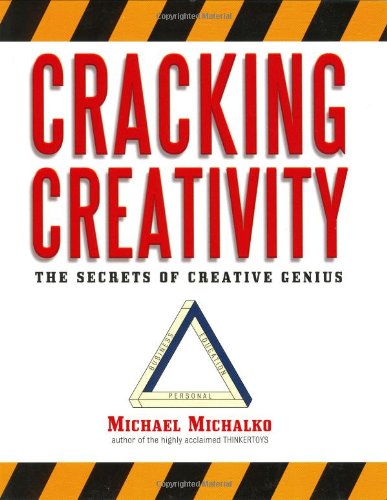
1. Cracking Creativity: The Secrets of Creative Genius
by Michael Michalko
Paperback: 309 Pages (2001-07)
list price: US$19.95 -- used & new: US$11.37
(price subject to change: see help)
Asin: 1580083110
Average Customer Review: 5.0 out of 5 stars
Canada | United Kingdom | Germany | France | Japan
Editorial Review

Book Description
What exactly is creativity? Why do some people seem to have so much of it? Can their secrets be learned? In this trail-blazing book, internationally renowned business creativity expert Michael Michalko answers these questions and more, bringing life-changing techniques into everyone's reach. Michalko has researched and analyzed over 100 of history's greatest thinkers-from Leonardo da Vinci to Charles Darwin, Thomas Edison to Walt Disney-to show readers how creative people think and how to put their secrets to use. It's no wonder that Entrepreneur magazine lauded CRACKING CREATIVITY as "Required reading for anyone in business." Packed with practical exercises and strategies for stimulating creativity, this original book will literally revolutionize the way you think and open up a world of innovative solutions to challenges that you face every day. ... Read more

Customer Reviews (43)

5-0 out of 5 stars First learn and then unlearn and learn again
This is something that is tickling my mind, after reading first few chapters of this book, I closed it, stood up, walked around my living room with my hands folded back. I looked outside the window and saw few kids playing the park and was forced to think something.

We are first as kids made to learn few things and are forced to treat those things as basic and important that is not true (refer to Michael's blog about Thomas Edison's Greatest Blessings). Now after reading the book Thinkertoys and Creative Thinking, I feel like its not that I have to learn these new concepts but there is an entire process involved of first of all unlearning most of the stuffs from past and then relearning the new concepts.

And when I say that I have to look at the kids I wonder what they are being tought in their schools only to find one day that they have to unlearn some of the concepts on which they are spending or rather wasting their time.

Do read the book, as mentioned earlier it makes you smile after every chapter as you discover immense possibilities of what all can be achieved in your day to day life.

5-0 out of 5 stars Great read
This is the best book on or about creative thinking I have ever read. I've recommended it to everyone I know who is interested in creating ideas and new ways to look at the world. Thanks.

5-0 out of 5 stars Practical Techniques to Boost Creativity
Author Michael Michalko delivers his best performance to date in this book. The book is filled with information on, and techniques for using, our creative processes. Many of the techniques are easy to learn, requiring only a little bit of practice to get used to them. Most of the book centers around: helping an individual generate many possible ideas about something, which will be critically evaluated at a later time; visualizing the problem and potential solutions; seeing from another's perspective, even the problem's in one case (quite effective sometimes); collaboration and creativity. This book already helped me deliver a 5 star essay on a very controversial subject. I followed its advice, producing as many ideas as possible in a short time, without rejecting any at first. Also, visualizing the data, as recommended, formed the basis for my later outline, which was complete enough that a rough draft was no work at all. So, for me, buying this book paid off already. I think anyone buying this will read it for a few minutes and then recognize they have a winner in their hands.

5-0 out of 5 stars I told you so
This book woke me up from my indifference toward creative thinking. My colleague at work recommended the book, so I bought it and read it expecting nothing much. I assumed creativity was something you were or were not. I can't believe how creative I've become since reading this book. This book has literally changed the way I the way I think and the way I look at the world. When I told my colleague about how I've changed, all he said was "I told you so."

5-0 out of 5 stars Superb!!!
This book has changed the way I look at the world and the way I think. I've gifted copies to all my friends and relatives.


... Read more


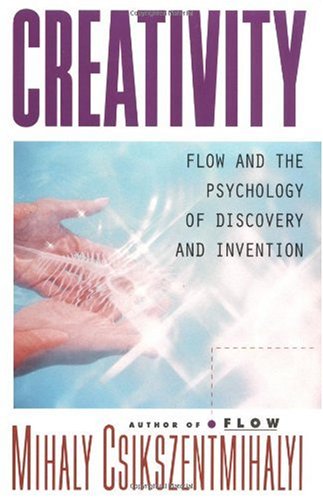
2. Creativity: Flow and the Psychology of Discovery and Invention
by Mihaly Csikszentmihalyi
Paperback: 464 Pages (1997-06-18)
list price: US$15.00 -- used & new: US$7.98
(price subject to change: see help)
Asin: 0060928204
Average Customer Review: 4.5 out of 5 stars
Canada | United Kingdom | Germany | France | Japan
Editorial Review

Book Description

Creativity is about capturing those moments that make life worth living. The author's objective is to offer an understanding of what leads to these moments, be it the excitement of the artist at the easel or the scientist in the lab, so that knowledge can be used to enrich people's lives. Drawing on 100 interviews with exceptional people, from biologists and physicists to politicians and business leaders, poets and artists, as well as his 30 years of research on the subject, Csikszentmihalyi uses his famous theory to explore the creative process. He discusses such ideas as why creative individuals are often seen as selfish and arrogant, and why the tortured genius is largely a myth. Most important, he clearly explains why creativity needs to be cultivated and is necessary for the future of our country, if not the world.

... Read more

Customer Reviews (22)

5-0 out of 5 stars Interesting
I especially liked the part where he says that a good chunk of Eulers mathematical theorems came towards the latter part of his life and when he was blind. I was especially interested in the linkage between age and creativity since I'm in my early 30's & wanted to make sure that I still have some juice left in me. :-)

5-0 out of 5 stars Excellent book
The description posted here doesn't do the book justice - I own a copy and still made 8 pages of notes for myself. Typed pages! Dr. Csikszentmihalyi distills and highlights the creative moments in life and how to create more creative moments in your own. It is not dry reading - the interviews and comments from his pool of world-class 'creative' people was very enjoyable and I liked that portion the least! Here's one of my favorite quotes: 'Creativity is a central source of meaning in our lives for several reasons.. First, most of the things that are interesting, important, and human are the results of creativity.

We share 98 percent of our genetic makeup with chimpanzees. What makes us different - our language, values, artistic expression, scientific understanding, and technology - is the result of individual ingenuity that was recognized, rewarded, and transmitted through learning. Without creativity, it would be difficult indeed to distinguish humans from apes.'


4-0 out of 5 stars Long and deep but very interesting
Very interesting and detailed book.Helps explain the true reality and complexity of creativity - that it is a system of multiple environmental, technology and human personality elements which in combination and interaction bring about new products and processes.

4-0 out of 5 stars A book for all psychology majors
If you're interested in any aspect of psychology then this is not only an informative book to read, but a fun one as well. As a psychology major, I enjoyed learning about how creative people live and work. Not only are the individual stories in the book interesting, but they also teach us ways of how to become more creative. The way Csikszentmihalyi describes the ways to enhance creativity makes us really believe we can do it. No, you don't need to come up with some incredibly brilliant invention. Just simply by waking up, setting a goal to achieve that day, enjoying your success, and increasing the complexity of the goal each day, you can develop the creative "flow" of everyday life.

In addition to helping people who lack creative qualities, Csikszentmihalyi also describes many ways to stay creative. For example, he suggests making time for reflection and relaxation. Also, he says to start doing more of what you love, and less of what you hate. These are just a few of the simple ways to help sustain your creative "flow" and again we feel confident that we can do these things. It's not brain science.

Even more importantly, Csikszentmihalyi does a great job of informing us about the so-called myths of creative people. These mostly deal with certain psychological traits that are given to the stereotypical creative person. We learn that creative people aren't as selfish, fanatical, crazy, and single-minded as we may assume. Psychologically, creative people tend to be very much a mixture of different levels of these stereotypes and the opposite of those stereotypes.

If I had to pick one downside of this book, it would be that there isn't a lot of detail on each creative person being interviewed by Csikszentmihalyi. For some of the people, we are given enough information to understand their creative story fairly well. However, for others it felt like not enough background information was given. A psychologist is interested in all perspectives of assessment: disease, dimension, behavior, and life-story. Thus, it would have been better to learn more about each person's life outside the creative world in order to see if creativity derives from psychological aspects of the person as a child or adolescent. Furthermore, the book could have contained more about the person's family, upbringing, hobbies, past achievements, IQ, etc. Again this is a bit of a personal preference and not necessarily a substantial flaw of the book.

This book "flowed", that's for sure. I enjoyed it!

5-0 out of 5 stars The Real Facts About Creative People
Few activities are a misunderstood by the general public as inventing and creativity. Sadly, Hollywood and television often portray the great inventor, scientist or musician as some sort of "mad genius". This book seeks to put the study of creativity on a rational basis.

For the purposes of this book, creativity is defined as "... to bring into existence something genuinely new that is valued enough to be added to the culture". Ninety-one noted contemporary people have been systematically interviewed. While only two -- Jacob Rabinow and Frank Offner -- are full-blown inventors, their creative processes have a fascinating similarity to the composers, architects, astronomers, biologists and others interviewed.

The book does not just quote the people interviewed, but cites their views regarding various facets of the creativity process.

Jacob Rabinow (200 patents in diverse areas) believes most original thinkers share three common traits -- 1) their curiosity, from early childhood, results in acquiring a great deal of information, 2) they enjoy thinking up and combining ideas, and 3) they recognize their "good" ideas and don't hesitate to discard "junk" ideas.

Frank Offner (first electronic controls for jet engines and developer of the only successful heat-homing missiles in World War II) notes that while a "solid grounding in physical sciences" is an asset, knowledge from other fields may trigger a creative person's mind to override what is assumed to be true in one field. He also feels the love or joy of solving problems is a key to finding solutions. This fun aspect is so strong that Rabinow is quoted as saying that, given a choice between money-making and fun, he would go for the fun.

Creative people are sometimes thought to be arrogant. However, this often stems from the need for self-assurance or, simply, overriding modesty. As Rabinow notes, "... I always assume that not only it can be done, but I can do it".

Robert Galvin (head of Motorola for 30 years) is reported as saying two traits are essential: 1) anticipation, i.e., having a vision of the future, and 2) commitment, which keeps you going when you or others have doubts. He also practices a mental exercise worth considering -- flip the problem by asking, "What if the opposite were true?".

Freeman Dyson, the physicist, observes, "... it is easy when you have a problem to work on. The hardest part is finding your problem".

The book cites how being in the right place at the right time contributes to being recognized. In Florence, Italy, between 1401 and 1425, an explosion of creativity took place. For example, for eighty years the cathedral of Florence lacked a dome, and yet the Pantheon of Rome had a dome (142 feet in diameter!) for a thousand years. Suddenly, Brunelleschi, who had analyzed the structure of the Pantheon, applied it to the problem at hand. The social, economic and political factors that made Florence the "right place at the right time" are detailed in the book.

Are we, today, providing incentives for creativity to flourish? One aspect of this is what we can do as a society. The author notes children who suffer from hunger or discrimination are less likely to be curious or interested in novelty. Another aspect is what as individuals can we do to promote our own creativity. The author offers various ways to cultivate creativity. For example, preserve the awe of childhood, "be surprised by something every day". Write down some of your observations and follow-up with some research. Don't think certain things are not your business -- life is your business.

While the author is a professor and former chairman of the Department of Psychology at the University of Chicago, the book is free from pompous phraseology and is readable by just about anyone who is interested in understanding creativity. If you want to dispel myths, such as "creative people are hyperactive", "have very high IQs" and "lack humor", then read this book and find out the real facts about creative people. A big book -- 456 pages -- but a delightful book. Read it and donate it to your local library -- the truth is there, so get it out there.
... Read more


3. Creativity for Graphic Designers: A Real-World Guide to Idea Generation--From Defining Your Message to Selecting the Best Idea for Your Printed Piece
by Mark Oldach
Paperback: 138 Pages (2000-04)
list price: US$19.99 -- used & new: US$11.94
(price subject to change: see help)
Asin: 158180055X
Average Customer Review: 4.5 out of 5 stars
Canada | United Kingdom | Germany | France | Japan

Customer Reviews (13)

5-0 out of 5 stars Great resource
This book packs a lot of punch. It's written in an easy to understand format that is very creative with handwritten notes from the author in the margins. It's a great source of ideas with the numerous full-color case studies that are included. This book does an excellent job of providing graphic designers with step-by-step instructions on how to ask the right questions at the initial client meeting, go back to the office and download the information, then take the information and begin generating ideas, and finally, select which ideas should be developed. It's an invaluable tool for new designers.

5-0 out of 5 stars A great book about how to practise as a graphic designer
I love my mac, but I also love not using it. This book tells a lot about a designers prosess outside the mac. I found this sentence in the book: "Designers have a responsebility to do what they are paid to - design .... To many designers use the (mac) for a substitute for thinking". So right!

4-0 out of 5 stars A real world book
Unlike design books filled w/ eye-candy & no direction on processes, Mark Oldach steers the reader through well defined concepts & thoughts. An excellent book for all designers who wish to communicate through design.

4-0 out of 5 stars definatly not a picture book
I found this book to be very helpful in getting you to think of the box. Instead of being like a picture book with not much information, it tells you how to come up with ideas and explains the process of making a good design. This is a great book to have if you already have those picture books with just designs and need something to help you with actually creating your own designs.

5-0 out of 5 stars The book of all books
I had been looking for a book about creativity, I wanted to understand the process more, and hopefully increase my productivity. This book was one of 12 that I bought related to the design and creativity area, and was by far the best I've read yet.It gives so much information about the process of idea generation that even I understand it more now (and I've been doing it for 4 years).I have already used the advice on handling clients to great success, and I'm reading the book a second time round.

This book is a MUST for all designers at all levels!!

Enjoy ... Read more


4. The Creativity Book: A Year's Worth of Inspiration and Guidance
by Eric Maisel
Paperback: 304 Pages (2000-06-19)
list price: US$13.95 -- used & new: US$5.00
(price subject to change: see help)
Asin: 1585420298
Average Customer Review: 5.0 out of 5 stars
Canada | United Kingdom | Germany | France | Japan
Editorial Review

Book Description
A complete creativity education in one volume. Everything you need to know to increase and unleash your creativity, by America's leading expert on the psychological side of creativity.

Whether you're a painter or a human resources manager, a novelist or an information services specialist, says Eric Maisel, whatever you do, creativity helps you do it better.

In this book, Maisel presents a complete one-year plan for unleashing your creativity. It uncludes two discussions/exercises per week, and culminates in a guided project of your choice--from working on your current novel to planning a new home business. ... Read more

Customer Reviews (11)

5-0 out of 5 stars Bite-Size Brillance
Since creativity usually reveals itself in small doses (and because most creative folks have short attention spans), I'm drawn to creativity-related books that stick to the point and offer bite-size morsels of materials. (In fact, both books I've written on this topic -- "IdeaSpotting" and "Zing!" take the approach of single-page messages.)

By presenting his content in a sequential, year-long plan, Maisel gives the reader digestible, easy-to-access inspiration and exercises for higher creativity and fresh ideas. Too many books force the reader to dig for the nuggets in volumes of narrative. Maisel's Creativity Book keeps the reader doing rather than digging!

4-0 out of 5 stars Worth a Year of Your Time
Eric Maisel has given us a nice book filled with inspiration and creative guidance.

This book is structured in 52 weekly segments starting with beginning work and ending up with a project that should be completed. Each short chapter contains a brief essay of guidance and then an inventive exercise to try on for size.

The author of this book, Eric Maisel, Ph.D., is a psychologist who teaches that the act of creating impacts all aspects of one's life. So this book is intended for everyone, not just those struggling to survive artistic blocks. Executives can develop new business ideas, cooks can create better dishes, lawyers can find new ways to argue, politicians can consider alternative ways to create democracy, children can become better students and so on. Overall an extremely good book for those willing to put forth a bit of effort towards creating new ideas.

5-0 out of 5 stars Creativity for anyone--not just writers and artists
I'm quite fond of Eric Maisel's books. He's a psychotherapist and "creativity consultant," and he has written a number of books on writing, art, and creativity. Several of them are among my favorite writing books: "Living the Writer's Life," "Deep Writing," and "Write Mind." Unlike those books, "The Creativity Book" is not aimed specifically at writers. It's aimed at you, me, your brother, and the guy in the cubicle down the hall. In other words, anyone who'd like to use a little more creativity in their lives, whether for painting, writing, mathematics, relationships, or business plans.

The book is designed to be read one section at a time, to take you through a year of learning. It has 88 sections, two per week, to get you through ten months, and then the idea is that you spend the last two months of your year devoted to a particular creative project. Each base section is pretty short--generally a page or three--so you'll have no trouble reading it in a few spare minutes some evening. Then it's followed by at least one exercise, and sometimes several. Sometimes the exercises are very specific; at other times, Maisel suggests ways to apply the exercises to whatever area you're trying to become more creative in.

Many of the ideas in the book are relatively basic, but this in no way makes them useless. After all, they're only basic for people who are already highly creative and making abundant use of that creativity. In large part this book is designed to help those who aren't sure where to start when it comes to creativity, and who haven't had much luck sitting down and getting started with their creative projects. Even highly creative people will still find things of value in this book, however. Some sections will feel like remedial schooling, but others might unlock surprising ways for you to move forward in your work. People with more experience using their creativity might prefer to skip from section to section instead of following the "plan," however, using the bits that have particular value to them.

5-0 out of 5 stars Worth reading, doing, keeping, re-reading
Eric Maisel is a prolific writer with a penchant for helping artists. And this book is no exception. For those who have read Cameron's "The Artist's Way," in the required number of weeks and wish there were other timed guides, Maisel's book is the answer. It's a year's worth of creative work, some gentle and imaginative, some kick-in-the-rear tough. I'll admit I read all the way through it, and I'll bet Maisel knew that most readers would. It's an interesting read that way, with Maisel's wry observations and self-deprecating humor serving as another level of inspiration. There is a lot hiding in this book, waiting to be discovered. The quotes in the scholar's margins create their own interesting commentary. Use this book to dip into when you are bored, stymied, frustrated, lonely or stuck. You won't come away feeling the same way. You might not want to do every exercise Maisel suggests, but imagining them might be enough to give you creative traction again.

5-0 out of 5 stars Excellent Resource for All Artists
All artists need a daily dose of positive thinking every single day, and this book provides just that.As a Creativity Coach who has studied with Eric Maisel, I can say that everything he writes is well grounded in his personal experiences and successes. ... Read more


5. The Zen of Creativity: Cultivating Your Artistic Life
by John Daido Loori
Paperback: 272 Pages (2005-05-31)
list price: US$16.95 -- used & new: US$9.56
(price subject to change: see help)
Asin: 0345466330
Average Customer Review: 4.5 out of 5 stars
Canada | United Kingdom | Germany | France | Japan
Editorial Review

Book Description
For many of us, the return of Zen conjures up images of rock gardens and gently flowing waterfalls. We think of mindfulness and meditation, immersion in a state of being where meaning is found through simplicity. Zen lore has been absorbed by Western practitioners and pop culture alike, yet there is a specific area of this ancient tradition that hasn’t been fully explored in the West. Now, in The Zen of Creativity, American Zen master John Daido Loori presents a book that taps the principles of the Zen arts and aesthetic as a means to unlock creativity and find freedom in the various dimensions of our existence. Loori dissolves the barriers between art and spirituality, opening up the possibility of meeting life with spontaneity, grace, and peace.

Zen Buddhism is steeped in the arts. In spiritual ways, calligraphy, poetry, painting, the tea ceremony, and flower arranging can point us toward our essential, boundless nature. Brilliantly interpreting the teachings of the artless arts, Loori illuminates various elements that awaken our creativity, among them still point, the center of each moment that focuses on the tranquility within; simplicity, in which the creative process is uncluttered and unlimited, like a cloudless sky; spontaneity, a way to navigate through life without preconceptions, with a freshness in which everything becomes new; mystery, a sense of trust in the unknown; creative feedback, the systematic use of an audience to receive noncritical input about our art; art koans, exercises based on paradoxical questions that can be resolved only through artistic expression. Loori shows how these elements interpenetrate and function not only in art, but in all our endeavors.

Beautifully illustrated and punctuated with poems and reflections from Loori’s own spiritual journey, The Zen of Creativity presents a multilayered, bottomless source of insight into our creativity. Appealing equally to spiritual seekers, artists, and veteran Buddhist practitioners, this book is perfect for those wishing to discover new means of self-awareness and expression—and to restore equanimity and freedom amid the vicissitudes of our lives.


From the Hardcover edition. ... Read more

Customer Reviews (10)

4-0 out of 5 stars A Big Commitment for Creativity
I am certain that even that torrent of innovation, Pablo Picasso, was interested in improving his creativity.So it's no surprise that the title of this book would pique the interest of artists

Loori is a photographer who adopted Zen and established a monastery that is noted for its way of integrating Zen and art.He begins the book by telling the story of how he came to be a Zen Buddhist after being influenced by the great photographer Minor White.He then explains how to adopt several Zen practices to enable one to be more creative and he describes exercises to develop these skills.These include the practices of still point, direct experience, caretaking, experiencing without identifying, and expressing things for what else they are.He next discusses the Zen aesthetic as expressed in various forms of Zen art with examples from history (or at least legend) and his personal experience.As the book progresses, various forms of enigmatic statements that appear to be common in the Zen tradition are introduced.For example, the author states "In the Zen transmission of wisdom, nothing is transmitted; nothing goes from teacher to student".

It would be nice if some principle could be extracted from a religion (for surely that's what Zen Buddhism is) that could be used by an artist without actually adopting the religion.On the other hand, I have never heard of a Christian way to be creative without being a Christian.So I suspect that Loori has placed the horse before the cart.If we are to practice the creativity of Zen Buddhism, we must first become Zen Buddhists and then the Zen creativity will come.

I'm not certain if readers are willing to adopt a religion to perhaps find new creativity as artists.I particularly wonder if an artist would be willing to confine his work to the constrained limits of what Zen art appears to be: haiku, pottery, calligraphy and so forth.I have always admired artists who work to innovate within rigidly defined standards, like the pueblo potters of the American southwest, but I have never been anxious to abandon my own art to adopt these traditions.Even the pictures that Loori provides of his Zen photographs, like the picture of a heron in black and white, look remarkably like the ink drawings shown throughout the book.I might have been more receptive if I had seen a color landscape that had been influenced by Zen principles.

I will acknowledge that I did not try the various exercises suggested by Loori throughout the book.It seemed clear that these were not one-shot exercises that could be tried and finished.Rather they were ways of behavior that would have to be practiced day after day to have an effect.And I was not interested in becoming a Zen Buddhist.

Even though I believe most artist will not want to adopt the path to creativity suggested by this book, I think artists will find it valuable to see how art is shaped by the cultural beliefs and milieu in which it is created.

5-0 out of 5 stars great experience!
i ordered the book for a class and the book arrived within a few days. also, in the condition that was stated on the website.

3-0 out of 5 stars Class
I bought this bought for my design college course and it has been pretty helpful. I don't agree with all of the theories and practices but my teacher really does. It is good that I have to read it, it helps me understand him more. If you would like to learn practices of zen or zazen I'd recommend this book. It is also helpful if you like creative arts.

5-0 out of 5 stars Perfection
Before reading this book, look at it.Turn the pages, but do not stop to read.Let your gaze come to rest on a typical page of text and notice the artistry of the type setter.Each page is a Zen garden with emptiness bounded by lines printed in beautiful font, and perfectly spaced so that the eye follows word after word without effort.Illustrations and graphics hold the reader's attention with few words of explanation to bias the experience.Finally, look at the covers, front and back.The front cover deserves contemplation, not interpretation.I will point to one disturbing feature of these covers - tiny dots of intense red ink.These dots are so perfectly placed, three on the front and four on the back, and so subtly infused into the background that when you finally see them, it is difficult to look away.Perfection.

Loori's writing is equally sublime, effortlessly awakening the reader's creative spirit without ever saying what it is one should create or how it must done.Yet, in his portrayal of the lives of artists with whom he has studied, as with his own, we are not only granted an intimate view of the creative process, we are invited to begin the process ourselves.Most important of all is the invitation to 'sit' with your subject before doing anything at all.Loori invites to be quiet and have no preconceived notions so that when the time is right, the picture takes itself when creating photographic images, the painting paints itself, poetry has no author, and tea springs to life in the cup.

Finally, this book is much more than a treatise on creativity.It is book about life lived simply in the manner of a Zen master.In this instance, the master is John Daido Loori.

1-0 out of 5 stars Zen Can't Dance
While this book is much more personal and revealing, a refreshing change from Loori's other ponderous books, American Zen takes itself too seriously -- at Loori's monastery one feels the "creative" has been deleted from their rigidly dense rule book.Case in point, many of the stories contained in the book derive from the period prior to Loori'szen training thirty years earlier .The message:If you want to dance with life, avoid becoming a "zen master" -- bad for the soul , and deeply damaging to any kind of authentic artistic experience. ... Read more


6. The Business Side of Creativity: The Complete Guide to Running a Small Graphic Design or Communications Business, Third Updated Edition
by Cameron S. Foote
Paperback: 440 Pages (2006-09-18)
list price: US$35.00 -- used & new: US$20.85
(price subject to change: see help)
Asin: 039373207X
Average Customer Review: 5.0 out of 5 stars
Canada | United Kingdom | Germany | France | Japan
Editorial Review

Book Description
The freelance designer's bible—a step-by-step guide to successful self-employment.

Hailed by one reviewer as the creative business "bible," and considered the authoritative book on the subject for over ten years, The Business Side of Creativity is back, updated and revised to include even more invaluable facts, tips, strategies, and advice for beginning creatives.

Every year the market for creative services expands-but the competition is increasing even faster. Today, success hinges not on talent alone, but on a thorough understanding of the business side of creativity.

The Business Side of Creativity is the most comprehensive business companion available to freelance graphic designers, art directors, illustrators, copywriters, and agency or design-shop principals. Cameron S. Foote, a successful entrepreneur and editor of the Creative Business newsletter, guides you step-by-step through the process of being successfully self-employed-from getting launched as a freelancer to running a multiperson shop to retiring comfortably, and everything in between. Sample business forms and documents to help put the information into practice are included in the appendixes, and are available for downloading online.

How should you organize? What should you charge? What marketing techniques yield the best returns? How do you know when it's right to expand? What are the most effective strategies for managing employees? How can you build salable equity? The Business Side of Creativity delves into these questions and hundreds more-and gives you practical, real-world answers and invaluable expert advice.

From launching yourself as a freelancer and managing a multi-person firm to marketing your services and retiring comfortably, this book is a one-stop resource for all creative service professionals on how to run a smooth, effective, and lucrative business. Useful forms and sample business plans are included. 25 illustrations. ... Read more

Customer Reviews (3)

5-0 out of 5 stars Great Resource
Very helpful, concise and confidence building resource for information on how to run a small design firm.

5-0 out of 5 stars A complete & practical resource
Cam Foote's book is a complete resource for new freelancers and a great "reality check" for experienced creatives. I have read his material for many years and always found it practical, clear, realistic, and helpful.Although his focus may seem to be almost entirely on graphic designers, as a copywriter I found most of his information applicable to my own business.

5-0 out of 5 stars The Business Side of Creativity gets right down to business.
I read a lot of business books so I tend to think I won't get much out of any one book. That's not the case with this book. I highly recommend the book to anyone who works in any kind of creative/freelance setting.

Cameron Foote really gets to the heart of the details of creative business. Most books like this take a 10,000 foot view of all the issues. I end up being frustrated with not really learning tactics, just strategies. With this book, even the generic business issues are dealt with in a way that's relevant to creative/freelance businesses.

When I first got the book I skipped to the chapter on how to go after the right business. I then read the chapters on how to make money in the business. After those chapters I realized there wasn't anything in the book I wanted to skip. I wound up reading the whole book back to back (and for a business book that's a big compliment--at least coming from me).

This may sound like a glowing review--that's because it is. I was very impressed with the level of detail and relevancy the book has to what I wanted to know. I found a few mistakes I was making with the way I was running my own business. I used the tips Foote gave and improved the issues immediately.

One last reason you might consider this book--in the Appendix there's a ton of helpful resources. Not only that, if you log on to the author's website, you can find about two times the forms found in the book. I wound up using 3 forms the author gives away on a daily basis. ... Read more


7. Creativity in Business
by Michael Ray, Rochelle Myers
Paperback: 240 Pages (1989-01-24)
list price: US$14.95 -- used & new: US$5.75
(price subject to change: see help)
Asin: 0385248512
Average Customer Review: 4.0 out of 5 stars
Canada | United Kingdom | Germany | France | Japan
Editorial Review

Book Description
This exploration of innovative thinking in companies of all kinds "shows us how creativity in business can enrich us, and those who work with us." -- Spencer Johnson, co-author, The One Minute Manager ... Read more

Customer Reviews (12)

5-0 out of 5 stars A book about wisdom
Even though it was written over 20 years ago, this book still shines like a gem.The simple reason is that this book is about wisdom.It is not a fad, nor is it really a how-to book.Instead, it directly talks to your wisdom by engaging both the left and right halves of your brain. For anyone who is deeply involved in today's fast-paced and short-fused business world, this book offers a breadth of fresh air.

5-0 out of 5 stars stimulate your right brain
This was used in Stanford's MBA program, but even if you're not an entrepreneur, it's an invaluable tool to unlocking your creative powers. There are tons of exercises and anecdotes to help you see problems from a different angle. The authors emphasize an intuitive Zen approach to solving problems. BUY THIS BOOK. IT'S GOOD FOR YOUR BRAIN.

4-0 out of 5 stars Practical Tools for the Art of Business
There are lots of books about business.There are probably an equal number about creativity.This book is about creativity in business.

This book is the distillation of the course that Michael Ray and Rochelle Myers taught at the Stanford Graduate School of Business.It is theoretical.It is practical.It is wonderful.

The special delight of this book is the mixing of the theoretical and the research findings with the practical applications. The authors present us with points, then give us stories and examples from the world of business and underpinnings from the world of scientific and psychological research that help explain why the examples work.

If you are looking for a book to give you a quick, simple way to come up with creative ideas in business, though, this ain't it.This is a book that presents you with tools and some understanding of why they work, so that you can apply them in your life and in your business.The key to the book is the title of one of the very first chapters: "Business As Art."

To practice an art, you must be creative.You must go beyond the established norms and rules.But you must also master some craft.This book will give you an introduction to the craft of creativity, an introduction to the ways that you can make your creativity not only more effective, but more powerful as a transformer of your business.

4-0 out of 5 stars Title Needs Revision
Calling this book Creativity in Business is about as accurate as calling the New York Times something like Sportsweek. This was a great book but it basically encompassed WAY more than its promised subject. Most of this book is about eastern philosophy and western physics as it relates to business. I didn't expect to get a chapter on the universe and my cosmic place in it and how to meditate to tap into it. If you have read anything by Thich Naht Hanh or the Dalai Lama you can skip this one. Otherwise, it's probably worth a read.

3-0 out of 5 stars Not structured, but some nice pieces
A collection of thoughts, insights, anecdotes, exercises and real life examples of applying creativity to business.If this is a structured approach, as the authors imply, the structure is hard to detect.However, the exercises are intriguing and the anecdotes are inspiring.Nice section on destroying the Voice of Judgment that shoots down creativity.I'm baffled by the other reviews that describe this as a "new age" or "occult" book.It is well-documented that creativity and intuition go hand-in-hand, but I guess this is just too esoteric an idea for most business people. ... Read more


8. Creativity Games for Trainers: A Handbook of Group Activities for Jumpstarting Workplace Creativity (McGraw-Hill Training Series)
by Robert Epstein
Paperback: 277 Pages (1995-12-01)
list price: US$34.95 -- used & new: US$11.50
(price subject to change: see help)
Asin: 0070213631
Average Customer Review: 4.0 out of 5 stars
Canada | United Kingdom | Germany | France | Japan
Editorial Review

Book Description
Games to Jumpstart workplace creativity. Dr. Robert Epstein's Creativity Games for Trainers arms you with 30 innovative, entertaining games guaranteed to enhance creativity in any organizational setting. Use them to develop creativity workshops or to breathe life into any training sessions. Each ready-to-use activity comes complete with lists of required and optional materials, time recommendations, reproducible handouts, follow-up discussion questions, and other essential information. You'll also find simple instructions for customizing exercises to different settings. . .data collection forms to help measure and track success. . .special ``challenge exercises'' that help participants develop their own games. . .and unique ``application exercises'' to assist users in promoting creativity on their own. ... Read more

Customer Reviews (4)

1-0 out of 5 stars uninspired, dry and clinical
A book about creativity, that lacks spark and "creativity" - it's too dry and clinical to be an enjoyable read and the exercises are uninspired.This material is dispassionate and lacks the flame it promises to ignite in others.As much as I admire the author's 15 years of clinical research, this book fall short in it's execution.

5-0 out of 5 stars Excellent
I've used Epstein's book together with Michalko's "Thinkertoys," in my creative thinking seminars with great success. You can't fail with these two books.

5-0 out of 5 stars A different approach
This book focuses on the stimuli (inputs/old ideas) and effective capaturing of responses (outputs/creative ideas) vs most other books about creativity focus on the thinking process, like mindmapping, six hats, thinking toys, etc.Thus, it directs to a total different path of how we build an environment to boost creativity.My analogy is no matter what thinking process you introduce, a group of housewives cannot invent a racket to reach the moon (don't get me wrong, I highly respect housewives for their contribution to families).It's the relevancy and variety of the inputs that matters.

I guess the author is a behaviourist who see thinking process as black box, i.e. non-observable and non-measurable.Thus, he only concentrates on the observable and measurable stimuli and responses.

I am a trainer for creativity for my company.I find this book very useful.The only complaint is that not all the games are up to my personal standard: able to demonstrate the theory AND able to energize the participants.

All in all, I highly recommand this book.You will see creativity in a different angle.

5-0 out of 5 stars Realy Improving
Creativity Games for Trainers was realy useful for me because it its change my life and i realy feel of the creativity on me. I approached my job with new inspiration after I started taking time-outs with myself. Ihighly recommend this book. ... Read more


9. Handbook of Creativity
Paperback: 502 Pages (1998-10-28)
list price: US$48.00 -- used & new: US$40.47
(price subject to change: see help)
Asin: 0521576040
Average Customer Review: 4.5 out of 5 stars
Canada | United Kingdom | Germany | France | Japan
Editorial Review

Book Description
The goal of this handbook is to provide the most comprehensive, definitive, and authoritative single-volume review available in the field of creativity. The book contains twenty-two chapters covering a wide range of issues and topics in the field of creativity, all written by distinguished leaders in the field. The volume is divided into six parts. The introduction sets out the major themes and reviews the history of thinking about creativity. Subsequent parts deal with methods, origins, self and environment, special topics and conclusions.All educated readers with an interest in creative thinking will find this volume to be accessible and engrossing. ... Read more

Customer Reviews (6)

5-0 out of 5 stars Thick and plentiful - worth it but not easy
Sternberg's Handbook has an almost mythical reputation amongst the Creative Studies Students at Buffalo State College.While there are shortcomings to the Handbook, areas where key authors or subjects are missing (it is written from the behavioral scientist point of view, and there are other, equally valid viewpoints in creative studies), each chapter will have plenty of food for thought.

And, guaranteed, you will have the time to digest this food for thought, as each and every chapter requires slow and careful reading.If the writing were to be any denser, it would tear free from the pages and sink to the very center of the Earth!Yet, there is so much information that, in the end, the knowledge derived is more than worth the work needed to get at it.

One last note: This is a handbook for those interested in the deep research on creativity.It is NOT suitable a "first book" for anyone starting out to learn about creativity!

4-0 out of 5 stars Using The Left Brain Too Much To Understand Right Brain
Although all the contributors of the book wrote about creativity, their writing and presentation styles are stiff, dry, and boring--- totally uncreative!

They used too much of their left brain to discuss a fascinatingsubject like creativity, which is supposed to be fun,lively, and thoughts provoking.

The only merit of this book is that it is a well-researchedfacts book on creativity, very suitable for the academicpeople. It focuses more on the WHY side of creativity, rather than on theHOW TO side, which makes it less practical and appealing to thecreativity practitioners or end-users!

Still a good book to put on the bookshelf though.

4-0 out of 5 stars Using The Left Brain Too Much To Understand Right Brain
Although all the contributors of the book wrote about creativity, their writing and presentation styles are stiff, dry, and boring--- totally uncreative!

They used too much of their left brain to discuss a fascinatingsubject like creativity, which is supposed to be fun,lively, and thoughts provoking.

The only merit of this book is that it is a well-researchedfacts book on creativity, very suitable for the academicpeople. It focuses more on the WHY side of creativity, rather than on theHOW TO side, which makes it less practical and appealing to thecreativity practitioners or end-users!

Still a good book to put on the bookshelf though.

5-0 out of 5 stars Not for getting informed but to understand the subject!
Dr.Sternberg's book on the evolution process of creativity research is a splendit source for anybody who deals with social sciences, a must for organizational behaviorists and a very satisfactory piece of reading for general reader.

The book does not give mere descriptions on the scope of creativity but it provides great amount of knowledge on the evolutionary process of creativity research from ancient times up to today! Furthermore, the subject of creativity has been examined both from theoretical and methodological perspective in such a creative manner which gives a very good knowledge about the major approaches, the outcomes of the previous researchs, main obstacles in the course of investigation, and finally the probable studies for further research on the creativity.

Consequently, the reader finds a good chance not only to have a detailed theoretical and practical information on the subject but also to learn the main approaches of outstanding social scientists towards the subject and not mentioning about the meticoulisly prepared bibliography.

I am amazed with the intensity of Dr.Sternberg's study the language of which is clear enough those of us whose Mother tongue is not English (like me!).

4-0 out of 5 stars Wonderful design, good but not great execution
I was looking for a comprehensive introduction to creativity research for students that combined a mapping function--showing what is out there by whom trending where--and a grounding interest function--showing how theresearch really does elucidate and give insight on insights, creation,etc.. Well..... The table of contents was perfect--absolutely perfect. But half of the articles served purely as mappings, with little or noinsight provided.One does not know immediately whether to ascribe this toa fault in the articles included on in the research surveyed. Studentswho happened to get assigned good chapters came away excited, but those whohappened to get assigned purely mapping chapters were bored by creativityresearch and hard to keep motivated. So now I have to use Sternberg'searlier book on Insight along with this Handbook.I apologize for thehonesty of this review.It is a great mapping book and a moderate insightprovider in sum. ... Read more


10. Creativity for Life: Practical Advice on the Artist's Personality, and Career from America's Foremost Creativity Coach
by Eric Maisel
Paperback: 400 Pages (2007-03-08)
list price: US$17.95 -- used & new: US$10.77
(price subject to change: see help)
Asin: 1577315588
Average Customer Review: 5.0 out of 5 stars
Canada | United Kingdom | Germany | France | Japan
Editorial Review

Book Description

Over the years, Eric Maisel has worked with thousands of creative people, including writers, musicians, artists, dancers, and actors. He knows firsthand the struggles they must face, and through his many books and professional practice he’s helped them find balance in their lives while pursuing their artistic endeavors. Firmly grounded in psychology, Creativity for Life explores all the challenges confronting an artist: deciding if you have talent (or if that’s even important); determining your level of commitment; pursuing stardom; honing your craft; overcoming blocks; taking care of the business end of your artistic life; finding your place in culture; coming out as an artist; finding love and friendship inside and out of your artistic community; and using your art to explore your inner life. A comprehensive approach to the much-misunderstood artist's life, this book, contains both nuts-and-bolts ideas and exercises and inspiration to nurture growth as an artist and a person. It includes update and expanded material from Maisel's Life in the Arts.
... Read more

Customer Reviews (2)

5-0 out of 5 stars Midwest Book Review, May 2007 Issue
The latest from Eric Maisel is an amazing and wonderful book that any writer, musician, artist, or performer would benefit from reading. In CREATIVITY FOR LIFE, Maisel brings together concepts and ideas he's discussed in previous books, but here every part is synthesized and complete. It's a smorgasbord of examples and tactics. He breaks new ground in detailing the artist's personality in ways that that the non-psychologist reader will instantly understand, and the book is highly accessible to anyone from beginner to master.

In the introduction he distinguishes between the "artful life," which is the way many people wish to live; the "art-filled life," which includes the joy that art brings; and an "art-committed life," the process of actively choosing to be creative. It's this latter that's the focus of the book.

"As soon as you decide to be creative in a particular domain and that you mean to live as a novelist, biochemist, actor, or sculptor, you introduce a set of profound challenges that you would not have confronted if you had `settled' for artful living and an art-filled life" (p. xii). In four major sections, Maisel thoroughly examines the challenges faced in seeking an art-committed life: The Challenge of the Artistic Personality, The Challenge of the Work, The Challenge of Relationships, and Strategies & Tactics. Each section is brilliantly detailed and will make sense to anyone at any stage of invention, innovation, or imagination.

Because creative folks face major obstacles that non-artists do not, Maisel spends a great deal of time giving hints, ideas, and suggestions. Just a few include ways to silence negative self-talk, using visualization, focusing, and practicing one's craft while bringing to it skills such as regularity, honesty, self-direction, intensity, joy, discipline, and more. He tells us, "Creativity is the act of making one choice after another" (p. 120). Living an art-committed life is the same. As Maisel says late in the book, "Lifelong creativity isn't given to you. You must earn it and attend to it every day... You will have to dig deep to find the requisite honesty, courage, and resilience to live an artful, art-filled, art-committed life... You must really want it and really commit to it in order to have it... to crack through everyday resistance and create for a lifetime" (p. 319-320).

I approach every new nonfiction book by Maisel with giddy excitement, wondering what fresh aspect of the creative process he'll unearth, dust off, and show around. Sometimes I feel like the man must personally know me and the challenges I face in writing - but we have, of course, never met. Maisel is just an amazing creativity coach and counselor who knows the secrets and insecurities, triumphs and tribulations of those who seek the creative life. This book is the next best thing to personally experiencing Maisel's creativity coaching, and I highly recommend it. ~Lori L. Lake, Midwest Book Review

5-0 out of 5 stars Comprehensive and Enlightening,
As a trainer of creativity coaches, I felt like this book was a delightful feast. The information is both exceptionally intuitive and timelessly helpful to both those who work with creative people and the creative individual themself. If you are a creative person all you need to do is open this book to feel validated, understood and inspired. It is a motivating reality. ... Read more


11. Inspiring Creativity: An Anthology of Powerful Insights and Practical Ideas to Guide You to Successful Creating
by Rick Benzel
Paperback: 224 Pages (2005-04-15)
list price: US$14.95 -- used & new: US$14.95
(price subject to change: see help)
Asin: 0976737108
Average Customer Review: 4.5 out of 5 stars
Canada | United Kingdom | Germany | France | Japan
Editorial Review

Product Description
Inspiring Creativity is an anthology of essays by 22 professional creativity coaches. The articles explore a wide variety of issues that can help people undertaking any type of creative work. The back cover reads as follows: Whatever type of creative work you do – writing, painting, acting, dancing, composing, crafting, or inventing – Inspiring Creativity will transform your results. Written by 22 practicing creativity coaches, this anthology presents a fascinating array of thoughtful approaches, practical tips, and valuable insights to engage your mind and help you become a more productive, successful creator. You’ll learn how to give yourself permission to create, find muses to arouse your imagination, develop big ideas and techniques to work deeply, and find time to live your creativity every day. You’ll receive the encouragement and support you need to honor yourself and face the challenges of the creative life. Powerfully motivating, the 22 articles in Inspiring Creativity represent the collective wisdom of a diverse team of knowledgeable, sensitive coaches who stand ready to guide you to your full creative potential. ... Read more

Customer Reviews (8)

2-0 out of 5 stars Less than Inspiring
A collections of writing from top creative coaches with anecdotes.Somehow I found the stories are boring and suggestions didn't inspire me to be creative.Very disappointed.

5-0 out of 5 stars Creativity coaching
Since ten years, I have been teacher of Creativity and Inventive of Engineering's students, the courses of educational formation in high education and of postdegree of teaching in high education, and this book is really one of the best ones than I have read. I widely recommend because it presents tips practical to help us to develop our creative potential by creativity coaching of another person and ourselves. Specially, the ideas to live our daily life creative are very valuable to enjoy the creative process and product.

5-0 out of 5 stars Midwest Book Review, October 2005 Issue
In the last five years, the field of coaching and mentoring creative artists has taken off as its own little cottage industry. Eric Maisel, more than any other writer/teacher/psychologist, seems to have had a major role in this genesis, so it's no surprise that this anthology is kicked off with a Foreword by Maisel. He says, "If you get it into your head that you must write novels, compose symphonies, prove or disprove string theory, or in some other way really manifest the potential of your heart, mind, and hands, you have set yourself on a journey that traditionally you have had to navigate alone. Now you need not feel completely alone: creativity coaches are available to help" ( p. xi).

The book is broken into six sections: Give Yourself Permission to Create, Choose a Muse for Inspiration, Create Big Ideas and Work Successfully, Live Your Creativity Every Day, Express and Honor Yourself, and Challenge Yourself to Higher Creativity. The sections form a natural progression, and each section contains three or four pieces. More than just tips and easy ideas, most of the articles advocate philosophies for approaching creativity that would be beneficial to all areas of art, writing, acting, or inventing. The only thing missing in this first edition is an index and a list of resources for further study and research. Perhaps as the field expands and later editions are created those items will be included.

The 22 professional coaches and experts who contributed to this volume are some of the best minds in the still nascent industry of creativity coaching. Four particularly good articles were: "Igniting a Creative Spark Within: How to Establish Creative Focus" by Suzanne R. Roy; "The Hero Within: Using the Mythic Journey to Discover Meaning in your Creative Work" by Michael Mahoney; "Of Flying Monkeys and Modern Day Muses: Who You Gonna Call?" by Jill Badonsky; and "Get BeMused: How to Find Yourself a Creative Muse in the Unlikeliest of Places" by Kaylen Bennett.

This is a fascinating collection, particularly for writers, but it would also serve as an excellent source for the college and online courses springing up to teach the art of creativity coaching. ~Lori L. Lake, Midwest Book Review

5-0 out of 5 stars Creative "Jaws of Life" in this book of inspiration
22 coaches of creativity provide their insight into delving the mind and spirit for inspiration. Some of this is intellectual; creativity as your spiritual birthright, how to tap the Muses by understanding how the personification of the arts is meaningful. Other advice is the type that writers need--how to write a memoir, getting unstuck, focus and self-awareness.

I found this book more aimed to the writer than the visual artist; still, there is a lot of wealth and wisdom here. If you are in any of the creative arts or in business, where creativity is a useful skill in problem-solving, then you ought to have a copy of "Inspiring Creativity" on your shelf. It just may get you unstuck someday. Think of it as an emergency "jaws of life" for those days when the juices just don't flow.

5-0 out of 5 stars A very useful source book in a field of not so useful books!
As a college teacher who is teaching a creativity course, I have found that there is much waffle and fluff printed about creativity.What I like about this set of essays is that it presents a wide and practical set of approaches to creativity.Thus students can find a mode, process, or perspective that fits their personal style.It is also very economically priced which is not a minor factor in this era of $100 text books. While it is not a book you would base a course on, if such a thing exists, it is a book that can be used effectively in any critical or creative thinking course.Well done! ... Read more


12. Everyday Creativity and New Views of Human Nature: Psychological, Social, and Spiritual Perspectives
Hardcover: 349 Pages (2007-06-15)
list price: US$69.95 -- used & new: US$44.00
(price subject to change: see help)
Asin: 097921257X
Average Customer Review: 5.0 out of 5 stars
Canada | United Kingdom | Germany | France | Japan
Editorial Review

Book Description
What is everyday creativity? A capacity, a strategy, a process, all ofthese. It is an ability that is intimately woven into our daily lives andour personalities, one that we use from hour to hour; yet it remains, formost of us, underdeveloped and, unfortunately, underacknowledged. Writeseditor and leading creativity researcher Ruth Richards, "Everydaycreativity is about everyone, throughout our lives, and fundamental to our very survival. It is how we find our lost child, get enough to eat, makeour way in a new place and culture.With our everyday creativity, we adaptflexibly, we improvise, we try different options, whether we are raising a child, counseling a friend, fixing our home, or planning a fundraisingevent." In this provocative collection of essays, an interdisciplinarygroup of eminent thinkers and writers offer their thoughts on howembracing creativity-tapping into the "originality of everyday life"-canlead to improved physical and mental health, to new ways of thinking, ofexperiencing the world and ourselves. They show how creativity can refineour views of human nature at an individual and societal level and,ultimately, change our paradigms for survival-and for flourishing-in aworld fraught with urgent challenges. Neither a dry treatise nor a manual, this anthology draws upon the latest research in the area to present alively examination of the phenomenon and process of everyday creativityand its far-reaching ramifications for self, culture, history, society,politics, and humankind's future. Part I looks at creativity andindividuals-our wellbeing, potential for new and transformativeunderstandings, and openings to richness, immediacy, and profundity ofexperience. Part II involves social creativity-including issues ofcomplexity, collaboration, contextual relativity, inclusiveness, andcreative systems evolving from the ground up (vs. more hierarchicalmodels). Part III presents a detailed and multilay ... Read more

Customer Reviews (2)

5-0 out of 5 stars The importance of creativity
To solve our age-old problems we need new ways of thinking. Ruth Richard's very valuable collection of authors on everyday creativity show us that creativity is a force that is alive, fluid and interconnected with everything in the universe--it is truly revolutionary. It shows us new ways to think about the world and create a healthy future.
Ilene A. Serlin, psychologist, author of Whole Person Healthcare (2007, Praeger). Whole Person Healthcare [Three Volumes]

5-0 out of 5 stars If You Want to Be Creative
An outstanding book. It has given me new insights into creativity. Having read many books on the subject, I feel its consideration of Asian as well as Western ideas about creativity supplies a fresh perspective. It also taught me practical ways of improving my own work, an almost-finished historical novel about British India, the field of my Harvard Ph.D. in history.

Which brings me to another strength of the book: It is accessible to a non-psychologist like myself. It has a minimum of jargon, a fine bibliography, and lucid style.
... Read more


13. Creativity Is Forever
by Gary A. Davis
 Paperback: 396 Pages (2004-09-01)
list price: US$58.37 -- used & new: US$53.46
(price subject to change: see help)
Asin: 0757510906
Canada | United Kingdom | Germany | France | Japan

14. Explaining Creativity: The Science of Human Innovation
by R. Keith Sawyer
Paperback: 368 Pages (2006-01-19)
list price: US$36.50 -- used & new: US$22.47
(price subject to change: see help)
Asin: 0195304454
Average Customer Review: 4.0 out of 5 stars
Canada | United Kingdom | Germany | France | Japan
Editorial Review

Book Description
Explaining Creativity is an accessible introduction to the latest scientific research on creativity.In the last 50 yearss, psychologists, anthropologists, and sociologists have increasingly studied creativity, and we now know more about creativity that at any point in history.Explaining Creativity considers not only arts like painting and writing, but also science, stage performance, and business innovation.Until about a decade ago, creativity researchers tended to focus on highly valued activities like fine art painting and Nobel prize winning science.Sawyer brings this research up to date by including movies, music videos, cartoons, videogames, hypertext fiction, and computer technology.For example, this is the first book on creativity to include studies of performance and improvisation.Sawyer draws on the latest research findings to show the importance of collaboration and context in all of these creative activities.Today's science of creativity is interdisciplinary; in addition to psychological studies of creativity, Explaining Creativity includes research by anthropologists on creativity in non-Western cultures, and research by sociologists about the situations, contexts, and networks of creative activity. Explaining Creativity brings these approaches together within the sociocultural approach to creativity pioneered by Howard Becker, Mihaly Csikszentmihalyi and Howard Gardner.The sociocultural approach moves beyond the individual to consider the social and cultural contexts of creativity, emphasizing the role of collaboration and context in the creative process. ... Read more

Customer Reviews (4)

5-0 out of 5 stars The Science of Creativity
"Explaining Creativity" is one of the best introductions to the science of creativity. It develops a perspective on creativity---an approach known as the sociocultural model---and applies it to a striking range of areas. This sophisticated book requires an open mind. Readers looking for a treatise on the "healing power of the creative spirit" and related pop-psyc pseudoscience will not enjoy "Explaining Creativity," but readers curious to know scientific facts about creativity and innovation will get a lot out of it.

For a different perspective, see Robert Weisberg's fine book "Creativity."

2-0 out of 5 stars poor to good yet narrow minded
This is a academically written treatise by "a self-proclaimed" expert on creativity who loves music and has read mostly only his own writing, it appears.

He begins highly critical of the massive research done in the creativity research rield from 1950 to 1980 then praises the work of his contemporaries and his own work.

I wrote more challenging notes in the margins of my copy then he wrote on most of the pages.

Often I found in correct statements about fields he seems to have only shallow knowledge of.This often lead me to doubt the value of his writing about fields I have minimal knowledge of.

If you are looking for an overview of creativity research and no other such books are available then you might read this one but be cautious of the extremelly restrictive biases often provided.

5-0 out of 5 stars about ME!!!?
Having been a fine artist(painter) my whole life, I felt that the author was talking about me personally! So many aspects of my creativity that I took for granted or didn't understand were clearly explained.

This book would also benefit others, who do not understand the life of an artist,comprehend the mind-set of creative people.

Many myths are "busted" and it comes down to what Thomas Edison and myself have always said....." 10% creativity and the rest is very hard work or a "labour" of love!

5-0 out of 5 stars Praise for EXPLAINING CREATIVITY
From the back cover of the book:

Dean Keith Simonton, author of ORIGINS OF GENIUS: "Without doubt EXPLAINING CREATIVITY is the most comprehensive single-volume presentation of what we know about the creative process, person, and product.Besides that, the book is extremely well written.It would be my first recommendation for anyone fascinated with creativity in all of its complexities and manifestations.There's simply nothing better out there for either specialist or general reader."

Mihaly Csikszentmihalyi, author of FLOW: "An extremely knowledgeable, wide-ranging, integrative summary of how the social sciences understand creativity.Keith Sawyer has again produced an intelligent and valuable contribution to knowledge.This is a volume that any scholar or lay-person interested in what creativity entails will want to have."

Howard S. Becker, author of ART WORLDS: "Sawyer has put together a mountain of research from a variety of fields to create a unified approach to understanding how people manage to do something different.His book is readable and learned, origninal, but mindful of its relation to all that other work, and well worth the attention of anyone who wants to think seriously about innovation in the arts and in social organizations." ... Read more


15. Managing Creativity and Innovation (Harvard Business Essentials)
Paperback: 192 Pages (2003-07)
list price: US$19.95 -- used & new: US$8.74
(price subject to change: see help)
Asin: 1591391121
Average Customer Review: 3.5 out of 5 stars
Canada | United Kingdom | Germany | France | Japan
Editorial Review

Book Description

Innovation is an undisputed catalyst for company growth, yet many managers across industries fail to create a climate that encourages and rewards innovation. Managing Creativity and Innovation explores the manager's role in sparking organizational creativity and offers insight into what managers and leaders must do to increase successful innovation. Contents include:


  • Generating new ideas and recognizing opportunities
  • Moving innovation to market
  • Removing mental blocks to creativity
  • Establishing a strategic direction for profitable product development
  • Brainstorming and fostering creative conflict within groups
  • Creating an innovation-friendly culture
  • Plus, readers can access free interactive tools on the Harvard Business Essentials companion web site.

    Series Adviser: Ralph Katz
    Dr. Katz is professor of management at Northeastern University's College of Business and in the Management of Technology Group of M.I.T.'s Sloan School of Management. He has carried out extensive management research on technology-based innovation with emphasis in the management of technical professionals and project teams.

    Harvard Business Essentials
    The Reliable Source for Busy Managers

    The Harvard Business Essentials series is designed to provide comprehensive advice, personal coaching, background information, and guidance on the most relevant topics in business. Drawing on rich content from Harvard Business School Publishing and other sources, these concise guides are carefully crafted to provide a highly practical resource for readers with all levels of experience. To assure quality and accuracy, each volume is closely reviewed by a specialized content adviser from a world class business school. Whether you are a new manager interested in expanding your skills or an experienced executive looking for a personal resource, these solution-oriented books offer reliable answers at your fingertips.


    ... Read more

    Customer Reviews (5)

    4-0 out of 5 stars Basic guidebook to managing innovation
    This book is useful even though, in itself, it's not all that innovative. In fact, if you have consciously been working on innovation, you'll find little or nothing new in it. However, it is an exceptionally clear compilation of the established ways to enhance creativity, guide innovation and manage your organization to support both. It does a great job of demystifying these often confusing concepts, and of making full use of diagrams, charts and capsule explanations. Its strengths are also its weaknesses: The brevity means some complex concepts are only sketchy. We therefore recommend this book to novices or methodical innovators - to the first as a guidebook and to the second as a reference.

    3-0 out of 5 stars A Good, Basic Introduction
    This text serves as a good, basic introduction to the concept of idea management. It is discussed from a higher level and can help some organizations set up a basic framework for identifying and implementing new ideas. It would be most helpful to those leaders and managers who do not find themselves that creative and need some assistance identifying who is creative and how to best tap into those resources.

    One area of weakness was that the book did not discuss implementation problems to the degree that is necessary for most organizations. This is the one area that generally troubles organizations the most. It did provide a basic framework, but little concerning the integration issues including; adapting to the current structure, organizational development, and cultural transformation, to name a few.

    5-0 out of 5 stars Creativity
    This book from the Harvard Business Press does a great job in providing a detailed look at the art of managing creative people.Creative minds require an atmosphere that allows them to thrive.Is your workplace conducive to encourgaging creativity or are ideas unintentionally inhibited before they have a chance to mature?The book also provides information on how to encourage and foster creativity and helps transform the workplace into an idea factory.Change is constant and the authors of this book provide information to help you manage that change.

    1-0 out of 5 stars If you like this book you are too dumb to create
    This book addresses none of the issues in getting creativity and doing business to relate to each other. I use the word "none" advisedly, not carelessly. I wanted a book I could recommend to consulting clients and trusted the name "Harvard".Boy was I wrong. This book is completely irrelevant for relating creativity to doing business.In addition, it is hard for me, honestly, to imagine anyone so mentally stunted that they would find the "insights" of this book, well, how shall I say...insightful!

    I suppose if your prior business experience was fishing in a tiny land-locked lake somewhere, this would be a real eye-opener for you, but if you lived in any of the top 2000 cities of any of the top 20 industrial nations of the 21st century, you would find this book part of a giant "boring trite-isms about innovation" recycling system.Apparently every 20 years you can re-publish this stuff to a new generation.

    Let me get real specific and real real about this for those of you doubting my review thus far--what SHOULD this sort of book be dealing with that it does not deal with? To wit:

    1) most of business does not need creativity at all--a lot of business needs great execution, fast response, careful positioning, speedy admission of error, seeking help rather than re-investing in failing lines of action, and the like.Creativity is so popular and talked about in business not because it is so needed but it is in large part a cover for other, ulterior purposes--primarily doing something personal that is jazzy enough to get attention of higher ups, whether it helps the firm or not is irrelevant as long as it gets you visibility to help your career!This book takes a naive, pro-more-creativity tone and bias, that belittles the hard trade-offs between creativity and things more essential, one wants to say more "creative" for business survival.

    2) Americans share a national neurosis of trying to cure all their ills of whatever sort by applying more:creativity, freedom, capitalism, you get the picture. So you find business people bandying about the word "creativity" as a solution to problems caused by too much creativity, among other causes.This book nowhere acknowledges the difference between "cute" creativity for show and life and death creativity for continued business survival.It takes a decorative sort of tone that I find highly irritating, like a whining employee who thinks he had got it but who clearly has not got it.

    3) People can sell systems, it is a fact, by telling customers these systems "are creative" and "help you become creative"--so the creativity of products and services is grossly exaggerated nearly everywhere in modern businesses.In addition the difficulty of getting tiny amounts of novelty through modern business bureaucracies causes tired frustrated people to celebrate tiny innovations as if biggo paradigm shaking creations.This book never acknowledges the gross exaggeration of the role, import, amount, and destiny of creativity actually out there in real businesses today. It just recycles business magazine enthusiasms.

    4) the career system generates simultaneous excesses and deficits of creativity--the famous inventory simultaneous overshoot and undershoot problem--it generates too much creativity because career forces drive people to exaggerate their "creativity" and the "creativity" of their "team" and "product"--it gener