e99 Online Shopping Mall

Geometry.Net - the online learning center Help  
Home  - Science - Econometrics (Books)

  1-20 of 100 | Next 20
A  B  C  D  E  F  G  H  I  J  K  L  M  N  O  P  Q  R  S  T  U  V  W  X  Y  Z  

click price to see details     click image to enlarge     click link to go to the store

$39.95
1. A Guide to Econometrics
$91.99
2. Econometric Analysis
$95.00
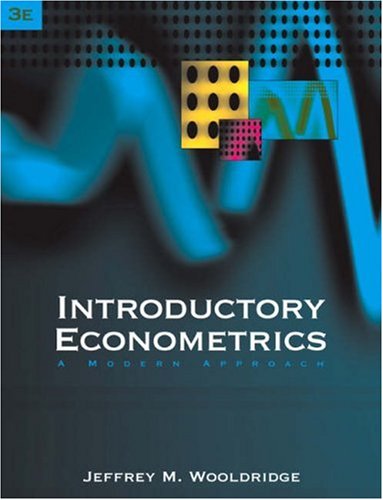
3. Introductory Econometrics: A Modern
 
$66.88
4. A Guide to Econometrics
$94.99
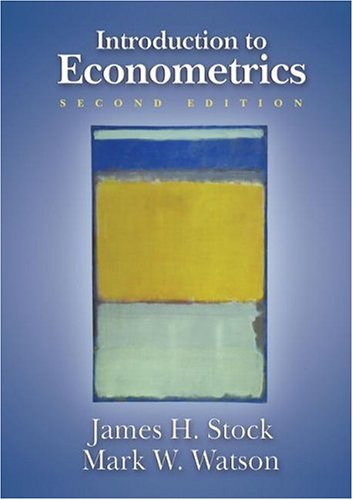
5. Introduction to Econometrics (2nd
$11.20
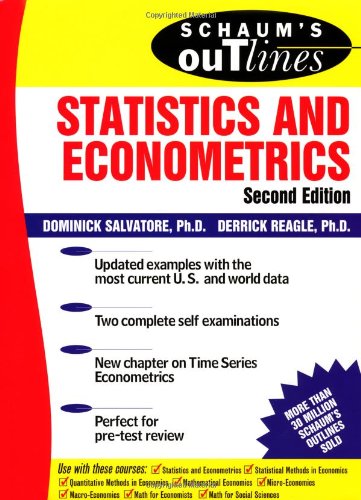
6. Schaum's Outline of Statistics
 
$61.67
7. The Econometrics of Financial
$39.50
8. Introductory Econometrics for
$56.20
9. Econometrics
$114.30
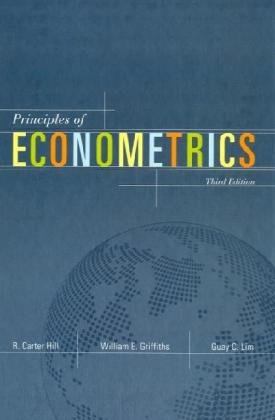
10. Principles of Econometrics
 
$89.00
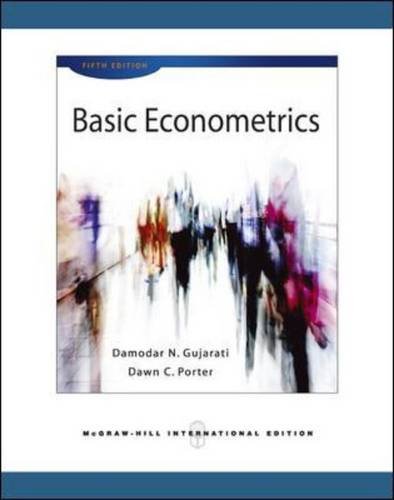
11. Basic Econometrics
$77.00
12. Econometric Analysis of Cross
$55.98
13. Applied Econometric Time Series,
$4.25
14. Econometrics: A Modern Introduction
 
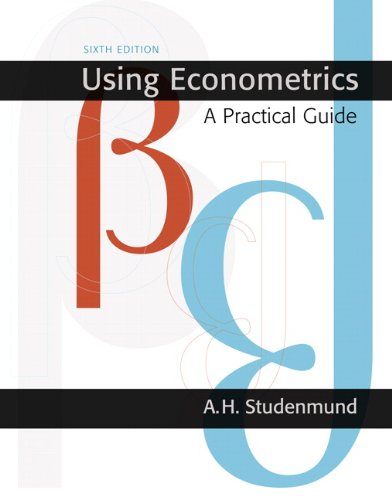
15. Using Econometrics : A Practical
$70.61
16. An Introduction to Modern Econometrics
$51.19
17. Financial Econometrics: From Basics
$84.97
18. Essentials of Econometrics + Data
 
19. Econometric Models and Economic
$24.68
20. Solutions Manual and Supplementary

1. A Guide to Econometrics
by Peter Kennedy
Paperback: 600 Pages (2008-02-25)
list price: US$39.95 -- used & new: US$39.95
(price subject to change: see help)
Asin: 1405182571
Average Customer Review: 5.0 out of 5 stars
Canada | United Kingdom | Germany | France | Japan
Editorial Review

Book Description
The classic aide to econometric students worldwide is now in a new edition. Guide to Econometrics, 6th edition is designed to illuminate the logic of econometrics without formulas, providing intuition, skepticism, insights, humor, and practical advice.


  • Designed for use in a range of courses, from undergraduate to graduate and PhD level
  • New chapters cover instrumental variables, computation considerations
  • Includes extensive information on GMM, nonparametrics, and an introduction to wavelets

... Read more

Customer Reviews (31)

5-0 out of 5 stars Review for a 'A Guide to Econometrics'
The product arrived in a timely manner and I have no complaints.I would use this seller for future transactions.

5-0 out of 5 stars basic text on econometrics
This is the fourth edition of a very popular text for an introductory graduate level course in econometrics. Although designed for econometricians and economics majors, the book has a lot to offer the statistician (time series analyst). There is good coverage of both the classical econometric models and the classical ARIMA time series models. The difference, as Kennedy points out, is that most univariate statistical time series models use only the past history to model and forecast the future while the econometric models emphasize the inclusion of economic predictor variables and not the past history.
However, in recent years, and partly because in fair-fight forecasting competitions the Box-Jenkins time series methods have done better than the econometric models, the econometricians are beginning to incorporate the Box-Jenkins approach in their models. As Kennedy points out,the new theory of multivariate ARIMA models is providing the econometricians with a methodology that is similar to their simultaneous equation models.

One nice feature of the book is that it treats classical linear regression theory early, highlights the key assumptions and then provides specific chapters that cover how to deal with the violations of the assumptions taken one by one.

The book is clear, up-to-date and has an excellent bibliography. It introduces the structural econometric time series approach along with multivariate Box-Jenkins methodolgy. Advanced topics such as dealing with roots on the unit circle in Box-Jenkins models and cointegration are covered. Also robust estimation procedures are discussed. It even introduces bootstrap methodology and the Bayesian approach to inference.

There is some coverage and some warnings about neural networks. Models for count data, duration, linear structural equations and instrumental variables are all presented in an introductory way.

Emphasis is placed early on the concept of sampling distributions for estimators. A clear understanding of sampling distributions is essential to understanding classical frequentist statistical approaches. Much confusion can arise when these concepts are glossed over.

5-0 out of 5 stars A guise to econometrics
It's a great book. The author uses easy language and makes the reader udertand the econometric analysis more clearly.

5-0 out of 5 stars Great
This book explains in details the intuitive meaning of econometrics.
This is the only book i know that makes you understand the subject, instead of showing how smart the author is in deriving asymptotical equations, proving theorems, etc.

If you are learning for the first time, read this book together with any "classical" econometric book. If you are an analyst, read it simply as a refresher while modelling a "real" problem.

You cant go wrong.

5-0 out of 5 stars An Essential Book
Why essential?

1) Focuses on the main ideas of econometrics, not the nasty formulas.
2) Provides an educated opinion about recent trends in the field.
3) Lists the things you absolutely must know how to do.


... Read more


2. Econometric Analysis
by William H. Greene
Hardcover: 1216 Pages (2007-08-17)
list price: US$164.80 -- used & new: US$91.99
(price subject to change: see help)
Asin: 0135132452
Average Customer Review: 3.5 out of 5 stars
Canada | United Kingdom | Germany | France | Japan
Editorial Review

Book Description

Econometric Analysisi, 6/e serves as a bridge between an introduction to the field of econometrics and the professional literature forsocial scientists and other professionals in the field of social sciences, focusing on applied econometrics and theoretical background. This book provides a broad survey of the field of econometrics that allows the reader to move from here to practice in one or more specialized areas. At the same time, the reader will gain an appreciation of the common foundation of all the fields presented and use the tools they employ. This book gives space to a wide range of topics including basic econometrics, Classical, Bayesian, GMM, and Maximum likelihood, and gives special emphasis to new topics such a time series and panels. For social scientists and other professionals in the field who want a thorough introduction to applied econometrics that will prepare them for advanced study and practice in the field.

... Read more

Customer Reviews (50)

5-0 out of 5 stars A excellent reference on statistical modelling
"Econometric Analysis" is an excellent reference book that cover all the different types of models that a person is likely to use in a typical statistical analysis. Topics covered include: Linear Regression Models; Generalized Least Squares; Models for Panel Data (including random effects models); Nonlinear Regression; Simultaneous Equation Models; Time Series Models; and Models for Event Counts, to name a few. Many of these topics are beyond the scope of a typical undergraduate course. However, the explanations of the models are clear and consise, with worked examples, and could easily be comprehended by an undergraduate. Exercises and applications are also included at the end of each chapter, although solutions to the exercises are not provided. I purchased this book to help me with some of the time series models that I needed to fit for my PhD thesis and I have found it to be a lot more useful than many books that are written solely on the topic of time series analysis.

4-0 out of 5 stars Don't buy the 5th edition
As of January 1st, 2008, according to Professor Green's web site the 6th edition of this book is already available from other vendors, but Amazon is still trying to sell you the 5th edition text. If you're going to spend so much money on a book, at least get the latest edition.

5-0 out of 5 stars Excellent
Really good advanced Econometrics Text.Anyone with a basic background in statistics, econometrics and matrix algebra will benefit greatly.

5-0 out of 5 stars Not an easy book
Be warned. If you are buying this book for your first class in graduate-level econometrics, I suggest you also look around for another book or two to give you a different (easier) take on this material.

4-0 out of 5 stars Encylopedic Treatment of Econometrics
If you have taken a course in econometrics, this is one of the best econometrics references that you can have on your bookshelf.There is ample discussion on linear regression models and all the required concepts from mathematical statistics that are needed.It just hits on time series and panel data, but clearly those are topics for two different books altogether.This book gets updated frequently and the format is reorganized to make things easier to understand.However, some times the reorganization does not work for the best. ... Read more


3. Introductory Econometrics: A Modern Approach (with Economic Applications Online, Econometrics Data Sets with Solutions Manual Web Site Printed Access Card)
by Jeffrey Wooldridge
Hardcover: 912 Pages (2005-07-13)
list price: US$161.95 -- used & new: US$95.00
(price subject to change: see help)
Asin: 0324289782
Average Customer Review: 4.5 out of 5 stars
Canada | United Kingdom | Germany | France | Japan
Editorial Review

Book Description
Succeed in econometrics with INTRODUCTORY ECONOMETRICS and its accompanying resources! Easy-to-read and student-friendly, this economics text places an emphasis on examples that give a concrete reality to economic relationships. With study tools found throughout the text, exam preparation and class projects have never been easier. Coverage of important knowledge used for empirical work and carrying out research projects in a variety of applied social science fields gives you a solid foundation for social science research. ... Read more

Customer Reviews (15)

4-0 out of 5 stars Great Exposition, but Poor Notation
Great introduction to the subject, but the notation is poor. By presenting the material without matrix algebra, the multiple regression analysis becomes a convoluted mess of summation notation. Additionally, matrix notation is adopted in more advanced texts, making in beneficial to learn from the start.

5-0 out of 5 stars A very good book
Wooldridge's explanations are clear and useful. After a semester hacking my way through the dense brush of matrices in Greene's book, I realized I needed some help. Now I go to Wooldridge's treatment first, to make sure I understand the main concepts. Then I go to Greene for the detail, if I need to.


5-0 out of 5 stars Great for Self-studying
This books is excellent read. It builds good intuition, and is well suited for self-studying. It is also not too mathematical, no matrix notation, good for undergraduate students or as a review for graduate students. I can truly recommmend it.

4-0 out of 5 stars Excellent for cross-sectional but needs complements for time series
As the author says, the book is "aimed at undergraduates but it is adaptable to master's students".It will provide you with excellent and extensive real life explanations. What is better about this book is that you can redo every example in the book by using the online data that it provides with. This was it is easier what happens by experimenting. In that sense this book is superior to many others where you cannot see how the results of estimations came about.

There is only one thing to take into account. Although there are three parts to this book, the shortest one is time series. Its coverage will is therefore not very comprehensive if you want basic explanations like the VAR, GARCH models etc...
In that case, I would recommend the book New Directions in Econometric Practice by Wojciech W. Charemza.

5-0 out of 5 stars If you don't know what is going on.....
If you don't know what you are doing then you need to get this book.If you think you know what you are doing, then you definitely need this book because you probably have no clue.Contrary to what one reviewer states, this text does provide a good balance between application and theoretical example.I use this book all of the time as a graduate student.It is a wonderful reference.If you are studying econometrics, then this is the first book you should buy. ... Read more


4. A Guide to Econometrics
by Peter Kennedy
 Hardcover: 600 Pages (2008-02-25)
list price: US$84.95 -- used & new: US$66.88
(price subject to change: see help)
Asin: 140518258X
Average Customer Review: 5.0 out of 5 stars
Canada | United Kingdom | Germany | France | Japan
Editorial Review

Book Description
The classic aide to econometric students worldwide is now in a new edition. Guide to Econometrics, 6th edition is designed to illuminate the logic of econometrics without formulas, providing intuition, skepticism, insights, humor, and practical advice.


  • Designed for use in a range of courses, from undergraduate to graduate and PhD level
  • New chapters cover instrumental variables, computation considerations
  • Includes extensive information on GMM, nonparametrics, and an introduction to wavelets

... Read more

Customer Reviews (31)

5-0 out of 5 stars Review for a 'A Guide to Econometrics'
The product arrived in a timely manner and I have no complaints.I would use this seller for future transactions.

5-0 out of 5 stars basic text on econometrics
This is the fourth edition of a very popular text for an introductory graduate level course in econometrics. Although designed for econometricians and economics majors, the book has a lot to offer the statistician (time series analyst). There is good coverage of both the classical econometric models and the classical ARIMA time series models. The difference, as Kennedy points out, is that most univariate statistical time series models use only the past history to model and forecast the future while the econometric models emphasize the inclusion of economic predictor variables and not the past history.
However, in recent years, and partly because in fair-fight forecasting competitions the Box-Jenkins time series methods have done better than the econometric models, the econometricians are beginning to incorporate the Box-Jenkins approach in their models. As Kennedy points out,the new theory of multivariate ARIMA models is providing the econometricians with a methodology that is similar to their simultaneous equation models.

One nice feature of the book is that it treats classical linear regression theory early, highlights the key assumptions and then provides specific chapters that cover how to deal with the violations of the assumptions taken one by one.

The book is clear, up-to-date and has an excellent bibliography. It introduces the structural econometric time series approach along with multivariate Box-Jenkins methodolgy. Advanced topics such as dealing with roots on the unit circle in Box-Jenkins models and cointegration are covered. Also robust estimation procedures are discussed. It even introduces bootstrap methodology and the Bayesian approach to inference.

There is some coverage and some warnings about neural networks. Models for count data, duration, linear structural equations and instrumental variables are all presented in an introductory way.

Emphasis is placed early on the concept of sampling distributions for estimators. A clear understanding of sampling distributions is essential to understanding classical frequentist statistical approaches. Much confusion can arise when these concepts are glossed over.

5-0 out of 5 stars A guise to econometrics
It's a great book. The author uses easy language and makes the reader udertand the econometric analysis more clearly.

5-0 out of 5 stars Great
This book explains in details the intuitive meaning of econometrics.
This is the only book i know that makes you understand the subject, instead of showing how smart the author is in deriving asymptotical equations, proving theorems, etc.

If you are learning for the first time, read this book together with any "classical" econometric book. If you are an analyst, read it simply as a refresher while modelling a "real" problem.

You cant go wrong.

5-0 out of 5 stars An Essential Book
Why essential?

1) Focuses on the main ideas of econometrics, not the nasty formulas.
2) Provides an educated opinion about recent trends in the field.
3) Lists the things you absolutely must know how to do.


... Read more


5. Introduction to Econometrics (2nd Edition) (Addison-Wesley Series in Economics)
by James H. Stock, Mark W. Watson
Hardcover: 840 Pages (2006-07-31)
list price: US$150.67 -- used & new: US$94.99
(price subject to change: see help)
Asin: 0321278879
Average Customer Review: 4.0 out of 5 stars
Canada | United Kingdom | Germany | France | Japan
Editorial Review

Book Description
Designed for a first course in introductory econometrics, Introduction to Econometrics, reflects modern theory and practice, with interesting applications that motivate and match up with the theory to ensure students grasp the relevance of econometrics. Authors James H. Stock and Mark W. Watson integrate real-world questions and data into the development of the theory, with serious treatment of the substantive findings of the resulting empirical analysis. ... Read more

Customer Reviews (10)

5-0 out of 5 stars Good entry level book
This will be used for an entry graduate level, non-econ majors course in econometrics.The exposition is clear, logical and does not contain any math that is not absolutely required.Also contains examples without bogging down on them.It does not contain much mention of the software, but that may be on the associated website that I have not checked out.

1-0 out of 5 stars Terrible book, no examples, way too complicated
The Gujarati book is MUCH better.I re-read the chapters and still have no idea whats going on.DONT buy this book.

5-0 out of 5 stars Great econometrics textbook for beginners!
It is clearly written and has a good level of detail. The very experienced authors were able to get the level right for beginners, while keeping precision and adding examples and current topics of interest even to more experienced users. Definitely a great buy!

3-0 out of 5 stars Lacking in key areas
I found the book to be adequate in terms of how well-written it is, but lacking in many areas that keep it from getting anything higher than 3 stars.

My biggest gripe is that there are few examples. I really took this for granted, and didn't notice how important it was until they were taken out. Inclasses like math, you can easily get lost in all the notation in each formula. Examples are important because they show you how to use that formula in a real application. The book lacks examples, and this really makes it harder to understand what Stock and Watson are talkin about.

Another thing I'd like are answers to their problems. This is just useful so that you can check whether you are doing the problems at the end of the chapter right. Otherwise, you're completely clueless on how well you are doing.

5-0 out of 5 stars Classic
This is a classic econometrics book. I think it's easy to understand without being too basic. ... Read more


6. Schaum's Outline of Statistics and Econometrics
by Dominick Salvatore, Derrick Reagle
Paperback: 256 Pages (2001-10-23)
list price: US$18.95 -- used & new: US$11.20
(price subject to change: see help)
Asin: 0071348522
Average Customer Review: 5.0 out of 5 stars
Canada | United Kingdom | Germany | France | Japan
Editorial Review

Book Description
- The updated and expanded second edition of the internationally bestselling guide to principles and practices for undergraduate business and economics students taking mandatory economics statistics courses. - Features four new sections—on nonparametric tests, the Logit Model,the Probit Model, and causality tests—complete with new models and tests used in financial econometrics, and a new chapter on time series econometrics - Over 100,000 students enrolled annually - Includes numerous examples, completely worked problems, supplementary problems, and two full-length self-examinations ... Read more

Customer Reviews (1)

5-0 out of 5 stars It got me through Econometrics
This was an extremely useful book for the understanding of Statistics and Econometrics.Each topic had examples to show how the formulas work.The computer chapter went over the programming in SAS, Excel, and Eviews for the problems in the book.Best of all, the problems had answers.This is a must-have for beginning statistics and econometrics since it starts from scratch, and for theory students in search of an application. ... Read more


7. The Econometrics of Financial Markets
by John Y. Campbell, Andrew W. Lo, A. Craig MacKinlay, Andrew Y. Lo
 Hardcover: 632 Pages (1996-12-09)
list price: US$105.00 -- used & new: US$61.67
(price subject to change: see help)
Asin: 0691043019
Average Customer Review: 3.5 out of 5 stars
Canada | United Kingdom | Germany | France | Japan
Editorial Review

Book Description

The past twenty years have seen an extraordinary growth in the use of quantitative methods in financial markets. Finance professionals now routinely use sophisticated statistical techniques in portfolio management, proprietary trading, risk management, financial consulting, and securities regulation. This graduate-level textbook is intended for PhD students, advanced MBA students, and industry professionals interested in the econometrics of financial modeling. The book covers the entire spectrum of empirical finance, including: the predictability of asset returns, tests of the Random Walk Hypothesis, the microstructure of securities markets, event analysis, the Capital Asset Pricing Model and the Arbitrage Pricing Theory, the term structure of interest rates, dynamic models of economic equilibrium, and nonlinear financial models such as ARCH, neural networks, statistical fractals, and chaos theory.

Each chapter develops statistical techniques within the context of a particular financial application. This exciting new text contains a unique and accessible combination of theory and practice, bringing state-of-the-art statistical techniques to the forefront of financial applications. Each chapter also includes a discussion of recent empirical evidence, for example, the rejection of the Random Walk Hypothesis, as well as problems designed to help readers incorporate what they have read into their own applications.

Professors: A supplementary Solutions Manual is available for this book. It is restricted to teachers using the text in courses. For information on how to obtain a copy, refer to: http://pup.princeton.edu/solutions.html

... Read more

Customer Reviews (16)

5-0 out of 5 stars Econometrics of Financial Markets
Fresh look at the beating heart of the financial markets by one of the best people in the field.

1-0 out of 5 stars CML: An Unnecessary Addition to a Saturated Literature
I was also skeptical of the negative reviews surrounding this book ("CML"). However after buying and reading this book, I now believe they had merit.

Simply stated, this book does not cater to its readers. If you have the prerequisites that the authors demand, then this book is comprehensive but ultimately below what ought to challenge you. And if you don't, then I guarantee you will be very lost. Unlike many similar volumes, CML is not self-contained (nor does it claim to be). And unlike many books that build a self-contained "model" of asset pricing dynamics, CML is full of literature-specific jargon and inconsistent notation. In fact much of this notation changes intrachapter.

Suppose you are a reader at the level CML insist their readers be. Then all the better to spend more time understanding Duffie's "Dynamic Asset Pricing," or Cochrane's veritable tour-de-force, "Asset Pricing." Both books are more contemporary and also at a better level for the readers CLM had in mind.

If you don't have the requisite knowledge, please ignore CML and try Luenenberger and Casella/Berger, as well as Greene for econometric-specific stats, Hamilton for time-series. You will not regret these purchases.

CML claims to fill a gaping hole in the secondary literature. But in reality, CML sits right in the middle of two types of readers, and caters effectively to none.

2-0 out of 5 stars Last quartile on the subject
This book used to be a must the first time it has been published but after ten years it is getting old and the topic is now better covered by some others authors. The arch/garch section is really weak and this book by its sole is not enough to implement advanced models.
The authors also forgot to include practical implementation of the models with Splus or Matlab or whatever language, which is now almost a standard in many financial engineering related books.

4-0 out of 5 stars An oldie but goodie
For the past ten years, this boook was the standard of financial time series and cross sectional analysis.There are several more recent books on the subject, but as the first good book in the field, it is still keeping up.Lot of the derivation in the book is a bit spotty - but that is expected at this level of sophistication and originality.There are some frustrating parts in the book, but if you cannot chew through that material, you should probably read an easier book.

1-0 out of 5 stars Absolutely useless
I'm not sure what the audience for this extremely poorly written book is.Is it graduate-level students?If so, this book will drive them totally crazy and depressed, thanks to its confusing structure, lack of contextual motivation for the topics covered, and nonsensical, semi-rigorous mathematical treatment of the subject.Is it "quant" practitioners?If so, it'll leave them more confused and pessimistic about their trade than ever -- or just leave them feeling disappointed and frustrated, which was how I felt when I tried to read this book.

This book is so bad it serves as neither a textbook nor a reference.It has no value whatsoever.Want to know the technical details of VAR models and when to use them and when not to use them?You won't find it here.Ditto for GARCH models.Ditto for ECM models.Ditto for dynamic pricing models.I'm pretty well-grounded in advanced math, statistics, econometrics, and financial economics, and I have to confess I had no clue what the word and sentences and math notations in this book meant.The contents are totally incoherent.

Please do everyone a favor and don't buy this absolutely worthless book, so publishers won't be encouraged to kills trees in order to print such trash. ... Read more


8. Introductory Econometrics for Finance
by Chris Brooks
Paperback: 728 Pages (2002-07-15)
list price: US$53.00 -- used & new: US$39.50
(price subject to change: see help)
Asin: 052179367X
Average Customer Review: 4.5 out of 5 stars
Canada | United Kingdom | Germany | France | Japan
Editorial Review

Book Description
This introduction to contemporary topics in the modelling of financial time series is data and problem driven, giving students the skills to estimate and interpret models, and intuitively grasp the underlying theoretical econometrics. An introductory knowledge of calculus, algebra, statistics and regression analysis is assumed. The book focuses on the needs of finance students and uses pedagogic textbook features throughout, notably in the later chapters, which offer advice on planning and executing a project in empirical finance, and which also evaluates sources of on-line financial information. ... Read more

Customer Reviews (7)

5-0 out of 5 stars Good coverage
good coverage of some advance topics.not sure but it looks like the next edition is suppose to come out soon.

5-0 out of 5 stars Worth the Money
This book all but saved my life.

Well-worth working through from start to finish.

5-0 out of 5 stars Very comprehensive, truely applied and easy to understand book!
An impresive number of applications and technics are developed accross this extensive book. The language is very clear without losing theoretical rigorousness. A chapter or annex about panel data analysis will complete the book, as long as it is an introductory book and should present all basic themes (something in the book's website could be useful). Is a great book, I'm very satisfied.

5-0 out of 5 stars Wonderful contribution to undergraduate econometrics and time series
This book is the perfect textbook to get undergraduate students motivated with the subject.
It is simple and readable, yet provides a complete treatment of the econometrics of financial series.
I would also recommend this textbook for MBA students, since it contains valuable applications to Eviews and RATS.
If you are interested in an introductory course to econometrics for economists, you will probably prefer Wooldridge's intro book. It has more information on panel data and limited dependent variables.
This one has a terrific and desirable bias towards students particularly interested in finance. The book quickly departs from econometrics towards time series, a topic much more relevant in business schools and is far better in this subject than Wooldridge's.

4-0 out of 5 stars Great introductory and practical book
My life would have been way easier if I had read this book while in college. It has what many other books lack, and that is explanations on how to carry out the different estimation methods in commonly used software packages such as E-Views and RATS. As for its contents, it has an excellent coverage on the topics that concern those who work with financial time series. It is a good summary of the econometric techniques used for high-frequency data. The explanations are simple and clear and it has a very practical approach. I would only add to this book a CD with the time series with which the estimations were run. ... Read more


9. Econometrics
by Fumio Hayashi
Hardcover: 690 Pages (2000-12-15)
list price: US$95.00 -- used & new: US$56.20
(price subject to change: see help)
Asin: 0691010188
Average Customer Review: 5.0 out of 5 stars
Canada | United Kingdom | Germany | France | Japan
Editorial Review

Book Description

Hayashi's Econometrics promises to be the next great synthesis of modern econometrics. It introduces first year Ph.D. students to standard graduate econometrics material from a modern perspective. It covers all the standard material necessary for understanding the principal techniques of econometrics from ordinary least squares through cointegration. The book is also distinctive in developing both time-series and cross-section analysis fully, giving the reader a unified framework for understanding and integrating results.

Econometrics has many useful features and covers all the important topics in econometrics in a succinct manner. All the estimation techniques that could possibly be taught in a first-year graduate course, except maximum likelihood, are treated as special cases of GMM (generalized methods of moments). Maximum likelihood estimators for a variety of models (such as probit and tobit) are collected in a separate chapter. This arrangement enables students to learn various estimation techniques in an efficient manner. Eight of the ten chapters include a serious empirical application drawn from labor economics, industrial organization, domestic and international finance, and macroeconomics. These empirical exercises at the end of each chapter provide students a hands-on experience applying the techniques covered in the chapter. The exposition is rigorous yet accessible to students who have a working knowledge of very basic linear algebra and probability theory. All the results are stated as propositions, so that students can see the points of the discussion and also the conditions under which those results hold. Most propositions are proved in the text.

For those who intend to write a thesis on applied topics, the empirical applications of the book are a good way to learn how to conduct empirical research. For the theoretically inclined, the no-compromise treatment of the basic techniques is a good preparation for more advanced theory courses.

... Read more

Customer Reviews (16)

5-0 out of 5 stars Solid basis for econometric analysis
I have a love/hate relationship with this book. Perhaps I should state as a precursor that I was never formally trained in economics before learning econometrics. And, that the last time I'd done matrix algebra or calculus was some 15 years prior.

We used this book as part of a taught graduate course. It took half a semester to go through the first two chapters - an investment of time that proved well worth it for the rest of the topics which were covered in the remainder of the semester.

Basically, if you can understand the first two chapters on ordinary least square regression for finite and large samples, the required assumptions and properties, then the rest of the chapters are a piece of cake:
- generalized method of moments for single and multiple equations
- panel data
- time series analysis (including unit root analysis)
- extremum estimators
- maximum likelihood
- cointegration.

In short, the book covers all major econometrics topics and does so in a succinct, clear manner. The way in which Hayashi builds on each topic, showing that all models are basically different versions of the same method, with slightly different assumptions is just brilliant. It put statistics in a different light for me, and gave me a much deeper, intuitive understanding of it than any other book or class had done before.

There is a caveat however. This book assumes that you have substantial mathematical grounding. In particular, I found the succinct use of notation, without any verbal explanation, irritating at first. I invested quite some time in a mathematical economics book reminding myself what sets were, rules of matrices, calculus functions, expectations and probability.

Without the support and input of our brilliant teacher who (very patiently) took us through the end of chapter exercises step-by-step, I would never have managed to successfully read this book on my own! While those exercises honed my skills and deepened my understanding, I relied heavily on Hayashi's home page notes and hints to complete them.

For those of you that have strong mathematical skills and an economic background, this book is probably one of the best introductions to econometrics. For those of you who do not, it will prove to be a difficult read at best.

What's certain is that after succesfully completing it, your econometrics and statistical skills will provide a solid enough basis for any graduate program.


5-0 out of 5 stars Helps you to become a complete econometrician
Yes, indeed I also think this one is the best around. Some points I'd add are:

Hayashi's book is the only econometrics textbook I am aware of (IMHO, these are certainly not all, but quite a few) that is truly complete. Not only from a material point of view - it covers both time series and cross section material in a unified framework (as opposed to Wooldridge). The empirical exercises are useful (outperforming, say, Davidson/MacKinnon) and yet you can also go on to read theoretical papers or Amemiya after having read Hayashi's coverage of asymptotic properties of GMM and M estimators. Finally, also more towards the theoretical side, it provides some first training in hands-on programming, as opposed to some books that tell you where to click in eViews.

Furthermore:

- A corollary of the above comments is of course that it's not very detailed in each of the fields covered. E.g., all you find on limited dependent variables is Probit, Logit, Tobit.
- It's well managed: the typo list (which isn't very long, I should emphasize, especially for a 1st ed.) is always up to date
- The typsetting really is debatable. I find it unpleasant to have italics, boldface, boldface italics, verbatim environments etc all on one page. Less is more.

5-0 out of 5 stars The best choice
Mr. Hayashi has written an excelent textbook, which has become the standard in PhD programs as far as I know. I agree with other recomendants that Hayashi has been original to explain econometrics from a newer and more efficient point of view. But there is more: Hayashi has devoted a lot of effort to create exercises to teach students instead of contributing to some professor's questions data bank.

5-0 out of 5 stars A modern and unusal approach
This is a fine book, but probably not the one you want to buy if you are looking for ONE all-encompassing reference. The approach is interesting, but unusual, with all the pros and cons that come with originality. It is for graduate students, or very advanced undergraduates, as it requires quite a lot of previous knowledge of linear algebra and statistics.
What is unusual about this book is that it covers most topics within a unifying Generalized Method of Moments (GMM) framework. Many many estimators are treated as special cases of GMM. The book is clear, and the notation is mostly OK, even if the chapters on panel data and systems of simultaneous equations are a notational nightmare, partly because of the choice of treating everything in a GMM framework. Another unusual aspect of this book is the emphasis on certain regularity conditions (such as ergodicity) that are usually used in a time-series framework, but are not commonly seen in cross-section analysis. I studied (also) on this book as a graduate student, and overall I liked it. The only real minus are the exercises, which contain so many hints that they become trivial (really, I am not a genius...). Worse, they only require mindless application of linear algebra.

One UNimporant cons of this book is the fact that (cover aside) it is... ugly! How could the publisher choose the boring "Times New Roman" font for this book!? But this, of course, does not really matter....

Overall, a useful and good book, but if you are looking for ONE textbook in cross-section econometrics Wooldridge is probably a better choice, and if what you are looking for is ONE book in time series, Hamilton is likely to be what you want on your shelf.

5-0 out of 5 stars The Most Readable Econometrics Text There Is.Period
I think Hayashi is the best econometrics textbook to come along in a long time.The treatment has that rare quality of being simultaneously sophisticated yet very easy to follow.In that sense, this book is much different than Greene - whereas Greene is (I think) much more of a reference, you can actually sit down and learn a lot of econometrics with this book.Hayashi not only takes the time to explain key concepts in good prose, but in some cases even writes down step-by-step instructions.All this while not compromising the material.

The treatment is also slightly different in that GMM is a central theme instead of something off to the side, which is very nice.There are plenty of empirical examples - these are somewhat helpful, and the exercises are fairly easy but still illustrative.

Two downsides - it would have been nice to see some treatment of Bayesian econometrics, since this appears to be used much more widely (Lancaster is a good supplement).Second, either I got a faulty book, or there are no tables of critical values.This is ultimately a minor gripe since just about every other book has tables (and you really don't even need them these days with packages and such), but it can be annoying.

Ultimately, the combination of sophistication and readability of this book is what sets it apart from all others.If you're looking to learn econometrics, buy this book. ... Read more


10. Principles of Econometrics
by R. Carter Hill, William E. Griffiths, Guay C. Lim
Hardcover: 579 Pages (2007-11-27)
list price: US$141.95 -- used & new: US$114.30
(price subject to change: see help)
Asin: 0471723606
Average Customer Review: 4.0 out of 5 stars
Canada | United Kingdom | Germany | France | Japan
Editorial Review

Book Description
Principles of Econometrics clearly shows why econometrics is necessary and provides you with the ability to utilize basic econometric tools. You'll learn how to apply these tools to estimation, inference, and forecasting in the context of real world economic problems. In order to make concepts more accessible, the authors offer lucid descriptions of techniques as well as appropriate applications to today's situations. Along the way, you'll find introductions to simple economic models and questions to enhance critical thinking. ... Read more

Customer Reviews (4)

5-0 out of 5 stars Very good for learning
This book is a shortened version of "Learning and Practising Econometrics (1993)", which itself is a shortened version of "The Theory and Practice of Econometrics (1982)".

Hill's "Undergraduate Econometrics" instills understanding by slowly going through derivations and principles, while at the same time motivating econometric analysis by referring to economic situations where it can be used. Much better than Gujarati (which tends to be a "cookery book" rather than giving an integrated treatment).

The book both motivates the student and takes them through the steps and methods they will need to adopt in further econometric studies, and always provides a good reference (often to one of the parent books mentioned above) when it omits proofs and other details.

The only weakness of the book reveals what is (to my mind) an unhealthy preoccupation with estimation issues, as opposed to those of data quality. As people like Granger have consistently pointed out, the real issues in 21st century econometrics have to do with what sort of data we have, and what methods are most appropriate in different situations. Despite this, Hill et al almost exclusively dwell on the identically and independently distributed (iid) specification. However, I should point out in the book's defence that this preoccupation is shared by most other introductory (and graduate) textbooks on econometrics.

The book's good points far outweigh these weaknesses. Finally, the second edition has some updates, and discusses such developments as time series econometrics."Undergraduate Econometrics" should definitely be purchased by anyone wishing to learn about modern empirical methods.

4-0 out of 5 stars Excellent intuition BUT A POOR BRIDGE TO THE DREADFUL GREENE
This book is the best book to use for the very first course in econometrics. It takes you by the hand to teach you all you need in terms of the basics.
I only give it 4 stars for two reasons. First, while this book is non-mathematical (and I agree with that) it should have nonetheless appendices that make use of matrices and differential calculus.
Second, this book is extremely expensive.
This book can easily earn 5 stars if in the next edition it contains appendices that will create a bridge towards intermediate econometrics. A more reasonable price would also be welcomed.
Overall, this is the best book to use for a very first course in econometrics.
BUT BEWARE: THIS BOOK IS A POOR BRIDGE TO THE DREADFUL GREENE!!!!THE BEST BRIDGE IS "LEARNING AND PRACTICING ECONOMETRICS" BY THE SAME AUTHOURS OF "UNDERGRADUATE ECOMETRICS" I.E. HILL, GRIFFITHS, AND JUDGE.
By the way, for those that are looking for a good substitue to "Undergraduate Econometrics", you have "Basic Econometrics" by Gujarati.

Thank you,

4-0 out of 5 stars carter makes me not-so-afraid of metrics...
this is one of those econometrics (i'll call it "metrics" from now on to save on typing) books which you know has to cover alot of the slow, boring stuff which lecturers expect students to know by the time they take metrics options and hated by undergraduates. having said that, this book does it quite well. one thing i hate in metrics texts is dense mathematical proofs. especially proofs which assume the reader knows other proofs intimately. this book nicely avoids that, dropping in an adequate and useful amount of proofs, especially the Gauss-Markov Theorem and a proof of why OLS estimation outshines any other method in simple regression analysis. the book does this without being overwhelming - in my opinion, mathematics has to be appreciated through discussion and argument, which Hill et al do quite admirably. Also, metrics is about interpretation of results, not just calculating them, and this book keeps that in mind very well from beginning to end. The reason i gave this book 4 stars is simple. when i was doing my last minute cramming for exams, i was able to move through the book quickly and easily, whilst still appreciating the main points, the big picture, and also the subtleties of more advanced topics like GLS, moments-based estimation and distributed lags in a short space of time. the book also comes with useful end-of-chapter "should know" points and problems. the best thing about the problems is the "real-world" nature of the tasks, often drawing on real-life data and economic intuition. using that data and being able to become comfortable with computer techniques is the most vital thing to a beneficial study of metrics. i found gujarati's "basic econometrics" a nice companion to this book (but then again everyone likes gujarati to some extent), but mostly i was satisfied with this book as a stand-alone manual to second-year metrics studies, good for laying the foundations for studies in topics like maximum likelihood estimation and financial econometrics. oh, and it's small and not too heavy. good for carrying around to classes all day!

4-0 out of 5 stars A Nice Beginner's Textbook
This book begins with simple concepts and gradually introduces more complex methods at a pace that is very comfortable for self-study. It also can be used in a one-quarter course for undergraduates who have had basic courses in calculus and linear algebra. However, it doesn't give all proofs for the statistical theorems in the text. ... Read more


11. Basic Econometrics
by Damodar N. Gujarati
 Hardcover: 1002 Pages (2003-01)
-- used & new: US$89.00
(price subject to change: see help)
Asin: 0072335424
Average Customer Review: 4.0 out of 5 stars
Canada | United Kingdom | Germany | France | Japan
Editorial Review

Book Description
Gujarati’s Basic Econometrics provides an elementary but comprehensive introduction to econometrics without resorting to matrix algebra, calculus, or statistics beyond the elementary level. Because of the way the book is organized, it may be used at a variety of levels of rigor.For example, if matrix algebra is used, theoretical exercises may be omitted. A CD of data sets is provided with the text. ... Read more

Customer Reviews (26)

1-0 out of 5 stars IS JUST AWFUL!!!!!!!
This book offers a poor treatment of simultaneous equations, time seriesand an obsolete sum notation.

Definitely I wouldn't recommend this book, At least not for 100 dollars.

It would be better for an undergraduate student to start with Woolridge's or
Maddala's.

5-0 out of 5 stars If you get one econometrics book, this is it
I used to have Gujarti's first or second edition during college. I think I sold it back to the campus bookstore after completing the econometrics course.

Recently, I wanted to get a reference book so got Gujarati's latest edition. It is thicker than I remember his earlier version to be. All the basics of econometrics are well covered in the book.

He does say though, that Bayesian econometrics, is not covered early onin the book. So if you need a reference on Bayesian econometrics, you'll need to get a separate book.

3-0 out of 5 stars Not what I expected
Got a re-bound copy of the textbook - this wasn't mentioned in the description. The binding is pulling away from the spine of the book. Otherwise was as described.

5-0 out of 5 stars The simplest econometrics book
This is the best book available to start learning econometrics at an undergraduate levet without getting into the esoteric and dark side of the mathematical demonstrations. The book will definitely help the reader grasp a pretty good understanding of what econometrics is about and the underlying statistical and economic concepts. I would definitely recommend it for those who are interested in learning econometrics but do not have a strong mathematical background.

4-0 out of 5 stars VERY GOOD TEXT, BUT COULD BE BETTER
Econometrics, as the extension of statistics into economics, sends shivers down the spine of most undergraduates.This book is, so far, the best textbook I have seen to teach econometrics.It divides concepts into chapters that are easy to reference separately, and it follows a logical sequence similar to the one in most college-level courses.

In its 4th edition, Gujarati has had much time to improve the method and get comments.However, after having gone through the course and the textbook, I was left with the feeling that there must be a better way to teach econometrics.After learning it, you realize that the concepts are indeed simple, with much complex veneer to scare people away.In a few years, a wise and student-aware professor will write a textbook (call it the Econometrics Holy Grail?) that will make learning econometrics similar to learning basic stats.

... Read more


12. Econometric Analysis of Cross Section and Panel Data
by Jeffrey M. Wooldridge
Hardcover: 776 Pages (2001-10-01)
list price: US$80.00 -- used & new: US$77.00
(price subject to change: see help)
Asin: 0262232197
Average Customer Review: 4.0 out of 5 stars
Canada | United Kingdom | Germany | France | Japan
Editorial Review

Book Description
This graduate text provides an intuitive but rigorous treatment of contemporary methods used in microeconometric research. The book makes clear that applied microeconometrics is about the estimation of marginal and treatment effects, and that parametric estimation is simply a means to this end. It also clarifies the distinction between causality and statistical association.

The book focuses specifically on cross section and panel data methods. Population assumptions are stated separately from sampling assumptions, leading to simple statements as well as to important insights. The unified approach to linear and nonlinear models and to cross section and panel data enables straightforward coverage of more advanced methods. The numerous end-of-chapter problems are an important component of the book. Some problems contain important points not fully described in the text, and others cover new ideas that can be analyzed using tools presented in the current and previous chapters. Several problems require the use of the data sets located at the author's website. ... Read more

Customer Reviews (12)

3-0 out of 5 stars Everything people say is true, but...

This book has no graphs - not one.As long there are no graphs or figures, this work will remain incomplete.

5-0 out of 5 stars The missing link for cross section, panel data and program evaluation
This book fills a real gap for those who are interested in things like ATE, ATET and topics related to impact evaluation that are only talked about now in research papers. The explanations are very very clear and they walk you through the thinking process by which the different methods were developed. Of course, it has the traditional coverage of panel data and cross section but with the clarity that Wooldridge always delivers on his books. For all that, this is a perfect addition to your econometric libraries as it covers topics that are not discussed in traditional and introductory econometric books.

4-0 out of 5 stars A comprehensive survey
This book provides an excellent overview about state-of-the-art methodologies in econometrics. Instead of other textbooks it stresses more on conditionals and explains potential problems with underlying assumptions in more detail. As I find it sometimes hard to orientate myself, I give 4 stars.

4-0 out of 5 stars Very good coverage on cross-sectional, but not enough of panel data
This book does an excellent job in covering cross-sectional and microeconometric models (Stata codes for all examples in the book are available from UCLA's webside). However, the exposure to panel data is limited. For a theoretical overview of panel data econometrics, I'd recommend Hsiao and Baltagi. For applied work, Edward Frees wrote a good book, although his book is more from the social science perspective (SAS and Stata codes are provided).

1-0 out of 5 stars The best? Not for me (and everyone I know).
Clearly this product is overrated. In my opinion the book is a complete mess, with definitions, propositions and theorems mixed with the main text and not clearly evidenced from it.

It's funny, because the book uses a panoplia of bolds, italics, etc in the main text (well, there is only main text here) which I dislike and think is unnecessary, and then do not use it to evidence the important results. As a result I think this is probably the worst book that I can remember of for reference.

There are better books and it's almost impossible to get one worse than this one. ... Read more


13. Applied Econometric Time Series, 2nd Edition
by Walter Enders
Hardcover: 480 Pages (2003-08-01)
list price: US$109.95 -- used & new: US$55.98
(price subject to change: see help)
Asin: 0471230650
Average Customer Review: 4.5 out of 5 stars
Canada | United Kingdom | Germany | France | Japan
Editorial Review

Book Description
Amstat News asked three review editors to rate their top five favorite books in the September 2003 issue. The first edition of Applied Econometric Time Series was among those chosen.

This new edition reflects recent advances in time-series econometrics, such as out-of-sample forecasting techniques, non-linear time-series models, Monte Carlo analysis, and bootstrapping. Numerous examples from fields ranging from agricultural economics to transnational terrorism illustrate various techniques. ... Read more

Customer Reviews (11)

5-0 out of 5 stars Excellent reference
This book is an excellent reference guide and a must have book to everyone interested in time series analysis.

5-0 out of 5 stars Good intro and review of the material
Having read a few books on time series analysis, Enders provides the best introduction to the area.The approach is simple and practically oriented.Explaining the basics of the area with limited use of math is beneficial.With this area developing so rapidly, a new, updated edition would be a welcome book on my shelf.

5-0 out of 5 stars Excellent as a practical quide - a must have handbook - recent development are here too
I bought this book as an introductory reading to time series. And found it very easy to understand, both the theoretical explanations and practical applications. I think it is a "must have handbook" for any economics student. The last edition also covers the recent panel unit root tests, not the 2nd generation ones but Im, Pesaran, Shin panel test is explanained pretty well. Graphical illustrations of series and visual detection of possible problems are nice for beginners. Also, shows how to analyze data step-by-step with plenty of examples. In overall I think it is a great investment for those doing empirical studies and/or starting to learn/work with time series.

5-0 out of 5 stars Practical book on time series econometrics
I am a Financial Engineer working primarily in risk management. Over the past few months I've had to study up on time series-related topics (both GARCH and cointegration-based analyses). This book is excellent for someone who needs to find time-series information and then apply it to a problem in a hurry. The explanations are clear and intuitive, yet mathematically precise. There are plenty of examples on how to apply techniques to real world problems, including lucid discussions of the proper statistical tests to use for the various methodologies.

Like many engineers, I often find myself scrambling to find a good source for a model or system component I will have to design, usually under tight time constraints. This is a perfect example of the type of textbook I always hope to find when starting such a task.

3-0 out of 5 stars An Elementary Book
The book is an introduction to time series and covers ARMA, VAR Unit roots and Basic Cointegration, is a good book for people that want learn time series quickly, the book has some elementary theory of time series and many examples and exercises, the computacional problems needs some of RATS ...the book describes time series without advanced mathematics. ... Read more


14. Econometrics: A Modern Introduction (Addison-Wesley Series in Economics)
by Michael P. Murray
Hardcover: 976 Pages (2005-08-14)
list price: US$150.67 -- used & new: US$4.25
(price subject to change: see help)
Asin: 0321113616
Average Customer Review: 5.0 out of 5 stars
Canada | United Kingdom | Germany | France | Japan
Editorial Review

Book Description

Econometrics: A Modern Introduction conditions students to think like econometricians right from the start by opening with a unique Monte Carlo exercise, and connects econometrics to economic theory through a series of exemplary econometric analyses presented throughout the text.Students learn to critically evaluate economic conclusions through the use of original data and compelling topics such as discrimination, demand for cocaine, capital punishment, and infant mortality.

... Read more

Customer Reviews (2)

5-0 out of 5 stars Excellent Text
I took this class with Professor Murray and the text, like the teacher, specializes in bringing the sometimes esoteric world of mathematical economic analysis down to an easily accessible level without watering down the material.I have since taken another econometrics class, and the text, while based on applied cases, fell short of what is presented here.Truly a wonderful text for both the undergrad non-math type as well as a more in depth graduate school introduction.Highly recommended!

5-0 out of 5 stars Worth the price
For those looking for the intuition behind econometrics, this textbook delivers.Not that there isn't any math, it is just that the understanding the theory is the priority.Obviously, a lot of work went into the refining the presentation, therefore we cannot begrudge the authour the rewards for his efforts. ... Read more


15. Using Econometrics : A Practical Guide
by A. H. Studenmund, Henry J. Cassidy
 Hardcover: 440 Pages (1987-07-23)
list price: US$48.75
Isbn: 067339137X
Average Customer Review: 4.0 out of 5 stars
Canada | United Kingdom | Germany | France | Japan

Customer Reviews (1)

4-0 out of 5 stars All you need for basic regression and such
This is a well organized text that is great to have on the shelf for making sense of your statistical output and for thinking about how to approach your research question. It's well written and neither too simple or impenetrable. A little short on statistical tables and diagnostics as compared to some of its peers. ... Read more


16. An Introduction to Modern Econometrics Using Stata
by Christopher F. Baum
Paperback: 341 Pages (2006-08-17)
list price: US$84.95 -- used & new: US$70.61
(price subject to change: see help)
Asin: 1597180130
Average Customer Review: 4.0 out of 5 stars
Canada | United Kingdom | Germany | France | Japan
Editorial Review

Book Description
Integrating a contemporary approach to econometrics with the powerful computational tools offered by Stata, An Introduction to Modern Econometrics Using Stata focuses on the role of method-of-moments estimators, hypothesis testing, and specification analysis and provides practical examples that show how the theories are applied to real data sets using Stata.As an expert in Stata, the author successfully guides readers from the basic elements of Stata to the core econometric topics. He first describes the fundamental components needed to effectively use Stata. The book then covers the multiple linear regression model, linear and nonlinear Wald tests, constrained least-squares estimation, Lagrange multiplier tests, and hypothesis testing of nonnested models. Subsequent chapters center on the consequences of failures of the linear regression model's assumptions. The book also examines indicator variables, interaction effects, weak instruments, underidentification, and generalized method-of-moments estimation. The final chapters introduce panel-data analysis and discrete- and limited-dependent variables and the two appendices discuss how to import data into Stata and Stata programming.Presenting many of the econometric theories used in modern empirical research, this introduction illustrates how to apply these concepts using Stata. The book serves both as a supplementary text for undergraduate and graduate students and as a clear guide for economists and financial analysts. ... Read more

Customer Reviews (2)

4-0 out of 5 stars good crash intro to necessary STATA commands
This book gives a good overview of some of the commands one would need to do regression analysis with STATA.I needed something to give me a quick intro to STATA and this book has helped me a lot.Howver, just like MS Excel, STATA has tons of commands that I probably will never touch!

4-0 out of 5 stars much cheaper from stata-press website
Not a review, sorry, but a tip for potential purchasers:

This book is much cheaper from stata-press dot com.
... Read more


17. Financial Econometrics: From Basics to Advanced Modeling Techniques (Frank J. Fabozzi Series)
by Svetlozar T. Rachev, Stefan, PhD Mittnik, Frank J. Fabozzi, Sergio M. Focardi, Teo, PhD Jašić
Hardcover: 576 Pages (2006-12-11)
list price: US$95.00 -- used & new: US$51.19
(price subject to change: see help)
Asin: 0471784508
Canada | United Kingdom | Germany | France | Japan
Editorial Review

Book Description
A comprehensive guide to financial econometrics

Financial econometrics is a quest for models that describe financial time series such as prices, returns, interest rates, and exchange rates. In Financial Econometrics, readers will be introduced to this growing discipline and the concepts and theories associated with it, including background material on probability theory and statistics. The experienced author team uses real-world data where possible and brings in the results of published research provided by investment banking firms and journals. Financial Econometrics clearly explains the techniques presented and provides illustrative examples for the topics discussed.

Svetlozar T. Rachev, PhD (Karlsruhe, Germany) is currently Chair-Professor at the University of Karlsruhe. Stefan Mittnik, PhD (Munich, Germany) is Professor of Financial Econometrics at the University of Munich. Frank J. Fabozzi, PhD, CFA, CFP (New Hope, PA) is an adjunct professor of Finance at Yale University’s School of Management. Sergio M. Focardi (Paris, France) is a founding partner of the Paris-based consulting firm The Intertek Group. Teo Jasic, PhD, (Frankfurt, Germany) is a senior manager with a leading international management consultancy firm in Frankfurt. ... Read more


18. Essentials of Econometrics + Data CD
by Damodar N Gujarati
Hardcover: 496 Pages (2005-02-10)
list price: US$132.19 -- used & new: US$84.97
(price subject to change: see help)
Asin: 0073135941
Average Customer Review: 4.0 out of 5 stars
Canada | United Kingdom | Germany | France | Japan
Editorial Review

Book Description
This text provides a simple and straightforward introduction to econometrics for the beginner.The author's intent is to provide the student with a "user friendly," non-intimidating introduction to econometric theory and techniques.The book motivates students to understand econometric techniques through extensive examples, careful explanations, and a wide variety of problem material.The audience is undergraduate economics, agricultural economics, and business administration majors, MBA students and others in the social and behavioral sciences where econometric techniques, especially the techniques of linear regression analysis, are used. ... Read more

Customer Reviews (1)

4-0 out of 5 stars One of the Best introductory Economterics texts out there!
Gujarati's BASIC ECONOMETRICS uses divide and conquer method to help readers achieve a solid grasp of the basics of econometrics. Each chapter takes on a major concept and explains it thouroughly. As the name suggests, this is basic econometrics and hence does not make much use of matrix algebra and other mathematical tools often used in advanced econometrics. However, all the statistical and mathematical concepts used are included in the appendix. If one's aim is to prepare for graduate level econometrics, then a more advanced text would be recommended. Otherwise, this book is the right way to enter the world of econometrics. ... Read more


19. Econometric Models and Economic Forecasts
by Robert S. Pindyck, Daniel L. Rubinfeld, Frank Wolak
 Hardcover: 672 Pages (2008-04-15)

Isbn: 0073137480
Average Customer Review: 3.5 out of 5 stars
Canada | United Kingdom | Germany | France | Japan
Editorial Review

Book Description
First course in Econometrics in Economics Departments at better schools, also Economic/Business Forecasting. Statistics prerequisite but nocalculus. Slightly higher level and more comprehensive than Gujarati (M-H, 1996) . P-R covers more time series and forecasting. P-R coverage is notch below Johnston-DiNardo (M-H, 97) and requires no matrix algebra.Includes data disk. ... Read more

Customer Reviews (7)

2-0 out of 5 stars muddy reading
The notation can be hard to follow if you don't have a grasp or natural incline for statistical regression.Steps are hard to come by in some problems because too many steps are skipped for a beginner.It is almost necessary to have at least a basic statistics background before reading this.

Even though I had a background and had read ahead, I had to depend on my professor to truly understand the material at all.If your professor has an accent or goes quite fast, and if you don't have classmates you can work with, using this book alone will be more than painful.

I would suggest a supplement such as "Using Econometrics: A Practical Guide (4th Edition should suffice) [Hardcover] by Studenmund" if you are just beginning to learn about regression.

4-0 out of 5 stars Deceivingly more information than you think - half way between introductory and advanced
In sum: This book is half-way in between an introductory text (i.e. Wooldridge - Introductory Econometrics) and an advanced graduate textbook (Greene - Econometric Analysis).

Wooldridge's introductory textbook is certainly better suited for a first class in econometrics.Pindyck and Rubinfeld provide an excellent complement however, particularly for mid-level graduate students.Appendices show the matrix form derivations of most estimators, and provides a treatment of the GMM estimator, neither of which you will find in an purely introductory course.Really the appendices are where the more advanced treatments are offered to the interested reader.

Sections on forcasting and time series models in this book are greatly superior than what is offered in introductory texts (which usually is no presentation at all).

Pindyck and Rubinfeld do not waste a word in this textbook.There's a discussion on pretty much all the estimators, although some of these are short (one paragraph and no equations for the ordered probit - but you can't have it all!).

If you know nothing about econometrics then this is not the book for you.I was forced to buy it in my introductory econometrics class and had no idea what was going on.Then I had a competent instructor and lots of Wooldridge reading.This book helped me through Master's level econometrics and makes for good subway reading, but will definitely be shy of what you need for a PhD in economics.For PhD you will need Greene OR [Hamilton (1994) AND Wooldridge's Cross Section and Panel Data book].

4-0 out of 5 stars Good beginners' book
This is a beginners' book, and for those, I would recommend its use, but only in addition to using it with Gujarati's. Pindyck's book is very simple and well explained. Its advantage over other books is that it is concerned with forecasting, something that other basic books do not do. It is a little bit more advanced than Gujarati's but lays between that one and Maddala's book.

3-0 out of 5 stars Great equations, bad explanations
The subject of econometrics is difficult for the beginner. I have yet to encounter a text that does a great job at explaining both the concepts and the math required to be proficient in this field. I completed three courses, two undergraduate and one graduate level, for which this book was the required text. Like most of my classmates I was never able to fully comprehend the concepts behind the numbers using this text alone. Now that I have a better grasp of econometrics I will vehemently suggest that this text provides a poor verbal description of what a student is actually doing when analyzing data. I found myself reading the chapters 2 or 3 times and still felt unsure of what was going on. Where this book is strong is in its presentation of equations. I highly recommend supplementing this text with Peter Kennedy's, "A Guide to Econometrics," which gives excellent verbal explanations but de-emphasizes the math. These two texts together make a great study for a difficult subject.

5-0 out of 5 stars It's not that bad
I'm giving this book 5 stars largely to balance out the somewhat unfair reviews that were given. For what it is -- an econometrics textbook that tries to present overview of neginning to intermediate econometrics and forecasting WITHOUT a lot of linear algebra -- it's a pretty good book. While it has its rough spots, the book has many good features. One of the really good features of this book is presenting the material with an emphasis on model building ... a very important emphasis that is too often ignored in other econometrics texts. In an ideal world, this book deserves at least an average of 4 stars and would deserve more if the readers made things more readable and better incorporated advances in econometrics since previous editions. ... Read more


20. Solutions Manual and Supplementary Materials for Econometric Analysis of Cross Section and Panel Data
by Jeffrey M. Wooldridge
Paperback: 250 Pages (2003-09-14)
list price: US$26.00 -- used & new: US$24.68
(price subject to change: see help)
Asin: 0262232332
Average Customer Review: