e99 Online Shopping Mall

Geometry.Net - the online learning center Help  
Home  - Science - Economics (Books)

  1-20 of 100 | Next 20
A  B  C  D  E  F  G  H  I  J  K  L  M  N  O  P  Q  R  S  T  U  V  W  X  Y  Z  

click price to see details     click image to enlarge     click link to go to the store

$14.96
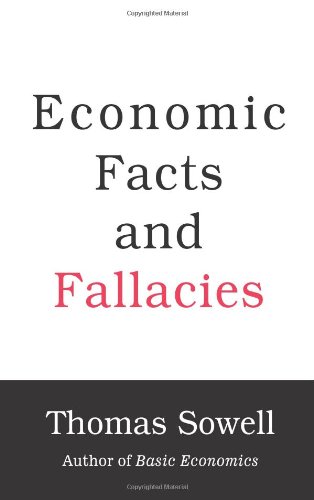
1. Economic Facts and Fallacies
$6.97
2. Confessions of an Economic Hit
$28.00
3. The Concise Encyclopedia of Economics
$9.00
4. Naked Economics: Undressing the
$11.60
5. The Secrets of Economic Indicators:
$22.38
6. Basic Economics: A Common Sense
$9.46
7. Economics For Dummies
$99.50
8. Economics
$108.75
9. Principles of Economics, 4th Edition
$7.45
10. The Coming Economic Collapse:
$7.79
11. Economics in One Lesson: The Shortest
$10.82
12. Cracking the AP Economics Macro
$89.98
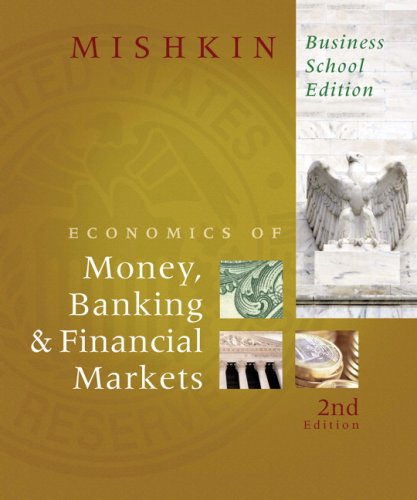
13. Economics of Money, Banking and
$10.85
14. The Economic Naturalist: In Search
$4.00
15. Engineering Economic Analysis
$90.00
16. International Economics: Theory
 
$128.90
17. Essentials of Economics
 
18. Essentials of Economics
$108.89
19. Statistics for Business and Economics
$49.75
20. Economics of Strategy

1. Economic Facts and Fallacies
by Thomas Sowell
Hardcover: 262 Pages (2007-12-31)
list price: US$26.00 -- used & new: US$14.96
(price subject to change: see help)
Asin: 0465003494
Average Customer Review: 4.5 out of 5 stars
Canada | United Kingdom | Germany | France | Japan
Editorial Review

Book Description
From one of America's most distinguished economists, a short, brilliant and revelatory book: the fundamental ideas people most commonly get wrong about economics, and how to think about the subject better.

Economic Facts and Fallacies exposes some of the most popular fallacies about economic issues--and does so in a lively manner and without requiring any prior knowledge of economics by the readers. These fallacies include many beliefs widely disseminated in the media and by politicians, such as fallacies about urban problems, income differences, male-female economic differences, as well as economics fallacies about academia, about race, and about Third World countries.

One of the themes of Economic Facts and Fallacies is that fallacies are not simply crazy ideas but in fact have a certain plausibility that gives them their staying power--and makes careful examination of their flaws both necessary and important, as well as sometimes humorous.

Written in the easy to follow style of the author's Basic Economics, this latest book is able to go into greater depth, with real world examples, on specific issues. ... Read more

Customer Reviews (10)

5-0 out of 5 stars Economic Fact s & Fallacies
It is just too bad that Sowell's work is not mandatory reading for everyone.

4-0 out of 5 stars Too Predictable
It is easy to predict the contents of "Economic Facts and Fallacies" knowing that Sowell is a respected conservative writer.Thus, however, that does not prevent him from providing and useful information.

Early in the book Sowell takes on what he calls the "zero-sum" fallacy in economics.His point is that free-market transactions involve two "willing parties - ergo, both feel better off.True, but that does not eliminate the possibility that one of the parties has unfair advantage, perhaps due to withholding information, outright fraud, or simply much greater economic strength.Regardless, Sowell makes a viable case against rent-control and minimum wage laws.

On the other hand, what about OSHA safety regulations?Assuming a relatively inelastic labor supply vs. personal risk, employers would otherwise be free to let economic forces compel employees to accept risky jobs - for what point?As for improved job safety reducing employment, that must be balanced against also reducing the externality of disabled workers dependent upon greater society.More recently, it is also difficult to see how society has been served by the recent sub-prime mortgage mess.

Sowell, of course, supports free trade - claiming benefits to millions impoverished within third-world countries - ignoring evidence that the U.S., England, Japan and South Korea all used protectionism to establish their initial strengths, and the U.S. considers to do so today, using patents instead of tariffs (especially in pharmaceuticals).And then there's the problems of millions of down-scaled American workers caused by "free trade" - unaddressed by Sowell.

Sowell, however, is totally on target when alleging that government restrictions are a major cause of high housing costs - eg. much of the L.A. area restricts development.(This also considerably raises the potential for disastrous fires.)On the other hand, these restrictions were imposed through democratic vote.In any case, Sowell is off base contending that because Houston's commute times went down while adding 100+ freeway miles/year, and up when building slowed supports a case that "cities can pave their way out of traffic congestion."

Sowell also points out that homeowners living in areas with restrictions (eg. large minimum lot sizes) deprive others with less funds of the "right" to live in the area - forgetting that the original homeowners have a right to exclude the negative financial impact such housing would bring to their investments.(In fact, they most likely paid a premium to obtain such restrictions, contrary to Sowell.

His material on how accreditation agencies restrict competition between established colleges/universities and newer innovative approaches (eg. employing part-time practitioners, instead of full-time academics; increasing teaching loads while reducing "research") is another area on target and well worth considering.

Bottom Line:Worth reading and careful consideration, though not always the last word.

5-0 out of 5 stars Required Reading
Thomas Sowell once again has the courage to critically examine generally accepted and politically correct social policies. His well researched and documented arguments unmasks these fallacious and ill conceived policies. "Economic Facts and Fallacies" is historically documented and an academic breath of fresh air.
This book should be required reading for all elected officials on the Municipal, County, State, and Federal level. Social Engineers could use a dose of economic reality as well.

5-0 out of 5 stars Willful Error...Forever.
Economic Fallacies is the third book by Thomas Sowell I've read this year and it continues to illustrate why he is one of the most important conservatives in America today. His writing beams with scholarship and clarity. There are no wasted words and the work is an arsenal of information. These chapters should be read and reread as they thoroughly refute the positions of those who irrationally regard America as being a racist, sexist and corrupt state.

Sowell debunks the myth of female oppression by highlighting the way that statistics are jiggled in the hopes of morphing the USA into a patriarchy. Indeed, in my opinion, our nation is closer to being a matriarchy than it is anything else. The old 74 cent to the dollar feminist canard is refuted after he teases out the example of unmarried, childless women. They oftentimes are anything but oppressed. Indeed, in many cases they make even more money than their male age-mate peers. Much of the difference between the sexes, in terms of wage, is a result of personal choice. Women work fewer hours and are more likely to choose stability over cash when deciding on a career. Women also select less dangerous jobs than do men as indicated by the statistic he cites showing that 92 percent of those who die in job-related accidents are male.

In terms of class, all of us who ever have tried to debate the left comprehend the error in their perceptions--as does Sowell who eliminates their positions with ease. Unfortunately, it's a serious challenge to ever get them to come around as they would feel contaminated should they ever try to examine world events through the eyes of a conservative. Rife among our opposition is the belief that only a finite amount of money exists in the world, and, if you have lots of it, that automatically means that thousands have none of it. While pseudo-liberals appear to have heard of "economic growth" they have yet to internalize its meaning. This is why they are so enamored with redistributing the rest of population's wealth. They dub this larceny "social justice" despite real social justice embodying the practice of letting people keep what they earn. Tragically, without a basic understanding of economics the left will continue to hike taxes until...the welfare state collapses along with the nation as a whole. Once they eradicate the rich there will be no one left to fund the dole.

With race, Sowell tears apart [yet again] the notion that blacks make less due to discrimination. He refers to an argument here I never heard elsewhere--but greatly appreciate--which is that when a particular group's mean age is lower, as is the case with blacks, they generally have lower incomes than do groups with higher mean ages. This makes perfect sense as a group of 20-year-olds never make as much as those nearing the end of that particular decade; although, his insight matters little as the mainstream media has no use for nuance. They crusade against injustice even though, most often, they are ones who perpetuate it.

5-0 out of 5 stars Great read!
This is Thomas Sowell at his best, making economics understandable for the non-expert.I would recommend this book as a great gift for those who may be interested in economics, but who would not normally chose the subject matter. ... Read more


2. Confessions of an Economic Hit Man
by John Perkins
Paperback: 320 Pages (2005-12-27)
list price: US$15.00 -- used & new: US$6.97
(price subject to change: see help)
Asin: 0452287081
Average Customer Review: 3.5 out of 5 stars
Canada | United Kingdom | Germany | France | Japan
Editorial Review

Amazon.com
John Perkins started and stopped writing Confessions of an Economic Hit Man four times over 20 years. He says he was threatened and bribed in an effort to kill the project, but after 9/11 he finally decided to go through with this expose of his former professional life. Perkins, a former chief economist at Boston strategic-consulting firm Chas. T. Main, says he was an "economic hit man" for 10 years, helping U.S. intelligence agencies and multinationals cajole and blackmail foreign leaders into serving U.S. foreign policy and awarding lucrative contracts to American business. "Economic hit men (EHMs) are highly paid professionals who cheat countries around the globe out of trillions of dollars," Perkins writes. Confessions of an Economic Hit Man is an extraordinary and gripping tale of intrigue and dark machinations. Think John Le Carré, except it's a true story.

Perkins writes that his economic projections cooked the books Enron-style to convince foreign governments to accept billions of dollars of loans from the World Bank and other institutions to build dams, airports, electric grids, and other infrastructure he knew they couldn't afford. The loans were given on condition that construction and engineering contracts went to U.S. companies. Often, the money would simply be transferred from one bank account in Washington, D.C., to another one in New York or San Francisco. The deals were smoothed over with bribes for foreign officials, but it was the taxpayers in the foreign countries who had to pay back the loans. When their governments couldn't do so, as was often the case, the U.S. or its henchmen at the World Bank or International Monetary Fund would step in and essentially place the country in trusteeship, dictating everything from its spending budget to security agreements and even its United Nations votes. It was, Perkins writes, a clever way for the U.S. to expand its "empire" at the expense of Third World citizens. While at times he seems a little overly focused on conspiracies, perhaps that's not surprising considering the life he's led. --Alex RoslinBook Description
The runaway bestseller that has generated a major movie deal—and an international dialogue—with over 170,000 copies sold in hardcover and seven weeks on the New York Times list

“Economic hit men,” John Perkins writes,” are highly paid professionals who cheat countries around the globe out of trillions of dollars. Their tools include fraudulent financial reports, rigged elections, payoffs, extortion, sex, and murder. They play a game as old as Empire but one that has taken on terrifying dimensions during this time of globalization.”

John Perkins should know—he was an economic hit manfor an international consulting firm that worked to convince developing countries to accept enormous loans and to funnel that money to U.S.corporations. Once these countries were saddled with huge debts, the American government and international aid agencies were able to request their “pound of flesh” in favors, including access to natural resources, military cooperation, and political support.

Confessions of an Economic Hit Man is the story of one man’s experiences inside the intrigue, greed, corruption and little-known government and corporate activities that America has been involved in since World War II, and which have dire consequences for the future of democracy and the world.

“[A] gripping tell-all book.”—The Rocky Mountain News
“Astonishing.”—Boston Herald
“This riveting look at a world of intrigue reads like a spy novel . . . Highly recommended.”— Library Journal
“Here are the real-life details—nasty, manipulative, plain evil—of international corporate skullduggery spun into a tale rivaling the darkest espionage thriller.”—Greg Palast, author of The Best Democracy Money Can Buy ... Read more

Customer Reviews (598)

2-0 out of 5 stars A Magazine Feature Stretched to Fill a Book
Perkins provides precious little detail in his work as an "Economic Hit Man."First, the book is about making other countries dependent on foreign debt. This is not news and being the economist who creates the lofty projections does not a hit man make.There is none of the cloak-and-dagger intrigue that you might expect.

Second, Perkins never discusses what he actually did. In nearly 300 pages he simply says he "cooked the books." This gloss deadens a book that might have had some real meat. Indeed, an account of 1970s and 80s Jakarta is really neat and vivid, but that can be accomplished in 5,000 - 10,000 words. Where is an explanation of the assessment process, a comparison of reality vs. his projects, etc.?

At best, this is a "tell-some" book, with a lot of lofty conclusions.

5-0 out of 5 stars Painful reality made into a masterpiece
This will sound like a cliché, but Confessions of an Economic Hit Man truly changed my life. Perkins describes a horrific world of which many of us already suspected it existed, but we `d never really known the details or how exactly it came about. Reading Confessions gave me the sensation of all the pieces of the puzzle falling into place. In addition, Perkins' narrative and literary talents make the book a super-exciting piece to read: once you pick it up, you almost can't put down. The nature of the assignments that the author was given during his career as an EHM, and the fact that these missions took place all over the world give his painful and sincere confessions at times the character of a thriller or an adventure novel in real life. As if this isn't enough, Perkins did not write an angry book, and never preaches. He concludes with suggestions in how we can all begin to make a difference, starting on a modest scale, and his inspiring conclusion has a profound impact on my current outlook.

5-0 out of 5 stars Confessions of an Economic Hit Man
John Perkins actually lived exactly what he writes about.The information is very timely in this an election year.The book is disturbing in that I was so disappointed in the government and many of its leaders in whom I put my trust.It points out that there are dynasties of families in this country who really run the world, destroy environments and cultures, and engineer the death of those who don't agree with their tactics.I would rather know than not know but it made me feel powerless until I read the study guide and found out that Perkins gives us tools to make a difference.A must read!

5-0 out of 5 stars Fun to read
I read a lot of books on global ecopolitics and world problems. A big reason is my feeling that the power elite may be figuratively preparing to play their hand and I want to somehow be a step ahead of them.

This book is efficiently written. It is as if an editor went through and boned down a dull 600 page documentary while keeping the important parts. It encapsulates the start of our domination of international finance and development at Bretton Woods when the Marshall Plan was approved. The Marshall Plan provided US government funding for the rebuilding of war torn Japan and Europe.

Rockefellers bank, the Chase Manhattan bank, has long specialized in multi-billion dollar loans to third world countries that pave the way forextraction of natural resources, especially oil. In order to more efficiently focus on this activity, the "World Bank" (really a US bank) was created with the IMF (International Monetary Fund).

This is how the dragon works. The elite in Third World countries are presenting with overwhelming studies that somehow 'prove' that the elite and their country will benefit from borrowing tens of billions of dollars from the World Bank. The bank then sends most of this money to approved insider US construction and engineering firms such as Bechtel, Halliburton, Brown & Root, and Shlumberger. The elite who approved of the massive loans are taken care of but the debt is intentionally so massive that the country has no real hope of ever paying it off. Now the Bank has legal recourse to do what happens when debtors can not pay off their loans....they extract their pound of flesh.

There are occasional leaders who prove to be incorruptible and are truly working in the interest of their people. If the economic hit men are unable to prevail against these leaders, jackals move in and the benevolent leader often dies in a ball of fire. Examples are Jaime Roldosof Ecuador and Omar Torrijos of Panama, whom the author was personal friends with. There are times when the jackals are bypassed and the military does the dirty work. Examples are Panama and Iraq.

Economic hit men are paid very well and enjoy a lot of other perks as compensation for selling civilizations down the river. These civilizations lose their lands and quality of life as their environment gets torn apart and poisoned. Unemployment and poverty tend to skyrocket.Tin pot dictators are installed who are beholden to the interests of theinternational banks and corporations.

I majored in economics for a long time. I know an ex-jackal, well I hope he is an "ex" anyway. An old 'girl friend' dated a man "close to the top" of a bank whose name I can not mention. In the 80's, that man complained of the exact same things that Perkins (book author)points out. His conscience also bothered him and he left after personally doing many loans to the LDCs (less developed countries).

As of late, they are following a less gentlemanly approach. They are simply attaching countries via military conquest (strictly my observation).

The reason this book receives so may one star ratings is because it is both highly effective and it takes aim at the biggest economic entity of them all. There is a very good chance that you work for the corporatocracy involving the international banks, corporations and the intelligence gathering side of the government. In other words, you work for Rockefeller (strictly my observation).

5-0 out of 5 stars Good explanation of the business side of the World Bank
I think everyone should read this book.
Explains how American economic interests trump everything,
and how "third-world" countries are forced into taking bad contracts
against the well-being of most of the populace. ... Read more


3. The Concise Encyclopedia of Economics
Paperback: 637 Pages (2007-12-31)
list price: US$28.00 -- used & new: US$28.00
(price subject to change: see help)
Asin: 086597666X
Average Customer Review: 5.0 out of 5 stars
Canada | United Kingdom | Germany | France | Japan

Customer Reviews (2)

5-0 out of 5 stars Excellent
I used the first edition extensively after it came out in 1993. This second edition is updated appropriately and retains all of the classic material that made the first edition so good.

5-0 out of 5 stars Ideal and indispensable addition
Compiled, organized and edited by David R. Henderson (Research Fellow with Stanford University's Hoover Institution and an Associate Professor of Economics at the naval Postgraduate School in Monterey, California), "The Concise Encyclopedia Of Economics" is a superbly presented introduction to economics comprised of more than 160 entries which draw upon the experience and expertise of some 152 contributors. Now it a completely revised, expanded and updated fourth edition, "The Concise Encyclopedia Of Economics" covers a diversity of subjects ranging from basic economic concepts, to discrimination and labor issues, to corporations and financial markets, to economic history, to economic legal issues, governmental regulation, taxes, environmental regulations, economic policies, macroeconomics, money and banking, international economics, economic systems within and outside of the United States, schools of economic thought, and so much more. "The Concise Encyclopedia Of Economics" is substantively enhanced with the inclusion of succinct biographies of leading and influential economists and a comprehensive Index. Also available in a hardcover edition (9780865976658, $45.00), "The Concise Encyclopedia Of Economics" ideal and indispensable addition to personal, professional, academic, and community library Economic Studies reference collections. ... Read more


4. Naked Economics: Undressing the Dismal Science
by Charles Wheelan
Paperback: 260 Pages (2003-09)
list price: US$15.95 -- used & new: US$9.00
(price subject to change: see help)
Asin: 0393324869
Average Customer Review: 4.5 out of 5 stars
Canada | United Kingdom | Germany | France | Japan
Editorial Review

Book Description
Finally! A book about economics that won't put you to sleep. In fact, you won't be able to put this one down.

Naked Economics makes up for all of those Econ 101 lectures you slept through (or avoided) in college, demystifying key concepts, laying bare the truths behind the numbers, and answering those questions you have always been too embarrassed to ask. For all the discussion of Alan Greenspan in the media, does anyone know what the Fed actually does? And what about those blackouts in California? Were they a conspiracy on the part of the power companies? Economics is life. There's no way to understand the important issues without it. Now, with Charles Wheelan's breezy tour, there's no reason to fear this highly relevant subject. With the commonsensical examples and brilliantly acerbic commentary we've come to associate with The Economist, Wheelan brings economics to life. Amazingly, he does so with nary a chart, graph, or mathematical equation in sight—certainly a feat to be witnessed firsthand.

Economics is a crucial subject. There's no way to understand the important issues without it. Now, with Charles Wheelan's breezy tour, there's also no reason to fear it. ... Read more

Customer Reviews (111)

3-0 out of 5 stars A decent overview of economics that doesn't much question mainstream economic thought
Just as we can look back, today, at economic failures and fallacies of the past, so too will those of the future look back at the economic policies (and much else for that matter) of today and see great flaws.While I understand that this is an introductory book, and thus should not go into too much detail critiquing modern-day economic policy, I wish I at least could have gathered the sense that the author realized there are many flaws with today's mainstream economic policies.Unfortunately, I think he finds little flaw in many of the popular policies and ideas of our day that (I believe) will surely be looked at more critically in the future.

As an example, I found it especially annoying that the author kept bringing up Bill Gates, once even making the argument that we're all better off because of this man.The great irony in this is that, not only does Microsoft make money by selling something non-scarce, they've been known to use dirty, anti-competitive tactics time and time again.It's not hard to imagine how this combination can make someone rich -- at the expense of others!The author obviously has no idea that there are alternatives to this model of "proprietary software", and I'm sure many would argue, alongside me, that we'd all be better off if Microsoft never did come to power, and the open, non-proprietary model (of creating software) produced the first mainstream desktop operating system.

And whether that comment about George W. Bush being a mature world leader was made in seriousness or not...Well, the author being an economist, I would think he'd at least make mention of the outrageous deficit spending of the U.S. government.

For a more honest introduction to economics, and a critical look at many of our modern-day economic fallacies, try reading Economics in One Lesson.Economics in One Lesson doesn't have as much of the humor of Naked Economics (which isn't really funny, but makes for lighter reading), but at least it uses good logic and examples for its arguments.(Naked Economics leaves out sound arguments in many cases.)

And for some insight into the great flaws with the monetary policy of most governments in the world today, try something like this.

5-0 out of 5 stars Naked Economics.
Naked Economics was a joy to read. The author wrote in a way as if he was speaking and due to that, the readings went by very quickly. Also, the author related things to his readers, which was nice since economics can sometimes seem so abstract. I highly recommended this book.

5-0 out of 5 stars A great introduction!
I got this book based on a recommendation of a friend. I wanted to understand economics further since I'm pursuing my Master's degree in Urban and Regional Planning, emphasizing on economic development and downtown revitalization. Needless to say, I enjoyed the frankness of the author in explaining economics and the topics worked together with what little I remember from taking Macroeconomics back in college. It is also easy to digest in small bits so you don't have to feel obligated to read every day in order to understand how everything links together.

4-0 out of 5 stars Impressive and Intriguing
The book is nice with pretty simple and straight forward explanations to how the economy and world economy works. Though some facts in the book are very outdated since 2001. They need to review the book and update some of the facts which are still stuck in 2001.

Overall for a n00b an amazing book to understand economic policies and their implications.

5-0 out of 5 stars Must Read
This book is enlightening. Written for the layman to understand, Naked Economics provides the reader with a very accessible overview of the world of economics, and how it is very much a part of our everyday lives. ... Read more


5. The Secrets of Economic Indicators: Hidden Clues to Future Economic Trends and Investment Opportunities (2nd Edition) (Wharton School Publishing Paperbacks)
by Bernard Baumohl
Paperback: 432 Pages (2007-08-03)
list price: US$18.99 -- used & new: US$11.60
(price subject to change: see help)
Asin: 0132447290
Average Customer Review: 4.5 out of 5 stars
Canada | United Kingdom | Germany | France | Japan
Editorial Review

Book Description
Every day, stocks, bonds, and currencies bounce wildly in response to new economic indicators. Money managers obsess over those statistics, because they provide crucial clues about the future of the economy and the financial markets.

Now you can use these indicators to make smarter investment decisions, just like the professionals do.You don't need an economics degree, or a CPA... just this easy-to-use book.

Former TIME Magazine senior economics reporter Bernard Baumohl has done the impossible: he's made economic indicators fascinating.

Using real-world examples and stories,Baumohl illuminates every U.S. and foreign indicator that matters.Where to find them.What they look like. What the insiders know about their track records. And exactly how to interpret them.

Whether you're an investor,broker, portfolio manager, researcher, journalist,or student, you'll find this book indispensable.Nobody can predict the future with certainty. But The Secrets of Economic Indicators will get you as close as humanly possible.

What the numbers really mean...

...to stocks, bonds, rates, currencies, and you

Ahead of the curve: spotting turning points

Calling recessions and recoveries in time to profit from them

Leading indicators: where's the economy really heading

Decoding initial unemployment claims, housing starts, the yield curve, and other predictors

Beyond the borders

Why foreign indicators are increasingly important—and how to use them

Making sense of indicators in conflict

What to do when the numbers disagree

Finding the data

Free web resources for the latest economic dataDownload Description
Every day, stocks, bonds and currencies bounce around wildly in response to economic indicators like these. They're monitored obsessively by the world's leading money managers. Why? Because they provide crucial, subtle clues about the future of the market -- and of individual investments. Now you can profit from these indicators just like the professionals do. You don't need an economics degree, or a CPA -- just this easy-to-read book. In plain English, renowned economic journalist Bernard Baumohl helps you find the numbers, understand their deepest meanings, and use your knowledge to make fast, smart investment decisions. For each key indicator, Baumohl presents a sample release, insider's information on the indicator's track record, and step-by-step instructions for decoding it. Baumohl covers both US indicators and the foreign indicators that are becoming increasingly important to investors. He answers key questions like: Which indicators are most likely to affect my personal investments or business? How does each indicator affect interest rates and bond prices? Stock prices? The value of the dollar? And what can these reports tell me where the economy's really heading? ... Read more

Customer Reviews (37)

5-0 out of 5 stars Economics
I've read a couple of books on Economic Indicators and this by far was the best.Good book to read.Author makes it easy to understand.

5-0 out of 5 stars Permanent fixture on my shelf
A great book which describes in great detail all the important indicators. If you trade the news, then this book is a must. Even if you dont, its an interesting read of how these indicators are derived.

5-0 out of 5 stars Must Have for Investors & Traders Alike
I have been a technical analyst for years trading stocks and forex but I could never really understand the "Fundamentals" and their importance at major turning points in the economy. Bernard Baumohl has made this very complex and confusing topic so easy to understand and learn, even for dummies and complete idiots like myself. If you ever want to invest or trade, or just learn how the economy really works, you absolutely should get this book first. Plus it's also loaded with lots of useful links and even important stuff in other countries that affect the US economy. 5 stars is not enough, this book deserves 10 stars, just like other books written by Martin J. Pring, John Murphy, Steve Nison, Kathy Lien and Boris Schlossberg.

3-0 out of 5 stars A great book for students and lousy choice for Investors!
The utility of this book is directly related to what your objective is going to be ..

1. If you are astudent who want to learn economic indicators, this book is a must read. In simple language and interesting examples, every economic indicator is explained.

2. If you are like me, an investor trying to decipher the economic indicators to make meaning to your investing decisions , you are better off tracking the tigers directly than analysing the terrain and weather patterns ( with some high level information that you can pick up from yahoo finance,CNBC etc ..example : Missed Durable goods meant stocks are down today)

Still if you are determined to understand the economic indicators, this is how you can maximise your time..

Every Chapter is an economic indicator has the following sections:

Market sensitivity(read the chapter if it is high or skip it entirely)
Why is it important ( read it)
How is it computed ( skip it)
Market Impact ( read it)

The world is already complicated and in a frenzy. Spend your time with your kids, get some fresh air or even watch TV than reading these type of academic books (Exception Students andto some extend Money managers)

Usually market takes care of the numbers within the first 15 minuts of a trading day on bad or good news!I am sure Warren buffett wont spend more than 15 minutes of his time a week digesting these news ( if at all he follows it)

If you trade sporadically, You may chose to read my review about an excellent stock market related book... Something that you can act upon!

The Successful Investor: What 80 Million People Need to Know to Invest Profitably and Avoid Big Losses

5-0 out of 5 stars Great book
Before I read this book, I had no knowledge in any aspect of the field of economics. After reading this book, I was prepared enough to earn an easy A in the macroeconomics course I took this summer at the local college. The book was easy enough to read for someone with no economics background; and it had enough advanced information to completely prepare myself for an easy A. I strongly recommend this book to everyone, no matter of yourprevious knowledge. You will learn a lot. ... Read more


6. Basic Economics: A Common Sense Guide to the Economy
by Thomas Sowell
Hardcover: 627 Pages (2007-04-30)
list price: US$39.95 -- used & new: US$22.38
(price subject to change: see help)
Asin: 0465002609
Average Customer Review: 4.5 out of 5 stars
Canada | United Kingdom | Germany | France | Japan
Editorial Review

Book Description
This completely revised and updated third edition of ThomasSowell's instrumental work includes a new chapter on government finance.Basic Economics is a citizen's guide to economics--for those whowant to understand how the economy works but have no interest in jargon orequations. Sowell reveals the general principles behind any kind of economy--capitalist, socialist, feudal, and so on. In readablelanguage, he shows how to critique economic policies in terms of theincentives they create, rather than the goals they proclaim. With clearexplanations of the entire field, from rent control and the rise and fallof businesses to the international balance of payments, this is the firstbook for anyone who wishes to understand how the economy functions. ... Read more

Customer Reviews (26)

5-0 out of 5 stars Thomas Sowell's Basic Economics
This is a very insightful book.It will be helpful for anyone trying to really understand the way the market works.It thoroughly explains why many things go wrong economically in our country and what the solutions would be if people knew the truth about economics.It's really not hard to read and is very interesting in many places.A definite must for anyone that is thoughtful about economic matters.

5-0 out of 5 stars Insightful, Easy to Read
I've only ever taken one class in economics, and that was a few years ago during college.This book taught me a hundred times as much as I learned in that class and really opened my eyes to a new world.Though reading it won't make you an expert on economics, it will give you a strong foundation to pursue further study or simply a grounding with which to understand the world a bit better.

Surprisingly, considering the subject, the book is an entertaining read.I found myself deeply interested and read through it very quickly.

I recommend this book to anyone who desires a basic understanding of economics.

4-0 out of 5 stars Solid introduction, but imbalanced in dealing with economic policy
If people ask me to recommend popular expositions of basic evolutionary biology or quantum physics, I have no trouble. In these and many other areas of natural and behavioral science brilliant expositions of basic theory abound. Economics is s different story. It is invariably the case that a popular economics book has a "point of view" that presents a biased and fundamentally unbalanced description of the state of knowledge in economic theory and policy. I do not know why this should be the case, but it is. Invariably.
One might argue that there are no agreed-upon "principles of economics" on which there is general consent among professional economists. This surely used to be the case when neoclassical economics, Marxian economics, Keynesian economics, and Institutional economics all held court. But, over the past two decades, a startling degree of unanimity on basic principles has developed---to the point where one can no longer say that there are alternative "schools of thought," except for a very small minority of beleaguered "heterodox" followers of some venerable guru, such as Marx, Veblen, von Mises, or Keynes.
This does not mean, of course, that economists agree on economic and social policy. For one thing, there are many things we simply do not understand very well. Take "corruption," for example. I believe corruption is a major impediment to growth in poor countries, but others believe corruption is a symptom rather than a cause, and I have neither the data nor the analytical model that can convince them otherwise. For another thing, economists differ in fundamentally normative ways. For instance, some believe that poverty is an abomination that should be addressed with all our economic resources. Others have a taste for reversing global warming, and others believe government should get out of the business of"solving social problems."
Sowell's book, Basic Economics, comes pretty close to being a neutral exposition of what economists know about running the economy. There is no statement of fact, no statement of economic principle in this book with which I disagree, even though my background is from the Left, and I have never voted for a Republican in my life, and Sowell is the arch-conservative guru of Hoover Institution fame. I am sure some of my Left colleagues will be shocked at this statement, but I predict that they objection to Sowell's basic principles will be simply wrong.
So, I would offer this book to acquaintances who want to "learn something about economics." However, Sowell's presentation is severely unbalanced in the presentation of basic economic issues. Most important, we have had a valuable model of the interaction of markets and state for the past forty years, and in the past twenty years this has involved an impartial treatment of market successes and failure, as well as the successes and failure of state interventions. Sowell treats market vs. state as a competition in which the market is almost always "good" and the state intervention almost always a disaster. By contrast, modern economic theory presents economic development as the joint growth and inextricable interaction of both state and market. We are trained to ask, in the face of a market failure, whether there is an appropriate remedy in the form of state intervention, but we are not predisposed to a negative answer. Indeed, the modern economy is precisely a synergistic interaction of state and market, with rather small deviations from a common model in all advanced countries.
As a general statement, I would say that markets do well in dealing with highly decentralized informational systems, whereas states do well in making the rules of game followed by participants in market exchange. As soon as state attempt to produce goods and services, or predict winners and losers, they are out of their domain of comparative advantage, and do poorly. On the other hand, there is nothing in fact, or in economic theory, that supports the notion that market exchange can generate efficient and welfare-enhancing rules of the game.
Another example of Sowell's bias is his treatment of poverty and inequality. Sowell says very clearly that it is not right to take from those who have earned their income and wealth to give to those who have little. This right-wing principle seems to me to be grotesque and bizarre. Humans have been redistributing material wealth since the time of our hunter-gatherer forbears. If a crumb is redistributed from a man with a surfeit of fine food to a starving child, this appears to be to be a just and fair act. Of course, taking from a hard-working family to support an antisocial drug addict might well be unfair, but this is a different story.
The basic unfairness of the capitalist economy is that people are born into a particular economic station, and that station will severely affect their ability to realize their ambitions andexercise their human capacities for self-realization. There is no way to avoid this situation, but Sowell does not even mention this issue is this volume. Pity.
Contemporary American liberals will not like this book because it defends free international trade and criticizes many of the types of programs liberals favor. However, I think Sowell is usually correct. On the other hand, there have been monstrously successful liberal program that Sowell does not acknowledge, such as social security, Medicare, EITC, and the welfare system. We need similar programs to deal with world poverty, domestic poverty, environmental destruction, and several other important social issues. The correct way to deal with this problems is to use the market system, but to erect incentives that lead private individuals and firms to act on behalf of the public interest. Only a strongly synergistic pattern of market and state activity can conceivably succeed. Sowell's imbalance in favor of markets is, in this respect, part of the problem rather than part of the cure.

5-0 out of 5 stars Good Introduction to Basic Economics
This is the best book on basic economics you will find.Those with previous experiance in the subject of economics may find it rather simplistic but for taking a complex subect and making it interesting and understandable it deserves 5 stars.If you want to better understand the world around you buy it, if you want in depth knowledge use it as your starting point.Its great examples that make the complex understandable.

5-0 out of 5 stars A real education!
Facinating and easy to read.I've had a hard time putting it down.I finally understand economics in depth.I've had my own business for over 20 years and the things that Thomas Sowell explains are so true. ... Read more


7. Economics For Dummies
by Sean Masaki Flynn
Paperback: 384 Pages (2005-04-08)
list price: US$21.99 -- used & new: US$9.46
(price subject to change: see help)
Asin: 0764557262
Average Customer Review: 5.0 out of 5 stars
Canada | United Kingdom | Germany | France | Japan
Editorial Review

Book Description
If you think economics is a complicated discipline that’s reserved for theorists and the intellectual elite and has nothing to do with you, think again. Economics impacts every aspect of our lives, from what we eat, to how we dress, to where we live. Economics might be complicated, but it has everything to do with you.

Economics For Dummies helps you see how your personal financial picture is influenced by the larger economic picture. When you understand how what happens on Wall Street affects Main Street and how policies emanating from the White House impact the finances in your house, you’ll be able to:

  • Learn how government economic decisions affect you and your family
  • Make better spending decisions and improve your personal finances
  • Maximize your business profits
  • Make wiser investments

Written by Sean M. Flynn, PhD, Assistant Professor of Economics at Vassar College, Economics For Dummies covers all the basics of micro- and macroeconomic theory. The next time you need to understand an economic theory or calculation, whether it’s on the nightly news or on a spreadsheet at work, you’ll no longer be in the dark. Economics For Dummies covers all the history, principles, major theories, and terminology, including:

  • How economics affect governments, international relations, business, and even environmental issues like global warming and endangered species
  • How the government fights recessions and unemployment using monetary and fiscal policy
  • How and why international trade is good for you even if you don’t appreciate French champagne, Irish crystal, or Swiss watches
  • How the law of supply and demand can explain the prices of everything from comic books to open heart surgeries
  • How the Federal Reserve controls the money supply, interest rates, and inflation
  • Basic theories such as Keynesian economics, the Laffer Curve, and Adam Smith’s Invisible Hand

Presenting complex theories in simple terms and helping you decode the jargon, understand the equations, and debunk the common misconceptions, Economics For Dummies could be a big boon to your personal economy! ... Read more

Customer Reviews (13)

5-0 out of 5 stars Economics for Dummies.....
This book is a good starting point for understanding economics. It's written clearly and with a sense of humour making the subject a little less tedious.

5-0 out of 5 stars Very well written
I was looking for a book to refresh my basic understanding of macro- and microeconomics for a certification exam I am preparing for. This book was great. It is very well written and the author knows how to explain these concepts so that they are easily understood.

I actually found it hard to put the book down while reading some parts of it. While I won't call the whole book a page-turner, it was an informative and enjoyable read.

4-0 out of 5 stars Economic for dummies
This book will provide a broad view of the economics and is a great guide for the student as well for the layman.

4-0 out of 5 stars Pleasantly surprised
Well I must say I was surprised at the quality of the information in this book considering the price; not belittling the "Dummies" series. I'm not completely devoid of knowledge but in this field and this book is certainly filling in the blanks for me. When I'm finished my mates want to read it

5-0 out of 5 stars A Decent Economics Foundation
Based on the other reviews on Amazon, I picked up this book to assist me with a graduate economics course after realizing that I was way in over my head. I'd never had an economics course before, so this book had to substitute for the undergraduate education that I was lacking. The verdict? I read it in one weekend, and caught up to speed in my grad class the next week. Definitely worth the investment. ... Read more


8. Economics
by Campbell R McConnell, Stanley L Brue
Hardcover: 808 Pages (2006-10-24)
list price: US$156.56 -- used & new: US$99.50
(price subject to change: see help)
Asin: 0073126632
Average Customer Review: 4.0 out of 5 stars
Canada | United Kingdom | Germany | France | Japan
Editorial Review

Book Description
McConnell and Brue’s Economics: Principles, Problems, and Policies is the leading Principles of Economics textbook because it is innovative and teaches students in a clear, unbiased way.The 17th Edition builds upon the tradition of leadership with three main goals: help the beginning student master the principles essential for understanding the economizing problem, specific economic issues, and the policy alternatives; help the student understand and apply the economic perspective and reason accurately and objectively about economic matters; and promote a lasting student interest in economics and the economy. ... Read more

Customer Reviews (4)

1-0 out of 5 stars Generally awful, saved by summaries
If you have the misfortune of being assigned this book, I feel for you. The book is filled with needlessly complicated explanations, some of which don't contribute anything to the subject. The authors love to interrupt sentences with variables and equations that could have been saved for information boxes.

The only thing that made this book tolerable is that figure captions and summaries were left to a competent editor. The book could be cut in half with a sufficiently critical editing pass. Don't buy this if your curriculum offers a choice of books.

5-0 out of 5 stars Thank You
The product came in the condition that it was said to be in. This book was brand new like said to be. It even still had it plastic on it.

5-0 out of 5 stars Fast Shipping! Excellent Condition
The book was delivered faster then what was arranged. The book was in Perfect Condition!

5-0 out of 5 stars An excellent presentation of economic theory and its application to real world problems and issues.
As an instructor of economics who uses this book for undergraduate classes, I would say McConnell and Brue's book is probably the best text to introduce students who may have no background or appreciation for the study of economics.This is the latest edition of the text, and each edition tries to take into account the current trends in society. It is well written and contains clear, concise analyses to examine important concepts and principles that have taken centuries to theorize and to validate. The authors also use several real world examples and case studies to help the reader apply economic concepts to business and societal problems. I still remember using an earlier edition of the authors' text when I was an undergraduate student a number of years ago. I found it meaningful and practical then , and I find it quite valuable now as a teacher. Some things never change!

I would higly recommend this text to students taking their introductory courses in economics. The material presented is quite relevant to the development of an understanding and appreciation of how humans and society satisfy their unilimited wants and needs given scarce resources and limited choices. I like to refer to it as "the philosophy of life." It never put me to sleep!No wonder why numerous academic institutions use Macconell and Brue's book as the standard text for their introductory economic courses. ... Read more


9. Principles of Economics, 4th Edition (Student Edition)
by N Gregory Mankiw
Hardcover: 936 Pages (2006-02-15)
list price: US$175.95 -- used & new: US$108.75
(price subject to change: see help)
Asin: 0324224729
Average Customer Review: 4.0 out of 5 stars
Canada | United Kingdom | Germany | France | Japan
Editorial Review

Book Description
PRINCIPLES OF ECONOMICS continues to be the most popular and widely used text in the Economics classroom. The 4th edition features a strong revision of content in all 36 chapters while maintaining the clear and accessible writing style that is the hallmark of the highly respected author. The 4th edition also features an expanded instructor's resource package designed to assist instructors in course planning and classroom presentation and full integration of content with Aplia, the leading online Economics education program. In the 4th edition Greg Mankiw has created a full educational program for students and instructors -- Experience Mankiw 4e. "I have tried to put myself in the position of someone seeing economics for the first time. My goal is to emphasize the material that students should and do find interesting about the study of the economy." - N. Gregory Mankiw. ... Read more

Customer Reviews (46)

4-0 out of 5 stars Good Introduction
This is one of the better books I have seen in economics. It is an excellent introduction to the field. It is comprehensive with very useful case studies from the real world.

If I want to break the review down to the two main parts of the book, I would give 4.5 stars to the micro part and 3 stars to the macro part. However, I am not aware of any good book on macroeconomics. I think most authors (or maybe all of them) just don't have a deep understanding of macroeconomics. Albert Einstein once said "if you can't explain an idea to a 6-year-old, then you don't understand that idea."

So, given the lack of better books, I would recommend this one as your starting point in economics.

5-0 out of 5 stars Microeconomics
This book, despite all its charts, diagrams and those algebra/calculus-looking formulas, which apparently is what economics supply/demand is all about, was easy to read, broken up well, and kept my interest despite this being for a class that was a necessity for my degree program.It was clear and you could apply what you learn from it in basic/general terms and concepts, or really get into tne nitty-gritty technicalities of the economic system if that's your thing!

5-0 out of 5 stars Perfect
The book was in perfect condition when I recieved it, no folded pages, the cover was in excellent condition, and it was shipped to me extremely quickly.

5-0 out of 5 stars audio version
i like this book very much. if only has the book an audio version (audio cd or mp3)! i can read and listen to it at the same time!

3-0 out of 5 stars Too simplistic to motivate individual learning
I can't believe how dumbed down this is. It's at least three times as dumbed down as our high school economics books here in Finland. You're supposed to have no background information, economical intuition or common sense.

Plus it explains economical concepts much like maths. The way it makes economics to be a precise science, even though much of it remains to be presented trough its biased sunglasses, is very misleading and even tiring if you're looking at it from the bigger picture instead of a memorization point of view. Actually learning it all must be like hell.

Much of what is written here in three pages you can figure out in a few moments if you actually bother to think for yourself. I don't know about you, but I'd prefer learning about economics in a more practical setting or from pop nonfiction books or whatever. Doing something like playing strategy games might help if you have no intuition whatsoever. (IndustryPlayer seems kind of interesting -- it actually attempts to teach business basics)

To me this all of this book just seems way too obvious considering it's college/university grade. It's great to exactify your economical thought a bit and be able to talk in the standardized concepts, but rather than memorizing what's basically common sense it'd be better to develop an understanding of these concepts and their roles in real life over time and much more painlessly. If you have no alternatives and this is seriously the best text book on the market and this is the standard way to learn, I'm sorry for bringing the ratings down, but to me personally it was pretty much useless.

In short, by being too simple, it makes learning economics harder than it actually is. ... Read more


10. The Coming Economic Collapse: How You Can Thrive When Oil Costs $200 a Barrel
by Stephen Leeb, Glen Strathy
Paperback: 224 Pages (2007-02-21)
list price: US$16.99 -- used & new: US$7.45
(price subject to change: see help)
Asin: 0446699004
Average Customer Review: 4.0 out of 5 stars
Canada | United Kingdom | Germany | France | Japan
Editorial Review

Book Description
Stephen Leeb shows how hard times can be a boon for smart investors. As the world faces an energy crisis of unprecedented scope, renowed economist Stephen Leeb shows how surging oil prices will contribute to an economic collapse. With meticulous research and analysis, Leeb shows that due to strong competition from India and China, prices could soon double, a cost for which most countries and investors are ill-prepared. Now, in this groundbreaking book, Leeb not only shows how this crisis will affect consumers, but how savvy investing can turn these dire times into financial gain. ... Read more

Customer Reviews (68)

3-0 out of 5 stars I hesitiate to give it even 3 stars,
but the book does contain information that is provocative and worth consideration.

The writing can best be described as "lazy."If I were reviewing just on the merits of the writing, this book would get 1 star.There is no excuse for anyone to put a literary product on the market that is as shabbily written as this one is.

For starters, Dr. Leeb switches voice four time throughout the book.He starts out with "I," then abruptly begins speaking as "we" on page 13, right in the middle of a chapter.Towards the end of the book, he goes back to "I," then again switches to "we."

The author has a penchant for revising history to fit his theories.For example, he portrays the 70's as just one economic step above the Great Depression, and even goes so far as to blame the homelessness of the 80's on the previous decade's financial turmoil (p 105).

Other examples:
The Iran-Iraq War ended in the "early 80's" (p. 84)
The Great Depression ended in 1944 (p. 110)

And listen to this one:"If the bursting of the tech bubble in 2000 was a rain shower, then a bust of the housing boom today (written in 2006)would be a Category 5 hurricane.But that is exactly why we do not think it will happen." (p 179)

Nevertheless, Dr. Leeb puts forth some provacative concepts that are worthy of consideration, including the role of China and India (Chindia) in Peak Oil scenarios as well as "Groupthink," aka "herd mentality."

In addition, the author lays out a comprehensive investment plan that would, assumably, prosper during a protracted energy crisis.In my opinion, the investment suggestions should only be considered a starting point for further research, rather than an iron-clad guarantee of success.The author's shoddy writing style casts a dubious shadow on all of his research and theories, and makes his investment suggestions suspect at best.

1-0 out of 5 stars Collapse This!
If you accept Mr Leeb's apocalyptic Peak Oil scenario and the possibly imminent "collapse of civilization," then the investment advice he offers seems oxymoronic. All the money in the world won't save you when the barbarians are at the gates. (Well, unless maybe you had the foresight and wherewithal to buy a big spread in Paraguay.)

However, not to despair.Mr Leeb's argument is predicated on several faulty assumptions:

1) That oil production has peaked and therefore cannot keep pace with growing demand from developing nations.
2) That America can't survive a severe energy shortage.
3) That gold is an excellent defense against hyperinflation.
4) That $100/barrel oil will result in $10/gallon gasoline.

Obviously, the last assumption has already proven incorrect.

As to supply, oil has always been a commodity managed by the world's most powerful cartels. Production has been suppressed through both sins of commission (read, regime change) and sins of omission (obstructing development of major oil fields). There is no reason to suppose the present situation is any different from past "energy crises": here's a symptom of artificiality --- the price of oil has risen 900% since its most recent low in 1999, yet demand has only risen about 12%. Clearly there is a disconnect between demand and price.

The theory that available oil is limited to shrinking, finite pools of rendered dinosaur fat may well prove a myth fostered by oil producers to "explain" curtailed supply. Consider the possibility that petroleum ---formed as in the lab from hydrogen and methane under high pressure---leaks out of the Earth, pushed by centrifugal force along crustal fissures? Is it merely coincidental that oil fields invariably flank major fault lines and fracture zones? How else to explain the self-replenishing field recently discovered in the Gulf of Mexico?It is quite possible that supply may prove to be far more abundant than Exxon would have you believe.

On the demand side, Mr Leeb posits inexorable growth -- yet it's easy to see how demand in the world's largest consuming economy, the US, could be reduced significantly, without hardship, if gasoline prices rose to "catastrophic" levels. There's no reason (except our customary extravagance) why US fleet economy couldn't be doubled, simply by our choosing to reduce the weight of our vehicles by a ton or two while decreasing the size of our engines by a couple of liters. No one really needs a 5000-pound SUV that does 0-60 in 7 seconds. Americans are supremely adaptable, if the price is right. One can even envision a future when privately owned, hybrid cars run on a network of rails; the combination of reduced friction, use of electricity while on the "net," and elimination of stop-and-go driving would result in massive fuel savings. For the present, ending our Middle Eastern military adventures would lead to lower energy prices as political tensions fell, along with Pentagon consumption. (The Air Force alone accounts for more than half the federal government's total energy use.)

Gold is deflationary, which is why it's a dangerous investment. Mr Leeb is correct in noting that inflation serves the gov't interest by reducing the true cost of debt. Plus, capitalism doesn't work when prices fall.Deflation must therefore be prevented at all costs, even to the point of hyperinflation if necessary. If there is widespread ownership of gold in response to high inflation, you can bet "jackbooted thugs" will be at the door to confiscate your bullion, just as in the 1930s."Windfall" profits taxes will be enacted to stop speculation in precious metals instruments.

My investment advice? Put some of your money into the candidacies of those rare politicians who reject the conventional wisdom. The answer to America's energy dilemma lies in the political arena. We must somehow end the oil producers' control over Washington policymakers, freeing Americans to do what they do best: respond creatively and rationally to solve a very solvable problem.


3-0 out of 5 stars Driver Beware -- How can you Diversify
This is the investor's guide to Peak Oil.If you are not both an investor and a subscriber to the theory behind Peak Oil, then this book will leave you a little lost.As it is, though, this book provides an answer to some questions that are otherwise never discussed elsewhere.

The premise is straightforward: the smart investor makes money by anticipating change and preparing for it.In this case, Leeb first sets out to explain why Peak Oil claims have some merit.He does not sound like Kunstler.He's got a cooler head, which I can really appreciate.He explains the problems at Ghawar as well as the visions of people like Matthew Simmons and Hubbert.

He is not just bucking the assumptions of geopolitics, though.He also takes Modern Portfolio Theory to task.That approach, which asserts that no investor can anticipate anything with regularity, advises people to seek the maximum expected risk-reward return. He goes over some of the famous geniuses who have rejected its assumptions - value investors like Buffett and the reflexivity theory of Soros.

Its not until the last chapter that he makes his specific investment suggestions.They are broad, but not just sectoral.He listed a few companies (FPL, the Canadian Oil Sands, Nabors) as well as sectors (gold, oil, alternative energy).

I read this book in about 10 hours.Its not meant to be that complicated.Maybe if the problems of the future weren't so visible over the horizon, it would need to be more eloquent.But it doesn't need to be, so its not.

5-0 out of 5 stars The Coming Economic Colapse
This book confirmed what I already thought and give ideas as how to survive the colapse/economic changes.

4-0 out of 5 stars Influential
This book clearly describes important global energy trends and US financial conditions that will have a dramatic impact on our future. One need not agree with all the authors proposals to appreciate the need for national action and personal adaptation. The predicted economic impact is developing even faster than the author predicts in the book. ... Read more


11. Economics in One Lesson: The Shortest and Surest Way to Understand Basic Economics
by Henry Hazlitt
Paperback: 218 Pages (1988-12-14)
list price: US$13.95 -- used & new: US$7.79
(price subject to change: see help)
Asin: 0517548232
Average Customer Review: 4.0 out of 5 stars
Canada | United Kingdom | Germany | France | Japan
Editorial Review

Book Description
A simple, straightforward analysis of economic fallacies that are so prevalent they have almost become a new orthodoxy. ... Read more

Customer Reviews (107)

5-0 out of 5 stars Best Book in Economics -- Forget all the technical stuff
A great and accessible book on economics. If you know nothing about the topic, read it, because it will save you from the pitfalls that have brough on most of modern economic errors. If you know much about economics, read it, because it will correct many tipically wrong notions of economics in your head. It is not meant to be a tratise, nor to solve all problems. Like all great books, it is a simple, concise, yet essential single lesson in economics. From a broken window glass it takes you through all main aspects of modern economics and teaches you an essential lesson: think about the unseen effects of economic policies and actions. Get that lesson wrong and you will find yourself in the midst of a third world economics mentality (which of course you may want, depending on your political position in life).

5-0 out of 5 stars A great macro-understanding of a dismal science!
This book is not a thorough, complicated review of every aspect of economics. This is a book that explains the fundamentals in easy prose and understandable terms. It won't make you an economist nor will you prepare you for an economics' exam... but it will increase your general knowledge of economics and some of the fundamentals behind the everyday terms you hear. You will really understand the theory behind the jargon. I liked it and thought it was easy to read and understandable. It's relatively short and is good for beginners as well as the more advanced readers in the this area.
From the outset, we are explained in this book that the two important issues that make economics less than an exact science (physics, etc.) is the influence of interest groups and balancing the short term needs vs. the long term needs of individuals and the society - very basic and yet so true.

2-0 out of 5 stars Very Outdated
As an undergraduate I had my doubts about this book.My studies of Economics at the graduate level confirmed my suspicion that this book is very outdated.If you're looking for a more intelligent approach to Economics, read Macroeconomics by Mankiw, or Microeconomic Analysis by Varian.Romer's Advanced Macroeconomics is also somewhat of a standard.At the very least, I encourage you to review other sources and not rely too heavily on this one book which in no way accurately portrays modern economic thought.

2-0 out of 5 stars This ain't no economics book!
I was expecting a book on economics 101, so maybe I might understand market forces, PE ratios, stuff like that.

It's just a big argument for a libertarian government. Not even particularly good arguments either - they're all based on metaphors, like the broken window (paraphrased from memory):
'Even though they may get paid, a community does not get rich fixing broken windows. That holds the community still, it does not push it forward.'

That's a fine argument and all, but that's not teaching. Metaphors are mental manipulation... give me all the pros and cons and let me decide. Or better: give me the damn facts.

And it's outdated too. The book is 50 years old. We are so NOT in Post WWII economics.

5-0 out of 5 stars a no interference in the market introduction to economics
The lesson of Economics in One Lesson is that any interference in economic systems that helps one group of people always ends up taking something away from another group of people. The author believes that the less interference in economic systems there is the better the economic system runs. He is against make work schemes, excessive taxes, public works, tariffs, a minimum wage, and unions. He is even critical of Social Security. This book was written originally in 1946 so there is no talk of the issue of Globalization and the numbers used are smaller than we are accustomed to, but otherwise it talks about timeless issues. I think it is important to remember that there are other ways of thinking about economics that are not so extreme in their opposition to public works, unions and a minimum wage. I also think that, although the market does correct itself without intervention and therefore the overall arguments of the author are correct, I think, for example, wages would be a lot lower if we did not have a minimum wage. Many minimum wage jobs require no skills and therefore there are lots of people to fill them so there is no competition for labor and therefore no incentive to offer higher wages. This book left me wanting to read more about economics, not just for more of the author's point of view, but also for opposing points of view.
... Read more


12. Cracking the AP Economics Macro & Micro Exams, 2008 Edition (College Test Prep)
by Princeton Review
Paperback: 272 Pages (2007-12-26)
list price: US$18.00 -- used & new: US$10.82
(price subject to change: see help)
Asin: 0375428410
Canada | United Kingdom | Germany | France | Japan
Editorial Review

Book Description
Scoring high on the AP Economics Macro & Micro Exams is very different from earning straight A’s in school. We don’t try to teach you everything there is to know about economics—only the strategies and information you’ll need to get your highest score. In Cracking the AP Economics Macro & Micro Exams, we’ll teach you how to

·Use our preparation strategies and test-taking techniques to raise your score
·Focus on the topics most likely to appear on the test
·Test your knowledge with review questions for each economics topic covered

This book includes 2 full-length practice tests, one each for Macroeconomics and Microeconomics. All of our practice questions are just like those you’ll see on the actual exams, and we explain how to answer every question.

Cracking the AP Economics Macro & Micro Exams has been fully updated for the 2008 tests.
... Read more


13. Economics of Money, Banking and Financial Markets plus MyEconLab plus eBook 1-semester Student Access Kit, The (8th Edition) (MyEconLab Series)
by Frederic S. Mishkin
Hardcover: Pages (2006-07-27)
list price: US$148.67 -- used & new: US$89.98
(price subject to change: see help)
Asin: 0321415051
Average Customer Review: 4.0 out of 5 stars
Canada | United Kingdom | Germany | France | Japan
Editorial Review

Book Description
Economics of Money, Banking, and Financial Markets heralded a dramatic shift in the teaching of the money and banking course in its first edition, and today it is still setting the standard. By applying an analytical framework to the patient, stepped-out development of models, Frederic Mishkin draws students into a deeper understanding of modern monetary theory, banking, and policy. His landmark combination of common sense applications with current, real-world events provides authoritative, comprehensive coverage in an informal tone students appreciate. Mishkin’s previous post as Executive Vice President and Director of Research at the Federal Reserve Bank of New York lends an insiders-view that helps to demystify this key institution for students. ... Read more

Customer Reviews (14)

2-0 out of 5 stars buy something else
Well I took the Financial Markets course at my university, both of my professors are very good at conveying information. Then when I read this textbook, man all the things in my head were messed up. This textbook is kind of Reviews of Money, Banking and FN Markets. It never really add more information to your brain if you have already taken couple of FN courses. I do recommend Financial Markets and Institutions by Jeff Madura or Money, Banking and Financial Markets by Stephen Cecchetti. Those guys are easier to read and follow.

5-0 out of 5 stars Fast service. excellent condition
I received my book before expected.The condition was as it was stated- excellent.Very satisfy with supplier.

3-0 out of 5 stars Too thorough....
I'm a student at the University of Michigan business school and this was a book assigned for one of the introductory economics courses here.It is VERY verbose and this can be both beneficial and problematic.On one hand, this book would be really helpful for those who are weak in symbolic logic since Mishkin go to great lengths to explain everything.But some of the unnecessary extra explanations can be distracting to the point of confounding the essentials. It wouldn't hurt to trim 1/3 of the contents in each chapter.

3-0 out of 5 stars good service
I ordered the book right before the hurrican Katrina. So my ordered was canceled, but they contacted me right away about my order and refunded my money back. Good service!!

4-0 out of 5 stars Pretty good book for intermediate level
Design:
The book is designed well with appropriate headings and sub-headings making it smooth to read and navigate. The language used is also well understood.

Content:
This book introduces the various financial markets: bond, stock, foreign exchange and a brief discussion on derivatives. It gives a general idea and analysis behind the operating mechanisms of monetary policies, paving the way for further studies into the topics.

Its main focus is on the U.S. economy, and includes applications in the European Union and Asia as well. Small sections are devoted to real world applications, with reference to the concepts taught.

For who:
On the other hand, this book remains an introduction to monetary economies and is not for students seeking detailed analysis. Students should also have a basic background on economics in order to utilize the text to the fullest. ... Read more


14. The Economic Naturalist: In Search of Explanations for Everyday Enigmas
by Robert H. Frank
Paperback: 240 Pages (2008-04-28)
list price: US$15.95 -- used & new: US$10.85
(price subject to change: see help)
Asin: 0465003575
Average Customer Review: 3.5 out of 5 stars
Canada | United Kingdom | Germany | France | Japan
Editorial Review

Book Description
Distinguished economist Robert Frank uses hundreds of fascinating, unexpected examples of everyday paradoxes to explain the economics of the everyday world.

Why do the keypads on drive-up cash machines have Braille dots? Why are round-trip fares from Orlando to Kansas City higher than those from Kansas City to Orlando?

For decades, Robert Frank has been asking his economics students to pose and answer questions like these as a way of learning how economic principles operate in the real world--which they do everywhere, all the time.

Once you learn to think like an economist, all kinds of puzzling observations start to make sense. Drive-up ATM keypads have Braille dots because it's cheaper to make the same machine for both drive-up and walk-up locations. Travelers from Kansas City to Orlando pay less because they are usually price-sensitive tourists with many choices of destination, whereas travelers originating from Orlando typically choose Kansas City for specific family or business reasons.

The Economic Naturalist employs basic economic principles to answer scores of intriguing questions from everyday life, and, along the way, introduces key ideas such as the cost-benefit principle, the "no cash on the table" principle, and the law of one price. This is as delightful and painless a way to learn fundamental economics as there is. ... Read more

Customer Reviews (21)

2-0 out of 5 stars Too much speculation
While some examples are interesting demonstrations of how past practice and economics come together, too much of this book attempts to force fit economic principles into "most likely explanations" by the author of the articles. This becomes quite repetitive and the explanation being not too convincing.

2-0 out of 5 stars Warning: Contains no economics
This book needs a new title, "Answers to Stuff You've Wondered About Without Economics".The book presents interesting questions, such as "Why are taxis in NYC yellow?", but the explanations have nothing to do with economics.For example, the answer to the above is that there were some illegal cabs operating, so NYC forced all cabs to be the same color and yellow was the common color at the time of the new law.Hey, that's neat to know but no economics involved.Each question is given slightly under one (small) page for a response and so this is more of a history/trivia lesson than anything to do with economics.I ended up reading the first 5-10 explanations and then flipping though the rest of the book, putting it down after about 90 minutes total.

3-0 out of 5 stars Fun speculation, but no more than that
I'd hoped this book would be a collection of enlightening economic explanations of puzzling phenomena. That is in fact what it purports to be, and while reading it it sometimes feels like that, but mostly it's too shallow to be really satisfying.

The book is organized as a bunch of questions about Stuff in the Marketplace (Why does X cost more here than there? Why do Zs come in round containers while Ws come in hexagonal ones?), each with clever economically-based answers.

The problem is that the answers, while clever and facile, are pretty much entirely speculative, just-so stories without any real evaluation of whether or not they're the right explanation. "It might be because C!" Well, okay, but is it?

While it's fun to see smart people make up plausible economic explanations for puzzling things, I find it ultimately unsatisfying that the book stops there. It would of course take more work to try to verify the armchair guesses, but without that verification the whole thing ends up feeling sort of pointless. I'd much rather read about clever economic explanations that turned out to be *correct* than ones that are merely cute and/or plausible.

4-0 out of 5 stars The Economic Naturalist: In Search of Explanations for Everyday Enigmas
The book uses many daily examples (each example has 200 to 300 words) to illustrate basic economic principles such as opportunity costs and marginal analysis. It is different from traditional economic textbook as no diagram and mathematical formula are used which is good for those who would like to know and apply the economic rationale without using graphical and mathematical techniques.

This book is recommended to all students studying economics (economic major or non-major) and to instructors teaching economics with a view to stimulating students' interests on economics.

But some examples are too specific. Readers who don't live in US may not understand the background of the examples.