e99 Online Shopping Mall

Geometry.Net - the online learning center Help  
Home  - Science - Electric Vehicles (Books)

  1-20 of 100 | Next 20
A  B  C  D  E  F  G  H  I  J  K  L  M  N  O  P  Q  R  S  T  U  V  W  X  Y  Z  

click price to see details     click image to enlarge     click link to go to the store

 
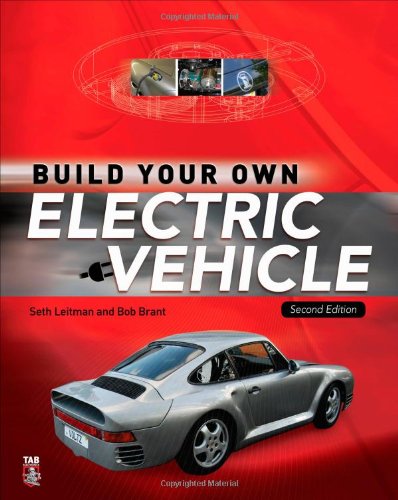
1. Build Your Own Electric Vehicle
$78.00
2. Electric Vehicle Technology Explained
$20.00
3. Electric Vehicle and the Burden
$51.69
4. Hybrid, Electric and Fuel-Cell
 
5. The New Electric Vehicles: A Clean
$121.00
6. Modern Electric, Hybrid Electric,
$79.85
7. Electric and Hybrid Vehicles:
$13.51
8. Electric Motors and Control Techniques
$24.95
9. Convert It!
$8.62
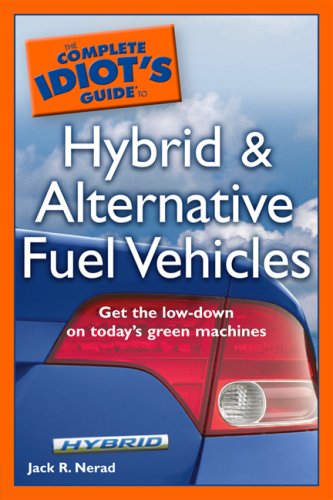
10. The Complete Idiot's Guide to
$34.31
11. The Electric Vehicle: Technology
 
$14.00
12. From Gasoline to Electric Power
$71.86
13. Lightweight Electric/Hybrid Vehicle
$86.50
14. Electric Vehicle Battery Systems
$99.00
15. IEC 61851-22 Ed. 1.0 b:2001, Electric
 
16. Electric vehicles: Design and
$13.87
17. Future Drive: Electric Vehicles
 
18. Building the E-Motive Industry:
$97.02
19. Propulsion Systems for Hybrid
 
20. The Complete Book of Electric

1. Build Your Own Electric Vehicle
by Bob Brant
 Hardcover: 310 Pages (1993-11)
list price: US$26.95
Isbn: 0830642323
Average Customer Review: 4.0 out of 5 stars
Canada | United Kingdom | Germany | France | Japan
Editorial Review

Book Description
Electric vehicles have many advantages over their gas-powered counterparts. They're ecologically sound, much cheaper to operate, and require almost no routine maintenance. Drivers can enjoy the clean-running convenience and economy of an electric vehicle for as much as it costs to buy a new car. This illustrated guide explains step by step how to build an inexpensive EV from a kit or convert an existing internal combustion engine. Build Your Own Electric Car begins with an informative history of electric vehicles, current international advances in EV technology, and a look ahead at the future of EV development. Then, author Bob Brant gives a building-block description of each EV component-motor, drive train, controllers, power supplies, chargers, and chassis-and how to put them all together to make a working vehicle. He also gives valuable advice on where to find affordable EV components and systems, how to get the most out of EV driving and ownership, and how to make the best buy, build, and conversion tradeoffs. ... Read more

Customer Reviews (21)

4-0 out of 5 stars A very good book, just needs a 2008 update to be perfect
I liked this book a lot, it reads well, it provides the "how to" information in the title but also a lot of background information. The only real defect I can find in it is the date of last update (1993). Suprisingly, most of what is said is still valid, but there are some things missing which did not exist then or were not mature enough. Some recommendations actually got even better: the "AC propulsion" system, which is already much praised in the book, went on to even greater success in the Tesla roadster. Just get someone (the author, if still active, or someone else) to update it for 2008 new technologies.

3-0 out of 5 stars This author is obsessed with mind maps!
The book is practically a collection of mind maps of various decision trees and other concepts... The text probably is adequate for designing a decent conversion. It's pretty useful if you don't mind the author's quirks.

3-0 out of 5 stars too much math and needs updating
I read the book and especially chapter 11 (actual conversion of the Ranger) I found the math in the book to be beyond my comprehension.I understood the point just to much math and explanation of the math.I have now read two books about converting cars to electric power.This book had more detail than the previous book which on one hand I liked.It would be nice to have an update on the book as this book was written over ten years ago there has been advancement in the areas of AC electric motor, controllers and batteries.

4-0 out of 5 stars Good place to start
This is a great first book to learn about electric vehicles.It includes history of EVs, design notes and formulas for those interested in predicting the results of a conversion.All written in a clear and understandable fashion, even for the novice, though even those with knowledge of EVs will learn.Lots of information so it takes some time to read, but is well worth it.

2-0 out of 5 stars Good, but outdated
This well written, engaging book was written in 1994, and badly needs to be updated. The technologies have changed (batteries, motors, controllers), the candidates for cars to convert have changed (for example, you need to be very careful with the computer-driven dashboards and controls of most cars built in the past 8-10 years), and the assumptions about oil prices, electricity prices, and the global energy picture have changed.
It is a little shocking that this book (and Michael Brown's Convert It, published in 1993 and not upbdated) are the only ones available for this exciting, rapidly changing field. ... Read more


2. Electric Vehicle Technology Explained
by James Larminie, John Lowry
Hardcover: 314 Pages (2003-12-19)
list price: US$160.00 -- used & new: US$78.00
(price subject to change: see help)
Asin: 0470851635
Average Customer Review: 5.0 out of 5 stars
Canada | United Kingdom | Germany | France | Japan
Editorial Review

Book Description
While the classic battery electric car continues to make only a small impact on the automobile market, other types of electric vehicle, especially hybrids, have made significant and promising improvements. Moreover, small battery electric vehicles such as bicycles and mobility aids are also developing well. Presenting more than 160 diagrams and pictures, this book explains the science and technology behind these important developments, and also introduces the issues that underpin the design and performance modelling of electric vehicles.

Electric Vehicle Technology Explained:

  • Encompasses a full range of electric vehicles: bicycles, mobility aids, delivery vehicles and buses – not just cars.
  • Covers all the basic technology relating to electric road vehicles – batteries, super capacitors, flywheels, fuel cells, electric motors and their controllers, and system design.
  • Considers the environmental benefits and disadvantages of electric vehicles and their component devices.
  • Includes case studies of a range of batteries, hybrids and fuel cell powered vehicles, from bicycles to buses.
  • Offers many MATLAB® examples explaining the design of appropriate computer prediction models.

Professionals, researchers and engineers in the electric vehicle industry as well as advanced students in electrical and mechanical engineering will benefit from this comprehensive coverage of electric vehicle technology.Download Description
"While the classic battery electric car continues to make only a small impact on the automobile market, other types of electric vehicle, especially hybrids, have made significant and promising improvements. Moreover, small battery electric vehicles such as bicycles and mobility aids are also developing well. Presenting more than 160 diagrams and pictures, this book explains the science and technology behind these important developments, and also introduces the issues that underpin the design and performance modelling of electric vehicles.

Electric Vehicle Technology Explained:

  • Encompasses a full range of electric vehicles: bicycles, mobility aids, delivery vehicles and buses – not just cars.
  • Covers all the basic technology relating to electric road vehicles – batteries, super capacitors, flywheels, fuel cells, electric motors and their controllers, and system design.
  • Considers the environmental benefits and disadvantages of electric vehicles and their component devices.
  • Includes case studies of a range of batteries, hybrids and fuel cell powered vehicles, from bicycles to buses.
  • Offers many MATLAB® examples explaining the design of appropriate computer prediction models.

Professionals, researchers and engineers in the electric vehicle industry as well as advanced students in electrical and mechanical engineering will benefit from this comprehensive coverage of electric vehicle technology." ... Read more

Customer Reviews (1)

5-0 out of 5 stars To the point and informative beyond words
This book is a fantastic resource for anyone even remotely interested in any aspect of electric/hybrid vehicle technology and design.It even provides Matlab code for performance modeling of vehicles incorporating a variety of fuel sources.I cannot recommend it highly enough! ... Read more


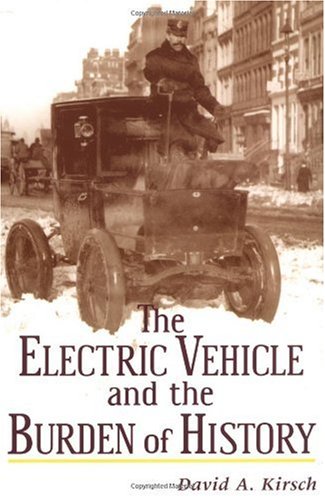
3. Electric Vehicle and the Burden of History
by David Kirsch
Paperback: 308 Pages (2000-08-01)
list price: US$22.00 -- used & new: US$20.00
(price subject to change: see help)
Asin: 0813528097
Average Customer Review: 5.0 out of 5 stars
Canada | United Kingdom | Germany | France | Japan
Editorial Review

Amazon.com
The electric vehicle of historian David Kirsch's title is an old technology that seems ever on the verge of making a comeback. In the late 1890s, the electric engine competed with steam- and gasoline-driven engines to become the standard for automobile manufacturers, and it remained competitive for nearly a decade until, in the early 1900s, the internal-combustion engine captured the market.

It did so for complex reasons, few of them, in Kirsch's account, having to do with purely technological issues. Enter the "burden of history," a fruitful notion that reminds us that deterministic ideas of why things are the way they are--for example, that the lead-acid battery held insufficient power to carry cars over long distances without recharging, thus ensuring the victory of the more easily replenished internal-combustion engine--are often only half-right, if that. Kirsch urges that those concerned with analyzing the wherefores of the past take into consideration multiple causes, and not always the most apparent ones. The automobile, he continues, is not simply a machine, but "a material embodiment of the dynamic interaction of consumers and producers, private and public institutions, existing and potential capabilities, and prevailing ideas about gender, health, and the environment." In short, the automobile is a system unto itself, and how it came to take its present form--unchanged in many respects for a hundred years--is a story that involves many episodes.

Kirsch's account of some of those episodes provides a solid case study for students of technological history, and for those who press for new means of transportation in the new century. --Gregory McNamee ... Read more

Customer Reviews (1)

5-0 out of 5 stars Great Read ... Interesting Thesis
Electric Vehicles giving way to the Internal Combustion Engine was not a given at the turn of the 20th century.

In the US, Electric Vehicles (EV) outsold the Internal Combustion Engine (ICE) significantly in 1900, and by WW2 the ICE was dominant and the last passenger EV company closed up shop. What happened? Why? Was this a foregone conclusion given what we know today?

This book examines the transportation network as it existed, and how EV's fit into it, the first book section detailing the ill-fated electric taxi monopoly (didn't fail because of the ICE, but a combination of mismanagement and poor quality) and the second talking about the foray into passenger cars. A large part of the market failure of EV's had nothing to do with the limitations of the battery technology as most people think.

Interesting to note that the ICE required both cheap fuel, and a purpose built transportation network **both didn't exist** in the early days. Through uniting the portions of the economy that feed into the cars and those that were to create its infrastructure network they managed to create a system where the ICE was to dominate. Once cheap oil was discovered in Texas, Henry Ford created the assembly line for the Model T, the stage was set for the highway building boom started in the 1920's.At that point the EV's didn't stand a chance - they had blown it by failing to achieve the level of united purpose 20 years earlier with their suppliers, the utility companies and the rest of the public infrastructure.The advantages of the ICE's technology weren't nearly the factor that we gather, since the infrastructure required to make the ICE successful was so much larger than the EV's at the time - the EV industry simply "blew it." (Though if the EV industry had succeeded we would have a very different transportation network than we do today)

We are at another crossroads - the assumptions and reasons for the ICE's dominance are under question.Petroleum prices have never been higher and promise to climb higher still, and the supply is less certain than ever given the current international situation. The combustion of oil over the last 100 years in service of transportation has created global climate change as well as severe air pollution in some metropolitan areas. We are seeing interest in electric, hybrid-electric and Fuel Cell based vehicles as possible "solutions" to these issues.Are we seeing the beginning of another period of change like the early 1900's?This book certainly offers an interesting perspective, as we challenge our infrastructure and question the decisions we have made for the last 100 years. ... Read more


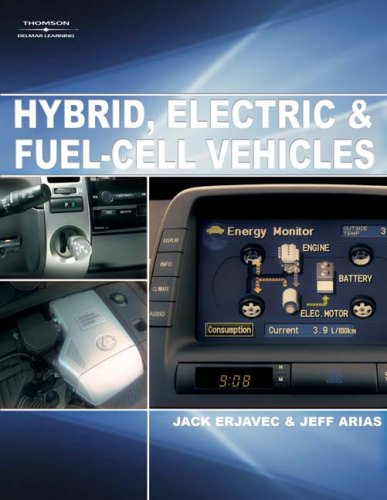
4. Hybrid, Electric and Fuel-Cell Vehicles
by Jack Erjavec, Jeff Arias
Paperback: 336 Pages (2006-11-03)
list price: US$68.95 -- used & new: US$51.69
(price subject to change: see help)
Asin: 1401881084
Canada | United Kingdom | Germany | France | Japan
Editorial Review

Book Description
Get all the information you need on the revolutionary vehicles that are gaining popularity in today's automotive industry.This easy-to-read book addresses the movement of technology towards new and upcoming electric vehicles, with a focus on the hybrids in use today and the fuel cell vehicles of tomorrow.Expansive coverage includes the political and social impact of these vehicles, as well as the basic theories of alternative vehicles as they relate to construction, electricity, batteries, and motors. The book ends with a look into the future, focusing in on vehicles under development. ... Read more


5. The New Electric Vehicles: A Clean & Quiet Revolution
by Michael A. Hackleman
 Paperback: 272 Pages (1996-04)
list price: US$25.00
Isbn: 0962958875
Canada | United Kingdom | Germany | France | Japan

6. Modern Electric, Hybrid Electric, and Fuel Cell Vehicles: Fundamentals, Theory, and Design (Power Electronics and Applications Series)
by Mehrdad Ehsani, Yimin Gao, Sebastien E. Gay, Ali Emadi
Hardcover: 424 Pages (2004-12-20)
list price: US$149.95 -- used & new: US$121.00
(price subject to change: see help)
Asin: 0849331544
Average Customer Review: 4.0 out of 5 stars
Canada | United Kingdom | Germany | France | Japan
Editorial Review

Book Description
Air quality is deteriorating, the globe is warming, and petroleum resources are decreasing. The most promising solutions for the future involve the development of effective and efficient drive train technologies. This comprehensive volume meets this challenge and opportunity by integrating the wealth of disparate information found in scattered papers and research.Modern Electric, Hybrid Electric, and Fuel Cell Vehicles focuses on the fundamentals, theory, and design of conventional cars with internal combustion engines (ICE), electric vehicles (EV), hybrid electric vehicles (HEV), and fuel cell vehicles (FCV). It presents vehicle performance, configuration, control strategy, design methodology, modeling, and simulation for different conventional and modern vehicles based on the mathematical equations.Modern Electric, Hybrid Electric, and Fuel Cell Vehicles is the most complete book available on these radical automobiles. Written in an easy-to-understand style with nearly 300 illustrations, the authors emphasize the overall drive train system as well as specific components and describe the design methodology step by step, with design examples and simulation results.This in-depth source and reference in modern automotive systems is ideal for engineers, practitioners, graduate and senior undergraduate students, researchers, managers who are working in the automotive industry, and government agencies. ... Read more

Customer Reviews (2)

5-0 out of 5 stars Modern Electric, Hybrid Electric, and Fuel Cell Vehicles: Fundamentals, Theory, and Design
It is a good textbook for studying electric vehicle and correspondence. It has paid much attention to explain the designing issues of an electric vehicle and tried to figure out what problems they are.
Good understanding for an electric vehicle.

3-0 out of 5 stars System Design, not Component Design
There is a dearth of books on hybrid gasoline-electric vehicles, so this book is welcome.However, the equations are not detailed enough for actual component design.There are no Simulink block diagrams, for instance, so a reader will be unable to do his own simulations directly from this book.The book is useful, though, for deriving the large scale parameters for a hybrid gasoline-electric vehicle or fuel cell-electric vehicle (power plant size, peak power source size, etc.)The worst chapter is Chapter 6, Electric Propulsion Systems.The authors throw numerous equations at the reader (for the various type of electric motor-generators), but with the symbols defined after the equations, and without any real derivation.Actual block diagrams (with real values) are not provided--so how is an automotive engineer supposed to use this material?

I've got other complaints.Chapter 3, Internal Combustion Engines, doesn't even discuss the Atkinson cycle--the one most commonly used in hybrid vehicles.(And of course the Satz engine, the most efficient engine ever designed, is not mentioned.)I was also expecting detailed descriptions of the Toyota Prius and Ford Escape/Mercury Mariner Hybrid drivetrains--no such luck, although this book is copyrighed 2005. The CVT discussion is minimal (there is on p. 135 a simple block diagram for the Prius drive train)--there should have been a detailed analysis and synthesis of eCVT, etc.

And another thing:the English in the book is substandard.I realize that for the foreign authors English is a second language, but still the CRC editors should have caught the many mistakes.For the next edition, please clean up the English and provide detailed Simulink diagrams, then I'll recommend it. ... Read more


7. Electric and Hybrid Vehicles: Design Fundamentals
by Iqbal Husain
Hardcover: 288 Pages (2003-03-12)
list price: US$99.95 -- used & new: US$79.85
(price subject to change: see help)
Asin: 0849314666
Average Customer Review: 2.5 out of 5 stars
Canada | United Kingdom | Germany | France | Japan
Editorial Review

Book Description
With advances driven by pressure from governments, environmental activists, and its associated industries, the subject of electric and hybrid vehicles is becoming increasingly important. Trends clearly suggest that we must educate the engineers of today and tomorrow in the technical details of these vehicles. While there are many books that provide narrative descriptions of electric and hybrid vehicle components, none cover the technical aspects from a mathematically derived, design point of view, and none serve well as a textbook.Electric and Hybrid Vehicles: Design Fundamentals presents a comprehensive, systems-level perspective of these vehicles that strikes an outstanding balance between technical details, design equations, numerical examples, and case studies. Starting with some historic background, the author describes the system components, the laws of physics governing vehicle motion, the mathematical relationships within and between the components, energy sources, and designing components to meet the complete vehicle specifications.As this text illustrates, the electric vehicle is an excellent example of electro-mechanical and electro-chemical systems, one that is technically challenging as well as highly motivating to engineering students. The material presented is designed to be covered comfortably in a one-semester course. Its multidisciplinary nature and systems approach makes Electric and Hybrid Vehicles ideal for teaching electrical, mechanical, and chemical engineers all in one course. ... Read more

Customer Reviews (5)

2-0 out of 5 stars Too Academic
Very academic.A lot of electrical theory not much practical advice for building an EV.The book is designed for university students I think.

4-0 out of 5 stars Solid on Fundamentals
Dr. Husain is an Electrical Engineer, therefore his book focuses primarily on the electrical, magnetic, electromagnetic & electromechanical aspects of EV & HEV vehicle design. From this perspective, his book is very solid on fundamental EV & HEV design considerations and component analyses. However, the continuously variable transmission (CVT)... including planetary gearsets (used in CVTs to combine/split torque) is a key HEV component. Consequently, I view omitting their discussion as dissapointing. On the other hand, Dr. Husain's text is very well written/edited and his style of explaining technical details is conversational, yet professional. I recommend this book without hessitation.

1-0 out of 5 stars Question the MF Momen review...
One must temper the fact that M. F. Momen has written papers with the author.Such as "Lightly Ferromagnetic Rotor Bars for Three-Phase Squirrel-Cage Induction Machines".

I have not read this book but rate it as the first reviewer since the other review is invalid.

1-0 out of 5 stars Hard to follow, not much pratical information
This book is very hard to follow.The author presents examples (and sometimes answers) without outlining how to solve the problems.This is very frustrating!Most of the work in the book is calculus-based which would not be a problem if the steps for deriving the equations were more explicit.The information is very theoretical with little practical relevance to electric car design.The author starts out by explaining generic vehicle mechanics and then jumps right into battery chemistry and motors. Very little effort is spent on the interrelationships between these elements.The author does a decent job describing motor fundamentals, but he does not spend much time discussing the practical limitations of the technology.The hybrid discussion is relegated to the last chapter of the book, and then only a few pages are devoted to explaining this technology. Most of the chapter is spent describing various thermodynamic cycles such as the Otto cycle and Rankine cycle.Curiously,at this point the author resorts to a very high level discussion of these cycles, using very little math to show the effects of the electric motor on the function and efficiency of the traditional ICE vehicle.

5-0 out of 5 stars A timely and valuable book in EV
This book is very helpful for an extensive overview of all the design perspectives regarding EV and HEVs. Very timely book and deserves to be a constant reference for ongoing EV research. ... Read more


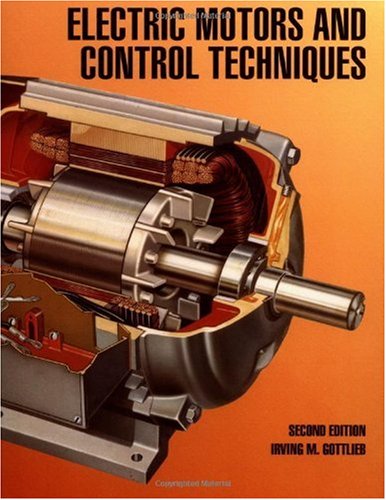
8. Electric Motors and Control Techniques
by Irving M. Gottlieb
Paperback: 304 Pages (1994-02-01)
list price: US$24.95 -- used & new: US$13.51
(price subject to change: see help)
Asin: 0070240124
Average Customer Review: 3.0 out of 5 stars
Canada | United Kingdom | Germany | France | Japan
Editorial Review

Book Description
Get greater flexibility, reliability, and reduced energy consumption from household appliances to automobiles. This book will show you how different types of motors operate and how electronic control devices can be used to improve efficiency in a wide range of applications. You'll get in-depth, updated coverage of: Electric motor control applications; dc and ac motors; Digital motors; Commutator-type motors; Noncommutator-types motors; Electric vehicles. ... Read more

Customer Reviews (6)

4-0 out of 5 stars A very useful survey
The author begins with plausible thought experiments that build to explain how common motors work. The remainder of the book is a large compendium of common circuits (both old and modern) used to control various motor types. His analysis of some designs were a bit oddly explained (but my background is RF and microwave design, not power electronics). I get something new and revealing every time I open the pages.

4-0 out of 5 stars Electric Motors and Control Techniques
I haven't completed the book as yet but to the point I am at it is very informative and easy to read.I do recommend this book...

1-0 out of 5 stars Disappointing
I was disappointed with this book. While full of detailed figures and schematics, the book is hodge-podge of information with very little logical flow. It jumps from 100,000 feet into the treetops with no explanation. The author peppers the book with his insights but without any context and background leaving the reader confused. As well, the book is dated given recent advancements in motor control technology.

5-0 out of 5 stars RichardNabuda@Email.MSN.com
Overall I found this to be an excellent book. I enjoyed every page, and in particular tracing out circuit operations of the various schematics. I thought the diversity of circuits was great.

Nowhere in the title did I see "Basics of" or Fundementals of". This is not a book for the novice. The reader must have a good understanding of AC and DC motors, and solid state theory, circiuts, and devices.

I found the concatenation of induction motors, and the Kramer speed control system very interesting. I have many old industrial control books, but none shows these systems.

There are several errors, and examples of such are: Page 44, Para 3 is completely wrong. The proper way to reverse direction of compound motors is to reverse A1 and A2. Page 57, para 2 relates to this proper method. Fig. 5-9 Q102 shows a JFET- should be a UJT. Fig. 5-13 Q1 same thing. Fig. 5-10 has negative 250 VDC lines to emitters of Q532-Q536 and Q552-Q556 missing. Eliminate lead from motor to bottom of C541. Fig. 6-11 motor will never reverse with this scheme. Turning dial in opposite direction FWD biasis Q2 turning on Q1 which energizes RY2. RY1 drops out turning system off. Motor never runs CCW.

I have a comprehensive technical library, and one of my books is by this author entitled "Design and Operation of Regulated Power Supplies". It's an old book, and it's full of solid state circuits. I am indebted to authors like Mr Gottlieb, for it's their writings that enabled me to learn solid state electronics.

2-0 out of 5 stars Electric Motors and Control Techniques
The information in this book is best suited to a physicist with a background in motors. If you don't already have a solid understanding about motors, servos and motor control already, then don't buy this book! The author covers far too much information at a very high level, makes too many assumptions about the reader's knowledge, and does not explain anything in easy-to-understand terms. ... Read more


9. Convert It!
by Michael Brown
Paperback: 128 Pages (1993-11)
list price: US$24.95 -- used & new: US$24.95
(price subject to change: see help)
Asin: 1879857944
Average Customer Review: 3.5 out of 5 stars
Canada | United Kingdom | Germany | France | Japan
Editorial Review

Book Description
This book is the leading how-to resource for electric car conversions.It combines Brown's years of professional automotive experience with down-to-earth language even an automotive beginner can understand.It is not written for the engineer in the laboratory, but for the home mechanic building his own car, and for the average person behind the wheel.Brown speaks to the reader as if talking to a friend in his garage.Before lifting a wrench, Brown answers the most frequently asked questions about electric cars: how fast will it go, how far will it go, how long will the batteries last, how pollution-free is it really, and many more.The conversion process itself begins with choosing an appropriate donor chassis, and stripping it of internal combustion components.Here Brown's experience provide numerous tips and tricks to make the later conversion process easier and more successful.Step by step, Brown leads the reader through the conversion.As each component comes up, Brown gives a little background on the different types available, and the pros and cons of each.He includes tips on layout, design and fabrication at each step, and discusses different approaches for different chassis, such as front wheel drive vs. rear wheel drive.By the end of the book, every part of the conversion process has been discussed.Brown wraps up with a procedure for testing and troubleshooting, and guidelines for normal driving, charging, and maintenance.The book is salted heavily throughout with photos and diagrams to illustrate its topics, and it includes a very thorough index.CONVERT IT has been chosen by the Department of Energy and by numerous schools across the country as the textbook for high school electric car conversion projects. ... Read more

Customer Reviews (18)

3-0 out of 5 stars step by step instructions
The book is a quick read and goes over the details of constructing an EV.Focuses mainly on the construction and is light on the background and concepts.

5-0 out of 5 stars convert it
in an era of gloabal warming, high gas prices and a growing feeling of helplessness its nice to have a book that tells you haw you can make a positive impact by doing your own conversion.

the steps are clear the layout is concise and when there are options they discuss pros and cons of your choices.

2-0 out of 5 stars Good but outdated
This well written, thoughtful book was written in 1993, and badly needs to be updated. The technologies have changed (batteries, motors, controllers), and the candidates for cars to convert have changed (for example, you need to be very careful with the computer-driven dashboards and controls of most cars built in the past 8-10 years).
It is a little shocking that this book (and Bob Brant's Build Your Own Electric Vehicle, published in 1994 and not upbdated) are the only ones available for this exciting, rapidly changing field.

4-0 out of 5 stars Actual step-by-step conversion explanation
First, the copy I got in 2007 is 126 pages with a color cover, bound with the kind of black fabric binding material they use at Kinko's. The pages are in order and all but a couple of the photos are perfectly clear. Oh, and it has an index; that's a nice touch missing from some books.

First published in 1989 but updated in 1990, and 1993. In *my* experience this makes it a very recent book on this subject. The electric car fad peaked back in the 70's and most books date from that time.

Brown actually attempts to take you through the step-by-step of converting your car to battery power. He includes component selection, wiring techniques, advice on battery boxes, etc. There's a lot of detail here.

He does skimp in some critical areas however. The machining of the mounting plate that adapts the electric motor to the old flywheel is kind of glossed over. I'm not sure your friendly local machine shop will help you with this, but I may be mistaken.

And since he lives in California, the fact that the resulting car will have no heater, no defroster, and no air conditioning doesn't matter to him. Oh, and you'll be adding 800 pounds to the weight to your selected vehicle.

I just don't see anyone actually doing this in 2007. You'd do better to buy a Prius or Insight, and maybe get one of the "plug-in" kits. Then at least you'd have a real car at the end of the day.

No one's ever sold a modern mass-produced battery powered electric car at a reasonable price, and I think with all the hybrids on the road, the sun has really set on the idea of a short-range battery only car.

What I REALLY wish he'd write about is how to convert a riding lawn mower to battery power. That's a project more of us could tackle, and you'd actually have something better than the original when you were done.

2-0 out of 5 stars Interesting but old material.
The book is somewhat interesting but the information in the book is old.
Information of engines and batteries was not up to date.
In my copy the pages was not in order (page 41 was followed by 40 the next was 42 and so on).
As I understand it the book was an icon when it came but now I'm sure there are better books. ... Read more


10. The Complete Idiot's Guide to Hybrid and Alternative Fuel Vehicles (Complete Idiot's Guide to)
by Jack R. Nerad
Paperback: 224 Pages (2007-08-07)
list price: US$14.95 -- used & new: US$8.62
(price subject to change: see help)
Asin: 1592576354
Average Customer Review: 3.5 out of 5 stars
Canada | United Kingdom | Germany | France | Japan
Editorial Review

Book Description
New hope for motorists.

With the rise in gasoline costs, the hybrid car has exploded into the fastest-growing segment of the American car industry. This book sorts out the dizzying array of choices faced by American motorists. In clear, jargon-free language, Nerad explains the nature of each kind of car and their advantages and disadvantages, so consumers can make a practical choice.
—The only book that includes all alternative fuel vehicles, including the hybrid
... Read more

Customer Reviews (2)

5-0 out of 5 stars Wonderful source of information
Jack Nerad won't tell you "buy this car" or "this is the answer to all your problems." What he does is far better than that. He provides a wealth of information on the true state of our oil reserves, how car emissions affect the environment, the spectre of global warming, and so on. And he does it by providing, in as unbiased a manner as possible (where unbiased means providing relevant information no matter which "side" it seems to come down on---it doesn't mean the current trend of trying to pretend that every theory out there is equally valid so as to avoid angering anyone), as much information as possible. There's so much packed into this little book that I constantly found myself repeating tidbits to my husband; I'm not a car person, but I found this stuff fascinating.

For instance, it's illuminating to learn a few things about automobile history. I daresay most folks buying cars and arguing over the viability of various types of engines today have no idea that the first cars didn't have gasoline engines, and that this is hardly the first time in history that automobile manufacturers have worked feverishly on things such as electric or hybrid cars. Or that the Prius was operating on the roads in Japan for several years before it debuted in the US. I was also surprised to learn about "clean diesel" technology in use in other countries, that our regulators are having trouble figuring out what to do with. This may not seem relevant right now since it isn't available here now, but if it becomes available I'd like to be able to approach it knowledgeably, rather than with the knee-jerk media-fed "ewwww, diesel" reaction.

Nerad goes into the advantages and disadvantages of hybrids, electrics, clean diesel, biodiesel, flex fuel, hydrogen fuel cell, and other current and proposed technologies---not those advantages and disadvantages that the media likes to tout, but the ones that simply affect your decisions as a buyer, as someone who hopefully cares about the environment, and as someone who has to weigh the benefit to the environment against what you're willing and able to pay. He delves into safety issues with each type of engine, repair costs, operation costs, maintenance costs, purchase price differences, projected savings (or not) over the life of the car (a general analysis that you can plug your own numbers into based on current fuel and car prices), convenience, and so on. You'll be able to figure out what type of car might work best if you have a large family to haul around, vs. what will work best if you have a two-hour commute every morning at highway speeds.

All of this information is provided in as simple-yet-complete a manner possible. I truly feel that when we're ready to buy our next car, this will arm us with what we need to make a choice that will benefit our wallets as well as the environment. Nerad could have stuck to a simple run-down of conventional hybrid vehicles, but I think he would have done the reader a disservice by doing so; by including so much information he made this book more useful in the long term. Hopefully it will help to show people that we don't have to stick to tried-and-true technologies in our search for a better solution.

2-0 out of 5 stars Timely book but not well thought out
This book appears to have been written in early 2007. He is aware of the coming change to EPA Fuel economy standards but doesn't know the details. It's good that he mentions the coming change at all, since anyone comparing 2008 cars to those he's writing about must be aware of this fact!

The book consists of 12 chapters:

1. Challenges to our mobility
2. Brief history of alternative fuels
3. Green for sale today
4. Gasoline-Hybrid vehicles
5. Flex Fuel/E85 vehicles
6. Natural gas vehicles
7. Clean diesel and bio-diesel
8. New tech gasoline vehicles
9. Electric cars
10. What about my car
11. Which vehicle is right for you
12. Coming attractions

I am primarily interested in hybrids, so I read chapters 1-4 closely (56 of the 189 pages in the book).

In Chapter 1 he proceeds to debunk global warming, and explain that we will never run out of gas (at least not until the next century). I think he's trying to be even-handed and explain all the pluses and minuses to each theory, but his reasoning is pretty un-supported (we'll find more oil reserves in the future, because we always have in the past).

In Chapter 2 he debunks steam cars and turbine gas cars. Again, he doesn't know very much about steam cars, but his general info is just OK.

In Chapter 3 he explains how nuclear power plants might make electricity so cheap they can put charging stations everywhere and not meter their usage. I live next door to one nuclear power plant already, let's pray he's wrong about there being more of these monstrosities (IMHO).

Chapter 4 begins by poking holes in the "bybrid hype". Huh? I haven't heard much of anything about hybrids, much less the hype. He says "sure you can save gas, but what about the added maintenance for all those electric bits" (I paraphrase). Too bad he didn't do a little more research here too. My Prius has no maintenance on the electric bits, no more than my washing machine's motor at home. And he forgot that a car like the Prius has no clutch, no torque converter, no starter motor, etc.

My reading stopped there because I am not interested in diesel cars. You know why? Because here are *no* high-mileage diesels for sale in the USA as of October 2008. The same is true for natural gas cars and electric cars (at least not in North Carolina).

So I have three problems with this book:

#1 - Either he doesn't like hybrid cars, or he has overcompensated in attempting to be even-handed.
#2 - His knowledge is pretty superficial.
#3 - He spends way too much time on things that consumers can't purchase now, or perhaps ever (hydrogen cars, high MPG diesels, etc.)

If you're going to buy a car, go read The Essential Hybrid Car Handbook: A Buyer's Guide. On the other hand, if you're writing a high-school paper on alternative fuels, this book is for you.

... Read more


11. The Electric Vehicle: Technology and Expectations in the Automobile Age
by Gijs Mom
Hardcover: 440 Pages (2004-03-22)
list price: US$57.00 -- used & new: US$34.31
(price subject to change: see help)
Asin: 0801871387
Average Customer Review: 4.0 out of 5 stars
Canada | United Kingdom | Germany | France | Japan
Editorial Review

Book Description

Recent attention to hybrid cars that run on both gasoline and electric batteries has made the electric car an apparent alternative to the internal combustion engine and its attendant environmental costs and geopolitical implications. Few people realize that the electric car -- neither a recent invention nor a historical curiosity -- has a story as old as that of the gasoline-powered automobile, and that at one time many in the nascent automobile industry believed battery-powered engines would become the dominant technology. In both Europe and America, electric cars and trucks succeeded in meeting the needs of a wide range of consumers. Before World War II, as many as 30,000 electric cars and more than 10,000 electric trucks plied American roads; European cities were busy with, electrically propelled fire engines, taxis, delivery vans, buses, heavy trucks and private cars.

Even so, throughout the century-long history of electric propulsion, the widespread conviction it was an inferior technology remained stubbornly in place, an assumption mirrored in popular and scholarly memory. In The Electric Vehicle, Gijs Mom challenges this view, arguing that at the beginning of the automobile age neither the internal combustion engine nor the battery-powered vehicle enjoyed a clear advantage. He explores the technology and marketing/consumer-ratio faction relationship over four "generations" of electric-vehicle design, with separate chapters on privately owned passenger cars and commercial vehicles. Mom makes comparisons among European countries and between Europe and America.

He finds that the electric vehicle offered many advantages, among them greater reliability and control, less noise and pollution. He also argues that a nexus of factors -- cultural (underpowered and less rugged, electric cars seemed "feminine" at a time when most car buyers were men), structural (the shortcomings of battery technology at the time), and systemic (the infrastructural problems of changing large numbers of batteries) -- ultimately gave an edge to the internal combustion engine. One hopes, as a new generation of electric vehicles becomes a reality, The Electric Vehicle offers a long-overdue reassessment of the place of this technology in the history of street transportation.

... Read more

Customer Reviews (1)

4-0 out of 5 stars A European Perspective on EV's ... But a Bit Dry ...
This is a book about the rise and decline of the electric car and the formation of the modern transportation network from the 19th century.It is an interesting topic, and this book tells the tale from a European perspective, where the ending is the same (EV's declined, the ICE tiumphed) but the path to the ending is a little different.

I really liked the meticulous data, graphs and detail showing theuses and comparing the EV to the ICE and the use of them compared to the size of the cities.What is interesting is that in Europe the EV as a mainstream vehicle lasted a lot longer in the form of fleet vehicles than in the US (In the US the EV stopped being sold in the Depression, in Europe it lasted until the 1950's).

All the data and graphs make for a rather dry read, and if there is a complaint, it is this.First and foremost I was looking for a good read, and I feel I have an academic textbook.

If you want a good read, there are other books out there that provide it.If you want a European perspective, and don't mind the textbook like read, this is a decent pick! ... Read more


12. From Gasoline to Electric Power
by Gary D. Powers
 Paperback: 114 Pages (1997-12-01)
list price: US$15.00 -- used & new: US$14.00
(price subject to change: see help)
Asin: 0966095308
Canada | United Kingdom | Germany | France | Japan
Editorial Review

Book Description
Here is a story of how one individual converted an old pickup truck from gasoline to electric power.The author received a big assist from an experienced conversion compnay located hundreds of miles away.The book is not a how-to technical manual, but it chronicles what happended from start to finish.The story is often humorous, since the author was highly motivated but lacked the automotive experience and mechanical and electrical skills to efficiently complete the plan.This book is a must-read for anyone considering such a project. ... Read more


13. Lightweight Electric/Hybrid Vehicle Design (Automotive Engineering)
by John Fenton, Ron Hodkinson
Perfect Paperback: 320 Pages (2001-06)
list price: US$0.95 -- used & new: US$71.86
(price subject to change: see help)
Asin: 0750650923
Canada | United Kingdom | Germany | France | Japan

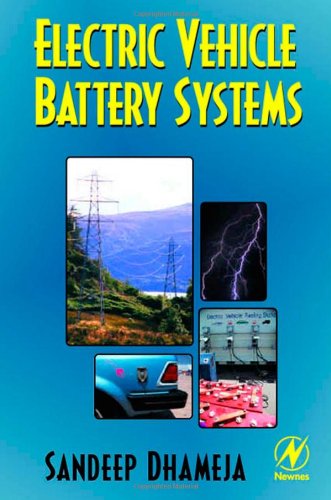
14. Electric Vehicle Battery Systems
by Sandeep Dhameja
Hardcover: 252 Pages (2001-09-25)
list price: US$91.95 -- used & new: US$86.50
(price subject to change: see help)
Asin: 0750699167
Average Customer Review: 1.0 out of 5 stars
Canada | United Kingdom | Germany | France | Japan
Editorial Review

Book Description
Electric Vehicle Battery Systems provides operational theory and design guidance for engineers and technicians working to design and develop efficient electric vehicle (EV) power sources. As Zero Emission Vehicles become a requirement in more areas of the world, the technology required to design and maintain their complex battery systems is needed not only by the vehicle designers, but by those who will provide recharging and maintenance services, as well as utility infrastructure providers.Includes fuel cell and hybrid vehicle applications.

Written with cost and efficiency foremost in mind, Electric Vehicle Battery Systems offers essential details on failure mode analysis of VRLA, NiMH battery systems, the fast-charging of electric vehicle battery systems based on Pb-acid, NiMH, Li-ion technologies, and much more. Key coverage includes issues that can affect electric vehicle performance, such as total battery capacity, battery charging and discharging, and battery temperature constraints. The author also explores electric vehicle performance, battery testing (15 core performance tests provided), lithium-ion batteries, fuel cells and hybrid vehicles. In order to make a practical electric vehicle, a thorough understanding of the operation of a set of batteries in a pack is necessary. Expertly written and researched, Electric Vehicle Battery Systems will prove invaluable to automotive engineers, electronics and integrated circuit design engineers, and anyone whose interests involve electric vehicles and battery systems.

* Addresses cost and efficiency as key elements in the design process
* Provides comprehensive coverage of the theory, operation, and configuration of complex battery systems, including Pb-acid, NiMH, and Li-ion technologies
* Provides comprehensive coverage of the theory, operation, and configuration of complex battery systems, including Pb-acid, NiMH, and Li-ion technologies ... Read more

Customer Reviews (1)

1-0 out of 5 stars Outdated book written by an amateur
In "Electric Vehicle Battery Systems", there is no information on the author's, Sandeep Dhameja's, education. His occupation at the time of publication (2002) seems to be in the field of business consulting. That his education, if any, is not in a technical field at all, becomes credible when reading statements like "... specific power greater than 200 Whr/kg" (p. 13), or "Specific Power: 150-200 Wh/L" (p. 44). Standard (SI) units are used in confusing mixture with non-standard units, even in the same equation, like: "Electrode size: 14.7cm x 29.7cm = 67.7in2" (p. 42). Language usage is poor and the book does not seem to have been proofread. Almost all the discussion in the book refers either explicitly or implicitly to two battery technologies that are outdated for EV energy storage purposes: valve-regulated lead-acid (VRLA), and NiMH. Li-ion, which has currently taken over in the industry as a vastly superior technology, is mentioned mainly as a "promising future technology", which, of course, was more or less true in 2002. I give the book one star because in all this desert, there is the occasional cactus of useful information. Regardless of the time factor, Butterworth-Heinemann should be ashamed of themselves for this publication. ... Read more


15. IEC 61851-22 Ed. 1.0 b:2001, Electric vehicle conductive charging system - Part 22: AC electric vehicle charging station
by IEC TC/SC 69
Paperback: 50 Pages (2007-08-19)
list price: US$99.00 -- used & new: US$99.00
(price subject to change: see help)
Asin: B000XYSAJG
Canada | United Kingdom | Germany | France | Japan
Editorial Review

Product Description
This part of IEC 61851, together with part 1, gives the requirements for a.c. electric vehicle charging stations for conductive connection to an electric vehicle, with a.c. supply voltages according to IEC 60038 up to 690 V. ... Read more


16. Electric vehicles: Design and build your own : first in a series
by Michael A Hackleman
 Unknown Binding: 202 Pages (1977)
list price: US$9.95
Isbn: 0915238179
Canada | United Kingdom | Germany | France | Japan

17. Future Drive: Electric Vehicles And Sustainable Transportation
by Daniel Sperling
Paperback: 191 Pages (1994-12-01)
list price: US$22.00 -- used & new: US$13.87
(price subject to change: see help)
Asin: 155963328X
Average Customer Review: 4.5 out of 5 stars
Canada | United Kingdom | Germany | France | Japan
Editorial Review

Book Description

In Future Drive, Daniel Sperling addresses the adverse energy and environmental consequences of increased travel, and analyzes current initiatives to suggest strategies for creating a more environmentally benign system of transportation. Groundbreaking proposals are constructed around the idea of electric propulsion as the key to a sustainable transportation and energy system. Other essential elements include the ideas that:

  • improving technology holds more promise than large-scale behavior modification
  • technology initiatives must be matched with regulatory and policy initiatives
  • government intervention should be flexible and incentive-based, but should also embrace selective technology-forcing measures
  • more diversity and experimentation is needed with regard to vehicles and energy technologies
Sperling evaluates past and current attempts to influence drivers and vehicle use, and articulates a clear and compelling vision of the future. He formulates a coherent and specific set of principles, strategies, and policies for redirecting the United States and other countries onto a new sustainable pathway. ... Read more

Customer Reviews (2)

5-0 out of 5 stars An excellent resource for students writing reports on EVs.
This book is a must read for anyone interested in electric vehicles and their possible role in the future of the United States transportation industry. Sperling's writing style is clear and easy to understand, and hisideas are well-developed and soundly grounded in science. This book makesan excellent resource for students writing on electric vehicles (the mainreason I picked it up) or anyone simply interested in electric vehicles asan alternative form of transportation for themselves or their community.After reading, the reader is thoroughly convinced that the development andpromotion of electric vehicles are necessary if we are to avert theimpending ecological disaster caused by polluted air and the looming gascrunch.

4-0 out of 5 stars Informative.The future of American Transportation.
This book examines the existing transportation delema that we face, with the ever bourgening automobile mode of travel.The Future of sustainable Transportation is possible with new technologies, and is outlined in this book.A must read if you are worried about the tons of pollutants that you as an individual are pumping into the atmosphere ... Read more


18. Building the E-Motive Industry: Essays and Conversations About Strategies for Creating an Electric Vehicle Industry
 Hardcover: 220 Pages (1995-02)
list price: US$29.00
Isbn: 1560915609
Canada | United Kingdom | Germany | France | Japan

19. Propulsion Systems for Hybrid Vehicles (Power & Energy)
by John M. Miller
Hardcover: 456 Pages (2003-12)
list price: US$119.00 -- used & new: US$97.02
(price subject to change: see help)
Asin: 0863413366
Canada | United Kingdom | Germany | France | Japan
Editorial Review

Book Description
The automotive industry is waking up to the fact that hybrid electric vehicles could provide an answer to the ever-increasing need for lower-polluting and more fuel-efficient forms of personal transport. This is the first book to give comprehensive coverage of all aspects of the hybrid vehicle design, from its power plant and energy storage systems, to supporting chassis subsystems necessary for realizing hybrid modes of operation. Key topics covered include hybrid propulsion system architectures, propulsion system sizing, electric traction system sizing and design, loss mechanisms, system simulation and vehicle certification.

Offering in-depth coverage of hybrid propulsion topics, energy storage systems and modelling, and supporting electrical systems, this book will be an invaluable resource for practicing engineers and managers involved in all aspects of hybrid vehicle development, modelling, simulation and testing. It will also be of interest to postgraduate students in the field. ... Read more


20. The Complete Book of Electric Vehicles
by Sheldon R. Shacket
 Paperback: 168 Pages (1979-06)
list price: US$9.95
Isbn: 0891960198
Canada | United Kingdom | Germany | France | Japan

  1-20 of 100 | Next 20
A  B  C  D  E  F  G  H  I  J  K  L  M  N  O  P  Q  R  S  T  U  V  W  X  Y  Z  

Prices listed on this site are subject to change without notice.
Questions on ordering or shipping? click here for help.

site stats