e99 Online Shopping Mall

Geometry.Net - the online learning center Help  
Home  - Science - Equations Differential (Books)

  Back | 21-40 of 100 | Next 20
A  B  C  D  E  F  G  H  I  J  K  L  M  N  O  P  Q  R  S  T  U  V  W  X  Y  Z  

click price to see details     click image to enlarge     click link to go to the store

$75.00
21. Partial Differential Equations
 
$25.64
22. Differential Equations
$50.00
23. Differential Equations and Their
$55.60
24. Partial Differential Equations
$17.13
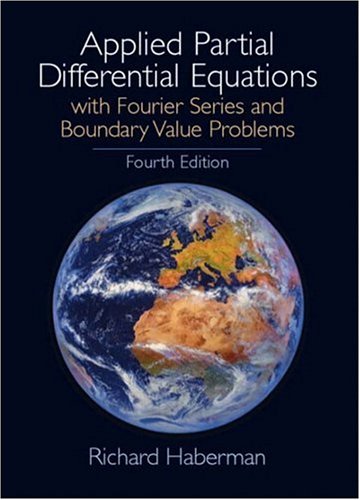
25. Applied Partial Differential Equations
$7.75
26. An Introduction to Ordinary Differential
$94.21
27. Differential Equations and Linear
$158.95
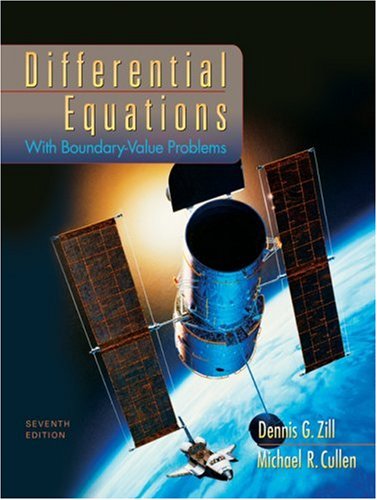
28. Differential Equations with Boundary-Value
$9.00
29. The Qualitative Theory of Ordinary
$37.00
30. Numerical Solution of Partial
$53.00
31. Ordinary Differential Equations
$87.99
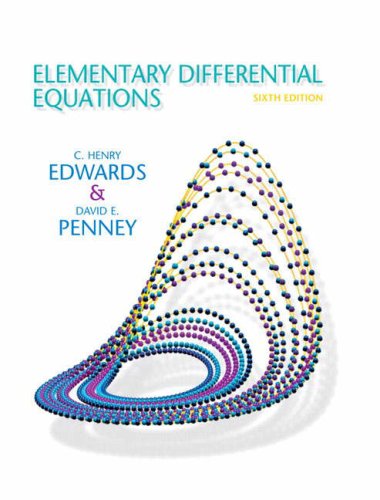
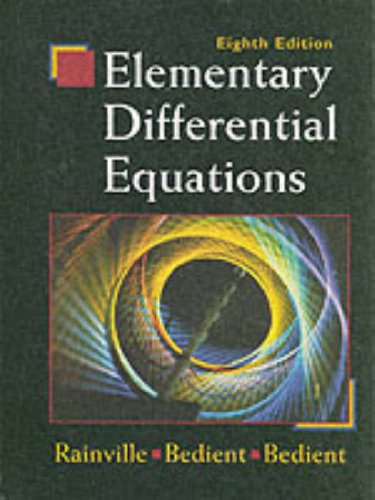
32. Elementary Differential Equations
 
$43.99
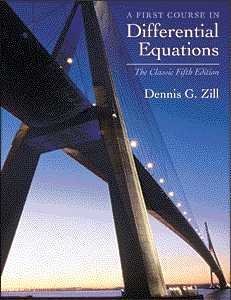
33. A First course in Differential
$3.93
34. Schaum's Easy Outline Differential
$11.73
35. Introduction to Partial Differential
 
$27.00
36. Elementary Differential Equations
$73.00
37. Theory of Ordinary Differential
38. Differential Equations: A Modern
$45.00
39. Introduction to Ordinary Differential
$16.21
40. Numerical Partial Differential

21. Partial Differential Equations (Graduate Studies in Mathematics, V. 19) GSM/19 (Graduate Studies in Mathematics)
by Lawrence C. Evans
Hardcover: 662 Pages (1998-06-01)
list price: US$79.00 -- used & new: US$75.00
(price subject to change: see help)
Asin: 0821807722
Average Customer Review: 4.5 out of 5 stars
Canada | United Kingdom | Germany | France | Japan
Editorial Review

Book Description
This text gives a comprehensive survey of modern techniques in the theoretical study of partial differential equations (PDEs) with particular emphasis on nonlinear equations. The exposition is divided into three parts: 1) representation formulas for solutions, 2) theory for linear partial differential equations, and 3) theory for nonlinear partial differential equations.

Included are complete treatments of the method of characteristics; energy methods within Sobolev spaces; regularity for second-order elliptic, parabolic, and hyperbolic equations; maximum principles; the multidimensional calculus of variations; viscosity solutions of Hamilton-Jacobi equations; shock waves and entropy criteria for conservation laws; and much more.

The author summarizes the relevant mathematics required to understand current research in PDEs, especially nonlinear PDEs. While he has reworked and simplified much of the classical theory (particularly the method of characteristics), he emphasizes the modern interplay between functional analytic insights and calculus-type estimates within the context of Sobolev spaces. Treatment of all topics is complete and self-contained. The book's wide scope and clear exposition make it a suitable text for a graduate course in PDEs. ... Read more

Customer Reviews (13)

4-0 out of 5 stars Clearly not for graduate students. Still very good!
Evans is not really worried about graduate students. However this book is essential for anyone that wants to have real (first) contact with nonlinear PDE. I'm sorry for the beginners but it has to be this way. If you are looking for some engineering do not buy it. Mathematician? What are you waiting for?

5-0 out of 5 stars A Fine Treatise on the Subject
This is a superb exposition of a difficult, yet enriching subject. This book is intended only as a beginning text (in a relative sense) and is by no means an attempt to give an exhaustive view of many topics discussed therein.

The first few chapters discuss classical solution techniques to frequently encountered PDEs such as the heat and Laplace equation. Methods of solution are discussed including Fourier transform methods and other classical methods to obtain strong solutions and/or representation formulas. The author, from this point, focuses on weak solution techniques for second order PDEs and systems in addition to conservation laws and other nonlinear PDEs. There is also a self-contained chapter on Sobolev spaces that proves to be fairly useful.

There is a necessary mathematical maturity needed to fully benefit from this text. The reader should be relatively comfortable with standard topics from classical analysis. It would help if the reader has seen Lebesgue spaces and is familiar with basic functional analysis and operator theory although many of these topics are reviewed in the apendices.

While this book is dense and difficult at times, it has a prominent place on my bookshelf.

4-0 out of 5 stars Solid opening, weak ending.
If you are just getting started in learning PDEs and want to see all the classical problems/solutions (Poisson, Laplace, Heat, and Wave Equations), then this book might be a little advanced for you, but it is solid in this content if you have a solid background in analysis (probably best to have at least one high-level analysis class that covers all the multivariable calculus materialas you will find that your ability to identify and use Green's Theorems will make life much easier as you get started). This is considered "Part I" of the book.

Once you have covered all the nice problems that don't exist in practice, you are ready to move onto general linear PDE theory in Part II of the book. I would recommend you complete a course in measure theory before you start in on chapter 5, which covers Sobolev spaces. I would then recommend that you complete a course in functional analysis before starting chapter 6 or 7 (chapters 5-7 are Part II of this book). This is not necessary as you will have access to a fairly complete appendix of functional analysis results in this book, but once you understand functional analysis and measure theory, then you will be able to grasp the idea of an elliptic (or in chapter 7, parabolic or hyperbolic) operator acting on a function space (the function space being a Sobolev space) more easily and these ideas won't seem so abstract. Overall, the second part of this book is great if you have a lot of the prerequisites I just suggested because many of the proofs can easily be made to be three to five times longer as many steps that link ideas in functional analysis are skipped. The proofs on higher regularity will be hard to understand your first time through, so I wouldn't worry about it too much. Read through the chapters and then read through the regularity stuff again. If you just want to get the basic ideas you can skip either the parabolic or hyperbolic section in chapter 7 because the techniques in solving either type of problem are fairly similar.

Once you are done with the linear PDE theory and are ready to start chapter 8, I recommend putting the book down and getting a different one. Evans gets fairly abstract in the nonlinear part of the book (Part III). I would recommend getting "Navier-Stokes Equations: Theory and Numerical Analysis" by Temam as it is a great source for nonlinear PDE theory and has more results and better proofs than Evans on this subject. I just feel like the Evans book is a great book to learn from for your first two semesters of PDEs at a graduate level, but after that it is time to change texts.

5-0 out of 5 stars The best book in PDE
If you want to learn PDE you have to study this book... as simple as that.

5-0 out of 5 stars Review of Book that i bought.
Partial Differential Equations (Graduate Studies in Mathematics, V. 19) GSM/19 (Graduate Studies in Mathematics)

The Book i bought was in good condition and was sent in time. The price of the book was also very reasonable and the packing was very good.

I have good words for Amazon about my first purchase. ... Read more


22. Differential Equations
by John Polking
 Paperback: 498 Pages (2005-09)
list price: US$34.40 -- used & new: US$25.64
(price subject to change: see help)
Asin: 0131437399
Average Customer Review: 2.5 out of 5 stars
Canada | United Kingdom | Germany | France | Japan
Editorial Review

Book Description
This text strikes a balance between the traditional and the modern. It covers all of the traditional material and more. It offers flexibility of use that will allow faculty at a variety of institutions to use the text. Includes a large number of graphics that display the ideas in ODEs; modeling and applications; and projects, which provide students with the opportunity to bring together much of what they have learned, including analytical, computational, and interpretative skills.Ideal for readers interested in learning about differential equations. ... Read more

Customer Reviews (9)

1-0 out of 5 stars this book should come with its own textbook
this book sucks-- plain and simple. Go and get some outlines and another textbook if you want to learn DiffE from this book. Examples are horrible, none of the problems correlate and this book just doesn't explain the in between steps. When i want to learn something, i need to see the complete though process, not spend hours trying to figure out how they got form point a to point b in the example.

4-0 out of 5 stars Great companion to lectures.
The most important thing to keep in mind would be the intended audience of this book. Specifically, the concepts outlined in this text should complement the content provided by a legitimate math instructors. If I were to use this book to self-teach or something of the sorts, I'm sure I would hate this book as well. Although the examples are sometimes unclear, the summaries of techniques are the most helpful parts in the book. At the end of a section, a blue box outlining the fundamental steps in a process reveals the simplest way to approach any problem. For example, this text's summary of Variation of Parameters pretty much sums up everything about that process in a clear and concise way.

Anyways, it's not as if you have any other choice when the instructor assigns this text as a required material. If looking for a self-teach sort of book, this text is not that great. But if you're looking for a review of ODEs and whatnot, I would recommend this book.

5-0 out of 5 stars Simply the best undergraduate text extant...
and I don't "do" hyperbole.

As a math instructor (and math student), I have seen texts on everything from fundamentals of math to real analysis.This book is more practical, clear, and concise than any of them.

Students will not only learn techniques to solve differential equations, they will learn the scope and limitations of each technique.A student who truly reads and absorbs this book will walk away with not only an understanding of but also a healthy skepticism toward mathematical models.The harsh realities of mathematical modeling, such as sensitive dependence on initial conditions, are emphasized rather than downplayed.In the section on motion problems, students are treated to a discussion of how solar system models have evolved.Models must adapt to explain new data.Sometimes a model can be "tweaked" at the expense of simplicity, while some models must be scrapped altogether.Scientific ideas are not gospel, but merely a description of the world as we see it today.

Unfortunately, this text is the ONLY book I have seen which truly addresses the issues described above (and that's very sad because my undergrad degree is in chemistry).Aspiring scientists and engineers need to learn intellectual flexibility as much as they need to learn facts and formulas.This book teaches both.

If the applications in this book were not so overwhelmingly excellent, I would have started this review by exalting the proofs and derivations.They too are unusually well done.The authors do an excellent job of choosing which proofs to include, and they make them as readable as humanly possible.(I hear the bitter chuckles of innumerable math students as I type the previous sentence...)

Yes, learning to read proofs IS hard.But, trust me, this book is where you want to start.First graders think adding and subtracting whole numbers is hard.They're right; for them, it is.But imagine how much harder it would be if first graders had to work with fractions!

To paraphrase Aristotle, "learning is painful".No one can make differential equations easy (why do you think scientists and engineers get paid so well?).However, the authors of this text make it as easy and pleasant as possible.

I suspect that students who disliked this book but were able to "learn" diff. eq. merely learned enough to pass the test.Students who do not take advantage of the learning opportunity provided by this book are doing themselves a serious disservice.

Take home message- buy it and make it the central element in your studies of differential equations.You will be glad you did.

1-0 out of 5 stars lack of examples and horrible explanations make a ghastly diffE text
Because the guy who initiated the project of writing the book is here at Rice, the rest of us are unlucky enough to have to use this book. If your class uses this book, prepare to go to class. All the time. That's because if you fall behind, the book does not do a good job of explaining things to you. Examples are generally vague and only apply to a few types of problems provided at the back of each section. A lot of the time, I'd find myself stumped on a problem, looking back, and realizing there was no example problem for me to get ideas from.

Yes there are lots of problems and that's good, in a way. But what's the point of having all those problems if the book never teaches you how to do them?

Furthermore, it is a poorly written book. Generally, reading through the book is like searching for a needle in a haystack. Literally speaking. You spend all that time figuring out what the authors talk about and once you figure it out, it was not even worth all that time.

So go to class. All the time. If the prof isnt that great, get yourself another workbook. I havent seen Schaum's but I'm pretty sure they'll do a better job on covering the topics than this text does.

1-0 out of 5 stars Worst book in Undergrad Career
tulane uses this book exclusively for diferential equation. This is t quite possible the worst text book i have ever used. They like to say that they don't put as much emphasis on specific solution techniques as they do to solving pratical equations. this means solution methos a briefly mention then sections up section are made of problem you should be able to solve if you were to know the solution methods. some sections don't even over solving differential equations at all. ... Read more


23. Differential Equations and Their Applications : An Introduction to Applied Mathematics (Texts in Applied Mathematics, Vol. 11)
by Martin Braun
Hardcover: 578 Pages (1992-12-05)
list price: US$69.95 -- used & new: US$50.00
(price subject to change: see help)
Asin: 0387978941
Average Customer Review: 4.5 out of 5 stars
Canada | United Kingdom | Germany | France | Japan
Editorial Review

Book Description
Used in undergraduate classrooms across the country, this book is a clearly written, rigorous introduction to differential equations and their applications. Fully understandable to students who have had one year of calculus, this book differentiates itself from other differential equations texts through its engaging application of the subject matter to interesting scenarios. This fourth edition incorporates earlier introductory material on bifurcation theory and adds a new chapter on Sturm-Liouville boundary value problems. Computer programs in C, Pascal, and Fortran are presented throughout the text to show the read how to apply differential equations towards quantitative problems. ... Read more

Customer Reviews (8)

5-0 out of 5 stars Great applications
This book discusses several excellent applications. I shall summarise a few of the simplest and most beautiful ones. Warfare models. Consider first a battle between two conventional armies, A and B. Each army has a constant efficiency coefficient (determined by weaponry, training, etc.): an A soldier takes out a enemies per unit time while a B soldier takes out b enemies per unit time. The battle is then described by the differential equations dA/dt=-bB and dB/dt=-aA. Dividing the first by the second gives aAdA = bBdB, which we integrate to get aA^2-bB^2=constant. The sign of this constant determines the outcome of the battle, since if, for example, there are side A troops still standing when B reaches zero then the constant must be positive. Thus the strength of an army is proportional to the square of its size, and this has an important strategical implication: never divide your forces. Now consider a battle between a conventional army A and a guerilla army G. The conventional army suffers casualties as before, dA/dt=-gG, while their offensive strategy consists in firing into the jungle more or less at random, making guerilla casualties proportional not only to the conventional army's efficiency a and size A but also the number of guerilla troops G, i.e. dG/dt=-aAG. Dividing the first equation by the second gives aAda=gdG and integrating gives (aA^2)/2-gG=constant. Thus the guerilla can divide its forces without loss, while the conventional army still does not want to divide its forces. Predator-pray systems. Consider the system of food fish and sharks. With no sharks around, the food fish would grow exponentially, x'=ax. The sharks alone, having nothing to eat, would die off exponentially, y'=-cy. In the combined system the food fish are eaten at a rate proportional to the number of encounters with sharks so x'=ax-bxy, and more sharks live as a result of this so y'=-cy+dxy. An equilibrium solution is x=c/d and y=a/b. We cannot find other solutions explicitly but we can prove that they are periodic (also very plausible from the direction field, should we choose to draw one; there are none anywhere in the book) and prove the following qualitative theorem: for any solution, the average number of food fish is c/d and the average number of sharks is a/b. Proof: Let x, y be solutions with period T. Take x'=ax-bxy and divide it by x to get x'/x=a-by. The integral of the left hand side from 0 to T is log(x(T))-log(x(0))=0, so the integral of the right hand side is also 0, so y-average=(1/T)(integral of y from 0 to T)=a/b. Similarly, taking y'=-cy+dxy, dividing by Ty and integrating from 0 to T gives x-average=c/d. Volterra used this result to explain why Italian fishers caught a larger percentage of sharks during world war I when overall fishing was reduced. If we assume that fishing by net simply catches a random handful of fish in proportion to their number then the system above becomes x'=ax-bxy-ex and y'=-cy+dxy-ey, i.e. x'=(a-e)x-bxy and y'=-(c+e)y+dxy, which is just the same system with different coefficients, making the new averages x=(c+e)/d and y=(a-e)/b. In other words: an increase in fishing benefits the food fish and a decrease benefits the sharks. Population growth. The standard model for population growth is the logistic equation p'=kp(1-p/s), where s is the maximum sustainable population. The observed periodicity of many populations is to be explained by a large population's susceptibility to epidemics, as is confirmed when we study an epidemiological model in detail later. But right after population growth we turn instead to the spread of technological innovations, which is not terribly exciting, but it can easily be translated into a simplistic model for the spread of a disease. The disease spreads in proportion to the size of the infected population p and, because of limited encounters as more people are infected, in proportion to the uninfected population (n-p), so p'=kp(n-p). But by factoring out the total population n we see that this is simply an instance of the logistic equation, where the total population corresponds to the sustainable population and the infected population corresponds to the living population. Thus mathematics tells us that the growth of a population is the spread of the decease of life.

4-0 out of 5 stars Differential Equations and Their Applications
From a pedagogy point of view this is a bad book becuase of the way its chapters are organized and presented. There seems to be a lack of a natural order of topic in the book, specifically that theory and applications are intertwined/overlappedrather than placed in seperate chapters. Also, few exercises are presented at the end of a section.
Putting aside the pedagogy philosophy, this is a great book for a one semester course in Differential Equations but I would rather choose "Differential Equations, The Classic 5th edition" by Dennis G. Zill.

5-0 out of 5 stars Outstanding clarity; this is an excellent text
This book is extraordinarily clear as well as being concise (but never too much so) in the mathematical parts.Discussion of applications is verbose, but is kept in separate sections; this material can be omitted entirely or read later without any detrimental effect to the flow of the book.However, the discussion of the applications is interesting and deep, and would be useful (and fun) for motivated students to read.

The book begins with a no-nonsense discussion of how to solve differential equations analytically.Unlike many books, it gives clear instructions to the reader as to how to know which techniques are applicable.Also, it does not introduce qualitative or numerical methods until it has already developed a number of analytic techniques, and in my opinion, this results in greater clarity than the path most books take of integrating (or should I say jumbling?) the material together.The book gradually and logically covers the ground between analytic and numerical, moving towards actually writing algorithms, which are included in the text.The emphasis is always on understanding.Exercises are straightforward and useful.

My only complaint is that, in this modern age, the C programs should be included in the text and the Pascal and FORTRAN ones relegated to the index.(It is the other way around, alas.)

This book is simply wonderful for anyone studying differential equations for the first time.I do not understand why undergraduate institutions use the more commercialized texts instead of ones like this.This is a great book; it would be excellent for a textbook or for self-study.

5-0 out of 5 stars A good comprehensive ODE book
I quite liked this book.It taught the material in a different order than I am used to, which gave me a more complete understanding.I would recommend it, especially to people who already know a bit about differential equations, as it is quite wordy and assumes some prior knowledge.

5-0 out of 5 stars Engaging and stimulating text
As an academic I rarely if ever use textbooks because I find their writing style bland and disengaging--especially in my own area (economics). Braun's text is the exception to the rule: this is a textbook that is so well written it could qualify as entertainment. At the same time the major issues in the field are covered well, complete with an overview of the linear algebra required for doing ODEs and a good introduction to nonlinearity and chaos. It may not, as one reviewer notes, provide a complete and rigorous coverage of this highly technical field, but it does what a text should do but so few achieve: it excites its readers and inspires them to delve further into this fascinating discipline. ... Read more


24. Partial Differential Equations (Applied Mathematical Sciences)
by Fritz John
Hardcover: 249 Pages (1991-11-20)
list price: US$69.95 -- used & new: US$55.60
(price subject to change: see help)
Asin: 0387906096
Average Customer Review: 5.0 out of 5 stars
Canada | United Kingdom | Germany | France | Japan

Customer Reviews (2)

5-0 out of 5 stars Very impressive
I'm very impressed by John's book on PDE's. Very complete, top down approach to the subject, while remaining lucid and concrete. It's the work of a master.

5-0 out of 5 stars Excellent summary of the most important PDEs!
I studied this book from cover to cover, and I found its explanations lucid and complete.F. John's writing style makes excellent reading, and the details he supplies are complete enough that anyone with only abackground in undergraduate multivariable calculus can understand thearguments.Like any good mathematics textbook, this one leaves the readerto work out his/her own steps at some points, but Dr. John always makes itclear which elements areneeded.This book will always have a place onthe shelf in my office. ... Read more


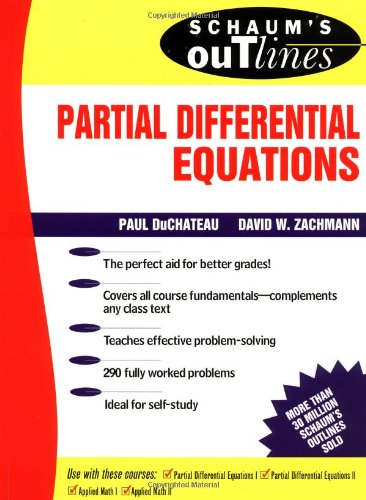
25. Applied Partial Differential Equations
by Paul DuChateau, David Zachmann
Paperback: 640 Pages (2002-02-11)
list price: US$26.95 -- used & new: US$17.13
(price subject to change: see help)
Asin: 0486419762
Average Customer Review: 4.5 out of 5 stars
Canada | United Kingdom | Germany | France | Japan
Editorial Review

Book Description

Superb introduction to numerical methods for solving partial differential equations, boundary-value and initial-boundary-value problems on spatially bounded and on unbounded domains; integral transforms; uniqueness and continuous dependence on data, first-order equations, and more. Numerous exercises included, with solutions for many at end of book.
... Read more

Customer Reviews (4)

4-0 out of 5 stars Great Book
This book is very well written and is worth every penny I paid for it. The authors are very clear,concise and understand the reader. The only drawback is that their Schaum's
Outline has the Finite Element Method, but this book, as detailed as it is, has for some reason omitted it. With that said, I still think the book is very well priced.

5-0 out of 5 stars Mad props
Everybody out there thinking of writing an Applied PDE textbook should just forget it, you're wasting your time... we already have a perfectly good one: it's here, and it's under $20. Comprehensive, understandable and way ahead of its time in appreciating the importance of numerical methods. With copious examples and stacks of problems, it's good as both a learning and a reference text. The only bad things I can find are a few typos in the finite difference chapters. Outstanding job.

4-0 out of 5 stars right mix of mathematics, physics, and numerics
Not very special book, but a beautiful price. Down the
line the goal is FEM, but it review different types of
equations with some mathematical rigor and physical
insight.

5-0 out of 5 stars It's about time this book is back in print.
Kudos to Dover for bringing this book back in print.We used
this book in a partial differential equations course at the
University of Pittsburgh a year ago.Unfortunately, the book
was out-of print then, and we had to use photocopies of the
original Harper & Row edition. (and the school bookstore charged
us about twice the $$ as the Dover edition costs.)The text
begins with the heat equation, and then progresses to more
complicated PDEs.The nice thing is that discrete methods are

introduced right from the start.I remember having a lot of fun
plugging discrete solutions of PDEs into Microsoft Excel and
seeing what the solutions looked like.The chapter on Fourier
Series is good, generalized Fourier series are covered, and
you will learn concepts such as pointwise and uniform convergen-
ce.Following that, there is a chapter on boundary-value
problems which covers Dirichlet, Neumann and Sturm-Liouville
problems.For both Cartesian and curvilinear coordinates.I
can't tell you what is in the later chapters, but if the rest
of the book is like the first three chapters, then it is a great
book, well worth the money. ... Read more


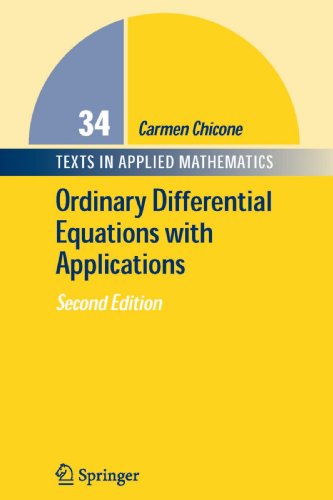
26. An Introduction to Ordinary Differential Equations (Dover Books on Advanced Mathematics)
by Earl A. Coddington
Paperback: 304 Pages (1989-03-01)
list price: US$12.95 -- used & new: US$7.75
(price subject to change: see help)
Asin: 0486659429
Average Customer Review: 4.5 out of 5 stars
Canada | United Kingdom | Germany | France | Japan
Editorial Review

Book Description

A thorough, systematic 1st course in elementary differential equations for undergraduates in mathematics and science, requiring only basic calculus for a background, and including many exercises designed to develop students' technique in solving equations. With problems and answers. Index.
... Read more

Customer Reviews (7)

5-0 out of 5 stars better than most
if you are looking for an introduction to ODEs that is 1. rigorous 2. accessible 3. concise; Then get this book.Good background for it would be some real analysis (Rudin), but if you did calculus from apostol then this still follows nicely.

5-0 out of 5 stars excellent book
I think this is one of the best books on the subject. If you really want to understand differential equations then you have to read an analysis book like this. The numerical recipes/methods books will teach you only how to program the computer to solve the the equations. This one will teach you WHY it works.

4-0 out of 5 stars An excellent text ... in 1970, not in 2003
I used this text as a reference over 25 years ago and it was great, for its time.Today, however, there are a number of books available with a more "modern" treatment - ones more likely to provide a more realistic view of the subject matter.

Arguably, ODE is a geometry course in disguise and not a collection of "party tricks" as it is often portrayed in older texts.Analytical methods are clean and easy to convey in the classroom but, frankly, they never appear in the "real world".

If you plan to (or do) encounter ODE's in your chosen field you'd do better to spend lots of time looking at qualitative and numerical techniques, i.e., a more up to date approach.

Coddington did a great job with the subtopics he did address but in the late sixties it would have been difficult, if not impossible, to really provide the reader with a solid feel for the depth and breadth of the subject.

5-0 out of 5 stars A great Introduction or review.
I took an undergraduate ordinary differential equations class and felt I grasped the subject quite well.I wanted an inexpensive text that I could review the subject with and I decided that I would give Coddington's book a try.I was really pleased with the order in which the text was presented which differed from the course I had taken.The author's seem to put things in a very logical order versus some texts I have seen which really confuse you by the order in which the subjects are presented.Another point that I have to make is the depth that the book has.I learned much more in reviewing this text than I ever did in any diff eq class.It shows the distinctionbetween linear and non-linear diff eq's and covered many other methods which I had not learned previously.This is a great text as a "refresher" or as a course text.I just wish I would have previously used this text to learn ordinary differential equations.

5-0 out of 5 stars Holy Bible for Introduction to differential equations UG
This book is a holy bible for introduction to differential equations. It is easy to understand and the problems are quite challenging. Dr Coddington knows how to explain the material by systematically order(Easy to tough). His book is not easy to figure out if you just sit without paper,pen and think. But once you are understand his book, no one can teach you differential equations for undergarduate level. Other suggested readingare Theory of ordinary differential equations, Linear ordinary differential equations by Earl Coddington(Both of them), Ordinary Differential Equations by Fritz John,and Ordinary Differential Equations by Edward L Ince. Once the most important statement is: YOU KNOW DIFFERENTIAL EQUATIONS IF YOU UNDERSTAND WHAT IS GOING ON IN CODDINGTON'S AND FRITZ JOHN BOOKS. ... Read more


27. Differential Equations and Linear Algebra (2nd Edition)
by Jerry Farlow, James E. Hall, Jean Marie McDill, Beverly H. West
Hardcover: 800 Pages (2007-01-05)
list price: US$137.00 -- used & new: US$94.21
(price subject to change: see help)
Asin: 0131860615
Average Customer Review: 2.0 out of 5 stars
Canada | United Kingdom | Germany | France | Japan
Editorial Review

Book Description
For sophomore-level courses in Differential Equations and Linear Algebra.

Extensively rewritten throughout, the Second Edition of this flexible text features a seamless integration of linear algebra into the discipline of differential equations. Abundant computer graphics, IDE interactive illustration software, and well-thought-out problem sets make it an excellent choice for either the combination DE/LA course or pure differential equations courses. The authors’ consistent, reader-friendly presentation encourages students to think both quantitatively and qualitatively when approaching differential equations — and reinforces concepts using similar methods to solve various systems (algebraic, differential, and iterative). ... Read more

Customer Reviews (8)

1-0 out of 5 stars I wish I could give it a 0 out of 5 stars
This textbook is the most vague textbook I have every read.The examples give no further explination or clarification.The text use terms such as "it is obviously" and "this way is pretty obvious".The homework problems assume that you do each problem in order because several problems reference previous problems for clarification.Several problems use methods discussed in the problems section and are not explained in the text.The book also assumes previous knowledge to be mastered.The authors have an understanding of math symbols that take the place of words (i.e. "such that"), but I don't.I need explinations of these symbols and it wouldn't have been difficult to insert a note.
I am disappointed that my school chose thise textbook to use.Avoid using this text for anything other than homework.I would rather read an "Idiots Guide to..." than study using this textbook.

1-0 out of 5 stars Could be little worse
This textbook has a number of problems:
1: It's expensive. I paid over $70, used, here on Amazon - it's over $120 new at the campus book store. This is particularly bad when you compare it to my other engineering calculus book, Thomas' Calculus 9th/Alternate edition - which is not only far cheaper (under $50, in good condition), it's also more than twice as long as Farlow's Diff. EQ.

2: It's *extremely* technical. The descriptions are designed for a mathematics major. I am an engineering major - for my purposes, it is more important to understand the material and develop problem-solving skills than it is to learn abstract high-level mathematical concepts. Having technical descriptions is fine, but this text doesn't follow them up with "quick and dirty" methods and formulas. Thomas' Calculus, 9th ed., is far more approchable in this regard.

3: The examples suck. They are too easy, too watered down, and there aren't enough of them. The text expects us to transform a few simple examples into the knowledge to do a whole series of complex problems.

4: The problems are hard. Very hard. Sometimes, new concepts are introduced with a sentence or two *right in the problem set*.

The purpose of the text is to teach the material and compliment the lectures by providing realistic problems. This text does neither.

1-0 out of 5 stars I'm certainly glad I'll never have to take another calc class after dealing with this crap
This is by far the absolute worst math book I have ever had the misfortune of using. The discussions teach everything using either completely abstract formulae or by using the absolute easiest example of that problem type. Then you get to the questions, which expect you to have mastered the concept of the preceding 10 pgs or so and be able to extrapolate these concepts to other topics (which the book offers no explanation of how to do). Overall, I would say you're better off learning this material from your cat's litter box, as it will probably make more sense. Also, i'm sure your cat put more effort into its litter box than the author's of this text put into writing this text.

1-0 out of 5 stars Trash
This book's attempts to teach anything do anything but teach. Each section has about ten pages of explanation followed by a bunch of problems. Unfortunately the explanations do anything but explain to people that are trying to learn math. If you're a math wiz you might be able to decrypt what they're talking about, but as a student I had no idea. In the examples the authors often use explanations such as "it is obvious that..." and "we remember from..." The lack of explanation (mainly laziness on the authors' part) makes it very hard to follow what they're talking about,and the problems afterwards often expect the reader to know things that weren't discussed or appeared as a one-sentence blurp in the margin. So unless you're a massochist or already know this stuff like the back of your hand and need a reference guide, spend your money someplace else.

2-0 out of 5 stars Craptacular
Unless you use this book straight away after taking an intensive Calculus II course, you're going to have absolutely no clue how they are doing any of the problems. They leave the "explanations" at an unacceptably high-level abstraction so that only those very freshly well-versed in Calculus can venture an understanding. Also contains no refreshers, not even a simple list of common integrals or integration formulas from Calculus. Just a crappy book, in my opinion. ... Read more


28. Differential Equations with Boundary-Value Problems
by Dennis G. Zill, Michael R. Cullen
Hardcover: 640 Pages (2008-04-04)
list price: US$158.95 -- used & new: US$158.95
(price subject to change: see help)
Asin: 0495108367
Average Customer Review: 3.5 out of 5 stars
Canada | United Kingdom | Germany | France | Japan
Editorial Review

Book Description
This Fourth Edition of the expanded version of Zill's best-selling A FIRST COURSE IN DIFFERENTIAL EQUATIONS WITH MODELING APPLICATIONS places an even greater emphasis on modeling and the use of technology in problem solving and now features more everyday applications. Both Zill texts are identical through the first nine chapters, but this version includes six additional chapters that provide in-depth coverage of boundary-value problem-solving and partial differential equations, subjects just introduced in the shorter text. Previous editions of these two texts have enjoyed such great success in part because the authors pique students' interest with special features and in-text aids. Pre-publication reviewers also praise the authors' accessible writing style and the text's organization, which makes it easy to teach from and easy for students to understand and use. Understandable, step-by-step solutions are provided for every example. And this edition makes an even greater effort to show students how the mathematical concepts have relevant, everyday applications.

Among the boundary-value related topics covered in this expanded text are: plane autonomous systems and stability; orthogonal functions; Fourier series; the Laplace transform; and elliptic, parabolic, and hyperparabolic partial differential equations, and their applications. ... Read more

Customer Reviews (17)

2-0 out of 5 stars diffcult text for the DE student
The written derivations and examples were brief and difficult to understand. I gave up on using this book for learning DE,only use to practice problems required for assignment. After finding alternative study links, did the DE aspects become clearer. Solution manual did not bring much to the table either.

4-0 out of 5 stars other DE books to choose from
I've run down most, if not all, of the available introductory DE books in my review of Boyce/Diprima (a book to be avoided by the way): Elementary Differential Equations and Boundary Value Problems , 8th Edition, with ODE Architect CD

4-0 out of 5 stars ADVANCED MATHMATICS
IT'S A GREAT BOOK FOR MATH LOVERS. YET IN THE EXAMPLES THROUGHOUT THE BOOK THE AUTHOR SKIPS MANY STEPS, SO YOU HAVE TO KNOW ALGEBRA, INTEGRATION, DIRRENTATION, AND SUMS VERY WELL TO UNDERSTAND WHAT THE AUTHOR IS DOING.

2-0 out of 5 stars Dense; Not for Self Study.
VCR directions. Especially how it explains variation of parameters (2.3). If you are a math whiz, this text is for you. If not, try to get a copy of Dr. Kapoor's _Differential Equations: Step by Step E-Z Math Cards_. By the way, Zill's Solutions Manuel simply omits explanations for many odd-numbered problems, so good luck.

4-0 out of 5 stars Old, but good
This is a good introduction to DE without alot of the unnecessary textual pollution often found in math texts.It's been around awhile (I used this one some years ago) but I found it was among the simplest, clearest, and best-written math texts because its approach assumes no prior knowledge of DE.From basic equations such as the famous Bernoulli to more complicated boundary-value issues, I was able to gain a solid and more complete understanding of the multivariable calculus I had just attended as well as preparation for higher math.Although it's been awhile, I do recall some errors in this book (as another reviewer has mentioned), so be aware.

Recommended. ... Read more


29. The Qualitative Theory of Ordinary Differential Equations: An Introduction
by Fred Brauer, John A. Nohel
Paperback: 320 Pages (1989-02-01)
list price: US$16.95 -- used & new: US$9.00
(price subject to change: see help)
Asin: 0486658465
Canada | United Kingdom | Germany | France | Japan
Editorial Review

Book Description

Superb, self-contained graduate-level text covers standard theorems concerning linear systems, existence and uniqueness of solutions, and dependence on parameters. Major focus on stability theory and its applications to oscillation phenomena, self-excited oscillations and regulator problem of Lurie. Bibliography. Exercises.
... Read more

30. Numerical Solution of Partial Differential Equations: An Introduction
by K. W. Morton, D. F. Mayers
Paperback: 278 Pages (2005-04-11)
list price: US$50.00 -- used & new: US$37.00
(price subject to change: see help)
Asin: 0521607930
Average Customer Review: 4.0 out of 5 stars
Canada | United Kingdom | Germany | France | Japan
Editorial Review

Book Description
This second edition of a highly successful graduate text presents a complete introduction to partial differential equations and numerical analysis. Revised to include new sections on finite volume methods, modified equation analysis, and multigrid and conjugate gradient methods, the second edition brings the reader up-to-date with the latest theoretical and industrial developments.First Edition Hb (1995): 0-521-41855-0First Edition Pb (1995): 0-521-42922-6 ... Read more

Customer Reviews (1)

4-0 out of 5 stars Good Starter
This book is a good starter for understanding how to numerically solve (Partial Differential Equations)PDE's. The chapters are arranged in an orderly manner and hints are provided then and there so that you wont need to switch back and forth between them. I myself a researcher in the field of Finite Element Analysis, which extensively involves PDE's for implementing the Finite element model. A thorough knowlegde of PDE's and the nature of their solutions is very important for such fields. This book is definitely the one which describes the nature of PDE's solutions and their interpretation, boundedness and applicability. ... Read more


31. Ordinary Differential Equations (Universitext)
by Vladimir I. Arnold
Paperback: 334 Pages (2006-07-26)
list price: US$64.95 -- used & new: US$53.00
(price subject to change: see help)
Asin: 3540345639
Canada | United Kingdom | Germany | France | Japan
Editorial Review

Book Description

There are dozens of books on ODEs, but none with the elegant geometric insight of Arnol'd's book. Arnol'd puts a clear emphasis on the qualitative and geometric properties of ODEs and their solutions, rather than on theroutine presentation of algorithms for solving special classes of equations.Of course, the reader learns how to solve equations, but with much more understanding of the systems, the solutions and the techniques. Vector fields and one-parameter groups of transformations come right from the startand Arnol'd uses this "language" throughout the book. This fundamental difference from the standard presentation allows him to explain some of the real mathematics of ODEs in a very understandable way and without hidingthe substance. The text is also rich with examples and connections with mechanics. Where possible, Arnol'd proceeds by physical reasoning, using it as a convenient shorthand for much longer formal mathematical reasoning. This technique helps the student get a feel for the subject. Following Arnol'd's guiding geometric and qualitative principles, there are 272 figures in the book, but not a single complicated formula. Also, the text is peppered with historicalremarks, which put the material in context, showing how the ideas have developped since Newton and Leibniz. This book is an excellent text for a course whose goal is a mathematical treatment of differential equations and the related physical systems.

... Read more

32. Elementary Differential Equations (6th Edition)
by Henry Edwards, David Penney
Hardcover: 648 Pages (2007-12-08)
list price: US$133.00 -- used & new: US$87.99
(price subject to change: see help)
Asin: 0132397307
Average Customer Review: 4.0 out of 5 stars
Canada | United Kingdom | Germany | France | Japan
Editorial Review

Book Description

The Sixth Edition of this acclaimed differential equations book remains the same classic volume it's always been, but has been polished and sharpened to serve readers even more effectively. Offersprecise and clear-cut statements of fundamental existence and uniqueness theorems to allow understanding of their role in this subject. Features a strong numerical approach that emphasizes that the effective and reliable use of numerical methods often requires preliminary analysis using standard elementary techniques. Inserts new graphics and text where needed for improved accessibility.A useful reference for readers who need to brush up on differential equations.

... Read more

Customer Reviews (1)

4-0 out of 5 stars EXPENSIVE YET OUTSTANDING DIFFERENTIAL EQUATIONS BOOK
With the sixth edition of this textbook, Edwards and Penney have made significant strides with interesting examples and chapter problems that can challenge one not only from a mathematical standpoint but also from concepts regarding physics, fluid mechanics, population growth, radioactive decay, etc.

As a teacher, I say that this is a very user-friendly book for an instructor who teaches differential equations as a three-hour college course. The introductory sections are a very good refresher for those who need to brush up on their calculus, especially in working with integrals and derivatives concerning natural logarithms. In each chapter, the range of the problems seems apt. Too often in so many publications are there relatively easy problems only to be followed immediately by exercises that are at an astronomical degree of difficulty for the student and many a professor.

Perhaps the main weaknesses are underscored by the amount of self-discipline an undergraduate might need to read and understand the theory thus application of the topics if he or she is not receiving added guidance from a tutor or quality instructor. This is not entirely a self-explanatory reference, but differential equations is not exactly an introductory level course; and I believe that Edwards and Penney did assimilate a great set of examples and exercises such that even if the material is difficult to grasp, the challenges posed are so relevant to daily life that one who cares to become a specialist in the sciences will be prone to try overriding any difficulties to at least gain a better understanding of the physical phenomena surrounding him or her.

As added kudos, with this volume, Edwards and Penney have helped me to gain a level of appreciation and joy in encountering engineering problems. Though it is pricey for its size, "Differential Equations Computing and Modeling" does provide adequate frames of reference without being bogged down with graphs or numerical tables that are not well displayed or explained. All in all, this is an excellent cross-training reference for those who want to enhance their mathematical skills while still developing their technical skills in engineering and various physical sciences. ... Read more


33. A First course in Differential Equations: Student Solution Manual for Zill's Classic Fifth Ed.
by Warren S.Wright, Carol D. Wrigth
 Paperback: 143 Pages (2000-12-12)
-- used & new: US$43.99
(price subject to change: see help)
Asin: 0534382800
Canada | United Kingdom | Germany | France | Japan

34. Schaum's Easy Outline Differential Equations
by Richard Bronson
Paperback: 144 Pages (2003-02-21)
list price: US$9.95 -- used & new: US$3.93
(price subject to change: see help)
Asin: 007140967X
Canada | United Kingdom | Germany | France | Japan
Editorial Review

Book Description

Boiled-down essentials of the top-selling Schaum's Outline series, for the student with limited time

What could be better than the bestselling Schaum's Outline series? For students looking for a quick nuts-and-bolts overview, it would have to be Schaum's Easy Outline series. Every book in this series is a pared-down, simplified, and tightly focused version of its bigger predecessor. With an emphasis on clarity and brevity, each new title features a streamlined and updated format and the absolute essence of the subject, presented in a concise and readily understandable form. Graphic elements such as sidebars, reader-alert icons, and boxed highlights feature selected points from the text, illuminate keys to learning, and give students quick pointers to the essentials.

Download Description
"Boiled-down essentials of the top-selling Schaum's Outline series, for the student with limited time What could be better than the bestselling Schaum's Outline series? For students looking for a quick nuts-and-bolts overview, it would have to be Schaum's Easy Outline series. Every book in this series is a pared-down, simplified, and tightly focused version of its bigger predecessor. With an emphasis on clarity and brevity, each new title features a streamlined and updated format and the absolute essence of the subject, presented in a concise and readily understandable form. Graphic elements such as sidebars, reader-alert icons, and boxed highlights feature selected points from the text, illuminate keys to learning, and give students quick pointers to the essentials." ... Read more

35. Introduction to Partial Differential Equations and Hilbert Space Methods
by Karl E. Gustafson
Paperback: 480 Pages (1997-07-10)
list price: US$18.95 -- used & new: US$11.73
(price subject to change: see help)
Asin: 0486612716
Average Customer Review: 5.0 out of 5 stars
Canada | United Kingdom | Germany | France | Japan
Editorial Review

Book Description

Excellent undergraduate/graduate-level introduction presents full introduction to the subject and to the Fourier series as related to applied mathematics, considers principal method of solving partial differential equations, examines 1st-order systems, computation methods, and much more. Over 600 problems and exercises, with answers for many. Ideal for a 1-semester or full-year course.
... Read more

Customer Reviews (2)

5-0 out of 5 stars review 1
This is an excellent book for the beginning engineer/scientist as well as the more experienced technical person. I will use this as a reference in the class I teach on Mathematical Methods for Electromagnetic Theory.

5-0 out of 5 stars Unique Organization
I recently taught a one-semester course out of this text, having chosen Gustafson's book after a careful review of most of the standard introductory PDE texts.The feature which distinguishes this text from its competitors is its organization, which is based upon the author's belief in the pedagogical style of reinforcement through repetition.Within the first 50 pages, the reader has already seen a first treatment of (i) separation of variables and Fourier techniques, (ii) Green's functions, and (iii) variational (or energy) methods. One then repeatedly studies each of these standard solution techniques in greater depth at later points in the text.By contrast, with many alternative texts one can read 300 pages and still know nothing about Green's functions or variational techniques.Additionally, Gustafson writes so clearly that the text could be used for independent study.His selection of problems (3 Problems and 3 Exercises at the end of each section)reflects careful, deliberate choices.One is not overwhelmed with endless pages of repetitious "drill" exercises. Instead, each problem has a definite purpose and illustrates an important point.This text is a masterpiece, and Dover is to be congratulated for keeping it in print. ... Read more


36. Elementary Differential Equations W/Boundary Value Problems (Student Solutions Manual)
by EDWARDS
 Paperback: 352 Pages (2003-10)
list price: US$36.20 -- used & new: US$27.00
(price subject to change: see help)
Asin: 0131457780
Canada | United Kingdom | Germany | France | Japan
Editorial Review

Book Description
Maintaining a contemporary perspective, this strongly algebraic-oriented text provides a concrete and readable text for the traditional course in elementary differential equations that science, engineering, and mathematics readers take following calculus.Matters of definition, classification, and logical structure deserve (and receive here) careful attention for the first time in the mathematical experience of many of the readers. While it is neither feasible nor desirable to include proofs of the fundamental existence and uniqueness theorems along the way in an elementary course, readers need to see precise and clear-cut statements of these theorems, and understand their role in the subject. Appropriate existence and uniqueness proofs in the Appendix are included, and referred to where appropriate in the main body of the text. Applications are highlighted throughout the text. These include: What explains the commonly observed lag time between indoor and outdoor daily temperature oscillations?; What makes the difference between doomsday and extinction in alligator populations?; How do a unicycle and a two-axle car react differently to road bumps?; Why are flagpoles hollow instead of solid?; Why might an earthquake demolish one building and leave standing the one next door?; How can you predict the time of next perihelion passage of a newly observed comet?; Why and when does non-linearity lead to chaos in biological and mechanical systems?; What explains the difference in the sounds of a guitar, a xylophone, and a drum? Includes almost 300 computer-generated graphics throughout the text.This text, with enough material for 2 terms, provides a concrete and readable text for the traditional course in elementary differential equations that science, engineering, and mathematics readers take following calculus. ... Read more


37. Theory of Ordinary Differential Equations
by Earl A. Coddington, Norman Levinson
Hardcover: 429 Pages (1984-06)
list price: US$73.00 -- used & new: US$73.00
(price subject to change: see help)
Asin: 0898747554
Average Customer Review: 4.5 out of 5 stars
Canada | United Kingdom | Germany | France | Japan
Editorial Review

Book Description
The prerequisite for the study of this book is a knowledge of matrices and the essentials of functions of a complex variable. It has been developed from courses given by the authors and probably contains more material than will ordinarily be covered in a one-year course. It is hoped that the book will be a useful text in the application of differential equations as well as for the pure mathematician. ... Read more

Customer Reviews (3)

5-0 out of 5 stars This is THE book
if you want to learn more about ODEs than just how to solve them. I took a course on ODEs in a german university more than 30 years ago and the prof chose Coddington and Levinson. It was tough but I am very thankful now! It is so different from all these new "ODEs for Dummies-type" books with colour pictures all over and matlab, mathematica, maple or whatever in the foreground.

5-0 out of 5 stars Bible for Differential Equations
Dr Coddington's books are bible for differential equations. He knows material quite well, He is one of the famous person for differential equations. Try to understand his books from top to bottom, and no one can teach you differential equations. Other suggested bible books for reading: Introduction to Differential Equations, Linear Ordinary differential equations by Earl Coddington, Differential Equations by Fritz John, Ordinary Differential Equations by Ince, Differential Geometry Vol 1-5 by Michael Spivak.

4-0 out of 5 stars A Comprehensive Text
The text is a standard reference on the theory of ordinary differential equations (it is not easy reading but comprehensive and accurate). Topics covered include: existence and uniqueness theorems for equations with various degrees of smoothness; dependence of solutions on parameters and initial conditions; singular equations; Sturm-Liouville theory (completeness of the eigenfunctions, convergence of eigenfunction expansions and asymptotic distribution of eigenvalues); asymptotic solutions; o.d.e's in the complex plane and much, much more.The text includes at the end of each chapter a collection of problems which extend the theory developed in the chapter and lead the reader to explore related areas. ... Read more


38. Differential Equations: A Modern Approach
by Harry Hochstadt
Paperback: 294 Pages (1975-08)
list price: US$8.95
Isbn: 0486619419
Canada | United Kingdom | Germany | France | Japan

39. Introduction to Ordinary Differential Equations, Student Solutions Manual, 4th Edition
by Shepley L. Ross
Paperback: 816 Pages (1989-03)
list price: US$60.95 -- used & new: US$45.00
(price subject to change: see help)
Asin: 0471634387
Average Customer Review: 4.0 out of 5 stars
Canada | United Kingdom | Germany | France | Japan
Editorial Review

Book Description
The Fourth Edition of the best-selling text on the basic concepts, theory, methods, and applications of ordinary differential equations retains the clear, detailed style of the first three editions. Includes new material on matrix methods, numerical methods, the Laplace transform, and an appendix on polynomial equations. Stresses fundamental methods, and features traditional applications and brief introductions to the underlying theory. ... Read more

Customer Reviews (7)

2-0 out of 5 stars I AM NOT SATISFY
I got the wrong product. I order for 'Introduction to ordinary differential equations, by Shepley L. Ross 4th edition' but what I got is
"Introduction to ordinary differential equations student solution also by Shepley L. Ross 4th edition"
That is not what I order. I am not impressed about the mix-up to say the least. I am simply disappointed, and up till this moment there was no way to place a complaint or to request a return. I think I will visit the local bookstore next time.

4-0 out of 5 stars Good book
well this is the solution book to the textbook. The solutions were as much understandable as the textbook itself - not so clear. However, its a good tool to know the answers and how they got to that point.

5-0 out of 5 stars no pictures but good reading
When I was an undergraduate student taking my first course in differential equations the class hat had a textbook that had a lot of pictures and almost no explaining of the material (i.e. the usual just try this method that works & the magic how did they get that step).... Thus, being a student that wanted to do well in the course I sought out a different book to read and found the Ross book. The Ross differential equations book is an excellent introduction to differential equations as it does answer why things work, but still keeps it at an introductory level that freshman / sophomore college students can grasp.


Now, that I have completed 80 years of school and have been granted the opportunity to be an assistant professor I choose this book to teach from as it keep that balance: for the students who want to see why things work it gives an outline, but then on the next page for the students who just want to solve the problems it gives the generic process that can be followed to solve the problems. And, the other useful thing is LOTS OF FULLY WORKED EXAMPLES, and not just simple examples. This book starts with one simple example and then builds to a more challenging example and continues in that fashion.

I guess the only thing I can complain about this book is there are no pretty pictures like all of the books have, but at least you can say if you read this book you will learn differential equations..

Tim


p.s. there is also a third edition available for about the same price that is the exact same book, but also adds in a few chapters as an introduction to partial differential equations / Fourier series at the end of the book which is very useful for engineers and scientist.

4-0 out of 5 stars Not perfect but a very good intro to ODEs.
Although this text has its problems, its an overall strong introducton to ODEs.Just exactly like another reviewer said, Some techniques (such as the operator method) are not given enough attention, while others are given a little too much attention.The applied sections can get a little flaky as well (Why the author does not use metric units is beyond me)

That being said, it is a very clearly written book.It is rarely (if ever) confusing, and the examples are generally good.His language and notation is not difficult to understand, and the plainly written style is a plus for any beginner to differential equations.I used this in my ODE class and this book alone is enough I would say.If it were a little more balanced with the methods and had a more robust applied sections I would give it five instead of four stars.

5-0 out of 5 stars A nice book for beginner
I rated this five stars for several reasons:
1. English isn't my native language. But when studied ODE in
sophomore life, I could read this book thoroughly without
any difficulty. It's style is clear, plain.
2. For a beginner to ODE, I thought an "introduction" is most
important. This book undoubtedly provides an introduction
to ODE and more to make you aspire to study other deeper
books.
3. "An example speaks more than thouand words of
explanation."
Besides giving you complete and good explanation, the book
also has wonderful examples to them. Read the explanations
and examples, then do execises.
I found that I had more clear concepts about ODE than others.
Thank you, Mr. Ross. ^_^ ... Read more


40. Numerical Partial Differential Equations: Finite Difference Methods (Texts in Applied Mathematics)
by J.W. Thomas
Hardcover: 437 Pages (1998-11-06)
list price: US$69.95 -- used & new: US$16.21
(price subject to change: see help)
Asin: 0387979999
Average Customer Review: 4.0 out of 5 stars
Canada | United Kingdom | Germany | France | Japan
Editorial Review

Book Description
This text will be divided into two books which cover the topic of numerical partial differential equations. Of the many different approaches to solving partial differential equations numerically, this book studies difference methods. Written for the beginning graduate student, this text offers a means of coming out of a course with a large number of methods which provide both theoretical knowledge and numerical experience. The reader will learn that numerical experimentation is a part of the subject of numerical solution of partial differential equations, and will be shown some uses and taught some techniques of numerical experimentation. ... Read more

Customer Reviews (2)

4-0 out of 5 stars Good, practical book for FDM applied to PDE
This is a book that approximates the solution of parabolic, first order hyperbolic and systems of partial differential equations using standard finite difference schemes (FDM). The theory and practice of FDM is discussed in detail and numerous practical examples (heat equation, convection-diffusion) in one and two space variables are given. In particular, Alternating Direction Implicit (ADI) methods are the standard means of solving PDE in 2 and 3 dimensions.
In almost all cases model problems are taken in order to show how the schemes work for initial value problems, initial boundary value problem with Dirichlet and Neumann boundary conditions.
This book is a *must* for those in science, engineering and quantitative financial analysis. It digs into the nitty-gritty of mapping a PDE to a FDM scheme while taking nasty boundary conditions into consideration. The resulting algorithms are documented are are easily programmed in C++ or other language.
The book does not cover topics that are also important: operator splitting (Marchuk/Janenko), non-constant coefficient PDEs, nonlinearities. Finally, the book uses von Neumann analysis as a means of proving stability (getting a bit long in the tooth). There are more robust methods that use monotone schemes, M-matrices and the maximum principle. You should consult other specialised references.
This is Volume I of a two-volume set (Volume II deals with Conversation Laws and first-order hyperbolic as well as Elliptic problems.

(...)

4-0 out of 5 stars Numerical Partial Differential Equations
Thomas wrote a good book on a quite specialized subject.Although finite difference schemes have been traditionally viewed as a game field for physicists, they are given today much more commercial attention asfinancial option market evolves.Those who seek standard numerical recipesare advised to read this book.You will enjoy it (easy reading) and learn. But the book may not satisfy quests of a more rigorous readership.Itabuses the Fourier method in stability analysis while considering only PDEswith constant coefficients.The bibliographical work has not been done atall.In addition, the cover does not state that this is the first book oftwo.I'd also advise to read G.Marchuk "Methods of NumericalMathematics" (Springer, 1982) where a more general approach for stabilityof numerical schemes is developed. ... Read more


  Back | 21-40 of 100 | Next 20
A  B  C  D  E  F  G  H  I  J  K  L  M  N  O  P  Q  R  S  T  U  V  W  X  Y  Z  

Prices listed on this site are subject to change without notice.
Questions on ordering or shipping? click here for help.

site stats