e99 Online Shopping Mall

Geometry.Net - the online learning center Help  
Home  - Science - Fractals (Books)

  1-20 of 100 | Next 20
A  B  C  D  E  F  G  H  I  J  K  L  M  N  O  P  Q  R  S  T  U  V  W  X  Y  Z  

click price to see details     click image to enlarge     click link to go to the store

$6.17
1. Fractals, Googols, and Other Mathematical
$6.99
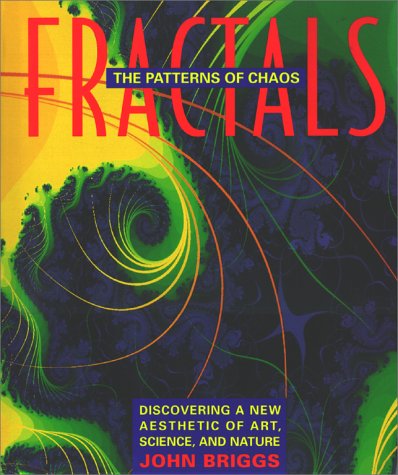
2. Fractals: The Patterns of Chaos:
$39.99
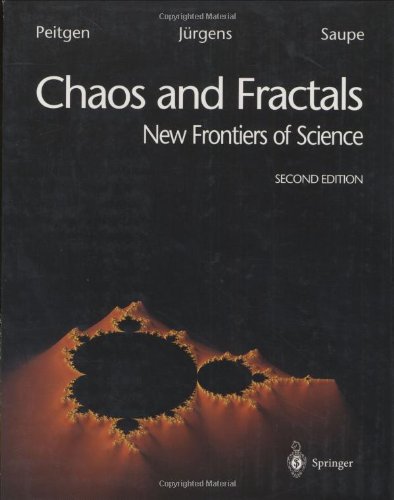
3. Chaos and Fractals: New Frontiers
$54.19
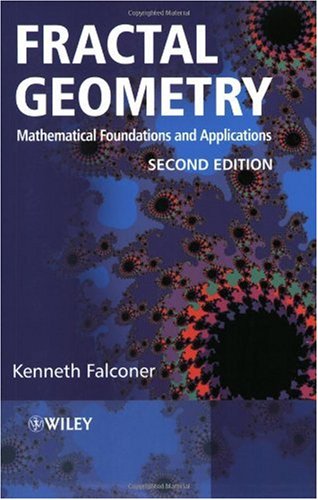
4. Fractal Geometry: Mathematical
$9.90
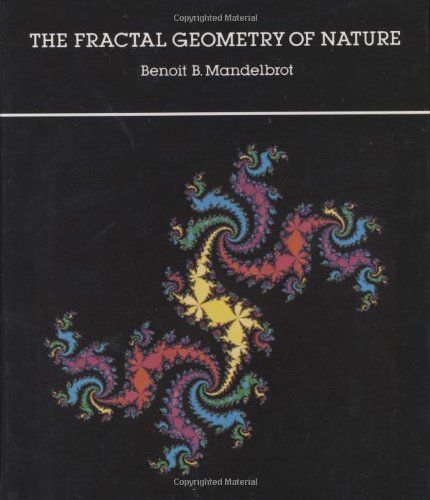
5. The Fractal Geometry of Nature
$25.00
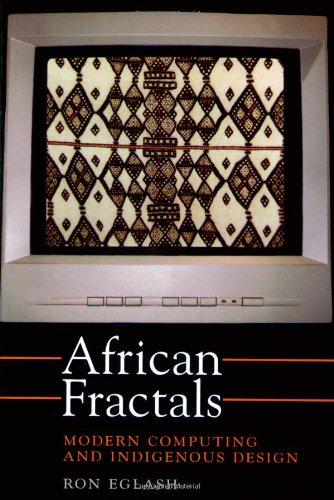
6. African Fractals: Modern Computing
$3.27
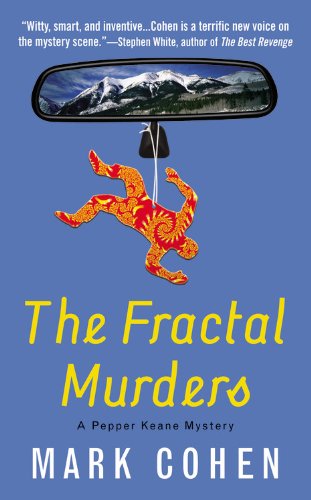
7. The Fractal Murders (Pepper Keane
$7.67
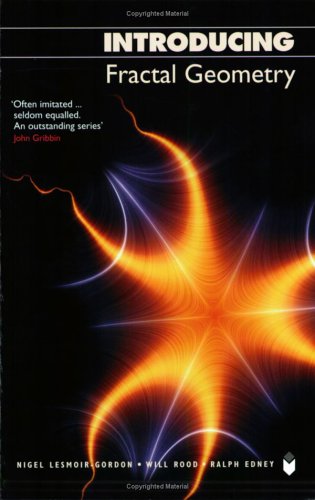
8. Introducing Fractal Geometry,
$7.95
9. Fractal Cosmos 2008 Calendar
 
$29.26
10. The Science of Fractal Images
$53.00
11. Fractals Everywhere
$1.99
12. Fractal Mode
$14.95
13. Easy Fractal Guide, An Introduction
$15.00
14. Beauty Of Fractals
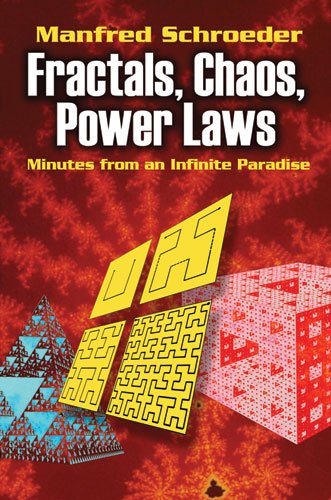
15. Fractals, Chaos, Power Laws: Minutes
$54.58
16. Fractals and Scaling In Finance
 
$114.99
17. Fractals (Physics of Solids and
$44.47
18. Measure, Topology, and Fractal
$14.32
19. Mathematica for Theoretical Physics:
$33.00
20. Fractals and Chaos: An Illustrated

1. Fractals, Googols, and Other Mathematical Tales
by Theoni Pappas
Paperback: 72 Pages (1993-02-16)
list price: US$10.95 -- used & new: US$6.17
(price subject to change: see help)
Asin: 0933174896
Average Customer Review: 4.0 out of 5 stars
Canada | United Kingdom | Germany | France | Japan

Customer Reviews (9)

4-0 out of 5 stars Let's clear this up
C=pi*d.That means the diameter has to be **multiplied** by "three and a little bit" in order to be equivalent to, or wrap around, the circumference of the circle.It takes "three and a little bit" diameters to get around the circle one time, not one diameter to get around the circle three and a little bit times.The engineer was right!Other than that, it was still a pretty good book, though.If you're a teacher with an older class, you can see if they can spot the error.

3-0 out of 5 stars Could I help clarify?
I believe the quote about the circumference and diameter is worded incorrectly.We all know that the size of the diameter and circumference are proportional (hence pi), but the diameter would never wrap around a circumference 3 and a little times!This is obviously false because the circumference is larger than the diameter.The circumference would wrap around the diameter 3 and a little times.Please check your books to determine if the quote is correct in R. Krapf's review - if so, then the book is WRONG!

5-0 out of 5 stars Revieing the reviewer
I am not sure what R. Krapf "Engineer" (below) was thinking when he/she wrote his/her review...

The circumference of a circle (C) is calculated as 2 * pi * r (or pi * 2 * r)

Since r is the radius and 1/2 the diameter (d), that means C = pi * d

Since pi is about 3.14, that means the book is correct.The diameter of a circle would wrap around (the circumference of) the circle "3 and a little bit"

5-0 out of 5 stars In response to a recent misguided review
Another reviewer reported being dissapointed because the description of pi in the book was "obviously wrong stating that the diameter of a circle would wrap around the circle '3 and a little bit'" and "how can I trust this book knowing that the editors missed such a glaring error?"

It is this reviewer's comment that is 'very confusing' and misleading, not the content of the book.

The definition of Pi is the ratio of the circumference to the diameter of a circle; approximately equal to 3.14159265358979323846... Euclid proved that this ratio (Circumference to diameter aka circumference to twice the radius) is always the same, no matter the size of the circle. What he did was inscribe similar regular polygons in any two circles. Then, he increased the number of sides of the inscribed regular polygons. He reasoned that as the number of sides increased, the perimeter of the inscribed polygon gets closer and closer to the circumference of the circle. He also showed that the perimeters of the similar polygons were proportional to the radii of the circles in which they were inscribed. And so, C is proportional to r, in other words C/r is a constant. By convention, pi=C/2r.(I borrowed these particular words from Jim Loy's website, thanks JL!)

Therefore, the statement the book makes is perfectly, mathematically true (QED!) albeit that it substitutes "a little bit" for 0.14159265358979323846... which I find perfectly acceptable for a children's book, don't you?

p.s. I'm an engineer, too.Cheers!

2-0 out of 5 stars The Story of Pi
I was disappointed.While skimming through the book prior to giving it to my 7 year old son,I stumbled on the Chapter on "PI".It was obviously wrong stating that the diameter of a circle would wrap around the circle "3 and a little bit".Now, how can I trust this book knowing that the editors missed such a glaring error?Could be very confusing to a young aspiring mathmetician. ... Read more


2. Fractals: The Patterns of Chaos: Discovering a New Aesthetic of Art, Science, and Nature (A Touchstone Book)
by John Briggs
Paperback: 192 Pages (1992-11-01)
list price: US$23.00 -- used & new: US$6.99
(price subject to change: see help)
Asin: 0671742175
Average Customer Review: 3.5 out of 5 stars
Canada | United Kingdom | Germany | France | Japan
Editorial Review

Book Description
Fractals are unique patterns left behind by the unpredictable movements -- the chaos -- of the world at work. The branching patterns of trees, the veins in a hand, water twisting out of a running tap -- all of these are fractals. Learn to recognize them and you will never again see things in quite the same way.

Fractals permeate our lives, appearing in places as tiny as the surface of a virus and as majestic as the Grand Canyon. From ancient tribal peoples to modern painters to the animators of Star Wars, artists have been captivated by fractals and have utilized them in their work. Computer buffs are wild about fractals as well, for they can be generated on ordinary home computers.

In Fractals: The Patterns of Chaos, science writer John Briggs uses over 170 illustrations to clearly explain the significance -- and more importantly, the beauty -- of fractals. He describes how fractals were discovered, how they are formed, and the unique properties different fractals share. Fractals is a breathtaking guided tour of a brand new aesthetic of art, science, and nature. It will revolutionize the way you see the world and your place within it.

* Contains a special bibliography listing fractal generating software for desktop computers

... Read more

Customer Reviews (12)

5-0 out of 5 stars staggeringly beautiful
Technically this book is good.The images, however, are staggeringly beautiful.I think Dr. Briggs teaches esthetics, which is the study of beauty.Of any book on fractals I have read, this is by far the most beautiful.I really liked this book, so much I donated it to the library of my alma mater.

5-0 out of 5 stars Patterns to Inspire - A Captivating Look into Fractals
This book brings a comprehensive and visually intriguing approach to the study of fractal geometry and the chaos theory. Through thought provoking imagery and discernible explanations & comparisons, John Briggs has sparked my curiosity where I now look more closely at the world around me. I believe this book is intended to captivate those with the ability to visualize and appreciate the aesthetics and interconnectedness of the arts, sciences and the natural phenomena that surrounds us. An insightful & visually stimulating read!

1-0 out of 5 stars Don't buy this book
This book says absolutely nothing.It has a few good pictures (the best one is one the cover by the way), but the text is utterly worthless and uninformative.My favorite quote from the book is "Nonlinear means not linear."Really?Don't waste your money.Now I understand why I found it at the used bookstore.

1-0 out of 5 stars Great Photos, Poor Content
This is a fantastic source of images on the subject of fractals, but not a great source of learning. Most books on math and science are difficult for the general reader; few authors (like Isaac Asimov) can make complex things easily understood. But the author of this book is, in my opinion, doing the public a disservice by oversimplifying the subject. The explanations underestimate the public's ability to think, and even include a number of things which are either dead wrong or made-up! The subject of fractals is still new, and there are recently more books available to explain fractals to the general public. Again, this is a great source of images, if that's what you're looking for, but look for another source if you want to undersatnd and appreciate this incredible and important topic.

3-0 out of 5 stars OK
This book was OK---but it had more fractals in nature and not so much in the way of computer-generated fractal art which is what I was looking for. Not bad if you can find it used. ... Read more


3. Chaos and Fractals: New Frontiers of Science
by Heinz-Otto Peitgen, Hartmut Jürgens, Dietmar Saupe
Hardcover: 864 Pages (2004-02-03)
list price: US$69.95 -- used & new: US$39.99
(price subject to change: see help)
Asin: 0387202293
Average Customer Review: 4.5 out of 5 stars
Canada | United Kingdom | Germany | France | Japan
Editorial Review

Amazon.com
Fascinating and authoritative, Chaos and Fractals: New Frontiers of Science is a truly remarkable book that documents recent discoveries in chaos theory with plenty of mathematical detail, but without alienating the general reader. In all, this text offers an extremely rich and engaging tour of this quite revolutionary branch of mathematical research.

The most appealing aspect about Chaos and Fractals has to be its hundreds of images and graphics (with dozens in full-color) used to illustrate key concepts. Even the math-averse reader should be able to follow the basic presentation of chaos and fractals here. Since fractals often mimic natural shapes such as mountains, plants, and other biological forms, they lend themselves especially well to visual representation.

Early chapters here document the mathematical oddities (or "monsters") such as the Sierpinski Gasket and the Koch Curve, which laid the groundwork for later discoveries in fractals. The book does a fine job of placing recent discoveries about chaos into a tradition of earlier mathematical research. Its description of the work of mathematicians like Pascal, Kepler, Poincaré, Sierpinski, Koch, and Mandelbrot makes for a fine read, a detective story that ends with the discovery of order in chaos. (For programmers, the authors provide short algorithms and BASIC code, which lets you try out plotting various fractals on your own.)

This is not, however, only a book of pretty pictures. For the reader who needs the mathematics behind chaos theory, the authors in no way dumb down the details. (But because the richer mathematical material is set off from the main text, the general reader can still make headway without getting lost.)

There have been advances in the field since this book's publication in 1992, but Chaos and Fractals remains an authoritative general reference on chaos theory and fractals. A must for math students (and math enthusiasts), Chaos and Fractals also deserves a place on the bookshelf of any general reader or programmer who wants to understand how today's mathematicians and scientists make sense of our world using chaos theory. --Richard Dragan

Topics covered: Overview of fractals and chaos theory, feedback and multiple reduction copy machines (MRCMs), the Cantor Set, the Sierpinski Gasket and Carpet, the Pascal Triangle, the Koch Curve, Julia Sets, similarity, measuring fractal curves, fractal dimensions, transformations and contraction mapping, image compression, chaos games, fractals and nature, L-systems, cellular automata basics, attractors and strange attractors, Henon's Attractor, Rössler and Lorenz Attractors, randomness in fractals, the Brownian motion, fractal landscapes, sensitivity and periodic points, complex arithmetic basics, the Mandelbrot Set, and multifractal measures.Book Description
The fourteen chapters of this book cover the central ideas and concepts of chaos and fractals as well as many related topics including: the Mandelbrot set, Julia sets, cellular automata, L-systems, percolation and strange attractors. This new edition has been thoroughly revised throughout. The appendices of the original edition were taken out since more recent publications cover this material in more depth. Instead of the focused computer programs in BASIC, the authors provide 10 interactive JAVA-applets for this second edition. ... Read more

Customer Reviews (10)

5-0 out of 5 stars Excellent tutorial on nonlinearity
At least 50% of this book can be well understood by any 1st year, exact science student. There are a couple of mathematical issues that are more senior-like, but never mind. With the appropriate teaching or guidance, a lot of practical, advanced tasks can be tackled down.I could use this book all along for giving examples for college (university), undergraduate students of almost every mathematical subject: numerical analysis, calculus, linear algebra, group theory, algorithm theory, visualization in 2 and 3 dimensions, topology...you name it, after reading this book. No fuzzy theory or wavelets or any other advanced statistical method for dynamical systems is formally mentioned, though. However the concept of measure is very well introduced and described with examples. For physics is not bad for dynamical systems theory. Although no Hamiltonian or Lagrangian formalism is mentioned, the description on how to obtain Lyapunov exponents out of a set of differential equations is very good. Engineers get their share too: useful examples are given about, e.g., feedback and control theory (mind you, it is not a book specialized in, say, robotic control using chaos theory, but it is a good start). For philosophers and the layman there are quite a few pages as well. The foreword from Mitchel Feigenbaum, just to give an example, tells us a kind of summary which "warms up" the reader and "exorcises away" the possible fantasies an unprepared reader could have regarding (or against or in favor of) the word "chaos". Nice color plates for those with artistic inclinations and the graphics are just so very well printed, you can practically "follow" their computation. Not a bad book at all for your personal (or institutional) library, I may say.

4-0 out of 5 stars A good introduction
Chaos as a physical theory began essentially in the 1970's, but as a mathematical field it has existed since the early 1900's. This book covers only the mathematical study of chaos, and is addressed to those readers who have a fairly strong background in undergraduate mathematics. A knowledge of dynamical systems and measure theory would help in the appreciation of the book, but are not absolutely necessary. The application of fractals and chaos to finance is now legendary, but other applications, such as to packet networks and surface physics are not so well-known. Current research in chaos is done predominantly in the context of information theory, wherein the goal is to understand the difference between chaos and noise, and develop mathematical tools to quantify this difference. The BASIC code in the book gives away its age, but can be easily translated to one of the symbolic computing languages available now, such as Maple or Mathematica.

This is a sizable book, and space prohibits a detailed review, but some of the more interesting discussions in it include: 1. The video feedback experiment, which can be done with only a video camera and a TV set. This is always a crowd pleaser, at whatever level of the audience it is presented to. 2. The comparison between doing iteration of a chaotic map on two different calculating machines: a CASIO and an HP. The difference is very dramatic, illustrating the effect of finite accuracy arithmetic. 3. The pictures illustrating the Chinese arithmetic triangle and Pascal's triangle as it appeared in Japan in 1781. 4. The space-filling curve and its relation to the problem of defining dimension from a topological standpoint. This discussion motivates the idea of covering dimension, which the authors overview with great clarity. They also give a rigorous definition of the Hausdorff dimension and discuss its differences with the box counting dimension. 5. The many excellent color plates in the book, especially the one illustrating a cast of the venous and arterial system of a child's kidney. 6. The difficulty in measuring power laws in practice. 7. Image encoding using iterated function systems, which has become very important recently in satellite image analysis. This leads into a discussion of the Hausdorff distance, which is of enormous importance not only in the study of fractals but also in general topology: the famous hyperspaces of closed sets in a metric space. 8. The relation between chaos and randomness, discussed by the authors in the context of the "chaos game." 9. L-systems, which are motivated with a model of cell division. 10. the number theory behind Pascal's triangle. 11. The simulation of Brownian motion. 12. The Lyapunov exponent for smooth transformations. 13. The property of ergodicity and mixing for transformations, the authors pointing out that true ergodic behavior cannot be obtained in a computer where only a a finite collection of numbers is representable. 13. The concept of topological conjugacy. 14. The existence of homoclinic points in a dynamical system. These are very important in physical applications of chaos. 15. The Rossler attractor and its pictorial representation. 16. How to calculate the dimensions of strange attractors. 17. How to calculate Lyapunov exponents from time series, which is of great interest in many different applications, especially finance. 18. The Julia set, which the authors relate eventually to potential theory.

5-0 out of 5 stars Simply a fantastic book
I purchased this book when it first came out, during the
initial wave of popularity of fractals and chaos theory.
Although the fadishness of chaos and fractals has died
down, a number of solid applications for this theory have
appeared in areas like computer graphics, finance,
modeling computer network traffic and datacompression.

I have purchased a number of books on fractals and chaos and
how these concepts can be applied in a number of areas.I
have yet to see a better introduction to the topic.This is
a core reference and I keep coming back to it again and again.

In the spectrum of popular science books, this is definitely
on the technical end.You do not need an advanced background
in mathematics as you do for some books on chaos and fractals,
but the authors do not shy away from equations.However, the
ideas are clearly presented.I have used this book as a
reference for developing software for fractal brownian motion
and Hurst exponent estimation.

"Chaos and Fractals" covers a great deal of material.On a few
occasions I found that the algorithms or explaination were
difficult to follow.In some cases, like the generation of
Gaussian random numbers, I found better, simpler algorithms.

When this book was written, fractals and chaos were fairly new.
It is difficult to avoid comparing this book to an even thicker
book, "A New Kind of Science" by Stephen Wolfram.Although
cellular automata, the core topic of "A New Kind of Science"
are not exactly new, Wolfram claims new and profound
perspectives.Many, including this reviewer, feel that Wolfram's
claims are overblown and egotistical (he has a bad habbit of
claiming credit for innovation, even as he cites other work).
The authors of "Chaos and Fractals" do not make exalted
claims for this work.Yet without any fanfare, this book
really does deliver profound ideas.This is simply a
fantastic book.I recommend it for anyone in the applied
sciences (e.g., computer science, quantitative finance,
geology, etc...).Even for the mathematically sophisticated it
will provide an valuable overview, which is difficult to obtain
anywhere else.

5-0 out of 5 stars Well worth the cost
This is possibly the best and most thorough of all books on fractals. The discussion is excellent, the illustrations superb. After all, these are the guys who developed the computer art exhibits that toured Europe and parts of the US in the 1980s.

The mathematics is somewhat advanced, but not so advanced that most persons with a thorough background in high school mathematics cannot understand it. After all, I used it as a primary reference for my book Fractals in Music!

5-0 out of 5 stars Excellent for intermediate knowledge of chaos
This book is a great entertainer for anyone who wants to spend many evenings "playing with chaos". The code in the book is a little dated (BASIC), but you won't have problems to use it as a good reference. The book will guide you through the understanding of the exciting realm of chaos and its hidden monsters.

Chaos and fractals are subjects that sound modern, interesting and eye-catching in the most of the cases. However, the applications and implications of chaos in the real world constitute the great achievement of human knowledge that the concept represents.

The lecture of this book doesn't require an extensive knowledge of math (but it would be helpful), it requires many will and passion for rediscovering your conception of the universe instead.

Before reading this book I'd recommend "Chaos: the Making of a New Science" by James Gleick and for those who are looking for a more compact but challenging material "Fractals, Chaos, Power Laws: Minutes from an Infinite Paradise" by Manfred Schroeder will be just fine. ... Read more


4. Fractal Geometry: Mathematical Foundations and Applications
by Kenneth Falconer
Paperback: 366 Pages (2003-11-14)
list price: US$70.00 -- used & new: US$54.19
(price subject to change: see help)
Asin: 0470848626
Average Customer Review: 5.0 out of 5 stars
Canada | United Kingdom | Germany | France | Japan
Editorial Review

Book Description
Since its original publication in 1990, Kenneth Falconer's Fractal Geometry: Mathematical Foundations and Applications has become a seminal text on the mathematics of fractals. It introduces the general mathematical theory and applications of fractals in a way that is accessible to students from a wide range of disciplines. This new edition has been extensively revised and updated. It features much new material, many additional exercises, notes and references, and an extended bibliography that reflects the development of the subject since the first edition.
* Provides a comprehensive and accessible introduction to the mathematical theory and applications of fractals.
* Each topic is carefully explained and illustrated by examples and figures.
* Includes all necessary mathematical background material.
* Includes notes and references to enable the reader to pursue individual topics.
* Features a wide selection of exercises, enabling the reader to develop their understanding of the theory.
* Supported by a Web site featuring solutions to exercises, and additional material for students and lecturers.
Fractal Geometry: Mathematical Foundations and Applications is aimed at undergraduate and graduate students studying courses in fractal geometry. The book also provides an excellent source of reference for researchers who encounter fractals in mathematics, physics, engineering, and the applied sciences.
Also by Kenneth Falconer and available from Wiley:
Techniques in Fractal Geometry
ISBN 0-471-95724-0

Please click here to download solutions to exercises found within this title:

http://www.wileyeurope.com/fractal ... Read more

Customer Reviews (5)

5-0 out of 5 stars A rare find
I agree with all that was said by the other reviews here but add one important point. The physical layout, (typeface, drawings, whitespace etc.) of this book is brilliantly done. This is often overlooked by the producers of technical works who do it "on the cheap", but it is vital if one is to use the book day after day, as I have had to.

While the subject matter is not easy, this is an excellent book to motivate one to get stuck into the underlying mathematics. The reward is a little insight into the often beatiful theorems and practical results found in this stimulating field of study.

5-0 out of 5 stars What every student should know about fractals.
Fractals make headlines from time to time[--are they everywhere?], and and they make lovely color pictures; but they are also part of a substantial mathematical theory, one with an
exciting mathematical history. This very important book presents
the subject in a way that it can be taught to students, and it starts with the basics, systematically, step by step, building up the material. Or it can be used for selfstudy! It has great exercises too! In view of the many applications to geometric analysis, to PDE, and to statistics, it is likely that fractal geometry will soon be a standard math course taught in many (more) math departments. By now it is widely recognized that the selfsimilarity aspects of the wavelet algorithms are key to their sucess. The book came out in 1990, and the author has an equally attractive book on the subject from 1985[The geometry of fractal sets] with a slightly more potential theoretic bent.

5-0 out of 5 stars Theoretical as well as practical insight
The first part of the book is essentially of a theoretical nature, with a thorough treatment of fractal geometry at a mathematical point of view. The second part on the other hand provides a flavour of the problems of fractal geometry in practice...so mathematicians as well as people interested in applications only should both find this book interesting. The maths are not easy but quite "understandable" for science undergrads...some notions of calculus or topology would help... but the introduction is excellent and allows anyone to follow the course of the book (but for understanding the proofs a good math background is required).

Excellent for understanding the geometrical properties of fractals.

5-0 out of 5 stars Exposes fractal geometry as a real mathematical discipline.
I appreciate Falconer's books on fractal geometry because they show the topic as it really is: a whole mathematical discipline on its own right and not just a nice temporary fashion.

It begins introducing basictopological concepts and then proceeds to develop the theory for severalpossible definitions of fractal dimension, showing the relations betweenthem. Then it explores deeply the local geometry of different kinds offractal objects, and studies some other geometrical situations, like thepojection of fractals (ever thought of a DIGITAL sundial? Here it isdescribed!).

The book also includes a lot of applications to other areasof mathematics and physics, a great amount of graphics, and muchmore.

The text is suitable from third year undergraduate school and on.It is a larger but lighter version of "The Geometry of FractalSets".

5-0 out of 5 stars One of the best books on fractals to be found anywhere!
The book opens the doors of mathematics: it isn't an easy door, but well worth the effort. It bridges the gap between beginner texts and advanced study and covers the basic material in a hard hitting manner. Those looking for "giltz" should look elsewhere. It is a book of great understanding and depth. Your unique Associates ID is:thefractaltransl. ... Read more


5. The Fractal Geometry of Nature
by Benoit B. Mandelbrot
Hardcover: 468 Pages (1983)
list price: US$45.00 -- used & new: US$9.90
(price subject to change: see help)
Asin: 0716711869
Average Customer Review: 4.0 out of 5 stars
Canada | United Kingdom | Germany | France | Japan
Editorial Review

Amazon.com
Imagine an equilateral triangle. Now, imagine smaller equilateral triangles perched in the center of each side of the original triangle--you have a Star of David. Now, place still smaller equilateral triangles in the center of each of the star's 12 sides. Repeat this process infinitely and you have a Koch snowflake, a mind-bending geometric figure with an infinitely large perimeter, yet with a finite area. This is an example of the kind of mathematical puzzles that this book addresses.

The Fractal Geometry of Nature is a mathematics text. But buried in the deltas and lambdas and integrals, even a layperson can pick out and appreciate Mandelbrot's point: that somewhere in mathematics, there is an explanation for nature. It is not a coincidence that fractal math is so good at generating images of cliffs and shorelines and capillary beds.Book Description
Imagine an equilateral triangle. Now, imagine smaller equilateral triangles perched in the center of each side of the original triangle--you have a Star of David. Now, place still smaller equilateral triangles in the center of each of the star's 12 sides. Repeat this process infinitely and you have a Koch snowflake, a mind-bending geometric figure with an infinitely large perimeter, yet with a finite area. This is an example of the kind of mathematical puzzles that this book addresses. The Fractal Geometry of Nature is a mathematics text. But buried in the deltas and lambdas and integrals, even a layperson can pick out and appreciate Mandelbrot's point: that somewhere in mathematics, there is an explanation for nature. It is not a coincidence that fractal math is so good at generating images of cliffs and shorelines and capillary beds. ... Read more

Customer Reviews (13)

5-0 out of 5 stars changed the way I look at the world
Visually, I see nature in a much richer way.As an artist, I find fractals to be inexhaustable inspiration.There is no better text to explain Mandlebrot's theories in a detailed but understandable way than the seminal work itself.Sometimes I got lost in the math, but most of it I could follow.I found helpful the notes in the text indicating which parts were mathematical asides for the technically-minded readers, where other readers could skip ahead without losing any understanding.the illustrations are evocative and timeless diagrams of real phenomena. If I were a more spiritual person, I am sure this book would be proof of the existence of god.

5-0 out of 5 stars A seminal work
Very few books have so many quotes as this one. I am not sure if there is much left to be said, but I know this. For those professionals who still think that fractals are "spurious solutions coming from the discretization of differential equations", should take a closer look to this book. Not only won't harm, but also will show many interesting features about the nature of fractals and the "fractality" of nature, besides the fact that many of them come from *difference* equations, which are not necessarily related to the discretization of a differential equation. This book is based on serious work from many well-reputed mathematicians before Mandelbrot, e.g., Haussdorff, Lyapunov and some others. Although the book does talk about the mathematics behind fractals (wouldn't be so much a book of mathematics if it didn't, but also a philosophical one) and the necessity of coining some new mathematical terms, it also contains so much about history of mathematics, the path that leads towards fractals. As I said, the book is many times quoted, but (without trying to point a firing, accusing finger), there is a difference in quoting a book because it is famous, and another actually reading it, and having enlightenment for our own sake. Certainly I think is a "must-have-it" for most mathematicians,for many physicists, philosophers of science and engineers, but also it wouldn't be a bad guest in the library of any layman, provided the layman overcomes for some minutes the initial "classical" fear to mathematics. I would say this layman won't regret it at all. Mandelbrot does explain most of the concepts practically "ab initio", from the very scratch, including etymology and history as I previously said. One little thing against this book though: it doesn't have so many color plates as some other books on the subject, but it does have all the needed graphics to grasp the concepts.

3-0 out of 5 stars Nice coffee table book? Not much else.
The BOOK by the MAN who coined the name fractal and brought them
to the general public. (Actually an enhanced version of an
earlier book with a slightly different title, same publisher.)

This book has historical value I suppose. But there are now
prettier picture books if you want those or you can easily create
your own. And if you are interested in the maths then you should
definitely look elsewhere (Devaney perhaps?). I think there is a
nice collection of papers by early 20th century pioneers
available too.

Now I wonder is Mandelbrot really the mathematician he is reputed
to be in popular imagination? It seems to me there is little here
that was not thought of before in the early 20th century by
Hausdorff, Poincare, Julia, Lebesgue, Bachelier and others. And
the whole fractal idea seems to have a life of its own in popular
imagination that does not to be justified according to the (much
smaller) importance in physics and other sciences.

5-0 out of 5 stars Essential classic book for everyone's library
Mandelbrot presents unique and infinitely deep look at nature. The emerging theory of interaction shows that his notion of fractal turned to be more fruitful than anyone could guess. Savov's theory of interaction rigorously proves that nature is one self-reproducing and therefore self-similar fractal like interaction.Its oscillating sources remain always finite and synchronize to eject smaller similar ones.

3-0 out of 5 stars A dated but still fascinating book
This was the book that first caught my attention. It was the cover diagram: a figure the like of which I had never seen. One thing led to another until I finally wrote my own application of fractals, Fractals in Music.

Mandelbrot is an odd character, but a superb thinker. His book does not offer a lot of science, but rather a compelling view of how this fascinating and growing topic developed. I recommend it highly. ... Read more


6. African Fractals: Modern Computing and Indigenous Design
by Ron Eglash
Paperback: 258 Pages (1999-06)
list price: US$25.00 -- used & new: US$25.00
(price subject to change: see help)
Asin: 0813526140
Average Customer Review: 5.0 out of 5 stars
Canada | United Kingdom | Germany | France | Japan
Editorial Review

Product Description
African Fractals: Modern Computing and Indigenous Design ... Read more

Customer Reviews (4)

5-0 out of 5 stars Connecting Africans ancient and modern
This is an amazing book! It clearly shows how many of the common things that people of African descent do have may scientific connections.Hair styles that are worn today by people of African descent, have been worn as far back to the ancient indigenous Africans known as the ancient Egyptians.So it really no surprise that there is mathematical and scientific knowledge being found today by scientist and scholars.

This book should be in every school and home in this country.I take that back, this book should be in every school globally.

Another scientific book that would make a great set for any school or home is, The African Unconscious.Written by Edward Bruce Bynum.You can find it here on Amazon.com.

5-0 out of 5 stars This book helps to render obsolete long-held myths.
Ron Eglash's brilliant work on Afrikan fractals helps to shatter long-held myths and misconceptions about Afrikans, the most pervasive and pernicious of which is the notion of Afrikans (both on the Motherland and in the Diaspora) as inactive agents in history. This work motivated me to complete mine on chaos theory and Afrikan fractals. My longer reviews of Eglash's book appear in the Nexus Network Journal (vol. 2, 2000:165-168) and the Journal of Third World Studies (vol. xviii, no. 1, 2001:237-239), each reflecting the publication's genre and disciplinary focus. Dr. Abdul Karim Bangura is a researcher-in-residence at the Center for Global Peace and a professor of International Relations in the School of International Service at American University, and the director of The African Institution in Washington, DC. He is the author of 21 books and more than 200 scholarly articles.

5-0 out of 5 stars An ingenious first, recognition of 'African' Maths.
This is a brilliant book. As an Architect, I was truly enlightened by the idea of the 'other' culture(s), having a valid scientific basis in fact. I was always told in Architectural school that the 'Africans',(includingthose in the diaspora) were a peoples without and writing systems,technological background and no culture. I'm glad to see evidence that thisis not the truth. I thank the author for his contribution.

5-0 out of 5 stars An ingenious first, recognition of 'African' Maths.
This is a brilliant book. As an Architect, I was truly enlightened by the idea of the 'other' culture(s), having a valid scientific basis in fact. I was always told in Architectural school that the 'Africans',(includingthose in the diaspora) were a peoples without and writing systems,technological background and no culture. I'm glad to see evidence that thisis not the truth. I thank the author for his contribution. ... Read more


7. The Fractal Murders (Pepper Keane Mysteries)
by Mark Cohen
Hardcover: 320 Pages (2004-05-13)
list price: US$25.00 -- used & new: US$3.27
(price subject to change: see help)
Asin: 0892967994
Average Customer Review: 4.5 out of 5 stars
Canada | United Kingdom | Germany | France | Japan
Editorial Review

Book Description
In the tradition of Robert B.Parker and Dennis Lehane comes THE FRACTAL MURDERS, a lively first novel featuring former Marine JAG and private eye Pepper Keane. Jane Smythe, a math professor specializing in fractal geometry, is shocked to learn that three professors with the same specialty have died in mysterious circumstances. That's where Pepper Keane, an ex-Marine turned PI with an encyclopedic knowledge of rock 'n' roll, comes in. He finds himself attracted to Professor Smythe and is determined to discover the root of these incidents. At first, he can't find any evidence that the three dead mathematicians even knew each other. But Keane, with the help of his hacker best friend and exercise guru brother, continues to dig. Suspects begin to appear and then multiply as they race through the rocky terrain of Colorado to Mexico, Boston, and Nebraska-with the main suspect an FBI agent who is also Keane's worst enemy. ... Read more

Customer Reviews (36)

4-0 out of 5 stars Smart
"The Fractal Murders" offers a terrific premise and the delivery lives up to it, too. The sleuthing is dogged, hard work. It's smart and well organized--the kind of diligent, relentless focus that is probably the norm out there for actual detectives. The Colorado settings are well rendered. I thought a few key things happened a bit too conveniently: the jet ride to Boston, the handy night vision goggles, access via a friend to key commercial airline passenger manifests. I also could have done without all the restaurant and eating descriptions; they just don't add up to much. For a guy who spends a lot of time running and working out, there is very little physical action. Most of the work is mental. Readers looking for a good brain exercise will enjoy how Pepper Keane approaches his work and the end packs a nifty double twist.

5-0 out of 5 stars Great math mystery that's not too technical
University of Colorado math professor Jayne Smyers hires Pepper Keane, former Marine JAG turned PI, to investigate the deaths of three other math professors.The Feds have investigated and found no link between the deaths.Jayne is convinced there's a link.Pepper is skeptical at first but agrees to look into it.

There's plenty of bad blood between Pepper and FBI agent Polk who did some of the investigating.This history adds to Pepper's determination to investigate these deaths.

As Pepper digs deeper into the deaths, he begins to see some similar threads that continue to propel him forward.With romance in the air, Pepper worries that Jayne may be the next victim.

Can he decipher the pattern and unmask the killer before anyone else is killed?Can he protect Jayne as well?

I thoroughly enjoyed this refreshing mystery.Pepper is a fabulous character, even with his baggage.It is explained throughout the book, so we aren't left floundering.His interactions with Polk, Jayne, detectives where each mathematician was killed, his brother, his neighbors, and his best friend really help us to get to know him.

I found the math to be explained in plain English so that it was easy to understand. It also didn't detract from the investigation; it actually enhanced it.I am not a mathematician, but I really enjoyed this book.I hope he writes more in this series.I can't wait to read them.I highly recommend this book.

4-0 out of 5 stars Chaos and comedy combine in a great story!
The Fractal Murders is nothing if not unique! Here's a first novel based on a completely fascinating premise that presents interesting, realistic and superbly developed characters; that develops a heart-warming romantic relationship complete with all the bumps, bruises and detours of reality; that avoids prurient sex and violence as completely unnecessary to the advancement of a well-written novel; and does it all with well crafted narrative and descriptive writing as well as positively hilarious dialogue! The fixings are so good that a main dish plot becomes almost secondary but I can tell you that Cohen has done a fine job with that as well! What a treat for a debut novel!

Pepper Keane, a former JAG prosecutor, is hired by University of Colorado mathematics Jane Smyers to investigate the almost simultaneous deaths of three of her professional colleagues - two by murder and one by apparent suicide - people who seem to have had nothing more in common than front-running world class expertise in the rather arcane field of fractal geometry. Smyers's mathematical background convinces her that the probability of the three deaths being unrelated is vanishingly small and some long-standing bad blood between Keane and FBI Special Agent Polk, who conducted the now closed investigation, raises Keane's eyebrows and prompts him into letting himself become involved in re-opening the case.

Pepper Keane is a lovable, laughable character that Cohen has endowed with an anally obsessive nature and a serious overdose of existential angst that he indulges by attempting to plow through some of Heidegger's heaviest writings. Cohen obviously loves a good pun and I nearly fell off my chair laughing when he set up this positively outrageous example. Keane's brother, nicknamed "Two Toe" as a result of a war wound, muses aloud about where they are as he and Pepper drive out of Kansas. Suggesting that he had been waiting a long, long time to say it, Pepper responded "Two Toe, I have a feeling we're not in Kansas anymore"! Ouch! Between you and me, I think it's much more likely that Cohen waited a long time to shoehorn that pre-conceived pun into a novel and I've got no doubt at all that he nicknamed his character Two Toe for the sole purpose of sticking that single line into the novel. It sure gets my unqualified approval! Cohen's sparkling wit shines throughout the novel with a veritable cornucopia of knee-slapping one liners.

As for the mathematics - Mandelbrot and Benoit sets, chaos, fractional dimensions, random walks, discussions of business applications such as fundamental versus technical analysis, weather prediction and crop markets - the basic concepts are presented in a lucid, simple and non-threatening fashion. And, frankly, since the mathematics aren't critical to the plot, the novel can be read and enjoyed even for those who haven't the remotest interest in such ideas!

Readers looking for a refreshingly different approach to a mystery hooked up to a healthy dose of humour should be well pleased with Cohen's first efforts. I'm certainly looking forward to more of his work.

Paul Weiss

4-0 out of 5 stars Very good debut
"The Fractal Murders" introduces the reader to Pepper Keane, a PI with a philosophical bent, who has turned his back on both the military and life as an attorney. In this adventure Pepper is hired by a university math professor to investigate the seemingly unrelated recent deaths of three other math professors - the common thread being all the professors are/were fractal geometry experts. Interesting premise and interesting book.This is a "traditional" gumshoe caper - no drug crazed Uzi toting maniacs or terrorists trying to blow up the planet - just Pepper searching for clues and bumping into some interesting characters along the way in solving this mystery. Some minor nits - the reader spends a lot of time following Pepper's culinary habits, exercise regimes and care of his dogs which at times, at least to me, detracted from the story. There are also a lot of characters in this book, all interesting, but they pop in and out causing some confusion to this reader. That being said, (written), The Fractal Murders is a darn good mystery, Pepper is a likeable protagonist and I look forward to reading more books in this series.

5-0 out of 5 stars Couldn't put it down
I am new to the mystery genre and fiction for the most part. I picked up Bluetick Revenge at the library a few months ago and really enjoyed it.
I couldn't wait to pick up Fractals. I wasn't disappointed. Cohens characters are fun and interesting and the locations let my imagination wander. The Fractal theme wasn't very technical and I believe I may have actually learned something useful from a fiction novel. I found it to be a nice reprieve from non-fiction world news and such. Anyway, it was a real page turner for me.I look forward to reading the next Buck and Wheat adventure ;)
... Read more


8. Introducing Fractal Geometry, 3rd Edition (Introducing)
by Nigel Lesmoir-Gordon
Paperback: 176 Pages (2006-04-25)
list price: US$12.95 -- used & new: US$7.67
(price subject to change: see help)
Asin: 1840467134
Average Customer Review: 4.0 out of 5 stars
Canada | United Kingdom | Germany | France | Japan
Editorial Review

Book Description
Fractal geometry is the geometry of the natural world. It mirrors the uneven but real shapes of nature, the world as we actually experience it. Introducing Fractal Geometry traces the development of this revolutionary new discipline. ... Read more

Customer Reviews (6)

5-0 out of 5 stars loved it
Want to learn what fractal geometry is?Get this book, you'll know enough to be able to join in conversations on the topic.

2-0 out of 5 stars What?
I like the format of these books, but the problem for me is that this one does not fulfil its brief, which is presumably to be, as its title implies, an introduction to a difficult subject for those not well-versed in science.
I am an interested member of the latter consituency, but I found this book presupposed far too much background knowledge - especially of terminology. Not enough is explained for those of us reformed Luddites who need to be hand-held in these matters. I shall try elsewhere. (Luckily, the field of `popular science` writing is a rich and fertile one these days.)

4-0 out of 5 stars This Book is Ok.

I liked this book.

I believe it will have value to someone already knowledgeable about math and/or systems and looking for a quick and easy survey of the ideas they will encounter as they start learning about fractal geometry. This book will NOT make them an expert on the subject.

I've read other, more technical books on fractal geometry and chaos, so nothing here was brand new to me.

As for an introduction for the layman...well, that's a tall order if you hope to go beyond the "gee whiz!" phase with pretty pictures. For that, this book is probably as good as you can reasonably expect.


3-0 out of 5 stars Glitzy graphics, Disappointing text, Broad coverage
Was this a Power Point presentation... gone missing?

First, it's important to realize that this book is part of a series of "Introducing..." books from a UK publisher.So good authors were probably forced to follow a bad format.

That format apparently required glitzy graphics which overpowered the book.Each small page seemed to be on a separate topic... much like a Power Point slide presentation.

There was disappointingly little coverage of the math side of the material.OK, there really was next to none.The saving grace was the coverage of where fractals were being used in practical applications.

Let me tell you a little more on these graphics.They were (professionally done) hand drawn cartoons.Mostly of famous mathematicians having quirky things to say about the subject, on an 8th grade level.

Overall, I think the authors did a fair job of trying to jamb an excellent subject into a stupid book format.The problem lies most likely at the feet of the publisher.This format makes sense for some of their other 8th grade books: "Introducing Feminism"... Freud... Jung... Marx... Einstein, etc.How they were able to pull off "Introducing Math" in one of these small books is probably a story in and of itself.They even have an "Introducing a Post-Feminism" book, if the first one was not enough.

This book was not a complete zero for me, as I did learn many new things.It was a fast read, but I think I have yet to find the best introductory book on Fractals.If you buy this book, you'll never have to pick up a pencil and solve a problem, or even use a calculator.It's just all... a quick read.

John Dunbar

5-0 out of 5 stars Excellent and fun introduction to Fractals
Discovered this book serendipitously-It's easy to read, and the witty illustrations pull you right into it.It's a good book because, while it follows a logical sequence of explanation of fractals, it can also be opened almost anywhere and "read in". I will pass this book on, both to adults and young people I know, and they will get a great introduction to fractals! ... Read more


9. Fractal Cosmos 2008 Calendar
Calendar: 26 Pages (2007-07-10)
list price: US$13.99 -- used & new: US$7.95
(price subject to change: see help)
Asin: 1569379254
Average Customer Review: 4.0 out of 5 stars
Canada | United Kingdom | Germany | France | Japan
Editorial Review

Product Description
Fractals are the visual depictions of mathematical equations, the same equations, in fact, that describe natural phenomena such as coastlines, plant shapes and weather patterns. A computer program assigns a color to each point in the image based on the answers to a chosen equation, which then results in abstract fractal shapes. Dozens of variables are manipulated in order to create these fascinating images. Equations representing each image accompany each picture. The Fractal Cosmos 2008 wall calendar features the organic designs of Alice Kelley, who says, "Fractals are an intuitive glimpse into the infinite order that comprises the natural world, as well as being proof that math is beautiful."Sample Caption:"The mathematician does not study pure mathematics because it is useful; he studies it because he delights in it and he delights in it because it is beautiful."-Jules Henri Poincare (1854-1912) ... Read more

Customer Reviews (1)

4-0 out of 5 stars good info in calender and pretty art
great calender...i have seen better visual fractals though...but i love all the info in the calender...better than any i've seen (ie, tells all holidays all over the world and gives astrological info too!).

good quotes as well. ... Read more


10. The Science of Fractal Images
 Hardcover: 312 Pages (1988-07-19)
list price: US$64.95 -- used & new: US$29.26
(price subject to change: see help)
Asin: 0387966080
Average Customer Review: 5.0 out of 5 stars
Canada | United Kingdom | Germany | France | Japan

Customer Reviews (3)

5-0 out of 5 stars Great book on fractals and imaging
This old book is a timeless gem. It goes into the details of the mathematics of fractals and also shows well-commented C code for producing fractal imagery along with good color illustrations.
Chapter 1, "Fractals in Nature", uses computer generated images to build a visual intuition for fractal as opposed to Euclidian shapes. There is also a mathematical characterization with Brownian motion as the prototype.
In chapter 2, "Random Fractal Algorithms", randomness is introduced into the algorithms discussed in chapter one as a way of simulating natural phenomena. Ideas are extended to higher dimensions. C programs that produce mountain ranges using these ideas are presented, along with the resulting imagery.
Chapter 3, "Fractal Patterns Arising in Chaotic Dynamical Systems", turns to the topic of dynamical systems and is less mathematical than the first two chapters. There is some mathematics and some illustrations in 2D and black and white that should be familiar to any student of dynamical systems.
Chapter 4, "Fantastic Deterministic Fractals", demonstrates how genuine mathematical research experiments open a door to a new reservoir of fantastic shapes and images. Programs are shown that extend the ideas of chapter 3 into truly beautiful fractals. Ideas here stay mainly in 2D.
The final chapter, "Fractal Modelling of Real World Images", draws from the material of the previous chapters to present C programs that produce clouds, vegetation, smoke, and mountain ranges, all by altering a few of the parameters in the sample code presented by the authors.
This book is much better than more recent titles that bury their algorithms in complex high level languages or "toy books" on the subject that provide dumbed-down applications and in which the simplest possible explanation of fractals is given with no insight. I highly recommend this book to anyone interested in understanding fractal mathematics and in using that mathematics to produce stunning visual effects.

5-0 out of 5 stars One of the best (if no the best) in the feild
You cant go past this book,

This book reads at any level, Great introduction to the field as well as an indespencible reference. Shows easy to implement code examples, and has lots of pictures showing what can beacheived.

This has been a main reference for a theisis I am currentlyworking on. The question is, why is it out of print. If you can find itit's worth it's wheight in gold.

5-0 out of 5 stars A must
In my opinion, the best work ever written in the category not-for-beginner-but-available-to-non-specialist (such as Beauty of Fractals, by the same authors). An easy answer to question "How can Igenerate a fractal image with my PC?", from brownian motion to Juliasets. A must for reader interested in fractals (a bit out-of-fashion butstill very interesting field). ... Read more


11. Fractals Everywhere
by Michael F. Barnsley
Paperback: 531 Pages (2000-04)
list price: US$78.95 -- used & new: US$53.00
(price subject to change: see help)
Asin: 0120790696
Average Customer Review: 4.0 out of 5 stars
Canada | United Kingdom | Germany | France | Japan
Editorial Review

Book Description


This volume is the second edition of the highly successful Fractals Everywhere.The Focus of this text is how fractal geometry can be used to model real objects in the physical world.


This edition of Fractals Everywhere is the most up-to-date fractal textbook available today.


Fractals Everywhere may be supplemented by Michael F. Barnsley's Desktop Fractal Design System (version 2.0) with IBM for Macintosh software.The Desktop Fractal Design System 2.0 is a tool for designing Iterated Function Systems codes and fractal images, and makes an excellent supplement to a course on fractal geometry

* A new chapter on recurrent iterated function systems, including vector recurrent iterated function systems.
* Problems and tools emphasizing fractal applciations.
* An all-new answer key to problems in the text, with solutions and hints. ... Read more

Customer Reviews (10)

2-0 out of 5 stars A below average text book

Barnsley's book has a shortcoming common to many math text books -- it's poorly written.Barnsely's writing style is superfluous and rambling.What I learned from this book was in spite of Barnsley's writing, not because of it.

Furthermore, the book's illustrations are substandard.There are over five different fonts used in illustrations (including hand written text).This leads to confusion when you're unsure if the text in Barnsley's illustrations is referring to Greek letters or the conventional alphabet.Another shortcoming is that Barnsley intermingles end of chapter exercises with new concepts.You may have problems 1.1 to 1.5 reviewing what you've already learned, and then problem 1.6 introduces completely new material.This is a problem throughout the book, as important concepts are introduced in exercises or otherwise illogical locations.

On the positive side, solutions to most exercises are presented at the end of the book.Overall the book was useful, but learning the material was unnecessarily difficult due to the book's shortcomings.

4-0 out of 5 stars Sometimes annoying but instructive
Although instructive, this book is sometimes annoying to read. The author seems to be playing his cards very close to the vest and not telling us everything.

For instance, there is little or no instruction on how to implement the IFS attractors presented as a panacea for data compression. This seems to be proprietary to his company. It also seems that hands-on manipulation is crucial to the images' production, contrary to the author's claims.

If you can understand the mathematics you may find the book useful, as I did when writing my book Fractals in MUsic.

1-0 out of 5 stars A bad book for 7 th graders like me
this is a bad and very confusing book for a young student in, say... 7th grade, like me.The language is incomprehensible and there are no visual aids.

4-0 out of 5 stars Opinión general
HUmmm!! parece interesante este librito.Pero la verdad busco uno donde encuentre aplicaciones a la ingeniería.
Estos libros de teoría suelen ponerse aburridos al no tener sufuciente información sobre aplicaciones.
De todos modos apenas lo tenga en las manos y lo mire doy una opinión más seria de este.

4-0 out of 5 stars Good book for applications of fractal geometry, but....
This is a good book on applications of fractals; the chapters on modeling natural objects with iterated function systems (IFS) and fractal interpolation are especially useful. Many standard topics are included, for example, fractal dimension, Julia and Mandelbrot sets, chaos and the shift dynamical system. Some of the illustrations are captivating.

However, the book is not well organized, and the writing is extremely wordy to the point of being irritating. Some paragraphs read as if they belonged to a "Dummies" handbook. Also, I have to agree with one reviewer that the treatment of fractal dimension is poor. For one thing, it does not fully develop the intuition behind the concept-- much less the math. This same remark holds for the chapter on chaotic dynamics.

In summary, the book is fine for applications, but supplement your reading with a more substantial text. ... Read more


12. Fractal Mode
by Piers Anthony
Paperback: 352 Pages (1992-12-01)
list price: US$7.99 -- used & new: US$1.99
(price subject to change: see help)
Asin: 0441251269
Average Customer Review: 4.0 out of 5 stars
Canada | United Kingdom | Germany | France | Japan
Editorial Review

Book Description
Colene and her multi-dimensional allies must help fulfill a prophecy in Nona's male-dominated universe. But first, Nona herself must cross dimensions to a world more unpredictable than any she has encountered--a world called Earth. ... Read more

Customer Reviews (10)

5-0 out of 5 stars Amazing!How does he come up with this stuff?!
Like the first book in this series "Virtual Mode", this is another wonderful trip into an area never gone to before in a novel and a unique way of getting there.As a writer, Mr. Anthony never ceases to amaze me!He always entertains while educating you at the same time.

4-0 out of 5 stars Interesting book
This book is very interesting, covering a variety of topics from child abuse to in-depth discussion of fractals, love to culture, society to magic.Piers shows an acute knowledge of the scientific aspects of what he writes about.The book seemed to focus a little too much on helping Nona, and not enough about the MAIN characters, but this didn't detract from the book too much.The settings are varied, as always with Anthony, as are the characters.Anthony provides much insight to what Colene is thinking, which I think is the most interesting part of the book-- to see how she reacts mentally to things like stress, Darius, her parents, etc.There are heartwarming moments, and some interesting happenings back at good old normal Earth.Many different things happen, settings change quickly, minor characters come and go, but the plot runs smoothly enough and what the gang learns along the way is interesting and their adventures are still fun, sometimes amusing--they get stuck in one really odd situation in Nona's reality!If you read Virtual Mode and are interested in how Colene and Darius' relationship will grow and change, and how Nona plays into their scheme, and if Colene and Darius will EVER settle down back in Darius' home reality...this is a good book for you.

5-0 out of 5 stars Confused?
I think that people looking for a book that they can just chill with, litrally switch their brain off and read are going to hate this book. Ithas references to maths, explanations of magic, totally-twisty landscapes,in depth character profiles and a totally confusing multi-realitystoryline. Oh, and some sexual references too, which might wake some up.This is the second book of the series that touched me, I love it and couldrecommend it (and have) to anyone. Read it, read them all! I await thearrival of my Chaos Mode book.. and whats this I hear about another!

2-0 out of 5 stars Fractured Mode
Perhaps slightly better than Virtual Mode, but not by much.Again, I recommend this for juveniles and not adults.It seemed to me that the book was really a series of short stories strung together.There is the initialconflict with the despots of Nona's world but Anthony gets away from thatquickly but returns to it in the end to wrap things up.Darius is really aminor character in this book which is surprising.The sexual referencesare getting really old by now.Anthony's description of fractals is hardto follow, and I was a math major!An illustration in a future editionwould benefit the reader in showing the layout of the Fractal Mode.On toChaos Mode which will finish up this series.If there is another book inthis series, I plan to steer clear of it.

2-0 out of 5 stars I did not like this book
I have read some of Anthony's books in the past, and I thought I would like the Mode series, but I was wrong.This book seems more like a math lesson than an adventure story.I liked the plot and the characterssomewhat, but it seemed like Mr. Anthony was trying to ram this mathconcept down my throat.I don't think I'll ever read this book again. ... Read more


13. Easy Fractal Guide, An Introduction to Fractal Mathematics and Creation
by Ann Dahlin
Paperback: 138 Pages (2005-01-01)
list price: US$14.95 -- used & new: US$14.95
(price subject to change: see help)
Asin: 0975563610
Average Customer Review: 4.0 out of 5 stars
Canada | United Kingdom | Germany | France | Japan
Editorial Review

Product Description
This guide explains the basic mathematics and computer mapping of some common fractal forms. This guide makes a good starter book for those wanting to understand the math and computer generation of fractals. Detailed, but written in an easy-to-read format, this guide takes the mystery out of fractal basics. Topics covered are how computers draw fractals, fractal dimension, and the mapping of several fractal forms. This guide covers the basic fractal forms of the Madelbrot Set, Julia Sets, Quaternions, Newton fractals, DLA's, Iterated Function Systems, L-Systems, and Random Midpoint Displacement fractals. The appendices include simple and easy programming algorithms and a quick math review. ... Read more

Customer Reviews (1)

4-0 out of 5 stars Great for beginners
As someone who started reading the book knowing NOTHING about fractals, I know feel like I know enough to direct me towards the correct, advanced materials (a series of choices I did not have sufficient knowledge to make before). ... Read more


14. Beauty Of Fractals
by Peitgen
Hardcover: 211 Pages (1987)
list price: US$69.95 -- used & new: US$15.00
(price subject to change: see help)
Asin: 0387158510
Average Customer Review: 4.0 out of 5 stars
Canada | United Kingdom | Germany | France | Japan

Customer Reviews (6)

3-0 out of 5 stars One of the first fractal books!
One of the first books on fractals that gave info on the mathematics to creating them and what parameters or sections of the set that yield some beautiful renderings. The math is for a math major but still interesting.

4-0 out of 5 stars The Essence of Beauty
I spent all last evening reading snippets of The Beauty of Fractals (those few paragraphs that a layman could understand) and admiring the sheer beauty of the diagrams/maps.I had not realised there was an aesthetic component to mathematics, and I certainly did not know that aspects of what is generally thought of as a dry science can be so visually appealing, not to say stunning.

I cannot understand why some people would argue the intrinsic artistic merit of something computer-generated and 'unnatural', when the results speak for themselves.

Beauty, true, is perceived, and lies in the eye of the beholder. It can be very subjective. But there are certain aspects of visual appeal that go beyond that. One would think that a symmetry of form, the complementary use of colours, the balance of shape and form, light and shade, arcs and curves--all these combine to give an objective, irrefutable fact of beauty that transcends thought and emotions, if not the senses.

In a couple of the chapters, it was said, and here I paraphrase:

The two modes of analysis and intuition as human means of understanding the natual world--need they be considered at opposite poles? Do they not complement one another? Are the thinker and the dreamer not one?

I find that very intriguing, just as I find the idea of chaos and order existing together in natural, dynamic processes being actually TYPICAL of Nature.

The word 'Chaos' has such negative connotations, implying confusion and destruction, but if I were to replace it with the word 'Disorder', then things begin to fall into place.

There can be no Order if there were no Disorder, for how then would we know the difference? In fact, one of the writers go so far as to say that it is the very existence of Disorder within Order that confers the essence of beauty found in Nature.
That is so true. It is the very non-linear aspect of Nature, that which mathematics, up till Mandelbrot, have been unable to map, that is so appealing in the visual sense.

In Nature, which, apart from abhorring vacuums, also has no place for a straight line (oh, how the poor, innocent straight line is maligned in the preface), beauty is inarguable, irrefutable, and only after that does it have history and context, different to and for each beholder.

So both Chaos/Disorder and Order co-exist in Nature, hand in hand. Order alone, rigidly disciplined, artificially-imposed, seems to require Disorder to breathe life into it.

Taking this a step further, our perception of beauty in all things is affected by Nature.

In yet another chapter, someone quoted someone else and here I go
paraphrasing again.

Beauty in science is the same as beauty in other disciplines-art, music,literature, what have you.'A fog of events, and suddenly you see a connection. It expresses a complex of human concerns that goes deeply to you, that connects things that were always in you that were never put together before.'

The thinker and the dreamer co-exist within each person, just as the analytical and intuitive modes of thought co-exist, not at opposite poles,but complementing one another.

Intuition and analysis complement, rather than confound (or they should, gods-willing).

The artist and the scientist complement each other, i.e. Art and Science are not the opposing polarites of disciplines as some would have us think.

The thinker and the dreamer ARE one.

And this book has shown that the essence of beauty lies in the marriage of Art and Science.

(Disclaimer: Mere thoughts from a layman.)

3-0 out of 5 stars Time goes by... the pictures fade
Amazon dot com gives no credit for my earlier reviews.... I wrote the first review without thinking or spell checking, fast.There are still parts of this book I can't duplicate! And parts that are just written so bad no one can understand them, but most of it stands the test of time, like Mandelbrot's article. This will probably be a classic in the future! I think the free Fractint documentation is probably better for a beginner or Hans Lauwerier's " Fractals".

5-0 out of 5 stars Swirly
Although one of the earliest titles to bring fractals into the mainstream, 'The Beauty of Fractals' isn't as visually exciting as the follow-up, 'Chaos and Fractals', and it's a very dry read - in 1986 complex dynamics were an esoteric field of mathematics that had yet to transfer to student posters and rave videos. At this price it's restricted to people who absolutely need it, although along with 'Godel, Escher, Bach' it's one of the seminal hackish coffee-table books.

5-0 out of 5 stars One of the more important textbook in the subject
A very good work, with wide subjects and deep analysis, not for beginner but you are not required to be a specialist to read it. Even if it shows the structure of lecture notes, it maintains a strong cohesion, embracingin a single context different fields, such as computer graphics andstatistical physics. ... Read more


15. Fractals, Chaos, Power Laws: Minutes from an Infinite Paradise
by Manfred Schroeder
Paperback: 429 Pages (1992-07-15)
list price: US$24.95
Isbn: 0716723573
Average Customer Review: 5.0 out of 5 stars
Canada | United Kingdom | Germany | France | Japan
Editorial Review

Book Description

“As notable as the book’s broad sweep is the author’s good-natured, humorous presentation.”—Physics Today
... Read more

Customer Reviews (10)

5-0 out of 5 stars A Chaotic Heaven


What a head-trip! While the Pearly Gates of Paradise may be more than a few minutes away, you are almost certain to enjoy the journey with this book in hand. I purchased this book from Amazon back in 2002 and apart from the curling cellophane-coated front cover, I have nothing but praise for it. It simply gets better, every single time I read it - not unlike sipping some fine vintage even as it ages.

It must be difficult to write a book on a subject so intrinsically mathematical while retaining a healthy, comprehensible tone with a twist of the ridiculous. Schroeder has an enviable sense of comic timing in addition to his peculiarly personalized insight into the world of Number Theory. It is pretty amazing, considering the broad and variable scope of his exposition that the entire opus did not descend into an inexorable chaotic mess of formulae. He skillfully manages to avoid the quagmire of complexity by properly abbreviating lengthy explanations with diagrams, pretty color prints and even the occasional cartoon aside. This leaves him enough time for the most engaging (not to mention informative) anecdotes which allows him to bring the reader into certain obscure fields of research - bilingual poetry, cheating at roulette and on how to kill Germans with Gift(s) - so to speak.

Do not be fooled by the casual tone of the book because this is anything but a cursory tour. In fact, if this is your first encounter with Chaos and Fractals, it may be better to have more than one supplementary text at hand. (I suggest Peitgen, Jurgens and Saupe's Chaos and Fractals: New Frontiers of Science.) Schroeder's book is written for serious students, who want to see some practical (and sometimes not-so-practical) applications of what were once mere mathematical monstrosities. Neither Weierstrass nor Cantor could have predicted that their little monsters would turn out to dominate the physical world. This book gives you an insightful look at how far non-differentiable functions have come since those early pioneering days.

Go ahead and buy this book. It is what every scientific book should aspire to be - brilliant and funny (exactly in that order!)

5-0 out of 5 stars Great Math Book
This is a one of the best semi-technical mathematics books I ever read. What I mean by "semi-technical" is, you need somewhat of a math interest and education to appreciate it, and if you have that, you can read it casually. You don't need pen and paper; it's not a textbook. However, occasionally you will want to grab the pen and paper to verify what the author writes.
For an ex-math person as myself, this book is an eye-opener as to how many areas of life are touched byfractals and chaos theory. Everything from nature, to economic markets, to music, to just plain theoretical stuff is mentioned here. And the writer delivers it in a well-organized, lucid, entertaining, and passionate fashion. And it is well-illustrated, which really helped me understand....
I'm on my 3rd reading of this book since 1992, and if I wear out the book, I'm buying another one! I rank this up there with "Prime Obsession" as the two best non-textbook math books I ever read.

5-0 out of 5 stars For the uninitiated!.--Fun too!
For the uninitiated! --The author combines insight with story telling. He has a story to tell, and does it well! Not only does he know the theory inside out, he has the ability to get accross the central points so it (almost) seems easy, in any case entertaining, using pictures (including cartoons), humor, and equations when they are needed. He further make clear the many fascinating links between chaos theory, algorithms, technology, and areas of pure math, such as number theory. Highly recommended!

5-0 out of 5 stars A comprehensive introduction to chaos in two levels
This book can be read in two different ways:

The first one is intended for the uninitiated who wants to get an introduction to chaos and fractals; the way Schroeder guides you into the chaotic phenomenae that occur everywhere around us is clear, elegant and funny. He plays with chaos and makes the reader part of this game.

The second way to read this book includes a warning for scholars: This is not a textbook! The mathematical background used to explain this game is strong. Shcroeder lets the committed reader to work with the maths by himself, so you must have paper, pencil, and computer near to you in order to enjoy the book's whole potential, in this case Shcroeder has all the experience and knowledge on the matter to guide you through "this infinte paradise" in a very firm way.

The only thing I'd wish from this book was a new hardcover edition, I've read it so many times that my copy is getting very spoiled.

If you are still interested after reading this book, but you want a little help with your maths then I'd recommend "Chaos Theory Tamed" by Garnett P. Williams. It will do the trick. However if you just want to fall in love with chaos without complications, then you should read "Chaos: The Making of a New Science" by James Gleick.

5-0 out of 5 stars Best book on chaos
This book is a complete guide of all possible situations in science where you may encounter chaos. It provides for every situation an intuitive as well as very formal view of every problem and the corresponding solution. The main drawback concerns its relative inaccessibility for non-scientific people, it requires a quite important scientific background to understand the formal part. Anyway, even for the lay-man, it can be interesting to read, in order to understand the widespread of chaos and non-linearity in real-life situations, not just the purely scientific-related ones.

However, the treatment is terrific, with excellent description and explanations of the how's and why's, at an intuitive level as well as a very rigorous one ! I don't think i've ever read a book of such a high quality...

This book is worth its price, and without a doubt deserves the time you'll need to go through it. ... Read more


16. Fractals and Scaling In Finance
by Benoit B. Mandelbrot
Hardcover: 551 Pages (1997-09-18)
list price: US$69.95 -- used & new: US$54.58
(price subject to change: see help)
Asin: 0387983635
Average Customer Review: