e99 Online Shopping Mall

Geometry.Net - the online learning center Help  
Home  - Science - Fungi (Books)

  1-20 of 100 | Next 20
A  B  C  D  E  F  G  H  I  J  K  L  M  N  O  P  Q  R  S  T  U  V  W  X  Y  Z  

click price to see details     click image to enlarge     click link to go to the store

$68.39
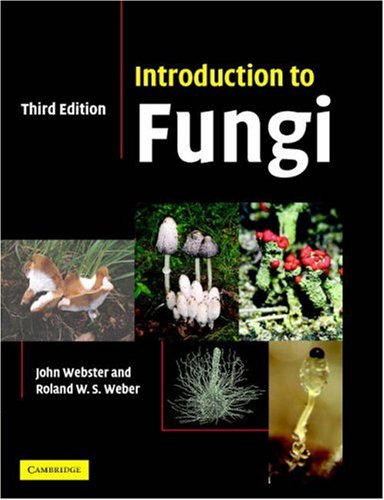
1. Introduction to Fungi
$24.90
2. Mushrooms and Other Fungi of North
$151.00
3. Fungi in Bioremediation (British
$48.98
4. The Fungi, 2nd Edition
 
$69.95
5. Identifying Filamentous Fungi:
$26.37
6. Mushrooms and Other Fungi of the
 
$22.93
7. Fruiting Bodies and Other Fungi
$70.47
8. Medically Important Fungi 4th.
$19.62
9. The Triumph of the Fungi: A Rotten
 
$12.61
10. Mushrooms of North America in
$55.40
11. Detection and Isolation of Soil
$84.77
12. Ainsworth and Bisby's Dictionary
 
$3.40
13. Microorganisms, Fungi, and Plants:
$8.99
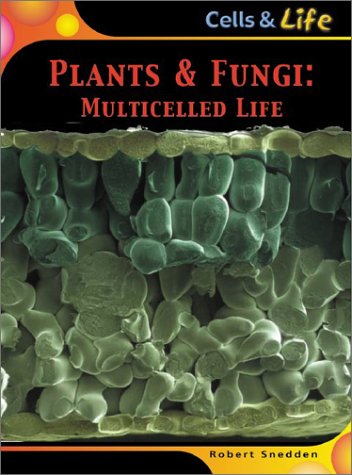
14. Plants and Fungi: Multicelled
 
$65.00
15. The Identification of Fungi: An
 
$76.71
16. Introduction to Food- And Airborne
$144.00
17. Sex in Fungi: Molecular Determination
$44.20
18. The Ultimate Study Guide For Biology:
 
19. THE TRIUMPH OF THE FUNGI. A ROTTEN
$22.76
20. Treasures from the Kingdom of

1. Introduction to Fungi
by John Webster, Roland Weber
Paperback: 846 Pages (2007-03-05)
list price: US$75.00 -- used & new: US$68.39
(price subject to change: see help)
Asin: 0521014832
Canada | United Kingdom | Germany | France | Japan
Editorial Review

Book Description
This new edition of the universally acclaimed textbook on fungal biology has been completely re-written, to take account of recent progress in the taxonomy, cell and molecular biology, biochemistry, pathology and ecology of the fungi. Features of taxonomic relevance are integrated with natural functions, including their relevance to human affairs. Special emphasis is placed on the biology and control of human and plant pathogens, providing a vital link between fundamental and applied mycology. The emphasis throughout is on whole-organism biology from an integrated, multidisciplinary perspective. ... Read more


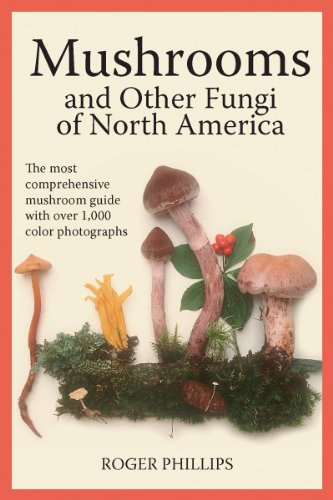
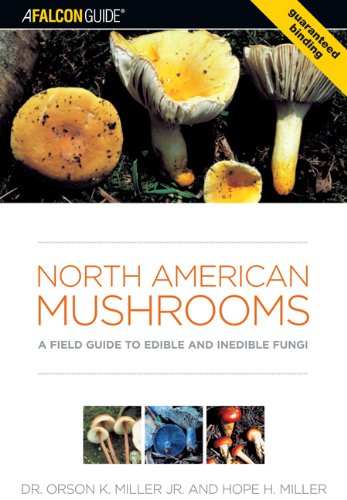
2. Mushrooms and Other Fungi of North America
by Roger Phillips
Hardcover: 320 Pages (2005-09-22)
list price: US$39.95 -- used & new: US$24.90
(price subject to change: see help)
Asin: 1554071151
Average Customer Review: 4.5 out of 5 stars
Canada | United Kingdom | Germany | France | Japan
Editorial Review

Book Description

The ultimate illustrated handbook on mushrooms.

More than 1,000 handsome color photographs by Roger Phillips illustrate this comprehensive guide to mushrooms and other fungi of North America, in all their astonishing variety.

Amateur collectors, expert mycologists and armchair naturalists will welcome the reissue of this valuable reference.

Each photograph has a neutral background to eliminate distractions. The specimens are arranged to show the cap, stem, gills, spines, and a cross section, usually in various stages of growth.

The information on each mushroom variety includes:

  • Dimensions of cap, gills and stem
  • Color and texture description of flesh
  • Description of odor and taste
  • Habitat and growing season
  • Description of spores
  • Categorization of edibility.

Mushrooms and Other Fungi of North America also includes useful tips and helpful advice on collecting specimens and identifying them. This book is the ideal introduction to mycology.

... Read more

Customer Reviews (16)

5-0 out of 5 stars Terrific book!
This book has a ton of great pictures and descriptions.I bought this book for my fiance who is a mushroom inthusiast.There were many times when we would be taking a walk and he would wonder if mushrooms we saw were edible.He keeps the book in his car, and it's a great reference guide.The descriptions let us know where to expect certain mushrooms, if they are edible or not, and what they taste like.
I highly recommend this book for new mushroom hunters!

4-0 out of 5 stars Bring back the soft cover!
I love this book, it has more pictures than any other mushroom book.It's like a bible for mushroom identifying.
BUT the older edition with the soft cover was way more practical to drag around in the field and easier to thumb through.
I miss it.

5-0 out of 5 stars Great photo guide for mushroom collectors
I bought this book for use in identifying and photographing mushrooms in New England, and it has yet to disappoint.Probably the best full-color photo guide that I've seen.If mushrooms are your thing, this book is a must-have.

5-0 out of 5 stars Excellent
I gave this book as a gift to my husband who has been trying to learn more about wild mushroom hunting.He had read several other books, but said this one was more informative than any of the others--the best ever!

3-0 out of 5 stars Good, but has a significant problem
On the plus side, this book exhaustively presents lots of species, including quite a few not covered in other popular guides, and in general, the photos are very good in all respects save one: the color accuracy. It appears that there has been little or no attempt to use color management when it came time to reproduce the photos. It appears that the mushrooms were all photographed in-studio rather than in the field, against a gray background. To appreciate how much the color reproduction varies, just look at the gray background in each photo, and you'll see just how off the color really is.

Other than that, I'd give the book 5 stars, but accurate color is very important in a book like this, so I give it 3 stars. ... Read more


3. Fungi in Bioremediation (British Mycological Society Symposia)
Hardcover: 496 Pages (2001-12-03)
list price: US$170.00 -- used & new: US$151.00
(price subject to change: see help)
Asin: 0521781191
Canada | United Kingdom | Germany | France | Japan
Editorial Review

Book Description
Bioremediation research has concentrated on organic pollutants, although the range of substances that can be transformed or detoxified by microorganisms includes both natural and synthetic organic materials and inorganic pollutants. The majority of applications developed to date involve bacteria, with a distinct lack of appreciation of the potential roles and involvement of fungi in bioremediation, despite clear evidence of their metabolic and morphological versatility. This book highlights the potential of filamentous fungi, including mycorrhizas, in bioremediation and discusses the physiology and chemistry of pollutant transformations. ... Read more


4. The Fungi, 2nd Edition
by Michael J. Carlile, Sarah C. Watkinson, Graham W. Gooday
Paperback: 588 Pages (2001-02)
list price: US$59.95 -- used & new: US$48.98
(price subject to change: see help)
Asin: 0127384464
Average Customer Review: 3.0 out of 5 stars
Canada | United Kingdom | Germany | France | Japan
Editorial Review

Book Description
The fungi are one of the great groups of living organisms, comparable in numbers of species, diversity and ecological significance with animals, plants, protists and bacteria. This textbook deals with all fundamental and applied aspects of mycology, illustrated by reference to well studied species from major fungal groups. Since the publication of the first edition of The Fungi, there have been many important advances in the field of mycology. This second up-to-date edition has been revised and substantially expanded, and incorporates the application of methods of molecular biology, especially DNA technology to mycology.

KEY FEATURES:
* Question and answer section at the end of each chapter
* Modern classification based on Molecular phylogeny
* Detail of the recent increased understanding of the organelles and processes involved in hyphal growth
* New molecular understanding of mating type genes
* The latest on molecular recognition in the infection process
* The use of DNA technology in engineering plant resistance to fungal diseases
* New section on medical mycology
* Fungal mycology in animals
* The latest on the use of genetically manipulated fungi to produce products earlier obtained from mammals ... Read more

Customer Reviews (1)

3-0 out of 5 stars Fungi, mysteries and fascinations
This book is a very good overview of the kingdom Fungi. With an easy vocabulary usage, the authors were able to entertain the reader with very well done chapters. Although some of the topics could have been streesed a little deeper, the book is perfect for college students enrolled in classes such as introductory mycoloy and fungal systematics. ... Read more


5. Identifying Filamentous Fungi: A Clinical Laboratory Handbook
by Guy St. Germain
 Hardcover: 314 Pages (1995-08)
list price: US$69.95 -- used & new: US$69.95
(price subject to change: see help)
Asin: 0898631777
Average Customer Review: 5.0 out of 5 stars
Canada | United Kingdom | Germany | France | Japan

Customer Reviews (1)

5-0 out of 5 stars Great resource for help in identifying fungi
GREAT source for the Mycologist or student faced with the difficult task of correctly ID'ing fungi.All fungi are in alphabetical order by Genus and have illustrated color pictures of the structures and various clinical tests that will verify your ID.MUCH better than many other textsreccomended for the same purpose. ... Read more


6. Mushrooms and Other Fungi of the Midcontinental United States (Bur Oak Guide)
by Donald M. Huffman, Lois H. Tiffany, George Knaphaus, Rosanne A. Healy
Paperback: 384 Pages (2008-03-15)
list price: US$39.95 -- used & new: US$26.37
(price subject to change: see help)
Asin: 1587296276
Canada | United Kingdom | Germany | France | Japan
Editorial Review

Book Description

This completely revised second edition provides all the information necessary to identify mushrooms in the field in the midcontinental region of Iowa, Illinois, Nebraska, Missouri, Minnesota, South Dakota, and Wisconsin: the tallgrass prairies and the western parts of the eastern deciduous forests.

The first edition has been improved in significant ways. The authors have updated scientific names, added photos where there were none and replaced poor photos with better ones, improved the keys, added some species and deleted others, added a section on truffles, and annotated the bibliography. There were originally 224 species; now there are 248. Some of the new photos—125 in all—serve as a second photo for a species, where it is helpful to show details that cannot be viewed in a single photo.

The authors describe each species’ cap, gills, stalk, annulus, and season when it is most likely to be seen as well as such characteristics as edibility and toxicity. In their detailed and lively introduction they discuss the economic and environmental aspects of fungi, basic mushroom biology, nomenclature, edibility and toxicity, and habitats and time of fruiting. Most important are the keys, which lead the dedicated reader to the major groups of fungi included in this guide. The section on mushrooms includes keys to their genera in addition to the species within each family discussed, and each of the subsequent sections has a key to the genera and species except where so few species are discussed that a key is not necessary. The volume also includes a glossary and two bibliographies, one with general and one with technical references.

Through their detailed technical descriptions and captivating color photos the authors convey their passionate fondness for these diverse and colorful organisms, whose mysterious appearances and disappearances have long made them objects of fascination.
... Read more

7. Fruiting Bodies and Other Fungi
by Brian Lumley
 Paperback: 288 Pages (1996-04-15)
list price: US$13.95 -- used & new: US$22.93
(price subject to change: see help)
Asin: 0312862008
Average Customer Review: 4.5 out of 5 stars
Canada | United Kingdom | Germany | France | Japan

Customer Reviews (9)

5-0 out of 5 stars Yeesh!Good old-fashioned tales to send chills down your spine.
Aside from having one of the coolest titles ever, this is one of the best collections of short stories in the vein of H.P. Lovecraft.Ah-ah-ah, but wait.This isn't to say that Mr. Lumley writes in a thick prose which could bore you to death while speaking of "indescribable horrors" - rather, Lumley takes every bit of that "I never really thought about how little man knows about anything" kind of chill that Lovecraft is famous for, and injects it into his own kinds of ideas and situations.There are also a few non-supernatural stories here, which show that a person doesn't need to transcend space and time in order to find true horror - again, we know SO little about anything, including what we're capable of.

"Fruiting Bodies," the titular opener, is one of the most singularly creepy stories you might ever read.I won't say much except that you'll never again walk into your basement without thinking about this story...and if it's musty and moldy, you probably will try to find any excuse you can to NOT go.

"The Man Who Photographed Beardsly" is a quick first-person narrative, detailing...well, it's an artist talking, and he...hm, well, without ruining it, it's a quick narrative of "what happened."This might be considered a little weak, but it's still good.

"The Man Who Felt Pain" is a future-set tale of twin brothers, one of which has the ability to feel the pain of others from all around him...and suffers greatly from it.The other, who tells this tale, raises a good point from this: that "if we all felt everyone's pain, why, then there'd be no more wars or cruelties or hurtfulness of any sort..."More emotional than it is scary, but with chilling implications that will haunt you - along with certain images from the tale itself - for a long time afterward.

"The Viaduct" is a straight-up thriller, with two boys who like to live life on the edge learning the ultimate lesson for themselves after making fun of a local reta--um, "special kid."It's a seriously tense story, but sadly the supernatural is again missing here.Scary climax, however.

"Recognition" - ahhh, Lovecraft delight.Strange happenings, eerie noises, monstrous implications, and a creepy finish.What more could you want from a second-generation Lovecraft writer?

"No Way Home" is also Lovecraftian in its angle of things (eep, pun lurking in there...).If you get lost somewhere near where you think you are supposed to be, maybe...don't read this story if you stop to think or rest.And watch out for High House!

"The Pit-Yakker" is not about some kind of monster that lives in a construction site and makes yakking sounds, unfortunately.I had that impression far too firmly in mind, especially after reading Mr. Lumley's intro to the story ("...sometimes I wonder what they'll find under all that pit filth.")Another no-supernature story, but, like "The Man Who Photographed Beardsley" and "The Viaduct," it's still a good one.

"The Mirror of Nitocris" - ah, back into Lovecraft mode.Narrated by Henri-Laurent de Marigny (later a faithful Watsonian sidekick to one of Mr. Lumley's series heroes, Titus Crow), it's a quick tale of a cursed mirror of an ancient Egyptian queen, ancient beings, and...well, read it for more details.There's one image from it which is pretty haunting, especially if you're alone in your room and dozing off while trying to stay awake.

"Necros" - nope, not NecrosCOPE, just Necros.Englishman visiting Italy meets a beautiful woman and her companion, a creepy old man, and a romantic evil begins to form.I shall say no more.

"The Thin People" may be one of the best stories in the book.Absolutely creepy, and definitely Lovecraft-inspired.You'll never quite look out your window at the street at night in the same way again.

"The Cyprus Shell," and "The Deep-Sea Conch" are two split tales that involve similar situations being shared by and to their respective narrators.And don't read them out of order! - read "Shell," then read "Conch."They make for a highly effective diptych.

"Born of the Winds" is another favorite of mine from this collection, along with "Fruiting Bodies" and "The Thin People."A total, absolute, 100% Lovecraft tale (Great Old Ones and all), this story is also the longest in the book (61 pages in all!).Highly recommended to be read during cold weather or if you live in a colder climate.Very creepy at times, and an excellent closer.

And now that you know a thing or two about the book, hunt down a copy and enjoy.

...wait, did you hear that?

5-0 out of 5 stars Fantastic!
Short horror stories are my favorite fiction form, and this is one of my favorite collections.The stories are original and creepy.

5-0 out of 5 stars There is a fungus amongus!
Having only recently been turned on to Brian Lumley, this is my first purchase and first read of Lumley; and all I can say is Wow!His writing phases from ethereal to direct impact, flowing with style and a flair for the creepy things that go squish in the night.

Beginning with the best story of the collection, "Fruiting Bodies", Lumley takes us on a trip through a small, dying town that is slowly falling into the sea.But will the sea claim its victim before the Dry Rot does?Seemingly, a new and mutated type of dry rot, it is as hungry as the sea.Lumley does not deny the imagination in this tale, leaving you searching the nooks and crannies of your house for any...well...nasty accumulations.

"The Man Who Photographed Beardsley" is a short but sweet sabbatical into a demented and twisted mind, which has managed to retain its sense of propriety.

"The Man Who Felt Pain" is a tale told by the protagonist, of his twin brother and the bond they shared, through life and death.If one twin suffers, will not the other twin feel his pain...sooner or later?

"The Viaduct" reminds me of Stephen King back when he still had tight and compelling stories with real-life characters you could relate to immediately.Children can be cruel, but just where is the line drawn when one doesn't understand the rules?This is an excellent story, in which I could actually feel the desperation and the slippery palms of true terror.

"Recognition" is a ghostly tale of a haunted place, and a firm argument as to why some things are best left alone.

"No Way Home" is a surreal nighttime journey through both familiar and unfamiliar territory, with a surprise ending that is unexpected...and worth the trip.

"The Pit-Yakker" takes us back in time to a simpler life within a working-man's village, and a young man's dreams that turn to dust and disintegration in the wake of simple urges and the lack of intelligence to quench them.Questions of friendship and tolerance and personal limitations are addressed here, in a harsh and unforgiving atmosphere of betrayal and lust.

"The Mirror of Nitocris" was one of the stories I found to be a bit boring, kind of strung out and lacking, even though it is only 10 pages long.It was just a bit of a yawn in all the rest of the excitement; a tale of an acquired artifact that comes into being in a chilling climax, only to be destroyed before it can leash its evil into the world.

"Necros" is a very interesting tale of immortality, and the things one must do in order to assure that immortality is youthful and pleasant.But there is a twist to this at the end that will surprise you, and give you a peek into the horrific aspects of bowing to such a creature.

"The Thin People" is a true masterpiece of the type of horror that will leave you forever guessing about ordinary things you see every day.I am counting the lamp posts on my street now, and have had a few disturbing dreams in regards to the science of "Folding".Excellent tale!

"The Cypress Shell" and "The Deep Sea Conch" are intertwined stories, based on letters written from one person to another.The tales they tell of mysterious mollusks are frightening and disgusting, and well deserve their place here in this anthology.The creepiness Lumley portrays upon something as simple as shellfish is amazing, and you will never eat clams or muscles in the same uncaring fashion as you once did before this unnerving description of these innocent organisms.

Lastly is "Born of the Winds", the longest story in the collection, and a novella in its own right.Although, it was my least favorite of all the set.A meteorologist recovering from an "incident" of chest discomfort visits his friend in Navissa, Manitoba.While recuperating from his complaint within the house of his friend, he meets the widow of Samuel Bridgeman, an anthropology professor who had died nearby some years ago.Our protagonist becomes interested in Bridgeman's written works, and eventually becomes involved in Mrs. Bridgeman's search for her son, Kirby.How deep is the Bridgeman's connection with the Air Elementals and the Wind Walkers, and where does Kirby fit in with these spirits?Not a bad story, just a little too wordy and..well...coy, for my tastes.

Don't miss this fantastic collection of stories from Lumley, a true master of mysterious and weird stories that are well written and well told.Enjoy!

2-0 out of 5 stars can't digest the fungi
i was not mazed by this collection. it was strange, in a way. great descriptions in one story, incredible shallow in another. good well developed style in one story,like a child writing in another. amazingly unoriginal in some stories. never really inventive. but the most sad thing was how Lumley kept from being interesting. oh, by the way: don't hate the man, know he's got some good stories.

5-0 out of 5 stars Reason to Mistrust the Abnormal
Amongst the most notable horror writers that have picked up a pen and crafted, Brain Lumley the short story writer (not to be confused with Brain Lumley, the novel writer, whom I really can't speak on because of lack of general knowledge on him) has to be mentioned with awe. I'm not certain if his allure is in the way he crafts situational happenstance, with the pages of foreshadowing seamlessly meshing with the way he flawless enacts characterization, if its the way his peaks and valleys, his towns and villas, dance so vividly that my mind can walkabout and taste the air that even the shortest of tales seems to craft, or if its the ideas for his stories themselves. Its strange how he accomplishes that task, though, approaching horror and punctuating it with an aire of newness that banishes many of the classically shallow pits we've seen a million times before. Honestly, every time I read one of his shorts I find myself wondering exactly where his mind will allow him to approach even the most basic idea from.

In this collection of short stories, I've found many and many a tale that merits and actually demands acclaim. Some, like Fruiting Bodies and The Thin People, teem with topics that are frightening in their flavors, wearing masks that I can't recall reading anywhere else. Others, like the Lovecraftian tales he forged, most notably Recognition, wear dread like familiar sweaters. Now, for a listing of the stories here and a synopsis of some that no doubt does them an injustice:

Fruiting Bodies, one of my favorite pieces in this book, incorporates the disappearance of a town and the tales of a kindly old man into a tale of a mysterious fungi that seems quite extraordinary in its abilities. In fact, as it consumes more and more, it seems downright horrific in its reproach. I particularly liked this story because of the last statements, the punctuation mark on the horror if you will, that left the terrible tale open for the mind to digest. On top of that, the detail given to the setting is deliciously remarkable.

The Viaduct, a tale containing a valuable lesson on the cost of tormenting others, on heights and the challenge they bring to the table, and on the wonderful world of falling. This tale wasn't one that I cared for simply because of its ending, a great piece of work in and of itself, but I also appreciated the detailing, quite explicit and painstakingly given. In it, I could feel the characters and taste the surroundings, something that always amazes me.

Recognition, a Lovecraftian inspired piece, focuses on an entity that dwells within a home that someone wishes to be rid of, their efforts to understand the enemy, and the subsequent means (a medium, and exorcist, and someone to draw the beast for him) used to do so. This tale is particularly inspiring because it focuses upon the notion we hold most dear, that of understanding, and the high costs that connection can bring.

The Thin People, another of the more remarkable pieces here, dwells within the domain of The Thin People and their thin homes, where lightbulbs seem to vanish from streetlights and sometimes the number of lampposts changes for the worse, and on the strange science of "folding things." Again, this was interesting because it was, in a word, original.

The Cyprus Shell, coupled with a piece Lumley states he wanted printed after it, The Deep-Sea Conch, are letters that go hand in hand detailing not one but two of the dwellers within the deep (not to be confused with Deep Ones). The first, a hypnotic piece with a mesmerizing snail, and the second, a prehistoric holdover dredged from the deep, flow well together and leave a wonderful taste in the mouth of the reader.

Lastly, Born in the Winds, another Lovecraftian pieces on the wonderfully Arctic world of the WindWalker, is something that approaches a familiar topic but does so in a grand way.

The stories I chose not to breakdown are The Man Who Felt Pain, The Man Who Photographed Beardsley, No Way Home, The Pit-Yakker, The Mirror of Nitocris, and Necros. This, in no way reflects upon them as stories because all are quite good, but more on the laziness of the reviewer himself and his need to keep some things nameless.

All in all, the way this collection bounces from topic to topic, from beastly horror to loathsomely fungoid terror, is a sight to behold and well worth the read. I especially find it nice to fear something new for a change. ... Read more


8. Medically Important Fungi 4th. edition: A Guide to Identification
Paperback: 400 Pages
-- used & new: US$70.47
(price subject to change: see help)
Asin: 1555811728
Average Customer Review: 3.5 out of 5 stars
Canada | United Kingdom | Germany | France | Japan
Editorial Review

Book Description
...emphasizes both basic science, including cell biology, cell structure,growth, virulence factors, & host response, & clinical science aspects ... Read more

Customer Reviews (2)

4-0 out of 5 stars Fungal ID
It is a well written, and illustrated book for the idenfication of fungi, however, the inclusion of plates for appearance on media and more direct photos would improve the publication (and no doubt increase the cost) otherwise it is a good book for the identication of fungi in the laboratory that processes some fungi, as an offshoot to the microbiology department, a mycology department would include this in its library but would include other texts, and resources. In summary good at uni good on the bench, but would need suplementation in a pure mycology department.

3-0 out of 5 stars It's a good book for fungi identification
I have had very satisfactory experiences in the use of this book as a guide for the identification of Food Fungi, even though outside written forFungi of Medical Importance. It displays a very particular approach thatmakes extremely didactic, mainly for the novices in the subject or thatthey do not make fungi identification of routine. It presents first aclassification of the fungi based on the color of the colony and thecharacteristic formation of conidias of the fungi genera. In one secondpart of the book it makes a more detailed description of each one of theconsidered generas. And finally it makes an review of the main medias usedin the isolation and identification of fungi. ... Read more


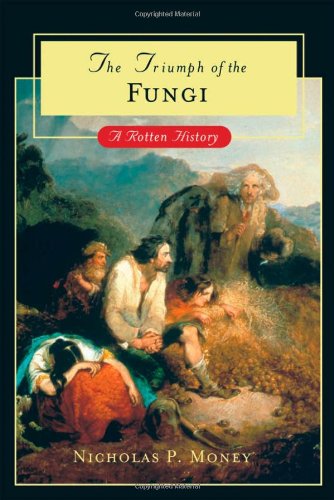
9. The Triumph of the Fungi: A Rotten History
by Nicholas P. Money
Hardcover: 216 Pages (2006-08-31)
list price: US$29.95 -- used & new: US$19.62
(price subject to change: see help)
Asin: 019518971X
Average Customer Review: 4.5 out of 5 stars
Canada | United Kingdom | Germany | France | Japan
Editorial Review

Book Description
This book is concerned with the most devastating fungal diseases in history. These are the plagues of trees and crop plants, caused by invisible spores that have reshaped entire landscapes and decimated human populations. The Triumph of the Fungi focuses on the fascinating biology of the well- and lesser-known diseases, and also tells the stories of the scientists involved in their study, and of the people directly impacted by the loss of forest trees like the chestnut, and cash crops such as coffee and cacao. In a surprisingly brief time, human knowledge of the fungi that infect plants has evolved from Biblical superstition, to the recognition of the true nature of plant disease, and, more recently, to a sense of awe for the sophistication of these microbes. The crucial issue of human culpability in these fungal epidemics is addressed in the books closing chapter. ... Read more

Customer Reviews (4)

5-0 out of 5 stars Laugh While You Learn
Could a book on fungus could make you laugh out loud?If the book in question is Dr. Nicholas Money's wonderful The Triumph of the Fungi, it certainly could. I laughed the whole way through, starting with the subtitle - A Rotten History, and learned so much along the way.

Each chapter of the book tackled a crop I take for granted, describing how it gained prominence, revealing who it enriched, and delving into what fungus destroyed or has the power to destroy it.Dr. Money tied in the historical aspects of each mycological disaster, making the book easy going, even for a nonscientist. As an English major, I only took two semesters of biology, so it would have been easy to lose me in the details.The numerous real-life examples, comparisons, quips, and allusions, however, made what would have been dry and inaccessible material in another author's hands fresh and fun.

Before this book, I knew nothing about how dangerous monocultures are and how at risk current farming practices make us.I had only a glimmer of how complex the life cycles of fungi are.I certainly didn't realize how impossible it is for fungicides to keep up with the rapidity of evolution in the fungal world.And now I do.

It took me months to read this book because I'm a teacher and, during the school year, I only get to read in 15-minute "Silent Reading" intervals.This kind of interrupted reading makes even great books take a loooong time to finish.To Dr. Money's credit, the book was so well written that even a sporadic reader found it easy to pick up where she left off and forge on. It's a rare book that entertains as well as it educates; Triumph of the Fungi does just that.

5-0 out of 5 stars Manifesto against monocultures
Apart from some strained attempts at humour, starting with the subtitle, Nicholas Money has produced an excellent book.The book is a well-organised and expressively written presentation of how various fungi [and their relations] have and are assaulting valuable trees and crops around the planet.With excellent graphics to support the text, the author describes how fungal infections have attacked decorative or lumber tree species, such as the chestnut and jarrah, crop plants like coffee, potatoes and rubber.He explains how the infections were detected and investigated by various researchers and what steps have been taken to curb or eliminate the infestation.The latter point is the one that should prompt the reader's close attention.

Although to many people, the blight causing the Irish Potato Famine may be the best known of fungal infections, Money opens with a story of the extermination of the American Chestnut.The account shows how little was known of fungi life cycles at the turn of the last century.Coping with the spreading infection was sporadic and ineffective.The spores, Money calculates, spread at the rate of over 100 metres per day.Small wonder governments failed to address the epidemic successfully.Control, in any case, would have meant an interdict on seed and seedling importation and transport, a multi-million dollar business.Such a draconian imposition would have raised the ire of business and governments alike.So we lost the chestnut.And the elm.The oaks and redwoods in California are presently under threat from a similar infestation.How can microbes be so destructive and apparently so immune to counter-measures?

Fungi are insidious in their invasive tactics and are talented breeders.Not only may a species have multiple mechanisms for breeding, many actually breed across species to create hybrids.These cross-bred organisms are highly adaptable to changing conditions.In fact, variations in environment may prompt species' mix to address the change.The breeding of multiple species may have immense impact, since some fungi may infect more than a hundred different types of plants.Money demonstrates mixed feelings as he describes some fungi as "the most exuberant swingers of the microbial world".It's an amazing capacity in such a simple organism.The genome of some species is nearly the size of a human's - but, far more importantly, the large genome imparts the ability to change rapidly as needed.This is one reason why so many fungi aren't "species-specific" in their infections.

In his descriptions of the historical efforts to identify the various rusts, blights, blasts and bunts attacking plants, Money recounts the efforts of investigators.There are the losers who went along almost fantastic idea tracks, attributing infections to malodorous mists and even moonlight.More rational researchers found ways of tracking infectors and how they operated.His first hero is Henry Murrill, who struggled to cope with the American chestnut epidemic that originated in the Bronx Zoo grounds in 1904.Rev. Miles Berkeley, working in limited circumstances, produced a landmark essay on the cause and effect of fungal infection of the "Irish" potato.Money's chapter heading, "Potato Soup" is telling as a descriptor.

Farther afield, Money admires the work achieved by a group of women in the Netherlands.Johanna Westerdijk, Christine Buisman and Marie Schwarz all made key contributions in revealing the mechanics of what is known as Dutch elm disease.Some of this work provided pointers to the evolutionary path of these fungi, information being applied elsewhere.Money's real praise, however, reaches further back in time in lauding two French scientific pioneers.Mathieu Tillet and Benedict Prevost proved to be the first to apply sound research methods in determining how plant disease operates.He would have this pair granted Nobel Prizes if the rules allowed posthumous awards.He notes that in France experimental research was held in low regard in their day.It was a serious uphill climb for them to gain recognition for their work.

It's not an uphill struggle to read this book, however.Money, who has published other works on mycology - the study of fungus - has an admirable way of making his point.The point here is that with fungi so adaptive, so easily disseminated over vast distances and so difficult to eradicate, the human species stands in some peril of indirectly succumbing to its effects.Wheat, maize, cocoa, coffee and rubber may join chestnuts in disappearing from our ken.These products are fundamental to our society, and more research must be undertaken to reveal how to address the problem.With so many of these crops being clones of earlier strains, their vulnerability is high, as is ours as a result.Read this and find out what you may be confronting.[stephen a. haines - Ottawa, Canada]

3-0 out of 5 stars An alright book
As I had read the author's other books on fungi I thought this one would be great. I was wrong. It fine for folks who know little about fungi and their influences in the world but not of much value otherwise. Mr Money can do better.

5-0 out of 5 stars Fantastic book!
It is often said that the cockroaches will outlast us--but Nicholas Money's new book convinces me it will be the fungi who triumph in the end. This wonderful, terrifying book details the devastation wrought by the fungi and our feeble efforts to keep them at bay. How is it possible that a book with such a grim message is a page-turner that makes you laugh out-loud on nearly every page? Because this guy can WRITE. Money is the Steven Jay Gould of mycology, the Richard Dawkins of the fungi, and this book is fantastic. ... Read more


10. Mushrooms of North America in Color: A Field Guide Companion to Seldom-Illustrated Fungi
 Paperback: 172 Pages (1995-08)
list price: US$19.95 -- used & new: US$12.61
(price subject to change: see help)
Asin: 0815603231
Canada | United Kingdom | Germany | France | Japan

11. Detection and Isolation of Soil Fungi
by Pierre Davet, Francis Rouxel
Paperback: 188 Pages (2000-09)
list price: US$55.40 -- used & new: US$55.40
(price subject to change: see help)
Asin: 1578081254
Canada | United Kingdom | Germany | France | Japan

12. Ainsworth and Bisby's Dictionary of Fungi
Hardcover: 650 Pages (2001-12-15)
list price: US$110.00 -- used & new: US$84.77
(price subject to change: see help)
Asin: 085199377X
Canada | United Kingdom | Germany | France | Japan
Editorial Review

Book Description
This is the one essential handbook for all who work with or are interested in fungi (including lichens, slime moulds and yeasts). This new edition, with more than 20,500 entries, provides the most complete listing of generic names of and terms used to describe fungi available. For each genus, the authority, the date of publication, status, systematic position, number of accepted species, distribution, and key references are given. Diagnoses of families, orders and higher categories are included for most groups. In addition, there are biographic notes, information on well-known metabolites and mycotoxins, and broad accounts of almost all pure and applied aspects of the subject (including citations of important literature). All information has been updated as necessary since the publication of the eighth edition in 1995. In addition the ninth edition has the following new features: a refined classification of fungal phyla reflecting the latest molecular evidence, including a major revision of the classification of the Ascomycota; a full integration of anamorphic genera in the classification; a revised synopsis of the proposed classification. ... Read more


13. Microorganisms, Fungi, and Plants: Unit A
 Hardcover: Pages (2004-01-31)
list price: US$23.65 -- used & new: US$3.40
(price subject to change: see help)
Asin: 0030255333
Canada | United Kingdom | Germany | France | Japan

14. Plants and Fungi: Multicelled Life (Cells and Life/ 2nd Edition)
by Robert Snedden
Paperback: 48 Pages (2007-08-15)
list price: US$8.99 -- used & new: US$8.99
(price subject to change: see help)
Asin: 1432900404
Canada | United Kingdom | Germany | France | Japan

15. The Identification of Fungi: An Illustrated Introduction With Keys, Glossary, And Guide to Literature
by Frank M. Dugan
 Spiral-bound: 176 Pages (2006-06-30)
list price: US$65.00 -- used & new: US$65.00
(price subject to change: see help)
Asin: 0890543364
Average Customer Review: 5.0 out of 5 stars
Canada | United Kingdom | Germany | France | Japan

Customer Reviews (1)

5-0 out of 5 stars Will aid students working in the field.
Frank M. Dugan's THE IDENTIFICATION OF FUNGI: AN ILLUSTRATED INTRODUCTION WITH KEYS, GLOSSARY, AND GUIDE TO LITERATURE offers a spiral-bound workbook suitable for college-level classrooms investigating the subject. Descriptions of plant pathogens, parasites, and descriptions are very specific and will aid students working in the field. ... Read more


16. Introduction to Food- And Airborne Fungi
 Paperback: 389 Pages (2004-01)
list price: US$79.95 -- used & new: US$76.71
(price subject to change: see help)
Asin: 9070351528
Canada | United Kingdom | Germany | France | Japan
Editorial Review

Product Description
Updated version of the previous editions an invaluable tool for the researcher Over 100 illustrations for easy identification. ... Read more


17. Sex in Fungi: Molecular Determination and Evolutionary Implications
Hardcover: 542 Pages (2007-08)
list price: US$169.95 -- used & new: US$144.00
(price subject to change: see help)
Asin: 1555814212
Canada | United Kingdom | Germany | France | Japan
Editorial Review

Book Description
Studies on the major groups within the fungal kingdom have providedsignificant and wide-ranging contributions on the molecular bases by which sexual identity and reproduction are defined and controlled.Sex in Fungi:Molecular Determinationa dn Evolutionary Implications not only encopassesthe current state of knowledge, but also serves as an invaluable resourcethat will guide new research on these systems and organisms. Drawing onthe great advances made over the past 10 years, this volumeprovidesilluminating insights into the molecular details of cell-typespecification, mating-type switching, pheromone perception and signaling,and cellular and nuclear fusion. ... Read more


18. The Ultimate Study Guide For Biology: Key Review Questions and Answers with Explanations (Topics: Evolution, Ecology, Kingdom Bacteria, Kingdom Protista, Kingdom Fungi & Viruses, Plant Form and Function) Volume 2
by Patrick Leonardi
Paperback: 87 Pages (2004-07)
list price: US$51.95 -- used & new: US$44.20
(price subject to change: see help)
Asin: 1933023015
Average Customer Review: 5.0 out of 5 stars
Canada | United Kingdom | Germany | France | Japan
Editorial Review

Book Description
This is the most specific and thorough study guide for college biology.It is written in an "easy to understand style."This test preparation study guide covers the following: Evolution, Ecology, Kingdom Bacteria, Kingdom Protista, Kingdom Fungi & Viruses, Plant Form and Function.

This is Volume 2 of a three volume series.Volume 1 covers Origin of Living Things & Chemistry of Life, Structure and Function of the Cell & Energy Pathways, Reproduction, Heredity and Genetics.Volume 3 covers Kingdom Animalia, Organization of the Animal Body, Animal Form and Function.In addition,Volume 3 also covers Animal Reproduction, Development and Behavior. ... Read more

Customer Reviews (1)

5-0 out of 5 stars This is an excellent study guide for Biology
This book was so helpful for my college classes, biology I and II.It had all the kind of questions that prepared me for the exams.The explanations were great and quite easy to read.I also used The Ultimate Study Guide for Biology: Key Review Questions and Answers with Explanations Volume 1 which coverd Organization of Living Things & Chemistry of Life, Structure and Function of the Cell and Energy Pathways, Reproduction and Heredity, Genetics.I also studied Volume 3 which had topics of Kingdom Animalia, Organization of the Animal Body, Animal Form and Function, Animal Reproduction, Development and Behavior.I must say these 3 books really did for me for helping me get excellent grades. ... Read more


19. THE TRIUMPH OF THE FUNGI. A ROTTEN HISTORY.
by N. Money
 Hardcover: Pages (2007)

Asin: B0011DFRD0
Canada | United Kingdom | Germany | France | Japan

20. Treasures from the Kingdom of Fungi: Photographs of Mushrooms and Other Fungi from Around the World
by Taylor F. Lockwood
Hardcover: Pages (2001-08)
list price: US$29.95 -- used & new: US$22.76
(price subject to change: see help)
Asin: 097094490X
Average Customer Review: 5.0 out of 5 stars
Canada | United Kingdom | Germany | France | Japan

Customer Reviews (1)

5-0 out of 5 stars The best book on fungi's photographies.
6 stars of 5. Isn't a botanical book. No keys, no descriptions of fungi, no introduction to families... just photos... fantastic photos. Many of the species shown inside are unidentified, but it doesn't matter.
If you wanna make a gift to someone interested in fungi this is the book i'll recommend to you. ... Read more


  1-20 of 100 | Next 20
A  B  C  D  E  F  G  H  I  J  K  L  M  N  O  P  Q  R  S  T  U  V  W  X  Y  Z  

Prices listed on this site are subject to change without notice.
Questions on ordering or shipping? click here for help.

site stats