e99 Online Shopping Mall

Geometry.Net - the online learning center Help  
Home  - Science - Grounded Theory (Books)

  1-20 of 100 | Next 20
A  B  C  D  E  F  G  H  I  J  K  L  M  N  O  P  Q  R  S  T  U  V  W  X  Y  Z  

click price to see details     click image to enlarge     click link to go to the store

$34.15
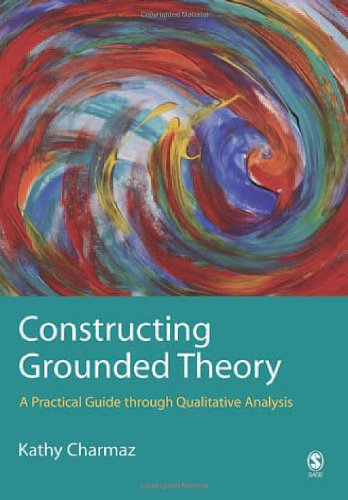
1. Constructing Grounded Theory:
$28.75
2. The Discovery of Grounded Theory:
$123.45
3. The SAGE Handbook of Grounded
$48.75
4. Grounded Theory in Practice
$83.64
5. Basics of Qualitative Research:
 
$30.00
6. Basics of Qualitative Research:
$68.95
7. Grounding Grounded Theory: Guidelines
$110.00
8. Grounded Theory in Management
$93.96
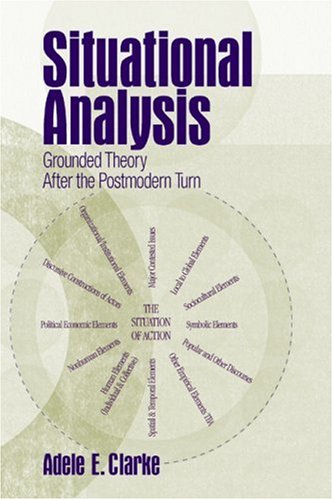
9. Situational Analysis: Grounded
 
$5.95
10. Understanding strategic transportation
 
$79.98
11. Basics of Grounded Theory Analysis:
 
$38.00
12. Theoretical Sensitivity: Advances
 
$74.98
13. Doing Grounded Theory: Issues
 
$29.95
14. Developing Grounded Theory (Developing
$17.95
15. A Grounded Theory Study of Truth-Telling
 
16. The Discovery of Grounded Theory:
 
$5.95
17. Finding the best fit: a grounded
 
$104.98
18. The Grounded Theory Seminar Reader
 
$83.94
19. The Grounded Theory Perspective
 
$5.95
20. The structure of the relationship

1. Constructing Grounded Theory: A Practical Guide through Qualitative Analysis
by Kathy Charmaz
Paperback: 224 Pages (2006-01-27)
list price: US$42.95 -- used & new: US$34.15
(price subject to change: see help)
Asin: 0761973532
Average Customer Review: 5.0 out of 5 stars
Canada | United Kingdom | Germany | France | Japan
Editorial Review

Book Description
`Grounded theory is a highly influential way of working with qualitative data and Kathy Charmaz is a major player, both innovative and fluent. This book is a model student text: lively, carefully argued and full of vivid illustrations. Beginning students and professional researchers will find it to be required reading' - David Silverman, Professor Emeritus, Sociology Department, Goldsmiths College and Visiting Professor, Management Department, King's College, University of London

Kathy Charmaz is one of the world's leading theorists and exponents of grounded theory. In this important and essential new textbook, she introduces the reader to the craft of using grounded theory in social research, and provides a clear, step-by-step guide for those new to the field.

Using worked examples throughout, this book also maps out an alternative vision of grounded theory put forward by its founding thinkers, Glaser and Strauss. To Charmaz, grounded theory must move on from its positivist origins and must incorporate many of the methods and questions posed by constructivists over the past twenty years to become a more nuanced and reflexive practice.

Essential reading for students, new researchers and seasoned social scientists alike, this book is one of those rare things, a textbook that is both accessible to those new to the field but also one that has important things to say about the nature of social enquiry itself.

... Read more

Customer Reviews (6)

5-0 out of 5 stars MUST HAVE
This book is a must have for anyone doing grounded theory research or dissertations. Kathy Charmaz helps the fans of qualitative methodology into the 21st century with this wonderfully written guide through grounded theory. The book promises to be of value to students or experts in the field, then delivers as promised!

Can't wait for her next book for my collection!!!

4-0 out of 5 stars A 'how to guide' and much more!
As the title suggests, Kathy Charmaz's 'Constructing Grounded Theory' is a practical and thoughtful guide to the intricacies of undertaking qualitative research. Each chapter focuses on a specific aspect with numerous 'hints' and examples from her own work. Charmaz is an excellent teacher, unafraid to challenge the work of Glaser & Strauss with humility and commonsense. Highly recommeded to all aspiring qualitative researchers.

5-0 out of 5 stars Wow!
This is by far the best and most detailed introduction to Qualitative Analysis I have seen. Charmaz is thorough, clear, to the point, and the book is well-written so that even beginner analysts could follow her points. Excellent find.

5-0 out of 5 stars Excellent core reading for Qualitative Researchers
Charmaz has used her vast experience in qualitative analysis to produce an excellent resource for qualitative researchers.Whether novice or experienced in qualitative research, Charmaz' book "starts at the start" for newer researchers; assists the reflective process of the qualitative methods; and leads the researcher to a firm research outcome thoroughly grounded by informant experience.Charmaz provides substantial examples from her own research to illustrate methods and techniques which encourage the researcher to remain on track, grounded by informant experience and to persevere with reflective and inquisitive thinking. Her book also offers suggestions for creative writing of the project report. I will be prescribing this as a basic text/reference for future qualitative research students.

5-0 out of 5 stars A Real Contribution to Grounded Theory
As someone who writes about grounded theory and supervises PhD students using grounded theory, I have absolutely no hesitation in recommending this book to them and anyone else using grounded theory. It isinfinitely superior to the Strauss and Corbin book which in my opinion is too restrictive and makes it difficult for graduate students to apply grounded theory. Charmaz also very cleverly avoids the schism that rose between Glaser and Strauss on the application of the method by giving the student several alternative steps. A scholarly book which is also very accessible. As someone using grounded theory, I am relieved that Kathy Charmaz wrote this book - she really does do a good job in reformulating it for 21st century researchers. ... Read more


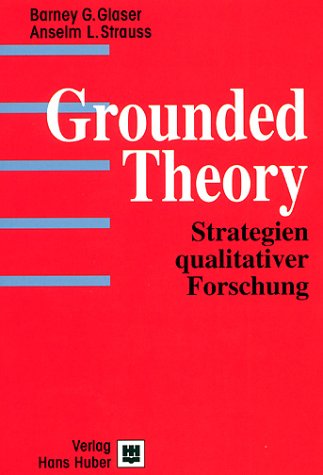
2. The Discovery of Grounded Theory: Strategies for Qualitative Research
by Barney G. Glaser, Anselm Strauss
Paperback: 271 Pages (1967-06-01)
list price: US$28.95 -- used & new: US$28.75
(price subject to change: see help)
Asin: 0202302601
Average Customer Review: 4.0 out of 5 stars
Canada | United Kingdom | Germany | France | Japan
Editorial Review

Book Description
This volume is directed toward closing the gap between theory and empirical research and improving social scientists' capacities for generating theory that is relevant and useful to their research. ... Read more

Customer Reviews (5)

4-0 out of 5 stars Grounded Theory
This is an excellent reference for those doing research that uses grounded theory to build theories.

5-0 out of 5 stars Seminal Work in Grounded Theory
This book is a must for anyone looking to write theory, or for researchers looking to do qualitative analysis.

4-0 out of 5 stars Grounded Theory Rocks
Glaser and Strauss's book is easy to read and offers a qualitative theory building strategy that is well structured. They provide a concise overview of the history of grounded theory and its uses. Moreover, they offer readers solid guidance on comparative qualitative studies and defense of the same in the world of research.

2-0 out of 5 stars Experimental and theoretical investigations
A. The term "theory" is used to mean many different things as can be seen in dictionaries. Even a simple guess of which the origin is ignored by the guesser and which has no proof can be called a theory. Consequently, there is a general distrust of theories even among scientists, and one often hears the slighting remark "it's only a theory." This attitude is most conspicuous in human sciences, such as psychology and sociology, for example. There was even a period during which theory construction was prohibited in those disciplines as pointed out by the authors in relation to sociology: "Those who still wished to generate theory had to brook the negative, sometimes punitive, attitudes of their colleagues or professors" (p. 10). So, the authors' aim appears to be to find a method of theory construction that will produce theories that are "grounded" in experimental data and therefore cannot be derogated as "only a theory." In reality, a theory has to be based on, or "grounded in," experimental data to be considered scientific. The real issue is how the grounding has to be done. We will see what the authors recommend and what physicists did an still do.

The authors do not explain what they mean by "theory," and instead, they say that the kind of theory constructed with the method advocated by them "provides us with relevant predictions, explanations, interpretations, and applications" (p. 1). What they overlook is that empirical knowledge too does the same things. Thus, the authors appear not to see the difference between empirical knowledge and scientific theories, and between experimental and theoretical methods of scientific investigation. This insufficiency is apparent even in the title of their book: "The discovery of grounded theory." The laws of nature can be experimentally discovered, but a theory is not something that exists in nature and can be experimentally discovered. A theory is constructed using the appropriate and unique method and is then tested, as explained below.

The authors' insufficiency in differentiating between experimental and theoretical investigations is reflected also in the second part of their book's title: "strategies for qualitative research." The term "research" indicates experimental investigation more often than theory construction, as in the nomenclature of The American Psychological Association, for example. So, the authors seem to say in the title of their book that reliable theories can be discovered by using adequate research strategies, which they will explain. Their text supports this view.

"We argue in our book for grounding theory in social research itself - for generating it from the data" (p. viii). "We believe that the discovery of theory from data - which we call grounded theory - is a major task confronting sociology today" (p. 1). "The basic theme in our book is the discovery of theory from data systematically obtained from social research" (p. 2). The issues involved in generating grounded theory from the data are listed as follows: "sampling, coding, reliability, validity, indicators, frequency distributions, conceptual formulation, construction of hypotheses, and presentation of evidence" (p. viii). The key issues are "construction of hypotheses" and "presentation of evidence."

B. The construction of hypotheses is explained thus: "The comparison of differences and similarities among groups not only generates categories, but also rather speedily generates generalized relations between them. It must be emphasized that these hypotheses..." (p. 39). So, "generalized relations" constitute hypotheses and are derived from the data. The authors also talk about "many levels of generality," "working" or "ordinary" hypotheses, "theoretical" hypotheses, and their integration (p. 40), but they do not clarify what they precisely mean.

Physicists are experts in theory construction but do not write about its method, because it looks most natural to them, for the reason mentioned below. It is only said that a theory is constructed by integrating at least one hypothesis with known facts. At the end of his book Principia, Newton explained very briefly the beginning of the process of theory construction and illustrated the rest of it by constructing his theory of mechanics. Judging from what Newton and other great theoreticians of physics said and/or did, hypotheses are framed in physics as explained by the authors (p. 39), but a hypothesis leads to theory construction only when it is generalized to cover phenomena of which the data do not allow the deduction of that hypothesis, contrary to the author's belief. For example, Newton assumed that, in accordance with his third law of motion, the Earth was attracting the Sun with the same force with which the Sun was attracting the Earth, even though this cannot be deduced directly from empirical data without using Newton's theory, i.e., it cannot be proved through direct measurement. A theory is made up of some basic statements, or laws, which contain at least one hypothesis that cannot be deduced from the analysis of every phenomenon to which it applies; when it is used to study a particular phenomenon, these laws are integrated with knowledge about that phenomenon. "Integration" means in this context deducing common consequences from the laws and the particulars of the phenomenon that is studied theoretically. All this means that the authors' explanation of the generation of hypotheses is valid only concerning a hypothesis that turns to empirical knowledge by being deduced from the data related to every phenomenon to which the hypothesis is supposed to apply and which is used to test it. Thus, the authors' conception of the generation of hypotheses is not valid in theory construction.

C. In relation to the "presentation of evidence," the authors require "an excessive piling of evidence to establish a proof" (p. 40). What they mean by this becomes clear when they explain the verification of some hypotheses, or hypothetical theories, on pages 119-131 and elsewhere. In each one of their examples, the verification is done by showing that the hypothesis, or the theory, is seen to be valid about a particular phenomenon, meaning that it can be deduced from the data related to that phenomenon. What the authors overlook is that when a hypothesis, or theory, can be deduced from the data related to every phenomenon to which it applies, it stops being a hypothesis or a theory and becomes empirical knowledge, as mentioned. For example, when ice is heated, it turns to water. This causal relation can be adopted as a hypothesis when it is observed for the first time; but after it is observed each time ice is heated, it becomes empirical knowledge. In opposition to this, a scientific theory contains at least one hypothesis that cannot be deduced from the data related to every phenomenon to which it is supposed to apply, as mentioned above. For example, the equations of the electromagnetic theory as they existed before Maxwell were not considered a theory but a group of empirical knowledge. They became "the electromagnetic theory" after Maxwell added to one of them the hypothetical term related to displacement currents which are not detected in any way even today. Because a theory contains at least one hypothesis that cannot be deduced from the data related to every phenomenon to which it is assumed to apply, it cannot be deduced from such data by definition. A theoretical hypothesis, or a theory, is tested not by deducing it from the data but by deducing some of its consequences from the data, which also means that the data support the consequences of the hypothesis or theory. Some scientists, notably psychologists, believe that untested hypotheses have no scientific value. The truth is that it is precisely non-testable hypotheses that make theories possible. Such hypotheses become tested together with the theory to which they belong - through their consequences that are supported by empirical data, which also means that those consequences can be deduced also from the data.

D. So, what the authors call "grounded theory" is in reality empirical knowledge, both because of the generation of its hypotheses and its verification. They ignore what a theory is and how it is constructed and tested. Worse than that, because they present the acquisition of empirical knowledge as theory construction, they close the door to real theory construction although they acknowledge the lack of, and the need for, theories in social sciences. However, the authors cannot be blamed for this mistake, because the process by which the grand theories of physics have been constructed, and are still constructed, is not explained in detail anywhere in the literature. This is a shameful blind spot of some disciplines of science and prevents progress in them. In my books, I have explained the method of theory construction in detail on the basis of what the great theoreticians of physics have said and done, profiting also from the views of Bertrand Russell, and I presented many examples of theories constructed using this method, including a psychological theory of automatic responses such as the symptoms of non-organic mental disorders, dreams, cerebral lateralization as a structural response, etc.

In reality, the method of theory construction is built into the brain/mind by evolution and is used by everyone automatically in daily life because of its survival value. Physicists have been the first scientists to use that method consciously, beginning with Newton.

E. So, the book of Glaser and Strauss explains not how scientific (reliable and respectable) theories are constructed but how fruitful research (experimental investigation) can be conducted. It may deserve five stars concerning the "strategies for qualitative research" and also as an illustration of the general ignorance reigning in social sciences about what a scientific theory is, how it is constructed, and how it is tested; but as a book about the construction of scientific theories, it deserves five black holes.

5-0 out of 5 stars A timeless classic
One should not be dissuaded from this book by its publication date. The material is as relevant now the day it was published, making it an essential classic now for over 30 years.

Readers of this book will be introduced into an entirely new paradigm for doing rigorous research based on a qualitative methodology. Particularly if you are only familiar with the traditional scientific method and experimentalism, this book open up a whole new world. Glaser & Strauss show how theory emerges from the data, as an ever improving understanding of the signifiance of what is discovered.

This book really presents a robust way for a researcher in any field, but particularly in the human sciences, to approach day to day research. It is the living method of creativity and innovation, presenting a system for understanding one's discoveries and framing them to producing meaningful knowledge.

Everyone is approaching life this way, living out experiences and drawing conclusions from them, including the most mainstream of scientists. But Glaser and Strauss show how that process can be transformed from a willy-nilly gut feel into something that more reliably produces defensible knowledge claims and builds a substantive theoretical network. ... Read more


3. The SAGE Handbook of Grounded Theory
Hardcover: 656 Pages (2007-09-19)
list price: US$130.00 -- used & new: US$123.45
(price subject to change: see help)
Asin: 1412923468
Canada | United Kingdom | Germany | France | Japan
Editorial Review

Book Description
Grounded Theory is by far the most widely used research method across a wide range of disciplines and subject areas, including social sciences, nursing and healthcare, medical sociology, information systems, psychology, and anthropology. The SAGE Handbook of Grounded Theory gives a comprehensive overview of the theory and practice of Grounded Theory, taking into account the many attempts to revise and refine Glaser and Strauss original formulation and the debates that have followed.

Editors Anthony Bryant and Kathy Charmaz bring together leading researchers and practitioners of the method from the US, the UK, Australia, and Europe to represent all the major standpoints within Grounded Theory, demonstrating the richness of the approach. The contributions cover a wide range of perspectives on the method, including its features and ramifications, its intricacies in use, its demands on the skills and capabilities of the researcher, and its position in the domain of research methods.

The SAGE Handbook of Grounded Theory is an indispensable reference source for academics and researchers across many disciplines who want to develop their understanding of the Grounded Theory method. ... Read more


4. Grounded Theory in Practice
Paperback: 288 Pages (1997-03-11)
list price: US$59.95 -- used & new: US$48.75
(price subject to change: see help)
Asin: 0761907483
Canada | United Kingdom | Germany | France | Japan
Editorial Review

Book Description

Grounded theory methodology and procedure has become one of the most influential modes of carrying out qualitative research when generating theory is a principle aim of the researcher. While there is no shortage of monographs or papers on grounded theory, much of the literature is not accessible for relatively novice researchers.

Grounded Theory in Practice, edited by the late Anselm Strauss and Juliet Corbin, presents a series of readings that emphasize different aspects of grounded theory methodology and methods. The selections are written by former students of Strauss and have been chosen for their accessibility and range. Strauss and Corbin provide commentaries for each paper that shed additional light and help make the book even more essential for researchers interested in the application of grounded theory.

... Read more

5. Basics of Qualitative Research: Techniques and Procedures for Developing Grounded Theory
by Juliet M. Corbin, Anselm C. Strauss
Hardcover: 400 Pages (2007-11-28)
list price: US$89.95 -- used & new: US$83.64
(price subject to change: see help)
Asin: 1412906431
Average Customer Review: 3.5 out of 5 stars
Canada | United Kingdom | Germany | France | Japan
Editorial Review

Book Description

The Third Edition of the bestselling Basics of Qualitative Research:Techniques and Procedures for Developing Grounded Theory continues to offer immensely practical advice and technical expertise to aid researchers in making sense of their collected data. Authors Juliet Corbin and the late Anselm Strauss (co-creator of Grounded Theory) present methods that enable researchers to analyze and interpret their data, and ultimately build theory from it. Highly accessible in their approach, Corbin and Strauss provide a step-by-step guide to the research act--from the formation of the research question through several approaches to coding and analysis, to reporting on the research. Full of definitions and illustrative examples, this book concludes with chapters that present criteria for evaluating a study, as well as responses to common questions posed by students of qualitative research. Significantly revised, Basics of Qualitative Research remains a landmark volume in the study of qualitative methods.

Key Features of the Third Edition:

  • Allows for students to develop their critical thinking skills in the "Critical Issues" section at the end of each chapter.

  • Shows the actual steps involved in data analysis (from description to grounded theory) and data gathering by means of theoretical sampling.

  • Provides exercises for thinking, writing and group discussion that reinforces material presented in the text.

  • Consists of a student companion Web site at www.sagepub.com/corbinstudysite that includes real data and practice with qualitative software such as MAXQDA, as well as student practice exercises.

... Read more

Customer Reviews (3)

2-0 out of 5 stars Research and Theory Construction
This book's title shows that "qualitative research" is its primary subject, and "developing grounded theory" is its secondary subject. The opposite is true in the case of the book coauthored earlier by Strauss: "The Discovery of Grounded Theory: Strategies for Qualitative Research." In the interval between the writing of the two books, Strauss may have realized that his thesis was about research work more than theory construction. But the text of this second book too presents research work as theory construction, as explained below. It could be thought that what is to be called a "theory" is a linguistic issue. But the definition of this term must not prevent the construction of real theories as distinct from empirical knowledge.

In lieu ofthe implicit definition of "theory" that appeared in the earlier book (p. 1), an explicit one is given in this second book: "A set of well developed concepts related through statements of relationship, which together constitute an integrated framework that can be used to explain or predict phenomena" (p. 15). The new and critical but obscure expressions in this definition are "well developed concepts" and "integrated framework," whereas the idea of explaining or predicting phenomena by using a theory appeared also in the earlier definition. As I mentioned in my review of the earlier book, explaining or predicting phenomena can be done by using empirical knowledge too and therefore cannot be considered a distinguishing characteristic of theories. For example, the empirical laws of electromagnetism known before Maxwell served to explain, predict, and control many electromagnetic phenomena but did not constitute a theory. The authors repeat the same mistake when they admit that "a theory is more than a set of [empirical] findings;" and continue by saying, "it offers an explanation of phenomena" (p.22). They also say, "generating theories about phenomena, rather than just generating a set of findings, is important to the development of a field of knowledge" (pp. 22-23). That is correct, but the problem is to know how theories are generated. Also, "findings" too serve to explain phenomena, as mentioned, although they have a narrower scope than theories.

"Statements of relationship [between phenomena] are commonly referred to as `hypotheses'" (p. 103). "Any hypotheses and propositions derived from data must be continuously `checked out' against incoming data and modified, extended, or deleted as necessary" (p. 22). The key concept here, which the authors do not clarify sufficiently, is the derivation of hypotheses from data. First, some relationships between phenomena can be deduced from the data. But what is thus produced constitutes not a hypothesis but empirical knowledge about those phenomena. It is when those relationships are "generalized through induction," in Newton's words, that they become general rules which are of hypothetical nature, or hypotheses, because induction yields only probabilities, not certainties, as Bertrand Russell emphasized. The authors seem to ignore this fact. Moreover, when the hypotheses thus derived from data are "continuously `checked out' against incoming data and modified, extended, or deleted as necessary" and those that are conserved are finally supported by all new information, they stop being hypotheses and become empirically known facts. And any set of such facts constitutes empirical knowledge, not a theory.

The authors seem not to have a clear view of where induction and deduction are used. "Anytime a researcher derives hypotheses from data, because it involves interpretation, we consider that a deductive process" (p. 22). A relationship that is deduced from the data related to some singular phenomena constitutes empirical knowledge about those phenomena. A hypothesis is created out of that knowledge when it is "generalized through induction." The total process is not only deduction but involves alsoinduction. The authors express these facts in an obscure way thus: "At the heart of theorizing lies the interplay of making inductions (deriving concepts, their properties, and dimensions from data) and deductions (hypothesizing about the relationships between concepts, the relationships also are derived from data, but data that have been abstracted by the analyst from the raw data)" (p. 22). What the authors unclearly describe as "abstracted by the analyst from the raw data" is what Newton meant by the words "generalized through induction." And the generalization must cover phenomena that do not allow the deduction of the hypothesis from the data if the hypothesis is expected to be used to construct a theory. The authors conclude: "At the end, it is hoped, the researcher has systematically developed the products of analysis into a theory" (p. 22). The major mistake in this conception of theory construction is that it ignores the following fact: A hypothesis that is "checked out against incoming data," (i.e. fits the data, is deducible from the data) is no more a hypothesis but empirical knowledge and therefore a system of statements that contains only such tested hypotheses constitutes not a theory but a group of empirical knowledge. The authors repeat the same mistake when they say that a theory "is validated during the actual research process" (213). What can be validated during the "actual" (original) research process is empirical knowledge. A second phase of research is concerned with the validation of the theory, i.e. with showing that the consequences of the theory fit the phenomena, or that they are deducible not only from the theory but also from the phenomena. Consequently, the theory becomes usable in explaining, predicting, and controlling the phenomena.

Only when knowledge that is deduced, or readily obtained, from the raw data related to some singular phenomena is "generalized through induction" and assumed, or hypothesized, to be valid also in relation to phenomena that do not make possible the deduction of that hypothesis from the data that a hypothesis is created that can be used to construct a theory. This means that a theory contains at least one hypothesis that cannot be deduced from the empirical data related to all phenomena to which it is assumed to apply. The reason for this is that a law of nature may be deduced from the data related to some phenomena but not from the data related to other phenomena. Consequently, by transferring knowledge from one set of phenomena to another can provide hypothetical knowledge that is otherwise unavailable. A theory is a set of general statements, or laws, of which at least one is such a non-testable hypothesis at the time of the construction of the theory. After a theory is thus constructed, consequences are deduced from it that serve to explain, predict, and control the related phenomena. The usefulness of a theory in doing these things constitutes the proof of its usability and also the proofs of all of its contents, including the non-testable hypothesis, or hypotheses. When phenomena that do not fit a tested and accepted theory are encountered, a more general theory is constructed. The old theory is not discarded by being considered wrong but remains in use in the area where it is valid, because it is simpler than the more general theory.

The above-presented knowledge about the content and the method of construction of theories is derived from the grand theories of physics. I have shown in my books how the same method can be used in psychology too. As an example, I constructed a theory of automatic responses such as the symptoms of non-organic mental disorders, dreams, cerebral lateralization as structural response, etc. This theory serves not only to explain and predict those phenomena but also to control them very effectively where this is possible. I had to mention these here because the best test of ideas is their usefulness in explaining, predicting, and controlling the phenomena.

Although Strauss and Corbin advocate what they call "grounded theory," which is in reality nothing else than empirical knowledge, they expose their distrust of their work, which contains many unclear points, when they warn the reader by saying, "Remember that a theory is just that - a theory" (p. 213). Theories inspire more respect when their method of construction and their function are better understood.

Cognitive-Behavioral Cybernetics of Symptoms, Dreams, Lateralization: Theory, Interpretation, Therapy

Theory Construction and Testing in Physics and Psychology

5-0 out of 5 stars Qualitative Research:A step-by-step approach
Fourth in a series of books about grounded theory,this book describes in detail the procedures and techniques used in the grounded theory method ofqualitative research.The first-time qualitative researcher will now beable to go through the process with a competent guide, while theexperienced researcher will be able to find answers to unansweredquestions. The book starts with an explanation of the theoretical andphilosphical foundations of the grounded theory method in qualitativeresearch.Later chapters explain the different techniques that can be usedin this approach, with examples.Sections that give definitions of termsused in this research approach provide a clearer understanding of thediscussion in each chapter. This book is an ideal companion for anyonewishing to pursue qualitative research.

4-0 out of 5 stars A Grounded Theory Classic (re-edited)
Excellent book to put in the hands of every student wishing to use qualitative methodology - in grounded theory - for a research project, especially at the graduate level. Strauss(who died in 1996, two yearsbefore the new edition of the book was published) and Corbin havethoroughly revised the first edition of "Basics of QualitativeResearch" and added, among other things, a FAQ based on theirstudents' questions. Caution, though, the book is NOT a step-by-step manualor a A-to-Z handbook for forging concepts, building categories andproperties, etc. and other books will have to be read as an introduction tothe technical aspects of qualitative research. Also, a complete newcomer toqualitative analysis may find chapters 5, 6 and 7 unclear until he gets tochapter 8 about open coding.

This re-edition of a classic is nonethelessa must-read for every junior researcher pretending to work in the traditionof grounded theory. ... Read more


6. Basics of Qualitative Research: Grounded Theory Procedures and Techniques
by Anselm C. Strauss, Juliet M. Corbin
 Paperback: 272 Pages (1990-09-01)
list price: US$27.95 -- used & new: US$30.00
(price subject to change: see help)
Asin: 0803932510
Canada | United Kingdom | Germany | France | Japan
Editorial Review

Book Description
There comes a time in all research when collected data must be analysed and interpreted. This volume presents practical procedures and techniques for doing grounded theory studies at a level accessible to students and researchers in applied disciplines. It provides a step by step approach to doing research from formulation of the initial research question, through various systems of coding and analysis, to the process of writing or speaking on the research topic. It will be an invaluable tool for the novice researcher and a useful text for courses in qualitative research in social science programmes. ... Read more


7. Grounding Grounded Theory: Guidelines for Qualitative Inquiry
by Ian Dey
Hardcover: 282 Pages (1999-06)
list price: US$68.95 -- used & new: US$68.95
(price subject to change: see help)
Asin: 0122146409
Average Customer Review: 3.5 out of 5 stars
Canada | United Kingdom | Germany | France | Japan
Editorial Review

Book Description
Professor Dey's persuasive, instructive, critical, engaging, and often humorous investigation places many elements of grounded theory under close scrutiny. In searching out the methodological principles on which grounded theory is built, he reveals its main features as a qualitative research methodology for social research and the issues fundamental to understanding it. He also highlights the disagreements between the originators of grounded theory, their reasons, and their effects. His enlightened perspective thereby makes sense of the ways in which grounded theory approaches some of the key issues in qualitative analysis, such as coding and categorization, analysis of process, and generation of theory.

Key Features
* Critically considers what grounded theory has to offer qualitative inquiry
* Explores the principles and methodologies raised during the course of grounded theory's evolution
* Not another "how-to" version of grounded theory ... Read more

Customer Reviews (4)

3-0 out of 5 stars Good though needs updating
This is a good book, though it is probably true to say that its critique has been superseded and bettered. Dey provides a comprehensive list of criticisms of grounded theory, suggesting that there are many ambiguities, confusions and unanswered questions surrounding its use. For example, he illustrates how tensions in the original formulation of the approach are revealed in the gulf that developed between the originators, such that the role of verification remains a "puzzle" and the role of prior theory is unclear. Despite this critique, though, Dey maintains a surprising degree of optimism in the approach. He sees grounded theory as capable of development and as offering a "middle way" between ideographic and nomothetic theorizing. A more up to date and comprehensive critique is provided in the Thomas and James article 'Reinventing grounded theory'.

4-0 out of 5 stars Learning to use Grounded theory
Ian Dey provides a good explanation of grounded theory method and he is especially worried in the definition of concepts, something very important in a research method. Special relevant are his highlights along the book, that help to focus on the essential of each section. In my opinion this book is a good analysis of Glaser and Strauss work, and he gives a more neutral perspective on how to use grounded theory. Very analytical and objective in his explanations.

2-0 out of 5 stars more problems than solutions?
As a student of its originators and a practitioner of the grounded theory approach, this book was for me a bit like reading an intelligent observer's critique of the conversations overheard at my family reunion, withoutknowing any of the context, history, or quirks of the family membersthemselves. Although Dey titles this book "Guidelines," I foundit instead to be a methodological critique, as acknowledged in theeditorial review provided by this website. Many issues Dey raises arereasonable and provocative, but his critique of the major methods texts ofgrounded theory bypasses the many hundreds of published examples ofgrounded theory research and thus doesn't address how the method isactually used in practice. This book will be of interest to seriousgrounded theory devotees who are able to see beyond some errors andmisconceptions to a thoughtful exploration of important ideas behindgrounded theory analysis, but it may discourage and confuse novices.

5-0 out of 5 stars Excellent, Detailed, on level ground!
If you've read Glasner and Straus' (1967), then this is an excellent modern day treatment of developing grounded theory. A must-have title for any qualitative researcher. Above all, suggestions throughout this bookoffer practical tips that any academic researcher will appreciate. ... Read more


8. Grounded Theory in Management Research (SAGE Series in Management Research)
by Karen Locke
Hardcover: 160 Pages (2001-03-08)
list price: US$110.00 -- used & new: US$110.00
(price subject to change: see help)
Asin: 0761964274
Average Customer Review: 5.0 out of 5 stars
Canada | United Kingdom | Germany | France | Japan
Editorial Review

Book Description
This book describes the grounded theory approach for organization and management researchers needing to fully understand the possibilities and challenges of this method. It brings together the broadly dispersed discussions of grounded theory's logic and practices, restoring the grounded theory style of qualitative research for students and teachers of organization and management.This book is particularly useful for graduate students involved in quantitative studies of organizational and managerial life, and for academics teaching research methods courses in management and organization studies. ... Read more

Customer Reviews (1)

5-0 out of 5 stars A masterful job of explaining grounded theory
Karen Locke manages, in a little over 100 pages, to simultaneously explain grounded theory, document its roots, show the conditions under which it can be used, and still maintain a critical stance toward it!She includes an extensive discussion of Barry Turner's work on disaster; an account of Glaser & Straus's procedure called 'coding,' unpacks the various varieties of grounded theory (there's not just one!), and shows great familiarity with the French influences on American social science in the past several decades.

Although she doesn't say it, her discussion implies that grounded theory is best learned from a mentor, when a novice is in an apprentice's role.My impression from some purported 'grounded theory' papers I've read in the past few years is that some junior scholars invoke it as a way of avoiding the hard work of doing what Glaser & Straus (& their followers) showed is really required to achieve a scholarly product. Some young scholars I've spoken with see it as a short cut, rather than as a serious & rigorous method in its own right. Locke does a great job of indicating how time consuming serious grounded theory work can be.

This is a great book for people just starting to think about doing grounded theory building. ... Read more


9. Situational Analysis: Grounded Theory After the Postmodern Turn
by Adele E. Clarke
Hardcover: 408 Pages (2005-03-30)
list price: US$98.95 -- used & new: US$93.96
(price subject to change: see help)
Asin: 0761930558
Average Customer Review: 5.0 out of 5 stars
Canada | United Kingdom | Germany | France | Japan
Editorial Review

Book Description

Situational Analysis: Grounded Theory After the Postmodern Turn provides an innovative approach to grounded theory useful in a wide array of qualitative research projects. Extending Anselm Strausss ecological social worlds/arenas/discourses framework, situational analysis offers researchers three kinds of maps that place emphasis on the range of differences rather than commonalities, as found via the traditional grounded theory approach:

* Situational maps lay out the major human, nonhuman, discursive, and material elements in the research situation of concern and provoke analysis of relations among them
* Social worlds/arenas maps lay out the collective actors and their arenas of commitment, framing mesolevel interpretations of the situation
* Positional maps examine the major positions taken (and not taken) in the discourses

Using extensive examples, author Adele E. Clarke covers why and how to do these maps with traditional qualitative data such as interviews and ethnographic materials. The book then follows in Foucaults footsteps, offering ambitious chapters on mapping and analyzing discourse materialsnarrative, visual, and historical. Situational analysis helps researchers examine variations, differences, silences in data, conditionality, and complexity. It is also very useful for multi-site research projects, which are increasingly common not only in the social sciences but also in the humanities and related professional fields.

Situational Analysis can be used in a wide array of research projects that draw on interview, ethnographic, historical, visual, and other discursive materials including multi-site research. It is a perfect supplement to any graduate-level qualitative research course, and will also support professional researchers and consultants from diverse backgrounds pursuing qualitative projects.

Through this book, grounded theory has been thoroughly remodeled. Pulling together diverse traditions in social theory and providing a coherent methodological translation for them, this renovation is both scholarly and practical. The text is as an exemplar for updating and reinterpreting research approaches in light of contemporary philosophical and methodological sensibilities.
Karen D. Locke, College of William and Mary
 
A timely and erudite critique of grounded theory, clearly favoring the Straussian line, and none the worse for that.
Antony Bryant, Leeds Metropolitan University, U.K.

With passion and bravura Situational Analysis maps the structures, discourses, and silences hidden in qualitative research. Adele Clarke offers the best of both worlds: a theoretically grounded methodology and a methodologically useful theory. This book is a must read for every researcher contemplating a study of people doing things together.
Stefan Timmermans, Brandeis University

... Read more

Customer Reviews (1)

5-0 out of 5 stars Useful for Dissertations
For the graphically-oriented person interested in grounded theory (or to some extent, Actor-Network-Theory ANT), this book offers a solid guide to the necessary mechanics for a dissertation.On the other hand, it's not a manual.There are no A-B-C or 1-2-3 steps for doing situational analysis a la Cresswell or other more hand-holding method texts.I view this as an advantage.Method ought to be a guide, not a script for performing research--especially qualitative research, but that is of course up to the researcher.

If one combines this book with Charvaz (2006) and Strauss and Corbin (1998) the necessary pieces are there for passing any level of methodological rigor related to grounded theory.

This is not ANT, but it is quite related.ANT comes from different intellectual antecedents and has a few different emphases that link contextually to Latour's project.Still, Latourians will see obvious similarities.

Overall, Clarke wants to add Foucauldian genealogy to Straussian grounded theory, in order to broaden the data sources considered as discourse, and to make some of the description and theorizing tools graphical.I do not downplay the reworking of grounded theory, but it is a refined branch within grounded theory--not something altogether new, I'd argue.And I think it is not excessively modest for Clarke to describe it this way, too.Strauss was a giant and deserves more acclaim.

I do not mean to detract from this important work.Situational analysis represents the state of the art of a symbolic interactionist methodology broadened out from where Strauss ended his work.Yet method isn't quite the right term--as Clarke discusses at some length in the book.Situational analysis is a way of thinking about research problems along with some tools for investigating the sort of approach that has built up from interactionists since Mead.

If advisors or reviewers aren't sypathetic to ethnographic or interpretive approaches, there is nothing here that will overcome that hurdle in all probability.On the other hand, if you can do a rigorous qualitative project, this is an interesting way to go for someone interested in developing theory while investigating facts.I think it is particularly relevant to areas where little has been written or developed.

There is a lot to be done with refining and extending the method, but the book nevertheless constitutes an exciting advance.Highly recommended.

... Read more


10. Understanding strategic transportation buyer-seller relationships from an organizational learning perspective: a grounded theory approach.: An article from: Transportation Journal
by Madhav Pappu, Ray A. Mundy
 Digital: 28 Pages (2002-06-22)
list price: US$5.95 -- used & new: US$5.95
(price subject to change: see help)
Asin: B0008FNSD8
Canada | United Kingdom | Germany | France | Japan
Editorial Review

Book Description
This digital document is an article from Transportation Journal, published by American Society of Transportation and Logistics, Inc. on June 22, 2002. The length of the article is 8379 words. The page length shown above is based on a typical 300-word page. The article is delivered in HTML format and is available in your Amazon.com Digital Locker immediately after purchase. You can view it with any web browser.

Citation Details
Title: Understanding strategic transportation buyer-seller relationships from an organizational learning perspective: a grounded theory approach.
Author: Madhav Pappu
Publication: Transportation Journal (Refereed)
Date: June 22, 2002
Publisher: American Society of Transportation and Logistics, Inc.
Volume: 41Issue: 4Page: 36(15)

Distributed by Thomson Gale ... Read more


11. Basics of Grounded Theory Analysis: Emergence Vs. Forcing
by Barney G. Glaser
 Paperback: Pages (1992-12)
list price: US$38.00 -- used & new: US$79.98
(price subject to change: see help)
Asin: 1884156002
Average Customer Review: 5.0 out of 5 stars
Canada | United Kingdom | Germany | France | Japan

Customer Reviews (1)

5-0 out of 5 stars basics of grounded theory analysis: emergence vs. forcing
the book was in excellent form, brand new. thanks very much ... Read more


12. Theoretical Sensitivity: Advances in the Methodology of Grounded Theory
by Barney G. Glaser
 Paperback: Pages (1978-06)
list price: US$38.00 -- used & new: US$38.00
(price subject to change: see help)
Asin: 1884156010
Average Customer Review: 5.0 out of 5 stars
Canada | United Kingdom | Germany | France | Japan

Customer Reviews (1)

5-0 out of 5 stars oldies but goodies
This is a classic must read for serious grounded theorists.

To me, this book was a bit chewy in the very beginning. Believe it or not, some messages in the book are very mathematical. It takes high level abstract thinking to be able digest the book. It's definitely not a bathtub reading. After weeks of cracking, everything felt into place. It has tremendously increased the level of my understanding of GT. Now, I rely it as an important source of information when I need some clarifications about GT. ... Read more


13. Doing Grounded Theory: Issues & Discussion
by Barney G. Glaser
 Paperback: Pages (1998-12)
list price: US$38.00 -- used & new: US$74.98
(price subject to change: see help)
Asin: 1884156118
Canada | United Kingdom | Germany | France | Japan

14. Developing Grounded Theory (Developing Qualitative Inquiry)
by Janice M. Morse, Phyllis Noerager Stern, Juliet M. Corbin, Barbara Bowers, Adele E. Clarke
 Paperback: 248 Pages (2008-06-30)
list price: US$29.95 -- used & new: US$29.95
(price subject to change: see help)
Asin: 1598741934
Canada | United Kingdom | Germany | France | Japan
Editorial Review

Book Description
Grounded theory is the most popular genre of qualitative research used in the health professions and is widely used elsewhere in the research world. In this volume, six key grounded theory methodologists examine the history, principles, and practices of this method, highlighting areas in which different strands of the methods diverge. Chapters cover the work of Anselm Strauss, Barney Glaser, Leonard Schatzman, and the postmodern and constructivist schools. Dialogues between the participants sharpen the debate and show key topics of agreement and disagreement.This volume will be ideal for courses on grounded theory that wish to show the ways in which it can be used in research studies ... Read more


15. A Grounded Theory Study of Truth-Telling in Cancer: Perceptions of White British and British South Asian Community
by Kelvin Karim
Paperback: 136 Pages (2002-10)
list price: US$19.95 -- used & new: US$17.95
(price subject to change: see help)
Asin: 1581121652
Canada | United Kingdom | Germany | France | Japan
Editorial Review

Book Description
Truth-telling about life-threatening cancer illness is a controversial matter. Few studies have explored attitudes towards truth-telling among people from migrant communities living in cultures different to their own. The purpose of this grounded theory study was to explore the perceptions of white British and British south Asian community workers within the Metropolitan Borough of Walsall as to the factors that influence truth-telling. In-depth, focused interviews were carried out with a sample of 20 key informants. A theoretical model was developed which describes the factors that lead to an imperative for family to act as gate-keepers of information exchange. The model describes the strategies used and the narrower and broader contexts in which they take place. The implications for practice are discussed and directions for further research are highlighted. ... Read more


16. The Discovery of Grounded Theory: Strategies for Qualitative Research
 Hardcover: Pages (1967)

Isbn: 0202300285
Canada | United Kingdom | Germany | France | Japan

17. Finding the best fit: a grounded theory of contraceptive decision making in women.: An article from: Nursing Forum
by Joanne Noone
 Digital: 25 Pages (2004-10-01)
list price: US$5.95 -- used & new: US$5.95
(price subject to change: see help)
Asin: B00081XZ7G
Canada | United Kingdom | Germany | France | Japan
Editorial Review

Book Description
This digital document is an article from Nursing Forum, published by Nursecom, Inc. on October 1, 2004. The length of the article is 7289 words. The page length shown above is based on a typical 300-word page. The article is delivered in HTML format and is available in your Amazon.com Digital Locker immediately after purchase. You can view it with any web browser.

Citation Details
Title: Finding the best fit: a grounded theory of contraceptive decision making in women.
Author: Joanne Noone
Publication: Nursing Forum (Refereed)
Date: October 1, 2004
Publisher: Nursecom, Inc.
Volume: 39Issue: 4Page: 13(12)

Distributed by Thomson Gale ... Read more


18. The Grounded Theory Seminar Reader
by Barney G. Glaser, Judith A. Holton
 Paperback: Pages (2007)
-- used & new: US$104.98
(price subject to change: see help)
Asin: B0012C2UIA
Canada | United Kingdom | Germany | France | Japan

19. The Grounded Theory Perspective III: Theoretical Coding
by Barry G. Glaser
 Paperback: Pages (2005)
-- used & new: US$83.94
(price subject to change: see help)
Asin: B000Y3RYCA
Canada | United Kingdom | Germany | France | Japan

20. The structure of the relationship between fathers and their gifted daughters that is supportive of giftedness: a grounded theory.: An article from: Roeper Review
by Sylvia Louise Kinzer Blanchfield
 Digital: 2 Pages (2005-01-01)
list price: US$5.95 -- used & new: US$5.95
(price subject to change: see help)
Asin: B00096TDLW
Canada | United Kingdom | Germany | France | Japan
Editorial Review

Book Description
This digital document is an article from Roeper Review, published by The Roeper School on January 1, 2005. The length of the article is 329 words. The page length shown above is based on a typical 300-word page. The article is delivered in HTML format and is available in your Amazon.com Digital Locker immediately after purchase. You can view it with any web browser.

Citation Details
Title: The structure of the relationship between fathers and their gifted daughters that is supportive of giftedness: a grounded theory.
Author: Sylvia Louise Kinzer Blanchfield
Publication: Roeper Review (Refereed)
Date: January 1, 2005
Publisher: The Roeper School
Volume: 27Issue: 2Page: 121(1)

Distributed by Thompson Gale ... Read more


  1-20 of 100 | Next 20
A  B  C  D  E  F  G  H  I  J  K  L  M  N  O  P  Q  R  S  T  U  V  W  X  Y  Z  

Prices listed on this site are subject to change without notice.
Questions on ordering or shipping? click here for help.

site stats