e99 Online Shopping Mall

Geometry.Net - the online learning center Help  
Home  - Science - Particle Physics (Books)

  1-20 of 100 | Next 20
A  B  C  D  E  F  G  H  I  J  K  L  M  N  O  P  Q  R  S  T  U  V  W  X  Y  Z  

click price to see details     click image to enlarge     click link to go to the store

$28.98
1. Elementary Particles and the Laws
$33.82
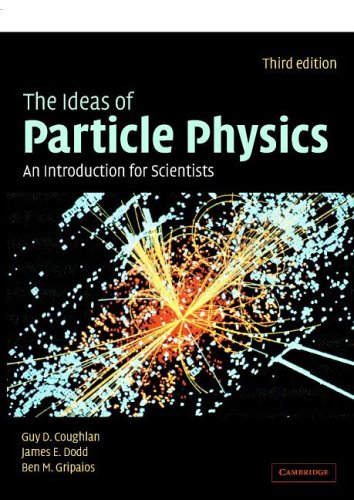
2. The Ideas of Particle Physics:
$49.31
3. Particle Physics, 2nd Edition
$50.54
4. An Introduction to the Standard
 
$83.00
5. Gauge Theories in Particle Physics,
$189.14
6. Particle Physics and Cosmology
$17.75
7. Deep Down Things: The Breathtaking
$65.98
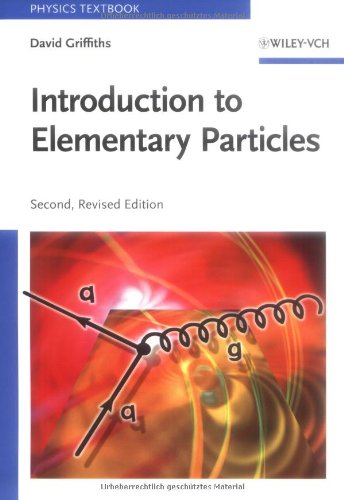
8. Introduction to Elementary Particles
$65.99
9. Quantum Physics of Atoms, Molecules,
$55.70
10. Nuclear and Particle Physics:
$49.88
11. Particle Physics: A Comprehensive
$48.00
12. Facts and Mysteries in Elementary
$5.00
13. The Wizard of Quarks: A Fantasy
$63.69
14. Statistical Physics of Particles
$5.30
15. Particle Physics: A Very Short
$65.92
16. Gauge Theory of elementary particle
$74.88
17. Techniques for Nuclear and Particle
$104.00
18. A Modern Introduction to Particle
$57.90
19. Nuclear and Particle Physics
$44.75
20. Modern Elementary Particle Physics

1. Elementary Particles and the Laws of Physics: The 1986 Dirac Memorial Lectures
by Richard P. Feynman, Steven Weinberg
Hardcover: 124 Pages (1987-11-27)
list price: US$65.00 -- used & new: US$28.98
(price subject to change: see help)
Asin: 0521340004
Average Customer Review: 5.0 out of 5 stars
Canada | United Kingdom | Germany | France | Japan
Editorial Review

Book Description
Developing a theory that seamlessly combines relativity and quantum mechanics, the most important conceptual breakthroughs in twentieth century physics, has proved to be a difficult and ongoing challenge. Thisbook details how two distinguished physicists and Nobel laureates have explored this theme in two lectures given in Cambridge, England, in 1986 to commemorate the famous British physicist Paul Dirac. Given for nonspecialists and undergraduates, the talks transcribed in Elementary Particles and the Laws of Physics focus on the fundamental problems of physics and the present state of our knowledge. Professor Feynman examines the nature of antiparticles, and in particular the relationship between quantum spin and statistics. Professor Weinberg speculates on how Einstein's theory of gravitation might be reconciled with quantum theory in the final law of physics. Highly accessible, deeply thought provoking, this book will appeal to all those interested in the development of modern physics. ... Read more

Customer Reviews (5)

5-0 out of 5 stars Tougher than the Lectures on Physics
When I readThe Feynman Lectures on Physics including Feynman's Tips on Physics: The Definitive and Extended Edition, I was hoping to understand the reasoning behind the exclusion principle, and was disappointed to find that RPF felt that this was too complex for undergraduates, so he asked them to take it on faith for the moment.

Here he is talking to a more advanced audience, and explains it - he was right, it's tough.I'm still struggling to understand it, but I have confidence that this is a good book to help.

[Added nearly a year later] Having reread the book several times, I finally understand Feynman's lecture!As is often the case, once I understand the principle, I see relationships to various other things I had not fully understood before.

I should also comment on Weinberg's lecture: he's talking about more speculative areas than Feynman, which is perhaps one reason I found him less enlightening than Feynman, but in a rather vague way I follow what he's saying.Certainly these are fascinating ideas, but they don't sing to me like Feynman's lecture.

4-0 out of 5 stars Recommended
From Richard Feynman, with love. Need more to be said? Read it, and read it again. This one can be read all over again once in a while and does not get boring.

5-0 out of 5 stars Great Lectures.Requires Math Background.
This short book, Elementary Particles and the Laws of Physics, offers two lectures: Richard Feynman's The Reason for Antiparticles and Steven Weinberg's Toward the Final Laws of Physics. These two talks comprise the 1986 Dirac Memorial lectures at Cambridge University. Both presentations are cogently structured and make fascinating reading.

The talks were directed at an advanced audience, one that was familiar with quantum mechanics. Unlike many popular presentations by Feynman and Weinberg, these lectures are not suitable for the general layman.

However, these lectures are accessible to a persistent (perhaps, stubborn) layman with a calculus background and a deep interest in particle physics. I am not a physicist, but I did take my share of physics, chemistry, and math courses several decades ago. I encountered Schrodinger's equation in more than one class, but not relativistic quantum mechanics. However, having recently read Bruce Schumm's wonderful review of particle physics (titled Deep Down Things), I was sufficiently motivated to work my way through both Dirac memorial lectures.

Richard Feynman's lecture, The Reason for Antiparticles, is decidedly the more difficult. Feynman first demonstrates that quantum mechanics and relativity together require the existence of antiparticles, and then shows that they also establish the spin-statistics connection. Within a few pages advanced mathematical expressions appear and then persistently stay in the foreground for nearly the entire talk.

Although understanding Feynman's mathematics is critical for a full and deep appreciation of his exposition, with careful, repeated readings the stubborn layman will have sudden moments of enlightenment and can come away with a deeper understanding of antiparticles and spin statistics.For readers engaged in some self-tutorial readings, it may prove helpful to return occasionally to this classic Feynman lecture to qualitatively measure progress.I have no doubt that, on a deeper level, Feynman's lecture will similarly challenge and enlighten physics majors as well.

Steven Weinberg discusses his speculations on the shape of a final underlying theory of particle physics.Initially, his talk is deceptively easy as few mathematical expressions are used.However, about midway a Lagrangian density equation appears, ratcheting the difficulty several notches, as Weinberg considers a theoretical framework based on quantum mechanics and a few symmetry principles, that is also mathematically consistent with the Lagrangian dynamical principle. After discussion of some limitations of the Standard Model, Weinberg concludes his talk with a somewhat mathematical introduction to string theory.

5-0 out of 5 stars Physics by two of the very best!
As usual, the best physics books are short and to the point, as is this one. The two Dirac lectures may serve as a perfectly good mini physics course all by themselves.I always enjoy a Feynman lecture, and this isno exception. He cuts to the chase without sacrificing the plot. But, Imust say, in this case the Wienberg lecture is the better of the two.Weinberg's style has a particular grace & beauty about it that gentlyexposes the aesthetic meaning of the search for a picture of nature.

5-0 out of 5 stars Two of the best give great insight into fundamentals.
Feynman yet again gives great insight into the laws of physics, this time exploring the reasons for existence of anti-particles, starting from the dirac equation etc.. Plus some really outstanding photographs, that fellaWeinberg will be chuffed to have his name mentioned on the book cover! ... Read more


2. The Ideas of Particle Physics: An Introduction for Scientists
by G. D. Coughlan, J. E. Dodd, B. M. Gripaios
Paperback: 266 Pages (2006-08-07)
list price: US$55.00 -- used & new: US$33.82
(price subject to change: see help)
Asin: 0521677750
Average Customer Review: 4.0 out of 5 stars
Canada | United Kingdom | Germany | France | Japan
Editorial Review

Book Description
The third edition of this well-received book is a readable introduction to the world of particle physics. It bridges the gap between traditional textbooks on the subject and popular accounts that assume little or no background knowledge. Carefully revised and updated, this new edition covers all of the important concepts in our modern understanding of particle physics. The theoretical development of the subject is traced from the foundations of quantum mechanics and relativity through to the most recent particle discoveries and the formulation of modern string theory. It includes a full description of the prospects for the Large Hadron Collider at CERN, which will allow many key ideas to be tested. The book is intended for anyone with a background in the physical sciences who wishes to learn more about particle physics. It is also valuable to students of physics wishing to gain an introductory overview of the subject. ... Read more

Customer Reviews (4)

3-0 out of 5 stars Unever presentation ...
I cannot agree with many of the comments in earlier reviews of this book.To begin, the intended audience remains unclear.There is insufficient mathematics to get much of a feel for the topic and frequently the mathematical ideas which do appear fall from the sky with little or no warning.Even more troubling is that these concepts, crucial for any real understanding, are often left half done.This must leave many mathematically competent readers nonplussed and leave the mathematically challenged simply out in left field.

There are better, more modern, books out there for the technically inclined.This books is not even close to being "the best physics book ever".

Look at a library copy before buying.

4-0 out of 5 stars for physicists outside particle physics
I knew one of the authors (Coughlan) when we were undergraduates at the University of Western Australia. So it was with some interest that I went through this book. While I can't tell which was his contribution and which was the other author's, the combined effort is an elegant rendition of particle physics, circa late 1980s.

A merit of the book is who it is pitched at. It is not really for a generalist outside physics. Rather, it seems best suited for the physicist (student or not) who is not in particle physics. Non-physicists may be surprised at this, but particle physics can seem strange and forbidding even to physicists. The text gives enough detailed physics to satisfy a physicist; that he is indeed getting enough of the real stuff to gain insight.

While the title does say it is for scientists, I wonder a little about how accessible the book might be to a typical chemist or geologist.

5-0 out of 5 stars The best particle physics book! ever
This is such an up to date and accurate book I have never read a book that explains particle physics in such detail yet keeps the information understandable. If your are just starting out in particle physics read thisbook. It's brilliant!

5-0 out of 5 stars Clear, concise, explanations accessible to undergrad student
Excellent use of figures and pictures in place of equations.Useful for an undergrad survey course, or as a reference for grad courses. Fred Olness, SMU ... Read more


3. Particle Physics, 2nd Edition
by B. R. Martin, G. Shaw
Paperback: 384 Pages (1997-08-28)
list price: US$65.00 -- used & new: US$49.31
(price subject to change: see help)
Asin: 0471972851
Average Customer Review: 1.0 out of 5 stars
Canada | United Kingdom | Germany | France | Japan
Editorial Review

Book Description
Particle Physics, Second Edition is a concise and lucid account of the fundamental constituents of matter. The standard model of particle physics is developed carefully and systematically, without heavy mathematical formalism, to make this stimulating subject accessible to undergraduate students. Throughout, the emphasis is on the interpretation of experimental data in terms of the basic properties of quarks and leptons, and extensive use is made of symmetry principles and Feynman diagrams, which are introduced early in the book. The Second Edition brings the book fully up to date, including the discovery of the top quark and the search for the Higgs boson. A final short chapter is devoted to the continuing search for new physics beyond the standard model. Particle Physics, Second Edition features:
* A carefully structured and written text to help students understand this exciting and demanding subject.
* Many worked examples and problems to aid student learning. Hints for solving the problems are given in an Appendix.
* Optional "starred" sections and appendices, containing more specialised and advanced material for the more ambitious reader. ... Read more

Customer Reviews (1)

1-0 out of 5 stars Quite useless
I have used the book as a lecture assistent, and helped students during class sessions to work out some selected problems from the book. The problems are quite all right, and hints to all exercises are in the back of the book, well actually their not hints but like shovels to the forehead! You just have to xerox them onto paper, some additional remarks or rephrasings and you're done technically.

The text, however, is awful, although, it's easy to read. The book is designed for undergraduates with minor knowledge of quantum mechanics, but if you don't know a lot of quantum mechanics and quantum field theory, almost all interesting pieces come out of the blue including formulas and their "derivations". What is in this book can be learnt from popular science books on particle physics. Of course, you will miss out on the formulas, but at least you think you can understand it and you will see the historical development.

For example, P-parity, C-parity, CP-invariance and violation, CPT-theorem, weak & quark mixing, weak selection rules, decay rates, etc. are all ill-defined or not at all, so really understanding them is impossible:
(*) Parity is discussed for fermions without stating the Dirac equation, which does not give much insight to its origin and relevance. A discussion of fermions without it is useless, unless you use only the Pauli principle and some loose arguments that are dropped as experimental facts.
(*) The decay rate is never defined (properly) in the book, although many numerical values are given throughout the book for certain processes. Moreover, two exercises in the 10th chapter ask you to show that two decay rates are equal under certain conditions, which is quite impossible, if you don't know what it actually is that you should try to prove.
Some topics are done too briefly, because the authors don't want to be too technical, but feel they cannot leave things out:
(*) Drawing Feynman diagrams is discussed nicely, but the "notation" for certain propagators and external lines is not in accordance with literature. The purely topological aspect of these diagrams is competely neglected, so it's merely presented as a "neat thingy to do without any particular reason", unfortunately.
(*) The gauge principle is mentioned and shown for electromagnetism very briefly and in non-covariant form, but it does not deal with it properly: either mention it and leave it, or do it properly, but don't create a cliff-hanger and then cut the safety rope.

I know this book is not intended to give undergraduates complete understanding of particle physics, but I cannot recommend it, unless you want to know some "tricks" in processes before you do the real deal in QFT courses. The effort Martin & Shaw have made is nice, the result isn't. ... Read more


4. An Introduction to the Standard Model of Particle Physics
by W. N. Cottingham, D. A. Greenwood
Hardcover: 292 Pages (2007-03-12)
list price: US$65.00 -- used & new: US$50.54
(price subject to change: see help)
Asin: 0521852498
Average Customer Review: 5.0 out of 5 stars
Canada | United Kingdom | Germany | France | Japan
Editorial Review

Book Description
The new edition of this introductory graduate textbook provides a concise but accessible introduction to the Standard Model. It has been updated to account for the successes of the theory of strong interactions, and the observations on matter-antimatter asymmetry. It has become clear that neutrinos are not mass-less, and this book gives a coherent presentation of the phenomena and the theory that describes them. It includes an account of progress in the theory of strong interactions and of advances in neutrino physics. The book clearly develops the theoretical concepts from the electromagnetic and weak interactions of leptons and quarks to the strong interactions of quarks. Each chapter ends with problems, and hints to selected problems are provided at the end of the book. The mathematical treatments are suitable for graduates in physics, and more sophisticated mathematical ideas are developed in the text and appendices. ... Read more

Customer Reviews (6)

5-0 out of 5 stars Review for An Intoduction to the Standard Model of Particle Physics
According to my opinion this book is well written and well organized and also quite short so that you are not lost in details.

5-0 out of 5 stars Updated New Edition
In this second edition the authors have upgraded their book to incorporate recent discoveries in several areas including:

o the successes of the theory of strong interactions
o the observations on matter-antimatter asymmetry
o advances in neutrino physics, especially as it has become clear that neutrinos are not mass-less
o the theoretical concepts from the electromagnetic and weak interactions of leptons and quarks to the strong interactions of quarks.

The book is aimed at the graduate student in particle physics. It has a rigorous mathematical structure. After all, the Standard Model is basically a mathematical theory that describes the interactions between leptons and quarks.

Throughout the book there are many references to open questions that likewise reflect the state of the Standard Model.

5-0 out of 5 stars workout with the Standard Model lagrangian

This book is about the experimental facts and the theoretical principles that lead to the construction of the Standard Model lagrangian. It is NOTabout calculating scattering crossections. Some of the problems ask you to calculate decay rates but only at tree level and the fields are treated like classical fields not operators, with the exception that the fermionic fields anticommute. There is a 12-page chapter on quantizing the fields and renormalization but I find it rather sketchy so don't expect to understand a lot from it if you don't already know it.

You should have some background in varying lagrangians otherwise the book will frequently seem difficult to you. The authors obtain symmetry currents corresponding to a symmetry of the lagrangian not in the standard way of Noether's theorem. Their method is entirely correct but it took me long time to understand because they didn't explain it with enough details the first time they used it(section 7.1, page 65). I think that will throw off the horse many readers.

The style is wonderfully concise which makes the logical structure easier to follow and there isn't the usual fluff `to motivate' things that are simply put guesses like the principle of local gauge invariance. On the other hand, some places definitely need more detailed explanations like signs of certain quantities or the symmetry currents I mentioned above.

The treatment of the Dirac equation and spinors is the least messy I've seen. The way they obtain the nonrelativistic limit of the Dirac equation with EM field is again the best and least messy I've seen.

The book has nice appendix on the groups of the Standard Model which covers what you need to know about SO(3), SU(2) and SU(3) in a very efficient way. There are about 5 problems after each chapter most of which have a solution outline at the end of the book.

Things I understood from this book:

-- why time reversal, space inversion and charge conjugation of fields are defined in a way that previously seemed to me quite arbitrary
-- how demanding local gauge invariance necessitates introduction of gauge fields which leads to interaction terms
-- how local gauge invariance can't be proven, it's just a guess that has worked so far hence it's called `principle' (my own interpretation)
-- global and local symmetry breaking, Goldstone bosons and Higgs boson
-- how the Lagrangian densities of the electroweak and strong interactions were constructed from the experimental input by demanding local gauge invariance and guessing the symmetry group to be SU(2) and SU(3) correspondingly
-- what's Kobayashi-Maskawa matrix that mixes the quark fields and how it arises
-- how symmetries of the lagrangian density lead to conservation numbers
-- how neglecting some terms in the lagrangian leads to effective lagrangian and effective theory
-- how to work with the terms in the QCD lagrangian where different matrices multiply different indices

4-0 out of 5 stars well written book but...
This is a very short resume of Standard Model, but well written,
the misguidance here, is the title "introduction" ... this text
is not for beginners.

5-0 out of 5 stars Excellent Introduction to Particle Physics
This book is an excellent introduction to particle physics. The chapters are short, clear and very readable. As the previous reviewer mentioned, there are a series of reasonable exercises at the end of each chapter with answers provided in the back of the book. Many concepts that field theory or particle physics books leave mysterious or have a difficult time explaining are clearly laid out in this book. I would judge it superior to Griffiths particle physics book, and if you are looking for a nice supplement to serious study of quantum field theory, this is it. ... Read more


5. Gauge Theories in Particle Physics, 2 Volume Set
by I.J.R. Aitchison, A.J.G. Hey
 Paperback: 639 Pages (2004-01-01)
list price: US$83.00 -- used & new: US$83.00
(price subject to change: see help)
Asin: 0750309822
Average Customer Review: 5.0 out of 5 stars
Canada | United Kingdom | Germany | France | Japan
Editorial Review

Book Description
Volume 1

This book provides an accessible, practical and comprehensive introduction to the three gauge theories of the 'standard model' of particle physics: quantum electrodynamics (QED), quantum chromodynamics (QCD) and the electroweak theory. For each of them, the authors provide a thorough discussion of the main conceptual points; a detailed exposition of many practical calculations of physical quantities; and a comparison of these quantitative predictions with experimental results.

For this two-volume third edition, much of the book has been re-written to reflect developments over the last decade, both in the curricula of university courses, and in particle physics research. On the one hand, substantial new material has been introduced which is intended for use in undergraduate physics courses. New introductory chapters provide a precise historical account of the properties of quarks and leptons, and a qualitative overview of the quantum field description of their interactions, at a level appropriate to third year courses. The chapter on relativistic quantum mechanics has been enlarged and is supplemented by additional sections on scattering theory and Green functions, in a form appropriate to fourth year courses. On the other hand, since precision experiments now test the theories beyond lowest order in perturbation theory, an understanding of the data requires a more sophisticated knowledge of quantum field theory, including ideas of renormalisation. The treatment of quantum field theory has therefore been considerably extended so as to provide a uniquely accessible and self-contained introduction to quantum field dynamics, as described by Feynman graphs. The level is suitable for advanced fourth year undergraduates and first year graduates.

This is the second volume of the third edition of a successful text, now substantially enlarged and updated to reflect developments over the last decade in the curricula of university courses and in particle physics research. Volume one covered relativistic quantum mechanics, electromagnetism as a gauge theory, and introductory quantum field theory, and ended with the formulation and application of quantum electrodynamics (QED), including renormalization. Building on these foundations, this second volume provides a complete, accessible and self-contained introduction to the remaining two gauge theories of the `standard model' of particle physics: quantum chromodynamics (QCD) and the electroweak theory.

Volume 2

The treatment significantly extends that of the second edition in several important respects. Simple ideas of group theory are now incorporated into the discussion of non-Abelian symmetries.

Two new chapters have been added on QCD, one devoted to the renormalization group and scaling violations in deep inelastic scattering, the other to non-perturbative aspects of QCD using the lattice (path-integral) formulation of quantum field theory; the latter is also used to illuminate various aspects of renormalization theory, via analogies with condensed matter systems. Three chapters treat the fundamental topic of spontaneous symmetry breaking: the (Bogoliubov) superfluid and the (BCS) superconductor are studied in some detail; one chapter is devoted to the implications of global chiral symmetry breaking in QCD; and one to the breaking of local SU(2)xU(1) symmetry in the electroweak theory. Weak interaction phenomenology is extended to include discussion of discrete symmetries, and of the possibility that neutrinos are Majorana (rather than Dirac) particles. Most of these topics are normally found only in more advanced texts, and this is the first book to treat them in a manner accessible to the wide readership which the previous editions have attracted. ... Read more

Customer Reviews (5)

5-0 out of 5 stars Strongly Recommend

I received my copy of Aitchison and Hey last week and have nearly finished reading the first volume. So far, the text is living up to its legend: it is very readable, well cited (so the historical context can be reconstructed) and pitched for a graduate student who has seen the topic before but is looking for the kind of "handle" on the subject that is missing in nearly all other volumes on QFT (esp so Peskin). If you are struggling with your first look at QFT, reviewing the subject or trying to get a headstart through self instruction --- this book is essential. I would strongly recommend that all physics graduate students read this text after completing the usual third semester grad course in QM that often includes a first look at relativistic QM, KG eqn, and Spinors. I would also recommend that one begin by just READING the book carefully before trying problems. Aitchison and Hey have created a very reader friendly intro to QFT and the standard model that is not watered down.

Take my advice: start reading this book in parallel with your QFT coursework or beforehand if you can. These books are worth every penny and every minute of your study time. Many mysteries are resolved! Enjoy.

5-0 out of 5 stars Very clear and readable
Like the 2nd edition this 2 volume set is very readable. I like it's informal style, and the wealth of background material presented, as well as the hints about when to expect further discussions of a subject in succeding chapters. By far the best Quantum Field Theory book I've come across.

5-0 out of 5 stars more understandable QFT for beginners

The 3rd edition of that book clarified to a degree the fog left in my mind by a two-semester QFT course. The book is better suited for beginners than Peskin & Shroeder, Mandl & Show or Lahiri & Pal simply because it senses better the difficult points for beginners and tries to explain them at lower level. It focuses on the main concepts and doesn't try to `cover broad material in shortest time' or get into extreme computational technicalities totally irrelevant to beginners. The correct historical perspective of many ideas is given and the important historical papers are cited. The theory is frequently compared to the experimental results. Violin string is used as a prototype of a continuous system described by a classical field which is the first field quantized later. The book develops physical intuition showing how a scattering process can be analyzed in full QED (all fields are operators), in semiclassical approximation (all fields are operators except the EM field) or using the lowest level wavefunction approximation (all fields are treated like wave functions just like scattering in nonrelativistic QM) often getting the same result (see chapter 8). Important concepts like Feynman diagrams and Renormalization of a theory are first explored in a simple theoretical playground - a hypothetical `ABC theory' of three massive scalar fields with an interaction ABC term - and later discussed again in the case of QED with all the complications like fermions and Electromagnetic gauge field.

Topics discussed include gauge invariance principle; relativistic field equations describing free particles like Klein-Gordon and Dirac; Feynman interpretation of the negative energy solutions of Dirac eq. (no its not `antiparticle going back in time'); Dirac equation with EM field; Lagrangian and Hamiltonian densities for continuous systems; quantization of free fields like KG (real and complex scalar), Dirac and Electromagnetic field [the quantization is by postulating commutators/anticommutators, no path integrals]; Normal ordering of operators; Interaction picture for interacting fields, Time ordering of operators, Dyson expansion of the S matrix; Wick's theorem; scattering processes in QED at tree level; Ward identity; form factors for scattering from non point particle; parton model, Bjorken scaling; diagrams with loops, regularization and renormalization of ultraviolet divergences in QED.

It took me a month and a half to read the book and solve all problems (10 problems per chapter on average). The problems are exactly the ones every beginner should solve and usually revolve about filling in details from the text or proving statements in the text. Solving them is usually easy with a few exceptions and teaches you the typical computational tricks of the trade. You have to know quantum mechanics (at least have seen scattering theory) and special relativity. You have to at least have heard of Green function and contour integration in the complex plane. The book provides nice appendices about all these.

Not everything is crystal clear in that book, sometimes it took me a few days for an idea to sink in or I understood some paragraphs only after I read the whole book. Other ideas I did not understand at all. Sometimes it's hard to tell what they are trying to say although they say it several times from different angles ... The authors should work on expressing an idea in a direct succinct wayonce and for all instead of repeating several fuzzy versions of it. Overall that book made me understand MUCH more than a regular QFT course and I highly recommend it as a prep for such a course.

5-0 out of 5 stars If you are having trouble with QFT - BUY THIS BOOK!
This book (2nd edition) has 15 chapters .I have just finished chapter 4 entitled QFT and I am compeled to write this review!After a year of studying of QFT informally I can report that this is the way to introduce yourself to the topic.I've been through Mandl & Shaw, Peskin & Schoeder, Ryder, Weinberg and a few others and this is heads and tails the BEST intro available. In 42 pages, Aitchison & Hey make the transistion from classical to QM and from QM to QFT as gracefully as I can conceive.For example, the transition from the discrete Lagrangian to the field Lagrangian is very explicit. One benfit of this is that the dependence of L on partial of phi wrt x is clearly motivated leading to the manifestly relativistically invariant form of L.They explicitly develop physical intuition at every step of the way - for example, this is the only book that I have found that explicitly asks the question where is QM's wavefunction in the QFT formalism? Answer - The vacuum to one-particle matrix elements of the field operators.The transistion from free fields to interacting fields is far clearer than any other treatment I've seen.I also appreciated that the problems were used to basically fill in details left out of the text.I was able to 'practice' the various kinds of manipulations that are required.

5-0 out of 5 stars Amazingly clear introduction to the subject
This book is the best book I've seen on the subject.The qualitative description of qunatum field theory in particular are amazingly lucid for the subject.The only possible flaw in the book is that the problems at the end of each chapter are both few in number and for the most part do not challenge the student at all; for the most part they are just rote calculations. ... Read more


6. Particle Physics and Cosmology
by P. D. B. Collins, Alan D. Martin, E. J. Squires
Hardcover: 512 Pages (1989-05-23)
list price: US$245.00 -- used & new: US$189.14
(price subject to change: see help)
Asin: 0471600881
Average Customer Review: 5.0 out of 5 stars
Canada | United Kingdom | Germany | France | Japan
Editorial Review

Book Description
This readable introduction to particle physics and cosmology discusses the interaction of these two fundamental branches of physics and considers recent advances beyond the standard models. Eight chapters comprise a brief introduction to the gauge theories of the strong and the electroweak interactions, the so-called grand unified theories, and general relativity. Ten more chapters address recent concepts such as composite fermions and bosons, supersymmetry, quantum gravity, supergravity, and strings theories, and relate them to modern cosmology and experimental astronomy. ... Read more

Customer Reviews (2)

5-0 out of 5 stars Great review
Slightly dated (does not discuss large extra dimensions, dark energy or gauge-string duality for example) but otherwise great review of the main ideas in both of the areas. Highly recommended.

5-0 out of 5 stars All important subjects in particle theories are in one book.
All important subjects, from the standard model to the string theory, are adequately provided for the students who major in particle theory. I have never imagine that anyone can write these contents in one book of 496 pages ... Read more


7. Deep Down Things: The Breathtaking Beauty of Particle Physics
by Bruce A. Schumm
Hardcover: 392 Pages (2004-10-20)
list price: US$29.95 -- used & new: US$17.75
(price subject to change: see help)
Asin: 080187971X
Average Customer Review: 5.0 out of 5 stars
Canada | United Kingdom | Germany | France | Japan
Editorial Review

Book Description

A useful scientific theory, claimed Einstein, must be explicable to any intelligent person. In Deep Down Things, experimental particle physicist Bruce Schumm has taken this dictum to heart, providing in clear, straightforward prose an elucidation of the Standard Model of particle physics -- a theory that stands as one of the crowning achievements of twentieth-century science. In this one-of-a-kind book, the work of many of the past century's most notable physicists, including Einstein, Schrodinger, Heisenberg, Dirac, Feynman, Gell-Mann, and Weinberg, is knit together in a thorough and accessible exposition of the revolutionary notions that underlie our current view of the fundamental nature of the physical world. Schumm, who has spent much of his life emmersed in the subatomic world, goes far beyond a mere presentation of the "building blocks" of matter, bringing to life the remarkable connection between the ivory tower world of the abstract mathematician and the day-to-day, life-enabling properties of the natural world. Schumm leaves us with an insight into the profound open questions of particle physics, setting the stage for understanding the progress the field is poised to make over the next decade or two.

Introducing readers to the world of particle physics, Deep Down Things opens new realms within which are many clues to unraveling the mysteries of the universe.

... Read more

Customer Reviews (25)

5-0 out of 5 stars Review for physicists
First a little about my background. I have a master's degree in mathematics, along with the usual undergraduate courses in physics (including introductory Quantum Mechanics). I am currently taking a survey course on elementary particle physics. This course is still at the undergraduate level, so there's no Quantum Field Theory (other than mentioning that there is something called QFT). Being a mathematician however, I am curious about the mathematical ideas, but not curious enough to read graduate level textbooks on QFT just for fun.

So why do I go on and on about my background? The reason is that if you, like me, are curiuos about the mathematical ideas behind elementary particle physics, and you are almost but not quite ready to dive into graduate level textbooks on the subject, this book could be a perfect match (it certainly was for me). What a relief to find a book that is both exciting and easy to read (I read it in five days), and at the same time elucidates a few of the ideas vaguely presented in "The ideas of Particle Physics" by Coughlan, Dodd & Gripaios, which is used in the course I'm taking. With my background I was also able to get a lot more from this book than the average lay person, since I can guess at some of the mathematical details.

It is also nice to know that if I do want to read graduate level textbooks on the subject, I now have a general idea of what the mathematical constructions are for. It is often a problem with graduate level books that it takes some time before you understand why certain abstract constructions are introduced.

4-0 out of 5 stars Not for the average joe
This is a tough book for the lay person. I am perhaps not suitably qualified to review it, but as I bought it I will do so nevertheless.I fell short of appreciating the "breathtaking beauty of particle physics," although I am certain that particle physics itself is breathtaking. There is a superb introduction and the opening chapter lays the groundwork perfectly, but after that I battled with the algebraic formulae and the complex jargon of particle physicists. The author has so little to say on the metaphysical implications of his subject; it is as though he is sitting in his living room oblivious to an entire herd of elephants.If you are interested in quantum physics as it might relate to how you live your life, then this book is probably not for you. If you are looking for an in depth analysis of the sub-atomic interactions between the "ethereal world" and the natural world, then it is.

5-0 out of 5 stars The Epitomy of Good Science Writing!
This author is a master teacher. So often such books are filled with oversimplifications, mystifying metaphors, and ridiculous speculating which do nothing to further anyone's understanding of science. This book is an absolute gem in comparison.

Without getting bogged down in the nitty gritty mechanics of the mathematics, he systematically explains the mathematical concepts behind the standard model of particle physics, step by step and with much summarizing and review throughout. The result is an account that reveals the true nature and beauty of the scientific theories that any reasonably educated person can appreciate.

As a high school science teacher, I admire his rigorous but pedagogically sound style. Although I am keenly interested in physics, it is not my specialty so I learned a great deal I didn't know from this book. More than that, I was awestruck by the beauty of the mathematical theories that were brought to me by this masterful teacher. It takes a truly special writer to bring that experience to the lay person.

5-0 out of 5 stars Particle Physics Made Easy
This book should be a must read for anyone that tries to understand particle physics. I've been looking for something like this for a long time. The Standard Model is explained with great skill and clarity, and with minimal use of math. This is not a mathematical book, but where minimal mathematics becomes necessary (group theory), it is introduced with the assumption that the reader knows next to nothing (which was my case) and developed to the point where, combined with physics, it makes sense. Most of the math only requires logic, not computations, and all you are required to memorize are a few rules -- conventions -- that only take a couple of lines. Beautiful.
The author limits himself to what is known and generally agreed about particle physics. The limits of the theory are also very well explained, but no significant steps into the unknown are made, which I think it is a good thing for once.
If you like Brian Greene, Michio Kaku, Lisa Randall, and others like them, do them, and yourself, a favor: read "Deep Down Things". It will open new horizons in the way you see, and appreciate, their work. These more popular authors cross into the unknown with beautiful, breathtaking constructs, but none explains the basics as Bruce Schumm does.

5-0 out of 5 stars A Review From a Non-Physicist

Two items set this lay physics book apart:clarity of writing and minimum of speculation.It covers only material amenable to experimentation.This rules out both string theory and multiple universes - each mentioned only briefly.Nor does it dwell on Einstein's theories of special or general relativity - the gravitational physics of the large."Deep Down Things" is like an introductory text on quantum phenomenon and particle physics without the explicit math and with more explicit wordage.

Particle physics studies the smallest units of matter and how they interact with each other.This led to ever larger particle accelerators during the last 68 years of the 20th century.More than 150 exotic particles have been discovered - every one having differing combinations of properties that boggle the mind.An exotic particle that results from the collision of two protons may exist for only 10 to the minus 12 seconds before it decays into something else.Traveling at close to the speed of light, this is just enough time to leave a (highly sought after) 1 mm mark on a recorder, documenting the brief life of that particle.The Particle Data Group from Berkeley exists just to keep physicists updated on these particles.

For something so fleeting, why do we bother?Because this research is centerstage in explaining the Big Bang and all of cosmology. As by-products, we achieved huge gains in any industry you can name.Unless you live like a Mennonite or are on a boy scout camp-out, these technologies effect the way you live your daily life - ground floor activity on the internet itself came about because physicists desired a more immediate way to share research with each other.

The use of common sense was not a factor in the investigations of particle physics.Instead, knowledge was and is gained through particle accelerators, predictions from abstract mathematical models, and meticulous use of the scientific method by thousands of physicists.The author mentions frequently that the math works out, predicts something, disproves something, needs a cheat factor, etc.This made me want to see the math, but I'm at least a couple of college courses from there, so I guess I'll have to take his word for it.For non-physics, non-math majors, consider reading on despite lack of total understanding or you might bog down in details.As the point of view changes, concepts are restated and you'll get another stab at it.The author starts a sentence on page 187, "If you've understood, even vaguely..." and ends it with "it gets even better (or worse...) as we move on to other properties of elementary particles."

On page 351, he closes with congratulations to anyone who made it to the end - then inserts a joke about the Higgs field that only an "insider" (a physicist or one who read the book) would understand.This is a great book that I highly recommend for any physicist who wants to brush up on particle physics, any undergrad or grad student in physics, or any other scientist types who are persistent enough to want a better handle on this fascinating but difficult subject.


... Read more


8. Introduction to Elementary Particles
by David Griffiths
Hardcover: 399 Pages (1987-03-15)
list price: US$130.00 -- used & new: US$65.98
(price subject to change: see help)
Asin: 0471603864
Average Customer Review: 5.0 out of 5 stars
Canada | United Kingdom | Germany | France | Japan
Editorial Review

Book Description
This is the first quantitative treatment of elementary particle theory that is accessible to undergraduates. Using a lively, informal writing style, the author strikes a balance between quantitative rigor and intuitive understanding. The first chapter provides a detailed historical introduction to the subject. Subsequent chapters offer a consistent and modern presentation, covering the quark model, Feynman diagrams, quantum electrodynamics, and gauge theories. A clear introduction to the Feynman rules, using a simple model, helps readers learn the calculational techniques without the complications of spin. And an accessible treatment of QED shows how to evaluate tree-level diagrams. Contains an abundance of worked examples and many end-of-chapter problems. ... Read more

Customer Reviews (11)

5-0 out of 5 stars Do yourself a favor - BUY THIS BOOK NOW
Seriously, DO YOURSELF A FAVOR, BUY THIS BOOK NOW.

I find it hard to describe to you in words how much I love this book.I am just speechless!This book will take you by the hand and spoon feed you all the important concepts and calculation steps.If you are thinking of pursuing a high energy physics and trying to find the very first book to read on this subject, Griffiths is THE ONE.

Reading QFT books before this book is in my opinion a NO-GO.Trust me from someone that has been there!You lose insight immediately and get taken down hard by the unfamiliar math.Griffiths knows how to explain things and always keeps in close contact with the actual physics.You will never lose motivation / insights into what's going on.

Take my word for it.BUY THIS BOOK NOW!You will save hundreds of hours invested on other books that claim to be "good".There are none of this kind.

After Griffiths, proceed to Ryder's QFT, and then Peskins.Then and only then will you finally see the light of the day.There are not other routes to the promised land.

5-0 out of 5 stars The perfect introduction
This is the perfect introduction for any student learning about particle physics, the Standard Model, or Quantum Field Theory. It introduces Feynman calculus very well, although anyone planning to continue will need Peskin & Schroeder's book as well for the details not introduced here. This book contains an excellent appendix with all formulae and rules needed for even an advanced researcher.

5-0 out of 5 stars Griffiths defines "Introductory Course"
David Griffiths' texts are indispensable for any beginner, and are used to "translate" more advanced texts.I used his "Quantum Mechanics" to fill in the gaps at the advanced graduate level, and his "Electrodynamics" was essential to understanding Jackson. I'm sorry that I waited so long to purchase his "Elementary Particles".

This book contains all the background that professors expect you to have already been exposed to: particle classification schemes, the November Revolution, relativistic kinematics, and fundamental force overviews.Griffiths then goes on to discuss Feynman rules, QED, QCD, electroweak and gauge theories.Griffiths also works out some essential problems, like muon decay, that you will want to see done, but I think it is done better by Lahiri and Pal (that, however, is a field theory book, which might be more advanced than is necessary to some people in particle physics).

This is a great text for anyone starting out in particle physics and for anyone who needs to review the fundamentals.My only bone with Griffiths is that sometimes more of the work is left to the reader than is appropriate (those problems worked out in gory detail are a godsend when you genuinely aren't getting the point).

5-0 out of 5 stars Great Intro to Particle Physics
Griffiths' book provides an ideal introduction to particle physics for the undergraduate who is desperate to find a comprehensive treatment that is truly understandable. I was greatly disappointed by Griffiths' books on electrodynamics and quantum mechanics, but he really hit the mark on this one. There is the usual introductory material on the Standard Model, relativistic kinematics, symmetries and bound states, but his presentations of QED, Feynman calculus, decays and interactions are clearly written and geared for the student who has been frustrated by the obtuseness of other so-called introductory texts. His exposition on gauge theories, the Yang-Mills field and the Higgs mechanism is elementary but enlightening and even entertaining.

Griffiths' sly wit is in great evidence in this text, and this is one of the reasons why it is so enjoyable. Although he displays a similar witty vein in his other texts, it just doesn't succeed as it does for this book. If you want to be able to calculate particle decay rates and interaction cross sections and have fun doing it, Griffiths' book is an excellent investment.

5-0 out of 5 stars A grain of salt...
OK. It seems that I am the one who criticizes all the books that everyone else loves.
The book is very good as far as didactics is concerned. But have you really read it? Let me ask you a few questions:

How many typos can you find in chapter 9?
What do you think - had ANYONE proofread Chapter 11 before the book was published?
What about the exercises -can you do 9.2 without Halzen and Martin at hand (so that you may look up what, say, |7'> really means? (Griffiths mixes notation from the two books and you can never solve the exercise without intoroducing some corrections).

There are many more questions like these to be asked about the Introduction to Elementary Particles.
So, do you like the content or the lively style?

But, of course, five stars! ... Read more


9. Quantum Physics of Atoms, Molecules, Solids, Nuclei, and Particles
by Robert Eisberg, Robert Resnick
Hardcover: 864 Pages (1985-01)
list price: US$133.95 -- used & new: US$65.99
(price subject to change: see help)
Asin: 047187373X
Average Customer Review: 4.0 out of 5 stars
Canada | United Kingdom | Germany | France | Japan
Editorial Review

Book Description
A revision of a successful junior/senior level text, this introduction to elementary quantum mechanics clearly explains the properties of the most important quantum systems. Emphasizes the applications of theory, and contains new material on particle physics, electron-positron annihilation in solids and the Mossbauer effect. Includes new appendices on such topics as crystallography, Fourier Integral Description of a Wave Group, and Time-Independent Perturbation Theory. ... Read more

Customer Reviews (17)

4-0 out of 5 stars good but please a little more explanation!
I think this book is surely meant to go along with a class, I don't think it is entirely suited for independent study.The reason I feel this is that the discussion questions at the end of each chapter seem to be asking about stuff that isn't really addressed in the chapter, and requires additional knowledge unrelated to what is given in the book to answer.Also, there are no solutions to the practice problems, so you will never be able to test your own accuracy.I really believe in having solutions in the back of the book, otherwise how are you to rate your own progress and understanding?In concert with a course however and with a teacher to fill in any information gaps, I think this is a fine book!All the explanations seem clear, and the steps in the derivation processes are easy to follow!

5-0 out of 5 stars Awesome Physics Book!
This is an awesome physcis book.It really allowed me to wrap my mind around some of them really big concepts.Sometimes my brain hurt!But I kept reading, just knowing it would make me smarter than George.He thinks he knows everything but he doesn't.Anyway, the book is better than a basket of spare ribs with extra sauce!

5-0 out of 5 stars wonderful and enlightening to read!
This book catches my attention to a point that I cannot put it down until I have finished a chapter. It is true that the book is focused on understanding the physical concepts with little math...this can be confusing at times...but I still think highly of it.

1-0 out of 5 stars Buy Griffiths Instead
This book was confusing, chaotic, and utterly disapointing.If your professor assigns this book I suggest you do not buy it but borrow from a friend.Instead use Griffiths to learn QM.Since moving onto graduate school I have learned just how little I learned from this book.Moreover, I was confused about simple issues in QM which Cohen-Tannoudji quickly and clearly dispelled.This book actually hurt my education.I can not for the life of me understand how anyone could give this book 3, 4, or even 5 stars.

5-0 out of 5 stars Great introduction, focused on understanding
This book is an excellent introduction to Quantum Physics. This book gives the non-expert reader an insight into the tremendous explanatory power of quantum mechanics. It describes why and how Quantum Mechanics was developed, and it is primarily concerned with the understanding of concepts and ideas, rather than focusing on mathematical techniques. For this reason it might appear a little verbose to some readers.

The first five chapters gives the reader a good insight into the history of Quantum Physics and to why classical mechanics was insufficient. Chapter 6 is an excellent overview of how to solve the Schroedinger Equation in a few specific cases, at the same time as the reader is given a very good "feeling" for how Quantum Mechanics works. The remainder of the chapters focuses on specific situations, applications and phenomena's.

There are plenty of books that use less mathematics, but I do not believe they give a good understanding of the topic. There are also plenty of books that uses a lot more complex mathematics, but they are not for beginners. I recommend this book as an introduction to Quantum Physics for undergraduate physics students, engineers, science professionals, and mathematically literate others.

For reference, these are the chapters in the book:
(1) Thermal Radiation and Plank's Postulate
(2) Photons--Particlelike Properties of Radiation
(3) De Broglie's Postulate--Wavelike Properties of Particles
(4) Bohr's Model of the Atom
(5) Schroedinger's Theory of Quantum Mechanics
(6) Solutions of Time-Independent Schroedinger Equations
(7) One-Electron Atoms
(8) Magnetic Dipole Moments, Spin, and Transition Rates
(9) Multielectron Atoms--Ground States and X-Ray Excitations
(10) Multielectron Atoms--Optical Excitations
(11) Quantum Statistics
(12) Molecules
(13) Solids--Conductors and Semiconductors
(14) Solids--Superconductors and Magnetic Properties
(15) Nuclear Models
(16) Nuclear Decay and Nuclear Reactions
(17) Introduction to Elementary Particles
(18) More Elementary Particles

I liked Appendix A, "The Special Theory of Relativity". In only sixteen pages, the authors succeed to correctly explain the special theory of relativity. I also liked Appendix C, "The Boltzmann Distribution", which was good concise description of classical statistical mechanics (you need to understand it, to understand why it was not good enough). ... Read more


10. Nuclear and Particle Physics: An Introduction
by Brian R. Martin
Paperback: 428 Pages (2006-04-28)
list price: US$65.00 -- used & new: US$55.70
(price subject to change: see help)
Asin: 0470025328
Average Customer Review: 4.0 out of 5 stars
Canada | United Kingdom | Germany | France | Japan
Editorial Review

Book Description
Particle physics is the study of the fundamental constituents of matter and their interactions. Nuclear physics is the scientific study of the forces, reactions, and internal structures of atomic nuclei. Increasingly both nuclear and particle physics are taught together at undergraduate level and it is usually a compulsory course for physics and astronomy undergraduates in their third year.
This text is an accessible, balanced introduction to nuclear and particle physics and is suitable for those taking short courses in the subject. It provides a readable and up-to-date overview of both the theoretical and experimental aspects of nuclear and particle physics. It also includes a comprehensive set of problems at the end of each chapter, plus solutions.
... Read more

Customer Reviews (1)

4-0 out of 5 stars A very good beginners text with problems and answers
This kind of text is very good for beginning students and as reference.
There are nicediagrams of new machines, mentions of breaks in the standard model
and neutrino mass.The Klein-Gordon equation is given in it's native
dimensional units of 1/ length^2 which is
better than in many texts that I have that use more artificial units in Messiah, Weinberg and Gordon Kane.
The text lacks a necessary approach to quantum groups or I would have given it 5 stars. ... Read more


11. Particle Physics: A Comprehensive Introduction
by Abraham Seiden
Hardcover: 504 Pages (2004-07-26)
list price: US$100.40 -- used & new: US$49.88
(price subject to change: see help)
Asin: 0805387366
Canada | United Kingdom | Germany | France | Japan

12. Facts and Mysteries in Elementary Particle Physics
by Martinus Veltman
Hardcover: 348 Pages (2003-04-26)
list price: US$48.00 -- used & new: US$48.00
(price subject to change: see help)
Asin: 9812381481
Average Customer Review: 4.5 out of 5 stars
Canada | United Kingdom | Germany | France | Japan
Editorial Review

Book Description
This book provides a comprehensive overview of modern particle physics accessible to anyone with a true passion for wanting to know how the universe works. We are introduced to the known particles of the world we live in. An elegant explanation of quantum mechanics and relativity paves the way for an understanding of the laws that govern particle physics. These laws are put into action in the world of accelerators, colliders and detectors found at institutions such as CERN and Fermilab that are in the forefront of technical innovation. Real world and theory meet using Feynman diagrams to solve the problems of infinities and deduce the need for the Higgs boson.

Facts and Mysteries in Elementary Particle Physics offers an incredible insight from an eyewitness and participant in some of the greatest discoveries in 20th century science. From Einstein's theory of relativity to the elusive Higgs particle, this book will fascinate and educate anyone interested in the world of quarks, leptons and gauge theories.

This book also contains many thumbnail sketches of particle physics personalities, including contemporaries as seen through the eyes of the author. Illustrated with pictures, these candid sketches present rare, perceptive views of the characters that populate the field. ... Read more

Customer Reviews (11)

5-0 out of 5 stars Wonderful - both instructive and entertaining
Martinus Veltman has a rare gift - to have indepth knowledge of a complex subject, and be able to give the layman a plausible explanation of it. I have almost completed my second reading of the book. Such was the wealth of information, and my eagerness to read, that I could not take it all in on the first reading. The reader must persist with some of Dr Veltman's language quirks , but this is a minor criticism - the effort is handsomely repaid. His character profiles (occasionally caricatures), and personal stories, add a human dimension, and serve to point out that it takes many brilliant and hard working people, not just theorists and not just Nobel Prize winners, to create an edifice as grand (and yet fragile) as the Standard Model. Highly commended - a beautiful legacy for future generations.

5-0 out of 5 stars A very good book
This is a well structured book which describes developments in modern physics in an in-depth and comprehensive way.
.
After a preliminary discussion of basic physical issues, the author launches into a detailed, yet non mathematical, outline of the standard model of particle physics which he rightly says is a beautiful model indeed. His discussion of this is a highlight of the book and the book is worth buying for this chapter alone. He then goes on to discuss quantum mechanics as well as discussing aspects of relativity pertinent to particle physics.

Understanding the basic elements of the universe did not happen overnight but rather was the fulfilment of a combined effort of a large number of people. At all stages throughout the book, the author illustrates the contribution of the various personalities involved, and does it so that the reader appreciates the erstwhile contribution each person made. The author himself made a significant contribution.

Of course, not just the `who' is relevant. How they achieved the various breakthroughs is also important and the book's discussion of the history and development of modern accelerators and particle colliders is of particular interest.

Finally the discussion of the theory of particles and of interactions within particles concludes what is an enjoyable and interesting book on topics that are justifiably regarded as complicated, yet are dealt with in the book in an easy and very readable way .

This book is recommended for all who wish to appreciate current ideas about the basic elementary particles of nature and would like to have an understanding of these incredible `building blocks' of our wonderful universe..


5-0 out of 5 stars Excelente Libro
Muy bien explicado si tus conocimientos sobre física de partículas no son excelentes. Matemáticamente sencillo de comprender

4-0 out of 5 stars unique book, but read others too

This is a unique book.

First of all, the paper, font, diagrams, and cover are wonderful. It's really a nice looking book cover to cover.

Next, the author includes biographies of people involved in the field. The writing is candid and humorous. The biographies don't read like a textbook at all. They include his own opinions, as well as interesting anecdotes about the people.

Finally, the author includes some of his own personal story in the book, regarding his work in particle physics. It's nice to see a first-hand account. I enjoy his commentary.

All these things make this a special book, and worth reading.

The author can be somewhat grumpy, but you have to take that with a sense of humor. Consider that physicists (I am one) tend to be literal and often TOO honest, at the risk of being blunt or awkward. So try not to be put off.

Some parts of the book are a bit tedious. If you really want to understand the topic, read some other books along with this one. If there's only one book to get, try Oerter's "Theory of Almost Everything". But if you want a few books, then definitely include this one.

4-0 out of 5 stars Not Finished Reading Yet, But Easy And Good Book
If you "understand" at least to some extent quantum theory you will enjoy this book. It is not described by math equations but Good writing and Analogies.You Must understand elementary particles to get quantum physics and mechanics to understand how they work since it's so different from our daily reality, you must visualize. I have read enough books and looked up info on the net to grasp the sense of quantum theory and it's counterparts, Read "Parallel Worlds" By Michio Kaku, He describes things so easily. 4 stars because no book is a five yet for me except the book previously Mentioned because of it's simplicity and wide variety of topics covered. Good luck opening your mind. ... Read more


13. The Wizard of Quarks: A Fantasy of Particle Physics
by Robert Gilmore
Hardcover: 202 Pages (2001-09-21)
list price: US$24.00 -- used & new: US$5.00
(price subject to change: see help)
Asin: 0387950710
Average Customer Review: 4.0 out of 5 stars
Canada | United Kingdom | Germany | France | Japan
Editorial Review

Book Description
Get ready to take another fantastic journey with physicist and author Robert Gilmore, this time with Dorothy, following the yellow building block road through the land of the Wizard of Quarks.Using characters and situations based on the universally known story, The Wizard of Oz, we learn along the way about the fascinating world of particle physics. Classes of particles, from quarks to leptons are shown in atomic garden, where atoms and molecules are produced; see how Dorothy, The Tin Geek, and the Cowardly Lion experience the bizarre world of subatomic particles. Thousands of readers who were delighted by the adventures and science content of Alice in Quantumland are in for another treat, with the prose and illustrations of Robert Gilmore. ... Read more

Customer Reviews (2)

3-0 out of 5 stars Sparks the imagination
I liked the book. It's Alice In Wonderland meets the world of Quantum Physics. The book reminds me of the Mr Tompkins books by George Gamow that I enjoyed reading when I was very young which helped me to understand the basics of quantum physics and quantum mechanics.

This book is entertaining, educational and sparks the imagination which inspires one to continue to study this subject. It covers such concepts as Planks constant, quarks, quantum tunneling, subatomic particles, and the uncertainty principle. A good read for people of all ages.

5-0 out of 5 stars At Last!
At last the author of "Alice in Quantumland" has written another parody, mixing a well-known tale with modern quantum physics.My son enjoyed "Alice in Quantumland" when he was eight, and he will enjoy "The Wizard of Quarks" (based - loosely - on "The Wizard of Oz") now as a teenager.The books are quite charming and witty for adults, as well. ... Read more


14. Statistical Physics of Particles
by Mehran Kardar
Hardcover: 330 Pages (2007-06-25)
list price: US$75.00 -- used & new: US$63.69
(price subject to change: see help)
Asin: 0521873428
Average Customer Review: 5.0 out of 5 stars
Canada | United Kingdom | Germany | France | Japan
Editorial Review

Book Description
Statistical physics has its origins in attempts to describe the thermal properties of matter in terms of its constituent particles, and has played a fundamental role in the development of quantum mechanics. Based on lectures taught by Professor Kardar at MIT, this textbook introduces the central concepts and tools of statistical physics. It contains a chapter on probability and related issues such as the central limit theorem and information theory, and covers interacting particles, with an extensive description of the van der Waals equation and its derivation by mean field approximation. It also contains an integrated set of problems, with solutions to selected problems at the end of the book and a complete set of solutions is available to lecturers on a password protected website at www.cambridge.org/9780521873420. A companion volume, Statistical Physics of Fields, discusses non-mean field aspects of scaling and critical phenomena, through the perspective of renormalization group. ... Read more

Customer Reviews (2)

5-0 out of 5 stars Excellent Text
Perhaps I am a bit biased as I took Mehran Kardar's statistical mechanics class, but this is the best graduate-level statistical mechanics textbook I have looked at (including Pathria, Huang, and Landau). In the tradition of Landau's excellent mechanics textbook, Kardar is a master of statistical physics who starts with only basic assumptions about the nature of the physical laws in each chapter, and derives wonderful results elucidating the nature of statistical physics. The meat of the textbook is less than 200 pages and includes all of the basic results of thermodynamics, a section on probability, an introduction to kinetic theory, and the bulk of classical and quantum statistical mechanics; brevity is the soul of wit, as they say. A few areas could have used a little more elaboration (the derivation of the Boltzmann equation seemed to skip a few important steps in implementing the streaming collision terms, and a better explanation for the basics of diagrammatical techniques would have been nice), but none of the other books I have looked at even broached these topics in any depth. Unlike Landau's excellent statistical physics book, very little assumed knowledge is required to follow this textbook; obviously, skill in elementary algebra, calculus, differential equations, and a bit of Hamiltonian mechanics and a few very basic results of quantum mechanics are prerequisites. Recommended!

5-0 out of 5 stars A Phenomenal Textbook produced by a Phenomenal Teacher
M. Kardar is simply phenomenal, probably the best teacher I've ever seen in the Institute. ... Read more


15. Particle Physics: A Very Short Introduction
by Frank Close
Paperback: 160 Pages (2004-07-29)
list price: US$9.95 -- used & new: US$5.30
(price subject to change: see help)
Asin: 0192804340
Average Customer Review: 4.0 out of 5 stars
Canada | United Kingdom | Germany | France | Japan
Editorial Review

Book Description
In this compelling introduction to the fundamental particles that make up the universe, Frank Close takes us on a journey into the atom to examine known particles such as quarks, electrons, and the ghostly neutrino. Along the way he provides fascinating insights into how discoveries in particle physics have actually been made, and discusses how our picture of the world has been radically revised in the light of these developments. He concludes by looking ahead to new ideas about the mystery of antimatter, the number of dimensions that there might be in the universe, and to what the next 50 years of research might reveal. ... Read more

Customer Reviews (4)

3-0 out of 5 stars decent introduction, but needs more
In an introduction to a topic, one expects lots of figures to explain just about every topic.This book, and indeed the entire series, generally has rather few figures.The series also, generally, focuses on the historical development of the topic and not necessarily on the current understanding of the topic.Therefore, the series sacrifices a better explanation of our current understanding to explain who thought what and when.Nonetheless, this book serves adequately in the capacity of a "very short introduction."

2-0 out of 5 stars Go figure
On page 13 (appropriately enough) of this book, we learn that 'Light travels at 300,000 metres per second'.Alas, there is no explanation of why it has slowed a thousandfold since last I heard.I'm afraid I gave up at that point.The Very Short Introduction books are excellent - than me, you will find no one more enthusiastic about them - but they are prone to typos, and so a book like this, heavily reliant on numbers, enters the series at its peril.You may think I am making too much of one typo, but when the value of a work lies so much in its lists of numerical facts and comparisons, what's the point of persevering with it if you can't trust the numbers?

5-0 out of 5 stars very good
very good for a basic introduction to a most fasinating subject. This books takes this subject, which very intresting and wonderful, can be made terribly dry by a bad writer, and puts it forth in its true glory. I highly reconmend it to anyone whos starting out in physics, or to educators seeking a basic introduction to use in a highschool class room.

5-0 out of 5 stars Not boring to read
This book is excellent for anyone who would like to learn fundamentals of particle physics, or refresh his or her basic knowledge in the area. Particles are on the forefront of physics, with new ones discovered or proven to exist not long ago, with new theories emerging, or old ones confirmed or found inconsistent, chances are what we know about particles today is somewhat different than what you may have learned in school back.

Interesting facts and easy to understand comparisons make this book captivating. It explains the structure of atoms, and subatomic particles, as well as methods and instruments used to study them. Sometimes the book is repetitive, but repetition is one of the key aspects of learning.

Overall, this very short introduction feels very fresh and light to a reader, and the last chapter that focuses on current high priority theories to be proven, gives an excellent outlook of what may await us in the future, giving this book balanced perspective.
... Read more


16. Gauge Theory of elementary particle physics
by Ta-Pei Cheng, Ling-Fong Li
Paperback: 548 Pages (1988-01-07)
list price: US$72.95 -- used & new: US$65.92
(price subject to change: see help)
Asin: 0198519613
Average Customer Review: 3.5 out of 5 stars
Canada | United Kingdom | Germany | France | Japan
Editorial Review

Book Description
This is a practical introduction to the principal ideas in gauge theory and their applications to elementary particle physics.It explains technique and methodology with simple exposition backed up by many illustrative examples. Derivations, some of well known results, are presented in
sufficient detail to make the text accessible to readers entering the field for the first time.The book focuses on the strong interaction theory of quantum chromodynamics and the electroweak interaction theory of Glashow, Weinberg, and Salam, as well as the grand unification theory, exemplified by
the simplest SU(5) model.Not intended as an exhaustive survey, the book nevertheless provides the general background necessary for a serious student who wishes to specialize in the field of elementary particle theory. Physicists with an interest in general aspects of gauge theory will also find
the book highly useful. ... Read more

Customer Reviews (4)

3-0 out of 5 stars Poor Binding
I have no issues with the contents: you should know QFT at the level of Weinberg Vol 1 and group theory at the level of Tung. If it were not for the construction of this book I would probably have rated it 5 stars. The cover and binding are what you would expect from a cheap five-dollar paperback. I wasn't reading it much longer than two ot three weeks before sections started to fall out. At the price its being sold, its poor quality is nothing but a crime.

3-0 out of 5 stars Not so elementary
This book was "recommended" for an elective course in particle physics for PhD students at OSU.Having little to no experience in the field (besides simple modern physics topics like bubble chamber examples and time-dilated lifetimes of particles, etc.) I was hoping that I would get a better introduction.The book offers no such thing.It jumps right in with "Basics in Field Quantization" (which is hardly comprehensive) and then blows through everything in high gear. Considering that most students in physics haven't seen particle physics in their core sequence of coursework, I would not recommend this book for a course in particle physics unless the requisites for the course explicitly state that the student should have experience with field theory and an understanding of group theory.This is definitely a poor source for a student who is seeing the subject for the first time.For those who are more experienced in particle physics, I would expect that this book is a good reference, though I cannot say that for sure because I am not a member of such a group.

I also purchased the book of solutions to problems in this book.It sheds some light on the topic, but not much.Nonetheless, I won't sell this book because sometime down the road I might find it and its companion to be useful.

4-0 out of 5 stars a classicto learn particle physics
The book presents the basics of the particle physics. I don't like the first of the book: field theory part is bad. But the rest of the book is very well written. It was very help for me to understand particle physics.

4-0 out of 5 stars gauge theory of elementary particle physics
since field theory is not setisfectory in any sense the book seems to present it not as ugly. ... Read more


17. Techniques for Nuclear and Particle Physics Experiments: A How-to Approach
by William R. Leo