
|
Help |
| Home - Science - Permaculture (Books) | |
e99 Online Shopping Mall
|
|
Help |
| Home - Science - Permaculture (Books) | |
| 1-20 of 101 | Next 20 |
click price to see details click image to enlarge click link to go to the store
| 1. Gaia's Garden, Second Edition: A Guide To Home-Scale Permaculture by Toby Hemenway | |
 | Paperback: 313
Pages
(2009-05-19)
list price: US$29.95 -- used & new: US$18.51 (price subject to change: see help) Asin: 1603580298 Average Customer Review: 
Canada | United Kingdom | Germany | France | Japan |
|
Editorial Review Product Description
Customer Reviews (34)
| |
| 2. PERMACULTURE: A Designers' Manual by Bill Mollison, Reny Mia Slay | |
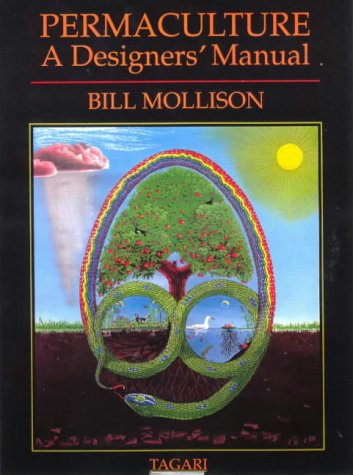 | Hardcover: 576
Pages
(1997-10-01)
list price: US$50.00 -- used & new: US$89.99 (price subject to change: see help) Asin: 0908228015 Average Customer Review: 
Canada | United Kingdom | Germany | France | Japan |
Customer Reviews (24)
| |
| 3. Getting Started In Permaculture: 50 Practical Projects to Build and Design Productive Gardens by Ross Mars, Jenny Mars | |
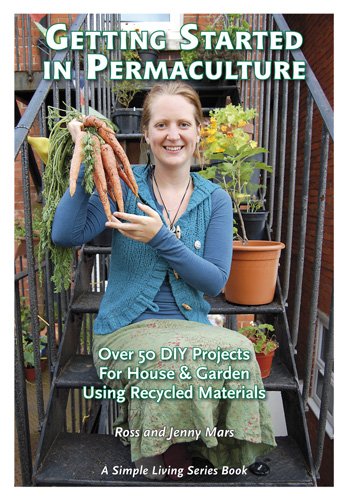 | Paperback: 102
Pages
(2007-10-17)
list price: US$14.95 -- used & new: US$8.59 (price subject to change: see help) Asin: 185623035X Average Customer Review: 
Canada | United Kingdom | Germany | France | Japan |
|
Editorial Review Product Description Customer Reviews (8)
| |
| 4. Introduction to Permaculture by Bill Mollison | |
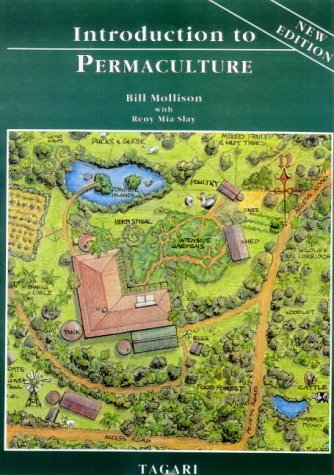 | Paperback: 224
Pages
(1997-08)
list price: US$16.95 -- used & new: US$43.00 (price subject to change: see help) Asin: 0908228082 Average Customer Review:
Canada | United Kingdom | Germany | France | Japan |
Customer Reviews (13)
| |
| 5. Permaculture: Principles and Pathways Beyond Sustainability by David Holmgren | |
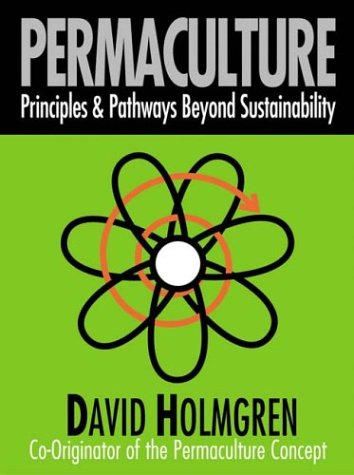 | Paperback: 286
Pages
(2002-12)
list price: US$30.00 -- used & new: US$17.45 (price subject to change: see help) Asin: 0646418440 Average Customer Review: 
Canada | United Kingdom | Germany | France | Japan |
Customer Reviews (12)
| |
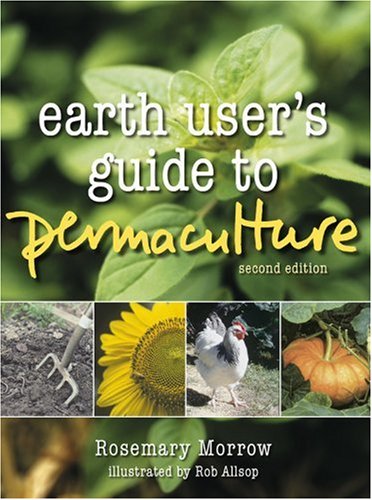
| 6. Earth User's Guide to Permaculture by Rosemary Morrow | |
 | Paperback: 288
Pages
(2010-03-15)
list price: US$34.95 -- used & new: US$21.90 (price subject to change: see help) Asin: 1856230511 Average Customer Review:
Canada | United Kingdom | Germany | France | Japan |
|
Editorial Review Product Description Customer Reviews (6)
Earth User's Guide to Permaculture has inspired us to get into permaculture in a big way.The information presented gives enough in the way of ideas to get the brain ticking over and to think how it can be applied in your own situation.We will buy another, more detailed book than this one, but this was perfect as an introduction to permaculture and to guide us in the direction we need to go. I'd recommend this book to anyone with an interest in permaculture who isn't sure if it's for them.There's enough to get you thinking and to let you know if permaculture is for you.
The author breaks down the complex material in simple layered concepts, building each successive chapter on the previous, and gives the reader practical "labs" to help apply the concepts--even if you are just dreaming about property and don't own any yet. About 1/3 of the book is foundational material on earth science: air, weather, soil, plants, etc. Starting with the basics, like observation and note taking, the author guides us step by step to help us understand the macro (the earth) and the micro (our backyard) world around us. The next 1/3 of the book helps you to start planning your own property based on the principles uncovered in the first 1/3. Photos and cartoon-like illustrations help flesh out the concepts. My only complaint is that the latter chapters are too brief. The author does such a good example of explaining the material in the first 1/3 of the book that I was disappointed to find the material lacking on how to build a natural forest. The reader will need additional books (like Patrick Whitefield's How to make a Forest Garden) to fill in where the author is sparse here. Despite what a previous reviewer has written, this book is neither preachy nor impractical. The notion to get rid of your car was briefly suggested in one place, about 3/4 ways through the book, and certainly not presented as an imperative--merely one idea among many possible solutions to pollution. To suggest that the author expects us to emulate Vietnamese poverty is misleading and unfair. The author presents several excellent agricultural examples currently employed in Vietnam--if good examples of permaculture exist there, why not use them to illustrate your point? The author in no way implies that we must adopt the Vietnamese lifestyle as a whole to fullfill the permaculture ideal. Rather, we can take their best examples and adapt them to our own situation. By the way, as a policitally conservative reader (to the "right"), I can confidently say the tone of the book is NOT leftist. Sound ecological principles are not "leftist". Good stewardship of the earth is a biblical and conservative notion. Anyway, this is a fun, informative book, with LOTS of practical ideas that have inspired me and enlightened my dreams for my own permaculture homestead.
I bought this book to learn about sustainable agricultural practice, but found myself enmeshed in a diatribe of leftist sentiment. For those of us who do not wish to wear biodegradable clothes, or who do not believe that corporate profits are the result of greedy and unethical conspiracies, it is too tempting to disregard the entire subject of permaculture. The proponents of this science need to accept that the majority of those citizens of the planet who have become accustomed to living in personal circumstances better than that of the "third world" are not going to go back to that lifestyle. While it might be a romantic ideal for some to live like a Vietnamese villager, not all would want to accept the poverty, short life expectancy and high infant mortality, to mention just three factors, which brand that country "third world". Permaculturists should abandon their politics and concentrate on promoting their science.
| |
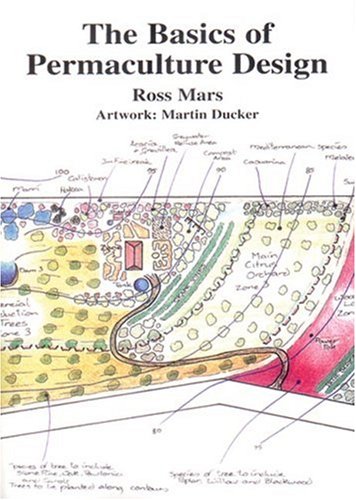
| 7. The Basics Of Permaculture Design by Ross Mars | |
 | Paperback: 170
Pages
(2005-03-30)
list price: US$25.00 -- used & new: US$16.69 (price subject to change: see help) Asin: 1856230236 Average Customer Review:
Canada | United Kingdom | Germany | France | Japan |
|
Editorial Review Product Description Packed with useful tips, clear illustrations, and a wealth of experience, it guides you through designs for gardens, urban and rural properties, water harvesting systems, animal systems, permaculture in small spaces like balconies and patios, farms, schools, and ecovillages. This is both a do-it-yourself guide for the enthusiast and a useful reference for permaculture designers. Customer Reviews (4)
| |
| 8. The Permaculture Way: Practical Steps to Create a Self-Sustaining World by Graham Bell | |
 | Paperback: 238
Pages
(2008-07-23)
list price: US$29.95 -- used & new: US$20.15 (price subject to change: see help) Asin: 1856230287 Average Customer Review:
Canada | United Kingdom | Germany | France | Japan |
|
Editorial Review Product Description Customer Reviews (4)
Put in its simplest terms, permaculture asks people to put as much into life as they demand from it; but it starts with each individual because that is what is immediate and within our control and because only we have the power to affect the future by acting creatively for the good of ourselves and others.Permaculture starts in the home because that is the central point in time and space from which all daily occupations radiate. Designing the home to supply much of its own needs and to consume its own outputs would be a massive contribution to global cleansing. Thoreau, in his book 'Walden' reviews his two-year experiment in simple living as a counter to industrialization and commerce that have driven people into virtual slavery. His remedy was to concentrate on simple requirements to free up time and energy for our spiritual needs. Our house should provide health for the family, peace for the spirit and harmony with the environment - and that is what permaculture strives to attain. Think globally but act locally is a slogan that reminds us, not just of our duty, but of our personal ability to affect change for the better. Permaculture is best expressed in your own garden because gardening exhibits all the qualities of planet-care - it is small scale, local, ethical, and a personal responsibility that brings together all strands of our relationship with nature; it is a common bond between families throughout the world. Permaculture is best expressed through the individual because leadership is so vital to building a better world. Every parent is a leader; every adult and every child can become a leader. All it requires is to do something when you see something that needs doing and that something may be as simple as creating a garden along the lines described in this book. This book shows us how to meet our basic needs while leaving the earth richer; it helps us to relearn the value of nature; it helps us to understand new ways of being wealthy; it helps us to create a productive lifestyle without causing environmental damage. Although the specifics of this book are for the British Isles, the principles and philosophies are universal. At present, the earth cannot keep up with our rate of production and consumption. We must deepen our understanding of the land and our relationship to it. This doesn't mean that we all have to become peasant or subsistence farmers; permaculture seeks more rewarding paths to paradise. This book helps us to design our lives efficiently, not just to feed and clothe ourselves better but to take as little as possible of the earth's space for the production of those needs; to do as little damage as possible to the environment and whenever possible to return as much as possible to nature. David Bellamy starts his preface with these words. "I have four books in my library which form the cornerstones of my hope for the future: Marcus Porcius Cato's 'Treatise on Agriculture' (about 160 AD); Robert Sharrock's 'History of the Propagation and Improvement of Vegetables by the Concurrence of Art and Nature' (1660); Hans Jenny's 'The Soil Resource' (1980); and Bill Mollison's 'permaculture' (1988). I can now add this book to the collection, for it is of great importance. This is a spring-board text, which relaunches the wisdom of almost twenty centuries into the arena where it is most needed and from which it can be most effective - the rich countries of the temperate world." At the 2002 Johannesburg World Summit for Sustainable Development, one resolution was to declare a Decade for Education on Sustainable Development starting in 2005. We must now start thinking about what should be included in the new curriculum. Permaculture should definitely be included.If you want to move away from the consumerist lifestyle; if you want to live by more enduring values; if you are looking for answers to the question 'What can I do about curing our world?'; if you are looking for ways to improve your health and to live more harmoniously with nature; if you agree with Edmund Burke that "for the triumph of evil it is only necessary that good men do nothing"; then this well may be the book you have been looking for. This book should be in the library of everyone interested in building a better world.
| |
| 9. The Permaculture Garden by Graham Bell | |
 | Paperback: 174
Pages
(2008-11-05)
list price: US$25.00 -- used & new: US$16.81 (price subject to change: see help) Asin: 1856230279 Canada | United Kingdom | Germany | France | Japan |
|
Editorial Review Product Description | |
| 10. Edible Forest Gardens: Ecological Vision, Theory For Temperate Climate Permaculture by Dave Jacke, Eric Toensmeier | |
 | Hardcover: 396
Pages
(2005-08-30)
list price: US$75.00 -- used & new: US$49.00 (price subject to change: see help) Asin: 1931498792 Average Customer Review:
Canada | United Kingdom | Germany | France | Japan |
|
Editorial Review Product Description Customer Reviews (4)
| |
| 11. Chicken Tractor: The Permaculture Guide to Happy Hens and Healthy Soil by Andy W Lee, Patricia L Foreman | |
 | Paperback: 324
Pages
(1998-01)
list price: US$22.95 -- used & new: US$14.80 (price subject to change: see help) Asin: 0962464864 Average Customer Review:
Canada | United Kingdom | Germany | France | Japan |
|
Editorial Review Product Description Customer Reviews (23)
| |
| 12. Edible Forest Gardens, Vol. 2: Ecological Design And Practice For Temperate-Climate Permaculture by Dave Jacke, Eric Toensmeier | |
 | Hardcover: 672
Pages
(2005-10-20)
list price: US$75.00 -- used & new: US$47.24 (price subject to change: see help) Asin: 1931498806 Average Customer Review:
Canada | United Kingdom | Germany | France | Japan |
|
Editorial Review Product Description Customer Reviews (3)
| |
| 13. Permaculture One: A Perennial Agricultural System for Human Settlements by Bill Mollison, David Holmgren | |
 | Paperback: 130
Pages
(1990-06)
-- used & new: US$63.30 (price subject to change: see help) Asin: 0908228031 Canada | United Kingdom | Germany | France | Japan |
| 14. The Earth Care Manual: A Permaculture Handbook For Britain & Other Temperate Climates by Patrick Whitefield | |
 | Hardcover: 482
Pages
(2005-03-30)
list price: US$75.00 -- used & new: US$54.74 (price subject to change: see help) Asin: 185623021X Average Customer Review:
Canada | United Kingdom | Germany | France | Japan |
|
Editorial Review Product Description Permaculture started out in the 1970s as a sustainable alternative to modern agriculture, taking its inspiration from natural ecosystems. It has always placed an emphasis on gardening, but since then it has expanded to include many other aspects, from community design to energy use. It can be seen as an overall framework that puts a diversity of green ideas into perspective. Its aims are low work, high output, and genuine sustainability. Customer Reviews (4)
| |
| 15. Gaia's Garden: A Guide to Home-Scale Permaculture by Toby Hemenway | |
 | Paperback: 240
Pages
(2001-04-01)
list price: US$34.95 -- used & new: US$69.94 (price subject to change: see help) Asin: 1890132527 Average Customer Review:
Canada | United Kingdom | Germany | France | Japan |
|
Editorial Review Product Description Customer Reviews (45)
| |
| 16. The Woodland Way: A Permaculture Approach to Sustainable Woodland Management by Ben Law | |
 | Paperback: 272
Pages
(2001-11)
list price: US$30.00 -- used & new: US$31.77 (price subject to change: see help) Asin: 1856230090 Average Customer Review:
Canada | United Kingdom | Germany | France | Japan |
|
Editorial Review Product Description Customer Reviews (2)
Last year a British on-line acquaintance told me that those tales of the early settlers in Tennessee being able to drive their ox-carts through the forest without getting stuck in the trees meant that the Indians were grooming the forest, had put a lot of thought and energy into making sure that the forest could sustain them.I wasn't sure what he meant.This book tells me.How he rotates his crops--cut some of the willow for artist's charcoal, a couple of years later, for rustic furniture, then let it come back from the stumps.In the meantime, blackberries can grow and fruit in the clearing, and a fairly rare bird just loves to nest there.The birds can move on to the next patch of cut back to the stumps by the time the blackberries are in too much shade and the willow is about ready to be cut a little bit for artist's charcoal. So I'm now busily wondering how I apply this to my woods. ... Read more | |
| 17. The Transition Handbook by Rob Hopkins | |
| Paperback:
Pages
(2009-03-01)
-- used & new: US$50.74 (price subject to change: see help) Asin: 1921462000 Canada | United Kingdom | Germany | France | Japan | |
|
Editorial Review Product Description | |
| 18. The New American Sustainable Garden: Green Roofs,Rain Gardens, Permaculture, Food Forests, Xeriscaping, and More | |
| Hardcover: 256
Pages
(2011-04-15)
list price: US$34.95 -- used & new: US$23.07 (price subject to change: see help) Asin: 1604691867 Canada | United Kingdom | Germany | France | Japan | |
|
Editorial Review Product Description | |
| 19. Permaculture One: A Perennial Agriculture for Human Settlements by Bill Mollison | |
| Paperback:
Pages
(1981-06)
list price: US$12.50 Isbn: 0938240005 Canada | United Kingdom | Germany | France | Japan | |
|
Editorial Review Product Description | |
| 20. Permaculture in a Nutshell by Patrick Whitefield | |
 | Paperback: 84
Pages
(1993-01-15)
list price: US$12.95 -- used & new: US$7.61 (price subject to change: see help) Asin: 1856230031 Average Customer Review:
Canada | United Kingdom | Germany | France | Japan |
|
Editorial Review Product Description Customer Reviews (8)
| |
| 1-20 of 101 | Next 20 |
 Very good, but too narrow a focus
 Permaculture or PhD Dissertation on Systems Theory?
 Good information but hard to read