e99 Online Shopping Mall

Geometry.Net - the online learning center Help  
Home  - Science - Safety Engineering (Books)

  1-20 of 100 | Next 20
A  B  C  D  E  F  G  H  I  J  K  L  M  N  O  P  Q  R  S  T  U  V  W  X  Y  Z  

click price to see details     click image to enlarge     click link to go to the store

$55.03
1. Construction Safety Engineering
$83.00
2. System Safety Engineering And
$43.59
3. Commercial Aviation Safety
 
$198.85
4. Product Safety Management and
 
$167.35
5. Construction Safety Management
$180.00
6. System Safety Engineering and
$112.17
7. Occupational Safety Management
 
$27.11
8. Engineering Design for Safety
$115.64
9. Safety Engineering
$113.15
10. Guidelines for Risk Based Process
$76.92
11. Supervisors' Safety Manual, Ninth
$109.96
12. Environmental, Safety, and Health
 
$75.00
13. Using Human Factors Engineering
 
$9.95
14. Proactive safety management: engineering
$108.40
15. Guidelines for Engineering Design
$210.62
16. Stability and Safety of Ships,
$84.57
17. Nuclear Safety
$64.00
18. LNG Fire Protection & Emergency
$59.89
19. Satisfying Safety Goals by Probabilistic
$79.00
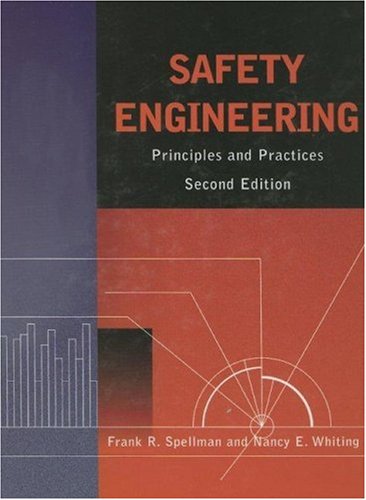
20. Safety Engineering: Principles

1. Construction Safety Engineering Principles (McGraw-Hill Construction)
by David V. MacCollum
Hardcover: 416 Pages (2006-12-18)
list price: US$99.95 -- used & new: US$55.03
(price subject to change: see help)
Asin: 007148244X
Canada | United Kingdom | Germany | France | Japan
Editorial Review

Book Description

Identify and Control Safety Hazards on Construction Sites to Reduce Worker Injuries and Increase Productivity

Construction Safety Engineering Principles: Designing & Managing Safer Job Sites equips architects, engineers, and construction managers with a step-by-step methodology for identifying and controlling hazards before construction starts. The book explains how to look beyond the utility of machinery and equipment to how they will actually be used ona construction site_and thereby spot potential hazards in advance.

Safety expert David MacCollum presents examples of the 50 most common construction hazards, showing how they can be eliminated by means of proven design techniques and technologies. He explains how to prevent falls from elevations with safe access systems, get rid of blind zones behind mobile equipment, utilize control systems that cannot be unintentionally activated, avoid crane accidents, and much more. Packed with detailed illustrations, Construction Safety Engineering Principles enables construction professionals to:

  • Design and plan safer construction sites for residential, commercial,and industrial projects
  • Correct safety problems before construction begins
  • Dramatically reduce costly worker injuries and job delays
  • Increase productivity and create a more cost-effective project

Improve Safety Conditions on Any Construction Site!

•Hazard Definition (Dormant, Armed, or Active) • Hazard Prevention through Design Features and Safety Appliances • Hazard Categories (Natural, Structural/Mechanical, Electrical, Chemical, Radiant Energy, Biological, Automated) • Safe Design Hierarchy • Hazard Identification and Prevention Matrix • Crane Hazards • Other Equipment Hazards • Universal Hazards • Access Hazards • Types of Construction • Operation and Maintenance • Planning • Including Safety in the Design • Including Safety in the Master Construction Plan • Economics of Safer Design ... Read more

2. System Safety Engineering And Risk Assessment: A Practical Approach (Chemical Engineering)
by Nicholas J Bahr
Hardcover: 251 Pages (1997-09-01)
list price: US$104.95 -- used & new: US$83.00
(price subject to change: see help)
Asin: 1560324163
Average Customer Review: 5.0 out of 5 stars
Canada | United Kingdom | Germany | France | Japan
Editorial Review

Book Description
As technological systems become more complex, it becomes increasingly difficult to identify safety hazards and to control their impact. Engineers today are finding that safety and risk touch upon every aspect of any engineered process, from system design all the way through disposal. Employing highly pragmatic examples from a number of industries, System Safety Engineering and Risk Assessment: A Practical Approach provides a comprehensive and easily accessible guide on how to build safety into products as well as into industrial processes. Using a systems approach, the text discusses the best system safety techniques used in various industries, types of hazard analyses, safety checklists and other safety tools, as well as techniques for investigating accidents. It explains how to set up a data management system for a system safety program, and delves into risk assessment, including ways to conduct a risk evaluation. While the book provides engineers with an efficient reference in a critical area, the clarity of the writing along with the case studies and illustrations makes this book accessible to non-technical professionals needing a how to guideforthe safety management of complex systems. It is also used by graduate classes involved with ergonomics and occupational safety as well as engineering. ... Read more

Customer Reviews (3)

5-0 out of 5 stars A great textbook
System Safety Engineering And Risk Assessment is an excellent reference on how to engineer safety and manage risk. The clarity of the writing combined with understandable examples makes this book an outstanding text for a course on engineering safe systems.

This book starts by introducing the need and benefits of implementing a system safety program providing context for the later material.Key safety concepts and definitions are then introduced with references to relevant government and industry standards. A pragmatic discussion follows on the necessity of management and organizational support for an effective safety program. The book then details specific techniques for hazard identification and analysis including HAZOP, fault tree, FMEA, FMECA and a few lesser known methodologies. The overview of human factors analysis begins with the observation that "human error is an out-of-tolerance action within the human machine system."This discussion provides a comprehensive framework for the more advanced material referenced in the section. The only weakness was the following section on software safety, which lacked detailed descriptions of state-of-practice analysis techniques. The analysis section is strengthened by the discussion of accident and failure reporting systems and the associated databases that are used to support accident and reliability analyses. The final chapters of the book provide a practical discussion of how to manage risk using tailored versions the various techniques introduced in the previous sections.

All in all, this is a worthwhile reference for systems engineers and safety officials.

5-0 out of 5 stars Illuminating Systems Safety Overview
In this book, Nicholas Bahr has taken the complex discipline of systems safety and made it accessible in a logical, useful format. The book is clear and well illustrated (although a couple of the charts are a bit cumbersome and unwieldy), and calls upon numerous case studies to illustrate key points. There are separate chapters of Hazard Analysis, Fault Tree Analysis, Safety Analysis in Engineering, and Safety Management.

While useful for engineers (particularly in the chemical processing or nuclear fields), this book is written in comprehensible terms that do not require an engineering background or technical education to understand. In fact, I believe that the biggest beneficiaries of this book are not engineers at all, but non-technical managers, who desperately need to understand safety systems, but often don't. In fact the chapter on Safety Management should be required reading for any manager in a safety critical environment, as it is an excellent "how to" guide to safety management of complex systems. This chapter has examples of correct safety management, and more importantly, excellent examples of the perils of management unwillingness to prioritize safety. The case study of the Nypro UK cyclohexane plant explosion in Flixborough, England is the best detailed, and has universal applications to safety systems across varying industries. The loss of the shuttle 'Challenger' is also reviewed from a systems safety vantage point, but while there are many errors to be analyzed and learned from there, more of the lessons are industry specific than are the lessons from the Flixborough example.

I used this book in a graduate class on systems safety. This is one of the best safety books I have seen, and is the most concise text on systems safety that I have ever read, far better, for instance, than the works of Perrow. Mr. Bahr is to be commended for his work; I look forward to reading more by him in the future.

5-0 out of 5 stars A good book for the student and the experienced professional
I used this book to teach system safety engineering to graduate students.The author provides the reader a background into system safety that lays the ground work for a functional and proactive system safety process.Thisbook provided workable examples to the student for comprehension of thematerial.Students as well as the instructor had a better understanding ofsystem safety and the integrationof the processes into general industrialand avaition safety programs/processes. I wish I had this book when I wastrying to explain to my management what system safety engineering was andhow it benefits the engineering department. ... Read more


3. Commercial Aviation Safety
by Alexander T. Wells, Clarence C. Rodrigues
Hardcover: 475 Pages (2004-01-09)
list price: US$50.00 -- used & new: US$43.59
(price subject to change: see help)
Asin: 0071417427
Average Customer Review: 4.5 out of 5 stars
Canada | United Kingdom | Germany | France | Japan
Editorial Review

Book Description

*An overview of airline industry safety statistics, standards, and mandates
*Covers FAA regulatory structure, development of technologies, management roles, air transport safety measurement methods - and more
*Includes tables relating to commercial aviation accident statistics
*New chapter on Aviation SecurityDownload Description
Rapidly increasing air traffic around the globe, soaring numbers of passengers, security concerns on the ground and in the air, changes in the Air Traffic System, new maintenance and flight technologies, recent accidents, and intensified media focus--all point up the need for greater attention to commercial aviation safety in the third millennium. Built upon the 5-M model--Man, Machine, Medium, Mission, and Management--this text by aviation author Alexander T. Wells integrates the latest research on human factors, technologies, systems, operations, and management strategies into the most comprehensive, up-to-date, and systematic reference on commercial aviation safety in the world. ... Read more

Customer Reviews (6)

5-0 out of 5 stars Informative Book

"Commercial Aviation Security" is a comprehensive book on various safety and security aspects of commercial aviation. The wide range of topics covered include aviation law and regulations, the FAA Rule Making process, recording and reporting safety data, safety statistics, model of accident causation, risk assessment and management, air traffic management and control issues, aviation security, among other things.

The book is well written, well presented and easy to follow and understand. Those people involved with commercial aviation safety, operations and security will find this a valuable, helpful and handy reference book.

5-0 out of 5 stars Great for class.
This is great for the intended class. Provides all the needed information.

4-0 out of 5 stars Full of Info, but Not Flashy
This is required reading by many Embry-Riddle Aviation Safety teachers.

It is broad in scope and recent, regarding coverage of the latest technology and events. It is not just a reprint of an out-of-date textbook with a new cover and a little new stuff thrown in, although I have not read the previous edition. I was surpised to see references to recent events and new technology that is barely being used. With the industry moving as fast as it is, I believe this is the book's strength. (Copyright is 2004) 5 of 5 stars for information.

Sure it may be dry, but it's a textbook. I haven't read too many textbooks that were written in a lively manner. Personally, I want information, not a entertainment or an agenda.

I particularly like that there is very little 'word fluff'. The writing is concise and straight-to-the-point, without excessive writing or stories to try to make a point. It encompasses a very wide range of Aviation Safety topics that one would need to know for general knowledge of the subject.

For a typical expensive textbook, I was surprised that there are NO pictures, and the book is printed on cheap 'copier paper' rather than fancy glossy paper. Otherwise, the binding and cover is rugged and secure. The absence of color or pictures, or fancy paper doesn't detract from the information which is top-notch. 3 of 5 stars for appearance and quality.

If you want fancy, get something else. If you want concise, up-to-date information, get this!

4-0 out of 5 stars Generally Good, Though Occasionally Off Track
"Commercial Aviation Safety" is a great introductory text for students wanting exposure to most safety considerations in aviation. The book is a well-organized survey, although I only award it four stars because the authors frequently get off-topic into areas only tangentially related to aviation safety.

The book opens with a discussion of the aviation regulatory and historical framework. This goes rapidly astray, with discussions of everything from the 1978 lead standard to the 1989 Hazardous Waste Operations and Emergency Response Standard (HAZWOPER), which deals with toxic spill cleanup. Both of these could be tied to aviation safety, but the numerous citations of this nature serve to dilute the import of more important and common aviation safety programs.

Chapter two is a good overview of rulemaking processes, and I agree with the authors that the current FAA rulemaking process is far to labyrinthine at 217 steps long. Unfortunately, chapter two gets into a protracted discussion of OSHA related topics including quagmires like the Small Business Regulatory Enforcement and Fairness Act (SBREFA) which are not especially germane to aviation. Chapter three is a good introduction to the NTSB.

Chapter four is on "Recording and Reporting Safety Data" and is one of the key chapters in the book. The authors make excellent points about accidents and incidents as precursors to accidents (page 75). I was amazed to find that the FAA has 280 separate data collection systems. Clearly a database management system would be of great help to the government. On page 84 the authors have written a great explanation of Flight Operational Quality Assurance (FOQA) and the Air Transport Oversight System (ATOS). Anyone interested in this field needs a good working knowledge of these two components. The authors once again (page 92) make the excellent point that nonaccident safety data is vital in identifying and estimating the magnitude of safety problems. Chapter four, unfortunately, closes off course with a discussion of chemical spill reporting requirements. This is only applicable to extremely specialized professionals and is not readily of interest to readers of a survey on aviation safety. (This, for instance, is the closing line of the chapter: "RCRA listed hazardous wastes (F, K, P, U) under 40 CFR Part 261, Subpart D, and characteristic wastes (I, C, R, TC) under 40 CFR Part 261, Subpart C, are reportable if the release equals or exceeds the designated RQ.")

Chapter five is an overview of safety statistics, and pages 102-103 contain an excellent discussion of the utility and interpretation of accident rates and their use as indicators of risk trends. Beginning in chapter five, though, the pro-Boeing bias of the authors becomes readily apparent. Many safety advances are attributed to Boeing when they were actually introduced first or done better by another manufacturer. Chapter five also contains a summary of accident statistics that is useful, although monotonously written.

Chapter six deals with accident causation modeling, and introduces several models including the 5-M model (page 145.) It also contains good discussions of risk management (page 151) and human performance factors (page 160.)

Chapter seven starts with (page 163) an excellent discussion of the management of error, which is becoming more important in aviation today. It goes astray on page 164, though, with an inaccurate Boeing versus Airbus example in which Boeing is seen as the champion for simplicity and Airbus for complexity. The authors then get into an example of fuel system design. Anyone who has flown the B-747-400 and the newer Airbus products (A-320 and subsequent) can refute the assertion that Boeing is simpler. The 747-400 has the most nightmarish fuel system I have ever been exposed to, whereas the Airbus fuel system is very simple to operate. Even the "simpler" Boeings like the 757 and 767 have more fuel-related operational limitations and user knowledge requirements than a newer Airbus. My point here isn't to denigrate Boeing, but to point out that some of the examples in the book are perhaps skewed by personal knowledge or bias. Page 170 has an interesting comparison of 757/767 versus A-320 envelope protection. It is generally well balanced and technically correct, but their conclusion about windshear escape maneuvers is not justified: many simulator studies have now been carried out comparing the Boeing and Airbus escape profiles, and in all that I am aware of the Airbus full aft stick recovery provided greater ground clearance in identical conditions. I am unsurprised that the B-777 is cited for the electronic checklist (ECL) as a safety improvement, although all Airbus aircraft since the A-310 have had excellent ECAM automatic normal and abnormal checklists.

The remainder of the book is an overview of Air Traffic Control (although the authors contend that Free Flight is alive, most think it's DOA), and airline specific information, which is generally good. The book credits the 737 with starting the two-pilot cockpit, while actually the DC-9 flew much earlier. The Flight Control Computer (FCC) discussion of page 248 discusses the advances in modern FCCs, though fails to mention that the architecture being described is exclusive to Airbus. Once again the chapter deteriorates at the end with a discussion of 29 CFR 1910.215, Abrasive Wheel Machinery (pedestal grinders and other grinding wheels), and a discussion of the American Conference of Governmental Industrial Hygienists under 29 CFR 1910 Subpart Z.

Security is well covered in Chapter 11, although perhaps the discussion of nuclear quadrupole resonance technology, and the Body Orifice Security Scanner (BOSS) are more rooted in minutia than is needed in a text of this nature.

Chapter 12 concerns airline safety programs, and discusses employee selection. Particularly excellent is the discussion of requirements for a Safety Director (page 352). The discussion of Internal Evaluation Programs (page 346) is also superior.

This book is a great resource. The material within it would rate five stars if it weren't for the fairly constant introduction of material only tangentially relevant to aviation safety. I recommend this book for any aviation student or professional.

5-0 out of 5 stars Excellent commercial aviation text
Commercial Aviation Safety is an excellent textbook for those needing a thorough overview of the nature of commercial aviation.

The book makes for a tremendous reference for anyone wanting more detailed information on the business of commercial aviation.

The chapters are all well written and well organized. At times, the writing style can be a bit dry.While an excellent book, it does not flow or read to the smoothness that Airport Planning & Management (Wells & Young) does.

But for anyone needing an in-depth outline on the dynamics of commercial aviation safety, from regulatory to operations, Commercial Aviation Safety is a very good book to use. ... Read more


4. Product Safety Management and Engineering
by Willie Hammer
 Hardcover: 311 Pages (1993-03)
list price: US$89.95 -- used & new: US$198.85
(price subject to change: see help)
Asin: 0939874903
Canada | United Kingdom | Germany | France | Japan

5. Construction Safety Management and Engineering
 Hardcover: 717 Pages (2003-09)
list price: US$99.95 -- used & new: US$167.35
(price subject to change: see help)
Asin: 1885581467
Canada | United Kingdom | Germany | France | Japan

6. System Safety Engineering and Management
by Harold E. Roland, Brian Moriarty
Hardcover: 384 Pages (1990-09)
list price: US$199.00 -- used & new: US$180.00
(price subject to change: see help)
Asin: 0471618160
Average Customer Review: 3.0 out of 5 stars
Canada | United Kingdom | Germany | France | Japan
Editorial Review

Book Description
Comprehensive in scope, it describes the process of system safety--from the creation and management of a safety program on a system under development to the analysis that must be performed as this system is designed and produced to assure acceptable risk in its operation. Unique in its coverage, it is the only work on this subject that combines full descriptions of the management and analysis processes and procedures in one handy volume. Designed for both system safety managers and engineers, it incorporates the safety procedures used by the Department of Defense and NASA and explains basic statistical methods and network analysis methods which provide an understanding of the engineering analysis methods that follow. ... Read more

Customer Reviews (2)

3-0 out of 5 stars Decent executive level intro
While starting to show its age, Moriarty's text is a sound introduction to the executive-level or program manager as to what his safety guys are doing, why they hold up his schedule and why he pays them so much.

For the supervised safety practitioner the text introduces common concepts but doesn't really do modern, embedded control systems justice.

The text is expensive and not what I would consider value for money.

3-0 out of 5 stars Overall a good book with some problems.
Overall, the book does a great job of covering the many areas of System Safety. It is the best book I've found on the topic.

However, this year I started teaching from this book. And when you teach you really discoverthe shortcomings of a text. It is frustrating when the author uses acronymswithout explaination. I've also been running into minor math errors oroversights in formulas (e.g. defining a function f(x) and using 't' in theequation as the independent variable).

I think the attempt to cover allof the material resulted in a brief overview of these areas and took awayfrom the quality of coverage. Still, I haven't seen a better book on thetopic and if the worst you can say is that it could have been better, thatsnot bad. ... Read more


7. Occupational Safety Management and Engineering (5th Edition)
by Willie Hammer, Dennis Price
Paperback: 584 Pages (2000-12-15)
list price: US$113.67 -- used & new: US$112.17
(price subject to change: see help)
Asin: 0138965153
Canada | United Kingdom | Germany | France | Japan
Editorial Review

Book Description
This revised text provides readers with the most current information available on a wide range of topics.Topics covered include workers' compensation, fault tree analysis, hearing protection, environmental protection, fire protection, workers with disabilities, ergonomics, OSHA violation policy, and much more.For anyone interested in industrial safety. ... Read more


8. Engineering Design for Safety
by Thomas A. Hunter
 Hardcover: 298 Pages (1992-01)
list price: US$57.00 -- used & new: US$27.11
(price subject to change: see help)
Asin: 0070313377
Canada | United Kingdom | Germany | France | Japan
Editorial Review

Book Description
Product design engineers must strive to identify and reduce potential hazards during every phase of product development. Focusing on the mechanical and structural aspects of the design of industrial, commercial, transportation, and consumer products, this authoritative book outlines the fundamental design principles utilized in achieving a reasonably safe product. Information is provided on all significant aspects of product design, product liability, and the legal process should litigation occur. Invaluable information is also provided on human factors and the codes and standards that affect the design of safe products. Case histories and examples illustrate key ideas. ... Read more


9. Safety Engineering
by Gilbert Marshall
Hardcover: 425 Pages (2000-04)
list price: US$50.00 -- used & new: US$115.64
(price subject to change: see help)
Asin: 1885581289
Canada | United Kingdom | Germany | France | Japan

10. Guidelines for Risk Based Process Safety
by Center for Chemical Process Safety (CCPS)
Hardcover: 768 Pages (2007-04-10)
list price: US$150.00 -- used & new: US$113.15
(price subject to change: see help)
Asin: 0470165693
Canada | United Kingdom | Germany | France | Japan
Editorial Review

Book Description
Guidelines for Risk Based Process Safety provides guidelines for industries that manufacture, consume, or handle chemicals, by focusing on new ways to design, correct, or improve process safety management practices. This new framework for thinking about process safety builds upon the original process safety management ideas published in the early 1990s, integrates industry lessons learned over the intervening years, utilizes applicable "total quality" principles (i.e., plan, do, check, act), and organizes it in a way that will be useful to all organizations - even those with relatively lower hazard activities - throughout the life-cycle of a company. ... Read more


11. Supervisors' Safety Manual, Ninth Edition
by National Safety Council
Hardcover: 397 Pages (1997-03)
list price: US$125.78 -- used & new: US$76.92
(price subject to change: see help)
Asin: 0879121971
Canada | United Kingdom | Germany | France | Japan
Editorial Review

Product Description
This manual presents the information supervisors need for the three aspects of loss control: recognizing hazards, determining levels of acceptable risk, and controlling hazards. It also covers OSHA and other industry standards; principles for safeguarding, maintaining and using tools and equipment; and promoting safety and health including shiftwork performance, substance abuse, and ergonomics. ... Read more


12. Environmental, Safety, and Health Engineering
by Gayle Woodside, Dianna Kocurek
Hardcover: 580 Pages (1997-05)
list price: US$170.00 -- used & new: US$109.96
(price subject to change: see help)
Asin: 0471109320
Average Customer Review: 5.0 out of 5 stars
Canada | United Kingdom | Germany | France | Japan
Editorial Review

Book Description
A complete guide to environmental, safety, and health engineering, including an overview of EPA and OSHA regulations; principles of environmental engineering, including pollution prevention, waste and wastewater treatment and disposal, environmental statistics, air emissions and abatement engineering, and hazardous waste storage and containment; principles of safety engineering, including safety management, equipment safety, fire and life safety, process and system safety, confined space safety, and construction safety; and principles of industrial hygiene/occupational health engineering including chemical hazard assessment, personal protective equipment, industrial ventilation, ionizing and nonionizing radiation, noise, and ergonomics. ... Read more

Customer Reviews (2)

5-0 out of 5 stars Excellent Overview of ES&H
I found this book to be an excellent review of the field of environmental health and safety.It is balanced between the sometimes separate fields of environmental health and occupational health and safety.The book managesto cover both areas very well.Of the books I have read and used, this isprobably the best combined coverage of the entire ES&H field.A wealthof helpful examples are included so the reader can adapt them for their ownneeds.Definitely a worthwhile book for professionals and students dealingwith these issues to own. ... Read more


13. Using Human Factors Engineering to Improve Patient Safety
by John W., Ed. Gosbee
 Paperback: 144 Pages (2005)
list price: US$75.00 -- used & new: US$75.00
(price subject to change: see help)
Asin: 0866889124
Canada | United Kingdom | Germany | France | Japan

14. Proactive safety management: engineering resilience makes the difference between a disruption and disaster.: An article from: Industrial Engineer
by David D. Woods
 Digital: 10 Pages (2007-06-01)
list price: US$9.95 -- used & new: US$9.95
(price subject to change: see help)
Asin: B000TNR7I6
Canada | United Kingdom | Germany | France | Japan
Editorial Review

Book Description
This digital document is an article from Industrial Engineer, published by Thomson Gale on June 1, 2007. The length of the article is 2918 words. The page length shown above is based on a typical 300-word page. The article is delivered in HTML format and is available in your Amazon.com Digital Locker immediately after purchase. You can view it with any web browser.

Citation Details
Title: Proactive safety management: engineering resilience makes the difference between a disruption and disaster.
Author: David D. Woods
Publication: Industrial Engineer (Magazine/Journal)
Date: June 1, 2007
Publisher: Thomson Gale
Volume: 39Issue: 6Page: 44(5)

Distributed by Thomson Gale ... Read more


15. Guidelines for Engineering Design for Process Safety
by Center for Chemical Process Safety (CCPS)
Hardcover: 573 Pages (1993-09-15)
list price: US$145.00 -- used & new: US$108.40
(price subject to change: see help)
Asin: 0816905657
Canada | United Kingdom | Germany | France | Japan
Editorial Review

Book Description
Inherently safer plants begin with the initial design. Here is where integrity and reliability can be built in at the lowest cost, and with maximum effectiveness. This book focuses on process safety issues in the design of chemical, petrochemical, and hydrocarbon processing facilities. It discusses how to select designs that can prevent or mitigate the release of flammable or toxic materials, which could lead to a fire, explosion, or environmental damage. All engineers on the design team, the process hazard analysis team, and those who make basic decisions on plant design, will benefit from its comprehensive coverage, its organization, and the extensive references to literature, codes, and standards that accompany each chapter. ... Read more


16. Stability and Safety of Ships, Volume 9: Vol 9 = Regualation and Operation (Elsevier Ocean Engineering Series)
by Lech Kobylinski, Sigismund Kastner
Hardcover: 430 Pages (2003-11-26)
list price: US$221.00 -- used & new: US$210.62
(price subject to change: see help)
Asin: 0080430015
Canada | United Kingdom | Germany | France | Japan
Editorial Review

Book Description
A stability accident is one of the worst things that can happen to a ship. This two-volume set brings together the mass of information available in one practical reference and is essential reading to all concerned with the prevention against capsizing.

*Focuses on the regulatory, operational aspects of intact stability
*Provides a detailed review of research and results in the field
*Facilitates the confident application of methods to new ship designs ... Read more


17. Nuclear Safety
by Gianni Petrangeli
Hardcover: 448 Pages (2006-07-18)
list price: US$104.00 -- used & new: US$84.57
(price subject to change: see help)
Asin: 0750667230
Canada | United Kingdom | Germany | France | Japan
Editorial Review

Book Description
Nuclear Safety is a comprehensive reference for heath & safety and engineering professionals in the nuclear industry and related bodies, including regulatory authorities, environmental and energy scientists, students, researchers and consultants.

It provides the methods and data needed to evaluate and manage the safety of nuclear facilities and related processes using risk-based safety analysis, and provides readers with the techniques to assess the consequences of radioactive releases.

The book covers relevant international and regional safety criteria (US, IAEA, EUR, PUN, URD, INI). The contents deal with each of the critical components of a nuclear plant, and provide an analysis of the risks arising from a variety of sources, including earthquakes, tornadoes, external impact and human factors. It also deals with the safety of underground nuclear testing and the handling of radioactive waste.

Covers all plant components and potential sources of risk including human, technical and natural factors
Brings together information on nuclear safety for which the reader would previously have to consult many different and expensive sources
Provides international design and safety criteria and an overview of regulatory regimes
Includes case studies and analysis of major accidents with data and calculations on accompanying website

Gianni Petrangeli has 40 years of experience in the nuclear industry. He was Director of the Departmental Area for Integrated Systems and New Technologies of ANPA, the Italian Regulatory body responsible for nuclear and industrial safety. He is a consultant to the United Nations Atomic Energy Agency and a researcher for nuclear safety for the European Commission. He lectures on Nuclear and Industrial Safety at the University of Pisa.

* Covers all plant components and potential sources of risk including human, technical and natural factors
* Brings together information on nuclear safety for which the reader would previously have to consult many different and expensive sources
* Provides international design and safety criteria and an overview of regulatory regimes
* Includes case studies and analysis of major accidents with data and calculations on accompanying website ... Read more


18. LNG Fire Protection & Emergency Response - BP Process Safety Series - IChemE (Bp Fire Safety)
by BP Safety Group, IChemE's Loss Prevention Panel
Paperback: 150 Pages (2007-08-15)
list price: US$64.00 -- used & new: US$64.00
(price subject to change: see help)
Asin: 0852955154
Average Customer Review: 5.0 out of 5 stars
Canada | United Kingdom | Germany | France | Japan
Editorial Review

Product Description
This book is intended for fire and emergency responders, design engineers, project engineers, facility operators, and safety professionals. The title aims to improve understanding of the nature and hazards of LNG and the special fire hazards management and emergency response measures required for such facilities. ... Read more

Customer Reviews (1)

5-0 out of 5 stars Table of Contents
Contents


1. Introduction - a brief history of LNG

2. LNG Properties

3. LNG Hazards

4. Tanks, Containment & Spill Control

5. Jetties and Marine Facilities

6. Passive Fire Protection

7. LNG, Gas & Fire Detection

8. Spill & Fire Control Measures

9. Emergency Response Plans

10. PPE

11. Codes & Standards

12. References


... Read more


19. Satisfying Safety Goals by Probabilistic Risk Assessment (Springer Series in Reliability Engineering)
by Hiromitsu Kumamoto
Hardcover: 253 Pages (2007-03-15)
list price: US$129.00 -- used & new: US$59.89
(price subject to change: see help)
Asin: 1846286816
Canada | United Kingdom | Germany | France | Japan
Editorial Review

Book Description

Safety is one of the most important issues today. Recent international standards such as ISO and IEC have consistently advocated goal-based procedures of designing systems for better safety. The procedure assumes safety goals are explicitly established by international organizations, individual nations, particular industries or private companies. Satisfying Safety Goals by Modern Reliability Engineering is a methodological approach to the goal-based safety design procedure that will soon be an international requirement.

Satisfying Safety Goals by Modern Reliability Engineering primarily focuses on the quantitative aspects of international standards. The methodologies presented are illustrated through the use of case studies. The book also:

  • presents accident statistics and safety goals;
  • describes abnormal event enumeration for the target system;
  • develops risk reduction mechanisms;
  • discusses probabilistic risk assessment (PRA) models typified by event trees coupled with fault trees;
  • presents conventional materials for basic event quantification;
  • describes how to calculate safety criteria from the PRA models, given basic event data;
  • evaluates uncertainties of point estimates of safety criteria; and
  • considers how external event quantification can expand the scope of PRA.

Satisfying Safety Goals by Modern Reliability Engineering will be a good reference for senior undergraduates, postgraduates and researchers in the fields of reliability engineering and safety engineering and risk assessment. It will also be of interest to reliability engineers, practitioners in industry and regulatory authorities.

... Read more

20. Safety Engineering: Principles and Practices
by Spellman Frank R.
Hardcover: 544 Pages (2004-10)
list price: US$99.00 -- used & new: US$79.00
(price subject to change: see help)
Asin: 0865879702
Canada | United Kingdom | Germany | France | Japan
Editorial Review

Book Description
The new Safety Engineering provides an overview of the fundamentals with expanded coverage of practical information for protecting workers and complying with federal regulations. This new edition features eight new chapters--including Thermal Stress ... Read more


  1-20 of 100 | Next 20
A  B  C  D  E  F  G  H  I  J  K  L  M  N  O  P  Q  R  S  T  U  V  W  X  Y  Z  

Prices listed on this site are subject to change without notice.
Questions on ordering or shipping? click here for help.

site stats