e99 Online Shopping Mall

Geometry.Net - the online learning center Help  
Home  - Science - Semiconductors (Books)

  1-20 of 100 | Next 20
A  B  C  D  E  F  G  H  I  J  K  L  M  N  O  P  Q  R  S  T  U  V  W  X  Y  Z  

click price to see details     click image to enlarge     click link to go to the store

$66.98
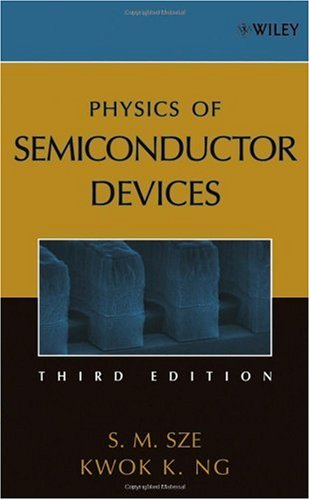
1. Physics of Semiconductor Devices
$22.00
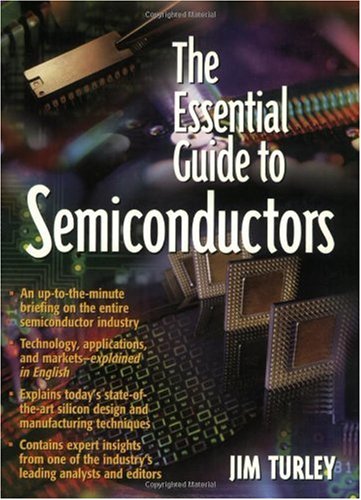
2. The Essential Guide to Semiconductors
$21.41
3. Fundamentals of Semiconductor
$58.78
4. Semiconductor Devices: Physics
$97.98
5. Semiconductor Device Fundamentals
$98.22
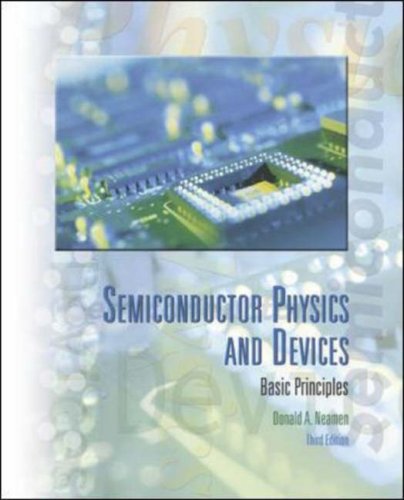
6. Semiconductor Physics And Devices
$64.95
7. Semiconductor Material and Device
$105.00
8. An Introduction to Semiconductor
$120.00
9. Semiconductor Manufacturing Technology
$25.33
10. Semiconductor Fundamentals, Volume
$120.00
11. Handbook of Semiconductor Manufacturing
$11.78
12. Optical Processes in Semiconductors
$42.23
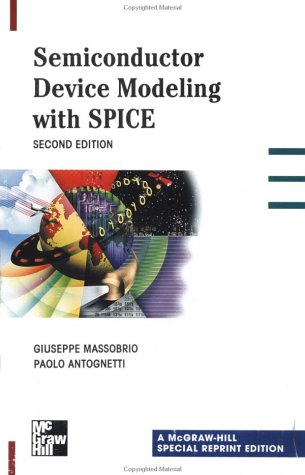
13. Semiconductor Device Modeling
$22.75
14. The Physics of Semiconductors:
$56.98
15. History of Semiconductor Engineering
$51.00
16. Fundamentals of Semiconductors:
$70.00
17. Semiconductor Measurements and
$45.60
18. Electronic and Optoelectronic
$43.50
19. Physics of Semiconductor Devices
$194.99
20. Power Semiconductor Devices: Theory

1. Physics of Semiconductor Devices
by Simon M. Sze, Kwok K. Ng
Hardcover: 815 Pages (2006-10-27)
list price: US$130.00 -- used & new: US$66.98
(price subject to change: see help)
Asin: 0471143235
Average Customer Review: 4.0 out of 5 stars
Canada | United Kingdom | Germany | France | Japan
Editorial Review

Book Description
The Third Edition of the standard textbook and reference in the field of semiconductor devices

This classic book has set the standard for advanced study and reference in the semiconductor device field. Now completely updated and reorganized to reflect the tremendous advances in device concepts and performance, this Third Edition remains the most detailed and exhaustive single source of information on the most important semiconductor devices. It gives readers immediate access to detailed descriptions of the underlying physics and performance characteristics of all major bipolar, field-effect, microwave, photonic, and sensor devices.

Designed for graduate textbook adoptions and reference needs, this new edition includes:

  • A complete update of the latest developments
  • New devices such as three-dimensional MOSFETs, MODFETs, resonant-tunneling diodes, semiconductor sensors, quantum-cascade lasers, single-electron transistors, real-space transfer devices, and more
  • Materials completely reorganized
  • Problem sets at the end of each chapter
  • All figures reproduced at the highest quality

Physics of Semiconductor Devices, Third Edition offers engineers, research scientists, faculty, and students a practical basis for understanding the most important devices in use today and for evaluating future device performance and limitations.

 A Solutions Manual is available from the editorial department.

... Read more

Customer Reviews (11)

4-0 out of 5 stars SZE Physics of semiconductor devices
Excellent reference but should be accompanied with course instruction or a basic introduction to semiconductor physics text. Much of the mathematical details to get to the results presented in the text are as usual, left out.

5-0 out of 5 stars Great fundamentals book
This book had all of the information for a good foundation.It is easy to read.

3-0 out of 5 stars 3rd Ed a good book, but less like Sze, more like Ng...
This is a fairly good book; however, it is more like a 3rd edition of the Complete Guide to Semiconductor Devices by the second author Ng than the expected updated edition of Sze's classic. Many of the figures are the same as in Ng's book, and although more topics are covered than in Sze's 2nd Ed, the theory of what is covered is often less in-depth. This is a nice book to have, especially if you do not have a copy of Ng's book, but I would not get rid of your 2nd edition of Sze yet. I am giving it 3 stars not because it is a bad book, but I truly believe there is a great deal of similarity between this 3rd Ed of Sze and the 2nd Ed of Ng's book, and I feel a little disappointed.

5-0 out of 5 stars still a bible
This book is not for undergrad. But if you want to be a guru, you still find this book very useful.

5-0 out of 5 stars A classic work
If there should at all be one point against this book, then it is that it is a priced high (at least in my country). However I found that the text was worth the investment. This book is one of those must-haves for every electronics engineer.

The text is presented in a way that will appeal to any student as well as working professionals, and the least one can say is that it is extremely well-written. This text is an indispensable one. ... Read more


2. The Essential Guide to Semiconductors (Essential Guide Series)
by Jim Turley
Paperback: 239 Pages (2002-12-29)
list price: US$39.99 -- used & new: US$22.00
(price subject to change: see help)
Asin: 013046404X
Average Customer Review: 4.0 out of 5 stars
Canada | United Kingdom | Germany | France | Japan

Customer Reviews (5)

5-0 out of 5 stars Semiconductors Simplified
Jim Turley's book, The Essential Guide to Semiconductors, is a GREAT read for anyone interested in learning about the building block technologies that power so much of our world. The book offers a truly comprehensive overview of semiconductors, encompassing easy to understand, "byte-sized" technology definitions and interesting chapters regarding the evolution of semiconductor design and manufacturing. Turley also presents interesting big picture perspectives of global market trends, supported by recent data. The reader is guided through the evolution of semiconductor technology, from component parts to integrated circuit technology with relevant concepts explained along the way. What makes the book especially enjoyable is Turley's insider perspective which allows him to make humorous anecdotal observations. All text is well-organized and clearly written. Graphics aid in understanding. Overall, the book offers a solid foundation of knowledge for the non-technical reader and can also be used as an up-to-date refresher course for seasoned practitioners and engineers.

5-0 out of 5 stars Great Book for first time semiconductor lovers
Simple, easy to read and to understand, good pictures at appropriate places to help you visualize the details.

This is a great book for first time semiconductor lovers. The author takes you through a time line of the semiconductor industry and also talks about the industry trends etc. The books talks about semiconductor components and its functions in an "easy to understand" format.

It's a good read especially if you are new to the semiconductor industry and want to get a good understanding of the industry.

1-0 out of 5 stars waste of money
Should be called 'The Coffee Table Overview to the Semiconductor Market'! It talked more about people who make them than how to make them.

It burned well!!

5-0 out of 5 stars WOW - I feel 10 times smarter right now...
This book is a must read for anyone in the technology industry - even a software guy like me found the content and processes explained fascinating!I would also urge anyone investing in public companies like Intel, Sun, etc.... to read this and truly understand what those companies do.There were several points in the book where the author would explain something, and the curious side of my brain would question "hrm, I wonder why it's called that... or how that came to be" - and without fail... the next paragraph of the book knew exactly what my curiosity would be and spelled it out.A HIGHLY RECOMMENDED BOOK!

5-0 out of 5 stars Best book for quickly getting the basics that I am aware of
The title and editorial reviews live up to their billing (with one very minor exception - see below).

As a former CEO of a software company who has been asked to consult to a fabless semiconductor design company, I needed to get up to speed on the basics of semiconductor technology as well as the value chain of the industry.This book provided the technology basics and then related it all to the general business world, something that is important to me as the company is supported by venture capitalists whose focus is both technology and economic success.

The author explains technology concepts in a very readable fashion for the layman.For example, in describing FPGAs, he writes, "Programmable logic chips are like electronic Etch-a-Sketches, ready to use but not really finished.Customers imprint their own design onto them, making their own semicustom chips. . . Like a Etch-a-Sketch, you can erase the chip and start over any time you want, so there's no risk."

This book provides a great overview and starting point.I've searched and bought several books related to the basics of semiconductors and found most of them to be too high-level or too much like a text book with a lot of math exercises.This one delivers what is claimed.In fact, I rated another book 1-star, so my 5-stars for this book indicates an uninflated opinion of its helpfulness to me.

A minor drawback is the editorial review claims it is sufficiently detailed for technical readers.Technical readers who want to understand the business of semicon or aspects outside of their direct field of work will likely find this book valuable, but if they are seeking technical details, there are better books out there.

There are a few things I wish the book covered in more depth, such as more about specific applications that the author believes is going to be hot; however, that is more of a personal preference and I would not downgrade the book on this account.

Finally, this book is part of a library of books in the Essential Guide Series by Prentice Hall.Other titles include Essential Guide: - to XML, - to Storage Area Networks, - to Telecommunications, etc.I will know where to look next time I need overviews on industries I am unfamiliar with. ... Read more


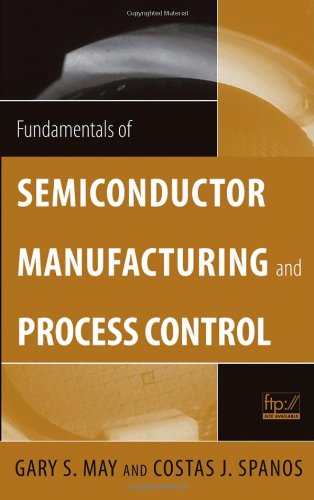
3. Fundamentals of Semiconductor Manufacturing and Process Control
by Gary S. May, Costas J. Spanos
Hardcover: 488 Pages (2006-05-22)
list price: US$84.95 -- used & new: US$21.41
(price subject to change: see help)
Asin: 0471784060
Average Customer Review: 4.0 out of 5 stars
Canada | United Kingdom | Germany | France | Japan
Editorial Review

Book Description
A practical guide to semiconductor manufacturing from process control to yield modeling and experimental design

Fundamentals of Semiconductor Manufacturing and Process Control covers all issues involved in manufacturing microelectronic devices and circuits, including fabrication sequences, process control, experimental design, process modeling, yield modeling, and CIM/CAM systems. Readers are introduced to both the theory and practice of all basic manufacturing concepts.

Following an overview of manufacturing and technology, the text explores process monitoring methods, including those that focus on product wafers and those that focus on the equipment used to produce wafers. Next, the text sets forth some fundamentals of statistics and yield modeling, which set the foundation for a detailed discussion of how statistical process control is used to analyze quality and improve yields.

The discussion of statistical experimental design offers readers a powerful approach for systematically varying controllable process conditions and determining their impact on output parameters that measure quality. The authors introduce process modeling concepts, including several advanced process control topics such as run-by-run, supervisory control, and process and equipment diagnosis.

Critical coverage includes the following:
* Combines process control and semiconductor manufacturing
* Unique treatment of system and software technology and management of overall manufacturing systems
* Chapters include case studies, sample problems, and suggested exercises
* Instructor support includes electronic copies of the figures and an instructor's manual

Graduate-level students and industrial practitioners will benefit from the detailed exami?nation of how electronic materials and supplies are converted into finished integrated circuits and electronic products in a high-volume manufacturing environment.

An Instructor's Manual presenting detailed solutions to all the problems in the book is available from the Wiley editorial department.

An Instructor Support FTP site is also available. ... Read more

Customer Reviews (1)

4-0 out of 5 stars extensive summary of fabs
For those of you working in a fab, or designing processes to be used in it, May gives a good summary of what is generally known and non-proprietary. He explains the key steps in photolithography, wet and dry etching, the different ways to dope, and deposition processes.

But along with these steps, every fab needs to monitor them for quality control. So we get discussions of how to measure data about a wafer. Like using inteferometry or ellipsometry to measure the thickness of a deposited thin film. Or using a four point probe for capacitance or resistance measurements.

A lot of the text also deals with statistics and how to maximise your device yield. Involves numerous modelling choices and process controls. ... Read more


4. Semiconductor Devices: Physics and Technology, 2nd Edition
by Simon M. Sze
Hardcover: 568 Pages (2001-09-07)
list price: US$137.95 -- used & new: US$58.78
(price subject to change: see help)
Asin: 0471333727
Average Customer Review: 3.5 out of 5 stars
Canada | United Kingdom | Germany | France | Japan
Editorial Review

Book Description
This book is an introduction to the physical principles of modern semiconductor devices and their advanced fabrication technology. It begins with a brief historical review of major devices and key technologies and is then divided into three sections: semiconductor material properties, physics of semiconductor devices and processing technology to fabricate these semiconductor devices. ... Read more

Customer Reviews (9)

2-0 out of 5 stars Reference book yes... but thats about it
As a undergrad electrical engineering student I found this book a horrible choice for an introductory level semiconductor class.As another reviewer mentioned, the example problems (the most important part of any textbook) are few and far between.Most of the book is filled with equations and derivations that are overwhelming and confusing.Clearly the author is well versed in the physics of semiconductor devices; however, the presentation of the information leaves any student reader overwhelmed.Maybe this book makes a handy reference, but only after you have been exposed to the material.As for me, I'll be replacing S.M. Sze's "Semiconductor Devices Physics and Technology" 2nd Ed with something that makes more sense for a student.

4-0 out of 5 stars Review
I found it quite good, there are some things better treated in the last version.

4-0 out of 5 stars Nice Book from Dedicated Author
The bible of semiconductor intended for under-/graduate students or as reference for advance scientist is the market of the author. The book consists of basic band gap explanation and carrier transport phenomena going through almost all exploited devices applied nowadays. Beside that, the technology starting form epitaxial growth until the etching mechanism is enclosed here. Moreover, the need of equation derivation is also appended herein since the author tries to explain them in deep.

Some devices,e.g BARITT, TRAPATT are not explained here. The photonic device are coped in a concise clear way including the solar cell.
The presentation and pictures attached here is well depicted and really helps the reader to the understanding of the material completely. Furthermore, this book is also well-suited for crash course for some experienced readers.

4-0 out of 5 stars Excellent Basic Introduction for Engineers
This is a welcome 2nd edition of Sze's basic introduction to the technology underlying modern conventional semiconductor devices. The first edition of 1985 served the needs of its time admirably, but the 17 years since have seen much progress in the field, especially in the area of fabrication technology.

It should be stressed that this text is an introductory text, covering the basics well, but not taking the material much beyond the intermediate level. It is also very much an engineering text rather than a physics text, for the focus is squarely placed on the technology and not the underlying solid-state physics. As such, it is suited to undergraduate electrical/electronic engineers wishing to gain some appreciation of the physics underpinning conventional semiconductor devices, and the way they are fabricated, or for physicists wishing to gain some perspective on the fabrication and operation of the same, but it is in no way a comprehensive textbook on semiconductor physics.

Nevertheless, the material that is presented is well chosen, and well explained. The English prose style is somewhat pedestrian, but this is no great flaw in an engineering textbook. All the essentials of semiconductor materials (almost exclusively Si and GaAs) are described, the p-n junction, as well as the major device types (BJTs, (MOS/MES)FETs, microwave diodes, LEDs, lasers, etc.) and the modern technologies employed for their fabrication. In some senses, the section on fabrication technologies, taking up fully a third of the book, is perhaps its best section, for fabrication is rarely given such emphasis (although, again, not detailed, but covering most salient points) in an introductory book.

The pedagogical method employed by Sze is sound, and relevant worked examples are provided. The only short-coming is perhaps the relative brevity of the end-of-chapter problems, for which no answers are provided, but, in such a textbook, I feel that it is not really necessary to work through them to gain a solid grasp of the material presented.

Physically, the book is much more attractive than the previous edition. The cover is more appealling, and the text is well set in a two-colour print. The diagrams are nothing special, but they are generally clear and explain their point well, and are certainly much improved from the first edition, especially those in the fabrication section.

Just a final comment on other reviews: it is difficult to see how this book may be regarded as a bible of any sort, for the material is covered in quite a superficial manner. I wonder if they are not mistaking it for the 'big Sze', viz., Sze's 'Physics of Semiconductor Devices', which is another, much larger and more comprehensive, work of Sze's.

4-0 out of 5 stars Recommended as a reference book
This is a good book providing the most important references in the field of semiconductors devices and technology. As a text book it is hard to follow and gives little scientific background regarding the physics of processes in semiconductors andstructures design criteria. However, it provides a wonderful summary of the most important facts related to the devices and their derivatives, including valuable data on the common materials in use. ... Read more


5. Semiconductor Device Fundamentals
by Robert F. Pierret
Hardcover: 792 Pages (1996-04-12)
list price: US$139.00 -- used & new: US$97.98
(price subject to change: see help)
Asin: 0201543931
Average Customer Review: 4.5 out of 5 stars
Canada | United Kingdom | Germany | France | Japan

Customer Reviews (19)

5-0 out of 5 stars Good knowledge in semiconductor from the prospective of Physics
This Books provides a good idea in Semiconductor material for Physics Major students and Engineering students. This explains about solid state physics.

Kiran Shrestha
Univ of Massachusetts Boston


5-0 out of 5 stars Very good book
We use it as our textbook for an undergraduate course at Carnegie Mellon University.
This book is fundamental enough. Once you are patient enough to read it, you will get a lot.
It teaches concepts step by step, very good for beginners!

5-0 out of 5 stars Great Semiconductor Book
Reads like a novel.This book teaches semiconductor theory very well.It would be nice if it had some practical realizations of the theory it teaches, but it is overall the best book you will find in introductory semiconductors.

3-0 out of 5 stars 1996
I'm looking for a good reference book, for my PE exam. I bought this, kind of at Random. When I got it I was very dissapointed to see that it was written in 1996... This was written a year after I graduated from high school... Simiconductor devices have changed so much sense then... I hope it is a good book, but I wish I would have got a more recent book.

4-0 out of 5 stars Best Text I've Had
While I maybe be biased in saying this is the best text I've had at a certain school (where the author teaches), I feel this book makes a solid effort at covering the material.The book is organized nicely and the end of chapter questions always relate to the chapter material.

The section right before the questions also helps direct the student to the chapter section pertaining most to the question.It has helped me save time in looking up information!The only thing I would like would be a few more examples.Overall, a well balanced book with adequate conceptual explanation and a fair amount of examples.With this textbook, a good professor (or some determination on your part) and some work, you will do well in a basic semiconductors course. ... Read more


6. Semiconductor Physics And Devices
by Donald Neamen
Hardcover: 768 Pages (2002-08-22)
list price: US$140.00 -- used & new: US$98.22
(price subject to change: see help)
Asin: 0072321075
Average Customer Review: 3.0 out of 5 stars
Canada | United Kingdom | Germany | France | Japan
Editorial Review

Book Description
Neamen's Semiconductor Physics and Devices, Third Edition. deals with the electrical properties and characteristics of semiconductor materials and devices.The goal of this book is to bring together quantum mechanics, the quantum theory of solids, semiconductor material physics, and semiconductor device physics in a clear and understandable way. ... Read more

Customer Reviews (12)

5-0 out of 5 stars Better than the rest
I own five different books on semiconductor physics and this text is by far the best. I've also references a sixth book.

I understand the other reviewers complaints but I think this is a weakness of all semiconductor books or proof of just how complicated device physics can get.

It helps to have an instructor step you through a lot of the derivations to make you understand the equations.

I like this book because it explains concepts very well. Making use of the equations and knowing when to make assumptions just comes with practice.

I've found a few mistakes but far fewer than some of the other books I've seen.

My advice to students studying semiconductors is to go to the library and get as many books as you can.

1-0 out of 5 stars Mediocre book; needs major overhaul
Assuming you have already read the previous (rather low) reviews on here, my own review may seem like overkill, but I feel that I must express just how bad Neamen's book is at explaining the material.

Most other reviewers have already covered the important points, so I'll just develop on two that I find particularly unsettling (after wasting several hours trying to see how the author arrived at the solution for ONE problem in his book):How is anyone supposed to figure out the many assumptions this guy makes when he makes no mention of them anywhere else?Also, how is anyone supposed to know what equations to use in what problems?

So far I've found that all the answers in the back of the book have been correct, however the problem is that the reader has to first figure out what equation(s) to use, which is why I'd imagine that many readers believe the answers to be incorrect.In terms of what the author explains, there are (presumably) several ways of obtaining the same answer, but for some reason this is not the case, given that your answer will often be different depending on what equation you use.Assuming the author is even correct in using the formulas he uses, he offers no explanation as to why one equation should be used in one situation but not in another.

Also, this book makes entirely too many assumptions and offers no explanation as to where they come from.Case in point:Problem 1 of Chapter 5 asks the reader to determine the drift current density in a semiconductor material under a certain set of conditions.Well, this is all fine and dandy, except for the fact that the author provides an in-book example IDENTICAL to the problem in which the answer is DIFFERENT.So why do the example and problem answers differ?Because Neamen (in the problem)apparently arbitrarily assumed a different value for electron mobility in said semiconductor material, yet he did not not explain why this different value was assumed in the first place, nor did he offer any clear explanation as to how to determine the supposedly correct electron mobility.

In summary, this book would be somewhat decent if the author spent more time explaining the material more clearly.As it stands, there are simply too many assumptions made and too few explanations for them, making this book a very poor source of information.

1-0 out of 5 stars Awful
Worst book I have come across in my college career. My only D EVER is from a professor that tried to follow this book. Many of his printed solutions to the problems in this book are vague with "Trial and Error" that yield no reasoning to how the problems should be solved.

It would take an excellent professor to make sense of Donald Neamen's, incomplete at best, work. If you don't want to take the word of the many posts of dislike for this book please feel free to read portions for yourself. And please try the wonderful incomplete problems (4 unknowns with 2 equations for example on Problem 4.4).

2-0 out of 5 stars A Little Detail Please
This is used for an upper division intro to semi's class at the Univ of MN-Duluth
This book is at best a poor text, but more likely it would be better with a reference book that actually went over the material, and used this as an overview.
I like what other students say about the answers in the back, "If you get that answer, you know your wrong."
Either the author doesn't really want the student to know how to do the material inside, wants an instructor to figure it out and teach it, or just doesn't care.
A poor purchase at 10% of the price.

1-0 out of 5 stars Third semester of crap and counting...
I had the misfortune of using his Electronic Circuit Analysis book my sophomore year.I'm impressed - he's actually managed to write a book that is more worthless!The examples are poor and few and definitions of symbols and constants was almost nonexistent.Get yourself some note cards or you're going to lose hours of your life flipping through this waste of paper. ... Read more


7. Semiconductor Material and Device Characterization
by Dieter K. Schroder
Hardcover: 800 Pages (2006-01-30)
list price: US$137.50 -- used & new: US$64.95
(price subject to change: see help)
Asin: 0471739065
Average Customer Review: 5.0 out of 5 stars
Canada | United Kingdom | Germany | France | Japan
Editorial Review

Book Description
This Third Edition updates a landmark text with the latest findings

The Third Edition of the internationally lauded Semiconductor Material and Device Characterization brings the text fully up-to-date with the latest developments in the field and includes new pedagogical tools to assist readers. Not only does the Third Edition set forth all the latest measurement techniques, but it also examines new interpretations and new applications of existing techniques.

Semiconductor Material and Device Characterization remains the sole text dedicated to characterization techniques for measuring semiconductor materials and devices. Coverage includes the full range of electrical and optical characterization methods, including the more specialized chemical and physical techniques. Readers familiar with the previous two editions will discover a thoroughly revised and updated Third Edition, including:

  • Updated and revised figures and examples reflecting the most current data and information
  • 260 new references offering access to the latest research and discussions in specialized topics
  • New problems and review questions at the end of each chapter to test readers' understanding of the material

In addition, readers will find fully updated and revised sections in each chapter.

Plus, two new chapters have been added:

  • Charge-Based and Probe Characterization introduces charge-based measurement and Kelvin probes. This chapter also examines probe-based measurements, including scanning capacitance, scanning Kelvin force, scanning spreading resistance, and ballistic electron emission microscopy.
  • Reliability and Failure Analysis examines failure times and distribution functions, and discusses electromigration, hot carriers, gate oxide integrity, negative bias temperature instability, stress-induced leakage current, and electrostatic discharge.

Written by an internationally recognized authority in the field, Semiconductor Material and Device Characterization remains essential reading for graduate students as well as for professionals working in the field of semiconductor devices and materials.

An Instructor's Manual presenting detailed solutions to all the problems in the book is available from the Wiley editorial department. ... Read more

Customer Reviews (3)

5-0 out of 5 stars Essential text
This is an essential text for engineers, scientists, and graduate students working in the semiconductor field.It contains a thorough review of all major electrical, optical, and physical characterization methods that are commonly used.Descriptions of techniques are generally conceptually oriented, clearly stated, and do not rely excessively on equations.In addition, many useful figures are included to help explain concepts when introduced.Up to date references are included for essentially every technique mentioned.

5-0 out of 5 stars Great reference
Schroder has compiled an extensive and very nearly complete guide to modern characterization techniques that apply mostly to semiconductors and solid state devices, but also to techniques used in general materials analysis.We used this text in a graduate level course in EE and found it easy to read through and concise for use as a quick reference.Well worth the money.

5-0 out of 5 stars Semiconductor Material and Device Characterization
This book offers an outstanding review of various techniques of semiconductor device processing.It is the type of book that is an invaluable reference to the device engineer.It's breadth is outstanding. ... Read more


8. An Introduction to Semiconductor Devices
by Donald Neamen
Hardcover: 720 Pages (2005-01-06)
list price: US$140.00 -- used & new: US$105.00
(price subject to change: see help)
Asin: 0072987561
Average Customer Review: 4.0 out of 5 stars
Canada | United Kingdom | Germany | France | Japan
Editorial Review

Book Description
An Introduction to Semiconductor Devices by Donald Neamen provides an understanding of the characteristics, operations and limitations of semiconductor devices.In order to provide this understanding, the book brings together the fundamental physics of the semiconductor material and the semiconductor device physics.

This new text provides an accessible and modern presentation of material.Quantum mechanic material is minimal, and the most advanced material is designated with an icon.This modern approach meands that coverage of the MOS transistor preceeds the material on the bipolar transitor, which reflects the dominance of MOS technology in today's world.

Excellent pedagogy is present throughout the book in the form of interesting chapters openers, worked examples, a variety of exercises, key terms, and end of chapter problems. ... Read more

Customer Reviews (1)

4-0 out of 5 stars no/little quantum mechanics needed
The book is an up to date introduction to the understanding of current semiconductor devices and their manufacture. Perhaps the best sign of this is the correct emphasis on describing the Metal Oxide Semiconductor (MOS) circuitry. Older texts go into more detail about bipolar technology - the Ebers-Moll model for an npn transistor and all that. But for over 10 years, MOS has been the dominant technology and students should concentrate on getting a clear understanding of it from the book.

There is still a description of bipolar, and of the bipolar-MOS amalgam.

The device physics of junctions and single transistors is competently done. The book is designed for a student who has had an undergraduate course in classical physics, but who perhaps hasnever seen quantum mechanics before. So devices that exhibit pure quantum behaviour, like Esaki/tunnel diodes aren't really gone into. ... Read more


9. Semiconductor Manufacturing Technology
by Michael Quirk, Julian Serda
Paperback: 624 Pages (2000-12-15)
list price: US$139.40 -- used & new: US$120.00
(price subject to change: see help)
Asin: 0130815209
Average Customer Review: 5.0 out of 5 stars
Canada | United Kingdom | Germany | France | Japan

Customer Reviews (9)

5-0 out of 5 stars Semiconductor Manufacturing Technology
Nice book.It helped with my understanding of nano technology.Best if used in conjunction with a class requiring it so the teacher can explain some of the processes better than the book because it is vague on some concepts.

5-0 out of 5 stars Yes, the Best
I feel the authors have accomplished exactly their stated intent.I have used this text as a Fab Manager to train technicians new and old, and I have used it in academia to instruct students.It is superbly presented and easy for ANYONE to understand.It is worth purchasing for the glossary alone which is an excellent tool in helping the un-indoctrinated sift through the tons of jargon associated with this technology.This book is not for in-depth study of the subjects covered- it just explains the basics very well.

5-0 out of 5 stars Best textbook on the market.
This book is well worth the price if you are looking for an understanding of how semiconductors are made.Although it would be useful to have an engineering degree in order to understand all of it, it isn't necessary.The first couple of pages in each chapter are easy to read and as you gain knowlegde, the book simply expands for you.If I have a complaint, it would be that the book doesn't fit easily in my briefcase!

5-0 out of 5 stars Buy this book
I am non-technical person in the financial community and have used this text as a resource on a regular basis. I have found it very accessible despite the fact that I have no engineering degree. I recommend this book to any reader who wants a detailed summary of semiconductor manufacturing from wafer fabrication to packaging and test.

5-0 out of 5 stars A Very Good Book
This is an excellent technicians-level text for students training for jobs in the semiconductor industry. The book covers the full range of topics important to the industry, from semiconductor materials to assembly and packaging.

I especially like the format the authors have selected to present such a wide range of technical material. Each chapter begins by clearly stating the chapter's learning objectives, and then proceeds to present the relevant concepts in a clear and lucid fashion that are easy for the student to understand. In addition, the text is profusely illustrated with several hundred high quality black and white drawings that enhance the comprehension of the material presented in the accompanying text.

Finally, each chapter ends with a list of key terms presented in the chapter, exercises for the student, as well as references and URL's for further research.

This is a beautiful book, and is ideal for students at the technician level, or for management personnel who want to learn more about the technology of semiconductor manufacturing. Until something better comes along to replace it, this book will remain the standard in its class. ... Read more


10. Semiconductor Fundamentals, Volume I (2nd Edition)
by Robert F. Pierret
Paperback: 160 Pages (1988-01-11)
list price: US$29.20 -- used & new: US$25.33
(price subject to change: see help)
Asin: 0201122952
Average Customer Review: 4.0 out of 5 stars
Canada | United Kingdom | Germany | France | Japan

Customer Reviews (3)

4-0 out of 5 stars Clear, but why so many modules ?
I've used the first 6 volumes of this series to give a
course in semiconductor device physics, and found the text
really well done, I could allmost give the material verbatim
to the students (except for some calculations where some
more additional steps needed to enlighten some of them).
Most of the basic aspects of semiconductor physics, having
an impact on the practical characteristics of real devices
are treated and follow logically from the theory that is
exposed in the volumes.
The only thing that I found strange is: why so many small
modules, which are anyway interdependent ?Wouldn't one
decent book have been a better idea ?

3-0 out of 5 stars a good book for start
I am a lecturer of semiconductors.my students found this book very suitable. in iran this book is translated in farsi by Dr.Moravej Farshi.

5-0 out of 5 stars Very Good Book
I really enjoyed reading the book and found it very well written and easy to understand. ... Read more


11. Handbook of Semiconductor Manufacturing Technology, Second Edition
Hardcover: 1720 Pages (2007-07-09)
list price: US$149.95 -- used & new: US$120.00
(price subject to change: see help)
Asin: 1574446754
Average Customer Review: 4.0 out of 5 stars
Canada | United Kingdom | Germany | France | Japan
Editorial Review

Book Description
Retaining the comprehensive and in-depth approach that cemented the bestselling first edition's place as a standard reference in the field, the Handbook of Semiconductor Manufacturing Technology, Second Edition features new and updated material that keeps it at the vanguard of today's most dynamic and rapidly growing field. Iconic experts Robert Doering and Yoshio Nishi have again assembled a team of the world's leading specialists in every area of semiconductor manufacturing to provide the most reliable, authoritative, and industry-leading information available.Stay Current with the Latest Technologies In addition to updates to nearly every existing chapter, this edition features five entirely new contributions on · Silicon-on-insulator (SOI) materials and devices · Supercritical CO2 in semiconductor cleaning · Low-κ dielectrics · Atomic-layer deposition · Damascene copper electroplating · Effects of terrestrial radiation on integrated circuits (ICs)Reflecting rapid progress in many areas, several chapters were heavily revised and updated, and in some cases, rewritten to reflect rapid advances in such areas as interconnect technologies, gate dielectrics, photomask fabrication, IC packaging, and 300 mm wafer fabrication.While no book can be up-to-the-minute with the advances in the semiconductor field, the Handbook of Semiconductor Manufacturing Technology keeps the most important data, methods, tools, and techniques close at hand. ... Read more

Customer Reviews (2)

4-0 out of 5 stars Get this handbook! Nothing will ever come close to it.
I'm new to the semiconductor manufacturing business. Getting this book is definitely the right thing I've done. This book provides all the things i wanted to know about semiconductor manufacturing. With over 1100 pages, this book is hard to resist. It covers almost all the technology required for making semiconductor IC. Even though it does not give much details, but the coverage of the topic is sufficient. In addition, the generousity of the authors to provide ample references at the end of each chapter is amazing. One will have plenty of time to search through the references for further info. I suggest that people who are in the semiconductor manufacturing field to get their hands on it. One thing that can be improved regarding to the presentation of this handbook, is the way the diagrams are displayed. Maybe the publisher should consider printing them in glossy paper as some diagrams looks very poor as if they just come out from the photocopy machine.

4-0 out of 5 stars Get this handbook! Nothing will ever come close to it.
I'm new to the semiconductor manufacturing business. Getting this book is definitely the right thing I've done. This book provides all the things i wanted to know about semiconductor manufacturing. With over 1100 pages, this book is hard to resist. It covers almost all the technology required for making semiconductor IC. Even though it does not give much details, but the coverage of the topic is sufficient. In addition, the generousity of the authors to provide ample references at the end of each chapter is amazing. One will have plenty of time to search through the references for further info. I suggest that people who are in the semiconductor manufacturing field to get their hands on it. One thing that can be improved regarding to the presentation of this handbook, is the way the diagrams are displayed. Maybe the publisher should consider printing them in glossy paper as some diagrams looks very poor as if they just come out from the photocopy machine. ... Read more


12. Optical Processes in Semiconductors
by Jacques I. Pankove
Paperback: 428 Pages (1975-06-01)
list price: US$18.95 -- used & new: US$11.78
(price subject to change: see help)
Asin: 0486602753
Average Customer Review: 5.0 out of 5 stars
Canada | United Kingdom | Germany | France | Japan
Editorial Review

Book Description

This comprehensive textbook and reference covers all phenomena involving light in semiconductors, emphasizing modern applications in semiconductor lasers, electroluminescence, photodetectors, photoconductors, photoemitters, polarization effects, absorption spectroscopy, radiative transfers and reflectance modulatons. With numerous problems. 339 illustrations.
... Read more

Customer Reviews (2)

5-0 out of 5 stars Reveals basic secrets of semiconductors :)
This book for me is a "book of revealing semiconductor secrets" which includes good in-depth details of fundamental semiconductors that majority of semiconductor books, published in last 10-15 years do not include. Since it was written over 30 years or so back, it includes basic stuff, which is whatyour advisor or lecturer at university "expects" you to know or understand without a problem (of course in reality nothing is easy unless one knows about it and this book, I feel, does provides those basic answers :o)

5-0 out of 5 stars Easy to understand its discussion
A very elegant, eloquent text on its subject. Explains the major physical processes very clearly, without drowning you in tons of mathematics. The sheer clarity of Pankove's exposition is the greatest appeal of this book. After reading this, you may wish to go onto heftier tomes that delve into greater detail. But consider starting here.

While the text dates from 1976, its explanations of optical phenomena are still valid. Don't consider it outdated. ... Read more


13. Semiconductor Device Modeling
by Giuseppe Massobrio, Paolo Antognetti
Paperback: 479 Pages (1998-12-01)
list price: US$60.00 -- used & new: US$42.23
(price subject to change: see help)
Asin: 0071349553
Average Customer Review: 4.0 out of 5 stars
Canada | United Kingdom | Germany | France | Japan
Editorial Review

Book Description
With all the clarity and hands-on practicality of the best-selling first edition, this revised version explains the ins and outs of SPICE, plus gives new data on modeling advanced devices such as MESFETs, ISFETs, and thyristors. And because it's the only book that describes the models themselves, it helps readers gain maximum value from SPICE, rather than just telling them how to run the program. This guide is also distinctive in covering both MOS and FET models. Step by step, it takes the reader through the modeling process, providing complete information on a variety of semiconductor devices for designing specific circuit applications. These include: Pn junction and Schottky diodes; bipolar junction transistor (BJT); junction field effect transistor (JFET); metal oxide semiconductor transistor (MOST); metal semiconductor field effect transistor (MESFET); ion sensitive field effect transistor (ISFET); semiconductor controlled rectifier (SCR-thyristor). ... Read more

Customer Reviews (1)

4-0 out of 5 stars A helpful book to understand semiconductor model
Spice is a software package that become a de facto standar in circuit simulation. But as in any other circuit simulator we need to define the accurate input model to get the accurate results. And this book describe inmore detail the components that is used in almost any electronic circuit,i.e. semiconductor devices.The value that is a credit point for this bookisnot just how detail the description of the semiconductor model is inorder to get the accurate parameters but also how to use those parametersin Spice. So, for you who new to this circuit simulator there is no need toworry because this book explain how the circuit model is built using Spice.And for you who need the basic theory of semiconductor model the book givestwo nice appendices on that one. One chapter that is need to be explored inmore detail is about noise and distortion (hopefully in the next editionthe editor could have more on that topic). Finally, this is a "must beread" book for you who want to get excellent results in modellingelectronic circuit.

(For you who understand more clearly in Indonesian)Spice adalah sebuah paket aplikasi yang secara defacto merupakan standaruntuk simulai dan analisa rangkaian elektronik. Namun secara umum berlakupula bahwa untuk menghasilkan simulasi rangkaian elektronik secara akuratdibutuhkan parameter-parameter yang akurat pula untuk setiap modelnya. Bukuini memberikan ulasan mendalam tentang parameter-parameter bagi pemodelandevice semikonduktor. Kelebihan yang dimiliki buku ini tidak hanya padabagaimana penghitungan dan pengukuran parameter untuk model tersebut tetapibagaimana menggunakannya pada simulasi rangkaian menggunakan SPICE. BagiAnda yang baru mendalami spice jangan khawatir karena buku ini jugamemberikan ulasan tentang sistem pemodelan dalam spice. Sebaliknya bagianda yang baru dalam pemodelan semikonduktor buku ini juga memberikanapendiks tentang teori dasar semikonduktor. Satu hal yang mungkin perludibahas lebih mendalam adalah tentang Nose dan Distorsi (mudah-mudahandalam edisi berikutnya materi ini dapat lebih dikembangkan). Kesimpulannya,buku ini merupakan suatu buku yang wajib dibaca bila anda ingin lebihakurat dalam menjalankan simulasi rangkaian elektronik yang menggunakansemikonduktor. ... Read more


14. The Physics of Semiconductors: An Introduction Including Devices and Nanophysics
by Marius Grundmann
Hardcover: 689 Pages (2006-05-22)
list price: US$89.95 -- used & new: US$22.75
(price subject to change: see help)
Asin: 354025370X
Average Customer Review: 5.0 out of 5 stars
Canada | United Kingdom | Germany | France | Japan
Editorial Review

Book Description

The Physics of Semiconductors provides material for a comprehensive upper-level-undergraduate and graduate course on the subject, guiding readers to the point where they can choose a special topic and begin supervised research. The textbook provides a balance between essential aspects of solid-state and semiconductor physics, on the one hand, and the principles of various semiconductor devices and their applications in electronic and photonic devices, on the other. It highlights many practical aspects of semiconductors such as alloys, strain, heterostructures, nanostructures, that are necessary in modern semiconductor research but typically omitted in textbooks. For the interested reader some additional advanced topics are included, such as Bragg mirrors, resonators, polarized and magnetic semiconductors are included. Also supplied are explicit formulas for many results, to support better understanding. The Physics of Semiconductors requires little or no prior knowledge of solid-state physics and evolved from a highy regarded two-semester course at the University of Leipzig.

... Read more

Customer Reviews (1)

5-0 out of 5 stars Nice survey of modern semiconductor science
This book is extremely well illustrated. It is a pleasure thumbing through the book and learning something in a new area just by looking at all the diagrams and pictures. However, the discussions of semiconductor devices are pretty sketchy, and formula derivations are mostly non-existent. For example, the book gives expressions for the different mobility limits for ionized impurity and phonon scattering, but does not derive any of them like Seeger would, although references are given. Unlike the Seeger classic, in its 9th edition, where new topics kind of look like they were just thrown in, this book has a more coherent integrated treatment of "new" topics with the older classical topics. If you want in-depth discussions, you will likely be disappointed. However, if you are looking for a broad survey of modern areas of interest in semiconductor physics and technology, with lots of well-chosen figures and diagrams, this is a fine book. ... Read more


15. History of Semiconductor Engineering
by Bo Lojek
Hardcover: 387 Pages (2006-12-28)
list price: US$79.95 -- used & new: US$56.98
(price subject to change: see help)
Asin: 3540342575
Average Customer Review: 4.5 out of 5 stars
Canada | United Kingdom | Germany | France | Japan
Editorial Review

Book Description

When basic researchers started working on semiconductors during the late nineteen thirties and on integrated circuits at the end of the nineteen fifties, they did not know that their work would change the lives of future generations. Very few people at that time recognized the significance of, perhaps, the most important invention of the century. Historians have assigned the invention of integrated circuits to Jack Kilby and Robert Noyce. In this book, the author argues that the group of inventors was much larger. This richly illustrated account is a personal recollection of the development of integrated circuits and personalitiessuch as Russell Ohl, Karl Lark-Horovitz, William Shockley, Carl Frosch, Lincoln Derick, Calvin Fuller, Kurt Lehovec. Jean Hoerni, Sheldon Roberts, Jay Last, Isy Haas, Bob Norman, Dave Allison, Jim Nall, Tom Longo, Bob Widlar, Dave Talbert, Frank Wanlass, and Federico Faggin. Here is the first comprehensive behind-the-scenes account of the history of the integrated circuit, the microelectronics industry, and the people closely involved in the development of the transistor and the integrated circuit.


"Your book is going to make a major contribution to semiconductor history. You and I agree that, while the world loves a hero, semiconductor progress depended on the efforts and ideas of a large number of people, and that moving forward depended on contributors going back a few decades in some cases. Also, as is the case with most inventions, a number of people with access to the same pool of common knowledge were working independently at the same time to put it all together and to make the necessary extensions to the existing technology and who realized that the time was right for society to accept the new concepts. Your diligent research points all of this out."

Dr. Jay Last, Former Shockley Laboratories employee, co-founder of Fairchild Semiconductor, co-founder of Amelco Semiconductor, and manager of Fairchilds group which designed and produced the world first planar integrated circuit.

"Bo Lojek presents a remarkable document of the most important and significant technical development of our times. He describes in astounding detail the engineering efforts of modern microelectronics. He concentrates on the history of silicon semiconductor devices. Californias "Silicon Valley" is the center of attention, together with its ancestry of transistor invention at Bell Laboratories. He has collected a wealth of illustrative documentation, gives incisive insight into the lives of the main actors and shows the often tragic fates of the engineers and businessmen. He does not hide his firm belief in the individual engineer and warns of the retarding influence of present-day political correctness."

Dr. Hans J. Queisser, Former Shockley Semiconductor scientist and retired director of the Max-Planck-Institute for Solids, Stuttgart, Germany.

"The technical history of the semiconductor history rivals the 1849 California Gold Rush as a period filled with excitement and opportunity. Although I cannot first hand validate its complete accuracy, I enthusiastically encourage you to read the collected facts, opinions, and views of an author who was actually part of this amazing period, viewing it as a successful practicing Engineer during this "gold rush" - like hey-day of the semiconductor industry.

For educators and technologists you will find this collection of data, facts, and opinions, collected and observed first hand by the author, fascinating! It is a tough read for others due to the writing experience of the author and its technical focus."

John F. Gifford, Former Fairchild Semiconductor Marketing Manager of Linear Integrated Circuits, co-founder of Advanced Micro Devices, and President and Chief Executive Officer of Maxim Integrated Products.

"Bo Lojek gets it right! There are few industries as dynamic as semiconductors and the history of the semiconductor industry is still unfolding. This book gives the history of people, places and technology that resulted in todays semiconductor industry. I particularly like the inclusion of many technical pieces in the book."

Robert Dobkin, Former National Semiconductor Director of Advanced Circuit Development and co-founder and Chief Technical Officer of Linear Technology Corporation.

... Read more

Customer Reviews (3)

4-0 out of 5 stars Complete history, if not a little biased
I am a graduate student specializing in IC Design. I must say this is an interesting read. The narrative can be a little bit dry, with a lot of names, dates, etc that does not necessarily enhance the storyline in any bit, but just making the book more historically complete. It is a pleasure to read for a practicing engineer like myself, but it can be a very alien book for even an electrical engineer who does not do board/chip design on a regular basis. The author simply assumes that the reader is familiar with all the popular product lines from companies like national and linear, etc - this can be a serious impediment for this book to get a wider acceptance.

The voice of the author tends to fall into the "Dilbert" stereotype, in a way venerating the eccentric but extremely smart engineers (like Shockley and others) while demonizing management-types (like Gordon Moore). I feel that the author went a little bit too far with his point that these broken geniuses are the one responsible for the success of the semiconductor industries and the management types took advantage of them. For a young buck like myself, I don't know if this is true or not. But this rather extreme viewpoint of the author certainly cast a shadow upon the objectivity of the author's account as a historian.

But overall, this is still a good read for practicing circuit designers. It certainly got good endorsements from the industry big names

4-0 out of 5 stars Interesting but needs extra editing
I loved reading this book. It sketches the history of semiconductor engineering with a focus on the American part of it.
It is well written but really needs extra editing or proof reading as the author has a strange way to deal with the (definite and undefinite) article and also sometimes with verbs in the English language. I'll give you two examples (but you can find them in abundance):
on page X he writes:
I wrote book about engineers (sic)
On p.8
This book is my personal story and it is story about engineers ... (sic)

I also would have loved to read a bit more about cupper oxide, selenium and galena components which preceded the semiconductor revolution which the author describes.

Some illustrations are also very hard to decipher (e.g. Fig. 1.1.)

All this doesn't mean it isn't a good read, on the contrary, it is one of finest books I have read since long.

5-0 out of 5 stars Bo's Great Book
This is a rare work of excellence almost without equal in the huge geek/chip literature. If you don't own it, you will regret it! I was there when it all happened and Bo has it RIGHT ON! ... Read more


16. Fundamentals of Semiconductors: Physics and Materials Properties
by Peter Y. Yu, Manuel Cardona
Hardcover: 639 Pages (2005-05-31)
list price: US$69.95 -- used & new: US$51.00
(price subject to change: see help)
Asin: 3540254706
Average Customer Review: 5.0 out of 5 stars
Canada | United Kingdom | Germany | France | Japan
Editorial Review

Book Description
This third updated edition of Fundamentals of Semiconductors attempts to fill the gap between a general solid-state physics textbook and research articles by providing detailed explanations of the electronic, vibrational, transport, and optical properties of semiconductors. The approach is physical and intuitive rather than formal and pedantic. Theories are presented to explain experimental results. This textbook has been written with both students and researchers in mind. Its emphasis is on understanding the physical properties of Si and similar tetrahedrally coordinated semiconductors. The explanations are based on physical insights. Each chapter is enriched by an extensive collection of tables of material parameters, figures, and problems. Many of these problems "lead the student by the hand" to arrive at the results. ... Read more

Customer Reviews (4)

5-0 out of 5 stars The best book in the market
This book is an excellent reference book on semiconductors in general. The physics behind semiconductor theory is discussed very well, however, if you are looking for a book regarding semiconductor devices or electronics, this is not what you are looking for.

One advantage of this book is that it contains a fairly large section for "group theory", if you are using it in your studies.

Electronic, transport and especially optical properties of semiconductors are mentioned very extensively and clearly. There is also a whole chapter on photoemission, which is very useful. The concept of quantum confinement is addressed independently with illustrative examples.

If you are interested in semiconductors and want to buy "one" book which you can use and consult all the time, this is the book you need. The authors are some of the best in the World on semiconductors.

5-0 out of 5 stars Best book on semiconductor PHYSICS
I'm a Ph.D on physics, I read this book from page to page and worked out the problems.
This is an excellent book on the physics of semiconductors, NOT on semiconductor devices! The text is well written. The physical concept is clearly explained, mostly with a diagram or a graph. The formulae are carefully deducted without wasting too much time and space. I must add a few words on the problems. From all the physics textbooks I've read, only Claude Cohen-Tannoudji's Quantum Mechanics book is comparable. Those problems usually are about the the formulae, such as k.p. perturbation method and Luttinger Hamiltonian, etc., appeared in the main text but its detail is not appropriate there. The problems are by no means easy. Actually, some of them are really hard. For example, it took me a lot of time to work out the 6 by 6 k.p. perturbation matrix! In the process of working out those problems, I had a better understanding on the computational physics. You don't see that in a normal textbook!

The references are the classical or landstone papers about a specific subject, very good for further research.

In summary, this is an excellent textbook, if you want to study it hard.

5-0 out of 5 stars 3rd edition
The third edition is already available. The second is OUT OF PRINT. ENTRY SHOULD BE UPDATED

5-0 out of 5 stars Excellent balance of breadth and depth
This is an excellent book on all properties of semiconductors -electronic structure , phonons , transport and optics . It primarilyfocusses on bulk properties ,but extremely succinct and relevant comments on hetersotructures can also be found interspersed throughout .

Many books on semiconductor physics err on the side of breadth at the expense of depth . I found this book to be a pleasant exception . I believe this leaves other similar books like Physics of Semiconductors and their Heterostructures by J.Singh far behind .

Cardona (of course) is at his best when discussing otical properties , especially optical diagnostic methods . I have not seen a similar book at this level which gives the same level of description of light-matter interaction in semiconductors.

I recommend it highly to all fellow graduate students . ... Read more


17. Semiconductor Measurements and Instrumentation
by W. R. Runyan, T. J. Shaffner
Hardcover: 454 Pages (1998-02-01)
list price: US$70.00 -- used & new: US$70.00
(price subject to change: see help)
Asin: 0070576971
Average Customer Review: 4.0 out of 5 stars
Canada | United Kingdom | Germany | France | Japan
Editorial Review

Book Description
The definitive reference on semiconductor characterization tools! Here, in one well-organized volume, are detailed explanations of the advanced and "traditional") techniques for evaluating virtually every criterion: crystal defects, impurity concentration, lifetime, film thickness, resistivity, and such critical electrical properties as mobility, Hall effect, and conductivity type. Reliable, high-accuracy methods of measuring hardness, stress, and various kinds of surface contamination are also included. In addition to its value as a practical everyday reference, the text also serves as an excellent user's guide to the latest methods of optical microscopy, scanning electron microscopy (SEM), electron microprobe analysis, transmission electron microscopy (TEM), Auger electron spectroscopy (AES), scanning probe microscopy (SPM), and secondary ion mass spectrometry (SIMS). This is the only guide that offers such "dual coverage" of its topic -- in terms of both measurements and tools. ... Read more

Customer Reviews (1)

4-0 out of 5 stars useful variety of instruments and measurements
Don't be put off by the fact that the book was written in 1998. While Moore's Law is still ongoing in the semiconductor industry, much of the book's material is quite up to date. The measurement techniques are mostly fundamental. Runyan describes the many different properties of a semiconductor chip and how you can measure these. This is then related to how best the chip can be characterised. Or, in some cases, a given circuit.

Accompanying this is a natural complementary description of a variety of instruments. So the ideas behind such devices as a TEM or an SEM are explained. The quantum mechanical aspect of some of the measurements is gone into only slightly. Mostly directed at the experimentalist. ... Read more


18. Electronic and Optoelectronic Properties of Semiconductor Structures
by Jasprit Singh
Paperback: 556 Pages (2007-03-26)
list price: US$60.00 -- used & new: US$45.60
(price subject to change: see help)
Asin: 0521035740
Canada | United Kingdom | Germany | France | Japan
Editorial Review

Book Description
Jasprit Singh presents the underlying physics behind devices that drive today's technologies, utilizing carefully chosen solved examples to convey important concepts. Real-world applications are highlighted throughout the book, stressing the links between physical principles and actual devices. The volume provides engineering and physics students and professionals with complete coverage of key modern semiconductor concepts. A solutions manual and set of viewgraphs for use in lectures is available for instructors, from solutions@cambridge.org.Download Description
A graduate textbook presenting the underlying physics behind devices that drive today's technologies. The book covers important details of structural properties, bandstructure, transport, optical and magnetic properties of semiconductor structures. Effects of low-dimensional physics and strain - two important driving forces in modern device technology - are also discussed. In addition to conventional semiconductor physics the book discusses self-assembled structures, mesoscopic structures and the developing field of spintronics. The book utilizes carefully chosen solved examples to convey important concepts and has over 250 figures and 200 homework exercises. Real-world applications are highlighted throughout the book, stressing the links between physical principles and actual devices. Electronic and Optoelectronic Properties of Semiconductor Structures provides engineering and physics students and practitioners with complete and coherent coverage of key modern semiconductor concepts. A solutions manual and set of viewgraphs for use in lectures are available for instructors, from solutions@cambridge.org. ... Read more


19. Physics of Semiconductor Devices
by J.-P. Colinge, C.A. Colinge
Paperback: 436 Pages (2005-10-03)
list price: US$79.95 -- used & new: US$43.50
(price subject to change: see help)
Asin: 0387285237
Average Customer Review: 3.0 out of 5 stars
Canada | United Kingdom | Germany | France | Japan
Editorial Review

Book Description
Physics of Semiconductor Devices covers both basic classic topics such as energy band theory and the gradual-channel model of the MOSFET as well as advanced concepts and devices such as MOSFET short-channel effects, low-dimensional devices and single-electron transistors. Concepts are introduced to the reader in a simple way, often using comparisons to everyday-life experiences such as simple fluid mechanics. They are then explained in depth and mathematical developments are fully described.
Physics of Semiconductor Devices contains a list of problems that can be used as homework assignments or can be solved in class to exemplify the theory. Many of these problems make use of Matlab and are aimed at illustrating theoretical concepts in a graphical manner. ... Read more

Customer Reviews (5)

5-0 out of 5 stars Very good!!
This book is very good! Both for beginners readers as for readers who are seeking more knowledge in physics of semiconductors. I particularly like much of the didactic Colinge. Recommended!

4-0 out of 5 stars Useful study text
If your aim is to review the main concepts and refresh your memory of semiconductor devices this book is excellent. Not a book for beginners in the area as it is heavy on equations but the main concepts are dealt with clearly and the many illustrations are quite helpful.

1-0 out of 5 stars Stay away!
This is terrible text.I am currently studying for a midterm and there are no examples and the authors write at a level that would not be acceptable for high school.The material is hard enough, but this book makes understanding it just that much more difficult.I hope the only schools that actually use this text are the two where the authors teach.I bet the good review was left by one of the authors.

1-0 out of 5 stars Not enough examples
Okay, maybe I'm just dumb, but this book barely has any examples besides the few problems at the end of each chapter. The book is full of equations and not enough explanation. I would not recommend taking this class or buying this book. Of course, if you're an EE student at UC Davis, this class (EEC140A) is required. So, tough luck. All I can tell you is... don't slack off. Attend the lectures, and don't fall behind. I found the materials to be pretty difficult. There's no way around it. Study.

5-0 out of 5 stars Excellent Book
A must buy for those wishing to study the physics of semiconductor devices. ... Read more


20. Power Semiconductor Devices: Theory and Applications
by Vítezslav Benda, Duncan A. Grant, John Gowar
Hardcover: 432 Pages (1999-02-02)
list price: US$230.00 -- used & new: US$194.99
(price subject to change: see help)
Asin: 047197644X
Canada | United Kingdom | Germany | France | Japan
Editorial Review

Book Description
Power Semiconductor Devices Theory and Applications Vít???zslav Benda Czech Technical University, Prague, Czech Republic John Gowar Duncan A. Grant University of Bristol, UK Recent advances in robotics, automatic control and power conditioning systems have prompted research into increasingly sophisticated power semiconductor devices. This cutting-edge text explores the design, physical processes and applications performance of current power semiconductor devices. The extensive scope covers the complete range of discrete and integrated devices now available. Features include:
* Use of physical models to explain the device structures and functions without complicated mathematical techniques
* Explanation of the structure, function, characteristics and features of the most important discrete and integrated power devices
* Demonstration of the influence of construction and technological parameters on important device characteristics
* Sections on power modules and conditions for reliable operation plus a look at future materials and devices
This valuable reference encompassing the structure, operation and application of power semiconductor devices will benefit both practising electronics engineers and students of power electronics. ... Read more


  1-20 of 100 | Next 20
A  B  C