e99 Online Shopping Mall

Geometry.Net - the online learning center Help  
Home  - Science - Signal Processing (Books)

  1-20 of 100 | Next 20
A  B  C  D  E  F  G  H  I  J  K  L  M  N  O  P  Q  R  S  T  U  V  W  X  Y  Z  

click price to see details     click image to enlarge     click link to go to the store

$58.00
1. Understanding Digital Signal Processing
$8.99
2. Schaum's Outline of Digital Signal
$55.00
3. Digital Signal Processing Using
$68.96
4. Fundamentals of Statistical Processing,
$66.16
5. Signal Processing for Neuroscientists:
$79.60
6. Discrete-Time Signal Processing
$38.00
7. Digital Signal Processing
$67.97
8. A Digital Signal Processing Primer:
$20.00
9. Signal Processing and Linear Systems
$56.88
10. Streamlining Digital Signal Processing:
$47.89
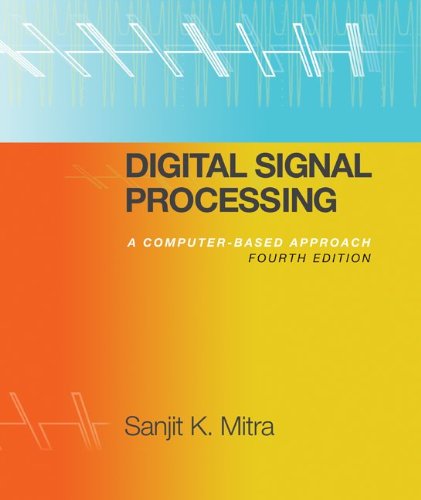
11. Digital Signal Processing (4th
$45.96
12. Digital Signal Processing: A Practical
$35.00
13. Digital Signal Processing: Principles,
$95.94
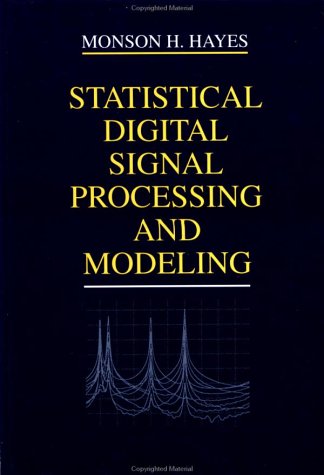
14. Statistical Digital Signal Processing
$10.00
15. Real-Time Signal Processing: Design
$89.07
16. Multirate Digital Signal Processing
$64.00
17. The Scientist & Engineer's
$100.00
18. Statistical Signal Processing
$112.20
19. Mathematical Methods and Algorithms
$23.49
20. A Self-Study Guide for Digital

1. Understanding Digital Signal Processing (2nd Edition)
by Richard G. Lyons
Hardcover: 688 Pages (2004-03-25)
list price: US$89.99 -- used & new: US$58.00
(price subject to change: see help)
Asin: 0131089897
Average Customer Review: 5.0 out of 5 stars
Canada | United Kingdom | Germany | France | Japan
Editorial Review

Book Description
Amazon.com's top-selling DSP book for 5 straight years-now fully updated!

Real-world DSP solutions for working professionals!

Understanding Digital Signal Processing, Second Edition is quite simply the best way for engineers, and other technical professionals, to master and apply DSP techniques. Lyons has updated and expanded his best-selling first edition-building on the exceptionally readable coverage that made it the favorite of professionals worldwide.

This book achieves the perfect balance between theory and practice, making DSP accessible to beginners without ever oversimplifying it. Comprehensive in scope and gentle in approach, keeping the math at a tolerable level, this book helps readers thoroughly grasp the basics and quickly move on to more sophisticated techniques.

This edition adds extensive new coverage of quadrature signals for digital communications; recent improvements in digital filtering; and much more. It also contains more than twice as many "DSP Tips and Tricks"… including clever techniques even seasoned professionals may have overlooked.

Down-to-earth, intuitive, and example-rich, with detailed numerical exercises
Stresses practical, day-to-day DSP implementations and problem-solving
All-new quadrature processing coverage includes easy-to-understand 3D drawings
Extended coverage of IIR filters; plus frequency sampling, interpolated FIR filters
New coverage of multirate systems; including both polyphase and cascaded integrator-comb FIR filters
Coverage includes: periodic sampling, DFT, FFT, digital filters, discrete Hilbert transforms, sample rate conversion, quantization, signal averaging, and more ... Read more

Customer Reviews (57)

5-0 out of 5 stars DSP for the practitioner!
I first got hold of the "Chinese copy" of this book in paperback.I liked the book so much that I bought the hardcover real McCoy so I could pay my proper respects to the author and avoid the poor paper and ink bleed-through of the paperback version.It is one of a half dozen books on the subject that I really value.

Unlike some abstract mathematical treatments of the subject, Richard Lyons really connects with the guy who needs to make it happen on the bench.It is loaded with relevant examples and clear figures.I recommend it as a reference for the DSP practitioner and as a first class tutorial.

5-0 out of 5 stars THE book to use to learn, to understand, DSP
Thank you, thank you, thank you, to Richard Lyons for "Understanding
Digital Signal Processing", both editions.I had the great pleasure to
use and learn from the 1st edition about 5 years ago.At that time, I
had the overwhelming urge to convey my appreciation for the wonderful
work.Now that the 2nd edition is out, there is even more reason to
express how much I enjoyed and still enjoy those works.

In particular, the topics are spot on (eg, I needed to learn about CIC
Decimation filters), but most importantly, the exposition is so very
clear and so easy to understand: each step in the progression is made
obvious -- no "and then the magic happens" or "left as an exercise to
the reader" for the important stuff.

The result is an EXCELLENT EXPOSITION.The care and the craft of
carefully showing the intermediate steps makes it real and concrete.
And it is done with a beautiful balance of intuition, observation,
analysis, and math.Why sling equations around when a simple graph
makes things clear?The equations are there, but the pictures are the
teaching tools.Other books discuss the topics.Richard Lyons's books
illuminate the topics.

I'm pleased to be able to purchase these books, and happy that Richard
is being rewarded (getting royalties, for he is DSP royalty) for his
achievements.

5-0 out of 5 stars excellent introduction but somewhat elementary.
I purchased this book because I found myself needing to do some digital signal processing and the FFT gives me anxiety. This book was an excellent and clear introduction to the basics and helped me to develop a much better understanding of the analysis. It's written in a clear style and assumes only very basic knowledge, in fact, I think you could understand much of it without even knowing calculus. I found the author's geometric exposition of aliasing to be particularly helpful.

I give the book 5 stars, but the potential reader should be aware that the book is serves as an introduction only. In the course of my analysis I discovered that some other "tricks" were necessary that could only be found in a more advanced DSP book. So, it might be helpful to have a more comprehensive reference at your side when it comes time to actually process your signals.


5-0 out of 5 stars The best DSP book I've found
Modern, gentle, readable, practical, serious, complete.So many other DSP books drown in their own mathematics, or gloss over subjects confusing to the author.The introduction to Hilbert transforms is worth the price of the entire book.Required reading for professional DSP programmers.

5-0 out of 5 stars Excellent Introduction and Great Tricks
This is a fabulous introduction to DSP, by far the best I have ever read. It explains concepts without throwing equations and math at the reader. The tips and tricks section is also great and I have already found some useful ones. While not providing the depth of a reference book I will always have it on my shelf for when I truly need to understand a topic. ... Read more


2. Schaum's Outline of Digital Signal Processing (Schaum's)
by Monson H. Hayes
Paperback: 432 Pages (1998-08-31)
list price: US$17.95 -- used & new: US$8.99
(price subject to change: see help)
Asin: 0070273898
Average Customer Review: 4.0 out of 5 stars
Canada | United Kingdom | Germany | France | Japan
Editorial Review

Book Description

Reflecting the rapid advances in microelectronics and computer technology, this powerful study guide is ideal as a supplement to any course on this subject or for independent study by electrical engineering majors and practicing engineers. Readers will learn how digital signal processing techniques come into play in a wide range of fields and will appreciate this thorough, yet concise coverage. The many illustrative problems with detailed solutions and the supplementary self-tests speed comprehension and aid remembering.

... Read more

Customer Reviews (13)

5-0 out of 5 stars Clean book just like new
The book came fast, was much cheaper than a new book, and its quality was practically new.

4-0 out of 5 stars Great Companion
This text was recommended as a companion to Oppenheim's "Discrete Time Signal Processing" for a senior DSP filtering course.If your school is like mine, you sit in three hours of lecture a week, nodding and agreeing and feeling like DSP is straightforward and intuitive.Then you sit down to do your homework and wonder, "where did this come from?"Schaum's helps to bridge this gap with compartmentalized topics and numerous examples.The sections help you quickly ascertain how the notation translates and how thoroughly the topic is covered relative to the coursework.The examples help because, let's face it, it helps to see certain types of problems worked through from start to finish.There are many, many examples within the sections and at the end of the sections, worked through in minute detail.If you're into or studying DSP as a senior engineering student, if you're not the top dog in your class but still want to do well, if you learn from examples and from working through many problems that you're able to confirm, then this book is for you.If you're looking for a "solutions manual" type of book, if you want a "cliff notes" type companion, or if you don't understand lecture concepts at all, then this book won't help you much.It's not an introductory text, although it covers introductory concepts, in my opinion there's not enough background on the rudimentary DSP topics to truly qualify as introductory.

1-0 out of 5 stars Helpful in Understanding Academic Deception
Look, to an engineering mind, the processing of samples at a certain rate is really straight forward and can be mastered in a couple years at any decent engineering firm.

Now there are concepts (useful abstractions...organic way of thinking) that will probably allude such a mind (machine way of thinking) in such a situation, but certainly ease one's solving of problems.

Unfortunately, these useful abstractions are not covered in this text.As far as I've seen, most DSP literature--this book is a good example--either never mentions or else completely obscures such useful abstractions through the inclusion of a huge number of useless and even harmful ones. Abstractions, that is.In short, this text is a student mind-control/brainwashing tool.

Moreover, as a Schaum's outline, this hidden purpose is reprehensible.Most Schaum's outlines serve as illuminators of the useful abstraction.Not this one.And so (tongue-firmly-in-cheek) DSP by Hayes can really only serve in the understanding of academic deception at institutions like MIT (Hayes is MIT^3: BS, MS, PHD) and GATECH (Hayes works there).

----------------------------------------

After some reflection, let me add the idea of "leaky abstractions."
In a sense, no abstraction is truly DRY, all leak a little bit, all subject to cross-cutting concerns.But in the case of Dr's Hayes's Outline, the abstract leakiness factor is far from a fixable plumbing problem and more towards one h-ll of a pss-poor construction.

5-0 out of 5 stars Excellent Refreshing supplement for revision
This book is a carefully written one which will enable any student to revise thoroughly before DSP exam. It has an outstanding collection of solved problems like most other Schaum's outlines. This book is to be used as a supplement book to any standard DSP book like Oppenheim or Proakis & Manolakis. This book can make quite a lot of difference in final grades of most of students. So, it is advisable for any UG/PG to revise this book well before exam.

5-0 out of 5 stars Good as a refresher or supplemental text in DSP
This outline could never stand alone as a DSP tutorial, but it is excellent if you need extra problems to solve or if you need a refresher course in elementary DSP topics. Chapter one starts where any DSP course usually starts - with a quick review of signals and systems. Chapter two is on Fourier analysis and discusses all of the basics including the concept of filtering, interconnection of systems, and finally the discrete time Fourier transform and its properties. Chapter 3 is on sampling, and includes a good discussion of analog to digital conversion and how it can induce aliasing. Next the converse, digital to analog conversion, is discussed as well as discrete time processing of continuous signals and finally sample rate conversion. Chapter 3 is especially useful, since most DSP texts do not go into as much detail on practical A/D and D/A conversion topics as this chapter does. Chapter four finally gets into the z-transform - its definition, its properties, and its inverse. Chapter 5 is about the transform analysis of systems and specifically how the z transform makes the analysis of such systems much simpler than what was done in earlier chapters. Chapter six discusses the discrete Fourier transform, which is a finite-series version of the DTFT, which was discussed in chapter two. Because the Discrete Fourier Transform has a time complexity of NxN, the next chapter discusses its more practical alternative the Fast Fourier Transform, which has an NlogN time complexity. This might seem trivial at first, but if you are filtering 1Kx1K pixel images, the difference becomes significant. Although this chapter is very brief, it does a pretty good job of driving home the main points of the algorithm. Also, it has some pretty good exercises on the FFT, which are usually hard to find in textbooks. Now that all of the groundwork has been laid, chapter eight discusses the implementation of discrete time systems, which is the essence of DSP. Common filter structures are introduced. Chapter 9, the final chapter, is on filter design. Both IIR and FIR filter techniques are introduced. Thus, if you are in an advanced DSP course, this outline will probably be too elementary for you. For first semester students, this should be a very helpful outline for transitioning from the study of linear systems to DSP. ... Read more


3. Digital Signal Processing Using MATLAB (Bookware Companion)
by Vinay K. Ingle, John G. Proakis
Paperback: 640 Pages (2006-08-10)
list price: US$64.95 -- used & new: US$55.00
(price subject to change: see help)
Asin: 0495073113
Average Customer Review: 4.0 out of 5 stars
Canada | United Kingdom | Germany | France | Japan
Editorial Review

Book Description
This supplement to any standard DSP text is one of the first books to successfully integrate the use of MATLAB® in the study of DSP concepts. In this book, MATLAB® is used as a computing tool to explore traditional DSP topics, and solve problems to gain insight. This greatly expands the range and complexity of problems that students can effectively study in the course. Since DSP applications are primarily algorithms implemented on a DSP processor or software, a fair amount of programming is required. Using interactive software such as MATLAB® makes it possible to place more emphasis on learning new and difficult concepts than on programming algorithms. Interesting practical examples are discussed and useful problems are explored. This updated second edition includes new homework problems and revises the scripts in the book, available functions, and m-files to MATLAB® V7. ... Read more

Customer Reviews (11)

1-0 out of 5 stars Frustrating
I have an expensive version of Matlab with the DSP toolkit. I was excited to learn how to use it from this book. What a let down. The first functions that I found were unusable making the examples worthless. Then I noticed a web site where I could download these functions that were created by the author(sited in the text): the link no longer exists (surprise!) rendering this book worth less than the paper it was printed on! Besides the link to the non-existent site the author gives no more incite into how to enable Matlab to work with this text. Don't buy this book!

5-0 out of 5 stars Perfect but aging companion to Discrete Time Signal Processing
This book does exactly what it purports to do - it teaches the reader how to perform signal processing tasks using Matlab. It starts out with signals and systems and moves on to the DTFT, the Z Transform, the DFT, digital filter structures including both IIR and FIR design, and finally covers some advanced topics in adaptive signal processing and communications. It even contains full-blown projects using Matlab on adaptive channel equalization, binary spread spectrum communications, and system identification. The reader should use another text such as Oppenheim's "Discrete Time Signal Processing" to get the theory, and come to this book on how to implement that theory in Matlab. The one drawback is that the book is older, so it is using Matlab 5. Also, another reviewer mentioned that much of the book is inaccessible to users who do not have the rather expensive signal processing toolkit at their disposal. Fortunately, thanks to the open source movement, this last problem has been solved. Octave, now on SourceForge, an open source code repository, has many of the matlab functions available for free that you need to do signal processing.
In conclusion, I highly recommend this book to signal processing students and professionals who wish to incorporate Matlab into their work.

5-0 out of 5 stars Excellent for review of DSP Mathematics....
Great companion book to "Understanding Digital Signal Processors" by Lyons and "Digital Signal Processors" by Hayes. I would recommend this book strictly for a companion book. It doesn't go into in-depth detail or explanation of Laplace, z-transforms, or Fourier Transforms but displays a good foundation for MatLab DSP routines.

5-0 out of 5 stars Great as a Companion Book!!!
I am currently taking a intro to Digital Signal Processing at my university. I find this book is a very good complement to Proakis' Digital Signal Processing book. I have learned a lot about DSP using these two books. the aim of this book is to be a companion book to more traditional DSP books, it tries to be nothing more. In that regard, I believe the book excels. Get it as a supplement/companion to a traditional DSP book and you will learn how to do DSP with MATLAB. Highly recommended!!!

2-0 out of 5 stars Many functions in examples missing in Matlab R12, R13
This would be a great book except it needs to be updated for Matlab R12 and (now) R13.Many of the functions referenced in the book (e.g. zplot, freqz) have now in the signal processing toolkit so one really needs to acquire this toolkit to make the book fully useful. ... Read more


4. Fundamentals of Statistical Processing, Volume I: Estimation Theory (Prentice Hall Signal Processing Series)
by Steven M. Kay
Hardcover: 625 Pages (1993-04-05)
list price: US$115.00 -- used & new: US$68.96
(price subject to change: see help)
Asin: 0133457117
Average Customer Review: 5.0 out of 5 stars
Canada | United Kingdom | Germany | France | Japan
Editorial Review

Amazon.com
This text is geared towards a one-semester graduate-level course in statistical signal processing and estimation theory. The author balances technical detail with practical and implementation issues, delivering an exposition that is both theoretically rigorous and application-oriented. The book covers topics such as minimum variance unbiased estimators, the Cramer-Rao bound, best linear unbiased estimators, maximum likelihood estimation, recursive least squares, Bayesian estimation techniques, and the Wiener and Kalman filters. The author provides numerous examples, which illustrate both theory and applications for problems such as high-resolution spectral analysis, system identification, digital filter design, adaptive beamforming and noise cancellation, and tracking and localization. The primary audience will be those involved in the design and implementation of optimal estimation algorithms on digital computers. The text assumes that you have a background in probability and random processes and linear and matrix algebra and exposure to basic signal processing. Students as well as researchers and practicing engineers will find the text an invaluable introduction and resource for scalar and vector parameter estimation theory and a convenient reference for the design of successive parameter estimation algorithms.Book Description

A unified presentation of parameterestimation for those involved in the design andimplementation of statistical signal processing algorithms. Covers important approaches to obtainingan optimal estimator and analyzing its performance; andincludes numerous examples as well as applications to real-world problems.MARKETS: For practicing engineers andscientists who designand analyze signal processingsystems, i.e., to extract information from noisy signals— radar engineer, sonar engineer, geophysicist,oceanographer, biomedical engineer, communications engineer,economist, statistician, physicist, etc.

... Read more

Customer Reviews (8)

5-0 out of 5 stars Perfect
One of the best written textbooks I have ever read, in any field. Crystal clear, and is a gold mine of knowledge.

5-0 out of 5 stars Legendary and masterpiece in estimation theory
Without any hesitation, I consider this book as a masterpiece in the area of statistical signal processing. Kay takes the reader to the journey of estimation theory as if a science teacher takes his students to a field trip. The one special feature of this book is the convergence of thought that reader obtains upon reading the book. Kay lays a fundamental bridge between various estimators using his succinct style for describing the subject.

Few special areas require more attention in this book. For example the coverage of EM methods is very condense and requires more elaboration. Also there is no discussion on the estimation methods using higher order statistics.

Overall I consider this book as the best book I have read ever and I highly recommend this book to those who want to obtain an ever-lasting view on statistical signal processing.

5-0 out of 5 stars couldn't rate 6... a must !
I've had tough courses on statistical signal processing as a post-grade student. I am often confused in front of a problem and turning back to the notes taken in class doesn't help much.
When you read this book all gets bright. I am still wondering how some teachers can be so confusing while such good books do exist...
However don't count on it for in depth mathematical demonstrations, it starts with a practical problem and explains how to model things. Thus it is a bit bottom-up but anyway starting from a good graduate level in signal and stats.
I got this one at the library but already ordered a copy for myself and am planning to get part2 on detection.

5-0 out of 5 stars A reference for self-directed study
This text is very good for those who start doing research in statistical signal processing. A lot of explanations, technical terms are well presented and consistent, plus a number of examples that help you to learn about different statistical signal processing concepts and algorithms. Research students can be beneficial alot from this text.

5-0 out of 5 stars The book has depth and is well written
This is one of the best references on statistical signal processing. The topic is not of simple matter, but the author presents the materials clearly together with great examples. The book is reader-friendly and is relatively error-free. I have bought several copies for my PhD students at Georgia Tech. ... Read more


5. Signal Processing for Neuroscientists: An Introduction to the Analysis of Physiological Signals
by Wim van Drongelen
Hardcover: 320 Pages (2006-12-13)
list price: US$79.95 -- used & new: US$66.16
(price subject to change: see help)
Asin: 0123708672
Canada | United Kingdom | Germany | France | Japan
Editorial Review

Book Description
Signal Processing for Neuroscientists introduces analysis techniques primarily aimed at neuroscientists and biomedical engineering students with a reasonable but modest background in mathematics, physics, and computer programming. The focus of this text is on what can be considered the golden trio in the signal processing field: averaging, Fourier analysis, and filtering. Techniques such as convolution, correlation, coherence, and wavelet analysis are considered in the context of time and frequency domain analysis. The whole spectrum of signal analysis is covered, ranging from data acquisition to data processing; and from the mathematical background of the analysis to the practical application of processing algorithms. Overall, the approach to the mathematics is informal with a focus on basic understanding of the methods and their interrelationships rather than detailed proofs or derivations. One of the principle goals is to provide the reader with the background required to understand the principles of commercially available analyses software, and to allow him/her to construct his/her own analysis tools in an environment such as MATLAB®.

· Multiple color illustrations are integrated in the text
· Includes an introduction to biomedical signals, noise characteristics, and recording techniques
· Basics and background for more advanced topics can be found in extensive notes and appendices ... Read more


6. Discrete-Time Signal Processing (2nd Edition)
by Alan V. Oppenheim, Ronald W. Schafer, John R. Buck
Hardcover: 870 Pages (1999-02-15)
list price: US$139.00 -- used & new: US$79.60
(price subject to change: see help)
Asin: 0137549202
Average Customer Review: 4.0 out of 5 stars
Canada | United Kingdom | Germany | France | Japan
Editorial Review

Amazon.com
This is the standard text for introductory advanced undergraduate and first-year graduate level courses in signal processing. The text gives a coherent and exhaustive treatment of discrete-time linear systems, sampling, filtering and filter design, reconstruction, the discrete-time Fourier and z-transforms, Fourier analysis of signals, the fast Fourier transform, and spectral estimation. The author develops the basic theory independently for each of the transform domains and provides illustrative examples throughout to aid the reader. Discussions of applications in the areas of speech processing, consumer electronics, acoustics, radar, geophysical signal processing, and remote sensing help to place the theory in context. The text assumes a background in advanced calculus, including an introduction to complex variables and a basic familiarity with signals and linear systems theory. If you have this background, the book forms an up-to-date and self-contained introduction to discrete-time signal processing that is appropriate for students and researchers. Discrete-Time Signal Processing also includes an extensive bibliography. ... Read more

Customer Reviews (24)

1-0 out of 5 stars Academic Propaganda
Look, problems involving digital signals and systems can get very complicated, but the basics are just that--basic.This famous book on DSP is a quintessential example of academic propaganda:it misinforms the general public into thinking the subject matter is far harder than it is, while it privately informs insiders with very precise information.

Propaganda-free Alternative:

Signal Processing and Linear Systems by B. P. Lathi

5-0 out of 5 stars Destined for a standard?
It is my pleasure to comment on this book which I recently purchased. I have two of Dr. Oppenheim's previous books. This book is a core integration of a topic with too many diverse starting points (mine was digital filters derived from Prony's method, not in the book by name). Dr. Bose was my first EE Professor. Alan Oppenheim was my second EE instructor. Alan (just finished MSEE at the time) had not published a book yet, but his focus was always on your questions. His product was your understanding. If this book is for your shelf, it will not harm it. If this topic is for your mind, this book was meticulously written for you. Lance Webb, PhDEE

5-0 out of 5 stars Six star book on Digital Signal Processing
This is the outstanding 2nd edition of Oppenheim's classic DSP book, which for over two decades was the only real choice for a textbook on the subject. That was too bad, since the first edition was probably the worst thing I have ever seen in print - terse, incomprehensible, and with only a few awful and poorly illustrated examples. When I decided to take a refresher course in DSP, I was horrified to see our class would be using the second edition of that horrendous text. What I found instead was a completely rehabilitated textbook! This is not a beginner's DSP textbook by any stretch of the imagination, but absolutely everything is explained and there are plenty of well worked out examples. The end-of-chapter problems are broken down into simple, intermediate, and advanced problems with quite a few mind-puzzlers in the advanced section. Plus, the answers to the first 20 problems in every chapter are in the back of the book.
There is really nothing unique about the book's format. What does makes the book unique is the density and amount of material included. Just about every page is packed with well-explained important information. I highly recommend this book to anyone who has had a prior semester of an upper-level undergraduate class in Signals and Systems and wants to study DSP. An accompanying book that you might find helpful is "Understanding Digital Signal Processing" by Lyons. That book is good for getting an intuitive feel for DSP. Another book that will help you with some of the earlier concepts in this book (linear systems, DTFT, Z-transform, DFT, basic filter design) and some of the direct computations involved is "Schaum's Outline of Digital Signal Processing".Amazon does not show the table of contents, so I do that here:
1. Introduction.
2. Discrete-Time Signals and Systems.
Introduction. Discrete-time Signals: Sequences. Discrete-time Systems. Linear Time-Invariant Systems. Properties of Linear Time-Invariant Systems. Linear Constant-Coefficient Difference Equations. Frequency-Domain Representation of Discrete-Time Signals and Systems. Representation of Sequence by Fourier Transforms. Symmetry Properties of the Fourier Transform. Fourier Transform Theorems. Discrete-Time Random Signals. Summary.
3. The z-Transform.
Introduction. The z-Transform. Properties of the Region of Convergence for the z-Transform. The Inverse z-Transform. z-Transform Properties. Summary.
4. Sampling of Continuous-Time Signals.
Introduction. Periodic Sampling. Frequency-Domain Representation of Sampling. Reconstruction of a Bandlimited Signal from its Samples. Discrete-Time Processing of Continuous-Time Signals. Continuous-Time Processing of Discrete-Time Signals. Changing the Sampling Rate Using Discrete-Time Processing. Practical Considerations. Oversampling and Noise Shaping. Summary.
5. Transform Analysis of Linear Time-Invariant Systems.
Introduction. The Frequency Response of LTI Systems. System Functions for Systems Characterized by Linearity. Frequency Response for Rational System Functions. Relationship Between Magnitude and Phase. All-Pass Systems. Minimum-Phase Systems. Linear Systems with Generalized Linear Phase. Summary.
6. Structures for Discrete-Time Systems.
Introduction. Block Diagram Representation of Linear Constant-Coefficient Difference Equations. Signal Flow Graph Representation of Linear Constant-Coefficient Difference Equations. Basic Structures for IIR Systems. Transposed Forms. Basic Network Structures for FIR Systems. Overview of Finite-Precision Numerical Effects. The Effects of Coefficient Quantization. Effects of Roundoff Noise in Digital Filters. Zero-Input Limit Cycles in Fixed-Point Realizations of IIR Digital Filters. Summary.
7. Filter Design Techniques.
Introduction. Design of Discrete-Time IIR Filters from Continuous-Time Filters. Design of FIR Filters by Windowing. Examples of FIR Filter Design by the Kaiser Window Method. Optimum Approximations of FIR Filters. Examples of FIR Equiripple Approximation. Comments on IIR and FIR Digital Filters. Summary.
8. The Discrete Fourier Transform.
Introduction. Representation of Periodic Sequences: the Discrete Fourier Series. Summary of Properties of the DFS Representation of Periodic Sequences. The Fourier Transform of Periodic Signals. Sampling the Fourier Transform. Fourier Representation of Finite-Duration Sequences: The Discrete-Fourier Transform. Properties of the Discrete Fourier Transform. Summary of Properties of the Discrete Fourier Transform. Linear Convolution Using the Discrete Fourier Transform. The Discrete Cosine Transform (DCT). Summary.
9. Computation of the Discrete Fourier Transform.
Introduction. Efficient Computation of the Discrete Fourier Transform. The Goertzel Algorithm Decimation-in-Time FFT Algorithms. Decimation-in-Frequency FFT Algorithms. Practical Considerations Implementation of the DFT Using Convolution. Summary.
10. Fourier Analysis of Signals Using the Discrete Fourier Transform.
Introduction. Fourier Analysis of Signals Using the DFT. DFT Analysis of Sinusoidal Signals. The Time-Dependent Fourier Transform. Block Convolution Using the Time-Dependent Fourier Transform. Fourier Analysis of Nonstationary Signals. Fourier Analysis of Stationary Random Signals: the Periodogram. Spectrum Analysis of Random Signals Using Estimates of the Autocorrelation Sequence. Summary.
11. Discrete Hilbert Transforms.
Introduction. Real and Imaginary Part Sufficiency of the Fourier Transform for Causal Sequences. Sufficiency Theorems for Finite-Length Sequences. Relationships Between Magnitude and Phase. Hilbert Transform Relations for Complex Sequences. Summary.

5-0 out of 5 stars Good book from initial reading
I haven't gone through this book all the way yet since classes haven't started; however, it seems to be a very well written book that is easy to get the necessary concepts out of easily.Once the class is done I will try to add a further review.

4-0 out of 5 stars yes, it is!
This is the book that focuses on the concept more than any thing else which ,in turn, build up your insight through the material.

This book addresses discrete time signal processing issues in an ordinary fashion and doesn't cover more advanced topics like wavelets or statistical signal processing.

Maybe you would be interested in this book if you are that senior/first year graduate student looking forward a nice job with a high salary or a DSP engineer that is interested in keeping his job :)

Overall, nothing can get better than Oppenheim DSP 1975 but however, this is a nice volume if you don't have the preceding one.
It is almost the same quality isn't it? ... Read more


7. Digital Signal Processing
by Alan V. Oppenheim, Ronald W. Schafer
Hardcover: 784 Pages (1975-01-02)
list price: US$135.00 -- used & new: US$38.00
(price subject to change: see help)
Asin: 0132146355
Average Customer Review: 3.5 out of 5 stars
Canada | United Kingdom | Germany | France | Japan
Editorial Review

Book Description

Written by 2 foremost authorities, this well-respectedreference discusses the processing of signals using digitaltechniques. Includes many useful applications.

... Read more

Customer Reviews (2)

3-0 out of 5 stars Not enough mathematical formulas
In dsp course we are using this book. The problem with this book is that it does not provide formulas for many dsp calculations. Thus, I need to find formula tables else where. Besides, there are not enough examples to further understandsings of the materials.

4-0 out of 5 stars The Old Version of the DSP Bible
"Digital Signal Processing" by Oppenheim and Schafer was, until the publication of their revised book "Discrete-time Signal Processing", the best DSP reference book.

While I would notrecommend this book for self-study, I would recommend it as a referencetext for someone who has done or is doing a DSP course.

Be advised ---the new version, "Discrete-time Signal Processing", is moreup-to-date. ... Read more


8. A Digital Signal Processing Primer: With Applications to Digital Audio and Computer Music
by Ken Steiglitz
Paperback: 300 Pages (1996-01-15)
list price: US$75.60 -- used & new: US$67.97
(price subject to change: see help)
Asin: 0805316841
Average Customer Review: 4.0 out of 5 stars
Canada | United Kingdom | Germany | France | Japan

Customer Reviews (15)

4-0 out of 5 stars Accessible DSP Text geared for those interested in audio
This is a different kind of digital signal processing textbook in just about every way. To begin with, chapter one starts out talking about sinusoids in the context of tuning forks, when just about every other DSP book under the sun starts with a review of linear systems. This is good, in that throughout the book your eye is kept on the ball of actual audio applications. This can be somewhat troublesome in that the author sometimes has to delve into mathematics that the typical DSP student may not be ready for - the wave equation and elementary partial differential equations for example. The author ultimately does get the job done, however, explaining the DFT, FFT, z-transform, and filter design all within the context of audio signals. It is true that only the last chapter is explicitly labeled "Audio and Musical Applications". However, this only means that the author is discussing complex applications in this chapter only, after the groundwork has been laid for all of the theory. I would especially recommend this book to people interested in computer music that need to get up to speed on DSP. Such students may also appreciate "DSP Filter Cookbook" by John Lane. It is all about the implementation of audio filters and contains C++ source code and schematics. If you are a traditional student of DSP and digital audio does not interest you, you might want to go a more traditional route starting out with "Understanding Digital Signal Processing" by Lyon and proceeding on to a more advanced text such as "Discrete Time Signal Processing" by Oppenheimer or "Digital Signal Processing: Principles, Algorithms and Applications" by Proakis.

5-0 out of 5 stars great DSP introduction, focus on computer music
This is the only DSP book I would recommend for a beginner.This is an especially great book for someone without an EE background who doesn't know much about signals, or someone who doesn't know/care about analog filters.I found the book quite practical, and was able to implement working digital filters after reading it.But, it also gave me a good understanding of the theory.

I've gotten other DSP books since then, including the famed Oppenheim, and I've been rather disappointed with each of them.The book is a lot more readable and less abstract than the others.

I do wish this book covered more topics..Some more specifics about Butterworth and Chebyshev filters would have been nice.If you just want sample code for building a filter, you won't get it.

However, this book covers some topics which I haven't seen covered well elsewhere, like comb filters, resonators, reverb, and digital simulation of a plucked string.So it's still worth getting even if you already know about DSP and have other books.

4-0 out of 5 stars Not bad
One of my math professors said that this was not a good book for me--"a pure engineering book," "Calculus III is required," & "send this book back because it won't help you to write code."He turned out to be WRONG!You might want to refresh yourself with Calculus before purchasing this book.Afterwards, this book is not that bad at all.As a person with a limited background of Calculus, I was able to get away with only derivatives & integrals.I actually learned a great deal from this book.The author used some pretty good examples that allowed me to write my own code.The author tried to make it as simple as possible, but I understand that there is almost no easy way to explain anything that has to do with math.Thank you.

4-0 out of 5 stars great so far!
This book is nicely written.The author takes a step-by-step approach, building up the knowledge level of the reader slowly and clearly, so that later parts of the book are easier understood.I have only read the first couple chapters, but am happy so far.I never clearly understood some of the basic DSP concepts because they tended to be taught in college by professors who were either in a rush, or didn't fully understand how to teach the basics.I'm not going to say that the book makes it super simple - the fact is DSP requires a good handle on calculus and trig, but assuming the reader is willing to stop and think a while as to what is being said and what the math means, it's approached in an intuitive manner.The only thing I found myself wanting was an answer sheet for the questions at the end of the chapter. It would be nice to have a few problems worked out so I can get a deeper intuition for how to approach problems beyond the theory, but then again, I'm only in the second chapter.

3-0 out of 5 stars good DSP primer, needed more on the audio/music applications
I bought this expecting a thourough primer for audio software development (soft realtime signal generation, filtering, many examples, some code).Nope.Just calculus.It reads very well, it is a great book, but it does not show you how to implement using software or even pseudocode.

For easy fun-to-read coverage on theoretical DSP, and for a small taste of DSP with respect to audio (1 small chapter), this book is five stars.

Since it wasn't what I needed (jeez, who does make a book like what I want anyway?I want to write a modular synth in software, lots of FX, filters, etc..), I give it only 3 stars..:( ... Read more


9. Signal Processing and Linear Systems
by B. P. Lathi
Hardcover: 864 Pages (2000-02-24)
list price: US$132.00 -- used & new: US$20.00
(price subject to change: see help)
Asin: 0195219171
Average Customer Review: 4.5 out of 5 stars
Canada | United Kingdom | Germany | France | Japan
Editorial Review

Book Description
This text presents a comprehensive treatment of signal processing and linear systems suitable for juniors and seniors in electrical engineering. Based on B. P. Lathi's widely used book, Linear Systems and Signals, it features additional applications to communications, controls, and filtering as well as new chapters on analog and digital filters and digital signal processing. Lathi emphasizes the physical appreciation of concepts rather than the mere mathematical manipulation of symbols. Avoiding the tendency to treat engineering as a branch of applied mathematics, he uses mathematics to enhance physical and intuitive understanding of concepts, instead of employing it only to prove axiomatic theory. Theoretical results are supported by carefully chosen examples and analogies, allowing students to intuitively discover meaning for themselves. ... Read more

Customer Reviews (12)

5-0 out of 5 stars Excellent book to understand DSP basics
This book is the best available in market to understand the basics of Signal Processing with crisp explanations and very good mathematical treatment. Still I feel that, after reading this book one must switch to EITHER the book by Proakis and Manolakis OR the book by Oppenheim for more thorough knowledge. The knowledge gained from Prof Lathi's book makes others easy to comprehend. I would strongly recommend this book to any novice in Signal Processing domain.

5-0 out of 5 stars Mathematically rigorous but explaining physical significance
This book clearly explains the physical significance of many phenomenon and topics that we come across in this subject. The most striking feature is that it does so from the fundamental linear differential equation and gives us very good insight of the subject and a sense of completeness . Definitely its better than Oppenheim book which deals the subject a bit more mathematical.

3-0 out of 5 stars Better to get Oppenheim Schafer Buck
The Lathi book is fine, and covers both continuous and discrete signals, but is a little hard to read at times.A better book that covers both is the one by Oppenheim & Willsky.And if you want a much better book for the discrete side of things then get Discrete-Time Signal Processingby Oppenheim, Schafer, & Buck.

5-0 out of 5 stars signal processing and linear system
this is a gem of a book on this subject no need to waste ur time reading abtruse and unfriendly books,the writer of this books comes down to the understanding of average student to explain the beautifull ideas of this subject.he is crystal clear about the subject and i have not found any book as good as this . he gives a good brushing up review in mathematics which is very very helpful.take my my advice ur money is safe in buying it .to do more numerical problems u can refer to A.V Oppenheim(a more difficult book).
rohit

5-0 out of 5 stars Great Undergraduate Signals and Systems Textbook
This is truly a superior book for teaching Signals and Systems.It far outpaces the competition in my mind, especially in terms of conceptual descriptions, examples, and readability.It was the only text (I have looked at the most popular 6) that I found that is written in a coherent and readable manner, such that it could serve as a standalone self-paced tutorial.

I am teaching this course for the first time this fall and found almost every one of my student's (and mine) conceptual and mathematical questions answered clearly by this text.I naively adopted Oppenheim since it is a classic, but that text truly pales in comparison.
Examples of things I appreciate in Lathi:
1) It serves as an excellent reference book, with a background mathematics section, tables of transforms and properties.
2) It generally starts each subject at the right point (e.g., with the trigonometic Fourier Series) to give student better conceptual understanding.I doesn't skip the basics.
3) It answers many common conceptual questions like "What is the meaning of negative frequencies in the FT?", "What do complex numbers mean physically?"
4) I love the history and wit (Is it a sin to make a textbook readable and even enjoyable?)
5) A lot of references to real engineering applications.For example, a REAL chapter on DIGITAL FILTER DESIGN.

I could go on, but it is obvious that the author put a great deal of care into this text and even the solutions CD.This, for upper-level undergraduate texts, in my opinion, is truly rare (see however, "Griffiths" and "Zahn" for E&M)

NOTE:By the way, for a previous reviewer, Ms. Chaston, in my text, the appendices are located on pages 161, 222, 356, 457, and 609.

Finally, I must admit that my own stupid prejudice cost me from adopting this textbook this year.I thought to myself, can a book written by a man with the name "Bhagawandas Pannalal" truly write this eloquently in English?As I get more in depth into the book, the answer is clearly YES and more. ... Read more


10. Streamlining Digital Signal Processing: A Tricks of the Trade Guidebook
Paperback: 322 Pages (2007-08-31)
list price: US$74.95 -- used & new: US$56.88
(price subject to change: see help)
Asin: 0470131578
Average Customer Review: 5.0 out of 5 stars
Canada | United Kingdom | Germany | France | Japan
Editorial Review

Book Description
This book is more than just a compilation of the original articles. All of the material in the book has gone through careful editorial review and has also benefited from the feedback of the readers of the magazine; the result is a consistent across all of the articles. Additionally, the authors have used this opportunity to include the additional explanations, applications, and illustrations that could not be included in the original articles due to space limitations. ... Read more

Customer Reviews (2)

5-0 out of 5 stars Unique tricks and tips for advanced signal processing
I wouldn't advise that students of digital signal processing buy this book. It is a well-written and unique tool for the professional, but it will likely not be useful for students unless you are working on some specialized project or Ph.D. and need advanced and specialized help. The tips are well-written, thorough, and well-illustrated. Part one, on efficient digital signal filtering, will be helpful for anyone from novice to professional. The rest of the book, however, deals with specific and complex topics. Quite frankly, Lyon's excellent book "Understanding Digital Signal Processing" includes most of the tips and tricks in part one and is aimed at the novice at an affordable cost. That book is a much better choice for students. I was looking for discussions on implementation of the arctangent function - don't ask me why - and this was the only book that had an accessible section on the subject. It is THAT kind of book. Have your copy of Oppenheim & Schafer's "Discrete-time Signal Processing" handy, though, because in explaining the details of some of these more difficult subjects the background material had to sacrificed for the sake of producing a compact volume that flows well. Highly recommended for the right audience.

5-0 out of 5 stars Can not be anything else
Rich is a unique author in the world of engineering writing. Many years ago, when his first book came out, I was so inspired that I found him. Didn't take too much looking, he was local then in the SF Bay area. I had to tell him personally that his book was awesome! (pre-cliche AWESOME!). Well, he himself turned out be as unique as his book!

"Understanding Digital Processing" made such an impression on me that I have been trying to write a book on communications ever since (chapters at complextoreal.com) If all engineering books were written as well as Rich writes them, we would not have so much fear of sciences and math.

Be be honest, I have just ordered this book. It has not arrived yet. BUT, I am sooooo sure, it is going to a great follow-on, as great as the first. - Charan Langton
... Read more


11. Digital Signal Processing (4th Edition)
by John G. Proakis, Dimitris K Manolakis
Hardcover: 1004 Pages (2006-04-07)
list price: US$135.00 -- used & new: US$47.89
(price subject to change: see help)
Asin: 0131873741
Average Customer Review: 5.0 out of 5 stars
Canada | United Kingdom | Germany | France | Japan
Editorial Review

Book Description

A significant revision of a best-selling text for the introductory digital signal processing course. This book presents the fundamentals of discrete-time signals, systems, and modern digital processing and applications for students in electrical engineering, computer engineering, and computer science.The book is suitable for either a one-semester or a two-semester undergraduate level course in discrete systems and digital signal processing. It is also intended for use in a one-semester first-year graduate-level course in digital signal processing.

... Read more

Customer Reviews (3)

5-0 out of 5 stars Solid text for learning the subject and reference
This book is comprehensive. It covers not only the basics for the beginning student but the second-half covers advanced subjects whereas other books do not, or at least not with the same clean organization and thoroughness. Some authors tend to be sparse in their explanations and helping you understand derivations. Others put in too many lengthy details and you get lost. Here, Proakis has a way of getting to the point and reiterating it. He also provides you with the critical concepts mathematically as well as in worded descriptions. Best overall DSP text/reference I have found in one volume...

5-0 out of 5 stars Cannibalizing on Manolakis' other book?!
I just got it the other day, and saw much more changes than was originally reported.

Most of the deletions are in the earlier chapters dealing with basic concepts of DSP (something usually dealt with in a senior undergraduate class on DSP), while the additions are mostly in the later chapters dealing with more advanced concepts - stuff usually dealt with in an advanced/graduate level course.

Topics on LTI systems and their state space representation have been dropped en masse, while Adaptive filtering has been added as a new chapter.

Some of the deletions are (Section #s are from the IIIrd ed.:

2.6.4 - Computation of Autocorrelation Sequences

3.6.7 - Schür-Cohn Stability Test

4.2.12 - Physical and Mathematical Duality

4.4 - Freuqnecy domain characteristics of LTI systems

4.5 - LTI systems as frequency selective filters

4.6 - Inverse systems and deconvolution

7.4 - State space analysis and structures

8.3.4 - Matched-z transformation

8.5 - Design of Digital Filters based on Least-Squares method

10.5 - The Direct Form FIR filter part of this section

10.5.3 - Time variant filter structures

Some additions:

Chapter 4 - Frequency domain and time domain signal properties

Chapter 7 - The Discrete Cosine Transform

4 new subsections on Polyphase filter structures and sampling rate conversion added

Section on Digital Filter Banks and Quadrature Mirror Filters (previously part of 'Applications of Multirate Signal Processing') considerably expanded (in new subsection)

Section on M-channel QMF banks added

Section on Random Signals, Correlation Functions and Power Spectra (formaerly in Appendix A) added

A whole new chapter on Adaptive Filters added

Section on Minimum Variance Spectral Estimation expanded

Some other changes include:

Section on 'Response of Pole-Zero systems with non-zero initial conditions' has been combined with other topics. Topics on 'Sampling and Reconstruction of Signals' have been completely revamped and reworked; Outlying topics dealing with this material have all been brought together in one place.

Topic covering 'Oversampling A/D and D/A converters' has been moved to the Sampling chapter.

In a few words, the new version has moved away from its DSP basics background to give space more advanced topics - in this respect, it has begun resembling, to an extent, the initial parts of Manolakis' other book (with Ingle and Kogon).

Although still relevant to undergraduate students or relative newcomers to DSP, many of the topics are now best handled at the graduate level, which already has a slew of good tomes on the vast subject (including one by Manolakis himself).

Moreover, if you need to study LTI and time variant systems, this edition is no longer of any use - stick to ed. III or look for Signals and Systems by either Haykin and Van Veen or Ziemer, Tranter and Fannin.

5-0 out of 5 stars Good book
I have read many DSP books, this turns out to be the best one. The other good DSP book to mention is the "Understanding Digital Signal Processing" (Lyons) which is written in favor of beginners. The Proakis book not only explains the basic idea as clear as the Lyons's book but it covers deeper materials. ... Read more


12. Digital Signal Processing: A Practical Guide for Engineers and Scientists
by Steven Smith
Paperback: 672 Pages (2002-09)
list price: US$73.95 -- used & new: US$45.96
(price subject to change: see help)
Asin: 075067444X
Average Customer Review: 4.5 out of 5 stars
Canada | United Kingdom | Germany | France | Japan
Editorial Review

Book Description
In addition to its thorough coverage of DSP design and programming techniques, Smith also covers the operation and usage of DSP chips. He uses Analog Devices' popular DSP chip family as design examples. Also included on the CD-ROM is technical info on DSP processors from the four major manufacturers (Analog Devices, Texas Instruments, Motorola, and Lucent) and other DSP software.

*Covers all major DSP topics
*Full of insider information and shortcuts
*Basic techniques and algorithms explained without complex numbers ... Read more

Customer Reviews (25)

5-0 out of 5 stars Clearly the author's labor of love!
This book literally picks up the reader and carries them through an impressive (read: large, scary, and dangerous!) body of information incredibly effectively, smoothly, and effortlessly. You can't help, but feel empowered afterwards!

I've been away from my EE background for 15+ years working on embedded real-time software. I picked up this book six months ago in what was a very modest attempt to familiarize myself with DSP and filters only enough to carry conversations with some new ME/Controls co-workers! The book ignited my interest (mainly by giving me a jolt of confidence!) in the subject such that I've spent the last few months delving into more "formal" DSP and reviewing some college math. In fact, I wanted to write a good review months ago, but it is now that I appreciate S. W. Smith's great work even more.

The simple and friendly language of the book is apparent, but the organization of the subject matter - so carefully weaved together - is absolutely nothing like the other pedantic introductory books on DSP. In summary, while it prepares the reader for practical DSP applications, the book is nothing like some other dull cook-book, get-rich, "for-the-working-professional" books. This one has a heart!

5-0 out of 5 stars it is NOT a book ... it's a magnificent working tool
great ! it answers the whole pattern of digital applications. It does not enter in theoretical details and gives the user an handy guide to design filters, fft's etc. .. and (only if you like) the theoretical background where to start from, at the end of the book.

Really great. Thanks to the author.

5-0 out of 5 stars Clear and useful
I started by reading the PDF versions on Steve Smith's website.That was enough to give me the background for a recently assigned task. Steve graciously returned a few e-mails about fine points that were not clear. I ordered the paperback version with the CDROM to get a version with the most errata removed.My task included some downshifting and upshifting not covered in Smith's book. Lyons filled the gap nicely. The example code in the book is in BASIC, but is very easy to implement in other languages.I used C++ and the FFTW libraries.

5-0 out of 5 stars Best DSP refresher course available
My 40 year old MSEE needed some refreshing on digital signal processing, FFT, FIR and IIR filters.This book read like a novel!A great addition to my EEE/Programming library.I've used it daily since it arrived for the development of real time signal processing software to be used by the amateur radio community.

3-0 out of 5 stars All but the BASIC...
I like the content of this book... but I personally find BASIC to be a horrible choice for the code examples, as I think it is difficult to conceptualize the structure of code with *LINE NUMBERS*...

I mean... c'mon... if you think that there is any chance in heck of me being able to understand the mathematics behind filter design... you should assume that I can follow some sort of function based example code...

Really... the BASIC syntax just gets in the way of the math behind the algorithms...

Okay... I'm done now. ... Read more


13. Digital Signal Processing: Principles, Algorithms and Applications (3rd Edition)
by John G. Proakis, Dimitris K Manolakis
Hardcover: 1016 Pages (1995-10-05)
list price: US$125.00 -- used & new: US$35.00
(price subject to change: see help)
Asin: 0133737624
Average Customer Review: 4.5 out of 5 stars
Canada | United Kingdom | Germany | France | Japan

Customer Reviews (26)

2-0 out of 5 stars Immense volume, meager quality
This is a very large book covering many areas of digital signal processing.I bought a used copy of the third edition to replace an earlier one. Unfortunately, many of the errors -conceptual, not typographical - have remained. For example, the authors state in Sec. 8.3 that the frequency response of an elliptic (Cauer) filter is a rational function of a Jacobian elliptic function of frequency.An electrical engineer would know that a transfer function of a network of discrete components is a rational function of frequency, whereas the Jacobian elliptic is a transcendental function.The typographical error in the name of the mathematician Schur has finally been corrected attesting to the fact that neither author ever read the original paper.The presentation is extremely detailed in trivialities, with as many pictures, including a derivation of the sum of a geometric series as an exercise, a subject usually taught in high school.Finally, as another example, the solution's manual gives the wrong answer for Problem 2.9(a) stating, in effect, that a periodic function possesses a limit as its argument tends to infinity, showing complete ignorance of the notion of limit by the authors.Books such as this have little educational value, confusing the student with tons of irrelevant information, non-standard nomenclature - the Cauchy Residue Theorem in Sec. 3.1.2 is renamed to Cauchy Integral Theorem - and wrong answers.This book, if properly corrected, would be very useful.

5-0 out of 5 stars Excellet handbook for system identification background
It's very very useful book for system identification specially newstarted, because of the fact that system identification is heavily related DFT, FFT, Spectral Analysis, Wiener-Khinchine relations and so on. Congratulations !!!

4-0 out of 5 stars A great theoretical introduction to DSP
This book is a great theoretical introduction to DSP. Although its size looks intimidating and there is a lot of math, this book is very good for a beginner because firstly, the size of the book is due to numerous examples as well as clear and detailed explanations for most of the concepts and secondly, it is possible to skip over much of the math if you are so inclined and take away the gist of the section. This is the case in some of the more advanced topics covered which may be suitable for a second reading.

Some of the things I liked in this book are:
- The organization of the material and lucidity of the writing and explanation
- Consistency of notation
- The concepts of frequency in continuous and discrete time signals in Chapter 1
- The long introduction to discrete time systems and the concepts of linear time invariance in Chapter 2
- The explanation of Fourier series and Fourier transforms of continuous time and discrete time signals (periodic and non periodic) in Chapter 4 is the best part of this book
- Frequency domain characteristics of LTI systems in Chapter 4
- The way the DFT was introduced and its relationship with the DTFT in Chapter 5
- Sampling and reconstruction of signals in Chapter 9

Some of the things I did not like in this book are:
- The way the sampling theorem was derived in Chapter 4. In DSP you can derive the same thing in many ways but in many cases one method is more intuitive and simpler than the rest. There is an easier way to derive the sampling theorem
- There are mistakes in some equations. Not a major issue though
- There is no MATLAB or computer exercises or examples anywhere. This is a pity because you can learn so much and get a lot of insights with a few hours of DSP with MATLAB. Also there are some things like filter design which are done only on a computer
- I did not like the treatment of Multirate DSP in Chapter 10
- There is no treatment of 2D processing anywhere

On the whole this is a great theoretical introduction to DSP with a few minor drawbacks. I would still recommend this book over the ones by Oppenheim and Mitra for a beginner. But I would wait for the fourth edition that comes out in Feb. 2006 before buying any DSP book.

3-0 out of 5 stars Something is missing ...
This book was required for a graduate-level DSP course, but I found it quite insufficient for study without a VERY good set of classroom notes.There are mistakes in various equations throughout the text, little to no examples, and I have yet to find a solutions manual.

The one nice thing I can say about the text is that it is thorough in its coverage.The book covers almost every topic I can think of for both undergraduate and graduate-level courses.My course has supplemented the text with "Discrete-Time Signal Processing" by Oppenheim and Schafer as well as "Adaptive Filter Theory" by Haykin.I found Oppenheim's text to be better for the examples -- even buying the Shaum's Outline for DSP can suffice.Haykin's text is for our coverage of adaptive filter theory.

If you're looking for a good undergraduate text try B.P. Lathi's book "Signal Processing and Linear Systems" -- it's much better and has been used at my University for a number of years now to teach our two undergraduate-level DSP courses.

4-0 out of 5 stars Solid Book
I am a graduate student at USC and this book I actually used in lieu of the assigned book Digital Signal Processing (by Mitra). I referred to this book mainly because the assigned book hardly had any intuitive explanations and was quite convoluted. Proakis did a much better job in terms of the relationships between the various Fourier Transforms without comprising mathematical rigor. I also have Lyons Understanding Digital Signal Processing which is great for people new to DSP but I felt it lacked some depth in certain areas and did not have sample problems. Overall Proakis does a solid job with this book. I'd recommend it after knowing the material in Lyon's book. ... Read more


14. Statistical Digital Signal Processing and Modeling
by Monson H. Hayes
Paperback: 608 Pages (1996-03)
list price: US$125.95 -- used & new: US$95.94
(price subject to change: see help)
Asin: 0471594318
Average Customer Review: 5.0 out of 5 stars
Canada | United Kingdom | Germany | France | Japan
Editorial Review

Book Description
The main thrust is to provide students with a solid understanding of a number of important and related advanced topics in digital signal processing such as Wiener filters, power spectrum estimation, signal modeling and adaptive filtering. Scores of worked examples illustrate fine points, compare techniques and algorithms and facilitate comprehension of fundamental concepts. Also features an abundance of interesting and challenging problems at the end of every chapter. ... Read more

Customer Reviews (5)

4-0 out of 5 stars This is an excellent book for advanced DSP topics
This book has great material on least squares filtering and spectral estimation techniques. And with Hayes providing the Matlab code to implement the formulas, it is a great help to the student in being able to run the code and see what the outputs should look like. The book reads well and is very easy to use. But it is not a substitute for an intro DSP book like Oppenheim/Schafer or Proakis.

5-0 out of 5 stars Clear, concise, and clean
This book very clearly explains advanced topics in DSP. The notation is consistent and very clean, as well as the book layout and the writing. The examples are useful and the review section is very helpful. This is how a technical book should be written.

5-0 out of 5 stars awesome book
Clear examples, clean derivations, and easy to understand style has Monson Hayes' his signature written all over it.I have his schaum's outline on DSP, and its just as good.I haven't finish perusing this book; i am currently on signal modeling (ch.3, i think) where pade, shank and other methods are derived, and i've already found plenty of application to work on.

homework problems include both mathematical and computer (matlab) exercises that help cement understanding the material at the end of each chapter.

applicable, yet theoretically appealing, this book is best for those who has had an introductory DSP course, although it is very much self-contained - the author starts with a comprehensive review of linear algebra and random processes - it will serve the serious student with an interest on statistical description of signals and system very well.

5-0 out of 5 stars Examples ! Examples! Examples
The book is beautiful, really neat. It contains all the essential topics that you will expect in a Spectral Analysis book. I stumbled across it in library and was impressed with the treatment that the author gave this subject. I now have a copy of my own. The topics range from basic to advanced including a few topics on adaptive filter theory.

Each treatment is almost immediately followed by an example, simple but powerful way to introduce you to this topic. I found this one feauture made the topics covered really enjoyable. Linear algebra review captures the essence of the style of this book. It is a welcome addition to this area in DSP. The one by Stocia is too mathematical to be called an introductory book. This one is way much above Stocia's mathematical nightmare.

5-0 out of 5 stars Jack of all trades, master of some
I used this book to learn nearly all the topics covered in a hurry, in order to take the prelim exam at Berkeley. While it was a humbling experience, it made me truly learn to appreciate and love this book, and its great presentation and organization.

It starts off with a very good introduction to linear algebra and probability theory for engineers, which should give you a taste of the effective way that this book is laid out. The format is excellent, and the important points clearly highlighted. This is a real joy to read!

The magic doesn't wear off into the later chapters, which include topics in signal modeling, least-squares methods, MMSE estimation, Levinson algorithm, spectral estimation, and adaptive filters.

I find this book to be a great source for both learning and reference, and as a bonus it includes Matlab codes for all the algorithms mentioned here.

One complain is that there are certain topics that could be covered more effectively. For example, the relationship between the different signal models and filtering is not mentioned, and this could help understand the motivation of the different signal models in the first place.

Anyway, once you get past Oppenheim/Schafer, Proakis/Manolakis and Lyons' material this can be a great way to start your journey into the more advanced topics in signal processing. ... Read more


15. Real-Time Signal Processing: Design and Implemen- Tation of Signal Processing Systems
by John G. Ackenhusen
Hardcover: 461 Pages (1999-06)
list price: US$98.00 -- used & new: US$10.00
(price subject to change: see help)
Asin: 0136317715
Average Customer Review: 4.0 out of 5 stars
Canada | United Kingdom | Germany | France | Japan

Customer Reviews (1)

4-0 out of 5 stars Good find and great read
This book gives a rare look at signal processing algorithms from a hardware perspective. The book is a pleasure to read with the right mix of figures, equations and text. I'd recommend it to any DSP design engineer whether you develop hardware or not.

A good understanding of signal processing and some idea of logic design is probably needed to get the most out of the book. ... Read more


16. Multirate Digital Signal Processing
by Ronald E. Crochiere, Lawrence R. Rabiner
Paperback: 411 Pages (1983-01-01)
list price: US$100.00 -- used & new: US$89.07
(price subject to change: see help)
Asin: 0136051626
Average Customer Review: 4.5 out of 5 stars
Canada | United Kingdom | Germany | France | Japan

Customer Reviews (5)

5-0 out of 5 stars print-on-demand
As seen on another site...

From the Publisher
This title is no longer being mass-produced. It is now being printed on demand by the publisher. While this process keeps information readily available, the print quality of these books is generally that of a copier and not of a normal book. This is a copy of the original book.

4-0 out of 5 stars Classic text
This book is a classic text for multi-rate signal processing. I recently picked it up to study the filter bank theory and found that the derivation was very clear. Although some of the material in the book is a bit dated, and there have been advancements in the field not included in this book, it is still a great reference to understanding the basics of multi-rate signal processing. I especially enjoy how the author keeps tabs on hardware implementation efficiency. I recommend this book.

5-0 out of 5 stars Clear, precise introduction to multirate systems
This book is a very good starting point for multirate systems. It seems to be keep its place in the classical sources. Rate conversion is explained very clearly. It also addresses selected references for fundemental subjects.

5-0 out of 5 stars Get a hardcover copy
I purchased this book when it first came out. (Yes I am dating myself with that remark!)The book is a classic and will always be timeless.As the publisher stated, this is a graduate level text book.I used it forself-study and solving real-world DSP problems.It worked well for me. Look for a green hardcover copy.Prentice-Hall Signal Processing Series,ISBN 0-13-605162-6

4-0 out of 5 stars An original engineering book
If someone wants to know about this topic, probably it is the first book that he or she should refer to; A collection of original works on this topic, that up to the time of publication, have been done. One has thechance to know about many aspects of this topic as they're presented inoriginal papers. However, the book is notvery attractive for self-study,and one needs to refer to the other referencesfor not to restricthim/herself, to the methods described in this book. (e.g. There is moreemphasis on the time domain analysis than frequency domain analysis throughout the book.) ... Read more


17. The Scientist & Engineer's Guide to Digital Signal Processing
by Steven W. Smith
Hardcover: 626 Pages (1997)
list price: US$64.00 -- used & new: US$64.00
(price subject to change: see help)
Asin: 0966017633
Average Customer Review: 5.0 out of 5 stars
Canada | United Kingdom | Germany | France | Japan
Editorial Review

Book Description
Clear and concise explanations of practical DSP techniques. Written for scientists and engineers needing the power of DSP, but not the abstract theory and detailed mathematics. ... Read more

Customer Reviews (21)

5-0 out of 5 stars It is a joy to read.
The author knows his stuff; instead of hiding behind equations and leaving it up to you to work out what it all means; he tells yo