e99 Online Shopping Mall

Geometry.Net - the online learning center Help  
Home  - Science - Social Sciences (Books)

  Back | 21-40 of 100 | Next 20
A  B  C  D  E  F  G  H  I  J  K  L  M  N  O  P  Q  R  S  T  U  V  W  X  Y  Z  

click price to see details     click image to enlarge     click link to go to the store

$15.87
21. Agent-Based Models (Quantitative
$117.00
22. Applied Mathematics for the Managerial,
$47.37
23. A Short Guide to Writing about
$18.53
24. Unthinking Social Science: The
$15.00
25. Social & Emotional Development:
$21.38
26. Social Science for What ?: Philanthropy
$20.00
27. Dictionary of Statistics &
$20.71
28. Making Social Science Matter:
$59.99
29. Rhetoric for the Social Sciences,
$51.71
30. FTCE Social Science 6-12 (XAM
 
$30.50
31. Student's Solutions Manual to
$17.97
32. Evaluating Social Science Research
$7.88
33. Social Intelligence: The New Science
$100.00
34. Geographic Information Systems
$42.84
35. Analyzing Social Science Data:
$34.29
36. Research Methods in the Social
$45.00
37. Statistics for the Social Sciences
$9.98
38. On the Logic of the Social Sciences
 
$17.39
39. History-Social Science Framework
$19.55
40. Social Darwinism: Science and

21. Agent-Based Models (Quantitative Applications in the Social Sciences)
by Nigel Gilbert
Paperback: 112 Pages (2007-09-14)
list price: US$16.95 -- used & new: US$15.87
(price subject to change: see help)
Asin: 1412949645
Average Customer Review: 4.0 out of 5 stars
Canada | United Kingdom | Germany | France | Japan
Editorial Review

Book Description

Agent-based modeling (ABM) is a technique increasingly used in a broad range of social sciences. It involves building a computational model consisting of agents, each of which represents an actor in the social world, and an "environment" in which the agents act. Agents are able to interact with each other and are programmed to be pro-active, autonomous and able to perceive their virtual world. The techniques of ABM are derived from artificial intelligence and computer science, but are now being developed independently in research centers throughout the world.

In Agent-Based Models, Nigel Gilbert reviews a range of examples of agent-based modeling, describes how to design and build your own models, and considers practical issues such as verification, validation, planning a modeling project, and how to structure a scholarly article reporting the results of agent-based modeling. It includes a glossary, an annotated list of resources, advice on which programming environment to use when creating agent-based models, and a worked, step-by-step example of the development of an ABM.

This latest volume in the SAGE Quantitative Applications in the Social Sciences series will have wide appeal in the social sciences, including the disciplines of sociology, economics, social psychology, geography, economic history, science studies, and environmental studies. It is appropriate for graduate students, researchers and academics in these fields, for both those wanting to keep up with new developments in their fields and those who are considering using ABM for their research.

Key Features

  • Aimed at readers who are new to ABM
  • Offers a brief, but thorough, treatment of a cutting-edge technique
  • Offers practical advice about how to design and create ABM
  • Includes carefully chosen examples from different disciplines
... Read more

Customer Reviews (1)

4-0 out of 5 stars Great book when writing papers on ABM
This short book is very useful if you are writing a paper on the results of an agent-based model.It outlines how your paper should be set up and discusses what details to include.Although it presents an overview of what is ABM, it will not teach you how to create an agent-based model.Nonetheless the student or researcher should find this book useful. ... Read more


22. Applied Mathematics for the Managerial, Life, and Social Sciences (with CD-ROM and iLrn Student Tutorial, Personal Tutor with SMARTHINKING Printed Access Card)
by Soo T. Tan
Hardcover: 992 Pages (2006-01-03)
list price: US$160.95 -- used & new: US$117.00
(price subject to change: see help)
Asin: 0495015814
Canada | United Kingdom | Germany | France | Japan
Editorial Review

Book Description
In the market-leading APPLIED MATHEMATICS FOR THE MANAGERIAL, LIFE, AND SOCIAL SCIENCES, Soo T. Tan provides an accurate, accessible presentation of finite mathematics and applied calculus combined with just the right balance of applications, pedagogy, and technology to help students succeed in the course. The new Fourth Edition includes highly interesting current applications and Microsoft® Excel® exercises to help stimulate student motivation. An exciting new array of supplements, including iLrn™ Mathematics and the Interactive Video Skillbuilder CD-ROM, provides students with extensive learning support so instructors will have more time to focus on teaching the core concepts. ... Read more


23. A Short Guide to Writing about Social Science (4th Edition)
by Lee J. Cuba
Paperback: 256 Pages (2001-08-01)
list price: US$47.40 -- used & new: US$47.37
(price subject to change: see help)
Asin: 032107842X
Average Customer Review: 4.0 out of 5 stars
Canada | United Kingdom | Germany | France | Japan
Editorial Review

Book Description
Comprehensive and well-balanced, this writing guide is designed to help its reader to prepare effective documents in the field of social science. The revised fourth edition includes coverage of may important topics,including: efficiently using the Internet for research as well as traditional information resources, the need for sustained and thoughtful revision, mastering oral communication, many different citation styles. For anyone interested in writing papers in the field of social science. ... Read more

Customer Reviews (2)

4-0 out of 5 stars review
everything needed to write a paper in the area of social sciences was in this book.

4-0 out of 5 stars Guide for social science writing
Lee Cuba's book A SHORT GUIDE TO WRITING ABOUT SOCIAL SCIENCEis exactly what the title promises -- a succinct, thoughtful andhelpful guide for students and novices wanting to write for a social science readership.It is a concise yet comprehensive introduction with loads of examples to drive the major points home.It is a must for students majoring or taking classes in the social sciences. Others wishing to write for a social science market should also pick up a copy.I supervise a writing program in my unversity department and we keep this book handy on our shelf. ... Read more


24. Unthinking Social Science: The Limits of Nineteenth-Century Paradigms; Second Edition, with a New Preface
by Immanuel Wallerstein
Paperback: 296 Pages (2001-07-22)
list price: US$20.95 -- used & new: US$18.53
(price subject to change: see help)
Asin: 1566398991
Canada | United Kingdom | Germany | France | Japan
Editorial Review

Book Description
In this, new edition of a classic work—now with a new preface—on the roots of social scientific thinking, Immanuel Wallerstein develops a thorough-going critique of the legacy of nineteenth-century social science for social thought in the new millennium. We have to "unthink"—radically revise and discard—many of the presumptions that still remain the foundation of dominant perspectives today. Once considered liberating, these notions are now barriers to a clear understanding of our social world. They include, for example, ideas built into the concept of "development." In place of such a notion, Wallerstein stresses transformations in time and space. Geography and chronology should not be regarded as external influences upon social transformations but crucial to what such transformation actually is. Unthinking Social Science applies the ideas thus elaborated to a variety of theoretical areas and historical problems. Wallerstein also offers a critical discussion of!the key figures whose ideas have influenced the position he formulates—including Karl Marx and Fernand Braudel, among others. In the concluding sections of the book, Wallerstein demonstrates how these new insights lead to a revision of world-systems analysis. ... Read more


25. Social & Emotional Development: Connecting Science and Practice in Early Childhood Settings
by Dave Riley, Robert R. San Juan, Joan Klinkner, Ann Ramminger, Mary Carns
Paperback: 158 Pages (2007-11-29)
list price: US$24.95 -- used & new: US$15.00
(price subject to change: see help)
Asin: 1933653302
Average Customer Review: 5.0 out of 5 stars
Canada | United Kingdom | Germany | France | Japan
Editorial Review

Book Description

Holding babies while feeding them and playing Simon Says with children are important developmental practices that help babies and children form an attachment to their caregiver and regulate their behavior.

With accessible language, this book examines common teaching practices in early childhood programs and the scientific research that supports them. Topics include attachment and exploration, impulse control, and problem-solving.

... Read more

Customer Reviews (1)

5-0 out of 5 stars A Increasingly Ignored Topic Needing Re-emphasis
From now until we see a distinct paradigm shift, the overarching influence of the No Child Left Behind Act will continue to bully early childhood education away from fostering socio-emotional development and toward a nearly exclusive focus on academic development.From this point until forever, I will always oppose such a singular viewpoint on education.I think you can correctly foster both equally, and this book should give teachers clues on how to accomplish this goal.

In an unusual way, Riley and her co-authors aim to show us how to use science (a logical field closely related to math during these early years) to model social and emotional growth and maturity.I cannot remember seeing this before.It is a fascinating discourse.

Each chapter shows through scientific exploration how to gain perspective on ideas like attachment or friendship or self-regulation through constructivist type experiences.

Not only is this book research-based but also it is quite inexpensive. Even if you do not agree with the approach, I think this book is worth looking at especially if you want to keep academics in your classroom in an appropriate way.

... Read more


26. Social Science for What ?: Philanthropy and the Social Question in a World Turned Rightside Up (Russell Sage Foundation Books)
by Alice O'Connor
Hardcover: 178 Pages (2007-04-15)
list price: US$22.50 -- used & new: US$21.38
(price subject to change: see help)
Asin: 0871546493
Canada | United Kingdom | Germany | France | Japan
Editorial Review

Book Description
Much like today, the early twentieth century was a period ofrising economic inequality and political polarization in America. But itwas also an era of progressive reform--a time when the Russell SageFoundation and other philanthropic organizations were established topromote social science as a way to solve the crises of industrialcapitalism. In Social Science for What? Alice O'Connor relates the historyof philanthropic social science, exploring its successes and challengesover the years, and asking how these foundations might continue to promoteprogressive social change in our own politically divided era. The philanthropic foundations established in the early 1900s focused onresearch which, while intended to be objective, was also politicallyengaged. In addition to funding social science research, in its early yearsthe Russell Sage Foundation also supported social work and advocatedreforms on issues from child welfare to predatory lending. This reformistagenda shaped the foundation's research priorities and methods. TheFoundation's landmark Pittsburgh Survey of wage labor, conducted in1907-1908, involved not only social scientists but leaders of charities,social workers, and progressive activists, and was designed not simply toanswer empirical questions, but to reframe the public discourse aboutindustrial labor. After World War II, many philanthropic foundationsdisengaged from political struggles and shifted their funding toward morevalue-neutral, academic social inquiry, in the belief that disinterestedresearch would yield more effective public policies. Consequently, thesefoundations were caught off guard in the 1970s and 1980s by the emergenceof a network of right-wing foundations, which was successful in promotingan openly ideological agenda. In order to counter the political in-roadsmade by conservative organizations, O'Connor argues that progressivephilanthropic research foundations should look to the example of theirfounders. While continuing to support the social science research that hascontributed so much to American society over the past 100 years, theyshould be more direct about the values that motivate their research.Inthis way, they will help foster a more democratic dialogue on importantsocial issues by using empirical knowledge to engage fundamentally ethicalconcerns about rising inequality.

O'Connor's message is timely: public-interest social science facesunprecedented challenges in this era of cultural warfare, as bothliberalism and science itself have come under assault. Social Science forWhat? is a thought-provoking critique of the role of social science inimproving society and an indispensable guide to how progressives canreassert their voice in the national political debate. ... Read more


27. Dictionary of Statistics & Methodology: A Nontechnical Guide for the Social Sciences
by W. Paul Vogt
Paperback: 336 Pages (1998-09-11)
list price: US$51.95 -- used & new: US$20.00
(price subject to change: see help)
Asin: 0761912746
Average Customer Review: 5.0 out of 5 stars
Canada | United Kingdom | Germany | France | Japan
Editorial Review

Book Description

Popular in its first edition, Dictionary of Statistics and Methodology will help students get through a difficult journal article or passage. This useful dictionary has been revised with 600 additional new terms and definitions compiled from readers' requests and suggestions! As you've come to appreciate in the first edition, the Second Edition of the Dictionary of Statistics and Methodology contains many examples and definitions written in ordinary English. Author W. Paul Vogt pays special attention to terms that most often prevent educated general readers from understanding journal articles and books by emphasizing concepts over calculations. The level of explanation varies with the simplicity or complexity of the term defined so that more detail is offered for basic terms (for more introductory readers) while less is used to explain more advanced concepts for readers who have more background. In those instances in which it is necessary to use another methodological or statistical term in a definition, that term is cross-referenced and indicated by an asterisk.

Written in a clear, readable style with ample explanations and examples, this dictionary is a must-have reference guide for every social scientists bookshelf.

... Read more

Customer Reviews (2)

5-0 out of 5 stars Phenomenal reference book
This is by far the most accessible, comprehensive, and
useful stat. reference book I have ever seen. At this
writing, I am a doctoral candidate in Communication and
have taken a variety of graduate level stat.courses from
the Math Stat. department at WSU.I wish I had
discovered this book earlier, as it would have been of
immense help. I am truly impressed with the author's clarity,
and the ease with which this text can be used by
beginning and advanced students alike.My hat goes off to
Professor Vogt.

5-0 out of 5 stars Helpful for nonstatisticians who must use statistics
This book provides the reader with short definitions of statistical and research terms in easy-to-understand language. It removes some of the mystery. I work with graduate students who are writing research proposalsand either theses or dissertations. While they have completed coursework instatistics, they are unfamiliar with many of the terms that are used injournal articles and research books. This book provides a link to help themunderstand what they are reading and allows them to write their papers withmore authority. I have recommended this book to my students, and theprofessors at several universities with whom I work. These professors arenow suggesting their students purchase this book during their coursework tohelp them with critiques and other assignments. ... Read more


28. Making Social Science Matter: Why Social Inquiry Fails and How it Can Succeed Again
by Bent Flyvbjerg
Paperback: 216 Pages (2001-01-15)
list price: US$24.99 -- used & new: US$20.71
(price subject to change: see help)
Asin: 052177568X
Average Customer Review: 5.0 out of 5 stars
Canada | United Kingdom | Germany | France | Japan
Editorial Review

Book Description
Making Social Science Matter presents an exciting new approach to social science, including theoretical argument, methodological guidelines, and examples of practical application. Why has social science failed in attempts to emulate natural science and produce normal theory? Bent Flyvbjerg argues that the strength of social science is in its rich, reflexive analysis of values and power, essential to the social and economic development of any society. Richly informed, powerfully argued, and clearly written, this book provides essential reading for all those in the social and behavioral sciences.Download Description
Making Social Science Matter presents an exciting new approach to the social and behavioral sciences including theoretical argument, methodological guidelines, and examples of practical application. Why has social science failed in attempts to emulate natural science and produce normal theory? Bent Flyvbjerg argues that the strength of social sciences lies in its rich, reflexive analysis of values and power, essential to the social and economic development of any society. Richly informed, powerfully argued, and clearly written, this book opens up a new future for the social sciences. Its empowering message will make it required reading for students and academics across the social and behavioral sciences. ... Read more

Customer Reviews (1)

5-0 out of 5 stars Empowering Stuff
On the back of this book is a short endorsement: "This is social science that matters." Fairly innocuous, I'm sure you'll agree. Yet it wasn't the quotation that caught my eye: rather the name of the endorser, one M. Pierre Bourdieu. As anyone familiar with his work will know, Bourdieu - currently the world's leading sociologist - does not endorse books, because (he argues) to do so is to play the 'back-slapping' and unmistakeably self-interested game of citations and counter-endorsements which makes or breaks today's academic careers. So why, then, does the ascetically-principled high priest of Sociology deign to break the habit of a lifetime for this unassuming work? The simple answer is: it really is that good. This is the first work of social theory/methodology for a long time which actually made me enthusiastic about the future of the social sciences outside the insulated groves of academia. By re-inventing the Aristotelian concept of "phronesis" - essentially a form of reasoning which is neither scientific (in the sense of following universal rules) nor technical (being something which is simply 'done' without rational reflection), but geared towards the "deliberation of values with reference to praxis" - Flyvbjerg finds a solid ground from which to start fighting back against previously devastating critiques which quite rightly ask questions such as "social science: so what?". Rather than seeking to answer this criticism by producing universal rules along the lines of the natural sciences, he argues, social science should aim to generate "power-conscious" interventions geared towards opening dialogue and generating consensus which will enable society to move forward. Social science, for Flyvbjerg, becomes an arena of expertise which seeks not to tell people "what to do" or "why they are doing", but rather to ask "where they are going" and "is this desirable?". As someone on the verge of 'losing his faith' in the pursuit of social science as a meangingful discipline with something to offer back to its object of study, this book has totally rejuvinated my enthusiasm and, as such, I find it hard to recommend it highly enough. Flyvbjerg is far from inscrutable - he falls back on unconvincing Habermasian talk of consensual validity when trying to explain how social research will actually make an impact, and his appropriation of Foucault and Nietzsche as methodological mentors makes me nervous - but for me this only adds to the book's charm. Consistent with the author's argument, no line of thought, not even the positivist search for 'socal rules', is rejected out of hand, but rather "thought through" in the hope of extracting the good bits and throwing out the waffle. And that is precisely how I believe this book should be read - and you definitely *should* read it - except that waffle is refreshingly thin on the ground. ... Read more


29. Rhetoric for the Social Sciences, A: A Guide to Academic and Professional Communication
by Kristine Hansen
Paperback: 492 Pages (1997-08-18)
list price: US$71.60 -- used & new: US$59.99
(price subject to change: see help)
Asin: 0134402723
Average Customer Review: 5.0 out of 5 stars
Canada | United Kingdom | Germany | France | Japan
Editorial Review

Book Description
This book provides social science majors with a systematicway of learning to write in their fields. It is based on the assumption thatsuch writing is not a mechanical process, but a kind of rhetoric socialscientists use to persuade each other of the validity of their research. KEYTOPICS: Features comprehensive coverage of research methods, including howto plan and propose original research, how to gather data or evidence fromsources and how to document it. It goes beyond the typical survey of librarytools and offers a brief chapter on how to use the Internet as a research tool. ... Read more

Customer Reviews (1)

5-0 out of 5 stars Rhetoric for the Social Sciences, A: A Guide to Academic and Professional Communication
Rhetoric for the Social Sciences, A: A Guide to Academic and Professional Communication ... Read more


30. FTCE Social Science 6-12 (XAM FTCE)
by Sharon Wynne
Paperback: 341 Pages (2006-08-01)
list price: US$59.95 -- used & new: US$51.71
(price subject to change: see help)
Asin: 1581979177
Average Customer Review: 1.5 out of 5 stars
Canada | United Kingdom | Germany | France | Japan
Editorial Review

Book Description
Includes 6 competencies/skills sets found on the FTCE Social Science 6-12 test and 125 sample-test questions. This guide is aligned specifically to standards prescribed by the Florida Department of Education. ... Read more

Customer Reviews (4)

1-0 out of 5 stars FTCE Social Science 6-12 study guide
Absolutely not worth the $55.00 I paid for this book.The actual test did not cover any of the material in the book.This company needs to re-evaluate the content use to prepare one for the test.It was absolutely worthless.

3-0 out of 5 stars Not so bad
I was concerned when I purchased this book that it would not help me pass my exam.I am entering the teaching profession after taking a leave of absence for ten years.However, despite and typographic errors and two or three facts that I did not agree with, I felt this study guide helped me focus on what was relevant.I recognized most of the material matching the test and the pattern of information tested was practically the same.All in all,I think if you read the whole book, check the facts (via the internet), take notes and do the sample test, you will pass.I did!

1-0 out of 5 stars Don't Waste Your Money
Unfortunately, I didn't pay attention to the other customer reviews and bought this book.Here is what I found: The skills/competencies do not match those specified by the Florida Department of Education in the third edition of its Test Preparation Guide.The long rambling passages in the book are not concise and ramble on and on--not focusing on what the test-taker needs to know.I took the test today and realized that the sample questions in the book are not very representative of the sample questions on the test.

1-0 out of 5 stars What ever you do don't buy this product or anything from XAM
This was by far the worst study guide that I have ever purchased. The book was full of errors both of basic english and of factual nature. On top of that when taking the test the answer key does not match up with the questions. So the answer key and the section detailing the answers to each of the questions are different. On top of that most of the questions that were asked in the practice test were never even mentioned in the study guide itself. So out of that taking the test made no difference if I read the book or not because the information was not even included with in it. This book has caused me to start back at the beginning of all my studying. I feel that this company is not up to their own standards of "Higher Quality Study Guides, Higher Quality Teachers" The writers of this guide and most likely the rest of their guides need to go back to school themselves and learn the facts and how to write. So out of all this what ever you do save your money and do not by this or any other study guides from XAM. ... Read more


31. Student's Solutions Manual to accompany Calculus for Business, Economics, and the Social and Life Sciences, Brief Edition
by Laurence D. Hoffmann, Gerald L. Bradley
 Paperback: 360 Pages (2005-12-20)
list price: US$38.75 -- used & new: US$30.50
(price subject to change: see help)
Asin: 007325729X
Canada | United Kingdom | Germany | France | Japan

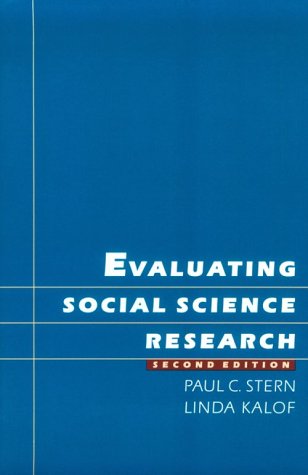
32. Evaluating Social Science Research
by Paul C. Stern, Linda Kalof
Paperback: 304 Pages (1996-04-04)
list price: US$44.95 -- used & new: US$17.97
(price subject to change: see help)
Asin: 0195079701
Canada | United Kingdom | Germany | France | Japan
Editorial Review

Book Description
We often decide what to believe and what to question on the basis of a simple rule of thumb like believe the trustworthy source or trust the expert. Sometimes, however, reliable and well-informed sources support both sides of the controversy. Whom are we to trust? How can we make a decision on the issue at hand? The second edition of Evaluating Social Science Research provides methods for thinking critically about claims of factual knowledge and drawing appropriate conclusions.The authors have added new sections to the book to reflect the new developments in the field since the appearance of the first edition sixteen years ago. Included is an expanded discussion of observational method that addresses the issues of validity that are now more clearly understood. There is an explicit discussion of quasi-experimental research design, including an added distinction between equivalent-group and nonequivalent-group experiments. New explanations of the logic of multiple regression analysis, casual modeling, and meta-analysis have been provided as well.The new edition, while recognizing the limits of each research method, retains its emphasis on the importance of observations that may be repeated and checked by other researchers. It treats the reader as a key actor who can advance knowledge by cross-checking observations and interpretations. ... Read more


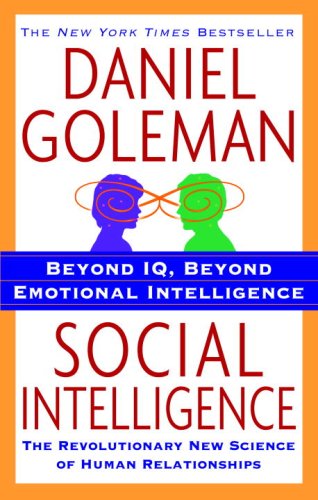
33. Social Intelligence: The New Science of Human Relationships
by Daniel Goleman
Paperback: 416 Pages (2007-07-31)
list price: US$14.00 -- used & new: US$7.88
(price subject to change: see help)
Asin: 055338449X
Average Customer Review: 4.0 out of 5 stars
Canada | United Kingdom | Germany | France | Japan
Editorial Review

Book Description
Emotional Intelligence was an international phenomenon, appearing on the New York Times bestseller list for over a year and selling more than five million copies worldwide. Now, once again, Daniel Goleman has written a groundbreaking synthesis of the latest findings in biology and brain science, revealing that we are “wired to connect” and the surprisingly deep impact of our relationships on every aspect of our lives.

Far more than we are consciously aware, our daily encounters with parents, spouses, bosses, and even strangers shape our brains and affect cells throughout our bodies—down to the level of our genes—for good or ill. In Social Intelligence, Daniel Goleman explores an emerging new science with startling implications for our interpersonal world.Its most fundamental discovery: we are designed for sociability, constantly engaged in a “neural ballet” that connects us brain to brain with those around us.

Our reactions to others, and theirs to us, have a far-reaching biological impact, sending out cascades of hormones that regulate everything from our hearts to our immune systems, making good relationships act like vitamins—and bad relationships like poisons. We can “catch” other people’s emotions the way we catch a cold, and the consequences of isolation or relentless social stress can be life-shortening. Goleman explains the surprising accuracy of first impressions, the basis of charisma and emotional power, the complexity of sexual attraction, and how we detect lies. He describes the “dark side” of social intelligence, from narcissism to Machiavellianism and psychopathy. He also reveals our astonishing capacity for “mindsight,” as well as the tragedy of those, like autistic children, whose mindsight is impaired.

Is there a way to raise our children to be happy?What is the basis of a nourishing marriage?How can business leaders and teachers inspire the best in those they lead and teach?How can groups divided by prejudice and hatred come to live together in peace?

The answers to these questions may not be as elusive as we once thought.And Goleman delivers his most heartening news with powerful conviction: we humans have a built-in bias toward empathy, cooperation, and altruism–provided we develop the social intelligence to nurture these capacities in ourselves and others. ... Read more

Customer Reviews (72)

5-0 out of 5 stars Like an Epiphany of the Mind
I have listened to the taped version of this book and I must admit it was hard to turn it off each morning and evening when I had reached my destinations. There was such intense revelations within the prose of this book again again... I found myself being validated again and again. I am in the medical field and I deal with patients every day. Being a Nurse Practitioner and not a physician I am constantly being told how I am not dealing with the patients in this difficult correctional setting like I should be, detatched and scientific. I have been recognized by the jail administrators to be who I am because we have recently passed an NCCHC certification inspection with a fantastic testimonial that expressed how the inspecting team has not seen our equal but once before in 10 years of inspections as a team. We were sited for cooperation and consideration in all areas that this team evaluates and were not found difficient in even one of the 40 criteria that encompasses the core of the certification process. This I attribute to my own approach to people using the concepts that Daniel Goldman has finally scetched out as being so productive in may aspects of human relationships and interactions. The easy manner of the prose made listening to this so much more enjoyable then if it had been presented in a more scientific manner. I do not think that Daniel Goldman was trying to prove anything with this treatise, he was only presenting gleefully to the world. Any critisim of his methodology might be truly justified if you are a one of the experts that might be used by a journal to justify its publication in your scientific publication. However, if you are a person wishing to validate how you communicate with the world around you, while others consistantly critize your approach you may be pleasantly suprised to find that your actually on track when the science is applied to really quantify your "feelings" about how things should be done. It was a pleasant epiphany for me. I would hope it would be for you as well.

5-0 out of 5 stars Very Insightful
This is a well thought out, well organized and very insightful work.In my opinion it is heavy reading.I generally can read a book a week.This one took about 50% longer.There are a number of reasons for this.There is very little white space on any page.The subject matter is new and different and unless you have made a deep study of the brain, its various parts and functions, you will often need to refresh your memory about what the various parts do.

Having said that, I would highly recommend the book to anyone who wishes to learn more about why we do what we do.There are some very valuable lessons that have application in everyday life.For example, Goleman talks about how fear in social situations engages the the flight or fight part of the brain, overriding the cognitive part.He gives everyday examples of how this shows up in our daily lives.The teacher randomly calling on students in the classroom can evoke social fear, shutting down the cognitive/learning part of the brain.

Goleman deals with numerous other social situations in life - love, anger, empathy, prejudices, crime and punishment.His insights are sharp and easy to understand.Some are real eye-openers.

The book is long, some 334 pages with 65 pages of notes.This means that the concepts set forth in the book have been well researched and he provides the sources for those who wish to do additional research on a particular point of view.

If you have any interest in why people do what they do, then this is an important book.Just realize that it requires some thought to read and grasp all the concepts put forth in the book.

4-0 out of 5 stars Very cool read
I enjoyed this book a lot; especially the parts about narcissism, the Machiavelli and the psychopath. Soon after that it got really into martial relationships, which, me not being in one, didn't apply to be immediately, but very insightful. Overall a good read and worth your purchase if your into finding out about how the brain works and how we get in tune with one another.

5-0 out of 5 stars amazing!
an amazing book about the importance of social interactions throughout life. filled with scientific proof and real life examples. this book will help you better your own social life and give you an understanding of your actions/reactions in all sorts of situations. it will give you all the tools to change your social life for the better.

5-0 out of 5 stars Daniel Goleman is a Master communicator
You could open this book anywhere and read something within the scope of the subject you may not have known before.What jumps out the most for me is the authors way of communicating a subject with his words.When a person is in love with his craft and wants to share and WANTS to help you understand(like any fine teacher) it shows, and with Daniel Goleman it shows in a very big way. ... Read more


34. Geographic Information Systems for the Social Sciences: Investigating Space and Place
by Steven J. Steinberg, Sheila L. Steinberg
Hardcover: 272 Pages (2005-08-11)
list price: US$109.00 -- used & new: US$100.00
(price subject to change: see help)
Asin: 0761928723
Canada | United Kingdom | Germany | France | Japan
Editorial Review

Book Description

"The Steinbergs have produced a very relevant book for the times. . . . While many books have emerged on the details of GIS, few resources exist to help teach the merger of GIS with more standard research methods. The Steinbergs accomplish this goal in a way that is readily accessible even to undergraduates."
Theodore Wagenaar, Miami University  

"The Steinbergs take the reader through all of the essential foundations of GIS using examples drawn from the social sciences throughout. This book will be essential reading for any social scientist looking for a straightforward introduction to GIS."
Mike Goodchild, University of California, Santa Barbara  

Geographic Information Systems for the Social Sciences: Investigating Space and Place is the first book to take a cutting-edge approach to integrating spatial concepts into the social sciences. In this text, authors Steven J. Steinberg and Sheila L. Steinberg simplify GIS (Geographic Information Systems) for practitioners and students in the social sciences through the use of examples and actual program exercises so that they can become comfortable incorporating this research tool into their repertoire and scope of interest. The authors provide learning objectives for each chapter, chapter summaries, links to relevant Web sites, as well as suggestions for student research projects.  

Key Features:

  • Presents step-by-step guidance for integrating GIS with both quantitative and qualitative research
  • Provides an introduction to the use of GIS technology written at an accessible level for individuals without GIS experience while providing depth and guidance appropriate to experienced GIS users 
  • Offers an associated interactive Web sitehttp://www.socialsciencegis.orgto provide a forum for sharing experience and ideas, input to the authors, and a variety of other examples, data, and information related to the topics covered in the text

    Geographic Information Systems for the Social Sciences offers a nuts-and-bolts introduction to GIS for undergraduate and graduate students taking methods courses across the social sciences. It is an excellent textbook for courses dedicated to GIS research and its applications in the fields of Sociology, Criminology, Public Health, Geography, Anthropology, Political Science, and Environmental Studies. It is also a valuable resource for any social scientist or practitioner interested in applying GIS technology to his or her work.

    An Instructor's Resource CD, containing PowerPoint slides, test questions, and suggested Web site links, among other items, is also available to all professors adopting this text.

    ... Read more

    35. Analyzing Social Science Data: 50 Key Problems in Data Analysis
    by David de Vaus
    Paperback: 402 Pages (2002-06-15)
    list price: US$69.95 -- used & new: US$42.84
    (price subject to change: see help)
    Asin: 0761959386
    Canada | United Kingdom | Germany | France | Japan
    Editorial Review

    Book Description

    In this novel and refreshing textbook, David de Vaus directs students to the core of data analysis. The book is an authoritative guide to the problems facing beginners in the field. Analyzing Social Science Data guides students in: problems with the initial data; problems with the initial variables; how to handle too much data; how to generalize; problems of analyzing single variables; problems examining bivariate relationships; and problems examining multivariate relationships

    The book is a tour de force in making data analysis manageable and rewarding for today's undergraduate studying research methods.

    `I'm full of admiration for this book. Once again, David de Vaus has come up with a superb book that is well written and organized and which will be a boon to a wide range of students. He has taken a vast array of problems that users of quantitative data analysis procedures are likely to encounter. The selection of issues and problems ... reflects the experience of a true practitioner with a grasp of his field and of the intricacies of the research process. The selection of issues clearly derives also from experience of teaching students how to do research and analyse data....A large number of practitioners will want the book. I was surprised at how much I learned from this. This will be a vital book for the bookshelves of practitioners of the craft of quantitative data analysis' - Alan Bryman, Professor of Social Research, Loughborough University

    ... Read more

    36. Research Methods in the Social Sciences
    Paperback: 376 Pages (2004-12-08)
    list price: US$51.95 -- used & new: US$34.29
    (price subject to change: see help)
    Asin: 0761944028
    Canada | United Kingdom | Germany | France | Japan
    Editorial Review

    Book Description

    A companion website is available for this text!

    "This book provides an excellent balance between theory and practical application in social research. The book works well to develop students' understanding of particular methods of inquiry, embedding them within "real world" settings. I envisage that it will help students to understand the nuances of particular approaches, the complimentarity of certain methods, and the areas of conflict/contention within social research in a way that overcomes the sometimes abstract nature of these discussions" - Dr Jon Tan, School of Education and Professional Training, Leeds Metropolitan University

    "This book unlocks all of the important areas of social science research in an easily digestible and stimulating style. Both students and supervisors in a range of disciplines will find this an excellent resource" - Fazal Rizvi, Professor in Educational Policy Studies at the University of Illinois at Urbana-Champaign

    Rather than being written by one or two `generalists', this innovative book is written by a large number of active researchers about their specialisms in methods/methodologies.

    The book introduces all the key qualitative and quantitative research methodologies and methods and seeks to draw readers into a community of researchers engaged in reflection on the research process. Included are narrative accounts of carrying out a research study that explore the way in which the research design and methods are shaped by the methodology, discussing problematic issues, and reflecting on the way in which knowledge and understanding develop. Aimed at researchers and postgraduate students, it will also be invaluable for students at masters level.

    Click on the companion website logo above to access additional resources and links to accompany each chapter in the book.

    "Research Methods in the Social Sciences is a valuable pedagogical tool. It is organized as a dialogue between theory and key concepts, and practice - stories from the field allowing novices and scholars alike to see how critical interpretive research is actually conducted" - Norman K Denzin, University of Illinois

    ... Read more

    37. Statistics for the Social Sciences
    by R. Mark Sirkin
    Paperback: 632 Pages (2005-08-17)
    list price: US$80.95 -- used & new: US$45.00
    (price subject to change: see help)
    Asin: 141290546X
    Average Customer Review: 5.0 out of 5 stars
    Canada | United Kingdom | Germany | France | Japan
    Editorial Review

    Book Description
    Do your students lack confidence in their ability to handle quantitative work? Do they get confused about how to enter statistical data on SAS, SPSS, and Excel programs? The new Third Edition of the bestselling Statistics for the Social Sciences is the solution to these dilemmas!

    Popular in previous editions, this Third Edition continues to help build students confidence and ability in doing statistical analysis by slowly moving from concepts that require little computational work to those that require more. Author R. Mark Sirkin once again demonstrates how statistics can be used so that students come to appreciate their usefulness rather than fear them. Statistics for the Social Sciences emphasizes the analysis and interpretation of data to give students a feel for how data interpretation is related to the methods by which the information was obtained. The book includes lists of key concepts, chapter exercises, topic boxes, and more!

    New to the Third Edition:

    • Includes additional exercises to reflect the new computer coverage
    • Provides new tools to teach students how to do analysis not only through SAS and SPSS, but also using Excel descriptive statistics features
    • Offers a wide range of examples from various fields in the social sciences to demonstrate the role of statistical analysis in the research process

    Statistics for the Social Sciences is an excellent text for advanced undergraduate and graduate students studying statistics across the social sciences. It can also be used in research methods courses that cover quantitative applications in some depth. An Instructors CD-ROM containing data sets, Powerpoint slides, exercises, and answers will be available free-of-charge to professors adopting this text. ... Read more

    Customer Reviews (2)

    5-0 out of 5 stars Comprehensive textbook
    This is a comprehensive book covering all the major topics that a student would need for the statistics modules in various social science courses. Managers need to have an understanding of statistics so that they are able to manipulate the numerous masses of data that come their way into meaningful and useful information that they can employ in making decisions in organisations.

    The author presented the material in the book in a clear and in-depth manner, making it suitable for social science students studying statistics or carrying out research required statistical manipulations. The author also provided several examples and exercises that should assist the reader in consolidating his/her understanding of the concepts described in the book.

    Most managers are consumers rather than producers of statistical information. This book equips you with the expertise to enable you to be an informed consumer who knows the right questions to ask and the kind of information to request from those who produce the statistical information in the organization.

    5-0 out of 5 stars clearest presentation of statistics.
    Excellent presentation of complicated subject. For many people stats are intimidating. This book is the clearest presentation I've seen ... Read more


    38. On the Logic of the Social Sciences (Studies in Contemporary German Social Thought)
    by Jürgen Habermas
    Paperback: 236 Pages (1990-08-15)
    list price: US$20.00 -- used & new: US$9.98
    (price subject to change: see help)
    Asin: 0262581043
    Canada | United Kingdom | Germany | France | Japan
    Editorial Review

    Book Description
    In a provocative argument that ends with his own sharply profiled position, Jürgen Habermas considers the main lines of thought pursued by epistemologists and methodologists of the social sciences - from NeoKantianism to behaviorism. For two decades, the German edition of this classic has been a standard reference point for discussions of the social sciences.

    Jürgen Habermas is Professor of Philosophy at the University of Frankfurt. ... Read more


    39. History-Social Science Framework for California Public Schools: Kindergarten Through Grade Twelve
     Hardcover: 234 Pages (2005-01)
    list price: US$17.50 -- used & new: US$17.39
    (price subject to change: see help)
    Asin: 0801115981
    Canada | United Kingdom | Germany | France | Japan

    40. Social Darwinism: Science and Myth in Anglo-American Social Thought (American Civilization)
    by Robert C. Bannister
    Paperback: 292 Pages (1989-02)
    list price: US$23.95 -- used & new: US$19.55
    (price subject to change: see help)
    Asin: 0877225664
    Average Customer Review: 4.5 out of 5 stars
    Canada | United Kingdom | Germany | France | Japan

    Customer Reviews (2)

    5-0 out of 5 stars Darwin's Dangerous Idea
    This is an important text in the study of Social Darwinism, written partly in response to Hofstadter's classic work on the subject. Somewhat revisionist it challenges some of the findings in that earlier work. It is a useful exercise to read both works, and one might in addition read a recent essay on the history of Hofstadter's work leading into Bannister's in an essay in Eric Foner's Who Owns History. Although I would recommend Bannister's work as essential reading here, I think the question of "Social Darwinism" is often misinterpreted depending on our prior and assumed views of Darwin's theory. If we are 'Darwinists' and accept his theory of selectionism in any strong form as a full theory we will inexorably become tacit 'social Darwinists', for the simple reason that we believe the rigors of natural selection will produce the highest evolved complexity. Therefore more of the same, etc... This obstinate fallacy springs from the failure to see that theories have temporal domains, and that a true theory of evolution must separate the past, present and futre, something Darwinian thinking is too clubfooted to do. The results are historically disatrous. Thus we are automatically likely to miscalculate our place in an historical context. Mimicking natural selection in social history is a nobrainer and will not produce further evolution in man, and yet we tend unconsciously to think so. And, despite Bannister's pointing to the thinness of the actual references to the term 'Social Darwinism', the fact is that vast numbers of people quietly and without much public discourse feel obligated to act in a social Darwinist manner.
    In fact, because of this confusion over theory, it should be said that Darwin, always defended from the charge usually pinned on Spencer, is really a clear 'Social Darwinist', by the very nature of the case. So analysis here stands or falls on the status of Darwin's theory, and there the point is precisely that we lack the full proof of that natural selection is the real answer in toto for man's descent. It is a disastrous confusion, and one that mars this otherwise interesting complement to the literature.
    In a broader context, the calamitous influence of Darwin cannot be explained away so easily by focussing solely on the concepts of something called 'Social Darwinism'. Its effect on the First World War generation and later can't be explained away so easily, nor the overall influence absolved.
    The main point is to see that Darwin's actual selectionist theory is probably false, and then research here can start all over.

    4-0 out of 5 stars Debunking some misconceptions of"Social Darwinism"
    If you went through high sdhool and college as I did, your History textbook probably mentioned Darwin and his Origin of Species and then went straight to "Social Darwinism" in which we were led to believe that several thinkers took Darwin's notion of "survival of the fittest" and applied it to humans, both individuals and races, espousing the idea that only the strong survive.-Bannister debunks both the history and logic of this supposed history.-To begin with, "Survival of the fittest" does not mean that the "strongest" survive.It means that those "adapted to existing conditions survive."In other words, a grizzly bear may be terribly strong, but he would die in equatorial regions where weaker, but more adapted, creatures survive.-Further, Bannister shows through thoroughgoing research that the term "Social Darwinism" did not even come into vogue until the 1940's, not, as most of us were led to believe, in the late 19th century.In fact, Bannister, in searching for references to those Social Darwinists he and I and probably you were so familiar with through History books, "came close to concluding that someone had made the whole thing up."Furthermore, the seldom times the term is used in the late 19th century, it is always pejorative and used to castigate someone ELSE who had a "Nature red and tooth and claw" perspective on human beings.In other words, proclaiming one's self a Social Darwinist in the late 19th century would be the equivilant of proclaimimg one's self a Nazi today...Remember, it was the Victorian age.-The reason I gave the book 4 stars instead of the superlative 5 is because he gives short shrift to Nietzsche in his chapter on him.While mentioning that there were thinkers that did not equate Nietzsche with Social Darwinism, he doesn't dwell on them or give their arguments.Instead, he dwells on those who equate Nietzsche with the most extreme form of Social Darwinism...Anyone who has read Nietzsche in detail realizes that this is far from the case.Simplification of Nietzsche abounds in almost all scholarly works not concentrated on him. Unfortunately, Bannister's is no exception.-But, aside from this scholarly neglect, the book was an eye-opener, debunking most of what I thought of the history of Social Darwinism.-Give it a read. ... Read more


      Back | 21-40 of 100 | Next 20
    A  B  C  D  E  F  G  H  I  J  K  L  M  N  O  P  Q  R  S  T  U  V  W  X  Y  Z  

    Prices listed on this site are subject to change without notice.
    Questions on ordering or shipping? click here for help.

    site stats