e99 Online Shopping Mall

Geometry.Net - the online learning center Help  
Home  - Science - Xenarthra (Books)

  1-20 of 32 | Next 20
A  B  C  D  E  F  G  H  I  J  K  L  M  N  O  P  Q  R  S  T  U  V  W  X  Y  Z  

click price to see details     click image to enlarge     click link to go to the store

 
$100.00
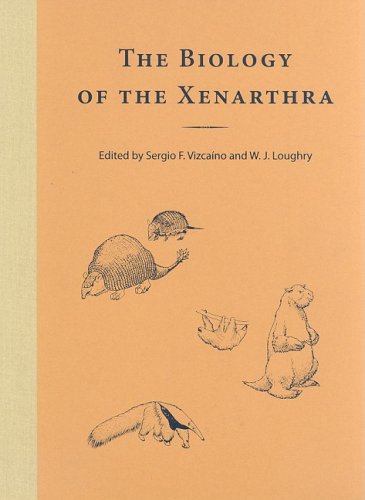
1. The Biology of the Xenarthra
$7.95
2. The armadillos (Mammalia, Xenarthra,
 
$3.95
3. Xenarthra: An entry from Thomson
$8.95
4. A translocation experiment for
 
5. Phylogeny of the Tardigrada (Mammalia,
 
$9.95
6. Un gliptodonte (xenarthra, cingulata)
 
$5.95
7. Diet of Pleistocene Paramylodon
 
8. The armor of fossil giant armadillos
 
9. Phylogeny of the Tardigrada (Mammalia,
 
10. Descriptions of two extinct mammals
 
11. The Morphology of Xenarthrous
 
12. First Tertiary land mammal from
 
13. Phylogeny of the Tardigrada (Mammalia,
 
14. Los xenarthras fosiles de la localidad
 
15. New megalonychid sloths (Phyllophaga,
16. Anteaters, Sloths, and Armadillos
 
17. Armadillos, Anteaters, and Sloths:
 
18. The Evolution and Ecology of Armadillos,
 
19. Observations on the genus Salamandra
 
20. Some observations on the habits

1. The Biology of the Xenarthra
 Hardcover: 640 Pages (2008-05-18)
list price: US$100.00 -- used & new: US$100.00
(price subject to change: see help)
Asin: 0813031656
Canada | United Kingdom | Germany | France | Japan
Editorial Review

Book Description

The Xenarthra are an order of the mammals consisting of the armadillos, anteaters, and sloths. The Biology of the Xenarthra is the first authoratative study of the Xenarthra in a generation.
The volume features an impressive group of international scholars who explore the current biology and ecological status of these mammals in each of the geographic regions they inhabit. Many of these populations reside in developing countries, and before now, information on these species has been scarce.
Topics cover a wide array of issues including genetics, physiology, behavior, ecology, and conservation. Discussions range from paleontological perspectives on xenarthran evolution to both lab and field-based studies of living species. Contemporary research in areas such as genome sequencing and leprosy in armadillos is also included.
... Read more

2. The armadillos (Mammalia, Xenarthra, Dasypodidae) of the Santa Cruz [An article from: Palaeogeography, Palaeoclimatology, Palaeoecology]
by S.F. Vizcaino, M.S. Bargo, R.F. Kay, N. Milne
Digital: 14 Pages (2006-08-04)
list price: US$7.95 -- used & new: US$7.95
(price subject to change: see help)
Asin: B000P6OB7C
Canada | United Kingdom | Germany | France | Japan
Editorial Review

Book Description
This digital document is a journal article from Palaeogeography, Palaeoclimatology, Palaeoecology, published by Elsevier in 2006. The article is delivered in HTML format and is available in your Amazon.com Media Library immediately after purchase. You can view it with any web browser.

Description:
The Santacrucian (early-middle Miocene) fauna is exceptional in its richness (over 70 species recorded in 21 stratigraphic levels). In this contribution we attempt a preliminary paleobiological characterization of the armadillos (Dasypodidae and Peltephilidae). Santacrucian Dasypodidae includes the genera Prozaedyus Ameghino, Proeutatus Ameghino, Stenotatus Ameghino, and Stegotherium Ameghino. The Peltephilidae include the genus Peltephilus Ameghino and others undergoing systematic revision. Body masses and locomotory habits are inferred from the sizes of the proximal and middle shaft dimensions of the limb bones from allometric equations and indices previously modeled in living dasypodids. Masticatory and dietary interpretations are based on the jaw mechanics, the analysis of the temporomandibular joint and mandibular symphysis, and the shape, arrangement and wear patterns of teeth. The body mass averages are 15.28 kg for Proeutatus, 3.72 kg for Stenotatus, 1.12 kg for Prozaedyus, 11.47 for Stegotherium, and 11.07 kg for Peltephilus. The diversity in limb bone proportions is not so marked as in the living species; forelimb indices reflect proportions similar to those of the living dasypodines and euphractines, all of whom are relatively good diggers. None of the Santacrucian taxa reach the degree of cursoriality of Tolypeutes Illiger, the extreme fossoriality of Priodontes F. Cuvier, or the subterranean habits of Chlamyphorus Harlan. Within a potentially generalized omnivory, some specializations can be easily detected within the Santacrucian armadillos: herbivory in Proeutatus and Peltephilus, and myrmecophagy in Stegotherium. This could help to explain the potential coexistence of so many genera in a single area, diminishing the degree of competition for resources. ... Read more


3. Xenarthra: An entry from Thomson Gale's <i>Grzimek's Animal Life Encyclopedia</i>
by Virginia L., PhD Naples
 Digital: 8 Pages (2004)
list price: US$3.95 -- used & new: US$3.95
(price subject to change: see help)
Asin: B000M59SU6
Canada | United Kingdom | Germany | France | Japan
Editorial Review

Book Description

Gale proudly presents the completely revised and updated version of the acclaimed Grzimek's Animal Life Encyclopedia set. Hailed by many as the best reference work on animals ever published, a legacy left to us by famed zoologist and animal lover Bernhard Grzimek, this set is renowned for its scientific reporting and coverage, and serves as a major point of reference for researchers, students, and those hoping to satisfy their curiosity about the animal kingdom. Information can be found on life cycles, predators, food systems, overall ecology and much more. Staying true to the original scientific pedigree, Gale enlisted prominent advisors and contributors from the international scientific community to incorporate recent developments in our knowledge of the animal world.

... Read more

4. A translocation experiment for the conservation of maned sloths, Bradypus torquatus (Xenarthra, Bradypodidae) [An article from: Biological Conservation]
by A.G. Chiarello, D.J. Chivers, C. Bassi, M. Maciel
Digital: Pages (2004-08-01)
list price: US$8.95 -- used & new: US$8.95
(price subject to change: see help)
Asin: B000RR067S
Canada | United Kingdom | Germany | France | Japan
Editorial Review

Book Description
This digital document is a journal article from Biological Conservation, published by Elsevier in 2004. The article is delivered in HTML format and is available in your Amazon.com Media Library immediately after purchase. You can view it with any web browser.

Description:
The maned sloth is a poorly known species endemic to the highly fragmented and disturbed Brazilian Atlantic forest. As this species has a strictly forest habitat and low dispersion ability, it is susceptible to local extinctions in small and isolated fragments. The project started in 1994, translocating stranded sloths found within or nearby urban zones into forest reserves located in Santa Teresa, state of Espi@?rito Santo. Five translocated, radio-collared adults were monitored monthly from periods lasting from 10 months to 3 years after release and data on activity budgets, diet, and home range size were analysed. Results showed that moving and feeding time and distances travelled daily were not significantly related to translocation time (i.e., time, in days, after release). One female, monitored for three years showed, however, a steady and significant decrease in time spent moving from the first to the second to the third year of monitoring (regression Analysis; p<0.05). The distances it travelled/day also decreased throughout this same period, but results were not significant (ANOVA; p>0.05). Sloths explored the area more intensively in the first 6 months after release, but minor changes in home ranges were detected even after 3 years. Results suggest that maned sloths are amenable to translocation experiments provided that source and release sites are floristic and ecologically similar. To fully access the success of such experiments though, it is recommended that sloths be monitored for periods longer than 1 year. ... Read more


5. Phylogeny of the Tardigrada (Mammalia, Xenarthra) and the Evolution of Locomotor Function in the Xenarthra.
by Timothy J. Gaudin
 Hardcover: Pages (1993)

Asin: B000XUHY8S
Canada | United Kingdom | Germany | France | Japan

6. Un gliptodonte (xenarthra, cingulata) de la localidad de chachagua, provincia de alajuela, Costa Rica.(Nota científica): An article from: Revista Geológica de América Central
by Ana Lucía Valerio Z., César Alberto Laurito M., Luis Diego Gómez P.
 Digital: 4 Pages (2005-06-01)
list price: US$9.95 -- used & new: US$9.95
(price subject to change: see help)
Asin: B000MTFIC4
Canada | United Kingdom | Germany | France | Japan
Editorial Review

Book Description
This digital document is an article from Revista Geológica de América Central, published by Thomson Gale on June 1, 2005. The length of the article is 950 words. The page length shown above is based on a typical 300-word page. The article is delivered in HTML format and is available in your Amazon.com Digital Locker immediately after purchase. You can view it with any web browser.

Citation Details
Title: Un gliptodonte (xenarthra, cingulata) de la localidad de chachagua, provincia de alajuela, Costa Rica.(Nota científica)
Author: Ana Lucía Valerio Z.
Publication: Revista Geológica de América Central (Magazine/Journal)
Date: June 1, 2005
Publisher: Thomson Gale
Issue: 32Page: 61(3)

Distributed by Thomson Gale ... Read more


7. Diet of Pleistocene Paramylodon harlani (xenarthra: mylodontidae): review of methods and preliminary use of carbon isotopes.: An article from: The Texas Journal of Science
by Dennis R., Jr. Ruez
 Digital: 19 Pages (2005-11-01)
list price: US$5.95 -- used & new: US$5.95
(price subject to change: see help)
Asin: B000DZVESY
Canada | United Kingdom | Germany | France | Japan
Editorial Review

Book Description
This digital document is an article from The Texas Journal of Science, published by Thomson Gale on November 1, 2005. The length of the article is 5640 words. The page length shown above is based on a typical 300-word page. The article is delivered in HTML format and is available in your Amazon.com Digital Locker immediately after purchase. You can view it with any web browser.

Citation Details
Title: Diet of Pleistocene Paramylodon harlani (xenarthra: mylodontidae): review of methods and preliminary use of carbon isotopes.
Author: Dennis R., Jr. Ruez
Publication: The Texas Journal of Science (Magazine/Journal)
Date: November 1, 2005
Publisher: Thomson Gale
Volume: 57Issue: 4Page: 329(16)

Distributed by Thomson Gale ... Read more


8. The armor of fossil giant armadillos (Pampatheriidae, Xenarthra, Mammalia) (Pearce-Sellards series)
by A. Gordon Edmund
 Unknown Binding: 20 Pages (1985)

Asin: B0006EKL0O
Canada | United Kingdom | Germany | France | Japan

9. Phylogeny of the Tardigrada (Mammalia, Xenarthra) and the Evolution
 Hardcover: Pages (1993)

Asin: B000IBGJWO
Canada | United Kingdom | Germany | France | Japan

10. Descriptions of two extinct mammals of the order Xenarthra from the Pleistocene of Texas
by Oliver Perry Hay
 Unknown Binding: Pages (1917)

Asin: B0008B247S
Canada | United Kingdom | Germany | France | Japan

11. The Morphology of Xenarthrous Vertebrae (Mammalia: Xenarthra) (Field Musuem of Natural History Publication 1505)
by Timothy J. Gaudin
 Paperback: Pages (2000-12)
list price: US$12.00
Isbn: 999142170X
Canada | United Kingdom | Germany | France | Japan

12. First Tertiary land mammal from Greater Antilles: An early Miocene sloth (Xenarthra, Megalonychidae) from Cuba (American Museum novitates)
by R. D. E MacPhee
 Unknown Binding: 13 Pages (1994)

Asin: B0006P7AMA
Canada | United Kingdom | Germany | France | Japan

13. Phylogeny of the Tardigrada (Mammalia, Xenarthra) and the Evolution
by Timothy J. Gaudin
 Hardcover: Pages (1993)

Asin: B000UFY51U
Canada | United Kingdom | Germany | France | Japan

14. Los xenarthras fosiles de la localidad de Buenos Aires de palmares (Blancano Tardio--Irvingtoniano Temprano), Provincia de Alajuela, Costa Rica.: An article from: Revista Geolgica de Amca Central
by Cr Laurito Mora, Ana LucPz Gamboa, Eduardo Antonio Valerio Zamora
 Digital: 13 Pages (2005-12-01)
list price: US$9.95
Asin: B000QJLN2O
Canada | United Kingdom | Germany | France | Japan
Editorial Review

Book Description
This digital document is an article from Revista Geológica de América Central, published by Thomson Gale on December 1, 2005. The length of the article is 3624 words. The page length shown above is based on a typical 300-word page. The article is delivered in HTML format and is available in your Amazon.com Digital Locker immediately after purchase. You can view it with any web browser.

Citation Details
Title: Los xenarthras fosiles de la localidad de Buenos Aires de palmares (Blancano Tardio--Irvingtoniano Temprano), Provincia de Alajuela, Costa Rica.
Author: César Laurito Mora
Publication: Revista Geológica de América Central (Magazine/Journal)
Date: December 1, 2005
Publisher: Thomson Gale
Issue: 33Page: 83(8)

Distributed by Thomson Gale ... Read more


15. New megalonychid sloths (Phyllophaga, Xenarthra) from the Quaternary of Hispaniola (American Museum novitates)
by R. D. E MacPhee
 Unknown Binding: 32 Pages (2000)

Asin: B0006RIKU4
Canada | United Kingdom | Germany | France | Japan

16. Anteaters, Sloths, and Armadillos (Animals in Order)
by Ann O. Squire
Paperback: 48 Pages (1999-09)
list price: US$6.95
Isbn: 0531159426
Average Customer Review: 4.0 out of 5 stars
Canada | United Kingdom | Germany | France | Japan

Customer Reviews (1)

4-0 out of 5 stars What An Interesting Read!
This is a fine starter series for kids interested studying different animals.Anteaters, Sloths, and Armadillos is our most recent adventure with the wonderful and interesting Animals in Order series...what can I say, my kids just can't get enough of these!What I like a great deal about this is that it takes time at the beginning of the book to look at (briefly) what makes an animal a xenarthrans, specifically getting into what traits exactly make a xenarthran (when roughly translates into strange joint).The book then goes into the "order" of living things which details the kingdom, phylum and class , order, family and species (with a handy visual chart for reference, great for younger kids, so they can SEE how it works rather than just read it or have it read to them). This is one of the better features of this series.Next the text goes specifically into where xenarthrans fit into animal kingdom, breaking it down (in words and pictures again) to kingdom (animal), phylum (chordate), class (mammal) and order (xenarthran).

The book also talks a bit about where anteaters, sloths, and armadillos of all types and sizes fit into food chain and in habitats.Anteaters, Sloths, and Armadillos goes from there into an overview of fifteen species complete with full page, color photographs for each one, which really serve to bring the information to life.This section includes Family, Common Example, Genus and Species and Size for each animal discussed and each animal is given one full page for written description and one full page COLOR photo...excellent for fully engaging the reader!Animals included here are the giant anteater, southern tamandua, two-toes sloth, pale-throated three-toed sloth, nine-banded armadillo, pichi and more!

Overall, a fantastic way to introduce various types of artiodactyls to your curious young reader!What you get in Anteaters, Sloths, and Armadillosis an excellent overview of all types of zenarthrans.Additionally, at the end of the book are several pages of fun facts about sloths, anteaters and armadillos.As always with this series, I was pleased to find that at the end of the book the author/publisher also included a short recommended reading list and some really great web pages to do more research on...the kids in particular LOVED this! The books in this series would make a wonderful addition to a classroom library or as gifts for your favorite young reader who has a passion for animals; the information here is scientifically presented, accented with wonderful color photos and is both interesting and informative!
... Read more


17. Armadillos, Anteaters, and Sloths: How They Live
by Jane E. Hartman
 School & Library Binding: 93 Pages (1980-03)
list price: US$7.95
Isbn: 0823404005
Canada | United Kingdom | Germany | France | Japan

18. The Evolution and Ecology of Armadillos, Sloths and Vermilinguas
 Paperback: 451 Pages (1986-03-17)
list price: US$51.00
Isbn: 0874746493
Canada | United Kingdom | Germany | France | Japan

19. Observations on the genus Salamandra ;: And Description of a new genus of quadrupeds, of the order Edentata
by Richard Harlan
 Unknown Binding: Pages (1824)

Asin: B0008CVMVG
Canada | United Kingdom | Germany | France | Japan

20. Some observations on the habits and placentation of Tatu novemcinctum ;: A suggested classification of edentates (Research bulletin / the State University of Oklahoma)
by Henry Higgins Lane
 Unknown Binding: 27 Pages (1909)

Asin: B00088G5LM
Canada | United Kingdom | Germany | France | Japan

  1-20 of 32 | Next 20
A  B  C  D  E  F  G  H  I  J  K  L  M  N  O  P  Q  R  S  T  U  V  W  X  Y  Z  

Prices listed on this site are subject to change without notice.
Questions on ordering or shipping? click here for help.

site stats