
|
Help |
| Home - Scientists - Aristotle (Books) | |
e99 Online Shopping Mall
|
|
Help |
| Home - Scientists - Aristotle (Books) | |
| 1-20 of 97 | Next 20 |
click price to see details click image to enlarge click link to go to the store
| 1. Ethics by Aristotle | |
 | Kindle Edition:
Pages
(2009-10-04)
list price: US$1.99 Asin: B002RKS4AY Average Customer Review: 
Canada | United Kingdom | Germany | France | Japan |
|
Editorial Review Product Description Customer Reviews (2)
| |
| 2. Politics: A Treatise on Government: A Powerful Work by Aristotle (Timeless Classic Books) by Aristotle, Timeless Classic Books | |
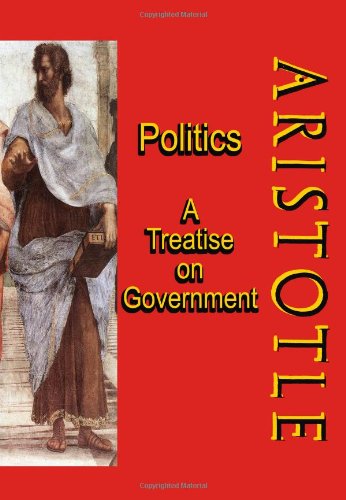 | Paperback: 150
Pages
(2010-08-28)
list price: US$14.95 -- used & new: US$10.76 (price subject to change: see help) Asin: 1453780173 Average Customer Review: 
Canada | United Kingdom | Germany | France | Japan |
|
Editorial Review Product Description Customer Reviews (1)
| |
| 3. THE WORKS OF ARISTOTLE THE FAMOUS PHILOSOPHER: CONTAINING HIS COMPLETE MASTERPIECE AND FAMILY PHYSICIAN; HIS EXPERIENCED MIDWIFE; HIS BOOK OF PROBLEMS AND HIS REMARKS ON PHYSIOGNOMY by ARISTOTLE | |
| Hardcover:
Pages
(1111-01-01)
Asin: B00199NIDM Average Customer Review: 
Canada | United Kingdom | Germany | France | Japan | |
Customer Reviews (1)
| |
| 4. Poetics. English by Aristotle | |
 | Kindle Edition:
Pages
(2009-10-04)
list price: US$1.99 Asin: B002RKRWWA Canada | United Kingdom | Germany | France | Japan |
|
Editorial Review Product Description | |
| 5. Aristotle on the art of poetry by Aristotle | |
 | Kindle Edition:
Pages
(2004-10-01)
list price: US$0.00 Asin: B000JQUPY6 Average Customer Review:
Canada | United Kingdom | Germany | France | Japan |
|
Editorial Review Product Description Customer Reviews (1)
| |
| 6. Nicomachean Ethics by Aristotle | |
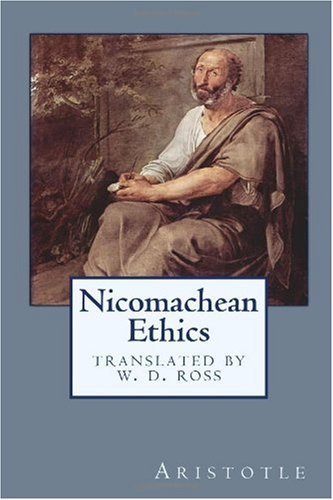 | Paperback: 182
Pages
(2009-09-16)
list price: US$6.99 -- used & new: US$6.99 (price subject to change: see help) Asin: 1557427704 Average Customer Review:
Canada | United Kingdom | Germany | France | Japan |
|
Editorial Review Product Description Customer Reviews (55)
| |
| 7. Poetics by Aristotle | |
 | Paperback: 68
Pages
(2008-10-31)
list price: US$9.95 -- used & new: US$8.61 (price subject to change: see help) Asin: 1605203556 Average Customer Review:
Canada | United Kingdom | Germany | France | Japan |
|
Editorial Review Product Description Customer Reviews (28)
| |
| 8. The Basic Works of Aristotle (Modern Library Classics) by Aristotle | |
 | Paperback: 1520
Pages
(2001-09-11)
list price: US$21.95 -- used & new: US$11.93 (price subject to change: see help) Asin: 0375757996 Average Customer Review:
Canada | United Kingdom | Germany | France | Japan |
|
Editorial Review Product Description Customer Reviews (14)
| |
| 9. Rhetoric by Aristotle | |
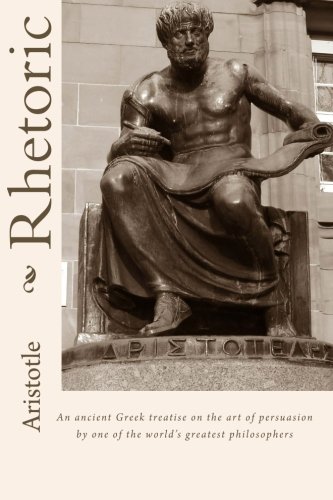 | Paperback: 146
Pages
(2010-09-18)
list price: US$9.95 -- used & new: US$9.95 (price subject to change: see help) Asin: 1611042402 Average Customer Review:
Canada | United Kingdom | Germany | France | Japan |
|
Editorial Review Product Description Customer Reviews (22)
| |
| 10. Aristotle for Everybody by Mortimer J. Adler | |
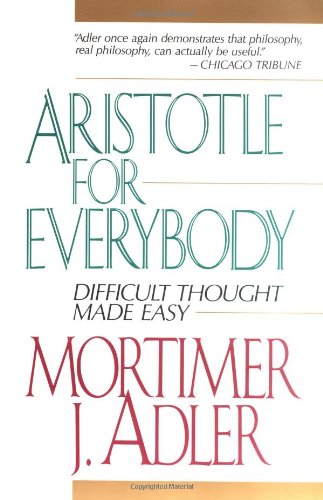 | Paperback: 288
Pages
(1997-06-01)
list price: US$15.00 -- used & new: US$7.19 (price subject to change: see help) Asin: 0684838230 Average Customer Review:
Canada | United Kingdom | Germany | France | Japan |
|
Editorial Review Product Description Customer Reviews (21)
| |
| 11. Complete Works of Aristotle, Vol. 1 by Aristotle | |
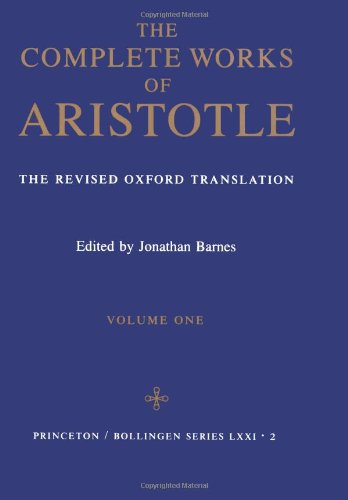 | Hardcover: 1256
Pages
(1971)
list price: US$49.50 -- used & new: US$33.99 (price subject to change: see help) Asin: 069101650X Average Customer Review: 
Canada | United Kingdom | Germany | France | Japan |
|
Editorial Review Product Description Customer Reviews (10)
| |
| 12. The Complete Works of Aristotle: The Revised Oxford Translation, Vol. 2 (Bollingen Series LXXI-2) by Aristotle | |
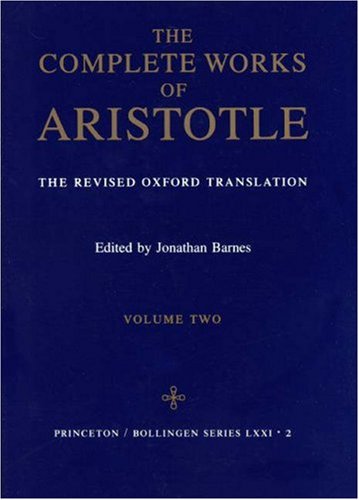 | Hardcover: 1256
Pages
(1984-09-01)
list price: US$49.50 -- used & new: US$33.99 (price subject to change: see help) Asin: 0691016518 Average Customer Review:
Canada | United Kingdom | Germany | France | Japan |
|
Editorial Review Product Description Customer Reviews (3)
As with the first volume, this translation makes the surviving works of Aristotle easily read for the English-speaking readers.This volume combined with the first makes a comprehesive work.Both volumes are nicely bound and the type is easy to read.Also, the volumes have numerals printed in the outer margins to key the translations to Immanuel Bekker's standard edition of the Greek text of Aristotle of 1831.The index of both editions could use a bit more work as they are cumbersome to work with, but not impossible. I've found that using "The Cambridge Companion to Aristotle" of great help.This is also edithed by Jonathan Barnes.The contents of volume 2 are as follows:On Plants, On Marvellous Things Heard, Mechanics, Problems On Indivisible Lines, The Situation and Names of Winds, On Melissus,Xenophanes,and Gorgias, Metaphysics, Nicomachean Ethics, Magna Moralia, Eudemian Ethics, On Virtues and Vices, Politics, Economics, Rhetoric, Rhetoric to Alexander, Poetics, Constition of Athens, Fragments. As with the first voume, this work contains works that the authenticity has been seriously doubted and works that are spurious and have never been seroiusly contested. The translations are easily read and flow.You can definately understand what Aristotle is trying to say. Both of these volumes make an excellent addition to your home library. ... Read more | |
| 13. Aristotle's Poetics for Screenwriters: Storytelling Secrets From the Greatest Mind in Western Civilization by Michael Tierno | |
 | Paperback: 192
Pages
(2002-08-21)
list price: US$13.99 -- used & new: US$7.53 (price subject to change: see help) Asin: 0786887400 Average Customer Review:
Canada | United Kingdom | Germany | France | Japan |
|
Editorial Review Product Description An insightful how-to guide for writing screenplays that uses Aristotle's great work as a guide. Long considered the bible for storytellers, Aristotle's Poetics is a fixture of college courses on everything from fiction writing to dramatic theory. Now Michael Tierno shows how this great work can be an invaluable resource to screenwriters or anyone interested in studying plot structure. In carefully organized chapters, Tierno breaks down the fundamentals of screenwriting, highlighting particular aspects of Aristotle's work. Then, using examples from some of the best movies ever made, he demonstrates how to apply these ancient insights to modern-day screenwriting. This user-friendly guide covers a multitude of topics, from plotting and subplotting to dialogue and dramatic unity. Writing in a highly readable, informal tone, Tierno makes Aristotle's monumental work accessible to beginners and pros alike in areas such as screenwriting, film theory, fiction, and playwriting. Customer Reviews (14)
| |
| 14. Categoriae. English by Aristotle | |
 | Kindle Edition:
Pages
(2010-02-13)
list price: US$3.55 Asin: B0038HEN4Q Canada | United Kingdom | Germany | France | Japan |
|
Editorial Review Product Description | |
| 15. Aristotle: A Very Short Introduction (Very Short Introductions) by Jonathan Barnes | |
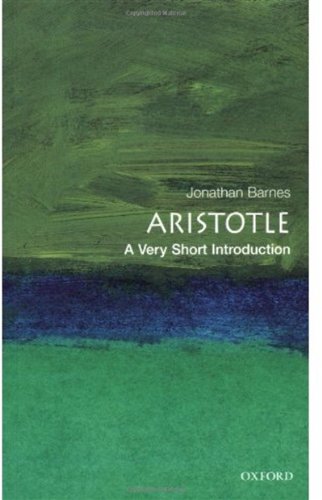 | Paperback: 176
Pages
(2001-01-18)
list price: US$11.95 -- used & new: US$6.62 (price subject to change: see help) Asin: 0192854089 Average Customer Review:
Canada | United Kingdom | Germany | France | Japan |
|
Editorial Review Product Description Customer Reviews (7)
| |
| 16. Aristotle: The Politics and the Constitution of Athens (Cambridge Texts in the History of Political Thought) by Aristotle | |
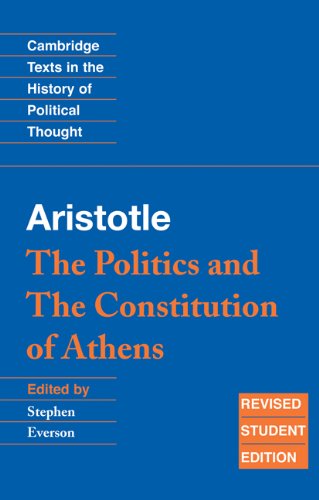 | Paperback: 328
Pages
(1996-10-13)
list price: US$16.99 -- used & new: US$4.90 (price subject to change: see help) Asin: 0521484006 Average Customer Review:
Canada | United Kingdom | Germany | France | Japan |
|
Editorial Review Product Description Customer Reviews (3)
'ThePolitics' remains an essential feature in the literature of politics andphilosophy.Whether the reader is a first year political science studentor a senior lecturer seeking to replace that well-worn second (or third)copy of an earlier edition, the particular book will be the ideal choice. ... Read more | |
| 17. The Rhetoric and the Poetics of Aristotle (Modern Library College Editions) by Aristotle | |
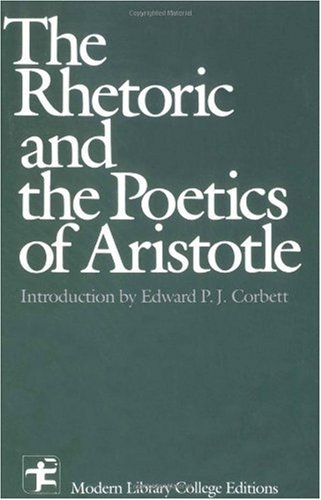 | Paperback: 289
Pages
(1984-02)
list price: US$10.00 -- used & new: US$9.50 (price subject to change: see help) Asin: 0075546027 Average Customer Review:
Canada | United Kingdom | Germany | France | Japan |
|
Editorial Review Product Description Customer Reviews (1)
| |
| 18. Aristotle and an Aardvark Go to Washington by Thomas Cathcart, Daniel Klein | |
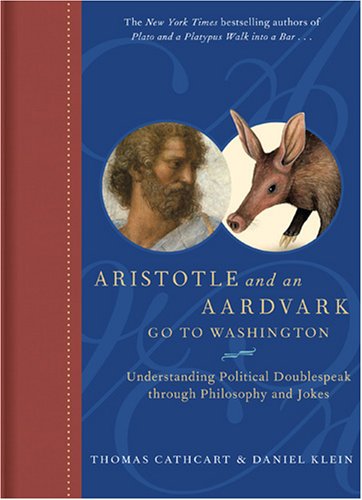 | Hardcover: 196
Pages
(2008-01-01)
list price: US$18.95 -- used & new: US$3.22 (price subject to change: see help) Asin: B003H4RAOA Average Customer Review: 
Canada | United Kingdom | Germany | France | Japan |
|
Editorial Review Product Description Customer Reviews (41)
| |
| 19. The Cambridge Companion to Aristotle (Cambridge Companions to Philosophy) | |
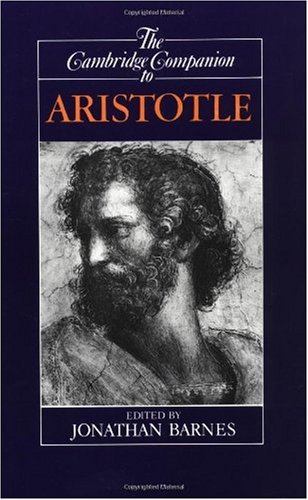 | Paperback: 404
Pages
(1995-01-27)
list price: US$38.99 -- used & new: US$14.98 (price subject to change: see help) Asin: 0521422949 Average Customer Review:
Canada | United Kingdom | Germany | France | Japan |
|
Editorial Review Product Description Customer Reviews (6)
This book is an excellent choice for that purpose.This book helps to alleviate some of the fears one has in reading a great thinker who is not only difficult and challenging but also complex.The content of this book are as follows:Logic, Metaphysics, Philosophy of Science, Science, Psychology, Ethics, Politics, Rhetoric and poetics.There is an introduction and a suggestions for reading section which are invaluable and help the reader to understand and comprehend what is trying to be said. If you need help with Aristotle... look no further than this book to help you get organized and to better understand Aristotle.Approach and methods vary from person to person, but if someone has proceeded you in understanding it is prudent to follow those footsteps... then make your interpretation. The editor has written an excellent chapter on Metaphysics.Metaphysics is one of Aristotle's most difficult books to understand.Here the editor helps the reader to understand it and also how to read Aristotle with a logical approach. Remember the best aid to reading Aristotle is Aristotle himself.Aristotle is difficult so read him slowly, very slowly, then he is inspiring and gripping. But, it helps to have someone to rely on and this book will help. ... Read more | |
| 20. Aristotle's Children: How Christians, Muslims, and Jews Rediscovered Ancient Wisdom and Illuminated the Middle Ages by Richard E. Rubenstein | |
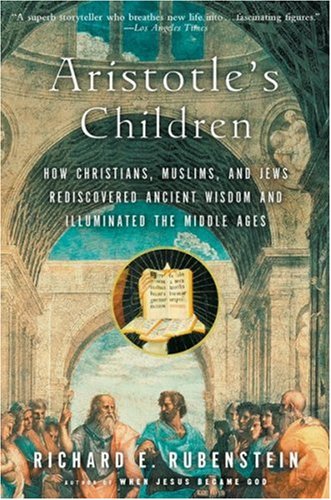 | Paperback: 384
Pages
(2004-09-20)
list price: US$15.00 -- used & new: US$3.78 (price subject to change: see help) Asin: 0156030098 Average Customer Review:
Canada | United Kingdom | Germany | France | Japan |
|
Editorial Review Product Description Customer Reviews (43)
| |
| 1-20 of 97 | Next 20 |
 Aristotle Rhetoric
 it's cheap for a reason