e99 Online Shopping Mall

Geometry.Net - the online learning center Help  
Home  - Scientists - Aristotle (Books)

  Back | 41-60 of 100 | Next 20
A  B  C  D  E  F  G  H  I  J  K  L  M  N  O  P  Q  R  S  T  U  V  W  X  Y  Z  

click price to see details     click image to enlarge     click link to go to the store

$28.20
41. Middle Commentary on Aristotle's
$10.00
42. A Guided Tour of Selections from
 
43. Aristotle's Physics
$42.70
44. Ethics With Aristotle
$3.98
45. Introducing Aristotle, New Edition
$59.62
46. Nature, Justice, and Rights in
$32.95
47. Readings In Ancient Greek Philosophy:
 
$7.99
48. Aristotle (Historical Biographies)
$22.22
49. Nicomachean Ethics
$4.08
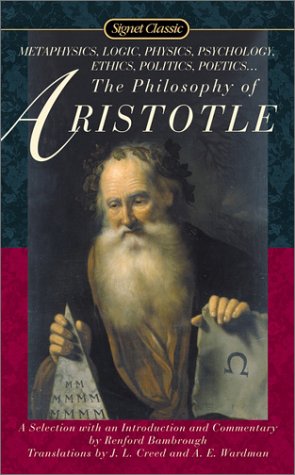
50. The Philosophy of Aristotle (Signet
 
$8.81
51. Student's Quest Guide: Aristotle
$37.95
52. Aristotle's Ethics: Critical Essays
$40.26
53. Politica (Oxford Classical Texts)
 
$21.50
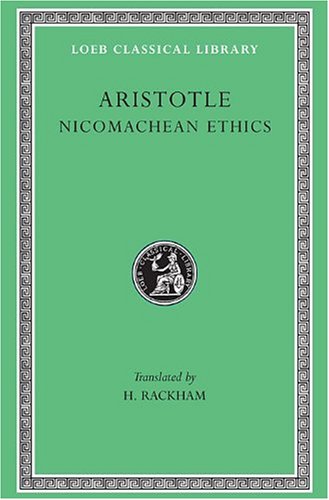
54. Aristotle, XIX, Nicomachean Ethics
$14.98
55. Categories and De Interpretatione
 
$8.75
56. Greek Science After Aristotle
 
$24.00
57. Aristotle: On Sophistical Refutations.
$7.70
58. Thank You for Arguing: What Aristotle,
$19.85
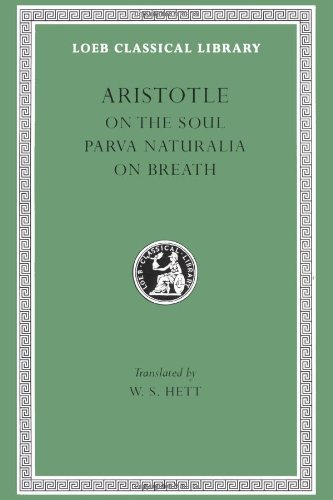
59. Aristotle: On the Soul. Parva
$7.94
60. Harry Potter and Philosophy: If

41. Middle Commentary on Aristotle's De anima (Islamic Translation Series)
by Averroës
Hardcover: 300 Pages (2001-12-01)
list price: US$34.95 -- used & new: US$28.20
(price subject to change: see help)
Asin: 0842524738
Canada | United Kingdom | Germany | France | Japan
Editorial Review

Book Description

Averroës, the greatest Aristotelian of the Islamic philosophical tradition, composed some thirty-eight commentaries on the "First Teacher's" corpus, including three separate treatments of De Anima ("On the Soul"): the works commonly referred to as the Short, Middle, and Long Commentaries. The Middle Commentary—actually Averroës's last writing on the text-remains one of his most refined and politically discreet treatments of Aristotle, offering modern readers Averroës's final statement on the material intellect and conjunction as well as an accessible historical window on Aristotle's work as it was interpreted and transmitted in the medieval period.
... Read more

42. A Guided Tour of Selections from Aristotle's Nicomachean Ethics
by Christopher Biffle
Paperback: 167 Pages (1990-10-15)
list price: US$30.94 -- used & new: US$10.00
(price subject to change: see help)
Asin: 0874848954
Canada | United Kingdom | Germany | France | Japan
Editorial Review

Book Description
This "guided tour" actively engages students with Aristotle's work through a variety of tasks that help them develop their critical thinking, reading, and writing skills. The text provides complete discussion of books 1-4 and 10 and offers summaries and excerpts of Books 2, 3, and 5 through 9. ... Read more


43. Aristotle's Physics
by Aristotle
 Paperback: 386 Pages (1980-05)
list price: US$19.00
Isbn: 0960287035
Average Customer Review: 5.0 out of 5 stars
Canada | United Kingdom | Germany | France | Japan

Customer Reviews (1)

5-0 out of 5 stars Ancient Philosophy at its Best
Aristotle's Physics is a brilliant compilation of his notes that he lectured from.This translation is stunning, with lots of commentaries and clarifications.This book encompasses everything from space, biology, potentiality, being, and luck, and much more.Whether reading for knowledge or pleasure, I would recommend this book. ... Read more


44. Ethics With Aristotle
by Sarah Broadie
Paperback: 480 Pages (1993-09-30)
list price: US$60.00 -- used & new: US$42.70
(price subject to change: see help)
Asin: 0195085604
Canada | United Kingdom | Germany | France | Japan
Editorial Review

Book Description
This is a close and comprehensive study of the main themes of Aristotle's ethics. Sarah Broadie concentrates on what he has to teach about happiness, virtue, voluntary agency, practical reason, incontinence, pleasure, and the place of theoria in the best life. Never forgetting that ethics for Aristotle is above all a practical enterprise, she sheds new light on ways in which this practical orientation affects both content and method of his inquiry. The book culminates in a sustained argument showing how even Aristotle's ideal of theoretic contemplation in integral to his essentially practical vision of human nature. Ethics with Aristotle is a major contribution toward the further understanding of Aristotle's ethics. ... Read more


45. Introducing Aristotle, New Edition (Introducing (Icon))
by Rupert Woodfin
Paperback: 176 Pages (2006-11-25)
list price: US$12.95 -- used & new: US$3.98
(price subject to change: see help)
Asin: 1840467592
Average Customer Review: 5.0 out of 5 stars
Canada | United Kingdom | Germany | France | Japan
Editorial Review

Book Description
Aristotle was named the 'master of those who know.' He is a foundational thinker in every field of inquiry. He established logic as a systematic discipline, conceived the earliest rules of science, developed a rational psychology, a political science and an outline of sociology, and gave us a virtue theory of ethics that is still a model today. His contributions to metaphysics continue to permeate modern philosophy. He supplied the first theory of aesthetics, which still provides the basis of debates today. Aristotle's authority extended beyond his time to influence Islamic society and medieval scholasticism. For fifteen hundred years he remained the paradigm of knowledge itself, until scientific empiricism in the 17th century is said to have discredited his methods. Is this true? How 'scientific' is Aristotle? ... Read more

Customer Reviews (2)

5-0 out of 5 stars Really liked it
Quite good book in the Introducing... series, and if you like this one, make sure to pick up the Plato book also, it needs to be read after this one.

5-0 out of 5 stars A simple yet helpful introduction to Aristotle.
Let me begin by saying that this book is far from an in-depth examination of Aristotle. It is, rather, a very elementary introduction to the philosopher and his philosophy. I rejected the idea of buying the book many times, because of it's approach; there are illustrations in pictographic form on every page. It is almost like the old "Classics Illustrated" comic books. I resented the facile approach to profound philosophy. However, the paucity of elementary introductions to Aristotle drove me to relent, and I bought it. The book is exactly what it claims to be...an introduction to Aristotle. In simple, non-philosophical language it gives an elementary introduction to the great philosopher. If you have become exasperated (as I had) at the unavailability of basic intro's to Aristotle, buy the book. Since reading the book, I have undertaken more challenging books about Aristotle, because this one gave me the elements I needed to move forward. ... Read more


46. Nature, Justice, and Rights in Aristotle's Politics
by Fred D. Miller
Paperback: 448 Pages (1997-06-26)
list price: US$59.62 -- used & new: US$59.62
(price subject to change: see help)
Asin: 019823726X
Average Customer Review: 3.5 out of 5 stars
Canada | United Kingdom | Germany | France | Japan
Editorial Review

Book Description
In this landmark study of Aristotle's Politics Fred Miller argues that nature, justice, and rights are central to Aristotle's political thought. Miller challenges the widely held view that the concept of rights is alien to Aristotle's thought, and marshalls evidence for talk of rights in Aristotle's writings, arguing further that Aristotle's theory of justice supports claims of individual rights, which are political and based in nature.He also considers the relation of Aristotles politics to other parts of philosophy, in particular to the teleological view of nature in the Physics and the theory of justice in the Nicomachean Ethics.Professor Miller examines in detail the constitutional applications of Aristotle's theory, including the correct constitutions of kingship, aristocracy, and polity (based in the common advantage), and the deviant constitutions of democracy, oligarchy, and tyranny (based in the advantage of the rulers). Arisototle's treatments of revolution and property rights are also covered, and the major presuppositions of his political theory are critically examined and related to current issues including the liberalism-communitarianism debate. This stimulating treatment of the Politics sheds new light on Aristotle's relation to modern political philosophy, in particular to natural rights theorists such as Hobbes and Locke. It will be of value to philosophers, political scientists, classical scholars, and anyone interested in the theoretical foundations of human rights. ... Read more

Customer Reviews (2)

2-0 out of 5 stars Weekend at Bernie's
Miller would like to reclaim Aristotle for the modern world.In order to accomplish this task Miller has decided that he must ignore certain blatantly obvious factors in Aristotle which clash with the way we live today.This is most obvious in his poorly argued decision to attribute a theory of rights to Aristotle.Miller cites but ignores the fact that the language of rights did not appear until around the 13th century.He also ignores the context in which that language appeared.Instead, Miller choses to rely upon an abstract definition of rights by a 20th century academic, apparently not bothering to notice the problem of relying upon the definition of an accepted entity to prove that entity's existence at a point prior in time.In other words, Miller commits the logical fallacy of assuming the consequent to prove the antecedent eg. "a theory of rights contains x,y, and z"; "Aristotle speaks of x,y, and z therefore Aristotle must have had a theory of rights".There is an additional problem with Miller's attempt to argue the existence of rights in Aristotle: the definition he relies upon is so vague as to allow us to claim that both the Torah and Hammurabi's Code contained a theory of rights.As there is no credible evidence that such a thing ever existed within those documents this procedure is absurd.Furthermore, Miller's "defense" of his "hypothesis" amounts to little more than two or three footnote citations of other professors' works with the unilluminating claim that these articles are enough to answer the obvious questions regarding his approach.He does nothing to "refute" the readings of Strauss, Macintyre, or Irwin but sniff and shuffle some papers.

What Miller ultimately concludes is that Aristotle did not believe in pre-political right but only in a particular type of political or civil right which depended entirely upon the constitution of the polis.Since Aristotle *never* used the language of rights the best we can state is that Aristotle believed that the constitution of a polis gave its citizens both *priviledges* and duties.As the existence of the polis preceeds and superceeds the existence of any of its members it is silly to claim that citizens possess "rights".Since law tries to mimic justice and give to each his own as his ability warrants, there is no place for a "right" which would override the claims of justice embodied within the law.One could ask, "why make such a fuss since what Aristotle said regarding the claims of justice because it sounds alot like what we say when we speak of rights?"It is important to be clear about these things because a certain amount of Aristotle's politics is based upon his understanding of nature and the cosmos.Everything within the cosmos operates according to a set order except for the relations between men.Nature should be our guide since it appears to guide everything else but nature is silent about the proper role of man.For Aristotle, law is the attempt to complete the work of nature by taking it as a guide.There are no "rights" in nature so it would have been absurd for Aristotle to invent such a fiction.Aristotle choses to emphasize the constitution of the polis because it mimics on a human scale the order of the cosmos.

To be fair, the book starts off quite promising and it is only when Miller begins his descent into the morass of rights that things deteriorate.One can read this work and learn a little bit about Aristotle but, in the end, it is not a terribly good exposition of what he wrote.Miller paints us a portrait of the dead philosopher dressed in some rather bad beach wear and pretends that this is still the profound thinker who dominated medieval philosophy for 1,000 years.The final chapter of the book attempts to defend the relevance of Aristotle for today by using the language of the modern university and its obsession with -isms.This may be a way to gain tenure but it makes for poor scholarship.

5-0 out of 5 stars A positive assessment of a challenging work on Aristotle
Millers' book is a teleological interpretation of Aristotle's Politics.Miller includes a succinct overview of Aristotle's division of the sciences and the virtues, an important subject usually not covered in secondaryliterature devoted to the Politics.The most controversial part ofMiller's thesis is the idea that Aristotle had a theory of individualrights.Miller offers possibly the best defense of this idea ever made,based on his teleological perspective, and is generally successful.

As agraduate student in Greek politics, I think that this is one of the bestbooks ever written on this subject.It will be very challenging fornon-specialists, but Miller's clear writing makes difficult conceptsunderstandable.Aristotle's Politics itself is a definite prerequisite. This book is required reading for students of Aristotle. ... Read more


47. Readings In Ancient Greek Philosophy: From Thales To Aristotle
Paperback: 958 Pages (2005-08)
list price: US$38.95 -- used & new: US$32.95
(price subject to change: see help)
Asin: 0872207692
Average Customer Review: 5.0 out of 5 stars
Canada | United Kingdom | Germany | France | Japan
Editorial Review

Book Description
The rich selection of superbly translated and edited Presocratic fragments and testimonia, dialogues of Plato, and selections from Aristotle that has made Readings in Ancient Greek Philosophy the preeminent anthology for the teaching of ancient Greek philosophy is now even richer: G.M.A. Grube's translation of Plato's Phaedo and Alexander Nehamas and Paul Woodruff's translation of Plato's Symposium are now both included in their entirety; in addition, the Third Edition features new translations by C.D.C. Reeve of Plato's Euthyphro, Apology, and Crito. ... Read more

Customer Reviews (3)

5-0 out of 5 stars A Must Have For Philosophy Students, and Anybody else interested in the "Celebrities" of Ancient Greek thought.
If your buying this book, its probably because you are enrolled in a philosophy or history class. And though it is used frequently in classrooms, the book doesn't fall into the same traps as other college level texts.

This book features all of Plato's Republic, Aristotle's Categories, Physics, Metaphysics, and Nicomachean Ethics. It also contains Apology (Written by Plato, in which Socrates speaks at his trial), along with writings and quotes from and about less well known Greek philosophers, such as Empedocles and Parmenides. The philosophers are presented by date, starting with the earliest, but they are also categorized by ideas.

One of the best things about this book is that, unlike other college texts, it is not a modern philosopher, or college historian, writing the bulk of the text. You actually hear from the horses mouth. The philosophers, such as Thales, who do not have many surviving words, have quotes from other famous Greek philosophers concerning them (often criticism, but informative criticism) . While at points the writing might seem dense, it is preferable to a third party writing; simply becauseany other person or group, though trying to, cannot capture the essence of what that person is trying to say.Anybody who has taking a philosophy coarse probably knows what I'm talking about; some philosophers have original message has been all but destroyed byprofessors "summery", either by misunderstanding, interjecting their own interpretations, or worse, allowing their own innate prejudices and beliefs to effect how they introduce them. The point is- Its preferable to have the actual philosopher talking for themselves, and this book has plenty of that.

I will say that, if you already own the dialogues and writings in this book, I wouldn't suggest buying it. While the short summaries and historical highpoints are good, they don't offer much that you couldn't find better somewhere else.

Quite simply, this is a comprehensive textbook that will enhance your understandingof Greek philosophy and provide a great starting place for further study.

5-0 out of 5 stars Good choice
I find this book to be invaluable to the philosophy student and any others who may be interested in Ancient philosophical thought in Miletus and Greece. The organization of the book is excellent, and the order in which he supplies the writings is fitting.

5-0 out of 5 stars This is the one to buy if you're buying only one
In my reading I frequently come across references to Greek philosophy. When I go to the bookstore, though, I see an entire shelf of books for Plato, and another for Aristotle. Presocratics are separate. How to choose? Fortunately, there is this volume. It is a large collection, filling 890 large pages, from the earliest Greek philosophers to Aristotle. The general breakdown is as follows: 89 pages devoted to the Presocratics and Sophists; 487 devoted to Plato; 277 devoted to Aristotle; 45 pages devoted to suggestions for further reading, concordance and sources for Presocratics, and glossary for Aristotle. The Presocratic selections represent 18 philosophers. Plato selections include the complete Republic and sections of 10 other dialogues. Aristotle selections contain readings from 13 treatises. Informative introductions precede each philosopher, and most individual selections from Plato and Aristotle have their own introductions. Each book of the Repulbic is introduced separately. In addition, footnotes are supplied on various obscure points of history, terminology, and ancient scientific theory. The notes on Timaeus are especially illustrative, giving the reader diagrams of theories. In short, this volume is very user friendly, geared toward the student or non-specialist who wants to know more about this fundamental area of Western culture, and very inclusive. The translations are modern and clear, not some dusted off antiques. A very good choice all around. ... Read more


48. Aristotle (Historical Biographies)
by Brian Williams
 Paperback: 32 Pages (2002-05)
list price: US$7.99 -- used & new: US$7.99
(price subject to change: see help)
Asin: 1588109976
Canada | United Kingdom | Germany | France | Japan

49. Nicomachean Ethics
by Aristotle
Paperback: 480 Pages (2002-04-11)
list price: US$27.95 -- used & new: US$22.22
(price subject to change: see help)
Asin: 0198752717
Average Customer Review: 4.5 out of 5 stars
Canada | United Kingdom | Germany | France | Japan
Editorial Review

Book Description
Amongst the works of Aristotle, the Nicomachean Ethics stands virtually alone in speaking not only to classicists, historians of ideas, and technical philosophers, but to anyone trying to make sense of practical human ideals.In this major new presentation, Aristotle's most engaging work has been freshly translated by Christopher Rowe into perspicuous English. Sarah Broadie's accompanying commentary brings out the subtlety of Aristotle's thought as it develops line by line. (Such close exegesis is indispensable for anyone who seeks a more than superficial understanding of Artistotle's text.)Additionally, a substantial introductory section by Sarah Broadie sets out the main themes and interpretative problems in preambles to each of Aristotle's ten Books.This scholarly and instructive treatment of Aristotle's great work of moral philosophy assumes no knowledge of Greek and will be invaluable to students reading Aristotle's text for the first time. Its emphasis on understanding the import of the text at every point will make this an equally indispensable resource for advanced students and scholars. ... Read more

Customer Reviews (3)

5-0 out of 5 stars Doing the right thing
Aristotle was a philosopher in search of the chief good for human beings. This chief good is eudaimonia, which is often translated as 'happiness' (but can also be translated as 'thriving' or 'flourishing'). Aristotle sees pleasure, honour and virtue as significant 'wants' for people, and then argues that virtue is the most important of these.

In the Nicomachean Ethics, Aristotle makes the claim that happiness is something which is both precious and final. This seems to be so because it is a first principle or ultimate starting point. For, it is for the sake of happiness that we do everything else, and we regard the cause of all good things to be precious and divine. Moreover, since happiness is an activity of the soul in accordance with complete and perfect virtue, it is necessary to consider virtue, as this will be the best way of studying happiness.

How many of us today speak of happiness and virtue in the same breath? Aristotle's work in the Nicomachean Ethics is considered one of his greatest achievements, and by extension, one of the greatest pieces of philosophy from the ancient world. When the framers of the American Declaration of Independence were thinking of life, liberty, and the pursuit of happiness, there is little doubt they had an acquaintance with Aristotle's work connecting happiness, virtue, and ethics together.

When one thinks of ethical ideas such as an avoidance of extremes, of taking the tolerant or middle ground, or of taking all things in moderation, one is tapping into Aristotle's ideas. It is in the Nicomachean Ethics that Aristotle proposes the Doctrine of the Mean - he states that virtue is a 'mean state', that is, it aims for the mean or middle ground. However, Aristotle is often misquoted and misinterpreted here, for he very quickly in the text disallows the idea of the mean to be applied in all cases. There are things, actions and emotions, that do not allow the mean state. Thus, Aristotle tends to view virtue as a relative state, making the analogy with food - for some, two pounds of meat might be too much food, but for others, it might be too little. The mean exists between the state of deficiency, too little, and excessiveness, too much.

Aristotle proposes many different examples of virtues and vices, together with their mean states. With regard to money, being stingy and being illiberal with generosity are the extremes, the one deficient and the other excessive. The mean state here would be liberality and generosity, a willingness to buy and to give, but not to extremes. Anger, too, is highlighted as having a deficient state (too much passivity), an excessive state (too much passion) and a mean state (a gentleness but firmness with regard to emotions).

Aristotle states that one of the difficulties with leading a virtuous life is that it takes a person of science to find the mean between the extremes (or, in some cases, Aristotle uses the image of a circle, the scientist finding the centre). Many of us, being imperfect humans, err on one side or the other, choosing in Aristotle's words, the lesser of two evils. Aristotle's wording here, that a scientist is the only one fully capable of virtue, has a different meaning for scientist - this is a pre-modern, pre-Enlightenment view; for Aristotle, the person of science is one who is capable of observation and calculation, and this can take many different forms.

Aristotle uses different kinds of argumentation in the Nicomachean Ethics. He uses a dialectical method, as well as a functional method. In the dialectical method, there are opposing ideas held in tension, whose interactions against each other yield a result - this is often how the mean between extremes is derived. However, there are other times that Aristotle seems to prefer a more direct, functional approach. Both of these methods lead to the same understanding for Aristotle's sense of the rational - that humanity's highest or final good is happiness.

There is a discussion of the human soul (for this is where virtue and happiness reside). Aristotle argues that virtue is not a natural state; we are not born with nor do we acquire through any natural processes virtue, but rather through 'habitation', an embedding process or enculturation that makes these a part of our soul. However, it is not sufficient for Aristotle's virtue that one merely function as a virtuous person or that virtuous things be done. This is not a skill, but rather an art, and to be virtuous, one must live virtuously and act virtuously with intention as well as form.

Of course, one of the implications here is that virtue is a quantifiable thing, that periodically resurfaces in later philosophies. How do we calculate virtue?

This is a difficult question, and not one that Aristotle answers in any definitive way. However, more important than this is the key difference that Aristotle displayed setting himself apart from his tutor Plato; rather than seeing the possession of 'the good' or 'virtue' as the highest ideal, Aristotle is concerned with the practical aspects, the ethics of this. Based on Aristotle's lectures in Athens in the fourth century BCE, this remains one of the most important works on ethical and moral philosophy in history.

4-0 out of 5 stars Excellent translation and overall edition
This Oxford translation of Aristotle's Nicomachean Ethics is the work of Sarah Broadie and Christopher Rowe. It's easy to pass over since Amazon doesn't have a cover-photo nor any product description, but it should be one of the first translations you consider getting of the Ethics.

The translation is proceded by an 80-page 'philosophical introduction' by Broadie that is superb. She does a good job explicating the Ethics in a reasonable and general way, given a lot of the dispute over the most basic analytic concepts in the literature (for instance the inclusive-dominant debate over eudaimonia). The introduction alone will make it essential for anyone trying to write on the Ethics while giving an overall view of scholarship out there.

The translation itself is very readable, with large print and the proper citations in the column.

Watch out for editions that don't include those, they are usually useless. For instance, Barnes & Noble bought the rights to an edition of the Ethics (one not available on Amazon for obvious reasons) and produced it in a paperback form. It doesn't have the numeric sections accompanying the text, though, and the translation itself is simply a reprint of a fifth edition translation from the 1890s (if an author felt he had to do five editions in ten years, simply spitting it out again 100 years later is a travesty).

A lot of work on the Ethics cites the Barnes collection, and I think it is useful to read this translation side-by-side with that one. My biggest objection is in how this Oxford edition translates "phronesis" and "sophia." The distinction between these two types of knowledge are crucial in understanding Aristotle's ethics. "Phronesis" is usually translated as 'practical wisdom,' and sometimes as 'prudence.' "Sophia" is usually translated 'knowledge.' In this translation "phronesis" is translated as 'wisdom' and "sophia" is translated as 'intellectual accomplishment.' It is very important to keep that in mind when you are reading the text, and if you are interested in Aristotle's discussions of prudential excellence. Anytime 'wisdom' appears in this text, Aristotle is talking specifically about practical wisdom/phronesis, and likewise with 'intellectual accomplishment.' Any apparent vagueness on this note is due to the translation, and frankly I'm surprised they decided to do that. Luckily I read Broadie's introduction, which mentions this on page 46, or else I might have been confused about this later on. Thus, one needs to be very aware that 'wisdom' in this translation is being referred to as a very specific kind of wisdom, namely the ability to reason practically. Not taking this into account will lead to some erroneous interpretations, I believe, and will make some of the discussions in the secondary sources seem confusing and obscure when they don't need to.

Part 3 of the translation is the line-by-line commentary, another commendable quality of this translation that makes it essential. They even do things like chart out the disposition as well as provide useful cross-references. A useful glossary in the back is also helpful, in fact probably essential to deal with any translation confusions like the one I outline above, especially if you are trying to compare translations. There is also a brief topical bibliography of select works as well, and they separate the index into names and subjects.

Overall, this is a great edition. Very well though out, very very useful to the student of Aristotle.

5-0 out of 5 stars Best available English translation
I admit that I have not personally seen this book yet, but I posted a query about translations of the Ethics on the Philosop internet list, and the majority of respondents (university professors) favored Sarah Broadie and Christopher Rowe's translation, which includes an extensive and useful commentary, over all others. ... Read more


50. The Philosophy of Aristotle (Signet Classics)
by Renford Bambrough, J. L. Creed
Paperback: 528 Pages (2003-06-03)
list price: US$7.95 -- used & new: US$4.08
(price subject to change: see help)
Asin: 0451528875
Average Customer Review: 4.0 out of 5 stars
Canada | United Kingdom | Germany | France | Japan
Editorial Review

Book Description
This annotated collection of the influential philosopher's most famous works includes: Metaphysics, Logic, Physics, Psychology, Ethics, Politics, and Poetics. ... Read more

Customer Reviews (1)

4-0 out of 5 stars Perfect one-volume selection of "The Philsopher."
Two things make this book great: its selection and its translation.

For a pocket size selection of Aristotle, this book is tops.It has sections from all of his major works, so it is useful for survey classes, or personal study.Of fundamental import is Metaphysics, which is the meta-basis for his thought.Also included are selections from his more popular Ethics and Politics, and lesser known Poetics.

What drew me to this book was the translation.Most translations are really crude transliterations. Yes, it is important to be as faithful to the text as humanly possible.But the "ivory tower academeese" sucks the life out of vibrant philosophies.

Creed and Wardmen avoid this problem entirely. This text was readable, and therefore enjoyable.It reminds me of the smooth prose of J. B Phillips or Edgar J. Goodspeed.It was like talking to a good friends, rather than a Latinized statue.

For a more comprehensive selection, I would recommend "Basic Works of Aristotle" (ISBN: 0375757996), or getting the books individually.

I love the cover! ... Read more


51. Student's Quest Guide: Aristotle Leads the Way
by Johns Hopkins University
 Paperback: 112 Pages (2007-12-01)
list price: US$12.95 -- used & new: US$8.81
(price subject to change: see help)
Asin: 1588342549
Canada | United Kingdom | Germany | France | Japan

52. Aristotle's Ethics: Critical Essays (Critical Essays on the Classics)
by Nancy Sherman
Paperback: 349 Pages (1999-01-28)
list price: US$39.95 -- used & new: US$37.95
(price subject to change: see help)
Asin: 0847689158
Average Customer Review: 1.0 out of 5 stars
Canada | United Kingdom | Germany | France | Japan
Editorial Review

Book Description
The ethics of Aristotle (384-322 B.C.),and virtue ethics in general,have enjoyed a resurgence of interest over the past few decades.Aristotelian themes,with such issues as the importance of friendship and emotions in a good life,the role of moral perception in wise choice,the nature of happiness and its constitution,moral education and habituation,are finding an important place in contemporary moral debates. Taken together,the essays in this volume provide a close analysis of central arguments in Aristotle's Nicomachean Ethics and show the enduring interest of the questions Aristotle raises. ... Read more

Customer Reviews (1)

1-0 out of 5 stars Don't buy this book
I received this book and it happened the strangest thing. The strange thing is that the cover of the book has the correct title, but once you open the book the whole content belongs to another book: James Rachels, Can Ethics provide Answers? In other words, I have Raechels'book with Sherman's cover. Be aware of this before purchasing this item. Who knows how widespread is this printing mistake? ... Read more


53. Politica (Oxford Classical Texts)
by Aristotle
Hardcover: 292 Pages (1957-12-31)
list price: US$45.00 -- used & new: US$40.26
(price subject to change: see help)
Asin: 0198145152
Average Customer Review: 5.0 out of 5 stars
Canada | United Kingdom | Germany | France | Japan

Customer Reviews (1)

5-0 out of 5 stars A CLASSIC NEVER BECOMES OLD OR USELESS
Whe could say that with this book, the politic acquires a "science" status.

After analyse the constitutions of more than 120 countries, aristotle discuss about the origin and contents of thedifferent models of government,( democracy, aristocracy, reign) andsomething really interesting in our times: the relation between ethic andpolitic, in other words, how the customes of a society mark the way inwich the goverment and his purposesworks?. ... Read more


54. Aristotle, XIX, Nicomachean Ethics (Loeb Classical Library®)
by Aristotle
 Hardcover: 704 Pages (1934-06-10)
list price: US$24.00 -- used & new: US$21.50
(price subject to change: see help)
Asin: 0674990811
Average Customer Review: 4.5 out of 5 stars
Canada | United Kingdom | Germany | France | Japan
Editorial Review

Book Description

Aristotle, great Greek philosopher, researcher, reasoner, and writer, born at Stagirus in 384 BCE, was the son of Nicomachus, a physician, and Phaestis. He studied under Plato at Athens and taught there (367-347); subsequently he spent three years at the court of a former pupil, Hermeias, in Asia Minor and at this time married Pythias, one of Hermeias's relations. After some time at Mitylene, in 343-2 he was appointed by King Philip of Macedon to be tutor of his teen-aged son Alexander. After Philip's death in 336, Aristotle became head of his own school (of 'Peripatetics'), the Lyceum at Athens. Because of anti-Macedonian feeling there after Alexander's death in 323, he withdrew to Chalcis in Euboea, where he died in 322.

Nearly all the works Aristotle prepared for publication are lost; the priceless ones extant are lecture-materials, notes, and memoranda (some are spurious). They can be categorized as follows: I Practical: Nicomachean Ethics; Great Ethics (Magna Moralia); Eudemian Ethics; Politics; Economics (on the good of the family); On Virtues and Vices. II Logical: Categories; Analytics (Prior and Posterior); Interpretation; Refutations used by Sophists; Topica. III Physical: Twenty-six works (some suspect) including astronomy, generation and destruction, the senses, memory, sleep, dreams, life, facts about animals, etc. IV Metaphysics: on being as being. V Art: Rhetoric and Poetics. VI Other works including the Constitution of Athens; more works also of doubtful authorship. VII Fragments of various works such as dialogues on philosophy and literature; and of treatises on rhetoric, politics and metaphysics.

The Loeb Classical Library edition of Aristotle is in twenty-three volumes.

... Read more

Customer Reviews (3)

5-0 out of 5 stars about halfway through it.
this book is beautiful for context when reading kierkegaard or thomas aquinas. for instance, take patience; where on the scale between passivity and wrath does turning the other cheek fit in? it is necessary to understand this in order to understand the teleological suspension of the ethical or to understand the theological virtues, faith, hope and charity, as departures from ethics. btw, father messick in an earlier review writes that the writers of the declaration of independence had an aristotelian mindset and i will not argue that point. i would just like to point out that life, liberty and the pursuit of happiness is commandeered, so to speak, from the writings of adam smith, i.e., life, liberty and the pursuit of property. also that thomas jefferson much preferred continental philosophers, such as locke and rousseau, to the ancient greeks as is evident in his letters. loeb library is the right choice for poor students of greek such as myself. i also have homer and hesiod.

5-0 out of 5 stars Doing the right thing
Aristotle was a philosopher in search of the chief good for human beings. This chief good is eudaimonia, which is often translated as 'happiness' (but can also be translated as 'thriving' or 'flourishing'). Aristotle sees pleasure, honour and virtue as significant 'wants' for people, and then argues that virtue is the most important of these.

In the Nicomachean Ethics, Aristotle makes the claim that happiness is something which is both precious and final. This seems to be so because it is a first principle or ultimate starting point. For, it is for the sake of happiness that we do everything else, and we regard the cause of all good things to be precious and divine. Moreover, since happiness is an activity of the soul in accordance with complete and perfect virtue, it is necessary to consider virtue, as this will be the best way of studying happiness.

How many of us today speak of happiness and virtue in the same breath? Aristotle's work in the Nicomachean Ethics is considered one of his greatest achievements, and by extension, one of the greatest pieces of philosophy from the ancient world. When the framers of the American Declaration of Independence were thinking of life, liberty, and the pursuit of happiness, there is little doubt they had an acquaintance with Aristotle's work connecting happiness, virtue, and ethics together.

When one thinks of ethical ideas such as an avoidance of extremes, of taking the tolerant or middle ground, or of taking all things in moderation, one is tapping into Aristotle's ideas. It is in the Nicomachean Ethics that Aristotle proposes the Doctrine of the Mean - he states that virtue is a 'mean state', that is, it aims for the mean or middle ground. However, Aristotle is often misquoted and misinterpreted here, for he very quickly in the text disallows the idea of the mean to be applied in all cases. There are things, actions and emotions, that do not allow the mean state. Thus, Aristotle tends to view virtue as a relative state, making the analogy with food - for some, two pounds of meat might be too much food, but for others, it might be too little. The mean exists between the state of deficiency, too little, and excessiveness, too much.

Aristotle proposes many different examples of virtues and vices, together with their mean states. With regard to money, being stingy and being illiberal with generosity are the extremes, the one deficient and the other excessive. The mean state here would be liberality and generosity, a willingness to buy and to give, but not to extremes. Anger, too, is highlighted as having a deficient state (too much passivity), an excessive state (too much passion) and a mean state (a gentleness but firmness with regard to emotions).

Aristotle states that one of the difficulties with leading a virtuous life is that it takes a person of science to find the mean between the extremes (or, in some cases, Aristotle uses the image of a circle, the scientist finding the centre). Many of us, being imperfect humans, err on one side or the other, choosing in Aristotle's words, the lesser of two evils. Aristotle's wording here, that a scientist is the only one fully capable of virtue, has a different meaning for scientist - this is a pre-modern, pre-Enlightenment view; for Aristotle, the person of science is one who is capable of observation and calculation, and this can take many different forms.

Aristotle uses different kinds of argumentation in the Nicomachean Ethics. He uses a dialectical method, as well as a functional method. In the dialectical method, there are opposing ideas held in tension, whose interactions against each other yield a result - this is often how the mean between extremes is derived. However, there are other times that Aristotle seems to prefer a more direct, functional approach. Both of these methods lead to the same understanding for Aristotle's sense of the rational - that humanity's highest or final good is happiness.

There is a discussion of the human soul (for this is where virtue and happiness reside). Aristotle argues that virtue is not a natural state; we are not born with nor do we acquire through any natural processes virtue, but rather through 'habitation', an embedding process or enculturation that makes these a part of our soul. However, it is not sufficient for Aristotle's virtue that one merely function as a virtuous person or that virtuous things be done. This is not a skill, but rather an art, and to be virtuous, one must live virtuously and act virtuously with intention as well as form.

Of course, one of the implications here is that virtue is a quantifiable thing, that periodically resurfaces in later philosophies. How do we calculate virtue?

This is a difficult question, and not one that Aristotle answers in any definitive way. However, more important than this is the key difference that Aristotle displayed setting himself apart from his tutor Plato; rather than seeing the possession of 'the good' or 'virtue' as the highest ideal, Aristotle is concerned with the practical aspects, the ethics of this. Based on Aristotle's lectures in Athens in the fourth century BCE, this remains one of the most important works on ethical and moral philosophy in history.

4-0 out of 5 stars Aristotle's Ethics: The Art of Living
I bought this book almost accidentaly, for having nothing better to do one night on a business trip to Pretoria.Being Greek, I have a love-hate relationship with the Ancients:brought up to marvel at their genius, butfeeling alienated by an education system that force-fed us with sterile,badly translated texts, which always seemed irrelevant to our lifes. Thisbook opened my eyes to the true meaning of "Philosophy". Thetranslation is in modern English, free from the back-to-front syntax of theAncient Greek text (which makes it impossible to understand the meaning ofa sentence until you reach the end of it!).

The subject matter is"Ethics".However, a modern author may have called it somethingmore akin to "The Meaning of Life" or "The Art ofLiving". Aristotle proceeds with simple and clear logic, to reveal theobjective of human struggle in this life. He demonstrates a deepunderstanding of the Human Being, what we are and what we are not, whatmakes us act in one way or another and what makes us feel joy or distress. He addresses anxienties of the modern human, such as the question of natureor nurture, the moral action versus the practical, violence versusnon-violence. His recommendations for living this life in a manner thatis meaningfull and rewarding are profound yet simple.I found myselfshaking my head in recognition at every example or conclusion.I felt afresh wind in my chest, as if it was I who was discovering this knowledge,not some 2.5 thousand year old man.

I recommend this book to anyone whowants to discover more about how to live this life, but feels foreign tocurrent eastern-derived, philosophical/religious fashions which, even whenilluminating, can appear alien to the western way of thinking. ... Read more


55. Categories and De Interpretatione (Clarendon Aristotle Series)
by Aristotle
Paperback: 170 Pages (1975-07-24)
list price: US$49.50 -- used & new: US$14.98
(price subject to change: see help)
Asin: 0198720866
Average Customer Review: 4.0 out of 5 stars
Canada | United Kingdom | Germany | France | Japan

Customer Reviews (4)

5-0 out of 5 stars The best available translation and commentary
The Categories and the De Interpretatione are very interesting and important works of Aristotle. Anyone who wants to understand any part of Aristotle's philosophy will surely have to acquaint himself with these works.

J.L. Ackrill's translations are in my oppinion the best available English translations of Aristotle's Categories and De Interpretatione. Although E.M. Edghills translations (in Richard McKeon's Basic Works of Aristotle) are also highly readable, Ackrill's translations are more accurate.

The commentary is quite good, and as usual, Ackrill writes very clearly. Although space does not permit him to exhaust every topic, his notes are very helpful, and all in all the commentary is far superior to other commentaries on the Categories or the De Interpretatione known to me (e.g. H.G. Apostle's Aristotle's Categories and Propositions). There is also a glossary and index of subjects which are helpful.

I recommend this book to anyone interested in (a) the Categories or the De Interpretatione, (b) Aristotle, (c) ancient philosophy, or (d) philosophy.

5-0 out of 5 stars Clarendon Series offers first-rate scholarship
I and my fellow philosophers have found the Clarendon Series to be quite helpful all around, especially in the case of the Categories. Instead of being adjusted to fit English idiomatic expression, Clarendon translations are quite literal (to the apparent chagrin of some).With this translation of Aristotle's Categories, one can develop an excellent picture of what Aristotle really said (without reading the Greek itself); and with the supplementary help of the extensive and thorough commentary, one can also develop a sense of where Aristotle was going (i.e. what issues he faced at the time, which concepts later philosophers borrowed and either used or abused, and plenty more).Overall, very helpful and highly recommended.

5-0 out of 5 stars Clarendon Series offers first-rate scholarship
I and my fellow philosophers have found the Clarendon Series to be quite helpful all around, especially in the case of the Categories. Instead of being adjusted to fit English idiomatic expression, Clarendon translations are quite literal (to the apparent chagrin of some).With this translation of Aristotle's Categories, one can develop an excellent picture of what Aristotle really said (without reading the Greek itself); and with the supplementary help of the extensive and thorough commentary, one can also develop a sense of where Aristotle was going (i.e. what issues he faced at the time, which concepts later philosophers borrowed and either used or abused, and plenty more).Overall, very helpful and highly recommended.

1-0 out of 5 stars Awful atempt at Aristotle
Not only is the translation second rate (Loeb or McKeon is definitely the way to go), but the commentary is awful.It does go over many of the questions but his conclusions and ideas are quite false, and easily reconizable to anyone who has given any thought to the subject.If you are interested in getting to know Aristotle, then the way to go is with Jonathan Lear's "Aristotle: The Desire to Understand". ... Read more


56. Greek Science After Aristotle
by G. E. R. Lloyd
 Paperback: 189 Pages (1975-08)
list price: US$14.20 -- used & new: US$8.75
(price subject to change: see help)
Asin: 0393007804
Average Customer Review: 5.0 out of 5 stars
Canada | United Kingdom | Germany | France | Japan

Customer Reviews (1)

5-0 out of 5 stars Greek Science the second time around.
I'd read this book some years ago, but found it difficult going at the time.I decided to re-read it recently, as it was on the wish list of a friend which reminded me I still had the volume.This time around I foundit much more interesting and more understandable.There definitely seemsto be a time for everything, and apparently this was the time for GreekScience for me.What I found of particular interest was a new perspectivethat I acheived in a novel way. I recently attended a MinneapolisChildrens' Theater production featuring events from the life of Galileo. It was pointed out in the playbill that what seems to us in retrospect apatent persecution of a new concept by jealous intellectuals and religiousauthorities was not quite so clear cut at the time.In fact the scientificthinkers of Galileo's time, as those of the Hellanistic Greek and Romantimes, labored with the technological inability to test the validity ofscientific observations. Much that passed for science during those timesmight be considered philosophy or metaphysics in our own.Without themeans of externally testing opposing explanations of natural phenomenonlittle of definitive worth could be said about any given observation.Itthen became a matter of philosophical orientation, of reputation and ofreligious sanction.It was in fact anybody's guess.We who are used tomeasuring equipment as simple as a thermometer and as complex as an earthorbiting satelite often forget that these devices were not yet available tothe researchers of ancient or even medieaval times. Some of the simplerdevices were only just being introduced in Galileo's time and wereconsidered untested and highly suspect themselves.Given that a number ofingeneous inventions of early times were engineered with the specificintent to mislead or impress the public, the scepticism with whichsomething like the telescope or the microscope were greeted is notsurprising.To the early critic, one could not necessarily believe oneseyes; it was better to believe what the Holy Book or a learned philosopherhad to say with respect to nature than what a "conjurer" mightsay.Greek Science After Aristotle makes this point apparent, explaningthat only in the area of mathematics and in applied physics (engineering,especially military engineering) could anything like trustworthy precisionbe achieved.It also points out that though modern science valuesobservation and experiment, the neglect of these was not necessarily due toa laziness or disregard for precision, but due to a lack of technologicalmeans.In fact, much was done and some very ingeneous devices toaccomplish it were invented to perform it.The researchers of the timeshad to be very innovative and original in their approach to problemsolving; something which we with our computerized devices are rarely calledupon to do a such basic levels.Rereading the book from this perspectivedefinitely gave me a greater appreciation for the achievments of ourintellectual predecessors. ... Read more


57. Aristotle: On Sophistical Refutations. On Coming-to-be and Passing Away. On the Cosmos. (Loeb Classical Library No. 400)
by Aristotle
 Hardcover: 448 Pages (1987-06)
list price: US$24.00 -- used & new: US$24.00
(price subject to change: see help)
Asin: 0674994418
Canada | United Kingdom | Germany | France | Japan
Editorial Review

Book Description

Aristotle, great Greek philosopher, researcher, reasoner, and writer, born at Stagirus in 384 BCE, was the son of Nicomachus, a physician, and Phaestis. He studied under Plato at Athens and taught there (367-347); subsequently he spent three years at the court of a former pupil, Hermeias, in Asia Minor and at this time married Pythias, one of Hermeias's relations. After some time at Mitylene, in 343-2 he was appointed by King Philip of Macedon to be tutor of his teen-aged son Alexander. After Philip's death in 336, Aristotle became head of his own school (of 'Peripatetics'), the Lyceum at Athens. Because of anti-Macedonian feeling there after Alexander's death in 323, he withdrew to Chalcis in Euboea, where he died in 322.

Nearly all the works Aristotle prepared for publication are lost; the priceless ones extant are lecture-materials, notes, and memoranda (some are spurious). They can be categorized as follows: I Practical: Nicomachean Ethics; Great Ethics (Magna Moralia); Eudemian Ethics; Politics; Economics (on the good of the family); On Virtues and Vices. II Logical: Categories; Analytics (Prior and Posterior); Interpretation; Refutations used by Sophists; Topica. III Physical: Twenty-six works (some suspect) including astronomy, generation and destruction, the senses, memory, sleep, dreams, life, facts about animals, etc. IV Metaphysics: on being as being. V Art: Rhetoric and Poetics. VI Other works including the Constitution of Athens; more works also of doubtful authorship. VII Fragments of various works such as dialogues on philosophy and literature; and of treatises on rhetoric, politics and metaphysics.

The Loeb Classical Library edition of Aristotle is in twenty-three volumes.

... Read more

58. Thank You for Arguing: What Aristotle, Lincoln, and Homer Simpson Can Teach Us About the Art of Persuasion
by Jay Heinrichs
Paperback: 336 Pages (2007-02-27)
list price: US$13.95 -- used & new: US$7.70
(price subject to change: see help)
Asin: 0307341445
Average Customer Review: 4.5 out of 5 stars
Canada | United Kingdom | Germany | France | Japan
Editorial Review

Book Description
Thank You for Arguing is your master class in the art of persuasion, taught by professors ranging from Bart Simpson to Winston Churchill. The time-tested secrets the book discloses include Cicero’s three-step strategy for moving an audience to actionÑas well as Honest Abe’s Shameless Trick of lowering an audience’s expectations by pretending to be unpolished. But it’s also replete with contemporary techniques such as politicians’ use of “code” language to appeal to specific groups and an eye-opening assortment of popular-culture dodges, including:

The Eddie Haskell Ploy
Eminem’s Rules of Decorum
The Belushi Paradigm
Stalin’s Timing Secret
The Yoda Technique

Whether you’re an inveterate lover of language books or just want to win a lot more anger-free arguments on the page, at the podium, or over a beer, Thank You for Arguing is for you. Written by one of today’s most popular online language mavens, it’s warm, witty, erudite, and truly enlightening. It not only teaches you how to recognize a paralipsis and a chiasmus when you hear them, but also how to wield such handy and persuasive weapons the next time you really, really want to get your own way. ... Read more

Customer Reviews (19)

5-0 out of 5 stars Use this kind of argument in your marriage.
When couples come to me for marriage counseling, they typically violate Heinrichs' most elementary principles. After reading this book, I realize that an important aspect of my counseling has been teaching rhetoric--the art of polite arguing.

For most couples, the idea of arguing politely seems like a joke or at least a myth until they learn to do it. The book will help with your understanding, but probably won't be enough to provide actual marriage help to put anger management into practice.

Heinrichs' style of writing makes rhetoric easy to learn, and some people will be able to put it into practice just using the book. However, in my experience with marriage counseling, I find that couples need practical exercises to make the process really easy and natural in everyday life.

You should know that my first copy was from the library. Half-way through, I realized I wanted my own copy.Then, when I was reading my own copy, I noticed my bookmark was mysteriously changing.The mystery was solved when my 22-year-old son announced he had been reading it and wanted to "borrow" it--and now I am buying my second copy.

Heinrichs has a light and humorous style. He brings stories from his own life, and he makes very complex concepts understandable through modern-day examples. I recommend this book for anyone wanting to improve his or her relationships.

4-0 out of 5 stars Great for Marriage Enrichment
This book review will be sent to the publication we get because we are a leader couple with ACME (Association for Couples in Marriage Enrichment).We've done a book review or two and have been asked to do more, so this review will be geared toward the audience of other couples leading marriage retreats.
On a whim, I picked up the book Thank You for Arguing: What Aristotle, Lincoln, and Homer Simpson Can Teach Us About the Art of Persuasion by Jay Heinrichs after hearing an interview with the author on NPR.As I read through the book, I found more and more example of skills that we can utilize in the weekend retreats for married couples.The quote at the beginning of the book aptly describes the benefit of conflict in marriage: Truth springs from argument among friends. -David HumeI can't think of any more fitting picture of healthy argument, especially in marriage.
As Mr. Heinrichs points out, the point of argument is consensus, not winning.Good argument is respectful, even if heated.Mr. Heinrichs mentions the research of Dr. John Gottman at the University of Washington who showed that successful couples didn't argue less often, but in a different way and with a different purpose than unsuccessful couples.He guesses that the happy couples seduced (he calls it good manipulation) each other with the full knowledge of both parties.People who fight will often win the battle, but lose the war.
He gives valuable skills for successful argument.According to Aristotle, all issues boil down to blame, values, and choice.Blame is based on the past and is least useful.Values are about the present and generally end with people bonding or separating.These can be moral values, or just preferences.Choice is about the future and about action.This is the "What do we want from this?" issue and the one most useful for resolving conflict.
Mr. Heinrichs gives some good advice for handling conflict and maintaining marital harmony simultaneously.He reminds us that "winning an argument may not be your best goal.Relationships and values occasionally trump the advantageous and a rational decision."Also, "many arguments fail simply because of bad timing."He recommends setting, or at least waiting for, a favorable mood before launching into discussion of an issue.He recommends fostering good will with such phrases as "What do you need?"He advocates using "code words" in relationships to foster a feeling of being the only two in a very exclusive club.These code words can even be used to diffuse tense situations by helping both spouses feel that they are on the same side.
Mr. Heinrichs also gives some warnings about improper techniques of argument.One is to never block the argument so that no solution can be reached.He warns against making threats, creating negative labels, or rejecting choices out of hand.He reminds us that "A person who desires something is especially susceptible to anger," and the poor and sick are also prone to anger.If you really want a person to become angry, belittling them will do it very efficiently.He states that "In most cases, there is no right or wrong decisions in argument."
I would recommend this book to any couple leading other couples in dialogue.If you're not interested in reading the whole book, the best chapters with regard to marriage are chapters 1, 2, 3, 18, 19, and 21.Mr. Heinrichs uses many examples from his own marriage and kids on how to successfully use the techniques he teaches.The book is very entertaining and engaging.On a final note, he observes that people who are skilled at argument are not easily offended or beguiled, and isn't that what we all need in marriage and in life?

5-0 out of 5 stars Thank You for Exisiting!
An excellent book!Many extra tidbits of knowledge. Very well organized.Overall inspiring!

5-0 out of 5 stars An Excellent Book for The Writer or Public Speaker
I would recommend this book to anyone who is interested in Public Speaking or persuasive writing.Heinrichs keeps his readers interested in everything he has to say through the use of real-world and pop culture references.Random bits of information in the margins keep every page interesting and well worth your time.

5-0 out of 5 stars Good but a lot of information
This is a great book if you like the subject matter. But don't think you are going to walk away ready to put all this into practice in your next public address or debate with a recalcitrant teen. Keep in mind the author's subtle point that the book effectively represents a summary session on a discipline that is thousands of years old. Not that you won't have fun trying it out though. ... Read more


59. Aristotle: On the Soul. Parva Naturalia. On Breath. (Loeb Classical Library No. 288)
by Aristotle
Hardcover: 544 Pages (1975-06)
list price: US$24.00 -- used & new: US$19.85
(price subject to change: see help)
Asin: 0674993187
Canada | United Kingdom | Germany | France | Japan
Editorial Review

Book Description

Aristotle, great Greek philosopher, researcher, reasoner, and writer, born at Stagirus in 384 BCE, was the son of Nicomachus, a physician, and Phaestis. He studied under Plato at Athens and taught there (367-347); subsequently he spent three years at the court of a former pupil, Hermeias, in Asia Minor and at this time married Pythias, one of Hermeias's relations. After some time at Mitylene, in 343-2 he was appointed by King Philip of Macedon to be tutor of his teen-aged son Alexander. After Philip's death in 336, Aristotle became head of his own school (of 'Peripatetics'), the Lyceum at Athens. Because of anti-Macedonian feeling there after Alexander's death in 323, he withdrew to Chalcis in Euboea, where he died in 322.

Nearly all the works Aristotle prepared for publication are lost; the priceless ones extant are lecture-materials, notes, and memoranda (some are spurious). They can be categorized as follows: I Practical: Nicomachean Ethics; Great Ethics (Magna Moralia); Eudemian Ethics; Politics; Economics (on the good of the family); On Virtues and Vices. II Logical: Categories; Analytics (Prior and Posterior); Interpretation; Refutations used by Sophists; Topica. III Physical: Twenty-six works (some suspect) including astronomy, generation and destruction, the senses, memory, sleep, dreams, life, facts about animals, etc. IV Metaphysics: on being as being. V Art: Rhetoric and Poetics. VI Other works including the Constitution of Athens; more works also of doubtful authorship. VII Fragments of various works such as dialogues on philosophy and literature; and of treatises on rhetoric, politics and metaphysics.

The Loeb Classical Library edition of Aristotle is in twenty-three volumes.

... Read more

60. Harry Potter and Philosophy: If Aristotle Ran Hogwarts
Paperback: 250 Pages (2004-09-10)
list price: US$17.95 -- used & new: US$7.94
(price subject to change: see help)
Asin: 0812694554
Average Customer Review: 4.0 out of 5 stars
Canada | United Kingdom | Germany | France | Japan
Editorial Review

Book Description

Harry Potter has put a spell on millions of readers, and they all want to find out more about the deeper meaning of his adventures. In Harry Potter and Philosophy, 17 experts in the field of philosophy unlock some of Hogwarts' secret panels, uncovering surprising insights that are enlightening both for wizards and for the most discerning muggles. Individual chapters look at such topics as life revealed in the Mirror of Erised; the ethics of magic; Moaning Myrtle, Nearly Headless Nick, and the relation of the mind to the brain; and the character of Hermione as a case of "sublimated feminism." Also examined in this witty collection are how Aristotle would have run a school for wizards; whether the Potter stories undermine religion and morality; how to tell good people from evil ones through the characters in these novels; and what dementors and boggarts can teach readers about happiness, fear, and the soul.
... Read more

Customer Reviews (16)

2-0 out of 5 stars 1 great essay, 1 good essay, and 14 essays to waste your time
After finishing book 7, but before rereading all of the HP books, I wanted to read something that was about the HP books, to see what other people had to say.

This book, consisting of 16 essays, is not about the Harry Potter books. Rather, it uses the characters and events in the Harry Potter books to illustrate the philosophical arguments that are studied at University level in Philosophy 101. For the most part, it won't add to you knowledge of Harry Potter, but it will make you glad you don't have to take Philosophy 101 again (or for the first time).

The essay "Magic, Science, and the Ethics of Technology" is an exception to the overall quality of the book. This is an outstanding essay, that focuses on magic in the HP books and its relationship to science and technology. The authors have thought out the issues very clearly, and this essay does shed significant light on the HP books. In brief, magic is seen as a proto-science, roughly comparable to the field of 'Natural Philosophy' as was studied in Europe just before the dawn of the scientific age. Magic has natural laws that are followed, and the students at Hogwarts have to learn these laws. It's not just waving a wand and having any desire 'magically' brought about. And they also have to learn the ethical principles involved in using magic. A brilliant, wonderful essay here.

The good essay is "Feminism and Equal Opportunity: Hermione and the Women of Hogwarts". In brief, this essay discusses how the Wizarding world is one in which there is pretty much full equality between the sexes, and everyone in the books just assumes it. As but one example, several of the players on the Irish Quidditch World Cup team are women, but this is only mentioned in passing, since it's no big deal that women are on the same world championship team with men.

The rest of the essays are a complete waste of time. They are nothing but empty philosophical concepts, basically empty words chasing other empty words in circles. (In the philosophical debate on whether ethics and metaphysics are worth studying or are the results of linguistic errors, I come down on the side of the Ordinary Language Philosophers like Wittgenstein.) As examples, taking several pages to discuss the real-world possibility of apparating as traveling through 'real' worm-holes, and discussing the paradoxes of time travel misses the point of Harry Potter.

If you want to know more about HP, read 'Unlocking Harry Potter' by John Granger.

Without the essay on Magic and Science, I would have given the book a 1. But I don't think one excellent essay out of 16 can raise the rating to a 3. So I'll leave it at 2.

4-0 out of 5 stars A Good Excuse to Enjoy Harry Potter as an Adult
I very much enjoyed reading "Harry Potter and Philosophy: If Aristotle Ran Hogwarts".As one who reads the Potter books mostly for the escapism, it was interesting to have the help of professional philosophers help me delve into the deeper meanings contained in the books.This book also helped me to appreciate JKR's talent even more.I believe she must have more than a cursery knowledge of philosophy herself. My favorite essays were "Feminism and Equal Opportunity:Herminone and the Women of Hogwarts", "Heaven, Hell and Harry Potter" "Magic,Muggles and Moral Imagination" and "The Prophecy-Driven Life: Foreknowledge and Freedom at Hogwarts"All of the essays had at least one "ah HA" moment where the brain went into high gear and really started purring.The essay "Space, Time and Magic" caused the usual brain cramp that all time travel conundrums do and I enjoyed it as much as I always enjoy such discussions with the addition that new concepts were introduced of which I had previously been unaware. I was not aquainted with the terms "tensed" and "tenseless" time.This book is probably not for the expert philosopher as these concepts will be basics but for someone of my experience (almost none) studying philosophy,it was a great read.Just like a good movie, don't leave before the credits are done; the bios at the end are amusing.

4-0 out of 5 stars Common Sense Revealed
To begin with, the subtitle should read:
If Aristotle Ran Hogwarts he wouldn't change a thing.

These Philosophers praise J.K. Rowlings for her character development of both the good and bad people in the books. They recognise, describe and praise her treatment of them and find her ideas mirrored in other philosphers.It's a fun read most of the time but to me the praise of that most uncommon of all qualities 'Common Sense' found in Rowlings was a pleasure.

4-0 out of 5 stars Interesting perspective
I read this book not expecting any great new philosophies or insights into old ones.I was pleasantly surprised.As a person that has read many of the older philosophical texts, I know how hard it is to sometimes understand the reasonings and logic presented.I think this book presents its ideas in a very clear way that even the youngest audiences of Harry Potter would be able to have a good introduction to philosophical thought.

5-0 out of 5 stars Entertaining enlightenment
As a Harry Potter fan, I pick up almost anything with Harry in the title.Often, I put it back down after a cursory glance.Not this time!

This book is a collection of essays on philosophical questions raised in the Harry Potter series.It would be a good adjunct for anyone taking a college level philosophy course, to see a practical application of using philosophy to aid in understanding literature - or the use of literature to understand philosophy!

... Read more


  Back | 41-60 of 100 | Next 20
A  B  C  D  E  F  G  H  I  J  K  L  M  N  O  P  Q  R  S  T  U  V  W  X  Y  Z  

Prices listed on this site are subject to change without notice.
Questions on ordering or shipping? click here for help.

site stats