e99 Online Shopping Mall

Geometry.Net - the online learning center Help  
Home  - Scientists - Bayes Thomas (Books)

  1-14 of 14
A  B  C  D  E  F  G  H  I  J  K  L  M  N  O  P  Q  R  S  T  U  V  W  X  Y  Z  

click price to see details     click image to enlarge     click link to go to the store

$89.00
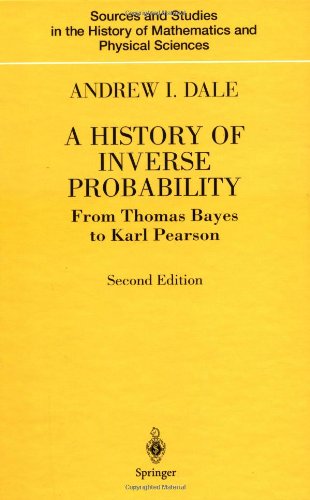
1. A History of Inverse Probability:
 
$9.95
2. Is "Hand D" of Sir Thomas More
 
3. Facsimiles of two papers by Bayes:
$58.16
4. Most Honourable Remembrance: The
 
5. Selected Chapter from Managerial
 
6. Essay towards solving a problem
 
7. Texas studies in English ; no.
$50.73
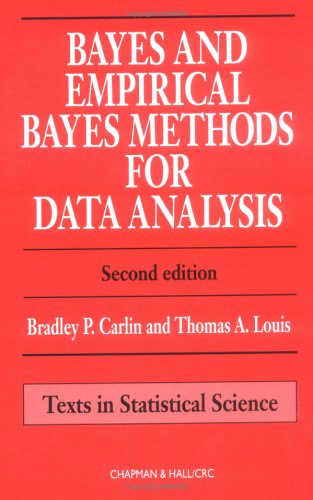
8. Bayes and Empirical Bayes Methods
 
9. Selected Materials from Managerial
 
10. Empirical Bayes forecasts of one
 
11. Staff paper series
 
12. Empirical Bayes results in the
$5.00
13. The Probability of God: A Simple
 
$7.99
14. Billy Bayes

1. A History of Inverse Probability: From Thomas Bayes to Karl Pearson (Sources and Studies in the History of Mathematics and Physical Sciences)
by Andrew I. Dale
Hardcover: 700 Pages (1999-06-04)
list price: US$129.00 -- used & new: US$89.00
(price subject to change: see help)
Asin: 0387988076
Canada | United Kingdom | Germany | France | Japan
Editorial Review

Book Description
This a history of the use of Bayes' theorem over 150 years, from its discovery by Thomas Bayes to the rise of the statistical competitors in the first third of the twentieth century. In the new edition, the author's concern is the foundations of statistics, in particular, the examination of the development of one of the fundamental aspects of Bayesian statistics. The reader will find new sections on contributors to the theory omitted from the first edition, which will shed light on the use of inverse probability by nineteenth century authors. In addition, there is amplified discussion of relevant work from the first edition. This text will be a valuable reference source in the wider field of the history of statistics and probability. ... Read more


2. Is "Hand D" of Sir Thomas More Shakespeare's? Thomas Bayes and the Elliott-Valenza Authorship Tests.: An article from: Early Modern Literary Studies
by MacDonald P. Jackson
 Digital: 31 Pages (2007-01-01)
list price: US$9.95 -- used & new: US$9.95
(price subject to change: see help)
Asin: B000Q674A2
Canada | United Kingdom | Germany | France | Japan
Editorial Review

Book Description
This digital document is an article from Early Modern Literary Studies, published by Thomson Gale on January 1, 2007. The length of the article is 9068 words. The page length shown above is based on a typical 300-word page. The article is delivered in HTML format and is available in your Amazon.com Digital Locker immediately after purchase. You can view it with any web browser.

Citation Details
Title: Is "Hand D" of Sir Thomas More Shakespeare's? Thomas Bayes and the Elliott-Valenza Authorship Tests.
Author: MacDonald P. Jackson
Publication: Early Modern Literary Studies (Magazine/Journal)
Date: January 1, 2007
Publisher: Thomson Gale
Volume: 12Issue: 3Page: NA

Distributed by Thomson Gale ... Read more


3. Facsimiles of two papers by Bayes: I. An essay toward solving a problem in the doctrine of chances, with Richard Price's forward and discussion; Phil. ... With a commentary by W. Edwards Deming
by Thomas Bayes
 Unknown Binding: 271 Pages (1963)

Asin: B0007DQCO8
Canada | United Kingdom | Germany | France | Japan

4. Most Honourable Remembrance: The Life and Work of Thomas Bayes (Sources and Studies in the History of Mathematics and Physical Sciences)
by Andrew I. Dale
Hardcover: 667 Pages (2003-09-02)
list price: US$119.00 -- used & new: US$58.16
(price subject to change: see help)
Asin: 0387004998
Canada | United Kingdom | Germany | France | Japan
Editorial Review

Book Description
Thomas Bayes (1702 - 1761) was an English clergyman and mathematician. Until around 1950, he was considered a minor contributor to the history of mathematics, and if he was known at all it was because his name was attached to a simple theorem in the calculus of probabilities. Since then, however, that theorem and the problem Bayes was able to solve with it have become the basis for an important branch of statistical methodology, the problem of inverse probability. Little is known of Bayes' life and few records mentioning him remain. Dale has meticulously researched the material and here gives a picture of Bayes and his time, as well as the intellectual and social climate in which Bayes worked. The writing is both instructive and entertaining, representing superb historical scholarship and excellent mathematics. (these are comments from our reviewers) ... Read more


5. Selected Chapter from Managerial Economics and Managerial Economics and Business Startegy
by Thomas, Baye Maurice
 Paperback: Pages (2002)

Isbn: 0072848642
Canada | United Kingdom | Germany | France | Japan

6. Essay towards solving a problem in the doctrine of chances
by Thomas Bayes
 Unknown Binding: 315 Pages (1958)

Asin: B0007FPTEA
Canada | United Kingdom | Germany | France | Japan

7. Texas studies in English ; no. 12
by Daniel Morley McKeithan
 Unknown Binding: Pages (1932)

Asin: B0008BTXXG
Canada | United Kingdom | Germany | France | Japan

8. Bayes and Empirical Bayes Methods for Data Analysis, Second Edition
by Bradley.P. Carlin, Thomas A. Louis, Bradley Carlin
Hardcover: 440 Pages (2000-06-22)
list price: US$79.95 -- used & new: US$50.73
(price subject to change: see help)
Asin: 1584881704
Average Customer Review: 4.5 out of 5 stars
Canada | United Kingdom | Germany | France | Japan
Editorial Review

Book Description
In recent years, Bayes and empirical Bayes (EB) methods have continued to increase in popularity and impact. Building on the first edition of their popular text, Carlin and Louis introduce these methods, demonstrate their usefulness in challenging applied settings, and show how they can be implemented using modern Markov chain Monte Carlo (MCMC) methods. Their presentation is accessible to those new to Bayes and empirical Bayes methods, while providing in-depth coverage valuable to seasoned practitioners.With its broad appeal as a text for those in biomedical science, education, social science, agriculture, and engineering, this second edition offers a relatively gentle and comprehensive introduction for students and practitioners already familiar with more traditional frequentist statistical methods. Focusing on practical tools for data analysis, the book shows how properly structured Bayes and EB procedures typically have good frequentist and Bayesian performance, both in theory and in practice. ... Read more

Customer Reviews (3)

5-0 out of 5 stars a must if you use Bayesian methods
Bayesian Statistics is being use more and more these days because the amazing advances in computational speed allow the use of computer-intensive methods to calculate Bayesian posterior distributions using more realistic prior distribution.

The first edition of this book was a well-written primer on Bayesian methods and the more "objective" empirical Bayes methods.The second edition adds much more on Gibbs sampling and algorithms such as Metropolis-Hastings that enable statisticians to produce realistic Bayesian results using the Markov Chain Monte Carlo techniques.Although some instructors do not sind it to be the best text for a course on Bayesian methods, it is a valuable reference yexy for statisticians and is well-suited for a graduate level text.

For a first course that includes in greater detail examples and applications I would prefer Jeff Gill's book which although written for the audience of social scientists, it can be used in other disciplines as well.

3-0 out of 5 stars More like a handbook
We used this book for our intro to Bayesian statistics class at SDSU.I thought it was more like a technical manual for how to do Bayesian statistics, rather than a good introductory textbook.Recommended for researchers who want to know the nitty-gritty of MCMC and the like.Not a good textbook for a first course in Bayesian statistics.To understand what was going on in class I used Lancaster, "An Introduction to Bayesian Econometrics".Much better intuitive explanation of what is going on.

5-0 out of 5 stars An good overview of the corps of the matter
This book features a deep and focused lesson on Bayes and Empirical Bayes Methods. It goes through the key topics as conjugate priors, MCMC methods (non iteratives and iteratives as the well known Gibbs samplining and metropolitis hastings algorithms), model selection methods (as bayes factor) and issues related as model robusteness.
The Approach is increasingly formal and deeply complex, allowing for getting the basics or diving into more complex knowledge according to your former background. You need at least a good understanding of Frequentist statistic to be able to follow the reasonings. Each chapter allow you to stop at some point without losing the thread. Last part of the book is in fact deep knowledge demanding.
The most interesting point of this book according to my very limited statistics background is that it makes good comparations with the frequentist approach (classical approaches as confidence intervals and point estimators), checking performance of either method. Even, it features some combination of both approaches getting some bayessian intervals.
As a negative point, I would say that examples are hard to follow for someone with limited bakground and too much complex. They really do not clear me up enough.
All in all, is a very profitable book for jumping into bayesian methods. ... Read more


9. Selected Materials from Managerial Economics 6th ed. and Managerial Economics...
by S. Charles Maurice; Chiristopher R. Thomas; Michael R. Baye
 Paperback: Pages (2000)

Asin: B000OFKLH8
Canada | United Kingdom | Germany | France | Japan

10. Empirical Bayes forecasts of one time series using many predictors (NBER technical working papers)
by Thomas Knox
 Unknown Binding: 4 Pages (2001)

Asin: B0006RM67W
Canada | United Kingdom | Germany | France | Japan

11. Staff paper series
by Thomas E Burk
 Unknown Binding: Pages (1980)

Asin: B00072WPCW
Canada | United Kingdom | Germany | France | Japan

12. Empirical Bayes results in the case of non-identical components (Statistical Laboratory publications)
by Thomas Eugene O'Bryan
 Unknown Binding: Pages (1972)

Asin: B00071W67M
Canada | United Kingdom | Germany | France | Japan

13. The Probability of God: A Simple Calculation That Proves the Ultimate Truth
by Stephen D. Unwin
Hardcover: 272 Pages (2003-09-23)
list price: US$22.95 -- used & new: US$5.00
(price subject to change: see help)
Asin: 0761526846
Average Customer Review: 4.0 out of 5 stars
Canada | United Kingdom | Germany | France | Japan
Editorial Review

Book Description
Does God exist?

This is probably the most debated question in the history of mankind. Scholars, scientists, and philosophers have spent their lifetimes trying to prove or disprove the existence of God, only to have their theories crucified by other scholars, scientists, and philosophers. Where the debate breaks down is in the ambiguities and colloquialisms of language. But, by using a universal, unambiguous language—namely, mathematics—can this question finally be answered definitively? That’s what Dr. Stephen Unwin attempts to do in this riveting, accessible, and witty book, The Probability of God.

At its core, this groundbreaking book reveals how a math equation developed more than 200 years ago by noted European philosopher Thomas Bayes can be used to calculate the probability that God exists. The equation itself is much more complicated than a simple coin toss (heads, He’s up there running the show; tails, He’s not). Yet Dr. Unwin writes with a clarity that makes his mathematical proof easy for even the nonmathematician to understand and a verve that makes his book a delight to read. Leading you carefully through each step in his argument, he demonstrates in the end that God does indeed exist.

Whether you’re a devout believer and agree with Dr. Unwin’s proof or are unsure about all things divine, you will find this provocative book enlightening and engaging.Download Description
STEPHEN D. UNWIN, Ph.D., received his doctorate in theoretical physics from the University of Manchester for his research in the field of quantum gravity. Dr. Unwin has written for New Scientist, among other influential scientific journals. Formerly the technical attaché to the United States Department of Energy for the British government, he is president of his own consulting firm, specializing in risk management for various Fortune 100 clients. He lives in Columbus, Ohio.


From the Hardcover edition. ... Read more

Customer Reviews (39)

1-0 out of 5 stars Abuses of probability and Bayes' theorem


Abuses of probability and Bayes' theorem
Probabilistic reasonings are abused quite often and sometimes are intentionally deceiving. This is very common in advertising and in politics. However, there is one flagrant abuse of Bayes' theorem which the reader of this book should be aware of, since it takes on a "scientific" posture. I am referring to Stephen Unwin's (2003) bookentitled: "The Probability of God", subtitled: "A simple Calculation That Proves the Ultimate Truth".
First, recall that probabilities are assigned to events, or to outcomes of an experiment, not to objects. There is no such thing as "Probability of a Table", nor of "Probability of the Moon" nor of "Probability of Kukuriku". Therefore, the title of Unwin's book is meaningless. On the book's first page, Unwin wtites: "I use the term probability in its strict mathematical sense and not in the fuzzy, ambiguous way it can be used in common language". That claim is an outright deception. All the book deals exclusively with "the fuzzy, ambiguous" meaning of probability A mathematical probability is assigned to events or to outcomes that can occur. The proposition "G" as defined by Unwin: "God exists", is neither an event nor an outcome of an experiment.
On page 15, Unwin is careful to note that the proposition "I did not have sexual relations with that woman" cannot be judged as true or false unless one defines what is meant by "sexual relations". That is correct. However, there is an abounding discussion of the probability of the proposition "God exists" in the entire book without ever defining who or what "God" is. This renders the entire contents of the book meaningless.
On page 58, Unwin writes: "Here, I think that the expression of complete ignorance (of the truth of proposition "G") is a good case of the 50-50 argument". It is not! He continues: "This is a perfect, unbiased expression of agnosticism". It is not! Clearly, Unwin draws from the symmetry argument applied to the two outcomes of throwing a coin. In the case of proposition "G", it is not clear what the experiment is, nor what the outcomes are.Therefore, the attachment of 50% probability to proposition "G" is totally arbitrary.
The rest of the book is a ridiculous exercise in using "evidentiary areas", in connection with Bayes' theorem to reassess the probability of proposition "G".
It should be noted that, Bayes' theorem allows one to modify probabilities of an event when given additional information. It is not a method of calculating probabilities! Using the same language,and the same kind or reasoning, one can prove anything one wants, and get any probability one wants. Specifically one can "prove" the important propositionthat the probability of "the existence of Kukuriku" is 95%.
Richard Dawkins (2006) commented on Unwin's "proof": "It sounds like a joke" and says that the GIGO principle (Garbage In, Garbage Out) is applicable to Unwin's "proof".
I fully agree with Dawkins that this book is nothing but GIGO. I do not agree, however, that it is a joke, not even a bad joke. It is sheer nonsense, disguised in a scientific language.
Finally, the subtitle of the book is also meaningless, unless one defines what the "Ultimate Truth" is. Once we know what the "Ultimate truth" is, we shall not need to prove it!


3-0 out of 5 stars A little painful at times...

Well, first off - let me say I'm an atheist...

... Ok - now that most of the religious folks have stopped reading (to protect their fragile sensibilities), I can speak freely...

I cannot say this is a bad book.I do like the writing style, and I found it a very quick read, with few impediments.But while the rudimentary framework laid out by Unwin is simplistic and logical, I can't say the same for his analysis.

The fact of the matter is that Unwin has the foregone conclusion that his conception of god exists.And while he may, at times, allude to the possibility that god does not exist, in almost every aspect of this book, he betrays any objectivity.(for example - in the last paragraph of the book, Unwin's dialog takes it for granted that an after-life exists).

Although Unwin certainly does not surreptitiously pervade his subjectivity, it definitely is present throughout the book.And this is why I felt the book is quite painful at times.There are just so many instances where I don't agree with his logic, or where it is obvious that he is overlooking some fact.So to forgive him for this, for the few instances where he does point out his subjectivity, would be too kind.

So with this in mind, I really only see this book serving as a tool for the faithful to reaffirm their beliefs under the guise of some logical framework.In mercilessly pushing his agenda, I find this book to be a bit of a waste of time for atheist readers - the more adept, of which, will not find anything new in the book, other than a very lengthy dissertation of a theorem of aggregate probabilities that could easily be summed up in a couple of paragraphs.

As for Unwin's analysis... I was disappointed to find that it falls flat onto what amounts to vague feelings about abstract concepts... and really seems to have no objective basis, other than his pre-existing faith.

I wonder, had Unwin been raised by some neolithic religious society, would he have found a rational basis upon which to accept human sacrifice?

4-0 out of 5 stars Nearly 5 stars--an original treatment for an old debate
Paul Gauguin's genius was painting, but he made a cutting analysis of literary art when he said that all writing is either plagiarism or it is revolution. This book is not plagiarism (well, on some points it is). And I dare say you've never read anything quite like it. Unwin is a theoretical physicist, mathematician, and risk management consultant. Given his interest and expertise in probability and decision theory, the thesis could not be in better hands. He is also a clever writer, as you will discover within the first couple of sentences. To suggest that the arguments concomitant to the question of God's existence can be quantified and wrestled into probability equations and thereby treated as straight-forward calculations, might sound, well -- naively optimistic, audacious, or worse. Unwin sees this clearly but shrugs it off; his vocation is treating uncertainties mathematically. Sharpen your pencils and enjoy the ride.

Before plugging quantities into Bayesian equations, Unwin describes what kind of arguments he thinks are most relevant (most obvious as well as being somehow quantifiable). Proposition "G" (that God exists) narrowly concerns itself with "not just any god" but strictly with the personal God envisioned by the monotheistic faiths. Teleological (design) arguments are categorically disallowed. Sure the universe looks designed, but so what? Unwin thinks that the WAP (weak anthropic principle) washes out the design argument ('plagiarism,' not 'revolution' on this point). He snipes at intelligent design theory, enlisting what he himself finally admits are "cheap shots." And the shots are indeed cheap: the weak anthropic principle is merely an 'apparent' cause, it is certainly not an 'effective' cause. An apparent cause is as follows: the reason you are reading this sentence is that you are a reader and you are looking at this sentence. Were it not so, it would not be so. Well, duh. Neither the observer nor the observed is 'effectively' explained. The teleological argument is an argument to an effective cause, by definition subsuming lower levels of causal relationships, up to and including a so-call Theory of Everything. (The logic here can get rather technical, but the design argument always remains.) On the other hand, Unwin does allow the 'anti-design' argument, the argument to the existence of pain and suffering. Okay then, these are the rules as the author sees them.

Most theists will think that proposition "G" [that God exists] has been dealt an artificial handicap at the outset (all things considered, I would tend to agree). But the proposition of a personal God proves to be much more mathematically robust than we might think if we assume that the theist must place all of his proverbial eggs in the basket of classical teleology. Still, I must point out that even if we accept Unwin's disallowance of design arguments for the reasons he asserts, there would remain a reason to introduce the existence of the -idea- of design as a sufficiently quantifiable proposition to plug into a Bayesian equation. What is the probability of the existence of contemplative beings holding this idea in a [proposition] God universe versus in a [proposition] No-God universe? Obviously, at least slightly higher. Well, Unwin does state that readers may find other potential indicators that might be sufficiently (approximately) quantifiable, to insert into their own calculations. At any rate, proposition G more than holds its own in terms of a critical treatment that Unwin eventually calls mathematical theology. I found it interesting that one of the participants in the author's dialogs, a skeptic who becomes a mathematical theologian, is named Anaxagoras (the Ax). Anaxagoras, of course, was an ancient Ionian philosopher who taught that the order of the world traces to a primordial Mind (is the author somehow admitting the design argument even while vehemently excluding it?). This is an entertaining, altogether unusual book, and I give high marks to Unwin for originality. The book deserves a large readership, not because it claims to produce a final answer to the Big Question (it does not), but because it is a surprisingly fresh approach to our oldest and most important debate.

5-0 out of 5 stars Douglas Adams meets Billy Graham
First of all I have to come clean. I didn't buy this book but found it on the bookshelf of a rented vacation apartment. I needed something to read and it was either this or something about boatmaking. I made the right choice. In a few easy to read and very witty chapters I learned more about the philosophy of religion and the math of probability than I had in tbe thirty years before. The arguments for and against God's existence are carefully balanced in a very convincing way. The author sets up these ongoing dialogs between two characters to clarify the points he makes. And after all that, does God exist? Refereshingly, the author does not know, but he figures 2 to 1 odds in favor. I don't think anyone is going to set up a new religion around those odds (although that would be a nice idea), but he goes on to talk about faith and how that tilts the odds. A great book for the beach or elsewhere.

5-0 out of 5 stars Not the typical arguments
I'm not normally one to post reviews, much less respond to other people's reviews, but the previous review of this book stunned me. The previous review more or less levels the usual generic counter-arguments against the usual generic arguments for God's existence, i.e., that only God could account for our seemingly well-crafted universe. In fact, this book does NOT make that argument. In fact, there's a big chunk in the book explaining why these arguments from design do not work. Therefore, it is clear beyond any uncertainty that the previous reviewer has not read the book. He also says that he wound up with a zero probability for God. This can only happen if your a priori probability for God (before looking at evidence) is 0. That's fair enough I suppose, but it isn't fair to post a review without reading the book, basing your comments on preconceptions of what generic God books contain. ... Read more


14. Billy Bayes
by Tom Clarke
 Hardcover: Pages (1994-06)
list price: US$21.95 -- used & new: US$7.99
(price subject to change: see help)
Asin: 0803490895
Canada | United Kingdom | Germany | France | Japan

  1-14 of 14
A  B  C  D  E  F  G  H  I  J  K  L  M  N  O  P  Q  R  S  T  U  V  W  X  Y  Z  

Prices listed on this site are subject to change without notice.
Questions on ordering or shipping? click here for help.

site stats