e99 Online Shopping Mall

Geometry.Net - the online learning center Help  
Home  - Scientists - Darwin George (Books)

  Back | 41-60 of 100 | Next 20
A  B  C  D  E  F  G  H  I  J  K  L  M  N  O  P  Q  R  S  T  U  V  W  X  Y  Z  

click price to see details     click image to enlarge     click link to go to the store

 
41. Pedigree of Shepard family, England
 
42. On the mechanical conditions of
 
43. Computation forms for the reduction
 
44. Leucorrhoea: Or, The 'whites'
45. L'évolution dans le vêtement
 
46. Stability of the pear-shaped figure
 
47. On the secular changes in the
$13.42
48. Frommer's Europe (Frommer's Complete)
 
49. The Darwin cyclone valuable lesson
 
50. The World into which Darwin led
 
51. Memorial sketch of Rev. Erasmus
 
52. George W. Skelton of Minnesota,
 
53. Cherokee Physician: Indian guide
 
54. Rustic sounds and other studies
 
55. The Voyage Of The Beetle: A Journey
$4.95
56. Darwin Among the Machines: The
$18.95
57. Darwin Loves You: Natural Selection
 
58. The Supernatural, a review of
$4.64
59. The Origin of Species (Barnes
 
60. Darwin's Radio: In the Next Stage

41. Pedigree of Shepard family, England
by Darwin George Clock
 Unknown Binding: Pages (1898)

Asin: B00089UG2A
Canada | United Kingdom | Germany | France | Japan

42. On the mechanical conditions of a swarm of meteorites, and on theories of cosmogony
by George Howard Darwin
 Unknown Binding: Pages (1889)

Asin: B0008BDVBG
Canada | United Kingdom | Germany | France | Japan

43. Computation forms for the reduction of tidal observations
by George Howard Darwin
 Unknown Binding: Pages (1884)

Asin: B0008C8MC8
Canada | United Kingdom | Germany | France | Japan

44. Leucorrhoea: Or, The 'whites' : a treatise upon the most common of the morbid discharges peculiar to women
by George Henry Darwin
 Unknown Binding: 71 Pages (1884)

Asin: B0008CX7D2
Canada | United Kingdom | Germany | France | Japan

45. L'évolution dans le vêtement
by George-H. Darwin
Paperback: 60 Pages (2002-09-26)

Isbn: 2914863004
Canada | United Kingdom | Germany | France | Japan

46. Stability of the pear-shaped figure of equilibrium of a rotating mass of liquid
by George Howard Darwin
 Unknown Binding: 314 Pages (1903)

Asin: B0008C5AVY
Canada | United Kingdom | Germany | France | Japan

47. On the secular changes in the elements of the orbit of a satellite revolving about a tidally distorted planet
by George Howard Darwin
 Unknown Binding: 891 Pages (1882)

Asin: B0008B6AW8
Canada | United Kingdom | Germany | France | Japan

48. Frommer's Europe (Frommer's Complete)
by Darwin Porter, Danforth Prince, George McDonald, Hana Mastrini, Sherry Marker, Andrew Princz, Carolyn Bánfalvy, Anna Kutor, Nóra Lakos, Suzanne Rowan Kelleher
Paperback: 1069 Pages (2006-09-25)
list price: US$24.99 -- used & new: US$13.42
(price subject to change: see help)
Asin: 047192265X
Average Customer Review: 3.5 out of 5 stars
Canada | United Kingdom | Germany | France | Japan
Editorial Review

Book Description
Whether you're a first-time visitor doing the grand tour or a seasoned traveler planning a multi-country itinerary, Frommer's Europe is a must. Inside this concise, user-friendly volume are all the highlights of the continent. We've included a wide array of options, from grand hotels to charming and affordable guesthouses, from five-star dining rooms to simple cafes—the very best in every price range. There's something here for every taste, interest, and budget.

Just because we're covering such a wide territory doesn't mean that we've skimped on the details. You'll find an astounding depth of accurate, up-to-date information, including exact prices, open hours, metro stops, credit cards, and more.

We'll take you to the legendary cultural capitals of Europe, where we offer complete sightseeing, shopping, and nightlife coverage and review the best accommodations and dining in all price ranges, from the Ritz on down. But we don't stop there. We've designed easy-to-follow itineraries that explore the most unforgettable parts of the European countryside. Frommer's Europe takes you to the vineyards and chateaux of the Loire Valley, the lovely villages of Oxford and Stratford-upon-Avon, the hill towns of Tuscany, and the spectacular scenery of the Alps.

It's all accompanied by detailed maps. You'll also find the latest trip-planning advice on everything from bargain airfares to rail passes, money-saving tips, and a color fold-out rail map that makes trip-planning a snap!Download Description
Updated for 2004, this edition contains planning chapters with special icons that point readers to great finds, excellent values, insider tips, best bets for kids, special moments, and Europe's overrated experiences. ... Read more

Customer Reviews (7)

4-0 out of 5 stars Frommer's Europe--Missing Poland
I purchased this book because of a cruise I will be taking in the fall.I was looking for background on all the countries I would visit in Europe.This book has nothing on Poland--only listed on the map.Otherwise I felt there was a lot of excellent information.

2-0 out of 5 stars Glad it was cheap
Def not a good book for those who don't like to travel to just the big cities.It has a basic synopsis of 2-3 major cities in each of the countries.It mostly focuses on hotels and restaurants instead of sights.A better book tobuy is Lonely Plants On a Shoestring, it at least gets cities that aren't complete tourist attractions and gives you some sights to see.It's sad that I now have to buy a book specifically for each country that I'm going to visit and so far that's gonna be over 7 books to tote around.Def save your money and do internet research or get lonely planets book

5-0 out of 5 stars Great for yourself or as a Gift
Gave this as a gift to a friend who traveled Europe for 3 months on a study abroad program with her college. She used it every step of the way. Some people just don't think to buy something like this for traveling because they don't know that it even exists!

4-0 out of 5 stars Good guide
A good travel guide.Read it before you go and it will save you time and money

2-0 out of 5 stars Boring
I know it's difficult to discuss and review all of Europe in one book, but this book was boring. It was easy to read, but not very fun or interesting. It did hit the highlights of the major sights, but it acts more like a reference than an exciting guide. ... Read more


49. The Darwin cyclone valuable lesson in structural design
by George F Walker
 Unknown Binding: Pages (1975)

Asin: B0007C08GW
Canada | United Kingdom | Germany | France | Japan

50. The World into which Darwin led us
by George Gaylord Simpson
 Unknown Binding: 32 Pages (1963)

Asin: B0007HNI5K
Canada | United Kingdom | Germany | France | Japan

51. Memorial sketch of Rev. Erasmus Darwin Eldredge,: Given at his funeral in Hampton, N.H.,
by George Edward Street
 Unknown Binding: Pages (1876)

Asin: B000891O2G
Canada | United Kingdom | Germany | France | Japan

52. George W. Skelton of Minnesota, 1846-1925: Ancestors and descendants, 1700-1993
by Robert Darwin Hill
 Unknown Binding: Pages (1993)

Asin: B0006F3ZA6
Canada | United Kingdom | Germany | France | Japan

53. Cherokee Physician: Indian guide to health
by George Darwin Wilson
 Unknown Binding: 14 Pages (1954)

Asin: B0007K7ZOC
Canada | United Kingdom | Germany | France | Japan

54. Rustic sounds and other studies in literature and natural history,
by Francis Darwin
 Unknown Binding: 3 Pages (1917)

Asin: B00087KXFM
Canada | United Kingdom | Germany | France | Japan

55. The Voyage Of The Beetle: A Journey Around The World With Charles Darwin and the Search for the Solution to the Mystery of Mysteries, as Narrated by Rosie ,an Articulate Beetle
by Anne H Weaver
 Library Binding: 80 Pages (2004-08-13)
list price: US$26.90
Isbn: 0761329234
Average Customer Review: 5.0 out of 5 stars
Canada | United Kingdom | Germany | France | Japan

Customer Reviews (4)

5-0 out of 5 stars Darwin for kids!
I began reading this wonderful book the day I brought it home and was so excited by it that I finished it the very next day. I love it, and in so many dimensions. I think it is wonderfully evocative of Darwin's close attention to the wide range of natural phenomenon which he encountered and his willingness to put it all together in such an innovative way - but only when nature thrust itself into his vision (thus, the ingenious use of clues from Rosie, Darwin's imaginary beetle friend). In my passion for all things Galapagos (I have been there more than once), I read the Voyage of the Beagle a couple of years ago, and this book reminded me vividly of some of the most fascinating and memorable parts of his voyage. I also love the book because I have an interest in writing for children, and appreciate how this rich and scientifically sound text makes the concepts of evolution so very approachable and inviting to this audience.

I think there is a paucity of books for children related to the Galapagos and Darwin and, given the increasing number of tourists with children going to the islands, I think this book should be recommended reading for families headed for Ecuador.

5-0 out of 5 stars My child's favorite!
We received this book around Thanksgiving and cannot stop reading it! My son's interest in science has only increased since reading this book and we both adore the illustrations. I hope for more young adult literature from this author!

5-0 out of 5 stars What a wondrous journey!!!!
Traveling the globe with Charles Darwin and his beetle companion Rosie, the reader joins them in an adventure that evokes wonder and curiosity. The friendly narrative and vibrant illustrations guide us along a rich educational experience. As we become detectives and join Darwin in his search for clues we also learn about geography, the animal world, history, and finally the theory of natural selection. This refreshing book is a must for all young people and adults curious about the mysteries of life!

5-0 out of 5 stars An exciting voyage for all ages!
This is an engaging story of the incredible voyage of Charles Darwin that is both adventure story and a fresh look at the world around us. At first blush it is a humorous account of a wise beetle leading the enthusiastic Darwin from discovery to discovery, describing key encounters in his 5-year voyage. But it also leads the reader to consider one of the great scientific theories of our time - how things come to be through natural selection.The clever use of Rosie keeps the pace light and accessible to many age levels without sacrificing intellectual integrity.Lawrence's lush illustrations are beautiful and Weaver's affectionate presentation of Darwin reveal the human side of Charles with a rich factual background.A very engaging read! ... Read more


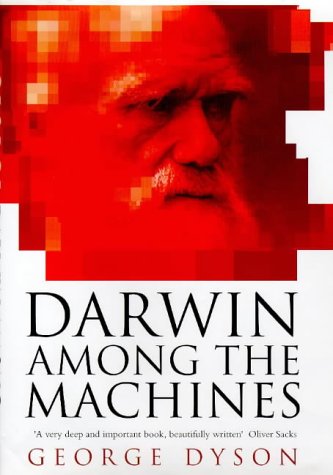
56. Darwin Among the Machines: The Evolution of Global Intelligence (Helix Books)
by George Dyson
Paperback: 304 Pages (1998-10-01)
list price: US$16.95 -- used & new: US$4.95
(price subject to change: see help)
Asin: 0738200301
Average Customer Review: 4.0 out of 5 stars
Canada | United Kingdom | Germany | France | Japan
Editorial Review

Amazon.com
Here's a mesmerizing account of the evolution of machines and thoughts about machines, woven into a story about the evolution of intelligence. Darwin Among the Machines is not so much about how today's intelligence came to be, but about how it may further develop as humanity and computer grow closer together. George Dyson tells the story largely through stories--both historical and legendary--from the lives of scientists and philosophers who paved the way for today's cybernetics revolution, starting with the 17th-century insights of Thomas Hobbes. This book challenges the assumption that nature and machine are opposing forces. Dyson believes them to be allies.Book Description
George Dyson grew up at the Institute for Advanced Study, where such scientists as his father, Freeman Dyson, and John von Neumann laid the foundations for the Information Age.From this vantage point, and with an unprecedented cast of characters, Dyson traces the course of the information revolution, illuminating the lives, work and ideas of visionaries who foresaw the development of artificial intelligence, artificial life, and the global mind. ... Read more

Customer Reviews (23)

4-0 out of 5 stars Computer biology?
How does the development of "artificial" intelligence fit into biological evolution? George Dyson suggests that the fit is seamless.This profound investigation of the history of thinking machines and evolutionary theory is brilliant and engaging. It offers a far morepalatable look at the human-machine future than the misanthropic vision of Ray Kurzweil in THE AGE OF SPIRITUAL MACHINES(Viking, 1999 ). (Palatability is no assurance of accuracy, of course, but it sure feels better going down.) Where Kurzweil sees machine intelligence as better than human and confidently predicts that we will upload ourselves and abandonour bodies, -- drawn initially by the superiority of cyber sex -- Dyson envisions a spreading macro intelligence that will involve humansin wholly new ways -- and suggests it is already emerging. He predicts that much like other life forms which share their eco-niche, weare apt to become symbionts with the machines, each doing what we do best and benefitting the other. But perhaps I have gotten ahead of myself here. Are there living, thinking, artificial minds on this planet already? Dyson asserts thatit depends entirely on one's definition of "living," "thinking," "artificial," and "mind." There are self-replicating cybernetic entitiesevolving within computer networks. Self awareness is not yet evident, but it is not entirely clear that it doesn't exist. How will weknow when and if it emerges? We don't have a clear definition of consciousness as it applies to our own condition, which makesconsideration of the whole issue iffy at best. Tracing the history of evolutionary theory, following the startling course of mathematics in the past century, noting the lightningfast advances in silicon technology, and all underlain by a trenchant sense of human development, Dyson weaves a fascinating tale. Hepulls in the Darwin family, Darwin's critics (then and now), oddball tinkerers, mainstream theorists, nuclear physicists, Turing, Godel,and von Neuman, and the science fiction of Olaf Stapledon in the telling. A highly rewarding if sometimes difficult read. Dyson ends with a quote from Thoreau, suggestive of his own open-ended view of our future: "In wildness is the preservation ofthe world." Exactly so.

5-0 out of 5 stars Maybe not scientific, but that's not the point anyway...
Several have criticized Dyson's philosophical and historical treatise "Darwin Among the Machines" for not articulating exactly how a global intelligence might emerge from today's synthetic biological and computational networks. But as Dyson says in the preface, the past is where we find answers, and the future merely a fog of questions "to which the answers are up to us." In the next 200 pages, Dyson explores the history of an idea: that man will someday create a form of artificial life, with intelligence that may match or exceed our own.

It may astound some readers to know that these ideas date much farther back than Alan Turing's "Turing Test," or Vannevar Bush's influential essay "As We May Think." Consider the following quote from Thomas Hobbes (1651): "Nature is by the Art of man, as in many other things, so in this also imitated, that it can make an Artificial Animal." Or consider this excerpt from Samuel Butler's 1859 essay, which serves as Dyson's main theoretical foundation: "As the vegetable kingdom was slowly developed from the mineral, and as in like manner the animal supervened upon the vegetable, so now in these last few ages an entirely new kindgom has sprung up ... It appears to us that we are ourselves creating our own successors."

Careful to acknowledge his predecessors, Dyson profiles the lives of some of the most prescient Enlightenment- and modern-era thinkers in captivating detail. In so doing, he traces the evolution of the "Artificial Animal" from its earliest incorporeal appearances - as merely an idea - to its current computational incarnation in neural networks. But Dyson doesn't stop there.

In fact, he goes on to argue that the global telecommunications network (primarily the internet) may provide the appropriate architecture for a kind of global, distributed intelligence to evolve. Here Dyson borrows from Leibniz, who noted that the "soul" may be "born when the machine is organized to receive it, as organ-pipes are adjusted to receive the general wind."

To further support this claim, Dyson draws parallels between the development of increasingly efficient machines and the processes of biological evolution. In fact, this is one of the most interesting parts of the book, in part because the language in which Dyson details the principles of evolution might be considered dangerous today, in the midst of the raging Intelligent Design debate. For example, Dyson suggests that evolution itself may embody a kind of intelligence, though we frequently perceive it as merely a shallow process, highly dependent on chance and randomness.

As Dyson points out, this perception gets to a fundamental semantic confusion surrounding "intelligence," a phenomenon well known to AI researchers in which problems once thought to require intelligence are then seen as trivial after an algorithm is designed to solve them. As Dyson points out, intelligence may simply be a word we use to describe behavior that corresponds to our view of how humans behave. Not believing in "'the existence of an intelligence behind the achievements in biological evolution may prove to be one of the most spectacular examples of the kind of misunderstandings which may arise before two alien forms of intelligence become aware of one another.' Likewise, to conclude from the failure of individual machines to act intelligently that machines are not intelligent may represent a spectacular misunderstanding of the nature of intelligence among machines."

Ultimately, whether you agree with Dyson's perspective is besides the point. This is not a scientific book; many of the ideas are purely philosophical, and the logic used to support Dyson's assertions frequently rests on historical anecdote and analogy. These should not be considered weaknesses, however. The real, lasting value of "Darwin Among the Machines" is Dysons's imaginative and graceful writing, his impeccable historical research, and the conceptual ease with which he integrates ideas from ballistics, biology, hydrodynamics, set theory, Cybernetics, and uncountably more esoteric subjects.

Though I won't dispute that many of these exciting ideas are far-fetched, Dyson has found powerful allies for his assertions, from Hobbes and Leibniz to Goedel and Von Neumann. So if you find yourself believing - or simply wanting to believe - in these groundbreaking ideas, then you're in fine company.

4-0 out of 5 stars EDVAC, Turing, Von Newmann, IAS.
EDVAC architecture by Von Newmann changed the world.Von Newmann chose to adopt the McCulloh-Pitts symbolism for diagramming logical structures of stored program codes.EDVAC had the ability to modify its own instructions similar too the theoretical Turing machine.EDVAC stored both data and instructions in mercury delay-line memory as binary and as in the Turing Universal Machine, long strings of bits represented numbers to be operated on and sequenced and potential dynamic structures of operations to be performed, such as bit shifting, multiplexing, Boolean logic, memory storage, and accumulation.

Von Newmann's next machine was called the IAS.The initial development of the IAS design was distributed to multiple locations. A central processor operating in parallel on multiple bits of a word of data at a time characterized IAS.ISA had a hierarchical memory range with random access to memory on limited media, and a distinction between software functionality and hardware functionality. "Science, as well as technology, will in the near future and in the far future turn from problems of intensity, substance, and energy to problems of structure, organization, information and control."Von Newmann was persuaded that the high-speed computer would change the nature of mathematical research.The IAS machine contained the world's first fully functional random-access memory, RAM.Disk storage was provide through 40 cylinders arranged in a bank of 20 with 1024 bits per cylinder; additionally, 40 Williams tubes and 2,600 vacuum tubes performed digital processing with a 75% up time.IAS included an arithmetic unit, accumulator, two shift registers, an adder, and a digit resolver.Floating point was considered but not implemented.IAS included 20 basic instructions and 44 order codes.

Human calculators provided the pattern of processing modeled in the computer.Human calculators demonstrated coordinated computing, sequencing, and analytical capability.Human calculators worked in parallel managed and coordinated processes deciphered WWI Germany encryption messages. The brainpower and segmented problem solving 10 X 15 power number combinations.

The human calculator model could be simulated in the Von Newman and Turing machine and the connection machine architectures and software. Neural Nets could be model in the Turing machine.

However, evolution algorithms will not be able too produce a thinking machine.Thinking is limited to the humans and divine beings.Behavior can be represented in Finite automata graphs, AFSMs, and mechanized behavior may appear logical but this does not suggest the machine can cross the sphere into human intelligence. The title of the book directly is a criticism against the evolutionary humanist. Turing grammer suggests discrete processes can be interactive described by a language. Computer automata can not evolve beyond discrete functions and the machine will be confined to the range of mathematical theorem proofs. Mathematical reasons does not encapsulate all human reasoning and such an acceptance of this conclusion would be uncreative, limiting, and lacking in vision of the potential for humans to feel love, joy, and acquire greater intelligence.

Von Newmann saw digital computers as mathematical tools, a general class of automata and did not imply they could think.Von Newman became more interested in the machine reproduction."Every automa that can produce other automa will only be able to produce less complicated ones."Celluar Automa has yet to produce a computer brain that will function.CA algorithms surprisingly can model many patterns found in nature and physics.However, no CA has produced a grammer or graph that can be reproduced by the machine yielding an intelligence reasoning machine.Von Newmann hoped for CA salvation, "there is, however, a minimal level where this degenerative characteristic ceases to be universal.At this point automata which can reproduce themselves, or even construct higher entities are possible." Von Newmann's inspiration was not CA but VLSI.VLSI were being replicated from computer generated patterns by computer operated tool.FAB in the 20th century continued Von Newmann's aspiration and robotic automated factories suggested to a minimum degree the theory had value. Intelligence move counter to entropy and if one observes a machine producing other machines of higher construct characteristics than one would declare intelligence has been proven.In "Flesh and Machine" the Brooks suggests GA do have the ability to create simple behaviors such as locomotion, tactics, and architectural models but fail too create higher-level concepts.Abstracting and creative thought are outside the realm of the machine. Brooks suggests AI breakthrough is limted by a lack of quality software, missing laws of intelligence, slow machines, and entropy caused by a lack of young Einsteins willing to dedicate their brains to solving the AI problem.

Von Newman in his "Theory of Self replicating Automa" believed automa would grow more complicated from one generation to the next; no device would become the brain; high speed switching was millions of times faster than biological neurons but pales in comparison with the combinatorial ability of a billion neurons; and something as complicated as the brain could not be designed but had to be evolved. The idea that perfection could be reached by random arrangement of neurons seems doomed to fail.Von Newmann suggested growing a matrix of artifical neurons.These neurons should have the tendency towards self-organization among large number of interconnected secondary machines. Incomprehensible complex processes among the secondary machines could be observed by humans have the appearance of comprehensible behavior.Brooks simple behavior modeling through AFSM seems too synchronized within the realm of computer theory.Imitation verses enhancement feels like imitation is more discrete, definable, and programmable.Enhancement seems to be the result of complicated imitation and the AI is the failure to adequately define AFSMs too model observable behavior.AI evolution must be confined to the realm of the Turing machine grammar.To expect a machine to suddenly start thinking and its neurons to behavior like biological counterparts is a myth, a fable to consume brilliant minds into the dream that machines can think.

4-0 out of 5 stars Not entirely satisfying
Though well written and informative, in the endDAM was a less than satisying read.Dyson marshals considerable data (and extensive and informative quotes) from the fields of history (of science and technology), the sciences (principally evolution and CS), and philosophy (as it has, historically, reflected on notions of mind and evolution).As an avid reader of history, with a deep interest in all of these subjects, I found the opening chapters of DAM quite interesting.That said, the history in DAM is not particularly deep.But Dyson writes well, and I appreciate his having shed light on several lesser known (and underappreciated) historical figures along the way.

Where DAM ultimately falters, in my view, is in its shallow futurism.I say "shallow" not because I don't think Dyson is highly imaginative.He is.And his predictions (to the extent he articulates them as such) may well be realized one day.However, though Dyson is skilfull in establishing the historical groundwork for the development of computer and communications technology as they exist today, he is far less skilfull in tracing even a speculative chain of developments from the present state of the art to the global/artificial intelligence he envisions as a possible (perhaps inevitable) future development.In fairness, every futurist has hit and will continue to hit this wall until the future comes knocking.But Dyson purports to do so.

In the final analysis, though Dyson does an admirable (and entertaining) job of accounting for the rise of computers, and the increasing complexity of computer networks, his discussion of artificial intelligence has more the ring of a leap of faith.It's a fascinating idea (though hardly original to Dyson), and certainly a possibility, but one whose potential trajectory (from idea to realization) is barely even attempted in DAM.DAM would have profited from a little more hard science, and a little less soft speculation.

3-0 out of 5 stars Title sizzles, but book was unappetizing.
I bought this book in the hope of reading some intelligent speculations by the author about evolution, machines, and AI, which is what the title suggested I would find. However, it turned out to be a history of the evolution of computers with old speculations from the computer pioneers concerning the evolution of computers injected along the way. To be fair, the author does have an overarching thesis that he tries to weave into the historical narrative whenever some past speculation seems to lend it some support. It is that the World Wide Web - that well known network of millions of computers - may some day, at a certain critical size and running who knows what software (certainly not the author) will become intelligent in some way (also not specified by the author). Come to think of it, I think the author has used the historical angle of the book - the similar speculations of the computer pioneers of the past - as a device to lend credence to his thesis - a kind of proof by consensus. I remain unconvinced, however. His arguments (where there were any; it was hard to tell his arguments from narrative) were very weak and unconvincing. To his credit, the author did a tremendous job of scholarship for the historical side of the book. However, he left the speculative side undeveloped (at the most weakly developed) and, therefore, the book was unappetizing to me. ... Read more


57. Darwin Loves You: Natural Selection and the Re-enchantment of the World
by George Levine
Paperback: 336 Pages (2008-02-20)
list price: US$18.95 -- used & new: US$18.95
(price subject to change: see help)
Asin: 0691136394
Canada | United Kingdom | Germany | France | Japan
Editorial Review

Book Description

Jesus and Darwin do battle on car bumpers across America. Medallions of fish symbolizing Jesus are answered by ones of amphibians stamped "Darwin," and stickers proclaiming "Jesus Loves You" are countered by "Darwin Loves You." The bumper sticker debate might be trivial and the pronouncement that "Darwin Loves You" may seem merely ironic, but George Levine insists that the message contains an unintended truth. In fact, he argues, we can read it straight. Darwin, Levine shows, saw a world from which his theory had banished transcendence as still lovable and enchanted, and we can see it like that too--if we look at his writings and life in a new way.

Although Darwin could find sublimity even in ants or worms, the word "Darwinian" has largely been taken to signify a disenchanted world driven by chance and heartless competition. Countering the pervasive view that the facts of Darwin's world must lead to a disenchanting vision of it, Levine shows that Darwin's ideas and the language of his books offer an alternative form of enchantment, a world rich with meaning and value, and more wonderful and beautiful than ever before. Without minimizing or sentimentalizing the harsh qualities of life governed by natural selection, and without deifying Darwin, Levine makes a moving case for an enchanted secularism--a commitment to the value of the natural world and the human striving to understand it.

... Read more

58. The Supernatural, a review of various works including Darwin’s On the Various Contrivances by which British and Foreign Orchids are Fertilized by Insects, pp. 378-397. Contained in: The Edinburgh Review, or Critical Journal for July, 1862….. October, 1862, Vol. 116.
by Charles] CAMPBELL, George John Douglas, Duke of Argyll (1830-1900). [DARWIN
 Hardcover: Pages (1862)

Asin: B0013WEQUE
Canada | United Kingdom | Germany | France | Japan

59. The Origin of Species (Barnes & Noble Classics Series) (Barnes & Noble Classics)
by Charles Darwin
Paperback: 480 Pages (2003-12-15)
list price: US$7.95 -- used & new: US$4.64
(price subject to change: see help)
Asin: 1593080778
Average Customer Review: 5.0 out of 5 stars
Canada | United Kingdom | Germany | France | Japan
Editorial Review

Book Description

The Origin of Species, by Charles Darwin, is part of the Barnes & Noble Classics series, which offers quality editions at affordable prices to the student and the general reader, including new scholarship, thoughtful design, and pages of carefully crafted extras. Here are some of the remarkable features of Barnes & Noble Classics:
New introductions commissioned from today's top writers and scholars Biographies of the authors Chronologies of contemporary historical, biographical, and cultural events Footnotes and endnotes Selective discussions of imitations, parodies, poems, books, plays, paintings, operas, statuary, and films inspired by the work Comments by other famous authors Study questions to challenge the reader's viewpoints and expectations Bibliographies for further reading Indices & Glossaries, when appropriateAll editions are beautifully designed and are printed to superior specifications; some include illustrations of historical interest. Barnes & Noble Classics pulls together a constellation of influences—biographical, historical, and literary—to enrich each reader's understanding of these enduring works.

On December 27, 1831, the young naturalist Charles Darwin left Plymouth Harbor aboard the HMS Beagle. For the next five years, he conducted research on plants and animals from around the globe, amassing a body of evidence that would culminate in one of the greatest discoveries in the history of mankind—the theory of evolution.

Darwin presented his stunning insights in a landmark book that forever altered the way human beings view themselves and the world they live in. In The Origin of Species, he convincingly demonstrates the fact of evolution: that existing animals and plants cannot have appeared separately but must have slowly transformed from ancestral creatures. Most important, the book fully explains the mechanism that effects such a transformation: natural selection, the idea that made evolution scientifically intelligible for the first time.

One of the few revolutionary works of science that is engrossingly readable, The Origin of Species not only launched the science of modern biology but also has influenced virtually all subsequent literary, philosophical, and religious thinking.

George Levine, Kenneth Burke Professor of English Literature at Rutgers University, has written extensively about Darwin and the relation of science and literature, particularly in Darwin and the Novelists. He is the author of many related books, including The Realistic Imagination, Dying to Know, and his birdwatching memoirs, Lifebirds.
... Read more

Customer Reviews (1)

5-0 out of 5 stars Need to know for cultural literacy
Because these reviews are cross-posted this is a review of ISBN: 0517123207, with a cover that was defiantly made to be provocative. It depicts an (ape) allying view of going from all fours to upright. If this is what you are looking for then you need to read " 2001: A Space Odyssey" by Arthur Charles Clarke.

This is a quick review of the book not a dissertation on Darwin or any other subject loosely related. At first I did not know what to expect. I already read " The Voyage of the Beagle: Charles Darwin's Journal of Researches" (see my review). I figured the book would be similar. However I found "Origin" to be more complex and detailed.

Taking in account that recent pieces of knowledge were not available to Charles Darwin this book could have been written last week. Having to look from the outside without the knowledge of DNA or Plate Tectonics, he pretty much nailed how the environment and crossbreeding would have an effect on natural selection. Speaking of natural selection, I thought his was going to be some great insight to a new concept. All it means is that species are not being mucked around by man (artificial selection).

If you picked up Time magazine today you would find all the things that Charles said would be near impossible to find or do. Yet he predicted that it is doable in theory. With an imperfect geological record many things he was not able to find at the writing of this book have been found (according to the possibilities described in the book.)

The only draw back to the book was his constant apologizing. If he had more time and space he could prove this and that. Or it looks like this but who can say at this time. Or the same evidence can be interpreted 180 degrees different.

In the end it is worth reading and you will never look at life the same way again.
... Read more


60. Darwin's Radio: In the Next Stage of Evolution, Human Are History
by Greg Bear, George Guidall
 Audio Cassette: Pages (1999-02)
list price: US$102.00
Isbn: 0788740873
Average Customer Review: 3.5 out of 5 stars
Canada | United Kingdom | Germany | France | Japan
Editorial Review

Amazon.com
All the best thrillers contain the solution to a mystery, and the mystery in this intellectually sparkling scientific thriller is more crucial and stranger than most. Why are people turning against their neighbors and their newborn children? And what is causing an epidemic of still births? A disgraced paleontologist and a genetic engineer both come across evidence of cover-ups in which the government is clearly up to no good. But no one knows what's really going on, and the government is covering up because that is what, in thrillers as in life, governments do. And what has any of this to do with the discovery of a Neanderthal family whose mummified faces show signs of a strange peeling?

Greg Bear has spent much of his recent career evoking awe in the deep reaches of space, but he made his name with Blood Music, a novel of nanotechnology that crackled with intelligence. His new book is a workout for the mind and a stunning read; human malignancy has its role in his thriller plot, but its real villain, as well as its last best hope, is the endless ingenious cruelty of the natural world and evolution. --Roz Kaveney, Amazon.co.ukBook Description
A 2000 HUGO AWARD NOMINEE

Ancient diseases encoded in the DNA of humans wait like sleeping dragons to wake and infect again--or so molecular biologist Kaye Lang believes. And now it looks as if her controversial theory is in fact chilling reality. For Christopher Dicken, a "virus hunter" at the Epidemic Intelligence Service, has pursued an elusive flu-like disease that strikes down expectant mothers and their offspring. Then a major discovery high in the Alps --the preserved bodies of a prehistoric family--reveals a shocking link: something that has slept in our genes for millions of years is waking up.

Now, as the outbreak of this terrifying disease threatens to become a deadly epidemic, Dicken and Lang must race against time to assemble the pieces of a puzzle only they are equipped to solve--an evolutionary puzzle that will determine the future of the human race . . . if a future exists at all.Download Description

Greg Bear's powerfully written, brilliantly inventive novels combine cutting-edge science and unforgettable characters, illuminating dazzling new technologies -- and their dangers.

Now, in Darwin's Radio, Bear draws on state-of-the-art biological and anthropological research to give us an ingeniously plotted thriller that questions everything we believe about human origins and destiny -- as civilization confronts the next terrifying step in evolution.

A mass grave in Russia that conceals the mummified remains of two women, both with child -- and the conspiracy to keep it secret... a major discovery high in the Alps: the preserved bodies of a prehistoric family -- the newborn infant possessing disturbing characteristics... a mysterious disease that strikes only pregnant women, resulting in miscarriage. Three disparate facts that will converge into one science-shattering truth.

Molecular biologist Kaye Lang, a specialist in retroviruses, believes that ancient diseases encoded in the DNA of humans can again come to life. But her theory soon becomes chilling reality. For Christopher Dicken -- a "virus hunter" at the Epidemic Intelligence Service -- has pursued an elusive flu-like disease that strikes down expectant mothers and their offspring. The shocking link: something that has slept in our genes for millions of years is waking up.

Now, as the outbreak of this terrifying disease threatens to become a deadly epidemic, Dicken and Lang, along with anthropologist Mitch Rafelson, must race against time to assemble the pieces of a puzzle only they are equipped to solve. An evolutionary puzzle that will determine the future of the human race... if a future exists at all.

A fiercely intelligent, utterly enthralling novel of adventure and ideas, genetics and evolution, a fast-paced thriller that is grounded in the timeless human themes of struggle, loss, and redemption.


WINNER OF THE NEBULA AWARD

Selected by the San Franciso Chronicle, Library Journal, and Publishers Weekly as one of the Best Books of the Year

"A frightening new wrinkle in human evolution... Darwin's Radio delivers the kind of narrative kick that distinguishes such novels as Arthur C. Clarke's Childhood's End and John Wyndham's The Midwich Cuckoos."
   SAN FRANCISCO CHRONICLE

"Vintage Bear... [His] characters are as complex as his ideas."
   THE SEATTLE TIMES

"A masterpiece... Fascinating."
   USA TODAY


... Read more

Customer Reviews (260)

5-0 out of 5 stars The evolution of mankind...
...may mean the end for mankind.An ancient disease seems to be killing babies before they even have a chance to be born.Mothers and their offspring are being killed by epidemic and if something isn't done soon there may be nobody left alive to bury the bodies.
The story seems slow at the start but it is soon flying almost as fast as one can read.Politics, science, evolution and human relationships all mix into a well thought out story.One that Greg Bear leaves open at the end, so you better be ready to get the next book.

5-0 out of 5 stars BEST BOOK EVER!
I have always liked Greg Bear, but I think this might be the best of his books that I've read yet. I can't wait to get the second one in the series :) I would recommend it, as long as you like science-based books. Otherwise, it might be a bit over your head.

3-0 out of 5 stars A good read
This book was selected by my book club. We all enjoyed it, even though many of us do not read much science fiction. Bear is very knowledgable scientifically, and he uses the real-life science to great advantage. His hypthoses are very interesting and the possibilities for evolution he imagines give you much to think about. He is no master of dialogue, however, and the relationships among characters are a bit stilted. It is far easier to suspend disbelief for purposes of buying that human evolution along these lines is scientific possibility than for purposes of believing that people would ever talk to each other that way. Overall worth the read, but hardly great literature.

4-0 out of 5 stars Enjoyable story that misstates the concept of punctuated equilibrium.
Any fiction that focuses on evolution would capture my attention, and I enjoyed the exploration of ideas, up to a point.However, what the novel describes as punctuated equilibrium is nothing like the actual Eldredge and Gould statementof the theory.Whether they are gradualists or equilibrists(?), no scientist that I've ever heard of thinks that evolution proceeds by other than natural selection.Punctuated Equilibrium refers to regular old darwinian evolution happening in a small population on the fringe, and then that evolved population spreads across the geographic territory of the main population of the parent species, replacing it seemingly overnight in the fossil record.

Darwin's Radio suggests something entirely different.Bear proposes that the genome itself works like a networked computer, somehow trying out new species in a "mind" or a virtual reality before somehow deciding to assemble the collected genes into a new species.There's no phenotype for natural selection to work on.According to Bear's hypothesis, it all takes place within the DNA, and the genome contains an internal intelligence that selects the next species.

Bear has taken many actual or possible features of evolution--punctuated equilibium, retroviruses, transposable genes, using crippled viruses to innoculate against dangerous ones--and assembled them to fit his story.However, the scientific concepts don't fit each other when he assembles them in this fashion.

Any fiction that gets people thinking about science is good, but I hope readers will look into the actual science a bit further and realize this is just an entertaining story, not a plausible extension of the science of evolution.Personally, I wish it was plausible because I'm certainly ready for a more intelligent species to come take over the management of our biosphere, but Greg Bear's interesting species is not really a plausible candidate.

3-0 out of 5 stars Super Reader
The earlier part of the book is the most interesting, with the investigation, and the parts in Georgia, and phage science, among other things.

Interesting, but not outstanding. The latter new child family oriented stuff drags a bit. The relationship and actions between the two main adult characters and parents doesn't necessarily ring true either, I think. ... Read more


  Back | 41-60 of 100 | Next 20
A  B  C  D  E  F  G  H  I  J  K  L  M  N  O  P  Q  R  S  T  U  V  W  X  Y  Z  

Prices listed on this site are subject to change without notice.
Questions on ordering or shipping? click here for help.

site stats