e99 Online Shopping Mall

Geometry.Net - the online learning center Help  
Home  - Scientists - Einstein Albert (Books)

  Back | 41-60 of 100 | Next 20
A  B  C  D  E  F  G  H  I  J  K  L  M  N  O  P  Q  R  S  T  U  V  W  X  Y  Z  

click price to see details     click image to enlarge     click link to go to the store

$4.79
41. Ordinary Genius: The Story of
 
42. Albert Einstein: Philosopher-Scientist
$10.00
43. Einstein's Miraculous Year: Five
$91.94
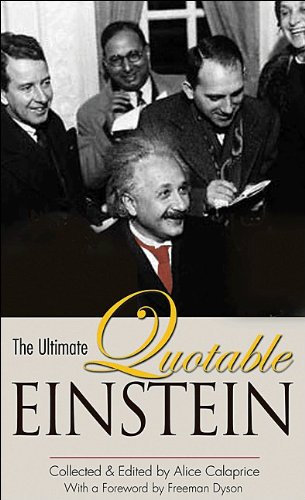
44. Bite-Size Einstein: Quotations
$17.44
45. Albert Einstein: Creator and Rebel
$24.63
46. Albert Einstein: A Biography (Greenwood
$15.43
47. Historic Recordings 1930-1947
$7.33
48. Dear Professor Einstein: Albert
$4.95
49. Albert Einstein (Rebel Lives)
$2.54
50. Albert Einstein (First Biographies
$8.06
51. Einstein on Humanism
$4.15
52. Albert Einstein/Mileva Maric:
$47.72
53. The Collected Papers of Albert
54. ALBERT EINSTEIN / THE WORLD AS
$1.99
55. Albert Einstein: A Life of Genius
$6.91
56. Albert Einstein: A Biography
$4.95
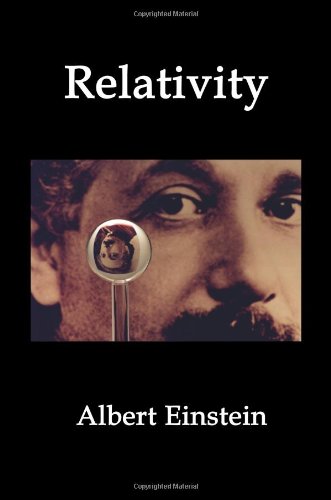
57. The Principle of Relativity (Dover
$8.18
58. Albert Einstein 2008 Calendar:
$50.00
59. The Collected Papers of Albert
$2.32
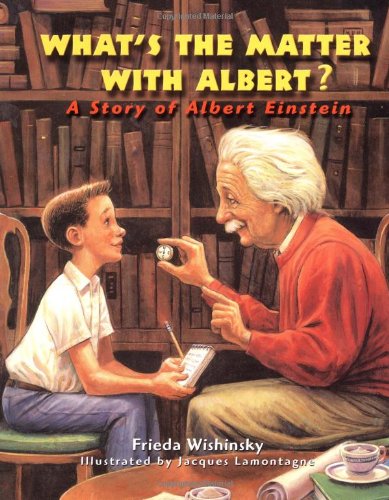
60. What's the Matter with Albert?:

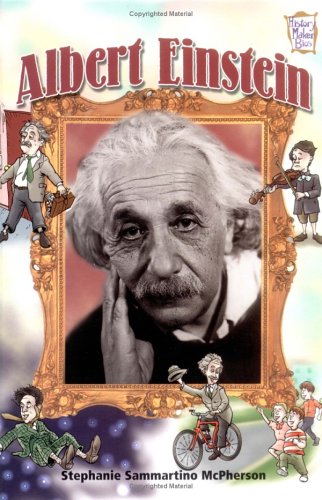
41. Ordinary Genius: The Story of Albert Einstein (Trailblazer Biographies)
by Stephanie Sammartino McPherson
Paperback: 112 Pages (1997-06)
list price: US$8.95 -- used & new: US$4.79
(price subject to change: see help)
Asin: 1575050676
Average Customer Review: 5.0 out of 5 stars
Canada | United Kingdom | Germany | France | Japan

Customer Reviews (8)

5-0 out of 5 stars Informative and Interesting
I liked this book because it was very informative and interesting.It was short and quick and I found out things about Albert Einstein.It covers his background, personal life and professional life.As a boy he was fascinated with a compass and wanted to know why the arrow always pointed north.When his father told him about magnetic fields, he was very excited about magnetism.That was just the beginning of his quest for discovering new things.In addition to enjoying equations and explaining his theories in an understandable way, he played the violin and liked sailing too.He denounced his German citizenship and became a citizen of the United States, none of which I knew before reading this book.

His advice was to always ask questions and never lose your curiosity about things.A lot of his teachers didn't like that he asked so many questions that they couldn't answer.When he became a professor, he encouraged his students to ask questions and was never upsset if he didn't know the answer.He just told them he didn't know.

Karen Arlettaz Zemek, author of "My Funny Dad, Harry"

5-0 out of 5 stars Personal stories and facts kept my interest
Reviewed by Spencer Zaborowski (age 12) for Reader Views (12/07)

"Ordinary Genius: The Story of Albert Einstein" is a biography, which is a story of a person's life, of the famous German scientist.He was born on March 14, 1879, in Ulm, Germany.He had one sister.He was thought of by his parents as being slow and not very bright, because he had an unusually large head when he was born and he did not speak much until he was nine-years-old.He was not a good student and was teased a lot by his teachers and other students, because he was different and questioned them a lot. He finally moved to Switzerland and worked for awhile before being accepted into college.He was curious about the world around him, especially science.He was a professor at universities in Switzerland and Germany, and he worked very long hours finishing scientific papers.He wrote the famous Theory of Relativity in 1916.Albert Einstein came to the United States in 1933 and lived in New Jersey because he was worried about how Jews were treated in Germany.He married twice - his second wife was his cousin.He died in 1955.

At first, I thought this book would be boring and full of science and facts, like some other biographies I have read.But after the first few pages, it was hard to put down!The reading was interesting, and the black and white pictures throughout the book helped to make the story easy to follow.There were not a lot of technical words that would be hard to understand.The book did not go into detail about the scientific things that he wrote about. Instead, the book was more about his personal life and his odd personality.I learned a lot of things about him that I had not known.For example, Einstein never learned to drive a car because he was confused by mechanical things.That was very funny to me.

I would recommend "Ordinary Genius: The Story of Albert Einstein" to middle school-aged kids.I don't normally like to read nonfiction books--only when I have to for school--but this one kept my interest because it told a lot of personal stories and facts about Einstein that made him seem ordinary, like the title says.

5-0 out of 5 stars ordinary genius
I love this book it gave me alot of great information, I did'nt have to go to other sources to get information about his life.I'm doing a report on his life for a school project. I'm going to dress like he did and memorize a speech I'm going to write and then give it in front of my school and all the parents of our school.

5-0 out of 5 stars Sean Delgado Per.3 (Ordiary Genius: The Story of albert Einstein)
Ordinary Genius: The Story of albert Einstein
By: Stephanie Sammartino McPherson
Retold by:S.Delgado
Per.3

The book talks about Alberts life, his ideas and his accomplishments. It talked about from his childhood to his death. Albert was born in March 14, 1879 and diedin April 18, 1955. he lived with his family along with his two siblings. When Albert was a child the first thing that he saw that changed his life was a compass. He wondered how the compass always go north when he goes to a different direction. Albert loved science and mathematics when ever he went to school.After years past Albert looked up books and writing eqautions that could make whateverAlbert thinks it is possible. when he thought up of ideas and eqautions, He became the worlds famous scientist.

I liked how they talked about what his eqautions mean, what were his eqautions, what did E=mc2 mean, and what is the theory of relativity. The Theory of Relativity is the motion at a constant speed. E=mc2 means energy equals mass of energy times speed of light two times.

What I disliked about the book was that it does not tell when he created his inventions or when did he enroll in his schools, for example it will tell when did he thought up of the E=mc2 or when did he enroll in the university.

My favorite part of the book wasone of Alberts ideas saying that if your toy car is going at 2 mph and then put the toy car while running on a 100 mph train and the car would be going 102 mph. If you place a light that goes 186,282 mps on a train, the light still travels the same mps, the speed never changes.

5-0 out of 5 stars Sean Delgado Per.3 (Ordiary Genius: The Story of albert Einstein)
Ordinary Genius: The Story of albert Einstein
By: Stephanie Sammartino McPherson
Retold by:S.Delgado
Per.3

The book talks about Alberts life, his ideas and his accomplishments. It talked about from his childhood to his death. Albert was born in March 14, 1879 and diedin April 18, 1955. he lived with his family along with his two siblings. When Albert was a child the first thing that he saw that changed his life was a compass. He wondered how the compass always go north when he goes to a different direction. Albert loved science and mathematics when ever he went to school.After years past Albert looked up books and writing eqautions that could make whateverAlbert thinks it is possible. when he thought up of ideas and eqautions, He became the worlds famous scientist.

I liked how they talked about what his eqautions mean, what were his eqautions, what did E=mc2 mean, and what is the theory of relativity. The Theory of Relativity is the motion at a constant speed. E=mc2 means energy equals mass of energy times speed of light two times.

What I disliked about the book was that it does not tell when he created his inventions or when did he enroll in his schools, for example it will tell when did he thought up of the E=mc2 or when did he enroll in the university.

My favorite part of the book wasone of Alberts ideas saying that if your toy car is going at 2 mph and then put the toy car while running on a 100 mph train and the car would be going 102 mph. If you place a light that goes 186,282 mps on a train, the light still travels the same mps, the speed never changes. ... Read more


42. Albert Einstein: Philosopher-Scientist (Living Philosophers Volume 7)
 Hardcover: 600 Pages (2001-03)
list price: US$12.98
Isbn: 1567314325
Average Customer Review: 5.0 out of 5 stars
Canada | United Kingdom | Germany | France | Japan

Customer Reviews (5)

5-0 out of 5 stars Uncle Albert's Legacy
In spite of his lasting fame and eminence, Albert Einstein remains largely misunderstood by most of us to this day. Yet it's not for lack of trying. His presence is ubiquitous in high school math classrooms throughout the United States, where he is often depicted on glossy posters as an old man amid the stars with e=mc2 hovering nearby. Most children eventually learn that Einstein and his famous equation are the reason we have atomic bombs. Beyond that, they know next to nothing.

But "Albert Einstein: Philosopher-Scientist" edited by Paul Arthur Schilpp can change all that, provided one makes the effort. After the introduction and preface the book opens with Einstein's "Autobiographical Notes," written in German at the age of 67. We may read both the German text and English translation on the facing pages, and compare the two, which I often did, especially with difficult passages. And there are some "difficult passages" to be sure.

The next section contains a series of essays by Einstein's esteemed colleagues and contemporaries. Among them are Wolfgang Pauli, Max Born, Niels Bohr, Kurt Godel, Gaston Bachelard and others of equal stature. Some contributors disagree with Einstein's position on statistical quantum theory, Max Born in particular. Others tackle the epistemological issues of their time, illuminating subtle philosophical considerations that quickened the numerous advances in theoretical physics during the late nineteenth and early twentieth century. One essay: Philipp G. Frank's "Einstein, Mach, and Logical Positivism" reveals an astounding fact. "Because of the close connection, which obviously exists between Einstein's theory of relativity and Mach's philosophy, Lenin feared that Einstein's theories might become a Trojan horse for the infiltration of idealistic currents among Russian scientists and among educated classes in general."

I find this appalling. Apparently, even devout atheists can lack an open mind.

Happily, Einstein answers each contributor at the end of the book in his "Remarks to the Essays Appearing in this Collective Volume." He begins with Pauli and Born, primarily because of their position on statistical quantum theory, whereupon Einstein launches into a fascinating defense of his own position. But as with all the contributors, the tone throughout was gentle and respectful. And one comes away with the impression that Einstein was beloved by his contemporaries because he returned that love in kind. The result was a mighty collusion of powerful minds that changed the world. Now, if only politicians and preachers could do the same!


5-0 out of 5 stars Al Einstein only Autobiography...so called "Obituary"
Albert Einstein lived the last thirty years of his life in the United States and passed away in 1955 in New Jersey.He wrote three great papers in 1905 at the age of 26.

This book is the only thing ever coming close to an autobiography that Einstein ever wrote.Needless to say, offers of money and prizes were offered to him, unlike the millions offered to ex-U.S. presidents to write a book. He never accepted any of these offers.The only offer he accepted was from Professor Schilpp to write an intellectual autobiography of himself.

Incredible and Timeless is only ways to describe this book.Einstein labels as his "obituary", for a man who was considered the "Person of the Century" by Time Magazine.

Friends, his own "obituary" in his own hand is a worthy read and cost of the book.It is nota "personal" life but his "thinking" on science and of course on physics. We all know the two great theories of physical was created in the early 20th. century: the theory of relativity and quantum mechanics. Einstein alone created relativity and was also one of the founders of the quantum theory. We also know now that Einstein never accepted quantum theory till the end.

Here, Einstein fully describes the failure of classical mechanics and the rise of the electromagnetic field, the theory of relativity and of the quanta.

Of note, Einstein's"Evolution of Physics" is a general lay discussion of the same issues. This is Einstein's technical discussion of the evolution of physics.

"When I was a fairly precocious young man the nothingness of the hopes and strivings which chases most men restlessly through life came to my consciousness with considerable vitality"This comment alone is worth price of the book.

The essays sections includes writing of the great scientist of the 20th century.We only read about them in textbook but here they are in their own words: Niels Bohr, Louis De Broglie, Arnold Sommerfeld, Max Born, Kurt Godel, Hans Reichenbach and Wolfgang Pauli.One only sees their picture in physics textbooks.

This book really belongs in all who are professional scientists or are interested in science.Unlike Newton "Principia" or Darwin's "The Origin of Species" Einstein papers are scattered everyone.This is the only definitive book on Einstein by Einstein himself.

Moreover, it is a scholarly and scientific book, so it should last for a long time and of value to all future generations.

5-0 out of 5 stars Al Einstein only Autobiography...so called "Obituary"
Albert Einstein lived the last thirty years of his life in the United States and passed away in 1955 in New Jersey.He wrote three great papers in 1905 at the age of 26.

This book is the only thing ever coming close to an autobiography that Einstein ever wrote.Needless to say, offers of money and prizes were offered to him, unlike the millions offered to ex-U.S. presidents to write a book. He never accepted any of these offers.The only offer he accepted was from Professor Schilpp to write an intellectual autobiography of himself.

Incredible and Timeless is only ways to describe this book.Einstein labels as his "obituary", for a man who was considered the "Person of the Century" by Time Magazine.

Friends, his own "obituary" in his own hand is a worthy read and cost of the book.It is nota "personal" life but his "thinking" on science and of course on physics. We all know the two great theories of physical was created in the early 20th. century: the theory of relativity and quantum mechanics. Einstein alone created relativity and was also one of the founders of the quantum theory. We also know now that Einstein never accepted quantum theory till the end.

Here, Einstein fully describes the failure of classical mechanics and the rise of the electromagnetic field, the theory of relativity and of the quanta.

Of note, Einstein's"Evolution of Physics" is a general lay discussion of the same issues. This is Einstein's technical discussion of the evolution of physics.

"When I was a fairly precocious young man the nothingness of the hopes and strivings which chases most men restlessly through life came to my consciousness with considerable vitality"This comment alone is worth price of the book.

The essays sections includes writing of the great scientist of the 20th century.We only read about them in textbook but here they are in their own words: Niels Bohr, Louis De Broglie, Arnold Sommerfeld, Max Born, Kurt Godel, Hans Reichenbach and Wolfgang Pauli.One only sees their picture in physics textbooks.

This book really belongs in all who are professional scientists or are interested in science.Unlike Newton "Principia" or Darwin's "The Origin of Species" Einstein papers are scattered everyone.This is the only definitive book on Einstein by Einstein himself.

Moreover, it is a scholarly and scientific book, so it should last for a long time and of value to all future generations.

5-0 out of 5 stars Profound
Here, Einstein clearly shows the world that he was a first-classintellectual and scientist.

--Lonnie R. Gardner (Math Teacher)

5-0 out of 5 stars Einstein by Einstein!
The philosopher Paul Schilpp directed, for many years, a series of books like this one, each around an eminent scholar. I recall, for instance, those onRussell and Popper. They started with an intellectual autobiography, followed by articles by specialists both pro and against the protagonist. They all had, it seems, a very high quality. No one surpassed,though, or even equalled, the volume on Einstein. And that because of the absolutely extraordinary quality of his intellectual autobiography, which he insisted in naming his "obituary". This is one of the great moments of written expression, rivalling Augustine's "Confessions". Is is written in German, and faced, page by page, with a translation by Schilpp. At a certain point, Einstein engages himself in answering the question hejust proposed: "What, precisely, is thinking". The defense rests. ... Read more


43. Einstein's Miraculous Year: Five Papers That Changed the Face of Physics
by Albert Einstein
Paperback: 248 Pages (2005-03-28)
list price: US$18.95 -- used & new: US$10.00
(price subject to change: see help)
Asin: 0691122288
Average Customer Review: 4.0 out of 5 stars
Canada | United Kingdom | Germany | France | Japan
Editorial Review

Book Description

After 1905, Einstein's miraculous year, physics would never be the same again. In those twelve months, Einstein shattered many cherished scientific beliefs with five extraordinary papers that would establish him as the world's leading physicist. This book brings those papers together in an accessible format. The best-known papers are the two that founded special relativity: On the Electrodynamics of Moving Bodies and Does the Inertia of a Body Depend on Its Energy Content? In the former, Einstein showed that absolute time had to be replaced by a new absolute: the speed of light. In the second, he asserted the equivalence of mass and energy, which would lead to the famous formula E = mc2.

The book also includes On a Heuristic Point of View Concerning the Production and Transformation of Light, in which Einstein challenged the wave theory of light, suggesting that light could also be regarded as a collection of particles. This helped to open the door to a whole new world--that of quantum physics. For ideas in this paper, he won the Nobel Prize in 1921.

The fourth paper also led to a Nobel Prize, although for another scientist, Jean Perrin. On the Movement of Small Particles Suspended in Stationary Liquids Required by the Molecular-Kinetic Theory of Heat concerns the Brownian motion of such particles. With profound insight, Einstein blended ideas from kinetic theory and classical hydrodynamics to derive an equation for the mean free path of such particles as a function of the time, which Perrin confirmed experimentally. The fifth paper, A New Determination of Molecular Dimensions, was Einstein's doctoral dissertation, and remains among his most cited articles. It shows how to calculate Avogadro's number and the size of molecules.

These papers, presented in a modern English translation, are essential reading for any physicist, mathematician, or astrophysicist. Far more than just a collection of scientific articles, this book presents work that is among the high points of human achievement and marks a watershed in the history of science.

Coinciding with the 100th anniversary of the miraculous year, this new paperback edition includes an introduction by John Stachel, which focuses on the personal aspects of Einstein's youth that facilitated and led up to the miraculous year.

Download Description
After 1905, Einstein's miraculous year, physics would never be the same again. In those twelve months, Einstein shattered many cherished scientific beliefs in five great papers that would establish him as the world's leading physicist. For the first time, this book brings those papers together in an accessible format. ... Read more

Customer Reviews (9)

5-0 out of 5 stars E = mc²
This book is a compilation of five important papers including Albert Einstein's dissertation, all published in Annalen der Physik the year 1905. The papers are;

(1) "A new determination of molecular dimensions". Which is Einstein's dissertation.

(2) On the motion of Small particles Suspended in Liquids at Rest Required by the Molecular-Kinetic Theory of Heat. This is what is referred to as Brownian Motion.

(3) On the Electrodynamics of Moving Bodies. This is what is referred to as the special theory of relativity. This paper is to some degree a synthesis of work done by H.A. Lorentz and Henri Poincare, which is common in science (and Lorentz is given his fair due).

(4) Does the Inertia of a Body Depend on Its Energy Content? This is essentially E = mc² and is an extension of the aforementioned paper.

(5) On a heuristic Point of View Concerning the Production and Transformation of Light. This is his paper on the photo electric effect and the quantum hypothesis. This is what Einstein got his Nobel price for. However, both (2) and (3) above are often considered to be Nobel Prize work.

The way I see it, these papers are of great historical value and it is awesome to be able to read the originals. However, I do not recommend this book as a good introduction to any of this material. As an engineering physics student I encountered most of the content of these papers in a more complete and clearer format. For example, the special theory of relativity is explained better in many text books on physics. Remember these papers are research papers not educational texts. That does not mean that I endorse the many non-mathematical popularizations of the topic that often end up misleading the reader. I should add, however, that in many texts on the special theory of relativity its foundation in electrodynamics is lost or downplayed, so reading the original will remind the student where it really came from.

I was surprised to see how the formula K0 - K1 = Lv²/ (2V²) was derived. This formula states the change in the kinetic energy of a body emitting radiation with energy L/2 in each direction. An implicit approximation (K = mv²/2, classic kinetic energy) was cancelled out by a MacLaurin/Taylor expansion and a corresponding approximation (when dropping terms). This is not wrong, and the proof is still valid, but it seems unnecessary to use approximations from classical mechanics when it is just as easy to make do without them. In any case from this formula it is concluded that when a body that emits the energy L in the form of radiation, then its mass decreases by L/V², or E = mc² ("V" is "c" plus classic formula above).

However, the formula E = mc² can be easily derived directly from the special theory of relativity without any approximation, which he did at a later date. You integrate E = F S (where S is distance) using the relativistic formulas for force and mass. In any case the paper proves the genial insight that "that the mass of a body is a measure of its energy content", which is worth perhaps yet another Nobel Prize. It is also short paper.

I can add that Einstein's opus magnum, the general theory of relativity, came much later 1915/1916. Some other huge achievements were "stimulated emission" the principle behind the laser, Bose-Einstein statistics, and relativistic cosmology. In addition he also did the following, critical opalescence, the geometrization of physics, unified field theory, the EPR paradox, the Einstein refrigerator, a refrigerator without any moving parts, and much more. So 1905 was a very good start, a miracle year, but still just the beginning.

Anyway, reading the originals is thrilling. It is recommended reading to anyone who is literate in physics, and also recommended to anyone who would like to have these master pieces in his library.

5-0 out of 5 stars A Treasure
Translations of these five revolutionary papers, written in Einstein's annus mirabilis of 1905, have been widely available from other sources.However, it is a delight to have them compiled in this handsome, low cost edition.And the thoughful foreward by Roger Penrose and the interesting historical introductions and annotations by John Stachel make this text invaluable.

As for the papers themselves, they still serve as pedagogically excellent introductions to the fields they created.And they provide stunning insight into the workings of one of the most amazing intellects the world has ever seen.

This book should be part of any science library worthy of the name.

4-0 out of 5 stars The Heart of the Matter
As a retired physicist I have taken great interest in the history of science, especially the times around the turn of the twentieth century when so many new ideas were put forward which have the basis of quantum mechanics and our current thinking from cosmology to quarks.This little volume is recommended either for bedtime reading or more serious study.The personal history reveals aspects previously unknown to me and the five papers themselves, in their original form, demonstrate Einstein's wonderful insightfulness and ability to make use of every aspect of a problem.Tney are a bit heavy going in themselves, and the mathematics is not for everyone, but what else would one expect from a distillation of so much into so relatively few words.I recommend this book to both the scintist and the layman who seeks a better understanding of these momentous mental leaps.

5-0 out of 5 stars Einstein's Masterful Synthesis
We should know some things about Einstein. He needed a mathematician to write his ideas and theories about relativity. He found the famous mathematician Kurt Godel to help him. Einstein said to Godel "I need you to write the equations for my theory". However, Godel said: " I don't know physics" whereby Einstein replied, " I know physics and you know mathematics". Then Godel agreed to go to work for Einstein.

As is always the case in science, we stand on the shoulders of others before us. Einstein got his ideas and theories about relativity from many mathematicians and some physicists.

When you read between the lines of this fine book, you will see how Einstein synthesized and derived some of the greatest theories in history as to how nature is constructed and works.

Einstein put it all together just like Newton did with the calculus.

5-0 out of 5 stars Einstein's masterful synthesis
We should remember a few things about Einstein. He needed a mathematician to write his concepts and theories about relativity. He found the famous mathematician Kurt Godel. He said to Godel " I need you to help me construct my theories". However, Godel replied " I don't know physics ". Einstein replied, "I know physics and you know mathematics". Then Godel agreed to go to work for Einstein.

As is always the case in science, we stand on the shoulders of others before us. Einstein got his ideas from many mathematicians and some physicists. He synthesized and derived the greatest theories in history about nature and how it works.

If you read between the lines of this book you will come to understand what this fine book is telling us about the great Albert Einstein. It was he, who put it all together, like Newton did with the calculus. ... Read more


44. Bite-Size Einstein: Quotations on Just About Everything from the Greatest Mind of the Twentieth Century
Hardcover: 112 Pages (2003-04-01)
list price: US$7.99 -- used & new: US$91.94
(price subject to change: see help)
Asin: 0517221004
Average Customer Review: 5.0 out of 5 stars
Canada | United Kingdom | Germany | France | Japan
Editorial Review

Book Description
This little volume is chock-full of fun and intriguing quotes from everyone's favorite scientist: Einstein. Read what he has to say about life, morality, philosophy, art and music, science and mathematics, politics, religion, social issues, war and peace, and himself. His views on life, religion, philosophy, and many other issues are as relevant today as they were when he was living. Including a brief biography of the physicist and an amusing bit of doggerel by Einstein himself, Bite-Size Einstein reveals his brilliant perspective on the human condition. ... Read more

Customer Reviews (2)

5-0 out of 5 stars Humanity is more important than national citizenship

In this year of intense political contention, based in part on a spiteful opposition to immigrants, it is worth reading these concise but poignant quotes by America's most illustrious immigrant.

"I am a democrat," said Albert Einstein.Today, such use of "democrat" means "small 'd' democrat" to avoid confusion with "big 'D' Democrat" which some accuse of being traitors to America.Such is our new intolerance.

However, consider:

--"The foundation of all human values is morality.

--"The destiny of civilized humanity depends more than ever on the moral forces it is capable of generating.

--"Comfort and happiness have never appeared to me as a goal.I call these ethical bases the ideal of the swineherd."

Comfort and happiness?In an era of global warming, perhaps drivers of SUVs really are modern swineherds with scrubbed faces and clean fingernails.It's not that Einstein is so perfectly correct;but, his comments should cause every intelligent person to re-think.After fleeing a Europe where a master race destined to rule the world was being created by government edict, it's hardly surprising Einstein should write, "The state is made for man, not man for the state."

Despite offering a wide range of provocative and stimulating ideas, he has enough common sense to understand, "As a human being, one has been endowed with just enough intelligence to be able to see clearly how utterly inadequate that intelligence is when confronted with what exists."

Has anyone come up with a better description of politics?let alone human events?let alone physics?

Einstein's fame is based on questioning the status quo;he did not want change we can believe in, he wanted questions to discover a new reality instead of preserving old bad habits.In contrast to Bible Thumpers (or Physics book thumpers and every other thumper), "The foundation of morality should not be made dependent on myth nor tied to any authority lest doubt about the myth or about the legitimacy of the authority imperil the foundation of sound judgment and action."

Such quotes make this book a gem.It encourages one to think (which infuriates politicians to no end).As he once said, which applies to today's "huddled masses yearning to breathe free" just inside the golden door, "Humanity is more important than national citizenship."


5-0 out of 5 stars Wisdom and Wit
When one thinks of Einstein, wisdom and logic seem to prevail.. This book proves that he has a number of one-liners which will blow your socks off and make you laugh out loud.It will also confirm your suspisions thatsmart people and funny people have a lot in common. ... Read more


45. Albert Einstein: Creator and Rebel (Plume)
by Banesh Hoffman, Helen Dukas
Paperback: 288 Pages (1973-05-01)
list price: US$15.00 -- used & new: US$17.44
(price subject to change: see help)
Asin: 0452261937
Average Customer Review: 4.0 out of 5 stars
Canada | United Kingdom | Germany | France | Japan

Customer Reviews (4)

3-0 out of 5 stars 'like you or me but smarter and better in all ways'
not to say that einstein wasn't exceptionally clever, but i found the tone of this book to be leaning a bit to far to the 'worship einstein as a minor deity' side of things.any potential cause to think less of old albert is glossed over in an unapealing way. the examples that come to mind are the minimal treatment that poincare's accomplishments regarding relativity recieve, and the minimal information on his divorces.i wish the authors had stepped down from the altar of the holy einstein long enough to give him a human treatment.even the title is a bit much.creator and rebel?it would be funny if it weren't sadly earnest.

5-0 out of 5 stars An intimate, personal biography.
I have read several biographies of Einstein, some of which are among my list of all-time favorite books. None however, approach the intimacy or sense of personal connection as Hoffmann and Dukas' 1972 classic"Creator and Rebel." Perhaps because of Helen Dukas' influence,this book contains perhaps the most intimate look at the man and, thanks toHoffmann, the one of the clearest explanations of his science. Though otherbiographies are also must-reads for Einstein devotees (Folsing and Frank,for instance), this one goes to the top of my list.

5-0 out of 5 stars Einstein by very close collaborators
Why is this book so good? Its first phrase is:"We sketch in this bookthe story of a profoundly simple man." This could be done only byfriends. And friends the authors are. Banesh Hoffman, a collaborator ofEinstein's, happens to be a great writer, possibly the best as books forthe layman are concerned. Helen Dukas, the other author, was Einstein'ssecretary for many years. The book is very beautifully produced, full ofnice photographs. Relativity is really explained. A labor of love whichdeserves much more popularity.

4-0 out of 5 stars A tour-de-force ofthe revolutionary physics of 1900-1935
One cannot seperate the man from his work and this biography branches into other people who touched upon A. Einstein aswell as his science.The incomparable simplicity of his brilliant thought is driven home in the discussion of AT-LAB and GRAV-LAB.The story may be known or not.It deserves good re-telling.This audio book is well done and special thanks to the reader who handles the math examples (less than a handful) with precise language, grace, and accuracy.My complaint is that the book is too short.I woud have liked more of the interaction with subject in his personal life.But still a solid 8. ... Read more


46. Albert Einstein: A Biography (Greenwood Biographies)
by Alice Calaprice, Trevor Lipscombe
Hardcover: 200 Pages (2005-06-30)
list price: US$29.95 -- used & new: US$24.63
(price subject to change: see help)
Asin: 0313330808
Average Customer Review: 4.0 out of 5 stars
Canada | United Kingdom | Germany | France | Japan
Editorial Review

Book Description
Albert Einstein remains one of most famous scientists in world history. His image is instantly recognizable by even the most scientifically uninformed person--for many people, Einstein personifies genius. But who was Einstein really? What was he like as a person? What did his science actually mean? This fresh biography of Albert Einstein provides students and general readers a concise, accessible introduction to the life and science of this revolutionary man. Underneath his genius, Einstein was an ordinary person, with human frailties and weaknesses, but also with charm, modesty, a wry sense of humor, and idiosyncrasies. Readers will understand why he was named the "Person of the Century" by Time magazine. Albert Einstein: A Biography will cover the entire history of this brilliant physicist's life and career, including: DT His early education, during which he was an excellent student, contrary to what is commonly believed. DT Einstein's struggles to find an academic position, which led him to work as a clerk at the Swiss patent office during the same period he was formulating his most famous and revolutionary theories DT His troubled marriages and family life DT Einstein's rise to international fame, and his use of that fame to fight for world peace DT Einstein's major contributions to physics, explained in ways that can be understood by anyone who wishes a fuller understanding of his scientific theories. The book includes a bibliography of secondary works that are useful for further reading, and a timeline of important dates in the life of Einstein. ... Read more

Customer Reviews (1)

4-0 out of 5 stars The Incredible Life Story of ALbert Einstein
.This book gives a very thorough detail of Albert Einstein's life from his ideas amounting to his development of the General Theory of Relativity to his difficult family life and his disabilities as a child. It explains many interesting facts and disproves any common misconceptions about Einstein's life. Calaprice and Lipscombe are able to magnify important points in Einstein's life and captivate the reader just through these events. This book also goes into detail describing how Einstein developed each of his theories and explains the ideas that are included in many of them so that any person can comprehend his incredible ideas. This enables the reader to feel they are in Einstein's head exploring the almost inconceivable thoughts of this brilliant scientist. I am sure that both Calaprice and Lipscombe desired to recount Einstein's life because of his varying life status as he became one of the most famous scientists in world history. Einstein's compelling life story is reason enough to read this book. If you have not already become acquainted with Einstein and his discoveries, I would highly recommend that you take time and get informed by reading one of his biographies. Einstein had an incredible life that is thoroughly summed up in Albert Einstein: A Biography by Alice Calaprice and Trevor Lipscombe. ... Read more


47. Historic Recordings 1930-1947
Audio CD: Pages
list price: US$25.99 -- used & new: US$15.43
(price subject to change: see help)
Asin: 0712305211
Canada | United Kingdom | Germany | France | Japan
Editorial Review

Album Details
68 Minutes of Rare BBC Recordings.the Celebrated Physicist Talks About his Life and Work, the Jewish People and the World of Science. Includes Deluxe 24 Page Booklet with Rare Photos, Extensive Historical Liner Notes and Translations Where Necessary. ... Read more


48. Dear Professor Einstein: Albert Einstein's Letters to and from Children
Hardcover: 232 Pages (2002-09)
list price: US$24.00 -- used & new: US$7.33
(price subject to change: see help)
Asin: 1591020158
Average Customer Review: 3.5 out of 5 stars
Canada | United Kingdom | Germany | France | Japan
Editorial Review

Book Description
"What holds the sun and planets in space?" "I want to know what is beyond the sky. My mother said you can tell me." "One question I would like to ask is if you make any mistakes?"

We are often amazed by the wide-eyed innocence and boundless curiosity of children and the questions they ask. And letters to and from children are always appealing, especially so when they are written to someone famous. In DEAR PROFESSOR EINSTEIN, Alice Calaprice has gathered a delightful and charming collection of more than sixty letters, most never published before, from children to perhaps the greatest scientist of all time. Obviously, Einstein could not respond to every letter written to him, but the responses he did find the time to write reveal the intimate human side of the great public persona, a man who, though he spent his days contemplating mathematics and physics, was very fond of children and enjoyed being in their company. Whether the children wrote to Einstein for class projects, out of curiosity, or because of prodding from a parent, their letters are amusing, touching, and sometimes quite precocious.

Enhancing this correspondence are numerous splendid photographs showing Einstein amid children, wearing an Indian headdress, carrying a puppet of himself, and donning fuzzy slippers, among many other wonderful pictures, many published for the first time in this book.

Complete with a foreword by Einstein's granddaughter Evelyn, a biography and chronology of Einstein's life, and an essay by Einstein scholar Robert Schulmann on the great scientist's educational philosophy, this wonderful compilation will be welcomed by teachers, parents, and all the young, budding scientists in their lives. ... Read more

Customer Reviews (4)

3-0 out of 5 stars A better title than book
The idea conveyed by the title is wonderful, and to some degree the notion is realized.Unfortunately, it doesn't really fly.While there still may be merit in study of Einstein's educational comments to children, this volume doesn't offer much insight.

The book starts with Einstein's grand daughter's recollections of grandpa, then her personal bio of Einstein, then another two mini-bio's by 3rd parties and a bunch of Einstein photos.Finally, we get to the letters, but 'Einstein' only replies to about 1 of 5 letters.Maybe this is enough if Einstein had addressed actually addressed the issues, but they generally offer polite parental advice: study hard and hope for the best.

A few answers might give us a peak into Einstein's metaphysics, but the author doesn't explore them.For example, one child asks if scientists pray.Einstein answers that A) Scientist know prayer cannot influence the laws of physics, so they don't pray. B) But, scientists know their knowledge is limited, so C) they realize God might work in a restricted domain.D) This means scientists have a very special relationship with God.Left unsaid was the less than politically correct D) So, scientists still pray.

3-0 out of 5 stars Misleading Title
I had been looking forward to this book's release for some time.As yet another self-confessed Einstein fan, the idea of a collection of correspondences between the greatest scientific mind in the history of human endeavour, and curious children from around the world, was irresistable.So, when I finally got my hands on it, I wanted to enjoy it very much.However, in the end, I felt a bit cheated and misled.

First of all, virtually the entire first half of the book (the first 110 pages!) contains no letters whatsoever.Instead it covers a biography of the scientist, discussions on his education, a photo gallery etc...While these were reasonably interesting, you can find similar material elsewhere, and was not the reason why I purchased the book.

And the letters themselves were a bit disappointing.While I enjoyed reading the funny and childish letters written to Einstein, the questions and comments they included whet my appetite for how Einstein might respond (are you going to go insane because all geniuses are said to go insane? Did Houdini discover the 4th dimension, allowing him to walk through walls? etc...).However, there were very few actual replies from Einstein (though the few there were were fascinating to read).Furthermore, many of the letters by Einstein included those to his own relatives or to grown ups - which I felt was not in keeping with the promise of the book.

This book reminded me of those music albums you buy because you hear one or two songs that you really like, only to discover that the remaining eight songs are just fillers to make up the space.Similarly, this book took a few gems and then made a book of it by adding a lot of extra stuff.

This book, titled "Dear Professor Einstein - Albert Einstein's Letters to and From Children" is misleading.I would have felt less cheated if it read something like "Dear Professor - a Biography of Einstein, including letters written to him (mainly from children) and the very few responses we could find that he made".However, that is a bit of a mouthful and probably less appealing from a marketing point of view.

I still gave it a 3 because it's about Einstein...did I mention I was an Einstein fan?

3-0 out of 5 stars Not what I expected
A good book, but it was not what I expected.Only half the book is actual letters.There are very few with responses from Einstein.There are more letters from children than to children.

5-0 out of 5 stars Get to know the other side of Einstein!
This is a beautiful and touching book. The letters from children are printed exactly as they are written, spelling errors and all--some letters are even printed in their handwritten form. It is amazing how insightful some of the questions from the children are. Einstein's responses are written on the level of the original letter-writer, and are always well thought-out. I'm a big Einstein fan, and this was a gift that I greatly enjoyed. There were also some very interesting pictures of Einstein included in this book. ... Read more


49. Albert Einstein (Rebel Lives)
Paperback: 1 Pages (2003-11)
list price: US$9.95 -- used & new: US$4.95
(price subject to change: see help)
Asin: 187617563X
Average Customer Review: 4.0 out of 5 stars
Canada | United Kingdom | Germany | France | Japan
Editorial Review

Book Description

This book takes a subversive look at lesser-known aspects of the famous scientist's intellectual life, the man whom the FBI thought was "too clever not to track." It presents Einstein's denunciation of U.S. use of nuclear bombs in 1945, his socialism and his passionate opposition to war as a profound advocate of radical humanism.

"What I like most about Albert Einstein is that he was a troublemaker."-Fred Jerome, author of The Einstein File

--------------

"We were born into an unjust system. We are not prepared to grow old in it."-Bernadette Devlin

Rebel Lives books feature writings both by and about individuals who have played significant roles in humanity's ongoing fight for a better world. The series shows the not-so-well-recognized political views of some well-known figures and introduces some not-so-famous rebels. Strongly representative of race, class and gender, these books are smaller format, inexpensive, accessible and provocative.

... Read more

Customer Reviews (1)

4-0 out of 5 stars A pleasant surprise
I didn't have great expectations for this "subversive" look at Albert Einstein, so I was pleasantly surprised when I got around to reading it.Though by no means a complete biography, this "Rebel Lives" volume provides a thoughtful and thought-provoking look at a side of the famous physicist not widely known.

This book is a collection of letters, articles and essays, all by Einstein, on various social issues to which he devoted his spare time: pacifism; internationalism and world government; human rights and civil rights; humanism; socialism; and opposition to nationalism, capitalism, militarism, fascism, and weapons of mass destruction.Organized into six sections by topic, it opens with a brief biographical sketch, chronology, and introductions to the documents by editor Jim Green.Also included is a brief bibliography of electronic and printed resources for more information.

Many of the documents were interesting, though since I was already familiar with several of them they were not such a revelation to me as they might be to others who didn't know Einstein was a socialist and pacifist.For instance, I long ago read his article "Why Socialism", published in the first issue of the socialist magazine "Monthly Review" in 1949 and available free online.In general, I felt that such a look at Einstein could have been both more comprehensive and more in-depth, especially for the relatively high price.I would also have preferred the backgrounds on the documents to be spread amongst the documents themselves, instead of all grouped together in the introduction.That way the reader wouldn't have to flip back to the beginning of the book to review the context of any particular document.

However, this subversive look at Einstein should be of interest to those who are curious about, but have little or no knowledge of, his leftist social and political stances.It may also be of special value to teachers looking for primary sources on any of the topics addressed. ... Read more


50. Albert Einstein (First Biographies (Capstone Paperback))
by Wyatt S. Schaefer
Paperback: 24 Pages (2003-08)
list price: US$5.95 -- used & new: US$2.54
(price subject to change: see help)
Asin: 073683382X
Canada | United Kingdom | Germany | France | Japan
Editorial Review

Book Description
Introduce young readers to great historical figures! Learn about major life events, from childhood to adult years. A time line in each book captures important details, one event at a time, culminating in a complete summary on the final page. ... Read more


51. Einstein on Humanism
by Albert Einstein
Paperback: 132 Pages (1998-08-18)
list price: US$8.95 -- used & new: US$8.06
(price subject to change: see help)
Asin: 0806514361
Canada | United Kingdom | Germany | France | Japan
Editorial Review

Book Description
This volume of collected essays by Albert Einstein covers the period of his life between 1931 and 1950. Einstein did not belong to that group of scholars who live in the ivory tower of their research work oblivious of the world around them. On the contrary, he was always an astute and critical observer of the trends and needs of his time. This collection reflects the philosophical as well as political and social attitudes of its author, and we feel privileged to offer them to the public with hardly any editorial change-- a moving document of the workings of a conscientious, profound, and deeply humane mind. ... Read more


52. Albert Einstein/Mileva Maric: The Love Letters
Paperback: 140 Pages (2000-10-31)
list price: US$14.95 -- used & new: US$4.15
(price subject to change: see help)
Asin: 0691088861
Average Customer Review: 5.0 out of 5 stars
Canada | United Kingdom | Germany | France | Japan
Editorial Review

Book Description

In 1903, despite the vehement objections of his parents, Albert Einstein married Mileva Maric, the companion, colleague, and confidante whose influence on his most creative years has given rise to much speculation. Beginning in 1897, after Einstein and Maric met as students at the Swiss Federal Polytechnic, and ending shortly after their marriage, these fifty-four love letters offer a rare glimpse into Einstein's relationship with his first wife while shedding light on his intellectual development in the period before the annus mirabilis of 1905. Unlike the picture of Einstein the lone, isolated thinker of Princeton, he appears here both as the burgeoning enfant terrible of science and as an amorous young man beset, along with his fiance, by financial and personal struggles--among them the illegitimate birth of their daughter, whose existence is known only by these letters. Describing his conflicts with professors and other scientists, his arguments with his mother over Maric, and his difficulty obtaining an academic position after graduation, the letters enable us to reconstruct the youthful Einstein with an unprecedented immediacy. His love for Maric, whom he describes as "a creature who is my equal, and who is as strong and independent as I am," brings forth his serious as well as playful, often theatrical nature. After their marriage, however, Maric becomes less his intellectual companion, and, failing to acquire a teaching certificate, she subordinates her professional goals to his. In the final letters Einstein has obtained a position at the Swiss Patent Office and mentions their daughter one last time to his wife in Hungary, where she is assumed to have placed the girl in the care of relatives. Informative, entertaining, and often very moving, this collection of letters captures for scientists and general readers alike a little known yet crucial period in Einstein's life.

... Read more

Customer Reviews (2)

5-0 out of 5 stars Excellent ! The book that the Einstein establishment doesn't want you to read
There can be no doubt about it .Mileva Maric(Marity)was a collaborator with Albert Einstein on one or more of the 4 1905 papers published by Max Planck in his German language journal.Her main contribution probably was in explaining to Albert the 1887 Michelson -Morley light refraction-reflection experimental results demonstrating that the speed of light had to be a constant.This would mean that there was no "ether" medium in which light would travel.Understanding these results are a necessary,but not sufficient, prerequisite to building a special or general theory of Relativity.Albert Einstein deliberately left out any reference to these results because he knew that it was Mileva who had helped him master this area of research.He wanted to pretend that he had reached his conclusions without resort to these extremely important empirical- experimental findings or any other empirical work.Albert Einstein was ,of course,the main author of the papers.His refusal to acknowledge her partial contribution means that Albert was a glory grabber in the same sense that Otto Hahn was in refusing to acknowledge the great aidof Lise Meitner in the discovery of nuclear fission.

5-0 out of 5 stars A lot more than a secretary
This a nice collection of love letters between Albert Einstein and his first wife, Mileva Maric.If you don't know the rest of the tragic story (for her, anyway), it's just as well. It's enough to make you reflect on the amount of pain that love turn to hate can engender.

They cover the period when he is getting his PhD, his first job at the patent office (which he was happy to get, by the way) in Zurich, and the birth of their first, but illegitimate child, a daughter named Lieserl, whose eventual whereabouts became a mystery (see the excellent Einstein's Daughter by Michele Zackheim for an exhaustive search for Lieserl).

What is most intriguing about these letters is the number of times Einstein refers to "our" in his scientific work.He has never acknowledged Mileva's help, but I don't know how anyone can avoid the conclusion that she was a collaborator during the critical period leading up to 1905.Consider the following, in Einstein's own words: " . . . our work on relative motion . . . "(p. 39); "Don't [Mileva] forget to check on the extent to which glass conforms to the Dulong-Petit law." (p. 40); " . . .our theory of molecular forces . . ."(p. 45); " . . . enough empirical material for our investigation . . . "(p. 47); and "I gave him our paper" (p. 52).There are other references.

Mileva has had her defenders in the last ten or fifteen years, but for the most part those who want to keep the Einstein myth alive that whatever he did, he did without any help have relegated her to the role of some sort of amanuensis and helpmeet.If the word "our" means what I think it means, she was a whole more than that. ... Read more


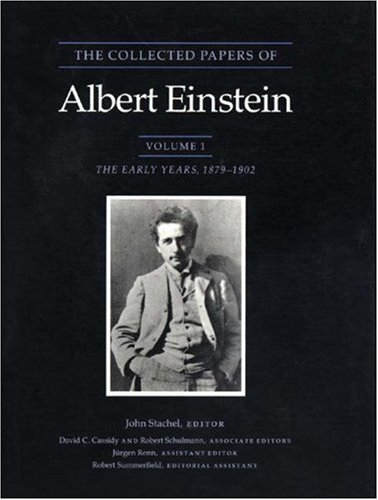
53. The Collected Papers of Albert Einstein, Volume 6: The Berlin Years: Writings, 1914-1917
by Albert Einstein
Paperback: 464 Pages (1997-09-15)
list price: US$50.00 -- used & new: US$47.72
(price subject to change: see help)
Asin: 0691017344
Average Customer Review: 5.0 out of 5 stars
Canada | United Kingdom | Germany | France | Japan
Editorial Review

Book Description

Presented in this volume are Albert Einstein's writings from his arrival in Berlin in the spring of 1914 to take up his new position at the Prussian Academy of Sciences through the end of 1917. During these years he completed the general theory of relativity--the relativistic theory of gravitation--and this was surely the high point of his scientific life. His writings on relativity in this volume range from general treatments of the theory to detailed calculations of specific consequences and his first attempt at a relativistic account of cosmology. They also include his popular exposition of the special and general theories, first published in 1917 and still a valuable account for the general reader.

As soon as the difficulties on the path to general relativity had been overcome, Einstein returned to the riddles of the quantum theory. His major clarification of the quantum theory of radiation appears here along with his lesser known contribution to the formulation of quantum conditions. This volume also contains the papers describing Einstein's only experimental investigation, a study of Ampère's molecular currents, which he carried out with the Dutch physicist W. J. de Haas.

Before the beginning of World War I, Einstein had never expressed his views on nonscientific subjects. Yet one of his first reactions to this previously unthinkable general war was to sign an "Appeal to Europeans" urging an immediate end to hostilities.

Every document in The Collected Papers of Albert Einstein appears in the language in which it was written.

... Read more

Customer Reviews (2)

5-0 out of 5 stars Excellent translations!
If without this translation version, I guess I'll be spending much more time in doing my own translation than trying to grasp the ideas in the papers. I really appreciate the translations.

5-0 out of 5 stars An extraordinary collection
Readers-

One might question why you might purchase a book such as this.Well the answer is quite simple.Logic.Now when I say logic I don't mean the logic of the words themselves rather the logic that youmight read such an impressive work.

Einstien was a genius in his time,a genius yet to be surpassed (in the authority of Science that is).Hisworks are timeless, classic examples of the scientific process and thisparticular is a well-balanced example.

Written during the years of the1910s this volume's works depict a dedication to science eventhrough thewar in Europe.

A Must Read!

Justin Smith ... Read more


54. ALBERT EINSTEIN / THE WORLD AS I SEE IT / OUT OF MY LATER YEARS
Paperback: Pages (1990)

Asin: B000C9K0E0
Canada | United Kingdom | Germany | France | Japan

55. Albert Einstein: A Life of Genius (Snapshots: Images of People and Places in History)
by Elizabeth MacLeod
Paperback: 32 Pages (2003-02-01)
list price: US$6.95 -- used & new: US$1.99
(price subject to change: see help)
Asin: 1553373979
Canada | United Kingdom | Germany | France | Japan
Editorial Review

Book Description
Albert Einstein was one of the most brilliant scientists who ever lived. The theories that he formulated about time, light and gravity have changed how we look at the world and resulted in many new inventions. But did you know that he was so absentminded that he once forgot where he lived? Or that even though he was an advocate of world peace, his work led to the creation of the atom bomb? Using photographs, maps, quotes, letters and drawings, this biography introduces young readers to Albert Einstein. Also included are a time line of his life and a list of places to visit to learn more about one of history's greatest thinkers. ... Read more


56. Albert Einstein: A Biography
by Milton Meltzer
Hardcover: 32 Pages (2007-10-30)
list price: US$16.95 -- used & new: US$6.91
(price subject to change: see help)
Asin: 0823419665
Canada | United Kingdom | Germany | France | Japan
Editorial Review

Book Description
Albert Einstein spent his life asking questions and searching for answers. In 1921 Einstein was awarded the Nobel Prize in Physics. He was not only a scientist, he was also a peace activist and a fighter for social justice.In this revealing biography-featuring black-and-white photographs-esteemed nonfiction author Milton Meltzer explores the life and work of one of the greatest scientists of all time. ... Read more


57. The Principle of Relativity (Dover Books on Physics)
by Albert Einstein, Frances A. Davis
Paperback: 216 Pages (1952-06-01)
list price: US$9.95 -- used & new: US$4.95
(price subject to change: see help)
Asin: 0486600815
Average Customer Review: 4.5 out of 5 stars
Canada | United Kingdom | Germany | France | Japan
Editorial Review

Book Description

Here are the 11 papers that forged the general and special theories of relativity: seven papers by Einstein, plus two papers by Lorentz and one each by Minkowski and Weyl. "A thrill to read again the original papers by these giants." — School Science and Mathematics. 1923 edition.
... Read more

Customer Reviews (13)

4-0 out of 5 stars The Principle of Relativity
This book presents Einstein's orginal papers on relativity along with many other "classics" on the subject. A good understanding of college math and physics is a must.

5-0 out of 5 stars A History of Relativity
Dover must be commended for re-printing this collection of 'seminal' papers which cover the development of Relativity. This collection includes Lorentz's papers "Michelson's Interference Experiment" & "Electromagnetic Phenomena ..." and Minkowski's "Space and Time". The latter was instrumental in forging the notion of Minkowski 'space' - and forever altered our conception of how we view time vis-a-vis space. Additional notes by Sommerfield are present as an appendix to Minkowski's paper.

All this is in addition to the famous papers by Einstein which gave birth to Special & General Relativity. In particular, "The Foundation of the General Theory of Relativity" is, of course, a classic - but a tough read. The paper on Special Relativity, "On the Electrodynamics of Moving Bodies", on the other hand, is easily accesible to anyone acquainted with high school mathematics.

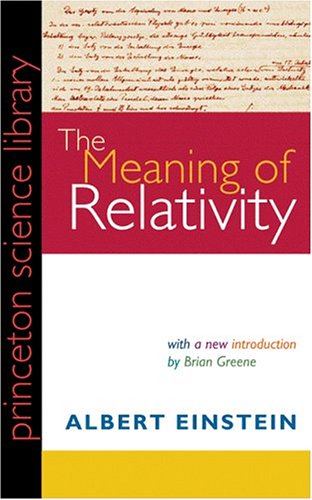
Even for the non-physicist, with a suitable grounding in the requisite mathematics, this book is a real gem. In general, it serves an excellent companion to Einstein's The Meaning of Relativity, Fifth Edition: Including the Relativistic Theory of the Non-Symmetric Field (Princeton Science Library) and makes for a priceless addition to a personal library.

5-0 out of 5 stars High school maths needed
One of the truly amazing things about the Special Theory is that you only need a decent grasp of high school mathematics and science to fully understand the two original papers. (Depending on your high school you may need to brush up on partial derivatives, but that's all.)

The General Theory is something else again, but by reading around the equations and accepting the descriptions of what is being solved you can still gain some incredible insights into a great intellectual achievement.

5-0 out of 5 stars How science should be written
Reading the original papers would be best, but if you don't read German then the Dover collection is the next best thing. In the paper on special relativity, the Lorentz transformations are derived via formulating and solving a first order pde, a treatment that no textbook presents (first order pdes aren't taught in math physics, in spite of the fact that every set of first order autonomous odes generates a first order pde). It took my teaching the subject to advanced undergrads in later years to realize what many others have by now noticed, namely, you don't need two postulates for special relativity. "Galilean invariance" is enough. The constancy of the speed of light follows from the requirement that there is no special reference frame.

Einstein's presentation of GR is unsurpassed for conciseness and clarity, is a model for other researchers to follow when writing papers. Here, he introduces the famous misconception (corrected today in the better texts like Misner, Thorne, and Wheeler) that general covariance is a physical principle. Well, even the greatest minds make mistakes.

Feynman wrote well, but no scientist to date has written better than Einstein.

5-0 out of 5 stars An accessible reference book
This compact collection of English translations of the original papers is a cheap and highly accessible reference book.

The book is a chronology of the development of the theory of Relativity. Starting with Lorentz' papers on Michelson's interference experiment and electomagnetic phenomena in moving frames of reference, the book follows the rapid development of the subject from Einstein's ground breaking papers of 1905 on Electrodymanics and Inertia. Minkowski's original paper on Space-Time is a delight: it's always a pleasant surprise when one finds that the explanation of the originator has not been bettered in nearly 100 years!

Latter chapters of the book present Einstein's papers on General Relativity -which are mathematically complex. They are definately not the place to start if one wants to learn the principles of General Relativity. Nonetheless, after one has learnt the principles from more accessible materials, such as "The Principles of Cosmology and Gravitation" by M V Berry, these papers can be very useful as original sources that the reader can use in order to grasp the methods by which Einstein presented his revolutionary discoveries.

This is an excellent, high value, low cost source that is worth keeping! ... Read more


58. Albert Einstein 2008 Calendar: A Man for All Seasons
Calendar: Pages (2007-07)
list price: US$13.99 -- used & new: US$8.18
(price subject to change: see help)
Asin: 0764939211
Canada | United Kingdom | Germany | France | Japan

59. The Collected Papers of Albert Einstein, Volume 3: The Swiss Years: Writings, 1909-1911
by Albert Einstein
Paperback: 447 Pages (1994-01-24)
list price: US$50.00 -- used & new: US$50.00
(price subject to change: see help)
Asin: 0691102503
Canada | United Kingdom | Germany | France | Japan
Editorial Review

Book Description

This volume of The Collected Papers of Albert Einstein presents Einstein's writings for the two-year period starting in October 1909. The initial date marks Einstein's departure from the Swiss Patent Office at Bern, which had been his professional home for seven years, and the beginning of his first academic appointment, at the University of Zurich. The volume concludes with the masterful report that Einstein, by then a full professor at the German-language university in Prague, gave to the original Solvay Congress, the first international meeting devoted to the problems of radiation and the quantum theory. Most of Einstein's efforts during these years went into his struggle with these ever more perplexing problems of quanta, on which he made discouragingly little progress.

Einstein's new academic career naturally required him to teach, and almost half of this volume consists of the previously unpublished notes he wrote in preparation for his lectures on mechanics, on electricity and magnetism, and on kinetic theory and statistical mechanics. The last of these are particularly interesting in reflecting some of his research interests.

Several papers here are concerned with aspects of the special theory of relativity, but it is Einstein's article of June 1911 that is a harbinger of things to come: it contains his calculation of the bending of light in a gravitational field on the basis of his equivalence principle.

Martin J. Klein is Bass Professor of the History of Science and Professor of Physics at Yale University and Senior Editor of The Collected Papers of Albert Einstein. A. J. Kox teaches history of science at the University of Amsterdam, Jürgen Renn is Assistant Professor of Philosophy and Physics at Boston University, and Robert Schulmann is Assistant Professor of History at Boston University.

... Read more

60. What's the Matter with Albert?: A Story of Albert Einstein
by Frieda Wishinsky, Jacques Lamontagne
Paperback: 32 Pages (2004-08-03)
list price: US$6.95 -- used & new: US$2.32
(price subject to change: see help)
Asin: 1897066155
Average Customer Review: 5.0 out of 5 stars
Canada | United Kingdom | Germany | France | Japan
Editorial Review

Book Description

Billy Whitestone gets the assignment of a lifetime when his school paper sends him to interview Albert Einstein. But though the world-famous physicist loves children, he is also somewhat reluctant to be interviewed. How will Billy win him over?

Using child-friendly language and stunning oil paintings to engage young readers, this fictionalized biography offers a vivid account of the life and times, struggles and accomplishments of Albert Einstein — who is revealed as a mischievous and sometimes temperamental student in his own right. Based on archival photographs, Jacques Lamontagne's artwork draws readers into Einstein's world, while a handy historical timeline accompanies the story.
... Read more

Customer Reviews (4)

5-0 out of 5 stars A great research tool!
This innovative biography explores Albert Einstein's life and his ideas. As a teacher-librarian, I use this book to inspire my students to use interviewing skills when conducting research. What's the Matter with Albert? should be in every library.

5-0 out of 5 stars Loved it!
I loved "What's the Matter with Albert?" I bought it as a gift for my 7 year old granddaughter Lauren, who loves to read. Before giving any book to her, I always make sure to read it first, so we can have phone discussions about it. (I am a long-distance grandma and she lives 3000 miles away.) This book was an excellent choice because of the lessons it will teach her.

I loved the way Billy found the courage to face his fears and conquer the challenge of interviewing a genius like Albert Einstein. I liked that it shows that it's okay to daydream, to think about life in a different way than the people around us think, and that if you face your fears, you can accomplish many things in life. There will always be people who feel that because someone thinks "outside of the box" or appears absent-minded, something is wrong with us.

I loved the childlike style of Billy's four questions and that the answers were actually in Einstein's own words. And I thought it was a good lesson to show that Billy was able to do further research and write another story on his own once Albert Einstein 'opened the door' to Billy's quest for knowledge.

This story will teach my granddaughter that our imagination is what makes us unique, that once you take the first step and just do your very best, you can accomplish great things, in spite of your fears.

On a personal level, I think I related to this story because as a child, I always felt "different" and didn't look at things in the same way as other kids did. I was a daydreamer, couldn't concentrate in school and often got into trouble because my mind wandered.

I wish I had been able to read this book when I was young - I'm sure it would have made me feel that it was okay to look at things differently, to ask questions, to always be curious. (I'm a cookbook author today, so I guess I succeeded in spite of myself!)

Thanks to the author for a wonderful book! I also loved the illustrations and the way they were integrated into the story. They remind me of Norman Rockwell's artistic style. Well done!

Norene Gilletz

5-0 out of 5 stars Who would have known?
What a great book! The title and the Norman Rockwell like illustration of Eistein immediately caught my attention. What's The Matter With Albert? Who would have thought that this famous scientist, this amazing genious of the 20th century would have anything the matter with him. I loved the way the author tells us about all the struggles and difficulties the young Albert Einstein had as a student. I always figured the guy sailed through school, and that he likely graduated by age 12 and was then courted by major universities around the world. But no, Albert was asked to leave his school!
I thought this book shared some fascinating facts about Einstein's life in a cute and unintimidating way - a fictional character's (a cub reporter with the Princeton Elementary School News) interview with Albert Einstein. At the end of the interview the young reporter asks Albert four more questions. My favorite, and I hope the author doesn't mind me sharing this one, is "What makes you think up all those great ideas?" I loved Einstein's answer - "I use my imagination. Imagination is more important than knowledge. Knowledge is limited. Imagination encircles the world". There are several great quotes from Einstein in the book.
I bought this book for two of my 8 year old nephews. I hope they will have as much fun reading it as I did and will be encouraged to let their imaginations fly and take them to all sorts of interesting thoughts and places.

5-0 out of 5 stars Einstein -- A Child's View
In her wonderful new book, WHAT'S THE MATTER WITH ALBERT? A STORY OF ALBERT EINSTEIN, author Frieda Wishinsky brings the Nobel Prize-winning scientist to life for young readers.

Billy, a shy young reporter for the school newspaper goes to interview Einstein to find out what he was like as a child. To his surprise, the great genius had lots of problems when he was a boy. Any child who has ever felt shy, inadequate or less than a star will relate to the young Einstein, who was late to talk, not a star in school, and subject to bursts of bad temper.

Wishinsky's style invites the reader to explore Einstein's world in a variety of interesting ways. These include the text of his final report on Einstein "When he Grew Up," a timeline of the important dates in his life and an excerpt from Billy's notebook, with answers in Einstein's actual words. For example, to the question "Why don't you wear socks?'", Einstein asnwers "When I was young I found out that the big toe always ends up making a hole in the sock. So I stopped wearing socks."

Children will find the man and the story irresistable. Told in clear, engaging prose and dialogue, WHAT'S THE MATTER WITH ALBERT EINSTEIN? will delightall young readers. Jaques Lamontagne's illustrations of Einstein at different periods of his life will round out the familiar image of the frizzy-haired genius.

Frieda Wishinsky has added to the long list of books about Albert Einstein one that truly makes him accessible, and that will be treasured by children of all ages. ... Read more


  Back | 41-60 of 100 | Next 20
A  B  C  D  E  F  G  H  I  J  K  L