
|
Help |
| Home - Scientists - Faltings Gerd (Books) | |
e99 Online Shopping Mall
|
|
Help |
| Home - Scientists - Faltings Gerd (Books) | |
| 1-16 of 16 |
click price to see details click image to enlarge click link to go to the store
| 1. Rational Points: Seminar Bonn/Wuppertal 1983/84 (Aspects of Mathematics) | |
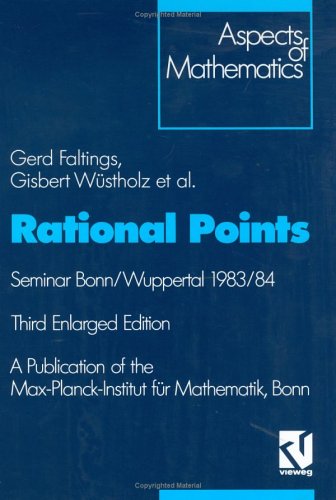 | Hardcover: 311
Pages
(1992-12-31)
-- used & new: US$295.55 (price subject to change: see help) Asin: 3528285931 Canada | United Kingdom | Germany | France | Japan |
| 2. Lectures on the Arithmetic Riemann-Roch Theorem. (AM-127) by Gerd Faltings | |
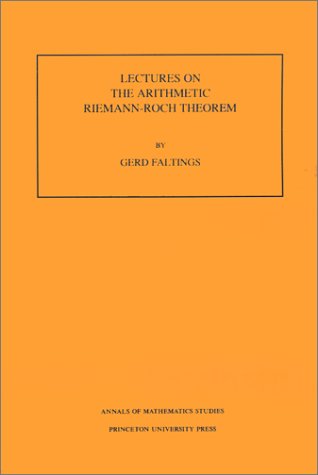 | Paperback: 118
Pages
(1992-02-19)
list price: US$38.95 -- used & new: US$34.84 (price subject to change: see help) Asin: 0691025444 Average Customer Review: 
Canada | United Kingdom | Germany | France | Japan |
|
Editorial Review Product Description Customer Reviews (1)
The work of Riemann and Roch is readily seen to be related to the genus of the surface, if viewed in the light of the polygon of 4p sides. The modern view of the Riemann-Roch theorem in fact is naturally viewed as a generalization of a formula for the Euler characteristic, the latter of which involves the genus of a Riemann surface. The "classical" Riemann-Roch theorem is stated in terms of divisors on a Riemann surface X of genus g and reads as r(-D) - i(D) = d(D) - g + 1, where D is a fixed divisor on the surface, r(-D) is the dimension of meromorphic functions of divisors >= -D on X, and i(D) is the dimension of the space of meromorphic 1-forms of divisors >= D on X. Many other statements have been given, one being in terms of holomorphic bundles defined by D over X, where one computes the Euler characteristic of the sheaf of germs of holomorphic sections of the bundle. Another is in the context of holomorphic bundles over nonsingular complex projective varieties, where the Euler characteristic of the sheaf of holomorphic sections of the bundle is given in terms of a formula involving the first Chern class of the variety. The Euler characteristic has of course also been computed in terms of the index of Dirac operators, and so it is not surprising to find that the Riemann-Roch theorem has an analytical formulation also. | |
| 3. Degeneration of Abelian Varieties (Ergebnisse der Mathematik und ihrer Grenzgebiete. 3. Folge A Series of Modern Surveys in Mathematics) by Gerd Faltings, Ching-Li Chai | |
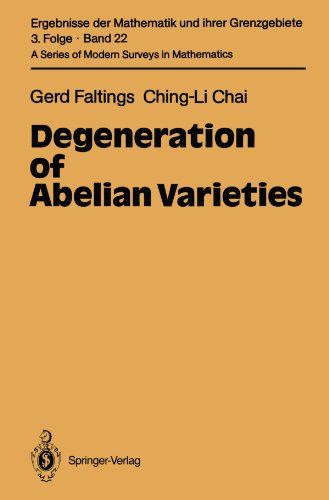 | Paperback: 316
Pages
(2010-11-02)
list price: US$139.00 -- used & new: US$139.00 (price subject to change: see help) Asin: 364208088X Canada | United Kingdom | Germany | France | Japan |
|
Editorial Review Product Description | |
| 4. Leibnizpreisträger: Jürgen Habermas, Christiane Nüsslein-Volhard, Gerd Faltings, Gottfried-Wilhelm-Leibniz-Preis, Berthold Beitz (German Edition) | |
 | Paperback: 700
Pages
(2010-07-22)
list price: US$74.81 -- used & new: US$54.61 (price subject to change: see help) Asin: 1159136580 Canada | United Kingdom | Germany | France | Japan |
|
Editorial Review Product Description | |
| 5. Mitglied Der Nordrhein-Westfälischen Akademie Der Wissenschaften: Ilya Prigogine, Christiane Nüsslein-Volhard, Kurt Alder, Gerd Faltings (German Edition) | |
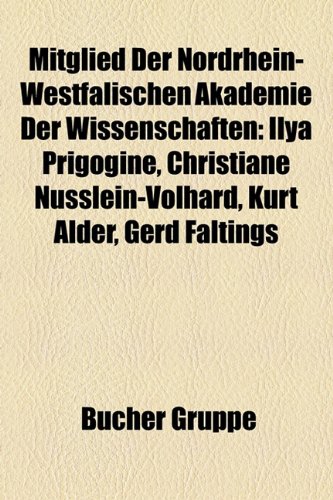 | Paperback: 398
Pages
(2010-10-18)
list price: US$46.77 -- used & new: US$46.77 (price subject to change: see help) Asin: 1159179964 Canada | United Kingdom | Germany | France | Japan |
|
Editorial Review Product Description | |
| 6. Hochschullehrer (Bergische Universität Wuppertal): Gerd Faltings, Karl-Heinz Petzinka, Johannes Harder, Lew Sinowjewitsch Kopelew, Peter Dienel (German Edition) | |
 | Paperback: 234
Pages
(2010-10-18)
list price: US$31.54 -- used & new: US$16.48 (price subject to change: see help) Asin: 115905164X Canada | United Kingdom | Germany | France | Japan |
|
Editorial Review Product Description | |
| 7. University of Wuppertal: University of Wuppertal Faculty, Walter Thiel, Gerd Faltings, Karl Albert | |
 | Paperback: 20
Pages
(2010-09-16)
list price: US$14.14 -- used & new: US$14.13 (price subject to change: see help) Asin: 1158661487 Canada | United Kingdom | Germany | France | Japan |
|
Editorial Review Product Description | |
| 8. Gerd Faltings Proves Mordell's Conjecture (1983): An entry from Gale's <i>Science and Its Times</i> by Brooke Coates | |
| Digital: 3
Pages
(2001)
list price: US$3.90 -- used & new: US$3.90 (price subject to change: see help) Asin: B0027UWYPA Canada | United Kingdom | Germany | France | Japan | |
|
Editorial Review Product Description | |
| 9. Gerd Faltings: An entry from Gale's <i>Science and Its Times</i> by Adrienne Wilmoth Lerner | |
| Digital: 2
Pages
(2001)
list price: US$2.90 -- used & new: US$2.90 (price subject to change: see help) Asin: B0027UWYWI Canada | United Kingdom | Germany | France | Japan | |
|
Editorial Review Product Description | |
| 10. Träger Der Fields-Medaille: Gerd Faltings, Alexander Grothendieck, Grigori Jakowlewitsch Perelman, Jean-Pierre Serre, Laurent Schwartz (German Edition) | |
 | Paperback: 172
Pages
(2010-10-18)
list price: US$25.79 -- used & new: US$25.79 (price subject to change: see help) Asin: 1158863829 Canada | United Kingdom | Germany | France | Japan |
|
Editorial Review Product Description | |
| 11. Rational points: Seminar Bonn / Wuppertal 1983/84 (Aspects of mathematics) by Gerd Faltings | |
| Unknown Binding: 268
Pages
(1986)
Asin: B0000EHHE7 Canada | United Kingdom | Germany | France | Japan | |
| 12. Inventiones Mathematicae: Vol. 159, Fasc. 3, 2005 by Jean-Michel; Gerd Faltings (eds.) Bismut | |
| Paperback:
Pages
(2005)
Asin: B001J4XU80 Canada | United Kingdom | Germany | France | Japan | |
| 13. Inventiones Mathematicae: Vol. 160, Fasc. 1, 2005 by Jean-Michel; Gerd Faltings (eds.) Bismut | |
| Paperback:
Pages
(2005)
Asin: B001J55X52 Canada | United Kingdom | Germany | France | Japan | |
| 14. Inventiones Mathematicae: Vol. 159, Fasc. 2, 2005 by Jean-Michel; Gerd Faltings (eds.) Bismut | |
| Paperback:
Pages
(2005)
Asin: B001J5235K Canada | United Kingdom | Germany | France | Japan | |
| 15. Inventiones Mathematicae: Vol. 159, Fasc. 1, 2005 by Jean-Michel; Gerd Faltings (eds.) Bismut | |
| Paperback:
Pages
(2005)
Asin: B001J55X3O Canada | United Kingdom | Germany | France | Japan | |
| 16. | |
Canada | United Kingdom | Germany | France | Japan | |
| 1-16 of 16 |