e99 Online Shopping Mall

Geometry.Net - the online learning center Help  
Home  - Scientists - Godel Kurt (Books)

  1-20 of 77 | Next 20
A  B  C  D  E  F  G  H  I  J  K  L  M  N  O  P  Q  R  S  T  U  V  W  X  Y  Z  

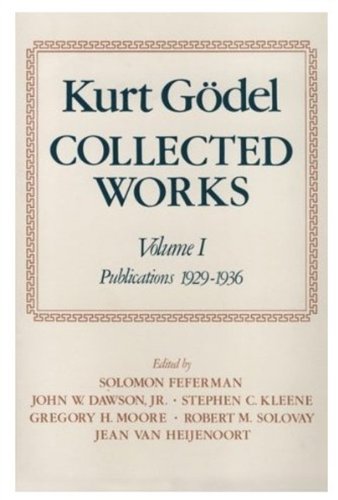
click price to see details     click image to enlarge     click link to go to the store

 
$3.00
1. On Formally Undecidable Propositions
$48.95
2. Collected Works: Volume III: Unpublished
$33.15
3. Logical Dilemmas: The Life and
$0.01
4. Gödel: A Life of Logic
$8.30
5. Incompleteness: The Proof and
$219.05
6. Collected Works: Volume V: Correspondence,
$39.26
7. A Logical Journey: From Gödel
$50.00
8. Reflections on Kurt Gödel
$7.92
9. On Godel (Wadsworth Philosophers
 
$5.50
10. Godel, Escher, Bach: An Eternal
$45.00
11. Kurt Godel: The Album
 
$9.95
12. Kurt Godel's centenary/Centenario
$85.37
13. Kurt Gödel: Leben und Werk (Computerkultur)
 
14. Sentences Undecidable in Formalized
 
$53.08
15. Collegium Logicum: Annals of the
 
16. Incompleteness: The Proof and
$72.15
17. Computational Logic and Proof
$9.95
18. Biography - Godel, Kurt Friedrich
 
19. Sentences Undecidable in Formalized
 
20. Sentences Undecidable in Formalized

1. On Formally Undecidable Propositions of Principia Mathematica and Related Systems
by Kurt Gödel
 Paperback: 80 Pages (1992-04-01)
list price: US$6.95 -- used & new: US$3.00
(price subject to change: see help)
Asin: 0486669807
Average Customer Review: 4.5 out of 5 stars
Canada | United Kingdom | Germany | France | Japan
Editorial Review

Book Description

First English translation of revolutionary paper (1931) that established that even in elementary parts of arithmetic, there are propositions which cannot be proved or disproved within the system. It is thus uncertain that the basic axioms of arithmetic will not give rise to contradictions. Introduction by R. B. Braithwaite.
... Read more

Customer Reviews (13)

3-0 out of 5 stars Mathematical Rationalismhas limits
It is very hard to find faults in what may be the most famous proof of the 20th century.
For those not familiar with the Russell-Whitehead Principia Mathematica notation
this is a very hard book. I had the benefit of the Kac-Ulam explanation.
I didfind what might be problems with this proof.
1) One is the reliance on number theory proofs about prime numbers that are assumed true
in the Gödelization of the primes coding of the mathematical axioms.
2) The second is the assumption that the axioms statements represent the minimal
representation of such a system of axioms.
Both are slim if none chances, but ones the Gödel doesn't consider.
Information theory was after this time where we discovered that a system of symbols can indeed at times be more efficiently coded.
The best example of this seems to be Gray code compared to ordinary binary number code ( a number theory code
like Gödel's prime code) where less turns out to be more in information terms.
The theory of primes suffers from the new doctrine of strings that says
that infinite scales don't exist in the "real" world: that a maximum and a minimum
of measure are fixed parts of our reality. This kind of assumption can't be "proved"
but is an axiom of a system of a mathematical sort and is counter to the Euclidean proof of an infinite number of primes.
Primes already discovered by use of computers are much bigger than the numbers of ordinary physics, but
we are already reaching the Turing"stopping" problem in finding new ones.
Some people equate in algorithmic information theory andnumber theory
the stopping problem with Infinity. That point of view of people like G. J. Chaitin
is itself an unproved assumption. So the metamathematics used in the proof itself may be unprovable propositions.
If so, then the proof based on such propositions can't itself be true.
This argument in no way takes away from the greatness of Gödel and his unique genius
as shown by this line of reasoning.

3-0 out of 5 stars The following is a dissenting view
As indicated in two other reviews of mine here, my comprehension of Goedel's work is opposite to the general one. My marking three stars regardless for this book is motivated by his extensive influence, but also by his fair admission later in life that his thesis could amount to hocus-pocus.

Indeed, I see it as one of the prominent mistakes in logical history, and I shall endeavor to explain as best I can. It should suffice to consider his Section 1, an outline of his proposed proof.

Although that section is brief, it already foreshadows an oppressingly complex logical symbolism for statements that in my view can be made much clearer using ordinary language. The symbolism, to be sure, is intended to establish a formal language, whose meaning is to be decided separately. This will be seen one of the problems.

For now, let me give the principal statement Goedel contended to be true but undecidable (neither provable nor disprovable):

"This statement is unprovable."

He symbolized it (p.40) as: "~Bew[R(n);n]". Font limitations made me slightly change it; the tilde "~" means "not", "Bew" is a German abbreviation for "provable", and within brackets "R(n)" says "Statement n" and "n" stands for the full statement.

Goedel proceeds: "...supposing...~Bew[R(n);n] were provable, it would also be correct; but that means...that...~Bew[R(n);n] would hold good, in contradiction to our initial assumption. If, on the contrary, the negation of ~Bew[R(n);n] were provable, then [its provability] would hold good. ~Bew[R(n);n] would thus be provable [in contradiction to the unprovability it states], which again is impossible." (I corrected some errors within brackets.)

So since both ~Bew[R(n);n] and its negation are unprovable, it is undecidable, and Goedel continues (p.41): "...it follows at once that ~Bew[R(n);n] is correct, since...certainly unprovable (because undecidable). So the proposition which is undecidable in the system...turns out to be decided by metamathematical considerations."

"Metamathematical", in excusing the contradiction, designates the above formal system void of assigned meaning, whereas the statement discussed is to have meaning. Not quite a lucid argument. Overlooked, furthermore, is a contradiction using the same reasoning as in the preceding.

Coupled with the preceding finding that ~Bew[R(n);n] CANNOT be proved unprovable (for if so proved, it would be contradicted), can in contradiction be that it CAN be proved unprovable. For if it were instead provable, it would again be contradicted. The statement in question thus becomes a paradox, rather than true, similar to paradoxes like the "liar", mentioned by Goedel (p.40).

He strangely adds to it the footnote: "Every epistemological [paradox] can likewise be used for a similar undecidability proof." The "liar", however, is, like all paradoxes, not a true statement, as required, but one harboring a contradiction. (I deal in my book with, and offer solutions to, paradoxes more fully, including Goedel's resulting one, without naming him.)

There occurs, further, another huge blunder in the alleged proof. The undecidability is said to apply to some of mathematics; in the above formula, ~Bew[R(n);n], the "n" refers to a number, with this justification by Goedel (p.38): "For metamathematical purposes it is naturally immaterial what objects are taken as basic signs, and we propose to use natural numbers for them." Adding (p.39): "Metamathematical concepts and propositions thereby become concepts and propositions concerning natural numbers..."

How so? In one breath he proposes using natural numbers as immaterial signs, and in the next breath the material concerns natural numbers!

The fallaciousness can indeed be made clear by considering our statement, ~Bew[R(n);n], interpreted as "This statement is unprovable." As noted, in ~Bew[R(n);n] the "n", now a number, is to name the whole statement, inside which it is also used in "Statement n..." But whether or not the statement is named by a number, the point is that the name must refer to the intended content of the statement to correspondingly function, not to the usual number possibly represented. Therefore the statement, or anything else similarly used, has nothing to do with numbers, or mathematics generally.

5-0 out of 5 stars Gödel's proof of the inadequacy of formalism
Gödel proves that a formal system containing arithmetic must be incomplete (i.e. incapable of proving all true statements). The proof consists in creating a statement that says "this statement cannot be proved", for then it follows that either this this statement can be proved and we have proved something false, or it cannot be proved but it is still true. In either case our formal system is flawed. This is in a way an instance of the liar paradox, which was of course well know long before, but no-one had expected it to materialise inside a seemingly sensible formal system. Gödel shows that it does by means of his arithmetisation trick that enables the system to speak about itself. All symbols in the system's alphabet is given a unique number. Then all formulas in the system is assigned the following number: the product of all the factors (n:th prime)^(n:th symbol in the formula). By unique prime factorisation one can recreate the formula from its number. Sequences of formulas---proofs in particular---can be coded by the same method. We can now express the relation "x is a proof of y" inside the formal system. This relation takes two arguments: x*, the Gödel number for the sequence of formulas x, and y*, the Gödel number for the formula y. Inside the formal system it is a perfectly well defined and finite problem to decide whether x is a proof of y, as is quite plausible, although Gödel has to work hard with his recursion theory to prove this strictly. Now that we can express "x is a proof of y" we can also express "x is a proof of y(z)", i.e. a relation that takes three arguments: x*, y*, z*, the Gödel numbers for a sequence x of formulas, a formula y with a free variable, and a formula z. Thus we can also express "there exists no x such that x is a proof of y(z)". In particular, we can send in y* for z, and the statement becomes: "there exists no x such that x is a proof of y(y*)". This expression has one free variable, y. Call it F(y). F(y) is a formula in our formal system, so it has a Gödel number, say F*. Now we can formulate the statement "this statement cannot be proved" inside our formal system as follows: "F(F*)"="there exists no x such that x is a proof of F(F*)"="F(F*) cannot be proved". So if our formal system is consistent (i.e. does not prove false things) then we must accept that it cannot prove F(F*), but then F(F*) is true, so our formal system is incomplete.

5-0 out of 5 stars One of the Best Books You Should Never Read
Godel's incompleteness theorem's are without a doubt genious.However, this day in age, no logician actually reads Godel's original work unless they are only interested in the historical aspect of it.Godel himself is not a very good writer.If you want to study Godel's incompleteness theorems there are other books out there that prove his theorems in a much more refined, shorter, and easier fasion.

3-0 out of 5 stars Unbelievable theorem
Reading through the reviews of self-proclaimed math geniuses (see some of the below unhelpful reviews for examples) is hardly edifying, so I feel compelled to lend a hand. Here are a few comments about this publication:

First, the introduction does a poor job in explicating the theory. I suppose it gives you the basic idea, but this is hardly the first account of the theory one should read. Brathwaite does not connect all of the dots, and it will take a long time to figure out how the proof works from his intro, if you can do it all. (And that's not a challenge or insult; it simply isn't that well written.)

Second, forget about wading through Godel's proof on your own. The reviewer who claimed to do so with two years of algebra and a really good dictionary is simply lying. You do not wade through difficult theorems in mathematical logic without the appropriate tools. And the appropriate tools include having done similar but simpler proofs on your own and having a solid background in mathematical logic. Without this background, it doesn't matter whether you have the ability to be a mathematics professor at Princeton or place top five in the Putnam - you simply will not understand the proof in a rigorous manner. By all means, take a look at it to get a general feel for what's going on, but if you want a semi-technical account read Smullyan's "Godel's Incompleteness Theorems."

Third, as one reviewer pointed out, there are multiple errors in this printing of the proof. This makes what was a tall task virtually impossible.

So what did Godel do that was so interesting?
He proved that there were certain arithmetical statements about whole numbers that were not provable but true. (This was important because it shattered the widely held belief that if you stated a problem in mathematics clearly enough you would be able to determine whether it was true or false. Godel showed this isn't always the case. As an aside, simpler mathematical systems have been shown complete; that is to say, they can answer any well formed question.)
So, how can something be true but unprovable?
The sentence Godel constructed said this, more or less: I am not provable. This statement, if true, is not provable. If it is provable it's false, and correct systems (systems that do not prove false statements) cannot prove false statements. Therefore, it must not be provable. But then it's saying something true, and thus it's true but unprovable. Now, I'm simplifying and being sloppy, and you need to know about the difference between mathematical statements and metamathematical statements, but in a nutshell that's the thrust of his first theorem.

The other interesting aspect of his proof is that he constructed a statement that referred to itself indirectly. Russell, in Principia Mathematica - the work that contains the arithmetical system that served as the model for the arithmetical system in Godel's proof - created a "Theory of Types" which did not allow statements to mention themselves. But the sentence "I am not provable" references itself so it would seem that I've erred. But in fact I haven't; I just didn't fully explain how that sentence worked. (I know you were worried, if for just an instant.) Where was I . . . Godel created a sentence which referred to itself indirectly. The sentenced said, "Sentences with such and such characteristics are unprovable." It so happened that a sentence with such characteristics was itself. Thus, it referred to itself, but only indirectly and not in violation of the "Theory of Types."

All of my blathering, I hope, has impressed on you . . .
1) That this proof is worth understanding.
2) That you shouldn't believe anyone who tells you they worked through and understood the proof without having a signficant background in mathematical logic and the history of the proof. If you don't understand certain basic features of Principia Mathematica you're not going to grasp fully his proof.
3) That you should get an introductory account. Nagle's "Godel's Proof" is excellent and easy to understand. Smullyan's "Godel's Incompleteness Theorems" is more difficult, but not impossible and amounts to what would serve as the textbook of a solid mathematical logic course or two at an elite university.
4) That you shouldn't buy this work if you're hoping to work through his proof, unless of course you have the requisite training. Brain power is not enough.

... Read more


2. Collected Works: Volume III: Unpublished Essays and Lectures (Collected Works (Oxford))
by Kurt Godel
Paperback: 560 Pages (2001-05-31)
list price: US$48.95 -- used & new: US$48.95
(price subject to change: see help)
Asin: 0195147227
Average Customer Review: 5.0 out of 5 stars
Canada | United Kingdom | Germany | France | Japan
Editorial Review

Book Description
Kurt Godel (1906-1978) was the most outstanding logician of the twentieth century, famous for his hallmark works on the completeness of logic, the incompleteness of number theory and stronger systems, and the consistency of the axiom of choice and the continuum hypothesis.He is also noted for his work on constructivity, the decision problem, the foundations of computation theory, unusual cosmological models, and for the strong individuality of his writings on the philosophy of mathematics. The Collected Works is a landmark resource that draws together a lifetime of creative accomplishment.The first two volumes were devoted to Godel's publications in full (both in the original and translation).This third volume features a wide selection of unpublished articles and lecture texts found in Godel's Nachlass, documents that enlarge considerably our appreciation of his scientific and philosophical thought and add a great deal to our understanding of his motivations.Continuing the format of the earlier volumes, the present volume includes introductory notes that provide extensive explanatory and historical commentary on each of the papers, English translations of material originally written in German (some transcribed from Gabelsberger shorthand), and a complete bibliography.A succeeding volume is to contain a comprehensive selection of Godel's scientific correspondence and a complete inventory of his Nachlass.The books are designed to be accessible and useful to as wide an audience as possible without sacrificing scientific or historical accuracy.The only complete edition available in English, it will be an essential part of the working library of professionals and students in logic, mathematics, philosophy, history of science, and computer science. ... Read more

Customer Reviews (1)

5-0 out of 5 stars Godel's unpublished philosphy
For anyone interseted in Godel's thought, this book is absolutely wonderful.Also for anyone interested in Platonism and how one can be a platonist after the crisis in math, this is a good thing to read. Moveover, Godel was sort of a freek-job and didn't like to publish stuffabout his personal philosphic views, so you won't get the real deal if youonly read the stuff he published.Much like his homie Einstein, Godelspent the last chunk of his life plugging away at a unified theory,Einstein's was reletivity, Godel's was metaphysics.Really good stuff.Sure, you can read that Godel, Escher, Bach stuff, but then you are onlylearning what the man wants you to know.You gots ta get the real dealfrom the source.Word. ... Read more


3. Logical Dilemmas: The Life and Work of Kurt Godel
by John W. Dawson Jr.
Paperback: 376 Pages (2005-05-28)
list price: US$39.00 -- used & new: US$33.15
(price subject to change: see help)
Asin: 1568812566
Average Customer Review: 5.0 out of 5 stars
Canada | United Kingdom | Germany | France | Japan
Editorial Review

Product Description
This authoritative biography of Kurt Gödel relates the life of this most important logician of our time to the development of the field. Gödel’s seminal achievements that changed the perception and foundations of mathematics are explained in the context of his life from turn of the century Austria to the Institute for Advanced Study in Princeton. ... Read more

Customer Reviews (4)

5-0 out of 5 stars Good Biography, a bit heavy on the math
This book has a kind of interesting way of doing a biography. The subject, Godel, is one of the pre-eminent mathematicians of the twentieth century. This biography, written by a mathematician spends a good bit of time on the math that Godel was doing as well as the story of his life.

Chapter III, for instance is a capsule history of the development of logic to 1928. This is to give background to the mathematical world as it existed when Godel was starting his work. In particular it discusses the open problems in mathematics that David Hilbert proposed in 1900.Godel resolved the second of these problems.

Coupled with his genius in mathematics, Godel also had serious psychological problems. He eventually died of starvation because he was convinced that the food he was getting had been poisoned and refused to eat. Dr. Dawson has written a compasionate and understanding biography, even if the mathematics gets just a bit deep once in a while.

5-0 out of 5 stars Excellent.
An excellent biography of Godel. Examines his personal life and mathematical work in an integrated manner. Dawson is thorough, well-researched, and shows a command of the mathematics involved. He provides the most accurate picture available of the real Godel- in contrast to the anecdotal, 'crazy-genius' stories you see elsewhere. This is not a popular account of Godel's work, so the reader will need an understanding of fundamental mathematical logic and Godel's theorem to appreciate much of the book. But Dawson does provide a lot of history of mathematical logic, including a great chapter on developments up to 1928 that could stand by itself. The appendix provides a chronology, genealogy, and "biographical vignettes" of other important logicians.

5-0 out of 5 stars The definitive biography of Kurt Godel
Knowing what went on in the mind of Kurt Godel will forever be unattainable.Nonetheless, John Dawson comes as close as possible to understanding what made Godel click.

Having catalogued Godel's works and personal papers, Dawson saw aspects of Godel's life that perhaps no one short of his wife had seen.

The book is a fascinating jaunt through the through the lives of one of the greatest minds of the 20th century.What is also interesting is Godel's interaction with personalities such as Einstein and Van Neumann.

While the mathematics is often abstract, as can be expected, Logical Dilemmas is a mesmerizing read.

4-0 out of 5 stars By a Mathematician for Mathematicians
Writing a biography of anyone is difficult.How can a writer, no matter how talented, really claim to understand someone well enough to give an overview of his life?When the subject is a genius like Kurt Godel, whose name is known by few and whose work is really understood by even less, the job must be even more difficult.Fortunately, people like Mr. Dawson are will to give it a shot and he succeeds fairly well.

In putting together this biography, Mr. Dawson has the advantage of being mathematician.Additionally, he has the advantage of being the mathematician who catalogued Godel's papers after his death.This gives him a lot of insight into Godel that other writers cannot have and he weaves quotations from these papers into the biography very well.Mr. Dawson's is a well-documented and logical biography that is short on conjecture and long on footnotes.In brief, it is a biography about a mathematician clearly written by a mathematician.This is both its strength and its weakness.

Actually, I like the purely biographical sections of this book very much.The biographical information is clear and informative, though a bit dry in the academic style favored by mathematicians and scientists.Fortunately, having lived and worked among these people, I am comfortable with this style.More importantly, I feel like I have a better idea now of who Godel was and what he was like from reading this book.His focus on his work, his relationship with his family and friends (particularly his wife) and his ultimate decent into mental illness are much more in focus for me now.

On the other hand, the sections that deal with Godel's mathematics are much more difficult to take.The discussion of mathematics in this book goes far beyond what most people are going to be able to handle.I fear the average reader even with a decent math background who comes across this book will drop it as soon as the mathematics starts and that is unfortunate. (I am always looking for books to promote math even among non-mathematicians.This one does not do it.)A reader who can handle the math, however, will find this book revealing. ... Read more


4. Gödel: A Life of Logic
by John L. Casti, J. L. Casti, Werner DePauli
Paperback: 224 Pages (2001-09)
list price: US$17.00 -- used & new: US$0.01
(price subject to change: see help)
Asin: 0738205184
Average Customer Review: 3.5 out of 5 stars
Canada | United Kingdom | Germany | France | Japan
Editorial Review

Book Description
"A compelling biography of the eccentric genius."- Discover.

Kurt Gödel was an intellectual giant. His Incompleteness Theorem turned not only mathematics but also the whole world of science and philosophy on its head. Shattering hopes that logic would, in the end, allow us a complete understanding of the universe, Gödel's theorem also raised many provocative questions: What are the limits of rational thought? Can we ever fully understand the machines we build? Or the inner workings of our own minds? How should mathematicians proceed in the absence of complete certainty about their results? Equally legendary were Gödel's eccentricities, his close friendship with Albert Einstein, and his paranoid fear of germs that eventually led to his death from self-starvation. Now, in the first book for a general audience on this strange and brilliant thinker, John Casti and Werner DePauli bring the legend to life. ... Read more

Customer Reviews (14)

4-0 out of 5 stars Un understandable overview of Godel and his completeness theorem
The main result of Godel's Completeness Theorem is that in arithmetic, there are true statements that can never be proven to be true in the system of arithmetic. Using this as a base system, this means that in any system equal to or greater than arithmetic in complexity, there will be true statements that cannot be proven to be true in the system. This result has been used by many people to argue for or against many things.
I have seen it used to argue for the existence of God.

"According to Godel's theorem, there are things that are true that cannot be proven to be true within the system of human thought. God is one such thing, therefore God exists."

I have seen it used to argue against the possibility of artificial intelligence (AI).

"According to Godel's theorem, there are things that are true that cannot be proven to be true within the system of programmable human thought. Humans take advantage of these unprovable truths, which makes intelligence. Since this advantage can never be programmed, AI is impossible."

I have suggested on more than one occasion that the people making these arguments need to spend more time studying both logic and what Gödel really concluded. For example, they could read this book.
It presents a brief biography of Kurt Gödel. In his later years he was quite eccentric and reclusive, however in his early years he apparently was quite a ladies man. Certainly Gödel was a genius; Albert Einstein himself openly expressed his admiration for Godel's intelligence. I was pleased to see the authors spend as much time as they did describing Gödel in his earlier years. So many other commentators spend so much time on his social difficulties that his achievements become overshadowed.
A complete explanation of his main results is also expressed in terminology that almost everyone can understand. There are few formulas; simple algebra is all that is needed to understand all of the mathematical symbolism used in the book. If I was teaching a course in popular mathematics, it would have to include Godel's Completeness Theorem and this is the book I would select for that section.

4-0 out of 5 stars An abridged version of Hofstadter's book.
Author shows a great skill in Chapter Two and Three to explain a crux of famous theorem in a very succinct language without using mathematical terms. Also a short biography of Godel's strange life explains: why he died of paranoia; why he hated Austria; why he was suffering a guilt of not producing enough academic result in Princeton.
As the author acknowledges, many metaphors used in this book overlaps with the Douglas Hofstadter's Pulitzer-winning book. However, as many other books for past twenty years, the author presents a theorem in a way that is easily misinterpreted. In p11, he says "Essentially, what Godel showed is that no kind of mathematics is ever going to be comprehensive enough to express fully the everyday notion of truth." And then, the author spends a great deal of pages on AI and computer.
As far as I know, Godel's theorem mentions nothing about "truth in daily life" or computer. Godel's theorem applies only in a strictly circumscribed sphere, i.e., first-order logic. For example, Euclidean geometry is not imcomplete, and the higher-order logic doesn't produce Russel-type paradox. So, what we cannot speak of we must pass over in silence.
Also, author asserts in p71 that Wittgenstein's shift to "sociocultural position" later in his life, but he failed to mention that Wittgenstein did describe his thought about Godel's theorem in his "Remarks on the Foundations of Mathematics".

5-0 out of 5 stars Biography: no --Look at his great theorm: YES!
I got to look at the book at a bookstore before I bought it so I knew I wasn't getting a biography. This book is a look at his theorem with comments about his life thrown in to put the work into some human context.For a thurough description of the theorem with a gentle human touch this is the book for you.Casti et al. does a great job of making tough ideas readable.If you want to know more about the theorem that turned mathematics on its head this is it.Not perfect (less talk about cake :-) ) but fun, readable, educational, A shame it is out of print.

2-0 out of 5 stars Not the real Gödel ?
Sorry, but this book was somewhat a disappointment for me. The authors for the most part keep personal life and work of Gödel separated, instead of seeing them as a unity. A biography has to be the best of both worlds in my opinion. That's what makes the work of a biographical writer a difficult task. Maybe one of the two authors did the biographical part, the other one the mathematical ? And of course, everything about Gödel is great, brillant and alltogether grand. I am missing a critical view on his lifestyle and his view on music e.g.. Appearently the author of the biographical part was so in awe of Gödel, that he didn't dare to critisize anything about Gödel. Ironic, since Gödel stands for the idea, that you are allowed and even have the obligation to question everything to get to the bottom of the truth of things.
I am still waiting for the real biography of Kurt Gödel.

5-0 out of 5 stars Not really a biography, but very good nonetheless
I would agree with other reviewers who point out that Casti and DePauli's book really doesn't work as a biography. While there are some interesting biographical factoids, they are offered in such a disjoint manner that it is hard to see this book as a good biography of Kurt Godel.

However, as a book that gives an accessible overview of Godel's work, it is very effective. The best parts of the book deal with Godel's Theorem and Turing's Halting Problem. While there are other books out there that do a good job of making both those topics accessible to a wide audience, Casti and DePauli's treatment is worth a read because they also offer some unique insights not (easily) found elsewhere.

But the best part of this book is the second to the last chapter that gives an accessible account of Algorithmic Information Theory (aka 'Kolmogorov Complexity') ... especially Gregory Chaitin's work on the randomness of natural numbers. While Chaitin has also written some accessible works on this topic, Casti and DePauli does a great job of explaining this topic to a wider audience as well as showing the connections between AIT and Godel/Turing. This chapter alone is worth the price of the book.

A very interesting and insightful thing that Casti and DePauli did was to periodically re-define Godel's Theorem in terms of Turing's Halting Problem, Chaitin's work, and from other interesting angles.

The book is not without fault. Besides the rather haphazard biographical details, the chapters dealing with some of Godel's other projects (physics, mysticism, etc.) were rather poorly written. Also, Casti and DePauli did a very bad job with citations/suggestions for further reading. E.g., they often cite to other works, or suggest readers consult other sources for further details, and then do NOT provide those sources in the bibliography. There are some other examples of sloppy editing and writing that would be hard to point out to those who haven't actually read the book.

Having said all of that, the book deserves 5 stars because of the material on the incompleteness of mathematics, solvability/computability, random nature of mathematics, and some of the biographical trivia (to the extent that they are offered). My recommendation is that people buy the paperback if they are interested in AIT, mathematical logic, and theoretical computer science, and want those topics dealt with in an accessible and interesting manner without sacrificing on insights. ... Read more


5. Incompleteness: The Proof and Paradox of Kurt Godel (Great Discoveries)
by Rebecca Goldstein
Paperback: 224 Pages (2006-02-06)
list price: US$13.95 -- used & new: US$8.30
(price subject to change: see help)
Asin: 0393327604
Average Customer Review: 3.5 out of 5 stars
Canada | United Kingdom | Germany | France | Japan
Editorial Review

Amazon.com
Kurt Gödel is often held up as an intellectual revolutionary whose incompleteness theorem helped tear down the notion that there was anything certain about the universe. Philosophy professor, novelist, and MacArthur Fellow Rebecca Goldstein reinterprets the evidence and restores to Gödel's famous idea the meaning he claimed he intended: that there is a mathematical truth--an objective certainty--underlying everything and existing independently of human thought. Gödel, Goldstein maintains, was an intellectual heir to Plato whose sense of alienation from the positivists and postmodernists of the 1940s was only ameliorated by his friendship with another intellectual giant, Albert Einstein. As Goldstein writes, "That his work, like Einstein's, has been interpreted as not only consistent with the revolt against objectivity but also as among its most compelling driving forces is ... more than a little ironic."

This and other paradoxes of Gödel's life are woven throughout Incompleteness, with biographical details taking something of a back seat to the philosophical and mathematical underpinnings of his theories. As an introduction to one of the three most profound scientific insights of the 20th century (the other two being Einstein's relativity and Heisenberg's uncertainty principle), Incompleteness is accessible, yet intellectually rigorous. Goldstein succeeds admirably in retiring inaccurate interpretations of Gödel's ideas. --Therese LittletonBook Description
"A gem….An unforgettable account of one of the great moments in the history of human thought."—Steven Pinker

A masterly introduction to the life and thought of the man who transformed our conception of math forever. Kurt Gödel is considered the greatest logician since Aristotle. His monumental theorem of incompleteness demonstrated that in every formal system of arithmetic there are true statements that nevertheless cannot be proved. The result was an upheaval that spread far beyond mathematics, challenging conceptions of the nature of the mind.

Rebecca Goldstein, a MacArthur-winning novelist and philosopher, explains the philosophical vision that inspired Gödel's mathematics, and reveals the ironic twist that led to radical misinterpretations of his theorems by the trendier intellectual fashions of the day, from positivism to postmodernism. Ironically, both he and his close friend Einstein felt themselves intellectual exiles, even as their work was cited as among the most important in twentieth-century thought. For Gödel , the sense of isolation would have tragic consequences.

This lucid and accessible study makes Gödel's theorem and its mindbending implications comprehensible to the general reader, while bringing this eccentric, tortured genius and his world to life.

About the series: Great Discoveries brings together renowned writers from diverse backgrounds to tell the stories of crucial scientific breakthroughs—the great discoveries that have gone on to transform our view of the world. ... Read more

Customer Reviews (53)

1-0 out of 5 stars Story heavily obscured by author's style
The author, Rebecca Goldstein, appears to be one of those authors who feels it necessary to use obscure words, phrasing, and technical language to impress her readers.Although I am a well-read professional person, I found it necessary to refer to my dictionary far more than I ever have before, to the point that it was difficult to maintain a smooth flow of understanding.I was struck not only by the topical tangents used to fill space, but by the incredible overuse of fabricated terminology, much of it based on the prefix "meta-".
Unfortunately the book's style obscures the story of Godel and his theorems.Perhaps time will heal my wounds and I'll be able to find a more coherent, lucid treatment of this mathematical icon's work.

2-0 out of 5 stars Incompleteness
Kurt Gödel lived from 28 April 1906 to 14 January 1978.

Rebecca Goldstein, a professor of philosophy, an esteemed novelist, and MacArthur fellow, seems in this book to be overly concerned with her own personal speculations on Gödel's psychological development and motivations. She begins the book with a 40 page introduction wherein Gödel is at the Institute for Advanced Study in Princeton, New Jersey, enjoying the intellectual company of Albert Einstein.She focuses on Gödel's Platonism and obdurate dedication to reason, and on his psychological and intellectual isolation. She sees Gödel's friendship with Einstein as sustained through a sharing of beliefs, against the epistemological current of the time, about the fundamental nature and knowability of reality. Contrary to the epistemological and ontological relativism of those who interpreted Einstein's Theories of Relativity and Gödel's Incompleteness Theorems, and those who accepted the Copenhagen Interpretation of Quantum Theory, Einstein and Gödel did not believe their work had shown their respective fields to be nothing but an assemblage of subjective and ultimately unsupportable convictions held in agreement by an influential collection individuals. They believed that the world was fundamentally knowable and within reach of human reason.

In chapter one, Gödel at 8 years old is a burgeoning hypochondriac, believing without evidence that he has suffered permanent heart damage during an illness, and as a 20 year old student at the University of Vienna, having taken a course in number theory by Phillip Furtwängler, and a course in the history of philosophy by Heinrich Gomperz, he is described as a "Platonist among the Positivists". In 1928, at age 22, Gödel shifted his focus from number theory to mathematical logic. By October of 1930 he had proved the First Incompleteness Theorem.

The Positivists are, of course, the Logical Positivists of Moritz Schlick's Vienna Circle, a formal discussion group, attendance by invitation only, held Thursday evenings at the University of Vienna, and presided over by Schlick from 1924 to 1930, ending when Schlick, on his way to a lecture, was shot to death by a former student who "had already twice been committed to a psychiatric ward for threatening Schlick." (79) Gödel entered the University in 1924, and "was a regular attendant" at the meetings of the Vienna Circle from 1926 to 1928, having "become a Platonist" in 1925. (58, 74, 75) "Interestingly, 1928 is the year when he turned to mathematical logic, which would of course yield him his famous proof. No wonder he no longer had the time or the inclination for the weekly sessions." (74)

During the academic year of 1924-25, Hans Hahn, who became Gödel's dissertation advisor in 1928 when Gödel switched from number theory to mathematical logic, gave a seminar on Bertrand Russell's and Alfred North Whitehead's three-volume Principia Mathematica of 1910-13 (Goldstein doesn't mention the dates). (83) Principia Mathematica was presented as a rigorous, formal proof that mathematics was logically derivable from logic. The Positivists, Goldstein tells us, held mathematics to be "purely syntactic" and "devoid of any descriptive content", its truth deriving from "the rules of formal systems". (86) This contrasts with Platonism, wherein mathematics is true because of the truth of its semantics, its descriptive content, and independently of any formal system.

Ludwig Wittgenstein and his Tractatus Logico-Philosophicus of 1921 (Goldstein doesn't mention the date), written under the influence of Russell's program, in turn influenced by that of Gottlob Frege, to translate natural language, for logical clarity, into the formal syntax and semantics of mathematical logic, is always in the background when speaking of the Vienna Circle. Goldstein, however, loses perspective and spends 30 pages of a 67 page chapter on this man, of whom Gödel himself has said: "Wittgenstein's views on the philosophy of math had no influence on my work nor did the interest of the Vienna Circle in that subject start with Wittgenstein (but rather went back to Prof. Hans Hahn)." (116) Having given Wittgenstein all of this undue attention, and foreshadowing more to come, Goldstein then admits: "Nary a mathematician I have spoken with has a good word to say about Wittgenstein." (119) In contrast, even though Hans Hahn, Gödel's dissertation advisor and lecturer on Principia Mathematica, wrote a well-known paper entitled "The Crisis in Intuition" in 1933 (excerpts are available online), Goldstein never mentions it, despite the topic being central to her book.

Chapter two is a mess. The title is "Hilbert and the Formalists" and is a mere 24 pages long. David Hilbert is introduced 15 pages into the chapter. Prior to discussing Hilbert, Goldstein cursorily mentions Giuseppe Peano and his famous 1889 axiomatic reduction of arithmetic to 5 axioms, then tells us only 3 of them. She does not relate Peano's work to Frege's or Russell's, except to say that "Frege simplified Peano's axiomatic system for arithmetic by deriving Peano's five axioms from a single axiom". (128) Back in the previous chapter, incidental to her discussion of Wittgenstein, she'd mentioned that Frege's Grundgesetze der Arithmetic (The Fundamental Laws of Arithmetic) of 1893,1903 (Goldstein doesn't mention the dates) "was the first attempt to reduce arithmetic to a formal system of logic" (91) and that Principia Mathematica was "a new formal system for expressing arithmetical truths". (92) She'd told us that Frege used set theory and ran up against Russell's Paradox arising from considering the set of all sets not members of themselves, and that Russell and Whitehead circumvented the paradox by instituting a hierarchical Theory of Types. (93) A footnote on the same page mentioned Georg Cantor and Cantor's Paradox arising from the postulation of a Universal Set and computing the cardinality of its power set, although she never explains to the novice reader what 'cardinality' (referring to the number of a set's members) means. Except for the mention of Peano's axioms, this information was in the previous chapter and given only to gloss Wittgenstein, not clarify Gödel's achievements.

Before reaching her discussion of Hilbert, Goldstein tells us that "a formal system is an axiomatic system divested of all appeals to intuition." (129) Notice that in chapter one she'd told us that Frege had presented a "formal system" in his Grundgesetze, and Russell and Whitehead had presented a "new formal system" in their Principia. Goldstein tells us: "The elimination of intuitions is accomplished by draining the axiomatic system of all meanings, except those that can be defined in terms of the stipulated rules of the system." (131) She doesn't explain how stipulated (syntactic) rules can be used to define (semantic) meanings. In fact, she says on the same page that the rules "make no pretense of being descriptive of some objective reality, of independent objects like numbers and sets. A formal system is precisely what we are left with after this meaning drainage." (131) In case we haven't gotten her point, she continues: "A formal system ... is an axiomatic system ... constructed entirely of meaningless signs, marks on paper whose only significance is defined in terms of the relations of each to one another as set forth by the rules." (131) Now this restriction to syntax and the outright exclusion of semantics from formalized axiomatics accords with a popular and debatable interpretation of Hilbert's Formalist program, but this was not the understanding of Frege nor of Russell and Whitehead in their Logicist programs. Goldstein, herself, gives evidence of this when quoting Gödel quoting Russell's Introduction to Mathematical Philosophy of 1921 (Gödel gives the date) telling us that Russell said: "Logic is concerned with the real world just as truly as zoology, though with its more abstract and general features." (117)

Goldstein's intention is to contrast intuition with formal syntactic systems, and to present Gödel's Theorems as proving formal syntactic systems (empty of all meaning) to be inadequate for capturing all of the truths (meanings) of mathematics, thereby giving, indirectly, a mathematical proof of Platonism. This accords with the theme of her book: Gödel, as philosophical Platonist and mathematical Genius, was, like Einstein, an Outsider among his peers. By intuition, Goldstein (Gödel, also?) means: "something that we just know, in and of itself, not on the basis of knowing something else." (122) Intuition is "the a priori analogue to sense perception, a direct form of apprehension." (134) Yet claims to intuitive knowledge can be wrong. Even an axiomatic system such as Euclid's Geometry can go awry. The parallel postulate's intuitive justification was shown wrong by the development of self-consistent geometries that oppose the axiom. (130) By divesting an axiomatic system of any appeal to intuition, we circumvent the possibility of being wrong, Goldstein seems to suggest. She tells us: "If it could be shown that logically consistent formal systems are adequate for proving all the truths of mathematics, then we would have successfully banished intuition from mathematics. ... By banishing intuitions we would be dissolving away the putative objects of mathematical descriptions. We would be showing mathematics not to be descriptive at all." (133-34) Goldstein has not explained how we could determine that a semantically empty syntactic system, void of all intuitions of what counts as mathematics, is actually about mathematics or has any relevance to it, nor has she explained how such a system could be "adequate for proving all the truths of mathematics"; and she has not yet reached her discussion of Hilbert.

Goldstein's discussion of Hilbert is deplorably short, considering all the attention she has given to the concept of a formal system; but then she never explained the philosophical or mathematical motivations of Frege or Russell and Whitehead, either. She approaches the end of the chapter giving the impression that proving "the consistency of the axioms of arithmetic" (she doesn't say what those axioms are) is tantamount to proving a system's truth, even though truth is a semantic notion and provability is a syntactic notion: "But in a formal system, with axioms drained of meaning, and truth amounting to nothing beyond provability, it cannot be taken for granted that the axioms will not yield logically incompatible theorems." (140-41) Again: "following the formalist agenda, if mathematics is to be successfully purged of intuitions in the service of certitude, then formal proofs of the consistency of the purged systems are a pressing necessity." (141) Only in an offhand sentence ending the chapter does she correct this misconception, when she says "if it could be shown that such a formal system was both complete, allowing us to prove all mathematical truths, as well as consistent, the linchpin of Hilbert's program would have been secured, the crisis posed by the paradoxes overcome." (145) This is her first mention of completeness (which correlates semantics and syntax) in relation to Hilbert's program, in a chapter ostensibly devoted to "Hilbert and the Formalists", in a book concerned with a theorem that is specifically about completeness.

Chapter three, "The Proof of Incompleteness", is where we are introduced to Gödel's Theorems. Goldstein spends 20 pages out of 58 explicating them. Outside of those 20 pages, the rest of this book is supposed to be a context for us to understand those theorems and their implications, and learn something of the man who proved them. The pages preceding chapter three comprised a loose, disordered, scattershot presentation that tells us very little indeed of the context in which those theorems arose. We've learned almost nothing of Frege, Russell, or Hilbert, (Whitehead is always shortchanged in these accounts), and have been told more than we need about Wittgenstein. Chapter three is no more clearly written, from a mathematical/philosophical point of view, than any of the others. Rather than continuing the review, allow me to quote Gregory H. Moore (author of Zermelo's Axiom of Choice and editor of the first two volumes of Gödel's Collected Works) from his 2005 review of the book (available at American Scientist online): "Goldstein does not understand mathematical logic and set theory, the subjects of Gödel's mathematical work. Her book would have benefited if she had just left them out and not pretended to explain them." For a respected biography of Gödel, see Logical Dilemmas: The Life and Work of Kurt Gödel, by John W. Dawson, Jr., published in 1997.

1-0 out of 5 stars Extraordinarily bad
A man is reading a book. For an unknown reason, the book begins in the most execrable of tenses, the historical present. He ponders putting the book down, but continues reading in the hope that both the literary style will improve, and that the ostensible topic of the book - Godel's work on incompleteness - will be taken up, in preference to biographical information about Einstein. Some 40 pages later, his hopes are still not met. He begins reading the next chapter, his hopes buoyed by the book's title, which is, after all, Incompleteness. He frowns upon discovering that this chapter is still not about Godel's work, but about the boy. He reads sentences like "Kurt Godel fell in love with Platonism" and "I found... those little Bible studies published by the Jehovah's witnesses, the kind that their itinerants will urge on you if you happen to be home in the middle of the day and answer the door." He thinks "I don't give a fig about Rebecca Goldstein's discoveries of scraps of paper once drawn on by Godel. Get to the point." The book does not get to the point. He reads "First exposure to Plato can be an extremely heady experience for those with a passion for abstraction. (I remember my own.)" He thinks "this woman has *no* passion for abstraction, she's trying to psychologise mathematical logic!" He reads pages and pages about Vienna and Karl Kraus, an asinine attempt to discuss the logical positivists as *subjectivists* of all things. He reads about the villainous Wittgenstein. He thinks, "what a terrible interpretation of Wittgenstein." By now the book has passed into the past tense, thank God. I finally realised what was going on: Rebecca Goldstein was writing this book in the hope that it would get picked up and adapted as a screen-play. Thus, she needed a love story (Godel meets Platonism; they have wonderfully incomplete children and live neurotically ever after); she needed a villain ('subjectivism,' which, as far as i can tell, means everything which isn't Platonism in this tale, and wears a black hat while shooting up bars and dishonoring ladies); she needed to avoid any sort of philosophical, mathematical or historical rigor at all costs.

This is a long review, and probably boring. It is a performative review. Buy Nagel's book, 'Godel's Proof,' instead.

3-0 out of 5 stars A disappointment due to its incompleteness
This is a good companion and counterpoint to "Wittgenstein's Poker" that starts off well but ends as a book with no payoff. Other than her well-argued characterization of Godel as a Platonist among positivists whose ideas were misunderstood or ignored, Goldstein presents neither coherent biography, nor any explanation of the development and significant influence of Godel's work after 1931 (a subject that seems beyond Goldstein's capabilities).Despite an occasional mention of an important date and a few details of political intrigue at the Institute for Advanced Study in between, the book has almost no content about Godel between 1931 to the 1970's, not long prior to Godel's starving himself to death.

Goldstein does present a decent overview of the first two incompleteness theorems and the goals of the formalists who preceded Godel, though the view she presents is very limited because it ignores the issues of pervasive errors in mathematical reasoning about the infinite in analysis and other fields that led to the formalist point of view in the first place.She is somewhat fuzzy, though, on the relationsip between completeness and incompleteness.There are some obvious errors in terms of the surrounding explanations from small details - Hilbert presented 23 major problems, not 10, at the 1900 Math Congress - to a misleading implication that the theory of arithmetic underlies all of mathematics and its incompleteness implies that the formal inference no value for complex mathematical domains (ignoring efficiently decidable theories like that of real-closed fields, for example).

As other reviewers have noted, Goldstein has almost nothing to say about Godel's relationship with von Neumann who has his biggest champion. Despite her mention of Turing's work, other than saying that Godel was pleased by it she seems to describe it as little more than changing the terminology of Godel's work. Finally, she repeats the Lucas argument and Godel's lack of sanction for it, but she does not seriously discuss the refutations of the Lucas argument that have appeared.The focus of her text seems to imply that, in his heart of hearts, Godel would have liked to believe it.

2-0 out of 5 stars Both technically and philosophically confused.
As a student of logic and the philosophy of mathematics I found this book seriously confusing.The book contains a number of technical, biographical and philosophical errors.Interested students should try and get hold of reviews of "Incompleteness" by Sol Feferman and Juilette Kennedy, logicians who explain the book's flaws better than I could. ... Read more


6. Collected Works: Volume V: Correspondence, H-Z (Godel, Kurt//Collected Works)
by Kurt Godel
Hardcover: 696 Pages (2003-06-05)
list price: US$360.00 -- used & new: US$219.05
(price subject to change: see help)
Asin: 0198500750
Canada | United Kingdom | Germany | France | Japan
Editorial Review

Book Description
Kurt Godel (1906 - 1978) was the most outstanding logician of the twentieth century, famous for his hallmark works on the completeness of logic, the incompleteness of number theory, and the consistency of the axiom of choice and the continuum hypothesis. He is also noted for his work on constructivity, the decision problem, and the foundations of computability theory, as well as for the strong individuality of his writings on the philosophy of mathematics. He is less well known for his discovery of unusual cosmological models for Einstein's equations, in theory permitting time travel into the past. The Collected Works is a landmark resource that draws together a lifetime of creative thought and accomplishment. The first two volumes were devoted to Godel's publications in full (both in original and translation), and the third volume featured a wide selection of unpublished articles and lecture texts found in Godel's Nachlass. These long-awaited final two volumes contain Godel's correspondence of logical, philosophical, and scientific interest. Volume IV covers A to G, with H to Z in volume V; in addition, Volume V contains a full inventory of Godel's Nachlass.L All volumes include introductory notes that provide extensive explanatory and historical commentary on each body of work, English translations of material originally written in German (some transcribed from the Gabelsberger shorthand), and a complete bibliography of all works cited. Kurt Godel: Collected Works is designed to be useful and accessible to as wide an audience as possible without sacrificing scientific or historical accuracy. The only comprehensive edition of Godel's work available, it will be an essential part of the working library of professionals and students in logic, mathematics, philosophy, history of science, and computer science and all others who wish to be acquainted with one of the great minds of the twentieth century. ... Read more


7. A Logical Journey: From Gödel to Philosophy
by Hao Wang
Hardcover: 432 Pages (1997-01-10)
list price: US$55.00 -- used & new: US$39.26
(price subject to change: see help)
Asin: 0262231891
Average Customer Review: 4.5 out of 5 stars
Canada | United Kingdom | Germany | France | Japan
Editorial Review

Book Description
Hao Wang (1921-1995) was one of the few confidants of the great mathematician and logician Kurt Gödel. A Logical Journey is a continuation of Wang's Reflections on Gödel and also elaborates on discussions contained in From Mathematics to Philosophy. A decade in preparation, it contains important and unfamiliar insights into Gödel's views on a wide range of issues, from Platonism and the nature of logic, to minds and machines, the existence of God, and positivism and phenomenology.

The impact of Gödel's theorem on twentieth-century thought is on par with that of Einstein's theory of relativity, Heisenberg's uncertainty principle, or Keynesian economics. These previously unpublished intimate and informal conversations, however, bring to light and amplify Gödel's other major contributions to logic and philosophy. They reveal that there is much more in Gödel's philosophy of mathematics than is commonly believed, and more in his philosophy than his philosophy of mathematics.

Wang writes that "it is even possible that his quite informal and loosely structured conversations with me, which I am freely using in this book, will turn out to be the fullest existing expression of the diverse components of his inadequately articulated general philosophy."

The first two chapters are devoted to Gödel's life and mental development. In the chapters that follow, Wang illustrates the quest for overarching solutions and grand unifications of knowledge and action in Gödel's written speculations on God and an afterlife. He gives the background and a chronological summary of the conversations, considers Gödel's comments on philosophies and philosophers (his support of Husserl's phenomenology and his digressions on Kant and Wittgenstein), and his attempt to demonstrate the superiority of the mind's power over brains and machines. Three chapters are tied together by what Wang perceives to be Gödel's governing ideal of philosophy: an exact theory in which mathematics and Newtonian physics serve as a model for philosophy or metaphysics. Finally, in an epilog Wang sketches his own approach to philosophy in contrast to his interpretation of Gödel's outlook. ... Read more

Customer Reviews (3)

5-0 out of 5 stars Hao Wang, Unsung Hero
Wang's presentation of Godel brings the supergenius mathematical logician within the reach of people who are neither logicians nor mathematicians ... at least occasionally. "Godel, Escher and Bach," a previous best-seller effort, didn't manage to do that. I never thought I could or would stay with a book I comprehended so little. It was like digging through a 5 gallon drum of sunflower seeds in search of a cupful of sesame seeds that I could digest and metabolize. But I couldn't stop! Every time I found one of those sesame seeds I could understand and maybe even use to help me understand something else, I got a rush of motivation to keep on reading, in hopes there would be at least one more such sesame seed! The reason was Wang's delivery, based on his very way of being. He is a smart, trained mathematical logician himself who grew up in a contrasting philosophical culture [featuring Chinese nontheistic assumptions] and he managed to become as humble and honest and open minded and open hearted an individual as I have yet encountered in person or on the printed page. His use of self disclosure ... an au currant recommended practice among scientist science writers ... demonstrates a Goldilocks model for others to follow: not too much -- no egotistical tangents, and not too little -- he is remarkably clear about his own assumptons, biases and prejudices. Even if you don't care much about understanding Godel, the book is worth reading to get acquainted with Hao Wang.

5-0 out of 5 stars The end of books: the pinnacle of knowledge
:The ideas expressed in this book are at least 100 years ahead of their time.Godel wasn't just friends with Einstein, he was (and is) widely regarded as "the greatest logician since Aristotle" (Oppenheimer said that, Aristotle was the father of logic).Einstein said that the only reason he showed up for work at the IAS in Princeton in his last years was so he could walk home with Godel.In his spare time, Godel was the first person in the world to show how Einstein's equations allowed for the possibility of time travel.He did this, not to show how to travel through time, but to show that time has no real existence, it is instead a consequence of the way in which our minds are organized.


:So much for the pedigree, here's some ideas from the book: the existence of an immortal soul can and will be proved scientifically, computers can never be conscious, and mathematical theorems have an existence every bit as real as the chair you are sitting in.


:I was an agnostic before I read this book.Now I know that "mind" and "soul" are just two words for the same thing.Godel is the smartest man that ever lived, and this book contains some of his most interesting ideas in a (reasonably) accessible form.Don't expect to understand more than 10% of it the first time you read it, I have been reading it for years and understand maybe a quarter of it.

4-0 out of 5 stars Meet Gödel the philosopher
Many mathematicians know about Gödel's famous theorem.But very few know about Gödel the man. Through this book, we come to know the man, especially Gödel the philosopher.

Through this book we find out that althoughGödel and Einstein were close friends, Gödel, unlike Einstein, shunnedpublic debate.He held philosophical views which he knew would be verycontroversial if he were to publicize them, and he greatly dislikedpublshing anything he could not prove rigorously.Accoringly, heinstructed his biographer to publish these viewpoints only after his death.

This book contains hundreds of quotations from Gödel's conversationswith the author.Fortunately, the author left in quotations that he hesaid he did not understand, trusting that others might.

Here are a fewquotes:

"Consciousness is connected with one unity. A machine iscomposed of parts."

"The brain is a computing machine connectedwith a spirit."

"Materialism is false."

"Our totalreality and total existence are beautiful and meaningful . . . . We shouldjudge reality by the little which we truly know of it. Since that partwhich conceptually we know fully turns out to be so beautiful, the realworld of which we know so little should also be beautiful. Life may bemiserable for seventy years and happy for a million years: the short periodof misery may even be necessary for the whole."

If you find Gödel'stheorem interesting, I hope you will read this book and found out moreabout the man behind the theorem. ... Read more


8. Reflections on Kurt Gödel
by Hao Wang
Paperback: 368 Pages (1990-03-14)
list price: US$30.00 -- used & new: US$50.00
(price subject to change: see help)
Asin: 0262730871
Average Customer Review: 4.5 out of 5 stars
Canada | United Kingdom | Germany | France | Japan
Editorial Review

Book Description
Kurt Gödel was indisputably one of the greatest thinkers of our time, and in this first extended treatment of his life and work, Hao Wang, who was in close contact with Gödel in his last years, brings out the full subtlety of Gödel's ideas and their connection with grand themes in the history of mathematics and philosophy. The subjects he covers include the completeness of elementary logic, the limits of formalization, the problem of evidence, the concept of set, the philosophy of mathematics, time and relativity theory, metaphysics and religion, as well as general ideas on philosophy as a worldview.

Hao Wang is Professor of Logic at the Rockefeller University. ... Read more

Customer Reviews (2)

5-0 out of 5 stars Wang Exposes Godel's Great Predictions.
On Pages 1 and 2, Wang tells us that Godel, the master of the incomplete, suggests the possibility of philosophy as an exact theory emerging within the next hundred years or even sooner.There will be, he believes, scientific disproofs of what he calls' mechanism in biology' and of the proposition that 'there is no mind separate from matter'; moreover he thinks it practically certain that the 'physical laws, in their observable consequences, have a finite limit of precision.In his conversations, he recommends the important project of finding what might be called a 'rational religion.'

I conclude that exact philosophy already exists because theological statements are being proven, even though the ultimate truth will always be incomplate.This prediction means that the scientific method cannot be used to prove worlds, which is a box in which we live.Thus, universe cannot be measured without measure standards. So the universe is relativistic and can never be known exactly.I also agree with Godel that mechanisms will never be found in living things.This is why US medical care is so bad.I agree with Godel that minds will never be without bodies because only organizations exist in Nature.I also agree with Godel that a rational religion is coming because theological statements are being proven.

4-0 out of 5 stars Since no one else has reviewed this I will.
Wang has been an important source in compiling information on Godel and bringing it to public attention. This volume contains a variety of material about Godel- biographical facts, personal recollections, chronologies, Godel's philosophical ideas, the impact and historical setting of his mathematical work, his relationship with Einstein, comparisons to other prominent intellectuals, and more. It assumes a basic understanding of Godel's theorems. The bulk of the book is a presentation of some of Godel's (largely unpublished) philosophical activity. There is also quite a bit on Wang's own views as he contrasts them with Godel's. Some of these sections require more background in philosophy than most students of mathematics possess (myself included).

Wang supplies lots of interesting historical and biographical material as well. The 75 page chronology of Godel's life and work is very informative. Contains 11 photographs of Godel and company. The book ends with some useful commentary on selected publications of Godel. If you're looking just for a biography get Dawson's excellent book, but anyone seriously interested in Godel will want this as well. ... Read more


9. On Godel (Wadsworth Philosophers Series)
by Jaakko Hintikka
Paperback: 88 Pages (1999-12-27)
list price: US$15.95 -- used & new: US$7.92
(price subject to change: see help)
Asin: 0534575951
Average Customer Review: 3.0 out of 5 stars
Canada | United Kingdom | Germany | France | Japan
Editorial Review

Book Description
This brief text assists students in understanding Godel's philosophy and thinking so that they can more fully engage in useful, intelligent class dialogue and improve their understanding of course content. Part of the "Wadsworth Philosophers Series," (which will eventually consist of approximately 100 titles, each focusing on a single "thinker" from ancient times to the present), ON GÖDEL is written by a philosopher deeply versed in the philosophy of this key thinker. Like other books in the series, this concise book offers sufficient insight into the thinking of a notable philosopher better enabling students to engage in the reading and to discuss the material in class and on paper. ... Read more

Customer Reviews (2)

2-0 out of 5 stars Too many typos
I'm surprised that the previous review did not comment on the number of typographical errors; as far as I can see there is only one edition. The typos range from the merely distracting, to places where sentences become gibberish. Based on content, I'd give this at least 4 stars, but I found it too difficult to read. It's a nice complement to *Goedel's Proof* by Nagel and Newman--N & N give a much clearer exposition of Goedel's work, but Hintikka brings up a number of points I have not seen elsewhere (warning: many of the points raised can't be fully understood without referring to other works that treat them in more depth, unless you already have a strong background in mathematical foundations and logic).

4-0 out of 5 stars Very interesting
This is a very interesting introduction to the thought and life of a great mathemetician and sometime philosopher.Hintikka has a clear writing style that helps with some difficult material and has special ability in making complicated math seem not so daunting.An excellent overview of the life of Godel. ... Read more


10. Godel, Escher, Bach: An Eternal Golden Braid
by Douglas Hofstadter
 Paperback: 777 Pages (1980-09-12)
list price: US$14.95 -- used & new: US$5.50
(price subject to change: see help)
Asin: 0394745027
Average Customer Review: 5.0 out of 5 stars
Canada | United Kingdom | Germany | France | Japan

Customer Reviews (14)

5-0 out of 5 stars No other word for it: Amazing.
It is quite likely that the hardest question I've ever been asked is, "What's that book about?" This book manages to discuss, coherently, cohesively, and interestingly, everything from molecular biology to quantum physics to computer science to music theory to philosophy to advanced mathematics to Elizabethan literature and beyond. Reading this will definitely change the way you see the world, and if you read one book this entire year, this should probably be it. VERY highly recommended.

5-0 out of 5 stars Excellent book
As far as the layout and design of the book go, I find this piece to be particularly structured in a way that one studying abstract and modern mathematics might find appealing. It gives specific axioms for use with each topic and in doing so defines more than just what the topic might imply. As the content goes, for those taking an introduction course in abstract algebra, this book may be slightly heavy and unwieldy, however, for those well-learned in some of its background material, this book is enjoyable and pleasurable to read. The author even makes use of antecdotes to enforce his topics. Overall, this book has been one of the most pleasurable assigned readings I have endured.

5-0 out of 5 stars GEB - A must read for all aspiring thinkers
The Atlanta Journal Constitution describes Gödel, Escher, Bach (GEB) as "A huge, sprawling literary marvel, a philosophy book, disguised as a book of entertainment, disguised as a book of instruction." That is the best one line description of this book that anybody could give.GEB is without a doubt the most interesting mathematical book that I have ever read, quickly making its place into the Top 5 books I have ever read.
The introduction of the book, "Introduction: A Musico-Logical Offering" begins by quickly discussing the three main participants in the book, Gödel, Escher, and Bach. Gödel was a mathematician who founded Gödel's Incompleteness Theorem, which states, as Hofstadter paraphrases, "All consistent axiomatic formulations of number theory include undecidable propositions." This is what Hofstadter calls the pearl. This is one example of one of the recurring themes in GEB, strange loops.
Strange loops occur when you move up or down in a hierarchical manner and eventually end up exactly where you started.The first example of a strange loop comes from Bach's Endlessly rising canon. This is a musical piece that continues to rise in key, modulating through the entire chromatic scale, ending at the same key with which he began. To emphasize the loop Bach wrote in the margin, "As the modulation rises, so may the King's Glory."
The third loop in the introduction comes from an artist, Escher. Escher is famous for his paintings of paradoxes. A good example is his Waterfall; Hofstadter gives many examples of Escher's work, which truly exemplify the strange loop phenomenon.
One feature of GEB, which I was particularly fond of, is the `little stories' in between each chapter of the book. These stories which star Achilles and the Tortoise of Lewis Carroll fame, are illustrations of the points which Hofstadter brings out in the chapters. They also serve as a guidepost to the careful reader who finds clues buried inside of these sections.Hofstadter introduces these stories by reproducing "What the Tortoise Said to Achilles" by Lewis Carroll. This illustrates Zeno's paradox, another example of a strange loop.
In GEB Hofstadter comments on the trouble author's have with people skipping to the end of the book and reading the ending. He suggests that a solution to this would be to print a series of blank pages at the end, but then the reader would turn through the blank pages and find the last one with text on it. So he says to print gibberish throughout those blank pages, again a human would be smart enough to find the end of the gibberish and read there. He finally suggests that authors need to write many pages more of text than the book requires just fooling the reader into having to read the entire book. Perhaps Hofstadter employs this technique.
GEB is in itself a strange loop. It talks about the interconnectedness of things always getting more and more in depth about the topic at hand. However you are frequently brought back to the same point, similarly to Escher's paintings, Bach's rising canon, and Gödel's Incompleteness theorem. A book, which is filled with puzzles and riddles for the reader to find and answer, GEB, is a magnificently captivating book.

5-0 out of 5 stars Must for Math Majors and Enlightened Individuals
This book is a must for math majors (as well as many logic and philosophy majors). Anyone else in the hard sciences should also read this book, at least to be enlightened. Initially, it is easy reading, then becomes slightly foggy, but pushing through is rewarding. Of the three, my favorite is Godel and I always mention his Incompleteness Theorem whenever his name comes up. It his probably actually best mentioned by Rudy Rucker in his book "Infinity and the Mind". I think it is significant enough to mention here:

---
The proof of Gödel's Incompleteness Theorem is so simple, and so sneaky, that it is almost embarassing to relate. His basic procedure is as follows:

1. Someone introduces Gödel to a UTM, a machine that is supposed to be a Universal Truth Machine, capable of correctly answering any question at all.

2. Gödel asks for the program and the circuit design of the UTM. The program may be complicated, but it can only be finitely long. Call the program P(UTM) for Program of the Universal Truth Machine.

3. Smiling a little, Gödel writes out the following sentence: "The machine constructed on the basis of the program P(UTM) will never say that this sentence is true." Call this sentence G for Gödel. Note that G is equivalent to: "UTM will never say G is true."

4. Now Gödel laughs his high laugh and asks UTM whether G is true or not.

5. If UTM says G is true, then "UTM will never say G is true" is false. If "UTM will never say G is true" is false, then G is false (since G = "UTM will never say G is true"). So if UTM says G is true, then G is in fact false, and UTM has made a false statement. So UTM will never say that G is true, since UTM makes only true statements.

6. We have established that UTM will never say G is true. So "UTM will never say G is true" is in fact a true statement. So G is true (since G = "UTM will never say G is true").

7. "I know a truth that UTM can never utter," Gödel says. "I know that G is true. UTM is not truly universal."

Think about it - it grows on you ...

With his great mathematical and logical genius, Gödel was able to find a way (for any given P(UTM)) actually to write down a complicated polynomial equation that has a solution if and only if G is true. So G is not at all some vague or non-mathematical sentence. G is a specific mathematical problem that we know the answer to, even though UTM does not! So UTM does not, and cannot, embody a best and final theory of mathematics ...

Although this theorem can be stated and proved in a rigorously mathematical way, what it seems to say is that rational thought can never penetrate to the final ultimate truth ... But, paradoxically, to understand Gödel's proof is to find a sort of liberation. For many logic students, the final breakthrough to full understanding of the Incompleteness Theorem is practically a conversion experience. This is partly a by-product of the potent mystique Gödel's name carries. But, more profoundly, to understand the essentially labyrinthine nature of the castle is, somehow, to be free of it.
---

This is the kind of mental freedom you will gain by reading this book. Highly recommended.

5-0 out of 5 stars One of the biggest influences in my life, and a classic.
Douglas Hofstadter uses the art of M.C. Escher, the music of J.S. Bach, and Kurt Goedel's mathematics as the centerpieces for a magnificent inquiry into the nature of the mind. Along the way you will encounter Bertrand Russel, Carroll Lewis, particle physics, molecular biology, Magritte's paintings, and Zen koans. These are all used to probe recursion and the mystery of how we form thoughts. But the list of topics alone is not what makes this book great, it's the playful, joyful sense that characterize's Hofstadter's treatment of this. This sense of wonder is critical, as without it this highly challenging book would be very frustrating. The book's style itself is based on Bach's canons, and the chapters are interspersed with dialogues between the Tortois and the Hare, in the style of Carroll's Alice in Wonderland. The result is an artistic as well as scientific or philisophical masterpiece. I am currently a triple-major in molecular biology, physics, and philosophy, and much of my curriculum has been influenced by the beauty of Hofstadter's book. This will go down as one of the 20th Century's bests books. ... Read more


11. Kurt Godel: The Album
by Karl Sigmund, John Dawson, Kurt Muhlberger
Hardcover: 225 Pages (2006-04-06)
list price: US$37.00 -- used & new: US$45.00
(price subject to change: see help)
Asin: 3834801739
Canada | United Kingdom | Germany | France | Japan

12. Kurt Godel's centenary/Centenario de Kurt Godel/Centenario de Kurt Godel.(EDITORIAL)(Editorial): An article from: Interciencia
by Carlos Augusto Di Prisco
 Digital: 8 Pages (2006-03-01)
list price: US$9.95 -- used & new: US$9.95
(price subject to change: see help)
Asin: B000PLWMWS
Canada | United Kingdom | Germany | France | Japan
Editorial Review

Book Description
This digital document is an article from Interciencia, published by Thomson Gale on March 1, 2006. The length of the article is 2230 words. The page length shown above is based on a typical 300-word page. The article is delivered in HTML format and is available in your Amazon.com Digital Locker immediately after purchase. You can view it with any web browser.

Citation Details
Title: Kurt Godel's centenary/Centenario de Kurt Godel/Centenario de Kurt Godel.(EDITORIAL)(Editorial)
Author: Carlos Augusto Di Prisco
Publication: Interciencia (Magazine/Journal)
Date: March 1, 2006
Publisher: Thomson Gale
Volume: 31Issue: 3Page: 157(3)

Article Type: Editorial

Distributed by Thomson Gale ... Read more


13. Kurt Gödel: Leben und Werk (Computerkultur)
by John W. Jr. Dawson
Paperback: 316 Pages (1999-07-01)
list price: US$89.95 -- used & new: US$85.37
(price subject to change: see help)
Asin: 3211831959
Canada | United Kingdom | Germany | France | Japan
Editorial Review

Book Description
Der österreichische Mathematiker Kurt Gödel (19061978) ist einer der herausragendsten Logiker des 20. Jahrhunderts. Seine Resultate sind von allerhöchster Bedeutung für die Mathematik, und zunehmend werden auch die Auswirkungen auf unser modernes Weltbild sichtbar. Mit dem Erscheinen von Douglas Hofstadters Buch "Gödel, Escher, Bach" wurde Gödels Werk einem breiten Publikum bekannt gemacht. John W. Dawson jr., Professor für mathematische Logik und Nachlaßverwalter von Gödel, zeichnet in dieser Biographie das Bild eines Mannes, dessen Werk allgemein für abstrus gehalten wurde und dessen Leben Elemente der Rationalität und der Psychopathologie vereinigt. Die lang erwartete Gödel-Biographie ergründet den Mythos des Mathematikers, indem sie gleichermaßen seine Ideen und Arbeit verständlich aufbereitet, als auch die Person zu erfassen vermag. ... Read more


14. Sentences Undecidable in Formalized Arithmetic: An Exposition of the Theory of Kurt Godel
by Andrzej Mostowski
 Hardcover: Pages (1957)

Asin: B000WSX2XC
Canada | United Kingdom | Germany | France | Japan

15. Collegium Logicum: Annals of the Kurt-Godel Society (Collegium Logicum)
 Paperback: 137 Pages (1996-04-30)
list price: US$59.95 -- used & new: US$53.08
(price subject to change: see help)
Asin: 321182796X
Canada | United Kingdom | Germany | France | Japan

16. Incompleteness: The Proof and Paradox of Kurt Godel (Great Discoveries)
by Rebecca Goldstein
 Paperback: 296 Pages (2005)

Isbn: 0739457446
Canada | United Kingdom | Germany | France | Japan
Editorial Review

Product Description
A fascinating account of well-chosen episodes in Godel's life together with an accessible account of Godel's extraordinary achievement - basically a proof that there are true but unprovable statements. ... Read more


17. Computational Logic and Proof Theory: 5th Kurt Gödel Colloquium, KGC'97, Vienna, Austria, August 25-29, 1997, Proceedings (Lecture Notes in Computer Science)
Paperback: 348 Pages (1997-09-19)
list price: US$79.95 -- used & new: US$72.15
(price subject to change: see help)
Asin: 3540633855
Canada | United Kingdom | Germany | France