e99 Online Shopping Mall

Geometry.Net - the online learning center Help  
Home  - Scientists - Hadamard Jacques (Books)

  1-20 of 39 | Next 20
A  B  C  D  E  F  G  H  I  J  K  L  M  N  O  P  Q  R  S  T  U  V  W  X  Y  Z  

click price to see details     click image to enlarge     click link to go to the store

1. Jacques Hadamard: A Universal
$16.83
2. The Mathematician's Mind
$3.99
3. The Psychology of Invention in
$27.45
4. An Essay On The Psychology Of
$29.09
5. Lectures on Cauchy's Problem in
$14.99
6. Four lectures on mathematics
 
$51.99
7. Jacques Hadamard: A Universal
 
8. La Vie et l'oeuvre de Jacques
$9.95
9. Biography - Hadamard, Jacques
 
$37.64
10. Leçons de géométrie élémentaire,
$29.99
11. Leçons sur le calcul des variations
 
12. The Mathematian's Mind
 
13. The Psychology of Invention in
 
14. THE PSYCHOLOGY OF INVENTION IN
 
15. Lectures on Cauchys Problem in
 
$20.00
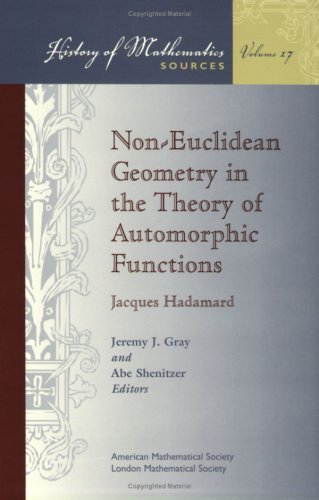
16. Non-Euclidean Geometry in the
 
17. Lecons Sur La Propagation Des
 
18. Essai sur la psychologie de l'invention
 
19. LECONS DE GEOMETRIE ELEMENTAIRE
 
20. An Essay on the Psychology of

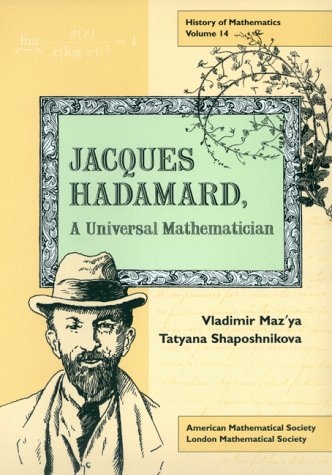
1. Jacques Hadamard: A Universal Mathematician (History of Mathematics, V. 14)
by V. G. Mazia, T. O. Shaposhnikova
Hardcover: 574 Pages (1998-01)
list price: US$79.00
Isbn: 0821808419
Average Customer Review: 5.0 out of 5 stars
Canada | United Kingdom | Germany | France | Japan

Customer Reviews (1)

5-0 out of 5 stars A fascinating biography of a great scientist
The biography is written brilliantly and is quite fascinating. The 98-year long life of Hadamard was extraordinary, filled with fantastic joys, like playing the violin with Albert Einstein, and terrible hardships, as losinghis three sons in the two World Wars. He was a man of amazing activity andgreat social commitment, being involved in the struggle for human rights.In his lifetime, the world was a scene of tremendous perturbations andchanges in all respects, and so also in the area of science, where Hadamardwas a great driving force especially in mathematics, but also in physics,mechanics, psycology of invention etc. Little did he realise during hiscareer that his matrices later would be used in the coding theory oftoday.

The chapters about Hadamard's work in mathematical physicscontains a lot of untraditional, interesting and almost unknown material.It is hard to find elsewhere such a complete and clearly written survey ofthe history ofthe disproval of several "obvious" hypotheses.

The textis tastefully mixed with illustrations and the occasional anecdote makes ita quite entertaining read. I can higly recommend it to anybody, fromundergraduate students to high-level professionals. ... Read more


2. The Mathematician's Mind
by Jacques Hadamard
Paperback: 166 Pages (1996-09-30)
list price: US$21.95 -- used & new: US$16.83
(price subject to change: see help)
Asin: 0691029318
Average Customer Review: 3.5 out of 5 stars
Canada | United Kingdom | Germany | France | Japan
Editorial Review

Book Description

Fifty years ago when Jacques Hadamard set out to explore how mathematicians invent new ideas, he considered the creative experiences of some of the greatest thinkers of his generation, such as George Polya, Claude Lévi-Strauss, and Albert Einstein. It appeared that inspiration could strike anytime, particularly after an individual had worked hard on a problem for days and then turned attention to another activity. In exploring this phenomenon, Hadamard produced one of the most famous and cogent cases for the existence of unconscious mental processes in mathematical invention and other forms of creativity. Written before the explosion of research in computers and cognitive science, his book, originally titled The Psychology of Invention in the Mathematical Field, remains an important tool for exploring the increasingly complex problem of mental life.

The roots of creativity for Hadamard lie not in consciousness, but in the long unconscious work of incubation, and in the unconscious aesthetic selection of ideas that thereby pass into consciousness. His discussion of this process comprises a wide range of topics, including the use of mental images or symbols, visualized or auditory words, "meaningless" words, logic, and intuition. Among the important documents collected is a letter from Albert Einstein analyzing his own mechanism of thought.

... Read more

Customer Reviews (4)

1-0 out of 5 stars Caveat emptor!
Note that another book with a different title (ISBN 0486201074) is identical in content save for a brief introduction. It's also roughly half the price. I made the mistake of buying both because of the Amazon `better together' recommendation (above). Save yourself the hassle.

I should add that Hadamard's text itself is terrific and well worth the read.

5-0 out of 5 stars The Psychology of Invention in the Mathematical Field
Not only is this book fascinating, it's the only one of it's kind. The book has also proved very useful to me in life. As a graduate student I used Poincaré's implicit `advice' (described in the book) in the following way. In electrodynamics we had a long problem sheet to hand in every two weeks. I started by writing down answers to all problems that I knew. Then, I thought about the next-easiest problem each day walking twice to and from the University (about 1 1/2 hours altogether). When the answer came I wrote it down and iterated the process. Before the end of two weeks most of the problems (from Jackson) had been solved. Poincari's advice is very good about giving the unconscious a chance to work. Phooey and double phooey on the silly, uncreative skinner-box types and other behaviorists who don't recognize the unconscious as the source of creativity!

4-0 out of 5 stars The Psychology of Math
The Mathematician's Mind is a study on how research mathematicians go about the business of advancing their field.Jacques Hadamard, a prominent mathematician, wrote this psychology text over 50 years ago, after having done his best work 50 years prior. Although in some ways dated, both in content and in writing style, the book provides an interesting examination of the role of the conscious and subconscious in solving a problem, particularly the process of incubation and (seemingly) sudden inspiration. He brings up the roles intuition and logic play in the way various mathematicians go about their business.Hadamard also examines the influence of aesthetics in not just choosing a problem, but in solving it. He studies the choice of research direction, with the interesting comment that Hadamard himself avoided areas of research where there was already a great deal of activity.

The book is short enough that if the subject interests you, it is worth your time.

The text is also published under the title "The Psychology of Invention in the Mathematical Field."

4-0 out of 5 stars A study of the mental workings of some great mathematicians
This is a short study of how creative thought works.Hadamard, a world-class mathematician best known for his proof of the prime number theorem in 1896, wrote this in the 40's, basing it on correspondence with many of the great living mathematicians of his time.The actual questions he posed are preserved in an appendix.

Most of his respondents were mathematicians (and he limited his correspondence to the best minds in the field), but he did get information from several other fields, and cites data about physicists (a letter from Einstein forms another appendix), chemists, physiologists, metaphysicians, and so on.What he is trying to examine is a slippery subject, perhaps best explained by a quote.Here is a discussion of Sidgwick, an economist: "His reasonings on economic questions were almost always accompanied by images, and the images were often curiously arbitrary and sometimes almost undecipherably symbolic.For example, it took him a long time to discover that an odd symbolic image which accompanied the word 'value' was a faint, partial image of a man putting something on a scale."

Hadamard gives his own mental images that accompany his following through the steps of Euclid's famous proof of the infinitude of primes.I won't reproduce that here for space reasons, but the contrast with Sidgwick's--and with other reports of mental activity--is fascinating.Many other examples are given, from Mozart to Polya to Galton to Poincare. Hadamard makes it clear that language and thought are not the same thing, contrary to a commonly expressed view among linguists.He cites Max Muller's comments equating thought and language, and acknowledges that for Muller it may be so, but convincingly demonstrates, by quoting numerous other mathematicians, that it is not true for everyone.The further conclusion, that the process of creative thought, while following similar patterns in similar discipline, can vary dramatically, is as far as Hadamard can go with the data he has.

One other note: this book was originally titled "The Psychology of Invention in the Mathematical Field" and is available under that title from Amazon, published by Dover Books.It's not immediately clear from the Amazon page that this is so.The Dover edition is substantially cheaper.

A fascinating and informative book. ... Read more


3. The Psychology of Invention in the Mathematical Field
by Jacques Hadamard
Paperback: 145 Pages (1954-06-01)
list price: US$8.95 -- used & new: US$3.99
(price subject to change: see help)
Asin: 0486201074
Average Customer Review: 4.0 out of 5 stars
Canada | United Kingdom | Germany | France | Japan
Editorial Review

Book Description

Thoughtful and articulate study of the origin of ideas. Role of the unconscious in invention; the medium of ideas — do they come to mind in words? in pictures? in mathematical terms? Much more. "It is essential for the mathematician, and the layman will find it good reading." — Library Journal.
... Read more

Customer Reviews (7)

4-0 out of 5 stars Understand the mind's inner creative workings
Well, the work is clearly outdated in many parts: that was inevitable. It is even a bit tedious, sometimes; and written in what sounded to me "a strange English"; after further reading I realized that it was not a translation, but it was Hadamard himself writing English...
The most interesting parts of the book are, obviously, the "case studies" presented by Hadamard (including, of course, himself). I found this parade of minds very interesting because it helped me to understand a bit more my own way of thinking and my own (little) creativity.
There is another most interesting point in this little book. Many mathematicians (perhaps all the true mathematicians) have a Platonic conception of an ideal world of numbers and mathematical concepts; in the course of their research they just "discover" these pre-existing, eternal truths. As a layman interested in many things, I have always agreed with this conception, but I have often wondered how and why such a Platonic view holds even today, against the recurrent blows of neopositivism and formalism, and so on.
Reading Penrose's books I saw some clues, but this book suggests a clear answer: true mathematicians really see glimpses of this ideal world.
One may argue that this could be just a way of our mind, so this ideal world is just an illusion cast by our mind (or I should say by the kind of mind which can develope into a mathematic mind). But there are many reasons to think that mathematics is a very real world which we can explore and discover. This is a very profound subject, involving the nature of our mind and that of the world around us, its being understandable, and the mysterious connections between the abstract world of pure mathematics and the physical world.

5-0 out of 5 stars the only book on the topic of doing mathematical research
I give it 5 stars because it is unique. I.e. although not perfect, there is to my knowledge no better book on the difficult and elusive topic of how to come up with new ideas and insights on unsolved problems.


Even though Hadamard restricted his survey to great minds of his and earlier time, I have found that the lessons described there apply also to the rest of us.

As described well above, the mora is to "prepare the mind", that one must think and study a problem as hard as one can for a long time, and then the mind will often reveal the solution.

I myself have tried hard to solve problems unsuccessfully, then gone to bed and awakened in the night with a sense of mental energy.I have learned it is prudent to arise and see what is forthcoming, and occasionally have obtained the solution of my problem.


After being told otherwise by my linguistics professors, it was also reassuring that my way of thinking about problems, in pictures and vague shapes, not words, was shared by famous scientists.

I was also piqued as a young student by Hadamard's quote from a mathematics professor asking a student wanting a thesis problem if, in all his studies, he had not noticed anything needing further investigation.This habit of attempting to "find problems" is essential to research, but seldom mentioned in class.

(I have been a research mathematician now for some 30 years since reading this book in 1970.)

4-0 out of 5 stars An entry into the creative mathematical mind
All humans are subject to the "aha moment" phenomenon, when a solution to a problem suddenly appears in your mind. In most instances, it is the sudden remembering of a name or a phone number, the rediscovery of something previously encountered and with nothing added. What is of most interest is when such a moment takes place and there is more there than there was before. This is what creativity is all about and it is one of the most difficult human activities to understand and predict.
Mathematics is very different from other fields, in that while new abstract ideas are built from old ones, the new idea is often quite different. Furthermore, it is sometimes not possible to use concrete representations such as diagrams to explain the idea. Hadamard refers to several mathematicians describing how their ideas came to them. From his evidence, mathematical inspiration is largely due to having a prepared mind. While the idea seems to appear fully formed in an instant, generally there was an extensive period of preparation to understand the background material. Once this was done, there was some significant mental effort that appeared to yield nothing, a time of relaxation and then suddenly the solution appeared. This is followed by the verification of the idea and the transliteration into a formal form for communication to others.
The three middle chapters, "The Unconscious and Discovery", "The Preparation Stage", "The Later Conscious Work" and "Discovery as a Synthesis: The Help of Signs" outline this sequence of events. In reading this book, it is clear that creativity is a skill that can be acquired and honed, at least to some extent. It was interesting to read the book and get the views of creative mathematicians on how they managed to invent new ideas.

Published in the recreational mathematics e-mail newsletter, reprinted with permission.

3-0 out of 5 stars Creativity by the creative
Hadamard was one of the productive mathematicians of the late 19th and early/mid 20th century. Maybe his name isn't as broadly known as Gauss or many others. Still, the Hadamard matrices appear in modern error correcting codes among other places, and his name is known in other contexts. This is someone whose creative work is still an active field of study, over a century after some of it was originated.

When someone of his stature decides to write about creativity, I am interested. He centers his inquiry on the thought processes of invention. That includes the place of sub-conscious thought, in several forms, and of abstract or verbal thought vs. imagery.

This study is wholly descriptive, not prescriptive. It simply relates the introspective sensation of Hadamard's thought process, and that of many others including Einstein and Mozart. There is little here about the the process of cultivating a creative talent, just description of how creators perceive their own talent in operation.

Although interesting, I found it somewhat dry. He cites many other studies of creativity, some of which are now hard to find. Many, however, come from an angle that I find un-helpful: the view a psychologist might take, rather than that of a mathematician or artist.

This brief book may be of historical interest, but probably won't benefit the working creative professional.

//wiredweird

4-0 out of 5 stars The Psychology of Math
The Psychology of Invention in the Mathematical Field is a study on how research mathematicians go about the business of advancing their field. Jacques Hadamard, a prominent mathematician, wrote this psychology text over 50 years ago, after having done his best work 50 years prior. Although in some ways dated, both in content and in writing style, the book provides an interesting examination of the role of the conscious and subconscious in solving a problem, particularly the process of incubation and (seemingly) sudden inspiration. He brings up the roles intuition and logic play in the way various mathematicians go about their business. Hadamard also examines the influence of aesthetics in not just choosing a problem, but in solving it. He studies the choice of research direction, with the interesting comment that Hadamard himself avoided areas of research where there was already a great deal of activity.

The book is short enough that if the subject interests you, it is worth your time.

The text is also published under the title "The Mathematician's Mind." ... Read more


4. An Essay On The Psychology Of Invention In The Mathematical Field
by Jacques Hadamard
Paperback: 160 Pages (2007-03-15)
list price: US$27.45 -- used & new: US$27.45
(price subject to change: see help)
Asin: 1406764191
Canada | United Kingdom | Germany | France | Japan

5. Lectures on Cauchy's Problem in Linear Partial Differential Equations (Dover Phoenix Editions)
by Jacques Hadamard
Hardcover: 320 Pages (2003-12-15)
list price: US$52.50 -- used & new: US$29.09
(price subject to change: see help)
Asin: 0486495493
Canada | United Kingdom | Germany | France | Japan
Editorial Review

Book Description

These lectures represent a pioneering investigation by the author. Basing his research on prior studies by Riemann, Kirchhoff, and Volterra, he extends and improves Volterra's work, applying its theories relating to spherical and cylindrical waves to all normal hyperbolic equations. Topics include the general properties of Cauchy's problem, the fundamental formula and the elementary solution, more. 1923 edition.
... Read more

6. Four lectures on mathematics
by Jacques Hadamard
Paperback: 68 Pages (1915-01-01)
list price: US$14.99 -- used & new: US$14.99
(price subject to change: see help)
Asin: 1429702125
Canada | United Kingdom | Germany | France | Japan
Editorial Review

Product Description
This volume is produced from digital images from the Cornell University Library Historical Mathematics Monographs collection. ... Read more


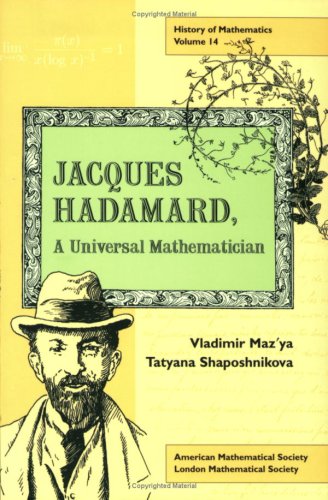
7. Jacques Hadamard: A Universal Mathematician (History of Mathematics)
by Vladimir Maz'Ya, Tatyana Poshnikova
 Paperback: 574 Pages (1998-01)
list price: US$51.00 -- used & new: US$51.99
(price subject to change: see help)
Asin: 0821819232
Average Customer Review: 4.0 out of 5 stars
Canada | United Kingdom | Germany | France | Japan
Editorial Review

Book Description
This book presents a fascinating story of the long life and greataccomplishments of Jacques Hadamard (1865--1963), who was oncecalled "the living legend of mathematics". As one of the lastuniversal mathematicians, Hadamard's contributions tomathematics are landmarks in various fields. His life is linkedwith world history of the 20th century in a dramatic way. Thiswork provides an inspiring view of the development of variousbranches of mathematics during the 19th and 20th centuries.

Part I of the book portrays Hadamard's family, childhood andstudent years, scientific triumphs, and his personal life andtrials during the first two world wars. The story is told of hisinvolvement in the Dreyfus affair and his subsequent fight forjustice and human rights. Also recounted are Hadamard'sworldwide travels, his famous seminar, his passion for botany,his home orchestra, where he played the violin with Einstein,and his interest in the psychology of mathematical creativity.

Hadamard's life is described in a readable and inviting way. Theauthors humorously weave throughout the text his jokes and themyths about him. They also movingly recount the tragic side ofhis life. Stories about his relatives and friends, and oldletters and documents create an authentic and colorful picture.The book contains over 300 photographs and illustrations.

Part II of the book includes a lucid overview of Hadamard'senormous work, spanning over six decades. The authors do anexcellent job of connecting his results to current concerns.While the book is accessible to beginners, it also provides richinformation of interest to experts. ... Read more

Customer Reviews (2)

4-0 out of 5 stars Portrait of a brilliant, deeply humane man
This is an inspirational and often moving biography of one of the great mathematicians of our century. Hadamard was not only a brilliant mathematician, but a stimulating mentor, a man of wide-ranging knowledge, insatiable curiosity, humility, and most of all, great humanity. When Japaninvaded Manchuria, he proposed that the League of Nations sendpeace-keeping forces there, only to face ridicule from the French press.Hadamard, more than most of us, deeply felt the tragic wastefulness of war.He lost two beloved sons in World War I. Of his son, Etienne, he once said:"what I did in mathematics is nothing compared to what he could do ifhe were alive today." (Half of the brilliant graduates of the EcoleNormale were killed in that war). I finished this book with feelings ofgratitude and regret--gratitude to Hadamard for sharing his remarkablegifts with such generosity, and deep regret that "fate" was sogrievously unfair to him.

4-0 out of 5 stars Inspirational and moving
This is an inspirational and often moving biography of one of the great mathematicians of our century. Hadamard was not only a brilliant mathematician, but a stimulating mentor, a man of wide-ranging knowledge,insatiable curiosity, humility, and most of all, great humanity. When Japaninvaded Manchuria, he proposed that the League of Nations send peacekeepingforces there, only to face ridicule from the French press. Hadamard, morethan most of us, deeply felt the tragic wastefulness of war. He lost twobeloved sons in World War I. Of his son Etienne, he once said: "what Idid in mathematics is nothing compared with what he could do if he werealive today."(As the book points out, half the brilliant graduates ofthe Ecole Normale were killed in that war). I finished this book withfeelings of gratitude and regret--gratitude to Hadamard for sharing hisremarkable gifts with such generosity, and deep regret that"fate" was so grievously unfair to him. ... Read more


8. La Vie et l'oeuvre de Jacques Hadamard.
by P. Levy
 Paperback: Pages (1967)

Asin: B000UFQS9W
Canada | United Kingdom | Germany | France | Japan

9. Biography - Hadamard, Jacques (Salomon) (1865-1963): An article from: Contemporary Authors
by Gale Reference Team
Digital: 5 Pages (2003-01-01)
list price: US$9.95 -- used & new: US$9.95
(price subject to change: see help)
Asin: B0007SHMU6
Canada | United Kingdom | Germany | France | Japan
Editorial Review

Book Description
This digital document, covering the life and work of Jacques (Salomon) Hadamard, is an entry from Contemporary Authors, a reference volume published by Thompson Gale. The length of the entry is 1500 words. The page length listed above is based on a typical 300-word page. Although the exact content of each entry from this volume can vary, typical entries include the following information:

  • Place and date of birth and death (if deceased)
  • Family members
  • Education
  • Professional associations and honors
  • Employment
  • Writings, including books and periodicals
  • A description of the author's work
  • References to further readings about the author
... Read more

10. Leçons de géométrie élémentaire, par Jacques Hadamard. Vol. 2
by Jacques Hadamard
 Hardcover: 612 Pages (2001-01-01)
list price: US$39.95 -- used & new: US$37.64
(price subject to change: see help)
Asin: 1418170038
Canada | United Kingdom | Germany | France | Japan

11. Leçons sur le calcul des variations professées par J. Hadamard ... recueillies par M. Fréchet: Tome premier. La variation première et les conditions du ... ordre. Les conditions de l'extremum libre
by Jacques Hadamard
Paperback: 534 Pages (1910-01-01)
list price: US$29.99 -- used & new: US$29.99
(price subject to change: see help)
Asin: 1429702885
Canada | United Kingdom | Germany | France | Japan
Editorial Review

Product Description
This volume is produced from digital images from the Cornell University Library Historical Mathematics Monographs collection. ... Read more


12. The Mathematian's Mind
by Jacques Hadamard
 Paperback: Pages (1996)

Asin: B00126LSVQ
Canada | United Kingdom | Germany | France | Japan

13. The Psychology of Invention in the Mathematical Field.
by Jacques. Hadamard
 Paperback: Pages (1945)

Asin: B000L2KZCK
Canada | United Kingdom | Germany | France | Japan

14. THE PSYCHOLOGY OF INVENTION IN THE MATHEMATICAL FIELD
by JACQUES HADAMARD
 Paperback: Pages (1954)

Asin: B00102UB24
Canada | United Kingdom | Germany | France | Japan

15. Lectures on Cauchys Problem in Linear Pa
by Jacques Hadamard
 Paperback: Pages (1923)

Asin: B000QABJVS
Canada | United Kingdom | Germany | France | Japan

16. Non-Euclidean Geometry in the Theory of Automorphic Functions (History of Mathematics, V. 17)
by Jacques Hadamard
 Paperback: 95 Pages (1999-09)
list price: US$20.00 -- used & new: US$20.00
(price subject to change: see help)
Asin: 0821820303
Canada | United Kingdom | Germany | France | Japan

17. Lecons Sur La Propagation Des Ondes et Les Equations De l'Hydrodynamique
by Jacques Hadamard
 Hardcover: Pages (1903)

Asin: B0010K030Q
Canada | United Kingdom | Germany | France | Japan

18. Essai sur la psychologie de l'invention dans le domaine mathematique (Collection Discours de la methode)
by Jacques Solomon Hadamard
 Unknown Binding: 134 Pages (1975)

Isbn: 2040022937
Canada | United Kingdom | Germany | France | Japan

19. LECONS DE GEOMETRIE ELEMENTAIRE
by Jacques Hadamard
 Hardcover: Pages (1898)

Asin: B000ZPSNAO
Canada | United Kingdom | Germany | France | Japan

20. An Essay on the Psychology of Invention in the Mat
by Jacques. Hadamard
 Hardcover: Pages (1945)

Asin: B0012CC4A4
Canada | United Kingdom | Germany | France | Japan

  1-20 of 39 | Next 20
A  B  C  D  E  F  G  H  I  J  K  L  M  N  O  P  Q  R  S  T  U  V  W  X  Y  Z  

Prices listed on this site are subject to change without notice.
Questions on ordering or shipping? click here for help.

site stats