e99 Online Shopping Mall

Geometry.Net - the online learning center Help  
Home  - Scientists - Hawking Stephen (Books)

  1-20 of 100 | Next 20
A  B  C  D  E  F  G  H  I  J  K  L  M  N  O  P  Q  R  S  T  U  V  W  X  Y  Z  

click price to see details     click image to enlarge     click link to go to the store

 
$23.95
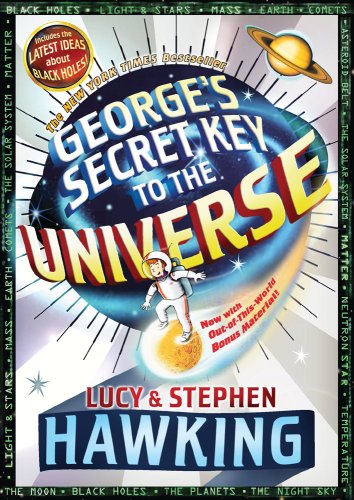
1. George's Secret Key to the Universe
$15.74
2. A Briefer History of Time
$9.99
3. A Brief History of Time
$2.82
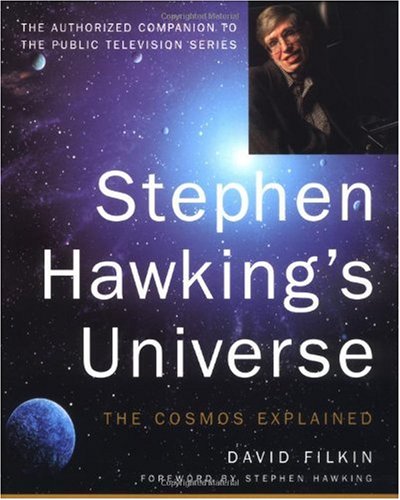
4. Stephen Hawking's Universe: The
$5.63
5. Stephen Hawking: A Biography
$9.95
6. A Stubbornly Persistent Illusion:
$7.98
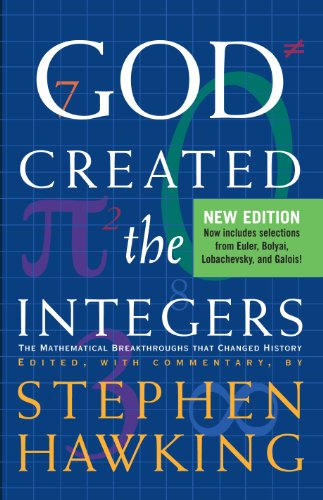
7. God Created the Integers: The
 
$11.91
8. The Theory of Everything: The
$16.87
9. The Universe in a Nutshell
10. A BRIEF HISTORY OF TIME - From
 
$5.24
11. BRIEF HISTORY OF TIME, A
$5.80
12. God, Time, & Stephen Hawking:
$1.38
13. Stephen Hawking's Universe
$22.45
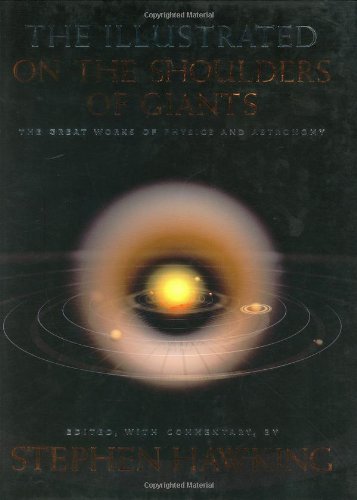
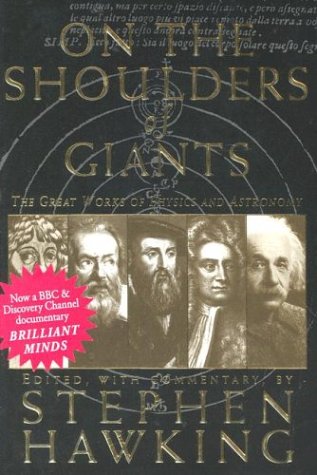
14. The Illustrated on the Shoulders
$12.15
15. The Nature of Space and Time
$26.22
16. Stephen Hawking (Biography (a
$3.98
17. Introducing Stephen Hawking, 3rd
18. Music to Move the Stars : A Life
 
$3.78
19. Stephen Hawking's A Brief History
$4.76
20. Stephen Hawking and the Mind of

1. George's Secret Key to the Universe
by Stephen W. Hawking, Lucy Hawking
 Hardcover: 300 Pages (2008-05-02)
list price: US$23.95 -- used & new: US$23.95
(price subject to change: see help)
Asin: 1410406385
Average Customer Review: 4.5 out of 5 stars
Canada | United Kingdom | Germany | France | Japan

Customer Reviews (19)

5-0 out of 5 stars Capture a Kids Imagination
I bought this book to read to my 5 and 8 year old grandchildren.The 8 year old boy couldn't wait to have it read to him, so he read and read and read until he finished it.He is in 2nd grade,but an advanced reader.He LOVED it and was really into the science as well as the story.I highly recommend it for any child who reads at least 4th-5th grade level who is interested in "outer space".This book has real and accurate science within the context of a good kids' story.

5-0 out of 5 stars George's Secret Key to the Universe
My eldest grandson (age 8) thought this was the best book about the Universe ever.I think my two other grandchildren will enjoy it also, when they get a bit older.

4-0 out of 5 stars A lovely blend between physical fact and science fiction, packaged for children
The fictional story is fast paced and well written.George, whose heart's desire is a new computer, is the son of activists who believe that technology is the root of all evil.They grow all their own vegetables, knit, and keep a large pig in the backyard.But when the pig escapes, George goes looking for it and finds, instead, his unusual neighbours.Annie is a girl around George's age, and her father Eric is the classic absent-minded physicist.Eric has invented an amazing computer called Cosmos who has been able to create a portal directly into space. After Eric very patiently explains a little bit about space, technology and the good and bad ways in which it can be used, George and Lucy suddenly find themselves exploring, and what a trip it is.

What really makes this book interesting is that the concepts that underpin it are quite modern.Relatively recently, Hawkings has discovered the ways in which black holes emit energy and slowly disappear, and these are explained very simply and easily.There is a nice blend here between physical fact, science fiction (if only a computer like Cosmos existed), and that lovely sense of wonder that underpins the study of astronomy.The book make a refreshing change for young readers from the dark world of black magic that seems to have taken precedence in fiction for young adults.After all, what could be more magical than a star at the centre of a plantary nebula, or the Pillars of Creation.It wouldn't surprise me if this book inspired a few more decades of physicists ready to explore the stars or the very origins of the universe.

Magdalena Ball is the author of Sleep Before Evening

4-0 out of 5 stars My five year old enjoys it!
I read it with my five year old - one chapter a night.She has been very interested in planets and stars since starting reading it.Clearly she cannot understand all of it, but she really enjoys the story and does still get a lot out of it based on her questions to me.

5-0 out of 5 stars My 9 year old read this in 3 days
I did not read this book, but my 9 year old son devoured it.He read the book in 3 days (and those were school days).He is now going back and "rereading the good parts!"

My son is a sporadic reader, but when he finds something he likes, I can't get his nose out of the book.Just seeing him excited about reading was enough for me, the fact that the book is really educational is a bonus! ... Read more


2. A Briefer History of Time
by Stephen Hawking, Leonard Mlodinow
Hardcover: 176 Pages (2005-09-27)
list price: US$27.00 -- used & new: US$15.74
(price subject to change: see help)
Asin: 0553804367
Average Customer Review: 4.5 out of 5 stars
Canada | United Kingdom | Germany | France | Japan
Editorial Review

Book Description
Stephen Hawking’s worldwide bestseller, A Brief History of Time, has been a landmark volume in scientific writing. Its author’s engaging voice is one reason, and the compelling subjects he addresses is another: the nature of space and time, the role of God in creation, the history and future of the universe. But it is also true that in the years since its publication, readers have repeatedly told Professor Hawking of their great difficulty in understanding some of the book’s most important concepts.

This is the origin of and the reason for A Briefer History of Time: its author’s wish to make its content more accessible to readers—as well as to bring it up-to-date with the latest scientific observations and findings.

Although this book is literally somewhat “briefer,” it actually expands on the great subjects of the original. Purely technical concepts, such as the mathematics of chaotic boundary conditions, are gone. Conversely, subjects of wide interest that were difficult to follow because they were interspersed throughout the book have now been given entire chapters of their own, including relativity, curved space, and quantum theory.

This reorganization has allowed the authors to expand areas of special interest and recent progress, from the latest developments in string theory to exciting developments in the search for a complete unified theory of all the forces of physics. Like prior editions of the book—but even more so—A Briefer History of Time will guide nonscientists everywhere in the ongoing search for the tantalizing secrets at the heart of time and space. ... Read more

Customer Reviews (46)

4-0 out of 5 stars Interesting yet comprehensive for laymen ...
I understand some of the concepts presented but was disappointed that the time wasn't taken to explain the minor details of some of the theories. What is a blackbody? The term wasn't in the glossary or fully explained in the body of the text. The example of interference was, on the other hand, too simple and explained a two-slit experiment that a 4th grader would understand. Einsten's theory of relativity is only cursorily explained.

3-0 out of 5 stars "A Short History of Sometimes Useful Theories"
There are a lot of theories in this book and no imagination. Because Mr. Hawking has a lot of complex math equations that make little sense to any one but his fellow math buddies why dose that make him an authority on anything.
Secondly I would argue that black holes are givers of life not takers they make room in the limited amount of space in the galaxy for other solar systems to exist. The ultimate predator, scavenger they kill indiscriminately just like any lion or wolf and slowly evaporate that energy back into the universe. Think about it for a second most of your really big black holes are in the center of the galaxy and that is where all the action in the galaxy is. Without Black holes the galaxy would be nothing but big bodies slamming into each other even all the way out here on the edge of the galaxy where we are. Not only that but it has been proven for a long time that if your at a correct angle you can easily survive very close to a black hole. This would be a huge benefit for any solar system you would not have to worry about stray comets and asteroids like we do. But it takes imagination to see things like this something Mr. Hawking and his math club lack.
There are other, how in the world would he know these things in this book. For instance the theory that man can not travel faster than the speed of light if Mr. Hawking was as much a student of history as he claims. He would know that in the history of automobile travel it was once believed that of you went too fast in a car you would die. And this was a widely accepted scientific theory at the time. Theoretical Physics and Math will only get you so far the only way to find out is to do. This book should have been called "A Short History of Sometimes Useful Theories" sense that is what it is and these theories hold no more weight than anyone else's theories including yours.

Eric

5-0 out of 5 stars A great overview!
Stephen Hawking is one of the few truly brilliant men who also has the ability to speak in a concise and meaningful way to people who are not experts. The book offers the absolute best overview of modern physics covering theories of both the past and present. Specifically, Hawking provides one of the best overviews of modern quantum theory that I have read.

5-0 out of 5 stars A Great Book
I think this book is as close as anyone will come to make quantum mechanics an easy subject. That is why I gave it 5 stars.

That being said, I only have a marginal increase of my understanding of the subject after reading the book.

I guess it is true that : "If you say that you understand quantum mechanics, and if you are NOT surprised, then you really did not understand quantum mechanics" !

4-0 out of 5 stars Half confused, half amazed
For as simple as Hawking was supposed to present the complicated theoretical physics concepts, at times I still found myself as confused as Adam on Mother's Day.Dr. Hawking's work is caught between a rock and a hard place in "A Brief History of Time" and the subsequent "The Universe in a Nutshell"; he provides neither the technical language to satisfy the experienced readers, nor the sufficiently simplified rhetoric to appeal to the uninitiated.Not to worry as the theories and supporting arguments in both books can still satisfy the curiosity of the inexperienced, and his celebrity status in the world of physics keeps the experienced audience engaged.

There is one update to this book not mentioned, and that is, Hawking eventually admits that he was wrong about his theory of loss of information in black holes.This idea of his had put him at odds with many theoretical physicists.Instead, he puts forth the unproven theory that information in a black hole is transferred to a parallel universe.Unfortunately, time may not permit Hawking to complete his work on the proof or supporting evidence of this important theory.His terminal illness appears to be finally catching up to him.I wish him well and thank him for his important contributions to the science of understanding the universe.

Despite its shortcomings, A Brief History of Time succeeds in shedding light on the mysteries of the creation of the universe at the point of singularity, what happened subsequently, and what may or may not transpire in the future.Hawking discusses in length Einstein's general theory of relativity, quantum mechanics and the attempt to combine these into a grand unified theory, a lofty goal that has eluded theoretical physicists to date. ... Read more


3. A Brief History of Time
by Stephen Hawking
Paperback: 224 Pages (1998-09-01)
list price: US$18.00 -- used & new: US$9.99
(price subject to change: see help)
Asin: 0553380168
Average Customer Review: 4.5 out of 5 stars
Canada | United Kingdom | Germany | France | Japan
Editorial Review

Amazon.com
Stephen Hawking, one of the most brilliant theoretical physicists in history, wrote the modern classic A Brief History of Time to help nonscientists understand the questions being asked by scientists today: Where did the universe come from? How and why did it begin? Will it come to an end, and if so, how? Hawking attempts to reveal these questions (and where we're looking for answers) using a minimum of technical jargon. Among the topics gracefully covered are gravity, black holes, the Big Bang, the nature of time, and physicists' search for a grand unifying theory. This is deep science; these concepts are so vast (or so tiny) as to cause vertigo while reading, and one can't help but marvel at Hawking's ability to synthesize this difficult subject for people not used to thinking about things like alternate dimensions. The journey is certainly worth taking, for, as Hawking says, the reward of understanding the universe may be a glimpse of "the mind of God." --Therese LittletonBook Description
A Brief History of Time, published in 1988, was a landmark volume in science writing and in world-wide acclaim and popularity, with more than 9 million copies in print globally. The original edition was on the cutting edge of what was then known about the origins and nature of the universe. But the ensuing years have seen extraordinary advances in the technology of observing both the micro—and the macrocosmic world—observations that have confirmed many of Hawking's theoretical predictions in the first edition of his book.

Now a decade later, this edition updates the chapters throughout to document those advances, and also includes an entirely new chapter on Wormholes and Time Travel and a new introduction. It make vividly clear why A Brief History of Time has transformed our view of the universe. ... Read more

Customer Reviews (335)

5-0 out of 5 stars Do I need to talk about this book
This is a fine book for people who love physics of those who are curious about the universe they are in. A great book by a great scientist.

5-0 out of 5 stars a pleasure to read
Many years after its initial release, this book is still a great pleasure to read.Written in a conversational tone, much of it is probably readily understandable to most readers.However, some parts of it, especially toward the end, aren't exactly simple by any means.Any curious reader, even if not particularly interested in physics or astronomy, will find this little book to be a gem.An extra treat is a few pages at the end describing prominent events from the lives of Einstein, Galileo, and Newton.Highly recommended read.Author of Adjust Your Brain: A Practical Theory for Maximizing Mental Health.

3-0 out of 5 stars Bumpy RIDE!!!!!!!
Hawkins may provide amazing insight into Astrophysics and have a Brillant Mind. However, he does a medicore job in explaining things and his writting style is often "choppy" and hard to read. He just does not expand on things well. The concepts in the book can be hard to grasp and the writting can make it very hard to stay focus.
I find other authors to be a much better selection like Neil Tyson with equal insight for the layman.

The book does provide alot of amazing insight into things like Black Holes, Time Travel, Entropy, Relativity and other cosmic delights.

5-0 out of 5 stars An excellent overview of modern physics.
If you can find it, I recommend this version over the original "Brief History of Time".This version was written about 8 years later and as such incorporates much that has been learned over the intervening years.In addition, the illustrations greatly enhance the text.They are not only a joy to look at, but actually make the book more understandable.The original work has been characterized as one of the most popular, but unread books of all time.Much of the unread characterization stems from the fact that this is a difficult book unless one has had some minimal understanding of physics.Minimal is, however, the appropriate word as one need not be a physicist to get a lot from this book, but one should not be put off by a discussion of quarks, gluons, gravitons, wormholes or string theory.

The first chapters deal with the classical view of physics and the universe.This is followed by discussions of the theory of relativity and quantum mechanics.It is important to note that these are not rigorous discussions, indeed no mathematics is used and the discussion is entirely devoted to the basic ideas and implications of these theories.At least one reviewer has criticized the fact that these subjects have not been developed in any detail, but rather are just expounded.I think that this misses the point.This is not a physics text; rather it tries (I think very successfully) to show the reader the beauty and implications of modern physics.I found the discussion of modern particle physics to be one of the best very elementary treatments that I have ever read.Next he discusses black holes and the origin of the universe.Again, I found his discussion of black holes to be one of the best very elementary treatments that I have ever read.The last chapters on wormholes, time travel and grand unified theories are more speculative than the preceding chapters, but the reader is clearly forewarned that this is the case.(The most speculative, and in my opinion least clear chapter, was the one on wormholes and time travel, which was not in the original version of "A brief History of Time".)

I liked this book a lot and do not agree with those who found it to be unclear and very difficult to follow, but I can see how those with no physics background at all would find it too difficult to finish.This version has the virtue of pictures which make following Hawking's text a bit easier to follow and as he states in the forward "Even if you only look at the pictures and their captions you should get some idea of what is going on."

1-0 out of 5 stars This book is a fake!
As a physicist I am flabbergasted and slightly depressed by the success of this book. First of all this book presents as if they were equally certain some pieces of orthodox science together with some of the author's dubious speculations. The lay reader is not told which are which. Secondly, the author obviously has no knowledge of the actual history of physics and yet he shamelessly "describes" it to the reader.

Hawking seems to have gathered together all the bad cliches about various physical issues and has taken out all the valuable ideas. He explains nothing, he just asserts that "we physicists know that..., we physicists have demonstrated that...". I cannot see how anyone can actually learn anything about physics from this book, about why we know what we know. And yet, judging from the amount of praise this book receives, it seems that quite a lot of people have fallen under the spell that they have been allowed access to some secret. They haven't and I find this trickery immoral.

Quantum physics and astrophysics are really interesting. They don't deserve to be thrashed in this unashamed manner. If you want to learn something about physics, there are other books which do a much better job, for example Asimov's Atom: Journey Across the Subatomic Cosmos. ... Read more


4. Stephen Hawking's Universe: The Cosmos Explained
by David Filkin
Paperback: 304 Pages (1998-10)
list price: US$24.95 -- used & new: US$2.82
(price subject to change: see help)
Asin: 0465081983
Average Customer Review: 4.0 out of 5 stars
Canada | United Kingdom | Germany | France | Japan

Customer Reviews (23)

4-0 out of 5 stars Classic.....
This is a classic book. And it looks great on a coffee table. Everyone will think you're smart.

A great book to have and read, and to tell people that you read it.

3-0 out of 5 stars Good Book, but more to do with other Various Scientists
Stephen Hawking's Universe is a book that attempts to explain Stephen Hawking's theories of how the universe was created. Under Stephen's theories he supports the Big Bang. In the Big Bang theory it states that the universe was created by a big explosion. Aside from explaining the Big Bang theory, the book also talks a little about Hawking's personal life before he developed Lou Gehrig’s syndrome which has paralyzed him for life.
Although the book talks about Stephen Hawking's Work, it mentions
very little. The book focuses mostly on the history of cosmology and various other cosmologists who have attempted to find the beginnings to the universe. If you are looking for a book that describes in depth Hawking's work and his theories, then this is not the right book.

4-0 out of 5 stars A basic primer, well presented
Stephen Hawking is widely acknowledged as one of the most intelligent persons on the planet, often seen as the intellectual successor to Einstein in reputation if not in actual adherence to theories.This book by David Filkin is a companion to book to a BBC/PBS series by the same name, highlighting different aspects and ideas that came from the television production.

Stephen Hawking's own book, `A Brief History of Time', is a very popular and accessible account of modern theoretical physics - it is somewhat astonishing that a book on this topic should have sold well over 10 million copies worldwide, being translated into many languages.Filkin's book looks not only at the theories (many of which can be found in Hawking's book), but also at the personality of the man behind the ideas.Hawking describes himself as a boy who liked to take things apart to see what made them tick - this is a rather difficult enterprise to undertake when dealing with the universe as a whole.

David Filkin and Stephen Hawking were at Oxford together.Filkin was on the crew team, and Hawking was the cox for the team of eight.Filkin writes of knowing Hawking only peripherally then, but being impressed with his determination, something that has continued to show through in Hawking's life, as he battles debilitating illness.However, as Filkin states, it is easy to get lost in thinking of Hawking in those terms.Hawking is worthy of recognition for his academic achievements in their own right - he holds the mathematics chair at Cambridge that Sir Isaac Newton held (and, as testament to its importance, one of the `future scenes' of Star Trek shows the android Data also hold the same chair, mentioning into the futuristic narrative both Newton and Hawking in the same breath).

Despite this brilliance, Hawking readily admits that much of his model of the universe is not his own.Standing on the shoulders of giants, he sees further, but acknowledges his debtsto past scientific research.Filking introduces theories of the universe by looking at past models, everything from `turtles all the way down' to Ptolemaic, Copernican, and more modern ideas.Filkin draws in the major scientists of the progress of science - Galileo, Kepler, Copernicus, Doppler, and Hubble - and shows a steady progress of science against a backdrop of political, religious and social concerns.The early days of the Hubble discovery of red-shifted light from stars and Einstein's change of view from an eternal, infinite universe to one that had an origin is presented in context of Lemaitre, a cosmologist for the Vatican, who tried to reconcile modern scientific theories with the idea that the universe did have a point or moment of origin; this was not universally accepted (no pun intended), however, as some scientists such as Fred Hoyle continued to argue for an eternal, infinite universe with the Steady State theory.

Beginning with chapter five, and continuing throughout the rest of the text, the real heart of the matter of modern theoretical physics, astronomy and cosmology is presented.Filkin uses both the progress of ideas of Hawking, the progress of technology, and the various personalities involved in the scientific community (most of whom who are presented are still alive and at work) to develop the narrative of understanding the universe.Big Bang theory presented in great detail, including some of the more philosophical/theological concerns involved (while some churches applauded the Big Bang theory because it provided evidence for a moment of creation, others decried it as being contrary to a strict, literal six-day creation interpretation).One of the most intriguing ideas to arise in physics as a part of these developments was the proposition of the black hole, a gravitational oddity that occurs when a supermassive object cannot support its own weight, and the effects on the space-time continuum are so severe that not even light can escape its grasp.

Along the way, Filkin describes in historical and scientific ways the development of ideas of matter (atoms, from ancient Greek thought to modern times), light and energy, dark matter, and more.We learn about WIMPs (Weakly Interacting Massive Particles), MACHO men (Massive Astrophysical Compact Halo Objects observers), SETI research (Search for Extraterrestrial Life), and doing the impossible - locating the elusive black hole.How can you see something no one can see?

The limits of observation also play into the limit of the partnership between theory and observation for cosmology.Filkin writes that, through history, there have been historic pairings (Kepler's theories and Brahe's observations make a classic example), but the limits of nature are bumping up against observational ability, and the theoretical limits of such observatories is being reached - nothing at absolute zero can be detected in and of itself, as absolute zero is the lower limit; similarly, very high temperatures render everything opaque and fuzzy.None of this even begins to deal with the observational issue of the observer changing the status (the uncertainty principle).

There is an interesting duality that arises in cosmology - those who think that our understanding of the universe and its principles is nearly complete (Ed Witten, one of the present-day physicists highlighted, speculates in this direction) and those who think that there is still a vast body of unknown information to be discovered.One cannot help but think of the speculation around the turn of the last century, as nineteenth-century science triumphed in its understanding of various things in the world, and intellectual hubris was so high as to make some consider that patent offices would soon be closing, as everything that would ever be invented already had been.The early twentieth century in science destroyed both the intellectual arrogance and the stability of our understanding of the world, and things have continued at a quickening pace for decades.Have we reached the limits?Time will tell.

Of course, that might be imaginary time (thanks to Richard Feynman).


5-0 out of 5 stars Best book describing the bestcosmological principles
Stephen Hawking's universe is one of the very few books of its kind. It describes the complex and beautiful picture of our cosmos as presented by the most famous living scientist of the world. This book will prove helpful and informative for all those who are concerned with the universe and also with Professor Hawking.
Stephen Hawking's universe is such a book which tends to describe a difficult subject with simplicity and ace. Thus any one out there who is intrested in cosmology and is waiting for a new arrival the please do have a look at this one.

1-0 out of 5 stars Beware!You will be dumber after reading this!
I've always enjoyed Stephen Hawking's writings, as in them he clearly explains things without condescendingly simplifying them, mixes humor with science, and conveys the awe and thrill of scientific discovery.However, once I got past the forward of this book (the only part written my Hawking), I could see that this book was a complete failure.I should have known when someone got me the book; Filkin is a total non-scientist and I now know is scientifically illiterite.

I was first confronted with horrid and sometimes malicious (or at least maddeningly stupid) terminology errors.For example, throughout the book, a brown dwarf is said to be a cooled-down white dwarf.WRONG!A brown dwarf is a starlike object too small to start thermonuclear fusion, so it produces heat and light by contracting; this is the definition according to the International Astronomical Union, the body which defines all astronomical, astrophysical, and cosmological terminology.This is just one of many such errors.
The terminology I had the biggest problem with was the wrongful (indeed, gratuitous) use of the word "creationism."It is relatively apparent that Filkin means the idea that the universe was created at some time, but it is still the wrong word.Either it was placed in there by Filkin (I think unlikely) or the publishers (more likely) to cave to the 45% of this backwards country which seriously believes creationism (in the sense of what the word really means), or (maybe a little more likely)used without thinking.This leads to my next big problem with the book.

Rather than sticking to the science, or at least pointing out how science sharply contrasts with "faith," Filkin spends a large amount of time talking about how science and religion (specifically Christianity) go hand-in-hand.He even makes up malicious falsities, frequently claiming that science at least partially supports Christianity (actually, he said it supporst "creationism"), and that important discoveries were held up by the dogma of "atheist scientists."One particularly despicable example is his claim that after Hubble discovered the Hubble flow, its reality and logical conclusions were denied and held back by "atheist scientists," being unwilling to accept the idea that the universe began (and hence doesn't violate the 2nd law of thermodynamics).Nothing could be further from the truth!The Hubble flow was looked upon very skeptically for over a decade because the original measurements put the age of the universe as less than the then-known age of the Earth.

Lastly, there are the contradictory statements.Filkin often makes statements contrary to the 'evidence' he supports it with, if there is any.One example is as follows: "churchgoing" scientist were shunned and forced to hide their beliefs from the 18th to the 20th centuries because (a) they believed in a moment of creation despite the official church policy that the universe was infinite, (b) the "atheist scientists" believed, like Newton, that the universe was infinite, and (c) these two beliefs (the church's and the atheist concepts) are different.If you were paying attention, you'd know these beliefs are NOT different, and hence not in conflict.

I put the book down after a few chapters of being frustrated not learning anything, frequently needing to correct Filkin, and seeing a creationist-propagandist's dream come true (regardless of what Filkin meant, I've seen quotes from this book paraded around by creationists).Finally, I would like to point out my disgust with Hawking for having a book like this sold with his stamp of approval. ... Read more


5. Stephen Hawking: A Biography
by Kristine Larsen
Paperback: 215 Pages (2007-10-31)
list price: US$16.95 -- used & new: US$5.63
(price subject to change: see help)
Asin: 1591025745
Canada | United Kingdom | Germany | France | Japan
Editorial Review

Book Description
Stephen Hawking is arguably the most famous physicist sinceAlbert Einstein. His decades-long struggle with ALS (Lou Gehrig's disease),combined with his singular brilliance as a cosmologist, has fascinated boththe public and his colleagues in science.In this engagingly written biography, Kristine Larsen, a physicist andastronomer herself, presents a candid and insightful portrait of Hawking'spersonal and professional life. Avoiding the hero-worship sometimes foundin popular works on Hawking, Larsen emphasizes that Hawking is first andforemost a scientist whose work has made significant contributions to ourunderstanding of the nature and origins of the universe. Writing innontechnical language for the lay reader, Larsen clearly explains Hawking'scomplex scientific accomplishments, while telling the story of hischallenging life.

Topics include Hawking's early lack of focus as a college student; theimpact of ALS on his career and personal life; his groundbreaking work onradiating black holes; his later cutting-edge theories of black holes,cosmology, and the anthropic principle; the amazing publishing success of ABrief History of Time; and his status as a pop icon and spokesperson forthe interplay of science and society. Larsen situates Hawking'ssometimes-controversial work within the broader context of scientific peerreview and public debate, and discusses his personal life with compassion,respect, and honesty. ... Read more


6. A Stubbornly Persistent Illusion: The Essential Scientific Works of Albert Einstein
Hardcover: 468 Pages (2007-11-26)
list price: US$29.95 -- used & new: US$9.95
(price subject to change: see help)
Asin: 0762430036
Average Customer Review: 5.0 out of 5 stars
Canada | United Kingdom | Germany | France | Japan
Editorial Review

Book Description
"People like us, who believe in physics, know that the distinction between past, present, and future is only a stubbornly persistent illusion."--Albert Einstein

Best-selling author and physicist Stephen Hawking assembles the most groundbreaking works by Albert Einstein together into one volume. From the text that revealed the famous "Theory of Relativity"--renowned as the most important scientific discovery of the 20th Century--to his significant works on quantum theory, statistical mechanics, and the photoelectric effect, here are the writings that changed physics, and subsequently, the way we view the world.

Einstein also thought deeply on both political issues and religious thought, so many of Einstein's philosophical essays are included. Hawking provides introductions to each work, which provides both historical and scientific perspective. From the papers that shaped modern scientific thought to Einstein's later musings on his landmark findings, A Stubbornly Persistent Illusion is a collection of Einstein's most important work, with commentary from our greatest living physicist. ... Read more

Customer Reviews (1)

5-0 out of 5 stars Einstein's seminal works commented on by Stephen Hawking
The most highly celebrated and recognized scientist alive today, Stephen Hawking has assembled, in this volume, highlights of Einstein's groundbreaking scientific works, such as his Special Theory of Relativity (1905) and his General Theory of Relativity (1915).

Also included are Einstein's thoughtful views on politics, religion, the history and development of physics, and the interplay between science and the world.

In a chapter titled "Selections from Out of My Later Years," Hawking discusses Einstein's reservations concerning quantum mechanics: "Einstein pointed out that if we were able to investigate microscopic phenomena on the smallest scales, we would be able to find deterministic relations." In other words, Einstein had serious doubts about the validity of Heisenberg's Uncertainty Principle, and rejected the fundamentally probabilistic nature of reality espoused by those who held to the workings of chance and randomness at the quantum (microscopic) level. "God does not play dice with the universe," he famously opined; "God is subtle but he is not malicious." He held adamantly (some would say stubbornly) to his belief that physical reality is, at bottom, deterministic.

Hawking gives brief introductions to each of Einstein's papers, thereby providing helpful historical and scientific perspectives.

Einstein once said, "Do not worry about your difficulties in mathematics. I can assure you mine are still greater." Yeah, right! Einstein is much too modest.

In a sense, however, Einstein is correct. Although this volume is replete with mathematical equations, one can read between the lines and gain an improved understanding of his revolutionary theories of spacetime and gravitation.

Einstein makes us smile with his wry humor: "Today I am described in Germany as a 'German savant,' and in England as a 'Swiss Jew.' Should it ever be my fate to be represetned as a bete noire, I should, on the contrary, become a 'Swiss Jew' for the Germans and a 'German savant' for the English."

The book's title of comes from another Einstein quote, "People like us, who believe in physics, know that the distinction between past, present, and future is only a stubbornly persistent illusion." ... Read more


7. God Created the Integers: The Mathematical Breakthroughs That Changed History
Paperback: 1358 Pages (2007-10)
list price: US$21.95 -- used & new: US$7.98
(price subject to change: see help)
Asin: 0762430044
Average Customer Review: 3.5 out of 5 stars
Canada | United Kingdom | Germany | France | Japan
Editorial Review

Amazon.com
"God created the integers," wrote mathematician Leopold Kronecker, "All the rest is the work of Man." In this collection of landmark mathematical works, editor Stephen Hawking has assembled the greatest feats humans have ever accomplished using just numbers and their brains. Each of the 17 sections opens with a historical introduction of the featured author, and proceeds to a faithful translation of their most famous work. While most mathematicians will already have complete editions of Isaac Newton's Principia or Georg Cantor's Contributions to the Founding of the Theory of Transfinite Numbers, this book is unique in presenting just the best bits of these and other theoretical works. The collection spans 2,500 years and covers a vast range of theories: the parallel postulate, Boolean logic, differential calculus, and the philosophy of the unknowable among them. Dense with numbers, formulae, and ideas, God Created the Integers is quite challenging, but Hawking rewards curious readers with a look at how mathematics has been built. In contrast to the towering physical edifices of great civilizations of the past, Hawking writes, "The greatest wonder of the modern world is our understanding." --Therese LittletonBook Description
Pulled together for the first time, and paired with commentary from the world's most respected scholars, God Created the Integers presents history's extraordinary moments in math, culled from 2,500 years of history and 21 distinguished mathematicians, four more than the hardcover edition. Each chapter begins with a profile of one of these mathematical masters, followed by original printings of their relevant works. This new paperback edition includes the work of Euler, Galois, Bolyai, and Lobachevsky.

Readers get a window into the minds of these geniuses and can see the unfolding thought process as it leads, inevitably, to the high-water marks in mathematical thinking. This new edition comes with an index to make it a valuable and easy-to-use research and reference tool. ... Read more

Customer Reviews (24)

5-0 out of 5 stars My son liked his Christmas gift
My son asked for this book for Christmas, so I bought it for him. Looking inside, I saw it was way over my head. But he, being a math and computer genius, loved it.

3-0 out of 5 stars Shout for joy or toss it?
To evaluate my comments, I think you should know who I am and why I bought this book: I'm a former technical editor and writer. As a girl, I was discouraged from studying math, because at the time (the Fifties and Sixties) they thought girls couldn't understand it.

Recently I've tried to fill in the gaps in my math and science education. I thought the idea of Hawkings choosing landmark math texts and commenting on them was fantastic. After spending three days trying to understand the Euclidian proof of the Pythagorean theorem, and concluding I was just too dumb, I turned the page and discovered that according to the commentary the proof was for an isosceles right triangle, while the illustration was not isosceles.

Other reviewers have commented on the egregious errors and typos. I'd like to add that the whole publication is a typographical horror. The publisher should be ashamed. The font size is miniscule. The illustrations are often misleading. Hawkings may have chosen the texts, but the publisher apparently selected the editions based not on quality of translation but whether the copyright had expired: most appear to be nineteenth-century and to include outdated commentaries. At first I thought the commentaries were by Hawkings, but they aren't, and this was not only a disappointment but also a source of my confusion at several points where I couldn't understand them.

I would be surprised if even ten percent of the book is authored by Hawkings. Given this, the ghastly page layout, inaccurate reprints of outdated texts, and amateurish copyediting, this book is overpriced.

IF YOU'RE MATHEMATICALLY LITERATE, you will likely find Hawkings' material a joy to read. Even I -- with my limited background -- am able to appreciate some of it. But the minute after I want to shout for joy when I understand something beautiful in the book, I want to throw it across the room for something like spelling Leonardo da Vinci "Lionardo" or typos like "Archimedes's asked." With glaringly obvious typos like those, I can only assume there are less obvious typos where it really counts, in the math. It's not that I think typos out-weigh the value of Hawkings' insights, by any means. It's that mathematicians have to be precise in their formulas and proofs if they want to convince anyone they're right. God is also in the details.

Addendum: The more I read, the more disappointed I am in this book. I'm beginning to question whether Hawkings wrote even the introductions to the excerpts. Many of them are nothing but poorly written biographies of the mathematicians anthologized. The intro to Newton asserts that Newton falsely claimed priority over Leibniz for devising calculus, for example, but the book doesn't include anything written by Leibniz. The book excerpts Euler, but only mentions the constant e in one sentence in the Euler intro. I'm going to look for a good history of mathematics and give up on this volume. And when I'm ready, I'll look for good translations of the original texts.

5-0 out of 5 stars God Created the Integers
This is a beautiful book because it lists the life and work of 16 mathematicians whose work has inspired our civilization. For example Einstein is not included, but Riemann whose analysis of curved space is the foundation of the General Theory of Relativity is rhere. So also are Archimedes and Newton the pillars of mathematical physics.Kurt Godel in 1931 proved that there will always a truth that is outside a set of axioms.Some of the original papers are difficult but I have gained much from the logic of George Boole which also governs computer programmes.

5-0 out of 5 stars Forget the flaws. Enjoy it.
I just couldn't put this book down. I was so absorbed that I even missed my station and had to catch a train back. The biographies mixed with mathematical explanations and an outline of the significance of each work is brilliant. It gives one an insight into how context-dependent genius really is.

I knew that the book had flaws because I read these reviews a while ago. But so what! You wouldn't use this book for reference or as a text book. It's meant to be entertainment and entertaining it is. If you can understand the maths and the significance of the selected papers you can enjoy it without worrying too much about everything being crossed and dotted.

I knew the biographies of many, but not all, of these men. Of the ones I didn't know, my favorite is George Boole. The description of his unusual career and the amazingly clear and readable paper on symbolic logic are worth buying the book for. I almost choked up when I read how he died.

Anyway, in our age or irrationality and ignorance we need more books like this to show us that we can rise above it all.

3-0 out of 5 stars Definitelly a great book but it serious editorial issues
I will be brief:
*** I miss a chapter on Euler. Wasn't he a great mathematician?
*** I need a magnifying glass to go with the book. The footnotes are very, very small
*** While I understand the editors that they did not want to bring the translated text up to today's standard I believe that a footnote or two to define the terms would have helped. Especially with the Riemann's seminal paper on Geometry ... Read more


8. The Theory of Everything: The Origin and Fate of the Universe
by Stephen Hawking
 Hardcover: 132 Pages (2007-11-01)
list price: US$19.95 -- used & new: US$11.91
(price subject to change: see help)
Asin: 1597775541
Average Customer Review: 3.0 out of 5 stars
Canada | United Kingdom | Germany | France | Japan
Editorial Review

Amazon.com
With a title inspired as much by Douglas Adams' Hitchhiker series as Einstein, The Theory of Everything delivers almost as much as it promises. Transcribed from Stephen Hawking's Cambridge Lectures, the slim volume may not present a single theory unifying gravity with the other fundamental forces, but it does carefully explain the state of late 20th-century physics with the great scientist's characteristic humility and charm. Explicitly shunning math, Hawking explains the fruits of 100 years of heavy thinking with metaphors that are simple but never condescending--he compares the settling of the newborn universe into symmetry to the formation of ice crystals in a glass of water, for example. While he explores his own work (especially when speaking about black holes), he also discusses the important milestones achieved by others like Richard Feynman. Though occasionally an impenetrably obscure phrase does slip by, the reader will find the bulk of the text enlightening and engaging. The material, from the nature of time to the possibility that the universe has no beginning or end, is rich and deep and inevitably ignites metaphysical thinking. After all, Hawking is famous for his "we would know the mind of God" remark, which ends the final lecture herein. --Rob LightnerBook Description
In physicist Stephen Hawking's brilliant opus, A Brief History of Time, he presented us with a bold new look at our universe, how it began, and how our old views of physics and tired theories about the creation of the universe were no longer relevant. In other words, Hawking gave us a new look at our world, our universe, and ourselves. Now, available for the first time in trade paperback, Hawking presents an even more comprehensive look at our universe, its creation, and how we see ourselves within it. Imagine sitting in a comfortable room listening to Hawking discuss his latest theories and place them in historical context with science's other great achievements--it would be like hearing Christopher Columbus deliver the news about the new world. Hawking presents a series of seven lectures in which he describes, more clearly than ever, the history of the universe as we know it. He begins with the history of ideas about the universe, from Aristotle's idea that the Earth is round to Hubble's discovery two millennium later that our universe is growing. Using this history as a launching pad, Hawking takes us on a fascinating journey through the telescopic lens of modern physics to gain a new glimpse of the universe--the nature of black holes, the space-time continuum, and new information about the origin of the universe. He uses this scientific basis to come up with a "unified theory of everything" that the author claims will be "the ultimate triumph of human reason." ... Read more

Customer Reviews (40)

1-0 out of 5 stars Don't buy this book!
This is from the Stephen Hawking website:

"It has come to our attention that the book "The Theory of Everything: The Origin and Fate of the Universe" has been published. Professor Hawking would like to make it clear that he has not endorsed this book. The text was written by him many years ago, however the material has already been published in books such as 'A Brief History of Time'. A complaint was made to the Federal Trade Commission in the US in the hope that they would prevent the publication. We would urge you not to purchase this book in the belief that Professor Hawking was involved in its creation."

5-0 out of 5 stars My Best Chance at Understanding Hawking
I'm not a math or science-y person, but I actually enjoyed Hawking's "Theory of Everything." It helps that the cover is fantastic and the book is less than 150 pages-- making it a great gift for any science buff or space whiz (or anyone else who likes to think outside of the box.) Don't be fooled by its sleek packaging, though-- it's the same heavy Hawking you know and love, just... simpler.

Very, very cool book-- now I just have to wait for my boyfriend to read it so we can discuss...!

5-0 out of 5 stars Even if it is unofficial...
Even if this product is unofficial, and unsanctioned by Stephen Hawking himself, I have to say I enjoyed it.
I liked how its topics were so clearly delineated into thematically cohesive lectures, I liked that the author read them himself using a computer, and I loved the clear and organized way that Hawking laid out topics as complex and unfathomable as black holes and time and the beginning of the universe.
Don't buy this, I suppose, since it's really not sanctioned by Hawking himself, but do buy his other work that basically repeats this same material.
Do buy this, though, if you're a Hawking completist, already have all his other books, and are looking for just a little bit more.
I loved it.

1-0 out of 5 stars Phoenix Strikes Again
When Phoenix did a crummy job on their audio book production of A Brief History of Time, I thought "that seems kind of disrespectful, doing a hack job like that just so they can make money off of a famous book."

Ha!Do I feel like a fool now!


Oh yeah, and of course I am obligated to add this little bit from Hawking's website:

IMPORTANT NOTE
It has come to our attention that the book "The Theory of Everything: The Origin and Fate of the Universe" has been published. Professor Hawking would like to make it clear that he has not endorsed this book. The text was written by him many years ago, however the material has already been published in books such as 'A Brief History of Time'. A complaint was made to the Federal Trade Commission in the US in the hope that they would prevent the publication. We would urge you not to purchase this book in the belief that Professor Hawking was involved in its creation.

1-0 out of 5 stars Question the publiser..
IMPORTANT NOTE
It has come to our attention that the book "The Theory of Everything: The Origin and Fate of the Universe" has been published. Professor Hawking would like to make it clear that he has not endorsed this book. The text was written by him many years ago, however the material has already been published in books such as 'A Brief History of Time'. A complaint was made to the Federal Trade Commission in the US in the hope that they would prevent the publication. We would urge you not to purchase this book in the belief that Professor Hawking was involved in its creation. ... Read more


9. The Universe in a Nutshell
by Stephen Hawking
Audio Cassette: Pages (2001-11-06)
list price: US$25.95 -- used & new: US$16.87
(price subject to change: see help)
Asin: 0553528394
Average Customer Review: 4.0 out of 5 stars
Canada | United Kingdom | Germany | France | Japan
Editorial Review

Amazon.com's Best of 2001
Stephen Hawking, science's first real rock star, may be the least-read bestselling author in history--it's no secret that many people who own A Brief History of Time have never finished it. Hawking's The Universe in a Nutshell aims to remedy the situation, with a plethora of friendly illustrations to help readers grok some of the most brain-bending ideas ever conceived.

Does it succeed? Yes and no. While Hawking offers genuinely accessible context for such complexities as string theory and the nature of time, it's when he must translate equations to sentences that the limits of language get in the way. But Hawking has simplified the origin of the universe, the nature of space and time, and what holds it all together to an unprecedented degree, inviting nonscientists to share his obvious awe and love of the unseen forces that shape it all.

Yes, it's difficult reading, but it's worth it. Hawking is one of the great geniuses of our time, a man whose life has been devoted to thinking in the abstract about the universe. With his help, and pictures--lots of pictures--we can seek to understand a bit more of the cosmos. --Therese Littleton Book Description
Read by
Four cassettes, 6 hours

Like many in the community of theoretical physicists, Professor Hawking is after the Grail of science-the Theory of Everything that lies at the heart of the cosmos. He involves us in the attempts at uncovering its secrets-from supergravity to supersymmetry, from quantum theory to M-theory, from holography to duality, and now, at the very frontiers of science, superstring theory and p-branes. He shares his eagerness to "combine Einstein's General Theory of Relativity and Richard Feynman's idea of multiple histories into a complete unified theory that will describe everything that happens in the universe."

With characteristic exuberance, Hawking invites us to be fellow travelers on this extraordinary voyage through spacetime. ... Read more

Customer Reviews (182)

5-0 out of 5 stars Review

If I had to sum up Stephen Hawking's The Universe In A Nutshell in one word, it would be brilliant.In this masterpiece Hawking somehow takes the most, in my opinion, complicated and confusing science topics and breaks them down into a reader-friendly showcase of knowledge and love of science.Upon first opening the book and skimming the topics and detailed illustrations I almost didn't even bother to start the adventure into Hawking's world, however upon reading the first few pages I quickly learned that such topics could be understood by even the most severely scientifically challenged.Granted comprehension of such daunting topics does not come instantaneously, but if slowly taken in you can easily come to understand the science of every bit of matter around you and begin to see the world through Hawking's eyes.
Normally I am the last one to pick up a non-fiction book such as this one for a pleasure reading book, but on my friends persistence I bought it.After reading the first couple of pages I could not stop reading.I would read a couple of pages, give myself time to wrap my mind around what I had just read, and then immediately dive back into the book.Hawking immediately pulls you in with his obvious delight in the universe and the science around us.He somehow makes the book fun to read.The fact that Hawking makes such advanced science subjects and ideas comprehendible without watering down the material makes you want to learn more about the world around you and the possibilities of the future.
Without a doubt, this book would not be as digestible as it is without the magnificent illustrations.Detailed pictures and diagrams help the reader to visualize the topics which Hawking explains with excellent clarity.The diagrams alone are enough to explain the ideas and theories Hawking conveys in this amazing book.I myself am a very visual learner so the illustrations were very helpful to my understanding of the topics.
In conclusion, Hawking takes seemingly impossible subjects such as quantum mechanics, time travel, and the actual shape of time and is somehow able to explain it in a fashion that can be understood by almost any reader.Hawking introduces ideas and theories completely alien to the average person in his book, so digest the book slowly.With a little effort, anyone can comprehend the world they live in through the eyes of the brilliant Stephen Hawking.

3-0 out of 5 stars Difficult Concepts
A Startrek to Eternity
After having read, and thoroughly enjoyed, Stephen Hawking's previous book (A Brief History of Time) I was a little disappointed in this one.Not that it isn't entertaining or that Professor Hawking isn't presenting it as well as he did in 'History,' it's just that the subject material is so much more difficult to comprehend that I'm sure the casual reader (such as myself) would have trouble getting through it.The theories presented are so 'off the wall' and are such a long way from being verified that it appears to be nothing more than wild guesses - but I suppose that's the world of a theoretical physicist.

5-0 out of 5 stars Accessible Reading Coupled With Humor and Illustrations
On the cover of Stephen Hawking's The Universe in a Nutshell you can find, surprise, a picture of the universe in a nutshell.This cover illustration is typical of both the sense of humor Hawking employs and the helpful illustrations found in his work.Hawking's book is written for the average person who is interested in the science that has today's most educated and intelligent minds talking.Theoretical physics from M-theory to duality are all examined and explained in terms that the average reader with basic scientific understanding can comprehend and apply.Throughout his writing, however, Hawking intersperses his own, unique, geeky science humor and also diagrams and pictures coordinating with his discussion to keep the reader interested and engaged.Through his ability to mix illustrations with humorous and yet highly informative and accessible reading, Hawking has created the most successful volume of its kind in years and educated millions of average readers on the most complex science to date.

Highly Informative yet Accessible

To begin the book Hawking first introduces Albert Einstein and his theory of relativity.He begins with Einstein because his ideas have had perhaps the strongest influence on the science that Hawking discusses.In explaining Einstein's theory of relativity, Hawking does not use mathematical equations or field-specific terms.Instead he uses everyday language with examples and analogies that almost anyone can relate to.For instance,, in explaining how time is relative to each individual in the universe rather than being the same for everyone everywhere, Hawking presents the experiment that was done in which two extremely accurate clocks were flown in opposite directions around the world, one to the East and one to the West.When the planes returned, the clocks read slightly different times.The result of this experiment supported Einstein's theory and its use is an effective way to teach an average reader about Einstein's theory of relativity.This accomplishment, teaching a reader the basics of Einstein's theory of relativity, is brought into context by a quote found in another of Hawking's books, A Brief History of Time.In the early 1920's, a journalist told Sir Arthur Eddington, a British astronomer, that he had heard there only three people in the world who understood general relativity.Eddington supposedly paused for a moment and replied, "I am trying to think who the third person is" (Hawking 108).

Engaging through Humor and Illustration

While presenting a barrage of information that would be difficult indeed to wade through on its own, Hawking throws his reader flotation devices in the form of illustrations and comic relief that make the seemingly overwhelming amount of information much more manageable.When discussing a complicated experiment designed by Albert Michelson and Edward Morley to measure the speed of light, Hawking provides two diagrams of the experiment that make it much easier to comprehend (Hawking 6).Because of the diagrams, the reader can better understand how the light was split into two beams which were made to travel at right angles to each other, and how by observing the behavior of the light in the experiment one can support the general theory of relativity.Because Hawking includes helpful diagrams such as these, his readers become less mired in the bog of information and are more capable of sifting through it.Hawking's use ofhumor is another device that makes reading his book easier.On page nine, after discussing the aforementioned clocks on airplanes which are flown in opposite directions, Hawking writes "This might suggest that if one wanted to live longer, one should keep flying to the east... However, the tiny fraction of a second one would gain would be more than canceled by eating airline meal.s."If an author can make a reader laugh as this comment made me, then the reader will be encouraged to keep reading.By engaging the reader through humor, Hawking keeps the reader interested despite the amount of difficulty the reader may have in understanding wormholes or string theory.

Stephen Hawking's book The Universe in a Nutshell has taught me more about physics than any textbook that I have ever used.Because of Hawking's work I have a greater understanding not only of the phenomena that occur around me but of the theoretical physics that are being discussed right now among the leading minds in the fields of astronomy and physics.While there is a vast amount of information covered in his book, because of Hawking's accessible style I was able to comprehend many more of the concepts he discusses than I would be able to on my own.His use of diagrams and humor kept me engaged and helped me to keep on reading right to the end, even when there were concepts that I had trouble grasping.For the average reader interested in learning more about the events that occur around them and what is going on in the universe that has the brightest scientists in the world talking, The Universe in a Nutshell is an extremely helpful tool.

5-0 out of 5 stars Companion to Brief History of Time
This book is more of a companion to, rather than a sequel to Hawking's "A Brief History of Time".It covers much of the same ground, but is illustrated, whereas the original version of "Time" is not. (There is also an illustrated version of "A Brief History of Time" that is far better than the original non-illustrated version.).I think that the first two chapters of "Nutshell" give a better overview of relativity theory and quantum mechanics than the corresponding chapters in "Time".These chapters and the illustrations are reason enough to read this book.The other chapters stand-alone and represent areas that Hawking has worked on or thought about since he wrote "Time".Some are a bit out there, especially the one on time travel, but are none the less very interesting and entertaining, even if they are very hard to follow (at least I found them so).A better alternative to this book is to get, if you can find it, Hawking's illustrated A Brief History of Time and Universe in a Nutshell, which is published in a single volume.It is available in hard and soft cover, but appears to be hard to find, even though it was published in 2007.(I have seen copies in the bargain sections at Borders and Barnes and Noble.)

4-0 out of 5 stars Still half confused and amazed
Dr. Hawking begins every chapter in this book with an intriguing question such as "Is time travel possible?"Instead of providing a response and proceeding to explain, prove or disprove his assertions, he delves into the detail of the theoretical physics aspect of time travel, and then somewhere in the middle of the chapter the following appears:"It seems, therefore, that quantum theory allows time travel on a microscopic scale."Hooray!It's fine and dandy that microscopic particles can travel through time.Please tell us about spaceships, humans, aliens, ANYTHING larger than a microscopic particle traveling to the past or the future.Here's what Hawking divulges two sentences later:"Can the probability in the sum over histories be peaked around spacetimes with macroscopic time loops?"This sentence alone mentions three complicated concepts covered in other chapters, albeit not in sufficient detail.And therein lies my biggest criticism of this book:

The uninitiated reader can easily lose her comprehension because of the layout and depth or lack thereof of material suited more to readers who have a physics background.

As was the case with his previous bestselling book , Mr. Hawking provides neither the technical detail to satisfy the knowledgeable, nor the simplified information for the lay person.

Nevertheless, Dr. Hawking deserves recognition for using his celebrity status in the world of theoretical physics combined with his remarkable effort to simplify and bring to the massesdifficult concepts that only a handful of people in the world can fully grasp, especially given his dire physical condition afflicted by his decades old fight with Lou Gehrig's.
... Read more


10. A BRIEF HISTORY OF TIME - From the Big Bang to Black Holes
by Stephen W Hawking
Hardcover: Pages (1988)

Asin: B000GLH9SO
Canada | United Kingdom | Germany | France | Japan

11. BRIEF HISTORY OF TIME, A
by Stephen Hawking
 Hardcover: 208 Pages (1988)
-- used & new: US$5.24
(price subject to change: see help)
Asin: 055305340X
Average Customer Review: 4.5 out of 5 stars
Canada | United Kingdom | Germany | France | Japan
Editorial Review

Book Description
Stephen Hawking has earned a reputation as the most brilliant theoretical physicist since Einstein. In this landmark volume, Professor Hawking shares his blazing intellect with nonscientists everywhere, guiding us expertly to confront the supreme questions of the nature of time and the universe. Was there a beginning of time? Will there be an end? Is the universe infinite or does it have boundaries? From Galileo and Newton to modern astrophysics, from the breathtakingly cast to the extraordinarily tiny, Professor Hawking leads us on an exhilarating journey to distant galaxies, black holes, alternate dimensions--as close as man has ever ventured to the mind of God. From the vantage point of the wheelchair from which he has spent more than twenty years trapped by Lou Gehrig's disease, Stephen Hawking has transformed our view of the universe. Cogently explained, passionately revealed, A Brief History of Time is the story of the ultimate quest for knowledge: the ongoing search for the tantalizing secrets at the heart of time and space. ... Read more

Customer Reviews (22)

5-0 out of 5 stars Finally
As a confirmed layman fan of all things science related I have, over a span of 40+ years, read and studied concepts related to Special and General Relativity. I picked up Brief History of Time when it came out and simply couldn't digest it. More reading, more study, more thinking and Voila! I picked up Hawking's book again and read it with understanding! With this book, Dr. Hawking has helped me pull all of that study together into a cohesive conceptual body (no small task!). If you have pursued this subject in a similar manner then you will be delighted with this treatment of Relativity and beyond. Now, it is on to String Theory, Dark Energy, Dark Matter and more Hawking books to help explain them.

5-0 out of 5 stars The Original (has introduction by Carl Sagan and missing Chapter 10)
For those who thought they knew the mind of God

A Brief History of Time (ABHOT) has been with me since its first publication. I now feel, after nearly 20 years of it as a passive hobby, to be able to comprehend and explain what it means to me. It is a deeply personal voyage that I am most glad to have undertaken.

Firstly to call this just a science book, a view I once held, is an understatement. It is both a scientific presentation and the exposure of the corruption of minds that submit completely to a mystery answer for mystery questions. You cannot separate the two in this book. They are interlinked by ABHOT's critic of the persistence of some members of mankind to maintain a wanton lack of knowledge.

This armchair sufficiency in a mystery answer must be combated at all costs in order for us to stop denying that we possess a large brain. If we invoke the mystery explanation as the answer for anything then God just might as well have finished with the spinal cord which would have been enough for us. We are faced with the facts. Creation happened and we want to know how. Hawking knows how.

Since this book deals specifically with theological questions and scientific ones it would be best to start with the theology problems posed by Hawking (the word God appears 40 times). Hawking claims that in 1981, at the end of a conference on cosmology organized by the Jesuits in the Vatican that they "...were granted an audience with the Pope. He told us that it was all right to study the evolution of the universe after the big bang, but we should not inquire into the big bang itself because that was the moment of Creation and therefore the work of God." Whether the Pope said this or not is up for debate (the Pope has made official declarations on this matter and they do not feature this element of non-inquiry) but Hawking thinks he knows how this God went about his business. The book builds up to the explanation of the universe starting with this critic of the Church in Chapter 8 - Origins and Fate of the Universe, which describes the history of time as we know it and gives the Church a nudge in the process.

It is obvious that Hawking, strictly using the scientific method, describes the history of time without invoking God or a mystery. Hawking shows us that he knows things about how creation came about and that at no point is an intelligence being used to describe the cosmos. This veil, he believes, was removed long ago with Copernicus, Kepler, Galileo, Newton, Einstein and now once more by himself.

This is not the first time the Catholic Church is featured in the book. It has a historical relationship with cosmology and a pretty poor one when it comes to Galileo who effectively ended the dark ages by reviving Greek mathematics and physics with an obvious fact that the heaven's change. The Church simply got this badly wrong whatever way you try to cut it (how can God's representatives get it so badly wrong?). The Earth is not the centre of universe. How does the Catholic Church keep their claim to God's representative on Earth if other people are explaining creation without recourse to a mystery? Hawking gives you problem equation that the Church is now dealing with. That equation is... the more we explain things, the less there is for God to do. God = ?

Now we get down to the brass tacks after finishing with this quick lesson about a major negative in theology. How does Hawking know there is less for God to do in his model of the universe? The answer is in the laws that exist and that remain unbroken. Things are the way they are. If God created the universe, he did it this way, the one we observe, the one with laws he doesn't break.

According to Hawking if we know what these laws are then we understand everything there is about how the universe governs itself. This means predicting what it will do. So how do they do that? How do these men of science come up with such outstanding prophecies! Probably the best way to go about ABHOT is to break it down into easy to understand sections.

Contrary to book blurbs, even though this is made for the layman, you can't do it with just this book alone unless you have a background in studying physics. Intense study over the period of several months, years even, as was my case, may be required.

Introduction by Carl Sagan.

Chapter 1 - Our Picture of the Universe
This chapter is easy to understand. It deals with the history of mankind's perception of the universe and gives special note to the Catholic Church's dealings with Copernicus and Galileo. In short the net result is that Churches tell us how to get to heaven while scientists tell us how the heavens work. The Earth actually goes around the sun.

Chapter 2 - Space and Time
Quickly combining Newtonian Gravity with Einstein's relativity we are given examples of spacetime models to explain the speed of light, how time can dilate, light cones and the geometry of spacetime according to relativity (imagine a rubber mesh with balls creating dips in the mesh that in turn create contours, called geodesics, for objects to follow naturally). Mass grips space by telling it how to curve, space grips mass by telling it how to move.*
*If this Chapter does not make sense then read "Introducing Newton and Classical Physics" by William Rankin for Newtonian Physics and "Introducing Relativity" by Bruce Bassett.

Chapter 3 - The Expanding Universe
Astronomical observations by Hubble (has the telescope named after him) prove that the universe is expanding which means at one time in the past it was all together. Penzias and Wilson in 1965 discovered background radiation noise from the big bang. Friedman's projected model of the universe is analysed and Hawking introduces three outcomes where two expands forever and one collapses in eventually, from a big bang to a big crunch.

Chapter 4 - The Uncertainty Principle
This chapter quickly covers three important scientific experiments (blackbody radiation, photoelectric effect and the double-slit experiment problem) that led to the development of Quantum Mechanics and the uncertainty principle that the process of measuring particles on the quantum scale can alter some their attributes*.
*While this chapter can be understood somewhat on its own, it is terribly short. Brian Greene's "The Elegant Universe" explains it a whole lot better in Chapter 4 - Microscopic Weirdness.

Chapter 5 - Elementary Particles and the Forces of Nature
**Stop Here**. You are not going to understand this part. You could skip this section but then you will not understand Chapter 7. "Introducing Quantum Theory" by J. P. McEvoy does it a lot better and also compliments the Greene book. Spend as long as you need to get an understanding of this. Relativity and quantum mechanics are not unified by the model presented by Hawking (gravity is not unified with the strong or electroweak force). Thus relativity describes macro events, while Quantum Mechanics describes subatomic particle events.

Chapter 6 - Black Holes
Hawking describes the history of Black Holes, what they are and how they advanced our understanding of quantum mechanics and relativity. Keywords are John Wheeler, Chandrasekhar, Oppenheimer and Cygus X-1.

Chapter 7 - Black Holes Ain't So Black
Hawking describes the dynamics of the black hole incorporating quantum mechanics. This section is why Chapter 5 needs to be understood very well.

Chapter 8 - The Origin and Fate of the Universe
This is the big description of how we came to be from the beginnings up until now with the predicted future of the universe which is described as a finite without boundary model. Keywords are Gamow, inflation and Guth.

Chapter 9 - The Arrow of Time
This is amazing. Here Hawking answers the question about Entropy and why the macro universe is gravitating towards disorder in the system it is in. Call an apple order and imagine all the possibilities of a disordered apple. There are much more possibilities of disorder than order. However since our universe was ordered according to the big bang event then the disorder model when collapsed backwards reveals events becoming more ordered as they return to their original state.*
*This chapter excludes how systems can become more ordered in systems that are not closed such as our planet which did not generate or destroy energy or change the balance of energy in the universe because the energy used in our evolution was transformed finally into heat which leaves the planet and goes back into the universe.

Chapter 10 - Wormholes and Time Travel
This chapter did not appear in the original edition. It appears in the new one. Einstein-Rosen bridges are more in-depth in Greene's work.

Chapter 10 (11 in new book) - The Unification of Physics
Hawking points to strings as a possible unification theory. The prediction looks good. Brian Greene's "The Elegant Universe" is a whole book about this. Relativity and quantum mechanics are unified by the models found in superstring theory (see M-Theory and Edward Witten).

Chapter 11 (12 in new book) - Conclusion
Hawking sums up his thoughts.

Glossary
You will reference this constantly to remember important terms. Put it to great use.

Ultimately Hawking does not say God does not exist (that would impossible to prove) but he can certainly critic those who think they know his mind. Wouldn't you think that if anyone was going to dictate how his world works that it would be the Church he started? Consult Galileo on attempts to show them how it worked.


Hawking is obviously the best explanation for creation since the writers of Genesis redacted the creation account from the Enuma Elish somewhere over 2200 years ago.

Living at the end of the 20th century meant being privy to facts that no one else had understood before. I only got it in the 21st. Why settle for anything less than the truth?

Thank you Mr. Hawking for explaining creation like no one else has done before.

4-0 out of 5 stars Take a little time to understand time...
This book was written in 1987, and since then others have made developments in physics available to the layman.(See Brian Greene's Elegant Universe, and I believe Hawking has an updated version of Brief History out now.)But this book became available from a friend and I jumped at the opportunity to read it.

Hawking's writing style is very reader-friendly, and generally in layman's terms.There are no equations in this book, although he constantly refers to crunching numbers with relativistic and quantum mechanical equations.The reason why this book remains a good read is because it explains how our understanding of our universe developed from the time of Aristotle through Copernicus, Galileo, Einstein and the scientists of the 20th century.Hawking does a great job explaining how our notions changed as relativity and quantum mechanics were shown to be valid models of physical behavior.

It seems that Hawking's passion is for black holes, but his discussion of them seems very abstract to me.I was more captivated by one of the final chapters called the Arrow of Time.He poses the question of why the thermodynamic, psychological, and cosmological arrows of time run in the same direction.In other words, why does it take energy to create order, why don't we remember the future, and why is the universe expanding?Would it be plausible the other way around?There are lots of intriguing ideas in this brief survey - highly recommended.

4-0 out of 5 stars Cosmology
This is a great book for the non-physicist. If you are interested in the whole process of the creation of our universe this book is a great source from science perspective. Yet I think the cosmology found in Religion is much richer, in particular that of the Kabala or Jewish Mysticism. Unfortunately there aren't many books out there dealing with the topic. And both areas, the scientific and the Kabalistic, need or the math or the Hebrew to really go into them. I think Hawking really made a great job presenting an accessible book, close to the complete mathematical view, and though we lose out on the lack of knowledge of math, we gain from his layman presentation. If you want his counter part in Religion read The Structure of Creation by S. Weiss.

5-0 out of 5 stars Shock and awe
Hawking explains just about everything in the universe and in a waythat doesn't require a PhD to grasp. Bending of space time, multimple dimension and the freakiness of black holes these days are concepts that lay people can understand. Fascination among the general populace is good for science and it's hitting new heights. For me, books like "A Brief History" are more captivating than any novel.
-- Mark LaFlamme, author of "The Pink Room." ... Read more


12. God, Time, & Stephen Hawking: An Exploration into Origins
by David Wilkinson
Paperback: 224 Pages (2001-08-01)
list price: US$12.99 -- used & new: US$5.80
(price subject to change: see help)
Asin: 0825460298
Average Customer Review: 4.0 out of 5 stars
Canada | United Kingdom | Germany | France | Japan
Editorial Review

Book Description
(Foreword by Sir Arnold Wolfendale FRS) An examination of the possible origins of the universe from the viewpoints of both science and religion. ... Read more

Customer Reviews (1)

4-0 out of 5 stars Embracing both sides
This is an interesting book by a liberal Christian regarding how he combines faith and science. He does not combine them very smoothly. The book lurches as it goes from cosmology to religion. Wilkinson does a good job at describing physics in a readable way, but left me without any new ways of looking at things. I found the book Finding Darwin's God to be more personal and touching in describing that author's struggle to make sense of religious conflicts over biology instead of physics. That is a better book unless one is interested strictly in physics. ... Read more


13. Stephen Hawking's Universe
by John Boslough
Mass Market Paperback: 160 Pages (1989-06-01)
list price: US$5.99 -- used & new: US$1.38
(price subject to change: see help)
Asin: 0380707632
Average Customer Review: 4.5 out of 5 stars
Canada | United Kingdom | Germany | France | Japan
Editorial Review

Book Description

Here is an intimate glimpse of the greatest scientist of our day, the brilliant physicist confined to a wheelchair whose A Brief History of Time has become the first worldwide scientific bestseller of the century. The story of Stephen Hawking's relentless quest for the secret of the origins of the universe will change forever the way you look at the stars . . . and your place among them.

... Read more

Customer Reviews (7)

5-0 out of 5 stars satisfaction
I was fullly please with my order... My expectations have been met in every angle.

4-0 out of 5 stars "On the Shoulders of Giants" Stephen Hawking's Universe Book Review
Stephen Hawking's Universe by John Boslough is an introduction to the life and works of one of the most remarkable scientists of our time, Stephen Hawking. Boslough, whom has delved deep into his life, depicts Stephen Hawking in the book as a man, and not as a brilliant scientist. This depiction also sets the tone for the rest of the book as Boslough uses his own personal, creative flair to explain scientific theories surrounding such topics as quasars, quarks, black holes, the Big Bang, and the universe into easily understandable terms. For the large task given, Boslough's attempt is quite admirable as he uses a series of everyday examples to simplify the technical jargon for the half-enthused readers, such as myself. Boslough's explanations give the readers truly wonderful insights into the subject of cosmology, a subject that was otherwise likely never to be comprehendible to me. Boslough has created a biography that is both humble and flattering of Stephen Hawkings for his discoveries are always connected to the forbearers of the field such as Galileo Galilei, Isaac Newton, and Albert Einstein, whose contributions are all discussed within the book. After reading the book, it is not hard to tell why John Boslough was compelled to recount the story of Stephen Hawking. The scientific breakthroughs that have come from a man confined to his wheelchair will alter anyone's ignorant perception of the universe and isolated thinking of the world. I recommend this book to anyone who is not already an expert on cosmology and looking to indulge one's mind into the intricacies of the universe without overly complex reasoning. Plus, a reader may come across a very interesting individual in doing so.

5-0 out of 5 stars Boslough at his best!
This is one of those very FEW books that I have actually read more than half a dozen times (yes, call me crazy)!A good book is difficult to put down, but a great book is difficult to not re-read!

I have always had an interest in Physics, particularly cosmology, black holes, and the Big Bang theory.This is one of the first books I've ever read on such topics.Boslough has a way of presenting his material in a concise, enjoyable, interesting way.This is one of the best science/physics books (for the layperons) I've ever read!This is THE book that got me hooked on further and continued readings about physics, cosmology, the Big Bang, quantum theory, and so on.Were it not for this book, I'd still be dreading the physics classes I took in college more than 15 years ago!

This book also laid a lot of the foundation work for my research into black holes in preparation for the writing of my science fiction novel "Temporal Armageddon".

5-0 out of 5 stars Revealing.
This