
|
Help |
| Home - Scientists - Keynes John Maynard (Books) | |
e99 Online Shopping Mall
|
|
Help |
| Home - Scientists - Keynes John Maynard (Books) | |
| 1-20 of 100 | Next 20 |
click price to see details click image to enlarge click link to go to the store
| 1. The End of Laissez-Faire: The Economic Consequences of the Peace by John Maynard Keynes | |
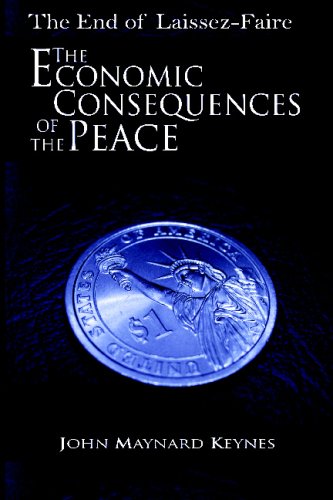 | Paperback: 300
Pages
(2009-03-25)
list price: US$10.99 -- used & new: US$10.99 (price subject to change: see help) Asin: 1607960869 Average Customer Review: 
Canada | United Kingdom | Germany | France | Japan |
|
Editorial Review Product Description Customer Reviews (4)
| |
| 2. Essays in Persuasion (Palgrave Insights in Psychology) by John Maynard Keynes | |
 | Paperback: 470
Pages
(2010-09-15)
list price: US$35.00 -- used & new: US$25.20 (price subject to change: see help) Asin: 0230249574 Average Customer Review:
Canada | United Kingdom | Germany | France | Japan |
|
Editorial Review Product Description Customer Reviews (8)
| |
| 3. The economic consequences of the peace by John Maynard Keynes | |
| Paperback: 296
Pages
(2010-09-13)
list price: US$28.75 -- used & new: US$20.94 (price subject to change: see help) Asin: 1171892551 Average Customer Review: 
Canada | United Kingdom | Germany | France | Japan | |
|
Editorial Review Product Description Customer Reviews (22)
| |
| 4. John Maynard Keynes by Hyman Minsky | |
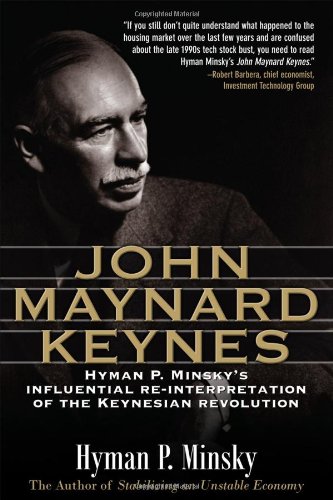 | Paperback: 181
Pages
(2008-04-16)
list price: US$24.95 -- used & new: US$13.85 (price subject to change: see help) Asin: 0071593012 Average Customer Review: 
Canada | United Kingdom | Germany | France | Japan |
|
Editorial Review Product Description “Today, Mr. Minsky's view [of economics] is more relevant than ever.”- The New York Times “Indeed, the Minsky moment has become a fashionable catch phrase on Wall Street.”-The Wall Street Journal John Maynard Keynes offers a timely reconsideration of the work of the revered economics icon. Hyman Minsky argues that what most economists consider Keynesian economics is at odds with the major points of Keynes's The General Theory of Employment, Interest, and Money. Keynes and Minsky refuse to ignore pervasive uncertainty. Once uncertainty is given center stage, recurring episodes of financial system crises are all but inescapable. As Robert Barbera notes in a new preface, “Benign economic circumstances…invite increasingly aggressive financial market wagers. Innovation in finance is a signature development in a capitalist economy. Once leveraged wagers are in place, small disappointments can have exaggerated consequences.” Thus for Minsky economic calm on Main Street engenders financial system fragility which, in turn, ensures a perpetuation of boom and bust cycles. Minsky colleagues Dimitri B. Papadimitriou and L. Randall Wray write in a new introduction, “We offer this new edition, in the hope that it will contribute to the reformation of economic theory so that it can address the world in which we actually live-the world that was always the topic of Minsky's analysis.” Customer Reviews (6)
| |
| 5. Keynes on the Wireless by John Maynard Keynes | |
 | Hardcover: 272
Pages
(2010-09-15)
list price: US$40.00 -- used & new: US$28.80 (price subject to change: see help) Asin: 0230239161 Canada | United Kingdom | Germany | France | Japan |
|
Editorial Review Product Description | |
| 6. John Maynard Keynes: 1883-1946: Economist, Philosopher, Statesman by Robert Skidelsky | |
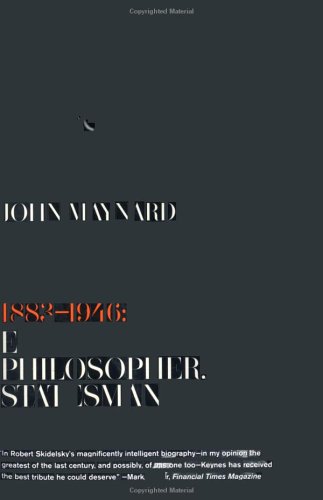 | Paperback: 1056
Pages
(2005-08-30)
list price: US$35.00 -- used & new: US$18.69 (price subject to change: see help) Asin: 0143036157 Average Customer Review:
Canada | United Kingdom | Germany | France | Japan |
|
Editorial Review Product Description Customer Reviews (4)
| |
| 7. The General Theory of Employment, Interest and Money by John Maynard Keynes | |
 | Paperback: 336
Pages
(2009-08-11)
list price: US$19.95 -- used & new: US$18.10 (price subject to change: see help) Asin: 144867185X Average Customer Review:
Canada | United Kingdom | Germany | France | Japan |
|
Editorial Review Product Description Customer Reviews (68)
| |
| 8. The Great Slump of 1930 by John Maynard Keynes | |
 | Kindle Edition:
Pages
(2009-01-28)
list price: US$4.25 Asin: B001QTXLMS Canada | United Kingdom | Germany | France | Japan |
|
Editorial Review Product Description | |
| 9. John Maynard Keynes: Volume 1: Hopes Betrayed 1883-1920 by Robert Skidelsky | |
 | Paperback: 496
Pages
(1994-01-01)
list price: US$23.00 Isbn: 014023554X Average Customer Review: 
Canada | United Kingdom | Germany | France | Japan |
|
Editorial Review Product Description Customer Reviews (8)
Although the book goes into ample detail, it is a little dry, and possibly lacks a little life. One sometimes feels as if there are a few too many quotes, names and places. This somewhat detracts from the interest of the book. However, overall anyone who is curious as to what made father of modern economics ought to read this book. ... Read more | |
| 10. John Maynard Keynes: Volume 2: The Economist as Savior, 1920-1937 by Robert Skidelsky | |
| Paperback: 768
Pages
(1995-01-01)
list price: US$25.00 Isbn: 0140238069 Average Customer Review:
Canada | United Kingdom | Germany | France | Japan | |
|
Editorial Review Product Description Customer Reviews (6)
What was to become of Europe after the end of the First World War was foreseen by him in many essays and primarily in his book The Economic Consequences of the Peace. The task which lays ahead for him, and only him, was to warn politicians and thinkers of the impending dangers of the years to come, specially in regard to a lack of theoretical analisys to support the transition from the old economy (classicist in his jargon), which ended with the death of the great Alfred Marshall, and a new one, which he purpoted himself to establish and then save the world. And save the world he did!!! Keynes is one of this towering figures who had the opportunity to mingle himself with daily facts and change them for the better. Amid a lot of controversy and polemic regarding the originality of his ideas, he published his major opus in 1937, which was to be used against the vagaries of rampant unemployment and inflation. His General Theory of Interest , Employment and Money is a sort of tribute he pays to his father , Malthus and G.E.Moore. | |
| 11. Treatise On Money V2: The Applied Theory Of Money (1930) by John Maynard Keynes | |
 | Paperback: 432
Pages
(2010-08-31)
list price: US$36.95 -- used & new: US$26.92 (price subject to change: see help) Asin: 1162557877 Canada | United Kingdom | Germany | France | Japan |
| 12. The Big Three in Economics: Adam Smith, Karl Marx, And John Maynard Keynes by Mark Skousen | |
 | Hardcover: 243
Pages
(2007-01-30)
list price: US$27.95 -- used & new: US$18.44 (price subject to change: see help) Asin: 0765616947 Average Customer Review:
Canada | United Kingdom | Germany | France | Japan |
|
Editorial Review Product Description Customer Reviews (14)
| |
| 13. The Economic Consequences of the Peace by John Maynard Keynes (Halcyon Classics) by John Maynard Keynes | |
 | Kindle Edition:
Pages
(2010-09-20)
list price: US$0.99 Asin: B00440DP5E Canada | United Kingdom | Germany | France | Japan |
|
Editorial Review Product Description | |
| 14. The General Theory of Employment, Interest and Money by John Maynard Keynes AND Essays In Persuasion by John Maynard Keynes by John Maynard Keynes | |
 | Paperback: 542
Pages
(2009-08-11)
list price: US$24.95 -- used & new: US$22.39 (price subject to change: see help) Asin: 144867302X Average Customer Review:
Canada | United Kingdom | Germany | France | Japan |
|
Editorial Review Product Description Customer Reviews (2)
| |
| 15. Treatise On Money V1: The Pure Theory Of Money (1930) by John Maynard Keynes | |
 | Paperback: 382
Pages
(2010-08-31)
list price: US$33.95 -- used & new: US$22.41 (price subject to change: see help) Asin: 1162557400 Canada | United Kingdom | Germany | France | Japan |
| 16. The Collected Writings of John Maynard Keynes, Volume IX, Essays in Persuasion (Collected works of Keynes) (v. 9) by John Maynard Keynes | |
| Hardcover: 470
Pages
(1972-09-07)
Isbn: 0333107209 Canada | United Kingdom | Germany | France | Japan | |
|
Editorial Review Product Description | |
| 17. Life of John Maynard Keynes, the by R.F. Harrod | |
 | Hardcover:
Pages
(1990-01-01)
-- used & new: US$75.00 (price subject to change: see help) Asin: B000S6SCMO Average Customer Review: 
Canada | United Kingdom | Germany | France | Japan |
|
Editorial Review Product Description Customer Reviews (2)
| |
| 18. A treatise on probability by John Maynard Keynes, Max Black | |
 | Paperback: 490
Pages
(2010-09-06)
list price: US$38.75 -- used & new: US$26.03 (price subject to change: see help) Asin: 1171516479 Average Customer Review:
Canada | United Kingdom | Germany | France | Japan |
|
Editorial Review Product Description Customer Reviews (10)
| |
| 19. The General Theory of Employment, Interest and Money [GENERAL THEORY OF EMPLOYMENT I] by John Maynard(Author) Keynes | |
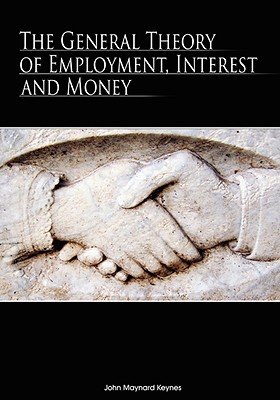 | Hardcover:
Pages
(2008-07-31)
-- used & new: US$31.28 (price subject to change: see help) Asin: B001TJ1H8K Average Customer Review:
Canada | United Kingdom | Germany | France | Japan |
Customer Reviews (1)
| |
| 20. John Maynard Keynes Volume Three Fighting for Freedom 1937-1946 by Robert Skidelsky | |
| Hardcover:
Pages
(2000-01-01)
Asin: B001TQMXGS Canada | United Kingdom | Germany | France | Japan | |
| 1-20 of 100 | Next 20 |
 Anti-Capitalism, Anti-Freedom
 Prints not properly aligned in the pages and sometimes missing