e99 Online Shopping Mall

Geometry.Net - the online learning center Help  
Home  - Scientists - Omar Khayyam (Books)

  1-20 of 100 | Next 20
A  B  C  D  E  F  G  H  I  J  K  L  M  N  O  P  Q  R  S  T  U  V  W  X  Y  Z  

click price to see details     click image to enlarge     click link to go to the store

$20.94
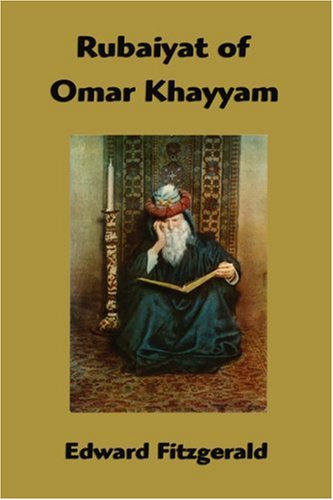
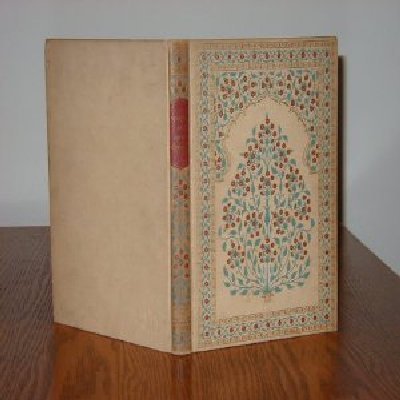
1. Rubaiyat of Omar Khayyam
2. Rubaiyat Of Omar Khayyam
$10.00
3. Rediscovery of Hakim Omar Khayyam
$15.00
4. The Quatrains of Omar Khayyam:
$13.62
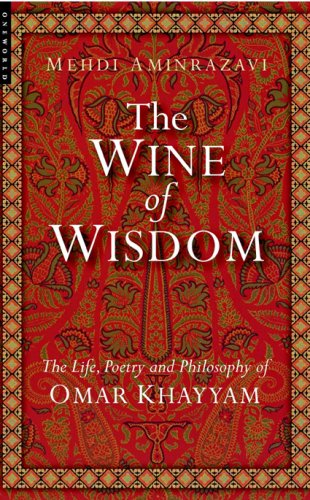
5. The Wine of Wisdom: The Life,
$56.20
6. The Art of Omar Khayyam: Illustrating
$9.00
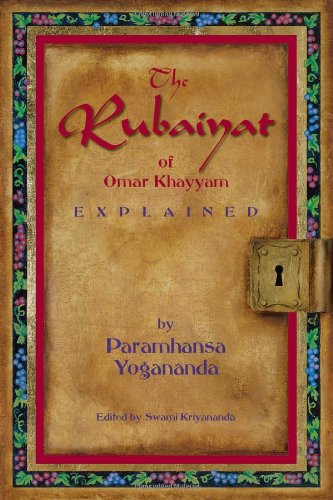
7. The Rubaiyat of Omar Khayyam Explained
$7.25
8. Rubaiyat of Omar Khayyam
$32.98
9. Rubaiyat Of Omar Khayyam: English,
 
10. Dinner at Omar Khayyam's
$10.78
11. Rubaiyat of Omar Khayyam
12. Rubáiyát of Omar Khayyám; Translated
$10.50
13. The Rubaiyat of Omar Khayyam,
 
14. Rubaiyat of Omar Khayyam (Classics
$10.17
15. The Rubaiyat of Omar Khayyam,Revised
$23.99
16. The Ruba'iyat of Omar Khayyam:
 
17. The Rubayyat of Omar Khayam;:
 
18. Rubaiyat of Omar Khayyam
 
19. The Rubaiyat of Omar Khayyam:
 
20. Rubaiyat de Omar Khayyam

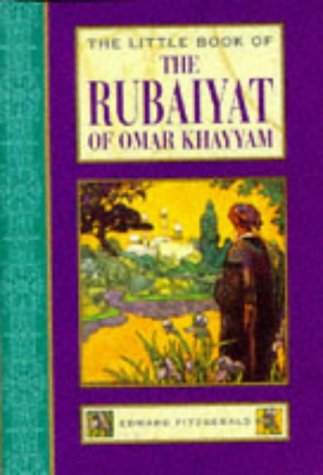
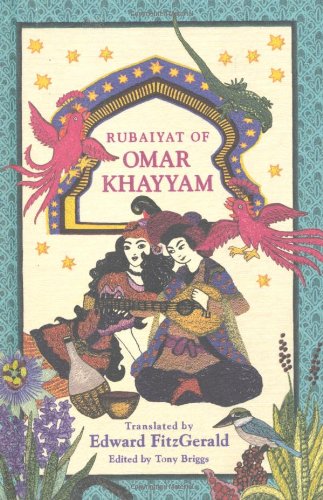
1. Rubaiyat of Omar Khayyam
by Edward Fitzgerald, Omar Khayyam
Hardcover: 100 Pages (2002-12)
list price: US$25.00 -- used & new: US$20.94
(price subject to change: see help)
Asin: 8171679137
Average Customer Review: 4.5 out of 5 stars
Canada | United Kingdom | Germany | France | Japan
Editorial Review

Product Description
Fresh translation, good production. Many color illustration. a delightful edition of a world classic ... Read more

Customer Reviews (35)

5-0 out of 5 stars Wine of Wisdom & Understanding
I'm new to the Ruba'iyat of Omar Khayyam, but I must say I throughly enjoyed this translation. It's great for reading alone, reading aloud and discussing with good philosophically-minded friends.

To sum up the feelings of this book, I shall use some quotations from other media I enjoy. Here we go:

"Seize the Day" (Dead Poet's Society)
"Eat, drink and be merry, for tomorrow you shall die" (The Bible)
"From dust you are, and dust you shall return" (Genesis, The Bible)

That's pretty much the gist of the poem, written in a style that evokes the Bible book of Ecclesiastes, which is not surprising. They are both written by old, disenchanted men nearing the end of their lives. The only difference is one is a disenchanted Jewish King (Solomon of Ecclesiastes) and the other (Omar Khayyam) is a disenchanted Moslem thinker and astronomer. It's very interesting to note the parallels.

I'd recommend this book and this very literal translation to those who are questioning the meaning of life. It's worth every penny...

5-0 out of 5 stars An essential read for multi-cultural studies
The Rubaiyat of Omar Khayyam is almost certainly the most widely known work by an Islamic writer. It is the only non-western piece of literature that I was required to read when in high school and I recently re-read this version. Like most historical pieces, it is difficult to understand without additional knowledge of the historical context. Khayyam was a Persian poet, mathematician and astronomer, which means he was as educated as the times allowed. The Rubaiyat was written in about 1120 C. E. and is in the form of quatrains or four-line rhymes.
As a poem, the flow is smooth and the imagery deals with the lot of what human life is. The fourteenth quatrain is:

Ah, make the most of what we yet may spend,
Before we too into the Dust descend;
Dust into Dust, and under Dust to lie
Sans Wine, sans Song, sans Singer, and--sans End!

with clear imagery regarding death, which is a consistent theme throughout.Other quatrains deal with how we cope with life, and how we deal with the difficult questions of our existence. Quatrain 74 is

Yesterday This Day's Madness did prepare;
To-morrow's Silence, Triumph, or Despair:
Drink! for you know not whence you came, nor why:
Drink! for you know not why you go, nor where.

describing how little we know about the consequences of our journey through life.

The deep imagery of the poems requires that you read it slowly and several times. Like the best of poems, the passages are often open to multiple interpretations, which increases the level of interest. I hope that the high schools in my area still require the eleventh grade English classes to read this poem, understanding it is truly within the purview of multicultural studies.

5-0 out of 5 stars Rubaiyat of Omar Khayyam
I collect this work in different formats. This particular book is very good. I recommend everyone reading the Rubaiyat at least once in their lifetime. It is an excellent poetic examination of Man's purpose and Man's relation with God. One can appreciate the Rubaiyat only for its beautiful poetic images or explore it over and over for its deeper philosophical nuances. The Rubaiyat of Omar Khayyam is ever a delight no matter how you prefer it.

4-0 out of 5 stars Illustrated Editions Company Review
There are so many editions of Fitzgerald's Rubaiyat translations that have been published, with many being limited editions. Several of these rose to highly collectible status, especially those with tipped-in color plates by Dulac, Pogany or Arthur Szyk. These necessarily set them apart from other more textual editions.

This review has specifically to do with the Illustrated Editions Company 1938 printing. Physically, at 11 1/2" x 8" it is rather long and wide, almost completely black, except for a red illustrationof a mosque on the cover, and thin.

I give 4 Stars only because it is not the first Fitzgerald edition, but a 20th century reprint. Beyond that, this is the most excellent of editions. The Illustrated Editions Company version has the first and last Fitzgerald translations.

This book is powerful and sacred. Reading it will invoke a shamanic experience-- you will be there, as Omar uses the wine metaphor to teach the value and ephemeral substance of life. The Rubaiyat of Omar Khayyam is essentialmetaphysics. The note and comment that open this edition are key to understanding why the Illustrated Editions Company is above all the rest, even other collector editions, of which I own several. It is the care and quality of the edition that sets it apart, certainly not anything distinguished about its content. This is my favorite edition of all. The tipped in color plates by Hamzeh Abd-ullah Kar are authentic Persian fantasy, and reading each carefully printed verse on the heavy, slightly glossy parchment is a religious experience. There is something qualitatively different about reading the Illustrated Editions Company version.

I can't find much else about this copy on the net, but there is one site that shows a copy remarkably similar to the one which I am using to base this review. I see no evidence that the title letters were ever gilt, although whenever the book goes up for auction the owners usually say the gilt is worn from the letters. This can't be true of all these copies, especially for a printing as late as '38, so I'm inclined to believe there never was any gilt lettering. I have seen other far less well preserved editions from earlier periods that have almost fully retained their gilt. The gems are between the boards, in this case.

The comment by Edward Heron-Allen is itself a collectible piece of literature, though he wrote only one paragraph. Truly an edition which can only be enjoyed by the reverential Rubaiyat enthusiast.

5-0 out of 5 stars Edward FitzGerald Gets Far Too Little Credit For this Translation
These verses, which we anglophones have come to intone as though they were scripture, are not those of Omar Khayyam (meaning Omar the tentmaker in Farsi), but those of a less celebrated Elizabethan poet, Edward FitzGerald.Our affection for the rhyme scheme, the aliteration, the meter, the very image the words evoke, is not for Omar, but for his tranlator, Edward FitzGerald.It was not Omar who wrote, "oh, but the long, long while the world shall last," but FitzGerald.FitzGerald translated this Twelfth Century poetry in the very early years of the Nineteenth Century, seven hundred years after Omar.It is FitzGerald to whom we should be grateful.

FitzGerald's verse is literally accurate only to the extent of its a, a, b, a rhyme scheme; and even so, the final combination of phonics comprising the cadence in each line is constructed in our language, not in Omar's.Only in the figurative meaning of the verse is the translation from Farsi accurate.What we anglophones think of as Omar's verse is not at all Farsi and not at all Twelfth Century.It sounds much more familiar to our ears because FitzGerald has cut the time gap by seven centuries and the language barrier to nothing.

But don't take my word for it; speak to any Iranian (if you permit them to speak for their ancestral Persians) and they will tell you that Omar is known principally for astrology and alchemy.Some will say he was a mathmetician, but no evidence remains to support that claim.Omar is never quoted as a poet by his ancestral Iranians.I have asked a dozen university-educated Iranians to recite a single verse of Khayyam and none have been able to do so.Not one.

One explanation for this omission is Omar's obsession with hedonism in general and wine in particular, which is now so stridently verboten by his militantly muslim ancestors.FitzGerald drew inspiration only from Omar, and that inspiration has positioned him in an orbit around Omar's star.Our current affection for Omar Khayyam's verse is not remotely due to the accuracy of FitzGerald's translation, but rather to his own creativity and originality.

The reason for the historical coincidence making blood-brothers of Omar and FitzGerald is the shocking nature of their verses.Omar's rebellion against the muslim propriety of his age paralleled FitzGerald's rebellion against the Elizabethian propriety of his age.Yet even to us these verses still sounds racy, and as long as they do they'll titillate our sensibilities, irrespective of their authorship.

"Perplext no more with human or divine,
Tomorrow's tangle to the winds resign,
And lose your fingers in the tresses of
The cypress-slender minister of wine." ... Read more


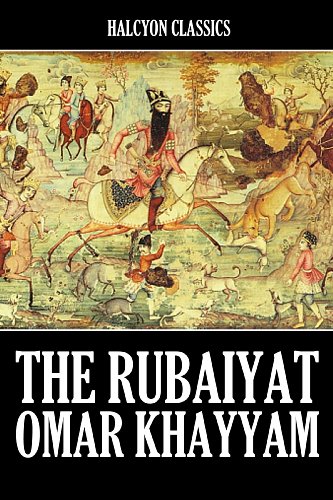
2. Rubaiyat Of Omar Khayyam
by Edward Fitzgerald
Hardcover: Pages (1937)

Asin: B000EI7O6G
Average Customer Review: 5.0 out of 5 stars
Canada | United Kingdom | Germany | France | Japan
Editorial Review

Product Description
A story taking place before the First Crusades from Europe. Great story and verses. ... Read more

Customer Reviews (1)

5-0 out of 5 stars Rubaiyat Of Omar Khayyam
This is a wonderful edition! It has a nice layout, informative introduction, and beautiful illustrations by Edmund Dulac. Its presentation of all five Fitzgerald editions makes it well worth the investment. ... Read more


3. Rediscovery of Hakim Omar Khayyam : The Great Persian Mathematician, Astronomer, Scientist, Philosopher, Poet and Eternal Role Model
by Ali A., Ph.D. Parsa
Paperback: 228 Pages (1998-06-01)
list price: US$10.00 -- used & new: US$10.00
(price subject to change: see help)
Asin: 0966336100
Average Customer Review: 5.0 out of 5 stars
Canada | United Kingdom | Germany | France | Japan
Editorial Review

Book Description
1998 English translation from Persian Robaiiat and their everlasting wisdom with emphasis on combating substance abuse and hypocrisy. Please note that this is not just another translation. It contains a uniquely detailed analysis of Khayyams personality according to his poems with emphasis on combating substance abuse and hypocrisy. The author calls Omar's Robaiiat " Literary tranquilizers," the cheapest and most effective means of inspiration, relaxation, self restraint necessary for a moderate and healthy lifestyle free from abuse and excess. This unique treatise is not merely another translation but much more and the only one of its kind. Reading this book is a must for those who are interested in factual and yet relaxing poetries, called "literally tranquilizers" by the author or recipes for a happy, healthy, long and independent life. ... Read more

Customer Reviews (2)

5-0 out of 5 stars Who was Khayyam?
Universally Khayyam is known as the book's title describes but there is a clear contradiction between Khayyam's poems and the quality of a Mathematician, scientist, jurisprudent,.... According to the late philosopher Muhammad Taghi Jafari Tabrizi citing from abook from Dr. Taghi Arani ( one of the 52 jailed by Reza Shah) Khayyam was the poet and Khayyami was the Mathematician, scientist,.....Two different individuals with two opposing qualities.

5-0 out of 5 stars A Wonderful, Amazing Book
How can you describe 246 pages of the most delightful writing in a paragraph? It is impossible. I can only say a few words that describe this wonderful book. It is an ongoing story, when you think all is good something happens. It is one of those books you soar through without noticing how much you have read. It is a happy and sad story, it is a calm and adventurous story, it has a very interesting plot, and I highly recommend it. ... Read more


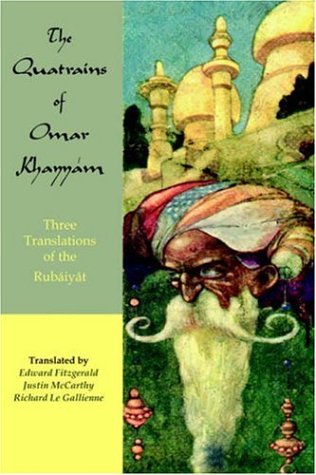
4. The Quatrains of Omar Khayyam: Three translations of the Rubaiyat
by Omar Khayyam
Paperback: 212 Pages (2005-07-02)
list price: US$16.95 -- used & new: US$15.00
(price subject to change: see help)
Asin: 0974566713
Average Customer Review: 5.0 out of 5 stars
Canada | United Kingdom | Germany | France | Japan
Editorial Review

Book Description
Though few translations have had as much impact as Edward Fitzgerald's Rubáiyát of Omar Khayyám, anyone who wishes to truly appreciate Omar Khayyám needs to read more than one translation. This volume contains Edward Fitzgerald's classic translation with all its variations, Justin McCarthy's elegant and mystical literal translation and Richard Le Gallienne's sharp and poetic version. For the first time the reader can appreciate the range of Omar Khayyám and his interpreters in a single volume. ... Read more

Customer Reviews (1)

5-0 out of 5 stars Excellent work by Richard Le Gallienne
I should start off by saying that I am not familiar with Omar Khayyam or his work. I should also state that Richard La Gallienne's translation is likely completely unlike the literal translation. His effort was only to produce a witty and stylish version reminiscent of Khayyam's original intent. From what I have read, it is excellent on its own. I do not generally go in for poetry, but found that I couldn't stop reading this work. Here are some especially interesting excerpts:

Look not above, there is no answer there;
Pray not, for no one listens to your prayer;
Near is as near to God as any Far,
And Here is just the same deceit as There.

[...]

And do you think that unto such as you;
A maggot-minded, starved, fanatic crew:
God gave the secret, and denied it me?--
Well, well, what matters it! Believe that, too.

[...]

"Did God set grapes a-growing, do you think,
And at the same time make it sin to drink?
Give thanks to Him who foreordained it thus--
Surely He loves to hear the glasses clink!" ... Read more


5. The Wine of Wisdom: The Life, Poetry and Philosophy of Omar Khayyam
by Mehdi Aminrazavi
Paperback: 368 Pages (2007-07)
list price: US$24.95 -- used & new: US$13.62
(price subject to change: see help)
Asin: 1851685049
Average Customer Review: 4.5 out of 5 stars
Canada | United Kingdom | Germany | France | Japan
Editorial Review

Book Description
Nourished by an admiration of Khayyam that has been with him since childhood, Aminrazavi's comprehensive new biography reintroduces the figure of Khayyam, and his great achievements, to the Western world. Blending a readable and accessible narrative with scholarly ambition and years of research, Aminrazavi's work covers not only Khayyam's well-known poetry, but also his extraordinary life, his neglected philosophical writings and the impact of his work in the West. It features a variety of supporting material, including original translations and the full text of Fitzgerald's Rubaiyyat, and will prove an ideal biography for those who want to know more about the poets inspired by Rumi. ... Read more

Customer Reviews (2)

4-0 out of 5 stars enlightened reading
The seems to be a lot of redundancy in the first part of the book but the overall information, history and review of the philosophy is well presented.
A very interesting book and enjoyable to read.

5-0 out of 5 stars The Ultimate Treatise on Khayyam
I am a filmmaker who spent 7 years making a feature film about the legendary mathematician, astronomer, poet of Persia, Omar Khayyam.I cannot think of another book published in this world that gives a more complete and thorough understanding of Khayyam.Dr. Aminrazavi's book is a scholarly masterpiece that illuminates the reader's mind with well researched, solid facts debunking the myths surrounding Khayyam.Each chapter clearly lays out the author's own struggle with what is fact and what is fiction.The book also explores Khayyam's vast influence on literature in the West.If there is anyone out there who wants an encyclopedic look into the mind of the 11th Century genius with the soul of a poet, look no further...purchase Wine of Wisdom today! ... Read more


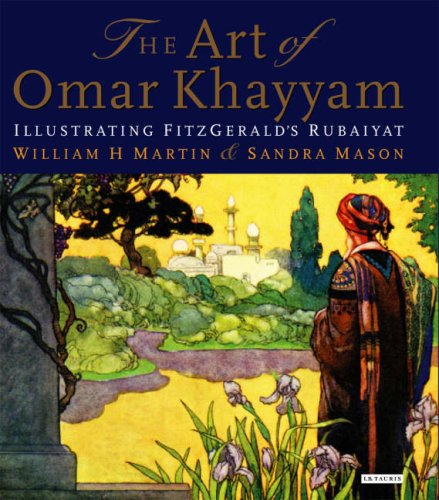
6. The Art of Omar Khayyam: Illustrating FitzGerald's Rubaiyat
by William Mason, Sandra Martin
Hardcover: 192 Pages (2007-05-15)
list price: US$69.95 -- used & new: US$56.20
(price subject to change: see help)
Asin: 1845112822
Canada | United Kingdom | Germany | France | Japan
Editorial Review

Book Description

This book describes a phenomenon unique in publishing history -- a book of poetry, published anonymously nearly 150 years ago -- purporting to be the translation of an 11th century Persian work -- which has remained almost continuously in print and stimulated at least 130 illustrators attempting to illuminate the verses it contains. The poetry in question is Edward FitzGerald's version of the Rubaiyat of Omar Khayyam. Khayyam was a mathematician, astronomer and philosopher in 11th century Persia. Edward FitzGerald was first introduced to Khayyam's verses in the original Persian in 1859. Since then, there have been many hundreds of separate editions and reissues of the Rubaiyat, including many further translations of FitzGerald's work into other languages. Today, FitzGerald's Rubaiyat is one of the most universally known of all poems. It is also probably the most widely illustrated of all literary works. William Martin and Sandra Mason have produced the first serious attempt to examine the illustrated editions in detail. The authors tell the extraordinary story of the popularity of FitzGerald's Rubaiyat, and looks at how different illustrators have approached the task of interpreting the individual themes and topics of the fascinating poem. Although the book focuses on one literary work, it provides a history of the changes in book illustration, mostly in Britain and America, over the past century and a half. With some 300 color illustrations and covering the work of over 100 artists, it also provides detailed documentation on the illustrators and a bibliography of the illustrated version of FitzGerald's Rubaiyat. This will prove a unique reference tool for collectors and bibliographers.
... Read more

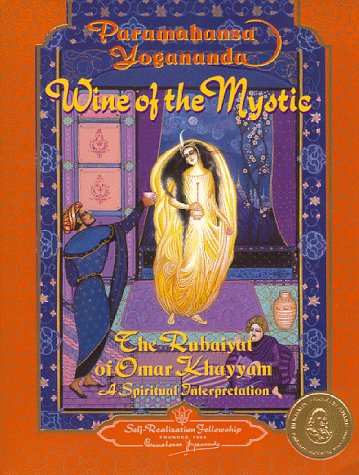
7. The Rubaiyat of Omar Khayyam Explained
by Paramahansa Yogananda, J. Donald Walters
Hardcover: 354 Pages (1994-09)
list price: US$19.95 -- used & new: US$9.00
(price subject to change: see help)
Asin: 1565896750
Average Customer Review: 3.5 out of 5 stars
Canada | United Kingdom | Germany | France | Japan
Editorial Review

Book Description
Omar Khayyam's famous poem, The Rubaiyat, is loved by Westerners as a hymn of praise to sensual delights.In the East it is known as a deep allegory of the soul's romance with God.As for what his quatrains actually mean, most of them have remained a mystery in the East as much as in the West.Now after eight centuries, Paramhansa Yogananda, one of the great mystics of our times, a master of yoga and the author of the classic Autobiography of a Yogi, explains the mystery behind Omar's famous poem. This book contains the essence of great revelation. ... Read more

Customer Reviews (6)

2-0 out of 5 stars Why not just read them yourself without another person's interpretation?
Many of Khayyam's quatrains make it seem unlikely that he is anything more than indifferent with respect to religious belief, heaven, hell, etc. In any case, there have been a wide variety of interpretations. (e.g. Christopher Hitchens includes Khayyam's quatrains as essential reading for atheists)

Why not just read them yourself and make up your own mind? Several of the best translations are all free, in the public domain, and available online through Project Gutenberg or WikiSource. Look for Fitzgerald, McCarthy, Whinfield, or even Richard Le Gallienne's paraphrase, which attempts to maintain the witiness of Khayyam.

Anything is preferable to having someone else tell you "for sure" what is meant - even if they're analysis is correct, isn't it better to figure it out for yourself?

2-0 out of 5 stars Was Omar Khayyam a yogi?
This is a book of rather peculiar interpretations of Omar Khayyam's "Rubaiyat" in the famous translation by Edward FitzGerald. Mr. Yogananda takes the 75 quatrains of the first translation of 1859 and adds to each a paraphrase, an "extended meaning" and what he calls "keys to meaning."

The purpose of this book, however, is to illustrate Mr. Yogananda's beliefs with the poetry of Omar Khayyam, not to explain or comment the quatrains.

Quatrain number 52 is one of the most materialistic, even fatalistic, of Omar Khayyam's poems:

And that inverted Bowl we call The Sky,
Whereunder crawling coop't we live and die,
Lift not thy hands to It for help - for It
Rolls Impotently on as Thou or I.

(in the standard 101 quatrain-edition of Edward FitzGerald this poem is number 72 and reads more correctly: "And that inverted Bowl they call the Sky, / Whereunder crawling coop'd we live and die, / Lift not your hands to It for help - for It / As impotently moves as you or I.")

Mr. Yogananda paraphrases it as "Sun, Moon, stars, and planets pass athwart the sky as though in a slow celestial dance. Their movements correspond to the decrees of the Cosmic Law. Their changing configurations are choreographed, like the events in our lives. The stars and planets themselves can no more choose how they will affect us than we can select our own karmic destinies. Look not to the stars, then, for help if you would change your lot. Look to God. He it was who made you and all the stars. He it was who first determined the workings of karmic law."

God and "karmic law" figure prominently in Mr. Yogananda's interpretations of the other quatrains, too. However, the connection between the poems and Mr. Yogananda's interpretation is in all cases very flimsy and arbitrary. In Omar Khayyam's quatrain about the indifference of nature towards human suffering it is definitely far-fetched to claim that he wanted the reader to look to God and remind him of the "karmic law" when he wrote this poem. Rather, it seems the opposite was the case.

Omar Khayyam asks many questions about life and life's meaning in his quatrains. Mr. Yogananda claims to have all the answers. I prefer to stay with the questions and find my own answers. One of which is: no, Omar Khayyam was no yogi.

4-0 out of 5 stars Story Behind the Scenes
Who has not heard or read these lines of beauty?

"Here with a Loaf of Bread beneath the Bough, A Flask of Wine, a Book of Verse -- and Thou," or "The Moving Finger writes; and having writ, Moves on."?

These lines are from the first translation of The Rubaiyat by the English translator and man of letters, Edward FitzGerald (1809 - 1883). While it retains the spirit and philosophy expressed in the original quatrains, FitzGerald's translation was so free in its rendition as to be virtually an original work.
Omar Khayyam, poet, astronomer and mathematician was born in Persia in the latter part of the 11th century. His surname, Khayyam, means "tent-maker" although that undoubtedly referred to his father's trade more than to his own because actually, he was independently wealthy. He was a friend of Nizami, the Vizier of Baghdad who founded the great college of Baghdad, where Omar Khayyam was taught. Omar Khayyam lived in seclusion until Malik Shah appointed him Astronomer Royal, who, along with eight other scholars, revised the Muslim calendar. It seems certain that Khayyam was a Sufi mystic and kept his spiritual life hidden from superficial worldly minds.

"Omar," Paramhansa Yogananda has said, "by a very large number of Western readers, has come to be regarded as a rather erotic pagan poet, a drunkard interested only in wine and earthly pleasure. This is typical of the confusion that exists on the entire subject of Sufism. The wine is the joy of the spirit, and the love is the rapturous devotion to God?"

The Rubaiyat as well as the Tales of the Arabian Nights are not love stories about drunkards, genies, and magic caves filled with treasures, but mystical stories based on the religion of Sufism. Their encoded symbolism, when revealed, is deeply mystical and meaningful.

One example is the magic lamp of Aladdin. First, the meaning of the name: AL is Arabic for God, "ALLAH."DDIN is a transcription of the word DJINN (or we would say in the West, "Genie.") But in Arabic it means SPIRIT. Thus, ALADDIN means "The Spirit of God." Well, what is the magic lamp, then? The magic lamp is something we all possess in the depths (cave) of the subconscious, the MIND. What would it mean then that the "Spirit of God" rubs the "Mind"? This refers to the practice of meditation. By focussing on an idea, a single thought, our minds are capable of bringing about any reality we dream of. We are the co-creators of our own universe, our own lives. As Pogo, the comic strip character, said: "We have met the enemy, and it is we-uns." We are responsible for our own self-undoing, just as we are responsible for creating our own lives.

Secrecy and the practice of hiding deep truths behind a veil of exotic symbolism was the way the Sufis protected themselves against persecution for their unorthodox views. It is similar to the deep mysticism of the Jewish Kabala. The Sufis called their secret language QBL. The alchemists of the West used another example of hidden mysticism. Do you think they were really trying to transmute lead into gold, or were they trying to transmute the gross material of our bodies and souls into the golden glory of the spirit? If you think so, read John Randolph Price?s book published by Hay House, The Alchemist?s Handbook. Nostradamus and Leonardo daVinci also hid their writings in obscure diaries and secret codes.

Paramhansa Yogananda accomplished much of the mystic discovery about Omar Khayyam in his book, The Rubaiyat of Omar Khayyam Explained. Paramhansa Yogananda was one of the great spiritual beacons of the 20th century. His Autobiography of a Yogi, first published in 1946, has been a best-selling autobiography for the past fifty years. Yogananda was born in India in 1893 and sent to this country in 1920 where he founded the Self-Realization Fellowship in Los Angeles, California, a non-sectarian and universal organization. His close friend and editor of the book on the Rubaiyat, J. Donald Walters, also known as Kriyananda, wrote: "Yogananda's charity, compassion, unshakable calmness, loving friendship to all, delightful sense of humor and deep insight into human nature were such as to leave me constantly amazed."

4-0 out of 5 stars If you love poetry like I do, you will love this one too!!
The first time I encountered this book was in the 10th Grade and I have been mesmerized by it ever since.The author gives extraordinary metphors and allows the reader to interpret the poetry how it best fits them.Hespeaks of most of the joys there is on this wonderful world and takes youto places you have never been before.I would recommend this wonderfulbook to anyone who loves poetry.

5-0 out of 5 stars Wow!
If you want the best of mysticism and poetry, read this beautiful and deep book. I've fallen in love again with reading poetry, and I've been given a new understanding of eastern wisdom.

Even though the commentaries arefull of esoteric wisdom, Yogananda writes in a poetic style that is easy onthe eyes, mind, and soul.

I quote from Yogananda here: "Come, fillthe Cup of Consciousness with the divine wine of bliss! Cast away yourmaterial desires (deceitful, because forever disillusioning), and flinginto the crackling fire of fresh spiritual enthusiasm your robe ofpenitence for having ever indulged in them." ... Read more


8. Rubaiyat of Omar Khayyam
by Omar Khayyam
Paperback: 52 Pages (2005-06-30)
list price: US$10.99 -- used & new: US$7.25
(price subject to change: see help)
Asin: 1905432453
Canada | United Kingdom | Germany | France | Japan

9. Rubaiyat Of Omar Khayyam: English, French And German Translations Comparatively Arranged V2
Hardcover: 400 Pages (2007-07-25)
list price: US$49.95 -- used & new: US$32.98
(price subject to change: see help)
Asin: 0548091552
Canada | United Kingdom | Germany | France | Japan

10. Dinner at Omar Khayyam's
by George Mardikian
 Unknown Binding: 150 Pages (1957)

Asin: B0007FHI80
Canada | United Kingdom | Germany | France | Japan

11. Rubaiyat of Omar Khayyam
Paperback: 160 Pages (2003-08)
list price: US$21.95 -- used & new: US$10.78
(price subject to change: see help)
Asin: 0766176673
Average Customer Review: 5.0 out of 5 stars
Canada | United Kingdom | Germany | France | Japan
Editorial Review

Book Description
1899. This volume contains an English rendering in quatrains of the first, second and fifth editions of Omar Khayyam's Rubaiyat, together with notes indicating the minor variants found in the third and fourth editions. ... Read more

Customer Reviews (4)

5-0 out of 5 stars unknown famous writer
Omar has contributed so many phrases to us that for the most part, people are unaware of their origin.
"Eat drink and be merry."
"The moving finger writes, and having writ, moves on. nor all thy piety, nor all thy wit, can lure it back to cancel half a line of it." Nothing ever written captures the inexorable one way march of time better than that single sentence by this master. But is it Fitzgerald, or is it Omar? What the hell... who cares?
Just wallow drunkenly in the rapture of his prose. Only Rumi approached this writing. But wait.. was it Barks, or was it Rumi? LOL.
Few books, excepting perhaps the Bible, have so many exquisitely crafted and picaresque sentences in them. A little tid bit from the book, unrelated to his prose:
The word Assassin, was associated with the life and times of Omar and two boy hood friends of his.
If you have not read this book, I envy you. You have before you, a stunning feast of prose by an unknown famous writer. Two of them. Omar and Fitzgerald. Although at one time Fitzgeralds star was burning bright.

5-0 out of 5 stars A poem to be enjoyed
My knowledge of theRubiyat came from reading it in Poetry Anthologies .The hypnotic rhythms , the combination of life- philosophy and striking poetry seemed to naturally lead to the memorization of many stanzas.
There is the 'seize the day' enjoy life now, ' a jug of wine a loaf of bread and thou/ kind of hedonism. There is also a certain skeptical and realistic attitude which as I understand created problems for Omar Khayyam in a Muslim society.
How I wonder is this treasure of world - literature taken, or perhaps censored in the radical Islamic Iran of today.
In any case Fitzgerald's is one of the great translations of world- literature one of those cases, some experts say, in which the translation surpasses the original.
A poem to be enjoyed .

5-0 out of 5 stars One Of My Favorites is............
Whether at Naishapur or Babylon,
Whether the Cup with sweet or bitter run,
The Wine of Life keeps oozing drop by drop,
The Leaves of Life keeps falling one by one.

5-0 out of 5 stars one of the greatest works of poetry in the world
"We are no other than a moving row
of magic shadow shapes that come and go,
'round with the sun-illumined lantern held,
at midnight by the master of the show.

But pieces of the game he plays
upon this chequer-board of nights and days,
and hither and thither moves and checks and slays,
and one by one, back in the closet lays."

Khayyam's Rubaiyat is a great work of amateur philosophy, as well as being one of the literary greats of all time.It combines a deeply poetic, resounding tone with ideas and images so vivid and sophisticated that one has to admire the genius of the work.Khayyam's view of the world runs back and forth, from religious to agnostic to atheistic.His central thesis, though, remains the same, that man's time on earth is limited, and he should drink the wine of fulfillment while he can, before it's too late.

"The moving finger writes, and having writ,
not all thy piety nor wit,
can lure it back to cancel half a line,
nor all thy tears can wash away a word of it." ... Read more


12. Rubáiyát of Omar Khayyám; Translated Into English Quatrains by Edward FitzGerald. A Complete reprint of the First Edition and the combined Third, Fourth and Fifth Editions, with an Appendix containing FitzGerald's Prefaces and Notes.
Hardcover: Pages (1947)

Asin: B000CDXXUO
Canada | United Kingdom | Germany | France | Japan

13. The Rubaiyat of Omar Khayyam, First, Second and Fifth Editions
Paperback: 108 Pages (2005-11-01)
list price: US$11.50 -- used & new: US$10.50
(price subject to change: see help)
Asin: 1596054387
Canada | United Kingdom | Germany | France | Japan
Editorial Review

Book Description
Oh, come with old Khayyám, and leave the Wise To talk; one thing is certain, that Life flies;One thing is certain, and the Rest is Lies; The Flower than once has blown for ever dies. -XXVIThough it's difficult to imagine, these 12th-century stanzas-oft quoted and frequently looked to for inspiration by those seeking to live life to the fullest-did not come to the public's attention until Edward FitzGerald published them in English in 1859... and even then they were ignored until the painter Dante Rossetti discovered a remaindered copy two years later and excitedly spread news of it around his intellectual and artistic circles.Not a direct translation, these liberal interpretations make Khayyám's verse accessible to readers in the English language. Several editions of FitzGerald's work are included in this volume, allowing the reader multiple approaches to their wisdom and beauty.Persian astronomer and poet OMAR KHAYYÁM (1048-1131) also authored works on music and mathematics.British poet and translator EDWARD FITZGERALD (1809-1883) also wrote Polonius: A Collection of Wise Saws and Modern Instances (1852) and translated from the Spanish Six Dramas of Pedro Caulderon (1853). ... Read more


14. Rubaiyat of Omar Khayyam (Classics Club)
by Omar Khayyam
 Hardcover: 178 Pages (1942)

Asin: B0006APKTA
Canada | United Kingdom | Germany | France | Japan

15. The Rubaiyat of Omar Khayyam,Revised and Expanded: Explained By Paramhansa Yogananda
by Paramhansa Yogananda
Paperback: 350 Pages (2008-02-25)
list price: US$14.95 -- used & new: US$10.17
(price subject to change: see help)
Asin: 1565892275
Canada | United Kingdom | Germany | France | Japan
Editorial Review

Book Description
Now after eight centuries, Paramhansa Yogananda, one of the great mystics of our times, a master of yoga and the author of the now-classic Autobiography of a Yogi, explains the mystery behind Omar's famous mystical poem. The Rubaiyat of Omar Khayyam Explained is available at last, edited by one of Yogananda's close disciples, J. Donald Walters. This new & expanded version is now available in paperback. ... Read more


16. The Ruba'iyat of Omar Khayyam: Translated by Edward Fitzgerald. With a Commentary by H. M. Batson and a Biographical Introduction by E. D. Ross
by Omar Khayyam
Paperback: 347 Pages (2005-11-30)
list price: US$23.99 -- used & new: US$23.99
(price subject to change: see help)
Asin: 1421261480
Canada | United Kingdom | Germany | France | Japan
Editorial Review

Product Description
This Elibron Classics edition is a facsimile reprint of a 1900 edition by Methuen and Co., London. ... Read more


17. The Rubayyat of Omar Khayam;: Life and love in one of the world's most famous poems in the classic translation of Edward FitzGerald
by Omar Khayyam
 Unknown Binding: 59 Pages (1967)

Asin: B0007E9VHC
Canada | United Kingdom | Germany | France | Japan

18. Rubaiyat of Omar Khayyam
by Edward FitzGerald
 Leather Bound: Pages (1909)

Asin: B000QG0VR0
Canada | United Kingdom | Germany | France | Japan

19. The Rubaiyat of Omar Khayyam: Rendered Into English Verse By Edward FitzGerald: First and Last Versions
by Hamzeh Abd-Ullah] Khayyam, Omar; FitzGerald, Edward (translator) [Kar
 Leather Bound: Pages (1938)

Asin: B000LQU4L8
Canada | United Kingdom | Germany | France | Japan

20. Rubaiyat de Omar Khayyam
by Omar KHAYYAM
 Hardcover: Pages (1910)

Asin: B000MXGB6C
Canada | United Kingdom | Germany | France | Japan

  1-20 of 100 | Next 20
A  B  C  D  E  F  G  H  I  J  K  L  M  N  O  P  Q  R  S  T  U  V  W  X  Y  Z  

Prices listed on this site are subject to change without notice.
Questions on ordering or shipping? click here for help.

site stats