e99 Online Shopping Mall

Geometry.Net - the online learning center Help  
Home  - Scientists - Pascal Blaise (Books)

  1-20 of 100 | Next 20
A  B  C  D  E  F  G  H  I  J  K  L  M  N  O  P  Q  R  S  T  U  V  W  X  Y  Z  

click price to see details     click image to enlarge     click link to go to the store

$11.35
1. Pensees
$24.95
2. Pensees (in French)
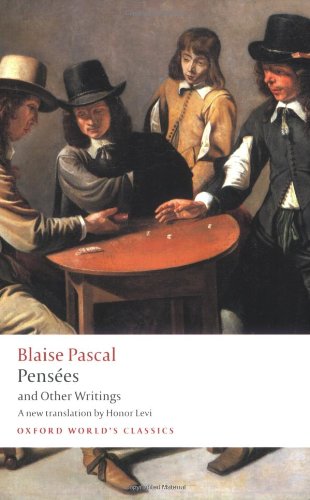
3. Pensees and Other Writings (Oxford
$29.95
4. Blaise Pascal: Thoughts, Letters,
$6.49
5. Pascal's Wager: The Man Who Played
 
$61.80
6. The Mind on Fire: An Anthology
$11.13
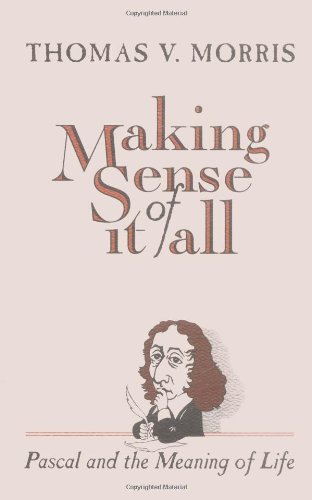
7. Making Sense of It All Pascal
$7.75
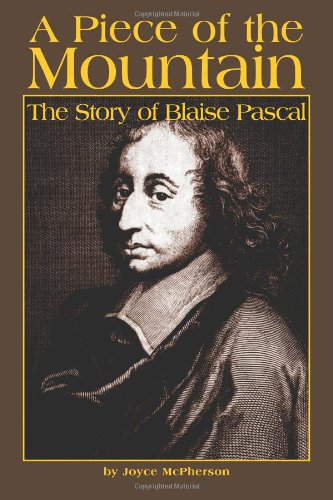
8. A Piece of the Mountain:The Story
$9.71
9. Christianity for Modern Pagans:
$6.64
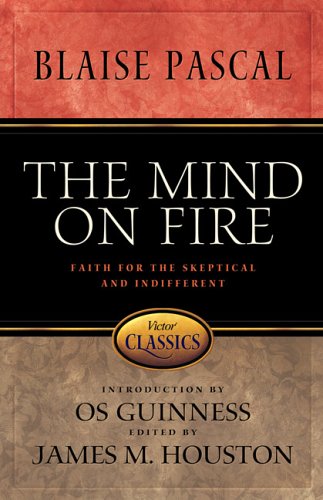
10. The Mind on Fire: Faith for the
$23.00
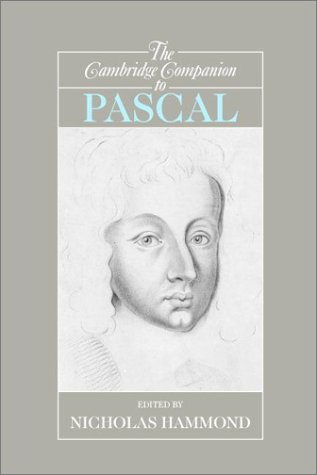
11. The Cambridge Companion to Pascal
 
12. Thoughts, Letters and Opuscules
 
13. Pensees De Blaise Pascal
$15.99
14. Pascal's Pensées
15. Mind on Fire: A Faith for the
$17.33
16. The Provincial Letters
$27.99
17. Pensées de Pascal: Publiées
$8.90
18. Blaise Pascal: Reasons of the
$44.95
19. The Physics of Chance: From Blaise
 
20. Pascal for our time

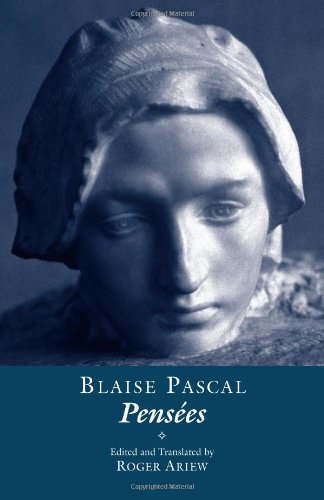
1. Pensees
by Blaise Pascal, Roger Ariew
Paperback: 328 Pages (2005-03-31)
list price: US$11.95 -- used & new: US$11.35
(price subject to change: see help)
Asin: 087220717X
Canada | United Kingdom | Germany | France | Japan
Editorial Review

Book Description
Roger Ariew masterfully renders the oddities of 17th-century French vocabulary and syntax in this eloquent and philosophically astute translation—the first complete English translation based on the Sellier edition of Pascal's manuscript, widely accepted as the version closest to what Pascal intended. Ariew provides a select bibliography of primary and secondary sources, a chronology of Pascal's life and works, a brief history of the text, concordances between the Sellier and Lafuma editions of the original, and an index. ... Read more


2. Pensees (in French)
by Blaise Pascal
Paperback: Pages (1999-01-11)
list price: US$24.95 -- used & new: US$24.95
(price subject to change: see help)
Asin: 0685342468
Average Customer Review: 4.5 out of 5 stars
Canada | United Kingdom | Germany | France | Japan

Customer Reviews (20)

5-0 out of 5 stars Poetic, Clear & Truthful.
I have read Pascal's Pensees 2 times now - and cannot but marvel at his depth and Truth. I have been blessed with languages and been able to read this monumental work in its original language of French. The translated book though is good and detracts not from the clear thoughts propounded. Truly an Apologist before any other, Pascal will with clarity, wit, logic and sarcasm, point out the faults of man, his need of God and why there is only one true God. Like a modern Solomon, Pascal states with simplicity many a timeless truth about the human condition. So much of this book could be used as quotes to guide nearly all facets of our lives. This is a must-read for those with an interest either in apologetics or truth.

5-0 out of 5 stars The depth of thought.. the poetry.. the reasons that are not accesible to reason
My profile- No qualifications as a philosophy critic whatsover

I write this review based on my own experiences while reading it in my early 20's... I was blessed with the time and the setting for it was done in a remote beach town here in Venezuela...indeed if there ever was a good time to read the Penseesit was during this period, where I had the time to read the philosophy, where the spirit was eagerly looking for its tools to discover truth..

The Pensees are even more applyable today (at my 40s) than back then.. its true I no longer follow the precepts of the Roman Catholic Church as I did back then.. to outgrow your religion, your nationality and your family is to me a necessary part of existence.. its ok if you go back to any of them later, but the trip has to be made... and to make this trip this is the book!! sure, it has compelling arguments to turn you into a christian.. but then again, the arguments are compelling for any religion that uses them.. I do not want to give you an impression that this is about religion only.. they are some many themes.. chose your existencialism poetry (young readers take note).. use practical psycology as to classify manking perception modes... laugh at the imagination is a an imperfect tool that exerts its mastery here and wide..

5-0 out of 5 stars A Spiritual Classic from a Great Scientific Mind
I first picked up Pascal's Pensees because I was intrigued by his reputation as a genius of physics and mathematics.I was not very far into it before I realized that I was reading a Christian spiritual classic, in its own right.

Perhaps because Pascal was such a brilliant physicist and mathematician, his Pensees resonate with my very modern soul, steeped as it is in the scientific mode of thought.

He understands the restlessness of the modern soul in his comments on "diversion" - "If our condition were truly happy we should not need to divert ourselves from thinking about it."And again - "The sole cause of man's unhappiness is that he does not know how to stay quietly in his room."These things are at least as pertinent in the 21st century as they were in the 17th.

His comments on reason (and its limitations) are very sharp - "Reason's last step is the recognition that there are an infinite number of things which are beyond it."Pascal was a world-class scientist of his day, and yet he was very much aware of what reason was and was not capable of.

I especially liked his comments on "The Hidden God" - "[We see] too much to deny and not enough to affirm." Or again, "What can be seen on earth indicates neither the total absence, nor the manifest presence of divinity, but the presence of a hidden God. ...to know that one has lost something one must see and not see; such precisely is the state of nature."

He is also very perceptive in his comments on the simultaneous greatness and smallness, glory and corruption, of human nature.

And I haven't even mentioned the two most famous passages, "The Wager" and "Reasons of the Heart"; this book is dense with nuggets of pure gold.

The Pensees can seem very disjointed, because, in his lifetime, Pascal merely wrote down his thoughts as they occurred to him.What we have are essentially his notes; he died before he could organize them into a coherent work, or develop some of his more obscure themes.A lot falls on the editor/translator to make sense of the material he has to work with, and I think A.J. Krailsheimer has done an admirable job.

This is a wonderful book, and justly counted a classic.

5-0 out of 5 stars Religion of the Heart and of the Head
Before actually reading "Pensees," I knew Blaise Pascal and his "Pensees" only from snippets of quotes such as, "The heart has its reason of which reason knows nothing" and from "Pascal's Wager": better to risk believing in God and living with Him for all eternity and being wrong, then risk not believing in God and living apart from Him in all eternity and because you were wrong.

Having read him, I know now that the quote and wager just mentoned, though only snippets, do summarize his brilliance and his beauty. Like few others, Pascal fuses head and heart in his defense of Christianity. His ability is likely due to his brilliant mind that on November 23, 1654, from 10:30 PM to 12:30 AM encountered God in a mysterious, mystical experience that he could only describe with the one-word epitaph: "Fire."

For the rest of his brief life (he died at age 39), the fire in his soul and the genius of his mind merged in the "writing" of "Pensees." I place "writing" in quotation marks because Pascal's early death never allowed him to finish "Pensees." What we have is akin to his outline (though 325 pages in length!). Imagine if he had actually finished it. Pascal, ever the absent-minded professor, would have a thought run through his mind, write it down, cut it in a strip, and splice it in with other similar subject headings.

It's helpful to understand this before reading "Pensee" for what you find is brilliant disorder--an incomplete sentence here, half a thought there, then long and insightful paragraphs here. In other words, you do need to wade through the unusual design of the book, but in the wading you will find oceans of depth that flood both your heart and your head with passion and reason to love and know God.

Pascal's "real world" arguments for God are the most rationally and personally compelling ones that I have ever read. Pascal honestly faces the reality that we see God only in part and that by evidence alone, whether of reason or nature or both, we might just as well conclude that there is no God (the atheists), or that He is not loving, or not powerful, or that He is disinterested (Deism), or dispassionate (the Greek philosophers). He then explains that God reveals enough in nature to cause us to perceive His existence and to perceive that we are finite and fallen. Nature, according to Pascal, points more to the Mediator--Christ--the One who reveals the hidden God as a God of holiness and love, and the One who reveals us as God's prodigal children who need to come home.

Reviewer: Dr. Robert W. Kellemen is the author of "Soul Physicians: A Theology of Soul Care and Spiritual Direction," "Spiritual Friends: A Methodology of Soul Care and Spiritual Direction," and the forthcoming "Sacred Companions: A History of Soul Care and Spiritual Direction."

5-0 out of 5 stars Pascal's Pensees
For thousands of years humanity has been searching for the presence of an invisible God.Blaise Pascal's "Pensees" is an excellent book describing why God's presence in our lives is so important.Even though I disagree with Pascal's reasoning concerning the defense and support of the Christian faith, he comes across as someone interested in the well-being and happiness of others, which makes it possible for "Pensees" to be beneficial to people of all faiths.
Pascal reminds us that people have been trying to find happiness, through worship, for many years.People have worshipped idols like wood, clay, stone and religious figures.Pascal's intention is to extend the idea that the need to worship someone or something is a natural fixation installed in us.Man's need to worship someone or something must then be due to the fact that God exists.
Pascal's "Pensees" suggests that we need God's help to be happy and to settle many of our own internal wars.Pascal points out that people fight with their own selfishness as well as that of others.He reminds us that the injustices, tyranny and irrational wars of the world have caused much distress.Pascal points out three troublesome questions humanity has struggled with: what is my purpose in life, where is my life going and how much time do I have left?
Pascal sheds light on the three types of people in the world and how God's presence in their lives is needed for their happiness.He tells us that people who have found God are reasonable and happy.Those who have not found God but continue to seek God are unhappy and reasonable, and those who leave God out of their lives are unreasonable and unhappy.Pascal is trying to relate to us that true happiness comes from knowing and understanding our creator.
Pascal, with his wager, intends to show how people have nothing to lose or possibly everything to gain when they put their faith in the Christian God.Although, he argues total destruction may find those who choose not to devote themselves to the Christian faith.As I stated, I disagree with the one-sidedness of Pascal's wager.If we look at Pascal's wager from a religiously neutral standpoint, we can eliminate the fallacy of the wager.Therefore, to put your faith in the "Creator of All Things" can only bring about a relationship with the true God.
Pascal's Pensees is a challenging book that if looked at with the right perspective depicts that happines can be found when a relationship is established with the true God.Pascal's "pensees", consists of ideas that can be useful if applied to our lives in a positive and non-prejudicial way.
... Read more


3. Pensees and Other Writings (Oxford World's Classics)
by Blaise Pascal
Paperback: 320 Pages (2008-05-08)

Isbn: 0199540365
Average Customer Review: 4.5 out of 5 stars
Canada | United Kingdom | Germany | France | Japan
Editorial Review

Book Description
For much of his life Pascal (1623-62) worked on a magnum opus which was never published in its intended form. Instead, he left a mass of fragments, some of them meant as notes for the Apologie. These were to become known as the Pensees, and they occupy a crucial place in Western philosophy and religious writing.Pascal's general intention was to confound scepticism about metaphysical questions. Some of the Pensees are fully developed literary reflections on the human condition,, some contradict others, and some remain jottings whose meaning will never be clear. The most important are among the most powerful aphorisms about human experience and behaviour ever written in any language.This translation is the only one based on the Pensees as Pascal left them. It includes the principal dossiers classified by Pascal, as well as the essential portion of the important Writings on Grace. A detailed thematic index gives access to Pascal's areas of concern, while the selection of texts and the introduction help to show why Pascal changed the plan of his projected work before abandoning the book he might have written. ... Read more

Customer Reviews (5)

5-0 out of 5 stars A beautiful mind
Seldom does a week go by that one of Pascal's musings doesn't come to my mind.Most often, I think, his comment that he believes that all man's misery is due to either laziness or impatience ("....not being able to sit quietly in a room alone").I've seen that played out so many times, and it's my favorite lecture to my grandchildren.

As another reviewer has said, Pascal's most provocative reflections are on the miraculous survival of the nation of Israel and what that tells us about the divine authorship of the Bible. This was especially surprising and gratifying to me in light of his times and religious affiliation.

Most amusing is his fascination with the male fixation on games involving balls.He turns that one over and over and never quite figures it out.

I always find it restful to pick up this tiny, sweet-tempered book--so huge in its enduring wisdom--and read a few pages.It always gives me something more worthwhile and just plain fun to think about than politics and my irritating next-door neighbor.

2-0 out of 5 stars Difficult
Hard to grasp. A following sentence will contradict the sentence above. Ravings not musings. If read by a believer it is great writing. If read by a stoic it's ragtime.

"In order to love God you must hate yourself." ???

5-0 out of 5 stars The Spirtual/Logical Mind Reveals Thoughful Comtemplations
Pascal's Pensees are among the more interesting and enlightened of Christian writings.Pascal was a brilliant 17th century mathematician and scientist who tabulated binomial coefficients, provided groundwork in the field of hydrodynamics and also invented the syringe.But for some reason he seems to be known best for his "Pensees" (thoughts).These Pensees are deeply religious but like Pascal's Wager (the argument that it makes sense to believe in god even if it can't be proven scientifically) they are also extraordinarily logical.And this is the crux of the enigma that is Blaise Pascal: how could a man of such brilliant reason also have such unshakeable faith?The answer is to some degree in the Pensees but at the same it is also something so sublime that it touches the realm of existentialism.Regardless, the Pensees are really thoughtful writings not all of which confront the existence of God.The also provide interesting insight into the intellect of the early age of reason.


Many compare Pascal to Montaigne and though I agree that they came from the same stock they certainly fall into different camps.Montaigne was an intellectual bon vivant and if one reads his "Essays" it is easy to see that his value in reason and science is not nearly as complete as that of Pascal.I really enjoy Montaigne and find myself thinking more like he did than Pascal.My belief is that their style of straightforward easy eloquence is similar due to the fact that they were both French intellectuals but the comparison should end there.The Pensees are great and I don't think they were meant to be read with any speed.Buying a copy is a great investment because it provides a series of aphorisms and thoughts for a lifetime of contemplation.

- Ted Murena

5-0 out of 5 stars A milestone of Western religious thought
This is one of the great works of Western religious thought. It is written in fragments, but these fragments are often brilliant poetic thoughts . Many of them have become part of the everyday vocabulary of the Western mind. " Man is a reed, but he is a thinking reed" " The silence of these infinite spaces cast me into dread"
Among the major suggestions of Pascal's thought is the Pascalian wager which William James picked upon. Roughly speaking betting on the non- existence of G-d gives nothing. But betting on the existence of G-d give the possibility of eternity. Therefore says Pascal we should be wise and bet on the existence of God. And this though it is not certain that God wants us as gamblers.
Pascal's insights also extend into his reading of the Bible and his special insight into the destiny of Israel. His God after all is not " the god of the philosophers but the God of Abraham, Isaac and Jacob " Pascal saw the continued survival the miraculous survival of the people of Israel through generations of persecution and suffering as a proof of the existence of G-d. And for that alone I have tremendously warm feelings for him.And this aside from the gratitude of his overwhelmingly powerful and beautiful insights.
This is one of the great books for probing the heart of Man and the Universe. And we should never stop rereading it.

5-0 out of 5 stars 'The Great Pascal'
This Oxford's version of the Pensees is in some ways superior to the Penguin Classics version.The introduction, by Anthony Levi, gives a much better insight into the history behind the development of Pascal's 'thoughts'.As far as the biography is concerned, Oxford's version gives a much broader span of time concerning Blaise's life.

A lot of people blame Pascal for not being like Montaigne, but that is just foolish.I enjoy Pascal's style because of its originality, and there also seems to me to be a similiar style between both men--espcially in how they both change ideas in a brief span of time.I believe Montainge originally meant to make his 'essays' a collection of expanded sayings and maxims but it took another form, and Pascal maybe wanted his 'pensees' to be his magnum opus by turning it into a large book that would be something like Montaign's Essays.Both men, I guess, envisioned something different from their final product and both of them left a legacy that was fruitful and informative, and their works shouldn't be compared as two competing styles since they are so different from one another in both format and intention.

And after reading Pascal's 'Discussion with Monsieur de Sacy', I was struck by Pascal's shear brilliance.He is a giant of a writer and is one of the cleanest writers I have ever read. ... Read more


4. Blaise Pascal: Thoughts, Letters, andMinor Works
by Blaise Pascal
Hardcover: 140 Pages (2007-06-01)
list price: US$29.95 -- used & new: US$29.95
(price subject to change: see help)
Asin: 1602064911
Average Customer Review: 5.0 out of 5 stars
Canada | United Kingdom | Germany | France | Japan
Editorial Review

Book Description
Contents: Thoughts on Mind and Style; The Misery of Man Without God; Of the Necessity of the Wager; Of the Means of Belief; Justice and the Reason of Effects; The Philosophers; Morality and Doctrine; Fundamentals of the Christian Religion; Perpetuity; Typology; Prophecies; Proofs of Jesus Christ; The Miracles. Various Letters. Minor Works: Epitaph of M. Pascal; Prayer; Comparison Between Christians of Early Times and Those of Today; Discourses on the Condition of the Great; On the Conversion of the Sinner; Conversation on Epictetus and Montaigne; Art of Persuasion; Discourse on the Passion of Love; Of the Geometrical Sprit; Preface to the Treatise on Vacuum; New Fragment of the Treatise on Vacuum. ... Read more

Customer Reviews (1)

5-0 out of 5 stars A brief comment
Please be advised that this review is only on Pascal's Thoughts.

I got this book as part of the Great Books of the Western World set, and of the 330 odd works and 54 volumes in that august set, this book was my favorite. Not because I was religious per se, but because I enjoyed reading the thoughts of a brilliant mathematician, philosopher, and thinker who could write so clearly and concisely and discuss so many topics in brilliant fashion. Although ostensibly about Pascal's religious convictions, he also discusses many other subjects as well. In fact, the first page of the book has a comment on women's intuition--which Pascal believed in. Pascal is also the founder of the science of probability, which he computed based on the then current popular game of 31, not 21. And let's not forget the famous "Pascal's Wager." Les Pensees was probably the most profound and intimate statement of his philosophy, and three centuries later it's still worth reading today. ... Read more


5. Pascal's Wager: The Man Who Played Dice with God
by James A. Connor
Hardcover: 240 Pages (2006-10-01)
list price: US$24.95 -- used & new: US$6.49
(price subject to change: see help)
Asin: B000YFYPUW
Average Customer Review: 5.0 out of 5 stars
Canada | United Kingdom | Germany | France | Japan

Customer Reviews (2)

5-0 out of 5 stars A wonderful little book about physics and faith
As an engineer I had studied all about Pascal's products, the conic sections, the vacuum, and the probability studies. However, until I read this book never could have imagined the sad and inspirational story behind the genius, Blaise Pascal.It is written in short readable chapters that give you a vivid picture on the 17th century in which he lived.The book gives a spectacular vision of the beginning of science as we know it in the 21st century. It also examines the conflict of one man between his faith and his passion for science. I won't tell you how it comes out that for you to read. The only thing I will tell you is that it is not the usual science is good and religion is bad that you find in many book today. Read this book, and if you have children interested in science have them read it too, or better read it to them.

5-0 out of 5 stars Interesting fellow, interesting times, interesting intersection of science and religion.
This fairly short (216 pages) book centers around the central dilemma of Blaise Pascal's, the 17th century math prodigy's, life philosophy: How to reconcile his austere view of life as should be lived by a creation of God with his obvious love of math, science, and worldly ideas. Another hundred pages could have been used to flesh out Pascal's writings and scientific ideas so that the reader could make more of his own decision about him. Instead the author has chosen to present his own thesis for acceptance or rejection. There is considerable interesting background provided on the France of Pascal's time and on Jansenism, the ascetic (Augustinian) form of deterministic (Calvinistic) Catholicism that Pascal ultimately accepted.

There are several descriptions of the discoveries of Pascal and his peers but nothing that requires a math or science background. The last chapter is a musing by the author that uses the probabilistic view of modern life that Pascal originated by his seminal work in probability theory. The author's dividing of people into climbers and sprawlers is insightful especially if you're inunudated with amazing coincidence \ God's providence spam e-mails as I seem to be. Recommended if you're Roman Catholic, definitely recommended if you're a fan of the Jesuits (the author is a former Jesuit). The book reads fast and is divided into short chapters; useful if, as I do, you like to finish a chapter before getting off the mass transit. Well recommended. ... Read more


6. The Mind on Fire: An Anthology of the Writings of Blaise Pascal (Classics of Faith and Devotion)
by Blaise Pascal
 Paperback: 333 Pages (1989-09)
list price: US$9.95 -- used & new: US$61.80
(price subject to change: see help)
Asin: 0880701595
Average Customer Review: 5.0 out of 5 stars
Canada | United Kingdom | Germany | France | Japan

Customer Reviews (2)

5-0 out of 5 stars Religion of the Heart and Head
"The Mind on Fire" is predominantly a modern translation and editing of Blaise Pascal's "Pensees" along with a few other short works and a sampling of his letters. It is quite user-friendly and a good place to start when reading Pascal.

Before actually reading "Pensees," I knew Blaise Pascal and his "Pensees" only from snippets of quotes such as, "The heart has its reason of which reason knows nothing" and from "Pascal's Wager": better to risk believing in God and living with Him for all eternity and being wrong, then risk not believing in God and living apart from Him in all eternity and because you were wrong.

Having read him, I know now that the quote and wager just mentoned, though only snippets, do summarize his brilliance and his beauty. Like few others, Pascal fuses head and heart in his defense of Christianity. His ability is likely due to his brilliant mind that on November 23, 1654, from 10:30 PM to 12:30 AM encountered God in a mysterious, mystical experience that he could only describe with the one-word epitaph: "Fire."

For the rest of his brief life (he died at age 39), the fire in his soul and the genius of his mind merged in the "writing" of "Pensees." I place "writing" in quotation marks because Pascal's early death never allowed him to finish "Pensees." What we have is akin to his outline (though 325 pages in length!). Imagine if he had actually finished it. Pascal, ever the absent-minded professor, would have a thought run through his mind, write it down, cut it in a strip, and splice it in with other similar subject headings.

It's helpful to understand this before reading "Pensee" for what you find is brilliant disorder--an incomplete sentence here, half a thought there, then long and insightful paragraphs here. In other words, you do need to wade through the unusual design of the book, but in the wading you will find oceans of depth that flood both your heart and your head with passion and reason to love and know God.

Pascal's "real world" arguments for God are the most rationally and personally compelling ones that I have ever read. Pascal honestly faces the reality that we see God only in part and that by evidence alone, whether of reason or nature or both, we might just as well conclude that there is no God (the atheists), or that He is not loving, or not powerful, or that He is disinterested (Deism), or dispassionate (the Greek philosophers). He then explains that God reveals enough in nature to cause us to perceive His existence and to perceive that we are finite and fallen. Nature, according to Pascal, points more to the Mediator--Christ--the One who reveals the hidden God as a God of holiness and love, and the One who reveals us as God's prodigal children who need to come home.

Reviewer: Dr. Robert W. Kellemen is the author of "Soul Physicians: A Theology of Soul Care and Spiritual Direction," "Spiritual Friends: A Methodology of Soul Care and Spiritual Direction," and the forthcoming "Sacred Companions: A History of Soul Care and Spiritual Direction."

5-0 out of 5 stars SET YOUR MIND ON FIRE!
Indeed friends this is a most excellent book. The translation is great, easy to read, down to earth and fluent. There are many places that one could start with the Pensees, but this is certainly not a mistake. Pascal was and is a certified genius, study his work and gain valuable insight into the story of man and the life of faith and the role of reason. "Mind on Fire" is a good place to start. ... Read more


7. Making Sense of It All Pascal and the Meaning of Life
by Thomas V. Morris
Paperback: 224 Pages (1992-09)
list price: US$18.00 -- used & new: US$11.13
(price subject to change: see help)
Asin: 080280652X
Average Customer Review: 5.0 out of 5 stars
Canada | United Kingdom | Germany | France | Japan

Customer Reviews (13)

3-0 out of 5 stars The Greatness and the Wretchedness of Pascal's Thought
I honestly don't know what to say about this book.It's written by a prominent Christian philosopher, Thomas Morris, who draws on Pascal's Pensees to give an analysis of faith, reason and the human condition.The writing is clear and conversational, the topics are profound, and some sections -- such as the discussion of skepticism -- are gems of lucidity.But boiled down to its essentials, the Pascal/Morris argument goes like this:

-- People without faith in God are unhappy and wretched, and spend most of their time covering up and denying their unhappiness and wretchedness;

-- Therefore, God must exist, because believing in Him makes people happy and ensures they'll be cared for in the afterlife;

-- In fact, God must be the Christian God, the father of Jesus and one of the Trinity, since hoary old "miracles" and "prophecies" attest to the authority of the Bible.

That's Pascal's argument in a nutshell.Really.It's that flimsy.All the focus is on knocking down atheism as an untenable way of life.Once that's accomplished, a fairly doctrinaire form of Christianity is treated as the natural default position.No consideration is given to other religious options -- even though most religious traditions can boast "miracles" and "prophecies" of their own.No consideration is given to the possibility of forging an atheistic life of courage and decency.Bad faith reigns supreme:Pascal appeals to Christians looking for practical reasons to keep up Christian practice even though they suspect Christianity is false.

I love the Pensees, but their elegant aphorisms and sharp insights can obscure the absurdity of the total argument.The same is true of Morris's book.It's a good reminder that Christian philosophers should keep their philosophy separate from their Christianity.

5-0 out of 5 stars Finding Meaning with Pascal as a Guide
This is a great book, which takes diverse sources such as Pascal and Woody Allen and probes the reasons why most of us waste our lives on trifles and baubles, distracting ourselves from our mortality and avoiding life's big questions. The book is part fun, part serious as it makes Pascal's inquiries into human nature very readable. The Christian and nonChristian alike should enjoy this study of how people waste their lives and how they can find meaning. Two great companions to this book, though more secular, are Viktor Frankl's Man's Search for Meaning and Erich Fromm's The Art of Loving.

5-0 out of 5 stars Outstanding!Quite readable - An excellent companion to Pascal's Pensees
Tom Morris is a gifted writer and philosopher.This book amplifies Pascal in ways you may not have thought about before, and it clearly intriques the critical mind about the possibility of the Truth behind Christianity.The leap from mind to faith doesn't seem all that large after reading this enticing book.

5-0 out of 5 stars fascinating!
this is a very insightful philosophical/theological book dealing with the plight of humanity in relation to faith in God and the meaning of life.There are a few things herein that will no doubt be disagreed with by many readers, but the many deep insights otherwise are well worth it.

5-0 out of 5 stars Morris Captured the Spirit of Pascal
Making Sense Of It All is one the best books I have ever read on the topic of Christian philosophy and apologetics. This book is unique both in its organization and content. Morris utilizes some of the scientific, philosophical, and apologetic statements of the great Christian thinker Blaise Pascal (from Pascal's book Pensees) and shows how faith in Jesus Christ is the unique answer to mankind's deepest yearnings for meaning, purpose, significance, and life eternal. This book skillfully and successfully answers many of the existential objections that people give for not believing. Morris weaves together many of Pascal's brilliant insights into a significant and powerful Christian apologetic work.

Though covering a lot philosophical and theological ground, this book is remarkably readable and at places quite humorous. It addresses philosophical, theological, and apologetic issues with tremendous clarity and in an engaging style. This volume provides deep insight into why people living in today's world avoid thinking about ultimate issues. I only wish the book contained a bibliography and/or notes for further reading.

Thomas V. Morris has been called one of Christianity's finest contemporary philosophers (former Notre Dame professor). This book is indeed evidence of his first rate philosophical ability. ... Read more


8. A Piece of the Mountain:The Story of Blaise Pascal
by Joyce McPherson
Paperback: 124 Pages (1997-12-01)
list price: US$8.95 -- used & new: US$7.75
(price subject to change: see help)
Asin: 1882514173
Average Customer Review: 4.5 out of 5 stars
Canada | United Kingdom | Germany | France | Japan

Customer Reviews (4)

3-0 out of 5 stars A good book for the right audience
I should have read the other reviews more closely.This book is written for a target audience of 5th and 6th graders.I was expecting a factual biography but this is actually a children's book written to entertain.I believe it probably does entertain to the targeted audience but I would not recommend this book to someone researching this theologian's life.

5-0 out of 5 stars An inspiring and fascinating biography of a genius
Here is the biography of a life well worth studying.Pascal was one of those rare people who, like da Vinci, was a genius in several areas--in science, mathematics, and theology.He also helped develop the world's first public transit system!As homeschoolers, we also enjoyed the depiction of his early education, as he and his siblings were taught by their brilliant, loving father. Throughout, the book reveals Pascal as a thoroughly decent and honest man. I highly recommend this book for about sixth grade up through adults.

5-0 out of 5 stars Wow, what a great biography!
I never knew as much about Blaise Pascal until I had read this book.What I'm really interested in is getting to know all of those lovely sources that McPherson used for her research material.

Before I had read this book, I didn't know much about Pascal's scientific experiments or his contributions to French society.This book has also cleared up a lot of the background concerning Pascal's writings.It is well written and highly entertaining.

5-0 out of 5 stars A Book I Will Read Again
My mother handed me this book--I thought "Oh no another school book." When I started I discovered how incredible a 17th century mathematiciancan be.This book is especially good if you try to work outthe mathematical equations it contains.This is a very good book.Though itwould not make much sense to people younger than 13.READ THIS BOOK. I amgoing to read it again. ... Read more


9. Christianity for Modern Pagans: Pascal's Pensees
by Blaise Pascal
Paperback: 341 Pages (1993-10)
list price: US$16.95 -- used & new: US$9.71
(price subject to change: see help)
Asin: 0898704529
Average Customer Review: 4.5 out of 5 stars
Canada | United Kingdom | Germany | France | Japan
Editorial Review

Book Description
Peter Kreeft believes that Blaise Pascal is the first post-medieval apologist. No writer in history, claims Kreeft, is a more effective Christian apologist and evangelist to today's uprooted, confused, secularized pagans (inside and outside the Church) than Pascal. He was a brilliant man--a great scientist who did major work in physics and mathematics, as well as an inventor--whom Kreeft thinks was three centuries ahead of his time. His apologetics found in his Pensées are ideal for the modern, sophisticated skeptic.

Kreeft has selected the parts of Pascal's Pensées which best respond to the needs of modern man, and offers his own comments on applying Pascal's wisdom to today's problems. Addressed to modern skeptics and unbelievers, as well as to modern Christians for apologetics and self-examination, Pascal and Kreeft combine to provide a powerful witness to Christian truth. ... Read more

Customer Reviews (23)

4-0 out of 5 stars Good.
I am giving only four stars not five because I needed it for a class, and it came later than I expected.Other than that, the book arrived in the condition that I expected.I highly recommend the book for those who want to learn to defend their faith against modern critics and skeptics of Christianity.I also highly recommend the reading for sketpics and critics.Read once quick, then re-read in a critical manner.

3-0 out of 5 stars Christianity for MOdern Pagans
The book was upside down. If the class had not already started I would have returned it. It is usable but one does not expect to pay for a book that is incorrectlybound without prior approval. I am dissatisfied with this order.

5-0 out of 5 stars Among the Best of Apologists
It is always a relief to read a very good book of apologists because there are so many ordinary ones.Pascal reads as fresh as when he originally wrote the pensees, and Kreefts adds immeasurably to the understanding and appreciation of Pascal's words.In terms of the quality of this work, I have got as much out of it as C S Lewis or Philip Yancey albiet Pascal is more sophisticated in many ways.

5-0 out of 5 stars A pleasure to read

Mr. Kreeft does it again in this book about Pascal's 'Pensses'.He picks up Pascal's best or most important 'pensees' and gives us his view of them. He does not intend to explain or interpret them, since they are to be interpreted individually by each of us, but he expands them, he adds to them what a modern reader -living in a neo-pagan world- would have come to his mind.

Mr. Kreeft is a masterful teacher. For those who are afraid of delving into the original authors like Pascal, Thomas Aquinas, etc. we have Mr. Kreeft to introduce us to them.

And for the Christian person this book is almost mandatory, it is the fresh air that we need to keep fighting in this ever more pagan world.

4-0 out of 5 stars Let's not get carried away with Kreeft
I have used this book in my college classes for several years. The reason why is that Kreeft knows how to get the students going. He is, and sounds like, a crotchety old Catholic. He is very opinionated - which is good (and bad). If you like that, then you will love his book on apologetics. But this does get him in trouble several times when he states somewhat imperiously that "Pascal REALLY means this..." (or that). He does this contra Pascal himself who is obviously being subtle.But a good teacher lets the students decide, and often they decide against Kreeft. The other major problem with Kreeft is that in spite of his (imperious?) pronouncement in the beginning of the book that he only included the truly worthy Pensees he nevertheless managed to leave out some of my big favorites. In spite of these somewhat minor criticisms this book is still a classic commentary and can be a terrific way to get in on Pascal. ... Read more


10. The Mind on Fire: Faith for the Skeptical And Indifferent (Victor Classics)
by Blaise Pascal
Paperback: 320 Pages (2006-02-11)
list price: US$14.99 -- used & new: US$6.64
(price subject to change: see help)
Asin: 0781441978
Canada | United Kingdom | Germany | France | Japan
Editorial Review

Book Description
Blaise Pascal (1623-1662) earned recognition as a renowned mathematician, physicist—and a man after God's heart. As he came to the forefront of geometry and physics, he turned his considerable analytical abilities to study religion or, as he said, to "contemplate the greatness and the misery of man." Pascal's classic defense of Christianity—Pensées—persuaded many a skeptic in his time.

Today, editor James Houston has organized Pascal's meditations into a logical progression of thought that contemporary readers can enjoy in Mind on Fire. Described as a "Masterpiece of theological scholarship," Mind on Fire also includes selections from Pascal's Letters to a Provincial, a description of his conversion in his own words. ... Read more


11. The Cambridge Companion to Pascal (Cambridge Companions to Philosophy)
Paperback: 304 Pages (2003-06-16)
list price: US$29.99 -- used & new: US$23.00
(price subject to change: see help)
Asin: 0521006112
Average Customer Review: 5.0 out of 5 stars
Canada | United Kingdom | Germany | France | Japan
Editorial Review

Book Description
Blaise Pascal (1623-1662) occupies a position of pivotal importance in many domains: philosophy, mathematics, physics, religious polemics and apologetics. A team of leading scholars surveys the range of his achievement and intellectual background as well as the reception of his work. New readers and nonspecialists will find a convenient and accessible guide to Pascal and advanced students and specialists, a conspectus of recent developments in the interpretation of his works.Download Description
Each volume of this series of companions to major philosophers contains specially commissioned essays by an international team of scholars, together with a substantial bibliography, and will serve as a reference work for students and nonspecialists. One aim of the series is to dispel the intimidation such readers often feel when faced with the work of a difficult and challenging thinker. Blaise Pascal (1623-1662) occupies a position of pivotal importance in many domains: philosophy, mathematics, physics, religious polemics and apologetics. In this volume a team of leading scholars presents the full range of Pascal's achievement and surveys the intellectual background of his thought and the reception of his work. New readers and nonspecialists will find this the most convenient and accessible guide to Pascal currently available. Advanced students and specialists will find a conspectus of recent developments in the interpretation of Pascal. ... Read more

Customer Reviews (1)

5-0 out of 5 stars A readable overview of an important historical figure
We've all heard of Pascal, but not many of us know much about him. Now that I've read this book, I have a much better understanding of who he was (not only a religious thinker, but also a sort of renaissance man who invented an early calculator and promoted public transport in the 17th century). The book helped to fill a major gap in my education. Although the articles are written by scholars, they are interesting and highly readable, without condescending to non-experts. ... Read more


12. Thoughts, Letters and Opuscules of Blaise Pascal
by Blaise Pascal
 Textbook Binding: Pages (1978-06)
list price: US$35.00
Isbn: 0849220947
Canada | United Kingdom | Germany | France | Japan

13. Pensees De Blaise Pascal
by Blaise Pascal
 Paperback: Pages (1942)

Asin: B000VL5U30
Canada | United Kingdom | Germany | France | Japan

14. Pascal's Pensées
by Blaise Pascal
Paperback: 352 Pages (2007-06-18)
list price: US$15.99 -- used & new: US$15.99
(price subject to change: see help)
Asin: 1434629384
Canada | United Kingdom | Germany | France | Japan
Editorial Review

Product Description
Introduction by T.S. Eliot ... Read more


15. Mind on Fire: A Faith for the Skeptical and Indifferent (Classics of Faith and Devotion)
by Blaise Pascal
Paperback: 312 Pages (1997-03)
list price: US$12.99
Isbn: 155661831X
Average Customer Review: 5.0 out of 5 stars
Canada | United Kingdom | Germany | France | Japan
Editorial Review

Book Description
An Invitation to Reasoned, Passionate Faith

Mind on Fire is an easy-to-read translation of the classic Pensées by Blaise Pascal. Here the remarkable seventeenth-century mathematician, physicist, and religious thinker presents his uncompromising defense of the Christian faith a rigorous refutation of the myth that to become a Christian is to commit intellectual suicide.

Dr. James Houston has arranged Pascal's seemingly random meditations into a logical progression of thought the first time ever that an editor has carried out Pascal's original intention for his Pensées. Also included are selections from pascal's Letters to a Provincial, Pascal's own description of his conversion.

Dr. James Houston, editor of the CLASSICS OF FAITH AND DEVOTION, is a highly acclaimed scholar and pioneer in the field of evangelical spirituality. He came to North America from England in 1968 to lead Regent College in Vancouver, Canada, a worldwide center of spiritual formation.

... Read more

Customer Reviews (4)

5-0 out of 5 stars And I don't even agree with everything
I give it 5 stars and I don't necessarily agree with all of his theology.His points are made from such a unique stand point.His ways of reasoning are very unique to me, yet he doesn't lead you to rely on his type of reasoning, but on the power of the Holy Spirit.
He makes many good points for any atheist to consider.His work on the subject of the Jews is interesting.I disagree with his stance on proofs of nature and some of His views God's restorative plans for Isreal, but who had views for God to restore Isreal 300 years ago?
If you like reading books, this one is diffrent and well thought out!

5-0 out of 5 stars PAR EXCELLENCE!
This is the finest introduction to Blaise Pascal that I have ever seen! Within the pages of this book lie some of the greatest thoughts the human mind could ever aspire to perceive. 'Mind on Fire' is an easy to read, well-arranged anthology of Pascal's thought. In this book you will begin to see the role of logic and reason in the life of faith. If you are looking for an in-depth book, a book that penetrates the deep well of skeptical thought, 'Mind on Fire' will not waste your time or your money. Simply put, Pascal is a genius with a knack for apologetical thought.

5-0 out of 5 stars Pensees +
In case you're wondering, this IS the Pensees.The only difference is that these thoughts are arranged topically under a new title plus five letters from Pascal are included in the rear of the book.This is not an abridged edition of the Pensees.That being said, this book will stimulate your thinking about human nature, divine sovereignty, faith, logic and apologetics in a way that few other works will.Being deeply influenced by Augustine, Pascal had an uncanny way for accurately portraying the human condition.His grasp of the sinful nature of mankind and the limits of reason was acute.Many believe that Pascal was a fideist (faith is not supported by reason) due to a cursory reading of the Pensees yet a more exhaustive reading will prove otherwise.Many of the Pensees, while not rationally proving Christianity, certainly state that he believed in a reasonable faith and not a leap of faith beyond logic.I would recommend this edition as opposed to the Pensees because of its logical arrangement in addition to the thought-provoking letters that are placed in the back.Definitely a great read.

5-0 out of 5 stars A passionate example for all
It is difficult to conceptualize exactly how much Pascal's faith meant to him.Reading his thoughts is like peaking into the journal of a reflective, passionate man, with no other ambition in life but to glorifyGod.Pascal's passion went beyond the intellectual borders of academia andinto the personal realtionship he had with Jesus Christ.Pascal didn'twant the God of the philosophers; he preferred the God of Abraham, Isaac,and Jacob. If you desire to glorify God with your mind, soul, and body, orif you are curious as to how such a person thinks, then I highly recommendthis book as it will be an encouragment and a challenge to your intellectas well as your soul.I pray God gives me the grace to think as this mandid. ... Read more


16. The Provincial Letters
by Blaise Pascal
Paperback: 232 Pages (2004-06-30)
list price: US$26.95 -- used & new: US$17.33
(price subject to change: see help)
Asin: 1419179292
Average Customer Review: 3.0 out of 5 stars
Canada | United Kingdom | Germany | France | Japan
Editorial Review

Book Description
"You always fly from the one extreme to the other," replied the monk: "prithee avoid that habit. For, just to show you that we are far from permitting everything, let me tell you that we never suffer such a thing as a formal intention to sin, with the sole design of sinning; and if any person whatever should persist in having no other end but evil in the evil that he does, we break with him at once: such conduct is diabolical.Download Description
These Letters, written in defense of his Jansenist friends, exposes and ridicules the doctrines of the Jesuits.Pascal does a wonderful job of being humorous while still making a valid point. Please Note:This book is easy to read in true text, not scanned images that can sometimes be difficult to decipher.This eBook has bookmarks at chapter headings and is printable. ... Read more

Customer Reviews (2)

1-0 out of 5 stars "Provincial Letters" in a provincial book
"They have proved agreeable to men of the world, and intelligible even to the ladies" (p. 25) or "It being a much easier matter with them to find monks than reasons" (p.30) or "There is a vast difference between laughing at religion and laughing at those who profane it by their extravagant opinions" (p. 117) or "I need not the aid of any but yourselves to confute you" (p. 171), and of course, "The present letter is a very long one, simply because I had no leisure to make it shorter" (p. 192). Pascal's witting style has been a major influence for most shining in irony writers, and the "Provincial Letters" - although Pascal didn't give the title - addressed to "the reverend fathers" (the Jesuits) are the best proof.

However, the book as published by NuVision Publications contains no comments, nor information about the background of the dispute (it does have contents, nevertheless). Not even a single paragraph for Pascal's life (born? - died?), his education and the impact (if any) his letters had in literature. It seems that the body of the letters was taken from a website (there are many containing all letters) and printed exactly as appeared, justified and page-numbered. I think that the price is too high considering the work it took to be published, or the rights the publishers did (not) pay. So, 5-star rate for the Letters, and 1 for the book.

Anyway, not everyone appreciated Pascal's humor. If you want a second opinion for Pascal, try "Men of Mathematics" by the reputable E. T. Bell, who wrote that "among other things which Pascal totally [sic] lacked was a sense of humor". What a bummer, eh?

5-0 out of 5 stars Excellent Read; Humorous and Insightful
This series of letters by Blaise Pascal has it all; humor, a good guy (Pascal) and bad guys (Jesuits), and a moral.

Pascal wrote these letters in defense of his Jansenist friends who were being branded as heretics by the Jesuits.At the time, the Jesuits were a powerful religious order who basically taught Christianity all over the world.

In the Provincial Letters, Pascal exposes and ridicules the doctrines of the Jesuits, especially the "doctrine of probable opinions".The Jesuits (supposedly) were attempting to update the Christian doctrine to satisfy the lax morals of the modern world.In an attempt to "widen the pipe" to heaven, the Jesuits developed "modern" church doctrine (while ignoring traditional church doctrine, and the scriptures) to compensate for societies lax morals.

Pascal, defender of the faith, effectively ridicules their doctrines and shows their errors.

A word of caution, the letters are difficult going with respect to discussions on the finer theological points of view (how far we have fallen regarding knowledge of our faith).A good introduction will orient the reader to the conflicts and provide information regarding many of the theological discussions (the edition I used did not have an introduction; this one may).However, Pascal's writing is so humorous and engaging that I continued reading even when I was lost in the argument.

I am on record (in another review) as stating that religion should be updated to reflect our modern view of the world.However, these letters point out the danger of attempting to do that.I need to reconsider that approach. ... Read more


17. Pensées de Pascal: Publiées dans leur texte authentique avec un commentaire suivi par Ernest Havet
by Blaise Pascal
Paperback: 702 Pages (2001-03-16)
list price: US$27.99 -- used & new: US$27.99
(price subject to change: see help)
Asin: 0543924963
Canada | United Kingdom | Germany | France | Japan
Editorial Review

Product Description
This Elibron Classics book is a facsimile reprint of a 1894 edition by Ch.Delagrave, Paris. ... Read more


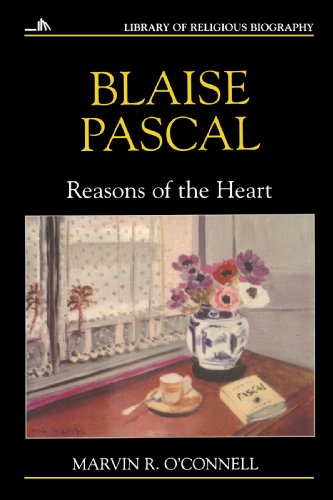
18. Blaise Pascal: Reasons of the Heart (Library of Religious Biography Series)
by Marvin R. O'Connell
Paperback: 210 Pages (1997-07)
list price: US$22.00 -- used & new: US$8.90
(price subject to change: see help)
Asin: 0802801587
Average Customer Review: 3.5 out of 5 stars
Canada | United Kingdom | Germany | France | Japan

Customer Reviews (5)

3-0 out of 5 stars Reasons of the Heart
Although in the beginning of the book the reader may be confused by the fact that the author explains many historical facts of the time, if bare with the author the reader shall find that this information is fully needed to be able to understand Pascal's life and efforts better. I thought that the book was very informing although could be a bit boring at times.

4-0 out of 5 stars A Fine Intro to Pascal for Americans
Blaise Pascal (1623-1662,) along with Michel de Montaigne, has always incarnated the French ideal of the introspective intellectual, the man of thought engaged with the vital questions of his time, the theorist of existence fearlessly involved in life's choices. He has been a key figure to Christian and secular thinkers alike, both for his deep psychological insights into man's inner workings-his own-as well as keen analysis of what goes into said man's options. Pascal is to French culture what Jonathan Edwards and Carl Jung, rolled into one, are to American culture.

Pascal's dense, rich analytical prose has been a decisive influence in the language of personal expression, in French and therefore in all language. Existentialism and psychoanalysis owe much to Pascal, who was, himself, a passionately committed Christian moralist. Largely ignored in the 18th Century, and known only to a few French intellectuals in the 19th, Pascal came to the fore in the 20th: the century of the conscious and the subconscious.

Marvin Richard O' Connell writes a præternaturally clear, entertaining, unpretentious short biography, suitably aware of the necessities of the dumbed-down, but never condescending. Ethical controversies in 17th Century France are eminently complicated to non-specialists, but O' Connell manages to keep things going with utmost confidence and gusto; no mean feat. He avoids the severity of French intellectual prose, but never sounds banale.A fine contribution.

3-0 out of 5 stars BlueJay54 on Blaise Pascal ???Please
Bluejay54 You Had Me interested at the beginning with your comments.You sounded reasonably intelligent until I came to your comment:

Mind you, one should not expect to learn this from a Christian writer and a Christian publishing house, but Pascal's natal astrology chart clearly illustrates the problems and paradoxes that he faced in life: Venus in Cancer squaring the Moon's Nodes and opposing Mars in Capricorn, with healing Chiron in Taurus, and a Stellium (Jupiter conjunct Saturn conjunct Uranus) in Leo. No wonder Pascal felt so torn by fame-and-fortune seeking of his keen mind, yet was irresistibly drawn to a fiery fundamentalism and an ascetic life-style!

Christianity, Pascal--NO God Himself--can't be Viewed, Explained, argued Logically, or Intelligently from "ASTROLOGICAL" Premises.

I did however find your comments, amusing, and commical.

2-0 out of 5 stars What reasons?
Make no mistake: this is *not* a book about Pascal the man, nor even a book about Pascal the (ascetic) Christian, but an excruciatingly painful book about the minutiae of Pasal's historical milieu and a long-winded discussion of the Jesuit/Jansenist dispute.I found the writing awkward in the extreme, with topical areas abstruse and singularly irrelevant to learning anything particularly useful about Pascal's life.(Well, given Pascal's later penchant for asceticism and renunciation of all pleasures--like enjoying steak dinners, the company of friends, or exercising his intellectual curiosity by inventing probability theory--at least that style was rhetorically appropriate!)Most of what *was" useful here can easily be found elsewhere.For example, when the converted Pascal visited his secular friends, he used to wear a belt studded with pins or nails on the inside so they poked him painfully in the waist, lest he enjoy their company too much.This fact I discovered in Guinness' introductory essay to Houston's "Mind on Fire" and *not* in the present book.In fact, I learned more about Pascal there and from on-line biographies that from this piece of work.Mind you, one should not expect to learn this from a Christian writer and a Christian publishing house, but Pascal's natal astrology chart clearly illustrates the problems and paradoxes that he faced in life:Venus in Cancer squaring the Moon's Nodes and opposing Mars in Capricorn, with healing Chiron in Taurus, and a Stellium (Jupiter conjunct Saturn conjunct Uranus) in Leo.No wonder Pascal felt so torn by fame-and-fortune seeking of his keen mind, yet was irresistibly drawn to a fiery fundamentalism and an ascetic life-style! But all Mr. O'Connell can do is muster up a bit of pity for poor Blaise's "restless heart [that] never quite purged itself of a lust for fame and worldly success [6]."Overall, the book did virtually nothing to illuminate the quote that inspired the title:"The heart has its reasons, of which Reason knows nothing," which was my reason for reading the book.Nor does it adequately explain other paradoxes: How could a genius like Pascal, fundamentalist or not, turn in a friend to the religious police for being a heretic? Why he was so bonded to his sister and why, with Cancer so prominent in his chart, did he never marry?Why his extremist embrace of original sin and human depravity?The book may have value or even be a big hit among believing Christians.But for a pagan neo-Vedantist yogi like me, this book shed absolutely no light at all on how a genius like Pascal wrestled with Ego to reconcile himself to Abstinence or (to paraphrase Kant) how he denied Reason in order to affirm Spirit.I'll have to find those reasons elsewhere....

5-0 out of 5 stars Excellent for Context and Analysis
I found this biography of Pascal enjoyable and very good for context and analysis.It is difficult to understand Pascal without a good grasp of the religious controversies at this time troubling Paris and the spiritual persons to whom Pascal felt close.For that reason, you may feel a little bogged down at first by explanations of theological and historical matters seemingly unrelated to the man.Bear with the author, because you will need to know these things in order to fully appreciate the passion and bravery (not to mention the substance) of Pascal's latter writings.There is excellent analysis here of Pascal's "Night of Fire" -- the 2nd, dramatic conversion to an intense fervor of Christianity -- as well as of his apologetic _Pensees_.The discussion of the _Pensees_ is just a taste, and after reading this book you will want to obtain a copy.There is so much more to Pascal than this book has room to tell, but it is a good general introduction, serious and somewhat scholarly, but reliable and not recklessly speculative.The picture that emerges is of a first-rate intellect deeply and emotionally touched, changed by an encounter with God. ... Read more


19. The Physics of Chance: From Blaise Pascal to Niels Bohr
by Charles Ruhla
Paperback: 240 Pages (1992-12-10)
list price: US$86.50 -- used & new: US$44.95
(price subject to change: see help)
Asin: 0198539770
Average Customer Review: 5.0 out of 5 stars
Canada | United Kingdom | Germany | France | Japan
Editorial Review

Book Description
This is an introduction to the ideas of randomness that are central to much of modern physics and have overthrown the "clock-work universe" conceptions of earlier centuries. The author shows how the laws of probability and statistics were developed by such mathematicians as Fermat, Pascal, and Gauss, and how they received their first major application in physics in the kinetic theory of gases developed by Maxwell and Boltzmann. Here the use of statistics is necessary because the number of particles involved is too great for a deterministic calculation. But soon the mathematician and physicist Poincare demonstrated the unpredictability if certain systems containing only a small number of bodies, because of extreme sensitivity to initial conditions. He thus became a founder of chaos theory. Finally, with the advent of quantum theory, physics seemed to be based on an essential randomness, whose reality was debated by Bohr and Einstein till the end of their lives. Only recently, in the experiments of Alain Aspect, has a convincing demonstration been given the inescapable randomness of quantum theory is a fact of nature. Professor Ruhla guides the reader skilfully through all these developments and provides mathematical details in appendices. The book provides an accessible introduction to the modern physicist's conception of the world of cause and chance. ... Read more

Customer Reviews (2)

5-0 out of 5 stars Chances are, you'll like this book
If you ever read one book on quantum theory, then this is the book you should read.Especially if you want to understand Bell's Inequality and how the experiments done by Alain Aspect in the 1980's verified that the inequality is violated.

I first heard of Bell's inequality and the EPR Paradox while reading an article by David Mermin in "Science News" and did not understand it at all.Then I read Robert Adair's account of it in "The Great Design" (a good book to have) and I began to gain a rudimentary appreciation of what was going on.But it wasn't until I read Ruhla's "Physics of Chance" that I learned how to derive the predictions of quantum theory - the predictions which show that two distant objects can exert influence on one another, "faster than the speed of light."

But Bell's Inequality is not the only subject in here.The text begins with rather simple treatments of probability, applied to coin tosses and telephone queues, on to Boltzmann Statistics, and then finally to quantum theory.So as your reading through the chapters in the book, you pick up the "tools" you need as you go along, in order to understand the more difficult material later on.

Ruhla's writing style is engaging, although silly at times....

5-0 out of 5 stars A wonderful overview of statistical physics
This book is extraordinarily well written and illustrated.It introduces the major themes of statistical physics at a level that shold be readily accessible to senior undergraduates or scientists and engineers who are non-specialists. Highly recommended; a gem! ... Read more


20. Pascal for our time
by Romano Guardini
 Unknown Binding: 236 Pages (1966)

Asin: B0006BODW4
Canada | United Kingdom | Germany | France | Japan

  1-20 of 100 | Next 20
A  B  C  D  E  F  G  H  I  J  K  L  M  N  O  P  Q  R  S  T  U  V  W  X  Y  Z  

Prices listed on this site are subject to change without notice.
Questions on ordering or shipping? click here for help.

site stats