e99 Online Shopping Mall

Geometry.Net - the online learning center Help  
Home  - Scientists - Ramsey Frank (Books)

  1-20 of 66 | Next 20
A  B  C  D  E  F  G  H  I  J  K  L  M  N  O  P  Q  R  S  T  U  V  W  X  Y  Z  

click price to see details     click image to enlarge     click link to go to the store

$27.48
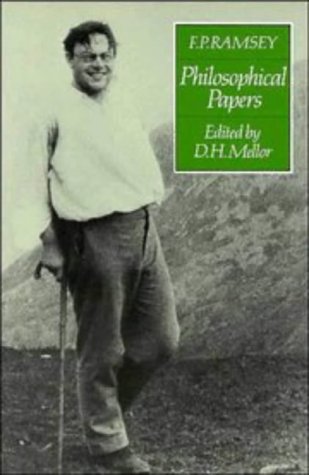
1. F. P. Ramsey: Philosophical Papers
 
$35.00
2. Foundations of Mathematics and
$9.95
3. Biography - Ramsey, Frank Plumpton
$61.87
4. The Foundations of Mathematics
 
$35.00
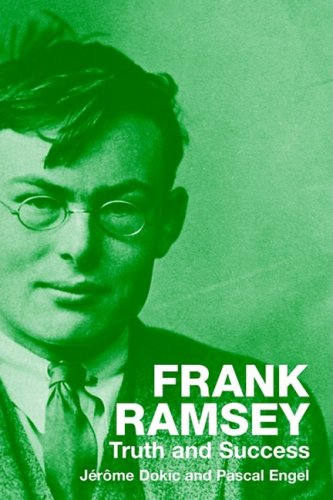
5. Frank Ramsey: Truth and Success
$113.99
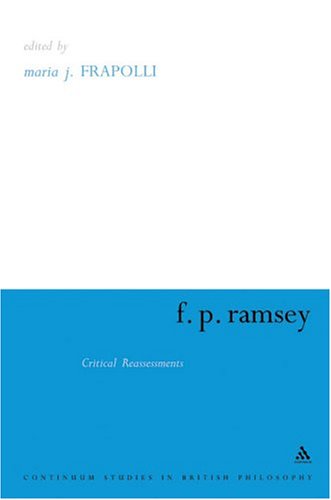
6. F. P. Ramsey: Critical Reassessments
$146.67
7. On Truth: Original Manuscript
 
8. Foundations: Essays in philosophy,
 
9. FOUNDATIONS OF MATHEMATICS
 
$962.70
10. Notes on philosophy, probability
 
11. Fundamentals: Concepts in Exercise
$54.50
12. Ramsey's Legacy (Mind Association
$87.48
13. Cambridge and Vienna: Frank P.
 
14. Prospects for Pragmatism: Essays
$34.99
15. Ramsey's Ontology (Metaphysica)
 
16. Whole-Loan CMOs
$84.00
17. The Philosophy of F. P. Ramsey
$39.50
18. The Handbook of Nonagency Mortgage-Backed
$20.99
19. Out of Devon: A Journal of the
 
20. The Foundations of Mathematics

1. F. P. Ramsey: Philosophical Papers
by Frank Plumpton Ramsey
Paperback: 285 Pages (1990-07-27)
list price: US$32.99 -- used & new: US$27.48
(price subject to change: see help)
Asin: 0521376211
Average Customer Review: 4.0 out of 5 stars
Canada | United Kingdom | Germany | France | Japan
Editorial Review

Book Description
Frank Ramsey was the greatest of the remarkable generation of Cambridge philosophers and logicians which included G. E. Moore, Bertrand Russell, Ludwig Wittgenstein and Maynard Keynes. Before his tragically early death in 1930 at the age of twenty-six, he had done seminal work in mathematics and economics as well as in logic and philosophy. This volume, with a new and extensive Introduction by D. H. Mellor, contains all Ramsey's previously published writings on philosophy and the foundations of mathematics. The latter give the definitive form and defence of the reduction of mathematics to logic undertaken in Russell and Whitehead's Principia Mathematica; the former include the most profound and original studies of universals, truth, meaning, probability, knowledge, law and causation, all of which are still constantly referred to, and still essential reading for all serious students of these subjects. ... Read more

Customer Reviews (2)

4-0 out of 5 stars Ramsey's "Truth and Probability"essay needs to be corrected
This book is another collection of essays written by F P Ramsey between 1922 and 1929.These essays cover practically allof Ramsey's important contributions to philosophy,logic,universals,pragmatism,mathematics,probability(subjective probability) and decision theory.I recommend the purchase of this volume for the reader who does not yet own any of the earlier published collections of Ramsey's papers.Unfortunately,there are major errors present in essay four,titled"Truth and Probability".These errors have never been corrected and essentially are passed down from one generation of philosophers ,economists and decision theorists to the next.Ramsey's fundamental error is his misinterpretation of the words J M Keynes used to describe his interval estimate approach to probability in chapter 3 of the A Treatise on Probability in 1921.Keynes used the terms "nonnumerical " and "nonmeasurable" to describethe numerical approximationof probabilities( indeterminate probabilities)by means of two numbers,a lower bound and an upper bound.In Keynes's general theory of probability,only a partial ordering is possible.There is no sigma algebra or measure defined on the real numbers between( and including) 0 and 1 so that all conjunctions and disjunctions(unions and intersections) of probabilities, using addition and multiplication operations,results in a unique single number answer.If a complete order can be specified,then Keynes's logical approach to probability will simplify to the special case given by assuming a complete ordering of the probability space.Keynes gave his most general axiomatic presentation on pp.135-138 of the TP;it develops a set theoretic analysis that holds for both unique probabilities as well as intervals.Keynes gave additional axioms that would allow the special cases of statistical frequences and unique numerical probabilities to be calculated in chapters 8(29-31)and 15 of the TP.Unfortunately,Ramsey decided that Keynes was arguing that probabilities ,in general, could not be calculated using numbers at all ,except in the special case of the Principle of Indifference .Similarly,Ramsey came to another strange conclusion-that Keynes was opposed to the idea of basing estimates of probabilities on frequency data.These false and misleading claims by Ramsey simply mean that he had no idea of the generality of Keynes's approach.Ramsey also failed to realize that his approach to probability is in fact a very special case of Keynes's general theory of probability. The same conclusion holds with respect toRamsey's decision theoretic approach -it is a special case of Keynes's general approach,which applies to all areas of human decision making and probability estimation,such as everyday practical decision making,social science,liberal arts,economics and business,education,and not just to "...Gibbs phase space...". Another reoccurring problem ,in this book as well as in all other books containing collections of Ramsey's papers,is the inaccurate and misleading introduction provided by the editor of this volume,D. H. Mellor.Mellor makestwo unsubstantiated claims.First,Mellor claims that"...in his 1922 Review of the Treatise,and in his 1926 paper,"Truth and Probability",Ramsey criticised the idea of partial entailment...so effectively that Keynes himself abandoned it;...(Mellor,p.xiv)".With the exception of some areas of physics,engineering,chemistry,and biology,partial ordering is simply a fact.Nowhere in any of Keynes's published works does Keynes ever state that a complete ordering of probability space is the general case.Second,Mellor claims that"The fact that Keynes did not resent Ramsey's demolition of his Theory of Probability is shown by his getting Ramsey a Fellowship at King's College Cambridge in 1924 at the ripe age of 21..."(Mellor,p.xv).This claim makes no sense at all,since Ramsey fails to present a formal deductive argument with clearly specified premises and a conclusion that follows from them.Ramsey's major "arguments"are the informal fallacies of appeal to authority and argument from ignorance.No where in any of Mellor's publications has he ever shown that Keynes would substitute Ramsey's very special theory for his own general theory.Lastly,the claim made on the back jacket cover of the book that Ramsey was the greatest Cambridge philosopher of all time is highly questionable,sinceBertrand Russell is usually considered to bethe greatest.

4-0 out of 5 stars Wittgenstein's Poker
Frank Ramsey is one of the rarely-mentioned geniuses of the 20th century, and this reissue of the material contained in *Foundations of Mathematics and Other Logical Essays* offers a body interested in decision theory a very fine view of the origins of that discipline.Ramsey's sparkling "Truth and Probability" gives the very best case for a theory of probability based in "subjective probability" (probability relative to an individual's beliefs); i.e., Ramsey's presentation of the concept of "ethically neutral choice" (a probability which divides an individual's beliefs and desires in two through their being "of no moment") escapes the problems confronting contemporary Bayesians through its strongly discursive character.

This is to say, we are talking about a gentle introduction to a forgotten giant of science rather than a whiz-bang technical report such as Ramsey was capable of producing; and in this monograph-length piece Ramsey sets a sets a standard forever damning those who crow about intellectual obsolescence as pikers.Thusly, perhaps whether the rest of Ramsey's then-seminal writings are worthy of such consideration turns on "turning", the amount of "work" his views on Russell and Keynes in light of his wider intellectual world can be made to do.Perhaps Hardy fans will already know there is a reason for this season; but to my mind Ramsey's work is as ready as it ever was for a wide readership (this is a book which was once read more, to salutary effects).Also an absolute must for British intellectual historians -- if you were wondering what really happened after a Tripos prize, this should give you a good idea. ... Read more


2. Foundations of Mathematics and other Logical Essays
by Frank Ramsey
 Paperback: Pages (2001-01-24)
list price: US$35.00 -- used & new: US$35.00
(price subject to change: see help)
Asin: 0415408520
Canada | United Kingdom | Germany | France | Japan

3. Biography - Ramsey, Frank Plumpton (1903-1930): An article from: Contemporary Authors
by Gale Reference Team
Digital: 5 Pages (2003-01-01)
list price: US$9.95 -- used & new: US$9.95
(price subject to change: see help)
Asin: B0007SHNAA
Canada | United Kingdom | Germany | France | Japan
Editorial Review

Book Description
This digital document, covering the life and work of Frank Plumpton Ramsey, is an entry from Contemporary Authors, a reference volume published by Thompson Gale. The length of the entry is 1220 words. The page length listed above is based on a typical 300-word page. Although the exact content of each entry from this volume can vary, typical entries include the following information:

  • Place and date of birth and death (if deceased)
  • Family members
  • Education
  • Professional associations and honors
  • Employment
  • Writings, including books and periodicals
  • A description of the author's work
  • References to further readings about the author
... Read more

4. The Foundations of Mathematics
by Frank Ramsey
Paperback: 312 Pages (2007-02-09)
list price: US$64.00 -- used & new: US$61.87
(price subject to change: see help)
Asin: 3865508146
Canada | United Kingdom | Germany | France | Japan
Editorial Review

Book Description
Few philosophers of the twentieth century have influenced the sciences as much as Frank Plumpton Ramsey (1903- 1930). He did pioneering work in pure mathematics, logic, economics, statistics, probability theory, decision theory and cognitive psychology. His philosophical works included "Universals" (1925), "Facts and propositions" (1927), "Universals of law and of fact" (1928), "Knowledge" (1929), "Theories" (1929), and "General propositions and causality" (1929). Some philosophers consider him to have been, or at least to have had the potential to be, an even greater philosopher than Wittgenstein. But Ramsey died young - at the age of 26 - after an abdominal operation. ... Read more


5. Frank Ramsey: Truth and Success
by Jerome Dokic
 Paperback: 128 Pages (2003-03-21)
list price: US$35.00 -- used & new: US$35.00
(price subject to change: see help)
Asin: 0415408288
Average Customer Review: 4.0 out of 5 stars
Canada | United Kingdom | Germany | France | Japan
Editorial Review

Book Description
This book provides a much-needed critical introduction to the main doctrines of Frank Ramsey's work and assesses their contemporary significance. ... Read more

Customer Reviews (1)

4-0 out of 5 stars A good,brief overview of Ramsey,but screws up on Keynes
Dokic and his coauthor,Engel, do a good job of covering the contributions of Frank Ramsey in this book.For instance,Dokic shows how Ramsey's initial, basically Platonic, view of mathematical entities( and his acceptance of the logicist attempt to base all of mathematics on logical principles) evolved and changed,moving toward an intuitionistic(Brouwer)view of the foundations of mathematics.The book is marred by Dokic's blind acceptance of Ramsey's extremely weak attack on J M Keynes's logical theory of probability that is contained in Keynes's masterpiece,the 1921 A Treatise on Probability.Dokic makes the following claims:"Ramsey makes two criticisms against Keynes.The first is that,for practically every pair of propositions,such as "This is Red" and "This is blue", we do not have the slightest idea of the probability relation between them."(Dokic,p.7).Given that Keynes's probability relations are always conditional,Dokic needed to combine tham in some fashion.Suppose we compare the conditional probability of" This is Red,given that That is red" with "This is Red,given that That is Blue".It is obvious that the first conditional probability is greater than the second,although one can not say how much greater.This problem, in the form of the red-blue books problem(just add "book" after Red or Blue) ,was covered by Keynes in chapter III of the TP to illustrate precisely that point.The point went completely over Ramsey's head.What we can't do is say that the first conditional probability is .7 and the second conditional probability is .6.Of course,Ramsey's error is to believe that all probabilities are point estimates.The second criticism of Keynes is that"...contrary to what Keynes holds,we cannot perceive these probability relations through introspection..."(Dokic,p.7).This is a mere assertion.Ramsey never supplied any deductive proof for his claim.Nor has anyone else.Finally,the foundation for Ramsey's entire approach is the claim that there exist" ethically neutral"propositions.These "propositions"are simply postulated to exist and be perceived by the individual decision maker so as to be able to always derive precise numerical probabilities,assuming that he/she is willing to bet on all propositions.This appears to be a hidden assumption of Keynes's principle of indifference,which Ramsey claimed his system of subjective probability did not need. ... Read more


6. F. P. Ramsey: Critical Reassessments (Continuum Studies in British Philosophy)
Hardcover: 256 Pages (2005-03-15)
list price: US$150.00 -- used & new: US$113.99
(price subject to change: see help)
Asin: 0826476007
Average Customer Review: 3.0 out of 5 stars
Canada | United Kingdom | Germany | France | Japan

Customer Reviews (1)

3-0 out of 5 stars Ramsey's small ideas on the logic of probability
This set of essays on Ramsey's contributions to philosophy,economics,probability,etc.,could have earned a five star rating.The reason it has not is that none of the authors is willing to deal with the fact that Ramsey's ideas on mathematical probability are a very special case of Keynes's general theory of logical probability which appliesnot only to point estimates(Ramsey's theory)but to interval estimates and ordinal rankings as well.Ramsey is primarily concerned with degrees of belief(not degrees of rational belief which is the major concern of Keynes's) where he believed that "...there was an authentically logical interpretation of the (PURELY MATHEMATICAL)laws of probability...[as]consistency constraints on the distribution of partial belief".(Howson,p.145).A major confusion of Ramsey's concerned Keynes's conditional probabilities.Only in the special case of the weight of the evidence,w,equaled one(w=1,where w is an index that measures the completeness of the relevant information,data,knowledge,etc., upon which the probability estimates are being based) would Ramsey's conditional probabilities(say P(A/B)=C) be identical to Keynes's conditional probabilities(say p(a/b)=c).Otherwise,different conditional probability estimates will result.Ramsey's subjectivist approach is thus a special case of Keynes's more general logical approach.The reader should note that Tversky and Kahneman made the exact same mistake as Ramsey did for about 20 years in their continuing series of exchanges with L Jonathan Cohen in the journal Brain and Behavioral Sciences over the rationality of decision makers in experimental setups between 1975 and 1994.Tversky's support theory was a belated attempt by Tversky to fix up the giant hole in his theory in an ad hoc manner since support theory has not been integrated into cumulative prospect theory.Keynes would ,of course, agree that ,in those special cases where the purely mathematical laws of probability were applicable(w=1), agreement with these laws is a coherence and consistency requirement that the rational and reasonable decision maker would want to accept ,provided that his probability preferences were linear.The problem ,then, is that Ramsey's theory is so narrow(only linear preferences and probabilities with weights of 1 can be used) that it is practically inapplicable to problems in everyday decision making,social science,liberal arts,business,economics,etc.Its applicability is resticted to areas in the life and physical sciences where the weight of evidence is equal to one or approaches one in the limit.
The second major flaw in Ramsey's approach is the requirement that ALL probabilities MUST be precise single number estimates.This directly contradicts Keynes's approach where the probabilities are primarily interval estimates based on Keynes's path breaking work in chapters 15 and 17 of the TP.All of Part III isbased on Keynes's analysis IN Part II of the TP.Ramsey never read Part II or Part III of the TP.Ramsey reviewed chapters 2 and 3 of Keynes's book.Ramsey had no idea at all about the fundamental interval estimate foundations of Keynes's approach.The only conclusion that is possible is that Ramsey's two book reviews of Keynes's TP,in 1922 and 1926,are completely worthless in so far as they purport to deal with Keynes's logical theory of probability.These two reviews have continuallymisled literally thousands of economists,philosophers,statisticians,psychologists,and logicians over the last 80-85 years. ... Read more


7. On Truth: Original Manuscript Materials (1927-1929) from the Ramsey Collection at the University of Pittsburgh (Episteme)
by Frank Plumpton Ramsey
Hardcover: 156 Pages (1990-12-31)
list price: US$179.00 -- used & new: US$146.67
(price subject to change: see help)
Asin: 0792308573
Canada | United Kingdom | Germany | France | Japan

8. Foundations: Essays in philosophy, logic, mathematics and economics (International library of psychology, philosophy and scientific method)
by Frank Plumpton Ramsey
 Unknown Binding: 287 Pages (1978)

Isbn: 0710088094
Canada | United Kingdom | Germany | France | Japan

9. FOUNDATIONS OF MATHEMATICS
by Frank P. Ramsey
 Hardcover: Pages (1950)

Asin: B000JF30VC
Canada | United Kingdom | Germany | France | Japan

10. Notes on philosophy, probability and mathematics (History of logic)
by Frank Plumpton Ramsey
 Unknown Binding: 349 Pages (1991)
-- used & new: US$962.70
(price subject to change: see help)
Asin: 8870882594
Canada | United Kingdom | Germany | France | Japan

11. Fundamentals: Concepts in Exercise and Fitness
by Frank H. Ramsey, Tom L. Paul
 Paperback: 128 Pages (1982-01-01)
list price: US$12.95
Isbn: 0840327579
Canada | United Kingdom | Germany | France | Japan

12. Ramsey's Legacy (Mind Association Occasional Series)
Hardcover: 192 Pages (2005-09-29)
list price: US$99.00 -- used & new: US$54.50
(price subject to change: see help)
Asin: 0199279551
Average Customer Review: 3.0 out of 5 stars
Canada | United Kingdom | Germany | France | Japan
Editorial Review

Book Description
The Cambridge philosopher Frank Ramsey (1903-1930) died tragically young, but had already established himself as one of the most brilliant minds of the twentieth century. Besides groundbreaking work in philosophy, particularly in logic, language, and metaphysics, he created modern decision theory and made substantial contributions to mathematics and economics. In these original essays, written to commemorate the centenary of Ramsey's birth, a distinguished international team of contributors offer fresh perspectives on his work and show how relevant it is to present-day concerns. Each of the ten essays addresses fundamental and contentious issues, including success semantics, propositions, infinity, conditionals, conceptual analysis, decision theory, and intergenerational justice. They also shed light on the intellectual context in which Ramsey developed his thought, including his relationship with such leading thinkers as John Maynard Keynes, Bertrand Russell, and Ludwig Wittgenstein. The volume will be indispensable reading for anyone interested in the recent history of philosophy and economics, as well as for practitioners and students of logic, metaphysics, philosophy of mathematics, philosophy of science, philosophy of mind, decision theory, and welfare economics. ... Read more

Customer Reviews (1)

3-0 out of 5 stars Subjective decision theory tells us very little
This collection of essays recognizes the great variety and wide ranging scope in Ramsey's thought and published work.It commemorates Ramsey's birth in 1903.The essays ,in general,cover Ramsey's contributions while at the same time connecting him to other famous philosophers and thinkers like Keynes,Russell,and Wittgenstein.Unfortunately,the entire book is marred by the failure of any of the authors to correct the error filled assessments made by Ramsey,in 1922 in a book review in The Cambridge Magazine and in 1926 ,in the essay titled "Truth and Probability",of J M Keynes's path breaking work of 1921,A Treatise on Probability.Mellor's contribution,like every other contribution made by him to this particular subject,completely ignores the fact that Ramsey's assessment of Keynes's work is mainly based on Ramsey's misinterpretation of Keynes's use of the term "nonnumerical" in chapter 3 of Keynes's book to mean using no numbers in the measurement and estimation of probabilities.Keynes's entire approach to measurement was clearly presented in chapters 15 and 17 of the TP after the introduction in chapter 3.Ramsey never read these chapters.Neither did Mellor or any other economist,philosopher,or psychologist in the 20th century .The other problem with Mellor's essay is that it fails to recognize the very limited range of application of Ramsey's approach.A necessary condition for the application of Ramsey's approach is that all estimates of probability be unique,precise,single number answers so that the addition and multiplication laws can be applied.Keynes's systematic approach incorporates Ramsey's approach as a special case of his far more general theory of probability that also includes interval estimates and rank orderings,as well as numerical probabilities in some cases.Mellor,like Ramsey,equates probability with mathematical probability alone.Such an approach can be applied only in those areas of physical and life science,like genetics and heredity,where the information set is complete,homogeneous, and fixed over time. ... Read more


13. Cambridge and Vienna: Frank P. Ramsey and the Vienna Circle (Vienna Circle Institute Yearbook)
Hardcover: 257 Pages (2006-04-11)
list price: US$179.00 -- used & new: US$87.48
(price subject to change: see help)
Asin: 1402041004
Average Customer Review: 1.0 out of 5 stars
Canada | United Kingdom | Germany | France | Japan
Editorial Review

Book Description

The Institute Vienna Circle held a conference in Vienna in 2003, Cambridge and ViennaFrank P. Ramsey and the Vienna Circle, to commemorate the philosophical and scientific work of Frank Plumpton Ramsey (19031930). This Ramsey conference provided not only historical and biographical perspectives on one of the most gifted thinkers of the Twentieth Century, but also new impulses for further research on at least some of the topics pioneered by Ramsey, whose interest and potential are greater than ever.

Ramsey did pioneering work in several fields, practitioners of which rarely know of his important work in other fields: philosophy of logic and theory of language, foundations of mathematics, mathematics, probability theory, methodology of science, philosophy of psychology, and economics. There was a focus on the one topic which was of strongest mutual concern to Ramsey and the Vienna Circle, namely the question of foundations of mathematics, in particular the status of logicism.

Although the major scientific connection linking Ramsey with Austria is his work on logic, to which the Vienna Circle dedicated several meetings, certainly the connection which is of greater general interest concerns Ramsey's visits and discussions with Wittgenstein. Ramsey was the only important thinker to actually visit Wittgenstein during his school-teaching career in Puchberg and Ottertal in the 1920s, in Lower Austria; and later, Ramsey was instrumental in getting Wittgenstein positions at Cambridge.

... Read more

Customer Reviews (1)

1-0 out of 5 stars Too many careless errors made about Keynes's logical theory of probability
Galavotti has turned out her usual assessment of Ramsey as the boy genius who was the greatest philosopher of the 20th century.This reviewer teaches discrete math courses so he certainly agrees that,in certain areas not related to probability,Ramsey made contributions that qualify him for genius status.His subjective theory of probabilty was not one of those areas,especially when he critiques Keynes's theory based on a reading of only two chapters of Keynes's 1921 A Treatise on Probability,chapters 3 and 4.How Ramsey has been able to get away with his gross misrepresentation of Keynes's theory,as well as what are many appeals to ignorance,authority,and ad hominem attacks on Keynes,is a mystery tothis reviewer .

Two of the contributors to this volume ,B Skyms and P Suppes,simply continue Ramsey'smisrepresentation ofKeynes's contribution.Keynes,a university tournament chess player,understood the extreme importance of the role of intuition in decision making.Practically any modern day study of the role played by intuition in decision making,such as those written by Gary Klein and D G Myers,concludes,based on large amounts of experimental evidence,that the use of intuition, knowing without knowing precisely how you know,is overwhelmingly supported .Keynes's position is that decision makers are able to use their intuition to establish a connection or degree of partial entailment or similarity between two propositions,one representing the existingpartial evidence and the other a conclusion based on this partial evidence.Keynes called these degrees logical or inductive probabilities.Ramsey simply denies that they exist,as do Suppes and Skyms.No experimental evidence is cited by Ramsey or deductive proof provided to show that inductive probabilities do not exist.The following inductive probabilities are intuited by this reviewer based on the partial evidence provided in these essays-(a)neither Ramsey,Skyms,or Suppes has ever played, or would ever haveplayed,anytournament chess games in their lives,(b)none of them ,if they had attempted to play,would ever rise above a class E rating because they are deductivists who would attemt to analyze every move they made.Suppes arrives at what can only be described as a nonsense conclusion:"It is hard to think of another book in the history of probability,as badly thought out as Keynes',which has had so much attention".(Suppes,p.36).

Suppes essay is followed by another essay written by Skyms,titled "Discovering "Weight",or the value of knowledge".Skyms claims that a two page essay written by Ramsey,a version of the EVPI(the expected value of perfect information)rule used to calculate expected values in the EMV(expected monetary value)rule,solves Keynes' weight of the evidence problem.It does nothing of the sort.Ramsey simply assumes that the weight of the evidence already equals 1 so that he can use either a specific probability distribution or a set of numerical probabilities that are additive and sum to one.This is the very point that Keynes would challenge.Skyms appears to be completely ignorant of the very similar work done by Ellsberg,Einhorn and Hogarth,Gardenfors and Sahlin,or Tversky's support theory,which all present indices to measure weight like concepts that are very similar to Keynes's specification of an index to measure the weight of the evidence,w,on the unit interval between 0 and 1.w measures the completeness of the relevant actual and potential evidence upon which a decision maker would base his estimates of probability.If w<1,Ramsey's calculations become worthless nonsense.
It appears that Suppes and Skyms never learned from the 20 year old confrontation between Kahneman and Tversky versus L Jonathon Cohen over the blue-green taxi cab problem that abruptly ended with Tversky implicitly conceding practically every point to Cohen and putting forth his support theory, a theory closely related to Keynes's weight of the evidence approach

A final error committed by both Suppes and Skyms is their claim that Keynes did not understand Bayesian conditionalization.On the contrary,Keynes understood only too well.Bayesian Conditionalization only works if w=1,which means that a timeless probability distribution has been defined to be applicable.Again,if w<1,this approach falls apart. ... Read more


14. Prospects for Pragmatism: Essays in Memory of F P Ramsey
 Hardcover: 274 Pages (1981-01-31)
list price: US$44.95
Isbn: 0521225485
Canada | United Kingdom | Germany | France | Japan

15. Ramsey's Ontology (Metaphysica)
Paperback: 110 Pages (2005-08-01)
list price: US$39.95 -- used & new: US$34.99
(price subject to change: see help)
Asin: 3937202722
Canada | United Kingdom | Germany | France | Japan

16. Whole-Loan CMOs
 Paperback: 297 Pages (1996-03)
list price: US$65.00
Isbn: 188324904X
Canada | United Kingdom | Germany | France | Japan
Editorial Review

Book Description
The definitive book on one of the fastest growing segments of the collateralized mortgage obligations market. Unlike traditional CMOs which are backed by government agencies, whole loan CMOs are backed by private entities. As a result, whole loan CMOs expose investors to credit risk, in addition to the traditional prepayment risk. Containing contributions from the top people in the field, Whole Loan CMOs expose investors to credit risk, in addition to the traditional prepayment risk. Containing contributions from the top people in the field, Whole Loan CMOs provides investors with the analytical tools they need to capitalize in this exciting, new market. Specific topics include: introduction to whole-loan CMOs; investment characteristics of whole-loan CMOs; evaluating the credit risk of whole-loan CMOs; preapyment analysis of whole-loan CMOs. ... Read more


17. The Philosophy of F. P. Ramsey
by Nils-Eric Sahlin
Hardcover: 268 Pages (1990-08-31)
list price: US$110.00 -- used & new: US$84.00
(price subject to change: see help)
Asin: 0521385431
Average Customer Review: 4.0 out of 5 stars
Canada | United Kingdom | Germany | France | Japan
Editorial Review

Book Description
F.P. Ramsey was a remarkably creative and subtle philosopher who in the briefest of academic careers (he died in 1930 at 26) made significant contributions to logic, philosophy of mathematics, philosophy of language and decision theory. His few published papers reveal him to be a figure of comparable importance to Russell, Carnap and Wittgenstein in the history of analytical philosophy. This book is the first critical study of Ramsey's work, offering a thorough exposition and interpretation of his ideas, setting the ideas in their historical context, and assessing their significance for contemporary research.The study is intended to complement the reissue by the Press of Ramsey's papers edited by Professor Hugh Mellor. ... Read more

Customer Reviews (2)

3-0 out of 5 stars Sahlin ignores the deficiencies in Ramsey's review of Keynes
Sahlin(S)does an excellent job in assessing the positive aspects of Ramsey's substantial contributions to mathematics,philosophy,economics,logic,probability ,induction,pragmatism,decision theory,and the subjectivist approach to probability.Unfortunately,S does not do a very good job of assessing the deficiency that exists in some areas of Ramsey's work.A prime example would be Ramsey's two reviews of J M Keynes's 1921 book ,titled A Treatise on Probability.Ramsey wrote reviews in 1922 and 1926.Both of these reviews are based on a reading of the first four chapters of Keynes's book plus 3-4 pages,apparently selected by Ramsey at random ,from Parts II-V of the rest of Keynes's book.Ramsey made a major blunder in his interpretation of Keynes's definitions of nonnumerical and nonmeasurable in chapter III of the TP(1921).Keynes defined these terms to mean not by a single numeral or number and not by a single numerical relation,respectively.Instead,Keynes argued that it generally took TWO numbers to measure a probability,an upper bound and a lower bound.The exception was the case of positive symmetrical evidence.In this case a decision maker could resort to Keynes's superior version of the principle of nonsufficient reason,the principle of indifference,to calculate exact,precise,definite point estimate using a single numeral or number.Ramsey instead argued that Keynes meant that nonnumerical meant that no numbers could in general be used to specify a probability estimate.Thus, Ramsey talks about Keynes's "mysterious"nonnumerical probabilities and "mysterious"degrees of belief,which,according to Ramsey are also"nonnumerical".Ramsey(and S)failed to take Keynes's chapter III ,page 37 warning to the reader that he should wait until after he has finished Part II of the TP BEFORE HE DRAWS ANY CONCLUSIONS FROM chapter III.Keynes's technical discussions ,in chapters 15 and 17 of the TP on using Boole's approach to establish upper and lower bounds to estimate probabilities, were not read by Ramsey(orS).The result has been that philosophers,economists ,psychologists ,etc.have,for the last 75-80 years,based their assessment of Keynes's TP on reviews that Bertrand Russell correctly,and very generously,characterised as having the LEAST value of any of Ramsey's work.

5-0 out of 5 stars best book ever--really
a great book!!read it and you will see!!gay-ron-teed!!!no lie.just do it!!!you have nothing to lose!!!!take it everywhere and folks will think you are so sophisticated and smart.who knows, maybe you are!!!at least thumb through it.there is good in it.it will make you a better person if that is important to you.thanks. ... Read more


18. The Handbook of Nonagency Mortgage-Backed Securities
Hardcover: 498 Pages (1997-03-01)
list price: US$75.00 -- used & new: US$39.50
(price subject to change: see help)
Asin: 1883249198
Average Customer Review: 5.0 out of 5 stars
Canada | United Kingdom | Germany | France | Japan
Editorial Review

Book Description
One of the investment world's fastest-growing segments is mortgage-backed securities. An important sector of this market is for nonagency securities. It includes nonagency pass through, nonagency collateralized mortgage obligations (whole loan CMOs), home loan equity-backed securities and manufacture-housing loan-backed securities. The Handbook of Nonagency Mortgage-Backed Securities gives in-depth analysis of this emerging sector, including: Structures; Credit analysis; Prepayment characteristics. ... Read more

Customer Reviews (2)

5-0 out of 5 stars Good book for daily use
This book had benefited me in my daily job.Our systems involving every area of MBS/ABS, and I could easily look up the area like Prepayment, Default/Loss, alt-A, HELOC, 125 LTV.Without this book, I could hardly understand the business logic behind the C++ code.Now with this book, I could finish my job at light speed.

5-0 out of 5 stars NON-AGENCY MORTGAGE BOOK IS GREAT!
I REALLY ENJOYED READING THIS BOOK ON NON-AGENCY MORTGAGE CMOs.

IT HASBEEN WONDERFUL TO SEE THE NON-AGENCY MARKET EXPAND AND PROSPER DURING THEPAST FEW YEARS, ALLOWING BOTH DEALER FIRMS AND BUY-SIDE FIRMS TO BENEFITFROM THE VARIETY OF COLLATERAL AND STRUCTURES CREATED.I REALLY ENJOYEDLEARNING ABOUT NON-AGENCY CMOs FROM LEGENDS SUCH AS FABOZZI, RAMSEY,RAMIREZ,AND MARZ.

THANK YOU FOR PROVIDING THIS WALL STREET TOOL.I NOWKNOW ENOUGH TO BECOME A SIGNIFICANT WALL STREET PRODUCER, IF EVER GIVEN THEOPPORTUNITY.

IF THERE IS A NEXT EDITION, PLEASE CONSIDER MYSERVICES.

RICHARD T. MUDRINICH MUDRINICH@aol.com ... Read more


19. Out of Devon: A Journal of the Ancestors of Frank Alan Winson Ramsay
by Philip Ramsay
Paperback: 164 Pages (2001-12)
list price: US$20.99 -- used & new: US$20.99
(price subject to change: see help)
Asin: 1401002439
Canada | United Kingdom | Germany | France | Japan

20. The Foundations of Mathematics
by Frank P. Ramsey
 Paperback: 292 Pages (1965)

Asin: B000P97GM6
Canada | United Kingdom | Germany | France | Japan

  1-20 of 66 | Next 20
A  B  C  D  E  F  G  H  I  J  K  L  M  N  O  P  Q  R  S  T  U  V  W  X  Y  Z  

Prices listed on this site are subject to change without notice.
Questions on ordering or shipping? click here for help.

site stats