e99 Online Shopping Mall

Geometry.Net - the online learning center Help  
Home  - Scientists - Reichenbach Hans (Books)

  1-20 of 100 | Next 20
A  B  C  D  E  F  G  H  I  J  K  L  M  N  O  P  Q  R  S  T  U  V  W  X  Y  Z  

click price to see details     click image to enlarge     click link to go to the store

 
1. The philosophy of space &
$21.94
2. The Rise of Scientific Philosophy
$7.77
3. The Philosophy of Space and Time
$191.99
4. Hans Reichenbach: Selected Writings,
 
5. Theory of Probability, The
$174.97
6. Hans Reichenbach: Logical Empirist
$59.00
7. Defending Einstein: Hans Reichenbach's
$99.95
8. Philosophic Foundations of Quantum
 
9. Wien, Berlin, Prag: Der Aufstieg
$36.45
10. Experience And Prediction: An
$7.95
11. Probability without certainty:
$135.00
12. Erkenntnis Orientated: A Centennial
 
$162.07
13. Hans Reichenbach's philosophy
$32.97
14. The Concept of Probability in
 
15. Hans Reichenbach und die Berliner
 
16. Atom and cosmos; the world of
 
17. Elements of Symbolic Logic
 
18. Philosophy and physics: Faculty
 
19. The philosophy of space &
 
20. The Theory of Probability: Inquiry

1. The philosophy of space & time
by Hans Reichenbach
 Unknown Binding: 295 Pages (1958)

Asin: B0006AVGEI
Canada | United Kingdom | Germany | France | Japan

2. The Rise of Scientific Philosophy
by Hans Reichenbach
Paperback: 348 Pages (1961-08-01)
list price: US$21.95 -- used & new: US$21.94
(price subject to change: see help)
Asin: 0520010558
Average Customer Review: 5.0 out of 5 stars
Canada | United Kingdom | Germany | France | Japan
Editorial Review

Book Description
This book represents a new approach to philosophy. It treats philosophy as not a collection of systems, but as a study of problems. It recognizes in traditional philosophical systems the historical function of having asked questions rather than having given solutions. Professor Reichenbach traces the failures of the systems to psychological causes.
Speculative philosophers offered answers at a time when science had not yet provided the means to give true answers. Their search for certainty and for moral directives led them to accept pseudo-solutions. Plato, Descartes, Spinoza, Kant, and many others are cited to illustrate the rationalist fallacy:reason, unaided by observation, was regarded as a source of knowledge, revealing the physical world and "moral truth." The empiricists could not disprove this thesis, for they could not give a valid account of mathematical knowledge.
Mathematical discoveries in the early nineteenth century cleared the way for modern scientific philosophy. Its advance was furthered by discoveries in modern physics, chemistry, biology, and psychology. These findings have made possible a new conception of the universe and of the atom. The work of scientists thus altered philosophy completely and brought into being a philosopher with a new attitude and training.
Instead of dictating so-called laws of reason to the scientist, this modern philosopher proceeds by analyzing scientific methods and results. He finds answers to the age-old questions of space, time, causality, and life; of the human observer and the external world. He tells us how to find our way through this world without resorting to unjustifiable beliefs or assuming a supernatural origin for moral standards. Philosophy thus is no longer a battleground of contradictory opinions, but a science discovering truth step by step.
Professor Reichenbach, known for his many contributions to logic and the philosophy of science, addresses this book to a wider audience. He writes for those who do not have the leisure or preparation to read in the fields of mathematics, symbolic logic, or physics. Besides showing the principal foundations of the new philosophy, he has been careful to provide the necessary factual background. He has written a philosophical study, not a mere popularization. It contains within its chapters all the necessary scientific material in an understandable form--and, therefore, conveys all the information indispensable to a modern world-view.
The late Hans Reichenbach was Professor of Philosophy at the University of California, Los Angeles. His previous books include ... Read more

Customer Reviews (3)

5-0 out of 5 stars A Life-Changing Book
I read Reichenbach's Rise of Scientific Philosophy when I was a freshman in college, forty years ago. I have read many books over the years, but to this day I would say that this is the most influential book of my life. I started college as an ordinary Christian protestant. A philosophy course taught me about critical thinking. Then I started reading Reichenbach over Christmas vacation and I found it so fascinating that I couldn't put it down. I underlined a lot of passages. I added lots of exclamation points!!! By the time I was finished I was no longer a Christian. I was an atheist. Reichenbach makes it clear that you don't have to have religion to be a good, moral person. For a while I was a militant atheist, but I soon matured out of that. Still wanting something to belong to, I was a Humanist with a capital H for awhile. Then I joined an ultra-liberal Unitarian church that didn't require people to believe any doctrine, but which discussed all sorts of philosophical and religious views and emphasized the importance of freedom of speech and religion. Now, after much reading in psychology, anthropology and philisophy, I continue to be fascinated by the need for religion as a universal human characteristic. Nobody can deny the power of religious beliefs to affect human emotions and behavior, for both good and evil. But some people are capable of deeper, more critical thinking about religion. Some people have the strength to exist and thrive without a God, but with love for people, for human rights, and for the natural world. This book is for those people. ...

5-0 out of 5 stars Mysticism on the rocks
Reichenbach pulls no punches.By the time he's finished, traditional, speculative philosophies are dead, buried and left without a headstone.(That these "undead" philosophies continue stalk the land, well, that's another story...)

According to Reichenbach - and his logic is impeccable - while the rationalist philosophers painted their mystical canvases, the parallel development of science, and scientific method handed the empiricists the tools they needed to produce the first grounded philosophic view.The search for certainty had the classic philosophers barking up the wrong tree.And meanwhile, the exploration of the microscopic world, coupled with the creation of a new mathematical tool - statistics - bootstrapped the scientific community into a model of the universe that was not causal, but probabilistic.

And what of ethics?Just as there are no absolute answers to the physical world, Reichenbach leaves the moral bucket empty as well.Your ethics, he argues, are ultimately what you choose to posit for yourself.

There is much more, lurking in this dense and difficult book.Published in 1951 - two years prior to his death - this is a tour-de-force of a man who was a contemporary of Einstein, and a participant in the famed "Weiner Kreiss"(Vienna Circle) whichincluded such mighty minds as Kurt Godel.(See my review of D. Hofstadter's "Godel, Escher, Bach...")Reichenbach was one hot potato, armed with superior weaponry, and ready to take on the world.

The tragedy of this pursuit of consistency, which is the trademark of the scientific view, is that it probably will never come to guide society at large.Empty as it is, it is unacceptable to the majorities, whom Reichenbach was certainly not writing to, and who have no working concept of the scientific method.Most people do not want to hear that there are no ultimate answers.

One very big problem I see with this philosophy lies not with its truthfulness, but in its usefulness.We humans have a tough situation all around.We have a state of awareness which far exceeds that of our animal brethren, but we are bound with all the other animal traits, including mortality.Therefore, since we became aware of our frailties, we have consistently sought a coping mechanism.The rationalist view offered some hope - be it a blatant lie - but scientific philosophy, alas, does not.In truth, it runs counter to any coping mechanism one might choose to create.It is certainly not a philosophy for the weak and sick.This is the largest difficulty I see with its acceptance. As correct as Reichenbach may be, how can we stomach sending our children into a world where there's no intrinsic good or bad?How can we prepare them?The search for an easy answer may be wrong - but it's easy!And like water, humanity will likely take the easy path.There are many sweeter smelling flowers out there.Why choose this one?The author could have spent some effort making this philosophy more appealing to the masses, but he chose not to.

So is it just for scientists after all?The implications of scientists, blindly searching for more empty knowledge, as pawns of the capitalists, guided by a philosophy of blind greed, creating new and better tools and toys for the rest of us, yields a rather uncomfortable image in my mind of the future of the human race.But, after all, it truly doesn't matter what we do.And even though the truth is sometimes a bit scary, I do like the concept of creating my own vision and values.

Now it's true that humans created both traditional and scientific philosophy, and however different their origins may have been, they are both here to stay.Are there any implications for the future of society in general?After reading this book, I would have to say:"Probably".

Very interesting book, but not for everyone.

5-0 out of 5 stars pre-Kantian speculative philosophy debunked
I am only half way through this AMAZING book, and the revelations are incredible.The first third is a history of philosophy and epistemology up until Kant, and shows you what true science is all about.This is amanifest for clear thought, if I've ever seen one, and I have... CarlSagan's "The Demon-Haunted World".This book explains everythingwith reason and rationale, he has not yet gone into the metaphysic toexplain anything.He doesn't expect the reader to go to another source, heexplains it all in the book, says who he got it from, even what book.Ifyou ever wanted to know what the scientific philosophy truly was you haveto read this.It is not just about its rise, but explains WHAT it is, withthat very important geneological information about how it came about.Ifyou are religious, watch out.It will really shake your world, and youwill understand why the highest percentage of agnostics is found in theintellectual, scientific fields that required the intellectual philosophicframework of science in order to be comprehended completely.EVERY SCIENCESTUDENT SHOULD READ THIS!Got to close up the computer lab, and happyreading. ... Read more


3. The Philosophy of Space and Time
by Hans Reichenbach
Paperback: 295 Pages (1957-06-01)
list price: US$12.95 -- used & new: US$7.77
(price subject to change: see help)
Asin: 0486604438
Average Customer Review: 4.0 out of 5 stars
Canada | United Kingdom | Germany | France | Japan
Editorial Review

Book Description

A brilliantly clear and penetrating exposition of developments in physical science and mathematics brought about by the advent of non-Euclidean geometries, including in-depth coverage of the foundations of geometry, the theory of time, Einstein's theory of relativity and its consequences, other key topics.
... Read more

Customer Reviews (5)

4-0 out of 5 stars A great treatise on time-space-time
As a "layman" I have had difficulty understanding the "four-vector" system that Minkowski and Einstein formulated.Time does not seem to be a vector inthe same way that space is; time is unidirectional, or perhaps my mind perceives it in this manner.Reichenbach tries to explain this geometry and it's consequences, and also tries to incorporate philosophy and epistemology in the discussion.He admits that physics uses mathematical abstractions that may or may not represent "reality".

I would recommend this book to those curious about the meaning of "space time" with the slight caveat that Reichenbach was a Positivist, and there are many who disagree with the basic philosophy of Positivism.

5-0 out of 5 stars Great book on the foundations of relativity
The reference to "A." which Mr. Ecce Nihil could not find is to a German book by Reichenbach, as written in the author's introduction at page xv. Reichenbach's book IS consistent. It is one of the few books on relativity explaining the question of clock synchronization properly and comprehensively ( in the sense of Bridgman's operational view ).

2-0 out of 5 stars unrewarding
I picked this book up in search of some insights and a way to think about this thing that is "space and time". However I found it rather uninspiring. Firstly Reichenbach is too much of a positivist, trying to be too general about the relativity of geometry, and he is overly concerned about debating the view that Euclidean space is more natural. Related to this the flow of the book gets bogged down in the problem of visualisation. For example there is an extended analysis of a spherical geometry using a ridiculous geometric construction, which by the way is very hard to get through until you realise he has used the same definition for two different things. I wasn't pleased to go through that effort so as to know what being trapped between two spherical shells looks like in a spherical world! Although he does have a minor point to argue here.
Anyway, though the first two chapters were largely a waste of time over trivialities and geometric fantasies, at least the arguments were constructed well and without large gaps, and I was looking forward to getting into the chapter on space-time combined. However the section 27 came with a footnote: "We shall present at this point only a summary, for a complete presentation we must refer to A". Arrggh!!! Not only does it now become unreadable without a knowledge of "A", I can't find what "A" is, so this book does not stand on its own. At this point I'm afraid I gave up, I cannot read this sort of stuff in "summary", but must follow an argument, so I cannot tell whether Reichy in the end had some interesting insights.

5-0 out of 5 stars Excellently written and still relevant today
Reichenbach writes with clarity, reason and passion on a topic that is in much need of this still today. It is accessible to the astute layperson - there is some occasional math, but the text handles most of the important concepts. It is useful for anyone interested in the combined scientific and philosophical perspective of space and time.

Reichenbach, in the Introduction, rues the current estrangement of philosophy and science, longing for the "natural philosophy" of the past, where thinkers were well-versed in both areas.

So this book takes us through the philosophy of space and time accompanied and supported by empirical and theoretical scientific work. He seems to have little in the way of agenda or "-isms" to tout, nor is he inclined to spend much ink on rehashing historical debates or trivial examples. And although the book winds it way eventually to General Relativity, we are thankfully not dragged through the typical "Aristotlean view -> Galilean view -> Einsteinian view" that is so commonly used.

Instead, he begins by discussing Euclidean space, the nature of geometry and so on. Throughout, the notion of topology is a common thread. Time, simultaneity, Lorentz, Principle of Equivalence, and gravitational effects on the topology of spacetime, are some of the steps through the book.

In section 39, for example, he guides us on a detour entitled "The Analytic Treatment of Reimannian Spaces", just to carry "...the treatment of general geometry a little further." In four short pages and a modicum of equations, the nature of tensors as a natural mathematical consequence appear, effortlessly and painlessly.

All along, woven in, are cogent philosophical treatments of the topic currently under discussion. The book is a good example of the author's desire to see philosophy and science melded again, and good example of his prowess in both areas.

5-0 out of 5 stars Forgotten jewel?
This is an absolutely fabulous book about the foundations of special and general relativity. The author's deep understanding of and insight to these complex structures is beautifully displayed and explained using simple butnontrivial examples and very readable text. If you really want tounderstand relativity, you must read this book. The focus is not on formalmathematics but on the real, intuitive, content of the concepts and themathematical theory.

If you have been confused by discussions of rigidrods, clocks, simultaneity etc. in other sources, check out Reichenbach'sconstruction of the light geometry and his discussion of the indefinitespace type. Want to understand how gravity affects spacetime but do notwant to study differential geometry? Read Reichenbach's sections on theRiemannian spaces and his chapter about space and time in gravitationalfields. No other source explains these relationships as clearly and withoutresorting to silly or trivial examples.

A beautiful scholarly book whichis thoroughly accessible. The author's great love of the subject is much inevidence. ... Read more


4. Hans Reichenbach: Selected Writings, 1909-1953. Volume I (Vienna Circle Collection, No. 4)
by Hans Reichenbach
Hardcover: 500 Pages (1978-12-31)
list price: US$299.00 -- used & new: US$191.99
(price subject to change: see help)
Asin: 9027702918
Canada | United Kingdom | Germany | France | Japan

5. Theory of Probability, The
by Hans Reichenbach
 Hardcover: Pages (1949)

Asin: B000KWH100
Canada | United Kingdom | Germany | France | Japan

6. Hans Reichenbach: Logical Empirist (Synthese Library)
Hardcover: 812 Pages (1979-07-31)
list price: US$175.00 -- used & new: US$174.97
(price subject to change: see help)
Asin: 9027709580
Canada | United Kingdom | Germany | France | Japan

7. Defending Einstein: Hans Reichenbach's Writings on Space, Time and Motion
by Hans Reichenbach
Hardcover: 222 Pages (2006-07-24)
list price: US$85.00 -- used & new: US$59.00
(price subject to change: see help)
Asin: 0521859581
Canada | United Kingdom | Germany | France | Japan
Editorial Review

Book Description
Hans Reichenbach, a philosopher of science who was one of five students in Einstein's first seminar on the general theory of relativity, became Einstein's bulldog, defending the theory against criticism from philosophers, physicists, and popular commentators.This book chronicles the development of Reichenbach's reconstruction of Einstein's theory in a way that clearly sets out all of its philosophical commitments and its physical predictions as well as the battles that Reichenbach fought on its behalf, in both the academic and popular press. The essays include reviews and responses to philosophical colleagues, such as Moritz Schlick and Hugo Dingler; polemical discussions with physicists Max Born and D. C. Miller; as well as popular articles meant to clarify aspects of Einstein's theories and set out their philosophical ramifications for the layperson.At a time when physics and philosophy were both undergoing revolutionary changes in content and method, this book is a window into the development of scientific philosophy and the role of the philosopher. ... Read more


8. Philosophic Foundations of Quantum Mechanics
by Hans Reichenbach
Paperback: 192 Pages (1998-06-19)
list price: US$9.95 -- used & new: US$99.95
(price subject to change: see help)
Asin: 0486404595
Average Customer Review: 5.0 out of 5 stars
Canada | United Kingdom | Germany | France | Japan
Editorial Review

Book Description

Written by an internationally renowned philosopher, this volume offers a three-part philosophical interpretation of quantum physics. The first part reviews the basics of quantum mechanics, outlining their philosophical interpretation and summarizing their results; the second outlines the mathematical methods of quantum mechanics; and the third section blends the philosophical ideas of the first part and the mathematical formulations of the second part to develop a variety of interpretations of quantum mechanics. 1944 edition.
... Read more

Customer Reviews (1)

5-0 out of 5 stars The classic text on the philosophy of quantum mechanics
Reichenbach's book is a classic text, the first (I think) to focus on the philosophical aspects of quantum mechanics.Since it was written around the time that quantum mechanics was born, it does not deal with moderndiscussion on the subject.Reichenbach does solid work, however, and thisis a valuable resource for anyone interested in these issues.

The bookhas three sections.The first is an overview of his conclusions and theimplications of quantum mechanics.This section is lucid and relativelynon-technical, it should be intelligible to anyone.The second section isan in-depth technical introduction to the formalism of quantum mechanics. Anyone, if determined enough, could get through this part, though it'spretty hairy going for those without a formal background in physics ormathematics.In the last section, he reaches his conclusions andintroduces a system of logic to deal with the truth value of propositionsabout quantum mechanics. ... Read more


9. Wien, Berlin, Prag: Der Aufstieg der wissenschaftlichen Philosophie : Zentenarien Rudolf Carnap, Hans Reichenbach, Edgar Zilsel (Bd. 2 der Veroffentlichungen des Instituts Wiener Kreis)
 Unknown Binding: 710 Pages (1993)

Isbn: 3209015988
Canada | United Kingdom | Germany | France | Japan

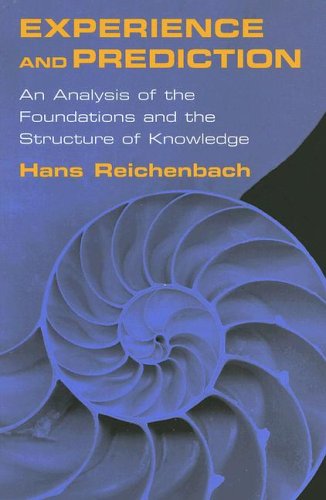
10. Experience And Prediction: An Analysis of the Foundations And the Structure of Knowledge
by Hans Reichenbach
Paperback: 456 Pages (2006-04-30)
list price: US$48.00 -- used & new: US$36.45
(price subject to change: see help)
Asin: 0268040559
Average Customer Review: 5.0 out of 5 stars
Canada | United Kingdom | Germany | France | Japan

Customer Reviews (1)

5-0 out of 5 stars A classic work highly recommended for college library and philosophy reference shelves
Experience And Prediction: An Analysis Of The Foundations And The Structure Of Knowledge reprints the classic treatise by German-American philosopher of science Hans Reichenbach (1891-1953). Paving the way for the rigorous post-WW II philosophy of science, Experience And Prediction breaks down the fundamental conundrums of existence, reduction, projection, construction, the nature of the ego, probability logic, and much more. A highly scholarly text, written expressly to introduce the concept of "logical positivism" (a form of epistemology the prioritized scientific truths over metaphysical truths) to English speakers, Experience And Prediction is a classic work highly recommended for college library and philosophy reference shelves.
... Read more


11. Probability without certainty: foundationalism and the Lewis-Reichenbach debate [An article from: Studies in History and Philosophy of Science]
by D. Atkinson, J. Peijnenburg
Digital: Pages (2006-09-01)
list price: US$7.95 -- used & new: US$7.95
(price subject to change: see help)
Asin: B000P6OTWO
Canada | United Kingdom | Germany | France | Japan
Editorial Review

Book Description
This digital document is a journal article from Studies in History and Philosophy of Science, published by Elsevier in 2006. The article is delivered in HTML format and is available in your Amazon.com Media Library immediately after purchase. You can view it with any web browser.

Description:
Like many discussions on the pros and cons of epistemic foundationalism, the debate between C. I. Lewis and H. Reichenbach dealt with three concerns: the existence of basic beliefs, their nature, and the way in which beliefs are related. In this paper we concentrate on the third matter, especially on Lewis's assertion that a probability relation must depend on something that is certain, and Reichenbach's claim that certainty is never needed. We note that Lewis's assertion is prima facie ambiguous, but argue that this ambiguity is only apparent if probability theory is viewed within a modal logic. Although there are empirical situations where Reichenbach is right, and others where Lewis's reasoning seems to be more appropriate, it will become clear that Reichenbach's stance is the generic one. We conclude that this constitutes a threat to epistemic foundationalism. ... Read more


12. Erkenntnis Orientated: A Centennial Volume for Rudolf Carnap and Hans Reichenbach
Hardcover: 480 Pages (1991-09-30)
list price: US$224.00 -- used & new: US$135.00
(price subject to change: see help)
Asin: 0792314085
Canada | United Kingdom | Germany | France | Japan
Editorial Review

Book Description
This volume is dedicated to Rudolf Carnap and Hans Reichenbach, two of the greatest philosophers of this century, on the occasion of their 100th birthdays. It is presented by Erkenntnis, the journal they founded, and contains 22 contributions from the most renowned analytic philosophers and philosophers of science. The essays address many subjects, all of which are related to the work of Reichenbach and Carnap. They cover epistemology and philosophy of science, metaphysics, philosophy of language, and philosophical logic. They thus display the rich and lively influence of Reichenbach and Carnap on present-day philosophizing. Some further essays give valuable historical information on their philosophical setting and on some neglected aspects of their work; in particular, two unknown pieces by Reichenbach, one of which was never published, have been included in the volume. ... Read more


13. Hans Reichenbach's philosophy of grammar (Janua linguarum)
by William E McMahon
 Unknown Binding: 284 Pages (1976)
-- used & new: US$162.07
(price subject to change: see help)
Asin: 9027932042
Canada | United Kingdom | Germany | France | Japan

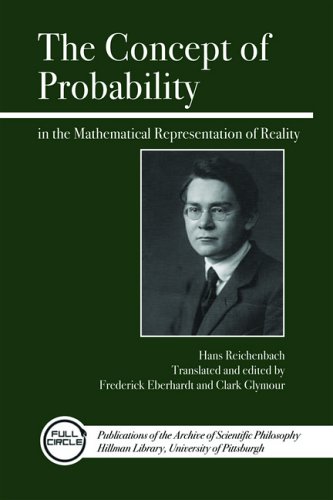
14. The Concept of Probability in the Mathematical Representation of Reality
by Hans Reichenbach
Paperback: 384 Pages (2008-03-28)
list price: US$49.95 -- used & new: US$32.97
(price subject to change: see help)
Asin: 0812696093
Canada | United Kingdom | Germany | France | Japan
Editorial Review

Book Description

The first English translation of Hans Reichenbach's lucid doctoral thesis sheds new light on how Kant’s Critique of Pure Reason was understood in some quarters at the time. The source of several themes in his still influential The Direction of Time, the thesis shows Reichenbach's early focus on the interdependence of physics, probability, and epistemology.
... Read more

15. Hans Reichenbach und die Berliner Gruppe
 Hardcover: 491 Pages (1994)

Isbn: 3528083433
Canada | United Kingdom | Germany | France | Japan

16. Atom and cosmos; the world of modern physics, by Hans Reichenbach. Translated by Edward S. Allen
by Hans (1891-1953) Reichenbach
 Hardcover: Pages (1957)

Asin: B000SSN5N8
Canada | United Kingdom | Germany | France | Japan

17. Elements of Symbolic Logic
by Hans Reichenbach
 Paperback: 444 Pages (1980-04)
list price: US$7.95
Isbn: 0486240045
Canada | United Kingdom | Germany | France | Japan

18. Philosophy and physics: Faculty research lecture, University of California, Los Angeles, delivered March 25, 1946 (Faculty research lecture)
by Hans Reichenbach
 Unknown Binding: 13 Pages (1948)

Asin: B0007DYPS8
Canada | United Kingdom | Germany | France | Japan

19. The philosophy of space & time: Translated by Maria Reichenbach and John Freund ; with introductory remarks by Rudolf Carnap
by Hans Reichenbach
 Unknown Binding: 295 Pages (1957)

Asin: B0007EU80G
Canada | United Kingdom | Germany | France | Japan

20. The Theory of Probability: Inquiry into the Logical and Mathematical
by Hans REICHENBACH
 Paperback: Pages (1987)

Asin: B000RJEEGA
Canada | United Kingdom | Germany | France | Japan

  1-20 of 100 | Next 20
A  B  C  D  E  F  G  H  I  J  K  L  M  N  O  P  Q  R  S  T  U  V  W  X  Y  Z  

Prices listed on this site are subject to change without notice.
Questions on ordering or shipping? click here for help.

site stats