e99 Online Shopping Mall

Geometry.Net - the online learning center Help  
Home  - Scientists - Schwinger Julian (Books)

  1-20 of 42 | Next 20
A  B  C  D  E  F  G  H  I  J  K  L  M  N  O  P  Q  R  S  T  U  V  W  X  Y  Z  

click price to see details     click image to enlarge     click link to go to the store

$61.44
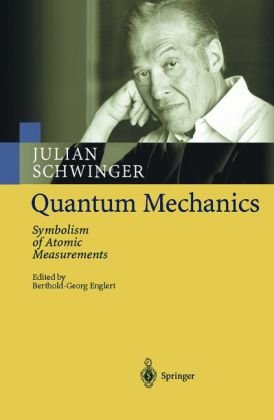
1. Quantum Mechanics: Symbolism of
$39.95
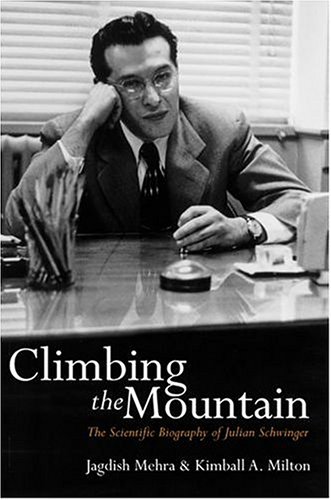
2. Climbing the Mountain: The Scientific
$34.95
3. Quantum Kinematics and Dynamics
$66.93
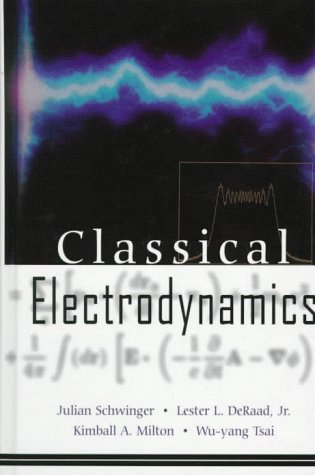
4. Classical Electrodynamics (The
$20.99
5. Particles, Sources, and Fields:
$4.95
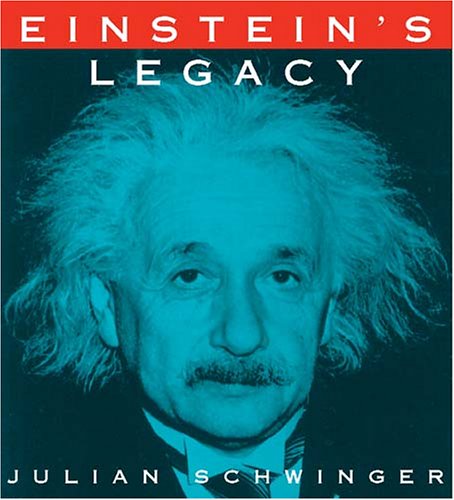
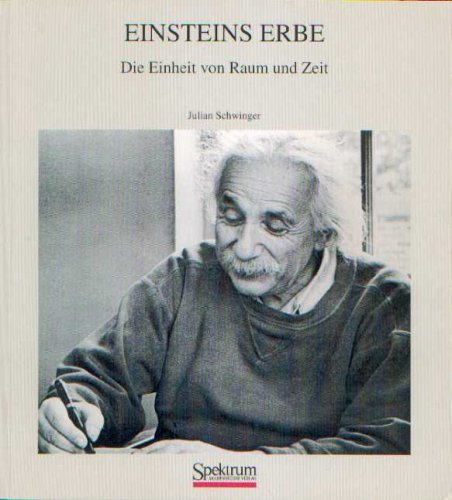
6. Einstein's Legacy: The Unity of
$178.81
7. Electromagnetic Radiation: Variational
$9.42
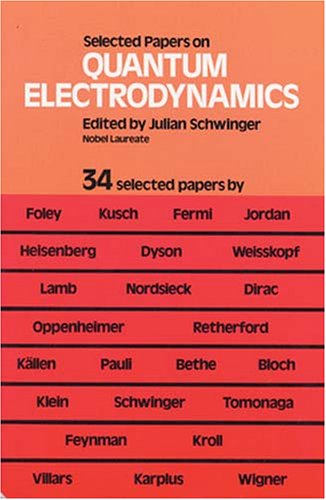
8. Selected Papers on Quantum Electrodynamics
 
$38.90
9. Julian Schwinger: The Physicist,
 
10. Selected Papers (1937-1976) of
 
11. Discontinuities in waveguides;:
 
12. Themes in Contemporary Physics
$137.00
13. A Quantum Legacy: Seminal Papers
 
14. Discontinuities in Waveguides;:
 
15. Particles and Sources Documents
 
16. Paticles & Sources
 
17. Particles and Sources
 
18. Quantum Electrodynamics
 
19. Quantum kinematics and dynamics.
 
20. Particles, Sources, and Fields

1. Quantum Mechanics: Symbolism of Atomic Measurements
by Julian Schwinger
Hardcover: 468 Pages (2003-04-29)
list price: US$79.95 -- used & new: US$61.44
(price subject to change: see help)
Asin: 3540414088
Average Customer Review: 5.0 out of 5 stars
Canada | United Kingdom | Germany | France | Japan
Editorial Review

Book Description
The lecture notes of Julian Schwinger's UCLA course consist of three parts corresponding to the three quarters of teaching. The first part begins with an analysis of Stern--Gerlach-type experiments which accomplishes a self-contained physical and mathematical development of the general structure of quantum kinematics. The second part proceeds from there. The response to infinitesimal time displacements yields the equations of motion. Then the Quantum Action Principle (QAP) is derived, and accepted as a fundamental principle. In a sense, the rest of part two and all of part three consist of instructive applications of the QAP. ... Read more

Customer Reviews (5)

5-0 out of 5 stars Enlightening
This is a fascinating, illuminating, even exciting work.I'm giving it 5 stars, but with the caveat that occaisonally Schwinger's thought process merely left me confused.I'm sure that had he lived to finish the book those few snags would have been worked out with the editors.

One interesting feature is that, once he starts getting into applications,
derivations are worked out in great detail, which may make the book look more mathematically dense than it really is.It's all pretty accessible to anyone who has had undergrad QM.There are also tons of exercises (no solutions, though.)This would make a great supplement to a book like Sakurai's that takes a more deductive approach.I could even see a talented instructor using it as a primary text.

5-0 out of 5 stars relatively easy to follow; unlike his research papers
Schwinger died in 1994, and this book is largely a summation of his lecture notes for courses he gave at UCLA in the 80s. To a physicist who already knows the subject, there are still chances of gleaning insight from Schwinger's approach.

Keep in mind that the notes were for lectures to undergrads and grads. They are not reprints of his journal papers. The latter are somewhat notorious to generations of physics grads. Yes, Schwinger's work on QED was seminal. No physicist disputes that. But his papers were sometimes so hard to follow. Feynman's approach was considered much clearer, especially with his refactorings into what we now call Feynman diagrams. These gave an intuition often lacking from reading the analysis in Schwinger's papers.

Anyhow, the level of dissertion in this book is a lot clearer than in those papers. Rather surprising, to me at least. Because my acquaintance with Schwinger was through the journal papers. I never knew that he could write so clearly as he did here.

5-0 out of 5 stars Great read!
This is how quantum mechanics ought to be written and studied.By reading this book you will be learning from a true master!

4-0 out of 5 stars A unique perspective by a unique man
I presume I do not need to introduce Schwinger's list of credentials, including a nobel prize for QED alongside with Feynman and the third guy (I'm sorry, I never seem to remember his name). Schwinger has always had his own view of physics, much like Feynman, and in his books he usually follows that view. The consequence is a book on an old subject, such as QM, which includes many new viewpoints and ideas not found in other books, especially in use of action principles, of which Schwinger was a major proponent.

That being said, it should be stressed that you should not approach this book without taking a course or two in QM - Schwinger himself states so at the introduction. It would not only make the book hard to follow, but also make it pointless - the whole idea of reading this book is getting a fresh new perspective on QM.

For example, instead of stating the "axioms" of QM, Schwinger decides to examine physical experiments and try to see where these axioms come from. He is not always successful in doing that, but at the very least he should get every faithful reader to deeply ponder the foundations of QM. Instead of just writing down Schroedinger's equation and saying, "this is how our system evolves in time", he decides to take an action principle as his fundamental rule for time evolution and derive Schroedinger's equation from it. In short, he turns QM upside down - and gets away with it.

It is definitely worthwhile checking out this book, although many will not like the idea of doing things Schwinger's way - in a sense, the book's greatest strength is also its greatest weakness. You have been warned.

5-0 out of 5 stars The Perfect Way to Do Quantum Mechanics
Schwinger has presented in the text the perfect way to do Quantum Mechanics.This book is actually transformed from lecture notes given by him for three quarters at UCLA in the mid-1980s.Just look at how he induses the general structure of quantum kinematics and establishes the dynamical principle - his quantum action principle, you would agree with me that it should be on the shelf of every physist, physics teacher and student. ... Read more


2. Climbing the Mountain: The Scientific Biography of Julian Schwinger
by Jagdish Mehra, Kimball A. Milton
Paperback: 696 Pages (2003-10-16)
list price: US$65.45 -- used & new: US$39.95
(price subject to change: see help)
Asin: 0198527454
Canada | United Kingdom | Germany | France | Japan
Editorial Review

Book Description
Julian Schwinger was one of the leading theoretical physicists of the twentieth century. His contributions are as important, and as pervasive, as those of Richard Feynman, with whom (and with Sin-itiro Tomonaga) he shared the 1965 Nobel Prize for Physics. Yet, while Feynman is universally recognized as a cultural icon, Schwinger is little known even to many within the physics community. In his youth, Julian Schwinger was a nuclear physicist, turning to classical electrodynamics after World War II. In the years after the war, he was the first to renormalize quantum electrodynamics. Subsequently, he presented the most complete formulation of quantum field theory and laid the foundations for the electroweak synthesis of Glashow, Weinberg, and Salam, and he made fundamental contributions to the theory of nuclear magnetic resonance, to many-body theory, and to quantum optics. He developed a unique approach to quantum mechanics, measurement algebra, and a general quantum action principle. His discoveries include 'Feynman's' parameters and 'Glauber's' coherent states; in later years he also developed an alternative to operator field theory which he called Source Theory, reflecting his profound phenomenological bent. His late work on the Thomas-Fermi model of atoms and on the Casimir effect continues to be an inspiration to a new generation of physicists. This biography describes the many strands of his research life, while tracing the personal life of this private and gentle genius. ... Read more


3. Quantum Kinematics and Dynamics
by Julian Schwinger
Paperback: 374 Pages (2000-01-15)
list price: US$49.00 -- used & new: US$34.95
(price subject to change: see help)
Asin: 0738203033
Average Customer Review: 5.0 out of 5 stars
Canada | United Kingdom | Germany | France | Japan
Editorial Review

Book Description
A classic from 1969, this book is based on a series of lectures delivered at the Les Houches Summer School of Theoretical Physics in 1955. The book outlines a general scheme of quantum kinematics and dynamics.

Read and cited by scientists worldwide, Advanced Book Classics are works that continue to inform today's groundbreaking research efforts. Redesigned and newly released in paperback, these graduate-level texts and monographs are now available to an even wider audience. Written by the most influential physicists of the twentieth century, these Advanced Book Classics promise to enrich and inspire a new generation of physicists. ... Read more

Customer Reviews (2)

5-0 out of 5 stars The best axiomatic development of pure mechanics ever
Schwinger was arguably one of the four or five brightest physicists of his era in terms of sheer intelligence, and he was also something of an iconoclast.This book beautifully demonstrates both -- it is a highly nontraditional axiomatic development of quantum theory, where the clear expectation is that by developing things extremely clearly from a minimal set of postulates and choices the "right path" on to theoretical breakthroughs becomes clear.I agree completely, although I also believe that some components of that "right path" -- for example, the full richness of Geometric Algebra -- were not yet accessible and need to be mixed into at the right places.

Schwinger begins by developing a priori an algebra of (numerical) measurement in the simplest possible terms.This section has nothing to do with quantum theory per se; rather it applies to any set of quantitative observations of some "system".

He then associates in a very intuitive way the notion that the quantitative measurements obtained in the context of the measurement algebra reflect the state of the system being observed, and works out just how the underlying states can be expressed as a geometry.Some aspects of this geometry are familiar but others are less so.Once again, this chapter is entirely abstract and really has nothing to do with whether the system in question is classical, quantum, or something else entirely.The system is viewed as something that has states, those states form a mixed discrete/continuous geometry, and the states are connected to quantitative measurements via the unknown properties of the measurement process itself.In this chapter he introduces the dirac bra/ket notation as a natural way to express the geometry and its norm/metric (inner product).

Schwinger then posits the fundamental question -- do all possible measurements performed on the system always return the same result independent of the order of measurement, or are there some measurements that will yield different results when performed in different orders?This is presented as an axiomatic choice -- one answer leads of course to classical mechanics, the other to quantummechanics.Only at this point does the book begin to be explicitly quantum mechanical.

Schwinger then formulates (in not unfamiliar but nevertheless compellingly presented ways) a dynamical principle, identifies classes of non-commuting measurement processes, and derives basic quantum theory from no further assumptions.It is beautifully minimal, and one can clearly see the forks in the road he takes and why one takes the branch he takes at each point.

The rest of the book is a gold mine -- Schwinger tries to tackle many of the most challenging issues of the time he delivered these lectures in novel and unconventional ways.They didn't "work" -- there are no breakthroughs here and history has given us in some cases alternative ways of solving or understanding the problems that are now "accepted" -- but his ideas and approach are wonderful to review, especially when one realizes that there was so much that wasn't known fifty years ago that might well inform new attempts to re-tackle those same old issues, or attempts to make progress in e.g. string theory and unified field theory that utilize his unconventional but very systematic approach.

I routinely use this book to help philosophically-minded students introduce themselves to quantum theory via the first three chapters; some of them go on to puzzle over the latter part of the book (as I still do) to see if there is anything yet to be gleaned from it.The book's lecture note format is particularly well suited to this -- one can read the first part of the book and work through everything in at most six or eight hours, total -- a lot of reward for such a small amount of work!

Feynman once said that "nobody understands quantum mechanics".I think that he was right, but a few people understand it far, far better than others:Dirac, Schwinger, and Feynman himself being luminous examples.Students of quantum theory can do far worse than to avail themselves of the words of these masters, especially when they are so tersely and clearly written.

5-0 out of 5 stars A beautiful, highly advanced text on Quantum Mechanics.
Julian Schwinger was one of the greatest minds of our century. He learned, as I heard at one of his semminars, quantum mechanics by himself as he was about fourteen from the horse's mouth, that is, the great book of Dirac, "Principles of Quantum Mechanics". One could consider this book as built around Dirac's. It starts by introducing a pre-Dirac notation, symbols which represent measurements. These symbols "factor out" into Dirac's bras and kets when the system is in a pure state. The mathematical properties of these symbols, therefore, follow from the way quantum mechanics describes experiments. The dynamics is introduced through the use of an action principle, soon explicited in terms of continuous transformation groups whose infinitesimal generators include the observables. This action principle turns out to be a differential version of the now popular Feynman action principle, which introduced the concept of path integrals. Schwinger's book is a!barely explored mine of gold. Most of his ideas are there, waiting for you! I think this is the second most beautiful physics book I ever met. The first, of course, is Dirac's. I think Schwinger would agree with me. ... Read more


4. Classical Electrodynamics (The Advanced Book Program)
by Julian Schwinger, Kimball A. Milton, Lester L., Jr. DeRaad, Wu-yang Tsai
Hardcover: 596 Pages (1998-09-01)
list price: US$79.00 -- used & new: US$66.93
(price subject to change: see help)
Asin: 0738200565
Average Customer Review: 3.5 out of 5 stars
Canada | United Kingdom | Germany | France | Japan
Editorial Review

Book Description
Classical Electrodynamics captures Schwinger's inimitable lecturing style, in which everything flows inexorably from what has gone before. Novel elements of the approach include the immediate inference of Maxwell's equations from Coulomb's law and (Galilean) relativity, the use of action and stationary principles, the central role of Green's functions both in statics and dynamics, and, throughout, the integration of mathematics and physics. Thus, physical problems in electrostatics are used to develop the properties of Bessel functions and spherical harmonics. The latter portion of the book is devoted to radiation, with rather complete treatments of synchrotron radiation and diffraction, and the formulation of the mode decomposition for waveguides and scattering. Consequently, the book provides the student with a thorough grounding in electrodynamics in particular, and in classical field theory in general, subjects with enormous practical applications, and which are essential prerequisites for the study of quantum field theory. An essential resource for both physicists and their students, the book includes a "Reader's Guide," which describes the major themes in each chapter, suggests a possible path through the book, and identifies topics for inclusion in, and exclusion from, a given course, depending on the instructor's preference. Carefully constructed problems complement the material of the text, and introduce new topics. The book should be of great value to all physicists, from first-year graduate students to senior researchers, and to all those interested in electrodynamics, field theory, and mathematical physics. The text for the graduate classical electrodynamics course was left unfinished upon Julian Schwinger's death in 1994, but was completed by his coauthors, who have brilliantly recreated the excitement of Schwinger's novel approach. ... Read more

Customer Reviews (6)

5-0 out of 5 stars A combination of Jackson and Landau
You can learn from Jackson's book mastering the special functions but have less compact idea about the principle of action in electrodynamics, which is nicely covered in Landau's classic book. Schwinger's book have both for you. Besides, Schwinger has the best way of introducing the special functions. This is a nice book on both math and physics. Should be used for standard textbook.

1-0 out of 5 stars Only maths
Contrary to what is said in some reviews, this does not comment at all about the physics. It is only mathematics. Only useful to those looking for some math help in the field.

1-0 out of 5 stars Impenetrable
I found this book to be completely useless to me.It relies heavily on pure math rather than physical insight to treat the subject.Electrodynamics is hard enough without focusing on the physics as if they were an equation to be derived.This book is intended as a replacement for Jackson, but somehow manages to be even less clear.There are plenty of other E&M books to choose from (Schwartz, Landau, Griffiths, Jenkins) and if you are looking for an alternative to Jackson, choose one of those.

5-0 out of 5 stars no title
I have taken physics courses from one of the authors, Milton, and they were some of the best classes I have taken in physics.During the semester, first the foundation is laid then everything builds else builds from it. What comes next is built on what was was taught before. Everything is logical and is built up on what waslectured on previously. Take a few concepts and develop them really well, rather than a shotgun approach of more topics but less detail.This book is of the same style. I highly recommend it.

5-0 out of 5 stars The physics and mathematics of electrodynamics
This is a concise, clear, and coherent account of advanced classical electrodynamics. The equation density is higher than in most books. Mostly this means that intermediate steps of the many illuminating calculations ofthe book are included. Many interesting topics not normally included inthis type of book are included. A lot of the mathematics needed isdeveloped in detail. I recommed it strongly to both teachers and advancedstudents of the subject. ... Read more


5. Particles, Sources, and Fields: Vol. 2
by Julian Seymour Schwinger
Paperback: 324 Pages (1998-11-01)
list price: US$47.00 -- used & new: US$20.99
(price subject to change: see help)
Asin: 0738200549
Average Customer Review: 5.0 out of 5 stars
Canada | United Kingdom | Germany | France | Japan

Customer Reviews (1)

5-0 out of 5 stars a very nobel author
Most people these days are reading peskin and schroeder, weinberg, ryder...etc. They are hard.Schwinger's books (3 vols) departs from most treatments; except for some similarity I think with weinberg (who i havent read). Here is what I like: 1) he wrote it to include everything but kept students in mind. 2) he wrote to counteract ''frustration with mathematical ambiguities and physical remoteness...'' 3) it is 'written by sure hands'' I would not recommend this as a first book or you might not see what he's doing; so do sakurai/bjorken and drell/ryder first, then deepen your knowledge on your second pass at the subject. In that context is it superb. ... Read more


6. Einstein's Legacy: The Unity of Space and Time
by Julian Schwinger
Paperback: 160 Pages (2002-12-13)
list price: US$16.95 -- used & new: US$4.95
(price subject to change: see help)
Asin: 0486419746
Canada | United Kingdom | Germany | France | Japan
Editorial Review

Book Description

A Nobel Laureate relates the fascinating story of Einstein and the development of relativity theory. Perfect for readers without a scientific background, it discusses the meaning of time, gravity and its effect on light, non-Euclidean geometry and the curving of space-time, and more. 189 black-and-white illustrations.
... Read more

7. Electromagnetic Radiation: Variational Methods, Waveguides and Accelerators: Including Seminal Papers of Julian Schwinger (Particle Acceleration and Detection)
by Kimball A. Milton, Julian Schwinger
Hardcover: 590 Pages (2006-06-15)
list price: US$179.00 -- used & new: US$178.81
(price subject to change: see help)
Asin: 3540292233
Canada | United Kingdom | Germany | France | Japan
Editorial Review

Book Description

The present volume comprehensively summarizes the late Julian Schwinger's work on the theory of electromagnetic radiation and its application to waveguides, transmission lines, accelerator physics and synchrotron radiation. The first part, written in textbook style, has grown out of lectures and manuscripts by Julian Schwinger prepared during the war at MIT's Radiation Laboratory, updated with material developed by Schwinger at UCLA in the 1970s and 1980s, and by Milton at the University of Oklahoma since 1994. The second part consists of reprints of more than 15 papers (some of them never published or available with very limited circulation) by Schwinger on these topics. This volume will be of great interest to physicists, electrical engineers and applied mathematicians whether they be students or seasoned professionals. A paperback study edition of the first part is available separately.

... Read more

8. Selected Papers on Quantum Electrodynamics
Paperback: 424 Pages (1958-06-01)
list price: US$19.95 -- used & new: US$9.42
(price subject to change: see help)
Asin: 0486604446
Average Customer Review: 5.0 out of 5 stars
Canada | United Kingdom | Germany | France | Japan
Editorial Review

Book Description

How quantum electrodynamics evolved in the first quarter of the 20th century, revealed here by its creators in 34 papers by Foley, Fermi, Heisenberg, Dryson, Weisskopf, Oppenheimer, Pauli, Schwinger, Klein and other key figures. Twenty-nine are in English, three in German, one each in French and Italian. Preface. Historical commentary.
... Read more

Customer Reviews (2)

5-0 out of 5 stars original papers - what more can you ask for?
The book contains the original papers on quantum electrodynamics. It is is fascinating to see how the minds of these physicists work, in particular, since the authors include several Nobel Price winners. The difference between Schwinger and Feynmann is the very interesting, one is mathematical and the other is intuitive, but both were completely correct! Dyson's paper where he shows that both theories are the same is a classic. An excellent reference for learning QED and for the history.

5-0 out of 5 stars Quantum electrodynamics:meet the heroes!
This is a collection of fundamental papers on quantum electrodynamics, starting from the very first, by Dirac, and going to the paper by G. Kallen showing that at least one of the renormalization constants is infinite (this paper has been called "poetry in quantum field theory"). This is invaluable for the historian, but much more, I think, for the student and, yet more, for the researcher. These days the students learn these things in classroom. This is all right, but it is only in the good pioneering papers that you find the reasons for the choices made, motivations for treating the problem and a full explanation of what is being done and why it would be wrong to follow that other, seemingly much more natural, way. As examples, you'll find here four of the greatest papers by Feynman. If you think Feynman wrote well because you read his popular books, wait till you read his scientific works! There is also the monumental paper by Dyson, where the founding pape! rs of Tomonaga, Schwinger and Feynman are made to coalesce into the beautiful formulation that, afterwards, was repeated in all textbooks. My favorite paper is the great "On gauge invariance and vacuum polarization", by Julian Schwinger, a masterpiece of insight, style, and incredible virtuosity, a paper that still gives rise to original research. The preface by Schwinger is a must for understanding the origin and early development of our main tool in theoretical physics: quantum field theory. ... Read more


9. Julian Schwinger: The Physicist, the Teacher, and the Man
 Hardcover: 195 Pages (1996-11)
list price: US$39.00 -- used & new: US$38.90
(price subject to change: see help)
Asin: 9810225318
Average Customer Review: 4.0 out of 5 stars
Canada | United Kingdom | Germany | France | Japan
Editorial Review

Book Description
In the post-quantum-mechanics era, few physicists, if any, have matched Julian Schwinger in contributions to and influence on the development of physics. A deep and provocative thinker, Schwinger left his indelible mark on all areas of theoretical physics; an eloquent lecturer and immensely successful mentor, he was gentle, intensely private, and known for being "modest about everything except his physics". This book is a collection of talks in memory of him by some of his contemporaries and his former students: A Klein, F Dyson, B DeWitt, W Kohn, D Saxon, P C Martin, K Johnson, S Deser, R Finkelstein, Y J Ng, H Feshbach, L Brown, S Glashow, K A Milton, and C N Yang. From it, one can get a glimpse of Julian Schwinger, the physicist, the teacher, and the man. Altogether, this book is a must for all physicists, physics students, and others who are interested in great legends.--This text refers to the paperback edition! of this title ... Read more

Customer Reviews (1)

4-0 out of 5 stars The Best On Schwinger-- But Only 2/3 of that Promised
For those interested in History of Science, Quantum Mechanics or Julian Schwinger, this is a great book-- at least from the science perspective.

This volume has essays by many of the contemporaries and students of Schwinger.In them, they talk a lot about his science, and howthis has influenced various areas of physics.In that the book is quite valuable.Thus, Schwinger the Physicist.

They also talk a great deal about how great a lecturer he was, and even discuss his lecturing style-- which I found quite interesting.I even found myself making a couple of mental notes for when I lecture.Thus, Schwinger the Teacher.

However, after reading many of these essays, I still could not get a really good feel of what Schwinger the Man was like.There were several anecdotes by some of his students of the sort: "In my five years of graduate school, Schwinger invited me to his house for dinner once.The evening was spent pleasantly." Or: "One time when I went to office hours, Schwinger asked me a question, and I explained why that could not be so.He said "Oh yes!How stupid of me!"This was the only time I heard him admit he was wrong." Or: "Schwinger enjoyed history, but not music."Or:"One time, after he had bought a new car, he took me driving.Usually restrained, on this day he showed reckless abandon."(paraphrasing these)

The feeling I got after reading these essays was that either: (1) Schwinger was such a private man, that no one really got to know him very wellor (2) Physicists do not have a good idea what an adequate description of a man is, other than describing his science--and that these anecdotes encompass what they feel is an adequate representation of the type of man he was.

Personally, I would have liked to hear more about Schwinger the NON-physicist.For example, how did he relate to his children?What about when his mother or father died?How about his relationship with his wife?

Who's to say, though?These are just my thoughts--- and I haven't won a Nobel Prize!

As an added bonus, there is a delightful transcript of a lecture Schwinger gave the year before he died in 1993, on George Green and physics.

This is still worth a look, if you are interested in this sort of thing. ... Read more


10. Selected Papers (1937-1976) of Julian Schwinger (Mathematical Physics and Applied Mathematics)
 Hardcover: 440 Pages (1979-04-30)
list price: US$160.50
Isbn: 9027709742
Canada | United Kingdom | Germany | France | Japan

11. Discontinuities in waveguides;: Notes on lectures by Julian Schwinger (Documents on modern physics)
by Julian Seymour Schwinger
 Unknown Binding: 163 Pages (1968)

Asin: B0006BW2HC
Canada | United Kingdom | Germany | France | Japan

12. Themes in Contemporary Physics II: Essays in Honor of Julian Schwinger's 70th Birthday
by S. Deser
 Hardcover: 104 Pages (1989-11)
list price: US$54.00
Isbn: 997150961X
Canada | United Kingdom | Germany | France | Japan

13. A Quantum Legacy: Seminal Papers of Julian Schwinger (World Scientific Series)
Hardcover: 793 Pages (2000-06)
list price: US$137.00 -- used & new: US$137.00
(price subject to change: see help)
Asin: 9810240066
Canada | United Kingdom | Germany | France | Japan
Editorial Review

Book Description
Julian Schwinger (1918-1994) was one of the giants of 20th Century science. He contributed to a broad range of topics in theoretical physics, ranging from classical electrodynamics to quantum mechanics, from nuclear physics through quantum electrodynamics to the general theory of quantum fields. Although his mathematical prowess was legendary, he was fundamentally a phenomenologist. He received many awards, including the first Einstein Prize in 1951, and the Nobel Prize in 1965, which he shared with Richard Feynman and Sin-itiro Tomonaga for the self-consistent formulation of quantum electrodynamics into a practical theory. His more than 70 doctoral students have played a decisive role in the development of science in the second half of this century.

This important volume includes many of Schwinger's most important papers, on the above and other topics, such as the theory of angular momentum and the theory of many-body systems. The papers collected here continue to underlie much of the work done by theoretical physicists today. ... Read more


14. Discontinuities in Waveguides;: Notes on lectures by Julian Schwinger (Documents on Modern Physics)
by Julian Schwinger, David S. Saxon
 Hardcover: Pages (1968)

Asin: B000UFUB5Y
Canada | United Kingdom | Germany | France | Japan

15. Particles and Sources Documents on Modern Physics
by Julian Schwinger
 Paperback: Pages (1969)

Asin: B000J42XMU
Canada | United Kingdom | Germany | France | Japan

16. Paticles & Sources
by Julian Schwinger
 Paperback: Pages (1969)

Asin: B000XZ1AWY
Canada | United Kingdom | Germany | France | Japan

17. Particles and Sources
by Julian Schwinger
 Hardcover: 102 Pages (1969)

Isbn: 0677020600
Canada | United Kingdom | Germany | France | Japan

18. Quantum Electrodynamics
by Julian [editor] Schwinger
 Paperback: Pages (1958)

Asin: B000VNM28E
Canada | United Kingdom | Germany | France | Japan

19. Quantum kinematics and dynamics.
by Julian (b. 1918). SCHWINGER
 Paperback: Pages (1970)

Asin: B000ZPRG6G
Canada | United Kingdom | Germany | France | Japan

20. Particles, Sources, and Fields (Addison-Wesley Series in Physics)
by Julian Schwinger
 Hardcover: Pages (1970)

Asin: B000ILSCVK
Canada | United Kingdom | Germany | France | Japan

  1-20 of 42 | Next 20
A  B  C  D  E  F  G  H  I  J  K  L  M  N  O  P  Q  R  S  T  U  V  W  X  Y  Z  

Prices listed on this site are subject to change without notice.
Questions on ordering or shipping? click here for help.

site stats