e99 Online Shopping Mall

Geometry.Net - the online learning center Help  
Home  - Scientists - Weyl Hermann (Books)

  1-20 of 98 | Next 20
A  B  C  D  E  F  G  H  I  J  K  L  M  N  O  P  Q  R  S  T  U  V  W  X  Y  Z  

click price to see details     click image to enlarge     click link to go to the store

$12.37
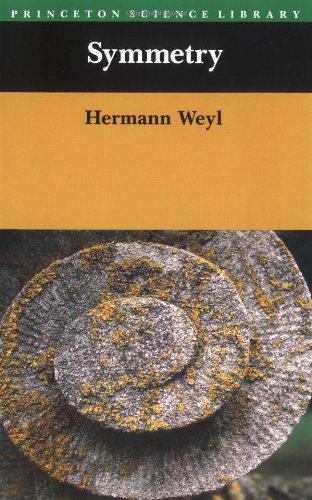
1. Symmetry
 
$65.00
2. The Classical Groups: Their Invariants
$25.19
3. The Theory Of Groups And Quantum
$21.35
4. Space, Time, Matter
$7.23
5. The Continuum: A Critical Examination
$17.98
6. The Open World
 
7. Philosophy of Mathematics and
 
8. The Classical Groups, their Invariants
 
9. Philosophy of Mathematics and
$39.49
10. Infinite Loop Spaces: Hermann
$31.26
11. Hermann Weyl's Raum - Zeit - Materie
$11.56
12. Algebraic Theory of Numbers
$9.95
13. Biography - Weyl, (Claus) (Hugo)
 
$60.65
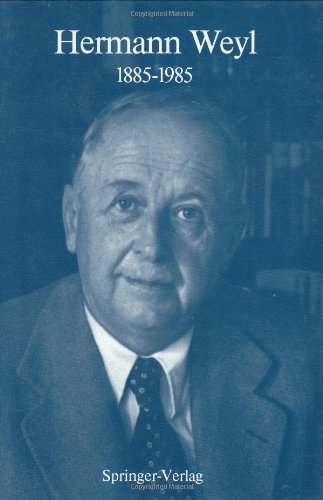
14. Hermann Weyl: 1885-1985 : Centenary
 
15. Fondazione della geometria: Da
 
$74.00
16. Hermann Weyl und die Mathematik
 
17. Concept of a Riemann Surface.Third
18. Gesammelte Abhandlungen: Band
 
19. Space-Time-Matter.
 
20. Philosophy of Mathematics and

1. Symmetry
by Hermann Weyl
Paperback: 176 Pages (1983-01-01)
list price: US$19.95 -- used & new: US$12.37
(price subject to change: see help)
Asin: 0691023743
Average Customer Review: 5.0 out of 5 stars
Canada | United Kingdom | Germany | France | Japan

Customer Reviews (5)

5-0 out of 5 stars a difficult but rewarding introduction to mathematical symmetry and some of it's applications
Symmetry is about the mathematical underpinnings of symmetry as it appears in nature and art. The book is divided into 4 sections, the first Bilateral Symmetry covers reflection. This lecture goes into biology and art. The next lecture is about rotational symmetry. I was able to follow the math presented in this lecture but had trouble in the 3rd lecture titled Ornamental Symmetry. Ornamental symmetry is mostly about tilings of the plane. There is a lot of math presented in this lecture. I had to fall back on my rudimentary knowledge or abstract algebra and linear algebra to understand it. My point is that without this knowledge this lecture and the next one The General Idea of Mathematical Symmetry would have been impossible for me to follow. However, I still recommend this book to people who don't have any of the above background. Symmetry covers the concepts behind symmetry well, and it's applications to nature and art can be followed by anyone.

5-0 out of 5 stars An excellent introduction to the concept of symmetry
Symmetry is a fundamental characteristic of most living creatures, some natural features such as crystals, the basis of some mathematical models and a beautiful form of art. Most animals possess a form of bilateral symmetry, with only minor differences our right and left sides are mirror images of each other. Weyl gives examples of all of these types of symmetry, images with text explaining the details regarding the symmetry of the object.
At the end, he gives the mathematical explanations of the symmetries, how they can be combined into the construct known as a group. The symmetries can then be sequentially combined to perform multiple actions and generate other actions. This dual examination provides a great deal of insight into the idea of symmetry. Biologically, it is clear that there must be powerful evolutionary advantages to symmetry, as it is universal in the animal kingdom. Humans also have a natural affinity for symmetric objects, as symmetry is a universal theme in the art work of cultures with little or no contact between them.
Weyl has written an excellent introduction to the concept of symmetry. It is an idea that is easy to understand and the different motions of a symmetric object are a very good way to begin the study of group theory. Artists can also obtain some benefit from the additional knowledge of symmetry that they will get from this book.

5-0 out of 5 stars Symmetry Package
This book came promptly, in perfect condition.Much more affordable than through the college bookstores.

4-0 out of 5 stars Great Examination of Symmetry from a Mathematical Viewpoint
Be forewarned this book is technical and mathematical. Though you can definitely read it without going through all the math and thinking it through it won't be nearly as valuable to you as it would be if you spentsome time and actually thought things out and figured them out rather thanjust speeding through. That being said this is probably the bestexamination of symmetry out there that I have read. Weyl starts from verysimple concepts and eventually works his way up to examining even complexornamental symmetry. Of course much of what he says about symmetry is trueof aesthetics and beauty in general and many parallels can be drawn betweenwhat he is saying and other items like music that may not appear to haveclear symmetry right off the bat. Unfortunately in the version I have thecitations that Weyl makes are not clearly listed, but many of the authorsare fairly prominent and easy to look up. If you like this book I mightalso reccomend G. D. Birkhoff's Aesthetic Measures. Where, Weyl isinterested more in just symmetry Birkhoff is interested in mathematicalaesthetic examination in general. Overall this book is a must read foranyone interested in aesthetics.

5-0 out of 5 stars Ornamentation and its mathematical basis
This delightful booklet motivates the study of symmetry by showing its presence in art and nature. This is a work of love, frequently bordering poetry. Yet, it is a scientific book of high class. Hermann Weyl, one of the very great mathematicians of this century, then explains the mathematics behind symmetry, mostly group theory, and obtains all forms that, by repetition, completely fill the plane and the space (the crystallographic groups). This is wonderful reading. After it, the reader should be prepared for a beautiful recent discovery by R. Penrose, that there are aperiodical forms that completely fill the space, and, still more surprising, that Nature makes use of them. They are the quasi-crystals (not treated in Weyl's book, of course). ... Read more


2. The Classical Groups: Their Invariants and Representations (Mathematics)
by Hermann Weyl
 Hardcover: 336 Pages (1946-09)
list price: US$70.00 -- used & new: US$65.00
(price subject to change: see help)
Asin: 0691079234
Average Customer Review: 5.0 out of 5 stars
Canada | United Kingdom | Germany | France | Japan
Editorial Review

Book Description
In this renowned volume, Hermann Weyl discusses the symmetric, full linear, orthogonal, and symplectic groups and determines their different invariants and representations. Using basic concepts from algebra, he examines the various properties of the groups. Analysis and topology are used wherever appropriate. The book also covers topics such as matrix algebras, semigroups, commutators, and spinors, which are of great importance in understanding the group-theoretic structure of quantum mechanics. ... Read more

Customer Reviews (2)

5-0 out of 5 stars Hard-core Group Theory
Forget about that pansy abstract axiom approach. This is the WWF of group theory. Weyl will take anyone to the mat with this book. It is packed with detail and demonstrations.He follows the vector space/matrix representation approach common to digital systems, physics and chemistry rather than axiomatic, generators/permutations approach more common in Abstract Algebra courses. This is the lineage that develops matrix transforms as groups starting from "the full group of all non-singular linear transformations and .. the orthogonal groups" (p. vii). The latter chapters cover characters and invariants. Galois and field theory have been vanquished. Chapter 2, "Remembrance of things past" is very entertaining. My favorite quote, "Here there is only one man to mention - Hilbert. His papers (1890/92) mark a turning point in the history of invariants theory. He solves the main problems and thus almost kills the whole subject." It's funny because it's true.This is almost a botanical treatise in which the matrix groups are studied as specimens in the jungle -- "...after all each group stands in its own right and does not deserve to be looked upon merely as a subgroup of...Her All-embracing Majesty GL(n)." (p 136). Historic references throughout provide motivation and entertainment. You couldn't possibly be disappointed with this book.

5-0 out of 5 stars Great
Although this is a dated work, lacking some of the more modern language, it is still worth owning and reading.It is, after all, a designated "classic."And the material presented has been incorporatedwithin so many aspects of physics that one simply cannot avoid needing abook such as this.There are better books on the subject, for bothmathematicians and physicists, but this book still proves its worth. ... Read more


3. The Theory Of Groups And Quantum Mechanics
by Hermann Weyl
Paperback: 448 Pages (2007-03-01)
list price: US$36.95 -- used & new: US$25.19
(price subject to change: see help)
Asin: 1432594109
Average Customer Review: 4.5 out of 5 stars
Canada | United Kingdom | Germany | France | Japan
Editorial Review

Book Description

This landmark among mathematics texts applies group theory to quantum mechanics, first covering unitary geometry, quantum theory, groups and their representations, then applications themselves — rotation, Lorentz, permutation groups, symmetric permutation groups, and the algebra of symmetric transformations.
... Read more

Customer Reviews (6)

5-0 out of 5 stars one the the most important work in quantum mechanics
It's a very important book, written by the father of group theory application in physics (with Wigner and Pauli), and one of the best mathematician of 20th century, Hermann Weyl. Everyone who wants study a deeper view of quantum mechanics, in his intrinsic mathematical formulation, should read this work. After a firt brief introduction to quantum theory, he passes to explain the theory of rapresentation of groups, and its physical application, like the rotation group, or Lorentz group, and finally the theory of simmetry. It's a fundamental book for a good understandig of the importance of simmetries in modern physics. Without any doubt one the the most important work in quantum mechanics.

4-0 out of 5 stars Still a good book
Written in the early years of the quantum theory, the author of this book foresaw the importance of considering symmetry in physics, the use of which now pervades most of theoretical high energy physics. Indeed, with the advent of gauge theories, and their experimental validation, it is readily apparent that symmetry principles are here to stay, and are just not accidental curiosities. A reader of the book can still gain a lot from the perusal of this book, in spite of its date of publication and its somewhat antiquated notation. Older books also have the advantage of discussing the material more in-depth, and do not hesitate to use hand-waving geometrical pictures when appropriate. This approach results in greater insight into the subject, and when coupled with eventual mathematical rigor gives it a solid foundation. One example where the discussion is superior to modern texts is in the author's discussion of group characters and their application to irreducible representations and spectra in atomic systems.

The reader will no doubt probably want to couple the reading of this book with a more modern text so as to alleviate the notational oddities in this book. The author's presentation is clear enough though to make an appropriate translation to modern notation. The reader will then be well prepared to tackle more advanced material in mathematical and theoretical physics that make use of the group-theoretic constructions that take place in this book.

5-0 out of 5 stars A wonderful book
This is my favorite introduction to quantum mechanics. It is a difficult book, because it is succinct, though clear, and reflects Weyl's powerful intellect and original approach at every step. Each page is a challenge, but worth the effort.

5-0 out of 5 stars One of the two great classics on group theory in physics
The other one is Wigner's "Group Theory and Quantum Mechanics". As it is true of the other great books by Weyl, this is not an easy book, but it is, by all means, accessible. Don't try to read it in front of the TV set. Get pencil and paper, put yourself in a calm and contemplative mood and patiently read the words of the master. Hermann Weyl, one of the great minds of the 20th century, wrote this book with utmost care to make it self-contained. Sometimes you have to be deep in order to be brief, so the book requires some thought. But the main ideas are all there, and the connection of group theory with quantum mechanics has here its best treatment, in my humble opinion. But in less humble too: this was the only book concerning physics which Enrico Fermi read as a grown up. Once, Max Born had to write a synthetic exposition of Quantum Mechanics. After he finished it, he saw, for the first time, this book, and Weyl's synthesis of QM. He felt depressed by the superiority of Weyl's text. The book was originally written in German, but the translation is excellent, due to the great American cosmologist H. P. Robertson, of Robertson-Walker fame.

4-0 out of 5 stars Classic from the early days of quantum mechanics
Although published by Dover in 1984, this book dates back to about 1930, when Weyl was the big proponent of group theory in quantum mechanics. Because of this date, much of what modern books on group theory wouldinclude, is absent from the book. It mainly discusses the permutationgroup. The book is, however, of historic interest, as Weyl (mathematician)tried to convince the physicists to exploit group theory - which even gaverise to some irritation ("group pest"). ... Read more


4. Space, Time, Matter
by Hermann Weyl
Paperback: 348 Pages (2007-09-12)
list price: US$31.95 -- used & new: US$21.35
(price subject to change: see help)
Asin: 0548452784
Average Customer Review: 4.5 out of 5 stars
Canada | United Kingdom | Germany | France | Japan
Editorial Review

Book Description

"A classic of physics ... the first systematic presentation of Einstein's theory of relativity." — British Journal for Philosophy and Science. Long one of the standard texts in the field, this excellent introduction probes deeply into Euclidean space, Riemann's space, Einstein's general relativity, gravitational waves and energy, and laws of conservation.
... Read more

Customer Reviews (6)

5-0 out of 5 stars MASTERPIECE OF BEAUTY AND TRUTH
Weyl's book is most famous for introducing gauge theory, which was later reborn in the form of phase transformations in quantum theory. Weyl did not live guite long enough to hear of the latter being applied by Yang and Mills, though he socially interacted with Yang in his last year at Princeton.

Einstein and Pauli both criticized Weyl's original unified theory based on general relativity using a length gauge, both as implying false empirical consequences (Einstein), since it implied tiny changes of length dependent on path and as untestable (Pauli). (Obviously it could not both be empirically false and non-empirical.) Yet Eddington and later Einstein himself revived similar theories. Eddington claimed that the length differences were to tiny as to be undetectable, but also that his own gauge theory could be thought of not as literal space/time structure but as a geometrization of an abstract background theory for specific space/time structures.

Thomas Ryckman's "The Reign of Relativity" (Oxford, 1995)has an excellent eighty page discussion of these ideas of Weyl in relativity, as well as chapters on those of Eddington in the 1920s.

Another novelty is Weyl's suggestion that General Relativity could be tied to observation via the conformal structure as representing light cones and the projective structure as particles in free fall. This alternative to the rods and clocks approach, on the basis of which Weyl was criticized, has been developed by Ehlers (who edited the new German edition of this work) Pirani and Schild.

Weyl also introduces what he calls "tensor densities" which Shouten called "Weyl tensors" and Synge and Schild call oriented tensors, often called twisted tensors. These are analogous to and include "axial vectors."

Weyl's introduction of the "affine connection" after criticism of Levi-Civita's notion of parallelism led the way to further notions of connections and generalization of the notion of connection as such by Elie Cartan and others.

These are but a few of the intellectual gems in this work.

The philosophical parts are, unfortunately, almost uniformly mistranslated. The phenomenological introduction is re-translated in Kockelmans and Kisiel, eds. "Phenomenology and the Natural Sciences." (Courant suggested Weyl as successor to Husserl in the philosophy chair at Goettingen!) This together with the misprints in formulas, makes it desirable that the whole book be retranslated.

4-0 out of 5 stars Dated, but a Masterpiece
In 1918, Hermann Weyl developed a theory of the combined gravitational-electromagnetic field that was based on an early form of today's gauge formalism. This book neatly summarizes Weyl's motivations for what can be considered the first serious attempt at unified field theory. This attempt failed, but the gauge idea did not, and in 1929 Weyl transformed it into the gauge-invariant concept of quantum mechanics. Today, gauge invariance is arguably the most profound concept in modern quantum theory, and our understanding of the strong and weak nuclear interactions would not have been possible without it.

Weyl was first and foremost a mathematician, but he also proved to be a visionary theoretical physicist who was greatly admired by the likes of Einstein, Pauli, Dirac and Heisenberg. He was also a great human being who was involved with humanity. In spite of its great age, Space-Time-Matter has earned a place of distinction in the physics literature, if only because of Weyl's gauge idea. The Dover edition costs next to nothing; get it andenlighten yourself.

4-0 out of 5 stars A Classic of Relativity Theory
Not long after Einstein published his general theory of relativity one of the greatest mathematician of his time trumped it. Space-Time-Matter has been published by Dover press for a very long time. My copy was put out in the 5o's. I bought it used in the late 60's. I have never regretted buying it. It is difficult reading even when you know what he is talking about: when I got it , it read like Greek. It isn't an easy read, but he predicts a tenth planet in it that was never found! And lays the foundation of what later became gauge theory. He introduces group theory at a time when quantum groups were just beginning. His tensor discussion is very basic and he doesn't even introduce the Weyl tensor! But he taught me the basic metrical equations and the applications of non Euclidean geometry to relativity. Together with Weinberg's flawed Cosmology this book has been my teacher. I wish I could say he did a good job, but since it took me years to wade through it without falling asleep, I can't say he did!

5-0 out of 5 stars God is the geometer (maybe)
This book is esoteric initiation into spacetime physics. Written with intellectual passion, full of powerful insights & alluring legions of equations- you will enjoy even by immersion in its spirit. Read it slowly and in awe: witness great ideas grow & collapse. Not a textbook, proven wrong in not few points, this is a mutable & profound vision of reality by one of the last universal mathematicians. If you want profit- look elsewhere.

5-0 out of 5 stars Please create an audio adaptation ...
To the publisher I would appreciate it if the publisher could produce an audio adaptation of this book. I would love to listen to this while I drive to work and to let my 16 month old son listen to it as a bedtime story.Arnold D Veness ... Read more


5. The Continuum: A Critical Examination of the Foundation of Analysis
by Hermann Weyl
Paperback: 130 Pages (1994-03-14)
list price: US$8.95 -- used & new: US$7.23
(price subject to change: see help)
Asin: 0486679829
Average Customer Review: 3.5 out of 5 stars
Canada | United Kingdom | Germany | France | Japan
Editorial Review

Book Description

This classic text deals with the conceptual problem posed by the continuum — the set of all real numbers. Chapter 1 deals with the logic and mathematics of set and function, while Chapter 2 focuses on the concept of number and the continuum. Advanced-level mathematical landmark will interest anyone working in foundational analysis. Bibliography. Originally published 1918.
... Read more

Customer Reviews (4)

3-0 out of 5 stars Not Weyl's finest writing
Space, Time, Matterand Symmetry are two true classics by this arthor.
This book translates badly and the subject has been covered better and more clearly by others like:The Principles of Mathematics.
The KAM theorem made Weyl's arguments obsolete
as it gave a better technology for the rational number continuum
approximations used in thesekinds of discussions. He never quite made his circulus vitiosusidea work.

5-0 out of 5 stars Correction
I feel obliged to place a 5-star review as compensation for the incompetent review by "GangstaLawya". He is a true amateur, the exact opposite of Hermann Weyl. "GangstaLawya" obviously couldn't understand the book and blames Weyl for this, trying to prevent other people from understanding it, how childish.
"GangstaLawya" claims in his "review" that Weyl didn't contribute to mathematics. Look for the "Weyl character formula" on the internet to see that he is wrong and thus incompetent.

1-0 out of 5 stars Waste of time
I'm quite skeptical of the merits of the analytic philosophers with regard to their labor in mathematical logic.Although much of my early understanding of the sciences and mathematics came from mathematical logicians, such as Russell, Carnap, Reichenbach, Hahn and Weyl, I discovered that knowledge to be a foundation built on sand.D'Abro notes that Russell never contributed anything productive to the development of mathematics.He never "created" any.Similarly, Weyl tackles the age old problem of founding the real numbers in a manner independent of geometrical methods.The latter would be circular reasoning since it is precisely that which we wish to depart from since sets are deemed more mathematically "pure" than geometrical lines.However, if, as Poincare says, the reasoning of Frege and hence of Dedekind leads to unwelcome paradoxes or contradictions, then Weyl's task is monumental indeed.

Originally, Newton talked about the vague idea of fluents and Liebnitz talked about the vague idea of infinitesimals.Cauchy circumvented the problem and gave us the concept of the limit, which is given the alternative appellation of "instantaneous velocity."Thus, the limit, as a distinct number approached by a sequence, doesn't suffer from the problem of unintelligibility.Bolzano, the Czech, gave us the modern concept of continuity, which was ultimately clipped and pruned into the intermediate value theorem.The proof of the latter is based on the rather odd but consistent reasoning that a certain "s" is both < and = to 0 and > and = to 0.Since it cannot be both < and > than 0, and since it is also = to 0, well, it is equal to zero.Q.E.D.

Dedekind showed that the real numbers is "complete" in the sense that there are no gaps to fill in with new kinds of numbers.His "cuts" land on only one single number, and not two or more numbers, and hence produces a correspondence between the real numbers and the geometric line.However, as Poincare showed, the underlying set concept of these cuts betrays logic.

Exploring mathematical forumlations is called metatheory.I don't think such metatheory, with exception of Kurt Goedel, has been productive in mathematics.In a sense, Bishop Berkeley engaged in such metatheory when he referred to calculus as dealing with ghosts of departed quantities.In Berkeley's reasoning, speed is change in position, change of position takes time, and therefore an instantaneous velocity (to use modern parlance) is an object moving in zero time or no time.This doesn't seem to make any sense.Similarly, Dedekind cuts don't seem to accomplish what they purport to accomplish if we pay attention to the fact the underlying set theory of such cuts leads to paradox's or contradictions.Thus, while calculus divides by zero, set theory makes improvident assumptions that give full flower to paradox.It seems "paradox" is the analogue in logic for "dividing by zero" in mathematics.

Weyl recounts the history of the continuum and fails to provide any insightful solutions to the conundrum Dedekind faced in lieu of Poincare's criticism.To give this book more than one star is to credit Weyl for nothing.He may be famous, but what did he contribute to mathematics?He's no Cauchy, no Gauss, no Euler, no Descartes or Galois.He's just meditating on what others have done, and was unproductive at it.

To sum up, work such as Weyl's acquaints us with a technical vocabulary that is full of thunder but signifies nothing.In Godel's short proof of the incompleteness theorem, Russell's towering structure crashed to the ground like the demolition job perpetrated against the twin towers.Similarly, Weyl doesn't give us anything new.Unlike Poincare, Weyl seemed to begin with what others had done, and left their works without adding to them.

Cauchy's definitions and Bolzano's definitions actually added to and clarified the works of their predecessors, Newton and Liebnitz.Berkeley prompted guys like Cauchy and Bolzano to clarify what we're talking about.What has Weyl done?Berkeley already provided the criticism necessary to prompt mathematicians to clarify their ideas.Weyl just produced sophisticated, albeit unproductive, meditations on the result of his predecessors' work.This book starts out with a grandiose promise of giving critical examination of analysis, and we end up leaving the end of the book empty handed.As a corollary, it shows a parallel between the meaningless speculations of the Kabbalists and Weyl's yiddish background.It is culturally ill-prepared for giving rise to Western ingenuity.Like the members of MENSA, the intellectual "dabbler" is skilled at trivial games found on the LSAT, SAT or other standardized tests, waxing profound on crossword puzzles, but completely incapable of painting a sistine chapel, erecting a skyscraper, or designing an automobile.

5-0 out of 5 stars a fascinating detour
I first learned of this book from Eves and Newsom back in the early 1960's. It sounded fascinating but I couldn't read German. Now we're lucky to have it in Englsh translation with an introduction that relates Weyl's notation and terminology to the current one. (Or, if you're really out of date like me, you can use it in reverse to catch up on the modern field of foundations studies).
Precise statement is the essence of the study of the foundations of mathematics and what follows won't rise to that level but I hope it won't be seriously misleading either. In real life definitions are often circular; dictionaries define words in terms of otherwords, etc. Ordinarily this is not a problem but vicious circles can happen. In 1872 Dedekind published a definition of real numbers in terms of sets of rational numbers.
This fulfilled a long term dream of defining the reals without reference to geometric concepts. Encouraged by this Frege began his project of deriving all of mathematics from basic logical notions. He was largely successful but Russell found a contradiction within his system. It wasn't clear what caused this problem and Poincare suggested that it arose because Frege had allowed a certain kind of circular definition called 'impredicative'. While it was true that the contradiction could be eliminated by avoiding impredicative definitions, this solution was very drastic: it also barred Dedekind's defintion of the real. Most mathenaticians, including Whitehead and Russell, shrank from this step and proposed more moderate ways of fixing the foundations of mathematics. Working in the aftermath of World War I, Weyl was attracted to the more radical idea of trying to develop mathematics without using any impredicative definitions. He managed to derive some, but far from all, of analysis and the result was this book. Subsequently, Weyl was attracted to an even more radical critique of mathematical foundations proposed by Brouwer (you can read about this in Mancosu's great anthology "From Brouwer to Hilbert". At the same time Weyl remained passionately attached to mainstream mathematics. As far as I know, he never resolved his own conflicts about this. Naturally, anything by Weyl is brilliant and worth reading and this book is no exception. ... Read more


6. The Open World
by Hermann Weyl
Paperback: 84 Pages (1989-10)
list price: US$18.00 -- used & new: US$17.98
(price subject to change: see help)
Asin: 0918024706
Canada | United Kingdom | Germany | France | Japan

7. Philosophy of Mathematics and Natural Science
by Hermann Weyl
 Hardcover: Pages (1949-01-01)

Asin: B000JWTFU0
Canada | United Kingdom | Germany | France | Japan

8. The Classical Groups, their Invariants andRepresentations
by Hermann Weyl
 Hardcover: Pages (1953)

Asin: B000H845OC
Canada | United Kingdom | Germany | France | Japan

9. Philosophy of Mathematics and Natural Science
by Hermann Weyl
 Paperback: Pages (1959)

Asin: B000WIQDEW
Canada | United Kingdom | Germany | France | Japan

10. Infinite Loop Spaces: Hermann Weyl Lectures, The Institute for Advanced Study. (AM-90) (Annals of Mathematics Studies)
by John Frank Adams
Paperback: 230 Pages (1978-09-01)
list price: US$39.50 -- used & new: US$39.49
(price subject to change: see help)
Asin: 0691082065
Average Customer Review: 5.0 out of 5 stars
Canada | United Kingdom | Germany | France | Japan

Customer Reviews (2)

5-0 out of 5 stars Rigorous, but very understandable
Although published in 1978, this book could be used as an introduction to the theory of operads and other recent work on homotopy theory and vertex operators. Vertex operators are not discussed in this book, but the theory elucidated herein is good background material for their study.

The author does a great job in motivating the subject in chapter 1. Loop spaces are function spaces of maps from the unit interval to a space with a chosen basepoint, with the property that each map sends 0 and 1 to the base point. The mathematician Jean Pierre Serre introduced the path space in order to study loop spaces, resulting in the famous Serre fibering. The nth homotopy group of the loop space can be shown to be equivalent to the (n+1)-th homotopy group of the original space. The homology of loop spaces can be calculated for some types of spaces, such as wedges of spheres. Infinite loop spaces are essentially sequences of spaces such that the nth element of this sequence is equivalent to the loop space of the (n+1)-th element. This sequence is also known as an "Omega-spectrum" and has the infinite loop space as its zeroth term. The name "spectrum" comes from general considerations involving sequences of spaces where the nth term is equivalent to the loop space of the (n+1)-th term; equivalently, where the suspension of the nth term is equal to the (n+1)-th term. The author reviews how a generalized cohomology theory yields an Omega-spectrum, giving two examples involving Eilenberg-Maclane spaces and complex and real K-theory. One can also start with a spectrum and construct a generalized homology and cohomology theory. Spectra and cohomology theory are thus essentially equivalent.

Chapter 2 is an overview of techniques needed to construct a category of spaces with enough structure so that the infinite loop space functor yields an equivalence from the category of spectra to the category of certain spaces. An example of the latter is given by the Stasheff A-infinity space, and its now ubiquitous property of having a product which is strictly associative. This property allows one to prove that a space is equivalent to a loop space if and only if the space is a Stasheff A-infinity space and that the zeroth homotopy of the space is a group. The Stasheff A-infinity spaces are also used to motivate the construction of 'operads'.

The next chapter the author is concerned with the concept of a space being like another one without being equivalent to it. He discusses the use of 'localization' in homotopy theory, an idea that is analogous to the one in algebra. The use of localization in homotopy theory is due to D. Sullivan, and involves use of the notion of a space being 'A-local', where A is a subring of the rationals. Remembering that a Z-module is A-local if it has the structure of an A-module, a space is A-local if its homotopy groups are A-local. Examples of the use of localization in constructing certain spaces are given. The author also discusses the use of the 'plus construction' that allows the alteration of fundamental groups without affecting the cohomology groups. Then after the construction of the Quillen higher algebraic K-theory groups in this regard, the author describes the relation between a topological monoid and the loop space of the classifying space of this monoid. This involves the notion of 'group completion', which is essentially an isomorphism between the homology of the path components of the monoid and the homology of the loop space of the classifying space of the monoid, but in the (infinite) direct limit.

Chapter 4 introduces the concept of a transfer map. A very elusive idea at first glance, the transfer map is motivated via the n-sheeted covering map of a space on another. The (singular) simplices of each then get matched up by the covering, and the transfer map between the spaces is then defined so that it is equal to the sum of the singular simplices of the covering space. It is in fact a chain map as shown by the author. The transfer maps are related to homotopy classes of the 'structure' maps of chapter 2, and the author gives a few examples of how they are used.

Chapter 5 is a quick overview of the Adams conjecture, which is essentially an assertion that the image of KO(X) in KF(X) can be characterized explicitly. Detailed proofs are omitted but references are given for the interested reader.

In chapter 6, the author restricts his attention to the K-theory of spectra. The treatment is concerned in large degree with the question of the existence of infinite loop map between infinite loop structures, and finding such a map, checking whether it is unique. This question is answered for particular types of spectra, via the Madsen, Snaith, and Tornehave theorem. Also, the Adams-Priddy theorem is proved, showing that one can construct on a space a unique infinite loop space structure. The reader gets more examples of the use of localization, in that some spaces can become equivalent as infinite loop spaces upon localization. The origin of K-theory in this chapter comes from the replacing of spectra that are not known by ones that are (namely the ones in classical K-theory). The author shows how the Madsen-Snaith-Tornehave theorem works in the context of both complex and real (periodic) K-theory. Detailed proofs are given for all of these results.

5-0 out of 5 stars A charming and readable introduction to infinite loop spaces
Reading this book made me excited about infinite loop spaces, which I had always imagined to be a very dry topic. Adams informal style reads as smoothly as a purely expository work, but gave me enough understanding andinsight to make me feel like I could fill in the details myself if I neededto. Even if this isn't always literally true, it certainly oriented me wellenough to be able to make sense of the literature. I especially liked thediscussion of A_infty spaces. ... Read more


11. Hermann Weyl's Raum - Zeit - Materie and a General Introduction to his Scientific Work (Oberwolfach Seminars)
Paperback: 403 Pages (2001-03-01)
list price: US$63.95 -- used & new: US$31.26
(price subject to change: see help)
Asin: 3764364769
Canada | United Kingdom | Germany | France | Japan
Editorial Review

Book Description

Historical interest and studies of Weyl's role in the interplay between 20th-century mathematics, physics and philosophy have been increasing since the middle 1980s, triggered by different activities at the occasion of the centenary of his birth in 1985, and are far from being exhausted. The present book takes Weyl's "Raum - Zeit - Materie" (Space - Time - Matter) as center of concentration and starting field for a broader look at his work. The contributions in the first part of this volume discuss Weyl's deep involvement in relativity, cosmology and matter theories between the classical unified field theories and quantum physics from the perspective of a creative mind struggling against theories of nature restricted by the view of classical determinism. In the second part of this volume, a broad and detailed introduction is given to Weyl's work in the mathematical sciences in general and in philosophy. It covers the whole range of Weyl's mathematical and physical interests: real analysis, complex function theory and Riemann surfaces, elementary ergodic theory, foundations of mathematics, differential geometry, general relativity, Lie groups, quantum mechanics, and number theory.

... Read more

12. Algebraic Theory of Numbers
by Hermann Weyl
Paperback: 240 Pages (1998-04-20)
list price: US$45.00 -- used & new: US$11.56
(price subject to change: see help)
Asin: 0691059179
Canada | United Kingdom | Germany | France | Japan
Editorial Review

Book Description

In this, one of the first books to appear in English on the theory of numbers, the eminent mathematician Hermann Weyl explores fundamental concepts in arithmetic. The book begins with the definitions and properties of algebraic fields, which are relied upon throughout. The theory of divisibility is then discussed, from an axiomatic viewpoint, rather than by the use of ideals. There follows an introduction to p-adic numbers and their uses, which are so important in modern number theory, and the book culminates with an extensive examination of algebraic number fields.

Weyl's own modest hope, that the work "will be of some use," has more than been fulfilled, for the book's clarity, succinctness, and importance rank it as a masterpiece of mathematical exposition.

... Read more

13. Biography - Weyl, (Claus) (Hugo) Hermann (1885-1955): An article from: Contemporary Authors
by Gale Reference Team
Digital: 11 Pages (2003-01-01)
list price: US$9.95 -- used & new: US$9.95
(price subject to change: see help)
Asin: B0007SHLKM
Canada | United Kingdom | Germany | France | Japan
Editorial Review

Book Description
This digital document, covering the life and work of (Claus) (Hugo) Hermann Weyl, is an entry from Contemporary Authors, a reference volume published by Thompson Gale. The length of the entry is 3055 words. The page length listed above is based on a typical 300-word page. Although the exact content of each entry from this volume can vary, typical entries include the following information:

  • Place and date of birth and death (if deceased)
  • Family members
  • Education
  • Professional associations and honors
  • Employment
  • Writings, including books and periodicals
  • A description of the author's work
  • References to further readings about the author
... Read more

14. Hermann Weyl: 1885-1985 : Centenary Lectures Delivered by C.N. Yang, R. Penrose, A. Borel at the the Zurich
 Hardcover: 119 Pages (1987-01)
list price: US$98.00 -- used & new: US$60.65
(price subject to change: see help)
Asin: 0387168435
Canada | United Kingdom | Germany | France | Japan

15. Fondazione della geometria: Da Bernhard Riemann a Hermann Weyl = Uber die Hypothesen, welche der Geometrie zu Grunde liegen (Collana di filosofia)
by Giorgio Scrimieri
 Unknown Binding: 318 Pages (1992)

Isbn: 8877865814
Canada | United Kingdom | Germany | France | Japan

16. Hermann Weyl und die Mathematik an der ETH Zürich 1912 - 1930 (History of Mathematics)
by G. Frei, U. Stammbach
 Hardcover: 210 Pages (1992-04-10)
list price: US$74.00 -- used & new: US$74.00
(price subject to change: see help)
Asin: 3764327294
Canada | United Kingdom | Germany | France | Japan

17. Concept of a Riemann Surface.Third Edition, 1955.
by Hermann Weyl
 Hardcover: Pages (1964)

Asin: B000V2CRM6
Canada | United Kingdom | Germany | France | Japan

18. Gesammelte Abhandlungen: Band 1 bis 4. FOUR VOLUME SET
by Hermann Weyl
Hardcover: 2848 Pages (1968-01-01)
list price: US$330.00
Isbn: 3540043888
Canada | United Kingdom | Germany | France | Japan

19. Space-Time-Matter.
by Hermann. Weyl
 Hardcover: Pages (1922)

Asin: B000L23TWS
Canada | United Kingdom | Germany | France | Japan

20. Philosophy of Mathematics and Natural Science, Revised and Augmented
by Hermann Weyl
 Hardcover: 311 Pages (1950)

Asin: B000V22WH6
Canada | United Kingdom | Germany | France | Japan

  1-20 of 98 | Next 20
A  B  C  D  E  F  G  H  I  J  K  L  M  N  O  P  Q  R  S  T  U  V  W  X  Y  Z  

Prices listed on this site are subject to change without notice.
Questions on ordering or shipping? click here for help.

site stats