e99 Online Shopping Mall

Geometry.Net - the online learning center Help  
Home  - Scientists - Wiener Norbert (Books)

  1-20 of 100 | Next 20
A  B  C  D  E  F  G  H  I  J  K  L  M  N  O  P  Q  R  S  T  U  V  W  X  Y  Z  

click price to see details     click image to enlarge     click link to go to the store

$19.88
1. Cybernetics, Second Edition: or
 
$11.87
2. Dark Hero of the Information Age:
 
3. Nonlinear Problems in Random Theory
 
4. The Human Use of Human Beings:
 
5. The Fourier Integral and Certain
 
6. Selected papers of Norbert Wiener,:
 
7. Norbert Wiener: Collected Works
8. Ex-Prodigy: My Childhood and Youth
9. I Am a Mathematician
$49.95
10. Norbert Wiener 1894-1964 (Vita
 
11. John von Neumann and Norbert Wiener:
$18.25
12. Extrapolation, Interpolation,
$9.69
13. Invention: The Care and Feeding
 
14. Norbert Wiener: Collected Works
 
15. God and Golem, inc.;: A comment
 
$125.00
16. Cybernetics
 
17. Norbert Wiener: Collected Works
 
18. Norbert Wiener 1894 1964 Ams Bulletin
$9.95
19. Biography - Wiener, Norbert (1894-1964):
 
20. Bulletin of the American Mathematical

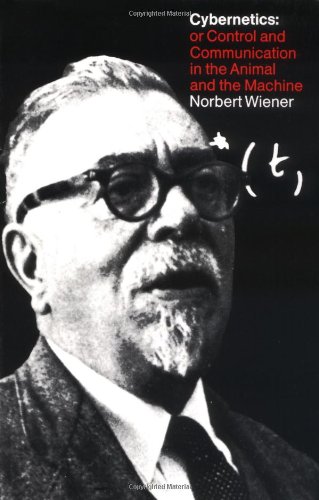
1. Cybernetics, Second Edition: or the Control and Communication in the Animal and the Machine
by Norbert Wiener
Paperback: 212 Pages (1965-03-15)
list price: US$26.00 -- used & new: US$19.88
(price subject to change: see help)
Asin: 026273009X
Average Customer Review: 5.0 out of 5 stars
Canada | United Kingdom | Germany | France | Japan
Editorial Review

Book Description
Acclaimed one of the "seminal books . . . comparable in ultimate importance to . . . Galileo or Malthus or Rousseau or Mill", Cybernetics was judged by twenty-seven historians, economists, educators, and philosophers to be one of those books published during the "past four decades," which may have a substantial impact on public thought and action in the years ahead." -- Saturday Review ... Read more

Customer Reviews (3)

5-0 out of 5 stars Timeless work joins philosophy, computing, and mathematics
Norbert Wiener was interested in the means by which feedback could be communicated to help correct the problems that develop in an organism. In investigating this matter, Weiner investigates a number of topics that differentiate between mere computation and intelligence and the importance that information plays in both. This is the unifying theme of a book that seems to wander through many topics using philosophy, mathematics, and the theory of computation.

For example, in chapter one of the book, Wiener illustrates the basic difference between man and machine with a discussion of the concept of Newtonian versus Bergsonian time. He states that Newtonian time - that of high level physics phenomena- is reversible. Bergsonian time, the time of living organisms making their way against entropy is not reversible. Thus since Newtonian time is reversible nothing "new" happens, as opposed to the irreversible time of evolution and biology in which there is always something new.

He continues this idea in the chapter "Computing Machines and the Nervous System." In it, he defines the characteristics of computing machinery. He concludes that the brain, being irreversible, is thus an analog of a single run of a machine. Wiener also points out that many problems of human metabolism and reproduction are associated with the inability to receive and organize impulses and make them effective in the outer world. Thus Weiner ultimately concludes that to live effectively is to live with adequate information.

There are also chapters that are almost purely philisophical about the role of information in society. Then there are other chapters that present heavy-duty mathematics on such topics as representing a time series of known statistical parameters asBrownian motion in an attempt to solve communications problems in nonlinear situations. The mathematics in this book is presented with little or no background, so you are going to need other sources to understand what Wiener is trying to convey.

In summary, if you want an interesting read on the science and philosophy of artificial intelligence and the role of the machine this is one of the best out there. It still stands the test of time after nearly sixty years.

5-0 out of 5 stars Welcome to the Machine
Why is everything called "cyber" (cyberspace, cyberpunk)? Because of this book from 1948 in which Norbert Wiener, a prof at MIT, coined the phrase "cybernetics," from the Greek word "kybernutos" meaning "governor." If you're tired of viewing your computer as a black box (the input goes in here, the output comes out there, and something mysterious happens inside), or if you wonder if the tech world has any relation to the natural world, check out this unusual book, which is rewarding on many different levels.

Find out why robotics, neural nets and artificial intelligence (AI) predate the PC and even the mainframe computer and are not a new development. Travel back to the days of the giant ENIAC when the computer seemed to be an idea on everyone's mind, simply waiting for advances in technology to make it a reality. But this very readable book goes further, as suggested in Wiener's subtitle: "Control and Communication in the Animal and Machine." Many specialists in various fields initially opposed this book because of Wiener's interdisciplinary approach, which broke down the hard and fast walls between various disciplines.

The vocabulary of this book has now become commonplace (we ask for "feedback" and refer to "systems" on a daily basis), but many of its ideas have yet to be discovered. I couldn't keep up with the math, but you don't need to to grasp the basic ideas or to enjoy Wiener's lucid and luminous style, which ranks among the best of popular science writing. Wiener also wrote a general market book, "The Human Use of Human Beings" to present some of these ideas to a wider audience. Some fifty years after its initial publication, this book still forms an inviting welcome to the machine.

5-0 out of 5 stars A fundamental law that is applicable to almost everything
Two books, both written in the late 1940s stand out as contributing much to our understanding of the world around us.One of these is "Cybernetics" by Weiner and the other is "The mathematicaltheory of communication" by Shannon.Both require some study bycontain many sections that are easily readable by anyone which get the mainpoints across in an understandable manner.

Weiner's book discuses the useof feedback on virtually every type of control mechanism known... i.e.,those of nature as well as those of man.It is the "basic" stuffthat everyone of us uses everyday and every moment of our lives whether weare aware of it or not.Whereas Shannon's book tells us how to communicateinformation in an error-free (or nearly so) way, Weiner's book explains howthat information is used to provide effective control of everything aroundus.For many decades since I first was introduced to these two works, Ihave used their principles in most things I do.

I very highly recommendthese two books to anyone who considers themselves a "thinkingperson" and is seeking to understand the world around them.Botheasily get 5 stars.They are major works! ... Read more


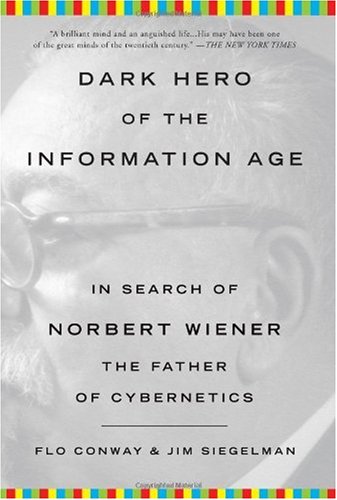
2. Dark Hero of the Information Age: In Search of Norbert Wiener The Father of Cybernetics
by Flo Conway, Jim Siegelman
 Paperback: 423 Pages (2006-09-30)
list price: US$17.95 -- used & new: US$11.87
(price subject to change: see help)
Asin: B000W90XQU
Average Customer Review: 4.5 out of 5 stars
Canada | United Kingdom | Germany | France | Japan
Editorial Review

Book Description
Child prodigy and brilliant MIT mathematician, Norbert Wiener founded the revolutionary science of cybernetics and ignited the information-age explosion of computers, automation, and global telecommunications. His best-selling book, Cybernetics, catapulted him into the public spotlight, as did his chilling visions of the future and his ardent social activism.
Based on a wealth of primary sources and exclusive access to Wiener's closest family members, friends, and colleagues, Dark Hero of the Information Age reveals this eccentric genius as an extraordinarily complex figure.No one interested in the intersection of technology and culture will want to miss this epic story of one of the twentieth century's most brilliant and colorful figures.
... Read more

Customer Reviews (14)

5-0 out of 5 stars A Fascinating Account of Norbert Wiener - Father of Cybernetics.
_Dark Hero of the Information Age:In Search of Norbert Wiener The Father of Cybernetics_ by the researchers Flo Conway and Jim Siegelman, who had previously written on cults and fundamentalism, is a fascinating biography of an important figure in the history of the last century who played an important role in heralding in the coming age of information.Norbert Wiener (1894 - 1964) was a fascinating individual and a man of many talents who is perhaps best remembered as both a mathematician and the father of the science of cybernetics.Wiener was a highly eccentric individual who had been renowned as a child prodigy in his youth and studied at Tufts and Harvard from the ages of 11 to 14, eventually earning his Ph.D. at age 18.Following his early years, Wiener became an academic originally focusing on philosophy and mathematics, though taking a more applied bent towards mathematical research than some of his contemporaries such as G. H. Hardy, who routinely castigated him for this.Wiener's career took off at MIT where he developed the science of cybernetics, which was to play such an important role in furthering engineering, biological, and social sciences, as well as playing the role of an astute commentator on the role of automation.Cybernetics (a term derived from the Greek for "steersman"), the creation of Norbert Wiener, was an essential science in the understanding of feedback and control systems.Wiener continued to develop his theories following the publication of his first book on the subject and in particular examined the role of automation among workers.Wiener also was able to prove an inspiration for several important engineering projects focusing on such things as the human brain, artificial intelligence, and the development of prostheses for amputees.Wiener's ideas played an important role in the United States, but with the advent of the Cold War they also played a role in the Soviet Union, as well as in India where Wiener saw certain potential developments arising from newfound technologies.While Wiener was an agnostic throughout his life, his ancestors were Jews and he may have been related to the Jewish philosopher Maimonides, and he developed a profound interest in Indian philosophy and Hinduism ultimately leading him to accept the notion of reincarnation.Wiener's theories played an important role in paving the way for the information age to come and we see the end result of that in the information explosion in this century.This book offers a fascinating examination of the life of Norbert Wiener and is an excellent biography of this great man.

This book starts with Wiener's early life, particularly as he developed into a child prodigy.The book begins with Leo Wiener, the father of Norbert Wiener, who was an adamant proponent of the ideals of Tolstoy and vegetarianism.Leo Wiener came to the United States and eventually made his way to Cambridge, Massachusetts where Norbert's talents for languages became widely known.Norbert Wiener became known as the "most remarkable boy in the world" and would attend university at Tufts and Harvard, originally specializing in zoology, along with other child prodigies such as William James Sidis.Following his Ph.D. at Harvard at the age of 18, Wiener traveled to Europe to study logic and philosophy with such individuals as Bertrand Russell.However, upon returning home, Wiener underwent somewhat of a crisis.Wiener, who was a lifelong manic depressive and prone to absent-minded spells and depressions, would largely see his emotional turmoil as arising out of his early youth.Wiener went on to join the faculty at MIT, an engineering school which hoped to promote a new mathematics department.Wiener made several important contributions and it was here that he developed his science of cybernetics.Wiener was known to all his students for his "Wienerwegs" or "Wienerwalks", where he frequently absent-mindedly roamed about the halls and campus of MIT.Wiener married and had two daughters.He also became involved with various other individuals and prodigies who tried to advance the science of cybernetics and the logical system developed by Russell in the _Principia Mathematica_.Wiener also was active in promoting the Macy conferences, where a diverse group of intellectuals including mathematicians, economists, social scientists, and anthropologists worked out the ideas of cybernetics.Wiener was deeply concerned about the role that automation would play in the coming era and wrote an important work focusing on the "human use of human beings" to show his concern over the new role of automation and computers.Wiener also wrote some more religious and philosophical works in which he attempted to address the problem of the "golem" from Jewish mythology as it concerned man and his creations.During the Cold War, Wiener refused to participate in research for the military and this led to his being branded a "Red" by the FBI.Wiener eventually was to travel to Europe and even the Soviet Union where he attempted to advance the science of cybernetics, although he made clear that he disapproved of the role of both superpowers in the Cold War.Wiener also knew the mathematician and Nobel Prize winner John Nash while he was at MIT.In his old age, Wiener took an interest in India and Hinduism.Wiener attempted to identify a new role for automation in India and the potentially liberating effects of such technologies.Wiener also traveled to Stockholm to attend the Nobel Prize ceremony and it was here that he died.

This book offers an interesting account of the life of an important figure in the dawn of the information age.Norbert Wiener and his science of cybernetics played a great role in giving rise to the information age and the era of computing.While Wiener was certainly a man of many talents and contradictions, he also had a darker side to him as did the technologies made possible through his advances.It is for this reason that he may be seen as the "dark hero of the information age" and the father of cybernetics.

1-0 out of 5 stars 100,000% Shovelware
From a historical and economic and sociological perspective, this book is utter propaganda.

For example, from page 340, "To date, India's engineers and entrepreneurs have had the most success following the path Wiener chartered for their country's advancement, and while their numbers are still small compared to the whole of their population, they are reaping many of the benefits Weiner envisioned without the drawbacks of older models of industrialization."

WHAT A F--KING JOKE!!!I'm dying of laughter!

There is categorically no relationship between India's newfound economic success and Norbert Wiener.None.Na-da.Nothing.Zip-0!

And that was just a single sentence from this text.Just imagine what else lurks in 400 pages of writing from what are two absolute fools.Flo conway and Jim siegelman are the stupidest writers ever!

5-0 out of 5 stars A tale of what might have been
My own introduction to Wiener was through the extraordinary insight and published works of Stafford Beer (acknowledged by Wiener as the inventor of Management Cybernetics). Beers insights into Industrial Engineering, Operations Research and Management Cybernetics, seem to have more and more relevance for managers, as the world we live in becomes more and more complex.
I am of the opinion that Cybernetics provides a Philosophical and Technical Framework that helps to explain why the widely practiced and innovative business-improvement approach of Lean - Six Sigma has been so successful.
This is what Beer had to say about Wieners seminal text on Cybernetics "Difficult, quixotic, immensely stimulating (then and now), Cybernetics split the scientific world (for those who read it) down the middle. Think of it like this: the great man (he really was) holds forth to his friends after dinner, ruins the tablecloth by scribbling mathematics all over it, sings a little song in German, and changes your life.It is tough going; you have to stay the night"
Beers review grabbed my attention and encouraged me to learn more about Wiener; and then a couple of years ago I was troubled by the following review from the prolific, oftentimes, acerbic polymath Cosmo Rohilla ShaliziA Professor Of Statistics at Carnegie Mellon University - . "A science which seems to have dissolved into the others. A lot of good science was done under this banner; it just doesn't seem to hold together ......As a study of abstract machines in general, it becomes identical with dynamics, or computation theory, or some amalgam of both; algebra, even. As a more limited science of "communication and control" it suffers from the fact that communication and control in animals is, when you get down to blood and guts, rather different from communication and control in machines, and neither resembles the mechanisms of C&C in society..... It may be that we haven't exhausted the potential of a science of communication and control, but I think at this point the burden of proof would be on the optimists.Dissolved? Not entirely. There's an old joke that if you're not part of the solution, you're part of the precipitate, and not everything associated with cybernetics has gone into solution. Caked on the bottom of the reaction vessel we find: A prefix which seems indispensible to marketroids; the occasion for a great deal of vaporizing in the social sciences and humanities; and a peculiarly navel-gazing sub-sect of systems theory, which isn't exactly God's gift to the advancement of learning in the first place."
Clearly Cosmo is no ones fool. Are, those of us who still think that the work of Wiener and Beer is relevant for today's problems, really part of a peculiar naval gazing sect?
As far as Management Cybernetics is concerned, irrespective of what old Cosmo thinks, Management Cybernetics really does provide all of us who deal with systems and organisations - I guess that's every one of us - with insightful and practical solutions for managing complexity. Beer like his mentor Wiener has been a neglected and oftentimes maligned prophet - just look at his poor reviews on this site.Management Cybernetics is, however, very much alive and well. One of the fastest growing consultancies in Europe, and a much respected competitor to my own practice - The Malik Group in Switzerland - have built their business model on cybernetic principles and are providing truly innovative solutions for their blue chip clients.Interestingly theyhave people with the title cybernetician on the pay role - Norbert still rules as far as they are concerned!
As for Cybernetics contribution to main stream science - Cosmo is, sadly, correct. In mainstream academia Cybernetics has been largely subsumed by other disciplines. But, until I read this book it puzzled me why. Why, given the impressive start and promising march towards becoming a truly systemic and integrative scientific discipline, was Cybernetics stopped dead in its tracks?
Conway and Siegleman's provide us with the answer to this question, and, by the way, it has absolutely nothing to do with science or logic!
Hopefully their tale will leave you, as it did me, with a profound sense of what might have been, had cybernetics progressed in line with the Philosophy and Vision of the Original Knights of Circular Causality.
This is a brilliant biography.

5-0 out of 5 stars Dark Hero of the Information Age recounts his life and discoveries - and the consequences of his discoveries.
Dark Hero of the Information Age: In Search of Nortbert Wiener the Father of Cybernetics tells of an ex-child prodigy and MIT mathematician who founded cybernetics - and then spent the rest of his life warning the world of the consequences of the new technologies he helped foster. Surprisingly, his works and his warnings are relatively unknown today - despite the fact many of his concerns and predictions came true. Dark Hero of the Information Age recounts his life and discoveries - and the consequences of his discoveries.

Diane C. Donovan
California Bookwatch

5-0 out of 5 stars superbly researched and quite interesting
Flo Conway and Jim Siegelman have put an immense effort into writing an exhaustive review of Norbert Wiener, one of the great geniuses of the last century.Wiener spoke an ungodly number of languages, got his PhD from Harvard at the age of 19, made immense contributions to mathematics, biology, computer sciences, medicine, political thought - even in McCarthy's heyday he had no qualms about speaking his mind -, etc, etc.

As generally is the case with biographies of Wunderkinder, the authors ultimately are not equal to their subjects, not for lack of effort, but for lack of having the intellect necessary to understand and do justice to an über-prodigy.And so it is with this book; rather than to analyze and judge Wiener's various accomplishments and beliefs, which range from phenomenal scientific accomplishments to believing that he had been reincarnated, the authors prefer to "tell it as it was" and let the reader draw his or her conclusions.

Despite these inevitable limitations, this book is well worth reading, albeit thoughtfully. ... Read more


3. Nonlinear Problems in Random Theory
by Norbert Wiener
 Unknown Binding: 131 Pages (1958)

Asin: B0000CK81D
Canada | United Kingdom | Germany | France | Japan

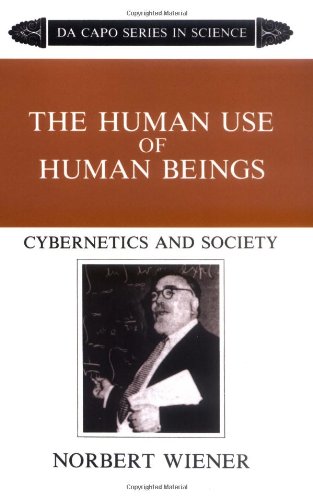
4. The Human Use of Human Beings: Cybernetics and Society
by Norbert Wiener
 Hardcover: Pages (1950)

Asin: B00005W491
Average Customer Review: 5.0 out of 5 stars
Canada | United Kingdom | Germany | France | Japan

Customer Reviews (5)

5-0 out of 5 stars important and relevant after half a century
More than fifty years after its initial publication, this book remains as relevant and prophetic as it is brilliant and exhilarating.

To start, Wiener explains cybernetics in a way that the intelligent layperson can understand; he discusses how human beings, animals, and machines relate to one another through communication and feedback, thus becoming systems that limit or temporarily reverse the universal tendency toward disorganization (entropy). After establishing this framework, he discusses the implications of cybernetics on society. As he takes cybernetic theory to its logical conclusions--that is, accounting for the communication and feedback between human beings, machines, and the environment as a whole--his insights are shown to be profoundly humane and ultimately very inspiring.

This is no ordinary scientific text. There are discussions of Augustinian vs. Manichaean worldviews and their implications; the inevitable spread of dangerous information (such as that resulting in the atomic bomb) despite the strenuous efforts of governments; and the need not to rely on machines--non-human machines as well as "human machines" such as bureaucracies and corporations--to do the difficult work that human beings must do to remain ethical, responsible, and free.

All in all, this is an outstanding book written in lucid, beautiful prose. The book tells us as much about the systems that make up our world as it does about the brilliance, humility, and humanity of Wiener himself. No summary of this book, in blurb or review format, can possibly do justice to Wiener's achievement.

5-0 out of 5 stars A concerned and conscienscious genius
Wiener was acutely aware of the promise and the danger of the new technolgies he was helping to invent. He worked very hard during the Second World War to help develop an anti- aircraft system which would make use of some of his mathematical and technical innovations. However the dropping of the Atomic Bomb turned him wholly against the military establishment and he became an insistent voice calling for regulation of military technologies.
His own vision of a humane society is one in which the cybernetic and feedback elements enable a better managing of the economy and society as a whole. And this when he again was very concerned about the possible destructive elements of technologies which would provide unreasonablemeans of control over individual human lives. He very much was concerned that a society in which machine- slaves produced everything would deprive humanity of its freedom and dignity.
In other words he saw great promise in the new technologies but also was concerned that might exercise a degree of control over humanity which would make them more harmful than beneficial.

5-0 out of 5 stars Another Wiener Gem
Norbert Wiener was a child prodigy and Professor of Mathematics at MIT from 1919 until his death in 1964.He invented the science of cybernetics (look it up in the dictionary) and the guided missile but refused to help the military during the cold war.This volume includes an open letter published in the January, 1947 Atlantic Monthly magazine entitled "A Scientist Rebels" by Norbert Wiener.An introduction by Wiener biographer Steve J. Heims provides a context for Wiener's works.

If you are at all interested in cybernetics, and particularly interested in the effects it is having and will have on society, this book is must reading.Of course, this book does not approach Wiener's "God & Golem, Inc."(reviewed elsewhere in Amazon.com) for sheer brilliance, but then, what does, except perhaps the "Bahir."

5-0 out of 5 stars intriguing ideas made plain
For those of us who cannot grasp the mathematical, technical version of Wiener's theory of messages in _Cybernetics_, this book is a wonderful stand-in.Wiener wrote this entirely equationless text as a populariztionof his ideas about humans and machines.this book is a fascinating pieceof philosophy and sociology also, as Wiener expands his theories and bringsthem to bear on history, journalism etc.He never loses his scientificperspective though; this gives his writing and ideas a clarity freshnessthat is uncommon in theoretical writings about society.This is a greatand important book

5-0 out of 5 stars prophetic book
where could i find areedited french traduction of this book published in 62 in france,second hand also ? ... Read more


5. The Fourier Integral and Certain of Its Applications
by Norbert Wiener
 Paperback: Pages (1958)

Asin: B000OLTVKK
Canada | United Kingdom | Germany | France | Japan

6. Selected papers of Norbert Wiener,: Including Generalized harmonic analysis and Tauberian theorems
by Norbert Wiener
 Unknown Binding: 453 Pages (1965)

Asin: B0006BLQ7O
Canada | United Kingdom | Germany | France | Japan

7. Norbert Wiener: Collected Works - Vol. 1: Mathematical Philosophy and Foundations; Potential Theory; Brownian Movement, Wiener Integrals, Ergodic and Chaos ... Mechanics (Mathematicians of our time)
 Hardcover: 760 Pages (1976-05-15)
list price: US$80.00
Isbn: 0262230704
Canada | United Kingdom | Germany | France | Japan

8. Ex-Prodigy: My Childhood and Youth
by Norbert Wiener
Paperback: 317 Pages (1964-08-15)
list price: US$20.00
Isbn: 0262730081
Average Customer Review: 5.0 out of 5 stars
Canada | United Kingdom | Germany | France | Japan

Customer Reviews (2)

5-0 out of 5 stars Ex-prodigy. My Childhood andYouth
It's an excellent book telling about how it's to grow up as a prodigy and thereby living a life betwwen older in the schools and at the same age when out playing. And besides allso becaurse the books is about living 100 years ago telling about how it was then, and the meating with many famous science person living then. Allso telling about other prodigys problems.

5-0 out of 5 stars A mathematical John Stuart Mill
This is the story of the childhood and youth of a genius. Norbert Wiener who would go on to become an important mathematician and one of the principal developers of communication theory, and his own specific discipline 'cybernetics' tells here the story of his most unusual childhood and youth. At the center is his relation to his father Leo Wiener who was a Professor of Slavic Languages, and an extraordinarily ambitious person. He pushed his son from an early age in much the same way that John Mill pushed John Stuart Mill. In the process he was often cruel. "He would begin the discussion in an easy, conversational tone. This lasted exactly until I made the first mathematical mistake. Then the gentle and loving father was replaced by the avenger of the blood.... Father was raging, I was weeping, and my mother did her best to defend me, although hers was a losing battle." The father pushed Wiener so well that he enrolled in Tufts University at the age of eleven finished four years later with a degree in Mathmematics. The father was also a publicity - hound who publicized his son the genius, and claimed it had nothing to do with any genetic quality or special gift of his son, but rather was solely attributable to his own educational methods. The father too saw too it that the son had a family life, and selected one of his students to be his son's wife, and practical daily life manager.
Wiener despite all this went on to become a distinguished MIT professor of Mathematics, an original genius and a highly respected teacher.
This autobiography is one of two and there is another work by Wiener covering his later years.
However anyone who wishes to know the life- in full should also look at the biographical literature, that contains much about the life of genius he himself did not apparently wish to tell. ... Read more


9. I Am a Mathematician
by Norbert Wiener
Paperback: 380 Pages (1964-08-15)
list price: US$24.00
Isbn: 0262730073
Average Customer Review: 4.5 out of 5 stars
Canada | United Kingdom | Germany | France | Japan

Customer Reviews (2)

4-0 out of 5 stars Wiener's personal memoirs rather than a recapitulation of his professional accomplishments
Norbert Wiener was a first class mathematician and collaborator, yet he doesn't seem to get the due credit for both. As a globetrotting collaborator, he spent significant amounts of time in India, China, Mexico and many of the countries in Europe. This was before the advent of regular international flights, so his trips took a significant amount of time, which is why he spent so much time in those countries once he got there. Wiener also collaborated with Paul Erdos, the one person whose mathematical globetrotting clearly exceeds that of Wiener.
This is not a book about mathematics or even the mathematics that Wiener worked on. The main theme is the adult life of Wiener, where he went, what he did and the people he did it with. There are few phrases or even words that require any significant background in mathematics if they are to be understood. The style is that of a man who is simply talking about his life, setting down his personal memoirs rather than a recapitulation of his professional life.
While Wiener occasionally gets into the juicy side of personalities, that is a rare sidetrack, this is a book about Norbert Wiener. The titles of his two autobiographical books are "Ex-prodigy: My Childhood and Youth" and "I Am A Mathematician: The Later Life of a Prodigy." Wiener was known for his ego and that is demonstrated in the titles of these books. Some of that comes through in this book but thankfully; he does manage to keep that aspect of his personality in check.

5-0 out of 5 stars Well written biography
Well written biography - what can I say else?It was very interesting toread the book. ... Read more


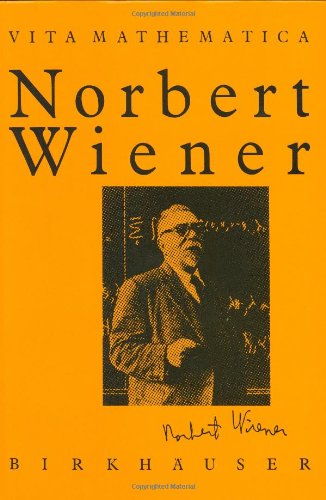
10. Norbert Wiener 1894-1964 (Vita Mathematica)
by Pesi R. Masani
Hardcover: 420 Pages (1989-12-01)
list price: US$49.95 -- used & new: US$49.95
(price subject to change: see help)
Asin: 3764322462
Canada | United Kingdom | Germany | France | Japan

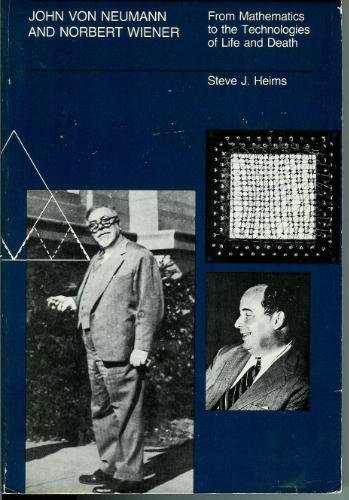
11. John von Neumann and Norbert Wiener: From Mathematics to the Technologies of Life and Death
by Steve Joshua Heims
 Paperback: 568 Pages (1982-06-17)
list price: US$13.50
Isbn: 026258056X
Canada | United Kingdom | Germany | France | Japan
Editorial Review

Book Description
. John von Neumann and Norbert Wiener were mathematician-scientists, both child prodigies born near the turn of the century. As young men each made profound contributions to abstract mathematics. ... Read more


12. Extrapolation, Interpolation, and Smoothing of Stationary Time Series
by Norbert Wiener
Paperback: 176 Pages (1964-03-15)
list price: US$25.00 -- used & new: US$18.25
(price subject to change: see help)
Asin: 0262730057
Canada | United Kingdom | Germany | France | Japan
Editorial Review

Book Description
It has been the opinion of many that Wiener will be remembered for his Extrapolation long after Cybernetics is forgotten. Indeed few computer-science students would know today what cybernetics is all about, while every communication student knows what Wiener's filter is. The work was circulated as a classified memorandum in 1942, as it was connected with sensitive war-time efforts to improve radar communication. This book became the basis for modern communication theory, by a scientist considered one of the founders of the field of artifical intelligence. Combining ideas from statistics and time-series analysis, Wiener used Gauss's method of shaping the characteristic of a detector to allow for the maximal recognition of signals in the presence of noise. This method came to be known as the "Wiener filter." ... Read more


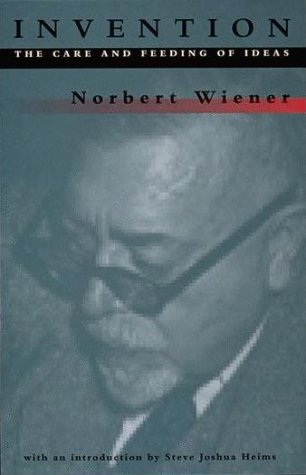
13. Invention: The Care and Feeding of Ideas
by Norbert Wiener
Paperback: 159 Pages (1994-08-22)
list price: US$20.00 -- used & new: US$9.69
(price subject to change: see help)
Asin: 0262731118
Average Customer Review: 4.0 out of 5 stars
Canada | United Kingdom | Germany | France | Japan
Editorial Review

Book Description
Internationally honored for brilliant achievements throughout his career, Norbert Wiener (1894-1964), Institute Professor at the Massachusetts Institute of Technology, was an insightful observer of the role of science in society. This book, written in 1954 but only now published for the first time, can be read as a salutary critique of events in science that Wiener accurately predicted and a chance to rethink the components of a social and political climate that encourages inventiveness. ... Read more

Customer Reviews (2)

3-0 out of 5 stars Not a book on how to invent
This is a book on history and social conditions of invention. It should be categorized as a history book. As such,it is a book bordering on personal speculation. It would be much better if Wiener had stick to his own scientific field and written a book on how to invent or discover.

5-0 out of 5 stars A book well worth reading
It has been said that all of science is concerned with ideas of patterns and all of mathametics is concerned with patterns of ideas. This book is a wonderful combination of both concepts. Norbert Wiener's toweringintellect,knowledge of the history of science and ability to developinteresting associations between diverse areas of scientific activity,which on initial consideration appear unrelated, have produced a documentwhich is grand in scope and remarkable in accomplishment. Moreover, hisstyle of writing is, in my opinion, quite attractive. He has many axes togrind and once they are sharpened he applies them with enormous vigor. Forexample, he refers to the patent as "nothing more than a ticket tolitigation". There is much to be learned from this book which canreadily be applied to current areas of major importance such as molecularbiology and solid state physics where new discoveries and their commercialapplications clearly emulate societies previous experiences with ourfundamental understanding of electricity and its application to both thetransfer of power and of information. ... Read more


14. Norbert Wiener: Collected Works - Vol. 3: The Hopf-Wiener Integral Equation; Prediction and Filtering; Quantum Mechanics and Relativity; Miscellaneous Mathematical Papers (Mathematicians of Our Time)
 Hardcover: 800 Pages (1982-04-20)
list price: US$70.00
Isbn: 0262231077
Canada | United Kingdom | Germany | France | Japan
Editorial Review

Book Description
Norbert Wiener's scientific contributions not only spanned numerous branches of mathematics but also mathematical philosophy, quantum mechanics and relativity theory, and the field he christened "cybernetics" - a synthesis of communication and control engineering, the physiology of the heart and the nervous system, brain wave encephalography, and sensory prosthesis. His scholarly work also included incisive social, education, and literary essays.

The object of these volumes of Collected Works is not only to reprint all of Wiener's scientific and scholarly papers but also to place them in the context of present-day research by means of commentaries written by contemporary authorities that trace both their genesis and their influence on subsequent work.

Commentaries on the papers in Volume III were written by E. J. Akutowicz, D. Bohm, G. Freud, Sir Dennis Gabor, A. E. Heins, T. Hida, E. Hille, T. Kailath, G. Kallianpur, M. Kanter, P. Masani, L. T. McAuley, P. S. Muhly, E. Nelson, J. Pincus, E. E. Robinson, H. Salehi, A Siegel, A. H. Taub, and M. S. Vallarta.

Volume I, published in 1976, included Wiener's contributions to mathematical philosophy and foundations, potential theory, Brownian movement, Wiener integrals, ergodic and chaos theories, and turbulence and statistical mechanics.

Volume II collected his work on generalized harmonic analysis and Tauberian theory and on classical, harmonic, and complex analysis. A projected fourth and final volume will bring together Wiener's papers on cybernetics as well as essays and articles on nonscientific subjects.

P. Masani, editor of the Collected Works, is University Professor of Mathematics at the University of Pittsburg and a former collaborator of Wiener. This book is twentieth in the series Mathematicians of Our Time. ... Read more


15. God and Golem, inc.;: A comment on certain points where cybernetics impinges on religion
by Norbert Wiener
 Unknown Binding: 99 Pages (1964)

Asin: B0006BM1NC
Average Customer Review: 4.0 out of 5 stars
Canada | United Kingdom | Germany | France | Japan
Editorial Review

Book Description
The new and rapidly growing field of communication sciences owes as much to Norbert Wiener as to any one man. He coined the word for it--cybernetics. In God & Golem, Inc., the author concerned himself with major points in cybernetics which are relevant to religious issues.

The first point he considers is that of the machine which learns. While learning is a property almost exclusively ascribed to the self-conscious living system, a computer now exists which not only can be programmed to play a game of checkers, but one which can "learn" from its past experience and improve on its own game. For a time, the machine was able to beat its inventor at checkers. "It did win," writes the author, "and it did learn to win; and the method of its learning was no different in principle from that of the human being who learns to play checkers.

A second point concerns machines which have the capacity to reproduce themselves. It is our commonly held belief that God made man in his own image. The propagation of the race may also be interpreted as a function in which one living being makes another in its own image. But the author demonstrates that man has made machines which are "very well able to make other machines in their own image," and these machine images are not merely pictorial representations but operative images. Can we then say: God is to Golem as man is to Machines? in Jewish legend, golem is an embryo Adam, shapeless and not fully created, hence a monster, an automation.

The third point considered is that of the relation between man and machine. The concern here is ethical. "render unto man the things which are man's and unto the computer the things which are the computer's," warns the author. In this section of the book, Dr. Wiener considers systems involving elements of man and machine.

The book is written for the intellectually alert public and does not involve any highly technical knowledge. It is based on lectures given at Yale, at the Société Philosophique de Royaumont, and elsewhere. ... Read more

Customer Reviews (3)

4-0 out of 5 stars A worthwhile venture
Weiner was something of a revolutionary in his time. He (among others) pushed the revolution in computing out of the slipstick era. He, at the height of the Cold War, wrote for audiences in both the USSR and the USA. Small wonder that he took on religion. I mean that he took it on as a duty and companion, not as an opponent, though many might have seen opposition.

Much of this book lacks direction. He skims issues that are still contentious, including the right to die. His arguments about self-reproducing machines tend twaords the vague, although he admits that he avoided tedious precision. Many of his points are clear and sharp, however. Drawing on the genie in the bottle, the Sorcerer's Apprentice, and other popular literature, he argues that the capabilities of technology steadily run ahead of our ability to predict and mitigate its consequences. He also notes, during first light of the transistor age, that "Living matter has a fine structure ... [approached by] machines which operate according to the principles of solid-state physics." As usual, technological optimism carried him well beyond justifiable extrapolation. Also as usual, he had a fair inkling of how today's 0.1 micron transistors might compare to 1.0 micron brain cells.

His sharpest commentary starts in the faith that scientists and engineers are moral people, and work in the belief of the human good that comes from their life's work. (Please, don't descend to the belief that we think we are evil people reveling in evil outcomes.) Weiner notes that the deepest hell in Dante's Inferno is reserved for the sin of simony - directing the Church's good power to personal gain, using the force of money. He draws a direct analogy to the sin of corrupting vast technological power towards personal gain, also using money as controlling force. If you're already queasy about the amorality of the MBA's "bottom line" ethos, this may give you some very bad dreams.

It's an important book. It's flawed, but has the honesty to ask hard questions. It also has the courage to attach a moral sense to the analytic trait of mind - it ought not be surprising that the two fit closely.

Among all the quotable lines in this book, one stands out: "... remember that in the game of atomic warfare, there are no experts." Here, now, under the president that demolished 30 years of arms control treaties, it's a phrase to remember.

//wiredweird

4-0 out of 5 stars Good retrospective of the history of computing
Written in 1964 when the concept of a human interacting dynamically with a machine was first becoming a reality, there are facets of this book that are dated. Nevertheless, the concepts that are described are still as pertinent today as they were when Wiener first set down his thoughts. The book is a collection of essays where Wiener explains his ideas for what he thinks the future holds for humans interacting with machines.
The approach is very non-technical so it is possible for the lay person to understand his thoughts. The prose is also well structured, making it very easy to read through. Reading this book is a good way to go back in time and get some idea of what the early experts thought would be the direction and consequences of the development of the new "thinking machines". It is also an excellent choice for gaining a retrospective in any history of computing course.

4-0 out of 5 stars Technological Ethics
A brief series of personal essays by famous mathematician Norbert Wiener on the ethics of modern technology and questions whether humans should follow all leads of technology regardless of the consequences. An easy-to-read, informative book. No technical background is needed to understand the arguments. ... Read more


16. Cybernetics
by Norbert Wiener
 Hardcover: 228 Pages (1961-01-01)
list price: US$22.50 -- used & new: US$125.00
(price subject to change: see help)
Asin: 0262230070
Canada | United Kingdom | Germany | France | Japan

17. Norbert Wiener: Collected Works - Vol. 2: Generalized Harmonic Analysis and Tauberian Theory; Classical Harmonic and Complex Analysis
 Hardcover: 1008 Pages (1980-01-09)
list price: US$80.00
Isbn: 0262230925
Canada | United Kingdom | Germany | France | Japan

18. Norbert Wiener 1894 1964 Ams Bulletin
by BrowderFelix
 Paperback: Pages (1966)

Asin: B000YCEJLK
Canada | United Kingdom | Germany | France | Japan

19. Biography - Wiener, Norbert (1894-1964): An article from: Contemporary Authors Online
by Gale Reference Team
Digital: 11 Pages (2005-01-01)
list price: US$9.95 -- used & new: US$9.95
(price subject to change: see help)
Asin: B0007SG5EA
Canada | United Kingdom | Germany | France | Japan
Editorial Review

Book Description
Word count: 3067. ... Read more


20. Bulletin of the American Mathematical Society Volume 72 Number 1, Part II: Norbert Wiener 1894-1964
 Paperback: Pages (1966)

Asin: B000Q1OPD6
Canada | United Kingdom | Germany | France | Japan

  1-20 of 100 | Next 20
A  B  C  D  E  F  G  H  I  J  K  L  M  N  O  P  Q  R  S  T  U  V  W  X  Y  Z  

Prices listed on this site are subject to change without notice.
Questions on ordering or shipping? click here for help.

site stats