|
Editorial Review Product Description
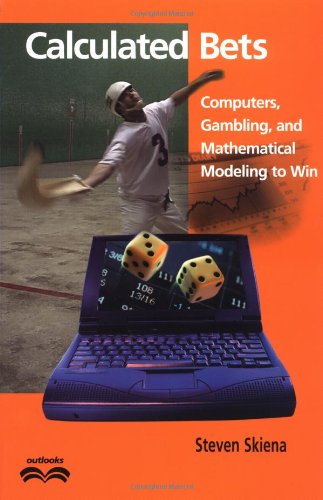
Calculated Bets describes a gambling system that works. Steven Skiena, a jai-alai enthusiast and computer scientist, documents how he used computer simulations and modeling techniques to predict the outcome of jai-alai matches and increased his initial stake by 544% in one year.Skiena demonstrates how his jai-alai system functions like a stock trading system, and includes examples of how gambling and mathematics interact in program trading systems, how mathematical models are used in political polling, and what the future holds for Internet gambling.With humor and enthusiasm, Skiena explains computer predictions used in business, sports, and politics, and the difference between correlation and causation.An unusual presentation of how mathematical models are designed, built, and validated, Calculated Bets also includes a list of modeling projects with online data sources.Steven Skiena, Associate Professor of Computer Science at SUNY Stony Brook, is the author of The Algorithm Design Manual (Springer-Verlag, 1997) and the EDUCOM award-winning Computational Discrete Mathematics.He is the recipient of the ONR Young Investigator's Award and the Chancellor's Award for Excellence in Teaching at Stony Brook.His research interests include discrete mathematics and its applications, particularly the design of graph, string, and geometric algorithms.Amazon.com Review
You could just as easily call this book How to Bet at Jai-Alai and Win! But that's only half the story. While Calculated Bets might indeed help you make a buck down at the fronton, it's as much concerned with the power of mathematical modeling and computer programming. The story of accomplished mathematician Steven Skiena's longtime obsession with this obscure Basque sport, Calculated Bets uses straightforward mathematics and real-world examples to divine the statistical mysteries behind playing--and, more important, wagering on--jai alai. (Which goes a long way toward explaining why Cambridge University Press is publishing what's basically a book about gambling.)A self-styled "mild-mannered professor," the conversational Skiena (The Algorithm Design Manual) delivers on his book's many promises, from explaining how mathematical models are "designed, built, and validated" to providing lucid discussions of such topics as market efficiency and the difference between correlation and causation. Even better are his riffs on why real programmers hate Microsoft (hint: it's not jealousy) and the beauty behind interesting curves. In the end, Skiena even puts his money where his mouth is: using a modem, he sets loose an auto-dialing program called Maven that he and his grad students cooked up, sending it off in the wee hours of the morning to cull the Web for stats, play each match a half-million times, and then automatically wager a $250 stake. --Paul Hughes ... Read more Customer Reviews (11)  The most fun book on math and computer modeling I ever read
I couldn't care less about Jai-lai. It is simply the background the author uses to take us on a journey that wraps gambling, odds, statistics, computers, and mathematical modeling into a totally engrossing book.
Well written, educational, and fun.. I cannot recommend this book enough for anyone interested in computers, math, and beating the odds.
 Non Fiction
A university guy looks at mathematically modelling a local sporting event to see if he can beat the odds.He discovers some ineffiencies because of the structure of the game of jai-alai.It is very small stakes betting, but he does come up with something that works.
However, being parimutuel, with very small pools, if there were ever two people doing the same thing at the same time it wouldn't work for anyone.
 You want this, even if you don't know you want this.
Steven Skeina, Calculated Bets (Cambridge University Press, 2001)
The first thing you need to know about Calculated Bets is that it is, by far, the most readable book you will ever pick up from Cambridge University Press. One wonders, in fact, how Skeina got past the stuffiness factor that distinguishes so much academic publishing to get this book released. A distinguished university putting out a book on, for all intents and purposes, building a system to bet jai-alai? And yet, I know it exists, as I have held it in my hands and read it.
And a good read it is, too. Skeina takes a look at what may be America's most overlooked and underrated spectator sport and how he created a computer program to automatically bet on jai-alai that actually beat the game (and the book's major failing, in my opinion, is that he didn't get farther into the actual algorithms he used), and uses it as an introduction to jai-alai and an introduction to theoretical programming at the same time. It's not a book for programming junkies as, as I alluded to, you're not going to get anything even remotely resembling hard code. It's also not really a book for handicapping devotees, because while Skeina does talk briefly about the basics of the stuff he plugged into those algorithms, he's going to leave you to do all the real work. And yet, despite both of these things, I loved this book. It may just be the novelty of reading something non-fiction from a University press that actually didn't require having a dictionary next to me (I should note here that much of what I read from university presses is linguistic and literary theory translated from obscure Eastern European languages, and poetry that might as well have been written in those languages and remains untranslated). Skeina has produced an enjoyable piece of work that seems almost marketless. That is a shame, because it's a fun book, and well worth reading.
For Both Jai Alai and Computer Enthusiasts
This book documents a simple computer program written by the author to exploit statistical advantages made through the Spectacular Seven scoring system for jai alai.The book is a well written summary of the author's interest in the game which lead him to this project.Like the author, I was an avid jai alai fan in the late 80s before the player's strike destroyed the game.The author matched his interest in jai alai and programming to lead graduate students to write subroutines for a Monte Carlo simulation computer program which won him money before he claims to have abandoned the project.The author is a gifted writer for an otherwise dry text as he keeps reasonable amount of humor and style which maintains your interest.
Mathematical modeling done right
To knowledge seekers, the ability to understand and beat a system is the entire game. In this book, Skiena describes how he and some of his students wrote a computer program to win money betting on professional jai alai matches. Along the way, he explains the origins of the game and some of the basic rules, the fundamental bets that can be made as well as the meaning of statements such as pari-mutuel betting. His program does work well, in that he quadruples his money in a short time. Once that is done, he gives the money to a university charity, hoping to make his money from writing this book.
The fact that such a program could be created is not surprising. Jai-alai is a sport where individuals compete one-on-one or in teams of two, and the betting patterns determine the payoffs. It is much easier to simulate these types of matchups and predict the outcome than it is for team games. Baseball managers have been doing such modeling for years. If my memory serves me correctly, the first to do it in major league baseball was Davey Johnson, who kept detailed statistics on all pitcher-batter matchups. All of his decisions concerning who to put up to bat were then based on playing the percentages. That is essentially what Skiena does, although with a different twist. Pari-mutuel betting is where those who wager are betting against each other, so the patterns of wagering determine the payoffs. The patterns of betting are also factored into his predictions. These conditions make it possible for someone to make money creating such a system, but only as long as no one else is doing it. If others begin to use the same system, then the players are betting against each other, destroying the opportunity to make a profit. Therefore, his very act of publishing this book probably means that his system can no longer be used to win at jai-alai betting.
This is an excellent example of how basic mathematical modeling is done. Use data of previous results to form a model of what has happened in order to predict what will happen. Skiena writes with a wit and rigor that is rarely seen in mathematics. Very little mathematics background is needed in order to understand the explanations of the behavior of the program and why it works.
I found this book so interesting that I stayed up very late finishing it. It reads like a novel, but teaches you a lot about mathematics. Instructors in mathematical modeling and computer programming can find many interesting ideas for classroom exercises in it. As long as no one takes it too seriously, it is all in good, clean fun.
... Read more |