e99 Online Shopping Mall

Geometry.Net - the online learning center Help  
Home  - Sports - Karate (Books)

  1-20 of 100 | Next 20
A  B  C  D  E  F  G  H  I  J  K  L  M  N  O  P  Q  R  S  T  U  V  W  X  Y  Z  

click price to see details     click image to enlarge     click link to go to the store

$4.65
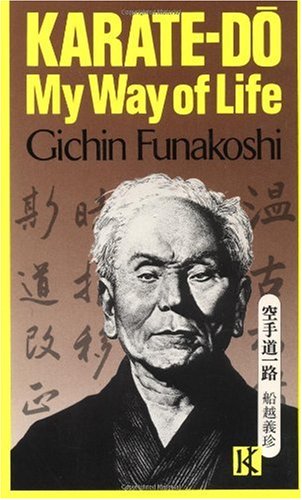
1. Karate-Do: My Way of Life
$10.53
2. The Twenty Guiding Principles
 
$22.49
3. Karate-Do Kyohan: The Master Text
$0.01
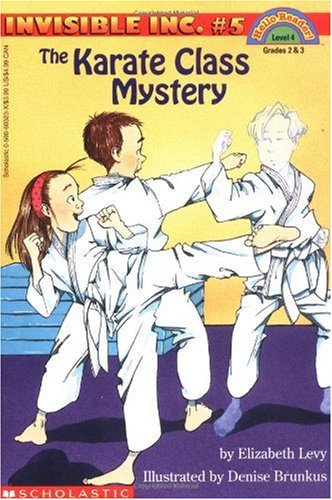
4. The Karate Class Mystery (Invisible
 
$9.58
5. Best Karate, Vol.1: Comprehensive
$8.95
6. Best Karate, Vol.5: Heian, Tekki
$11.68
7. The Essence of Okinawan Karate-Do:
 
$9.48
8. Best Karate 2: Fundamentals
$10.98
9. The Bible of Karate Bubishi
$6.94
10. Karate for Kids (Martial Arts
$1.17
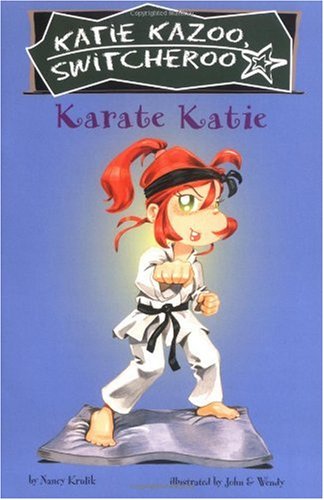
11. Karate Katie #18 (Katie Kazoo,
$5.97
12. Karate Dojo: Traditions and Tales
 
$10.89
13. Karate-Do Nyumon: The Master Introductory
$9.75
14. Best Karate, Vol.8: Gankaku, Jion
$14.00
15. Shotokan Karate Kata Vol. 1
$9.75
16. Best Karate, Vol.4: Kumite 2 (Best
$12.68
17. Shotokan Karate: Its History and
$15.00
18. Dynamic Karate (Bushido--The Way
$6.70
19. Complete Idiot's Guide to Karate
$10.50
20. The Shotokan Karate Bible: Beginner

1. Karate-Do: My Way of Life
by Gichin Funakoshi
Paperback: 144 Pages (1981-09-15)
list price: US$9.00 -- used & new: US$4.65
(price subject to change: see help)
Asin: 0870114638
Average Customer Review: 4.5 out of 5 stars
Canada | United Kingdom | Germany | France | Japan
Editorial Review

Book Description
Linking the time when karate was a strictly Okinawan art of self-defense shrouded in the deepest secrecy and the present day, when it has become a martial art practiced throughout the world, is Gichin Funakoshi, the "Father of Karate-do."

Out of modesty, he was reluctant to write this autobiography and did not do so until he was nearly ninety years of age. Trained in the Confucian classics, he was a schoolteacher early in life, but after decades of study under the foremost masters, he gave up his livelihood to devote the rest of his
life to the propagation of the Way of Karate. Under his guidance, techniques and nomenclature were refined and modernized, the spiritual essence was brought to the fore, and karate evolved into a true martial art.

Various forms of empty-hand techniques have been practiced in Okinawa for centuries, but due to the lack of historical records, fancy often masquerades as fact. In telling of his own famous teachers-and not only of their mastery of technique but of the way they acted in critical situations-the
author reveals what true karate is. The stories he tells about himself are no less instructive: his determination to continue the art, after having started it to improve his health; his perseverance in the face of difficulties, even of poverty; his strict observance of the way of life of the
samurai; and the spirit of self-reliance that he carried into an old age kept healthy by his practice of Karate-do. ... Read more

Customer Reviews (43)

5-0 out of 5 stars Good insight into Master Funakoshi's life and philosophy
This really gives a great insight into a lot of the philosophy of the master.How you take the information inside this book is up to personal opinion but whatever your opinion it is an eye opener if you wanted to know why perhaps some things are the way they are

5-0 out of 5 stars Humbled by the master
A wonderful book from the man who effectively created Shotokan Karate.
Funakoshi was a very humble man who was trained by two early Okinawan masters (Yasutsune Azato & Yasutsune Itosu). He never boasts of his acheivements and indeed claims only ever to have used his skills once, when he was quite old, to protect himself and his goods from a young thug. He regretted this act though.

The book is only small, and perhaps this reflects a man who lived a very simple life. As he says "think of everyday life as Karate". Whether you are a new student nervously awaiting your first grading or a Dan grade with years of experience you should really read this book to bring a sense of perspective to your Karate.

4-0 out of 5 stars Interesting glimpse in to the unwavering mind of a master
This is an interesting book written by Gichin Funakoshi in the eves of his life. More than 80 years of his life he dedicated to this ancient and fantastic way of phsysical and mental training. All the while trying to become a better person, never becoming selfabsorbed or complacent. I particularly like the story where he, as an old man, is attacked by a much younger man. Master Funakoshi repels the assailant without hurting him, but afterwards he chides himself and feels that he should have been able to avoid physical confrontation completely...

5-0 out of 5 stars Every Shotokan Karate-ka ought to be given this when they 1st join their club
In his biographical masterpiece, Grand Master Funakoshi gives a very witty, intelligent & often funny account of his whole life, from his early days when he was forced to take up training for his poor health to when he was finally invited to Japan to give the first successful demonstration of his art - Shotokan Karate.

He was obviously a very clever man who really had a passion for his art. At an early age he developed a goal, a vision and a passion to learn all he could about karate from the then great masters of his time and present it to the world. He recounts several times in his life when he was confronted by would-be assailants and describes how he got out of the potentially lethal encounter, he does this in a very witty and often funny way.

Despite the book being very small and could be read by some perhaps in a day or so, it really is very interesting and worth reading several times, especially if you practice Karate. I think that it's the sort of book that should be given to new students on joining a Shotokan club.

It's just packed with gems of wisdom worth there weight in gold for successful living, even in today's manic society.

As in all the other positive reviews listed here already, Funakohi's book is full of wisdom, inspiration and hope.

Check out Clive Layton's "Training With Funakoshi" too, an excellent work from a different perspective not to mention Funakoshi's "Twenty Guiding Principles".

4-0 out of 5 stars a fine book, recommendable
This book should enrich your knowledge of the martial arts, and is an enjoyable read. ... Read more


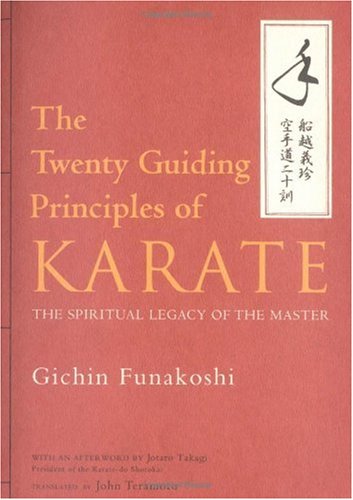
2. The Twenty Guiding Principles of Karate: The Spiritual Legacy of the Master
by Gichin Funakoshi, Jotaro Takagi
Hardcover: 128 Pages (2003-11-07)
list price: US$18.00 -- used & new: US$10.53
(price subject to change: see help)
Asin: 4770027966
Average Customer Review: 4.5 out of 5 stars
Canada | United Kingdom | Germany | France | Japan
Editorial Review

Book Description

Gichin Funakoshi, "the father of karate," once said that "that ultimate aim of karate lies not in victory nor defeat, but in the perfection of the character of its participants."

To support this life-long stance and offer guidance to future practitioners, he penned his now legendary twenty principles. While the principles have circulated for years, a translation of the accompanying commentary has never found its way into publication-until now.

Master Funakoshi's approach stresses spiritual considerations and mental agility over brute strength and technique. Practitioners should not rely on technique alone-striking, kicking, blocking-but must nurture the spiritual aspects of their practice as well. Attend to yourself and the rest will follow, was the message he set for posterity over sixty years ago.

As axioms, Funakoshi's principles are open to various interpretations. "There is no first attack in karate" has occasioned endless discussion about its true meaning. Many of these ambiguities are clarified in the commentary, which is also filled with philosophical musings, fascinating historical episodes, and advice for anyone seeking a better Way.

Translated for the first time into English by John Teramoto, a karate practitioner himself, and accompanied by original calligraphy, this long-awaited treatise is a provocative read and, for martial arts enthusiasts, a long overdue godsend.

... Read more

Customer Reviews (10)

5-0 out of 5 stars A GREAT AND KNOWLEDGEABLE BOOK
This is an excellent book. It is an easy read, and covers the important spiritual, social, physical and practical parts of Karate. I definitely recommend this book to anyone who wants to know what Karate or martial arts in general is really about.

5-0 out of 5 stars A Bible for any Martial Artist.
Again, every Shotokan Karate-ka (in fact any martial artist) ought to have one of these and read it often to learn the proper meaning of what karate is all about.

It's [karate] not just all kicking, punching, grunting and stuff. Some of the 20 "guiding principles" or "precepts" in the book have actually been acquired from earlier great martial art [Budo] masters (Matsumura e.g.)

That's not to say that Master Funakoshi copied them, and even if he did, it was a very wise decision to have them listed all in one place.

A short book that can easily be devoured in a day, it's full of "worldly" wisdom, no matter what martial art you study. It's best read a few times to digest the intention behind each precept.

Even if you're not martial artist, there are many great principles here that when applied to everyday living will enhance your life and help you to be more successful, kinder and a happier person, regardless of your religion. Each short one sentence precept is then interpreted over the next page or two in simple but meaningful way.

I incorpoarte all of these principles in my lessons (one at a time of course!) and try to have my students learn them & understand their true meaning. I'm certain it goes a long way to improving my students character, especially with junior students.

Again, this is another one of those books, that, if I were able to afford it, I would give my students for FREE when they joined my club.

3-0 out of 5 stars Not exactly "by Funakoshi"!!!
Although the book is announced to be written by master G.Funakoshi, only a 10% of it was actually written by him, the other 90% are commentaries by G. Nakasone. Despite this the book is quite inspiring in the advanced study of karate.

5-0 out of 5 stars THE Basis of Karate-Do
Master Funakoshi provides an even greater legacy to our troubled world than that of modern karate.His book, "The Twenty Guiding Principles of Karate," is a rich guide to living one's life day-to-day.The applicability is not just to the dojo; but our homes, the corporate world, and every other environment.

Although the serious karateka will treasure this volume; anyone who understands the benefits of mind-body-spirit integration can gain from the lessons.Some may say the book is too short; it is deceptively short and deceivingly simple.It is easy for a reader to "intellectually" connect with a long tome where everything is spelled out.They close the volume and that's that.The challenge is every morning and evening to look oneself directly in the eye and do an honest inventory of how we are living the principles.

As Rule #4 clearly states (echoing one of the most insightful strategies of Sun Tsu); First Know Yourself Then Know Others.In the same way that one can never "master" karate, the wisdom that can be gained from the insights Master Funakoshi offers is directly proportional to the honest introspection of the reader.When many people are so quick to judge and blame others for the quality of their lives, rather than assume responsibility, this book offers simple guidance.

Each time I read it, there is some new insight gleaned; another layer peeled.At times, there is a brief moment of chagrin accompanying the realization of a behavior not in keeping with the principles; but quickly followed by appreciation for the opportunity to change.As with Principle #1; a little more REI (respect) could go a long way in all venues.

4-0 out of 5 stars The 20 Guiding Principles of Karate
Very insightful and well written.This book provides the novice martial artist, as well as the more experienced practitioner, a basic, fundamental approach to learning, recognizing, and appreciating the essence and spirituality of karate. It helps the reader understand that practicing martial arts extends beyond the technical aspects of learning the art and focuses on one's development of character, proper attitude, and respect for self, others, and life itself.The book is very enlightening and should be read and practiced by all who study the martial arts. ... Read more


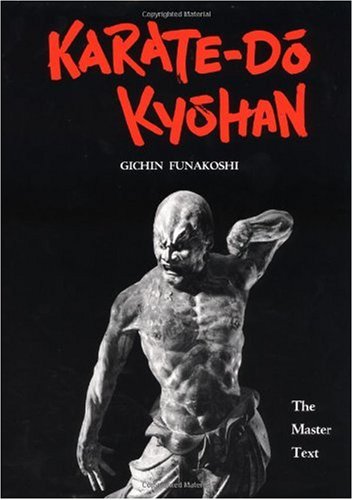
3. Karate-Do Kyohan: The Master Text
by Gichin Funakoshi
 Hardcover: 256 Pages (1973-05-15)
list price: US$40.00 -- used & new: US$22.49
(price subject to change: see help)
Asin: 0870111906
Average Customer Review: 4.5 out of 5 stars
Canada | United Kingdom | Germany | France | Japan
Editorial Review

Book Description
Nineteen kata ("forms") of karate-the art of self-defense without weapons-are presented here in complete detail. They are the ones selected by the great master and teacher, Gichin Funakoshi, to give comprehensive training in Karate-do, the way of karate.

Fully illustrated demonstrations by the translator cover not only every technique of the kata but also the fundamentals and applications: how to make a fist; the correct form of the open hand; preliminary training in blocking, striking and kicking; the seven stances; and sparring.

The author presents, besides kata that he himself originated, beginning and advanced kata from both the Shorei school and the Shorin school, the former remarkable for their forcefulness and development of strength, the latter characterized by their gracefulness and lightning swiftness.

This book, the most comprehensive and authoritative ever published, was being revised by the author shortly before his death in 1957, at the age of eighty-eight, and is translated for the first time. Through his advice on both practical and spiritual aspects of training, the master guides the
student from techniques to the Way of karate. Complementing the English edition are illustrations of National Treasures from Kofuku-ji and Todai-ji temples in Nara and Master Funakoshi's calligraphy.

Karate, whose value for the well-rounded development of strength, coordination and agility is scientifically validated, can be practiced at any time and in any place, for any length of time, by men and women of all ages, and requires no special equipment. It also fosters the development of spiritual
qualities: courage, courtesy, integrity, humility and self-control.

Gichin Funakoshi's karate books, the first published in 1922, are landmarks, for the development of this martial art in Okinawa was shrouded in secrecy, and almost no records of its early history, dating back more than a thousand years to the Shao-lin Temple in Hunan Province, China, exist.
Karate-do Kyohan is a book that lives up to its title: it is in truth the master text for karate instruction at all levels and in all aspects of technique and character development. ... Read more

Customer Reviews (36)

5-0 out of 5 stars not much to say
If you do Shotokan or any karate for that matter you should have this book, If you do Shotokan you HAVE to have this book and you are very luck to have so much of the founders works published in english and still in print, i train in Kyokushin and most or Mas Oyama's work is in Japanese only and long out of print

5-0 out of 5 stars An Invaluable Resource, Among the First Karate Documents
I am a 2nd-dan practitioner under Tsutomu Ohshima, the translator, and I want to point out a few things, regarding the comments.Mr. Ohshima read the original Japanese text of his teacher(Funakoshi), at least 50 times (before translating), and was authorized by his family to translate it into English.With those considerations (and the fact that it took 10 years), it was a monumental undertaking--personally, professionally, and historically.I can appreciate that he used his own photos, because, as someone else pointed out, the stances got lower and longer, and some things were in transition at the time the book was written--think of it as a "2nd, updated edition."For more information on the changes going on at the time, investigate Shigeru Egami's excellent Karate-do Nyumon, also available here.Egami was Mr. Ohshima's senior and very close friend, considered by many to be the top karateka during his life.

Master Funakoshi mastered 2 styles--shorei-ryu and shorin ryu-during his lifetime, instructed by Masters Itosu and Azato.The former has powerful, hard directed movements, rooted in deep stances, while the latter has swift, sweeping, bird-like movements, and we have kata from each style (Ie. the Heian/Pinan forms are Shorin, while Tekki/Neihanchu kata are shorei).Traditional "karate" come from Okinawa, and the different regional styles, named for the towns, drew some influence from Chinese sailors trained in kung-fu, who washed ashore and trained the villagers, further influencing their styles, and differentiating them."Shotokan" means "House of Shoto.""Shoto" was Master Funakoshi's nickname.Whena karateka was asked where he was going, he'd say "Shotokan," or Shoto's house."Shoto" also means the sound the wind makes when blowing through pine needles, which Master Funakoshi loved.

Numerous styles claim heritage through Funakoshi, and widespread, unauthorized use of the Shotokan "circled tiger" has ensued.This symbol was created by one of Funakoshi's students, and is trademarked.You can see it in the opening of one of Jet Li's movies, and probably many others.

Traditional Tae-Kwon-Do was created by practitioners who got their karate black belts in Japan in the 20th century (according to my research) although there's a raging debate about the "ancient" origins of those arts.Some claim Tae-Kwon-Do descended from a children's game in which practitioners tried to knock down their opponents with a kick, which was banned by elders long ago--a view that is often ridiculed by martial art historians.This is buttressed by the fact that many Tae-Kwon-Do schools use this Kyohan as their text, and either the exact same kata(particularly the Heian), or lightly modified (usually with modified or added kicks).

Not all "karate" styles are directly descended from Shotokan.Goju-ryu and others at least partially developed in parallel, but they definitely influenced each other, and had common roots.To be called "karate," however, implied, originally, Chinese roots.This changed, later, to mean "open-hand" styles, so karate, today, is more generally loosely defined.This website has a clear "family tree," of karate heritage, as well as incredibly useful information and links-- [...].Ohshima Shihan's website is [...].Also see [...] (in English or Spanish).

One reviewer criticized the Shotokan punch, and it seemed that he was responding not to the book, but to Shotokan generally.Our stances have gotten longer and narrower.When Funakoshi brought karate to mainland Japan, many practitioners were already experts in judo and kendo.One effect was the lengthening of the distance between fighters--often a judo expert would immediately slam a karateka to the ground, or a kendoka would quickly "spear" the uninitiated with a punch.These 2 aspects, as you might imagine, caused a relatively immediate change, not unlike (although it's a long-shot) the effect Gracie Jujitsu had on early mixed martial arts events.These three disciplines (and others) combined to develop the efficacy of Japanese karate, as practiced by Funakoshi's students.

Another reviewer sharply pointed out that the book was written for beginners, as well as advanced practitioners.One isn't meant to punch (and fight) with the hand opposite the punching hand pulled back to the hip (ie. "pulling hand), so there is no "arm ending up behind one's body" as the other reviewer had mentioned.This is taught to beginners to show them the proper movement, and is often reverted to by the advanced, to refine the development of power through the thrusting of the hips.In a real engagement (and sparring), fighters hold their hands up naturally, like boxers or MMA fighters.

This review is supplemented by my material here--[...]

The highly-rated Karate Jutsu: The Original Teachings of Gichin Funakoshi, by Ohshima godan John Teramoto (and also available here on Amazon) is the first official English translation of an earlier Funakoshi book.Also do not miss Funakoshi's Karate-do: My Way of Life.

4-0 out of 5 stars A must have
This book is a fantastic must-have for any Karate enthusiast.It really is The Master Text (it says so right on the cover).The early chapters provide an insightful background and history of Karate and Shotokan, and are a great read.The later chapters serve as wonderful reference material for the practicing Karate-ka.
Highly recommended.

1-0 out of 5 stars Disappointing
I feel quite disappointed abut this product: The original pictures by master Funakoshi (more than 50% of the book) were replaced by similar pictures of the translator doing similar examples. This information was not available online, I just realized this when I received the item. I've been told that a new english edition has been released by ITKF recovering the original pictures of the author.

5-0 out of 5 stars A must own for Japanese and Korean Students
If you want to see the evolution of Okinawan Karate from Shuri-teinto Shorin-Ryu, Shoto-Kan , and eventually Korean Tang Soo DO You need to have this book and also Karate Jutsu. Then study Hwang Kees Two texts on Tang Soo Do vol 1 and 2 and you'll see Tang Soo Do is the Korean version of Shoto-Kan (which is nothing to be ashamed of). Even though the Koreans don't like to admit it, there's no question where Tang Soo Do's roots lie and it's not in a 2000 year old Korean art or anything Mstr. Kee learned in China! You will also see the changes that evolved, from the High original stances of Okinawan karate (Karate Jutsu) that Funakoshi was taught by Itosu, to the deeper and longer stances that later developed in shoto-kan, as well as many Shoto-isms particular to both styles such as Pinan 1 and 2 being reversed from Itosu's original order. You'll notice the single index finger knife hand blocks in Seishan Kata (Hangetsu), which modern Shoto-kan no longer uses but Tang Soo Do still does, the commonality of the total kata and the overall simularity which is remarkable especially when Tang Soo Do's leaders and most Koreans refuse to admit it.

... Read more


4. The Karate Class Mystery (Invisible Inc. Hello Reader!, Level 4, No. 5) (Hello Reader, Invisible Inc.)
by Elizabeth Levy
Paperback: 48 Pages (1996-09-01)
list price: US$3.99 -- used & new: US$0.01
(price subject to change: see help)
Asin: 059060323X
Average Customer Review: 5.0 out of 5 stars
Canada | United Kingdom | Germany | France | Japan

Customer Reviews (2)

5-0 out of 5 stars Invisible Inc. is a visable success
"The Karate Class Mystery" is a book about friends who work together even when their frindship is threatened.The karate stuff is fun and the vocabulary is explained really well so you don't feel stupid.I love mysteries and this is a fun one.If you like mysteries and karate you should read this one.The other Invisible Inc. books are good too but I liked this one best.

5-0 out of 5 stars The best Invisible Ink book I've ever read.
This is a story about a kid who wanted to see his friend more often, so he went to karate classes to see him, andin the story he helps his friend find his white belt.This was a fun book to read and it had some funny parts, too. ... Read more


5. Best Karate, Vol.1: Comprehensive (Best Karate)
by Masatoshi Nakayama
 Paperback: 144 Pages (1977-10-15)
list price: US$17.00 -- used & new: US$9.58
(price subject to change: see help)
Asin: 0870113178
Average Customer Review: 5.0 out of 5 stars
Canada | United Kingdom | Germany | France | Japan
Editorial Review

Book Description
All the basic points of karate arranged systematically for effective learning, step by step--the parts of the body used as natural weapons, the stances, how to block, how to attack, introduction to the kata and to kumite.

The fundamentals as presented in this volume, briefly but accurately, are the distillation of the author's forty-six years' experience in this art of self-defense. As well as setting forth the basic rules that must be put into practice when performing kata or applying techniques in kumite, this
volume pinpoints the underlying physical and physiological principles of karate: source and concentration of power; stance, form, stability and technique; movement in all directions; basic and comprehensive aspects of training. ... Read more

Customer Reviews (2)

5-0 out of 5 stars Best karate book I've read
I studied from this book's spanish version. The precision with which Nakayama Sensei explained each technique is the closest thing to having a karate master teaching you the art. Even when nothing replaces the dojo experience, this series of books are the finest. Totally recommended

5-0 out of 5 stars Excellent intro in Karate
The book is well illustrated, and gives an excellent introduction into the different stances and strikes found in Karate. More importantly, it is probably the only book that illustrates the "flow" of the moves, instead of just showing the ends of the move. Overall, the book is great for a Karate-ka who want to refine certain things in Karate. Finally, the price that Amazon sells it at is really hard to beat!Ron Przygodzki ... Read more


6. Best Karate, Vol.5: Heian, Tekki (Best Karate)
by Masatoshi Nakayama
Paperback: 144 Pages (1979-10-15)
list price: US$17.00 -- used & new: US$8.95
(price subject to change: see help)
Asin: 0870113798
Average Customer Review: 5.0 out of 5 stars
Canada | United Kingdom | Germany | France | Japan
Editorial Review

Book Description
Kata, the formal exercises of karate training, were the essence of practice in Okinawa and China, and are the core training method even today.

Detailed here in 1500 sequential photos are the five Heian and three Tekki kata, mastery of which is necessary to attain first dan.

Demonstrated by the author and Yoshiharu Osaka. ... Read more

Customer Reviews (9)

5-0 out of 5 stars Best series of books on kata.
I have been practicing Shotokan karate for 10 years now. Even though I attend regular classes and seminars, as well as working out with very qualified karate-ka, I still find myself coming back to Master Nakayma's work in this very fine series of books. Of all the books on kata I have these books are superior.

The instruction is straight forward and to the point. Tips are given to avoid common mistakes. Under the many pictures illustrating the kata is a stance diagram and short concise sentences to describe each move.

Extremely well done by one of the finest karate masters.

4-0 out of 5 stars masters
i think its also so good book but i dont know how bought this book. its for your information i am a black belt of martialarts. i cose so diffrent style of martial arts its use only in tis time Pakisatn but future its must be te king style of the world.

4-0 out of 5 stars masters
i think its also so good book but i dont know how bought this book

5-0 out of 5 stars Excellent to learn Katas
I bought three books out of the "Best Karate" series and the two books about katas are simply outstanding. I use another book which describes the movements in words but it's just too hard to figure it out for some of the tricky movements. The "Best Karate" series has photo series for all katas plus additional information about what people should take care of for the individual katas (for instance, stance changes for Heian Shodan). That way, it's really "easy" to learn a kata on your own, just from the book.

5-0 out of 5 stars Shotokan Katas from beginner to Brown Belt
Excellent book.Those that do not have an instructor close by can learn the details of the katas from this book. ... Read more


7. The Essence of Okinawan Karate-Do: (Shorin-Ryu)
by Shoshin Nagamine
Paperback: 278 Pages (1998-10)
list price: US$19.95 -- used & new: US$11.68
(price subject to change: see help)
Asin: 0804821100
Average Customer Review: 4.5 out of 5 stars
Canada | United Kingdom | Germany | France | Japan

Customer Reviews (29)

5-0 out of 5 stars Great Book
This book is well worth the price, it helps you reinforce your instructions.It also prepares you for the next step.Great

5-0 out of 5 stars A good reference for katas
Like other authors, Nagamine starts on his beginnings as a karate man.While interesting I found the photos of katas more beneficial.Whether you come from a different style of karate, or are just forgetful of what the next move is, the photos will help you understand the basic movements a kata takes.However, this book will not teach you how to perform the moves correctly, and they will not be exactly the same as your instructor's.

5-0 out of 5 stars Indispensible for Matsubayashi-ryu
Do not say that you study Matsubayashi-ryu unless you own and study this book. My instructor, a sixth degree black belt, carries it in his duffel bag. I do likewise.

The first section is a good review of the history of the matsubayashi system and of the principles of martial arts. The bulk of the book contains photographs of Nagamine, the author, demonstrating kata. I have been able to learn and practice kata between lessons without waiting to ask my instructor this or that question. Consequently, I have progressed very rapidly.

However, speed of progression is not the point of the book. The point is that karate is and should be practiced as a martial art. If you want to know what that means, you MUST read this book.

4-0 out of 5 stars A Master's View of His Martial Art
Sensei Nagamine shares his heart, as well as his art, in this excellent book.The history of the martial arts development as well as its forms and function are presented in an easy-to-read format.For those who are students of the martial arts, especially Shorin-Ryu, this is an insight into the mindset of one of Okinawa's greatest teachers.It is a "must have" for the traditional student who wants to preserve the original kata forms and legacy of Grandmaste Nagamine.

5-0 out of 5 stars Excellent book!
This book is really indispensable for those who want to study Karate-do seriously, especially Shorin-Ryu practitioners. It includes historical data (Nagamine Sensei was a researcher, himself) along with moral and philosophical aspects of Karate-do, besides the technical aspects. After that, Nagamine Sensei shows the Kata of his branch of Shorin-Ryu, the Matsubayashi (may be some differences with other Shorin-Ryu schools in several Kata) along with some essential explanations. Readers must realise that the only way to learn Kata is training in a Dojo with a Sensei. However, this book is an excellent companion to remember and review aspects of the Kata and -as said- enter the realm of Karate-do as an art and a way of life. ... Read more


8. Best Karate 2: Fundamentals
by Masatoshi Nakayama
 Paperback: 144 Pages (1978-07-15)
list price: US$17.00 -- used & new: US$9.48
(price subject to change: see help)
Asin: 0870113240
Average Customer Review: 4.0 out of 5 stars
Canada | United Kingdom | Germany | France | Japan
Editorial Review

Book Description
As well as setting forth the basic rules that must be put into practice when performing kata or applying techniques in kumite, this volume pinpoints the underlying physical and physiological principles of karate: source and concentration of power; stance, form, stability and technique;
movement in all directions; basic and comprehensive aspects of training. ... Read more

Customer Reviews (4)

2-0 out of 5 stars Not the best karate...
The foundations of Traditional Karate make no more sense (at least in the modern civilization). Principles and methods must be rationalized. Sensei Kenji Tokitsu, a living ledgend in Japan and France, is carrying a supberbwork towards Quality. The best Karate indeed.

4-0 out of 5 stars A great series to start your personal library with
I recommend Nakayama sensei's Best Karate series as a must have for any personal library.Individually, each book is not the be all-end all of karate knowledge, but taken as a set, it offers a wide range of informationand motivation for the beginning karateka.Plus...its a classic with thelittle men jumping and kicking all over the pages!

5-0 out of 5 stars A MUST FOR THE MOST SERIOUS KARATE-KA!!!
Sensei Nakayama provides readers with a no-nonsense in-depth study of what is required to develop solid fundamentals in Karate! This book is very easy to visualize and comprehend. Traditional Japanese instruction from a greatmaster!

4-0 out of 5 stars The serious students starting point.
The Best Karate series is THE definitive reference for the praticing karataka.Fundamentals covers the basic blocks, strikes and stances. ... Read more


9. The Bible of Karate Bubishi
Paperback: 214 Pages (1995-06)
list price: US$18.95 -- used & new: US$10.98
(price subject to change: see help)
Asin: 0804820155
Average Customer Review: 4.5 out of 5 stars
Canada | United Kingdom | Germany | France | Japan
Editorial Review

Book Description
No other classic work has had as dramatic an impact on the shaping and development of karate as The Bubishi. Treasured for centuries by karate?s top masters, studied, applied, and plagarized, The Bubishi is a classic Chinese work on philosophy, strategy, medicine, and technique as they relate to the martial arts. Referred to as 'the bible of karate' by the famous master Miyagi Chojun, for hundreds of years The Bubishi was a secret text passed from master to student in China and later in Okinawa. Now made available to the world in paperback, incorporate its eternal insights into your martial arts training. ... Read more

Customer Reviews (19)

5-0 out of 5 stars The title is exactly what it is.
This is a great book.Everytime I look at it I learn something new.The best part of the book, the more you now, the more you'll get out of it.

5-0 out of 5 stars Bubishi - the Bible of Karate
Very interesting book about the history, tactics & strategies of karate from the old China and Okinawa. This book really open our eyes to understand more about the roots and important principles of Martial Arts.

Soke Leif Hermansson, 9 dan hanshi karate & kobudo
Sweden

3-0 out of 5 stars Good overview and translation of classic oriental book
This book offers a good overview of the original bubishi. It will give excellent historical reference that will build up on your knowledge of martial arts history. A big part of the book is taken by ancient oriental medicine recipies which are interesting to read but little practical use for people not familiar or interested in herbal medicine. If this book is for history or martial arts techniques, it's better as a supplement to other books fully dedicated to each of these two subjects, it'll help building your rounded understanding of martial arts but won't teach you specific styles or techniques.

4-0 out of 5 stars Good book about history of Okinawan Karate
_The Bible of Karate Bubishi_ is a pleasant book to read. Patrick McCarthy is not the author, but the translator and commentator of a book whose original author & date of origin are unknown.

"Bubishi" is the name of a document that was read, copied and passed from master to student in the fighting traditions of Okinawa since the mid-1800s.The Chinese ideograms that make up its title can be interpreted as "a manual of military preparation".I cannot do better than Mr. McCarthy's description of Bubishi on page 27 of the book, so I will quote that here:

" Okinawa's Bubishi is an anthology of Chinese gongfu, its history, philosophy, and application.Focusing on the White Crane style from Yongchuan village, Fujian Province, this compilation also addresses Shaolin Monk Fist gongfu and reveals its relationship to Okinawa's civil fighting legacy of karate-do."
" The contents of this anthology's thirty-two articles include White Crane gongfu history, moral philosophy, advice on etiquette, comparisons of styles, defensive applications, herbal medicines, training mechanics, and Monk Fist Boxing."


McCarthy's translation is broken up into four major sections:
- History and Philosophy
- Chinese Medicine and Herbal Pharmacology
- The Vital Points
- Fighting Techniques

Part One: History and Philosophy has translations and commentary from the six chapters of Bubishi that dealt with history, philosophy, & etiquette for the martial artist.It also includes McCarthy's notes on possible origins of the Bubishi document in China, different theories on the origin of Karate-do, history of Karate-do from the Meiji era, and Okinawan Karate-do dynasties.

Part Two: Chinese Medicine and Herbal Pharmacology is a section that is often vague, but also shows McCarthy's dedication to this project.Ten of the thirty-two articles in the original Bubishi were devoted to medicine & healing.McCarthy spent a number of years consulting with Chinese herbalists to understand what plants were being referred to by the pictures & Chinese ideograms.This was no small task, as many of the ideograms had been miscorrectly copied at one point or another during the past century.McCarthy & the herbalists sometimes had to first figure out what ideograms made no sense, before they could start deciphering what the prescriptions should perhaps have been.

McCarthy is very honest about the facts that (1) no instructions for how to administer the herbs were included, so a person would need to take the list to a Chinese herbalist and have them help figure out what plants needed to applied externally, internally, eaten as a powder, drunk as an infusion, etc., and (2) the prescriptions in Bubishi don't match any current prescriptions in Chinese herbalism, so the information is presented to the reader as is, with no guarantees from McCarthy OR the experts who helped him about whether the prescriptions will be of any use at all.

In part two, only the plants' scientific names are given, and that is the main reason why I give this book four stars and not five.But I also realize McCarthy may have done that deliberately, to discourage experimentation by those who are not herbalists.

Part Three: The Vital Points contains translations of five chapters within Bubishi that deal with vital point striking.McCarthy also includes an introductory section on vital point theory and items of historic note such as the bronze man statues.McCarthy has done a great service to the reader by including both the original diagrams and also more detailed modern anatomical diagrams to show the locations of the striking points.

Part Four: Fighting Techniques includes translations of eleven articles in Bubishi on fighting techniques.McCarthy also includes some notes on Gongfu Quan, Qin Na, and short histories of six different Fujian gongfu styles, including Monk Fist Boxing and five variations of Crane gongfu.The Bubishi articles are very interesting, but sadly there are some where accompanying text and commentary was lost long ago, and all we have today are diagrams of stances & strikes.For those articles where accompanying commentary is available, McCarthy translates the original commentary (which is often in poetic language) and then adds his own notes about what is really meant by "Butterfly Fluttering" and "Blue Dragon Going Out To Seize".


Overall, _The Bible of Karate Bubishi_ is a book I enjoyed reading and found to be very informative.

On a personal note, I am writing this review as someone who typically doesn't read books on martial arts history.There are just too many arts where too much "history" has occurred between different teachers.Consequently figuring out what really happened, even a generation ago, requires reading seven different version told by at least three different people, with allowances made for whether a particular version comes from a personal memoir, a magazine article, or notes from a dojo lecture.And after all that, the reader still won't know if the art is any good, or what its strengths and weaknesses are versus other styles.

I read this book at the behest of one of my teachers, and I was very pleasantly surprised. I am very glad he recommended it to me and a number of other students.

5-0 out of 5 stars Great Knowledge!
This book is excellent for all martial artiest to read!Mr. McCarthy does an excellent job translating and explaining the translation of the material that is present.This is a good soource for introduction into the vital points of the human body.It also possesses great amounts of history on the white crane systems. ... Read more


10. Karate for Kids (Martial Arts for Kids Series)
by Robin L. Rielly
Hardcover: 48 Pages (2004-06)
list price: US$13.95 -- used & new: US$6.94
(price subject to change: see help)
Asin: 0804835349
Average Customer Review: 4.5 out of 5 stars
Canada | United Kingdom | Germany | France | Japan
Editorial Review

Book Description
A fun and accessible introduction to studying karate--designed specifically with the interests and capabilties of young martial artists in mind.

First time martial arts students are not just starting a program of physical and mental practice. They are entering a new world--one that not only has new rules, new goals, and even new clothing--but that also offers them lots of new opportunities for fun and accomplishment.

Karate for Kids will help prepare kids to start learning about karate and help them practice at home. It includes thorough introductions to the history and philosophy of the techniques, what to expect in the first few classes, how to warm up and practice, and advice on setting goals.

With over 75 full-color illustrations, including 40 clearly diagrammed karate exercises, along with lots of fun facts and informative sidebars written in kid-friendly, jargon-free language, this is the perfect introduction for the younger martial artist. ... Read more

Customer Reviews (3)

5-0 out of 5 stars Karate Book
This Karate book is just great!My 8 year old reads it.It helped him visually to understand poses, kicks, blows, etc. A good review as well as introduction to Karate. I'm glad we purchased it.

4-0 out of 5 stars Neatly done
I wrote a book about teaching martial arts and run a kid's karate class so I believe that I can speak with authority when I say that Rielly's book is well-rounded, easy to read and very child appropriate. It covers all the basics including a brief history of karate, why students might be interested in studying this martial art, an explanation of the karate uniform, description of the dojo (practice hall), discussion of etiquette, overview of warm up routines, explanation of basic techniques, and description of advancement testing practices. If your child is thinking about taking karate this book can help set his/her expectations and increase his/her chance of success. There is a small caveat about the appropriate use of karate in the front but I wish he'd spent a little more time on that particular aspect. New practitioners, especially younger ones, have a tendency to get into trouble for inappropriately trying out their skills on classmates at school. The sensei (teacher) should cover this but it is always good to know ahead of time. All in all, this book is a great overview for kids.

Lawrence Kane
Author of Surviving Armed Assaults, The Way of Kata, and Martial Arts Instruction

5-0 out of 5 stars A "must-read" for children enrolled in a karate course
Knowledgeably written by Robin L. Rielly (an expert martial artist with decades of experience, a seventh-degree black belt in Shotokan karate as well as a second-degree black belt from Shin Kage Ryu jujutsu), Karate For Kids is a simple but complete introduction to the fitness, self-defense, movements, philosophies, and etiquette of karate for young people. Down-to-earth illustrated instructions and guidelines for proper decorum as well as appropriate physical form make Karate For Kids a "must-read" for children enrolled in a karate course -- or who are considering joining a karate class. ... Read more


11. Karate Katie #18 (Katie Kazoo, Switcheroo)
by Nancy E. Krulik
Paperback: 80 Pages (2006-01-19)
list price: US$3.99 -- used & new: US$1.17
(price subject to change: see help)
Asin: 0448437678
Average Customer Review: 5.0 out of 5 stars
Canada | United Kingdom | Germany | France | Japan
Editorial Review

Book Description
Katie's friend Kevin can't wait for his big karate match. And Kevin, who says he's the best yellow belt in his class, thinks he's bound to win. But when the magic wind turns Katie into Kevin just before his big match, she manages to threaten his chances of beating the competition! Will Katie be able to karate chop her way to the top? ... Read more

Customer Reviews (1)

5-0 out of 5 stars Karate Katie #18
Very cute, and item receoved in timely fashion, in good condition. ... Read more


12. Karate Dojo: Traditions and Tales of a Martial Art
by Peter Urban
Paperback: 176 Pages (1991-08)
list price: US$12.95 -- used & new: US$5.97
(price subject to change: see help)
Asin: 0804817030
Average Customer Review: 4.5 out of 5 stars
Canada | United Kingdom | Germany | France | Japan

Customer Reviews (11)

5-0 out of 5 stars Every Martial Artist should own
As a black belt and teacher/student I constantly reference this book as a source of inspiration and knowledge as I continue on the warriors path. This is a must have book for anyone considering trying karate, wondering what the heck karate is, or at any level in their training. Participants of other martial arts would also benefit from reading and recognizing the shared characteristics and spirit among us.

3-0 out of 5 stars "The Weaponless Weapon"
As a ShoDan assistant instructor of Shiho Karano Kenpo Karate, I strive to educate myself about the martial arts.I've found some good books on the subject, and I'm always on the lookout for more.Since "The Karate Dojo" has been in print since 1967, I figured it must provide valuable direction.It does, mainly by portraying a snapshot of martial arts history that challenges the budo practitioner to forsake mediocrity for mastery and character.

The book has three basic parts.First, the author provides a somewhat Karate-centric view of martial arts facets such as the dojo, belt ranking systems, and character self-analysis.In the second section are a number of martial arts parables that teach through historical narrative.Finally, Sensei Urban uses the last chapter to discuss the "contemporary" Karate scene (i.e. the mid-1960s).The overall theme is one of extreme discipline and perseverance within the martial arts, necessary to achieve a seemingly mystical level of physical, mental, moral, and spiritual ability.In other words, it takes hard work and commitment to become a "weaponless weapon."

"The Karate Dojo" is a quick read - I finished it in less than a day.There are a number of stylized line drawings and black-and-white photographs to complement the text.It's a portrait of an era in Karate that seems to be almost mythical - and mostly lost, at least in the West.The author fondly discusses harsh daily training under the strict discipline of a revered master in a dojo where everyone's practically family.I've tasted some of that, but nothing close to what Sensei Urban describes.And that's where I differed with the author.Yes, optimal mastery of any activity requires the type of commitment he advocates, and that's OK for some.But I believe it's possible to benefit from a consistent and disciplined practice of the martial arts without making an all-consuming religion out of it.

At any rate, despite some dated aspects and a monkish focus on martial arts that may be beyond what many would bear, "The Karate Dojo" contains worthwhile insights for the martial artist.If nothing else, its high standards may challenge one to take their current commitment and practice to a higher level.

4-0 out of 5 stars Simple Book, Simple Stories, Simple Teaching - Nice
Peter Urban was a pioneer in American karate and helped not only spread the art of goju ryu, but the ripple effect helped the promotion of other martial arts as well in the 60s and 70s. While a little eccentric, Urban was true to the bushido roots, while adapting karate for an American population.

This book covers karate philosophy in its mid-twentieth century form and promotes the positive aspects of discipline and etiquette.The book deals with attitude and motivation of spirit.The second half of the book has "dojo stories" that help embody the essences of karate training.

This is just a nice and simple book worth the read.

5-0 out of 5 stars Karate Dojo byMaster Peter Urban
The author's name is synonymous with the Goju style of Karate.
The volume covers the dojo etiquette, the system of belts,
kata and jiu-kumite. The Goju style has a progressive series of
belts from white to green to green/stripes to purple to brown
to brown/stripes and finally to the first level black belt.
Incremental knowledge of the katas combined with excellence of
execution are important distinguishing factors between the
various belts. At the higher levels, candidates must have
some formal teaching together with entries into various competitions sponsored by local, national and international
associations in the art. Contestants have a separate karate
etiquette to be displayed before the judges and their fellow
colleagues.

Master Peter Urban shows the all-important
connection between excellence of execution of the kata and
transferal of those skills to the formal jiu-kumite. The book
contains a series of stories related by the author. These stories
form an integral part of the book. Mastery of the art requires
continuous practice and study on the part of candidates.
The skills learned in Goju Karate can be transferred into life
practices and habits. The volume is well worth the price for
serious students of the Goju Karate. Read this book thoroughly
and your Sensei will marvel at your progress in the art!

5-0 out of 5 stars wonderful, and my training partner thinks so too!
I borrowed this book from my Sensei and loved it so much that I had to buy it for myself!The stories in the second section are wonderful, and the ideas in the first half really make you examine yourself and your training.

A must read for all karate students, even if all you get out of it is that the stories are cute. ... Read more


13. Karate-Do Nyumon: The Master Introductory Text
by Gichin Funakoshi
 Paperback: 120 Pages (1994-12-15)
list price: US$19.00 -- used & new: US$10.89
(price subject to change: see help)
Asin: 4770018916
Average Customer Review: 4.0 out of 5 stars
Canada | United Kingdom | Germany | France | Japan
Editorial Review

Book Description
Karate-do Nyumon literally means a passage through the gates of the Karate way-in other words, an introduction to the world of Karate. Karate-do Nyumon is the result of Master Funakoshi's wish to clarify Karate thought and practice for those who know nothing about it. It comprises unpublished
writings from the years before his death in 1957, together with simplified kata-sequences of movements-synthesized by Funakoshi from the traditional Okinawa Karate-do kata, for beginners.

Master Funakoshi begins by exploding some of the myths of Karate:

"Karate-do is a noble martial art, and the reader can rest assured that those who take pride in breaking boards or smashing tiles, or who boast of being able to perform outlandish feats like stripping flesh or plucking out ribs, really know nothing about karate. They are playing around in the leaves
and branches of a great tree, without the slightest concept of the trunk."
In his description of what Karate is, the Master describes the history of Karate-its origins in the ancient methods of unarmed combat in China, and its growth as a fighting method in Okinawa, a country where arms were banned in a succession of decrees from the Japanese mainland. In order to prevent
it being subjected to control, or more importantly, to prevent the Japanese overlords from knowing and using the techniques, the practice of Karate was kept a secret. To preserve this secrecy, the habit persisted until very recent times of keeping no records. Master Funakoshi, however, recognized in
this book and others the need to formulate the kata precisely, so as to establish a standard of true Okinawan Karate.
The kata in this book are not traditional kata, but they serve to establish the correct habits of stance, thought and action, and to facilitate the eventual mastery of the true Karate-do kata. All these special kata are clearly explained and illustrated by photos.

Lastly, Master Funakoshi recalls stories of men who were living legends when he was a youth in Okinawa, men whose reputations overcame even the secrecy that clung to Karate until the middle of this century. ... Read more

Customer Reviews (8)

5-0 out of 5 stars The Master does it again!
There are certain books in which EVERY true martial artists should have in their library.A few of those books are "The Tao of Jeet Kune Do", "Karate-Do KyoHan", "Zen in the Martial Arts", "The Book of Five Rings", "The Art of War", and last but not least, "Karate-Do NyuMon".Gichin Funakoshi has a view of Karate-Do that most practitioners do not see.He wants it more of a way of life...a whole excesize of mind, body, and spirit.In this book, he expands on this belief and even includes the almost forgotten (but SO important) Ten-No-Kata.It is short and worth the study.VERY IMPORTANT!This book contains a lot of "Do" as well as technique.Funakoshi is the "man" in my book, along with Lee, Inosanto, Ueshiba, Rhee, and Hatsumi.I HIGHLY recommend this book.

3-0 out of 5 stars Introductory Text
This book begins with history of te and a couple of masters. Of course in Funakoshi style there is no in depth details nor any dates. Ten no Kata is revisited, which is no longer practiced with frequency today. Funakoshi'sbooks were the text book of karate in the early 1940's. Good for theirtime, but still a good addition to your library.

3-0 out of 5 stars A fun overview but nothing deep
All of us who study karate are lucky that Funakoshi wrote all he did. Except for a very few others, Funakoshi is the only early written information about karate and the earliest material that was translated intoEnglish.

Unfortunately for myself and many others who study karatehistory, Funakoshi never goes into much detail about much of anything. Healmost never gives a date and he rarely, if ever says where he learned anyof his kata or other practices.

The material on his teachers (Itosu andAzato primarily) is in summary form, never mentioning more than anecdotes.There are no dates, mentions of other students they had, what they taughtetc...

Over all, this kind of book is about real karate, certainly enoughto get a young mind going in the right direction about karate. It is wellwritten, we can probably thank the translator for that. It contains someinteresting material that is fun to read. Beyond that, it lacks detail tokeep you interested for long.

Most of Funakoshi's books are like this forhistory. For the real meat of Funakoshi's karate (rather than thisintroduction), take a look at "Karate-do Kyohan", which containsmuch more technical information.

5-0 out of 5 stars Living History
Karate-Do Nyumon is a wonderful book for any karate practitioner to read.I've read my copy through many times, and that's not counting all the times I've come back to specific areas of the book.This is one of the bestbooks available for the new student in helping them understand just whatkarate-do really is, and it is no less a very informative read for studentsand teachers of all other levels.

2-0 out of 5 stars A bit disappointing
So, there's some nice stories about Funakoshi and his masters, all with some kind of morality in them. Well, not that bad. Than there's the presentation of Ten No Kata. So, that's interesting because this Kata isnot practiced anymore formally in the JKA and few karatekas even know itexists, and personnaly I think it's a great method of training basics. Soat least the book shows this kata, but the performer has (seems to me) avery weak technique compared to the performer in karate-do kyohan themaster's text (see this title). Sometimes the postures and techniques seemto be shocking for modern shotokan standards. Maybe it has to do with theevolution of shotokan since the book was written, but then again theperformer in kyohan looks much more the way we are used to for modernshotokan karate-Do. All in all, I was a bit disappointed with this book. Igive it 2 stars for the Ten No Kata and maybe a little nit for the stories. ... Read more


14. Best Karate, Vol.8: Gankaku, Jion (Best Karate)
by Masatoshi Nakayama
Paperback: 144 Pages (1981-12-15)
list price: US$17.00 -- used & new: US$9.75
(price subject to change: see help)
Asin: 0870114026
Average Customer Review: 5.0 out of 5 stars
Canada | United Kingdom | Germany | France | Japan
Editorial Review

Book Description
The three kata in this volume are on the Japan Karate Association recommended list and are notable for the sticklike use of the arms-Jitte, the circular movements of hands and feet coordinated with breathing-Hangetsu, and easy, agile movements, combined into continuous techniques-Empi. ... Read more

Customer Reviews (3)

5-0 out of 5 stars Absolutely the best
This whole series by Master Nakayama is superior to everything else out there in my humble opinion. All levels can benefit tremendously from every book. The kata described in these books are presented with outstanding camera work and superior foot work diagrams. The tempo of each kata is also demonstrated (usually at the front of the book) so that proper timing and speed can be taught. After each kata is a small (couple of pages) demonstration of a couple moves in the kata describing a particular use and common mistakes.

Brilliant!!!

5-0 out of 5 stars A timeless Masterpiece
It has been over twenty years since I was first introduced to this series of books and they remain timeless classics for anyone interested in Karate.After so many years, so many moves, so many changes, I had lost track of my Best Karate books.This year my son started training and I was thrilled to discover that Amazon.com has this book available.

5-0 out of 5 stars Excellent production, as is the entire "Best Karate" series
This book, and the entire "Best Karate" series, have the typical JKA (former JKA that is), high production values and painstaking attention to detail. With the exception of the first few kata books of this series,novice rank students may find it difficult to understand many of thenuances of the techniques presented, but in fact, the entire series is avirtual warehouse of infomation for the more advanced student, and isperfect as a reference source. The late Mr. Nakayama has always producedpublications of high quality, and this series is no exception, even forstudents not aligned with the JKA or even Shotokan, for that matter. ... Read more


15. Shotokan Karate Kata Vol. 1
by Joachim Grupp
Paperback: 224 Pages (2002-10)
list price: US$17.95 -- used & new: US$14.00
(price subject to change: see help)
Asin: 1841260886
Average Customer Review: 3.5 out of 5 stars
Canada | United Kingdom | Germany | France | Japan
Editorial Review

Book Description
The Kata are the backbone of Karate. Continually practising them allows the whole spectrum of possibilities contained in Karate to be revealed. The Kata consist of a fascinating multitude of techniques, which permit defence in close contact as well as at medium and long distance with your partner. Situations where the Kata can be applied are comprehensively explained in this book. Additionally, the special features of any Karate style are expressed through the Kata. The Kata contained in this book have their roots in the Shotokan Karate style. The book aims to assist in understanding them better, to get to know the situations when they can be applied, and how to improve them in the daily training routine as well as in grading tests and competitions. 17 Kata are presented in detail using the Bunkai method: Heian 1 to Heian 5, Tekki 1 - the basic Kata up to the Brown Belt; Tekki 2 and Tekki 3; Bassai-Dai, Empi, Jion, Hangetsu and Kanku-Dai - the first of the Master Kata; Bassai-Sho and Nijushiho, Gojushiho, Gojushiho-Dai - advanced Master Kata. ... Read more

Customer Reviews (3)

4-0 out of 5 stars Pretty good
Martial arts moves are dynamic and fluid. By their nature, photographs are a limited medium for teaching them, as they only show the endpoints of the moves and not the more important motions in between (for this reason, the creative illustrations such as in the Sugiyama book are much better for showing what photographs cannot). So whenever approaching a book on martial arts technique, one must always keep this limitation in mind.

As an adjunct to the process of learning in a dojo, this book succeeds fairly well.Each kata chapter includes not only photos of each move of the kata, but also photographs of how these moves would actually be used in combat.All too often the katas are taught in the abstract as a mere choregraphed exercise, divorced from any fighting context or practical application.The karate student is supposed to visualize an imaginary attacker while repetitively performing each kata, so having the extra photographs of the actual fighting application of the different moves is a valuable resource.

The introductory information (historical background, training tips, etc.) and the paragraphs that give insight into the nature of each kata are helpful and enlightening.My main dissatisfaction with this book, however, is that this material is poorly translated from the author's native language.It includes many tortured and nonsensical sentences such as: "The time spent on competitions, however, should lead from the finish of such a phase for the Karateka through to Karate-Do as an accompanying life-style."Huh?

2-0 out of 5 stars I'm not impressed
I had some other expectations to these two books. Shotokan Karate Kata Vol. 1 and Vol. 2 are nice to have, BUT don't thing of these books as source for learning Kata.
regards
Siavash T.

5-0 out of 5 stars Great karate kata book!
This book shows pretty much all the katas from rookie to advanced. Shows many differant pictures and tells what some attacks or blocks are used for. Great book! ... Read more


16. Best Karate, Vol.4: Kumite 2 (Best Karate)
by Masatoshi Nakayama
Paperback: 144 Pages (1979-07-15)
list price: US$17.00 -- used & new: US$9.75
(price subject to change: see help)
Asin: 0870113593
Average Customer Review: 5.0 out of 5 stars
Canada | United Kingdom | Germany | France | Japan
Editorial Review

Book Description
This book complements volume 3 of this series and, like the earlier volume, includes writings of masters of the martial arts to guide the student toward spiritual awareness and mental maturity. It places kumite in perspective, relating it to training as a whole. ... Read more

Customer Reviews (1)

5-0 out of 5 stars The Best Of The Best!
Well My name is Aristos and i havea black belt and 2 dans .Well this book is excellent!It shows all the motions ,it explains how to do the motions so even an amateur can understand ... Read more


17. Shotokan Karate: Its History and Evolution
by Randall G. Hassell
Paperback: 196 Pages (2007-08-31)
list price: US$19.95 -- used & new: US$12.68
(price subject to change: see help)
Asin: 1933901284
Average Customer Review: 4.5 out of 5 stars
Canada | United Kingdom | Germany | France | Japan
Editorial Review

Book Description
The first comprehensive written history of Shotokan karate in any language! In this completely revised edition of the classic bestseller, Randall G. Hassell covers recent developments in the art of Shotokan Karate-do. Rare and never-before-published photos complement everything from the Okinawan roots of karate to the JKA in Japan and the United States, American karate organizations, and the current state of karate. Also in this edition: A chronology of Shotokan Karate, the origins of all Shotokan kata, a genealogy of traditional karate, and much more. ... Read more

Customer Reviews (2)

4-0 out of 5 stars This is an excellent resource for Shotokan karate-ka.
I really enjoyed this book alot.I've studied Shotokan Karate since 1974, and ever since Mr. Hassell wrote his article for Kick Magazine in 1981, I have been looking for a more detailed account to be published in a book. I am planning on using this book as a study guide for my students.I highly recommend it!

5-0 out of 5 stars A truly captivating work, a vortex of information!
Randall G. Hassell is again shown here, to be in "top form"! This captivating work, is a compilation of tangibly "intense research". This book is living snapshot into the martial arts, and scrutiny of one particular "family" of Martial Artists. It's focus is the passionate discussion of the evolution and development of the proverbial "family" known as Shotokan Karate. Agree or disagree with its author, but the presentation is compelling, EXTREMELY articulate, a very balanced and interesting read! ... Read more


18. Dynamic Karate (Bushido--The Way of the Warrior)
by Masatoshi Nakayama
Paperback: 308 Pages (1987-02-15)
list price: US$30.00 -- used & new: US$15.00
(price subject to change: see help)
Asin: 0870117882
Average Customer Review: 4.5 out of 5 stars
Canada | United Kingdom | Germany | France | Japan
Editorial Review

Book Description
Most books on karate usually do not provide complete, detailed instructions and illustrations-the fundamentals plus the fine points-that readers hope for. This book fills the gaps left by others.

The late Master Masatoshi Nakayama, chief instructor of the Japan Karate Association, left this book as a testament. It reveals his great experience as a karate competitor and teacher, describing and illustrating in detail all the correct movements involved in the particular block, punch, or kick
you want to perfect, as well as instructions--on combining blocking techniques with decisive counterattacks. Also included is a glossary of all Japanese karate terms and a guide to their pronunciation.

Because of the lightning speed of karate techniques, normal camera work often fails to record the action accurately. For this reason, many of the photo sequences found in Dynamic Karate were taken using a stroboscope with a flash time of 1/10,000 of a second, enabling you to follow each movement as
it is actually performed. ... Read more

Customer Reviews (15)

5-0 out of 5 stars JKA textbook!
THE book on Shotokan Karate as taught by the Japan Karate Association. Besides having hundreds of pictures and explanations of techniques, it is filled with numerous action pictures of the Masters of The Japan Karate Association from the 1950's and 1960's era.

Simply put, a MUST have for all Shotokan Karate-ka!

5-0 out of 5 stars Traditional Japanese Karate
Kicking Theory: Nakayama says, "If sufficiently mastered, kicking techniques can have a more powerful effect than attacks with the hands." "To counteract the shock of hitting with a foot strike, place the supporting foot firmly on the ground an fully tighten the ankle of the supporting leg." "Attempt to absorb the shock with ankle, knee, and hip of the supporting leg, and keep the upper body well balanced and perpendicular to the ground." "To achieve maximum effect, kick with the whole body instead of with the leg alone. Pushing the hips forward during the kick helps achieve this goal."

Punch theory: "Notice that the muscles at the front and side of the abdomen are strongly tensed, linking the chest and hipbones firmly together. When the hips are properly set and the body is correcly supportted by the thigh muscle, the standing position is firm and stable. This table foundation enables the power of the hps to flow to the chest, shoulder, and arm. Power can be concetrated only when the hips, chest, shoulders, arms, wrists, and fists are firmly linked, and all necessary muscle function fully."


1. R Punch: Step L 45, L inward block, R step forward into a horse, R chop to kidney, two hand grand to R shoulder, pivot and throw to ground, R knee ribs and R punch to face.
2. R Punch: Step R 45, into a Left cover, L knife block, R chop to neck, L bear claw to face, R upcut to solar plexus.
3. R Punch: From a L Cover, step back into a horse, Pivot to the right and lean to the R, L knife block and grab, pivot L and lean to the L, and R chop to the neck.
4. R punch: Step R 45, R chop to the temple, R knuckle down opponents lead arm, drop down into a low horse, and R hammer to groin.
5. R punch: Step back R cover, L outward block, L punch, and R reverse punch to face.
6. R punch: Step backward into a low R cover, L rise punch to chin deflect opponents R with L forearm during the lunge, R knife hand safety to your left side of head.
7. L punch: R cover, L upward block and grab, R invert knuckle punch behind L ear, and R wheel kick to ribs.
8. R punch: R cover, step L 45, R upward block and grab, R wheel kick to solar plexus.
9. L punch: R cover, R upward block, R downward backknuckle to face, R snap kick away.
10. L punch: L cover, R inward block, grab and pull, R side kick to the ribs
11. R punch: R cover, Step L 45, L inward block and R vertical finger to solar plexus or armpit.
12. R punch: R cover, upward X block, R grab, L chop to the throat
13. R punch: R cover, upward X block, L grab and pull down, R step in, R chop to the throat

5-0 out of 5 stars Japanese Karate Bible
In a skillful conceived layout, Masatoshi Nakayama's book, Dynamic Karate lacks nothing in providing teachers and students with the smallest of details needed to master Karate.

The author's credentials for presenting the basics for a wide variety of Karate techniques include being a student of master Funakoshi Gichin who took the foundations of "Chinese Hand Techniques" and built Karate-do (empty hand ways), which is the style presented in this book.

The first part of this enlightening book, which deals with the fundamentals in great detail, devotes considerable text and images to assure the reader understands the importance of stance and balance. The section on using the hands and feet as weapons, which shows alternate techniques as well as the currently preferred technique, is clearly written and diagramed. The fifty chapter, which is devoted to punching techniques, provides insight on theory and practice. This is followed by a related chapter on the theory and practice of striking techniques. Chapter 7, which is devoted to kicking techniques, includes some fantastic images of kicking dynamics. Placed as almost an after thought, Chapter 8 provides great text and images of blocking techniques. In this chapter, considerable effort is made to make the reader aware of the differences between proper and improper form.

In the final part of the book, the reader is treated to the applications of the techniques describe in all the previous chapters. The book ends with chapters on basic training, calisthenics and exercises. Note that there are no chapters on forms; Nakayama presents forms in separate publications.

There are other great books on Karate (Tae Kwon Do by Richard Chun) but there are none better than this. If I could only afford to buy one book on Karate, this would be my choice.

5-0 out of 5 stars The best karate book. Timeless
I began in 1957. I obtained my first copy of Dynamic Karate in 1966. After almost 50 years of practicing karate I have not found a better book. The book explains and illustrates proper form, proper techniques, proper stances and proper torque to achive maximum impact. All Karateka should read it. It is a must for instructors. I am no great fan of Shoto-kan. However,the application of the basics is universal and timeless. This book will help any karate student attain proper form... and form is power...regardless of the type of karate studied. This is important in an age were there are so many bogus teachers that have no concept of form, body dynamics and real fighting. You'll stop falling on your front kick after you read it!

5-0 out of 5 stars A Master Text
Truly one of the finest books ever written on the subject of karate.The book is directed towards fundamental stances, techniques, and principles and is a "must-have" for every serious karate practitioner.
It's a classic! ... Read more


19. Complete Idiot's Guide to Karate
by Randall