e99 Online Shopping Mall

Geometry.Net - the online learning center Help  
Home  - Sports - Karate (Books)

  Back | 21-40 of 100 | Next 20
A  B  C  D  E  F  G  H  I  J  K  L  M  N  O  P  Q  R  S  T  U  V  W  X  Y  Z  

click price to see details     click image to enlarge     click link to go to the store

 
$9.75
21. Best Karate, Vol.9: Bassai Sho,Kanku,
$9.75
22. Best Karate, Vol.10: Unsu, Sochin,
$20.78
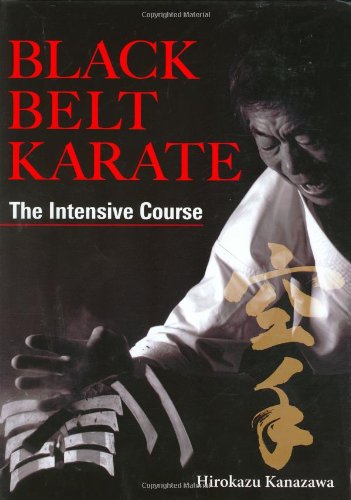
23. Black Belt Karate: The Intensive
$10.63
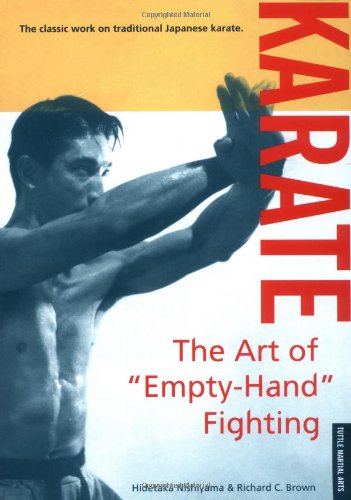
24. Karate: The Art of Empty-Hand
$43.90
25. Mas Oyama's Essential Karate
$5.96
26. Karate Hour (Booklist Editor's
$7.61
27. The Best of Dave Lowry: Karate
$8.95
28. Karate: Technique and Spirit (Tuttle
 
$149.99
29. Fighting Karate
$6.88
30. My Journey in Karate: The Sabaki
$3.81
31. 75 Down Blocks: Refining Karate
$14.95
32. Kenpo Karate 101 : What the Beginner
$5.91
33. Classical Kata of Okinawan Karate
 
$9.75
34. Best Karate, Vol.6: Bassai, Kanku
$22.50
35. Karate the Japanese Way
$16.47
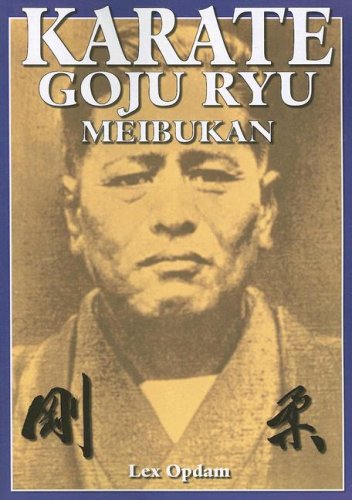
36. Goju Ryu Karate Meibukan
$1.97
37. Karate Basics (Tuttle Martial
$9.82
38. Okinawan Karate: Teachers, Styles,
$8.86
39. Winning Tournament Karate
$14.90
40. Kenpo Karate 201: The Basics and

21. Best Karate, Vol.9: Bassai Sho,Kanku, Sho, Chinte (Best Karate)
by Masatoshi Nakayama
 Paperback: 144 Pages (1986-01-15)
list price: US$17.00 -- used & new: US$9.75
(price subject to change: see help)
Asin: 0870116800
Average Customer Review: 4.5 out of 5 stars
Canada | United Kingdom | Germany | France | Japan
Editorial Review

Book Description
These advanced kata may be selected for testing above shodan level. The techniques in Bassai Sho, using sword hand, ridge hand and tiger mouth, make good defenses against stick attacks. In Kanko Sho are many counter-attacks to the upper level. Chinte has unique techniques, the rarely seen
tateken, and is especially valuable for women's self-defense. ... Read more

Customer Reviews (2)

5-0 out of 5 stars A Good Reference Tool
The entire BEST KARATE series is very educational once you struggle through how to learn the forms from the descriptions and pictures.The book does an excellent job, but learning and teaching forms from a book isinherently difficult.These forms come from a reliable source and areconsidered one of the authortative sources for these shotokan kata. Alsoincludes great information (in the glossary) on japanese martial artsvocabulary. I enjoyed this entire series and found it overall veryeducational.

4-0 out of 5 stars This series is the standard
I've been studying Karate (Shotokan) in southern Japan for three years with a 7-dan teacher who is also an international referee. We use this series, combined with separate video tapes, as the standard by which tolearn kata. occaisionally our own kata differs from the book in smalldetail, but the books still provide the basis for study. (Our copies are inJapanese but otherwise identical to the English versions) ... Read more


22. Best Karate, Vol.10: Unsu, Sochin, Nijushiho (Best Karate)
by Masatoshi Nakayama
Paperback: 144 Pages (1990-01-01)
list price: US$17.00 -- used & new: US$9.75
(price subject to change: see help)
Asin: 0870117343
Average Customer Review: 4.5 out of 5 stars
Canada | United Kingdom | Germany | France | Japan
Editorial Review

Book Description
The kata in this volume are at the advanced level and may be selected for examination above the grade of shodan.

In Unsu, there are constant transformations, signified by the name meaning "Cloud Hands." All parts of the body are used as weapons, with feints and provocations leading to unique combination techniques and multi-directional kicks.

Sochin is characterized by a certain solemnity and imperturbability. Using a very stable stance, muscular power is built up slowly in many movements, instantaneously in others, leading to a keen sense of timing for continuous attacks.

Nijushiho offers training in the unique back-hand block (haishu uke). It requires integration of varying strengths and speed, and mastery can be seen in a smooth and unbroken flow of movements. ... Read more

Customer Reviews (2)

4-0 out of 5 stars Best Karate - best with an instructor
This book is well and clearly written, and the photographic illustrations are better than average.The footprint diagrams are particularly helpful.As with any book of this type, though, it should be considered as a useful supplement to - not a substitute for -a live instructor.

5-0 out of 5 stars Excellent "video-like" manuscript
I think every BEST KARATE Series is excellent manuscript. Providing clear, detail and comprehensive instruction, with explanation of the important point, application, and "the soul" of each kata, this is"video-like" book. This volume explains advance katas. ... Read more


23. Black Belt Karate: The Intensive Course
by Hirokazu Kanazawa
Hardcover: 232 Pages (2006-06-23)
list price: US$35.00 -- used & new: US$20.78
(price subject to change: see help)
Asin: 4770027753
Average Customer Review: 4.5 out of 5 stars
Canada | United Kingdom | Germany | France | Japan
Editorial Review

Book Description
Hirokazu Kanazawa is the most respected figure in the karate world today, and a close disciple of Gichin Funakoshi, the father of modern karate and the founder of the Shotokan school.Kanazawa founded the Shotokan Karate-do International Federation in 1979, after gaining his impressive reputation in Hawaii, the U.S. mainland, and Europe as an official trainer for the Japan Karate Association..The Shotokan Karate-do International Federation now has branches in more than 90 countries throughout the world, including the United States.InBlack Belt Karate, this preeminent figure in the karate world offers a systematic approach to basic karate. Karate is a martial art that can be practiced by anyone, regardless of age or gender, and can be undertaken at any time during a person's life.The training system employed in karate is comprised of three main areas:kihon (basics), kumite (sparring) and kata (forms).Here, using meticulously detailed explanations and illustrative photos, Kanazawa offers an intensive self-study training course designed to be accessible to beginners, as well as to those who are already at an intermediate level.If practiced continuously and diligently over the course of a year, the practitioner will be able attain black-belt-level proficiency. ... Read more

Customer Reviews (9)

5-0 out of 5 stars Very Good Book
It is a very well written book with many pictures showing you proper technique. You won't become a black belt, but if you want to take a class you won't be completely lost with exercises, names of each position and general knowledge.

5-0 out of 5 stars Kanazawa kancho the best master of shotokan
Buy this book, read it and you will understand what are the roots of karate, this book help beginners and advanced pratiquants, thank you Hirokazu, you are the best master.

Sergio

2-0 out of 5 stars Forget about it.
Don't be fooled by the title. This book is not going to give you the knowledge of a blackbelt Shotokan karateka in twelve months. It is a good book that provides an overview of the basics that you can get elsewhere for a lot less money. Most of the stuff in the book you will pick up in a few months at a good dojo.

5-0 out of 5 stars Clear descriptions in an excellent book
Although it is known that learning to master a martial art from a book is nearly impossible, this excellent manual does provide a great deal of help.
Very clear descriptions of all karate tecniques, clear photos, accurate highlights of the points to remember of every stance/throw;
A must have book for every practitioner of karate-do.

4-0 out of 5 stars Black belt karate
I am a yellow belt student just starting out and this book helps to answer some of the questions a teacher does not always have time for. Each style is slightly different but this appears to cover everything you need to know. ... Read more


24. Karate: The Art of Empty-Hand Fighting
by Hidetaka Nishiyama, Richard C. Brown
Paperback: 251 Pages (1990-06)
list price: US$19.95 -- used & new: US$10.63
(price subject to change: see help)
Asin: 0804816689
Average Customer Review: 5.0 out of 5 stars
Canada | United Kingdom | Germany | France | Japan

Customer Reviews (9)

5-0 out of 5 stars I knew Nishiyama and this book is Nishiyama
I bought this book written by Hidetaka Nishiyama because I wanted to relearn his style of Karate after some 35 years away from the art.This book teaches one the basic Karate moves and accompanying philosophy the old fashioned way.Like learning the abc's one must start at the beginning and learn through repetition, building on a firm foundation and hard work.The illustrations are clear and straight-forward, the explanations are as clear as you can get in a written format. The progression of the student cannot fail to receive a good start with this manual.

5-0 out of 5 stars comperhensive
i had this book now for three years , still can not find a single book that beats it or even competes it.
absolutely excellent book. more than enough illustrations, simple and straight however suffecient explaination for workouts, stances ,basic and advanced techniques.just looking at the book's covermakes me want to exercise (very motivating)
if you are looking for a book that saves you time , mony and effort of buying many other books then i'd strongly recommend that you get "Karate: The Art of Empty-Hand Fighting
by Hidetaka Nishiyama
" the best single Karate book ever written

4-0 out of 5 stars Fundamental Shotokan Karate
Karate: the Art of "Empty Hand" Fighting by Hidetaka Nishiyama and Richard C. Brown is the perfect starter book for any one wishing to learn Shotokan Karate. It describes all the stances, punches, strikes, blocks, and kicks. An explanation of the application of Karate techniques in self-defense situations is given. Briefly outlined is the history and principles of the art but what is indispensable in the book are the recommended schedules for the different training situations which make this book a perfect guide for the student and helpful manual for the instructor. After learning what is in this book I would suggest moving on to one of the books by Robin L. Rielly; either Complete Shotokan Karate, ISBN 0-8048-2108-9, or The Secrets of Shotokan Karate, ISBN 0-8048-3229-3. My only wish is that the chapters on Kumite and Kata would be expanded but that is why I recommend the two books above as well.

5-0 out of 5 stars A must for all serious practioner of Karate
This book should be considered a bible to all martial artist and students who are serious about studying the Japanese Style karate.It is very informative and still up to date.As an Instructor I find this book as a great source of reference.

5-0 out of 5 stars Early work but still great
Considering this book came out originally in 1960 and was the first large-format book on Karate I had seen up to that point, it is remarkable that it has rarely been exceeded in the all time since. The photos of the basic techniques are very clear. The applications sections are generous with good coverage of sparring and self-defense.

I have a personal story about Nishiyama, although I didn't study with him myself, but someone I know did. Nishiyama was in Los Angelos for some time back in the 60's and he was conducting a training session. One of the students, a guy by the name of Ray Dalke, who later led the U.C. Riverside Shotokan club to the national championship title, was in the class. I met Dalke when I was a doctoral student at UCR back in the early 80's, but I actually heard this from one of his students. Ray had never been very loose in the legs, especially the groin stretch, where you sit on the ground in a quasi-lotus position and bounce your knees up and down and try to get them all the way to the ground.

Anyway, Nishiyama came around to Dalke, and noticed his problem. He says to Dalke, "You want to have loose lap?" (Sometimes Nishiyama's English was a bit rough, but the meaning came through loud and clear). Dalke says, "yes, Master, I do." Nishiyama says again, "Are you sure you want to have loose lap?" Dalke says, "Yes, yes, Master, I want it more than anything!" At that moment Nishiyama jumps up into the air and comes down with both feet planted squarely on Dalke's knees, driving them all the way to the floor.

Well, he said Dalke's scream of agony could be heard for two city blocks. They had to get an ambulance and take Dalke away. But he survived and was back later after he healed with the "loosest lap" you've ever seen. I hope Ray doesn't mind my telling his story. Like I said, I met Ray in about 1980 when he was the faculty karate instructor at UC Riverside and he was really a pretty cool guy, as well as an excellent instructor. He loved the Shotokan katas and I recall having an enjoyable discussion with him about some of the more advanced forms.

Anyway, Nishiyama is one of the greats of the Shotokan style and this book is still one of the finest books on the subject. I will say one more thing about Nishiyama, which is that he has the most vicious-looking front kick I've ever seen. I've tried to emulate his style on this one but he's basically got the patent on it. ... Read more


25. Mas Oyama's Essential Karate
by Masutatsu Oyama
Paperback: 256 Pages (1979-03)
list price: US$14.95 -- used & new: US$43.90
(price subject to change: see help)
Asin: 0806988444
Average Customer Review: 5.0 out of 5 stars
Canada | United Kingdom | Germany | France | Japan

Customer Reviews (2)

5-0 out of 5 stars This book overviews Kyokushin basics very well.
I do not think anyone could go wrong with this book. Also, for those whohave not noticed. The new work out titled "Mas Oyama's Complete KarateCourse" is in fact THIS book with a new title. Enjoy. It's worth everypenny!

5-0 out of 5 stars A definative explanation of KyokushinKia-Kan Karate
Mas Oyama's book "The Essential Karate" is perhaps the easiest source for a beginning martial artist to use to gain knowledge about this interesting artform. KyokushinKai-Kan Karate, also known as the assocaition for the search in ultimate truth in Karate, was founded in the early 1950's.Matsutatsu Oyama, the founder, created a Karate style that is derived from Shotokan and Goju-Ryu.In doing so he started one of the most powerful and most widely respected martial forms.Kyokushin is extremely popular with over ten million practitioners in the world today. This book will enable the beginner and the expert to unravel Master Oyama's thoughts on how this art should be performed. It will explain in detail and with photos all of the basic manuevers.Each page is well illustrated with reasons why each attack or defense is done.Also included are basic self defenses and a history of martial arts. Due to both of Master Oyama's other book being out of print this manuel is a indespensable tool for any martial artist. Further more it is clearly the best available and affordable tool for the adherent to this style.I cannot recommend this book highly enough.It will put the extra umph into each punch and kick that you do. ... Read more


26. Karate Hour (Booklist Editor's Choice. Books for Youth (Awards))
by Carol Nevius
Hardcover: 32 Pages (2004-10)
list price: US$14.95 -- used & new: US$5.96
(price subject to change: see help)
Asin: 0761451692
Average Customer Review: 5.0 out of 5 stars
Canada | United Kingdom | Germany | France | Japan
Editorial Review

Book Description
KARATE CLASS SHOULD ALWAYS BE THIS EXCITING!

Karate class begins and students come together to practice their blocks and stances--from crescent kicks to front kicks to tuck roll stands.Dynamic black-and-white artwork of children bowing, kicking and sailing through the air contrasts with their brilliantly colored karate belts in this rhythmic read-aloud that explores the action and philosophy of karate. ... Read more

Customer Reviews (2)

5-0 out of 5 stars Amazing Illustrations
The illustrations in this book are incredible. They come at you from unusual and creative angles. They are so detailed and realistic you would almost swear they were photographs. They are primarily black, brown and white, with the only splashes of color coming from the karate student's belts. It surprising the illustrator did not win the Caldecott Medal for this book. Hopefully he'll do another book soon and get the deserved recognition.
The author does a nice job introducing the reader to the basic history and beliefs of karate in the note at the end of the book but her poetry in the main section is content free and requires some rather strained routes to close out her rhymes.
This book would be a great gift for any child under 10 just getting introduced to karate.

5-0 out of 5 stars Wonderful Verse and Illustrations
Karate Hour is a beautifully done book. It is done in verse, very cleverly, as the book goes through the karate class. The illustrations are breathtaking and look like photographs.. Although Karate Hour is in many respects, non fiction, it is also a work of art, where poetry and visual arts combine. Very well done. ... Read more


27. The Best of Dave Lowry: Karate Way Columns 1995 to 2005
by Dave Lowry
Paperback: 187 Pages (2005-06-01)
list price: US$12.95 -- used & new: US$7.61
(price subject to change: see help)
Asin: 0897501489
Average Customer Review: 4.5 out of 5 stars
Canada | United Kingdom | Germany | France | Japan

Customer Reviews (4)

5-0 out of 5 stars Dave Lowry Redux
Whenever he writes, Mr Lowry has something interesting to say, whether or not you may agree with him.In this, "The Best of..." what you get is a series of short, easily readable essays on various aspects of the practice of the martial arts; - not a specific art, but elements which are common to all those human activities that could be included under the heading "martial arts."This book is a good, easy read, and I would recommend it to anyone with an interest in the martial atrs.

3-0 out of 5 stars More of the same.
This is a compilation of Lowry's columns that have run in Black Belt magazine for many years.Some of the information is interesting, as long as you are willing to deal with the author's elitist and dogmatic point of view.Still, some of the information is interesting and much would be relevant to any martial artist.This book is a good read as long you keep an open mind regarding the author's sometime biased viewpoint.

5-0 out of 5 stars Essential Lowry- keen observations into the arts
Like all of Lowry's books, this is easily worth the price. I never read his columns in Black Belt Magazine, but have read all of his other books, apart from the Bokken text, several times. His style is such that I find myself returning time and again to the same piece to glean something new that I either missed from a lack of interest in the particular point, or an inability at the time to grasp the profundity of the observation.

I received this book yesterday, and read it all in one sitting (actually more of a laying on the couch). In seventy-two very short essays, most about two pages long, Lowry provides a humorous, philosophical and high observant window into the martial arts history and practice. Every article was worth reading twice.

My only complaint regards the silly accompanying illustrations. I don't know if they were part of the magazine version, but they are so disjointed from the substance of Lowry's themes that they become distracting. Jaimie Filer is the illustrator, and I certainly (honestly) don't want to hurt any feelings, but I found them more appropriate for a kid's book; not exactly a good editorial match for Lowry's subject matter. Other than that almost inconsequential point I have to heartily recommend this book with the rest of his corpus. Enjoy!

5-0 out of 5 stars A great collection
I've read Dave Lowry's column, The Karate Way, for years. It's one of the few things in Black Belt, or any other magazine for that matter, that I'm sure I'll find illuminating and am rarely disappointed. This book is a collection of 70 of Lowry's best columns from the last ten years all in one place.His essays cover just about everything related to traditional martial arts or related Asian culture. Topics are both broad and deep, including the benefits and hazards of martial arts training, budo teaching traditions, lifelong learning in martial arts, profiles of ancient and modern budo masters, tenets of the martial ways, dojo ethics, history, and techniques/applications. If you enjoy Mr. Lowry's columns as much as I have yet have not kept copies over the years, here's a phenomenal opportunity to own the best of the lot.

Lawrence Kane
Author of Surviving Armed Assaults, The Way of Kata, and Martial Arts Instruction ... Read more


28. Karate: Technique and Spirit (Tuttle Martial Arts)
by Tadashi Nakamura
Paperback: 168 Pages (2001-11)
list price: US$19.95 -- used & new: US$8.95
(price subject to change: see help)
Asin: 080483282X
Average Customer Review: 5.0 out of 5 stars
Canada | United Kingdom | Germany | France | Japan

Customer Reviews (4)

5-0 out of 5 stars The Golden Hand - River Rock
I found Nakamura's devotion to karate admirable.I liked his work ethic.The ideas of love (discovering why men suffer), obedience, and zen were made in a very clean presentation.The most impressive feat in the book was the portion where Nakamura demonstration his power by breaking river rocks.This is no cheap trick. The breaking represented, the complete symbolism of:giving a 100 percent, seeking mental clarity, releasing extreme power through joining as one with the material.The verbal discussion of zen being manifest as action. One can reason, breaking the rock is simply the principle of the fulcrum and leverage being applied to a material through a mechanical forces. However, one must experience the physical and mental pain associated with failure to perform such a feat to understand the simplicity and perfection illustrated by Nakamura.

My teacher talked about breaking river rocks in the mountain.He told me it was a matter of timing and speed.Apparently, the his first attempts at breaking the rocks were unsuccessful and he wanted to quit.After receiving encouragement and demonstrations that it was possible, he proceeded to break many rocks.Also, my first attempt to breaking a 6 inch piece of ice using a full circle chop failed. I thought about power only and failed. I turned inward focusing internally and broke the ice with a one inch slap.People want to know what was the difference in technique.Zen was the difference, and it produced the power needed to break the ice.The difference in breaking quality was noticeable.Nakamura inspired me to encourage my students to give a 100 percent at every practice.He demonstrated katas as a means to strengthen the mind of the body.I hope for significant improvements in concentration and desire.Nakamura karate is very good, no wonder he became a karate legend.
The photos in the book create a strong connection to natural beauty of the sunsets, waterfalls, rock textures, and the whiteness of snow. His tradition links philosophy and spirituality links back to feudal Japan.

5-0 out of 5 stars Living Legend Bearing Gifts

Nakamura is a living legend. He brought Mas Oyama's Kyokushinkai from Japan to the United States,and later formed his own style, Seido, which is now nearly 25 years old. This book is virtually a textbook for Seido students, and since Seido is a traditional style, it would be of use to students of any Japanese style. The book includes all "natural" weapons (body parts), stances, striking and blocking techniques, with detailed photographs and diagrams, and also includes discussions on the history of martial arts, its relevance to modern life, proper breathing and stretching, the meanings of the names of various traditional kata and why kata is important to a karete-ka's training regimen, karate's relation to Zen, and several of Nakamura's own meditation lectures he gives to his own students on a weekly basis. Anyone can write a book about karate technique, but Nakamura not only has expert knowledge of the techniques shown in this book, he is among a handful of true exponents ofthe spirit ofKarate-Do: The ---Way--- of Karate, and he has made it his life's work to instill that spirit in his students. Seido has dojos all over the world.

5-0 out of 5 stars A Gem
This book, may at first glance, seem a bit "pricey", however, it is a great primer book, printed on high quality paper.The techniques are standard karate type fare:Blocks, punches, and kicks.What makes thisbook such a collectable is that the author and publisher, write a beautifulintroduction as to what the spirit of karate is really all about.Theyarrange the photos, bioagraphies of students, demonstrations, and martialarts tenets in a masterful way.This book will probably not add much tothe black belts (assuming he is well studied) knowledge of the subject ofkarate, but, it will add much to his vision on a masterful way to write andpublish a karate primer book.He or she will further just enjoy the bookfor what it is: a great work of art.

To the beginning or intermediatestudent, this book will engage his or her imagination.The section onethical and moral values of karate is short, sweet, and to the point.Thelast chapter on "Karate Meditation Lectures" is outstanding andnot pretentious.If you are a karateka - purchase this book for the beautyof it.

5-0 out of 5 stars All you need to know about true Karate: Mind, Body & Spirit
Respect, love and Obedience are the three principles.This book will show you the correct paths to take when training in martial arts.I learned about the history and beliefs of Seido (The Sincere Way).This showed the natural weapons in karate and how to use the against an attacker.There is also a section on the traditional karate weapons ( Bo, JO, Sai). I was able to see how to do proper techniques, step by step in detail.This book helped me with expanding my variety of stretching exercises and martial art warm-ups. I personally love the mediation lectures in the book.This is the spiritual side of karate.In the mediation lectures I learned that karate is not just when I put on my GI and begin training.It is apart of my daily life and how I choose to live.One of my favorite lectures was Nana Korobi Ya Oki (If you fall down seven times, get up eight times).This showed me that no matter how hard life becomes and even if I am going against almost impossible odds, I must never give up.Even if I was to fall one hundred times, I must get up one hundred one times.We all make mistakes and we can not be assured on what the next day will bring, but we must go on and never surrender. I suggest that anyone no matter what style of martial arts they take should read this book. ... Read more


29. Fighting Karate
by Hideyuki Ashihara
 Paperback: 162 Pages (1985-10)
list price: US$25.00 -- used & new: US$149.99
(price subject to change: see help)
Asin: 0870117424
Average Customer Review: 5.0 out of 5 stars
Canada | United Kingdom | Germany | France | Japan

Customer Reviews (3)

5-0 out of 5 stars The best textbook on full-contact karate
Ashihara's Fighting Karate has its roots in Oyama's Kyokushin Karate.Though Kyokushin style emphasizes on power and body conditioning, Ashihara refined the technical aspects of the art tremendously.Packed with abundant step-by-step photos and clear instructions, this is the best textbook on full-contact karate for beginners and veterans alike.The same is to be said of Ashihara's subsequent book, More Fighting Karate.

5-0 out of 5 stars Outstanding, detailed, extremely well-written & illustrated
Don't be put off by the cover price, this book is extremely detailed and covers all aspects of real-life fighting techniques for competition or use on the street. Originally published in Japan in 1983 (6th printing 1994), it's well worth the price for its extremely comprehensive, step-by-step instructions on everything from basic stretching techniques to delivering power-packed punches and kicks and realistic lessons on distance, blocking, practical fighting techniques and effective fight control tactics. A tremendous source of realistic, practical, proven fighting lessons and tips presented in very learnable, digestible sections. A must for the personal library of any serious martial artist who trains for tournament success

5-0 out of 5 stars Outstanding, detailed, extremely well-written & illustrated
Don't be put off by the cover price, this book is extremely detailed and covers all aspects of real-life fighting techniques for competition or use on the street. Originally published in Japan in 1983 (6th printing 1994), it's well worth the price for its extremely comprehensive, step-by-step instructions on everything from basic stretching techniques to delivering power-packed punches and kicks and realistic lessons on distance, blocking, practical fighting techniques and effective fight control tactics. A tremendous source of realistic, practical, proven fighting lessons and tips presented in very learnable, digestible sections. A must for the personal library of any serious martial artist who trains for tournament success ... Read more


30. My Journey in Karate: The Sabaki Way
by Kancho Ninomiya
Paperback: 240 Pages (2000-08-28)
list price: US$16.95 -- used & new: US$6.88
(price subject to change: see help)
Asin: 1583940170
Average Customer Review: 5.0 out of 5 stars
Canada | United Kingdom | Germany | France | Japan
Editorial Review

Book Description
Follow the path of budo--the warrior’s code of conduct--as it unfolds in the life of karate master Kancho Joko Ninomiya. Grandmaster of Enshin Karate and creator of the Sabaki Challenge, Kancho Ninomiya reveals how the spirit of feudal Japanese warriors inspired him as a boy and continues to shape his life as a man. My Journey in Karate describes the rigors of Ninomiya’s early training in judo before a chance meeting introduced him to an innovative karate sensei who changed his life. In addition to Kancho Ninomiya’s own story, My Journey in Karate includes an extended section of Ninomiya’s reflections on training, competition, strategy, and the lessons of karate both in and out of the dojo. ... Read more

Customer Reviews (5)

5-0 out of 5 stars A True Karate Book
My Journey In Karate: The Sabaki Way is a in depth book about Kancho Ninomiya's Journey though Karate. It describes how he won the All Japan Tournment and started the Enshin Karate Style. I am a Student of Enshin and Recommend the book to anyone who wants to read a great book about Karate. Two Thumbs up!

5-0 out of 5 stars highly recommended for all serious martial artists
Anyone who has been a serious martial artist will throughly enjoy reading the inspiring story of Grand Master of Enshin Karate Joko Ninomiya.Anyone who has been serious about the martial arts for a significant amount of time can relate to Ninomiya's life story.

Before beginning his study of kyokushin karate at the age of 15, Ninomiya practiced judo.After making the transition to karate, Ninomiya never turned back and had the dream of becoming a karate champion.The book explains how he would go to different karate schools in Japan and challenge the top students to improve his skills.He challenged different schools in a dignified way, he never used bully tactics.After hearing about the all-Japan karate tournement, Ninomiya practiced diligently for years until he was able to win first place.In the book, he talks about his training and preparation, his fights and the people who helped him become better as a martial artist and as a person.

I like the way Ninomiya emphasizes that karate is not about winning tournaments and beating people up, it's about confronting yourself and pushing beyond what you are today.Master Ninomiya admits that he did not realize the true meaning of karate until after he had accomplished one of his goals.Sometimes that's what it takes because after we win something or accomplish something big, we often ask ourselves "now what?" and become complacent.We should fight against this complacency because it will only make things harder in the long run.

Towards the end of the book, Ninomiya gives his opinion of "no holds barred" fighting contests.I agree with Ninomiya that "no holds barred" contests appeal to a morbid curiosity.People often watch these types of contests and are happy to see someone lying flat on their back at the end of a match or seriously hurt in some way.Ninomiya founded The Sabaki Challenge which is a real karate tournament, but he has a point system that emphasizes technique to minimize injuries.

5-0 out of 5 stars Oss! A Journey in Karate
Rarely in the martial arts world are biographies rich with insight about both the individual and the training.Normally, -except a couple bio accounts of Bruce Lee and Chuck Norris' auto-bio account- the books are very dry and not very telling. Sometimes it is the writing and often it is because the reader is never really let under the skin of the martial artist.In this book - that has changed.

Ninomiya graciously allows the reader to travel in his mind and spirit as he grows from an unfocused (though hardworking)martial artist and somewhat immature teen into a higly skilled and mature warrior.

The reader travels and sees when Ninomiya, through several events and a couple of key mentors, understands himself and his journey through karate.Unlike most auto-biographical accounts, I never felt Ninomiya was boasting about his success.Instead, he shows where his failures and determined manner leads to success beyond winning a "trophy."

An excellent book.I learned much from this extra-ordinary man.

5-0 out of 5 stars A good martial arts book is as elusive as a good martial art
Kancho Ninomiya is not only a world class champion, he writes with a certain gift; one that captures the essence of a lesson one could only get from training with him... and make no mistake, this may make for an inspiring read but reading it without training in any martial art is as hollow as reading Shakespeare and never seeing it performed... I began studying karate very seriously as an adult under Sensei Kishi, one of Kancho Ninomiya's teachers and best friends, as well as a collaborator on this book... this text captures the true spirit of martial arts training, something that is very difficult by nature of the difference between the written word and the life of martial arts training.Osu.

5-0 out of 5 stars Insightful and inspiring
I have been a martial artist for most of my life, and so have always been attracted to stories that outline other martial artists journeys. Joko Ninomiya has written a "must read" for anyone whose chosen path is the Way of the Warrior. He has done an outstanding job of outlining the highs and lows of a life dedicated to the "eight Fold Path". I was also moved by his love and respect for his Sensei and for his father. This book was much more than I expected and a wonderful addition to everyone's library. ... Read more


31. 75 Down Blocks: Refining Karate Techniques
by Rick Clark
Paperback: 185 Pages (2003-05)
list price: US$19.95 -- used & new: US$3.81
(price subject to change: see help)
Asin: 0804832188
Average Customer Review: 4.0 out of 5 stars
Canada | United Kingdom | Germany | France | Japan

Customer Reviews (4)

4-0 out of 5 stars Detailed and technical
Prof. Rick Clark isn't your usual martial arts writer. For one thing, in this book he writes about the ideas of Wilfredo Pareto, the 19th century economist who invented the 80/20 rule, and how that idea applies to martial arts; crime statistics for violent attacks against police officers and their implication for martial arts training; and in the second appendix to the book, there is a brief history of the reintroduction of Japanese martial arts into their univerisity system and the contribution of a German doctor who became physician to the Meiji emperor's son in that regard by the name of Erwin Baelz.

The title of the book derives from the fact that the author uses the concept of the down block as a metaphor to examine similar motions and to compare different techniques across the martial arts. For example, he mentions how the nikyu technique in aikido resembles the down block in many respects. Also, the book contains 75 different self-defense techniques against various kinds of attacks.

The techniques also follow the rationale of being designed around the kinds of attacks one can expect based on the aforementioned crime statistics. According to the statistics, most percussive attacks involve either a simple front kick or punch, kicks being about 10% more likely than punches. Grabs at one's wrist or lapel are also very common, along with the attempt to twist the arm, but rarely does anyone try a specific choke or arm hold or technique.

So as I said, although the technques run the full gamut in terms of responses, from holds and locks to takedowns and the usual karate techniques, they are organized around and seleted according to the critieria of probability of occurrence. I liked this aspect of the book and thought it made a lot of sense. The author's crime statistics are based on FBI crime figures from past decades.

Another strong point of the book is that the percussion techniques are directed at the Chinese dim mak or vulnerable points, so you learn some of that too. I'm not going to debate the validity or efficacy of those theories of Chinese medicine here, I just mention it for accuracy's sake. The self-defense techniques in this book are more hold and lock oriented than karate oriented, so they take more skill to execute. Some of these techniques would qualify as very advanced and probably the average martial artist wouldn't be able to perform it in a real street situation. In that sense many of the techniques are more suitable for the advanced practitioner.

One of the more advanced aspects of the techniques is that reversals against a wrist lock and arm bar are shown. These technqiues won't work, however, if you wait until the last minute to execute them, and the best reversal techiques aren't the ones actually illustrated, but they are the simplest. However, the author mentions the first point in the text.

That having been said, most self-defense is pretty much the same whether one is talking about judo, BJJ, karate, or kung fu. They all invaribly involve how to escape from such things as wrist graps, chokes, and how to respond to kicks and punches. So the techniques illustrated here run the full gamut from basic to very advanced. Another reviewer here said some of the techniques are unrealistic in that they require grabbing a punch out of mid-air, but then that's no different from what many martial arts and artists teach. One has to take the good and useful along with less than useful and filter the techniques accordingly, although that takes some experience and skill.

Some of the photo sequences are a bit unclear and required more photos to show the complete transition in the technique, but then, that's also a common problem in martial arts books on the grappling arts. The only real cure here is to use a book like this in conjunction with a video illustrating the holds and locks if one doesn't have access to a real teacher.

So despite the above flaws, overall, an excellent book with a self-defense oriented theme from Prof. Clark.

2-0 out of 5 stars Starting point, but not really worth buying
It's becoming a trend in martial arts nonfiction writing to do a lot of overly-analytic psuedo-scholarship. This is not a fault in and of itself, and when well-written, is no worse than other such nonfiction. However, this is not well-written. Yes, Mr. Clark does quote Pareto (in the same way that many psuedo-scholars do), and uses the 80/20 rule used in economics incorrectly to support his theory that 80% of what you train in in traditional martial arts isn't useful. He goes on to say that this can be changed if moves are critically analyzed in light of your purpose for training. He also does a lot of analysis about HAOV (Habitual acts of violence) to show that often the moves traditional martial arts train to counter aren't often seen in modern confrontations. This book could have skipped about a hundred pages if he had begun with an introduction that said this much more clearly. Bill Burgar does a much better analysis of HAOV and the so-called Pareto rule in "Five Years, One Kata."

Pros: Conceptually, an interesting approach. Rather than waste time trying to determine exactly what the original application of a down block is (almost impossible to do in even one art, let alone when addressing the down block among many arts), Clark has expanded the idea of determining sensible applications that work for the individual. A martial artist can determine what application the down block seems to resonate with, without worrying about the "proper" down block application.

Cons: The applications themselves seem very unrealistic. About four-fifths of the techniques he uses seem to be useless, many of them beginning with the defender rather impossibly catching the punch in mid-air. Many of the others involve small-joint manipulation that seems very unrealistic; for example, in one sequence the attacker has grabbed Clark's hand, and in the next photo, Clark suddenly has a wrist lock on the attacker, with no transition or explanation. Most of the 75 down block applications Clark does are simply unworkable.

Cons also include the fact that he uses the confusing terminology of pressure points like "spleen 32" that is not at all helpful.

Cons additionally include Clark's appearance. In the photos he seems to be terribly flabby and out of shape. A small thing, perhaps, but it gives him less credibility.

Cons also include the photography, which is dark and often difficult to see.

Overall, just a starting point to see how one can find out applications for oneself. Clark himself admits that it would be more helpful to think of the book's applications as a starting point for one's own research, and I concur, since most of the applications he suggests are unworkable. Between 12 and 15 of the 75 applications Clark gives might actually be workable, with some modification, so the ratio may not be high enough for some readers who might expect the number to be closer to the 75 in the title. Conceptually, though, his approach does give food for thought, although the book is a little pricey for what you get. An expansion of some of his theories on kata applications, and a much more realistic set of them, is included in Bill Burgar's "Five Years, One Kata," which I would recommend greatly over this book. In summary, rent this book from the library, don't buy it.

5-0 out of 5 stars A book as important as "Barefoot Zen" - Persuasive,Effective
"The down block is perhaps the most common technique used in martial arts.The down block motion is found in virtually all kata and is utilized in various stances.

One hand comes up toward the opposite side of the head then moves down to groin level, while the opposite hand is brought back to one's side.

The inclusion of this movement in so many kata is a clear indication of how important this movement must have been in the eyes of the old masters.

So, why are we taught such simplistic bunkai if kata are so important to our understanding of the martial arts?When I began to look at explanations for the various movements in the kata, I became very interested in the answer to this question.I began looking into the history of the martial arts and, in doing so, I discovered a number of reasons why we have been taught this way.

* Knowledge of more esoteric aspects of the martial arts has been kept secret from the general population, so those in the upper ranks can maintain their position of authority
* Historical developments in Japan-specifically, the western "opening" of Japan in the mid-nineteenth century-made it necessary for the nation to move beyond the martial arts as part of its military culture.
* When combat techniques, which had been restricted to the warrior class, began to be taught to the general public, they were often to be less dangerous-or less effective, depending on how you look at it.
* These techniques were further simplified when the martial artist were introduced into school system, more formalized aspects of the martial art forms began to dominate.

"

Here are the types of attacks most likely to occur in a self-defense situation:

1. A grab
2. A push
3. A punch
4. A kick

A grab will probably be for your wrist, forearm, upper arm, lapel, or throat.

Technique 1

1. Your Opponent strikes long distance with a L back snap kick
2. L downward block

Technique 2

1. Your opponent kicks at your chest with the right foot, medium distance away
2. Shift your weight to the rear, sweep deflect with the left hand
3. Punch to the ankle (spleen 6), pressing with the left hand on the other side of the ankle

Additional thoughts: Reach with the right hand over and grab the heel, full circle of your head flipping while stepping back into a horse stance, the opponent flips onto his face, left stomp to the tail bone.

Technique 3

1. Your opponent prepares a R thrusting side kick at solar plex level.
2. You are in a L cover, shift weight into a cat stance, Draw your hand up and under the opponent leg (spleen 6) and grab the ankle with the L hand
3. R elbow down on upper thigh (gall bladder 31)
4. R downward hammer strike to groin or tail bone

Technique 4
1. Your opponent prepares to deliver a R front snap kick with R punch combination
2. L 45, sidestep movement, deflect R punch with L inward block, right scoop his ankle with the R hand and pull to the R hip.You now have the opponent center control at the most powerful leverage point on your body.
3. L downward sweep knocking him down over your left knee.

Additional thoughts: follow through with a pivot 90 degrees to the L, shuffle downward with theknee about 3 inches above the ground and finish with a R punch to his L ribs.

5-0 out of 5 stars A wealth of interesting ideas
In recent years we have learnt that to understand our style thoroughly we have to go beyond our style; but in so doing we can find the effective self defence principles that were there all along. So practitioners of karate, tae kwon do, kung fu and so on are realizing that their kata and even basic kihon can make sense as self defence -in a way they never did as "traditionally" taught - if we have the eyes to see what they could be. Because at this stage in the evolution of our arts this is largely a process of reverse engineering, the sticking point is having the range of conceptual tools to see what the moves could be. Having trained with Rick Clark regularly on his seminars in the UK, I was always struck by how someone could show him some piece of kata from their style, and Rick could see immediately a number of interesting and worthwhile applications. He has taken that vision of his and inspected one of the most basic movements in many styles - the down block. What comes out is a wealth of ideas - just the inspiration the modern practitioner needs to understand his art. Any one person should reject many of the ideas and accept only a few for regular training, so that what they take fits in most coherently with what else they use for other movements in their kata etc. But each student will select something different, and so seeing a wide range of possiblities is invaluable for guiding one to create one's own personal self defence system. Presented here are many principles of jujutsu, arnis and kyusho jutsu applied to a simple move of karate, illustrating the fundamental unity of all styles. It's a book I will return to many times. ... Read more


32. Kenpo Karate 101 : What the Beginner and the Black Belt Should Know
by Lee Wedlake
Paperback: 168 Pages (2000-10-27)
list price: US$14.95 -- used & new: US$14.95
(price subject to change: see help)
Asin: 0967991609
Average Customer Review: 3.5 out of 5 stars
Canada | United Kingdom | Germany | France | Japan
Editorial Review

Book Description
This is a broad scope book, aimed at both new students and instructors. It contains chapters on how to find a school, set goals, student responsibilities, practice methods, special sections for women, children and seniors. Has a short history of Kenpo and Ed Parker, information on self defense (but not how-to), psychological response to fear, tournaments, street fighting and more. ... Read more

Customer Reviews (3)

5-0 out of 5 stars A+++
Everything was great the book got here super fast! In the conditionstated.

1-0 out of 5 stars Just Another book
I strongly believe you must SWEAT SWEAT SWEAT to learn karate, instead of reading on your couch, and think you have mastered Karate. This is just another karate book only good for information.......I would like to see more philosphy type of book.

4-0 out of 5 stars Excellent material for new students and old hands alike
I am 29 and on 30 Aug 00 started American Kenpo training at Curtis Abernathy's school in San Antonio, Texas.Previously, during 6 1/2 years in the Air Force, I studied in schools teaching Wah Lum kung fu, tae kwon do, modern arnis, and wing tsun, and dabbled in small circle jujitsu, ground fighting, and tai chi.(I tried a little shotokan karate and judo in college earlier.)American Kenpo, as presented by my current instructor and in Mr. Wedlake's book, is the most enjoyable system yet.

Mr. Wedlake roughly covers the following: - What is kenpo, and who was Ed Parker? - Set a goal, select a school, how to be a student - Class structure, student responsibilities, and how to practice - Kenpo techniques and cultural impact on the arts - Attitude/philosophy - The gi, belt, and testing - Women, children, and seniors - Street fighting, seminars, associations, competitions, and demos - Instructor footnotes and rules of motion

The book is short (157 pages) and can be read in two or three sittings.I was tempted to blast through it in one, but letting the lessons within sink in requires some time for reflection.The material mirrored much of what I've been learning in class, and helpfully illustrated and reinforced techniques and theories.As kenpo is a very logical system, it is suitable for the analysis presented in books like this.It is not a series of attack - response scenarios, like most martial arts books in my library.Rather, it explains the ideas behind kenpo and its associated practices, filling a gap left by some other authors.

Having been a student of Ed Parker Sr., Mr. Wedlake brings many personal stories to the book.He answers many "why" questions, such as why newly promoted students are struck in a good-natured manner upon receiving their belts.(I'm sure this will surprise non-martial artists.I first saw this aspect of kenpo in Jeff Speakman's movies.)

This volume is a must-read if you are a kenpo student.Serious practioners from other styles with any interest in kenpo will find it useful, too.I'm looking forward to your next book, Mr. Wedlake! ... Read more


33. Classical Kata of Okinawan Karate (Japanese Arts)
by Pat McCarthy
Paperback: 256 Pages (1987-06-01)
list price: US$19.00 -- used & new: US$5.91
(price subject to change: see help)
Asin: 0897501136
Average Customer Review: 2.5 out of 5 stars
Canada | United Kingdom | Germany | France | Japan
Editorial Review

Book Description
McCarthy, a shorinji-ryu stylist and triple-crown winner of the North American Karate Championships in 1974, demonstrates 11 karate kata. A detailed history of Okinawan karate and biographies of 37 of its greatest patriarchs are also included. Fully illustrated. ... Read more

Customer Reviews (12)

2-0 out of 5 stars Classical Kata of Okinawan Karate
I appreciate the depth of knowledge and experience of Mr. McCarthy in the realm of martial arts, particularly karate.However, this book would likely be more accurately titled "Kata of Japanese Karate" because the techniques he shows in this book are that of perhaps traditional Japanese karate, NOT Okinawan karate that is truly traditional (e.g. Shorin Ryu or closely related styles).I've long wondered if this book would be at all helpful...perhaps it will, but only if I forget the direction to move during a kata.

4-0 out of 5 stars Critiques to hard!
This book has some good background information on the history of the kata.While they are not the way that my system traditionally runs the kata, who is to say that they are not traditional, or classical, as Mr. McCarthy titles them.There are so many variations even on the island of Okinawa.This shows us that more then one version of a kata can be the traditional way of running the kata.The book has a good discription of each move, numbered with the picture that it corrosponds with.They are not difficult to pick up from the book, however I don't advocate learning kata from a book, this is a good place to see a different version then the one that you may run!

5-0 out of 5 stars this is a good book, despite what the reviewers say
This is a very good book, its not meant to teach you kata its meant as a reference , and the section on all the different branches of okinawan karate from shuri-te , tomari-te to even okinawan kempo was very informative and entertaining. Everyone is giving it bad reviews saying its inaccurate and plugging Shoshin Nagamines book , while Nagamines is a good book it only shows one style of okinawan karate. Mccarthys book is meant to give the reader a broad reference , not as a manuel of how-to. If you want a book with one style of karate,then get Nagamines book if youwant a book with a braod reference of styles then get mccarthys book, its a good book.

1-0 out of 5 stars Not classical nor okinawan! Book should be revised!
The kata versions presented in this book are not classical nor okinawan... period!
OK, the book was issued long ago in a time little was known about the subject BUT books CAN and MUST be revised and updated when the author is still living (thats what 2nd and further editions are for!). If not, a continuously re-issued obsolete innaccurate work becomes an anomaly such as this book, misleading prospective buyers and giving a questionable contribution for the actual knowledge of traditional karate!

3-0 out of 5 stars not totally informed?
Those who say the kata in this book are not "classical" should be informed or reminded that the style Shorinji-Ryu was created in the late 1940's, so you're not going to find the Heian katas, or other "centuries old" katas of Shotokan or other, older karate systems. For example, the nijushi (or nijishio) kata in Shorinji-ryu is different than the shotokan version, so don't judge this book by that alone.
I can't comment on the book itself, as I havn't read it, but I wanted to clarify this point for those reading the reviews. ... Read more


34. Best Karate, Vol.6: Bassai, Kanku (Best Karate)
by Masatoshi Nakayama
 Paperback: 144 Pages (1980-04-15)
list price: US$17.00 -- used & new: US$9.75
(price subject to change: see help)
Asin: 0870113836
Average Customer Review: 5.0 out of 5 stars
Canada | United Kingdom | Germany | France | Japan
Editorial Review

Book Description
Fully described and illustrated in this volume are the widely practiced Bassal and Kanku kata from the JFA recommended group. The student learns fast and slow techniques, the dynamics of strength, how to turn weakness into strength, changing directions, jumping and going to ground. ... Read more

Customer Reviews (4)

5-0 out of 5 stars Learning Bassai
This kata is very demanding.This book lays out the kata very thoroughly (much more so than in Best Karate, Vol.5).It also gives you a front and side view which are essential to practicing at home.

4-0 out of 5 stars Karate Ressurrection
Sensei Nakayama's book is excellent. Its advantages are that the techniques are explained in full detail and they are all performed by top JKA instructors.

While its a great book during Nakayama's time (and probably till the late 80's), its my humble opinion that this book is a little outdated. Many JKA masters today have improvished on some of the techniques so perhaps its more advisable to get a more up to date version by either Sensei Kanazawa or Sensei Enoeda.

Having said all these, its nevertheless a book which has no equal in the world of Shotokan.

5-0 out of 5 stars Best Karate is the Best
Best Karate Series books are excellent and this one is no exception. The transistion from technique to technique is excellent. Most other books just show the end result of each "move", Best Karate shows YOU how toget there. I also liked the Bunkai (application) section for each kata.

5-0 out of 5 stars Excellent teaching source for the intermediate to advanced.
Through the use of pictures, american and japanese language, Nakayama is able to explain the kata's required after the Heian kata's in Shotokan Karate-do ... Read more


35. Karate the Japanese Way
by Mark Adrian Groenewold
Paperback: 180 Pages (2002-12-01)
list price: US$22.50 -- used & new: US$22.50
(price subject to change: see help)
Asin: 1553698452
Average Customer Review: 5.0 out of 5 stars
Canada | United Kingdom | Germany | France | Japan
Editorial Review

Product Description
Karate the Japanese Way is a text for beginners to Karate, a guide for parents and a window into martial arts training in Japan. ... Read more

Customer Reviews (6)

4-0 out of 5 stars unique look
As a student and teacher of JKA-style Shotokan karate who had the opportunity to train in Japan in the early 70's, I was very much impressed with this book. The information is accurate, presented in an engaging manner,and is very readable. This isn't your typical instruction manual (though there is an instructional section). For beginnning students, or people just starting to look for a quality, credible school in which to train, there is very helpful advice, advice which, to the best of my knowledge is to be found in print nowhere else. This is a look at how training is done in Japan, but the information is truly international.What makes good training there really differs little from what makes quality training and instruction here in US, or anywhere else. Were I to find myself transplanted to Germany or Great Britain, this would still be very solid advice.I would recommend the book to anyone interested in training in any traditional Japanese or Okinawan school of karate. Many instructors would do well to read it, as well.

5-0 out of 5 stars It's a long path
The book is written in a way that does explain the Japanese karate training experience very well.I've done it for 35+ years and his book sums up a lot of things that take a long time to figure out.I was trained by a former JKA kumite champion who came to the U.S. with little english and a goal of teaching karate as it was taught to him and figuring out what he wasn't taught. He is still a great teacher although he has not reached out for the commercial aspects of karate.
The book goes a long way in helping students understand the JKA and what is the essence of the karate training.
It will be interesting to see if the author can write another book in 10 more years about what else he has learned.

5-0 out of 5 stars Karate the Japanese Way - Great Book!
"Karate the Japanese Way" written by Mark Groenewold is truly a wonderful book. Groenewold Sensei has torn asunder concepts of what Western Karate practitioners conceive how Karate is done in Japan. Mark has given us, best described in his own words, an "unadulterated perspective of what karate is like in Japan, how the Japanese train, and what are the key elements of karate from a Japanese perspective." Not many of us "Dans" have ever trained in Japan, so we repeat what we have been taught by our American/Japanese Sensei's here in America. Not realizing that they may be modified due to the fact we are not a Japanese culture but Western (Question: is that the reason for repeating the Dojo Kun for adults???). So we repeat the customs of what were taught under the guise of "Well, that's how they do it in Japan." Guess what!We are very wrong on some of our concepts and that not how they do it!
Groenewold Sensei takes through a tour of Karate in Japan chapter by chapter. Answering many questions we might have about types of dojos, etiquette, types of instructors and so many other topics. By interweaving his own experiences through out the book makes the reading not only fun but very interesting. To be honest with you all, I am so glad my Shodan testing was nothing like Groenewold Sensei's. Please, do not misconstrue my previous statement. My exam was very demanding and grueling but it was not insane. What am I talking about.... well, buy this book and find out!
I recommend this book to one and all. No matter what your rank is, one will learn from it.

Frank Thomas
4th Dan
Muskegon Karate Association
Muskegon, Michigan

5-0 out of 5 stars Great intro to how karate is REALLY done in Japan
A great mix of technical and practical information, written in plain english, about doing in traditional Shotokan karate in Japan.This book gives the beginner a good introduction to the art and also can help someone with more experience better assess how close what they are currently doing is to authentic Shotokan as done in Japan.

5-0 out of 5 stars A "must have" for every karate student
Mark Groenewold's new book Karate the Japanese Way is definitely a "must have" for every karate student.Mark's conversational writing style makes this book very easy to read and enjoy.In contrast to so many other karate texts, Karate the Japanese Way gives the reader a sense of chatting with a friend, rather than being preached at by a self-proclaimed karate master.The book is very well illustrated and covers the entirety of Mark's training in Japan, from the day he met his teacher, Taniguchi-sensei, through warm-ups and stretching to what he calls the triad of karate... kihon, kata and kumite.

This book does not go into too many details with regards to the execution of karate techniques, nor does it profess to.This is not a "how to" manual of karate. Instead it shows those of us in the Western world how karate is really taught and learned in Japan.

I am not a "dan" level student in karate, nor do I even train in the same style of karate (Shotokan),as Groenewold-sensi, but I still think this book should be on the bookshelf of every karate student, regardless of rank or style. ... Read more


36. Goju Ryu Karate Meibukan
by Lex Opdam
Paperback: Pages (2008-01-15)
list price: US$24.95 -- used & new: US$16.47
(price subject to change: see help)
Asin: 1933901292
Canada | United Kingdom | Germany | France | Japan

37. Karate Basics (Tuttle Martial Arts)
by Robin L. Rielly
Paperback: 192 Pages (2003-10)
list price: US$12.95 -- used & new: US$1.97
(price subject to change: see help)
Asin: 0804834938
Average Customer Review: 4.0 out of 5 stars
Canada | United Kingdom | Germany | France | Japan

Customer Reviews (2)

4-0 out of 5 stars good introduction to karate
This books is a good introduction to karate basics for the beginner. The author discusses:
* the main blocks, punches and kicks
* how to choose a karate teacher and dojo (the training place)
* the grading system (the karate belts)
* what to expect during your dojo training

The book is well-written, clear and well-organized.The information is appropriate for someone thinking about doing karate, and someone who has recently started karate.Someone who has practiced karate for more than a few months would already know this information.

4-0 out of 5 stars Good, knowledgeable volum
I purchased this book when I decided to finally indulge a curiosity about karate that I've had for a long time. It helped me pick a school that I am quite happy with, as well as helping me a little bit with some of the basic protocol and movements. It also helped me feel a bit more comfortable knowing what to expect and how to behave in the dojo. I'd recommend it to anyone who wishes to learn karate. ... Read more


38. Okinawan Karate: Teachers, Styles, and Secret Techniques
by Mark Bishop
Paperback: 208 Pages (1999-10)
list price: US$16.95 -- used & new: US$9.82
(price subject to change: see help)
Asin: 0804832056
Average Customer Review: 4.5 out of 5 stars
Canada | United Kingdom | Germany | France | Japan
Editorial Review

Book Description
Written by a well-known figure in the Martial Artsl arts community noted for his outspokenness, this book is an engaging and rich text, certain to provoke and please.Okinawan Karate, long sought after by connoisseurs of Okinawan Martial Artsl arts, is the definitive survey and examination of traditional Martial Artsl arts of the island.With detailed lineage charts of most of the major Okinawan Martial Artsl arts systems, sequential photographs displaying the distinctive techniques of his subjects, solid reportage, and frank quotes from his interview subjects, Okinawan Karate is a complete and encyclopedic source of information. ... Read more

Customer Reviews (26)

4-0 out of 5 stars Bias - Shorin Ryu Marketing
Although we have to admit that Mr. Bishop put a lot of research on the history of the Birthplace and Development of Karate, there is too much of his opinions imprinted on the writing style... all in favor of the several branches of Shorin Ryu and at a certain point minimizing the importance of the other Okinawan Karate Koryu... Further more on his excerpt titled Goju and Health, Mr. Bishop presents an irresponsible and highly biased personal opinion disguised as a "medical proven fact" of the alleged health effects caused by Sanchin Kata (Three Battles Form). Reality has it that Mr. Bishop is not a health licensed professional and according to my research there has never been a scientific study performed or any type of medical lead investigation that supports his misguided and fantastic allegations about the Danger of the Practices included in Goju Ryu Karate Do... He goes to the length to even propose that Goju Teachers die at an early age, this cannot be further from the truth, e.g., Yagi Meitoku Dai Sensei founder of Meibukan Goju Ryu and Successor of Miyagi Chujun O'Sensei founder of Goju Ryu Karate Do, died at age 91, and reportedly, practiced Sanchin Kata until the dawn of his days (1912-2003)... The book relays interesting information to include apparent gossips of the Okinawan Karate Koryu, and excellent tables of lineage... Certainly NOT a technical book and NOT for beginners. Otherwise recomended as a good source of record of Okinawan Karate Teacher-Student Lineage and Geneolocial Tree... Juan Javier Adames / USA - Philippines

4-0 out of 5 stars Unfortunately does not show Kanji / Chinese characters
Okinawan Karate, and its history tends to be contradictory, or ambiguous depending on who does the telling, and how long the "telephone game" was.Bishop's english language book adds to that history as he saw it.What's missing are Kanji / Chinese characters for the various people, locations, and styles.Kanji have multiple pronuciations (i.e. Japanese is a language full of homonyms).Since this book is in part intended to perserve Okinawan history it would be considerably more useful to have the correct words.

5-0 out of 5 stars Excellent Historical Reference
For those who study the Okinawan martial arts, this is an excellent historical review of the origins of these arts.While a bit "dry" in places for those who might not understand the historical significance of many of the founders, Mark Bishop does a great job in preserving the heritage of the Okinawan arts, and shares insights into the lives of its origniators.Many of these founders are overlooked in other publications, this is a "must-read" for those who want to know the true history of the Okinawan martial arts.

4-0 out of 5 stars Very good book
In this book, Bishop tries to show all the branches in Okinawan Karate-do. It details the well known stiles, interviews with the responsible masters and so on. It also includes valuable information on some rare styles. But if you are looking for the "secret techniques" they are not here, of course (try training with your Master for 20 years ;-) ).Very good and recommendable book!

5-0 out of 5 stars A major reference on Okinawan Karate
An universally acclaimed book. A real reference praised by all martial arts scholars and experts including the same karate masters it faithfully depicts! Includes a specially accurate and complete rendering of the Nahate (Goju-Ryu) line which sadly has been lately distorted by some very successfull "reference" books for individual promoting purposes.
This book should be present in every serious martial artist's bookshelf. ... Read more


39. Winning Tournament Karate
by Chuck Norris
Paperback: 128 Pages (1975-05-01)
list price: US$14.00 -- used & new: US$8.86
(price subject to change: see help)
Asin: 0897500164
Average Customer Review: 4.0 out of 5 stars
Canada | United Kingdom | Germany | France | Japan
Editorial Review

Book Description
This practical study of competition training for any rank is the first book by Chuck Norris. International film star, former world middleweight champion, and Black Belt's Fighter of the Year in 1969, Norris covers all phases of executing speedy attacks, conditioning, fighting form drills, and one-step sparring techniques. Illustrated with hundreds of step-by-step photos. ... Read more

Customer Reviews (8)

5-0 out of 5 stars Winning Tournament Karate
Winning Tournament Karate
Is an excellent book for People interested in learning more about traditional Karate. I think Chuck Norris has done an excellent job with this book. Ignore any bad reviews.
However I think there could have been a lot more to this book.
Mr Norris explains techniques very clearly and his combinations are excellent. Chuck Norris was a 6 times World Karate Champion so I am sure he can teach Karate to a very high standard. Anyone who doubts this should visit Chuck Norris Karate Academy in Texas. Buy the book you will learn a lot. I do hope Mr Norris writes more Karate Books & Maybe books on Bagwork Padwork Mixed Martial Arts and stretching. Chuck Norris holds a 10th Degree Blackbelt in Tang So Do and Tae Kwon Do as well as a Purple Belt in Brazilian Jiu Jitsu. And Mr Norris currently trains under Carlos Machado.

4-0 out of 5 stars A Look into the Past
This book has some great drills for working out.Most of the drills for tournaments can be adapted to be updated to modern rules.This is a great look into the past of what tournaments used to be, to bad they have changed so much!

4-0 out of 5 stars Good for what it offers
Martial arts books have come along ways since Chuck Norris penned this book in the mid 1970s. Nonetheless, there are still some good things in it that can motivate the reader to seek out more on the subject.

For example, there is Norris's red-line drill, which is still an excellent training method to push the karateka beyond what he thought was his top speed. He also touches briefly on mental imagery, which is arguably one of the top training methods used today by top athletes in virtually every sport. Lastly, Norris illustrates, with plenty of pictures, his concept of blitzing, that is, charging straight in and launching a hand or foot technique every half step or so.

This is still a good book worthy to be in every fighter's library.

Loren W. Christensen, author of FIGHTER'S FACT BOOK: Over 400 Concepts, Principles & Drills to Make You a Better Fighter

2-0 out of 5 stars Little To Offer
This book, written by Chuck Norris in 1975, the year he retire from sport karate competition, has very little to offer the karate student.The book doesn't have much material in written information, but instead, relies onstill photography to teach the karatestudent certian sport karatetechniques, such as entry techniques and striking drills.Overall, thebook is a very weak presentation on point fighting.

I highly admire ChuckNorris and if one would rather read books authored by him they should read"The Secret Power Within" or his autobiography.These books areinformative and at times, insightful.If someone is looking for a goodbook on sport karate and how to improve their sparring skills, I highlyrecommend the superiorbook "American Freestyle Karate" by DanAnderson.

5-0 out of 5 stars THE BEST
I have read many karate, kung fu, and martial arts books. Most of them have been