e99 Online Shopping Mall

Geometry.Net - the online learning center Help  
Home  - Technology - Artificial Intelligence (Books)

  1-20 of 100 | Next 20

click price to see details     click image to enlarge     click link to go to the store

$86.83
1. Artificial Intelligence: A Modern
 
$7.99
2. Introduction to Artificial Intelligence:
$53.91
3. Artificial Intelligence: Structures
$7.51
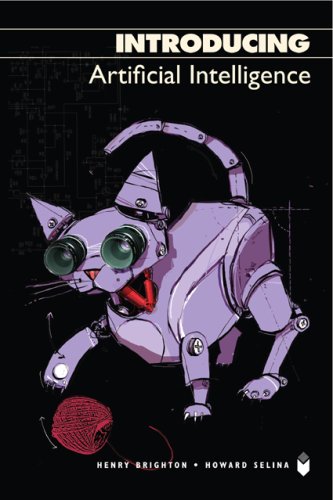
4. Introducing Artificial Intelligence
$56.00
5. Artificial Intelligence: A Guide
$12.31
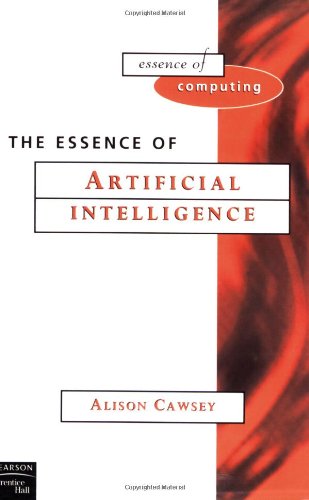
6. The Essence of Artificial Intelligence
$56.16
7. Artificial Intelligence for Games
$65.00
8. Paradigms of Artificial Intelligence
$53.39
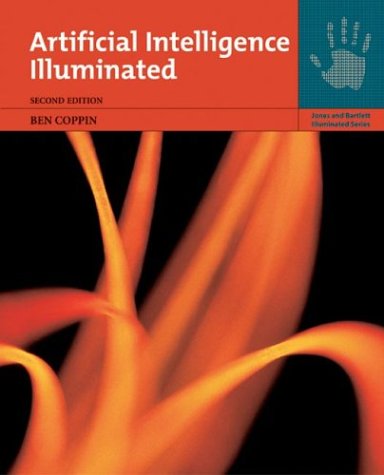
9. Artificial Intelligence Illuminated
$38.40
10. Artificial Intelligence: A Systems
$34.99
11. Artificial Intelligence: A Philosophical
$14.95
12. Artificial Intelligence: A New
$105.07
13. Artificial Intelligence: Structures
$13.90
14. Understanding Artificial Intelligence
 
15. Problem-Solving Methods in Artificial
$82.70
16. Biologically Inspired Artificial
$78.00
17. Data Mining with Decision Trees:
$29.11
18. Game Development Essentials: Game
$150.48
19. Artificial Intelligence in Geography
$52.56
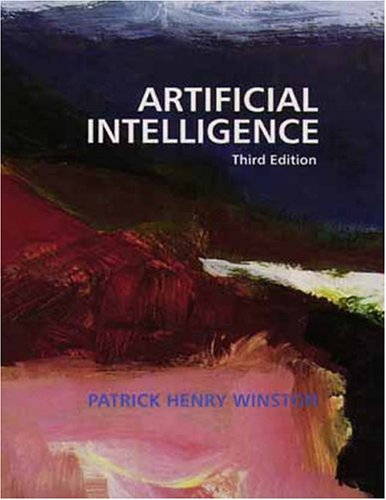
20. Artificial Intelligence (3rd Edition)

1. Artificial Intelligence: A Modern Approach (2nd Edition)
by Stuart J. Russell, Peter Norvig
Hardcover: 1132 Pages (2002-12-20)
list price: US$115.00 -- used & new: US$86.83
(price subject to change: see help)
Asin: 0137903952
Average Customer Review: 4.0 out of 5 stars
Canada | United Kingdom | Germany | France | Japan
Editorial Review

Amazon.com
Artificial Intelligence: A Modern Approach introduces basic ideas in artificial intelligence from the perspective of building intelligent agents, which the authors define as "anything that can be viewed as perceiving its environment through sensors and acting upon the environment through effectors." This textbook is up-to-date and is organized using the latest principles of good textbook design. It includes historical notes at the end of every chapter, exercises, margin notes, a bibliography, and a competent index. Artificial Intelligence: A Modern Approach covers a wide array of material, including first-order logic, game playing, knowledge representation, planning, and reinforcement learning.Book Description
The long-anticipated revision of this best-selling book offers the most comprehensive, up-to-date introduction to the theory and practice of artificial intelligence. Intelligent Agents. Solving Problems by Searching. Informed Search Methods. Game Playing. Agents that Reason Logically. First-order Logic. Building a Knowledge Base. Inference in First-Order Logic. Logical Reasoning Systems. Practical Planning. Planning and Acting. Uncertainty. Probabilistic Reasoning Systems. Making Simple Decisions. Making Complex Decisions. Learning from Observations. Learning with Neural Networks. Reinforcement Learning. Knowledge in Learning. Agents that Communicate. Practical Communication in English. Perception. Robotics. For those interested in artificial intelligence. ... Read more

Customer Reviews (76)

2-0 out of 5 stars Disappointing...
Following the accolades in the reviews and having a keen interest in AI (as a physician and computer scientist) - I have dived into this book. It took me more than half a year of stubbornly trying to read and understand it. What a disappointment...
On one hand, the math is inaccessible, least you have a major in computer sciences / statistics, math - or all of the above. It seems some, if not all of the math "proofs" are unnecessary for the matter at hand. Unless there are some sinister motives behind these superfluous math complications - such as providing professors with ammunition for students testing. But why should someone interested in AI - get bogged down in this? Is it really what the authors had in mind?
On the other hand there are not enough examples to follow and the examples that are there - are inconsistent and insufficient (for example: the `wumpus' world that is used in the logic chapters, actually succeeds to stir an interest in the reader and then ....it is not followed up in the subsequent chapters such as the one on Bayesian networks)...
Some easy to grasp principles (such as basic propositional logic) are repeated ad nauseam while some difficult subjects (such as MCMC) are left as puzzling axioms, for us to decipher on our own.

I summarize my disappointment asking myself what I got from this effort that I have invested into this book, absorption and digestion wise, professionally speaking:
1. Did this book help me better understand the depth and breadth of the AI domain? - No.
2. Am I able to develop, even conceptually a plan for an AI application / "intelligent agent"? Absolutely not.
3. Did the book clarify for me the fields of logic, machine learning, reasoning, uncertainty, probability and so on? - No. I am as confused now as I was before embarking on this study project, maybe even more so.
4. Am I a smarter person, able to read now the multitude of scientific articles out there on the AI subject - after finishing this book? - No.

The only reason I gave it 2 stars instead of the single one it deserves - is because of the historical and bibliographical summaries the authors have nicely detailed at the end of each chapter. I've seen other books recommended in these reviews - and I intend to look into them shortly. CAVEAT EMPTOR (buyer beware) !

2-0 out of 5 stars encyclopedic NEQ pedagogically useful
Form your own opinion on this book, don't let the gushing over this book force you into questioning your instincts

I thought I liked this book at first, but I had confused interest in AI with regard for this book.

Sure this was ground breaking. But, currently, it is bloated, full of wordy, unclear descriptions. I particularly dislike the coverage in: ch. 7, 8, 9 (logics + reasoning). ch. 13, 14 (prob, belief nets). Make the search chapters shorter, fewer. We get the idea, no need to spend so much time on it. Make the logic chapters shorter, dig deeper into those subjects if you want to use that much of the readers time. Scrap chapter 13 or write it over again (refer reader to Pearl's or others coverage of probability). It is partially to elementary, stating obvious rules with very simple usages. The rest of it jumps around, with unclear explanations. Chapter 14, skims past ideas, not enough time spent explaining ideas.

I particularly like the detailed references at the end of each chapter.

After glancing at Winston, Nilsson, and Poole books, I am leaning towards Poole, especially since I am more interested in the knowledge rep and reasoning than other areas.

4-0 out of 5 stars Well organizedbut disappointing in some aspects
Pros: Well organized, Description is clear and complete, good for beginners.
Cons: Examples chosen are not the best, author's attempts at humor are quite lame in most cases.

5-0 out of 5 stars Highly recommended
I am half way through and I like it so far. Frankly I am puzzled by other reviewers complaining about "lack of real code examples", they clearly have not read the book carefully: it comes with tons of sample code (online) written in different languages, publishers/authors simply did not want to waste the precious real estate. The book is nearly a thousand pages already.

Otherwise this is a great CS book. Yes there is some math in it, but don't be scared - there is an appendix with all necessary mathematical background you'll need (and you don't need much). I was surprised to see so much historical references in this book, it teaches you not just about most major branches of AI, but also about how they started and where originated from in a "problem -> solution" form. For instance when they talk about genetic algorithms they actually go ahead and write a comprehensive comparison of analogies between biological evolution, genes and their computer-generated counterparts referencing the original work of Darwin and others.

If you're into AI, applied mathematics or computer science, I have no doubt you'll enjoy this book: it's not too focused on something specific (and something you'd need a PhD to understand) while not too shallow and covers fairly wide spectrum of AI problems, including (!) ethical and philosophical issues like "what happens if we succeed?"

Highly recommended.

5-0 out of 5 stars Worth a million
An author of this book is said to have commented that its writing has made him a millionaire.It is used in over 1000 universities for a simple reason, it is good.The book uses the concept of an agent to unify the formerly fragmented field of AI and to link together concepts as diverse as logic programming and ethics.It is very easy to read and touches every area of modern research interest I can think of.The problems have a nice variety of difficulties (although there are no worked-out solutions in the book) and provide a mix between theory and practice, introducing the careful student to concepts and papers not developed in the main text of the chapter.The bibliography is well laid-out and provides useful depth (one of my current research interests was sparked by reading one of the referenced papers in the 2nd chapter).

My only complaint so far (not having finished the entire book) is that some of the definitions in chapter 17's whirlwind introduction to game theory were a little vague.But, a quick look at some other sources clarified things immensely.

It is rare to find a textbook as interesting and clear as this one.If a professor is requiring that you read it, consider yourself fortunate.If you are thinking of reading it yourself, you also are blessed.Look forward to many pleasant evenings.
... Read more


2. Introduction to Artificial Intelligence: Second, Enlarged Edition
by Philip C. Jackson
 Paperback: 512 Pages (1985-06-01)
list price: US$17.95 -- used & new: US$7.99
(price subject to change: see help)
Asin: 048624864X
Average Customer Review: 4.5 out of 5 stars
Canada | United Kingdom | Germany | France | Japan
Editorial Review

Book Description

This comprehensive, easy-to-read survey of how machines (computers) can be made to act intelligently explores problem-solving methods, representation and models, game playing, automated understanding of natural languages, heuristic scene analysis, specific artificial intelligence accomplishments and other related topics. With 132 illustrations.
... Read more

Customer Reviews (6)

3-0 out of 5 stars Good, but somewhat outdated
This is an interesting introduction to artificial intelligence, but it is rather outdated.In addition, while it gives a general overview of the entire field (at least how the field stood during the writing of the book), it doesn't give as man concrete examples, or as many code examples, as an in-depth developer might want.I would recommend Russell & Norvig's Artificial Intelligence: A Modern Approach for the serious developer, and forego this guy.

4-0 out of 5 stars A good introduction book for grown-ups
I was thinking of purchasing an introductory book on AI for my 14 year old son since he was so interested in robots and automation. Apparently, this book is beyond him. I am not sure whether there is an AI book for children.

5-0 out of 5 stars A Little dated, but very good introduction
Having last been printed in the mid 80's some of the information is getting a little dated at this point, but for anyone new to the subject it is a very good read and an excellent introduction to the feild of AI.

5-0 out of 5 stars Great read, excellent price
I actually picked up this book at the discount bin at a local bookstore.I had always been interested in A.I research, and this deal was irresistable.However, I think this book is worth alot more, and provides more insight into the field than many of the current popular books on the subject.

This book basically goes into A.I research and leaves alot of the philosophical issues at a minimum.Basically you can look at this as a real text book about the subject of A.I.By my expirience, it isn't easy to find outside of the popular science market.

The topics that this book covers is extensive.The first few chapters go into subjects like Game Theory, and the problem-state models of A.I.He also gives a very extensive overview of the contruction of the human brain and its paralells to finite state machines.What I found particularly interesting was his coverage of many Turning Machines.Later, the author takes you into more rigorous examples dealing with problems of Theorem proving.And definitely one of the most interesting chapters was his coverage of natural languages.

I have owned this book for about 2 years, and although I do not read it faithfully everyday, I do find myself reading this book extensively for periods of 2-3 months.The material will demand a great deal of work on the behalf of the reader.As this book deals with many abstract concepts in mathematics that can be confusing to the untrained reader.Admitedly, i had to stop reading this book for a little while and take 4 months to get to a functional level of linear algebra, before I could fully comprehend the tranformation he showed chapter 6.

This is a must buy for anyone who wants to get their feet wet in the field of A.I.And with such a small price tag, you really cant lose.

5-0 out of 5 stars Great Introduction and not only that.
I was searching for a book that will introduce me to artificial intelligence concepts; and although this book seemed old (1985), I bought it because of it's low price. Then when I opened it for the first time Iwas amazed how great it is. It worths a whole lot more. I soon found outthat some concepts are for ever, and no matter how old they will be currentin the future. ... Read more


3. Artificial Intelligence: Structures and Strategies for Complex Problem Solving (5th Edition)
by George F. Luger
Hardcover: 928 Pages (2004-10-10)
list price: US$104.40 -- used & new: US$53.91
(price subject to change: see help)
Asin: 0321263189
Average Customer Review: 4.0 out of 5 stars
Canada | United Kingdom | Germany | France | Japan
Editorial Review

Book Description
The fifth edition of this book continues to provide a balanced perspective on the language schools, theories, and applications of artificial intelligence. These diverse branches are unified through detailed discussions of AI's theoretical foundations.The book is broken down into six parts to provide readers complete coverage of AI.It begins by introducing AI concepts, moves into a discussion on the research tools needs for AI problem solving, and then demonstrates representations for AI and knowledge-sensitive problem solving.The second half of the book offers an extensive presentation of issues in machine learning, continues presenting important AI application areas, and presents Lisp and Prolog to the reader.This book is appropriate for programmers both as an introduction to and a reference of the theoretical foundations of artificial intelligence. ... Read more

Customer Reviews (9)

1-0 out of 5 stars Outdated
In 2004 nobody should be wirting AI books like this one. Lisp and Prolog are still good languages, but people have already realized that there is no "AI language" -- and most AI researchers today use C++, Java, Matlab and other languages. AI is not about "Lisp and Prolog" at all!

The book does not give a good overview of AI today. See Russel&Norvig, for example -- it was published ealier than this one, but is more up to date.

If you want to learn AI, get Russel&Norvig's book (second edition) to have a feeling of what was around in 2000. It's still not what's going on today, but it's much better than Luger's book. Then, choose an area and start reading lots of books and papers about it. For example, if you choose "Machine Learning", there are tons of good books.The same for other areas...

2-0 out of 5 stars Superficial and unclear
Trying to gather the greatest audience possible, this book is superficial, completly unclear and boring. Why? Topics are quickly introduced, concepts are rarely analized deeply, it's more discorsive than formal. With so many subjects of AI in the same book not enough space can be given to all of them, so most of the chapters are lists of important algorithms or concepts, barely explained. Do you want to verify it? See the table of contents andthe number of pages, and try to see how much space can be given toevery point... not enough.

5-0 out of 5 stars Fantastic Introduction to AI
This book really stands out among the AI texts (I've read 4 others). First, the language is clear and simple enough for undergrads to grasp. Second, there are consistent examples that pervade the text to help the reader apply each method to an established problem. Third, the explanations of algorithms/structures are crafted and phrased to TEACH, not merely to summarize a bunch of material for reference purposes. Finally, the programming chapters allow the student to realize the material, and really think about the problems by implementing them and hashing out the details.

I cannot complain about any lack of depth - the length already exceeds 900 pages. To those that desire more, look into academic journals - this is an intro. Moreover, robotics, vision, neural nets, and other topics already have their own "forked" research fields, with textbooks of comparable length focusing on those topics alone!

Enjoy! This text is sure to get you started!

3-0 out of 5 stars this book not cover much
I bought this book for my introduction course in AI. I feel that this book has lack of somethings which are very important, neural networks, and Ai and robotics to name a few. I found that the text is very hard to understand. Again he didn't use enough example to explain some of the topics. I am lost reading this book. The book is not well structured and turned me bored after 30 minutes reading it. The reason are, AI term definations are not included as other book do, few visual diagrams, objective is not well defined. Once again, he didn't include introduction/review of what we acpect to learn of each of every chapters. Reading it is like reading a "white bible". Only plain text and unprofessional layout. This book discorage me reading it. I think i should buy other book that have a wider coverage topics in AI and yet easy to understand, consistent with my AI course syllibus and yet easy for my eyes.

4-0 out of 5 stars Good For Beginners in AI
This is a very good book for anyone wanting to get an insight. Good for the first college course in AI too. It introduces the different areas of AI quite well, and develops logic before doing that. Prolog and LISP are also introduced.

The only reason I wouldn't give this book 5 stars is because
1) The Prolog and LISP features aren't all that great. They could have done better than just explaining what they did.

2) There was very little or almost no depth in the material covered. I wanted to go on reading more about the advanced features, but that never happened. So, I had to go to the library and look for something there.

But a great book for a college course. I wouldn't recommend this for a Grad course in CS...A grad student should be knowing beyond what this book covers. ... Read more


4. Introducing Artificial Intelligence (Introducing...)
by Henry Brighton
Paperback: 175 Pages (2008-01-25)
list price: US$12.95 -- used & new: US$7.51
(price subject to change: see help)
Asin: 1840468416
Average Customer Review: 5.0 out of 5 stars
Canada | United Kingdom | Germany | France | Japan
Editorial Review

Book Description
Can machines really think? Is the mind just a complicated computer program? Half a century of research into Artificial Intelligence has resulted in machines capable of beating the best human chess players and humanoid robots that can walk and interact with us. Yet exactly should we go about building a truly intelligent machine? Introducing Artificial Intelligence focuses on the major issues behind one of the hardest scientific problems ever undertaken. ... Read more

Customer Reviews (4)

5-0 out of 5 stars Thought, Consciousness and Understanding (oh my!)
This is a very light weight read on the subject that discusses the history of the slow and not certain advancement of the concept of what Artificial Intelligence is or will be.

As a person that is new to the subject I enjoyed the format -- lots of illustrations.

I was amazed to learn how inter-disciplinary the topic is. The book draws from the perspectives of psychology, mathematics, computer science, biology, and philosophy.Before starting the book, I was personally hoping to get an introduction to computer science tools (neural networks, Bayesian network etc.) that make up modern AI.However, I believe I am better off for starting with a book that helped me better understand that there is more to AI than computer science.


4-0 out of 5 stars Yet another fascinating book in the "Introducing..." series
Coming from a Computer Science background, but only having been exposed to AI via science fiction, the most interesting thing I learned while reading Introducing Artificial Intelligence was the distinction between the two major schools of thought in AI research:"strong AI," or those who believe machines can be made to think like humans or better, and "weak AI," those who seek further knowledge about natural intelligence through the use of artificial simulations of intelligence, but don't seek to create sentient thought in machines.Based solely on the descriptions of artificial intelligence that I've encountered in popular culture, it's never explicitly stated but always tacitly assumed that with sufficiently advanced technology, machines can be made to think.As this book discusses, this is not a universally acknowledged truth, but rather there is much disagreement among AI scientists as to whether this feat is even possible.

Some interesting history of AI research is covered, including the idea of Turing machines, and the robot "Shakey" who could perform simple tasks in a simplified environment, but ultimately failed to adapt when his surroundings became unfamiliar.Toward the end of the book, more recent developments are touched on, such as robot designs based on insects and robots who can negotiate more complex "real world" environments.

Overall a quick and interesting read like I've found most of the "Introducing..." books to be.

5-0 out of 5 stars Connection to Philosophy
Last night I was raving about a book I had just read, Introducing Artificial Intelligence by Henry Brighton, 2004. This book is illustrated with cartoons on each page depicting caricatures of the scientists and philosophers in the field. It covers the entire history of the field from "classic" A.I. to the "New A.I." including the terminology, debates, and the connection to philosophy of mind. It reminded me just how much this topic interests me.

5-0 out of 5 stars An excellent introduction.
This book would be an excellent choice for anyone who has no background in artificial intelligence (AI) and wants to understand what the subject is all about. In particular, the book would be ideal for a high school senior who is college bound and is considering computer science as a possible major. But anyone who has an interest in artificial intelligence can gain much from a perusal of this book. Research and applications of artificial intelligence are skyrocketing, and there are many areas in the subject that were unheard of ten years ago. The book discusses some of these new developments, and also the philosophical argumentation that usually accompanies discussion of AI. If the book makes a young person decide to go into the field of artificial intelligence, it has done its job, and this person will join an army of individuals who are deeply passionate about their profession and are very optimistic about its future. ... Read more


5. Artificial Intelligence: A Guide to Intelligent Systems (2nd Edition)
by Michael Negnevitsky
Hardcover: 440 Pages (2004-11-12)
list price: US$104.40 -- used & new: US$56.00
(price subject to change: see help)
Asin: 0321204662
Average Customer Review: 5.0 out of 5 stars
Canada | United Kingdom | Germany | France | Japan

Customer Reviews (4)

5-0 out of 5 stars explains key ideas with minimal maths complications
The field of Artificial Intelligence has been around for decades. During which there have been numerous advances and disappointments. Often, the advances have been described in other texts using highly mathematical treatments. All to the good. Except that this does tend to act as a barrier to newcomers to AI, who might not have a very strong maths background. And even for those who do, the sheer amount of maths to understand in those books can be time consuming.

Which is the attraction of Negnevitsky's approach. He deliberately de-emphasises the maths. Enough is retained to give a valid treatment. But it is now far easier to understand the underlying ideas. Such as artificial neural networks. Here, I was also impressed to see him give proper prominence to John Hopfield's seminal contributions to neural network theory.

More generally, the book covers well the entire breadth of AI. From fuzzy systems to genetic algorithms to rule-based systems.

5-0 out of 5 stars A very good introductory text book for intelligent systems
The author explains various AI concepts in very simple terms and has managed to present the math behind some of the ideas in an understandable manner.

The treatment of various topics is intermediate though but it is a good place to start and does not leave the reader riddled with complex math equations.

In-fact the author has done a great job at keeping the concepts separate from the mathematics, except for some places like neural networks where it is not possible to explain the concepts without talking about the math involved.

Instead of focusing too much on a particular aspect of intelligent systems this book deals with a whole spectrum of technologies such as fuzzy systems, neural networks, hybrid systems etc.

The writing style of the author is very simple and clear and it is possible to finish the entire book over a period of one semester or a little more.

5-0 out of 5 stars Excellent Treatment of Complex Topics
What Dr. Negnevitsky states in the preface of this book, "Most of the literature on AI is expressed in the jargon of computer science, and crowded with complex matrix algebra and differential equations" is an accurate assessment of current textbooks that try to go beyond just the basics of AI.

Actually, this book does contain some of the same complex material that Dr. Negnevitsky accuses others for having with one exception:He does a terrific job in simplifying the complex theories behind them.

At first, when I flipped through the pages, huge equations and matrices jumped at me.My first impression was that this book was for serious computer scientists or mathematicians.I was looking for simpler material for my beginning AI students.I started reading the preface and found the argument interesting.

I speed-read through the first chapter and found the history of the field presented in a concise and a very well laid out fashion.I jumped into reading the beginning of chapter 2 and I was amazed at how well Dr. Negnevitsky progressed from basic ideas to more and more complex layers.With other similar books, the reader will need many basic theory books (mathematics, basic AI...) in order to understand the topics.Dr. Negnevitsky provides all the basics necessary.This same strategy is repeated for the remaining chapters.

I acquired the book and read it from beginning to end.I found the material consistently well presented.One warning: this book does get very technical and complex in many chapters.However, the material in each of those chapters is progressively laid out.Even if a reader stops in the middle of some chapters, there is still a lot to gain from the experience of reading the entire book.I highly recommend it to anyone interested in really understanding beyond just keywords and delve into the internals of AI topics.

Thanks to Dr. Negnevitsky for a great book.

5-0 out of 5 stars Great Introductory Book on Soft Computing
For a beginner that wants to know where the stories about Soft Computing really converge, this book is a starting point. The style of the author is simple and great.

My interest was to get a book that keeps the daunting mathematical jargons in Fuzzy Logic (contained in several other books) minimal, while presenting the concepts. I fell in love with this book, that I had to run through all the pages as if it's a novel.

This book really demonstrates that the whole idea behind intelligent systems are simple and straightforward. You do not need another teacher. He presented algorithms (e.g. back-propagation)in a very simple to understand manner.

Dr. Michael Negnevitsky, the author, must be a great teacher. It's a handy and nice book. I strongly recommend it. ... Read more


6. The Essence of Artificial Intelligence (Essence of Computing Series)
by Alison Cawsey
Paperback: 200 Pages (1997-11-20)
list price: US$19.95 -- used & new: US$12.31
(price subject to change: see help)
Asin: 0135717795
Average Customer Review: 4.5 out of 5 stars
Canada | United Kingdom | Germany | France | Japan
Editorial Review

Book Description

The Prentice Hall Essence of Computing Series provides a concise, practical and uniform introduction to the core components of an undergraduate computer science degree. Acknowledging the recent changes within Higher Education, this approach uses a variety of pedagogical tools - case studies, worked examples and self-test questions, to underpin the student's learning.

The Essence of Artificial Intelligence provides a concise and accessible introduction to the topic for students with no prior knowledge of AI.

Taking a pragmatic approach to the subject, this book de-mystifies and makes AI concrete and transparent. Examples and Algorithms are given throughout and can be sensibly implemented in a range of different languages. Offering a less formal/mathematical treatment of the subject than many of its competitors, The Essence of AI provides an overview of all the key subjects covered in one semester.

... Read more

Customer Reviews (5)

5-0 out of 5 stars A good overview and introduction to the field of AI
This book a a great starting point for studying Artificial Intelligence.For those with a Computer Science background, the book is a quick read that will show how theories such as data structures and search algorithms apply to the different areas of AI.For those without a background in computers, the book will take longer to read and for deeper understanding of some subjects other texts may need to be consulted.However, it is still one of the easiest-to-understand books on AI as most are extemely lengthy and detailed beyond the scope of what most beginners are able to understand.
The book is well written and explains complicated topics in plain English.Figures are used effectively to explain certain concepts.An extremely helpful feature is that every chapter is summarized and further references on that topic are given with a short description of the strength and weaknesses of each reference.
I would definitely recommend this book to those who want to learn about AI.Its a great starting point that can lead you in the right direction if you want to study a particular topic in further detail.

5-0 out of 5 stars Wonderfully simple and sweet
This is a wonderfully compact introduction to the basic concepts of Artifical Intelligence. You probably aren't going to be able to go and write your own AI after reading this but at least you'll have enough background to read a more detailed text and some of the scientific literature out there. If you've picked up other AI books and felt lost then start here, you won't regret it.

5-0 out of 5 stars Very readable introductory text
This is a very readable introductory text.Its coverage of topics is surprisingly good for such a slender volume.I especially liked the chapter on searching--the examples are very clear.

4-0 out of 5 stars A neat and concise summary
This book is a fine introductory text on AI. It covers all major subjects in the field and it is very clear and elaborates on the problems in a very direct and simple manner.If you are looking for an introductory text,then you found it by now.

4-0 out of 5 stars A neat and concise summary
This book is a fine introductory text on AI. It covers all major subjects in the field and it is very clear and elaborates on the problems in a very direct and simple manner.A very fine book as an introductory text. ... Read more


7. Artificial Intelligence for Games (The Morgan Kaufmann Series in Interactive 3D Technology)
by Ian Millington
Hardcover: 896 Pages (2006-06-21)
list price: US$72.95 -- used & new: US$56.16
(price subject to change: see help)
Asin: 0124977820
Average Customer Review: 3.5 out of 5 stars
Canada | United Kingdom | Germany | France | Japan
Editorial Review

Book Description
Creating robust artificial intelligence is one of the greatest challenges for game developers. The commercial success of a game is often dependent upon the quality of the AI, yet the engineering of AI is often begun late in the development process and is frequently misunderstood. In this book, Ian Millington brings extensive professional experience to the problem of improving the quality of AI in games. A game developer since 1987, he was founder of Mindlathe Ltd., at the time the largest specialist AI company in gaming. Ian shows how to think about AI as an integral part of game play. He describes numerous examples from real games and explores the underlying ideas through detailed case studies. He goes further to introduce many techniques little used by developers today. The books CD-ROM contains a library of C++ source code and demonstration programs, and provides access to a website with a complete commercial source code library of AI algorithms and techniques.

* A comprehensive, professional tutorial and reference to implement true AI in games.
* Walks through the entire development process from beginning to end.
* Includes over 100 pseudo code examples of techniques used in commercial games, case studies for all major genres, a CD-ROM and companion website with extensive C++ source code implementations for Windows, and source code libraries for Linux and OS X available through the website. ... Read more

Customer Reviews (2)

2-0 out of 5 stars Not a great source for code
The author uses "pseudo-code" through out the book. The cd contains only a pc-executable program. There is no source code on the CD.

This book is a poor source of programming code where the author explains how ai works based on the pseudo-code.

If you're looking for source code (ie C++ source code) you'll not find it here.

5-0 out of 5 stars Impressed, this is well worth it.
I have been fascinated with AI for a long time, so I was excited to see this book.I own 3 other AI books, and all of them are really good.This book explains things in a way that is easy to understand.The author doesn't use any C++ in the book every algorithm is done in pseudo-code to make it easy to implement using any language.It is a definitive guide to the basic and not so basic AI techniques.The aicore that the author provides on the CD is well documented and is very helpful.

The book covers:
Steering behaviors
Pathfinding
Decision Making
State Machines
Fuzzy Logic
Waypoints
Learning Behaviors
Communication
Teaching characters

And a break down of how a typical AI design is done in different types of games.

Just to give you a notion I am about 12 hours into this book. So I may add or change this as I get further along, but overall this is a must have book.

There are a few things that I personally don't like.One is no .exe are on the cd so everything has to be built.This is a new book, so maybe the author will build them and place them on his website.I would also like to see some solutions for Visual Studio on the cd.The author says several times he tries and makes the code as platform independent as possible, but It would be nice to have prebuilt .exe files at least so I can see the demo's in action. ... Read more


8. Paradigms of Artificial Intelligence Programming: Case Studies in Common Lisp
by Peter Norvig
Paperback: 946 Pages (1991-10-01)
list price: US$85.95 -- used & new: US$65.00
(price subject to change: see help)
Asin: 1558601910
Average Customer Review: 5.0 out of 5 stars
Canada | United Kingdom | Germany | France | Japan
Editorial Review

Amazon.com
This is an overview of classical artificial intelligence (AI) programming via actualimplementation of landmark systems (case studies). For the student interested in AI, Paradigms ofArtificial Intelligence Programming is an invaluable history lesson. Even the programmer who isrelatively uninterested in AI will find value in the book's basic introduction to Lisp and case studies writtenin Lisp. But perhaps the book's best feature is its information on efficiency considerations in Lisp.Paradigms of Artificial Intelligence Programming is worth purchasing for these discussions alone,which provide a wealth of useful guidelines for optimizing your code.Book Description

Paradigms of AI Programming is the first text to teach advanced Common Lisp techniques in the context of building major AI systems. By reconstructing authentic, complex AI programs using state-of-the-art Common Lisp, the book teaches students and professionals how to build and debug robust practical programs, while demonstrating superior programming style and important AI concepts. The author strongly emphasizes the practical performance issues involved in writing real working programs of significant size.Chapters on troubleshooting and efficiency are included, along with a discussion of the fundamentals of object-oriented programming and a description of the main CLOS functions. This volume is an excellent text for a course on AI programming, a useful supplement for general AI courses and an indispensable reference for the professional programmer.

... Read more

Customer Reviews (7)

5-0 out of 5 stars One of the Best
"Paradigms of Artificial Intelligence Programming" is one of the best books of computer science that I have ever read.I put it up there in the pantheon with "Structure and Interpretation of Computer Programs".I have found more useful and mind expanding material in these case studies than I have in many other books on computer science. I highly recommend this book to anyone, even if they have never used Lisp.

5-0 out of 5 stars Norvig's Corollary to Greenspun's Tenth Law of Programming
This book has been called "The best book on programming ever written".I'd have to agree--it is certainly the best that I've ever read.

William Zinsser said, "The essence of writing is rewriting" and the same can be said for writing computer programs.Norvig's book presents this process--how the limitations of a program are overcome by revision and rewriting.What sets Norvig apart as a writer is that, amazingly enough, he can write about debugging (the most dreaded part of computer programming) and make it a fascinating read!

Lisp has been getting a higher profile lately because of essayists like Paul Graham and Philip Greenspun; in particular,Greenspun's Tenth Rule of Programming which states: "Any sufficiently complicated C or Fortran program contains an ad hoc, informally-specified, bug-ridden, slow implementation of half of Common Lisp." So, should this book be read as an exhortation to return to Lisp as the preferred programming language?

Paradoxically, I think not.One third of the way through the book, Norvig shows us how to implement Prolog in Lisp.From then on out, most of the AI techniques he presents either directly use Prolog instead of Lisp (such as his excellent discussion of natural language processing using Prolog) or use Prolog as a base to build on (such as his discussions on knowledge representation).

From this we can abstract what I'd like to call Norvig's Corollary to Greenspun's Tenth Law of Programming: "Any sufficiently complicated LISP program is going to contain a slow implementation of half of Prolog".I'm leaving out the "ad hoc", "bug-ridden" part of Greenspuns's law, because Norvig's programs are neither.But it is quite remarkable the degree to which, once having absorbed Prolog, Norvig uses Prolog as the basis for further development, rather than Lisp.

Is this a book about Prolog then?Again, no.What is the take-away message?It is this: as our world becomes more and more complex, and as the problems which programmers are facing become more and more complex, we have to program at a higher and higher level.

Norvig does not stop at just embedding Prolog in Lisp.He also shows us how to embed scheme as well.Excellent discussion on the mysterious call/cc function and on continuations.

In a capsule review, it is impossible to really give an overview of a 1,000 page book like this one. But the scope and heft of the volume really needs to be commented on: the programs presented in this book are like basis vectors, the totality of which nearly span the space of programming itself. In no way should this be considered "just an AI book" or "justa LISP book".This book transcends language, time, and subject matter.It is a programmer's book for the ages.

5-0 out of 5 stars An Excellent Reference on WHY to write good Lisp
This book is equally excellent regardless of whether you wish to regard it as:

a) A historical study of Artificial Intelligence, with USABLE examples of code, or

b) A book presenting techniques for programming in Common Lisp.

As a reference about Common Lisp, it is certainly lacking, but this is no great problem when both the Common Lisp HyperSpec and Steele's book are readily available in electronic form.It provides something more important: SIGNIFICANT examples, and significant discussions on WHY you would use various Lisp idioms, and, fairly often, discussions on HOW pieces of Common Lisp are likely to be implemented.Its discussion of an implementation of the LOOP macro, for instance, provides a very different point of view than the "references" to LOOP.(Contrast too with Graham's books, which largely deprecate the use of LOOP.)

From an AI perspective, it is also very good, providing WORKING SAMPLES for a whole lot of the historically significant AI problems, including Search, PLANNER, symbolic computation, and the likes.

It would be interesting to see parallel works from the following sorts of perspectives:

- The same sorts of AI problems solved using functional languages (e.g. - ML, Haskell), to allow contrasting the use of those more modern languages.Being more "purely functional" has merits; such languages commonly lack macros, which is something of a disadvantage.

- The use of CL to grapple with some other sorts of applications, notably random access to data [e.g. - databases] and rendition of output in HTML/SGML/XML [e.g. - web server].

4-0 out of 5 stars Not advanced, but good and vast
The strength of this book is its combination of breadth and completeness: there is working code (well beyond the toy stage) of a large number of different AI systems that cover a large subset of what is commonly considered AI.

The programming itself is rather basic, and very straightforward.In many places an advanced programmer would have avoided a global variable, unified code through the use of higher-order functions, had functions communicate through a shared local environment, created a lazy list, you name it.

The author avoids most of these more advanced approaches in order to present the ideas behind the approaches without being sidetracked into programming technique issues, and that is the correct choice for this book.Even as it is, there is already the duplicity of teaching Common Lisp and teaching AI programming.

That being said, the code in general is not bad at all, even though I wouldn't want my students to learn CL programming from it.The author has simply bent down to the level of, a good C programmer, and worked from there.His main intention being to teach AI programming approaches, he has spent much less time to raise the programming level of his audience.

Knowing the author's level of Lisp programming, I can't wait to see a book by his hand on how to use abstraction as an organising principle in programming.

5-0 out of 5 stars Excellent study of both AI and Common Lisp
I have no background in computer science or AI, but found myself needing to use Lisp for various creative and artistic purposes. I've spent a lot of money on books relating to Common Lisp, but I wish I had just gotten this one and Touretzky's "Gentle Introduction to Symbolic Computation." The particular strengths of this book are its detailed discussion of advanced topics, especially optimization, and the practical overview of current and historical AI topics through programming examples.Very clearly written. ... Read more


9. Artificial Intelligence Illuminated
by Ben Coppin
Paperback: 600 Pages (2004-03)
list price: US$98.95 -- used & new: US$53.39
(price subject to change: see help)
Asin: 0763732303
Average Customer Review: 4.0 out of 5 stars
Canada | United Kingdom | Germany | France | Japan
Editorial Review

Book Description
Artificial Intelligence Illuminated presents an overview of the background and history of artificial intelligence, emphasizing its importance in today's society and potential for the future. The book covers a range of AI techniques, algorithms, and methodologies, including game playing, intelligent agents, machine learning, genetic algorithms, and Artificial Life. Material is presented in a lively and accessible manner and the author focuses on explaining how AI techniques relate to and are derived from natural systems, such as the human brain and evolution, and explaining how the artificial equivalents are used in the real world. Each chapter includes student exercises and review questions, and a detailed glossary at the end of the book defines important terms and concepts highlighted throughout the text. ... Read more

Customer Reviews (4)

3-0 out of 5 stars Disappointing
A big fan of the COMPUTER SCIENCE ILLUMINATED text, I had high hopes for this as a good text for my undergrad class on A.I..I was sorely disappointed; this text is far too shallow for even a middle-level undergrad course. It also contains several errors, although that may be expected of a first edition.

5-0 out of 5 stars Artificial Intelligence Illuminated
It's new one, which has a great quality. And very quick delivery. Perfect purchase to me.

3-0 out of 5 stars Suitable for a brief course, inappropriate for a regular one
I recently completed the abbreviated January term class at my college where I taught Artificial Intelligence (AI) using this book. The course was an experimental one with the goal being to eventually add it to our regular offerings. While I found this book adequate for the abbreviated session, I will not use it when AI is offered during a regular term.
I found the depth of coverage of most of the topics to be less than what I will need in a full semester course. The topics in the book are exactly what I would cover in such a course, but the examples are limited and too rare in appearance. For example, finite automata are introduced on pages 366-368 but the only example is the simplest possible automaton, a two state acceptor of an even number of a's.
Some of the notations were confusing and quite frankly unnecessarily so. A few additional words of explanation would have prevented a simple concept from appearing so complex. The pseudo-code used to demonstrate alpha-beta pruning was close to incomprehensible, although the example was simple. These examples and many others just made the book too hard to read.

5-0 out of 5 stars A Thorough Introduction and Beyond!
This is an excellent book. It covers all aspects of AI in a friendly, clear manner. Despite being written as an undergraduate textbook it is easily accessible to someone like myself who is not doing a course in computing (or anything else for that matter).

The subject manner is handled well with enough diagrams and examples to ensure that you understand even the more esoteric concepts. It is presented in a manner that is enjoyable to read with many asides into the interesting applications in the real world (such as using AI in games programs like chequers and chess).

All in all I would recommend this book to anyone who has an interest in AI from any perspective, whether you are studying in a university or are just interested in learning more about AI in general. ... Read more


10. Artificial Intelligence: A Systems Approach (w/CDROM)(Computer Science) (Engineering)(AI)
by M. Tim Jones
Hardcover: 498 Pages (2007-12-21)
list price: US$69.95 -- used & new: US$38.40
(price subject to change: see help)
Asin: 0977858235
Canada | United Kingdom | Germany | France | Japan
Editorial Review

Product Description
This book offers students and AI programmers a new perspective on the study of artificial intelligence concepts. The essential topics and theory of AI are presented, but it also includes practical information on data input & reduction as well as data output (i.e., algorithm usage). Because traditional AI concepts such as pattern recognition, numerical optimization and data mining are now simply types of algorithms, a different approach is needed. This sensor / algorithm / effecter approach grounds the algorithms with an environment, helps students and AI practitioners to better understand them, and subsequently, how to apply them. The book has numerous up to date applications in game programming, intelligent agents, neural networks, artificial immune systems, and more. A CD-ROM with simulations, code, and figures accompanies the book. *Features *Covers not only AI theory, but modern applications e.g., game programming, machine learning, swarming, artificial immune systems, genetic algorithms, pattern recognition, numerical optimization, data mining, and more *Discusses the various computer languages of AI from LISP to JAVA and Python *Includes a CD-ROM with 100MB of simulations, code, and fi gures *Table of Contents 1. Introduction. 2. Search. 3. Games. 4. Logic. 5. Planning. 6. Knowledge Representation. 7. Machine Learning. 8. Probabilistic Reasoning. 9. Stochastic Search. 10. Neural Networks. 11. Intelligent Agents. 12. Hybrid Models. 13. Languages of AI. ... Read more


11. Artificial Intelligence: A Philosophical Introduction
by Jack Copeland
Paperback: 328 Pages (1993-12-15)
list price: US$44.95 -- used & new: US$34.99
(price subject to change: see help)
Asin: 063118385X
Average Customer Review: 4.0 out of 5 stars
Canada | United Kingdom | Germany | France | Japan
Editorial Review

Book Description
Presupposing no familiarity with the technical concepts of either philosophy or computing, this clear introduction reviews the progress made in AI since the inception of the field in 1956. Copeland goes on to analyze what those working in AI must achieve before they can claim to have built a thinking machine and appraises their prospects of succeeding. There are clear introductions to connectionism and to the language of thought hypothesis that weave together material from philosophy, artificial intelligence and neuroscience. John Searle's attacks on AI and cognitive science are countered and close attention is given to foundational issues, including the nature of computation, Turing Machines, the Church-Turing Thesis and the difference between classical symbol processing and parallel distributed processing. The book also explores the possibility of machines having free will and consciousness and concludes with a discussion of in what sense the human brain may be a computer. ... Read more

Customer Reviews (2)

3-0 out of 5 stars Consider the edited volumes
I had high hopes for this book as part of my Artificial Intelligence course.I've been unhappy with the edited volumes where I would find a small subset of papers that I wanted to use in a course.Copeland's treatment of the intersection between Philosophy of Mind and Artificial Intelligence seemed to be exactly what I was looking for in a text.Unfortunately, the AI content is extremely dated, making it nearly useless to my computer science majors.(If I were teaching in a Philosophy department that wouldn't matter as much.)The first half of the book is great as a historical perspective, but I'll be going back to the edited volumes next time I teach AI and want to cover the Philosophy of Mind questions.

5-0 out of 5 stars A model philosophy textbook
This is a fascinating and lively book, which is almost incredible give that it is an introductory philosophy textbook.Copeland manages to write with both personality and balance.The combination of his style (which is clear and witty without being facetious)and the intrinsic interest of the subject of artificial intelligence had me hooked.I read it like a novel, never wanting to put it down. Copeland assumes no prior knowledge of computer science, psychology, or philosophy, so the book should be accesible to any intelligent reader, although a few parts can be hard going.Beginners are likely to struggle with the sections on the CYC project (in chapter 5) and the Church-Turing thesis (in chapter 10), but slow and careful reading should do the trick. Copeland does explain eveything you need to know in order to understand what he's saying, but some of his explanations are gentler than others.

Otherwise my only complaint is that Copeland raises some interesting questions without exploring them very far.His view on the prospect for artificial intelligence is that, given the purposes for which we use such concepts as thinking, it is quite possible that there will come a day when the only reasonable course is to say that machines can think.In other words, he thinks that computers cannot now think, but that one day they (or their descendents) might become sophisticated enough that we ought to change our use of the word 'think' so that it applies to machines as well as humans.But he says very little about the purposes of concepts like thinking.In particular, he ignores the idea that rationality (surely a related concept) has great moral significance of a kind that might well make some people highly reluctant to say of any machine that it really thinks.Since this is an introductory book I don't hold this against Copeland, but it would be nice if he would say something about this in the next edition, which I believe is due out soon.

I'm looking forward to it. ... Read more


12. Artificial Intelligence: A New Synthesis (The Morgan Kaufmann Series in Artificial Intelligence)
by Nils J. Nilsson
Hardcover: 513 Pages (1998-04-01)
list price: US$80.95 -- used & new: US$14.95
(price subject to change: see help)
Asin: 1558604677
Average Customer Review: 3.0 out of 5 stars
Canada | United Kingdom | Germany | France | Japan
Editorial Review

Book Description

Intelligent agents are employed as the central characters in this new introductory text. Beginning with elementary reactive agents, Nilsson gradually increases their cognitive horsepower to illustrate the most important and lasting ideas in AI. Neural networks, genetic programming, computer vision, heuristic search, knowledge representation and reasoning, Bayes networks, planning, and language understanding are each revealed through the growing capabilities of these agents. The book provides a refreshing and motivating new synthesis of the field by one of AI's master expositors and leading researchers. Artificial Intelligence: A New Synthesis takes the reader on a complete tour of this intriguing new world of AI.

* An evolutionary approach provides a unifying theme
* Thorough coverage of important AI ideas, old and new
* Frequent use of examples and illustrative diagrams
* Extensive coverage of machine learning methods throughout the text
* Citations to over 500 references
* Comprehensive index ... Read more

Customer Reviews (15)

4-0 out of 5 stars Good general overview
The field of artificial intelligence has an interesting history, both in terms of its content and the philosophical debate it has provoked. The field could also be loosely described as divided into two camps, those who view it as a collection of highly sophisticated algorithms, and those who view it as an attempt to create machines that exhibit human-level intelligence. Ironically, in the latter camp, it is difficult to assess the progress that has been made, since criteria for measuring machine intelligence are never explicitly given. Instead, dependence has been made on the "Turing test" for intelligence, a test that is difficult to apply, and in fact can be said to be too vague for a practical, objective assessment of machine intelligence.

This book is written more in the context of the latter camp, than in the former. However, in-depth discussion of the Turing test is not given, and this actually is one of the main virtues of the book, although the author clearly believes that the purpose of doing research in artificial intelligence is to achieve human-level intelligence. As he remarks in the last paragraph in the book, it was written to overview the techniques that he believes are required to achieve human-level intelligence. Although he does not explicitly give the reader tests for machine intelligence that will allow progress to be measured, he devotes a small portion of the book to various ideas on just what constitutes intelligence.

The book also gives a general (and sometimes very brief) overview of the algorithms used in artificial intelligence.Search heuristics, neural networks, and genetic programming are some of the topics that are covered. The influence of the "intelligent agent" paradigm, that is now taking the AI community by storm, is very apparent throughout the book. The author though does not neglect some of the topics in "good-ole-fashioned" artificial intelligence that arose decades ago and is still applicable today, especially in the field of logic programming. These topics include resolution in both the propositional and predicate calculus, and in expert systems. By far the best discussion in the book is on knowledge-based systems and evolving knowledge bases. This topic has taken on considerable importance in recent years due to the importance of data mining and business intelligence.

Readers who are considering artificial intelligence as a career choice will find good motivation by reading this book. The field also is quite different than most others in that it respects a high degree of individual creativity and ingenuity, and has a high bandwidth for new ideas. Beginning with its origins in the 1950s, the field has grown by leaps and bounds, but its applications have exploded in the last five years, fueled mainly by business and financial applications. Concerned not only with achieving human-level capabilities, but also with other forms of intelligence and how they can be useful, artificial intelligence has become one of the predominant forces in the twenty-first century. One can only be excited and optimistic about its further advances.

1-0 out of 5 stars Run Forrest Run
In general avoid this book.
I purchased this book for a course, and unfortunately this is my first book. Its 95% maths, of course AI is a lot of math, but the book is so abstract and nothing related to practical stuff. Take convolution filters, it gives integrals and all that stuff, but what exactly does it do, how does it perform it on images, and where the heck are sample images, and sample matricies.
I bet this author must have sent this book out to teachers so that 50 students would have to buy this over priced book with no practicle use and so hard to read/understand and extremely dense.

3-0 out of 5 stars Not a good intro to AI
While the book is well organised and number of topics covered is substantial, this was the worst intro-to-anything book I had to suffer through. If calculus is something you are very comfortable with, then go ahead, read it. :-)

4-0 out of 5 stars nice, but with these errors
A nice book. Especially the order in which the topics are covered is a good idea. However, you will not find the following errors reported in the book's webpage:

Page 52: The "high-degree function" is not a function!

Page 92: In Figure 6.6, the topmost pixels that get deleted as a result of the averaging operation should actually remain there, since both their sums are 4, which is greater than the threshold, which is 3.

Page 100: In Fig. 6.13, the last row of the last image contains a spurious image boundary.

Page 151: In Fig. 9.8, there are two nodes with name n; the one which is higher in the figure should have the subscript 1.

Page 152, item 3 in the list: There is an implicit assumption that h-hat always returns 0 for goal states. I don't think that this assumption is stated earlier in the text.

Page 165: In Figure 10.1, all arrows are supposed to be pointing away from the current state.

Page 246: The last paragraph mentions ".. the two interpretations for Clear and On suggested by Fig. 15.2", but aren't actually THREE interpretations suggested for On?

And in the current errata list in the book's website, something is clearly wrong with item 6, since it says n_i should be replaced by n_i.

All in all, a good book.

1-0 out of 5 stars Varies between being superficial and incomprehendable
After having borrowed and read part of Nilsson's previous book "Principles of Artificial Intelligence" at the library some years back I was quite positive about the prospect of reading this one. However, it falls short on many of my expectations and can therefore not be recommended for neither the beginner nor the expert.

The book covers all the major areas of artificial intelligence but does so in a very superficial manner. There isn't actually enough information in the book at allow to to implement some of the techniques available - it is mostly teasers. Also many of the subjects are - and even some of the subjects that I already knew about beforehand - incomprehendable and I often got more confused about a subject than before I began reading it.

I very rarely give a book one star, but this one deserves it in the light of the many better books on AI. I recommend that you read "Russell and Norvig: Artificial Intelligence - A Modern Approach" instead.

Jacob Marner, M.Sc. ... Read more


13. Artificial Intelligence: Structures and Strategies for Complex Problem Solving (6th Edition)
by George F. Luger
Hardcover: 784 Pages (2008-03-10)
list price: US$105.07 -- used & new: US$105.07
(price subject to change: see help)
Asin: 0321545893
Canada | United Kingdom | Germany | France | Japan
Editorial Review

Book Description

KEY MESSAGE: In this accessible, comprehensive text, George Luger captures the essence of artificial intelligence–solving the complex problems that arise wherever computer technology is applied.
Key representation techniques including logic, semantic and connectionist networks, graphical models, and many more are introduced. Presentation of agent technology and the use of ontologies are added. A new machine-learning chapter is based on stochastic methods, including first-order Bayesian networks, variants of hidden Markov models, inference with Markov random fields and loopy belief propagation. A new presentation of parameter fitting with expectation maximization learning and structure learning using Markov chain Monte Carlo sampling. Use of Markov decision processes in reinforcement learning. Natural language processing with dynamic programming (the Earley parser) and other probabilistic parsing techniques including Viterbi, are added. A new supplemental programming book is available online and in print: AI Algorithms in Prolog, Lisp and Java ™. References and citations are updated throughout the Sixth Edition.

For all readers interested in artificial intelligence.

... Read more

14. Understanding Artificial Intelligence (Science Made Accessible)
by Scientific American
Paperback: 160 Pages (2002-03-01)
list price: US$15.99 -- used & new: US$13.90
(price subject to change: see help)
Asin: 0446678759
Canada | United Kingdom | Germany | France | Japan
Editorial Review

Book Description
Artificial Intelligence is the proposition that human brains are nothing more than machines, albeit extremely complicated oned, whose abilities will someday be duplicatedand surpassedby computers. Such a goal may seem elusive now, but these essays present the wide spectrum of knowledge already compiled on the pursuit of this dream.Download Description
Called AI by followers and practitioners, the field of Artificial Intelligence is dedicated to the proposition that human brains are nothing more than machines, albeit extremely complicated ones, whose abilities will someday be duplicated-and surpassed-by computers.This collection of essays discusses the wide spectrum of knowledge compiled on the pursuit of this elusive goal. It includes a fascinating overview of the subject by Douglas B. Lenat, the president of Cycorp, Inc., and a forward-thinking essay on "The Rise of Robots" by Hans Marvec, the principal research scientists at the robotics Institute at Carnegie Mellon University, which conservatively estimates that by 2050, robot brains based on computers will start rivaling human intelligence.Other articles include "Here's Looking at You," which profiles a robot who learns about itself and its environment through trial and error, as well as a profile on Marvin L. Minsky, the mastermind behind Artificial Intelligence.The book-like the entire series-is targeted to intelligent readers who want to expand their understanding of complex scientific subjects and contains essays from top scientists working in the field.Like the magazine, the book encompasses a spectrum of innovation through expert-authored articles that demonstrate the convergence of science, technology, and the world economy, challenging readers with fresh, new ideas and empowering them to make smart, strategic decisions. ... Read more


15. Problem-Solving Methods in Artificial Intelligence
by Nils J. Nilsson
 Hardcover: Pages (1971)

Asin: B000PGHBQ0
Canada | United Kingdom | Germany | France | Japan

16. Biologically Inspired Artificial Intelligence for Computer Games
Hardcover: 278 Pages (2007-12-03)
list price: US$99.95 -- used & new: US$82.70
(price subject to change: see help)
Asin: 1591406463
Canada | United Kingdom | Germany | France | Japan
Editorial Review

Product Description
Computer games are often played by a human player against an artificial intelligence software entity. In order to truly respond in a human-like manner, the artificia intelligence in games must be adaptive, or respond as a human player would as he/she learns to play a game.Biologically Inspired Artificial Intelligence for Computer Games reviews several strands of modern artificial intelligence, including supervised and unsupervised artificial neural networks; evolutionary algorithms; artificial immune systems, swarms, and shows using case studies for each to display how they may be applied to computer games. This book spans the divide which currently exists between the academic research community working with advanced artificial intelligence techniques and the games programming community which must create and release new, robust, and interesting games on strict deadlines, thereby creating an invaluable collection supporting both technological research and the gaming industry. ... Read more


17. Data Mining with Decision Trees: Theroy and Applications (Machine Perception and Artificial Intelligence)
by Lior Rokach, Oded Maimon
Hardcover: 300 Pages (2008-03)
list price: US$78.00 -- used & new: US$78.00
(price subject to change: see help)
Asin: 9812771719
Canada | United Kingdom | Germany | France | Japan

18. Game Development Essentials: Game Artificial Intelligence
by Jr., John B. Ahlquist, Jeannie Novak
Paperback: 320 Pages (2007-09-14)
list price: US$52.95 -- used & new: US$29.11
(price subject to change: see help)
Asin: 1418038571
Canada | United Kingdom | Germany | France | Japan
Editorial Review

Book Description
Written by experts with years of gaming industry experience developing today's most popular games, Game Development Essentials: Game Artificial Intelligence provides an engaging introduction to "real world" game artificial intelligence techniques. With a clear, step-by-step approach, the book begins by covering artificial intelligence techniques that are relevant to the work of today's developers. This technical detail is then expanded through descriptions of how these techniques are actually used in games, as well as the specific issues that arise when using them.With a straightforward writing style, this book offers a guide to game artificial intelligence that is clear, relevant, and updated to reflect the most current technology and trends in the industry. ... Read more


19. Artificial Intelligence in Geography
by Stan Openshaw, Christine Openshaw
Hardcover: 348 Pages (1997-06-05)
list price: US$190.00 -- used & new: US$150.48
(price subject to change: see help)
Asin: 0471969915
Average Customer Review: 4.0 out of 5 stars
Canada | United Kingdom | Germany | France | Japan
Editorial Review

Book Description
This unique work introduces the basic principles of artificial intelligence with applications in geographical teaching and research, GIS, and planning. Written in an accessible, non-technical and witty style, this book marks the beginning of the Al revolution in geography with major implications for teaching and research. The authors provide an easy to understand basic introduction to Al relevant to geography. There are no special mathematical and statistical skills needed, indeed these might well be a hindrance. Al is a different way of looking at the world and it requires a willingness to experiment, and readers who are unhindered by the baggage of obsolete technologies and outmoded philosophies of science will probably do best. The text provides an introduction to expert systems, neural nets, genetic algorithms, smart systems and artificial life and shows how they are likely to transform geographical enquiry.

  • A major methodological milestone in geography
  • The first geographical book on artificial intelligence (Al)
  • No need for previous mathematical or statistical skills/knowledge
  • Accessible style makes a difficult subject available to a wide audience
  • Stan Openshaw is one of the world s leading researchers into geographical computing, spatial analysis and GIS.
... Read more

Customer Reviews (1)

4-0 out of 5 stars Promising
This is a very interesting direction for geography. Although this text often repeats itself, it covers some good ground.

It does not come with a disk. ... Read more


20. Artificial Intelligence (3rd Edition)
by Winston
Paperback: 691 Pages (1992-01-15)
list price: US$126.20 -- used & new: US$52.56
(price subject to change: see help)
Asin: 0201533774
Average Customer Review: 3.0 out of 5 stars
Canada | United Kingdom | Germany | France | Japan
Editorial Review

Amazon.com
This book is one of the oldest and most popular introductions to artificial intelligence.An accomplished artificial intelligence (AI) scientist, Winston heads MIT's Artificial Intelligence Laboratory, and his hands-on AI research experience lends authority to what he writes. Winston provides detailed pseudo-code for most of the algorithms discussed, so you will be able to implement and test the algorithms immediately. The book contains exercises to test your knowledge of the subject and helpful introductions and summaries to guide you through the material. ... Read more

Customer Reviews (9)

1-0 out of 5 stars Nauseating
In a phrase: as nauseating as the "artwork" which besmirches its cover.This book is definitely not worth the price.Donate the money instead to your city's homeless instead!You will learn as much about AI by doing so and will actually contribute something to the world.Of course, the cover makes a great prank at cocktail parties.Place it under someone's drink and it will look like the beverage has been spilled.

Winston's book is not only disorganized, but pretentious.He writes about the mind as if he has the authority of a philosopher of mind, when, in fact, he's just a programmer.Winston and his books will go down in history with the works of others, such as Doug Lenat, who made their fame primarily by doing something very easy before anyone else got around to doing it.

Real AI is yet to come.

1-0 out of 5 stars Can't get worse
This book is bad (period). It is very incoherent and ill-organized. The examples are vague and serve anything but support the material. Very theoritical with hardly any real life applications. Lacking in modern AI topics/game design.

1-0 out of 5 stars Miserable AI book - avoid at all costs
Winston's book is really terrible.I mean truly repellently, malignantly bad."Can it really be as bad as all that?" you wonder.Yes!!It's that bad!!For starters, the book is poorly organized.Topics that logically belong together are often several chapters apart.There is no overall structure to the book.It seems like a collection of topics in AI that were hastily assembled without concern for thematic organization or flow.For example, the forward and backward chaining algorithms are presented in a chapter (Ch. 7) on rule-based systems, but are not even mentioned in the chapter (Ch. 13) on logic!Perceptron training is presented AFTER backpropagation!Contrast this with the much better book by Russell and Norvig, which uses the theme of intelligent agents as a continuing motivation throughout, and which groups related topics into logically arranged chapters.

The examples in Winston are atrocious.The main example in the backpropagation chapter is some kind of classification network with a bizarre topography.This example is so trivial and weird that it totally fails to illustrate the strengths of backpropagation.The explanations of generalization and overfitting in backprop training are awful.

The only chapter of this book that is not an unmitigated pedagogical disaster is the chapter on genetic algorithms, although better introductions exist (e.g. Melanie Mitchell).

A further annoyance is the placement of all the exercises at the end of the book ins