e99 Online Shopping Mall

Geometry.Net - the online learning center Help  
Home  - Technology - Food Science (Books)

  1-20 of 100 | Next 20

click price to see details     click image to enlarge     click link to go to the store

$22.98
1. On Food and Cooking: The Science
$62.13
2. Understanding Food Science and
$32.50
3. Food Science (Food Science Texts
$50.94
4. Elementary Food Science (Food
 
$7.16
5. The Science Chef: 100 Fun Food
 
$3.95
6. Food Science: The Biochemistry
$2.57
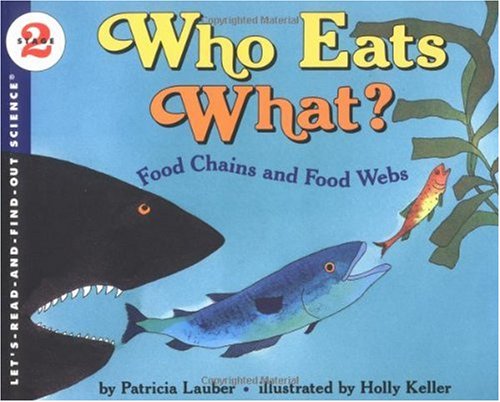
7. Who Eats What? Food Chains and
$45.06
8. Essentials of Food Science (Food
$56.90
9. Essentials of Food Science (Food
$164.60
10. Food Drying Science and Technology:
$87.99
11. Foodborne Infections and Intoxications,
$15.63
12. Dictionary of Food Science and
$48.98
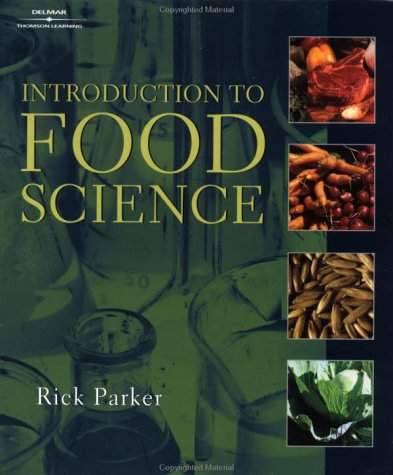
13. Introduction to Food Science
$16.10
14. What Einstein Told His Cook: Kitchen
$29.76
15. The Science of Cooking
$42.95
16. When Food Kills: BSE, E. coli,
$6.73
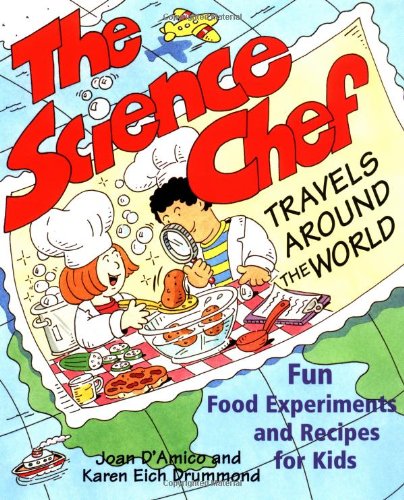
17. The Science Chef Travels Around
 
$136.95
18. New Food Product Development:
$53.96
19. Food Chemistry (Food Science and
$57.80
20. Food Chemistry

1. On Food and Cooking: The Science and Lore of the Kitchen
by Harold McGee
Hardcover: 896 Pages (2004-11-16)
list price: US$40.00 -- used & new: US$22.98
(price subject to change: see help)
Asin: 0684800012
Average Customer Review: 5.0 out of 5 stars
Canada | United Kingdom | Germany | France | Japan
Editorial Review

Amazon.com
A classic tome of gastronomic science and lore, On Food and Cooking delivers an erudite discussion of table ingredients and their interactions with our bodies. Following the historical, literary, scientific and practical treatment of foodstuffs from dairy to meat to vegetables, McGee explains the nature of digestion and hunger before tackling basic ingredient components, cooking methods and utensils. He explains what happens when food spoils, why eggs are so nutritious and how alcohol makes us drunk. As fascinating as it is comprehensive, this is as practical, interesting and necessary for the cook as for the scholar.Book Description
Harold McGee's On Food and Cooking is a kitchen classic. Hailed by Time magazine as "a minor masterpiece" when it first appeared in 1984, On Food and Cooking is the bible to which food lovers and professional chefs worldwide turn for an understanding of where our foods come from, what exactly they're made of, and how cooking transforms them into something new and delicious.

Now, for its twentieth anniversary, Harold McGee has prepared a new, fully revised and updated edition of On Food and Cooking. He has rewritten the text almost completely, expanded it by two-thirds, and commissioned more than 100 new illustrations. As compulsively readable and engaging as ever, the new On Food and Cooking provides countless eye-opening insights into food, its preparation, and its enjoyment.

On Food and Cooking pioneered the translation of technical food science into cook-friendly kitchen science and helped give birth to the inventive culinary movement known as "molecular gastronomy." Though other books have now been written about kitchen science, On Food and Cooking remains unmatched in the accuracy, clarity, and thoroughness of its explanations, and the intriguing way in which it blends science with the historical evolution of foods and cooking techniques.

Among the major themes addressed throughout this new edition are:

  • Traditional and modern methods of food production and their influences on food quality
  • The great diversity of methods by which people in different places and times have prepared the same ingredients
  • Tips for selecting the best ingredients and preparing them successfully
  • The particular substances that give foods their flavors and that give us pleasure
  • Our evolving knowledge of the health benefits and risks of foods

On Food and Cooking is an invaluable and monumental compendium of basic information about ingredients, cooking methods, and the pleasures of eating. It will delight and fascinate anyone who has ever cooked, savored, or wondered about food. ... Read more

Customer Reviews (149)

5-0 out of 5 stars On Food and Cooking
This was a present for my daughter, who was delighted because it was exactly the book she had been hoping to get. I found it very interesting (before giving it to her!).

5-0 out of 5 stars What Happens to What We Cook
This book is a must for anyone wanting the truth about cooking and what we cook. More power to McGee: don't fail to get your library to own a copy and buy one yourself. More good stuff/chapter/$ than most books.

5-0 out of 5 stars One of the best books on my shelf
For somebody who likes cooking and is interested to improve his skils,and looks for in depth of the processes in the kitchen this is the right textbook.Over that it is a good literature for reading/at least for me/

5-0 out of 5 stars Excellent book
This book is full of excellent well researched information. We keep it in the kitchen and all of us read from it.

5-0 out of 5 stars A non-cook book cook book
If you want to understand why certain combinations of food taste better, or how to cook better in general this book is for you.McGee takes a great deal of time to experiment in the kitchen and understand not only what makes a good recipe but why it does so. ... Read more


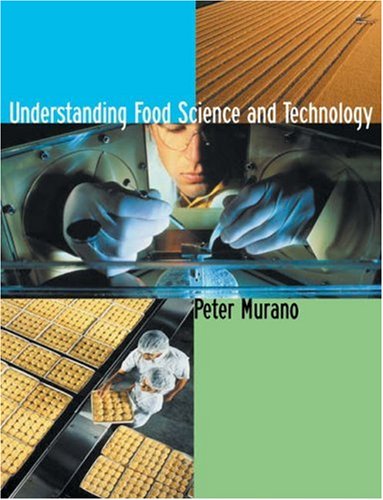
2. Understanding Food Science and Technology (with InfoTrac )
by Peter Murano
Hardcover: 504 Pages (2002-09-25)
list price: US$108.95 -- used & new: US$62.13
(price subject to change: see help)
Asin: 053454486X
Canada | United Kingdom | Germany | France | Japan
Editorial Review

Book Description
UNDERSTANDING FOOD SCIENCE AND TECHNOLOGY is a comprehensive introductory level text that provides thorough up-to-date coverage of a broad range of topics in food science and technology.The text begins with an explanation of the interdisciplinary nature of food science (including biology, engineering, chemistry, and physics) and describes avenues of advanced study in the field.The text explores key food commodities and food composition with an emphasis on the functional properties of each commodity.Three chapters on food chemistry cover the chemical and physical properties of foods through the use of many easy to understand figures, tables, and illustrated concepts.Next the text includes an overview of food law that provides historical perspective as well as the latest information on nutrition labeling and food regulation.Thorough coverage of processing methods in included in all major food commodities as well as a background in microbiology and fermentation, food handling and safety, food contamination, HACCP principles and toxicology.The final chapters cover food engineering concepts and applications, biotechnology and the field of sensory evaluation and food product development with coverage of marketing principles. ... Read more


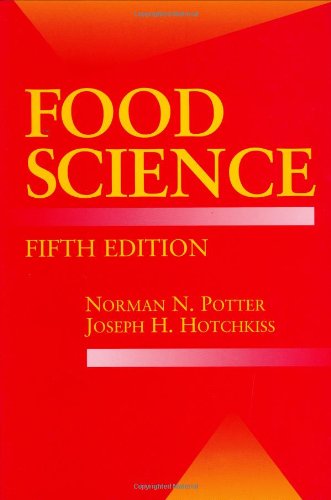
3. Food Science (Food Science Texts Series)
by Norman N. Potter, Joseph H. Hotchkiss
Hardcover: 608 Pages (1999-07-01)
list price: US$62.95 -- used & new: US$32.50
(price subject to change: see help)
Asin: 083421265X
Average Customer Review: 4.0 out of 5 stars
Canada | United Kingdom | Germany | France | Japan
Editorial Review

Book Description
Now in its fifth edition, Food Science remains the mostpopular and reliable text for introductory courses in food science andtechnology. This new edition retains the basic format and pedagogicalfeatures of previous editions and provides an up-to-date foundationupon which more advanced and specialized knowledge can be built. Thisessential volume introduces and surveys the broad and complexinterrelationships among food ingredients, processing, packaging,distribution and storage, and explores how these factors influencefood quality and safety. Reflecting recent advances and emergingtechnologies in the area, this new edition includes updated commodityand ingredient chapters to emphasize the growing importance ofanalogs, macro-substitutions, fat fiber and sugar substitutes andreplacement products, especially as they affect new productdevelopment and increasing concerns for a healthier diet. Revisedprocessing chapters include changing attitudes toward foodirradiation, greater use of microwave cooking and microwaveableproducts, controlled and modified atmosphere packaging and expandingtechnologies such a extrusion cooking, ohmic heating and supercriticalfluid extraction, new information that addresses concerns about theresponsible management of food technology, considering environmental,social and economic consequences, as well as the increasingglobalization of the food industry. Discussions of food safety anconsumer protection including newer phychrotropic pathogens; HAACPtechniques for product safety and quality; new information on foodadditives; pesticides and hormones; and the latest information onnutrition labeling and food regulation. An outstanding text forstudents with little or no previous instruction in food science andtechnology, Food Science is also a valuable reference forprofessionals in food processing, as well as for those working infields that service, regulate or otherwise interface with the foodindustry. ... Read more

Customer Reviews (4)

4-0 out of 5 stars Food Science
This book was nominated for the referencebook for my Masters of Food Science and technology to the "Principles of food science" subject/course. Contents of this book is very informative and useful for a beginner in food science. It helped me lot to get a good grade of my course work.

5-0 out of 5 stars Milestone reference text!
Conceptually this book became a truly essential consult book and invaluable reference for all those involved in a real Food Engineering.

In twenty four chapters Potter clasps the main themes concerned with this passionate science: conservation and processing foods through the heat, refrigeration. Dehydration and concentration of aliments.

An invaluable guide and continuous learning process around the accurate temperature to preserve fruits, cereals, fishes, fruits, vegetables, beverages and all kind of meats.

Go for this. It will be very helpful for Industrial and Chemical Engineers and obviously for Pre Grade students.

5-0 out of 5 stars Excellent
Excellent textbook for students.

3-0 out of 5 stars good for very beginners
As a prescribed book at varsity, I was very glad I didn't waste my sparce finances on this one. Good for your first aquaintance with food science, but very quickly outgrown. ... Read more


4. Elementary Food Science (Food Science Texts Series)
by Ernest R. Vieira
Paperback: 452 Pages (1999-02-01)
list price: US$54.95 -- used & new: US$50.94
(price subject to change: see help)
Asin: 0834216574
Canada | United Kingdom | Germany | France | Japan
Editorial Review

Book Description
An Aspen Food Science Text Series Book. Following the success of the previous editions, this popular introductory text continues to provide thorough, up-to-date information covering a broad range of topics in food science, with emphasis on food processing and handling and the methodology of specific foods. Presenting a multitude of easy-to-understand figures, tables, illustrated concepts and methods, this text maintains the strengths of the previous edition while adding new information. The book opens with a revised chapter on what food science actually is, detailing the progression of food science from beginning to future. Succeeding chapters include the latest information on food chemistry and dietary recommendations, food borne diseases and microbial activity. A complete revision of HACCP is outlined, accompanied by numerous examples of flow charts and applications, as well as major additions on food labeling. Extensive updates have been made on processing methods and handling of foods, such as new procedures on: candy making; coffee and tea production; beer and wine production; soft drinks; ultra high temperature processing; aseptic packaging; aquaculture and surimi; and UHT and low temperature pasteurization of milk. In addition, there is a completely new section which includes safety and sanitation as well as laboratory exercises in sensory, microbiological, chemical quality test, and processing methods for a variety of the foods described in previous chapters. ... Read more


5. The Science Chef: 100 Fun Food Experiments and Recipes for Kids
by Joan D'Amico, Karen Eich Drummond
 Paperback: 180 Pages (1994-09)
list price: US$12.95 -- used & new: US$7.16
(price subject to change: see help)
Asin: 047131045X
Average Customer Review: 5.0 out of 5 stars
Canada | United Kingdom | Germany | France | Japan
Editorial Review

Book Description
What melts in your mouth and not in your hands, plumps when you cook it, and comes in more than forty-eight scrumptious flavors? Give up? The correct answer is: Science!

With The Science Chef you'll learn loads of basic science by doing fun, easy-to-perform cooking projects. And you get to eat the results when you're finished!

Why do onions make you cry? How does yeast make bread rise? What makes popcorn pop, whipped cream frothy, and angel food cake fluffy? You'll discover the scientific answers to these and dozens of other tasty mysteries when you prepare kid-tested recipes for everything from Cinnamon Toast and Basic Baked Potatoes to Stromboli Pizzoli and Monkey Bread.

Whether you're a beginner or an experienced cook, you can become a great Science Chef. All 100 experiments and recipes require only common ingredients and standard kitchen utensils. And The Science Chef includes rules for kitchen safety and cleanup, plus a complete nutrition guide. ... Read more

Customer Reviews (1)

5-0 out of 5 stars Kids love to learn
This book is fascinating and exciting.Not only do children enjoy the recipes, but they learn in a fun way.It is an easy way of learning new information and keeps them interested. ... Read more


6. Food Science: The Biochemistry of Food & Nutrition
by Kay Yockey Mehas
 Hardcover: Pages (1997-06)
list price: US$57.32 -- used & new: US$3.95
(price subject to change: see help)
Asin: 0026476479
Canada | United Kingdom | Germany | France | Japan

7. Who Eats What? Food Chains and Food Webs (Let's-Read-and-Find-Out Science, Stage 2)
by Patricia Lauber
Paperback: 32 Pages (1995-01-30)
list price: US$5.99 -- used & new: US$2.57
(price subject to change: see help)
Asin: 0064451305
Average Customer Review: 4.5 out of 5 stars
Canada | United Kingdom | Germany | France | Japan
Editorial Review

Book Description
An award-winning author and artist explain how every link in a food chain is important because each living thing depends on others for survival. "Clear, simple drawings illustrate the clear, simple text. Informative and intriguing, this basic science book leads children to think about the complex and interdependent web of life on Earth."'BL.

Outstanding Science Trade Books for Children 1996 (NSTA/CBC) ... Read more

Customer Reviews (6)

5-0 out of 5 stars love it
I used it to make an interactive bulletin board for my classroom.It is simple but it gets the point across.I use it with my 8th and 9th grade students, and they don't mind that it's a picture book.

5-0 out of 5 stars Who Eats What? Food Chains and Food Webs
I found this book to be very entertaining and I feel the children's interest held to the very end of the story.

3-0 out of 5 stars Food Chains and Food Webs
Detailed examples of food chains and food webs, but hard to follow the arrows in the illustrations in food chains.

My son would prefer just reading about the types of meals each animal species eats and how they kill it as opposed to the food chain process. There are several pages that have arrows pointing from one item to another and it gets confusing trying to sort it all out.

We begin with seeing a caterpillar eating a leaf on an apple tree until he becomes the dinner of the arriving wren. When a hawk comes around he eats the wren. In this example the food chain begins with the leaf and ends with the hawk. It is described how the animal at the top of the food chain is the last eater because it is the one no one else will eat.

There are other short chains like when you eat an apple off a tree or drink milk in a glass. The cow eats the grass and the milk comes from the cow. There is a detailed diagram with a girl eating a peanut butter and jelly sandwich, an apple and a glass of milk. Food keeps us alive and animals need to catch the food they need to survive. First we begin with green plants, as they are the only living things that can make their own food and do not need to eat something else. Animals depend on green plants as well.

During the summer months Antartica comes alive with tiny green plants that are eaten by krill. The squid will in turn eat the krill, which looks like shrimp. The killer whale can eat a sperm whale or a blue whale.

When you change your eating patterns you are changing the food chain as well. Fishermen kill krill but they cannot kill them all since this is what happened when they almost wiped out the sea otters in the Pacific Sea. It is important to take care of the earth so all living things have something to eat and in turn we help them and ourselves in the process.

4-0 out of 5 stars My 2nd Graders Thought This Was Cool
Interesting, written on a level primary school students can understand, and packed with information

4-0 out of 5 stars Good but not great
By the time the kids are at this level most of them already have some idea of the food chain concept (and anybody who has played Magic School Bus Animals definitely will!). It sits right at the cross roads of two levels- a solid first grade book, perhaps. ... Read more


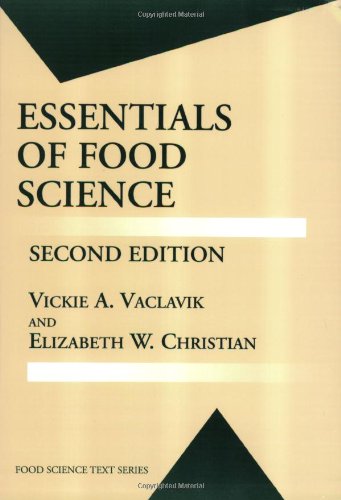
8. Essentials of Food Science (Food Science Text Series)
by Vickie A. Vaclavik, Elizabeth W. Christian
Paperback: 500 Pages (2003-05-31)
list price: US$60.00 -- used & new: US$45.06
(price subject to change: see help)
Asin: 0306473631
Average Customer Review: 4.0 out of 5 stars
Canada | United Kingdom | Germany | France | Japan
Editorial Review

Book Description
Designed primarily for the non-Food Science major, this textbook presents principles of food science for the nutrition, dietetics, hospitality, and culinary arts student enrolled in an introductory food science course. As in the first edition the book is easily readable. Chapters follow the order of the USDA's Food Guide Pyramid, beginning with foods appearing at the base of the Pyramid - the bread, cereal, rice, and pasta foods, and continuing with foods through the top of the Pyramid - the fatty, oils, and sweets. A chapter on baked products covers batters and doughs, and builds upon information in earlier chapters. The last chapters cover aspects of food production and government regulation.
For this second edition the authors have expanded the concepts relating to material in all chapters, including quality, gums, organic food, irradiation, biotechnology, sugar substitutes, fat replacers, packaging, health claims, and dietary guidelines. There is also a new chapter dedicated to a discussion on emulsification and foams. In addition, the index has been revamped.
As nutrition and food safety continue to be important issues, where applicable, individual chapters contain sections on nutritive value and safety concerns regarding the foods discussed. Additionally, each chapter contains a glossary and helpful references useful for further study.
Using a multidisciplinary approach, Essentials of Food Science, Second Edition combines food chemistry, food technology, and food preparation into one single source of information. ... Read more

Customer Reviews (1)

4-0 out of 5 stars Technical hand book for understanding food
I purchased this book to accompany McGee "on Food and Cooking" and although it was interesting and thorough, the book should be considerd by advanced users.The book touches on chemical composition as opposed to functionality as it applies to cooking. ... Read more


9. Essentials of Food Science (Food Science Texts Series)
by Vickie A. Vaclavik, Elizabeth W. Christian
Paperback: 572 Pages (2007-11-30)
list price: US$64.95 -- used & new: US$56.90
(price subject to change: see help)
Asin: 0387699392
Canada | United Kingdom | Germany | France | Japan
Editorial Review

Book Description

Knowledge of food science is applicable to all persons, in diverse college majors. This text is designed with a user-friendly approach to Food Science for the non-major.

This text reviews an Introduction to Food Componentsquality and water. Next it addresses carbohydratesincluding starches, pectins and gums, breads and pasta, vegetables and fruits. Then proteinsmeats, poultry, fish, beans, eggs, milk and milk products are presented. Following proteins are fats and emulsions. Then sugars and sweeteners, and baked products, the latter of which builds upon basic food component knowledge.

Various aspects of Food Production are examined, including food safety, preservation and processing, food additives and packaging. Government regulation and labeling complete the chapter information.

New in this edition are "Culinary Alerts!" scattered throughout chapters. Their inclusion allow the reader to more easily apply text information to cooking applications. Also new are the Appendices, which cover the following:

  • Biotechnology. Genetically Modified Organisms (GMOs)
  • Functional foods
  • Nutraceuticals
  • Phytochemicals
  • Medical foods
  • USDA Food Pyramid
  • Food Label Heath Claims
  • Research Chefs Associationcertification as a culinary scientist and more

Using a multidisciplinary approach, Essentials of Food Science, Third Edition combines food chemistry, food technology, and food preparation applications into one single source of information.

... Read more

10. Food Drying Science and Technology: Microbiology, Chemistry, Application
Hardcover: 800 Pages (2007-06-15)
list price: US$189.50 -- used & new: US$164.60
(price subject to change: see help)
Asin: 1932078568
Canada | United Kingdom | Germany | France | Japan
Editorial Review

Product Description
A definitive guide to all major food drying techniques and equipment Latest technologies for meats, fruits, vegetables, and seafood Covers microbial issues and safety Newest designs for drying systems and manufacturing linesHere, in one source, is the scientific information needed for high-quality and high-throughput removal of water from many different foods. All major food drying manufacturing operations are illustrated, with key design information for each stage. This book makes clear the principles of food drying and the mathematical techniques for analyzing drying processes. At the same time it provides details on how drying is now done within the global food industry, e.g., how drying lines are designed and set up. Using the most current numerical and empirical data, the authors show how various types of drying affect the chemistry and sensory properties of foods. Key information is also furnished on microbial safety, preservation, and packaging. Table of contents1. Fundamentals of Food Dehydration2. Unified Approach to the Analysis of Different Drying Methods3. Food Dehydration and Developing Countries4. Solar-Assisted Drying of Foods5. Rotary Drum Dryers6. Microwave Drying7. Far Infrared Dehydration and Processing8. Vacuum Drying9. Spray Drying and Powder10. Heat Pump and Dehumidification Drying11. Osmotic Dehydration of Foods12. Novel Drying Technologies13. Vacuum Fluidized Bed Drying14. Packaging and Storage of Dried Foods15. Food Drying Equipment and Design16. Freeze-Drying17. Freeze-Drying of Fruits and Vegetables: Process Variables, Quality and Stability18. Freeze-Drying of Meats and Seafood19. Specialty Foods20. Banana Dehydration21. Drying of Mango (Mangifera Indica L.) and Mango Products22. Pear Drying23. Drying of Plums24. Chili (Capsicum anuum) Drying25. Onion Drying26. Tomato Deyhdration27. Drying Behavior of Starches and Gels28. Deep-Fat Frying of Potatos29. Pasta Drying30. Milk Powders31. Deyhdration of Muscle Foods32. Fish DryingINDEX ... Read more


11. Foodborne Infections and Intoxications, Third Edition (Food Science and Technology)
Hardcover: 520 Pages (2005-12-16)
list price: US$125.00 -- used & new: US$87.99
(price subject to change: see help)
Asin: 012588365X
Canada | United Kingdom | Germany | France | Japan
Editorial Review

Book Description
The accelerated globalization of the food supply, coupled with toughening government standards, is putting global food production, distribution, and retail industries under a high-intensity spotlight. High publicity cases about foodborne illnesses over recent years have heightened public awareness of food safety issues, and momentum has been building to find new ways to detect and identify foodborne pathogens and eliminate food-related infections and intoxications. This extensively revised Third Edition covers how the incidence and impact of foodborne diseases is determined, foodborne intoxications with an introduction that notes common features among these diseases and control measures that are applicable before and after the basic foodstuff is harvested.

* A summary of the foods most association with human infections
* A discussion of the principles of laboratory detection of the agent considering the advantages and disadvantages of various procedure
* A 'historical to present-day' section
* A description of the infection in humans and animals, including reservoirs and the mode of transmission ... Read more


12. Dictionary of Food Science and Nutrition (Food Science)
by A & C Black Publishers
Paperback: 320 Pages (2006-11)
list price: US$19.67 -- used & new: US$15.63
(price subject to change: see help)
Asin: 0713677848
Average Customer Review: 5.0 out of 5 stars
Canada | United Kingdom | Germany | France | Japan
Editorial Review

Book Description

Simple definitions of more than 6,000 food and nutrition terms are provided in this comprehensive reference. Covering subjects such as dietary requirements, chemistry, food preparation and handling, labeling, and commercial food production, this resource is ideal for students, employers, and employees who work with food in any capacity.
... Read more

Customer Reviews (1)

5-0 out of 5 stars A great book for students!
I am a college instructor who teaches nutrition & food science, and make this book available for my students. It is by far the most complete and understandable dictionary for undergraduate nutrition,food science, and food service managements students that I have ever found.Many of my students have bought their own copy! ... Read more


13. Introduction to Food Science
by Ph.D., Rick Parker
Hardcover: 672 Pages (2001-10-19)
list price: US$90.95 -- used & new: US$48.98
(price subject to change: see help)
Asin: 0766813142
Canada | United Kingdom | Germany | France | Japan
Editorial Review

Book Description
"Introduction to Food Science" is an ideal resource for anyone interested in a comprehensive overview of the science of foods.Four sections organize twenty-eight chapters into logical groupings, from basic chemistry and nutrition, to food composition and preservation, to environmental concerns and world food needs.This book presents a variety of interesting topics in an easy-to-understand manner. It also provides insight into career opportunities for those interested in working within food science industries. ... Read more


14. What Einstein Told His Cook: Kitchen Science Explained
by Robert L. Wolke
Hardcover: 350 Pages (2002-05)
list price: US$25.95 -- used & new: US$16.10
(price subject to change: see help)
Asin: 0393011836
Average Customer Review: 4.0 out of 5 stars
Canada | United Kingdom | Germany | France | Japan
Editorial Review

Amazon.com
Why do recipes call for unsalted butter--and salt? What is a microwave, actually? Are smoked foods raw or cooked? Robert L. Wolke's enlightening and entertaining What Einstein Told His Cook offers answers to these and 127 other questions about everyday kitchen phenomena. Using humor (dubious puns included), Wolke, a bona fide chemistry professor and syndicated Washington Post columnist, has found a way to make his explanations clear and accessible to all: in short, fun. For example, to a query about why cookbooks advise against inserting meat thermometers so that they touch a bone, Wolke says, "I hate warnings without explanations, don't you? Whenever I see an 'open other end' warning on a box, I open the wrong end just to see what will happen. I'm still alive." But he always finally gets down to brass tacks: as most heat transfer in meat is due to its water content, areas around bone remain relatively cool and thus unreliable for gauging overall meat temperature.

Organized into basic categories like "Sweet Talk" (questions involving sugar), "Fire and Ice" (we learn why water boils and freezers burn, among other things), and "Tools and Technology" (the best kind of frying pan, for example), the book also provides illustrative recipes like Black Raspberry Coffee Cake (to demonstrate how metrics work in recipes) and Bob's Mahogany Game Hens (showing what brining can do). With technical illustrations, tips, and more, the book offers abundant evidence that learning the whys and hows of cooking can help us enjoy the culinary process almost as much as its results. --Arthur BoehmBook Description
Einstein's cook was lucky. But you, too, can have a scientist in your kitchen: Robert L. Wolke. Does the alcohol really boil off when we cook with wine? Are smoked foods raw or cooked? Are green potatoes poisonous? With the reliability that only a scientist can provide, Robert L. Wolke provides plain-talk explanations of kitchen mysteries with a liberal seasoning of wit. A professor of chemistry and a lifelong gastronome, he has answered hundreds of questions about food and cooking in his syndicated Washington Post column, "Food 101." Organized into basic categories for easy reference, What Einstein Told His Cook contains more than 130 lucid explanations of kitchen phenomena involving starches and sugars, salts, fats, meats and fish, heat and cold, cooking equipment, and more. Along the way, Wolke debunks some widely held myths about foods and cooking. Whether kept in the kitchen or on the reference shelf, What Einstein Told His Cook will be a friendly scientist at your elbow. 20 illustrations. ... Read more

Customer Reviews (46)

5-0 out of 5 stars Informative and easy read
I found this book to be a very easy and entertaining read. The author did a very good job of making it entertaining with some anecdotes and tongue in cheek writing style. It was also very informative. If you are a fan of Alton Brown style of delivery, you will probably enjoy this book.

5-0 out of 5 stars Einstein Sure Knew a Lot!
The headmaster at the school where I teach recommended this book for my domestic arts class and it has been a great source of information - the kind you don't normally find in the usual textbooks.We have enjoyed learning all the ends and outs of information that is not normally covered in cooking classes.Plus the book is divided into sections with very creative titles; and with the use of well-placed humor, this book is not only very informative but very entertaining!

5-0 out of 5 stars Funny and interesting cooking facts
My husband and I are both engineers and enjoy cooking.This book appealed to us and is a wonderful explanation of the science behind the kitchen.The author has a certain humor, which keeps the book interesting, and explains details well, even for non-technical people.I would recommend it as an addition to your kitchen.

5-0 out of 5 stars Equal pleasures
Great fun.........and practical advice........for the scientist who is not a cook and equally for the cook who is not a scientist

CHUCKHILTY
Reston VA

5-0 out of 5 stars appeals to the cook and the geek in me!
Very entertaining, well organized and actually informative.Since I have a pretty extensive bioscience background, I wasn't confused by his explanations so I am not sure how a non-science person would react.But I think he does a pretty nice job of it, coats it in sugar, etc.

Basically if you like books like "The Turk", Devil in the White City, Salt, Freakonomics, etc. then this should be up your alley! ... Read more


15. The Science of Cooking
by Peter Barham
Hardcover: 244 Pages (2001-06-08)
list price: US$39.95 -- used & new: US$29.76
(price subject to change: see help)
Asin: 3540674667
Average Customer Review: 4.0 out of 5 stars
Canada | United Kingdom | Germany | France | Japan
Editorial Review

Book Description

A kitchen is no different from most science laboratories and cookery may properly be regarded as an experimental science. Food preparation and cookery involve many processes which are well described by the physical sciences. Understanding the chemistry and physics of cooking should lead to improvements in performance in the kitchen. For those of us who wish to know why certain recipes work and perhaps more importantly why others fail, appreciating the underlying physical processes will inevitably help in unravelling the mysteries of the "art" of good cooking.

Strong praise from the reviewers -

"Will be stimulating for amateur cooks with an interest in following recipes and understanding how they work. They will find anecdotes and, sprinkled throughout the book, scientific points of information... The book is a pleasant read and is an invitation to become better acquainted with the science of cooking." - NATURE

"This year, at last, we have a book which shows how a practical understanding of physics and chemistry can improve culinary performance [Barham] first explains, in a lucid non-textbooky way, the principles behind taste, flavour and the main methods of food preparation, and then gives fool-proof basic recipes for dishes from roast leg of lab to chocolate soufflé." - FINANCIAL TIMES WEEKEND

"This book is full of interesting and relevant facts that clarify the techniques of cooking that lead to the texture, taste and aroma of good cuisine. As a physicist the author introduces the importance of models in preparing food, and their modification as a result of testing (tasting)."- THE PHYSICIST

"Focuses quite specifically on the physics and food chemistry of practical domestic cooking in terms of real recipes... Each chapter starts with an overview of the scientific issues relevant to that food group, e.g. toughness of meat, thickening of sauces, collapse of sponge cakes and soufflés. This is followed by actual recipes, with the purpose behind each ingredient and technique explained, and each recipe followed by a table describing some common problems, causes and solutions. Each chapter then ends with suggested experiments to illustrate some of the scientific principles exploited in the chapter." - FOOD & DRINK NEWSLETTER

... Read more

Customer Reviews (9)

4-0 out of 5 stars The Science of Cooking
A review for science teachers:

Peter Barnam's The Science of Cooking (Springer, 2000) is a classic, much quoted in New Scientist and The Science of Christmas. After a general introduction at about a year 9 chemistry level it quickly moves on to Maillard reactions (which develop the flavours in cooked meat), the formation of insoluble gluten (from the proteins gliadin and glutenin) when flour is hydrated and kneaded, and the role of fats and oils in carrying aromatics (or emulsifying finely ground cocoa to make chocolate).

Most of all I enjoyed this book for the experiments it suggested (adaptable to inquiry learning). For example: How could you prove fructose is sweeter than glucose? Easy: Use a control, such as an artificial sweetener. But not all people will give the same interpretation when faced with the sugars. How can we show that they are detecting the control in a consistent way? And so on...Secondly, the text is punctuated with anecdotes about demonstration lectures on the Physics of the Black Forest Gateau or Soufflé Chemistry ...you can almost hear this born teacher, winner of the Institute of Physics Prize for Promoting the Public Awareness of Physics, script a unique lesson for your students.

This little recipe book promises a few mouthwatering improvements to my own kitchen alchemy, and comes highly recommended.

4-0 out of 5 stars scientifically informative but far from complete in the cooking aspect
Pros: Scientifically informative and solid. Knowing the chemical and physical facts behind cooking methods applied to certain group of food would definitely help one to produce constantly good cooking result. And the text is very well written, _no_ part of this book is boring to read.

Cons: This book is focused on western cooking methods, many highly interesting cooking methods which are very popular, even dominating in East Asia are not even mentioned in this book. For example, there is a chapter for sauces but soup was hardly mentioned in this book, as if soup is not a kind of dishes. However the art/science of soup cooking is very important for many people. I, for one, really looked for information for soup cooking in this book but was disappointed. And, the author seems think any sauce has to be at least a bit thick (containing reasonable amount of starch). But this is not true in Asia countries. We have many kinds of really tasty sauces which are totally fluid, almost as light as water. These light sauces are not only tasty but also have really nice aroma, nice colours, contains very little energy and they attach onto the main food very well. In the fish chapter, he said salted/dried fishes are very difficult to regain the good texture and taste, and wrote up 2 pages about a Norwegian disaster of fish making. But in east China, people steamsalted sea eels and the result is so, so delicious. He should really have tried it out himself. In this book, the science of vegetable cooking is not mentioned. Nevertheless I think vegetable cooking is very important and I really want to learn the science of vegetable cooking from the author, I like his writing so much! And, in this book all doughs are baked but there are many people (mostly from East Asia) who steam doughs and the results are excellent too. For beef steak cooking, many professional cooks saute/shallow fry every side of a 2-3cm thick steak first (every side one minute) and then put it into pre-heated oven for 5-7 minutes. This cooking method is not mentioned in this book and actually I did want to know the advantage of the post-fry oven handling of a beef steak.

I really hope there will be a second edition of this book. I seriously suggest the author travel to Hong Kong and try out reasonably many different kinds of food in non-western restaurants in Hong Kong. Especially the famous soups, all kinds of vegetable dishes and all kinds of steamed dough-based snacks....

4-0 out of 5 stars behind the kitchen
This book will teach you the chemical secrets of the techniques that usually are used in gastronomy,from the basic concepts to most complex.Knowing the scientific basis of the culinary processes, Peter Barham describes kitchen recipes in detail, of this way, will not fail any more.
This book also has some very interesting experiments to do at home, and that will offer help to understand of more practical way, the physical-chemistries concepts that try to explain.
If you are interested in cooking, and science doesn't bore to you, read this book!

3-0 out of 5 stars http://www.bragazzis.com
A little to heavy on the science for my liking!...but there are some useful theories for beginners!

Ian

http://www.bragazzis.com

5-0 out of 5 stars Excellent Science and Culinary Technique. Highly Recommended
Reviewing `The Science of Cooking' by Bristol University (UK) don Peter Barham gives me the pleasure of commenting on a book with differential equations, a subject for which I received my all time lowest grade (a D) in school. Luckily you, dear reader, these equations are no more than window dressing in a sidebar on thermodynamics which, if nothing else, convince us that Dr. Barham knows what he is talking about. And yes, dear reader, Dr. Barham most certainly knows of what he speaks. And, he does an excellent job of communicating this information to the layman.

This excellent book can be evaluated on at least three different levels. On the highest level, where Barham talks about the relevance of science to cooking, the author is just a bit weak. Early in the book, he compares a cook's following a recipe to the conduct of an experiment, and I think this metaphor simply does not work, and, I think the author repudiates this notion later in the book when he does a true description of how a recipe would be written if it were an experiment. A second major weakness in his talking about science is where he describes both a recipe (experiment) and a theory as a model. Philosophers of science clearly distinguish experiment from explanation (theory) and while `model' is a good word for theory, it is definitely not a good word for experiment. Oddly enough, there are important roles for experiment in cookery, but only when one is truly developing recipes and examining the properties of a new foodstuff product. Thankfully, the author gets on to the important business at hand of actually describing science and applying it to cooking, two tasks he does with great skill.

Unlike Harold McGee, Barham correctly puts his introduction to basic chemistry in the front of the book. I am sure that thousands of people will stumble over this with unprintable mutterings in an effort to get to the writing about pots and potatoes, but you must gives serendipity a fighting chance. A fair number of readers will pick up on this stuff and it will clearly improve their understanding of what follows. This is especially true as Dr. Barham or his book design team has done an excellent job of selecting illustrations of the basic organic molecules of which he speaks. There is a risk here that since I studied organic chemistry I may not have the same eye of a chemical innocent, but I think not. I believe reasonably intelligent people prefer the straight skinny rather than explanations tailored for 12 year olds. In addition to basic chemistry, Dr. Barham opens the subject of cooking with an overview of the science of food and heat and food and the senses. Here begins what is Dr. Barham's greatest single contribution to food science writing, and the thing that would make this book a superb textbook on food science. In each chapter, Barham supplies two or more experiments on food science that can easily be done at home or in a standard school chemistry lab with no expensive special equipment.

I must also note that Dr. Barham is crystal clear on methods of heat distribution. This is important, as Alton Brown's first book has a major error in its opening discussion of heat transfer methods in that he does not rate convection with as much importance as conduction and radiation. Dr. Barham corrects this error by citing that in fact, convection is the most important means of heat transfer in ovens.

The next chapter deals with cooking tools and the materials from which they are made. While this chapter is no match for the detail in Alton Brown's book on kitchen equipment, it does include a few cautions that I do not recall Alton's having mentioned. The most interesting is the warning against the very expensive stainless steel sheathed pots with copper or aluminum cores that extend all the way up the sides of the pot. While others have recommended this, the author warns this may cause hot spots high up on the wall of the saucepan that may have undesirable consequences if hot liquid splashes against the even hotter metal high in the pan. Unfortunately, the good doctor does not back this observation up with a demonstration, so it is no better than an anecdotal observation, but I will feel a bit more respectful to the cookware lines with only a disk of high conducting metal in the bottom.

The first real foody subject is `Meat and Poultry'. I find it a bit odd that the author says that meat cookery is the one place where an understanding of science can make the biggest difference in cooking results. I can say with confidence that a scientific view of things is probably at least as important, if not more so in baking, where the effect of errors in measuring ingredients can be truly disastrous (or inventive, depending on how you look at it).

This chapter is the first appearance of actual recipes and the second great contribution to food science writing (first being the experiments). Here, Dr. Barham not only gives excellently explained recipes; he also gives great little tables of problems that may arise with various cooking methods and how to solve the problems. There is little that is new here except that the presentation gets a lot of the ideas across more effectively than simple narrative. Shirley Corriher uses a similar tabular presentation, although her information is more proactive than diagnostic in that it explains the reasons for steps in the procedure rather than giving solutions for problems.

Be warned that all units are metric and there are some unexplained English references here and there, such as the term `A4' for letter paper. I recommend this book very highly. It doesn't have Alton Brown's humor or Shirley Corriher's southern charm, but it is a very, very sound book, once you get past the first three pages.
... Read more


16. When Food Kills: BSE, E. coli, and Disaster Science
by T. Hugh Pennington
Hardcover: 240 Pages (2003-11-27)
list price: US$47.50 -- used & new: US$42.95
(price subject to change: see help)
Asin: 0198525176
Canada | United Kingdom | Germany | France | Japan
Editorial Review

Book Description
The 'food scare' concept took on new meaning in 1996, which opened with variant CJD emerging as the human form of BSE, and closed with Britain's worst E.coli O157 outbreak in central Scotland.As people died, so did trust in government and science.This book tells the story of these events, what led up to them, and what has happened since.It breaks new ground by dissecting these tragedies alongside catastrophes like Aberfan, Piper Alpha, Chernobyl, and the worst ever railway accidents in Ireland and Britain (Armagh and Quintinshill), as well as classical outbreaks of botulism, typhoid, E.coli O157 and Salmonella food poisoning. Britain's ability to win Nobel prizes marches with a propensity to have disasters.The book explains why,demonstrating failures in policy making, failures in the application of science, and failing inspectorates. A unique feature of this book is its breadth since it covers history, politics and law as well as science.It also makes some fascinating connections, like those between 1930's nuclear physics, E.coli, and molecular biology, and the links between manslaughter in 19th century mental hospitals, syphilis, the Nobel Prize, and the prospects for successfully treating variant CJD.Royal murderers, vaccine research in Auschwitz and Buchenwald, and the race to develop the atom bomb appear as well.For the general reader its non-technical but authoritative account of the science behind these tragedies, its critical appraisal of how the government responded to them, its coverage of public inquiries and its analysis of risk will be informative and stimulating. Scientists will find its approach to the prion theory and the origins of BSE challenging and controversial.Policy makers will find not only diagnoses of what went wrong in the past, but remedies ror the future. ... Read more


17. The Science Chef Travels Around the World: Fun Food Experiments and Recipes for Kids
by Joan D'Amico, Karen Eich Drummond
Paperback: 192 Pages (1996-01)
list price: US$12.95 -- used & new: US$6.73
(price subject to change: see help)
Asin: 047111779X
Average Customer Review: 4.0 out of 5 stars
Canada | United Kingdom | Germany | France | Japan
Editorial Review

Book Description
Discover the delicious answers as you satisfy your hunger for science!

The Science Chef Travels Around the World is serving up a feast of fun with over 60 easy-to-do food experiments and recipes. Come and join the adventure! You'll travel to 14 fascinating countries—starting in Canada and ending in Ghana—and along the way you'll explore the science secrets of food.

Why does orange soda fizz? Do vegetables really die when you pick them? What makes peanut butter smooth? You'll discover the scientific answers to these and dozens of other yummy mysteries. Plus you'll get to make and eat Sizzling Mexican Chicken Fajitas, tasty Italian Cannoli, Awesome Chinese Egg Rolls, and many other delicious dishes.

Whether you're a beginner or an experienced cook, you can become an International Science Chef, too. All experiments and recipes are kid-tested, include metric equivalents, and require only common ingredients and kitchen utensils. The Science Chef Travels Around the World also includes rules for kitchen safety and a complete nutrition guide. ... Read more

Customer Reviews (1)

4-0 out of 5 stars Great Book!
This Book is a great but can get a little boring. The recipes are really fun to make and eat. The discriptions about the countries were very interesting to read. But the one thing I didn't like was the experiments. Ididn't think the book needed them and they were weird. example:determiningthe specific gravity of potatoes. I enjoyed this book and i hope you willtoo(if you buy it). this book is great for kids and adults alike. They willenjoy learning about different contrys,foods,and coultres. ... Read more


18. New Food Product Development: From Concept to Marketplace
 Hardcover: 304 Pages (1994-04-23)
list price: US$136.95 -- used & new: US$136.95
(price subject to change: see help)
Asin: 0849380022
Average Customer Review: 4.5 out of 5 stars
Canada | United Kingdom | Germany | France | Japan
Editorial Review

Book Description
This book provides an objective overview of the hectic, often chaotic, and frequently unpredictable new food product development process. The stages of development are described from the vantage points of the technologist, marketer, and senior management by an author who has worn all three hats. The book covers the various stages of product development, including generating and sifting ideas against the company's objectives, the consumers' perceived needs and expectations, the competitiveness of the marketplace, the technologist's ability to create and manufacture a safe product within budget, and test marketing. Problems facing both small and large companies are confronted and solutions are proposed. Test marketing and the evaluation of such tests are discussed with some new suggestions for interpreting the criteria used. A chapter on organization presents ideas for fostering creativity and avoiding communication and personality conflicts. Trends in new ingredients and technologies to assist in the design of new products are given full coverage. The last chapter is devoted to the future, with stimulating discussion of new challenges to current trends in the industry. ... Read more

Customer Reviews (2)

4-0 out of 5 stars Great books for this area!
This book does meet my expectation! It is a great reference book for Food product development.

5-0 out of 5 stars NPD isn't only for Consumer Goods
If you are seeking to establish the NPD best practices into your food product lines, this is the manual for you and your company. ... Read more


19. Food Chemistry (Food Science and Technology Series , No 76)
by Owen R. Fennema
Paperback: 1088 Pages (1996-06-19)
list price: US$71.95 -- used & new: US$53.96
(price subject to change: see help)
Asin: 0824796918
Average Customer Review: 5.0 out of 5 stars
Canada | United Kingdom | Germany | France | Japan
Editorial Review

Book Description

The third edition of Fennema's standard text offers comprehensive coverage of the chemical properties of major and minor food constituents, dairy products, and food tissues of plant and animal origin. Organizedin a logical, step-by-step presentation ranging from simple to more complex systems, Food Chemistry, Third Edition discusses water and ice; dispersed systems - basic considerations; carbohydrates; lipids; amino acids, peptides and proteins; enzymes; vitamins; minerals; colorants; flavors; food additives; toxic substances; characteristic of milk; characteristics of milk; characteristics of edible muscle tissue; and characteristics of edible plant tissue.

... Read more

Customer Reviews (4)

5-0 out of 5 stars Food Chemistry
I got the books I ordered just in time. Also Amazon let me know every step what it was doing so I'll buy books or other things fromAmezon again.

4-0 out of 5 stars Thorough text, poor index
This is an excellent reference book with a very poorly done index.Finding what you need often requires a bit of legwork.I've begun to note topic locations myself in the margins of the index.It drives me crazy.

5-0 out of 5 stars Good book
I a great book for anyone that studies food technology or some related area, is a good reference and is well explain, and understable.

5-0 out of 5 stars Excellent desk reference
This book provides an excellent reference for those in food science/engr related areas.Though it can be quite dull, it's very comprehensive, and provides much more material than it's closest competitor. ... Read more


20. Food Chemistry
by H.-D. Belitz, W. Grosch, P. Schieberle
Paperback: 1071 Pages (2004-06-14)
list price: US$69.95 -- used & new: US$57.80
(price subject to change: see help)
Asin: 3540408185
Average Customer Review: 4.5 out of 5 stars
Canada | United Kingdom | Germany | France | Japan
Editorial Review

Book Description
The 3rd edition has been extensively re-written and a number of new topics, many of which will be of particular interest to food technologists, have been introduced or completely revised. The book now comprises more than 620 tables and 472 figures, including the structural formulae of around 1.100 food components. This well-known and world-wide accepted advanced text and reference book is logically organized according to food constituents and commodities. It provides students and researchers in food science, food technology, agricultural chemistry and nutrition with up-to-date information. The extensive use of tables for easy reference, the wealth of information given, and the comprehensive subject index supports the advanced student into getting in-depth insight into food chemistry and technology and makes this book also a valuable on the job reference for chemists, food chemists, food technologists, engineers, biochemists, nutritionists, and analytical chemists in food and agricultural research, food industry, nutrition, food control, and service laboratories. ... Read more

Customer Reviews (5)

4-0 out of 5 stars For a deep knowledge of what we eat
Books I've read before about food chemistry aren't so detailed and specific. This book is full of graphs, tables, chemical structures and very clear explanation of what are the components of a great number of foods and how their react to natural process as the fermentaton or in certain food treatments (cooking, freezing, ecc..). Chemical reactions are described in great details with reaction mechanism and intermediate products. Lot of fun while you sitting down at the table....or at the desk!

5-0 out of 5 stars Excellent technical book on advanced food chemistry
Food Chemistry is an amazing book, BUT, be careful before you buy it. You DO have to have a fairly strong background in the fundamentals of structure, nomenclature, reactions and the like involved in organic chemistry and biochemistry. They show some great reactions and offer some pretty helpful tables and charts on chemical properties and reactivities of various foodtsuffs. The later chapters, such as dairy, meat/fish, fruits are extremely comprehensive. I will at one point be using this as a text book for an advanced food chemistry course. However, if you are just beginning to explore food chemistry I would suggest starting out with "On Food and Cooking," and work your way up to this AFTER you get a bachelor's in chemistry

5-0 out of 5 stars Amazingly Comprehensive
This text deserves much better accolades than what I have seen.First of all, it is a book about FOOD.It covers every food I know of, and many more I didnt know.Second, it is a CHEMISTRY book, so you WILL have trouble understanding it if you dont know what "CHO" means, or have no chemistry background!
It is extremely organized with chapters on proteins, enzymes, lipids, carbohydrates (CHO), vitamins, minerals, and even aroma substances and food additives (want to know what MSG really is?).There is a section on food contaminants that would interest anyone who prefers certified organic foods, or wonders why they should.The whole food sections are divided into dairy, eggs, meat seafood, cereals, legumes, fruits, vegetables, and sugars.There are even chapters on alcoholic beverages (any home beer or wine makers?), coffees and teas, spices, and water!
Of course, you can see this from looking at the table of contents, but what you dont see is the organization and attention to detail that he pain-stakingly provides.Do you want to know how toffee is made?, What happens to beef after the cow is executed?What were the first ancient grains grown? (enkorn and emmer are now being sold by many raw-food enthusiasts.How are "soy-meats" made? What fruit has the most lignans or sugar content?What is a crayfish?What happens when fruit ripens or which fruits have brain neurotransmitters like serotonin?Why do you need to take aspirin when many fruits have salicylates already in them?How much vitamin B-6 is destroyed during meat cooking?(45%), or vegetable cooking?(20-30%)What is red dye #2?How much mercury, lead, and cadmium are in the foods you eat?...and much more!
This book is certainly intended for the student of food technology with all the attention to chemical processes and aroma compounds, but the wealth of information on food in general could easily interest any nutritionist, vegetarian, raw-fooder or maybe even a creative chef!As a physician interested in healthy nutrition, my copy will have well worn pages. This author deserves tremendous praise for the immense amount of time he must have spent compiling so much knowledge of food, and in such an organized fashion, that I feel obligated to take the time to give him my personal ovation.

3-0 out of 5 stars Suitable only for reference
If I were a professional food chemist looking for a reference book to remind me of all the food-related chemical reactions I'd learned in college, I might give this book 5 stars.I'm not a food chemist, though, and I was hoping for something that would actually educate me about some processes I don't understand very well.This book does not succeed on that score.

"Food Chemistry" makes little effort to actually teach the subjects it covers.All of the text has a very passive tone, describing chemical reactions and physical structures of food in a very disjointed way, such that there's never any real indication of why they're telling you anything.This weakness may be a result of translation from German, but somehow, I suspect this book was equally dry in the original.

Huge sections of the book are devoted to simply listing chelating agents, enzymes, lipids, etc., with a description of the chemical reactions each is involved in, but there is really no indication anywhere of why anybody should care about such things.

There is enough text to indicate that "Food Chemistry" is actually intended to be used as a textbook, but unless you already have a very thorough grounding in the principles of food chemistry, you won't be able to make much sense of it.Even if you actually do have sufficient background to make sense of the book, you probably don't need another textbook like this one.You may, however, find it quite useful for reference, or for filling in obscure details of chemical processes you already mostly understand.

Unless you regularly engage in food-related industrial or research chemistry, though, you will find this book almost completely useless.

5-0 out of 5 stars A must for every foodscientist and technologist
This book is very valuable becasue it covers almost every subject with as much facts as possible. Therefore it is very usefull for quick reference. ... Read more


  1-20 of 100 | Next 20

Prices listed on this site are subject to change without notice.
Questions on ordering or shipping? click here for help.

site stats