e99 Online Shopping Mall

Geometry.Net - the online learning center Help  
Home  - Technology - Human Factors And Ergonomics (Books)

  1-20 of 100 | Next 20

click price to see details     click image to enlarge     click link to go to the store

$92.99
1. Handbook of Human Factors and
 
$55.19
2. A Guide to Human Factors and Ergonomics,
$206.53
3. Handbook of Human Factors and
$93.50
4. Introduction to Human Factors
$99.95
5. The Handbook of Human Factors
 
$89.00
6. The Human-Computer Interaction
$195.95
7. Handbook of Human Factors and
$132.00
8. Handbook of Warnings (Human Factors/Ergonomics)
$210.00
9. Handbook of Cognitive Task Design
$189.09
10. Handbook of Standards and Guidelines
 
11. Human Performance Engineering:
$895.00
12. International Encyclopedia of
 
$4.15
13. Macroergonomics: Theory, Methods,
$66.56
14. 'Extra-Ordinary' Ergonomics: How
$118.94
15. The Handbook of Data Mining (Human
$49.20
16. The History of Human Factors and
$96.71
17. Engineering Physiology: Bases
$55.00
18. Usability and Internationalization
$43.45
19. Principles of Forensic Human Factors/Ergonomics
 
$99.95
20. Handbook of Digital Human Modeling

1. Handbook of Human Factors and Ergonomics Methods
Hardcover: 768 Pages (2004-08-30)
list price: US$109.95 -- used & new: US$92.99
(price subject to change: see help)
Asin: 0415287006
Canada | United Kingdom | Germany | France | Japan
Editorial Review

Book Description
Research suggests that ergonomists tend to restrict themselves to two or three of their favorite methods in the design of systems, despite a multitude of variations in the problems that they face. Human Factors and Ergonomics Methods delivers an authoritative and practical account of methods that incorporate human capabilities and limitations, environmental factors, human-machine interaction, and other factors into system design. The Handbook describes 83 methods in a standardized format, promoting the use of methods that may have formerly been unfamiliar to designers.The handbook comprises six sections, each representing a specialized field of ergonomics with a representative selection of associated methods. The sections highlight facets of human factors and ergonomics in systems analysis, design, and evaluation. Sections I through III address individuals and their interactions with the world. Section IV explores social groupings and their interactions (team methods), and Section V examines the effect of the environment on workers. The final section provides an overview of work systems-macroergonomics methods.An onion-layer model frames each method; working from the individual, to the team, to the environment, to the work system. Each chapter begins with an introduction written by the chapter's editor, offering a brief overview of the field and a description of the methods covered. The Handbook provides a representative set of contemporary methods that are valuable in ergonomic analyses and evaluations.The layout of each chapter is standardized for ease-of-use, so you can quickly locate relevant information about each method. Content descriptions are brief, and references are made to other texts, papers, and case studies. Standard descriptions of methods encourage browsing through several potential methods before tackling a problem. ... Read more


2. A Guide to Human Factors and Ergonomics, Second Edition
by Martin Helander
 Kindle Edition: 408 Pages (2007-04-16)
list price: US$68.99 -- used & new: US$55.19
(price subject to change: see help)
Asin: B000Q36262
Canada | United Kingdom | Germany | France | Japan
Editorial Review

Book Description

This introductory text is a revision and update of the successful first edition. While most ergonomics and human factors textbooks give emphasis to physical aspects of ergonomics, this new edition gives a broad overview of cognitive as well as physical ergonomics and provides tools needed to solve systems problems and propose adequate design solutions. Written in an accessible style, the book presents a systems approach to human factors and ergonomics that leads to complete understanding and helps to explain the myths and misconceptions in ergonomics. It shows how to collect data on users and operators and how to convert data to good design, and offers a practical guide to the design and analysis of systems.

... Read more

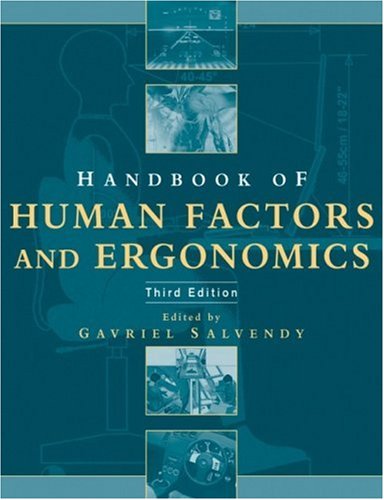
3. Handbook of Human Factors and Ergonomics
Hardcover: 1680 Pages (2006-02-10)
list price: US$250.00 -- used & new: US$206.53
(price subject to change: see help)
Asin: 0471449172
Average Customer Review: 5.0 out of 5 stars
Canada | United Kingdom | Germany | France | Japan
Editorial Review

Book Description
The completely revised edition of the leading reference on human factors and ergonomics

The field of human factors and ergonomics has developed and broadened considerably since its inception more than sixty years ago, and no single book has done more to help proliferate its importance than the Handbook of Human Factors and Ergonomics.

Winner of the Institute of Industrial Engineers Joint Publishers Book-of-the-Year Award, this thoroughly revised Third Edition of Gavriel Salvendy's seminal work compiles the research of 109 of the world's top thinkers and practitioners in one volume. All new chapters feature theoretically based and practically oriented material-supported by numerous case studies, examples, figures, and tables-to be useful to both practitioners and researchers.

A value-packed read for all human factors and ergonomics specialists, engineers, industrial hygienists, safety engineers, and human-computer interaction (HCI) specialists, this Third Edition covers such new topics as:
* Cultural ergonomics
* Virtual environments
* Human factors and information security
* Usability evaluation and testing
* Design of e-business Web sites
* Augmented cognition in HCI
* Design for those with disabilities
* Design for children
* Human factors and ergonomics standards
* Human factors and ergonomics in transportation
* And much more! ... Read more

Customer Reviews (3)

5-0 out of 5 stars Seminal Work on Human Factors

"Handbook of Human Factors and Ergonomics" is an excellent seminal work on human factors and ergonomics. It is a well researched and well written book on the subject, well illustrated with case studies, examples, tables and figures.

The book has a comprehensive coverage of the subject and covers a wide range of subjects and applications which makes it an indispensable part of the library for human factor and ergonomics practitioners, safety managers and auditors, engineers and other specialists. This weighty tome is worth the price and should not intimidate the reader.

5-0 out of 5 stars My most valuable book
Pardon the cliche but if you're only going to buy one 'hand' book (it's more like a phone book), this is the one you should get.It covers conventional physical ergonomics, as well as every other significant genre in the field.
When I'm stuck for a quality resource, I find what I need here.Ouch!I'm still paying for it though.

5-0 out of 5 stars Ergo Buster
A definate must for the Ergo student! The book has excellent describtive definitions and is an eye opener to the world of work. It focus on a diffirent perspective on the qaulity of worklife. ... Read more


4. Introduction to Human Factors and Ergonomics for Engineers (Human Factors and Ergonomics)
by Mark R. Lehto, James R. Buck
Hardcover: 1000 Pages (2007-08-30)
list price: US$99.95 -- used & new: US$93.50
(price subject to change: see help)
Asin: 0805853081
Canada | United Kingdom | Germany | France | Japan
Editorial Review

Book Description

Appropriate for a first course in Human Factors and Ergonomics taken by engineers and psychology majors, this book explains ergonomic design. It teaches students about designing products, such as tools, machines, or systems, as well as the tasks or jobs people perform, and environments in which people live. Introduction to Human Factors and Ergonomics for Engineers explores methods of obtaining these objectives, uniquely approaching the topic from an engineering perspective as well as a psychological standpoint.
The textbook offers a heavy emphasis on design, and gives broad coverage of design principles and techniques of predicting human performance. Critiques of principles and tools used in predictions are also addressed. Authors Mark R. Lehto and James R. Buck adopt a quantitative angle so that students experience the applications of statistics, and observe the implications of those results to the design. Challenging end-of-chapter problems are exceptionally valuable for course instruction. Moreover, the book presents numerous vignettes to illustrate practical examples of theoretical concepts.

This text is appropriate for engineering, psychology, and science students at the upper undergraduate and graduate levels. It is also ideal for engineers and designers. For students, a background in the fundamentals of probability and statistics is assumed.
... Read more

5. The Handbook of Human Factors in Web Design (Human Factors & Ergonomics)
Paperback: 208 Pages (2004-11-30)
list price: US$99.95 -- used & new: US$99.95
(price subject to change: see help)
Asin: 0805846123
Average Customer Review: 5.0 out of 5 stars
Canada | United Kingdom | Germany | France | Japan
Editorial Review

Book Description
The Handbook of Human Factors in Web Design covers basic human factors issues relating to screen design, input devices, and information organization and processing, as well as addresses newer features which will become prominent in the next generation of Web technologies. These include multimodal interfaces, wireless capabilities, and agents that can improve convenience and usability. Written by leading researchers and/or practitioners in the field, this volume reflects the varied backgrounds and interests of individuals involved in all aspects of human factors and Web design and includes chapters on a full range of topics.

Divided into 12 sections, this book addresses:
*historical backgrounds and overviews of Human Factors and Ergonomics (HFE);
*specific subfields of HFE;
*issues involved in content preparation for the Web;
*information search and interactive information agents;
*designing for universal access and specific user populations;
*the importance of incorporating usability evaluations in the design process;
*task analysis, meaning analysis, and performance modeling;
*specific Web applications in academic and industrial settings;
*Web psychology and information security;
*emerging technological developments and applications for the Web; and
*the costs and benefits of incorporating human factors for the Web and the state of current guidelines.

The Handbook of Human Factors in Web Design is intended for researchers and practitioners concerned with all aspects of Web design. It could also be used as a text for advanced courses in computer science, industrial engineering, and psychology. ... Read more

Customer Reviews (1)

5-0 out of 5 stars An excellent resource for web designers and developers interested in the research behind the guidelines
Consider the following questions about web design:

*Which font is the best to use for online information?
*What kind of navigation structure best supports user performance?
*What does airplane cockpit research have to do with effective web design?
*How can you design and measure search interfaces to ensure that users view the search results as relevant?
*What must a web designer do in order to ensure that web-based content is accessible to users with physical and cognitive disabilities?
*What task analysis, knowledge elicitation, and user modeling methods are best suited for developing web interfaces and systems?

This handbook gives readers the answers to these questions and more. The book provides a comprehensive treatment of human factors research methods, design guidelines, and processes for use in developing effective websites and web-based technologies. Its 38 chapters are written for a wide audience, and many of the chapter authors lead the field in human factors research and web interface development.

Topics range from the history of human factors and the origins of networked computing, to research methods for understanding user needs and task requirements, to effective interface design guidelines and emerging technologies in the field. Each chapter contains a rich collection of historical and contemporary references, and many chapters provide the reader with links to additional information available online. While some of the information published in this book can be found elsewhere, this text is truly a "one stop shop."

If you can only get one book on web design guidelines and methods (as well as the human factors research behind them), this is the one to have! ... Read more


6. The Human-Computer Interaction Handbook: Fundamentals, Evolving Technologies, and Emerging Applications (Human Factors and Ergonomics)
 Hardcover: 1312 Pages (2002-09-01)
list price: US$325.00 -- used & new: US$89.00
(price subject to change: see help)
Asin: 0805838384
Canada | United Kingdom | Germany | France | Japan
Editorial Review

Book Description

The Human-Computer Interaction Handbook: Fundamentals, Evolving Technologies, and Emerging Applications is a comprehensive survey of this fast-paced field that is of interest to all HCI practitioners, educators, consultants, and researchers. This includes computer scientists; industrial, electrical, and computer engineers; cognitive scientists; experimental psychologists; human factors professionals; interface and systems designers; product managers; and executives working with product development.

This new Handbook offers a comprehensive compendium of foundational principles, as well as the most recent advances in conceptualizing, designing, and evaluating computing technologies. It spans a variety of traditional and non-traditional platforms, including desktop and mobile computing, networked and virtual environments, and information appliances. In addition, the volume offers thorough coverage of interaction issues concerning diverse users, including men; women; children; the elderly; and those with cognitive, physical, and perceptual impairments. Another unique feature of this new Handbook is that HCI is presented in the context of special application domains, such as e-commerce, telecommunication, government, health care, educational software, entertainment, games, motor vehicles, and aerospace.

In this volume, an unprecedented number of top experts in the field of HCI share their expertise, experience, and insight regarding research, technological advancements, and specific methodologies in the field of human-computer interaction.
... Read more

7. Handbook of Human Factors and Ergonomics in Health Care and Patient Safety (Human Factors and Ergonomics Series) (Human Factors and Ergonomics)
Hardcover: 1008 Pages (2006-09-08)
list price: US$199.95 -- used & new: US$195.95
(price subject to change: see help)
Asin: 0805848851
Canada | United Kingdom | Germany | France | Japan
Editorial Review

Book Description

In 1999, the Institute of Medicine published a report exposing the high prevalence of medical error, boosting academic, medical, and human factors interest in this field. The Handbook of Human Factors and Ergonomics in Health Care and Patient Safety presents the most current knowledge on concepts and methods of human factors and ergonomics, and their applications to help improve quality, safety, efficiency, and effectiveness in patient care. This influential book provides specific information on how to analyze medical errors with the fundamental goal to reduce such errors and the harm that potentially ensues.

Editor Pascale Carayon and an impressive group of contributors highlight important issues relevant to healthcare providers and professionals and their employers. They discuss the design of work environment and working conditions to improve satisfaction and well-being, and the reduction of burnout and other ailments often experienced by healthcare providers and professionals. It is a remarkably comprehensive account offering readers invaluable knowledge from individuals who are some of the most respected in the field.

This important handbook should be read by all healthcare and human factors professionals, and is very useful to quality improvement and patient safety specialists in healthcare organizations. It is likewise appropriate for graduate-level courses in nursing and other fields, as well as undergraduate courses in human factors, ergonomics, and engineering.
... Read more

8. Handbook of Warnings (Human Factors/Ergonomics) (Human Factors and Ergonomics)
Hardcover: 864 Pages (2006-01-20)
list price: US$149.95 -- used & new: US$132.00
(price subject to change: see help)
Asin: 0805847243
Canada | United Kingdom | Germany | France | Japan
Editorial Review

Book Description

Warnings are much more than most people think they are. Warnings are some of our most important communications. They are commonly used to prevent personal injury and property damage. In some circumstances, a failure in the warning process can lead to death or devastating injury. Therefore, warnings are being asked to perform a substantial role in the welfare and safety of people, and effective warnings are an important, serious concern.

The Handbook of Warnings presents a technical discussion on warnings including theory, research, and application. It describes warning design standards and guidelines; aspects of law relevant to warnings such as government regulations, case/trial litigation, and the role of expert testimony in these cases; and international, health/medical, and marketing issues. Broken into thirteen major sections, the chapters in this text cover theory, research, applications, and law, and many different perspectives on topics associated with warnings. No other book gives a more comprehensive treatment of warnings.

This text will appeal to those whose study, work, or research concerns the design of hazard communications by linguistic, symbolic, and auditory means. In addition, the blending of research, theory, and applications will also be informative to a much wider array of target audiences including professional safety engineers, health and medical professionals, occupational safety specialists, consumer product and industrial equipment designers, government regulators of consumer products and industrial safety, documentation writers, and plaintiff and defense attorneys involved in product- and premises-liability claims.
... Read more

9. Handbook of Cognitive Task Design (Human Factors and Ergonomics)
Hardcover: 840 Pages (2003-06-01)
list price: US$210.00 -- used & new: US$210.00
(price subject to change: see help)
Asin: 0805840036
Canada | United Kingdom | Germany | France | Japan
Editorial Review

Book Description
This Handbook serves as a single source for theories, models, and methods related to cognitive task design. It provides the scientific and theoretical basis required by industrial and academic researchers, as well as the practical and methodological guidance needed by practitioners who face problems of building safe and effective human-technology systems.

Fundamental across a wide range of disciplines, from military systems to consumer goods and process industries, cognitive task design covers the whole life-cycle of work from pre-analysis, specification, design, risk assessment, implementation, training, daily operation, fault finding, maintenance, and upgrading. It applies to people, sophisticated machines, and to human-machine ensembles. This comprehensive volume summarizes the extensive, worldwide experience with cognitive task design since the 1980s; it defines the state of the art and outlines the future of this ever-developing field.

Aimed at the graduate and postgraduate level, the Handbook of Cognitive Task Design is applicable to courses relating to the design of human-technology systems, interaction design, cognitive engineering, and applied industrial engineering.
... Read more


10. Handbook of Standards and Guidelines in Ergonomics and Human Factors (Human Factors/Ergonomics)
Hardcover: 640 Pages (2005-12-16)
list price: US$195.00 -- used & new: US$189.09
(price subject to change: see help)
Asin: 0805841296
Canada | United Kingdom | Germany | France | Japan
Editorial Review

Book Description

Human factors and ergonomics (HFE) standards and guidelines play an important role in facilitating the design and optimal working conditions with regard to human safety, health, and general well-being--as well as system performance in the context of technological advances and opportunities for economic development worldwide. Such standards and guidelines offer guidance on the design of work systems including tasks, equipment, and workplaces, as well as working conditions in relation to human capacities and limitations. The Handbook of Standards and Guidelines in Ergonomics and Human Factors offers a comprehensive review of and knowledge about the selected international and national standards and guidelines in the broadly defined area of ergonomics and human factors--including relevant safety and health issues.

The Handbook consists of 32 chapters divided into nine sections including:
*The Standardization Efforts in Human Factors and Ergonomics;
*Nature of HFE Standards and Guidelines;
*Engineering Anthropometry and Working Postures;
*Design and Evaluation of Manual Material Handling Task;
*Human-Computer Interaction;
*Management and Occupational Safety and Health;
*Safety and Legal Protection Standards;
*Military Human Factor Standards; and
*Sources of Human Factors and Ergonomics Standards.

This book appeals to professionals in HFE and other related fields including ergonomics specialists, consultants, and practitioners; researchers and graduate students from a great variety of interrelated fields including engineering, safety, manufacturing, and product design; industrial and system designers; managers and supervisors responsible for management of corporate ergonomics and safety and health; architects; quality specialists; occupational health and safety and environmental protection managers; and government officials at all levels.
... Read more

11. Human Performance Engineering: Using Human Factors/Ergonomics to Achieve Computer System Usability/Book and Disk
by Robert W. Bailey
 Hardcover: 250 Pages (1989-03)
list price: US$82.00
Isbn: 0134451805
Canada | United Kingdom | Germany | France | Japan

12. International Encyclopedia of Ergonomics and Human Factors, Second Edition - 3 Volume Set
Hardcover: 3728 Pages (2006-03-15)
list price: US$895.00 -- used & new: US$895.00
(price subject to change: see help)
Asin: 041530430X
Canada | United Kingdom | Germany | France | Japan
Editorial Review

Book Description
The previous edition of the International Encyclopedia of Ergonomics and Human Factors made history as the first unified source of reliable information drawn from many realms of science and technology and created specifically with ergonomics professionals in mind. It was also a winner of the Best Reference Award 2002 from the Engineering Libraries Division, American Society of Engineering Education, USA, and the Outstanding Academic Title 2002 from Choice Magazine. Not content to rest on his laurels, human factors and ergonomics expert Professor Waldemar Karwowski has overhauled his standard-setting resource, incorporating coverage of tried and true methods, fundamental principles, and major paradigm shifts in philosophy, thought, and design. Demonstrating the truly interdisciplinary nature of this field, these changes make the second edition even more comprehensive, more informative, more, in a word, encyclopedic.Keeping the format popularized by the first edition, the new edition has been completely revised and updated. Divided into 13 sections and organized alphabetically within each section, the entries provide a clear and simple outline of the topics as well as precise and practical information. The book reviews applications, tools, and innovative concepts related to ergonomic research. Technical terms are defined (where possible) within entries as well as in a glossary. Students and professionals will find this format invaluable, whether they have ergonomics, engineering, computing, or psychology backgrounds. Experts and researchers will also find it an excellent source of information on areas beyond the range of their direct interests. ... Read more


13. Macroergonomics: Theory, Methods, and Applications (Human Factors and Ergonomics)
 Hardcover: 432 Pages (2002-04-01)
list price: US$120.00 -- used & new: US$4.15
(price subject to change: see help)
Asin: 0805831916
Canada | United Kingdom | Germany | France | Japan
Editorial Review

Book Description

This book's primary objective is to provide a comprehensive coverage of ergonomics in overall work system analysis and design. It provides a summary of the historical development of macroergonomics. It explains how an understanding of macroergonomics can lead to improvements in such things as reducing work-related lost time accidents; and describes the methods and tools used in work system analysis and design. Throughout, the integrating theme is that the full potential of an organization--in terms of productivity, safety, health, and Quality of Work Life (QWL)--can't be met unless the overall work system is designed to conform with the characteristics of its technology, personnel subsystem, and the external environment upon which it depends for its survival and success. Using a sociotechnical systems approach, this text discusses the application of macroergonomics to training system development, hazard management, technology transfer, large scale organizational change projects, office and factory automation, community planning and development, and job design. For each of these applications, actual case examples will be included.

The book will appeal to teachers of introductory human factors/ergonomics courses as a supplemental text or as the primary text for a course fully devoted to macroergonomics. In addition, it should also appeal to practicing ergonomists internationally as a "must" add to their personal professional libraries.
... Read more

14. 'Extra-Ordinary' Ergonomics: How to Accommodate Small and Big Persons, The Disabled and Elderly, Expectant Mothers, and Children (Hfes Issues in Human Factors and Ergonomics)
by Karl H.E. Kroemer
Hardcover: 254 Pages (2005-08-12)
list price: US$79.95 -- used & new: US$66.56
(price subject to change: see help)
Asin: 0849336686
Canada | United Kingdom | Germany | France | Japan
Editorial Review

Book Description
Small and big persons, disabled and elderly, expectant mothers and children. Everyone will fall into one of these categories at least once in their lifetime. In fact, demographics show that at least two of every five people vary from the norm in height, width, and weight at any given time. Yet customarily, designers design for adults of regular size with standard abilities. Written by an expert in human factors and ergonomics, Extraordinary Ergonomics explores designing for population groups that do not meet the customary standards in age, size, and abilities.Underscoring the need for extraordinary ergonomics, the book illustrates various approaches to measuring the characteristics, capabilities, and limitations of those who differ from the norm. It provides the how-tos of designing for people who are smaller, weaker, or bigger, discusses specifically the design for persons with disabilities and the aging population, and covers human factors engineering for expectant mothers and ergonomics for children and teenagers. The author explains how to assess and determine abilities and needs and demonstrates how to design tools, homes, and environments to make working space safe and living space easy. ... Read more


15. The Handbook of Data Mining (Human Factors and Ergonomics)
Paperback: 720 Pages (2004-11-30)
list price: US$85.00 -- used & new: US$118.94
(price subject to change: see help)
Asin: 0805855637
Canada | United Kingdom | Germany | France | Japan
Editorial Review

Book Description
Created with the input of a distinguished International Board of the foremost authorities in data mining from academia and industry, The Handbook of Data Mining presents comprehensive coverage of data mining concepts and techniques. Algorithms, methodologies, management issues, and tools are all illustrated through engaging examples and real-world applications to ease understanding of the materials.

This book is organized into three parts. Part I presents various data mining methodologies, concepts, and available software tools for each methodology. Part II addresses various issues typically faced in the management of data mining projects and tips on how to maximize outcome utility. Part III features numerous real-world applications of these techniques in a variety of areas, including human performance, geospatial, bioinformatics, on- and off-line customer transaction activity, security-related computer audits, network traffic, text and image, and manufacturing quality.

This Handbook is ideal for researchers and developers who want to use data mining techniques to derive scientific inferences where extensive data is available in scattered reports and publications. It is also an excellent resource for graduate-level courses on data mining and decision and expert systems methodology.
... Read more


16. The History of Human Factors and Ergonomics
by David Meister
Paperback: 400 Pages (1999-03-01)
list price: US$55.00 -- used & new: US$49.20
(price subject to change: see help)
Asin: 0805827692
Canada | United Kingdom | Germany | France | Japan
Editorial Review

Book Description
Human factors/ergonomics (HFE) as a discipline has grown by accretions rather than having been developed systematically and deliberately. Therefore, this book's goal creates a formal conceptual structure for HFE. It is intended as a contribution to cultural history because (a) ours is a technological civilization, and (b) one cannot understand technology outside of the various disciplines that make up that technology. A disciplinary history is highly specialized, but the author maintains that HFE is distinctive in being the only discipline that relates humans to technology. Other behavioral disciplines like anthropology have little connection with technology, and this is what makes HFE important in the present historical era.
... Read more


17. Engineering Physiology: Bases of Human Factors/Ergonomics, 3rd Edition
by K. H. E. Kroemer, H. J. Kroemer, K. E. Kroemer-Elbert
Hardcover: 317 Pages (1997-07-25)
list price: US$130.00 -- used & new: US$96.71
(price subject to change: see help)
Asin: 0471287989
Canada | United Kingdom | Germany | France | Japan
Editorial Review

Book Description
Engineering Physiology

Bases of Human Factors/Ergonomics

How tall are people nowadays? How far can we reach? How high do we sit? How strongly do we push with a hand or foot? How does the body develop strength? What are our work capabilities? How can we measure and judge them? How can we, at the same time, make work easy and effective? Engineering Physiology, Third Edition, describes the bases of human factors and ergonomics by providing answers to these and many other questions concerning the size, build, and functioning of the human body at work. This information is presented in clear, concise language, not in the jargon of physiology, biology, or medicine; it does not require background knowledge from the reader, just interest—and it is interesting to read.

This practical guide shows how the body monitors itself, how it reacts to workloads and environmental stresses such as heat or cold, humidity, and wind. Each chapter focuses on real-world applications of specific physiological knowledge in the workplace to help assure high performance with minimal effort.

A wealth of information on anthropometry is also included, exploring the size and mobility of the human body and the various ways of designing for different sizes—there is no "average" person. There is a thorough discussion of the architecture, functioning, and biomechanics of bones, joints, muscles, tendons, and ligaments. It becomes clear how they develop forces and torques and move the body at work or sports. Overhead work, or sitting and standing still for a long time, is fatiguing: the team of authors explains why. Our bodies prefer dynamic activities to sustained static effort: we want to move about.

The book explains energy extraction from food and drink, what efforts the body is capable of, and how this depends on the cooperation of respiratory, circulatory, and metabolic systems. It points out ways of measuring and assessing a person's ability to work and continue working, such as the observation of a subject's breathing rate, heart beat rate, and oxygen consumption.

The effects of environmental conditions (heat, cold, humidity, air movement) and of shift work (day, evening, and night work) on task performance are discussed in practical terms. There are advantages, and some drawbacks, to "compressed work weeks" and "flextime"!

The Third Edition of Engineering Physiology has new information on body size and how to fit equipment to it. The book describes how we develop muscle strength and transmit it along the limbs to a handle or pedal—and how to design for that application of force or torque.It explains what happens in repetitive trauma and how to avoid "carpal tunnel syndrome." What can we expect from "reengineering" the body; how can artificial joints replace worn out hips and knees?

The third edition of this successful book provides numerous ideas to human factors engineers, designers, managers, industrial hygienists, safety personnel, plant engineers and supervisors, students, and anyone else interested in the ergonomics of "fitting work to the human body." ... Read more


18. Usability and Internationalization of Information Technology (Human Factors/Ergonomics Series) (Volume in the Human Factors/Ergonomics Series)
Paperback: 392 Pages (2004-08)
list price: US$55.00 -- used & new: US$55.00
(price subject to change: see help)
Asin: 0805844791
Average Customer Review: 4.0 out of 5 stars
Canada | United Kingdom | Germany | France | Japan
Editorial Review

Book Description
Today, more and more Web sites are providing content in multiple languages for targeted countries, and more and more products are being designed for cultural differences in mind. However, the concept of cross-cultural design has not yet become a strong force in the practitioners' and educators' agenda. This book looks at techniques, software, tools, the current state of the art, and future directions that one needs to understand for a successful application of cross-cultural interface design.

Usability and Internationalization of Information Technology provides a bridge between theoretical foundations and practical examples, as well as guidelines for designing information technology for different cultures, languages, and locales. Written by some of the foremost practitioners from the United States, Europe, and Asia, the book is organized into three sections. It begins with a general introduction to the topic and discusses cultural considerations. Part II focuses on some aspects of design, cost justification and international usability evaluations. Part III covers three case studies on international user interface design. An appendix is included at the end of the book, providing a list of books and magazines published in the area of internationalization in the user interface design, project management, software design and development fields, as well as valuable resources, the leading journals, and the non-profit organizations that deal with internationalization. ... Read more

Customer Reviews (1)

4-0 out of 5 stars Good Job

not intended for people that don't want to go very deep in to the topic from many directions. if your not that type of reader then its a hard read but if you are then this is probably on of the better books out in the market in the subject. so if you interested in taking you're site to the next level and support or at least know about the options , this is a great start point.

4 and not 5 only because it was a hard read for me, although probably the only good book in the topic out but still is a hard read. ... Read more


19. Principles of Forensic Human Factors/Ergonomics
by Wesley E. Woodson, H. Harvey Cohen
Hardcover: 193 Pages (2005-07-30)
list price: US$65.00 -- used & new: US$43.45
(price subject to change: see help)
Asin: 1933264098
Canada | United Kingdom | Germany | France | Japan
Editorial Review

Book Description
Human factors engineering is a ground-breaking area too often ignored or misunderstood by lawyers. Often a designer's error encourages mistakes or misuse. Unfortunately, when trying these personal injury cases, legal professionals often pre-determine the "human factors" based on their own ability to use a product or operate in a particular environment. Since lawyers are human, they feel that they intuitively know about all human factors. The result? Many lawyers fail when trying personal injury cases, even though a thorough knowledge of human factors engineering could have meant a successful verdict.

Principles of Forensic Human Factors/Ergonomics (revised edition of Human Factors Engineering for Forensic and Safety Specialists) is an excellent resource because it takes you step-by-step over the areas of concern. You'll get an in-depth look at the fields of architecture, transportation, consumer products, and furniture, areas in which questions of safety are most frequent. In addition, you'll discover how to separate the situation in which the product design is at fault from those situations where the injured is at fault due to carelessness or misconduct. Topics include: • concept of design-induced human error or product misuse and personal safety • user/product interface and environmental influences • user limiting characteristics in product design • architectural systems • roadway, groundand air vehicular systems • consumer products and tools • home and work furnishings and equipment • graphics and product labeling • human factors/ergonomics tests ... Read more


20. Handbook of Digital Human Modeling (Human Factors and Ergonomics)
 Hardcover: Pages (2021-06-26)
list price: US$99.95 -- used & new: US$99.95
(price subject to change: see help)
Asin: 0805856463
Canada | United Kingdom | Germany | France | Japan
Editorial Review

Book Description
Many human factors specialists lack the engineering knowledge to communicate possible modifications to their design team. Closing this gap between capability and expectation, Handbook of Digital Human Modeling provides a detailed description of the fundamentals, tools, and applications in the field digital human modeling. The book covers applications in advanced manufacturing, aerospace, automotive, data visualization and simulation, defense and military systems, design for impaired mobility, healthcare and medical, information systems, and product design. This text also contains tools to help evaluate product and work design while reducing the need for physical prototyping. ... Read more


  1-20 of 100 | Next 20

Prices listed on this site are subject to change without notice.
Questions on ordering or shipping? click here for help.

site stats