|
Editorial Review Product Description
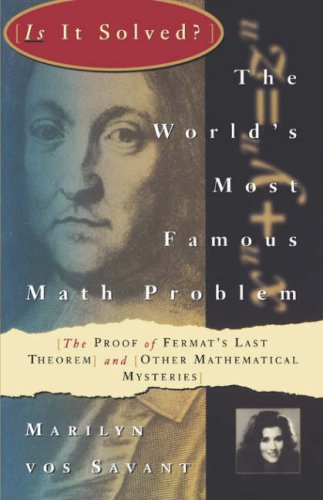
June 23, 1993. A Princeton mathematician announces that he has unlocked, after thousands of unsuccessful attempts by others, the greatest mathematical riddle in the world. Dr. Wiles demonstrates to a group of stunned mathematicians that he has provided the proof of Fermat's Last Theorem (the equation x" + y" = z", where n is an integer greater than 2, has no solution in positive numbers), a problem that has confounded scholars for over 350 years.
Here in this brilliant new book, Marilyn vos Savant, the person with the highest recorded IQ in the world explains the mathematical underpinnings of Wiles's solution, discusses the history of Fermat's Last Theorem and other great math problems, and provides colorful stories of the great thinkers and amateurs who attempted to solve Fermat's puzzle.
... Read more Customer Reviews (35)  Another error she made
I stumbled upon this book while browsing in a bookstore long ago. I imagined from the title that she was attempting to explain to the public Sir Andrew Wiles' great accomplishment in proving Fermat's Last Theorem, but when I started reading her book, I couldn't believe my eyes.
In addition to the errors other reviewers have pointed out, she claims that non-Euclidean geometry is "false." I would send her my book on that subject but I doubt that she would read it.
I say that because a mathematician I know sent her a polite letter pointing out her errors. She replied:
"My mathematical friends and I had a good laugh over your missive. Keep those cards and letters coming."
Yes, she was smart enough to give the correct solution to the Monty Hall problem, but when she errs, she is either too arrogant or too ignorant or too corrupt to admit it.
Blame the publisher for Marilyn's mistakes
I picked this up cheaply at a used book shop based on Marilyn Vos Savant's reputation, she has the world's highest I.Q., and I was curious as to what her writing was like. It's quite good, as you would expect from a professional magazine writer. The subject was topical at the time (1993) and the book was quickly published to cash in on the announcement of a proof of Fermat's Last Theorem. Unfortunately, no one with college math was around to correct some repeated blunders. Just to pick one: Vos Savant confuses inductive knowledge, which she understands well, with inductive proof, which she doesn't.
Inductive knowledge is when we think we "know" something because we've seen it time and again. She illustrates it quite well with the phrase "all wheels are round". Why do we believe this? Because every time we see a wheel, it's round. Repeated exposure. Now to push things a little further, if "all wheels are round" then "something that's not round isn't a wheel". So logically every time we see a knife, which is not round, then this inductively confirms the earlier statement. Vos Savant's illustration drives the point home that this isn't really satisfying logically and that inductive knowledge doesn't really work when it comes to proofs.
What Vos Savant fails to realize is that an inductive proof is a completely different animal. It's an accident that both concepts use the same label (i.e. inductive). Inductive proof is a mechanical process, an algorithm, a method, by which we can show the truth of many mathematical theorems. To use the method, the theorem we're trying to prove must be about something we can count. We look at the first case and usually, it's fairly simple to show it to be true. Then we look at the second case, and again we often easily prove it to be true. Then we look at the third, fourth, fifth cases and we notice that we can generalize the next case from the one we are looking at now. So we do just that, we generalize: if we can show that the (n+1)th case (i.e. the next case) is true whenever the nth case (i.e. the case now) is true, AND if we explicitly show the first case to be true, then and only then is our theorem always true.
There is nothing weird or special about this, it only takes a little time and effort to understand. Proof by induction is not usually taught before college, and then only to those who take calculus, and then only superficially (analysis and abstract algebra courses examine this method (one of Peano's natural number axioms actually) in more depth). There's no denying that Ms. Vos Savant is an accomplished intelligent human being. But she only has, as we all only have, so much time alloted to her to enjoy life and pursue her interests. Mathematics is obviously not among these and shame on the publisher for thinking that Vos Savant's high I.Q. automatically made her a mathematical authority.
Vincent Poirier, Tokyo
 A review of these reviews
Ah, these poor little threatened egos on display:How dare anyone contradict the university professionals?How dare anyone have an opinion outside the status quo?How dare any publisher even consider a book not from a fully affiliated tenured and chaired professor of mathematics?Where is peer review when we need it?I especially enjoyed the brag of vandalism.Savonarola would be proud.
Im SO excited
Isn't it just marvelous, finally a chance to polish up my knowledge of the worlds most famous maths problem. I can't tell you how much me and my wife have enjoyed, and been entregued by this. Night-after-night, just laying down on the hay, having a laugh with this top quality piece of material. Maths world here I come.
the world's IQest woman?
I have no problem to admit that the world's IQest person, is a female person. But as I browsed this book, I would be hard pressed to grant Madame Marilyn Vos Savant the title,as the world's IQest woman.
... Read more |