e99 Online Shopping Mall

Geometry.Net - the online learning center Help  
Home  - Composers - Babbitt Milton (Books)

  1-19 of 19
A  B  C  D  E  F  G  H  I  J  K  L  M  N  O  P  Q  R  S  T  U  V  W  X  Y  Z  

click price to see details     click image to enlarge     click link to go to the store

$45.20
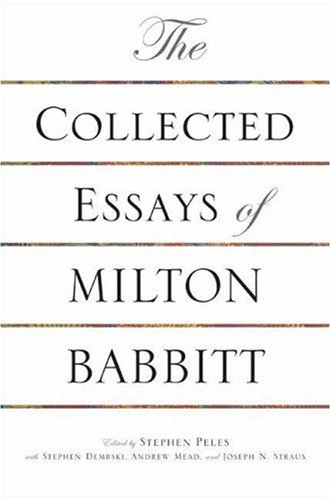
1. The Collected Essays of Milton
$21.06
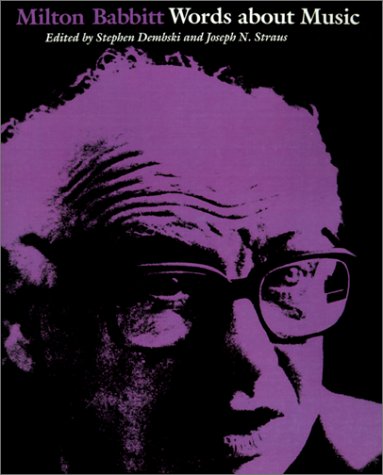
2. Milton Babbitt: Words About Music
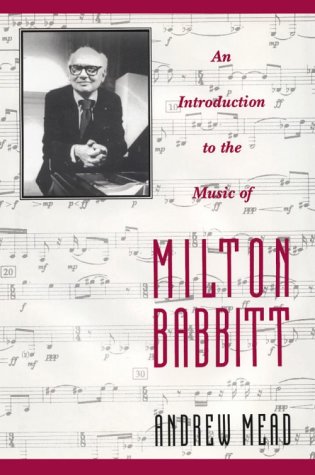
3. An Introduction to the Music of
 
$5.95
4. An Introduction to the Music of
 
$5.95
5. Daniel Asia & Milton Babbitt
 
$34.95
6. Irving Babbitt, Literature, and
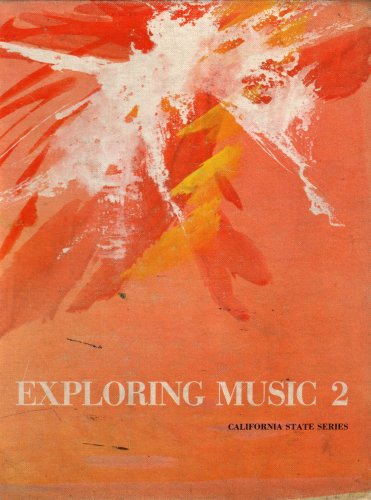
7. Exploring Music 2: California
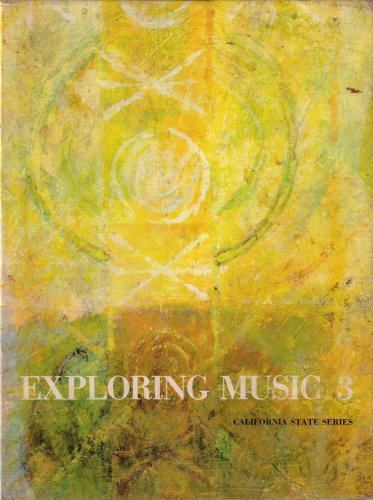
8. Exploring Music 3: California
 
9. Milton Babbitt: Words About Music
 
10. Milton Babbitt: Words About Music
 
11. Spectrum: New American Music,
 
12. Some aspects of twelve-tone composition:
 
13. Correspondences and associations
 
14. Beyond Orpheus: Studies in Musical
 
15. The Masters of Modern French Criticism.
 
$5.95
16. A Life of Learning: Charles Homer
 
$5.95
17. Soli e Duettini for 2 Guitars.
 
$5.95
18. Play It Again, Sam: Viola Solo.:
 
$5.95
19. My Ends Are My Beginnings for

1. The Collected Essays of Milton Babbitt
by Milton Babbitt
Hardcover: 504 Pages (2003-10-20)
list price: US$47.50 -- used & new: US$45.20
(price subject to change: see help)
Asin: 0691089663
Average Customer Review: 5.0 out of 5 stars
Canada | United Kingdom | Germany | France | Japan
Editorial Review

Book Description

Like his compositions, Milton Babbitt's writings about music have exerted an extraordinary influence on postwar music and thinking about music. In essays and public addresses spanning fifty years, Babbitt has grappled profoundly with central questions in the composition and apprehension of music. These writings range from personal memoirs and critical reviews to closely reasoned metatheoretical speculations and technical exegesis. In the history of music theory, there has been only a small handful of figures who have produced work of comparable stature. Taken as a whole, Babbitt's writings are not only an invaluable testimony to his thinking--a priceless primary source for the intellectual and cultural history of the second half of the twentieth century--but also a remarkable achievement in their own right.

Prior to this collection, Babbitt's writings were scattered through a wide variety of journals, books, and magazines--many hard to find and some unavailable--and often contained typographical errors and editorial corruptions of various kinds. This volume of almost fifty pieces gathers, corrects, and annotates virtually everything of significance that Babbitt has written. The result is complete, authoritative, and fully accessible--the definitive source of Babbitt's influential ideas.

... Read more

Customer Reviews (3)

5-0 out of 5 stars seminal, groundbreaking, life-changing essays
A great deal of these essays form the basis for current intellectual music thought: the five great twelve-tone essays, the Stravinsky verticals essay, 'Contemporary music theory as contemporary intellectual history,' and 'The Structure and Function of Music Theory' should be required reading for anyone even considering applying the label of 'composer,' 'theorist,' or 'musician' to themselves.Many of the other essays provide fascinating insight into a whole variety of musical, musico-sociological, and musico-philosophical issues, including the place of the composer in society, the perceptual issues raised by the electronic medium, biographical insights into a myriad of Babbitt's contemporaries, and, most critically, the reason for and role of precise speech in musical discourse.Babbitt's virtuosic use of such precise language, as mentioned above, can make for slow reading.Familiarity with these essays makes one realize that Babbitt's control of language, even if a little opaque at times, makes his writing more powerful, more accurate, and more musical. I can't recommend this book higher; these essays changed my life and they've changed Western music.

5-0 out of 5 stars A MOST IMPORTANT TOME!!!
No serious student or devotee of music should be lacking a copy of this book in their collection! This is one of the most important collections of writings on serious music to date, alongside George Perle's THE RIGHT NOTES and Elliott Carter's COLLECTED ESSAYS & LECTURES, 1937-1995. The annotations by two leading Babbitt scholars are first rate, as Babbitt's thought provoking insights reveal an extraordinary musical intellect at work, corroborating once again his status as one of the most important musical figures of our time with just that right combination of heart and brain. Just one caveat, though: I only wish the book had included Babbitt's doctoral dissertation THE FUNCTION OF SET STRUCTURE IN THE TWELVE-TONE SYSTEM, written in 1946 but not published until 1992. Though this seminal work is gratefully available from UMI, the print is very hard to make out. Including this 1946 classic text fully annotated into the main body of this new book would have made it the ultimate 'perfect book'.

5-0 out of 5 stars Give Babbitt a chance!
Babbitt always inspires debate, especially amongst musicians and theorists: is he a bold radical, is his music sterile, is he the future, is he ruining music? Who can say? Ultimately, you'll need to make up your own mind and what better way to do that then with this handsome edition! I've read six or seven thus far and have formed the basis for a number of conclusions.

I believe Babbitt was a brilliant theorist and his work with pitch class theory was seminal in developing serial music. However, his music seems to lack something when I listen to it. It's mathematically complex, formally advanced, and fascinating to analyze; but it doesn't seem to have the passion of Berg or the beautiful mixture of formal perfection and expressive texture of Webern. While I don't particularly "enjoy" his music, I completely respect his ideas and I know music has benefitted from his work.

The only reason for the digression on my take on Babbitt is because I formed this opinions reading his work and listening to his music. I would encourage everyone who his passionate about 20th century music to give Babbitt a chance: read what he has to say about music - it's profound. If you don't like his music, simply consider his ideas and you will see how they are at work in many current composers.

Before I wrap this up, a few words on his style: Babbitt's prose is unwieldy to say the least - half page sentences, needlessly complex sentence structures, awkward wordings, it's all here. I've read widely in aesthetics, philosophy, and musicology and one can quickly tell when a complex style is necessary (Lacan or Deleuze) and when it's the fault of the writer (Hegel never claimed to be a good writer!). Perhaps Babbitt is, at times, being deliberately obscure, but I feel that he simply isn't the greatest at explaining ideas in a way that leads to understanding. There were so many instances where a paragraph could be half the size while still conveying the same meaning - it's actually that bad. Oh well - maybe this is part of the fun. It definitely WAS amusing at times and in all honesty, it's not all THAT hard to understand - just harder than it needs to be.

In short, this is a very welcome collection and it belongs on the shelf of any 20th century theorists or musicologist. You'll enjoy it. ... Read more


2. Milton Babbitt: Words About Music (Madison Lectures)
Paperback: 205 Pages (1987-04)
list price: US$21.95 -- used & new: US$21.06
(price subject to change: see help)
Asin: 0299107949
Average Customer Review: 4.5 out of 5 stars
Canada | United Kingdom | Germany | France | Japan

Customer Reviews (2)

5-0 out of 5 stars More than Worthwhile
In never ceases to amaze me how many people who call themselves "amateurs" and even "experts" misunderstand Milton Babbitt.If anyone ever would take the time to listen, they would understand him better.

The first tragedy of the "Who Cares if You Listen" essay, is that it was the choice of the publisher, not the author, to change the title.Whether this is an acceptable answer or not, it is well documented.It is sad to say that most people don't even get past the title of the essay.In this way, the irony of the message actually comes through: the people who are too quick to judge something end up being the last person any artist wants to please.Mr. Babbitt makes it clear that he is not interested in pleasing every single person that listens to his music.Why is this a crime?
Any composer who writes "serious" music is deluding themselves if they think their music is going to be accepted by and adored by the greater public. So a composer has a concert with a major orchestra or fifty--can those composers imagine what their audience listens to when they are away from the concert hall? I am sure they would like to think that their music lifted the audiences' spirits or realized a deeper truth about music.
The reality is: this notion is more the exception than the rule.

This collection of essays is full of wit and the wry sense of humor that hides just beneath the surface.His commentary on the societies of music making is appropriate if not at times misgiving.Mr. Babbitt is an iconoclast that stands out from his peers, both in his compositions and his writings.Anyone who knows him would tell you that, (though watch out for the baseball stories).

4-0 out of 5 stars worthwhile
Milton Babbitt is the most intelligent and articulate of the serialist propagandists. He is very often dead wrong, but he is always worthwhile to read. His monographs published in "The Journal of Music Theory"and elsewhere have been very influential, but as far as I know they havenever been collected in book form. This is a valuable compendium of histhought. The last lecture reprises the argument of his notorious "WhoCares If You Listen?" article. For a reprint of the original articleand an apposite rebuttal, see "Music in the Western World: A Historyin Documents" edited by Piero Weiss and Richard F. Taruskin.

I alsorecommend (very much) PENTATONIC SCALES FOR THE JAZZ-ROCK KEYBOARDIST byJeff Burns. ... Read more


3. An Introduction to the Music of Milton Babbitt
by Andrew Washburn Mead
Hardcover: 264 Pages (1994-10-31)
list price: US$55.00
Isbn: 0691033145
Average Customer Review: 5.0 out of 5 stars
Canada | United Kingdom | Germany | France | Japan
Editorial Review

Book Description
In this celebration of Milton Babbitt's art, Andrew Mead explores the development of a central figure in contemporary American music. As a teacher and writer, Babbitt has influenced two generations of students, including such notable musicians as Stephen Sondheim and Donald Martino. He has helped establish the study of music theory as a serious academic pursuit, and his articles on Schoenberg, Stravinsky, and the twelve-tone system constitute a seminal body of research. But Babbitt is first and last a composer, whose works are, in Mead's words, "truly music to be heard." With Mead as a guide, we discover the strong emotional and expressive charge of Babbitt's music that is inextricably entwined with its structure.

Babbitt is a twelve-tone composer, unabashedly so, and it is precisely his profound understanding of Arnold Schoenberg's epochal insight that gives Babbitt's music its special quality. By examining the underlying principles of twelve-tone composition, Mead allows us to appreciate Babbitt's music on its own terms, as a richly varied yet unified body of work. In achieving this purpose, he provides an excellent introduction to twelve-tone music in general. Without relying on professional jargon, he lucidly and succinctly explains Babbitt's complexities. A catalog of compositions, a discography, and a bibliography complete a book that will interest performers, music theorists, and music historians, as well as other readers who are enthusiastic or curious about contemporary musical works. ... Read more

Customer Reviews (2)

5-0 out of 5 stars comprehensive, on great theoretical musical eudaemonia
As we gaze over the vast edifice of dodecaphonic music this side of the Atlantic we find a number of profound creations, Stefan Wolpe, Ralph Shapey, Donald Martino, Charles Wuorinen, Ezra Simms, and of course Milton Babbitt. There is a premonition, a harbinger which had marked Babbitt's life, being the first American to welcome Arnold Schoenberg as he arrived from exile,escaping the darkest pages of European history with the then popularity of the fascists in Europe and some cults within the USA,as Father Cooglan, and then Senator McCarthy and Roy Cohn's dithyrambic Purges of left minded American workers.
Andrew Mead does an admirable job, tracing the vast diapasonal musical creations of Babbitt.
Mead admirably divides Babbitt's creativity into useful periods, ones marked with a penchant for theoretical discursis,an elan for the pure structural and durational devices his inventive mind had. It all begins with Schoenberg's evolutionary 12 Tone language,which Babbitt had devloped into further functional divisions of the almost Kabballah like power of the number 12. His Composition for Four Instruments, Flute, Clarinet, Violin and Cello was a primary achievement, although rhythmically tthis period was marked by a persistent provincialism of the parameter of rhythm.It wasb't until the Second String Quartet where such tactile parametric freedoms begin to reveal themselves in an effulgence language.. With the Third creative period Mead identifies here the years 1961 to 1980 we impart ourselves in stil greater expansive dimensions. A number of piano solo works distinguish this period, the "Post-Partitions", and a work I deeply admire the rather modest 'Sextets', for Violin and Piano from 1966,and a revistation of the genre in "Joy of more Sextets" from thedisplaying the hexachordal-like encysted divisions between both contrasting instruments. There the genre,of Violin and Piano,which emanates from the 19th Century Sonata, was truly redefined discovering newer contexts, within the predictable structure of duet. Babbitt had also developed theories which now aimed to consolidate the vagaries of the infinite permutations and combinatorial mixtures of the 12 tones,his More Phonemena was a summation piece. I am still thrilled by the Piano Concerto a work in the Eighties, where now we see a freer utilizsation of some of these theoretical achievements. He still maintained this penchant for discovering differing contexts for predictable musical genres,and interestingly pursued interesting combinations as the various 'Soli e Duettini', as the one for two acoustic guitars.

5-0 out of 5 stars First Rate!
I have always admired Milton Babbitt's work, not least for the subtle beauties of his often misunderstood music -- misunderstood only by those who are not up to the challenge of this demanding, olympean music! Andrew Mead's Introduction is exactly what it claims to be, an introduction--but then how could it be otherwise, considering the vast scope of Babbitt's astounding technique--and a very clear and well written one at that. Most important, Mead clarifies the musical responses and exigencies which brought about this impressive technique in very readable english. The bibliography at the end of the book is also excellent, listing some very important articles in the study of twelve tone music theory. Also recommended is Milton Babbitt's own, very readable, "Words About Music". ... Read more


4. An Introduction to the Music of Milton Babbitt.: An article from: Notes
by Edward Harsh
 Digital: 6 Pages (1996-03-01)
list price: US$5.95 -- used & new: US$5.95
(price subject to change: see help)
Asin: B00096L036
Canada | United Kingdom | Germany | France | Japan
Editorial Review

Book Description
This digital document is an article from Notes, published by Music Library Association, Inc. on March 1, 1996. The length of the article is 1793 words. The page length shown above is based on a typical 300-word page. The article is delivered in HTML format and is available in your Amazon.com Digital Locker immediately after purchase. You can view it with any web browser.

Citation Details
Title: An Introduction to the Music of Milton Babbitt.
Author: Edward Harsh
Publication: Notes (Refereed)
Date: March 1, 1996
Publisher: Music Library Association, Inc.
Volume: v52Issue: n3Page: p787(4)

Article Type: Book Review

Distributed by Thomson Gale ... Read more


5. Daniel Asia & Milton Babbitt & Robert Baksa & Daniel Pinkham.(Review) (book review): An article from: Notes
by Calvin Elliker
 Digital: 8 Pages (2001-03-01)
list price: US$5.95 -- used & new: US$5.95
(price subject to change: see help)
Asin: B0008HQQMG
Canada | United Kingdom | Germany | France | Japan
Editorial Review

Book Description
This digital document is an article from Notes, published by Music Library Association, Inc. on March 1, 2001. The length of the article is 2270 words. The page length shown above is based on a typical 300-word page. The article is delivered in HTML format and is available in your Amazon.com Digital Locker immediately after purchase. You can view it with any web browser.

Citation Details
Title: Daniel Asia & Milton Babbitt & Robert Baksa & Daniel Pinkham.(Review) (book review)
Author: Calvin Elliker
Publication: Notes (Refereed)
Date: March 1, 2001
Publisher: Music Library Association, Inc.
Volume: 57Issue: 3Page: 759

Article Type: Book Review

Distributed by Thomson Gale ... Read more


6. Irving Babbitt, Literature, and the Democratic Culture (Library of Conservative Thought)
by Milton Hindus
 Hardcover: 135 Pages (1994-01-01)
list price: US$34.95 -- used & new: US$34.95
(price subject to change: see help)
Asin: 1560001135
Average Customer Review: 5.0 out of 5 stars
Canada | United Kingdom | Germany | France | Japan

Customer Reviews (1)

5-0 out of 5 stars He Who Conquers Himself
I continue to be fascinated by this modest-looking book, perhaps because it is where I discovered Milton Hindus. Half the essays concern Irving Babbitt, the literary critic and founder of American Humanism, while the other half address issues that preoccupied Babbitt, namely the condition of American democracy and literature's role in it.

Hindus gives some biographical info about Babbitt in "Masters of Modern French Criticism," also the title of Babbitt's critique of nineteenth-century French literary critics. Although Babbitt wrote this book in 1912, his method is just as applicable today, as Hindus points out, because of its attempt to restore the word "criticism" to its original meaning of judging literary works.

A scholar of the Sanskrit language, Babbitt had a lifelong interest in Buddhism. His translation of Buddha's Dhammapada was published posthumously. In Buddhism one can see principles Babbitt cherished: the inner check, the need for self-restraint and self conquest, the tending of one's own garden, the limiting of politics to its proper sphere, and the high value placed on modesty and humility.

Hindus, too, repeatedly demonstrates fine judgment that is grounded in humility. His recognition that Babbitt has a feeling for the "main tendency" of his time is a way of giving the critic the benefit of the doubt. That is, although one might put Babbitt and Rousseau on opposite sides of the bookshelf, each gets his due for providing what each thought his age demanded. Why choose between them when each had something to offer? As Hindus puts it, we Americans are a "both-and" culture rather than "either or."

In addition to being a charitable literary critic, and an acute reader of Babbitt, Hindus is a keen observer of democracy who reads the Federalist Papers every year. The inner check praised by Babbitt has its analogue in the American institutions analyzed in the Federalist Papers, such as the separation of powers among the three branches of government.

I found new respect for President Bush after reading the essay "Autobiographies of Van Buren, Reagan, and Bush" and still find it after repeated readings. Rivals depicted Bush as a preppie weakling, summing up their disgust by the childish repetition of his name, George Herbert Walker Bush. For his part, Hindus finds it rather charming to have had a president named after the seventeenth-century poet, George Herbert, himself one of history's most decent men. Hindus calls Bush an ordinary man of extraordinary sensitivities; Reagan he considers equally decent and every bit as clever as his detractors, though less intellectually pretentious. Both knew not to take themselves too seriously.Equally remarkable is the thread that Hindus traces from of an episode in Van Buren's autobiography, through Ezra Pound's depiction of it in the Cantos, to its modern analogue in the Bush autobiography. All three presidents -- Van Buren, Bush, Reagan -- are praised for the virtues of humility and restraint.

Surely this is criticism of the highest order: readable, generous, and measured, of the sort I would like to accomplish myself someday. I will miss the contributions of Milton Hindus, who died a few years ago without fanfare. I hope that others will discover his work. ... Read more


7. Exploring Music 2: California State Series (4520854, Volume 2)
by Paul Kapp, Henry Carey, Samuel F. Smith, John Philip Sousa, Cecil Cowdrey, Igor Stravinsky, William S. Haynie, Henry Holcomb Bennett, Margaret Lowrey, Norman Cazden
Hardcover: 164 Pages (1967)

Isbn: 0452085403
Canada | United Kingdom | Germany | France | Japan

8. Exploring Music 3: California State Series (4520508, Volume 3)
by M.H. Howliston, Conrad Kocher, Folliott S. Pierpont, Charles Winter, John Philip Sousa, John Jacob Niles, Ruth De Cesare, Stephen Foster, William S. Haynie, Lizette Woodworth Reese
Hardcover: 164 Pages (1967)

Isbn: 0452050804
Canada | United Kingdom | Germany | France | Japan

9. Milton Babbitt: Words About Music (Madison Lectures)
by University of Wisconsin Press
 Paperback: Pages (1987)

Asin: B000OS5PK8
Canada | United Kingdom | Germany | France | Japan

10. Milton Babbitt: Words About Music (Madison Lectures)
by Stephen Dembski
 Paperback: Pages (1987)

Asin: B000OS7E3E
Canada | United Kingdom | Germany | France | Japan

11. Spectrum: New American Music, Vol V - All Set, for Jazz Ensemble - T.J. Anderson , Variations on a Theme By M.B. Tolson - Richard Wernick, Kaddish-Requiem - Contemporary Chamber Ensemble - Arthur Weisberg, Conductor
by Milton Babbitt
 Hardcover: Pages (1974)

Asin: B000KXB7SG
Canada | United Kingdom | Germany | France | Japan

12. Some aspects of twelve-tone composition: Set structure as a compositional determinant
by Milton Babbitt
 Unknown Binding: Pages (1955)

Asin: B0007JKR2K
Canada | United Kingdom | Germany | France | Japan

13. Correspondences and associations in Milton Babbit's Reflections
by John Peel
 Unknown Binding: Pages (1986)

Asin: B0007CC22K
Canada | United Kingdom | Germany | France | Japan

14. Beyond Orpheus: Studies in Musical Structure
by David (foreword By Milton Babbitt) Epstein
 Hardcover: Pages (1987)

Asin: B000MBVJK2
Canada | United Kingdom | Germany | France | Japan

15. The Masters of Modern French Criticism. Introductionby Milton Hindus
by Irving Babbitt
 Paperback: Pages (1963)

Asin: B000MOHBRO
Canada | United Kingdom | Germany | France | Japan

16. A Life of Learning: Charles Homer Haskins Lecture, 1991. (book reviews): An article from: Notes
by Richard Swift
 Digital: 4 Pages (1994-06-01)
list price: US$5.95 -- used & new: US$5.95
(price subject to change: see help)
Asin: B00092WR3C
Canada | United Kingdom | Germany | France | Japan
Editorial Review

Book Description
This digital document is an article from Notes, published by Music Library Association, Inc. on June 1, 1994. The length of the article is 1193 words. The page length shown above is based on a typical 300-word page. The article is delivered in HTML format and is available in your Amazon.com Digital Locker immediately after purchase. You can view it with any web browser.

Citation Details
Title: A Life of Learning: Charles Homer Haskins Lecture, 1991. (book reviews)
Author: Richard Swift
Publication: Notes (Refereed)
Date: June 1, 1994
Publisher: Music Library Association, Inc.
Volume: v50Issue: n4Page: p1411(2)

Article Type: Book Review

Distributed by Thomson Gale ... Read more


17. Soli e Duettini for 2 Guitars. (book reviews): An article from: Notes
by Andrew Mead
 Digital: 4 Pages (1995-06-01)
list price: US$5.95 -- used & new: US$5.95
(price subject to change: see help)
Asin: B00093N1DQ
Canada | United Kingdom | Germany | France | Japan
Editorial Review

Book Description
This digital document is an article from Notes, published by Music Library Association, Inc. on June 1, 1995. The length of the article is 1004 words. The page length shown above is based on a typical 300-word page. The article is delivered in HTML format and is available in your Amazon.com Digital Locker immediately after purchase. You can view it with any web browser.

Citation Details
Title: Soli e Duettini for 2 Guitars. (book reviews)
Author: Andrew Mead
Publication: Notes (Refereed)
Date: June 1, 1995
Publisher: Music Library Association, Inc.
Volume: v51Issue: n4Page: p1461(2)

Article Type: Book Review

Distributed by Thomson Gale ... Read more


18. Play It Again, Sam: Viola Solo.: An article from: Notes
by David Sills
 Digital: 6 Pages (1996-03-01)
list price: US$5.95 -- used & new: US$5.95
(price subject to change: see help)
Asin: B00096L0IQ
Canada | United Kingdom | Germany | France | Japan
Editorial Review

Book Description
This digital document is an article from Notes, published by Music Library Association, Inc. on March 1, 1996. The length of the article is 1552 words. The page length shown above is based on a typical 300-word page. The article is delivered in HTML format and is available in your Amazon.com Digital Locker immediately after purchase. You can view it with any web browser.

Citation Details
Title: Play It Again, Sam: Viola Solo.
Author: David Sills
Publication: Notes (Refereed)
Date: March 1, 1996
Publisher: Music Library Association, Inc.
Volume: v52Issue: n3Page: p1030(3)

Distributed by Thomson Gale ... Read more


19. My Ends Are My Beginnings for Clarinet in B-flat (Bass Clarinet) Solo. (book reviews): An article from: Notes
by Andrew Mead
 Digital: 4 Pages (1995-06-01)
list price: US$5.95 -- used & new: US$5.95
(price subject to change: see help)
Asin: B00093N1DG
Canada | United Kingdom | Germany | France | Japan
Editorial Review

Book Description
This digital document is an article from Notes, published by Music Library Association, Inc. on June 1, 1995. The length of the article is 996 words. The page length shown above is based on a typical 300-word page. The article is delivered in HTML format and is available in your Amazon.com Digital Locker immediately after purchase. You can view it with any web browser.

Citation Details
Title: My Ends Are My Beginnings for Clarinet in B-flat (Bass Clarinet) Solo. (book reviews)
Author: Andrew Mead
Publication: Notes (Refereed)
Date: June 1, 1995
Publisher: Music Library Association, Inc.
Volume: v51Issue: n4Page: p1461(2)

Article Type: Book Review

Distributed by Thomson Gale ... Read more


  1-19 of 19
A  B  C  D  E  F  G  H  I  J  K  L  M  N  O  P  Q  R  S  T  U  V  W  X  Y  Z  

Prices listed on this site are subject to change without notice.
Questions on ordering or shipping? click here for help.

site stats