e99 Online Shopping Mall

Geometry.Net - the online learning center Help  
Home  - Composers - Bach Johann Sebastian (Books)

  1-20 of 100 | Next 20
A  B  C  D  E  F  G  H  I  J  K  L  M  N  O  P  Q  R  S  T  U  V  W  X  Y  Z  

click price to see details     click image to enlarge     click link to go to the store

$15.33
1. Johann Sebastian Bach: His Life
$24.35
2. Johann Sebastian Bach
$5.37
3. J.S. Bach - Two-Part Inventions:
$59.95
4. Johann Sebastian Bach: The Culmination
$3.24
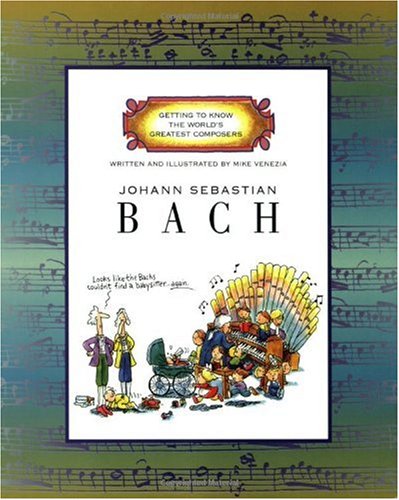
5. Johann Sebastian Bach (Getting
$12.37
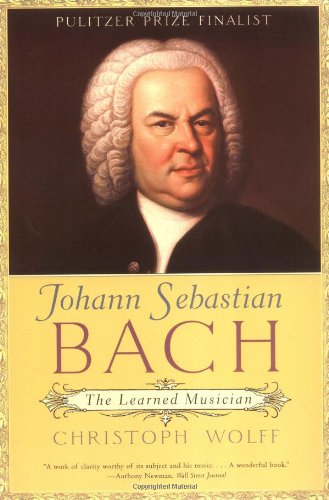
6. Johann Sebastian Bach: The Learned
$11.58
7. Johann Sebastian Bach: His Work
$12.75
8. J. S. Bach: Inventions & Sinfonias
$10.89
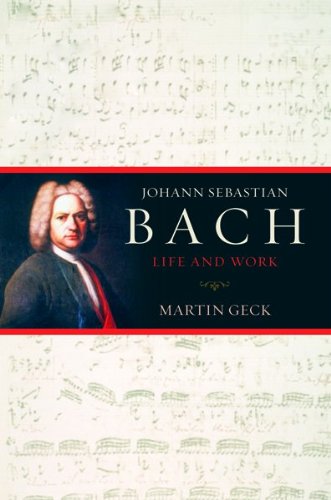
9. Johann Sebastian Bach: Life and
$12.25
10. The True Life of Johann Sebastian
$15.66
11. Mel Bay Presents J.S. Bach: Six
$9.84
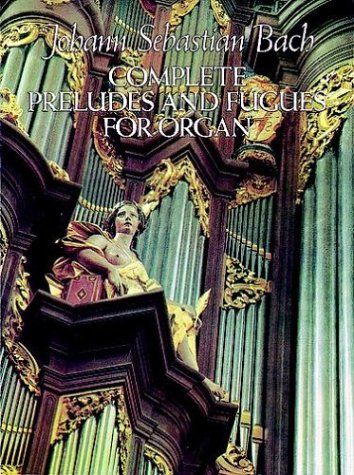
12. Complete Preludes and Fugues for
$5.88
13. Parkening Plays Bach: Guitar Solo
$11.95
14. Mel Bay Great Instrumental Works
 
15. Johann Sebastian Bach. His Greatest
$12.31
16. Magnificat in D and the Six Motets
$7.95
17. J.S. Bach: Selections from Anna
$7.66
18. Works for Violin: The Complete
19. Bach's Passion: The Life of Johann
$4.52
20. Bach for the Cello: Cello Method

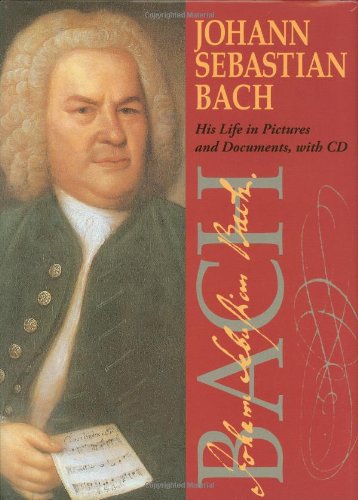
1. Johann Sebastian Bach: His Life In Pictures And Documents
by Hans Conrad Fischer
Hardcover: 191 Pages (2005-08)
list price: US$25.00 -- used & new: US$15.33
(price subject to change: see help)
Asin: 080063764X
Average Customer Review: 5.0 out of 5 stars
Canada | United Kingdom | Germany | France | Japan
Editorial Review

Book Description
The monumental work of J. S. Bach—some 250 cantatas, 280 organ compositions, the great Passions, oratorios and masses, the Well-Tempered Clavier, the Brandenburg Concertos, the Art of the Fugue—stands as a high-water mark of Western civilization. Yet that work is understandable only in light of Bach's profound Christian faith, asserts Hans Conrad Fischer. Born under the shadow of Wartburg Castle, where Martin Luther in seclusion had translated the New Testament into German, Bach saw his work as a daily engagement with Christian mysteries, often signing his manuscripts SDG-soli deo gratia or for God's glory alone.

This lavish volume celebrates Bach unabashedly. The engrossing text, enhanced with dozens of portraits, photos of locales and artifacts, maps and manuscripts, brings Bach, his faith, and his achievements directly to the reader. So too does the accompanying CD-ROM, including 17 key selections sampling Bach's best-known pieces from each genre and period of his life. It conclusively presents J. S. Bach's genius as not only musical but also religious, one that still effectively presents Christian faith to today's largely secular public. ... Read more

Customer Reviews (6)

5-0 out of 5 stars A Bach Bargain
If you know someone who loves Bach's Music, this is the perfect, impressive yet inexpensive gift. Wonderfully illustrated, this one volume and accompanying CD covers Bach's life, times, contemporaries and music. With many full-color photos as well as smaller black and white illustrations, this "coffee Table" book would ordinarily sell for two or three times the price it is being offered at now.The CD recording is a nice touch for non-musicians that provides a good overview of Bach's music as well as further illustration of the text.

4-0 out of 5 stars short and sweet
In this simply written and beautifully appointed volume Hans Fischer has provided a general overview of the life and times of one of the greatest composers ever to live. This is no substitute for the likes of Christoph Wolff's massive (600 pages) intellectual biography Johann Sebastian Bach: The Learned Musician, but for that very reason it is all the more accessible and enjoyable for the non-specialist. Fischer concentrates on Bach's life and times, and there is little analysis of his music per se. Born in Eisenach, home of the famous Wartburg Castle where Luther translated the Bible into German while imprisoned, Bach (1685-1750), was the youngest son of a family of eight children (four of whom survived). By age 10 both his mother and father died within a year, so the orphan Bach was raised by his brother. In his own two marriages he fathered 17 children.

Fischer insists that to understand Bach you must move beyond mere technical or intellectual analysis and grasp the centrality of Bach's deeply held (Lutheran) Christian faith. His organizing theme is that, in Bach's own words, the composer's lifelong goal was a "regulated sacred music to God's honor." His life was centered around the daily prayers, life, and worship of the local church. Indeed, writes Fischer, Bach "completely subordinated himself to the liturgy." At the top of many of his compositions Bach wrote the letters "JJ" (Jesu juva, Jesus help), and at the end, of course, the three letters "SDG" (Soli Deo Gloria, for the glory of God alone).

The subtitle of this book is important. Perhaps a full third of the book includes gorgeous plates of autographed manuscripts, engravings of churches and towns, period portraits of people close to Bach, along with important primary documents. For example, it is common knowledge that Bach came from a long line of family musicians; Fischer includes the entire Origin of the Musical Bach Family in which Bach documented what he knew about his 53 ancestors back to the sixteenth century and Vitus Bach, a baker in Hungary. Or again, it is fun to read the city council of Leipzig's Contract of Employment as the Cantor of St. Thomas's (where Bach spent 27 years). Among the 14 enumerated points: "That I will make music in the two major city churches as well as I can" (#2), and, "That I will not leave town without the Mayor's permission" (#13). For about $1300 you might purchase Hänssler Classic's 172 CDs of the Edition Bachakademie (the complete works of Bach). Or buy this book and enjoy the delightful CD that comes with it, A Musical Journey Through the Life of Johann Sebastian Bach, which includes 17 extracts from the Hänssler edition.

5-0 out of 5 stars Bach: His Life
H. C. Fischer has given in his book a helpful, informative and well reseached view of the man J. S. Bach whose music we hear yet in this time and enjoy no less than when he wrote.

5-0 out of 5 stars The glory of Bach
It really is impossible to capture the glory that is the music of J.S. Bach in the printed page, but this book comes very close.Coupled with a CD of music samples taken from the Edition Bachakademie (a 172-CD set that is the only complete recording of the music of J.S. Bach), this book is a wonderful introduction and survey of the Bach's life and music.

The CD itself is a wonderful collection of seventeen pieces, ranging from just a little over a minute to nearly ten minutes, excerpts or complete renderings of Bach compositions.These include a generous sampling of organ pieces such as the Toccata and Fugue in D-Minor, harpsichord pieces including The Art of the Fugue, and pieces for other instruments and combinations.Included also are portions of the Brandenberg Concertos, the St. Matthew Passion and the Mass in B-Minor, arguably his best piece (and argued by some as the best music ever written).

Bach's work was primarily liturgical and religious in nature.At the conclusion of a great many of his manuscripts, he inscribed the letters SDG, which stand for Soli Deo Gloria, for God's glory alone.Bach was employed as a church organist in Germany, having come from a distinguished musical family (in fact, figuring out which Bach is which can sometimes be a struggle even for scholars).Living a few generational after the Reformation, Bach brought the fullness of the theological impulses together with the richness of the Baroque tradition of music, then in full flower, together in a magnificent form.

This book gives insight into the spiritual and historical forces that helped shape Bach and his music.It has a lavish presentation style, with full-colour portraits of people and places of significance in generous number throughout the text.There are photographs of some of the great organs of the time, too.It is a uniquely fortunate work of fate that J.S. Bach's career should coincide with that of the Silbermann family's ascendancy in organ building, for they reached heights in craftsmanship rarely reached even today.

Bach was a man of strong passions - such is obvious from his music, but also is demonstrated in various aspects of his life apart from music.He was more than once called before church councils to answer for his behaviour, and was involved in physical brawls that required police and court interventions.Bach was very opinionated, to the point of exasperation of those around him, but often got his way.

This book introduces in a very inviting manner.Author Hans Conrad Fischer writes in a lively, interesting fashion for beginners and experienced music fans alike.This book makes a wonderful introduction to Bach, a good refresher for Bach, and is especially good for exploring the historical and spiritual contexts that surround Bach's music.

5-0 out of 5 stars Wonderful!
Nearly everyone is familiar with the joyous music of Bach, from the Jesu Joy of Man's Desiring often heard at weddings to Air, the musical ambiance of many fine restaurants. Such smooth and lyrical melodies can put us into an immediate state of calm and tranquility, but what is the source of these treasures? What is the story behind the music?

Hans Conrad Fischer sets out to tell us exactly that through words, pictures and the music itself. In this illustrated biography which includes a CD, Bach's life comes alive in a way not seen before. Listening to the gorgeous music while sifting through the images of Bach's life transports the reader to a time when creating heavenly music was truly the highest form of worship.

Bach was a Lutheran Christian and a mystic. His music is imbibed with devotion and awe of God. Bach's music, during his lifetime and continuing to the present, has been a unifying source of interdenominational worship. The pure melodies are able to transcend divisions within religious communities, as if reaching a unifying connection much deeper than squabbles about doctrine. Today much of Bach's music is used for clearly secular purposes, however Fischer reminds us of the deep Christian roots beneath all of Bach's works.

This beautifully illustrated biography gives a fuller understanding to both the music of Bach and to the man himself. Listening to the CD, while perusing the text and illustrations gives a fully sensuous experience that truly transcends time and place.

Armchair Interviews says: This biography is best enjoyed with a glass of wine while lounging on a luxurious sofa enveloped in the melodic.


... Read more


2. Johann Sebastian Bach
by Hannsdieter Wohlfarth
Hardcover: 120 Pages (1985-12-31)
-- used & new: US$24.35
(price subject to change: see help)
Asin: 0718826175
Canada | United Kingdom | Germany | France | Japan

3. J.S. Bach - Two-Part Inventions: Schirmer Performance Editions Series (Hal Leonard Piano Library)
Paperback: 48 Pages (2005-01-01)
list price: US$9.95 -- used & new: US$5.37
(price subject to change: see help)
Asin: 0634073591
Canada | United Kingdom | Germany | France | Japan
Editorial Review

Book Description
Schirmer Performance Editions are designed for piano students and their teachers as well as for professional pianists. Pedagogical in nature, these editions offer insightful interpretive suggestions, permanent fingering, and historical and stylistic commentary. Prepared by renowned artists/teachers, these publications provide an accurate, well-informed score resource for pianists. J.S. Bach (1685-1750) composed the Two-Part Inventions for his son Wilhelm Friedemann. While giving the player a superb example of musical construction, they also teach the basics of articulation, rhythm, phrasing, fingering, ornamentation, and the development of a singing tone. These short masterpieces are essential repertoire for every pianist. Editor and recording artist: Christopher Taylor ... Read more


4. Johann Sebastian Bach: The Culmination of An Era
by Karl Geiringer
Hardcover: 400 Pages (1966-12-31)
list price: US$59.95 -- used & new: US$59.95
(price subject to change: see help)
Asin: 0195005546
Average Customer Review: 5.0 out of 5 stars
Canada | United Kingdom | Germany | France | Japan
Editorial Review

Book Description
This basic, one-volume study of Johann Sebastian Bach combines a sensitive biographical sketch with a detailed analysis of each of his major types of composition, including vocal music, organ music, keyboard music, and instrumental music.In each section, Geiringer thoroughly examines many Bach compositions and evaluates them in relation to the rest of the composer's work, as well as in relation to the music of his contemporaries.More than seventy musical examples enable the reader to understand how Bach worked and to observe his music in various stages of completion.In addition, an interesting aspect of research methods is revealed through an explanation of the techniques used in studying handwriting, paper, and watermarks in the original sources. ... Read more

Customer Reviews (2)

5-0 out of 5 stars THE BOOK ON BACH...
This is THE book on Bach.Boyd's Bach is okay, but Karl Geiringer's Bach is better.

5-0 out of 5 stars Fine biography of Bach's life and music
Karl Geiringer wrote compelling and informative biographies that are concise yet musically mature and insightful.This book is divided into two parts.The first third of the book (106 pages) is a narrative of Bach's life.Part II has a short essay on Bach's musical heritage that describes the musical resources and forms that were in force in Bach's time.

Part III discusses the great composer's music by type rather than in chronological order.This helps us compare the various compositions in each genre and see the compositional choices Bach made and how he developed as a composer.

This is a fine book for the general reader, student, or professional musician.
... Read more


5. Johann Sebastian Bach (Getting to Know the World's Greatest Composers)
by Mike Venezia
Paperback: 32 Pages (1998-08)
list price: US$6.95 -- used & new: US$3.24
(price subject to change: see help)
Asin: 0516263528
Average Customer Review: 5.0 out of 5 stars
Canada | United Kingdom | Germany | France | Japan
Editorial Review

Book Description
Presents a biography of Johann Sebastian Bach ... Read more

Customer Reviews (2)

5-0 out of 5 stars Funny and fabulous
This book has both my boys (ages 6 & 4) laughing and singing (there is a made-up ditty about Heinrich the Pizza Man) and wanting to read the whole book repeatedly. The silly illustrations along with actual images make Bach's history understandable and interesting to the very young. Now we're all listening to the Brandenberg Concertos!

5-0 out of 5 stars Great Books
All of the Venezia books are really great.They are funny yet informative and really help children to learn about Artists and Composers. ... Read more


6. Johann Sebastian Bach: The Learned Musician
by Christoph Wolff
Paperback: 624 Pages (2001-09)
list price: US$21.95 -- used & new: US$12.37
(price subject to change: see help)
Asin: 0393322564
Average Customer Review: 4.5 out of 5 stars
Canada | United Kingdom | Germany | France | Japan
Editorial Review

Amazon.com
The Learned Musician is an apt subtitle for this intellectual biography, which assesses the career of Johann Sebastian Bach (1685-1750) with the scholarly rigor one would expect from a Harvard professor. Opening with a 1737 attack by a critic who labeled Bach a pedant who spoiled the natural beauty of his creations with "an excess of art," Christoph Wolff cogently compares the German composer to English scientist Isaac Newton. Both men "brought about fundamental changes and established new principles" in their chosen fields, he argues; both sought to reveal God's harmonious ordering of their world. While Wolff conscientiously covers the basics of Bach's life, including his two marriages and the musical achievements of his gifted family, the author's primary focus is on his performing (Bach was an unrivaled organist) and composing. From the Goldberg Variations through the Brandenburg Concertos to Art of the Fugue, Wolff carefully analyzes Bach's innovations in harmony and counterpoint, placing them in the context of European musical and social history rendered in nicely atmospheric detail. Casual readers may find this dense tome a bit daunting, but serious music lovers will relish the deeper understanding it conveys of a genius who transformed Western music. --Wendy Smith Book Description
Finalist for the 2001 Pulitzer Prize in Biography. A landmark biography of Bach on the 250th anniversary of the composer's death, written by the leading Bach scholar of our age. Although we have heard the music of J. S. Bach in countless performances and recordings, the composer himself still comes across only as an enigmatic figure in a single familiar portrait. As we mark the 250th anniversary of Bach's death, author Christoph Wolff presents a new picture that brings to life this towering figure of the Baroque era. This engaging new biography portrays Bach as the living, breathing, and sometimes imperfect human being that he was, while bringing to bear all the advances of the last half-century of Bach scholarship. Wolff demonstrates the intimate connection between the composer's life and his music, showing how Bach's superb inventiveness pervaded his career as musician, composer, performer, scholar, and teacher. And throughout, we see Bach in the broader context of his time: its institutions, traditions, and influences. With this highly readable book, Wolff sets a new standard for Bach biography. 42 b/w illustrations. ... Read more

Customer Reviews (20)

4-0 out of 5 stars A Belly-Button's Radius from Winning the Prize Pulizer

Brilliant book written on the life and works of JS Bach, a Pulitzer Prize finalist owning a close reading of his compositions and a sensitive examination of the man himself, and his progenic plethora of talents tiny Bachs - CPE, JC, and the rest of the bunch. A work wished for by any student of Baroque or Classical music wishing to move beyond the "mere" listening. Twice the size, and indeed, there IS, twice the material, would have nudge a fifth star from this Chestertonian curmudgeon.

"Johann Sebastian Bach, The Learned Musician" by Christoph Wolff . . . a grand and sound work upon God's greatest gift to composition and the aural sense.

4-0 out of 5 stars Detailed, historical, factual but lacking insight
Very complete factual account of Bach's life and musical production.So many facts and such little insight into the man behind the facts. What good are all the facts if we come away from this book without a enlightening vision of the man. The books provides a complete catalogue of Bach's works, which is very handy.

5-0 out of 5 stars Lifetime accumulation of knowledge by a great scholar
We should all thank Christoph Wolff for putting his thoughts and knowledge of Johann Sebastian Bach in print.Christoph Wolff is the world's leading authority on Bach.He is currently Director of the Bach-Archiv Leipzig, an appointment given to the person who presumably knows Bach best.He is University Professor at Harvard Univesity, a title given to those of retirement age that Harvard wishes to keep. A previous example of a University Professor is Paul Tillich.Christoph Wolff himself is a repository of knowledge about Johann Sebastian Bach that is unmatched in the world.

Christoph Wolff still teaches the course on Bach at Harvard that I audited during the 1975 academic year, except that now it is taught every other year.What a great intellectual experience that course was, to learn what Bach was trying to do, while contending with multiple personal and situational problems without a mentor, coping with the changing situation in Leipzig and the Thomaskirche and Thomasschule, all the while developing the intricacies of his music!I have experienced nothing intellectually to match his course.

Sometime after I audited his course, Christoph Wolff became Dean of the Graduate School of Arts and Sciences of Harvard University, and upon achieving retirement age, was made University Professor.

In the course, Christoph Wolff discussed Die Kunst der Fuge.He emphasized that, to write a fugue one must resolve its closure or ending first.In his book, Johann Sebastian Bach: The Learned Musician, Christoph Wolff described Bach's early skills in German tablature, an early form of music notation used in north and central Germany in the 17th century.A musical score, written by Bach in tablature during his stay in Weimar, has recently been found.This finding emphasizes Bach's mastery of this form of music notation.A thought has gradually come to me, based upon information gathered from the writings and lectures of Christoph Wolff.When Bach resolved the ending of Die Kunst der Fugue, he may have written it down in tablature.It was a sort of shorthand for him, and, most importantly, it was beyond the scrutiny of the casual observer.Upon Bach's death, his sons may have recognized the resolution of the ending of Die Kunst der Fugue as tablature, but they did not recognize that bit of tablature as the resolution of the ending of Die Kunst der Fugue.I shared these ideas with Christoph Wolff during a visit with him with my wife, Julie Moll, at the Bach-Archiv Leipzig in May, 2007. It would be a most rewarding experience to hear the end of Die Kunst der Fugue.If the end of Die Kunst der Fugue is found, I strongly expect that Christoph Wolff will play a pivotal role in it.

There is no other book to match this one on Bach.I enjoyed it thoroughly.I found it refreshing and stimulating and had difficulty putting it down.This book represents the lifetime accumulaton of knowledge about an important topic, Johann Sebastian Bach, by a world-class scholar, Christoph Wolff.That is enough for five stars for me any day.

5-0 out of 5 stars fascinating biography of Bach
I have read other biographies of Bach, but none more detailed or insightful than this. He really comes alive as a person.

5-0 out of 5 stars well written, interesting...not "textbook-ish"
This book is really well written.It doesn't feel like a textbook when I read it, instead, it's as if you're reading a story. I don't feel as bored when reading for my class assignments.I'm able toread and remember what was said in the book. ... Read more


7. Johann Sebastian Bach: His Work and Influence on the Music of Germany, 1685-1750 (Volume II) (Dover Books on Music)
by Philipp Spitta
Paperback: 721 Pages (1997-07-03)
list price: US$24.95 -- used & new: US$11.58
(price subject to change: see help)
Asin: 0486274136
Average Customer Review: 2.0 out of 5 stars
Canada | United Kingdom | Germany | France | Japan
Editorial Review

Book Description

Volume 2 of a 3-volume study. Detailed information on almost everything known about Bach's life and family; also perceptive analyses of over 500 compositions with more than 450 musical excerpts.
... Read more

Customer Reviews (1)

2-0 out of 5 stars be careful
This is volume 2 of a 3 volume work.Unfortunately you can't tell that from the product description unless you read the cover page very carefully.Volume 2 is 700+ pages long.I have not been able to find volumes 1 and 3.Would not have purchased this had I known it wasn't the "complete" Spitta.("Unabridged" shown on the web site is "Unabridged-in 3 volumes" when you're able to read the cover of the book). ... Read more


8. J. S. Bach: Inventions & Sinfonias (Book & CD) (Alfred CD Edition)
Plastic Comb: 116 Pages (2004-12)
list price: US$15.95 -- used & new: US$12.75
(price subject to change: see help)
Asin: 0739036866
Average Customer Review: 4.0 out of 5 stars
Canada | United Kingdom | Germany | France | Japan
Editorial Review

Product Description
For the first time ever, many of Alfred's most popular Masterwork Library editions are now packaged with a full-length CD at affordable prices for students! The Alfred Masterwork Library CD Editions conveniently combine each exceptional volume with a professionally recorded CD that is sure to inspire artistic performances. The Masterwork Library offers pianists the most historically informed and up-to-date presentation of standard piano repertoire. Each book is carefully researched by world-renowned musicologists back to original autograph sources or first printings and all selections are presented in their original form. A must-have for teachers and students. ... Read more

Customer Reviews (2)

5-0 out of 5 stars J. S. Bach: Inventions & Sinfonias (Book & CD)
Music book & CD are exactly as advertised & highly suitable for the piano student with interest or assignment in this music.

3-0 out of 5 stars For the beginner/intermediate only
The preface to this edition contains lots of specific information about ornamentation which is a great learning tool.However with regard to the actual music, I found the editor's suggested phrasing, dynamics, and fingering to be a large artistic imposition.Though they are in grey ink to distinguish them from Bach's markings, they still clutter up the page considerably and are hard to ignore.I would prefer to begin learning this music from Bach's notation and interpret from that.A beginning or intermediate student would very probably enjoy the guidance, as the suggestions are not terrible, just not authentic.Avoid this edition if you want a clear presentation of this music the way Bach prepared it. ... Read more


9. Johann Sebastian Bach: Life and Work
by Martin Geck
Hardcover: 752 Pages (2006-12-04)
list price: US$40.00 -- used & new: US$10.89
(price subject to change: see help)
Asin: 0151006482
Average Customer Review: 3.5 out of 5 stars
Canada | United Kingdom | Germany | France | Japan
Editorial Review

Book Description

Two hundred and fifty years after his death, Johann Sebastian Bach remains one of the most compelling figures in the history of classical music. In this major study of the composer's life and work, Martin Geck follows the course of Bach's career in rich detail--from his humble beginnings as an organ tuner and self-taught court musician to his role as Kapellmeister and cantor of St. Thomas's Church in Leipzig. Geck explores Bach's relations with the German aristocracy, his position with regard to the Church and contemporary theological debates, his perfectionism, and his role as the devoted head of a large family.
The focus in this comprehensive, thoroughly researched book is on the extraordinary work that came of the composer's life. From the Goldberg Variations to the Brandenburg Concertos to the Art of the Fugue, Geck carefully analyzes Bach's innovations in harmony and counterpoint, placing them in the context of European musical and social history. Always fresh and stimulating, this definitive work reintroduces Bach's enormous oeuvre in all its splendor.
... Read more

Customer Reviews (6)

2-0 out of 5 stars BACH NO HUMANIST
This book, like most written about J. S. Bach within the last hundred years, paints a man who wrote "J. J." at the top of his compositions as a humanist!(The two "Js" stand for "Jesu Juva," a Latin inscription meaning, "Jesus, Help Me."These same manuscripts were ended with S.D.G. = Soli Deo Gloria or, To God, Alone the Glory.)

Men like Geck, with long strings of letters after their names, rush to derail the abundant and irrefutable proofs that J. S. Bach was a devout, believing and practicing CHRISTIAN, and they misrepresent him as a humanist.Some books, like this one are downright silly in proposing that a man who set to music more than five hundred deeply spiritual and Christ-centered cantata texts, did so while not believing a word of what he set. To accept the Bach as a humanist would mean that on every Sunday (except during Lent) and on all the major Feast Days, from 1723 to 1750, Bach's choirs sang a lie and he directed those lies.

Bach never wrote words himself, or set to music words of anyone else who believed or espoused the Humanists mantra: That mankind's strength comes "from within."Read the words to the recitative for bass in the Christmas Oratorio that state: "My Jesus, when I die, I shall not die eterally.Thy name upon me Thou dost write, which puts the fear of death to flight!"No one, who reads the texts to Bach's Pentecost cantatas can come away with any doubt that the composer truly believed in an in-dwelling Holy Spirit and in the life-changing qualities of that infusion of God's power.

To the unbeliever, these words are suffocating and seem excessive.But further familiarization with the texts Bach chose, reveal other, innumerable instances of just what he believed.Bach did not believe, as humanists would propose, that man is basically good.Bach did not believe that man can improve himself by merely being kind to others and by drawing upon some mysterious, self-contained strength.

To confirm this, read the margin notes he wrote in his Calov Bible.The book is in the library of Concordia College in Missouri, USA.The "New Bach Reader" contains all these notes with very clear explanations of them.

Further, Geck's book indicates that Bach was a pietist.This is clearly WRONG.Bach put up with a pietist rector in Muehlhausen and stomached the incursion and growing popularity of pietism, but he was an ORTHODOX LUTHERAN and he retained and practiced all the elements of that strong faith, inculcated in him and his father, Ambrosius, all his uncles and ancestors, going back to the earliest known ancestor, Lips Bach!

J.S. Bach set to music and wrote in his second wife's "Notenbuch," arias, recitatives, chorales and choruses that support the teachings of Martin Luther: That man's salvation comes only through the grace of God, as a gift.It cannot be "earned" or "bought" as the Roman church had taught.He believed, as Luther did, "By Adam's fall, we sinned, all."Further, as Luther knew, Bach knew that good works are not the recipe for eternal life.

Humanists believe doing good is what makes a person better.Luther (,St. Paul) and Bach believed people are worms to start with and that once you had accepted Christ's gift of salvation, one would WANT to do "good" in order to serve their new Lord and his creation.Geck apparently does not share or understand this, so he (and others) attempt to ignore or twist Bach's Orthodox Lutheran beliefs to suit the revisionist and humanist view of what the sermons and cantata texts in the Thomaskirche stated clearly.

This is a long treatise on Bach's beliefs, but a full explanation is required to point out how misguided and uninformed Geck and the others are, when they minimize, debunk or distort Bach's beliefs and replace them with what most of "academe" thinks is a smarter and better-informed interpretation of them.

The book does reveal Geck's sometimes extravagant conjectures about known happenings in Bach's life, but I could not discover anything new and useful.Instead, I found a tiresome re-hashing of popular fable and baseless and untruthful revisions in what Forkel and Spitta wrote about when it came to the great Sebastian's beliefs.

Michael Lonneke
Round Hill, VA

3-0 out of 5 stars Some interesting content, annoyingly disturbing translation
This book is a strange combination of some interesting content (especially the part about the works; the biographical information is dry and gives no idea what kind of a person Bach was), and some very misguided choices in translation. Aside from the occasional translation error, the translator seems not to realize that the "historical present", which is used in German, does not exist in English (other than rarely). This gives, as another reviewer pointed out a sensation of cognitive dissonance. As I translator myself, I'm used to seeing this is French (the language I work from), but when I read a French book using this, it is rarely as disturbing as it is here. The translator should have normalized this into English, that is, using the past, but also should have normalized the disturbing shifts of time from the past to the present that occur on nearly every page.

The biographical section is, as I mentioned, dry and static; you get no feeling that Bach ever ate a meal or went to the bathroom. It is fact after fact, date after date, written document after written document. The parts about the music itself are more interesting, but the overall feeling this book leaves is one of confusion. The decision to separate Bach's life and work is curious; the two were intertwined (especially because the author talks so little about Bach as a person, there's nothing else to hold up to the light).

All in all, this is not a good book for someone wanting to understand Bach's life. Alas, in spite of the many books about Bach, not many of them do so. Others are also plagued by translation errors, or academic prose, and a real humanist biography of Bach is needed.

3-0 out of 5 stars Temporal schizophrenia?
Other reviewers (three at the time of writing) have adequately addressed the scholarly content of this book, so I shall confine myself to a stylistic problem that none of them mentions.Perhaps it didn't disturb them?It certainly did me; in fact, it drove me crazy.

And that is (if you will forgive me), that the author cannot make up his mind whether he spoke of Bach in the past or the present tense.For instance, on p. 38 we have:

`Eisenach not only provides his musical world but is also the site of his upbringing and education' (etc.)

But then:

`The hymnal, the catechism, Latin texts -- these elements dominated the early education of young Bach.'

Again:

`At all events, he sets out on foot in March 1700 for Lüneburg, to arrive there before Easter.His classmate at the Ohrdruf lyceum, Georg Erdmann, released from school several weeks earlier, may have accompanied him.'

These examples, perhaps not particularly egregious, are merely chosen at random from those that pervade the book.

German is sufficiently like English, that it seems safe to assume that this is a characteristic of the original, and not of the translation (especially since we're told that the translation is `skillful').It would be interesting to know for sure; I looked at Amazon Germany's website, but Search Inside was not enabled.

Sad to say, the mannerism also affects the analysis portion of the book, contaminating not only syntax but semantics.On p.355 we read:

`Bach continues his experimenting.For the very next Sunday, the fourteenth Trinity Sunday, he writes an opening chorus for the cantata BWV 25...'

Since we have by now grasped the fact that Bach is dead, we can safely assign this event to the past.But then we have:

`Taking a broad view of Bach's music, the musicologist Gerd Rienäcker speaks of a "consciousness of catastrophe," located in Luther's theology but...' (etc.)

Is Rienäcker a denizen of the 18th century, or the 20th?Or is it the 19th?We have no easy way of telling.

I personally find all this, as Caligula supposedly found Gemellus's cough, very irritating.While I would not go so far as to suggest Caligula's remedy, I would certainly hope that enough people will expostulate with the author and/or publisher that it will be corrected in future editions.

The rating is a compromise between five stars for content and two for style.If you're a music student, this review probably won't -- and shouldn't -- affect your purchasing decision; but if you read merely for pleasure, you may want to take note.

5-0 out of 5 stars A Biography and A Musical Analysis
It's strange that with someone as famous as Bach that we really know very little about his personal life. In this book Martin Geck has written as much as we know, and has had to expand that with some of the generally accepted rumors. He has done a very good job in this area. That takes about a third of this book.

The other two thirds of the book is on Bach's music. In this area, the book is absolutely supurb. Mr. Geck has been a professor of musicology at Dormund University. He has written about the other German major composers and now has produced this masterpiece on Bach.

He covers every aspect of Bach's music from technique, to the impact on the listener. Surprisingly his analysis is not too technical so the average enthusiast can understant what he is saying. The last section of the book is called Horizons, and while fairly short (30 pages or so) he offers some opinions on Back's art, theology, symbolism and other aspects of his work that are seldom covered.

5-0 out of 5 stars Bach and Leipzig: So much in 1750; Today?
This book came to my attention from a long review of it that appeared in the
Intl. Herald Tribune by William F Buckley of all people. It is all that he said and then some. It is clearly written for the expert, and so there is a lot that is beyond both my interest and abilities, but there is enough that I seek to keep me engaged. Now, I admit my interest in Bach is highly specialised: I am a novelist and seek to place Bach alongside Caspar David
Friedrich, Germany's great romantic painter, and Goethe all in various settings, but mostly in Dresden, Leipzig and Luebeck, which this book turns out to be highly useful. Handsomely bound and highly readable. A wonderful addition to a serious reader's library. ... Read more


10. The True Life of Johann Sebastian Bach
by Klaus Eidam
Hardcover: 413 Pages (2001-07)
list price: US$35.00 -- used & new: US$12.25
(price subject to change: see help)
Asin: 0465018610
Average Customer Review: 3.0 out of 5 stars
Canada | United Kingdom | Germany | France | Japan
Editorial Review

Amazon.com
This engagingly eccentric biography by German playwright and television scriptwriter Klaus Eidam performs the valuable service of knocking off the dust accumulated around Bach (1685-1750) by generations of writers more concerned with their own musical, religious, or political theories than the particulars of the composer's life. Eidam has as little use for Marxist scholars declaring Bach "the musician of the Enlightenment" as he does for their precursors who declared the composer to be so devout that he viewed his art only as a means to praise God. His aim is to restore Bach to the general public as a musician first and foremost, well versed in the techniques and instruments of his day, deeply immersed in his artistic goals.

To this end, Eidam spends a good deal of time quarreling with previous biographers about everything from whether or not Bach's second marriage was a love match to the precise circumstances under which he departed his post at Weimar. Although it's accessibly written and thorough, this is not really the book for readers seeking a recital of the accepted facts about Bach's life. Biography connoisseurs, however, will relish Eidam's marvelous bluntness, as when he comments of an alleged Bach authority's ideas, "Such claims provoke me to so much head-shaking they make me suspect I suffer from Parkinson's disease," and his valuable reality checks on predecessors' insufficiently documented speculations. (Translator Hoyt Rogers has maintained the author's contentious tone in English.)

Locating Bach firmly in the context of the gritty intrigues by which composers got and kept musical positions in 18th-century Germany, Eidam also manages to convey appreciation for his timeless genius. --Wendy SmithBook Description
This comprehensive biography contrasts 250 years' worth of legend with the real facts of Bach's life as uncovered through the author's extensive research.

In this new biography of Johann Sebastian Bach, Klaus Eidam brings the icon of Baroque music into focus as never before. ... Read more

Customer Reviews (4)

5-0 out of 5 stars Finally, Bach as a real person
Although I do not have a musicological background, I have loved the music of Bach for years and have read many of the extant biographies: Boyd, Wolff, Spitta, etc.Of all the biographies, I found Mr. Eidam's to be the best at creating an understanding of the man who created such divine music without perpetuating myths or attempting to explain Bach's personality based upon his musical art.Mr. Eidam admirably highlights the irony inherent in the fact that Bach produced such sublime art in the face ofcontinual opposition from lesser intellects.

I did not find the language of the english translation to be distracting and found the work to be refreshingly free of musical theory that while interesting does not increase one's understanding of the man himself.Instead, the reader is left with a deep and abiding appreciation for Bach's untiring efforts, in the face of incredible opposition, to share with the world a miraculous music that only he could hear.

2-0 out of 5 stars Not a biogaphy, a critique
I divide this book in two parts. An interesting view of Bach's life, quite different from the "standard", and a book review to complain of the other biographies. If he concentrated in his view on Bach's life it would be an interesting book. His comments about the other biographers belong in the end notes. They are not a part of the story of Bach. I read foot notes, mind you, but including them in the text only detracts from the flow of the story.
His comments about the music per-se are very interesting. They served my purpose, in buying this book. But once again, if I bought the author's book it is because I would like to know what he thinks ... not why other musicologist are wrong in their evaluation. Mine might be wrong, and that is why I want other's opinion, not their opinion on other people.

1-0 out of 5 stars Shame on you Basic Books!
What a shame! That a respected publisher like Basic Books would release a text in such a sorry state. As a translator, I don't like to criticize my colleagues, but the language of this translation is appalling. It reads as though the translator, in many places, just put English words in place of the German. When I ran some of the sentences by some colleagues, they all agreed that they could see the German syntax through the English text.

While the translator is at fault, the publisher is guilty of not taking the blue pencil to this text. This gives such gems as:

Legend has praised one of the Bachs to the skies in particular:

... they made music that was not to be sneezed at.

That the sons would also become musicians was taken for granted.

Of their childhood there was nothing left.

Though time-consuming in any event, the experience was nonetheless rewarding...

To Luther's Reformation belonged above all the lively participation of the congregation in the worship service, especially the German hymns that were sung together, and therefore the cultivation of church music.

These sentences, all taken from the first couple of chapters, stand out like potholes in the road of reading. I couldn't go any further than page 18.

Save your money...

4-0 out of 5 stars Eccentric revisionism, entertaining
This comprehensive biography clears up 250 years' worth of legend with a new reading of the documentary evidence around Bach's life as uncovered through the author's extensive research.Engagingly and eccentric in opinion it makes us wonder that much of what we think we know of the composers and their music is more fiction and fancy that biography and social history, enough so that I wonder along with the author about the lives of other composers. The picture of Bach is one of a struggling musician who made some serious career move mistakes which if it did not noticeably affect his art at least cause injury to his social standing and livelihood. Well worth a read for the context it puts the creation of his music in to. ... Read more


11. Mel Bay Presents J.S. Bach: Six Unaccompanied Cello Suites Arranged for Guitar (Thorne Brothers Trilogy) (Stanley Yates)
by Johann Sebastian Bach, Stanley Yates
Spiral-bound: 192 Pages (1998-06)
list price: US$24.95 -- used & new: US$15.66
(price subject to change: see help)
Asin: 0786629665
Average Customer Review: 5.0 out of 5 stars
Canada | United Kingdom | Germany | France | Japan
Editorial Review

Book Description
Although Johann Sebastian Bach did not write any music for the guitar,transcriptions of his unaccompanied string music and music for lute havelong been a part of the guitar repertoire. Despite the respect that thismusic commands among musicians and audiences debate still exists as towhat constitutes an appropriate means of transcribing, interpreting andperforming this music on the guitar. It is this debate that prompted thislong-awaited edition of Bach's unaccompanied cello suites by scholar andconcert guitarists Stanley Yates. This definitive work includesperformance scores, comparison scores an an invaluable 40-page guideentitled Arranging, Interpreting, and Performing the Music of J.S. Bach.Furthermore, the author offers comments on his arranging process andsuggestions on using this edition including: ornamentation, slurs,fingerings, notation, and implementation of the comparison scores. Written in standard notation in guitar-friendly keys. ... Read more

Customer Reviews (1)

5-0 out of 5 stars Excellent adaptation of Bach masterpieces
This book is a terrific adaptation of the Bach unaccompanied cello suites for guitar, and is a great value.Author Steven Yates supplies a guitar arrangement of each suite, which is followed by the same suite represented in "pseudo-grand staff" (original cello line on top and adaptation in bottom staff) so one can reference how the guitar version derived from the original.The overlay is admittedly in very small type, but it is really an added bonus to get the original cello lines as well.The music is followed by a useful and interesting set of chapters with commentary on historical context, procedures for arranging such pieces for modern guitar, style, interpretation, etc.All in all, I can't think of what more you could want from a book of this nature.Highly recommended. ... Read more


12. Complete Preludes and Fugues for Organ
by Johann Sebastian Bach
Paperback: 168 Pages (1985-03-01)
list price: US$15.95 -- used & new: US$9.84
(price subject to change: see help)
Asin: 048624816X
Average Customer Review: 4.0 out of 5 stars
Canada | United Kingdom | Germany | France | Japan
Editorial Review

Book Description

This volume reproduces all 25 of Bach's complete sets of preludes and fugues (i.e. compositions written as pairs), from the authoritative Bach-Gesellschaft edition. Organists and music lovers can enjoy Bach's beautiful compositions in one convenient edition — ideal for reading, study, and performance. Table of contents.
... Read more

Customer Reviews (8)

5-0 out of 5 stars This book IS complete for those works that are SPECIFICALLY Preludes AND Fugues (and are otherwise not part of something else)
Another steal!Beautifully reproduced at an attractive size (I could have liked it slightly larger) and lightish weight from the Bach-Gesellschaft authoritative edition that still hasn't been dethroned by the Neue-Bach-Ausgabe.

Of course, those who insist on the "St.Anne" E-flat pair or the E-major (BWV566) Toccata will need to turn to the other two volumes published by Dover.[Personally I wouldn't have minded all three volumes published in one larger-sized book;however, those who don't wish to carry more weight around than necessary can then be happy with the 'status quo'.]

Very warmly recommended - what lovely music here present like the great A-minor, B-minor, E-minor and 3 C-major pairs!!!

3-0 out of 5 stars You give a little, you take a little...
This book contains some of the most wonderful music ever composed, which are perfect in themselves, yet this book has several flaws in its presentation of them:You will find that the print is somewhat small in this book, which is good or bad, depending upon your eyesight.And the last major issue I found (besides the fact that the book doesn't contain "all" of the Preludes and Fugues) was that there were several page turns which were placed in rather undesirable places.But as the title of this review suggests, for such an inexpensive price, the book serves its basic duty.

5-0 out of 5 stars More detail on the contents
As other reviewers have mentioned, the term "complete" does not mean that every prelude and fugue by Bach is contained.Here is a complete list of its contents:

Prelude and Fugue, C Major (BWV 531; BG XV, 81)
Prelude and Fugue, D Major (BWV 532; BG XV, 88)
Prelude and Fugue, E Minor (BWV 533; BG XV, 100)
Prelude and Fugue, F Minor (BWV 534; BG XV, 104)
Prelude and Fugue, G Minor (BWV 535; BG XV, 112)
Prelude and Fugue, A Major (BWV 536; BG XV, 120)
Prelude and Fugue, D Minor (BWV 539; BG XV, 148)
Prelude and Fugue, G Major (BWV 541; BG XV, 169)
Prelude and Fugue, A Minor (BWV 543; BG XV, 189)
Prelude and Fugue, B Minor (BWV 544; BG XV, 199)
Prelude and Fugue, C Major (BWV 545; BG XV, 212)
Prelude and Fugue, C Minor (BWV 546; BG XV, 218)
Prelude and Fugue, C Major (BWV 547; BG XV, 228)
Prelude and Fugue, E Minor (BWV 548; BG XV, 236)
Prelude and Fugue, C Minor (BWV 549; BG XXXVIII, 3)
Prelude and Fugue, G Major (BWV 550; BG XXXVIII, 9)
Prelude and Fugue, A Minor (BWV 551; BG XXXVIII, 17)
Eight Short Preludes and Fugues (possibly spurious)
1. C Major (BWV 553; BG XXXVIII, 23)
2. D Minor (BWV 554; BG XXXVIII, 27)
3. E Minor (BWV 555; BG XXXVIII, 30)
4. F Major (BWV 556; BG XXXVIII, 33)
5. G Major (BWV 557; BG XXXVIII, 36)
6. G Minor (BWV 558; BG XXXVIII, 39)
7. A Minor (BWV 559; BG XXXVIII, 42)
8. B-flat Major (BWV 560; BG XXXVIII, 45)

5-0 out of 5 stars Just a note on BWV 552 "St Anne"
People below complained that BWV 552 "St Anne" does not appear in this book. BWV 552 is part of Clavier Uebung III, which includes more than a dozen other pieces (mostly chorale preludes). According to Clifford Bartlett, in actual practice, the prelude was played separately from the fugue; the rest of Clavier Uebung III was sandwiched between the prelude and fugue. Furthermore, often only pieces of the Clavier Uebung were played, rather than the whole thing. Hence, one might argue that BWV 552 stands in contrast to other pieces clearly marked "Prelude and Fugue."

5-0 out of 5 stars Bach Preludes and Fuges
As a young organ student, I enjoyed the basic challenge and ease of reading the clean print in this fine manuscript. ... Read more


13. Parkening Plays Bach: Guitar Solo
by Christopher Parkening
Paperback: 24 Pages (1997-08-01)
list price: US$9.95 -- used & new: US$5.88
(price subject to change: see help)
Asin: 0793585260
Average Customer Review: 4.5 out of 5 stars
Canada | United Kingdom | Germany | France | Japan
Editorial Review

Book Description
Nine transcriptions edited and fingered by Parkening: Preludes I, VI and IX * Gavottes I and II * Jesu, Joy of Man's Desiring * Sheep May Safely Graze * Wachet Auf, Ruft Uns Die Stemme * Be Thou with Me * Sleepers Awake (2 guitars). ... Read more

Customer Reviews (2)

5-0 out of 5 stars Parkening Plays Bach: Virtuoso Music for Guitar
I found Pakening's transcriptions to be wonderfully true to the original compositions. I especially enjoyed the transcription of BE THOU WITH ME (Aria: Bist Du bei mir BWV 508). Though some of the stretches are fairly difficult, the music is beautiful in nature. Reguarding the stretches, Parkening himself said "No compromise has been made in requirements of technique." I give this book five stars.

4-0 out of 5 stars Parking Plays Bach.
I have been playing for five years and am not really qualified to be near this book, but the way Parking arranged the beautiful on pieces I can play Jesu,Joy of Man's Desiring and a great duet version of Sleepers,Awake is amazing. But the impossible left hand streches you have to pull off on Prelude 1 and Sheep May Safely Graze are discouraging I would rather stick with Carulli and Sanz for guitar. ... Read more


14. Mel Bay Great Instrumental Works of J.S. Bach-Trans. for Solo Electric
by Johann Sebastian Bach, Bennett L. Cohen
Paperback: 56 Pages (2001-07)
list price: US$12.95 -- used & new: US$11.95
(price subject to change: see help)
Asin: 0786607734
Canada | United Kingdom | Germany | France | Japan
Editorial Review

Book Description
While many electric bassists study the Bach cello suites at some point,fewer attempt the sonatas and partitas for un- accompanied violin (BWV1001-1006). Composed around 1720, the sonatas and partitas display richpolyphonic writing, unlike the simpler monophonic cello suites. Thiscollection features a challenging but rewarding transcription of thecomplete A minor Violin Sonata (BWV 1002), which fits particularly well on the bass. Also included are the well-known gavotte en rondeau from the Emajor violin partita (BWV1006) and the complete A minor partita for soloflute (BWV 1013), transposed here to D minor. Finally, an arrangement ofthe familiar chorale Jesu, Joy of Man's Desiring (from BWV 147) takesadvantage of the bass's natural and artificial harmonics. Performancenotes are included. Written in notation and tablature for the 4-stringelectric bass. ... Read more


15. Johann Sebastian Bach. His Greatest Piano Solos. A Comprehensive Collection of His World Famous Works.
by Johann Sebastian (Shealy, Alexander, Compiler) Bach
 Paperback: Pages (1971)

Asin: B000NUSWUC
Canada | United Kingdom | Germany | France | Japan

16. Magnificat in D and the Six Motets in Full Score : From the Bach-Gesellschaft Edition
by Johann Sebastian Bach
Paperback: 208 Pages (1995-11-27)
list price: US$16.95 -- used & new: US$12.31
(price subject to change: see help)
Asin: 0486288048
Average Customer Review: 3.5 out of 5 stars
Canada | United Kingdom | Germany | France | Japan
Editorial Review

Book Description

One of the most performed masterworks of devotional music, with all the Bach motets: "Singet dem Herrn ein neues Lied," "Der Geist hilft unsrer Schwachheit auf," "Jesu, meine Freude," "Furchte dich nicht, ich bin bei dir," "Komm, Jesu, komm" and "Lobet den Herrn, alle Heiden." All reprinted from the authoritative Bach-Gesellschaft Edition published by Breitkopf & Härtel, Leipzig.
... Read more

Customer Reviews (3)

5-0 out of 5 stars Perfect!
No more comments... this is part of Bach production! Fantastic and in an original format!

5-0 out of 5 stars practical for the well versed, a great study tool
As always, Dover is great. These scores are excellent tools for the student conductor, composer, and music historian, as they are taken from the reputable Bach Gesellschaft editions. The printing is neat, clear, and fairly easy to read. As far as the varied clefs go, they are an appropiate preservation of the original. If one is well versed in composition, and I dare say a flexible and conducter too, there should not be a problem. We deal with transposing instruments, right? How hard can tenor clef be with a little practice? Anyway, they do help to differentiate between the parts with only a quick glance- better than all treble and bass clefs in my opinion.

1-0 out of 5 stars Mixed Clefs Mixed Reviews
Having all of the these works in one place is a great resourse, however, the choral parts are written in mixed clefs (i.e. soprano, alto, tenor, etc.) making it completely impractical for rehearsal use.

Given that 5 or the 6 motets are unaccompanied, I would recommend buying individual choral scores instead. ... Read more


17. J.S. Bach: Selections from Anna Magdalena's Notebook (Book & CD) (Alfred CD Edition)
Paperback: 48 Pages (2004-12)
list price: US$9.95 -- used & new: US$7.95
(price subject to change: see help)
Asin: 0739036882
Canada | United Kingdom | Germany | France | Japan
Editorial Review

Product Description
For the first time ever, many of Alfred's most popular Masterwork Library editions are now packaged with a full-length CD at affordable prices for students! The Alfred Masterwork Library CD Editions conveniently combine each exceptional volume with a professionally recorded CD that is sure to inspire artistic performances. The Masterwork Library offers pianists the most historically informed and up-to-date presentation of standard piano repertoire. Each book is carefully researched by world-renowned musicologists back to original autograph sources or first printings and all selections are presented in their original form. A must-have for teachers and students. ... Read more


18. Works for Violin: The Complete Sonatas and Partitas for Unaccompanied Violin and the Six Sonatas for Violin and Clavier
by Johann Sebastian Bach
Paperback: 158 Pages (1978-09-01)
list price: US$14.95 -- used & new: US$7.66
(price subject to change: see help)
Asin: 0486236838
Average Customer Review: 4.0 out of 5 stars
Canada | United Kingdom | Germany | France | Japan
Editorial Review

Book Description

Complete Sonatas and Partitas for Unaccompanied Violin; Six Sonatas for Violin and Clavier. Bach-Gesellschaft edition.
... Read more

Customer Reviews (7)

5-0 out of 5 stars Bach is a river, not a brook
Bach has to come pretty much at the top of any list of composers. We seem to be in a bit of a Dark Age of classical music these days when, as Giles once remarked to Buffy, "singers are chosen for their ability to dance." So it is rather important that some of us at least keep the candle of musical beauty burning in the dark.

Well, after that bit of effusion, perhaps I should review the book! This is an inexpensive reprint of the Bach Gesellschaft edition and as such is unimpeachable. There is no finer music than this and it's cheap. Also, nice reproduction of the best portrait of Bach on the cover.

Oh, the title of my review is something Beethoven once said about Bach. In German, a 'bach' is a brook.

5-0 out of 5 stars Great Music
A few years ago I purchased an inexpensive violin with the intent of learning to play it.Not expecting any kind of virtuosity, I thought I could learn enough to perhaps play in an amateur string quartet or something like that.I knew it would take time and be a lot of work, but I've been playing the piano for a long time and figured a different instrument would be a good change of pace.

After a few months of cramped fingers, a stiff neck, and a bow arm that was more suited to sawing lumber, I gave up.Not that I'm a quitter by any means, but I am a realist.Besides, the sounds that I produced would cause every feline in the neighborhood to congregate outside my window.Don't know what my 'music' sounded like to them, but do you realize how much noise a herd of howling cats can make?But all was not lost.The violin hangs above the piano, next to a copy of a Renoir painting.It looks very nice there, and there it shall stay.

But I'll always have a fascination for violin playing.Hence, I bought this book, primarily for the Chaconne for solo violin.I was familiar with the Busoni transcription, and even flirted with the idea of learning the Brahms transcription for left hand only (by the way, I'm a lefty, but that didn't make the Brahms any easier!).But I wanted to see for myself the demands Bach made on the poor fiddle player.

Bach can be a very demanding composer, but the demands are always in service to the music he wrote. The Chaconne deserves every accolade and legendary status that it has.It is a truly phenomenal piece of absolute music that taxes the interpreter absolutely in every way.It is one of those pieces that exists in the stratosphere, positively unique in its makeup and emotion.

Dover does it again!There is much music in this volume besides the Chaconne, which would be worth the price itself.If it's true you get what you pay for, then you get a lot of music for not much money with this edition.

Recommended for music students, performers, and even for people that have a violin hanging on the wall!

3-0 out of 5 stars No separate piano parts
I bought the book and thought to have both violin and piano parts on separate sheet.Unfortunately, the violin sonatas are printed in form of score containing both violin and piano.I have to copy the score for my piano accompaniment.Other than that the Fugue and Patitas are great.Overall this book is good for personal collection and I can never stop playing them.

3-0 out of 5 stars Mmmm, not a good edition for a violinist
First, I studied the Bach Partitas from the Carl Fisher Edition, and some day I lost it. I see the portrait of this work, and I liked and buy. Bach is phenomenal; and an important part of the violinist life, and this edition has a good distribution of the work, but the edition is not good, for example the Arpeggios of the Ciaccona are edited in a very old style, and not depured the different legato, sincerely is very difficult to undertand the intention of the editor; for the sonatas the edition could be better if the work includes the violin part separated from the Piano.
I choose three stars because, this work is very important, and the edition not help so much to explore all the work, because some passages will generate to a new violinist many ambiguities.

5-0 out of 5 stars The brilliant mind of J.S. Bach
I have been a musician for 30+ years. I was a theory and compostion major in college. But I just took up the violin about a year ago. Of course, everything in this collection is way over my head, but I have considered ita joy to plow through a few bars at a time, picking up what I could of thecraftsmanship of the guy who virtually invented music as we know it. It'samazing to watch him compose with complete anticipation of the performer.He gives you breaks when you need breaks. He gives you open strings whenyou need to hear intonation. He gives you a hold just in time to move toanother position. Yet, if you listen to the partitas on CD, it soundstotally spontaeous, seamless, and fluid. It is a fulfilling exercise simplyto listen to the CD, with violin in hand, as you follow along in the music.I will be learning these pieces for the next 30 years. I will never ceaseto be challenged by them. And their mastery will always be a verysatisfying quest. The more I look into the mind of J.S. Bach through thesecompositions, the more I appreciate his genious! ... Read more


19. Bach's Passion: The Life of Johann Sebastian Bach
by Ruthann Ridley
Paperback: 400 Pages (1999-07-01)
list price: US$16.99
Isbn: 1579211704
Average Customer Review: 4.0 out of 5 stars
Canada | United Kingdom | Germany | France | Japan

Customer Reviews (6)

5-0 out of 5 stars This book "rescues" Bach
What you have done is to rescue Bach from the rationalists, even as you show him to be the greatest man of reason that the musical world has ever known. It is this apparent anomaly - the idea that this supremely reasonable man was also a man of faith - that infuses your writing and lends tension to it. This is also the Mystery that the seeking Christian must grapple with and come to terms with.It recalls Einstein's unshakable faith in God, and Aquinas's proof of God's existence based on the design of the Universe.

-William A. Kromer

Organist, St. Mary's Episcopal Church,Downsville, NY

5-0 out of 5 stars Inspirational / Educational
Here's a review from Andrea Ivanov-Craig, in Christianity and the Arts Magazine

---

"If you love God," says J. S. Bach in Bach's Passion, "you do everything at the highest level of competency." And so should we all, if we all weren't so profoundly fallible.

RuthAnn Ridley's fictionalized life of "the greatest composer of church music" fleshes out many of the central conflicts faced by Christian artists and creators of all kinds. It is a novel of great inspirational value and good educational and historical interest.

Readers should be prepared for a long but engaging read, and, at the end, an excellent introductory glossary of terms, footnotes, a bibliography, and a "Word from the Author" regarding the novel's historical accuracy.

Ridley narrates Bach's life (1685-1750) basing each chapter and major character on true incidents and people. However, scholarship suggests that interpretation of Bach's personal life and motives is highly controversial. Although legends and anecdotes exist in abundance, personal correspondence and other acceptable documentation is scarce.

One recent source plainly states that there is no evidence that Bach's church music was especially important to him (Jan Koster, "Biography,").

Another source points out that even listening to the approximately 1,120 pieces Bach composed would still not reveal who Bach was (Sandberger, Bach 2000, Teldec Classics International 1999, p. 2).

Yet it is precisely Ridley's willingness to map out Bach's artistic and spiritual journey according to a faith in a personal God that affords this novel value. As a young man, Bach receives his summons while listening to a scriptural aria in a cathedral: "He would write a new and deeply personal music for the Lutheran liturgy, one that would woo a person into the love of the Divine Bridegroom" ( p. 50). We discover that the dark and eerie "Toccata and fugue in D minor" was an "effort . . . to deal with the heartbreak of losing their twins" (pp, 17-18).

Throughout his life, Bach encounters conflicts so common to many of us: professional jealousy; recognition of self disguised as the need for the recognition of God's glory; and perhaps, above all, the responsibility of vocation versus family. Bach is absent enjoying the intellectual heights of conversations with artists and philosophers while his first wife, Barbara, undergoes a miscarriage. Even more poignantly, Bach lingers on another such trip and misses her death and burial by two days.

Through this portrayal, Ridley also researches and gives us a snapshot of the lives of middle-class women in seventeenth-century Germany. Though she deeply loves him, Barbara grows estranged from Bach when he discounts her own spiritual struggles. Anna, the second wife, is encouraged by Bach because he recognizes her as a person and an artist in her own right, unlike the other male figures of her day.

As well researched and inspirational as the novel is, its still greater value is that it leaves readers wanting to learn more. Interested readers should thus consult recent biographies and scholarship, and certainly, listen to more of the music "that compels people to become involved, that raises them up into the God who became man" (p. 249).

- Andrea Ivanov-Craig, Christianity and the Arts Magazine

4-0 out of 5 stars Exceptional Research
In RuthAnn Ridley's "Bach's Passion," the reader meets Bach, his family and his compatriots as living people. The characterizations and the descriptions of dress, customs and music of the time reflect exceptional research of Bach's life and times. An excellent glossary and bibliography relating to Bach are an added bonus.

- Herbert Colvin, Professor Emeritus of Music Theory: Baylor University

1-0 out of 5 stars Intro for young readers
I enjoyed the attempt to bring Bach alive - Ridley shows creativity and passion for her subject.I rated only 2 stars because it read more like an introductory or children's book than a serious bio.Some problems I'd raise in a musicology class: Bach worked from texts, rather than texts being set to already-composed music; harpsichords are not curved like a piano; it's anachronistic to imagine Bach composing with a modern piano in mind. Young readers however should enjoy getting an empathetic portrait of Bach's surroundings and the major events of his life.

5-0 out of 5 stars Fills a need for creative persons who are also Christians...
Few books explore the unique struggles of artists attempting to integrate the demands of talent with their Christian faith.In fact, much writing about historically important artists simply ignores their faith; deeming itirrelevant to their art.Ridley¹s book doesn¹t.The author takes bothspiritual committment and creativity seriously and, using Bach¹s life asher medium, explores the challenges of integrating passion for art withpassion for God. Bach¹s Passion, presents the author¹sfictionalized portrait of the life of Johann Sebastian Bach from youngmanhood in 1701 to his death in July of 1750 at the age of 65.This periodincludes two marriages which undergirded his great musical outpouring andhis constant determination, for God¹s sake, ³to leave nothing mediocrebehind². A writer, musician, and Christian herself, Ridley aims tomaintain historical accuracy while offering the reader well-groundedspeculation on Bach¹s concrete dilemmas with creativity, career, andfamily. She grapples with Bach¹s struggles over his desire forrecognition versus servanthood through his music; his attempts tocomprehend God¹s plan for his life and work, his deep frustration with thepolitics of the music world, and his final question:had his life counted? These themes are woven with personal issues like Bach¹s desire for happyfamily life;his search for understanding companionship, and hisheartbreak over the problems of his children.She also includes a poignantpostlude on the ultimate fate of Bach¹s work. I deeply appreciateRidley¹s honesty in not iconizing Bach as an untouchable, irreproachablesaint.She writes as one who has lived the tension between faith and art,and her constructions of Bach¹s life events and his responses to them ringtrue. Bach¹s Passionwill be prized by anyone facing the challenges,agonies, ecstasies, uncertainties, and appeals to God, which Bach underwentwhile seeking to realize the full potential of the talent God gave him. For such as these, Bach¹s Passion is a much needed companion for thejourney. ... Read more


20. Bach for the Cello: Cello Method
Paperback: 20 Pages (1986-11-01)
list price: US$5.95 -- used & new: US$4.52
(price subject to change: see help)
Asin: 0793554381
Canada | United Kingdom | Germany | France | Japan
Editorial Review

Book Description
For unaccompanied cello. ... Read more


  1-20 of 100 | Next 20
A  B  C  D  E  F  G  H  I  J  K  L  M  N  O  P  Q  R  S  T  U  V  W  X  Y  Z  

Prices listed on this site are subject to change without notice.
Questions on ordering or shipping? click here for help.

site stats