e99 Online Shopping Mall

Geometry.Net - the online learning center Help  
Home  - Philosophers - Agamben Giorgio (Books)

  1-20 of 75 | Next 20
A  B  C  D  E  F  G  H  I  J  K  L  M  N  O  P  Q  R  S  T  U  V  W  X  Y  Z  

click price to see details     click image to enlarge     click link to go to the store

$12.20
1. State of Exception
$15.01
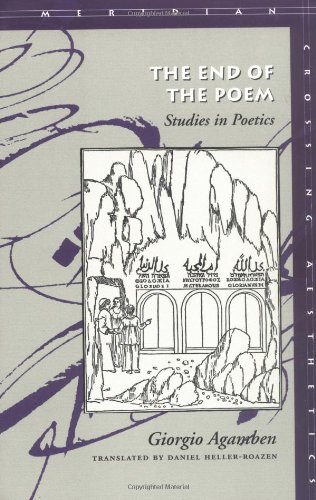
2. The End of the Poem: Studies in
$16.45
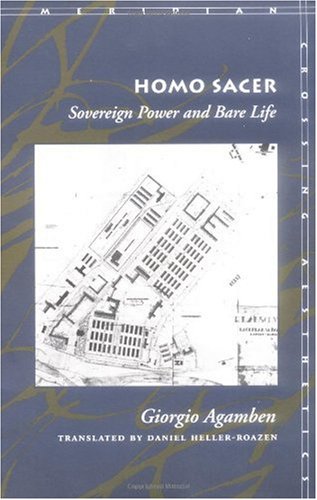
3. Homo Sacer: Sovereign Power and
$16.07
4. Profanations
 
$18.50
5. The Coming Community (Theory Out
$60.00
6. Giorgio Agamben: Sovereignty and
$7.42
7. Infancy and History: On the Destruction
$17.63
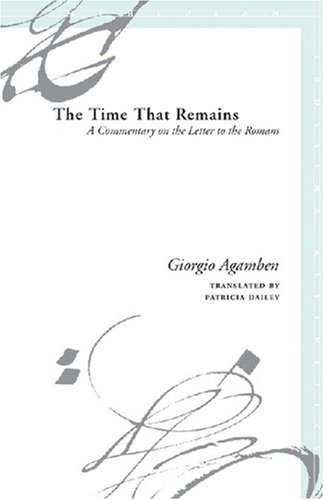
8. The Time That Remains: A Commentary
$18.54
9. Idea of Prose (Suny Series, Intersections)
$22.45
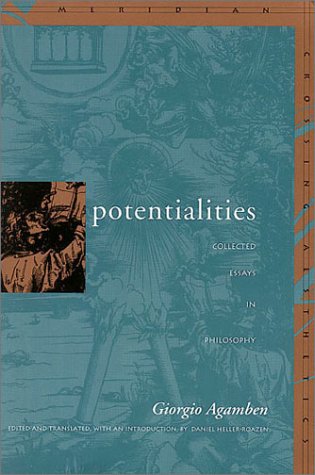
10. Potentialities: Collected Essays
$17.24
11. Means Without End: Notes on Politics
$17.95
12. The Man Without Content (Meridian:
$9.95
13. Remnants of Auschwitz: The Witness
 
$62.98
14. Stanzas: Word and Phantasm in
$43.00
15. The Open: Man and Animal
$19.90
16. Language and Death: The Place
 
$21.95
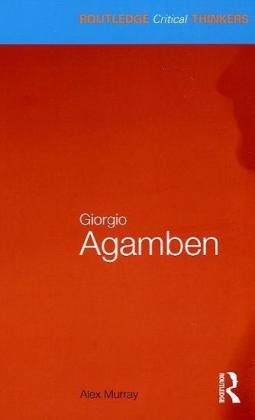
17. Giorgio Agamben
 
$20.97
18. Politica y Mesianismo: Giorgio
 
$140.00
19. Giorgio Agamben: The Idea of Justice
$21.51
20. Politics, Metaphysics, and Death:

1. State of Exception
by Giorgio Agamben
Paperback: 104 Pages (2005-01-15)
list price: US$13.00 -- used & new: US$12.20
(price subject to change: see help)
Asin: 0226009254
Average Customer Review: 4.0 out of 5 stars
Canada | United Kingdom | Germany | France | Japan
Editorial Review

Book Description

Two months after the attacks of 9/11, the Bush administration, in the midst of what it perceived to be a state of emergency, authorized the indefinite detention of noncitizens suspected of terrorist activities and their subsequent trials by a military commission. Here, distinguished Italian philosopher Giorgio Agamben uses such circumstances to argue that this unusual extension of power, or "state of exception," has historically been an underexamined and powerful strategy that has the potential to transform democracies into totalitarian states.

The sequel to Agamben's Homo Sacer: Sovereign Power and Bare Life, State of Exception is the first book to theorize the state of exception in historical and philosophical context. In Agamben's view, the majority of legal scholars and policymakers in Europe as well as the United States have wrongly rejected the necessity of such a theory, claiming instead that the state of exception is a pragmatic question. Agamben argues here that the state of exception, which was meant to be a provisional measure, became in the course of the twentieth century a normal paradigm of government. Writing nothing less than the history of the state of exception in its various national contexts throughout Western Europe and the United States, Agamben uses the work of Carl Schmitt as a foil for his reflections as well as that of Derrida, Benjamin, and Arendt.

In this highly topical book, Agamben ultimately arrives at original ideas about the future of democracy and casts a new light on the hidden relationship that ties law to violence.
... Read more

Customer Reviews (8)

4-0 out of 5 stars great text, poor translation
Agamben's text is filled with relevant historical examples and he makes a clear point, but the translation is lacking.It would have been better if more reference to the original were in the translation that way the reader would have a better understanding of the historical implications of Agamben's terms from within the Western philosophical tradition.It's worth buying for its conceptual value, but I would recommend buying the Italian to read alongside.

2-0 out of 5 stars Post-modern Exceptionism
Carl Schmitt serves as a foil for Agamben's reflections as well as that of Derrida, Benjamin, and Arendt. The Rhetoric of Indeterminancy (i.e., deconstructionism) and Francophile intellectual linguistic abuse does not solve the State of Exception, but heightens its Fallacy of Special Pleading.

Today's choices are either a communitarian society (theocracy or Fabian) or a pluralistic liberal democracy that arose in the Age of Enlightenment. Agamben veers toward an Indeterminate Society of Power Relations (akin to Foucault, before Foucault "got" the Enlightenment Ideal) of communitarianism.

Liberty, freedom, self-rule, spontaneity, social safety, autonomy, equality (cf., economic egalitarianism), justice, fairness, pluralism, tolerance, and other liberal principles trump every Exception of Exception. While many objections to the present problems are valid, the prescriptions are just as disagreeable as the problems it thinks it will solve.

An open, free, equalitarian society is a liberal one, not a communitarian screed based on the Rhetoric of Indeterminacy and Post-modernism.

3-0 out of 5 stars Post-Humanism at its best
The intellectual ancestor of this work is Foucault and Hiedegger, an Islamist-collaborater and a Nazi collaborator.But dont let that change the view of the argument here, namely that all democratic states today are equivilent 'philosophically' to Nazi Germany, which after all was not 'legally' a dictatorship.THis book is a perfect example of how high falutent language with flowery and latin mixed in, anything can become anything, thus democracy is nazism, refugee camps are concentration camps, dictatorship doesnt exist but if it did than it would be America.The main problem with things like this is it focuses on a tiny philosophical view of seven thinkers, expands that to include four or five countries and tries to make an over-arching argument for a massively diverse world, using value judgements and creating a new language suhc as 'state of exception' which is meaningless, in order to condemn western democracy without offering an alternative.

Therefore it is not a suprise that in the name of 'democracy' and 'the people' philosophies and critiques like this have been used to murder millions and accomplish exactly the opposite of what they pretend to be in favor of.This condemns the current situation as 'slavery' so that real slavery can be imposed, slavery of the mind, which is merely the precurser to the real thing.

Seth J. Frantzman

3-0 out of 5 stars Agamben's State of Exception offers a place for political action
Agamben begins this work with a critical and historical look at the state of exception as it has developed over the last few centuries.In short, as nation/states developed and citizens entered into contracts with these governments, laws and constitutions were the agreed to rules of conduct.With the advent of war and national security issues, the state of exception has arisen in which the laws of the nation must be--at least for a time--suspended so that the goverment may take whatever means necessary to secure the safety of its citizens.Of course this has little to do with the safety of citicizens and more to do with securing the power for the political entity in charge.
Agamben points out that we are now--with the advent of terrorism and the war on terror--entering into a time of perpetual exception.The laws are now in a perpetual state of suspension due to the pressing need of the state to protect us from the threats--both real and perceived--of the terrorists.This can be clearly seen from the acts of the United States in its treatment of detainees in Guantanamo Bay.There the law does not extend to those being held who are apparently being held indefinitely and without any legal recourse.
Agamben's point is that the state of exception identifies a place of anomy--no law--wherein one can sieze power and act politically.His argument is that the state is not the only actor who can seize this anomy.If we are willing to exert ourselves within this gap, we too can create change in our world.If you are looking for a book on the philosophy of law and its aporetic nature--this is not the book for you; however, if you would like to read about the beginnings of a theory for social change, this is a good place to start.

5-0 out of 5 stars The Liberalism of Fear, Contintental Style
In Agamben's new book, State of Exception, a sequel to Homo Sacer, he draws explicitly upon lectures he has delivered in New York and elsewhere in the years since 9/11, repeating the central themes of his past work and transposing it to a different key. Here, rather than speaking of "the camp," he argues that "the state of exception" is a primal form of modern government. Agamben has long argued, in a formulation best distilled in his book Homo Sacer: Sovereign Power and Bare Life (2000), that "the camp"- the concentration camp as much as the refugee camp-- is the paradigm of political modernity insofar as legal categories and the idea of sovereignty have served as a justification for abondoning `enemy bodies'to zones outside strict legality. While that book's conceptual apparatus is all too reminiscent of quirky Heideggerian readings of Greek politics, and he sometimes leans on tendentious readings of Foucault, Benjamin, Arendt, and Schmitt, Agamben's thesis, when examined closely, is no more "paranoid" than the more redemptive works of Primo Levi or Judith Shklar. Beneath his evasive ethics is yet another post-Holocaust "liberalism of fear."In my view, Agamben can be read as a philosopher of deep ethical concern and originality,but to read him charitably, one must start by getting used to his signature rhetorical devices of hyperbole, paradox, and "indistinctions"-- situations where conceptual opposites (security and insecurity, totalitarianism and civil war) are actually contained within each other. It is helpful to approach a number of these claims as "thought experiments." Moreover, perhaps more than any other concern of legal theory, the discussion of states of exception is an area of inquiry where these discursive vices can actually be seen as virtues: the language of indistinction and undecidibility is often descriptively appropriate. ... Read more


2. The End of the Poem: Studies in Poetics (Meridian: Crossing Aesthetics)
by Giorgio Agamben
Paperback: 164 Pages (1999-06-01)
list price: US$19.95 -- used & new: US$15.01
(price subject to change: see help)
Asin: 0804730229
Canada | United Kingdom | Germany | France | Japan
Editorial Review

Book Description

This book, by one of Italy’s most important and original contemporary philosophers, represents a broad, general, and ambitious undertaking—nothing less than an attempt to rethink the nature of poetic language and to rearticulate relationships among theology, poetry, and philosophy in a tradition of literature initiated by Dante.

The author presents “literature” as a set of formal or linguistic genres that discuss or develop theological issues at a certain distance from the discourse of theology. This distance begins to appear in Virgil and Ovid, but it becomes decisive in Dante and in his decision to write in the vernacular. His vernacular Italian reaches back through classical allusion to the Latin that was in his day the language of theology, but it does so with a difference. It is no accident that in the Commedia Virgil is Dante’s guide.

The book opens with a discussion of just how Dante’s poem is a “comedy,” and it concludes with a discussion of the “ends of poetry” in a variety of senses: enjambment at the ends of lines, the concluding lines of poems, and the end of poetry as a mode of writing this sort of literature. Of course, to have poetry “end” does not mean that people stop writing it, but that literature passes into a period in which it is concerned with its own ending, with its own bounds and limits, historical and otherwise.

Though most of the essays make specific reference to various authors of the Italian literary tradition (including Dante, Polifilo, Pascoli, Delfini, and Caproni), they transcend the confines of Italian literature and engage several other literary and philosophical authors (Plato, Aristotle, the Stoics, Boethius, the Provençal poets, Mallarmé, and Hölderlin, among others).

... Read more

3. Homo Sacer: Sovereign Power and Bare Life (Meridian: Crossing Aesthetics)
by Giorgio Agamben
Paperback: 228 Pages (1998-04-01)
list price: US$20.95 -- used & new: US$16.45
(price subject to change: see help)
Asin: 0804732183
Average Customer Review: 4.0 out of 5 stars
Canada | United Kingdom | Germany | France | Japan
Editorial Review

Book Description

The work of Giorgio Agamben, one of Italy’s most important and original philosophers, has been based on an uncommon erudition in classical traditions of philosophy and rhetoric, the grammarians of late antiquity, Christian theology, and modern philosophy. Recently, Agamben has begun to direct his thinking to the constitution of the social and to some concrete, ethico-political conclusions concerning the state of society today, and the place of the individual within it.

In Homo Sacer, Agamben aims to connect the problem of pure possibility, potentiality, and power with the problem of political and social ethics in a context where the latter has lost its previous religious, metaphysical, and cultural grounding. Taking his cue from Foucault’s fragmentary analysis of biopolitics, Agamben probes with great breadth, intensity, and acuteness the covert or implicit presence of an idea of biopolitics in the history of traditional political theory. He argues that from the earliest treatises of political theory, notably in Aristotle’s notion of man as a political animal, and throughout the history of Western thinking about sovereignty (whether of the king or the state), a notion of sovereignty as power over “life” is implicit.

The reason it remains merely implicit has to do, according to Agamben, with the way the sacred, or the idea of sacrality, becomes indissociable from the idea of sovereignty. Drawing upon Carl Schmitt’s idea of the sovereign’s status as the exception to the rules he safeguards, and on anthropological research that reveals the close interlinking of the sacred and the taboo, Agamben defines the sacred person as one who can be killed and yet not sacrificed—a paradox he sees as operative in the status of the modern individual living in a system that exerts control over the collective “naked life” of all individuals.

... Read more

Customer Reviews (11)

4-0 out of 5 stars The Body = The Nation
I was first introduced to this text in one of my college courses.I'm not quite familiar with all of Agamben's theory on power, but I have read portions of, "The Camp as Biopolitical Paradigm of the Modern."This text I found to be weighty and at times difficult to read, but it sparked an interest in me to read more.I would like to contribute to the reviews with a simple interpretation of a few things that I read.

I'm intrigued with Agamben's idea of how society creates the category of the devalued through the category of the valued.An example of this categorical sorting is how the Nazis created this category of the devalued with the Jewish people, thus raising their own status of the valued.The Nazis were able to gain control/domination through the use of their concentration camps.By labeling others in society as lower than oneself, one can easily determine whether one's life is worth keeping around.

Another interesting point is how one's body/identity doesn't belong to that person, but rather the government and society owns that body.An example is of the creation of our American society, which came about through the killing of the Native Americans and bringing in of Slaves to further gain land and power.By controlling and taking over the body, the new America was created.It's fascinating to think of one's identity and body as one with the nation/government through citizenship, yet there are many examples within our own American society.America has taken citizenship away and than contradicted itself to ask the non-citizen to contribute to our causes (i.e. "war" or "economy").An example of this control over citizenship is related to the Japanese-American internment camps during WWII.Once in these camps, Japanese-Americans' rights as a citizen were taken, than the government asked if they would fight for America.Thus the Japanese-Americans would have to prove themselves worthy of being a citizen/body of the United States of America.

5-0 out of 5 stars Homo Sacer is a must read.
Agamben's best known work lives up to the hype. One of the most powerful aspects of this book is its shocking predictions about the world to come. Published many years before the initiation of the war on terror, Agamben signals the beginning the of a style of governance built on permanent exception. He insists that the extermination of the Jewx by the Nazis was not simply a horrible enigma that should never return, rather biopolitical atrocities have continued to intensify. This book is a must read for any person interested in understanding how the deep seated structure of sovereignty and its spatio-temporal course through power relations have brought us to the seeming limit poit of exception become rule. A handbook for contemporary politics. This is a great book.

4-0 out of 5 stars Political Ontology and Bio-Politics
Agamben begins his inquiry into sovereignty in the light of the problematic left to contemporary political ontology via Hobbes, Schmitt, and up to Heidegger (Dasein being that being who's very being is always at stake for that being, and ontological difference), post Heideggerian political thought (Nancy, Lacoue-Labarthe, and Derrida) and finally Foucault's bio-politics.While Agamben's criticisms of these thinkers is brief (and somewhat reductive) it does serve the importance of situating his own conception of bio-politics, sovereignty and life as a radicalized "state of exception".
The Logic of Sovereignty is not one of a mere inclusion of beings into a political sphere or form of life specific to it (bios) which emerges or is transformed from an originary bare life (zoe).Rather Sovereignty establishes itself as "sacred" or "set apart" from the polis.There is nothing legal about law, in that the very founding moment of political ontology is apolitical and extra-juridical (because there is no normative law that has been set up yet).Benjamin distinguishes between two forms of violence (constituting and constituted).However, while the Sovereign constituting power of law must claim to be wholly outside the law in order to have created it, it must also regulate and constitute its power through law itself, thus including itself within the law.The Paradox of Sovereignty then is that its life is an "inclusion through exclusion".The signifier of law is absent (or non-signifying form) but is signified through this very non-signification of absence.
Homo Sacer then is the non-criminal criminal , the "extra-juridical" exception that is designated by the sovereign.The homo sacer can be legally killed by any person but is not a juridical killing. That is to say, killing the sacred human is not homicide nor is it sacrifice.The norm of political subjects are set against the exception of the homo sacer, but also included in the norm in its very opposition and ability to exile homo sacer.Agamben sees homo sacer and the sovereign to have this very inclusion by exception in common.Both the Sovereign and homo sacer can be killed but not sacrificed.(It is not a legal issue to kill a King but rather a heretical or anti-juridical one in this account).The Werewolf (half man and wolf inside the city and outside of it, man and animal, political and non-political) and the Sovereign, the inside and outside become an "indistinction" which no longer holds up for modern politics.
The Camp is the modern political space or "coming to light" of this "indistinction" between nature and law in the form of bio-politics.Modern politics as bio-politics takes life as what is at stake for its own life.Bare life as the state of exception, or the sacred, now becomes the rule.As for homo sacer everyone was sovereign, for the sovereign everyone is homo sacer."The Enemy" as constitutive outside to the norm of civil society now becomes the inside in a society as war carried out by other means (politics).Society as life itself is the `enemy outside which is inside'. In fact, it was the rule from the inception of western politics.The camp then refers to the Nazi bio-political movement where law and fact are indistigusihable.The "suspension of law" and "states of emergency" are not purely juridical, and the holocaust cannot be understood in terms of law alone, but can only be understood as the indefinite suspension necessary for sovereign power to kill without crime, and without sacrifice.
One of the strengths of Homo Sacer is that it is able to weave the problems of political ontology together with the historico-political configurations and aporias of Nazism/mythology/capitalism/ and statism.In a subtle way Agamben is challenging the whole of contemporary political ontology to begin to rethink politics in terms of (actual)potentiality: (Life).Bio-politics as the state of exception (as rule) is no longer oriented toward the impossibility of the law (as form of the law without signification) but is rather concerned with the form-of-life (as indistinction/exception).A political ontology that is not concerned with the impossibility of laying claim to bare life as such, or the fascist mobilization of its totality and implementation,but rather with the practical creation and proliferation of non-statist, non-hierarchical experimentations in political practices that would create new ways of living and maximize the diversity of lives that would decide these ways.Life as potentiality (never reducible to any given definition or determination (totalitarianism) always calls for the emergence of a new politics of the actual, pointing always to the inexustablity/infinity of Life itself.
Critique of Agamben's somewhat reductive (although appropriate) critique of Heidigger, Battaille, Nancy, Derrida etc. aside for a moment, what remains a gapping hole in this work is the complete lack of eco-critical perspective on life.Almost every time Agamben speaks of life it is always in terms of a human life (a human political refugee, a proletariat, the life of a human political body, or a human sovereign king or people).It is his call for the creation of a people (resonances with Deleuze here) that heseems to close up his work on life.His very inquiry into the `open' of Bare Life (potentiality) as always political (indistinction) is closed up through the work in his neglect of animal, plant, and non-organic life, and hierarchical (statist?) (almost humanist) privileging of the bios politicos of the human.

4-0 out of 5 stars Interesting but Problematic
Agamben's sets up his work in the left-open space of Foucault's work, the void in which "subjectivization" (the internalization of the order into the individual psyche)and police/political strategies might intersect. It is this void that Agamben desires to write, a (non)place in which "life" is incorporated into the political order. Agamben goes about this by beginning with a reading of Greek and Roman philosophical and poetic texts and weaving a continuity from these early works through the works of Thomas Hobbes, Carl Schmitt, and Jacques Derrida. The continuity he describes is that of sovereignty founded upon the "suspension" of "bare life." "Life," here, is "natural life," natural being that element (like the referent in language) that is the always already included absence (or as Agamben calls it the "exclusive inclusion"). This relation of suspension also creates the possibility of the "state of exception," a space in which the force of law is exerted outside of law.

This state in which the law is outside of itself allows for a renewal of the force of law, it transforms the law through its absence. Such a process involves the creation of sacred life, the life that can be killed without sacrifice and without guilt. It is from here that Agamben takes a look at the concentration camp and comes to the conclusion that this exceptional state of political life is in fact the norm of our contemporary reality: the exception has become the rule. "Life" in modern times is the life in the camp, whether it be in a totalitarian regime or one of mass democracy.

The strengths and faults of Agamben's lie in this continuity of sovereingty. On the one hand, it provides a discourse (indeed, a kind of meta-discourse) for placing philosophy and politics in relation to each other. It makes a poignant argument for the politicization of life as not merely a modern affair (as Foucault largely situates it) but, in fact, the founding moment of Western civilization, of the civis and the polis. However, this poignancy is also the achilles heel of Agamben's argument. Agamben's argument accounts for modernity as a "coming into light" of life's incorporation in politics. This subordination of modernity to a realization of what was already there is reductive to the point of excluding some of Foucault's most interesting insights into the diagramming (or beuraucratization) of life. In other words, much of Agamben's argument seems to derive its powers from excluding particularities. (This exclusion of particularities extends to a reductive reading of Derrida's "The Force of Law.")

Don't get me wrong, Agamben's work is important, especially his considerations of Walter Benjamin and Aristotle. Like Benjamin, he raises the stakes. Revolution becomes not merely the transition of one state to another but an eradication of the state that must also involve a revolution of language. Like, Benjamin in his "Critique of Violence," this transformation is ambiguous. Agamben locates it in the sphere of ontology's limits: the revolution will deconstruct the difference of world and person and of pure being and being. It will heal the fissure of life and politics that captures life in politics. Though this is a noble cause, it could certainly use elaboration, an elaboration that may not be possible within the reductive limits of Agamben's historicizing.

4-0 out of 5 stars Murder and sovereignty
This book can be read as a Heideggerian philosophy of law, that is, the tracing and transformation of the concept of "sacred" -like the Heidegger's history of being/Seinsgeschichte- throughout the history of the West. If "sacred man" is that who can be killed and not sacrified -and its opposite: the sovereign, the one who decides over life and death of its subjects-, it is later transformed -subreptitiuosly and acomplice of- into the sanctity of human life.

If we say: "our life is sacred, no one can take it away from me", we are actually saying: "our life is at the hands of the sovereign who can kill us without regret or sanction" The profound identification and/or consequences this book makes is how human rights and all its ideologies is the complement of biopolitics -like Hardt and Negri establish also in "Empire"- for they participate from the same root of "sacred life" qua "the sovereign".Like Heidegger -but without his romanticism for an original Being-, Agamben describes the process where life -"bios"- is stripped of all rights and becomes "zoe" -bare life. This bare, naked life is the product of biopolitics -from the Roman homo sacer to the Nazi concentration camp. And biopolitics is the core of political philosophy because its name is sovereignty. THE SOVEREIGN SPHERE IS THE SPHERE IN WHICH IT IS PERMITTED TO KILL WITHOUT COMMITING HOMICIDE ABD WITHOUT CELEBRATING A SACRIFICE, AND SACRED LIFE -THAT IS, LIFE THAT MAY BE KILLED BUT NOT SACRIFICED- IS THE LIFE THAT HAS BEEN CAPTURED IN THIS SPHERE. (p.83) ... Read more


4. Profanations
by Giorgio Agamben
Hardcover: 100 Pages (2007-11-30)
list price: US$25.95 -- used & new: US$16.07
(price subject to change: see help)
Asin: 189095182X
Canada | United Kingdom | Germany | France | Japan
Editorial Review

Book Description
The Italian philosopher Giorgio Agamben has always been an original reader of texts, understanding their many rich and multiple historical, aesthetic, and political meanings and effects. In Profanations, Agamben has assembled for the first time some of his most pivotal essays on photography, the novel, and film. A meditation on memory and oblivion, on what is lost and what remains, Profanations proves yet again that Agamben is one of the most provocative writers of our time. In ten essays, Agamben ponders a series of literary and philosophical problems: the relation among genius, ego, and theories of subjectivity; the problem of messianic time as explicated in both images and lived experience; parody as a literary paradigm; and the potential of magic to provide an ethical canon.

The range of topics and themes addressed here attest to the creativity of Agamben's singular mode of thought and his persistent concern with the act of witnessing, sometimes futile, sometimes earth-shattering: the talking cricket in Pinocchio; "helpers" in Kafka's novels; pictorial representations of the Last Judgment, of anonymous female faces, and of "Rosebud," the infamous object of obsession in Citizen Kane. "In Praise of Profanity," the central essay of this small but dense book, confronts the question of profanity as the crucial political task of the moment. An act of resistance to every form of separation, the concept of profanation reorients perceptions of how power, consumption, and use interweave to produce an urgent political modality and desire: to profane the unprofanable. Agamben not only provides a new and potent theoretical model but describes it with a writerly style that itself forges inescapable links among literature, politics, and philosophy. ... Read more


5. The Coming Community (Theory Out of Bounds, Vol 1)
by Giorgio Agamben
 Paperback: 105 Pages (1993-03)
list price: US$18.50 -- used & new: US$18.50
(price subject to change: see help)
Asin: 0816622353
Average Customer Review: 4.0 out of 5 stars
Canada | United Kingdom | Germany | France | Japan

Customer Reviews (4)

5-0 out of 5 stars The Coming Community in Context
The Coming Community by the Italian thinker Agamben, translated by Michael Hardt, is an indispensible work for anyone who is interested in a renewed thinking of a political community without identity.

The Coming Community does not refer to a community that will arrive one day in a fixed form. Such an arrival would only indicate that it is not the community that we are talking about. Rather, it is a community which lacks precisely this fixed identity, and which beings must learn to belong to.

This can be seen as a singular attempt at a renewed thinking of community against the background of Jean-Luc Nancy's work in Inoperative Community and Blanchot's Unavowable Community. Also, the work can be read in the context of Derrida's work on "the democracy-to-come".

5-0 out of 5 stars The indetermination of limit...
Giorgio Agamben's The Coming Community is a quiet and beautifully written confrontation of thinking, an opening onto potentia that the careful reader (as such) will raise heart, head, and hand to meet irreparably.The small book bears its own halo, the words guilty yet of my own inactuality.The world such as, "here I am!"

5-0 out of 5 stars Gateway
Less an argument and more a constellation or mosaic of insights, formulas, and enigmas, The Coming Community by Giorgio Agamben is both a courageous delineation of political crisis and an intervention in thought that is bothbeautiful and cheerfully destructive.That is, this mosaic (inspired, Ithink, more by the early Heidegger of Sein und Zeit and also WalterBenjamin's Ursprung des deutschen Trauerspiels) saves, without naming, thepotential for the uprecedented that comes out of the delineation of theastonishing: the 'whatever' which "always matters" but which isin no wise the result of a process of any kind.Composed of twenty-ninebrief, dense, suggestive sections, this book opens a gateway out of thespace of nihilism that currently enthralls the planet in the form of theDebordian Spectacle.The example of Tianenmen is intended to evoke ascintillating, lawless time--blasted out of history--when everythingmattered exactly such as it is.Since Benjamin, no thinker has moreclearly entered into the threshold of complicity that thought and politicsshare.

2-0 out of 5 stars Obscuratist
Agamben's book Infancy and History was a superb book, and I was looking forward to reading this book. The book should be twice as big, as seemingly every other sentence calls for further elaboration. To be sure, it is esay to undersatnd that Agamben's language is inspired by the later Heidegger's unfolding of language, particularly through etymology. The grounding of the book is an elaboration of the word "whatever" (qualunque), and perhaps this was more understandable in the original Italian, the point being, for Agamben, that 'being' is not a case of "whatever being" such that it does not matter which, but "such that it always matters". This then becomes his base for human ethics. Fair enough. But who needs the exposition of "whatever" in order to argue for an ethics of understanding? His ultimate argument is that the coming community will not be one of control of the State in politrical terms, but rather a struggle between the State and the non-State. He gives the example of the demonstrators in Tiananmen Square, whom, Agamben argues, did not demonstate for concrete demands, or rather, that "democracy and freedom are notions too generic and broadly defined to constitute the real object of a conflict". This is incredible! Agamben is more familiar with Italian farmers demanding foreign goods be stopped at the borders. My feeling by the end of the book, was that Agamben's Coming Community would be a community of Intellectuals who a few times a year march for people who are no longer a community, the disposessed, (whom, despite their efforts of solidarity with each other's plight, remain ultimately marginal) but after the demonstration the intellectuals return to their comfortable university-paid jobs. This book left me feeling angry. ... Read more


6. Giorgio Agamben: Sovereignty and Life
Hardcover: 296 Pages (2007-06-08)
list price: US$60.00 -- used & new: US$60.00
(price subject to change: see help)
Asin: 0804750491
Canada | United Kingdom | Germany | France | Japan
Editorial Review

Book Description

Giorgio Agamben has come to be recognized in recent years as one of the most provocative and imaginative thinkers in contemporary philosophy and political theory. The essays gathered together in this volume shed light on his extensive body of writings and assess the significance of his work for debates across a wide range of fields, including philosophy, political theory, Jewish studies, and animal studies.The authors discuss material extending across the entire range of Agamben's writings, including such early works as Language and Death and more recent and widely acknowledged works such as Homo Sacer. Readers will find useful discussions of key concepts and theories in Agamben's work, such as sovereignty and bare life, along with more critical analyses of the political stakes and consequences of his theoretical and political interventions.

... Read more

7. Infancy and History: On the Destruction of Experience (Radical Thinkers)
by Giorgio Agamben
Paperback: 256 Pages (2007-01-19)
list price: US$12.95 -- used & new: US$7.42
(price subject to change: see help)
Asin: 1844675718
Canada | United Kingdom | Germany | France | Japan
Editorial Review

Book Description
Agamben's profound and radical meditation on language and philosophy. ... Read more


8. The Time That Remains: A Commentary on the Letter to the Romans (Meridian: Crossing Aesthetics)
by Giorgio Agamben
Paperback: 216 Pages (2005-11-07)
list price: US$20.95 -- used & new: US$17.63
(price subject to change: see help)
Asin: 0804743835
Average Customer Review: 4.5 out of 5 stars
Canada | United Kingdom | Germany | France | Japan
Editorial Review

Book Description

In The Time That Remains, Agamben seeks to separate the Pauline texts from the history of the Church that canonized them, thus revealing them to be “the fundamental messianic texts of the West.”He argues that Paul’s letters are concerned not with the foundation of a new religion but rather with the “messianic” abolition of Jewish law.Situating Paul’s texts in the context of early Jewish messianism, this book is part of a growing set of recent critiques devoted to the period when Judaism and Christianity were not yet fully distinct, placing Paul in the context of what has been called “Judaeo-Christianity.”

Agamben’s philosophical exploration of the problem of messianism leads to the other major figure discussed in this book, Walter Benjamin.Advancing a claim without precedent in the vast literature on Benjamin, Agamben argues that Benjamin’s philosophy of history constitutes a repetition and appropriation of Paul’s concept of “remaining time.”Through a close reading and comparison of Benjamin’s “Theses on the Philosophy of History” and the Pauline Epistles, Agamben discerns a number of striking and unrecognized parallels between the two works.

... Read more

Customer Reviews (3)

5-0 out of 5 stars To make atheists into believers
This book is one of the most profoundly moving and important I have ever read.And Giorgio Agamben is perhaps the most ethical and committed intellectual of our times.Not only has he refused teaching appointments in the United States in principled opposition to its imperial chicanery, he has been an outspoken critic of the US-right wing and its attack on Christianity.This book attempts to give Christianity back to the people, to restore its revolutionary potential.American politicians like to claim they believe in Jesus.Jesus does not believe in American politicians.

5-0 out of 5 stars Don't be misled...
By theory types who don't know anything about philology -- it would be a shame if you didn't read so great a book because of uninformed, hasty criticism. (I refer to the review "Another Book on Paul".) 'Christos' isn't a transliteration but a direct translation of the Hebrew 'Messiah.' 'Dunameis' is a technical term of Aristotle's philosophy (Metaphysics Theta) and the distinction between dunameis as 'power' and dunameis as 'potential' is a central interpretive question both in Aristotle and in Paul - not a straightforward question of translation, since both English words line up with one Greek word. Agamben's philological and philosophical case on this point goes well beyond the title of his collected philosophical essays and cannot be dismissed (or even evaluated) without long engagement with the question in some detail. (Except in some very rareified sense, then, you just can't say that this is 'poetic licence,' as if it were a vague question of finding the mot juste.)

The book is the text of a seminar, and time in seminarss is limited - as indeed it is in life - and the kind of reading Agamben undertakes takes a lot of time. That he doesn't move beyond the first line of the epistle shouldn't be allowed to obscure the very important point that this is Agamben's longest, most explicit, and most detailed statement on the central open question of his positive political project: if, as he writes in the introduction to the Homo Sacer project, "one ends up identifying with an enemy whose structure one does not understand, and the theory of the State (and in particular of the state of exception, which is to say, of the dictatorship of the proletariat as the transitional phase leading to the stateless society) is the reef on which the revolutions of our century have been shipwrecked," then what is missing is just what this book provides: a theory of the vanguard partyand its formation that does not fall prey to the double-binds of the state it hopes to overthrow. You may not like the way Agamben addresses his problems, or the way he writes, but our 'Lacanian' (read: Zizekian) friend's cut-to-the-chase political voluntarism faces no stronger rebuttal than Agamben's work on the structure of law and no stronger alternative than this new book provides.

3-0 out of 5 stars Another Book on Paul
Agamben's book is yet another offering in an ever growing list of books on Christian Theology and specifically Saint Paul. What this book endeavors to argue is that Paul was the first in the tradition of thought called Messianism. Agamben claims to give a close reading of Romans in order to theorize what Messiantic time meant for Paul. Interestingly, Agamben only offers a "close" reading of the opening line of Romans and then argues that this opening line contains Paul's entire theory of Messianism in it. Of course the argument is flimsy, and Agamben must be aware of this too, because he fills the rest of his book with citations to other Pauline epistles. He, at least, gives the opening line of Romans a word by word reading. But this too leaves much to be desired as he takes poetic license with the words themselves. For example, he argues that an entire Church tradition has been aimed at erasing the word Messiah from Paul's letters thus when Paul writes "Christos," it is a Greek transliteration of the Hebrew Messiah. True enough. But then he himself attempts the same feat: for example, he reads the Greek "dynameis" as "potential" rather than the more logical "power." Of course this fits in with another of his books entitled "Potentialities." I suppose Agamben is interested in erasing "power" from the pauline epistles. After much arguing, Agamben demonstrates the relevance of Paul's messianism by using it to read a poem. If Pauline Messianism is supposed to be important, I would think it should have implications for politics and society, not simply reading a poem. In the end, Agamben's Paul turns out to be some academic who was interested in philology, not in creating the church. This book takes the radicalness out of Paul, just as his other books take the radicalness out of Walter Benjamin.
Interestingly, many books are being written on Paul. Each of these book have the same argument: Paul is important for today, and we must read him provocatively, which is code for: read him as if he were not a believer in Jesus. It turns out that all of these books--Agamben's included--are more interested in taking Jesus out of Paul. I am still waiting for the truly provocative book on Paul to come out that would argue: we must read Paul as a fanatic believer in Jesus. ... Read more


9. Idea of Prose (Suny Series, Intersections)
by Giorgio Agamben
Paperback: 138 Pages (1995-05)
list price: US$21.95 -- used & new: US$18.54
(price subject to change: see help)
Asin: 0791423808
Average Customer Review: 3.0 out of 5 stars
Canada | United Kingdom | Germany | France | Japan
Editorial Review

Book Description
This book consists of prose pieces that find a new form of expression for philosophy, an expression showing the inseparability of idea and prose--the very form of truth.

In this book, thought seeks a new form, a new "prose." To this end, it brings into play the strategies of the apology, the aphorism, the short story, the fable, the riddle, and all those "simple forms" that are today no longer used, but whose task it has always been to bring about in the reader an experience, an awakening--rather than attempting to put forth a theory. It is only in this sense--insofar as thought contends with the exposition of an Idea--that the problem of "thought" becomes, in these "treatises," a poetic problem. These are little ideas or forms that, in their brevity, compress that which cannot in any way be forgotten, since according to the platonic admonition, it would be put in "the shortest possible measure." ... Read more

Customer Reviews (1)

3-0 out of 5 stars might work for you
An idiosyncratic, ifnot pretentious, collection. Far from being a succinct analysis of his topics, he muses over and wanders about the theme he chooses. But he is high quality, a high-brow Eco, so on occasion his writing opens up new fascinations. I must say that if much has gone over my head this is because he's a professional philosopher and I'm a retail assistant.
I came to this as Agamben is admired by Baudrillard, someone I do understand and admire. But don't expect the same fireworks. ... Read more


10. Potentialities: Collected Essays in Philosophy
by Giorgio Agamben
Paperback: 328 Pages (2000-01-01)
list price: US$27.95 -- used & new: US$22.45
(price subject to change: see help)
Asin: 0804732787
Average Customer Review: 5.0 out of 5 stars
Canada | United Kingdom | Germany | France | Japan
Editorial Review

Book Description

This volume constitutes the largest collection of writings by the Italian philosopher Giorgio Agamben hitherto published in any language. With one exception, the fifteen essays, which reflect the wide range of the author’s interests, appear in English for the first time.

The essays consider figures in the history of philosophy (such as Plato, Plotinus, Spinoza, and Hegel) and twentieth-century thought (most notably Walter Benjamin, but also Heidegger, Derrida, Deleuze, the historian Aby Warburg, and the linguist J.-C. Milner). They also examine several general topics that have always been of central concern to Agamben: the relation of linguistic and metaphysical categories; messianism in Islamic, Jewish, and Christian theology; and the state and future of contemporary politics. Despite the diversity of the texts collected here, they show a consistent concern for a set of overriding philosophical themes concerning language, history, and potentiality.

In the first part of the book, Agamben brings philosophical texts of Plato and Benjamin, the literary criticism of Max Kommerell, and the linguistic studies of J.-C. Milner to bear upon a question that exposes each discipline to a limit at which the possibility of language itself is at stake. The essays in the second part concern a body of texts that deal with the structure of history and historical reflection, including the idea of the end of history in Jewish and Christian messianism, as well as in Hegel, Benjamin, and Aby Warburg. In the third part, the issues confronted in the first and second parts are shown to be best grasped as issues of potentiality. Agamben argues that language and history are structures of potentiality and can be most fully understood on the basis of the Aristotelian theory of dynamis and its medieval elaborations. The fourth part is an extensive essay on Herman Melville’s short story “Bartleby, the Scrivener.”

... Read more

Customer Reviews (2)

5-0 out of 5 stars On the Existence of Non-Being and more
This is a collection of essays written over a period of twenty years. This book is as stunning in its unexpected insights as it is diffcult to summarize. Agamben's mastery of classical philosophy and philology gives him the advantage of discussing pressingly modern issues in philosophy, history, politics and criticism as personified in the works of everyone from Aristotle to Heidegger, Benjamin, and Derrida. And that advantage is apparent not only in the ease with which he brings Aristotle's discussion of dynamis (potentiality) on the issue of redemption and Being, but also in the vividness of ancient philosophy's immediate relevance to the discussion of the messianic notion of time and history as transmitted to our age through figures such as Kafka, Benjamin and Scholem.
This collection of essays is divided into three parts: Language, History, Potentiality. Each section has under it a number of essays loosely pertaining to that category. Under the section on Histroy, for example, we have essays on Aby Warburg and the man's legacy in the refiguration of the study of art history; on Tradition; on Hegel's Absolute and Heiddeger's Ereignis; on Walter Benjamin's Angel of History; and on Benjamin's rumination on the Messiah in realtion to the Sovereign.
Heiddeger looms, as always, over much of Agamben's writing, but here so does that which has no name except as a tradition that partakes of the kabbalistic power of deep vision. The content of the book is offered here like so many spores of light, shedding light on so much of what constitutes the abyss/ground of modernity, but resisting capture in the stiff net of unimaginative academic argumentativeness. The prose is as dense as usual, reflecting the very density of the topics the author is trying to analyse. A most head-on collision of a reading.

5-0 out of 5 stars Potenzia is the name of a Hyundai
Potentialities, or more precisely, potentia passiva. Reception and capability go together: the hand is the gift that gives itself (handshake) and receives: catch! The chapter on Heidegger and Stimmung is for me themost interesting. The word "facticity" is confusing because itimplies making (factum est verum), but is the very opposite of any making(ie, thrownness). Agamben traces in the word the common root of both fetishand faktish, and finds in the notion of Stimmung a weise, a face, or guise.There too is a passivity, and the passivity of "affect" as bothreception and potential (the ability to receive: endexetai). Heideggerwould perhaps find there xeir-, or hand: VorHANDenheit and ZuHANDenheit).Aisthesis as both an activity (-is) and a passivity (think of all the playson the word horen in S&Z). The introduction by the translator iscurious. As for the distinction of intentio prima and intentio secunda, itis the very basis of modern science and Descartes' geometry: not this conicsection (intentio prima) but every conic section (intentio secunda taken asintentio prima). That is the origin of Husserl's "sedimentation,"and hence the return to the "things themselves." In sum, much canbe learned from this book. ... Read more


11. Means Without End: Notes on Politics (Theory Out of Bounds)
by Giorgio Agamben
Paperback: 156 Pages (2000-10-13)
list price: US$18.50 -- used & new: US$17.24
(price subject to change: see help)
Asin: 0816630364
Average Customer Review: 4.0 out of 5 stars
Canada | United Kingdom | Germany | France | Japan
Editorial Review

Book Description
Political Science/Critical Theory

An essential reevaluation of the proper role of politics in contemporary life.A critical rethinking of the categories of politics within a new sociopolitical and historical context, this book builds on the previous work of the distinguished political philosopher Giorgio Agamben to address the status and nature of politics itself. Bringing politics face-to-face with its own failures of consciousness and consequence, Agamben frames his analysis in terms of clear contemporary relevance. He proposes, in his characteristically allusive and intriguing way, a politics of gesture-a politics of means without end.

Among the topics Agamben takes up are the "properly" political paradigms of experience, as well as those generally not viewed as political. He begins by elaborating work on biopower begun by Foucault, returning the natural life of humans to the center of the polis and considering it as the very basis for politics. He then considers subjects such as the state of exception (the temporary suspension of the juridical order); the concentration camp (a zone of indifference between public and private and, at the same time, the secret matrix of the political space in which we live); the refugee, who, breaking the bond between the human and the citizen, moves from marginal status to the center of the crisis of the modern nation-state; and the sphere of pure means or gestures (those gestures that, remaining nothing more than means, liberate themselves from any relation to ends) as the proper sphere of politics. Attentive to the urgent demands of the political moment, as well as to the bankruptcy of political discourse, Agamben's work brings politics back to life, and life back to politics.

Giorgio Agamben teaches philosophy at the Collge International de Philosophie in Paris and at the University of Macerata in Italy. He is the author of Language and Death (1991), Stanzas (1992), and The Coming Community (1993), all published by the University of Minnesota Press.

Vincenzo Binetti is assistant professor of Romance languages and literature at the University of Michigan. Cesare Casarino teaches in the Department of Cultural Studies and Comparative Literature at the University of Minnesota.

Theory Out of Bounds Series, volume 20

Translation Inquiries: University of Minnesota Press ... Read more

Customer Reviews (1)

4-0 out of 5 stars on the way to...
This collection of occasional pieces from the nineteen-nineties can seem slight and derivative by comparison to Agamben's major works of the same decade, coming on the heels of Homo sacer, The Coming Community, The Man Without Content, and The Remaining Time. Means without ends is supercilious about dance, and shows unexpected pietism in the hope for rights "Beyond Human Rights": how meaningful are rights without the conjunction of law and enforcement, i.e. something resembling the state? And there's a puzzling reference to "Beckett's Traum und Nacht" (p. 55). But Means without ends also contains some pearls close to the persistent heart of Giorgio Agamben's uniquely disquieting train of thought: how is it possible to think politics today, in the wake of the Holocaust on the one hand, imposing the heritage of extermination camps that incorporate the state of exception as the essential model of state sovereignty? Agamben's bracing paradoxicalization of politics remains incisively challenging in the "Marginal Notes" on Guy Debord's Society of the Spectacle, in the dialogue on "The Face" (whose unidentified interlocutor is presumably Emmanuel Levinas), and in the deeply personal reflections on contemporary politics, especially in Italy. Curiously, the initial words of a passage repeated word-for-word on pages 81 & 95 suggests the absent totalization, and perhaps the subtitle of a major new Agamben in the offing: "an integrated Marxian analysis..." ... Read more


12. The Man Without Content (Meridian: Crossing Aesthetics)
by Giorgio Agamben
Paperback: 144 Pages (1999-06-01)
list price: US$18.95 -- used & new: US$17.95
(price subject to change: see help)
Asin: 0804735549
Average Customer Review: 4.5 out of 5 stars
Canada | United Kingdom | Germany | France | Japan
Editorial Review

Book Description

In this book, one of Italy’s most important and original contemporary philosophers considers the status of art in the modern era. He takes seriously Hegel’s claim that art has exhausted its spiritual vocation, that it is no longer through art that Spirit principally comes to knowledge of itself. He argues, however, that Hegel by no means proclaimed the “death of art” (as many still imagine) but proclaimed rather the indefinite continuation of art in what Hegel called a “self-annulling” mode.

With astonishing breadth and originality, the author probes the meaning, aesthetics, and historical consequences of that self-annulment. In essence, he argues that the birth of modern aesthetics is the result of a series of schisms—between artist and spectator, genius and taste, and form and matter, for example—that are manifestations of the deeper, self-negating yet self-perpetuating movement of irony.

Through this concept of self-annulment, the author offers an imaginative reinterpretation of the history of aesthetic theory from Kant to Heidegger, and he opens up original perspectives on such phenomena as the rise of the modern museum, the link between art and terror, the natural affinity between “good taste” and its perversion, and kitsch as the inevitable destiny of art in the modern era. The final chapter offers a dazzling interpretation of Dürer’s Melancholia in the terms that the book has articulated as its own.

The Man Without Content will naturally interest those who already prize Agamben’s work, but it will also make his name relevant to a whole new audience—those involved with art, art history, the history of aesthetics, and popular culture.

... Read more

Customer Reviews (2)

4-0 out of 5 stars Genial but a bit too German
This is the first book by Agamben I have read, and it's quite an impressive encounter. Agamben has a lively historical imagination, and seems comfortable in tracing the manner in which art and the aesthetic has shifted in status and situation from the middle ages to the 20th century. When Agamben is using his native Italian intelligence, he's first-rate. However, when the names Hegel or Heidegger are invoked, the discussion tends to become arid, vaporous, and unnecessarily enamoured of Greek etymons. Frankly, I wish Agamben had never read either of the H's - too much teutonic fog dims even his Latin acuity.

5-0 out of 5 stars Agamben's "aesthetics"
Giorgio Agamben is quite simply one of the most profound living philosophers and essayists, and this is one of his most illuminating texts.In it, Agamben takes up the question of the status of the work of art incapitalist culture.Much of his critique draws upon Heidegger's lateressays on the relationship between technology and art ("The QuestionConcerning Technology", "What are Poets For?"), attemptingto explore the implications of Heidegger's concern that art may havealready become "standing reserve."However, this book owes asmuch to Hannah Arendt's _The Human Condition_, especially her reading ofthe history of political theory through her trichotomy of labor, work, andaction.Throughout his book, however, Agamben takes these ideas instartling new directions, always seeking out new connections betweenconcepts and pushing them to their limits.He also writes in a reasonablyclear style, avoiding much of the word-play of contemporary continentalphilosophy, although it probably won't be very accessible to readerswithout some understanding of recent continental philosophy.All in all,this might be the most significant contribution to the philosophy of artsince Adorno's _Aesthetic Theory_. ... Read more


13. Remnants of Auschwitz: The Witness and the Archive
by Giorgio Agamben
Paperback: 176 Pages (2002-01-01)
list price: US$16.95 -- used & new: US$9.95
(price subject to change: see help)
Asin: 189095117X
Average Customer Review: 4.0 out of 5 stars
Canada | United Kingdom | Germany | France | Japan
Editorial Review

Book Description
In this book the Italian philosopher Giorgio Agamben looks closely at the literature of the survivors of Auschwitz, probing the philosophical and ethical questions raised by their testimony.

"In its form, this book is a kind of perpetual commentary on testimony. It did not seem possible to proceed otherwise. At a certain point, it became clear that testimony contained at its core an essential lacuna; in other words, the survivors bore witness to something it is impossible to bear witness to. As a consequence, commenting on survivors' testimony necessarily meant interrogating this lacuna or, more precisely, attempting to listen to it. Listening to something absent did not prove fruitless work for this author. Above all, it made it necessary to clear away almost all the doctrines that, since Auschwitz, have been advanced in the name of ethics."
--Giorgio Agamben ... Read more

Customer Reviews (2)

3-0 out of 5 stars lost-lacanian truly lost
Having read Lost-Lacanian's review of Agamben's 'Remnants' and then read the book, I must say that Agamben did not live up to his reviewers opinion of him. The book's argument is compelling in places, but by no means intruiging overall, and far from new. If Agamben aims to adjust ethical terms by using auschwitz as limit situation (which is by no means wrong) he can only do so by 'correcting' actual survivors' testimony, and placing himself in a position of having a truer knowledge of life in the camps than those who were actually there. Auschwitz is by no means simple to write about, and Agamben's book is not worthless, though something of a bad first step towards his proposed project.

5-0 out of 5 stars Haunting, Captivating, Unspeakable
I read this book after having read Agamben's big book "Homo Sacer." I found the analysis of bare life (homo sacer) in that book to be so fascinating that I picked up "Remnants," to see where else Agamben might go. This book is some of the most compelling theory I have read to date. The book has three major categories of analysis: the witness, the musselman (literally, the muslim), and shame. Each of these three categories have to do with the inhuman quality of being human and the speakability of that which is unspeakable. Indeed, Agamben deploys subtle thought in order to construct these internal contradictions that actually played on in the extreme case of Auschwitz. As one might expect from the title, this book is haunting. The testimonials given of the Musselman are particularly disturbing. Indeed, the experiences of Auschwitz is unspeakable. Perhaps, most startling is that Agamben argues our modern political paradigm is basically a sedated Auschwitz in which all of us can be turned into Musselmen, indeed, the musselman is that inhuman potential within our humanity. In short, this book is haunting, captivating, yet, unspeakable in the topics it tackles and the issues with which it wrestles. If you are not acquainted with Agamben, then, you might first be taken off guard by his verse and thesis style. But once you get in the flow, the form of his writing adds to its content. ... Read more


14. Stanzas: Word and Phantasm in Western Culture (Theory and History of Literature)
by Giorgio Agamben
 Hardcover: 224 Pages (1993-01)
list price: US$76.50 -- used & new: US$62.98
(price subject to change: see help)
Asin: 0816620377
Canada | United Kingdom | Germany | France | Japan

15. The Open: Man and Animal
by Giorgio Agamben
Hardcover: 120 Pages (2003-10-28)
list price: US$43.00 -- used & new: US$43.00
(price subject to change: see help)
Asin: 0804747377
Average Customer Review: 4.5 out of 5 stars
Canada | United Kingdom | Germany | France | Japan
Editorial Review

Book Description

The end of human history is an event that has been foreseen or announced by both messianics and dialecticians. But who is the protagonist of that history that is coming—or has come—to a close? What is man? How did he come on the scene? And how has he maintained his privileged place as the master of, or first among, the animals?

In The Open, contemporary Italian philosopher Giorgio Agamben considers the ways in which the “human” has been thought of as either a distinct and superior type of animal, or a kind of being that is essentially different from animal altogether. In an argument that ranges from ancient Greek, Christian, and Jewish texts to twentieth-century thinkers such as Heidegger, Benjamin, and Kojève, Agamben examines the ways in which the distinction between man and animal has been manufactured by the logical presuppositions of Western thought, and he investigates the profound implications that the man/animal distinction has had for disciplines as seemingly disparate as philosophy, law, anthropology, medicine, and politics.

... Read more

Customer Reviews (2)

5-0 out of 5 stars erudition as art as thought as action
A magisterial meditation on the question of the "human" -- used as an adjective. This short book is Agamben's 'Duino Elegies': thalassically poetic and swirling with thought that hovers, indifferent to the gravity of common sense.

The title refers to Heidegger's term for the possibility of Dasein but Agamben is not doing a pro-Heidegger critique here. The Italian is thinking against the German: Agamben mentions that Heidegger was in fact the harshest separator of man and animal in modern thought, denying animals the very possibility of ever seeing the OFFEN (Open) that is (supposedly) available to man alone. But forget Heidegger--the book's not about him. Agamben questions the very ground of Western thought that made it possible for Marty to make such an inhumane declaration at all.

Agamben's meditation begins with a medieval illustration that depicts the world after the end of the world (post-judgment) in which all the Saved are shown with various animal heads. Agamben wants to know what to make of this strange, unexplained overlapping of man and animal.
And so he weaves a series of tales -- each only a few pages long and Kafkaesque in their brevity, mysteriousness, and flash of insight -- of how the idea that man and animal are two separate categories of being came to be. He weaves by unraveling the secret codes, the invisible knots that have held, and still hold, the most basic assumptions that drive Western thought, beginning with theology / philosophy and now, the bio-sciences.

I was startled to learn how seemingly silly hair-splitting arguments of the theologians concerning the resurrected body could be so consequential later in the modern age in the formulation (and separation) of man and animal. An example: Would the intestines of the resurrected be full or empty? If full, then what to do about the problem of excrement in the Kingdom of God? If empty, is it because they are no longer needed? And if that is the case, what have them at all? Etc.
(BTW, it was decided that there would be no animals in Heaven.)

Agamben continues here what he began in his earlier works -- namely the meaning and consequence of NAKED or RAW LIFE, devoid of any qualifiers, such as "human" such that a "human" being becomes just a living thing.
Agamben states that his purpose is to expose and figure out a way to stop what he calls the 'anthropological machine' whose rise and history made possible the most "logical" outcome of such thinking: The Holocaust. But Agamben does not limt the phenomenon of the Holocaust only to what happened to the Jews --he extends it the entire spectrum of modern political thinking that permits the stripping of human beings of humanity. (See HOMO SACER.)

Having said all that, I must confess, one cannot possibly do justice to this book by summarizing Agamben's little molecules of thought, so compact and phosphorescent are they.

4-0 out of 5 stars Great book
This is a pathbreaking book that explores the unstable frontier between what we consider human and what we still define as animal. This book paves the way for other attempts to discuss this crucial difference which has been relatively unexplored. Agamben achieves a genealogy of the anthropological machine (as he calls it) from the Hebrew Bible to Heidegger and Foucault. I wonder why he didn't explore another barrier that this book also leaves open: the difference between human and machine, which usually accompanies the problematization of the diad animal-human (think about Junger's organische konstruktion and
Spengler Der Mensch und die Technik). This is an intelligent and well written book although I wish it would have been longer. Why not an essay on Aristotle's zoon politikon or on Nietszche's blond beast? I guess I will have to wait for his next book. ... Read more


16. Language and Death: The Place of Negativity (Theory andHistory of Literature)
by Giorgio Agamben
Paperback: 136 Pages (2006-09-10)
list price: US$20.00 -- used & new: US$19.90
(price subject to change: see help)
Asin: 0816649235
Average Customer Review: 5.0 out of 5 stars
Canada | United Kingdom | Germany | France | Japan
Editorial Review

Book Description
A formidable and influential work, Language and Death sheds a highly original light on issues central to Continental philosophy, literary theory, deconstruction, hermeneutics, and speech-act theory. Focusing especially on the incompatible philosophical systems of Hegel and Heidegger within the space of negativity, Giorgio Agamben offers a rigorous reading of numerous philosophical and poetic works to examine how these issues have been traditionally explored. Agamben argues that the human being is not just “speaking” and “mortal” but irreducibly “social” and “ethical.”Giorgio Agamben teaches philosophy at the Collège International de Philosophie in Paris and at the University of Macerata in Italy. He is the author of Means without End (2000), Stanzas (1993), and The Coming Community (1993), all published by the University of Minnesota Press. Karen E. Pinkus is professor of French and Italian at the University of Southern California. Michael Hardt is professor of literature and romance studies at Duke University. ... Read more

Customer Reviews (3)

5-0 out of 5 stars Negative grounding
In this book, early, but not that much so, in Agamben's carreer and work, he explores what metaphysics has proposed as the grounds for being and language. As he notes through a close reading of Hegel's concept of the Absolute and Heiddeger's Ereignis, the place of the ground has been a negativity. It is this negativity what remains to be thought in western philosophy, and what relates language and death as ungrounded grounds of being. Divided in daily conferences, with intermitent excursus, a concise and very profound work on both metaphysics and continental philosophy of language.Recommended to anyone who is interested in such subjects.

5-0 out of 5 stars The Poverty of Speech
Giorgio Agamben's Language and Death goes beyond certain limits - in philosophy, linguistics, and anthropology - while concurrently speaking of the limit, that which is undefinable, lacking, absent. It is a significant work that questions not only self-presence, through discussions of the fractured 'Voice' of the human, but also, in leaving behind poststructuralism, draws out the possibility of a life that has, in some sense, 'abandoned' speech, and accepts something of a constitutive emptiness found in the awareness of death.
What Agamben proposes is thus a truly radical redefinition of the linguistic basis of the human, a linguistic basis, it must be added, which has explicitly political effects. Instead of enclosing humans ever more within the 'prison-house' of language, historically taking the form of the polis or political community, Agamben considers the importance of absence and lack in defining the proper dwelling place of the human. To live in poverty, without a proper home or 'mother tongue' is that which is most human. Emptiness must be taken as the starting-point of all definitions of the human.
The breadth of themes this book covers makes it an important work for any who seek to question the now hegemonic theories of language proffered by postmodernism, as well as those who seek to effect a radical opposition to those institutions and systems whose existence are premised on the fullness and consistency of their speech.

5-0 out of 5 stars "Voice" - the instance of discourse
Agamben analyses the space of negativity in the thought of Hegel and Heidegger. Since Derrida,continential philosophies of language have critiqued traditional philosophy for privleging presence and treating signsas transparent conveyors of meaning. But Agamben, through exacting studiesof Patristic and Medieval thought, demonstrates the tradition's awarenessof the constitutive moment of absence in discourse. He contends that thedeconstructionist critique of metaphysical thinking merely repeats an oldproblematic and fails to escape the difficulties it reveals. His correctiveaccount of language and the place of negativity within it open a space forthe human apart from reductive theories of the self as merely a social andlinguistic construct. ... Read more


17. Giorgio Agamben
by Alex Murray
 Paperback: Pages (2009-05-15)
list price: US$21.95 -- used & new: US$21.95
(price subject to change: see help)
Asin: 0415451698
Canada | United Kingdom | Germany | France | Japan

18. Politica y Mesianismo: Giorgio Agamben
 Hardcover: 149 Pages (2005-01)
-- used & new: US$20.97
(price subject to change: see help)
Asin: 8497424956
Canada | United Kingdom | Germany | France | Japan

19. Giorgio Agamben: The Idea of Justice and the Uses of Legal Criticism
by Tha Zartaloudis
 Hardcover: Pages (2009-04-29)
list price: US$140.00 -- used & new: US$140.00
(price subject to change: see help)
Asin: 041544022X
Canada | United Kingdom | Germany | France | Japan

20. Politics, Metaphysics, and Death: Essays on Giorgio Agamben's Homo Sacer
Paperback: 311 Pages (2005-06)
list price: US$23.95 -- used & new: US$21.51
(price subject to change: see help)
Asin: 0822335379
Canada | United Kingdom | Germany | France | Japan
Editorial Review

Book Description
The Italian philosopher Giorgio Agamben is having an increasingly significant impact on Anglo-American political theory. His most prominent intervention to date is the powerful reassessment of sovereignty and the politics of life and death laid out in his multivolume Homo Sacer project. Agamben argues that in both the modern world and the ancient, politics inevitably involves a sovereign decision that bans some individuals from the political and human communities. For Agamben, the Nazi concentration camps—in which some inmates are reduced to a form of living death—are not a political aberration but instead the place where this essential political decision about life most clearly reveals itself. Engaging specifically with Homo Sacer, the essays in this collection draw out and contend with the wide-ranging implications of Agamben’s radical and controversial interpretation of modern political life.

The contributors analyze Agamben’s thought from the perspectives of political theory, philosophy, jurisprudence, and the history of law. They consider his work not only in relation to that of his major interlocutors—Hannah Arendt, Michel Foucault, Carl Schmitt, Walter Benjamin, and Martin Heidegger—but also in relation to the thought of Plato, Pindar, Heraclitus, Descartes, Kafka, Bataille, and Derrida. The essayists’ approaches are varied, as are their ultimate evaluations of the cogency and accuracy of Agamben’s arguments. This volume also includes an original essay by Agamben in which he considers the relation of Benjamin’s “Critique of Violence” to Schmitt’s Political Theology. Politics, Metaphysics, and Death is a necessary, multifaceted exposition and evaluation of the thought of one of today’s most important political theorists.

Contributors: Giorgio Agamben, Andrew Benjamin, Peter Fitzpatrick, Anselm Haverkamp, Paul Hegarty, Andreas Kalyvas, Rainer Maria Kiesow , Catherine Mills, Andrew Norris, Adam Thurschwell, Erik Vogt, Thomas Carl Wall ... Read more


  1-20 of 75 | Next 20
A  B  C  D  E  F  G  H  I  J  K  L  M  N  O  P  Q  R  S  T  U  V  W  X  Y  Z  

Prices listed on this site are subject to change without notice.
Questions on ordering or shipping? click here for help.

site stats