e99 Online Shopping Mall

Geometry.Net - the online learning center Help  
Home  - Philosophers - Arendt Hannah (Books)

  1-20 of 100 | Next 20
A  B  C  D  E  F  G  H  I  J  K  L  M  N  O  P  Q  R  S  T  U  V  W  X  Y  Z  

click price to see details     click image to enlarge     click link to go to the store

$12.21
1. The Jewish Writings
$21.35
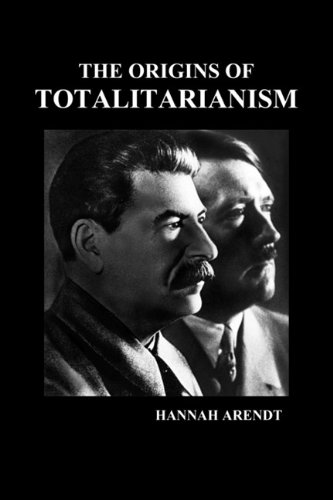
2. The Origins of Totalitarianism:
 
$4.77
3. On Violence (Harvest Book)
$9.03
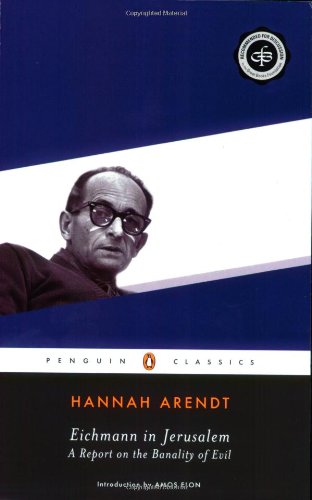
4. Eichmann in Jerusalem: A Report
$10.12
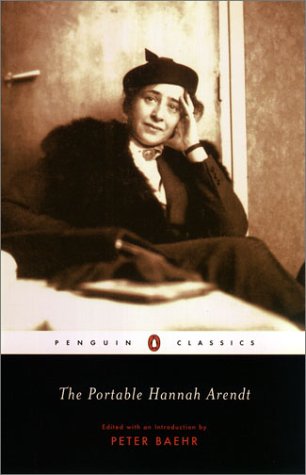
5. The Portable Hannah Arendt (Penguin
$11.86
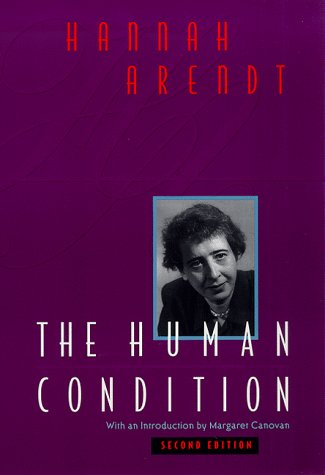
6. The Human Condition (2nd Edition)
$8.52
7. The Promise of Politics
$13.90
8. Lectures on Kant's Political Philosophy
$17.90
9. Hannah Arendt & Human Rights:
$10.91
10. Love and Saint Augustine
$9.02
11. On Revolution (Penguin Classics)
$33.00
12. Hannah Arendt and Education: Renewing
$7.99
13. Between Past and Future (Penguin
$10.93
14. Essays in Understanding, 1930-1954:
$9.22
15. Responsibility and Judgment
$20.46
16. Reflections on Literature and
$15.69
17. The Cambridge Companion to Hannah
$6.98
18. IMPERIALISM
$8.02
19. The Life of the Mind (Combined
 
20. The political thought of Hannah

1. The Jewish Writings
by Hannah Arendt
Paperback: 640 Pages (2008-02-26)
list price: US$17.95 -- used & new: US$12.21
(price subject to change: see help)
Asin: 0805211942
Average Customer Review: 5.0 out of 5 stars
Canada | United Kingdom | Germany | France | Japan
Editorial Review

Book Description
Although Hannah Arendt is not primarily known as a Jewish thinker, she probably wrote more about Jewish issues than any other topic. As a young adult in Germany, she wrote about German Jewish history.After moving to France in 1933, she helped Jewish youth immigrate to Palestine.During her years in Paris, her principle concern was the transformation of antinomianism from prejudice to policy, which would culminate in the Nazi "final solution." After France fell, Arendt escaped from an internment camp and made her way to America.There she wrote articles calling for a Jewish army to fight the Nazis.After the war, she supported the creation of a Jewish homeland in a binational (Arab-Jewish) state of Israel.

Arendt's original conception of political freedom cannot be fully grasped apart from her experience as a Jew.In 1961 she attended Adolf Eichmann's trial in Jerusalem.Her report, Eichmann in Jerusalem, provoked an immense controversy, which culminated in her virtual excommunication from the worldwide Jewish community.Today that controversy is the subject of serious re-evaluation, especially among younger people in the United States, Europe, and Israel.

The publication of The Jewish Writings–much of which has never appeared before–traces Arendt’s life and thought as a Jew.It will put an end to any doubts about the centrality, from beginning to end, of Arendt’s Jewish experience. ... Read more

Customer Reviews (1)

5-0 out of 5 stars Essential documents for understanding a central political thinker
Hannah Arendt is known today primarily as the political thinker who provided a fundamental understanding of 'Totalitarianism'. Her work explores the meaning of the human condition. And her thought often involves a profound exploration of the etymology of basic concepts of thought and experience.
In this comprehensive collection of her writings on Jewish - related subjects we come to better understand how her experience as a Jew played a formative role in her thinking. In his illuminating introduction Jerome Kohn tells of how Arendt as a schoolchild when taunted by Anti- Semitic remarks by other pupils, did not flinch and run, but rather followed her mother's instruction, stood proudly and answered back. This 'fighting spirit' no doubt also played a central role in her urging during the Second World War the creation of an independent Jewish fighting force which would give shape and meaning to Jewish political identity.
Kohn sees Arendt as having gone through a number of stages in her relation to her Jewish identity. In the first phase in which she wrote 'Rahel Varnhagen' she was very much concerned with the effect of the Enlightentment on Jewish identity. In a second phase when Anti- Semitism began to threaten the very existence of German Jewry she was forced to confront the rejection of herself as German national. When the war clouds thundered and the threat to European Jewry became more palpable she escaped to France. There she entered the world of action, the world central to the political meaning of her thought. She worked for Youth Aliyah helping young people make their way to the Jewish Yishuv in Palestine. In one of the most moving documents in the work she urges a young person, distressed at the thought that his parents will not be able to go with him, to think not only of his own future but of that of the larger Jewish community.
After her internment at Gurs and her escape she made her way to the United States. Here was ushered in her most active period of Jewish writing. Writing for the German- Jewish 'Aufbau' she urged the creation of a Jewish military force. She saw in the inability of the Jews to defend themselves, not only a physical danger but a threat to their communal integrity.
After the war when she began to become more widely known as a political thinker. (The 'Origins of Totalitarianism' her breakthrough book was published in 1951.) she wrote less about Jewish issues. However when Eichmann was captured she requested from the 'New Yorker' to be its correspondent at the trial. The result was her most controversial work 'Eichmann in Jerusalem ' in which she spoke of the 'banality of evil' and in also indicting the Jewish communal leadership caused a sharp break between herself and much of the Jewish world. My own personal take on this story is that this was Arendt's 'worst moment' and her moment of failure. Despite Kohn 's defense of her, and despite the fact that a number of Israeli scholars have risen to her defense any close and clear- minded reader of this book can she that she displayed in it a somewhat aloof, arrogant and cold tone towards the victims. No less than Gershom Scholem who had once been a friend and defender disassociated himself from her because of this coldness.
Clearly Arendt's relationship to her Jewishness is a central and complex theme in her story. This present work gives the evidential base upon which to judge her words if not all her deeds. It is an important work which will enable scholars and thinkers to further probe her life and thought.
I myself prefer to think of her primarily as the woman of action who in the hour of the Jewish people's greatest need did work to rescue young people and send them to what would become the state of Israel. ... Read more


2. The Origins of Totalitarianism: Introduction by Samantha Power
by Hannah Arendt
Hardcover: 704 Pages (2004-04-20)
list price: US$35.00 -- used & new: US$21.35
(price subject to change: see help)
Asin: 0805242252
Average Customer Review: 4.0 out of 5 stars
Canada | United Kingdom | Germany | France | Japan
Editorial Review

Book Description

Generally regarded as the definitive work on totalitarianism, this book is an essential component of any study of twentieth-century political movements. Arendt was one of the first to recognize that Nazi Germany and the Soviet Union were two sides of the same coin rather than opposing philosophies of Right and Left. “With the Origins of Totalitarianism Hannah Arendt emerges as the most original and profound-therefore the most valuable-political theoretician of our times” (New Leader). Index.
... Read more

Customer Reviews (14)

3-0 out of 5 stars Got Time?
There's no question Arendt is brilliant and inspired, but I should read the Arendt for Dummies or choose a shorter book.I began to read this volume, which covers Origins of Antisemetisim and Origins of Imperialism also, and got bogged down, so I began skimming.Definitely important stuff in there, and I did glean information that was new to me, but in the end I shelved the book because it is too long.Choose it if you are "studying", not just an inquiring person.

5-0 out of 5 stars More relevant than ever
Though this book was written in the 1950s, there is much in it that is relevant to politics as we know it today.In the wake of the disinformation we now know to be the basis for the debacle of the current war, some of the statements made by Arendt regarding totalitarian regimes sound a very loud warning bell.A case in point:

"Totalitarian politics....use and abuse their own ideologies and political elements until the basis of factual reality, from which the ideologies derived their strength...have all but disappeared."

There is a disturbing similarity between the refusal of some of our government officials to admit their mistakes and the description of some of the methods used by totalitarian leaders to manipulate facts and discernible reality in order to produce outcomes they have previously predicted. Totalitarian leaders never admit to error.If the reader finds no other relevance in this book but that, it will have been time well spent.

5-0 out of 5 stars A Book to be read now
I'll keep this simple: look at what is going on in the US, in the MId-East, in China. If that doesn't alarm you, you need to read this book even more carefully than the rest of us, as Histaory is about to repeat itself because our xenophobia knows no limits. This is as critical today as it was when Arendt wrote it.

5-0 out of 5 stars A real classic
This is a must read for anyone interested in understanding popular history, values, and structures of modern western society, and how they relate to modern political power in the twentieth and twenty-first century.It challenges many values that are often taken for granted in national and international power play and politics. The Origins of Totalitarianism will remains relevant to current events, and a warning to those who advocate change without taking into account the mistakes committed by our forbearer. This book explains in detail the dangers to liberal democracy that the scourge of racism has been and could be again. On a darker note it could also be used as blueprint by those who wish to abuse power.A true classic.

At first glance one could be drawn into making close parallels between modern Pan Islamist movements and the Pan European movements of the twentieth century, but the analysis would be far from complete. The Pan European movements where primarily tribal in nature, where as the Osama's Pan Islamist movement forms a supersetwithout full integration of racial components.The dangers and the cold bureaucratic cauculas are similar, however Islam spans many races and cultures. Race therefore cannot form the primary glue required to hold it together.Also Islamist movements are not progressive, they are reactionary in nature.On the other hand close parallels can be drawn to the Pan Slavic movement with regards to Saddam's Iraqi nationalistic movement.Osama's concept of Pan Islam differs in many ways from Stalin's or Hitler's base, the primarily glue is religious ideology and fear, not race or nationalism. Furthermore his ideology is not anywhere close to being shared by the masses within Islamic countries, and as a result terrorism is a requirement from start, not so much against the west, but against moderate elements or differing sects within the countries where this movement thrives. This is not to say that they do not use terrorism in all of it's traditional roles.Euro style nationalism is counter productive to the Pan Islamist movement, and one of it's objectives is to break down nationalism.In short if one must make parallels, they can be made to the books third section andOsama's Islamist movement operations, but only very weak correlation to sections one and two.

This book is written in a way that requires the reader to work hard, but it is worth the effort.

5-0 out of 5 stars A Frightening Warning about Mass Man and "Virtue" of Thoughtlessness
Haannah Arendt's THE ORIGINS OF TOTAITARIANISM(TOT)is both a thoughtful book and a frightening view of both the background of totalitarianism as well as the practical application of this political phenomena.The reader should realize this book requires time and careful thought to appreciate the book's importance.

The first section of the book deals with antisemitism which Miss Arendt argues was a cornerstone of later totalitarianism.She argues that the gradual development of mass culture and mass politics resulted in targeting and scapegoating any target minority such as Jews.She explains that antisemitism was a gradual political movement that exploded in the late 19th and especially in the 20th century.A different thesis could have beenpresented, but thus far this is the best one this reviewer has read.

Part two of the book explains how imperialism and racism merged especailly during the Age of Nationalism.Religious discord was replaced by sociological and political theories that not only extolled nation but also race and blood.This section deals with these two concepts both in Western Europe and Eastern Europe.One must remember that persecution of Jews was particulary lethal in Eastern Europe between World War I and World War II and espeically during The Second World War.

Part three of the book is the best section of THE ORIGINS OF TOTALITARIANISM. If readers have difficutly with sections one and two of this book, they owe it to themselves to at least read section three.

Miss Arendt makes a frightening assessment that the liquidation (mass murder of people of race or class) was not so much personal vendetta as these mass murders were bureaucratic operations that were done as a matter of political policy and "normal" bureaucratic operations.She warns readers that totalitarian leaders changed enemies almost weekly.In other words, those who were innocent one time were "enemies of the state or people" later.In other words, totalitarian leaders never never exhausted their enemies' lists and kept the masses alert for supposed enemies regardless of the rapid changes in those designated for mass murder.One quote that should alert thoughtful readers is, "The aim of totalitarian education has never been to instill convictions but to destroy the capacity to form any."The serious implication is that totalitarian leaders suspect that thoughtlessness is a virtue which benefits the leaders of the mass political movements.The fact is that once innocent people were arrested, they were "non-persons" whose memories were altered and then forgotten.

This book is a serious warning to anyone who takes pride in individual liberties and appreciates individual achievement regardless of their religious convictions or ancestry. Miss Arendt is clear that totalitarian leaders do not recognize talent except as talented individuals may threaten their arrogant self importance.
Readers would do well to also read Orwell's 1984 and Hoffer's THE TRUE BELIEVER to have a better grasp of THE ORIGINS OF TOTALITARIANISM.This reviewer highly recommends this book with the reservation that this book is not "light reading."

... Read more


3. On Violence (Harvest Book)
by Hannah Arendt
 Paperback: 120 Pages (1970-03-11)
list price: US$11.00 -- used & new: US$4.77
(price subject to change: see help)
Asin: 0156695006
Average Customer Review: 4.5 out of 5 stars
Canada | United Kingdom | Germany | France | Japan
Editorial Review

Book Description

An analysis of the nature, causes, and significance of violence in the second half of the twentieth century. Arendt also reexamines the relationship between war, politics, violence, and power. “Incisive, deeply probing, written with clarity and grace, it provides an ideal framework for understanding the turbulence of our times”(Nation). Index.
... Read more

Customer Reviews (4)

5-0 out of 5 stars Castration and Power
The irony of viewing the natural need of men (and increasingly, women) to view power as dominance over rather than as a part of a coooperative spirit toward mutual goals is the foundation of this articulate and simple philosophy where violence becomes a part of the political and economic landscape. Arendt stopped short of asking to what extent men will sacrifice to acquire the power through violence that is supposedly the motive underlying the methods used. When males sacrifice both their honor and their natural masculinity for power, one wonders what limit, if any, is man willing to condone in himself to "win" the power or money he fervently and diligently pursues. Although supposedly, man comes equipped with the height of survival instinct, it is remarkable how willing he is to castrate himself in pursuit of essentially man made goals that symbolize success, often crippling many others in the process without hesitation, too often, in violation of the religious teachings of compassion and brotherhood. Given this rather historically well documented pattern of acceptance in mankind, it appears the decision to request increasingly more of man's sacrifice for that pursuit tilts the seesaw in the other direction. What man hath wrought, man will deliver in the finest mode of free market principles, leaving us to question whether indeed there are limits to what man ought to be asking other men to do, i.e., to what extent moral and logical principles are allowed to become the modifying influence that limits the scope of that pursuit and the credible measure by which such decisions are made.

5-0 out of 5 stars where is human nature headed
The most simple questions are the hardest to answer so we leave them to people like Hannah Arendt.Here she writes about the difference between violence in the hands of the state versus violence in the hands of extremist groups or individuals.In other words, how is terrorism different from totalitarianism?Her theoretical conclusions on violence and power are interesting because she reasons that they are opposites: violence is the lack of access to power (and is power then the ability to use violence at any time?I didn't really grasp that).Something about that idea resonated with me the fist time I read this book, and it made me think about the violence in schools like Columbine, and even self-violence in young adults, but she doesn't go into those more psychological areas- only historically and politically on a larger scale-attacking state-sponsored violence.Through this short book she argues intelligently and factually and does not use sophistry or tug at our emotions with wishy-wash.
You should also read her other books and I suggest the Hannah Arednt Reader to get started.The fact that the author was an exiled Jewess who lived during the Holocaust and spent her life as a political activist, and is still able to objectively examine the nature of of violence in the 20th century make her words speak even greater.For me, someone who can take something so evil and complex as this subject, crack it open, get to the heart of it and understand it, and then rearrange ideas about violence in a new, simpler form, may have more to say about stopping it than the spiritual/inspirational leaders who have preached nonviolence in our century like Mahatma Ghandi or the Dalai Lama.

Everyone who is currently nauseated or confused at the state of our world affairs, every student of history should be forced to read this book.Its not morbid, just thoughtful.But- like George Orwell's 1984- pretty scary if you let it get to you.

4-0 out of 5 stars A must-have for any student of politcal philosophy.
There are few books from college that remain with me 15 years later. Thisis one of them. Arendt's writing transcends academia. Not only does herphilosophy apply to politics but it can easily be applied to allrelationships (worker/employer, parent/child, siblings, black/white,etc),as all relationships involve a power struggle. Her general thesis isthat where there is lack of power or where power is slipping away, there isgreater potential for violence. Lack of power begets violence. Apply thatto the current world scene and you begin to wonder exactly how safe we are.In re-reading it recently, I couldn't help think that this book could justas easily be prescribed for management solutions...right alongside The Artof War.

4-0 out of 5 stars Intelligent examination of the overlooked role of violence
Though this book does not have the same power over me as On Revolution had, On Violence is still a very well written, witty and insightful look at the power structures most prevalent in the early 1970's. Arendt makes theintelligent claim that those with power that are losing that power will hita point where they only see violence as a means to maintain the currentpower distribution, but that violence will actually cause a loss of power.The book can be read in a day (and should), but this book needs to be read3 or 4 times to catch all of the subtle points Arendt throws inunannounced. The main criticism I have of this book is its failure atpoints to demonstrate the relavence of her arguments, which I find she doesincredibly well in her other books. Not a must buy, but if you have theoption, take it. ... Read more


4. Eichmann in Jerusalem: A Report on the Banality of Evil (Penguin Classics)
by Hannah Arendt
Paperback: 336 Pages (2006-09-22)
list price: US$16.00 -- used & new: US$9.03
(price subject to change: see help)
Asin: 0143039881
Average Customer Review: 5.0 out of 5 stars
Canada | United Kingdom | Germany | France | Japan
Editorial Review

Book Description
Hannah Arendt’s authoritative report on the trial of Nazi leader Adolf Eichmann includes further factual material that came to light after the trial, as well as Arendt’s postscript directly addressing the controversy that arose over her account. ... Read more

Customer Reviews (4)

5-0 out of 5 stars Emphasis on Banality
A previous reviewer claims that Arendt's book shows the ambivalence of human nature, proving that in effect anybody could have done what Eichmann did.In fact, this is exactly the cynical point of view that Arendt opposes in this, and her other writings. Her argument here is a revision of her earlier position on 'radical evil' advanced in The Origins of Totalitarianism, a position which Heidegger claimed to find 'incomprehensible.'She argues here that banality and "sheer thoughtlessness" (akin to Heidegger's reflections on boredom) are in fact the root of Evil. To put it better, evil continues precisely because of its inherent rootlessness, its constitutive disregard of the world.Thus, the detachment of claims such as "Anybody could have done what Eichmann did" distort her intention.Evil, she insists, is not an inevitable aspect of human nature, but instead arises from an unwillingness to understand.

5-0 out of 5 stars Rethinking the Nature of Evil
"It was sheer thoughtlessness that predisposed him to become one of the greatest criminals of the period," political theorist Hannah Arendt observes of Adolf Eichmann, who was in charge of the logistics behind the mass deportations of Jews and other so-called asocials to ghettos and extermination camps during the 2nd World War. The face of evil, she suggests through her portrayal of the high-ranking SS bureaucrat at his trial in Jerusalem, is not necessarily that of a radically perverse pathological mastermind, but instead and more frightening still, can come in the form of a banal and unimpressive caricature of normalcy.

In his testimony, Eichmann characterizes himself as a blameless cog who was only following orders, and even goes on to cite instances where he tried to help certain Jews who were friends of his escape their inevitable fate. His tone is that of one regaling a run-of-the-mill human sympathy story of hard luck, and his telling is rife with contradiction, blanks in memory, and ridiculous cliché. According to Arendt, this "created considerable difficulty during the trial - less for Eichmann himself than for those who had come to prosecute him, to defend him, to judge him, and to report on him. For all this, it was essential that one take him seriously, and this was very hard to do, unless one sought the easiest way out of the dilemma between the unspeakable horror of the deeds and the undeniable ludicrousness of the man who perpetrated them, and declared him a clever, calculating liar - which he obviously was not."

Also relevant for its criticism of the shaky legal foundation upon which the trial was conducted (Eichmann was illegally abducted in Argentina, then was brought to Israel and prosecuted there using an outdated framework that was unable to properly address the problem of genocide as specifically carried out by the Nazis).

This book is very smart, very elegantly written. The questions it raises about ethics and preconceived notions of good and evil are universal and remain relevant to the times. If it were a person, I'd sleep with it on the first date.

5-0 out of 5 stars A Classic that Elaborates on the Genocide of Jews and Others
I am delighted to see this classic back in print. Jewish author Hannah Arendt has provided a wealth of timeless information that goes far beyond the trial of the German war criminal Adolf Eichmann. This review is based on the original (1964) edition.

Arendt (p. 39) gives the readers a taste of the scale of the Kristallnacht (November 1938): 7,500 Jewish shop windows broken, all synagogues burned, and 20,000 Jewish men incarcerated in concentration camps. In common with many others who wrote during the first two decades after WWII, Arendt (p. 5, 11-12) addresses the issue of Jewish passivity in the face of death during the later roundups and transports to the death camps.

Arendt briefly discusses the fate of Jews of some individual European nations. She mentions the conniving of the Bulgarians (with, of course, the implied freedom to do so) performed in order to avoid sending their Jews to the death camps, and the fact that Finland, Germany's ally, was never seriously pressured to turn over her 2,000 Jews to be murdered (p. 170). Clearly, the latter part of the oft-repeated statement, "Not all of the victims of the Nazis were Jews, but all Jews were victims of the Nazis" is incorrect.

Throughout this work, Arendt gives various biographical details of Adolf Eichmann. For example, she mentions that he was a Gottglaubiger (p. 27), a Nazi term for those who had broken with Christianity, and which Eichmann maintained right up to the very moment of his hanging, having refused the solace and Bible reading of a Protestant minister (p. 252).

Arendt briefly discusses Hitler's flouting of the Versailles treaty and his rise to power. While Jan T. Gross has asserted that there were Poles who praised Hitler in the 1930's, Arendt makes it clear that this was far from limited to Poland during that time: "...Hitler was admired everywhere as a great national statesman." (p. 37).

While most recent Holocaust materials focus on the real or imagined collaboration of locals in the sending of Jews to their deaths, Arendt is unsparing in her criticism of Jewish collaborators in this regard: "Without Jewish help in administrative and police work--the final roundup of Jews in Berlin was, as I have mentioned, done entirely by Jewish police--there would have been either complete chaos or an impossibly severe drain on German manpower. (p. 117). She adds that, because of this collaboration, only a few thousand Germans, most of whom furthermore only did office work, were able to send hundreds of thousands of Jews to their deaths (p. 117). Finally, Arendt concludes that: "Wherever Jews lived, there were recognized Jewish leaders, and this leadership, almost without exception, cooperated in one way or another, for one reason or another, with the Nazis. The whole truth was that if the Jewish people had been unorganized and leaderless, there would have been chaos and plenty of misery but the total number of victims would hardly have been between four and a half and six million. (According to Freudiger's calculations about half of them could have saved themselves if they had not followed the instructions of the Jewish councils..." (p. 125).

Arendt (p. 42, 118, etc.) elaborates on the actions of a Jew, Rudolf Kastner (Kasztner). He made a deal with Eichmann in which 1,684 Jews were allowed to go to Palestine in exchange for Kastner's silence before and during which 476,000 Hungarian Jews were sent to the gas chambers of Auschwitz.

Jan Tomasz Gross, who has gotten a great deal of publicity for his books (NEIGHBORS and FEAR), has stated that the 2-3 million Poles who died in the hands of the Germans were largely the collateral victims of military action. Arendt knows better: "...Eichmann knew that right behind the front lines all Russian functionaries ("Communists"), all Polish members of the professional classes, and all native Jews were being killed in mass shootings." (p. 95). "At no point, however, either in the proceedings or the judgment, did the Jerusalem trial mention even the possibility that extermination of whole ethnic groups--the Jews, or the Poles, or the Gypsies--might be more than a crime against the Jewish or the Polish or the Gypsy people, that the international order, and mankind in its entirety, might have been grievously hurt and endangered." (pp. 275-276). Arendt realizes the alternative future: "The measures against Eastern Jews were not only the result of anti-Semitism, they were part and parcel of an all-embracing demographic policy, in the course of which, had the Germans won the war, the Poles would have suffered the same fate as the Jews--genocide. This is no mere conjecture: the Poles in Germany were already being forced to wear a distinguishing badge in which the "P" replaced the Jewish star, and this, which we have seen, was always the first measure to be taken by the police in instituting the process of destruction)." (pp. 217-218).

Arendt praises the Danes for saving Jews during WWII and then, without mentioning the incomparably more difficult conditions under which Polish rescuers of Jews labored, nevertheless gives the Poles their due. After listing some individual examples of Polish assistance to Jews, Arendt adds the following: "One witness claimed that the Polish underground had supplied many Jews with weapons and had saved thousands of Jewish children by placing them with Polish families. The risks were prohibitive; there was the story of an entire Polish family who had been executed in the most brutal manner because they had adopted a six-year-old Jewish girl." (p. 231).

5-0 out of 5 stars Beneath the thin layer of civilization
In covering, from a moral and ethical rather than legal standpoint, the trial of former Nazi Adolf Eichmann, Arendt must have known she was jumping head first into certain controversy.While I disagree with her insistence on international law, as opposed to an Israeli-ran trial (unlike Arendt, I have the hindsight of the Milosevic trial, not to mention pretty much every other pathetic joke of international law flouted by the U.N. but to which no nation honestly adheres outside Belgium), I must say that she made a rather convincing case regarding the "banality of evil".

Her point seemed to be, to the outrage of her critics, that seemingly normal men are capable of doing terrible deeds.It doesn't take a monster to act monstrous.Her critics accused her of attempting to humanize a Nazi war criminal, but I think what most people were secretly offended at was her assertion of the duality of human nature.We like to think of history and sociology in terms of black and white, good and evil.There are good guys, and there are bad guys, and there is no blur between them...

What Arendt is saying is that, save the occasional saint, we are all capable of committing the crimes that Eichmann did.It may take years of systematic propaganda, carrots and sticks, career enhancements, and whatnot, but in the end, the leap Eichmann took from ethical civilization into barbaric genocide wasn't a far leap at all.Weimar Germany wasn't a Third World country.For an industrialized, cultured, and Western nation to descend so rapidly into the dark age of Nazism is not a sign of any inherent flaw in German civilization, but rather of how thin the line between humanity and barbarism truly is.

Whether you agree with Arendt or not, the book will make you think.There's nothing wrong with hearing a fresh and opposing viewpoint, even for debate's sake. ... Read more


5. The Portable Hannah Arendt (Penguin Classics)
by Hannah Arendt
Paperback: 640 Pages (2003-07-29)
list price: US$18.00 -- used & new: US$10.12
(price subject to change: see help)
Asin: 0142437565
Average Customer Review: 5.0 out of 5 stars
Canada | United Kingdom | Germany | France | Japan
Editorial Review

Amazon.com
Peter Baehr's anthology is a gem made up of 33 selections supplemented by his highly competent introduction, a chronology covering the major events in Hannah Arendt's life, and a basic bibliography. Arendt's erudition and incisive brilliance are well represented throughout. Passages include lengthy excerpts from her major books (The Origins of Totalitarianism, The Human Condition, On Revolution, and Eichmann in Jerusalem), shorter excerpts from Rahel Varnhagen and The Life of the Mind, eight essays (four from Between Past and Future, one from Men in Dark Times, and two not previously available in book form), a University of Chicago lecture, her famous television interview with Guenter Gaus, four letters (two to Karl Jaspers, others to Mary McCarthy and Gershom Scholem), and a brief journal entry (on Heidegger "the fox"). Ever sensitive to the limitations of anthologies, particularly for the work of thinkers like Arendt, Baehr has managed to effectively convey the feel of Arendt's conscientious yet combative thinking through his selections and arrangements.

Arendt burst upon the world literary stage in 1951 with The Origins of Totalitarianism and a Saturday Review cover photo. She understood totalitarianism as an unprecedented phenomenon, identifying several elements that fused into it and analyzing totalitarian movements and rule. The success of Origins led to prestigious lectureships and 25 years of fiercely independent writing and teaching. She proved knowledgeable about philosophy as well as history and politics, fluent not only in English and German (her beloved "mother tongue") but also in French, Greek, and Latin. This precocious German Jewess had devoted her college years to studying philosophy, theology, and Greek (with Heidegger, Jaspers, Husserl, and Bultmann!), but the Nazi rise to power compelled Arendt to focus on politics, especially the Jewish question. From the '50s until her death in 1975, Arendt developed and publicly defended controversial views, including her report on the Eichmann trial and her coinage "the banality of evil"; her opposition to integrationist busing and to affirmative action hiring in universities; and her version of (classical) republicanism, rooted in her radical understandings of human action and the dignity of politics. All these views and more find expression in this collection. Of late, Arendt's fame has been rekindled by revelations of her love affair with Heidegger. Now, as we approach her birth centenary (2006), this Portable provides newcomers and faithful admirers alike a marvelous package of Arendt's writings. --Richard Kenney Book Description
Although Hannah Arendt is considered one of the major contributors to social and political thought in the twentieth century, this is the first general anthology of her writings. This volume includes selections from her major works, including The Origins of Totalitarianism, Between Past and Future, Men in Dark Times, The Jew as Pariah, and The Human Condition, as well as many shorter writings and letters. Sections include extracts from her work on fascism, Marxism, and totalitarianism; her treatment of work and labor; her writings on politics and ethics; and a section on truth and the role of the intellectual.

Edited by Peter Baehr. ... Read more

Customer Reviews (1)

5-0 out of 5 stars Superb introduction to a great mind.
Hannah Arendt (1906-1975) was one of the great thinkers of the twentieth century.She was equally at home in philosophy, political theory, and history, and blended all three disciplines in her pursuit of integrity in political thought and action.This fine book is perhaps the single best place to begin to get to know her thought and work.The introduction is first-rate -- clear, accessible, yet intellectually rigorous, respectful of Arendt while critical.The choices of readings -- both complete and self-contained essays and extracts from larger books such as ORIGINS OF TOTALITARIANISM, EICHMANN IN JERUSALEM, and ON REVOLUTION -- are excellent.The annotations don't get in the way and are of much aid to the reader.The bibliography of works by and about Arendt is excellent.All in all, this is a superb addition to the VIKING PORTABLE series. ... Read more


6. The Human Condition (2nd Edition)
by Hannah Arendt
Paperback: 370 Pages (1998-12-01)
list price: US$19.00 -- used & new: US$11.86
(price subject to change: see help)
Asin: 0226025985
Average Customer Review: 4.0 out of 5 stars
Canada | United Kingdom | Germany | France | Japan
Editorial Review

Book Description

A work of striking originality bursting with unexpected insights, The Human Condition is in many respects more relevant now than when it first appeared in 1958. In her study of the state of modern humanity, Hannah Arendt considers humankind from the perspective of the actions of which it is capable. The problems Arendt identified then—diminishing human agency and political freedom, the paradox that as human powers increase through technological and humanistic inquiry, we are less equipped to control the consequences of our actions—continue to confront us today. This new edition, published to coincide with the fortieth anniversary of its original publication, contains an improved and expanded index and a new introduction by noted Arendt scholar Margaret Canovan which incisively analyzes the book's argument and examines its present relevance. A classic in political and social theory, The Human Condition is a work that has proved both timeless and perpetually timely.

Hannah Arendt (1906-1975) was one of the leading social theorists in the United States. Her Lectures on Kant's Political Philosophy and Love and Saint Augustine are also published by the University of Chicago Press.
... Read more

Customer Reviews (16)

5-0 out of 5 stars What it is that We are Doing
Arendt begins her opus magnum with a proposal: she states that the launch of Sputnik in 1957 (similar to Vaclav Havel's proposal of the moon landing) has hearkened in a new age of humanity. Following this proposal is one of the most mysterious but rewarding books of the 20th century, in my humble opinion.
I first encountered "The Human Condition" in an undergraduate class regarding the post-modern community. To this day, I still have not completely digested this work. Her objective, in her own words, is to determine "... what it is that we are doing", and her choice of a goal is challenging considering what is to follow. Situating herself between a Greek model of society and a Marxist interpretation of labor, Arendt calls into question our ideas of progress, technology, and even forgiveness, and aims a withering critique at the subjective personality of the post-modern world.
I won't go into a broad summary of her points to convince you to read it, but instead implore the reader of this review to see for themselves what Arendt is doing. Some will give up on this book after a few pages, calling it semantical nonsense. Yet for those who forge a path through Arendt's intelligent interpretation of history will come out on the other side with a new appreciation for the way in which they live their lives, participate in this thing we call "work", and interact with the human community. I can't stress enough how much this book means to me.

4-0 out of 5 stars The Color Purple
To judge this book by it's cover, I would say that it's red violet. I hope the content covers the spectrum of the human condition. Enjoy your lunch.

3-0 out of 5 stars Unbelievably verbose and difficult to read
I should forewarn those who are about to the buy this book that you ought to first be well read in ancient Greek Culture: philosophy, political city-state as well as Greek mythology.Arendt uses a lot of Greek terminology which can make it incredibly difficult for the average Liberal Arts student or international student, for that matter, who are unfamiliar with these these terms.

No doubt the concepts she spoke of in the mid-50s are more than applicable to todays society.She was clearly a woman ahead of her time, but much too brainyfor her own good.Chapter 2 on the "Public and Private Realm" is a 50+ page drag, emphasis on the word DRAG.I'm barely scraping through this chapter.

Had Arendt chosen to write in a taut, less opulent but fluid fashion, she could have easily connected to average readers and would have been an instant bestseller.If she did in fact become one...then more power to her.

Two cents worth from a frustrated liberal arts student.

1-0 out of 5 stars Hannah Errant
I'd had this book for quite some time so I thought I might take a look at it. After reading it from cover to cover, all I have to say is, "What a waste of my time".

Arendt jumps back and forth from ancient Greece and Rome to the modern and post-modern eras, sometimes in the space of a few words in a paragraph, in a single-minded quest to put her stamp on what it is that gives value to existence. Turns out that it isn't happiness (too vulgar and egotistic and Bentham was a dirty crude little egoist) or even God (although He shows up in both the Heavenly and Nazarene versions). Nope, it's politics. The why is unclear to me; something to do with the mind (too vulgar and egotistic) and its inability to really know God's creation (Never mind that Genesis says mankind was created in God's image. Arendt puts a governor on the intellect and proclaims it incapable of understanding.) and how action for the sake of action is the greatest achievement of man (the working animal).

Throw in some rationalizing of immortality based on her understanding of then up-to-date physics and you've got it in a nutshell.

4-0 out of 5 stars Not quite what I expected but a classic nonetheless
Arendt's book is really more a disquisition on political theory than an explanation of the human condition in all its endlessly tragic vicissitudes.

It was interesting, and I learned more about ancient Greek and Roman political theory than I really wanted to know; with the most interesting facet being the defining of the terms "labor", "work", and "action" as they pertain to the the means by which the human animal has his being in the world.But by and large, it really didn't touch on the human condition in a way that enlarged my understanding of the essence of its gestalt.

The most interesting chapter is the one on action as the public realm in which some men choose to live and act, and how that affects both the present and the future.While action is essentially ephemeral in nature, its impact on the human condition is one that can and often does have unintended consequences reaching far into the future like ripples on a pond spreading outward from a central occurence.It is that very unpredictability that is its foremost feature.

Labor too is ephemeral in nature, in its attendance on the basic needs of mankind, food and shelter.Only work, in Arendt's estimation is durable and in this category she places all forms of art.

It is not an easy book to read but, given a little effort, accessible to even a novice at political theory.
... Read more


7. The Promise of Politics
by Hannah Arendt
Paperback: 256 Pages (2007-06-19)
list price: US$15.00 -- used & new: US$8.52
(price subject to change: see help)
Asin: 0805212132
Average Customer Review: 3.5 out of 5 stars
Canada | United Kingdom | Germany | France | Japan
Editorial Review

Book Description
In The Promise of Politics, Hannah Arendt examines the conflict between philosophy and politics.In particular, she shows how the tradition of Western political thought, which extends from Plato and Aristotle to its culmination in Marx, failed to account for human action.The concluding section of the book, “Introduction into Politics,” examines an issue that is as timely today as it was when Arendt first wrote about it fifty years ago–the modern prejudice against politics.When politics is considered as a means to an end that lies outside of itself, argues Arendt, when force is used to create “freedom,” the very existence of political principles is imperiled. ... Read more

Customer Reviews (2)

4-0 out of 5 stars Drama Queen
Jerome Kuhn's introduction is a little patronizing of Arendt, but it's short and skimpy and won't deter you from plunging into Arendt's prose, beginning with her startling revision of Socrates.For Arendt, Socrates helped split politics and philosophy with one decisive strategy, his defense at his famous trial.It's typical of Arendt that she sees thought in dramatic terms, always with a terminal at either end of time, existing not so much in essential terms but in contingent, always partial and always temporary states of being--human beings reacting to strain or stress, and in turn launching something new to spur new reaction.Thus Socrates becomes interesting only when in peril.

Because so many of these papers were presented as reviews or for occasional purposes (such as lectures) perhaps this emphasis on the dramatic might be explained thus.But oh, how she loved to be able to use "The End of Tradition" as the title of a paper, its apocalyptic note gave her a sort of gleeful, if embarrassed, outrage.

The master text here is the longest, the INTRODUCTION INTO POLITICS, oddly titled with "into" in special italics as though there might be an INTRODUCTION "out of" politics, as I suppose there might.It reads like a novel.We haven't had this novella translated into English before now.Whoever translated it did a fabulous job of approximating Arendt's nearly colloquial, clean and rich English.She was a stylist before anything else and this collection, published on the 30th anniversary of her death, burnishes the legend.It's no disgrace and it makes you wonder, if more papers are up there in her archive just waiting for new eyes to take a new look.

3-0 out of 5 stars Re-Thinking Politics From A Different Viewpoint.
Politics is considered as a means to an end that lies outside itself.When force is used to create freedom, political principles vanish.She wonders if politics do have any meaning at all anymore.

She finds politics to be the never-ending endeavor of the plurality of humans to live together and share in mutually guaranted freedom.This is 'the promise of politics.'She questions the relation of politics to human freedom.I think that her understanding of politics is worldwide and not American.I know only the U. S. version, and it is back-stabbing with constant lies about the opponent (a negative effect on the candidates and the voters), promises of things which will never happen (and the politician knows it when he makes the false promises).Politics is dirty business.

Today's politics is nothing like that of the Greeks (beginning), Romans (founding) nor the Christian (forgiving).Here we believe in the division between church and state, thereby keeping these two entities separate.They are completely different in precept and beliefs and deeds which seem to be foreign as Spain is from Japan.

This is an intellectual thesis written in the '50s (and my! have things changed since then -- no more Kennedys in power, no Krushchev who had a hole in his shoe, no more totalitarianism or corrupt Jews.She bases her political thoughts on philisophy.She has written EICHMANN IN JERUSALEM, THE JEW AS PARIAH, THE HUMAN CONDITION, THE LIFE OF THE MIND, and RESPONSIBILITY AND JUDGEMENT.She is a deep thinker on the subjects of 'revolution,' 'violence,' 'political philosophy,' 'Jewish identity,' 'understanding,' and 'love.'

She was born in Germany and migrated to the U. S. after WWII where she has taught at Berkeley, Princeton, University of Chicago, and the New School for Social Research.She died thirty years ago. ... Read more


8. Lectures on Kant's Political Philosophy
by Hannah Arendt
Paperback: 182 Pages (1989-09-15)
list price: US$14.00 -- used & new: US$13.90
(price subject to change: see help)
Asin: 0226025950
Average Customer Review: 5.0 out of 5 stars
Canada | United Kingdom | Germany | France | Japan
Editorial Review

Book Description

Hannah Arendt's last philosophical work was an intended three-part project entitled The Life of the Mind. Unfortunately, Arendt lived to complete only the first two parts, Thinking and Willing. Of the third, Judging, only the title page, with epigraphs from Cato and Goethe, was found after her death. As the titles suggest, Arendt conceived of her work as roughly parallel to the three Critiques of Immanuel Kant. In fact, while she began work on The Life of the Mind, Arendt lectured on "Kant's Political Philosophy," using the Critique of Judgment as her main text. The present volume brings Arendt's notes for these lectures together with other of her texts on the topic of judging and provides important clues to the likely direction of Arendt's thinking in this area.
... Read more

Customer Reviews (1)

5-0 out of 5 stars Thinking, Willing , Judging- The third pillar of Arendt's "Life of the Mind"
Ronald Beiner , as a close student of Hannah Arendt,undertakes in this work, the 'hypothetical completion ' of her last major philosophical enterprise, "The Life of the Mind". Arendt died just as she was about to begin the third and final section of the work, the one on the faculty of 'Judgment'. The previous two sections, one on 'Thinking' and the other on 'Willing' had been completed- this though the second left her at a certain 'impasse'. She had hoped through the work on Judgment to come to clarifications of problems raised in the work on 'Willing'. In this she would follow to a large degree the work of Kant, whose Critiques were in a sense the model of her 'Life of the Mind'. But essentially it is the Kantian theory of Judgment which is most important for her in the final work.
Beiner in this volume provides what he regards as the most relevant texts to the 'Judging 'volume. Her Postscriptum to 'Thinking' her 'Lectures on Kant's Political Philosophy' and another essay on 'Imagination'.
The second part of the work which Beiner is an 'Interpretive Essay- Hannah Arendt on Judging.'
Arendt had told her good friend, and fellow political philosopher Glenn Gray that she felt her own personal strongest quality was her capacity for judgment. For her judgment is bound up with the world of the past. To establish valid judgments as Beiner explains it there is, following Kant, a necessity for an intersubjective community which essentially has a world in common and relates to that world. This enables a kind of relation through which each one might seek to see through the eyes of the other, to somehow form a judgment which takes into account the judgments of others- though of course there is no expectation that this will lead to unanimity.
As Beiner sees it Arendt opted for a Kantian perception of the historical process and its judgment as opposed to a Hegelian one. Instead of collectively looking at the process from a perfected end, she focused on the idea that it is the judgments of individuals from their own time looking back at time which constitute significant and meaningful judgment. This means that the 'judgments' themselves which in a sense have the aim of selecting and making memorable certain selected aspects of reality, cannot ( if I understand this rightly) have the quality of the absolute.
I have given a very condensed and no doubt in some way distorted view of Beiner's first- rate presentation- summary both of Kant's theory of judgment, and of Arendt's.
I found this work inspiring and moving , providing the sense that reading works of this kind truly put us in a'higher realm of the mind'. Or perhaps to say it with less pretension, 'in a realm of the mind where thought has its own special meaning'.
Despite my admiration for this work I do not believe that the 'Life of the Mind' will be the work which Hannah Arendt is most remembered for. I believe it is 'The Origins of Totalitarianism' which has had and probably will have greatest impact on political thought.
As for the work of hers which made her most known to a wider public her 'Eichmann in Jerusalem'. I personally believe that she in it showed tremendously poor judgment, violated her solidarity with the community with which she really had in one sense the deepest 'loss of a world' in common with. But that is of course my judgment.
It may well then be that Arendt like so many great writers and thinkers , misunderstood her own abilities, underestimating some capacities and overestimating others.
To my mind the tremendous appeal ofher categorical definitions of concepts like 'autonomy ' and 'freedom' and ' willing' and 'love' and 'judgment' and 'action' and ' contemplation' do provide one, if not the only possible one,'vocabulary of life and thought'.
I greatly appreciate the work done by Ronald Beiner here in helping enrich my own personal understanding of the thought of Arendt.
Every student of hers, and I would almost want to say, all those who take interest in the 'Life of the Mind' will certainly profit by reading this work.
... Read more


9. Hannah Arendt & Human Rights: The Predicament of Common Responsibility (Studies in Continental Thought)
by Peg Birmingham
Paperback: 161 Pages (2006-09-18)
list price: US$24.95 -- used & new: US$17.90
(price subject to change: see help)
Asin: 0253218659
Canada | United Kingdom | Germany | France | Japan
Editorial Review

Book Description
Hannah Arendt's most important contribution to political thought may be her well-known and often-cited notion of the "right to have rights." In this incisive and wide-ranging book, Peg Birmingham explores the theoretical and social foundations of Arendt's philosophy on human rights. Devoting special consideration to questions and issues surrounding Arendt's ideas of common humanity, human responsibility, and natality, Birmingham formulates a more complex view of how these basic concepts support Arendt's theory of human rights. Birmingham considers Arendt's key philosophical works along with her literary writings, especially those on Walter Benjamin and Franz Kafka, to reveal the extent of Arendt's commitment to humanity even as violence, horror, and pessimism overtook Europe during World War II and its aftermath. This current and lively book makes a significant contribution to philosophy, political science, and European intellectual history. ... Read more


10. Love and Saint Augustine
by Hannah Arendt
Paperback: 254 Pages (1998-04-26)
list price: US$18.00 -- used & new: US$10.91
(price subject to change: see help)
Asin: 0226025977
Canada | United Kingdom | Germany | France | Japan
Editorial Review

Book Description

Hannah Arendt began her scholarly career with an exploration of Saint Augustine's concept of caritas, or neighborly love, written under the direction of Karl Jaspers and the influence of Martin Heidegger. After her German academic life came to a halt in 1933, Arendt carried her dissertation into exile in France, and years later took the same battered and stained copy to New York. During the late 1950s and early 1960s, as she was completing or reworking her most influential studies of political life, Arendt was simultaneously annotating and revising her dissertation on Augustine, amplifying its argument with terms and concepts she was using in her political works of the same period. The disseration became a bridge over which Arendt traveled back and forth between 1929 Heidelberg and 1960s New York, carrying with her Augustine's question about the possibility of social life in an age of rapid political and moral change.

In Love and Saint Augustine, Joanna Vecchiarelli Scott and Judith Chelius Stark make this important early work accessible for the first time. Here is a completely corrected and revised English translation that incorporates Arendt's own substantial revisions and provides additional notes based on letters, contracts, and other documents as well as the recollections of Arendt's friends and colleagues during her later years.
... Read more

11. On Revolution (Penguin Classics)
by Hannah Arendt
Paperback: 368 Pages (2006-09-26)
list price: US$16.00 -- used & new: US$9.02
(price subject to change: see help)
Asin: 0143039903
Average Customer Review: 4.5 out of 5 stars
Canada | United Kingdom | Germany | France | Japan
Editorial Review

Book Description
Tracing the gradual evolution of revolutions since the American and French examples, Arendt predicts the changing relationship between war and revolution and the crucial role such combustive movements will play in the future of international relations. ... Read more

Customer Reviews (3)

5-0 out of 5 stars Pristine Condition!
This book got rave reviews, ("Neo-Marxists beware!") so it must be filled with baffling amounts of provocative realizations.Too bad its condition was so pristine I could not but gaze upon it.

Oh, Amazon.


*le sigh*

4-0 out of 5 stars On "On Revolution"
On Revolution by Hannah Arendt is a philosophical study of the nature of revolutions, mainly focusing on the French and American revolutions.A big portion of her analysis involves the "Social Question" involved in revolutions.How do revolutions start?Even though her writing style can be convoluted and overly verbose at times, eventually the reader will acclimate to her not so accessible prose.This is not a light read.If you want a book to stimulate internal dialogue, however, this is the book to buy.

5-0 out of 5 stars Brilliant
This book is yet another deep, original and controversial contribution of Hannah Arendtto twentieth century political theory. In this book, Arendt analyzes the phenomenon of revolution by focusing almost exclusively on thegreat XVIIIth century revolutions, the American and the French. Arendt'sdeep insights allow her to compare, both on a theoretical and a practicallevel, the similarities and differences between the two and on how and whythe American Revolution allowed the foundation of freedom while the Frenchfailed miserably in this attempt almost from the beginning. The greatthemes in this book are the social question (necessity) in its relation topolitics (the realm of freedom) and the ever-present distinction betweenliberation and freedom properly speaking. Thus, constitutions and theirsignificance, the problem of secular law in relation to its need for anAbsolute with which to provide a foundation for it, the problem ofhypocrisy and Robespierre's Terror, and insightful interpretations of someof the Founding Fathers' political thought (though in my opinion a bit toofar reaching in her inferences thereof), are all issues with which shedeals with in this book and which are rounded up in a great closingchapter. Deep, powerful, perceptive, intense: like most of Arendt'swritings, a must read for anyone interested in political thought andtheory. ... Read more


12. Hannah Arendt and Education: Renewing Our Common World
by Mordechai Gordon
Paperback: 224 Pages (2002-01-04)
list price: US$33.00 -- used & new: US$33.00
(price subject to change: see help)
Asin: 0813366321
Canada | United Kingdom | Germany | France | Japan
Editorial Review

Book Description
Hannah Arendt And Education is the first book to bring together a collection of essays on Hannah Arendt and education. The contributors contend that Arendt offers a unique perspective, one which enhances the liberal and critical traditions' call for transforming education so that it can foster the values of democratic citizenship and social justice. They focus on a wide array of Arendtian concepts- such as natality, action, freedom, public space, authority and judgment- which are particularly relevant for education in a democratic society. Teachers, educators, and citizens in general who are interested in democratic or civic education would benefit from reading this book. ... Read more


13. Between Past and Future (Penguin Classics)
by Hannah Arendt, Jerome Kohn
Paperback: 320 Pages (2006-09-26)
list price: US$15.00 -- used & new: US$7.99
(price subject to change: see help)
Asin: 0143104810
Average Customer Review: 4.5 out of 5 stars
Canada | United Kingdom | Germany | France | Japan
Editorial Review

Book Description
Arendt describes the loss of meaning of the traditional key words of politics: justice, reason, responsibility, virtue, glory. Through a series of eight exercises, she shows how we can redistill once more the vital essence of these concepts. ... Read more

Customer Reviews (7)

4-0 out of 5 stars Deep Thinking and a Better World
Hannah Arendt was the kind of deep thinker who is sorely needed in our world.

Santayana's quote that "those who do not learn from history are doomed to repeat it" has long been one of my favorites. Arendt's book is worth reading as provocative food for thought about relating past to future.

The problem with political theory, politics and government is that deep thinking alone is not enough.There also has to be policy development and good execution which yield two large real-world disconnects--between thought and policy and policy and results.

Arendt's work offers important starting points.

Jim Namaste
[...]

4-0 out of 5 stars The intellectual situation is not improving; is a comic response art?
I was reading a book by Hannah Arendt at the beginning of July, when I went to a Bo Diddley concert in which his song "Shut Up, Woman" ended with "You know I love you, and I would love you twice as much if you put that razor away."I was primarily interested in what Arendt could say about Nietzsche, but her observations also included Marx and Kierkegaard.Arendt was a member of the last generation that was well-read.Since then reading has become an individual hobby for some, but books are no longer a context within which meaning advances, and her observations shaved off the B.C. comic suggestion for males proving their superiority over females by scratching them with our beards.

Do we all remember this comic?
We're going to catch the women and prove the innate superiority of men over women.
Curls:How do you plan to do that?
Peter:We'll scratch them with our beards.

Hannah Arendt might be a good example of how modern exercises in political thought think very much like Nietzsche, but use Nietzsche as the philosopher most responsible for ending the authority which thought itself, as a superfluous product of human mental aspiration, assumes in her book, BETWEEN PAST AND FUTURE.Its index of names does not include George Eliot (Mary Ann Evans, 1819-80, dead now these 125 years), an English author that Nietzsche heard about from his friend, Helene Druscowicz, and mentioned in section 5 of the "Expeditions of an Untimely Man" in Nietzsche's book TWILIGHT OF THE IDOLS with the disavowal, "let us not blame it on little bluestockings a la Eliot.In England, in response to every little emancipation from theology one has to reassert one's position in a fear-inspiring manner as a moral fanatic."People being what they are, morals ought to assume an awe-inspiring place in the expression of anyone's individuality.For Nietzsche to assume that "it possesses truth only if God is truth - it stands or falls with the belief in God" applies religious presumptions to a matter that holds no water, "For the Englishman morality is not yet a problem . . ."I tried to find something about Marx in Nietzsche's books, and instead I found an English novelist who might be familiar to anyone who reads.

To let Hannah Arendt state the matter in her own way:

"Kierkegaard, Marx, and Nietzsche remained Hegelians insofar as they saw the history of past philosophy as one dialectically developed whole; their great merit was that they radicalized this new approach toward the past in the only way it could still be further developed, namely, in questioning the conceptual hierarchy which had ruled Western philosophy since Plato and which Hegel had still taken for granted."

George Eliot did not get mentioned when Hannah Arendt considered the way in which modern society functions:

"Values are social commodities that have no significance of their own but, like other commodities, exist only in the ever-changing relativity of social linkages and commerce.Through this relativization both the things which man produces for his use and the standards according to which he lives undergo a decisive change:they become entities of exchange, and the bearer of their `value' is society and not man, who produces and uses and judges."

Considering the common element of self-defeat in Nietzsche, Marx, and Kierkegaard, Arendt suggests, "In complete independence of one another--none of them ever knew of the others' existence--they arrive at the conclusion that this enterprise in terms of the tradition can be achieved only through a mental operation best described in the images and similes of leaps, inversions, and turning concepts upside down:Kierkegaard speaks of his leap from doubt into belief; Marx turns Hegel, or rather `Plato and the whole Platonic tradition' (Sidney Hook), `right side up again,' leaping `from the realm of necessity into the realm of freedom'; and Nietzsche understands his philosophy as `inverted Platonism' and `transformation of all values.'"

Freedom is a neat theme because it allows everyone to participate as liberators.Even the CIA is still looking for a slam dunk way to make it happen, but the future is never a cakewalk.Education has been trying to produce people who can reach some consensus on things that have to be done, but the methods which lead in that direction are incredibly boring to anyone who has access to the feelings of those who produce and perform art.As Bo Diddley would say, "Sit down and shut up."

5-0 out of 5 stars One of her best
This along with ' Men in Dark Times' and ' The Human Condition' is my favorite Arendt work. Her analysis of fundamental concepts such as Authority, Truth, Freedom, Action are fundamental in that they go to the root morning of the term and trace the concepts transformations in reality. Her narratives are generally narratives of decline and loss, of concepts and experiences that somehow lose their meanings in the transformation of time. And this while she is always searching for some kind of redefinition of fundamental political activity and reality that will bring a new dignity to the human condition. Her writing is profound, and whether one agrees with her or not her analyses always ' educate' and make ' the life of the mind ' seem especially meaningful.
This is one of the best works of one of the great political thinkers of the modern world.

5-0 out of 5 stars Between truth and genius
Very few political theorists have the reach and thought of Hannah Arendt.I read her works first by requirement, then with joy.Between Past and Future articulates and solidifies my own thoughts on politics, particularly the observations in "What is Freedom?" on courage and action.A must read for anyone seriously thinking about political theory or a career in civil service.

5-0 out of 5 stars More vitamins than a semester full of the "usual texts"
Notice inside the parenthesis next to the title it says (20th century classics). That's because this work belongs to that rank. I first read this book back when I was in grad school, and have used it as a reference ever since. If a 'classic' -- if we may dare use such a term still -- is something akin to a great poem as Ezra Pound defined it, "News that stays new", then this work is a classic.Arendt must have been a great teacher as well as a thinker. These essays read like lectures: Lectures given by a caring professor who actually gives a damn about getting through to her audience.Yes, some Greek and Latin here and there, but with Arendt as your guide you cannot get lost if you pay attention. The subtitle of the book is Eight Exercises in Political Thought, and Arendt, in her grand style, deals with the big topics -- Freedom, Authority, Power, Tradition, etc -- that ground everything else in civic life. The sheer pleasure to be had in encountering the density of her scholarship is found not only in her crystal clear prose, but also in her mastery of the foundational concepts and experience, Roman and Greek, that shape, willy nilly, the warpature within the space of our civic and political discourse even today. However, in her presentation of the trajectory of tradition, she also shows exactly where and how the displacement of tradition occurred. In the opening lines of her essay 'What is Authority?', she asks whether we ought not instead be asking 'What WAS Authority?', making clear from the get go that the notion of Authority has undergone an irreversible transformation since the Roman conception. And then she goes on to explain how that change occurred and in what way, with what chain of consequences. This book is noteworthy not only for its content and inimitable delivery, but also as a model of intellectual "exercise". The calmness, the steady architectural build-up of the argument, attention to philological detail when it's called for, all make up Arendt's generous style of writing and thinking. But that generosity is especially evident in this collection of essays. This is one of those rare books that, if read well, will actually make you more thoughtful. And smarter. Besides, you get to pick up some Greek and Latin for free. ... Read more


14. Essays in Understanding, 1930-1954: Formation, Exile, and Totalitarianism
by Hannah Arendt
Paperback: 496 Pages (2005-06-07)
list price: US$17.95 -- used & new: US$10.93
(price subject to change: see help)
Asin: 0805211861
Canada | United Kingdom | Germany | France | Japan

15. Responsibility and Judgment
by Hannah Arendt
Paperback: 336 Pages (2005-08-09)
list price: US$16.00 -- used & new: US$9.22
(price subject to change: see help)
Asin: 0805211624
Average Customer Review: 5.0 out of 5 stars
Canada | United Kingdom | Germany | France | Japan
Editorial Review

Book Description
Responsibility and Judgment gathers together unpublished writings from the last decade of Arendt’s life, where she addresses fundamental questions and concerns about the nature of evil and the making of moral choices. At the heart of the book is a profound ethical investigation, “Some Questions of Moral Philosophy,” in which Arendt confronts the inadequacy of traditional moral “truths” as standards to judge what we are capable of doing and examines anew our ability to distinguish good from evil and right from wrong. We also see how Arendt comes to understand that alongside the radical evil she had addressed in earlier analyses of totalitarianism, there exists a more pernicious evil, independent of political ideology, whose execution is limitless when the perpetrator feels no remorse and can forget his acts as soon as they are committed.

Responsibility and Judgment is an indispensable investigation into some of the most troubling and important issues of our time. ... Read more

Customer Reviews (4)

5-0 out of 5 stars Excellent
A necessary companion to 'Eichmann in Jerusalem.' I concur to an extent with the reviewer below regarding Jerome Kohn's introduction. One should definitely start with the first chapter, "Personal Responsibility Under Dictatorship," before reading Kohn's piece, as it clarifies some of the confusing aspects of Kohn's argument.

5-0 out of 5 stars Great book, lousy introduction
Hannah Arendt has always been one of my favourite writers. This volume collecting her works does not disappoint.

However, do not expect the same incisive and indepth look into the pressing ethical issues here. This is not the fault of Hannah Arendt. This is afterall a collection of bits and pieces of her works, put together not necessarily in a coherent way.

Nonetheless, this book is worth a read, particularly as it condenses and crystalises some of the thoughts contained in her other, longer, and more difficult to read books. Next to her "Men in Dark Times", I would recommend this book as a good place for those unfamiliar with Hannah Arendt to begin.

However, do ignore the introduction by Jerome Kohn, which is rather a rather incoherent, bitter, and ranting little piece of work, attributing to Hannah Arendt thoughts and opinions that might or might not have been hers. It is better for the reader to judge for himself or herself as to what Hannah Arendt meant to say, and not left a lesser mind to colour the reader's perceptions.

5-0 out of 5 stars A compilation of thought-provoking texts
Given that none of the editorial reviews on this page contain a table of contents, I decided it may be wise to copy it here:

Introduction by Jerome Kohn
A Note on the Text
Prologue
I. RESPONSIBILITY
Personal Responsibility Under Dictatorship
Some Questions of Moral Philosophy
Collective Responsibility
Thinking and Moral Considerations
II. JUDGMENT
Reflections on Little Rock
The Deputy: Guilt by Silence?
Auschwitz on Trial
Home to Roost

The first part deals with somewhat abstract questions, whereas the second is an application of Hannah Arendt's moral and more generally philosophical considerations to real-world situations. The fundamental text contained in this volume is "Some Questions of Moral Philosophy", which is based on four lectures Arendt gave in 1965. In it, Arendt deals with Socrates, Immanuel Kant, Paul of Tarsus, Augustine of Hippo, and Friedrich Nietzsche while discussing thinking, willing and judging. Also of note is Arendt's examination of Dr. Franz Lucas's case (described in "Auschwitz on Trial"). In a nutshell, this is a very interesting, though somewhat mixed and slightly repetitive, collection of essays, speeches, and lectures by a significant Selbstdenker.

Alexandros Gezerlis

5-0 out of 5 stars A collection of previously unpublished writings from the last decade of the life of editor & World War II survivor Hannah Arendt
Responsibility And Judgment is a collection of previously unpublished writings from the last decade of the life of editor and World War II survivor Hannah Arendt (1906-1975). Chapters wrestle with complex moral issues and philosophical questions both in general and in relation to specific events such as judicial trials of World War II criminals and the repercussions that America's failed war effort in Vietnam had on the nation's policies and psyche. Written in clear, no-nonsense terms, Responsibility And Judgment is as accessible to lay readers as it is to philosophers, and offers its insights free from the constraints of political ideology. Highly recommended.
... Read more


16. Reflections on Literature and Culture (Meridian: Crossing Aesthetics)
by Hannah Arendt
Paperback: 400 Pages (2007-02-02)
list price: US$24.95 -- used & new: US$20.46
(price subject to change: see help)
Asin: 0804744998
Average Customer Review: 5.0 out of 5 stars
Canada | United Kingdom | Germany | France | Japan
Editorial Review

Book Description

As one of the foremost public intellectuals of the twentieth century, Hannah Arendt is well known for her writings on political philosophy.Less familiar are her significant contributions to cultural and literary criticism.This edition brings together for the first time Arendt’s reflections on literature and culture. The essays include previously unpublished and untranslated material drawn from half a century of engagement with the works of European and American authors, poets, journalists, and literary critics, including such diverse figures as Proust, Melville, Auden, and Brecht.

Intended for a wide readership, this volume has the potential to change our view of Arendt by introducing her not only as one of the leading political theorists of her generation, but also as a serious, committed, and highly original literary and cultural critic. Gottlieb’s introduction ties the work together, showing how Arendt developed a form of literary and cultural analysis that is entirely her own.

... Read more

Customer Reviews (1)

5-0 out of 5 stars wonderful book
I have to say that's a quite good book, offering you a totally different perspective on Arendt. ... Read more


17. The Cambridge Companion to Hannah Arendt (Cambridge Companions to Philosophy)
Paperback: 305 Pages (2001-01-08)
list price: US$26.99 -- used & new: US$15.69
(price subject to change: see help)
Asin: 0521645719
Canada | United Kingdom | Germany | France | Japan
Editorial Review

Book Description
Hannah Arendt was one of the foremost political thinkers of the twentieth century, and her particular interests have made her one of the most frequently cited thinkers of our time. This volume examines the primary themes of her multi-faceted work, from her theory of totalitarianism and her controversial idea of the "banality of evil" to her classic studies of political action and her final reflections on judgment and the life of the mind. Each essay examines the political, philosophical, and historical concerns that shaped Arendt's thought. ... Read more


18. IMPERIALISM
by Hannah Arendt
Paperback: 216 Pages (1968-03-20)
list price: US$15.00 -- used & new: US$6.98
(price subject to change: see help)
Asin: 0156442000