e99 Online Shopping Mall

Geometry.Net - the online learning center Help  
Home  - Philosophers - Arendt Hannah (Books)

  Back | 21-40 of 100 | Next 20
A  B  C  D  E  F  G  H  I  J  K  L  M  N  O  P  Q  R  S  T  U  V  W  X  Y  Z  

click price to see details     click image to enlarge     click link to go to the store

$8.75
21. Rahel Varnhagen: The Life of a
$4.59
22. Between Friends: The Correspondence
 
$10.94
23. The Art of Being Free: Taking
$19.99
24. Hannah Arendt: An Introduction
$21.83
25. Zur Zeit. Politische Essays.
 
$55.00
26. Hannah Arendt (Key Contemporary
$15.95
27. Hannah Arendt and the Jewish Question
$77.71
28. Hannah Arendt and the Uses of
$26.00
29. Hannah Arendt and Leo Strauss:
 
30. Hannah Arendt: Critical Essays
$8.92
31. Crises of the Republic: Lying
 
$27.50
32. Hannah Arendt and the Meaning
$15.00
33. Hannah Arendt: Twenty Years Later
$38.57
34. Between War and Politics: International
$16.47
35. Hannah Arendt: An Intellectual
$15.90
36. Hannah Arendt: For Love of the
 
37. The Origins of Tatalitarianism
$9.98
38. Letters : 1925-1975
$11.66
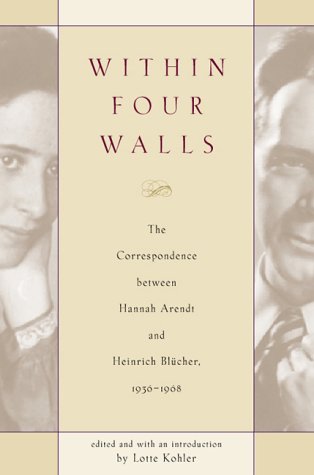
39. Within Four Walls: The Correspondence
$6.65
40. Hannah Arendt

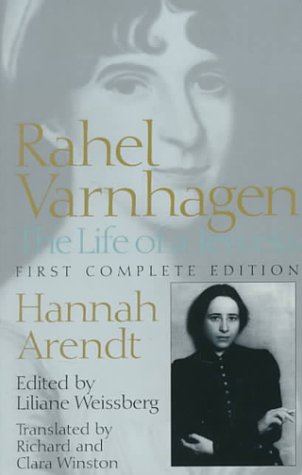
21. Rahel Varnhagen: The Life of a Jewess
by Hannah Arendt
Paperback: 400 Pages (2000-03-02)
list price: US$21.95 -- used & new: US$8.75
(price subject to change: see help)
Asin: 080186335X
Canada | United Kingdom | Germany | France | Japan
Editorial Review

Book Description

She was, Hannah Arendt wrote, "my closest friend, though she has been dead for some hundred years." Born in Berlin in 1771 as the daughter of a Jewish merchant, Rahel Varnhagen would come to host one of the most prominent salons of the late eighteenth and early nineteenth centuries. Arendt discovered her writings some time in the mid-1920s, and soon began to reimagine Rahel's inner life and write her biography. Long unavailable and never before published as Arendt intended, Rahel Varnhagen: The Life of a Jewess returns to print in an extraordinary new edition.

Arendt draws a lively and complex portrait of a woman during the period of the Napoleonic wars and the early emancipation of the Jews, a figure who met and corresponded with some of the most celebrated authors, artists, and politicians of her time. She documents Rahel's attempts to earn legitimacy as a writer and gain access to the highest aristocratic circles, to assert for herself a position in German culture in spite of her gender and religion.

Arendt had almost completed a first draft of her book on Rahel by 1933 when she was forced into exile by the National Socialists. She continued her work on the manuscript in Paris and New York, but would not publish the book until 1958. Rahel Varnhagen became not just a study of a historical Jewish figure, but a poignant reflection on Arendt's own life and times, her first exploration of German-Jewish identity and the possibility of Jewish life in the face of unimaginable adversity.

For this first complete critical edition of the book in any language, Liliane Weissberg reconstructs the notes Arendt planned for Rahel Varnhagen but never fully executed. She reveals the extent to which Arendt wove the biography largely from the words of Rahel and her contemporaries. In her extended introduction, Weissberg reflects on Rahel's writings and on the importance of this text in the development of Arendt's political theory. Weissberg also reveals the hidden story of how Arendt manipulated documents relating to Rahel Varnhagen to claim for herself a university position and reparation payments from the postwar German state.

... Read more

22. Between Friends: The Correspondence of Hannah Arendt and Mary McCarthy 1949-1975
by Hannah Arendt, Mary McCarthy
Paperback: Pages (1996-03)
list price: US$16.00 -- used & new: US$4.59
(price subject to change: see help)
Asin: 0156002507
Canada | United Kingdom | Germany | France | Japan

23. The Art of Being Free: Taking Liberties With Tocqueville, Marx, and Arendt (Contestations)
by Mark Reinhardt
 Hardcover: 234 Pages (1997-04)
list price: US$51.50 -- used & new: US$10.94
(price subject to change: see help)
Asin: 0801431379
Canada | United Kingdom | Germany | France | Japan
Editorial Review

Book Description
The "art of being free" is an essential part of democracy. It involves, Mark Reinhardt believes, bringing into being the multiple spaces in and practices through which individuals and groups help to constitute their lives, their selves, their worlds. Americans are presently witnessing a contraction of officially sanctioned spaces for citizen action. It is now crucial, Reinhardt argues, to identify ways of opening new spaces for the direct practice of democratic politics. Reinhardt treats the writings of Alexis de Tocqueville, Karl Marx, and Hannah Arendt as exemplary sources for an expansion of political possibility. These writers indicate where and how the new spaces can be brought into being, and they reveal acts of making space as some of the prime moments of politics. Reinhardt's extended readings of these writers, never previously treated together, are quite unlike the familiar understandings of their thought. "Taking liberties," he brings the literary and political sensibility usually associated with postmodernism to a sympathetic if critical encounter with eminently modern thinkers.The result is a strong and idiosyncratic book, accessible and stylish, that mixes acute readings of canonical thinkers with more practical applications and illustrations. Reinhardt combines attention to textual detail and nuance with concern for contemporary politics, discussing as an unusually inventive example the AIDS activist group ACT UP. ... Read more


24. Hannah Arendt: An Introduction
by John McGowan
Paperback: 194 Pages (1998-02)
list price: US$22.50 -- used & new: US$19.99
(price subject to change: see help)
Asin: 0816630704
Average Customer Review: 5.0 out of 5 stars
Canada | United Kingdom | Germany | France | Japan

Customer Reviews (1)

5-0 out of 5 stars Comprehensive, Clear, Clever
If Hannah Arendt has always intrigued you, but you never managed to read one of her books all the way through (or you wish you had read Arendt), this is the book for you.McGowan tells the story of her intellectual life, her passions, her ethics, her principles--in clear and readable prose that makes Arendt and her era come alive.I think it's the best little book ever written about Hannah Arendt. ... Read more


25. Zur Zeit. Politische Essays.
by Hannah Arendt, Marie Luise. Knott
Paperback: 230 Pages (1999-05-01)
-- used & new: US$21.83
(price subject to change: see help)
Asin: 3434530371
Canada | United Kingdom | Germany | France | Japan

26. Hannah Arendt (Key Contemporary Thinkers)
by Phillip Hansen
 Hardcover: 276 Pages (1994-02-01)
list price: US$55.00 -- used & new: US$55.00
(price subject to change: see help)
Asin: 0804721459
Canada | United Kingdom | Germany | France | Japan

27. Hannah Arendt and the Jewish Question
by Richard A. Bernstein
Paperback: 251 Pages (1996-07-11)
list price: US$24.00 -- used & new: US$15.95
(price subject to change: see help)
Asin: 0262522144
Average Customer Review: 5.0 out of 5 stars
Canada | United Kingdom | Germany | France | Japan
Editorial Review

Book Description
Hannah Arendt (1906-­1975) was one of the most original and interesting political thinkers of the twentieth century. In this new interpretation of her career, philosopher Richard Bernstein situates Arendt historically as an engaged Jewish intellectual and explores the range of her thinking from the perspective of her continuing confrontation with "the Jewish question."

Bernstein argues that many themes that emerged in the course of Arendt's attempts to understand specifically Jewish issues shaped her thinking about politics in general and the life of the mind. By exploring pivotal events of her life story ­ her arrest and subsequent emigration from Germany in 1933, her precarious existence in Paris as a stateless Jew working for Zionist organizations, her internment at Gurs and her subsequent escape, and finally her flight from Europe in 1941 ­ he shows how personal experiences and her responses to them oriented her thinking.

Arendt's analysis of the Jews' lack of preparation for the vicious political antiSemitism that arose in the last decade of the nineteenth century, Bernstein argues, led her on a quest for the ultimate meaning of politics and political responsibility. Moreover, he points out that Arendt's deepest insights about politics emerged from her reflections on statelessness and totalitarian domination. Bernstein also examines Arendt's attraction to and break with Zionism, and the reasons for her critical stance toward a Jewish sovereign state. He then turns to the issue that, in Arendt's opinion, needed most to be confronted in the aftermath of World War II: the fundamental nature of evil. He traces the nuances of her thinking from "radical evil" to "the banality of evil" and, finally, reexamines Eichmann in Jerusalem, her meditation on evil that caused a storm of protest and led some to question her loyalty to the Jewish people. ... Read more

Customer Reviews (1)

5-0 out of 5 stars A deep study despite the apologetics
Richard A. Bernstein traces Hannah Arendt's relationship to her own Jewishness, from her earliest experiences of Anti- Semitism in childhood to and through the 'banality of evil' controversy. He shows that certain fundamental concepts of her thought were strongly influenced by her experience as a stateless Jew.He details the story of her special connection with Kurt Blumenfeld and the thought of Charles Lazare which helped form her Zionism.
Her latter- day critique of Israel is considered as her passionate admission that the one public tragedy she could not think to bear would be the destruction of Israel.
As to her controversy with the Jewish community on the 'banality of evil'. My own sense is that Bernstein is a bit too sympathetic to her position, and that Scholem was essentially right in speaking of Arendt's distance from the ordinary Jewish people. Her insensitivity, even moral cruelty to the victims of the Shoah, is a black mark on her record, a record which includes a heroic chapter in her years in France helping foster Youth Aliyah, and saving Jewish children.
The story is complicated and always interesting. This is a deep study but a political thinker who understands Arendt well. ... Read more


28. Hannah Arendt and the Uses of History: Imperialism, Nation, Race, and Genocide
Hardcover: 282 Pages (2007-12-15)
list price: US$85.00 -- used & new: US$77.71
(price subject to change: see help)
Asin: 1845453611
Canada | United Kingdom | Germany | France | Japan

29. Hannah Arendt and Leo Strauss: German Émigrés and American Political Thought after World War II (Publications of the German Historical Institute)
Paperback: 220 Pages (1997-06-13)
list price: US$32.99 -- used & new: US$26.00
(price subject to change: see help)
Asin: 0521599369
Canada | United Kingdom | Germany | France | Japan
Editorial Review

Book Description
This book explores the influence of Hannah Arendt's and Leo Strauss' background in pre-World War II Germany on their perception of American democracy.The contributors analyze how their émigré experience both influenced their American work and also impacted on the formation of the discipline of political science in postwar Germany.Arendt's and Strauss' experiences thus aptly illustrate the transfer and transformation of political ideas in the World War II era. ... Read more


30. Hannah Arendt: Critical Essays (Suny Series in Political Theory : Contemporary Issues)
 Paperback: 422 Pages (1994-02)
list price: US$21.50
Isbn: 0791418545
Canada | United Kingdom | Germany | France | Japan

31. Crises of the Republic: Lying in Politics; Civil Disobedience; On Violence; Thoughts on Politics and Revolution
by Hannah Arendt
Paperback: 252 Pages (1972-05-10)
list price: US$15.00 -- used & new: US$8.92
(price subject to change: see help)
Asin: 0156232006
Average Customer Review: 5.0 out of 5 stars
Canada | United Kingdom | Germany | France | Japan
Editorial Review

Book Description

A collection of studies in which Arendt, from the standpoint of a political philosopher, views the crises of the 1960s and early 1970s as challenges to the american form of government. Index.
... Read more

Customer Reviews (1)

5-0 out of 5 stars An Honest View vs. Political Lying
This reviewer considers Hannah Arendt as a "Renaissance Woman."She was learned individual who wrote profoundly on philosophy, history, political thought, etc.Her book CRISES OF THE REPUBLIC again demonstrates her knowledge, profound thought, and ability to write.THE CRISES OF THE REPUBLIC is a book that clearly diagnoses political problems in the United States which she states undermine both civil liberties and government honesty.

This book was first published in 1969 in the midst of the controversy over the Vietnam War.An import section of this book deals with the China Series documents and correspondence between Mao tse Tung who approached American diplomats to extend diplomat overtures because of Chinese leaders fears of Soviet power and influence.These efforts were ignored and only came to light in 1969 which was 16 years after the conclusion of the Korean War which involved the Chinese Communists vs. the Americans.Miss Arendt also reveals documents that showed that that Ho Chi Minh appealed American policy makers to extend U.S. control over Vietnam to avoid re-occupation by the French who had Vietnam as a colony prior to World War II.These efforts were refused and kept secret from Americans so that a Cold War mentality could be maintained at the expense of truth and then the lives of American kids who suffered and died in the Korean and Vietnam wars.In other words, Miss Arendt reveals that documents demonstrate that neither of these wars were necessary. What happened and is happening is that political and bureaucratic blundering have been substituted for truth and honesty.

Part of American political history in the late 1960s included dissent and civil disobedience.Those in powerclaimed that public demonstrations against the Vietnam War and the draft were part of a secret conspiracy.Miss Arendt demolishes this conclusion by writing that a public demonstraion by its very nature is not a secret conspiracy.Otherwise it is not public.She also warns that radicalism on campuses had a dangerous tendency to impose ideology rather than achieve goals and inform "public opinion."

The latter sections of the book are informative regarding the status of those in power on the other side of the Iron curtain.An interesting point that Miss Arendt makes is that for all the communist propaganda about the Capitialisic West, the gulf between rich and poor behind the iron curtain was much greater.She comments that the communist authorities had devolved from socialist ideals to entrenched bureaucrats who tried to protect their "turf" from economic and political realities.Events since the late 1980s have vindicated Miss Arendt with the collapse of Big Communism.

Hannah Arendt shows her vast knowledge and profound thought in one of her last books.CRISES OF THE REPUBLIC is timely and well written.She makes remarks that should alert Americans about blundering into quagmire wars and creating enemies to insure that useless bureaucrats maintain their positions by lying about supposed enemies who in reality do not exist.This has been expensive in terms of treasure and blood. ... Read more


32. Hannah Arendt and the Meaning of Politics (Contradictions of Modernity Series)
 Paperback: 362 Pages (1997-09)
list price: US$27.50 -- used & new: US$27.50
(price subject to change: see help)
Asin: 081662917X
Canada | United Kingdom | Germany | France | Japan

33. Hannah Arendt: Twenty Years Later (Studies in Contemporary German Social Thought)
Paperback: 392 Pages (1997-08-01)
list price: US$32.00 -- used & new: US$15.00
(price subject to change: see help)
Asin: 0262631822
Canada | United Kingdom | Germany | France | Japan
Editorial Review

Book Description
Hannah Arendt (1906-1975) was one of the most important political philosophers of our century. Now, twenty years after her death, this collection of fifteen essays brings her work into dialogue with those philosophical views that are at center stage today--in critical theory, communitarianism, virtue theory, and feminism. An extensive bibliography of work on Arendt in English is included as an appendix.

THE ESSAYS

- Hannah Arendt as a Conservative Thinker - Margaret Canovan

- Hannah Arendt on Judgment: The Unwritten Doctrine of Reason - Albrecht Wellmer

- The Moral Costs of Political Pluralism: The Dilemmas of Difference and Equality in Arendt's "Reflections on Little Rock," - James Bohman

- Socialization and Institutional Evil - Larry May

- The Commodification of Values - Elizabeth M. Meade

- Did Hannah Arendt Change Her Mind?: From Radical Evil to the Banality of Evil - Richard J. Bernstein

- Evil and Plurality: Hannah Arendt's Way to The Life of the Mind, I - Jerome Kohn

- The Banality of Philosophy: Arendt on Heidegger and Eichmann - Dana R. Villa

- Thinking about the Self - Suzanne Duvall Jacobitti

- Novus Ordo Saeclorum: The Trial of (Post)Modernity or the Tale of Two Revolutions - David Ingram

- The Political Dimension of the Public World: On Hannah Arendt's Interpretation of Martin Heidegger - Jeffrey Andrew Barash

- Love and Worldliness: Hannah Arendt's Reading of St. Augustine - Ronald Beiner

- Women in Dark Times: Rahel Varnhagen, Rosa Luxemburg, Hannah Arendt, and Me - Bat-Ami Bar On

- Hannah Arendt among Feminists - Elisabeth Young-Bruehl

- Ethics in Many Voices - Annette C. Baier ... Read more


34. Between War and Politics: International Relations and the Thought of Hannah Arendt
by Patricia Owens
Hardcover: 232 Pages (2007-08-25)
list price: US$50.00 -- used & new: US$38.57
(price subject to change: see help)
Asin: 0199299366
Canada | United Kingdom | Germany | France | Japan
Editorial Review

Book Description
This is the first book length study of war in the thought of one of the twentieth-century's most important and original political thinkers. Hannah Arendt's writing was fundamentally rooted in her understanding of war and its political significance. But this element of her work has surprisingly been neglected in international and political theory. This book fills an important gap by assessing the full range of Arendt's historical and conceptual writing on war and introduces to international theory the distinct language she used to talk about war and the political world. It builds on her re-thinking of old concepts such as power, violence, greatness, world, imperialism, evil, hypocrisy and humanity and introduces some that are new to international thought like plurality, action, agonism, natality and political immortality. The issues that Arendt dealt with throughout her life and work continue to shape the political world and her approach to political thinking remains a source of inspiration for those in search of guidance not in what to think but how to think about politics and war. Re-reading Arendt's writing, forged through firsthand experience of occupation and struggles for liberation, political founding and resistance in time of war, reveals a more serious engagement with war than her earlier readers have recognised. Arendt's political theory makes more sense when it is understood in the context of her thinking about war and we can think about the history and theory of warfare, and international politics, in new ways by thinking with Arendt.This book is a project of the Oxford Leverhulme Programme on the Changing Character of War. ... Read more


35. Hannah Arendt: An Intellectual Biography
by Michelle-irene Brudny
Hardcover: 250 Pages (2008-03)
list price: US$24.95 -- used & new: US$16.47
(price subject to change: see help)
Asin: 1933633352
Canada | United Kingdom | Germany | France | Japan
Editorial Review

Book Description
With her argument that Hannah Arendt began to formulate key ideas of her masterpiece, The Origins of Totalitarianism, years earlier than previously thought-well before World War II and anticipating the horrors of Nazism-Michelle-Irene Brudny overturns traditional Arendt scholarship. Based on that groundbreaking and persuasive claim, in Hannah Arendt Brudny rejects the proposition that Arendt is primarily a polemical writer and shows instead that she was truly an original thinker.In this first intellectual biography of Arendt, Brudny traces the development of Arendt's philosophy, showing her wide-ranging interests and her intellectual growth. She clearly delineates the influence of Arendt's philosophy teacher and lover, Martin Heidegger, and illuminates Arendt's complex relationship with Judaism-which Arendt never saw as her "repellant doppelganger," as has been sometimes said. Brudny also examines the importance of Arendt's American years through French eyes - a new and original approach.The writings and philosophies of Hannah Arendt have never been more relevant, especially in the context of today's violence and barbarism. With fascinating details about her life and her influence on contemporary philosophy, this brief biography-one of only two Arendt biographies available in English-is an excellent guide to the life and work of one of the twentieth century's most important thinkers. ... Read more


36. Hannah Arendt: For Love of the World, Second Edition
by Elisabeth Young-Bruehl
Paperback: 620 Pages (2004-10-11)
list price: US$23.00 -- used & new: US$15.90
(price subject to change: see help)
Asin: 0300105886
Average Customer Review: 5.0 out of 5 stars
Canada | United Kingdom | Germany | France | Japan
Editorial Review

Book Description

This highly acclaimed, prize-winning biography of one of the foremost political philosophers of the twentieth century is here reissued in a trade paperback edition for a new generation of readers. In a new preface the author offers an account of writings by and about Arendt that have appeared since the book’s 1982 publication, providing a reassessment of her subject’s life and achievement.
Praise for the earlier edition:
“Both a personal and an intellectual biography . . . It represents biography at its best.”—Peter Berger, front page, The New York Times Book Review
“A story of surprising drama . . . . At last, we can see Arendt whole.”—Jim Miller, Newsweek
“Indispensable to anyone interested in the life, the thought, or . . . the example of Hannah Arendt.”—Mark Feeney, Boston Globe
“An adventure story that moves from pre-Nazi Germany to fame in the United States, and . . . a study of the influences that shaped a sharp political awareness.”—Richmond (Va.) Times-Dispatch

... Read more

Customer Reviews (2)

5-0 out of 5 stars Greatness of mind
FOR LOVE OF THE WORLD

This work is an outstanding intellectual biography,detailed consideration of both the life and work of one of the twentieth- century's great political figures. I learned much from it, and it was a great pleasure to read it.
Among the revelations of the work to me was the depth of Arendt's involvement in Jewish communal work during her six years in Paris in the late thirties, and during her first years in America. The knowledge of her dedication and courage in this work makes even more painful one of the central episodes of this work and her life, the controversy that her `Eichmann in Jerusalem' book created. Here despite Young- Bruehl's careful defense of Arendt it seems to me that she committed a major error. This does not in my opinion relate so much to her much misinterpreted concept of the ` banality of evil' but rather through her tone and manner of writing about the victims. Arendt whose central value in life was friendship and loyalty to those friends without intention `betrayed' according to their feeling the `victims' and again without intending to seemed to implicate in the evil that they suffered.
This chapter of her life came after she had already published her monumental work ,"The Origins of Totalitarianism'. In this biography we learn how Arendt prepared for this work, for understanding the connection between the totalitarian terror of the Nazis and that of the Soviets. Here a central part was played by her second husband Heinrich Blucher her instructor in radical revolutionary thought. We learn how this work grew out of her classical philosophical training and her constant concern with the meaning of political action.
In fact I found the first half of this biography which tells us about her life and work leading up to the `Origins of Totalitarianism' to be more engaging than the second half. In the first half we learn more about her personal story, of the central role her mother widowed when Hannah was seven played in her life. We see the development of her strong , independent personality. We follow her in the world of studies with Heidegger, and Jaspers and in the story of her romantic liasons ( including the one with Heidegger) and two marriages.Weare made to understand too the general climate of the time of Germany in the twenties and early thirties.
Again one of Arendt's greatest gifts was for friendship. And her life is filled with encounters with and friendships with remarkable people, a number of whose stories are told in one of her best books, " Men in Dark Times".
If I were to find fault with this biographywhich contains so much more than I have indicated in this brief review is that it does not it seems to me analyze critically the basic relationships of Arendt's life. For there are problematic sides morally to the friendship with Heidegger, who had a Nazi period- questionable areas in her relation to her second husband, however intellectually strong their connection was. I too think that for one who so valued the faculty of Judgment, Arendt's numerous political errors in judgment should have been considered here. As one who came from the world of catastrophe she was too ready to see America on the verge of , or going into catastrophe. And to my mind her late books `On Violence' and ` On Revolution' are the weakest of her offerings.
However it is necessary to stress that this biography really brings Arendt, and her inner life to life. It does this especially by bringing examples of her poetry, the record of her inward life. As I understand it this poetry has not appeared in a volume of its own and it seems to me that a dual German- English language edition of her complete poems , annotated properly would be a great contribution to our understanding of her and her work.
There are many `moving and great moments in this work and in Arendt's life. Among those moments are the description of her participating in a seder at the house of Louis Finklestein in the last year of her life. Here, she who had become a bit of a pariah in the Jewish world was as it were welcomed back home, and she joined in the singing of the traditional Passover songs. Another such great moment was her meeting with Blucher after her period in an interment camp at Gurs, when he too was a fugitive. This reunion set them on their way to America.
This book does a very good job of analyzing Arendt's standing as a scholar , her evaluation in the eyes of her colleagues, the great appreciation had for her by many at the highest level of human thought.
I think that if there was a chapter on her in `Men in Dark Times' it should certainly have the word ` Greatness' in it.
This book is a gift to all those who love the life of the mind. I cannot recommend it more highly.

5-0 out of 5 stars a fascinating ,well written and judicious biography
This book has become something of a classic. It unearths a mass of detail about Arendt's life - the pages on her upbringing and experiences before her flight from Europe are particularly memorable. However, the main focusis kept firmly on the way Arendt's thought developed during her life. Theauthor [who knew Arendt in her later years] is well versed in philosophyand political thought and so her account becomes a useful companion tostudies of Arendt's many contributions to modern thought:'totalitarianism', 'the banality of evil', the loss of public space in thecontemporary west and much more. Thisbook is not the kind of simpleminded attempt to reduce thought to biography that we see all too often.While it is no hagiography [Arendt comes in for some serious criticism onoccasion], itends with a sense of celebration for a life well lived, oneof passionate thinking motivatedby 'love of the world' ... Read more


37. The Origins of Tatalitarianism
by Hannah Arendt
 Paperback: Pages (1958)

Asin: B000N90HZ6
Canada | United Kingdom | Germany | France | Japan
Editorial Review

Product Description
"not only an achievement in historiography, but also in political science... (including) the rights of man, in philosophy and ethics... itself a social force not to be underestimated." David Riesman ... Read more


38. Letters : 1925-1975
by Hannah Arendt, Martin Heidegger
Hardcover: 360 Pages (2003-12-01)
list price: US$28.00 -- used & new: US$9.98
(price subject to change: see help)
Asin: 0151005257
Average Customer Review: 4.5 out of 5 stars
Canada | United Kingdom | Germany | France | Japan
Editorial Review

Book Description

When they first met in 1925, Martin Heidegger was a star of German intellectual life and Hannah Arendt was his earnest young student. What happened between them then will never be known, but both would cherish their brief intimacy for the rest of their lives.
The ravages of history would soon take them in quite different directions. After Hitler took power in Germany in 1933, Heidegger became rector of the university in Freiburg, delivering a notorious pro-Nazi address that has been the subject of considerable controversy. Arendt, a Jew, fled Germany the same year, heading first to Paris and then to New York. In the decades to come, Heidegger would be recognized as perhaps the most significant philosopher of the twentieth century, while Arendt would establish herself as a voice of conscience in a century of tyranny and war.
Illuminating, revealing, and tender throughout, this correspondence offers a glimpse into the inner lives of two major philosophers.

... Read more

Customer Reviews (6)

4-0 out of 5 stars Thepassionate and morally problematic love of two of the greatest thinkers of the century
This collection of letters is as one- sided as the relationship between Heidegger and Arendt was in certain respects. In this collection Heidegger is the one who speaks, over three - fourths of the one- hundred sixty- six letters are his. We do not have key documents, Arendt'searly letters to Heidegger which were destroyed either by Heidegger himself ora member of his family.
The relationship in the first stage at Marburg in 1925 was of the great intellectual figure Heidegger, already a person of tremendous reputation,thirty- five married with children, and that of an eighteen oldstudent worshipper. The illicit love affair was clearly passionate and deeply felt on both sides.
However in little more than a year there are signs that he does not mind her going out with a fellow student,and off to study somewhere else a sign perhaps of his being troubled that the affair exposed might cause harm to his reputation.
A second stage came with the rise of the Nazis to power , Arendt's exile, and Heidegger's becoming a collaborator with the Nazi regime. At this stage Arendt becomes disturbed about allegations of Heidegger's anti- Semitism.
The third stage came after a long hiatus in letter - writing. It was only after the war that there was a renewal of their relationship, though it is not clear that this was also a romantic renewal. For by this time Arendt was married to Heinrich Blucher. At this point Arendt played the role of advisor to Heidegger in helping him deal with the charges of collaboration with the Nazis. This chapter is not one which does Arendt credit. Her readiness to not simply excuse Heidegger for his revolting behavior, (including anti- Semitic remarks, dismissal of Jewish colleagues, a use of concepts of his own philosophy in a pro- Nazi speech, ) but to help him get off the hook reflects a loyalty void of all judgment. And this from the philosopher for whom 'judging' was a fundamental philosophical category.
Their post- war reconciliation was prompted and pushed by Heidegger's viciously anti- Semitic wife, Elfreide. Elfreide despised Arendt but understood that she could help Heidegger, and so encouraged the renewal of the relationship. Heidegger for his part never read Arendt's work and could not give her the kind of respect and esteem that she continued to give him.
Heidegger and Arendt are profound souls, and this is felt in the content and tone of these letters. They are people of high ideals and aspirations. They are two of the most significant thinkers of the twentieth century. Their story of love and friendship is a fascinating one. And whatever additional light is thrown on this relationship is eagerly seized upon by students of their work. Yet their relationship illicit at the outset , later became even more suspect as it worked to cover up Heidegger'simmoral behavior. The dishonesty and evasiseness of Heidegger in dealing with the charges against himis all the more reprehensible as it is that of one whose fundamental enterprise is in striving for Truth.Arendt'sexcess of caring to protect Heidegger are in painful and troubling contrast with her insensitity to survivors of the Shoah, this of course in her famous 'banality of evil' analysis of the action of Eichmann. Her tone in ' Eichmann in Jerusalem' was contemptuous and superior, a tone she might too have learned from Heidegger. There are those who claim that the final phase of the Heidegger- Arendt relationship involved a reversal in which she was the powerful one and he the one more needing and enslaved. But these letters do not seem to bear this out. Her loyalty to him and love enabled her to continue serving him too well to the end of their days. She died in the latter half of 1976 and he only six months later.

.

3-0 out of 5 stars Some ontics
Most of the material in this correspondence between Martin Heidegger and Hannah Arendt shouldn't come as much of a surprise to most students who are familiar with these great thinkers's respective work. Although, there is surprisingly little discussion of the unfortunate political situation of Heidegger, I suppose the de-Nazification trials exhausted the subject. Still, this is a nice collection of letters; what unfolds are the painful vicissitudes of their affair, and the almost complete destruction of their (and their families) lives on account of WWII. What is a pleasure to read here, however, is Heidegger's casual remarks on his serious philosophical projects, it provides an excellent window into his craft. One reaction, though it hardly comes as a surprise: Heidegger was a terrible poet. For example:

"SONATA SONANS"
What rang rings.
It sinks
Into lament's unknown ware's
Sings into what no one dares,
What's formed from the wreath,
Takes place,
Gentle's love and woe
Into the Same.

Etc. Etc.

Perhaps the most problematic aspect of this collection is (at least for me), that it turns the reader into a creepy voyeur who peers into these personal love letters. Still, there is enough scholarly material contained within for scholars and students to make it a worthwhile collection.

5-0 out of 5 stars Poetry and how personal histories matter
Everybody knows what two people in a situation like Hannah Arendt and Martin Heidegger in 1925, a female student and a married philosophy professor, shouldn't say to each other.With imaginary docudramas filling in the blanks of the lives of so many famous people in ways that fulfill the fantasies of millions of TV viewers, as well as the readers of historical novels, those who watch movies about Samson, and theologians who wonder what Adam and Eve ever saw in the forbidden fruit, it is a relief to be getting some actual documents from a famous romance.Heidegger's fame was growing rapidly at the beginning of this book, and Hannah Arendt was bound to become known for paying attention.The fiftieth item in this book, "Martin Heidegger for Hannah Arendt:Five Poems," ends with the short poems:

Correspondence

Godless is God
alone, and no
other thing--
death first
corresponds,
to the ring
of Being's poem,
the first.

DEATH

Death is, in the world's own rhyme,
Being's mountain chain.
Death will evade what's yours and mine
in the falling weight
falling toward silence's tor,
star of earth, nothing more.

For the friend's friend (pp. 63-64, prior to a letter dated Febr. 15, 1950).

Hannah Arendt responded in item 127, twenty years later, a few weeks after Heidegger sent her a poem about time, but trying to quote the earlier poem, from New York, on November 27, 1970:

Dear Martin,
For days, weeks, I have wanted to write to you, at least to tell you how much good your letter did me, your sympathy, the time poem as an aid to reflection.Together with the other from many, many years ago

Death is, in the world's design,
Being's mountain chain.
Death will evade what's yours and mine
In the falling weight.
Falling toward silence's tor,
Star of earth, nothing more. (p. 173).

British users of the English language might know that tor is a hill.Heinrich Blucher had died and a memorial service was held at Bard College on November 15.Like soldiers in a time of mounting casualties, people of different ages often have unsettled feelings about death because which will survive is not obvious.Hannah Arendt died in December, 1975, a few months before Heidegger's death in May, 1976.The `Romeo and Juliet' ending of fifty years of being German, Jewish, or American thinkers, bound together by an interest in the years that offered multiple lessons to be learned on both sides, makes this a bit more interesting to me than the other collections of Hannah Arendt's Letters with Karl Jaspers, Mary McCarthy, Hermann Broch, Kurt Blumenfeld, and Heinrich Blucher.

This book mentions Nietzsche or Heidegger's book about Nietzsche about a dozen times, but the interesting comments are in Hannah Arendt's tribute, "Martin Heidegger at eighty" on pages 148-162, and a brilliant short description of Heidegger as a fox in July 1953 which ends with:

But the fox living in the trap said proudly:So many fall into my trap; I have become the best of all foxes.And there was even something true in that:nobody knows the trap business better than he who has been sitting in a trap all his life.(p. 305).

Most of us could apply the trap business view to everything in life that requires our involvement.Longing for a few ideas, we can pick up a book like this as the inside and outside view of an intellectual trap.Lacking the ability to read this book all at once, I had bookmarks in several places for weeks at a time as my ability to comprehend was expanding to get a grip on what this book has to offer.The Index is helpful for those who have particular interests.Minor items like Beethoven's Piano Sonata No. 32 in C minor are not to be found in the Index, however much it might have been on Heidegger's mind when he wrote his letter of April 12, 1950, listing Beethoven, opus 111 Adagio, Conclusion as an addressee on page 74 and thanking Hannah for the opportunity to listen to it:

"And now, Hannah, you have, on top of everything, and with a loving word, also given me Beethoven's Opus 111.Its sound has already become kin to the light I mentioned at the beginning of this letter.

"Elfride returns your greeting and kiss with a happy heart and is glad you returned home safely.Say hello to your dear husband from me."(p. 76).

The index does not have an entry for Elfride Heidegger on page 76, but it did list page 74, where Heidegger wrote about "what is loving about love that cast its light into my room when Elfride and you embraced.We will need time to make what has become of us our own:That you came, that what grew close in us became the closest closeness; that Elfride was helpful with all of it, that our love needs her love; that everything, including your safe return home, is reflected, clarified, and validated in everything else."

I'm sure that Nietzsche wrote that a married philosopher, like Socrates, ought to be cast in some comedy, as Aristophanes did with Socrates in `The Clouds' in 423 B.C., a comedy which placed last in the competition with Cratinous and Ameipsias at the Great Dionysia in the month of March, 423 B.C.Fortunately, Aristophanes revised his comedy, so "The Clouds' that we have today, "as purely farcical as the presentation of the philosopher himself suspended in a basket betwixt heaven and earth" in the notes for the Rogers translation, might be much better than running through it the first time.Heidegger's opportunity in these LETTERS to get himself right all over again after five half decades had passed has a miraculous quality, to say the least.

5-0 out of 5 stars Arendt and Heidegger in Letters
This collection of letters is an absolute necessity for anyone interested in Hannah Arendt, and particularly her relationship with the controversial German philosopher (and mentor) Martin Heidegger.The letters are well annotated and there is a helpful introduction as well.The only problem is that there are relatively few letters from Arendt.And those that appear in the collection are somewhat concise, whether from the editing or simply because they were not extensive. As a result, the reader does not get the intimate and expansive view into Arendt's thinking and activities that one comes away with from reading, for example, her collection of letters to and from Mary McCarthy. Of particular interest is the exchange of poetry between the two--somewhat ironic given Heidegger's controversial career and purported anti-Semitism during the Nazi period.One cannot help thinking, as the letters pass by, as to why Arendt chose to treat Heidegger with such kid gloves; nonetheless, there is a touching quality about this late-in-life correspondence of two former lovers.Quite pleasant and informative and not overly technical in philosophical terms.

5-0 out of 5 stars Finally Available
Perhaps it's a sign of the times in which we live, but the biggest stories of recent note in philosophy have been Heidegger's flirtation with National Socialism and the revelation of his affair with his student, Hannah Arendt, in the 1920s. The affair with Arendt has left a bad account of the affair (Ettinger) and a badly written novel in its wake, but perhaps these lumps of fool's gold have led us to the real thing, for they helped persuade Heidegger's son, Herman, to open the private files of his famous father and release these letters to the public. These, along with the letters to Arendt that are extant, comprise a volume that belongs in the library of every serious student of Arendt and Heidegger. It provides a glimpse of the lives and thought of two intellectual giants and of how events led to their estrangement and shaky reconciliation.

The first part of the book comes across as a one-way conversation, as only Heidegger's letters to Arendt are extant. Obviously Heidegger was smart enough to destroy Arendt's letters lest they fall into the hands of Mrs. H. The tone of these early letters is that of a besotted adolescent. Heidegger sends her bad poetry and, in one letter, refers to her as his "little wood nymph." As these letters were meant to be strictly private, we cannot help but suffer the embarrassment of an unintentional voyeur. However, the section ends on an ominous note with a letter from Heidegger in 1933 answering Arendt's charges that he is anti-Semitic. This came shortly after the ascension of Hitler and makes us sad that Heidegger destroyed Arendt's letter making the charges.

The correspondence begins anew after the war and only because Arendt saw it in her heart to forgive her former mentor and in effect bury the hatchet. Heidegger seems most pleased and the letters lead to a personal reconciliation with Arendt visiting Heidegger and his wife in Germany. But all was not to remain quiet. Heidegger had confessed all to his wife, and took her willingness to see Arendt again as a sign all was back to normal, as it were. The letters he sends in 1950 give the impression that he is more than willing to resume their affair; to once again have his cake and eat it, too. But a sudden dispatch from Heidegger warns Arendt to cancel a postponed visit and not to write for a while. Seems Elfride Heidegger was not the willing accomplice her husband believed her to be.

But time heals all and the letters (and visits) resume. Heidegger is more interested in what he is doing and the American response than in what Arendt is doing. In one telling letter, he admits he has no idea of what she means by "radical evil." Another subject on which Arendt treads lightly is that of Karl Jaspers: Jaspers and Heidegger attempted a reconciliation after the war, but failed and each has bitterness toward the other with Arendt playing the diplomat in the middle, though in her letters with Jaspers there is no doubt about whose side she is on.

Another missed opportunity is the sudden death of Merleau-Ponty a few months before he was to meet Heidegger in Marburg. Arendt has a higher opinion of him than does Heidegger, although in a philosophical debate I'd place my money on Merleau-Ponty, whose forays into aesthetics, ontology and physics expose Heidegger as stuck in a neo-Kantian continuum.

All in all, this is the book students of these two intellectual giants have waited for, and I, for one was not disappointed in the least. ... Read more


39. Within Four Walls: The Correspondence between Hannah Arendt and Heinrich Bl¿cher, 1936-1968
by Hannah Arendt, Peter Constantine
Hardcover: 700 Pages (2000-11-17)
list price: US$35.00 -- used & new: US$11.66
(price subject to change: see help)
Asin: 0151003033
Average Customer Review: 5.0 out of 5 stars
Canada | United Kingdom | Germany | France | Japan
Editorial Review

Book Description

Here is the life story of two exceptional people, two Germans who fled their country for different reasons. It is the story of their life in exile in Paris and in New York, their dependence on each other and deepening love, their continued exchange of ideas, Arendt's teaching and writing, her involvement with Jewish life in Europe and in Israel, and Blucher's years at The New School and at Bard College. It is also an important document of the '30s in Germany and France, of World War II, and the post-war life in ravaged European cities. Meanwhile, there is love of food and drink, and of friendship-both intellectual and affectionate-with Karl Jaspers, Mary McCarthy, Alfred Kazin, and the complex relationship with Martin Heidegger and his wife. Within Four Walls is an extraordinary personal and historical record.
... Read more

Customer Reviews (1)

5-0 out of 5 stars Intimacy at Its Highest Level
Hannah Arendt has had much of her correspondence published over the last decade or so. We have volumes of her correspodence with Karl Jaspers, Mary McCarthy, Kurt Blumenfeld, and Martin Heidegger, among others. But these letters between Arendt and husband Heinrich Blucher stand out as the finest volume yet published. Whereas in the other volumes we see Arendt as student, friend, confidant, teacher, philosopher, intellectual, in these letters with Blucher we see Arendt as intimate confidant, vulnerable lover, and supportive wife. Heinrich Blucher was the one person to whom she could reveal herself, with whom she dropped her guard. The confidence was mutual as well; in Blucher's letters to Hannah we see his hopes, frustrations, trepidations, and above all, his devoted attachment to her hopes, needs and ambitions. Two people for whom the other was much more than a spouse or lover: someone in whom to take refuge in dark times.

The letters begin in 1936, shortly after Arendt and Blucher met in Paris, to which both escaped from Berlin in 1933: she after a short prison term for illegal Zionist activity, and he as a member of the German Communist Party, fleeing via Prague. At the time they met she was 29 and he 37. Both were married, but not to each other. They would not marry until 1940, shortly after their divorces became final.

Their first letters set the tone. Interspersed with intellectual and political affairs are their feelings for each other and their doubts and a lasting commitment can be achieved. IT grows from there, in all aspects, intellectual and emotional. When Arendt reproaches Blucher for not sticking to their letter-writing schedule, she tells him that she cannot continue to careen like a car wheel that has come off, "without a single connection to home or anything I can rely on."

They also discuss mutual friends such as Karl Jaspers, Mary McCarthy, Alfred Kazin, and Martin Heidegger (whose relationship over the years with Arendt can only be described as ambivilent), holding nothing back and giving the reader a rare glimpse into their intellectual and social world, a glimpse one can only imagine in a formal biography of the two. As no one writes letters anymore, this is a most valuable look into an intellectual time and world as distant from our cyber-present as last century's history.

Worth your time and money? Yes - in every sense of the word. ... Read more


40. Hannah Arendt
by Julia Kristeva
Paperback: 320 Pages (2003-07-15)
list price: US$23.00 -- used & new: US$6.65
(price subject to change: see help)
Asin: 0231121032
Average Customer Review: 4.0 out of 5 stars
Canada | United Kingdom | Germany | France | Japan
Editorial Review

Amazon.com
Julia Kristeva's Hannah Arendt brings together two of the best minds in 20th-century philosophy; two who are especially noteworthy because they are visionary women in a field long dominated by men. Appropriately, the book is, in part, a tribute to Arendt, one of a series of looks at female genius. Kristeva brings her considerable scholarly arsenal, which includes linguistics, literary criticism, philosophy, feminism, aesthetics, cultural studies, and psychoanalysis. In particular, her psychoanalytic bent makes for an incisive look at Arendt because she was "gripped from the start by that unique passion in which life and thought are one.... [She] consistently put life--both life itself and life as a concept to be analyzed--at the center of her work."

Arendt is certainly one of the 20th century's brightest intellectual luminaries. Penning The Human Condition and Eichmann in Jerusalem, she wove her accounts of philosophy with a unique penchant for narrative and personal reflection, vivified by her extraordinary life. Throughout this biography, Kristeva plies Arendt's trade, using Arendt's life to illuminate her thought. By turns she examines Arendt's use of narrative, her ratiocinations on Jewish-ness and anti-Semitism, and her political philosophy. Kristeva's insightfulness in this volume will help ensure her a place in the canon alongside Arendt. --Eric de Place Book Description

Twenty-five years after her death, we are still coming to terms with the controversial figure of Hannah Arendt. Interlacing the life and work of this seminal twentieth-century philosopher, Julia Kristeva provides us with an elegant, sophisticated biography brimming with historical and philosophical insight.

Centering on the theme of female genius,Hannah Arendt emphasizes three features of the philosopher's work. First, by exploring Arendt's critique of Saint Augustine and her biographical essay on Rahel Varnhagen, Kristeva accentuates Arendt's commitment to recounting lives and narration. Second, Kristeva reflects on Arendt's perspective on

Judaism, anti-Semitism, and the "banality of evil." Finally, the biography assesses Arendt's intellectual journey, placing her enthusiasm for observing both social phenomena and political events in the context of her personal life.

Drawing on fragments of Arendt's most intimate correspondence with her longtime lover Martin Heidegger and her husband Heinrich Blucher, excerpts from her mother's "Unser Kind" (a diary tracking Hannah's formative years), and passages from Arendt's philosophical writings, Kristeva presents a luminous story. With a thorough thematic index and bibliographical references,Hannah Arendt is a major breakthrough in the understanding of an essential thinker.

... Read more

Customer Reviews (1)

4-0 out of 5 stars The intellectual overview of a political science genius
It has been a long time since I went to a baseball game, but trying to keep track of the intellectual action in the biography of Hannah Arendt by Julia Kristeva reminded me of the game.Eventually, I even thought of a song, "Catfish" by Bob Dylan (Words by Bob Dylan and Jacques Levy) recorded on July 28, 1975, an outtake from the album "Desire" that was finally released in a three-CD package called "The Bootleg Series Volumes 1-3 [rare and unreleased] 1961-1991."There was once a pitcher called Catfish Hunter, million dollar man, and Dylan's chorus said, "Nobody can throw the ball Like Catfish can."I have had the words since "The Songs of Bob Dylan" was released in 1976, but I didn't hear the song until 1991.Having an English translation from 2001 of a feminist biography of a political scientist of the mid-twentieth century captures the intellection activity that interests me about as well as "Catfish" captures the action of a baseball game.

Lazy stadium night, Catfish on the mound,
"Strike three" the umpire said,
Batter have to go back and sit down.

There are three chapters in HANNAH ARENDT, and the third has 219 notes.Basic statistics on how much Julia Kristeva is merely educating herself in public by providing a reading from Arendt's books might be obtained by counting the Ibid.s.Counting backwards, I found 133 Ibid.s in the notes for Chapter 3, including my favorite note:

"99."Letter to the Romans 7:21, drafted between 54 and 58 a.d., cited in ibid., p. 64."(p. 268).

A lot of the books I read lately keep trying to tell me when the Bible was written, but I never noticed it in a note before.Usually my favorite notes are about Nietzsche, like:

"123.Ibid., p. 165, citing Nietzsche, THE GAY SCIENCE, no. 310"

"126.Concerning the `forgetting' that Nietzsche revives see p. 237; and Paul Ricoeur, paper presented at the Hannah Arendt Conference at the Grande Bibliotheque de France, December 6, 1997."

"128.Ibid., pp. 169-70, citing Nietzsche, THE WILL TO POWER, no. 585 A, pp. 316-19."

`131.LM, "Willing," p. 172, citing Nietzsche, THUS SPOKE ZARATHUSTRA, pt. 3, "Before Sunrise." '

`187.Ibid., citing Nietzsche, "The Use and Abuse of History," pp. 6, 7.'

"189.Ibid., citing Nietzsche, THE GENEALOGY OF MORALS, p. 61"

`192.Ibid., pp. 63, 72-73 ("even in old Kant:the categorical imperative reeks of cruelty").'

Nietzsche wrote such things about Kant, and it is a bit difficult to imagine that Kristeva and Arendt would associate such ideas with the great weight of the past if Nietzsche hadn't made this connection first.Understanding philosophy is a process that can be compared to intellectually building a rehash of old, familiar plays, as if it is about something like a baseball game, which has an umpire who gets to decide when an easy pop fly is an infield fly rule call that makes the batter out, but the umpire does not have time to say anything until after it is all over when a triple play picks off the runners before they have a chance to tag up if the pitcher ducks under a line drive that gets caught right on second base before anyone has time to react, but a quick shortstop snagged the ball out of the air and flipped it to first in the only instant in which that could happen.Kristeva is capable of interpreting political science as an activity best understood in terms of the philosophy of Nietzsche:

"To the `identical will' that forges the solidarity of a group, Arendt contrasts the way men who are connected to one another through a mutual promise `act in concert.'These men dispose of the future as though it were the present, and they live together in the miraculous enlargement of what Nietzsche called the `memory of the Will,' which is what distinguishes human life from animal life.As Arendt evokes Nietzsche's concept, she hears only the joyful touches of the superman and denotes not a trace of Nietzsche's disdainful tone."(p. 236).

Still counting backward, I find 102 Ibid.s in the notes for Chapter 2 and only 52 Ibid.s in the notes for Chapter 1.The Introduction only had two notes, on a wide variety of topics, but both related to the nature of "genius."When political opinion surveys offer a few sample views to encompass the political orientation of the great mass of the population, only a genius could be expected to have a ready answer to questions like "Will mothers become our only safeguard against the wholesale automation of human beings?"(p. xiii).The Introduction actually seems more suited for a triple biography, as "The three women who are the subject of this work" on page xv includes two women who are hardly mentioned in the three main chapters of HANNAH ARENDT.It does not add much to understanding this book to also learn "that Melanie Klein devoted herself to studying decompensation."(p. xvii).But in considering who else has been brilliant, it pays to have some comic relief.Among the French, who must understand comedy as well as any people anywhere, it might even be popular to declare:

"Colette's only real rival would prove to be Proust, whose narrative search has a social and metaphysical complexity that goes well beyond the adventures of Claudine and her counterparts.And yet Colette far surpasses Proust in the art of capturing pleasures that have never been lost."(pp. xviii-xix). ... Read more


  Back | 21-40 of 100 | Next 20
A  B  C  D  E  F  G  H  I  J  K  L  M  N  O  P  Q  R  S  T  U  V  W  X  Y  Z  

Prices listed on this site are subject to change without notice.
Questions on ordering or shipping? click here for help.

site stats