e99 Online Shopping Mall

Geometry.Net - the online learning center Help  
Home  - Philosophers - Aristotle (Books)

  1-20 of 100 | Next 20
A  B  C  D  E  F  G  H  I  J  K  L  M  N  O  P  Q  R  S  T  U  V  W  X  Y  Z  

click price to see details     click image to enlarge     click link to go to the store

$10.00
1. Aristotle and an Aardvark Go to
$2.32
2. Politics (Dover Thrift Editions)
$12.80
3. The Basic Works of Aristotle (Modern
$29.75
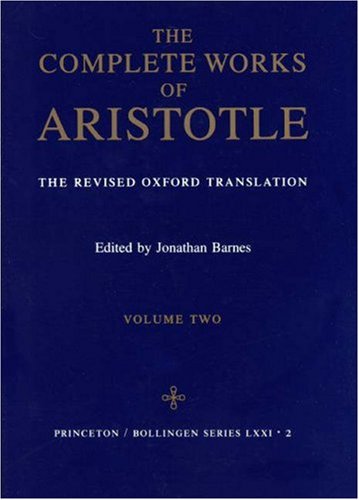
4. Complete Works of Aristotle, Volume
$5.99
5. Poetics (Penguin Classics)
$15.42
6. If Aristotle Ran General Motors
$4.87
7. Aristotle's Poetics for Screenwriters:
$6.50
8. The Nicomachean Ethics (Penguin
$4.93
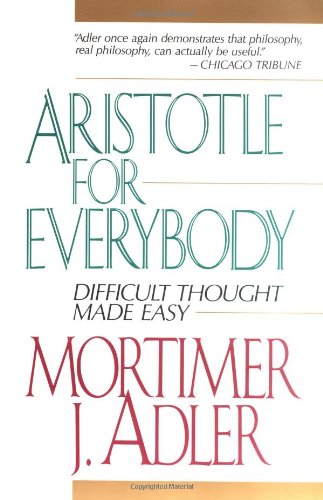
9. Aristotle for Everybody
$4.79
10. Aristotle's Ethics (SparkNotes
$1.39
11. Rhetoric (Thrift Edition)
$5.30
12. Aristotle: A Very Short Introduction
$9.89
13. The Rhetoric and the Poetics of
$15.89
14. The Cambridge Companion to Aristotle
$26.90
15. Aristotle's Poetics
$9.12
16. Aristotle's Children: How Christians,
$23.19
17. On Rhetoric: A Theory of Civic
$14.66
18. Physics
$50.49
19. Metaphysics: Books B and K 1-2
$14.48
20. The Story of Science, Book One:

1. Aristotle and an Aardvark Go to Washington: Understanding Political Doublespeak Through Philosophy and Jokes
by Thomas Cathcart, Daniel Klein
Hardcover: 196 Pages (2008-01-01)
list price: US$18.95 -- used & new: US$10.00
(price subject to change: see help)
Asin: 0810995417
Average Customer Review: 3.5 out of 5 stars
Canada | United Kingdom | Germany | France | Japan
Editorial Review

Book Description
Thomas Cathcart and Daniel Klein, authors of the national bestseller Plato and a Platypus Walk into a Bar, aren’t falling for any election year claptrap—and they don’t want their readers to either! In Aristotle and an Aardvark Go to Washington, our two favorite philosopher-comedians return just in time to save us from the double-speak, flim-flam, and alternate reality of politics in America.

Deploying jokes and cartoon as well as the occasional insight from Aristotle and his peers, Cathcart and Klein explain what politicos are up to when they state: “The absence of evidence is not the evidence of absence.” (Donald Rumsfeld), “It depends on what the meaning of the word ‘is’ is.” (Bill Clinton), or even, “We hold these truths to be self-evident…” (Thomas Jefferson, et al).

Drawing from the pronouncements of everyone from Caesar to Condoleeza Rice, Genghis Kahn to Hillary Clinton, and Adolf Hitler to Al Sharpton. Cathcart and Klein help us learn to identify tricks such as “The Texas Sharpshooter Fallacy” (non causa pro causa) and the “The Fallacy Fallacy” (argumentum and logicam). Aristotle and an Aardvark is for anyone who ever felt like the politicos and pundits were speaking Greek. At least Cathcart and Klein provide the Latin name for it (raudatio publica)! ... Read more

Customer Reviews (6)

3-0 out of 5 stars Nothing really new
Even though the book is about Washington politics, it is quite evident the author does not like President Bush. I am no fan of Bush or some of his cohorts. Having said that, the constant anti-Bush theme gets boring at times - nothing really new. The persistent political inconsistencies cited by the author of many politicians and political groupies are well known and equally ignored by most people outside of the Beltway.
There are times when the humor is quite good and the jabs well placed.

2-0 out of 5 stars Not Scorates and an aardvark...
A bit of a disappintment after the previous book "Scorates and an Aadvark..." still worth reading.

3-0 out of 5 stars Great Jokes, but Otherwise an Average Primer
First off, Cathcart and Klein are extremely talented writers.I wish I had their rhetorical flair.In addition, they are fair philosophers.They no the terms and definitions and provide proper examples to illustrate their points. The book does, however, suffer, both stylistically and yes, at times philosophically. With the other reviews being so glowing (so far at least), I am going to highlight some draw backs.

The jokes, like their first book, are just downright funny.While maybe not as humorous as their first volume, they are funny nonetheless.I don't want to say which jokes are "best" because at some point, jokes and their ability to make us laugh are a result of one's taste and experiences.The jokes rate about 4 star and half stars.

Stylistically, the book suffers on a couple of levels, but I'll address only one.The book is organized largely as if it was a Keith Olberman or a MoveOn.Org tract.Does anyone remember those "Chick" tracts?They are those very, right wing, Christian Fundamentalists tracts that obfuscates certain "Bible" issues and "the way to salvation."Well, this book does the same thing.The title suggests one reads this book to "understand" "political doublespeak."Well, yes, but the "doublespeak" is so one sided that President Bush and most conservatives end up looking like mental midgets in almost everyway while even when liberal Democrats commit errors, they obfuscate and "spin" to make sure the GOP still looks the "dumber" for it.For example, on page 77-78, they take the infamous Kerry's lack of an education sends you to Iraq/in the military speech and claim yes, he committed a straw man, but they place more of the onus on the GOP for using his words against him.Here they obfuscate the issue as well as go on a red-herring.Their point was made with Kerry's speech, but they were bent on making their point with the GOP. Further, they do not show that these GOP leaders (as well as many Democrats) missed the point of Kerry's sentence (Ignoratio elenchi), in fact, the understood his point quite well, as they themselves admit by pointing out that Kerry "shoots himself in the foot."(Also, why defend a man that claimed he was making a joke - where is the punch line?)

There are many more examples, but I would then belabor the point.Sure they make attempts at trying to appear fair, but they really fail on the political front (and why bring in Sam Harris and Freidmen's book on book about Washington politics? - Freidmen, one can make a case for, but much less so for Harris).

I would have preferred a more balanced presentation, slapping both sides of government up the side of the head since they both provide so much fodder.The book would also become less tiresome.Someone like me buys this book, not for the philosophy or logic; I have that under my belt, but I purchase this book for the fun.Now, this is not to say they do not occasionally take a pot shot at the left, but the balance is so skewered, the book looses its punch for moderates and fair minded conservatives.

However, the jokes and their writing style is funny, even when I disagree!Their observations about Dick Cheny's comments over the British troop withdrawal is laugh-out-loud funny, just to name a one such of many instances (of which I don't disagree with them on).

Yes, buy the book.One will learn the basic terms and insight on logical fallacies(most of the time), but understand this is a primer with a tilted slant.

5-0 out of 5 stars A laugh out loud!
Well, lets see. I will admit that I have read very little of this book, but what I have read I have really enjoyed and found to be extreemly hilarious. I was turned on to the book one day when I arrived at my parents house to find my father sitting in his chair one afternoon laughing out loud. I took that as a vote of confidence that my father of all people would not be laughing out loud if this book was indeed not funny. In fact he has been slowly savering this book, which is a sure sign that it is a good read. I recently purchased a copy of the book for my boyfriend knowing that he will get the same joy out of the book as my father.

5-0 out of 5 stars A Welcome Measure of Mirth
The authors present a sensible analysis of utter nonsense, which is to say, the nonsense uttered by many of our (arguably) elected officials. A valuable comic spin on the tragic machinations that are currently playing themselves out in Washington, DC. ... Read more


2. Politics (Dover Thrift Editions)
by Aristotle
Paperback: 355 Pages (2000-11-15)
list price: US$4.00 -- used & new: US$2.32
(price subject to change: see help)
Asin: 0486414248
Average Customer Review: 4.0 out of 5 stars
Canada | United Kingdom | Germany | France | Japan
Editorial Review

Book Description

Intellectually stimulating work describes the ideal state and ponders how it can bring about the most desirable life for its citizens. Both heavily influenced by and critical of Plato's Republic and Laws, Politics is the distillation of a lifetime of thought and observation. The great Benjamin Jowett translation.
Download Description
Examines the way human societies are governed and organized.Aristotle establishes how constitutions can be upheld and established by examining how societies are run.An extremely exciting work in the history of politics. This book easy to read in true text, not scanned images that can sometimes be difficult to decipher.This ebook has bookmarks at chapter headings and is printable. ... Read more

Customer Reviews (22)

4-0 out of 5 stars Another famous ancient Greek philosopher.
Perhaps I've been reading too many ancient Greeks and Romans, and certainly too many treatises on ancient politics, but I had a great deal of difficulty getting through this book.Aristotle is a very well-known philosopher and a student of Plato.This book outlined his views on politics, and he quite blatantly goes against a lot of what Plato and Socrates said, but his ideas make sense, especially for the time and place when they were written. It was interesting to compare his ideas to those of Plato since I just finished reading Plato's Republic.I think at heart, I'm more in agreement with Aristotle than with Plato.

4-0 out of 5 stars Politics Defined
Perhaps it is not accidental that the work of the Aristotle, the student who explored so clearly and deeply all the externals and interactions of nature and Man, is recorded as tedious, repetitious, complex lecture notes while Plato the teacher who tried to find all the answers within the confines of his own head is recorded as lucid, lively dialogue.Aristotle the rube was evidently too busy observing, cataloging, teaching - living, to write it all down in an organized coherent whole while Plato the aristocrat was at first desperate to capture all he could remember then to expand upon the works of his revered master, Socrates, trying desperately to walk in his sandals.I think maybe with Aristotle there was just too much material, to much to know, and the thing he did best was know.So here is the country boy with that horrible Macedonian accent but regal connections come to study at the Academy, to learn from the very best, and in the end, the thought he produces far surpasses all that the best laid before him.

How is the community of Man best organized?That is the concern of Aristotle's "Politics".Plato had more or less just conjured up an ideal "Republic" based on his interpretation of Socrates.But that was not enough for Aristotle.He traveled, he learned, he catalogued everything and human organization and systems of government were at the top of his list.And he did this traveling analysis at a unique time when all possible permutations of human social organization were up for a try, from the dynamic democracy of the tiny city-state to the decrepit tyranny of the Persian Empire.With this catalog, he could not just conjecture as to what government might work best but make solid statements of fact about the consequences of various human organizations and recommendations about what works best under what circumstance.And we live with the result of his systematic pursuit.As one reads (or re-reads) this the very foundation of Western political thought, images of Madison flipping pages of a well warn and well loved edition to find a particular passage as he pens drafts of the Constitution of the United States of America flash by time and again.The result of his obvious reference to Aristotle was a thriving republic that has grown and flourished providing freedom and the possibility of a good life for millions.What grew from Plato was the horror of the Soviet Union.But I have betrayed my prejudice.One must read both and in order, Plato first to discover the thoughts that inspired Aristotle's questions then Aristotle to find the answers.

That said, I must reiterate, this book is exceptionally tedious, repetitious and complex (though not intellectually difficult).Thousands of people have made careers analyzing it and commenting on it.It is not for everybody but Mortimer Adler's "Aristotle for Everybody" is.That book is a brief, well written compendium, a distillate, of all we have of Aristotle.To go through a life and not read at least that is to miss some of the best thinking ever done by a human.

3-0 out of 5 stars The irony of me calling Aristotle's work average is not lost on me.
Yep, I feel way over my head giving Aristotle three stars, but I'm throwing in my two cents anyhow.

This book is an incredible window into another time.Aristotle's views on a number of topics (women and slavery come quickly to mind) stand out so opposed to our beliefs today that it's almost worth reading this book just to get some perspective on how new some of the social ideas we take for granted really are.Getting that sense of perspective is truly the best part of this book.

That said, there is little here beyond that for anyone but a student of philosophy or someone engaging in a very serious study of the history of government.Very little of what Aristotle says rings true today and at times it's as if he went to the future and decided to predict the exact opposite of what's come to pass.

If you are a layperson looking for a classic on government, I recommend Plato's Republic.While it is even older than Aristotle's work, it is filled with insights that feel as if they must have been written in modern times.That is a truly inspiring feat of thought and foresight.

5-0 out of 5 stars In the name of Iran
In this book Aristotle discussed different kind of state and what would lead to corruption of a state. Aristotle believed no one should rise against their state. Every one had to remian submissive toward state.

5-0 out of 5 stars A Must Know For All Who Desire To Vote!
Aristotle's constitutional theory is the most important aspect of this book.Every high school world history should become familiar with the 6 forms of government that Aristotle identifies, and every college poli-sci student should commit Aristotle's analysis into their core knowledge.

Of course Aristotle lived in a time when social norms were different.Much of what he writes applies to a different age, but the constitutional theory of government remains a timeless set of observations -- especially important in our times. ... Read more


3. The Basic Works of Aristotle (Modern Library Classics)
by Aristotle
Paperback: 1520 Pages (2001-09-11)
list price: US$21.95 -- used & new: US$12.80
(price subject to change: see help)
Asin: 0375757996
Average Customer Review: 4.5 out of 5 stars
Canada | United Kingdom | Germany | France | Japan
Editorial Review

Book Description
Preserved by Arabic mathematicians and canonized by Christian scholars, Aristotle’s works have shaped Western thought, science, and religion for nearly two thousand years. Richard McKeon’s The Basic Works of Aristotle–constituted out of the definitive Oxford translation and in print as a Random House hardcover for sixty years–has long been considered the best available one-volume Aristotle. Appearing in paperback at long last, this edition includes selections from the Organon, On the Heavens, The Short Physical Treatises, Rhetoric, among others, and On the Soul, On Generation and Corruption, Physics, Metaphysics, Nicomachean Ethics, Politics, and Poetics in their entirety. ... Read more

Customer Reviews (10)

5-0 out of 5 stars Excellent
This is an excellent collection of Aristotle's works that is very interesting and well written.

4-0 out of 5 stars "Basic" and enough for a solid reference and good overview
This is a concise singular source on Aristotle and with enough in it to understand a great deal about him. Since so much of what he had to say has been taken apart by later philosophers it is helpful to have the real "basics" for a reference.

It's approach is especially useful in comparing him to Plato.Plato's world was one of changeless things assigned for lofty contemplation and for Aristotle, as we are told in the introduction, it was a world for empirical investigation. In this volume these works are found nearly complete: The Physics, On Generation and Corruption, On the soul, the Metaphysics, the Nicomachean ethics, the Politics, and the Poetics. The contents list a Preface, Introduction and Bibliograhpy as well as chapters on, Organon, Physica, DeCaelo, De Generatione Et Corruptione, De Anima, Parva Naturalia, Historia Animalium, De Partibus, De Generatione, Metaphysica, Ethica Nicomachea, Politica, Rhetorica, and De Poetica.

I recommend the Hardcover over the paperback.I also recommend this over the multiple volume approaches to his life and thoughts. Even if you don't find the introduction to be complete it is still very useful, as an overview of all that this author felt was needed for a "Basic Works".

3-0 out of 5 stars Notfor a permanent place on your shelf
I won't be the first reviewer to point out that this book is shoddy in binding; my son's school copy fell apart after less than two weeks of teenage reading. Surely, if one is still to take Aristotle seriously, one will need a longer acquaintanceship. If one is only "cruising" through Aristotle, then this flimsy volume includes far too much.
Nevertheless, what a thrill to review the nearly complete works of Aristotle in one quick paragraph! No one could deny his central role in the intellectual history of the world, but one shouldn't forget that his influence was as much pernicious as valuable. If, as might well have happened, his works had perished and Anaximander's survived into the Middle Ages, would we not have dodged a lot of dogmatic bullets?

5-0 out of 5 stars Good collection of Aristotle
After Plato, Aristotle is by far the greatest Athenian Greek Philosopher.A polymathic genius whose interests ranged from poetry to theology to astronomy, physics and biology, Aristotle systematized Western thought and laid down many of the basic rules for argument and rationality which still stick with us today.

This collection includes Aristotle's major works including logic, metaphysics, scientific works, and works on ethics.

3-0 out of 5 stars Problems with this edition
I love Aristotle and this is a good collection, but my book fell apart!I had a course that used just this book, and despite the fact that we all took good care of our copies, nearly all of our books tore in half or lost pages.Some actually had to make a new book out of it! ... Read more


4. Complete Works of Aristotle, Volume 2
by Aristotle
Hardcover: 1256 Pages (1984-09-01)
list price: US$49.50 -- used & new: US$29.75
(price subject to change: see help)
Asin: 0691016518
Average Customer Review: 4.5 out of 5 stars
Canada | United Kingdom | Germany | France | Japan
Editorial Review

Book Description

The Oxford Translation of Aristotle was originally published in 12 volumes between 1912 and 1954. It is universally recognized as the standard English version of Aristotle. This revised edition contains the substance of the original Translation, slightly emended in light of recent scholarship; three of the original versions have been replaced by new translations; and a new and enlarged selection of Fragments has been added. The aim of the translation remains the same: to make the surviving works of Aristotle readily accessible to English speaking readers.

... Read more

Customer Reviews (15)

5-0 out of 5 stars Worth every penny
Aristotle is known as THE philosopher for a reason.The Complete Works of Aristotle is a two volume set that contains great translations of Aristotle.He covered almost any topic you can imagine and it is worth your time to read what he had to say.

2-0 out of 5 stars Comprehensive set, but lacks commentary
This is a two-volume edition of all the known works ascribed to Aristotle -- both genuine and those that are generally agreed to be spurious.They are presented in the traditional ordering with no commentary or annotation of any kind (other than a few notes about variant readings), and no introductions.If you know that this is what you need or want, then the set will work well for you.

However, the lack of annotation and introduction will likely make the works overwhelming to a reader who is not well versed in philosophy, and even some who are.I realize that this was necessary to keep the size of the set down, but it still presents a problem.The writing style of Aristotle (or his students) is very terse and complex -- even specialist scholars often have trouble understanding what the texts say.This is particularly acute in the case of the Organon (the logical works), but is true in some sense of every work in the corpus.

A number of the more famous works (De Anima, Poetics, Rhetoric, Politics, and the Nicomachean Ethics, for example) are available in annotated editions with good introductions from the Penguin Classics or Oxford World Classics.If you have access to a good library (or a lot of money), the Clarendon Press (Oxford) editions of the works offer very detailed commentary and annotation of a number of the works, including most of the Organon.These editions are likely to prove of more value to the beginning reader.

However, if your goal is to eventually read all of Aristotle, you will need a complete edition at some point, since not everything is available in these other editions (this is particularly true of the spurious works), and this is probably the best one you can get.However, there are online editions of Aristotle's works in English -- printing those out will be cheaper than paying almost $100 for this set, and may fit the bill just as well.

In the end, I find the lack of annotation to be a serious flaw of this set, and I give it two stars because I think this set will be of use primarily to people who already have a good grounding in Aristotle and have a specific need for a compact edition of his complete works.

5-0 out of 5 stars The Entire Aristotelian Corpus Presented in a Fine English Translation
For readers seeking the greatest affiliation with the works of Aristotle, one need not look any further than to the two-volume set presented here by Princeton U. in the classic Oxford translation, revised by Jonathan Barnes.In these two stellar volumes, the entire Aristotelian Corpus is made available to the English speaking world; and also contained here are the various treatises considered to be doubtful or spurious, which nonetheless belong to the Aristotelian tradition regardless of their authenticity.Furthermore, it must be noted that the English is smooth and exceedingly direct, making this edition very readable and illuminating. In short, it may be said that this two-volume set is for readers striving to go beyond the basics [see, Mckeon's Basic Works of Aristotle] to embrace a much more comprehensive command of Aristotle's philosophy.

5-0 out of 5 stars Marvelous- It's ALL in here folks!(BOTH VOLUMES)
I studied philosophy in a French speaking Institute in Europe.These two volumes came in very handy.The first question that may come to mind for those shopping for Aristotle is whether it's necessary to purchase the "Complete Works" and not just a volume of Major Works.In fact, it's not necessary- you'll get so much enrichment from even one major work of The Philosopher, especially with the aid of a competent professor.However, the complete works will ensure you that you have everything, and provide a good deal more reading enjoyment (even Aristotle's final will and testament is printed in Vol. II).

Aside from that, the translations contained in these works are considered the best available in English (and perhaps any) language other than the original Greek.To testify to this fact, some of my native French professors would occassionally ask to borrow my volumes to make photocopies of certain passages (or more), telling me that they felt the English translations were far better done than those in their native tounge!(And we know how much the French care for their native tounge!)

All in all, excellent books and money well spent.

5-0 out of 5 stars a bit of irony
is that, although these volumes contain the absolute worst translations of aristotle available, they're probably the best bet for people who are serious about aristotle and the worst bet for people who are just reading this or that text for a class, personal interest, etc. the reason they're good for people who are serious about aristotle is the very simple reason that it's all there, so if you're scanning your bonitz and bonitz says the definition of some term or another is in one of the writings on animals, you can at least (with a bit of detachment) see what in hell he's talking about (if the greek isn't there) without having to get up! in other words, you've got it all, sister!, which is really the only advantage to be culled from having these books. the margins are just meaty enough to import greek phrases, retranslate sections of text, etc., so it turns out to be a nice reference tool for scholars. why? because it's all there! now, if you're just 'into' aristotle, as i said, don't (for godsakes) get these books. read apostle's translations. sachs is alright, but he can throw you off. of course, you can also get the real cheapies from hackett, and some of them aren't bad (in general, by the way, hackett's the way to go for translations). besides, these things are weighty and difficult to maneuver; they're really for reading at a table, so you can't really tuck up with them, if you see what i mean. another nice thing about these volumes is that they stay open by themselves (no finagling with or breaking the binding)! i'm not joking: aristotle scholars couldn't have a better english-language resource. ... Read more


5. Poetics (Penguin Classics)
by Aristotle
Paperback: 144 Pages (1997-03-01)
list price: US$10.95 -- used & new: US$5.99
(price subject to change: see help)
Asin: 0140446362
Average Customer Review: 5.0 out of 5 stars
Canada | United Kingdom | Germany | France | Japan

Customer Reviews (8)

5-0 out of 5 stars Aristotle Clearly Explained
By this time, the importance of Aristotle as a philosopher and the first analyst of drama is well known. For budding screenwriters, reading and understand his Poetics is one of the requirements for building good stories. Since I can't read the original in its Attic Greek, good translations are worth their weight in gold.

Malcolm Heath's excellent translation is incredible. First, the introduction to the main work is longer than the translation itself. Heath dissects and explains EVERYTHING so that when reading the main work, things are clear. Not satisfied with that, there are notes to the translation as well! One comes away from this work with a crystal clear understanding of the concepts Aristotle teaches.

This definitely is my preferred translation of the Poetics. 10 stars!

5-0 out of 5 stars Introduction is about as long as the treatise!
No joke - the introduction written by a modern scholar is more or less neck to neck with Aristotle's 'essay' on storytelling (Poetics) as far as length is concerned. This is good because, quite honestly, the average person will have a hard time understanding the concept Aristotle is trying to get across with his archaic (no insult intended) analysis.

But first, my "credentials" as a reviewer:

I started reading Plato because I watched some movies (Truman Show, The Matrix) and some Anime (The Big O) in which the screenwriters heavily borrowed from Republic and other Platonic dialogues when shaping their plots. At first, I read just so I can understand the plot of these works of visual art a little better. After a couple of dialogues (I especially liked Phaedo and Theatetus - I still haven't finished Republic), however, I began appreciating Greek philosophy in and of itself. Having read a bit of Plato (Euthyphro, Apology, Crito, Phaedo, Cratylus, Theatetus, and part of Republic) I decided, hey, why not go in for some of Aristotle? Supposedly this 'common sensical' philosopher was the foil of the more heavenly inclined Plato - so why not compare and contrast?

That said, Poetics has been my first exposure to Aristotle.

Quite different from Plato too! For starters, Aristotle views poets, dramatists, "novelists" and fiction writers in general much more sympathetically than his 'teacher' - he sees them as humans with a talent who can put it to good purpose (as opposed to Plato's perception of them being the scum of the earth).

A point I would like to bring up - some people say 'Poetics' is universal, applicable to any time in history for any fiction writer or storyteller. Quite a few successful screenwriters have taken this position. The scholar who wrote up the introduction to this edition, however, disagrees - as do I. Most of the stuff Aristotle's mentions as being for making a story has already crossed my mind at one or time or another - in less stuffy, more conceptualized form, certainly, but the ideas have occured to me. Not only that, but his somewhat rigid formula, although he himself acknowledges that it isn't absolute, is very restrictive in 'what's good, what's bad'.

That said, Poetics contributes to literary theory. Plus, it can reinforce some writer's ideas about how their craft should work. More significantly, however, it is the thought of Aristotle, a highly influential philosopher, accessible through word that really captivates the reader - what he thinks about is important, but the way he thinks is what really makes him 'timeless'. His views on storytelling, however, are visibly from an era that no longer strongly coincides with our own.

Note - yes, yes, I've read some books on Greek history and know it is the Cradle of Western Civilization, spread by Rome and a major influence on history (including democracy) - but Greek academia is largely alien.

4-0 out of 5 stars Any student of literature should read this.
Poetics is an illuminating analysis of poetry and its origins.Aristotle analyzes the writing of famous ancient Greek poets such as Homer, Aeschylus and Sophacles and outlines the difference in construction between poems that are tragedies and poems that are Comedy.This book is really only for those who are true Greek poetry lovers, or at least serious students of literature.I found it hard slugging indeed.But if you want to complete your education on ancient Greek philosophers, Aristotle must be read.His presentation of argument and topics for disucussion cannot be beat.

5-0 out of 5 stars The Original Story Analyst
The principles in what was probably a compilation of Aristotle's "lectures notes" are timeless, and have influenced story analysis for the past 2400 years. His understanding of story as a contrived mechanism aimed to MOVE audiences should be a relief to every writer who takes it to heart: the elements required for drama and dramatic fiction and nonfiction are not infinite but a handful. But that handful must be dealt with properly or the assembly will have no effect on audiences. He tells us Homer's greatness was that "he himself is nowhere to be found in his works, his characters everywhere"; that Homer began "in the middle of things" (Latin rhetoricians called it, "in medias res"; and that every great story needs a discovery that leads to a turning point in the protagonist's progress toward comedy or tragedy. Don't leave home without it!

5-0 out of 5 stars Penguin Classics: Aristotle's Poetics
I teach a course on Ethics and Aesthetics in Aristotle to graduate students.This translation and its introduction are the best for my purpose.Both are clear, crisp, and readable.The translation is reliable and the endnotes are very helpful.I would highly rcommend this edition to anyone who has a serious interest in either Aristotle or aesthetics that does not rise to a level that requires a reading knowledge of the Greek text. ... Read more


6. If Aristotle Ran General Motors
by Tom Morris, Thomas V. Morris
Hardcover: 216 Pages (1997-01-15)
list price: US$25.00 -- used & new: US$15.42
(price subject to change: see help)
Asin: B00006K138
Canada | United Kingdom | Germany | France | Japan
Editorial Review

Amazon.com
Philosophy purists take note: yes, this is a business self-help book. But Tom Morris has plenty of philosophical street credibility: after getting his Ph.D. from Yale, he taught for 15 years at the University of Notre Dame (where stunts like bringing the ND marching band to class for an impromptu "pep rally" before a big test made him one of the most popular professors on campus). And Morris isn't dumbing down his message for the corporate culture. Rather, he's genuinely interested in fostering a workplace environment where one can seriously think about truth, beauty, goodness, and unity. "If we let the great philosophers guide our thinking," he says, "and if we then begin to become philosophers ourselves, we put ourselves in the very best position to move towards genuine excellence, true prosperity, and deeply satisfying success in our businesses, our families, and our lives. Why should we settle for anything less?" Why indeed? Book Description

What does classical philosophy have to offer modern business? Nothing less than the secrets to building great morale and productivity in any size organization.

This is the message that Tom Morris will deliver this year to thousands of executives of leading companies such as Merrill Lynch, Coca Cola, Bayer, and Northwestern Mutual Life.

In If Aristotle Ran General Motors, Morris, who taught philosophy at Notre Dame for fifteen years, shares the knowledge that he garnered from a lifetime of studying the writings and teachings of history's wisest thinkers and shows how to apply their ideas in today's business environment. Although he frequently draws on the wisdom of Aristotle, Morris also finds inspiration in the teachings of a wide array of thinkers from many different traditions and eras. Throughout these pages we're invited to pause and consider the words of Confucius, Seneca, Saint Augustine, Ralph Waldo Emerson, Abraham Lincoln, and many others.

By looking at the inside workings of various kinds of businesses-- from GE to Tom's of Maine-- Morris shows why any company that is serious about attaining true excellence must adhere to four timeless virtues first identified by Aristotle more than two thousand years ago: Truth, Beauty, Goodness, and Unity. Morris makes clear that the most successful companies encourage a corporate culture that ensures that all interactions among colleagues, employees, bosses, clients, customers, and suppliers are infused with dignity and humanity. Moreover, the book provides clearly stated strategies for how everyone who works can make these qualities the foundation for their everyday business (and personal) lives.

If Aristotle Ran General Motors presents the most compelling case of any book yet written for a new ethics in business and for a workplace where openness and integrity are the rule rather than the exception. It offers an optimistic vision for the future and a plan for reinvigorating the soul back into our professional lives.
... Read more

7. Aristotle's Poetics for Screenwriters: Storytelling Secrets From the Greatest Mind in Western Civilization
by Michael Tierno
Paperback: 224 Pages (2002-08)
list price: US$13.95 -- used & new: US$4.87
(price subject to change: see help)
Asin: 0786887400
Average Customer Review: 4.0 out of 5 stars
Canada | United Kingdom | Germany | France | Japan
Editorial Review

Book Description
L ong considered the bible for storytellers, Aristotles Poetics is a fixture of college courses on everything from fiction writing to dramatic theory. Now Michael Tierno shows how this great work can be an invaluable resource to screenwriters or anyone interested in studying plot structure. In carefully organized chapters, Tierno breaks down the fundamentals of screenwriting, highlighting particular aspects of Aristotles work. Then, using examples from some of the best movies ever made, he demonstrates how to apply these ancient insights to modern-day screenwriting. This user-friendly guide covers a multitude of topics, from plotting and subplotting to dialogue and dramatic unity. Writing in a highly readable, informal tone, Tierno makes Aristotles monumental work accessible to beginners and pros alike in areas such as screenwriting, film theory, fiction, and playwriting. ... Read more

Customer Reviews (8)

4-0 out of 5 stars A solid work
[4.5 stars]

The oft-stated maxim of dramatic storytelling, everyone who is anyone in screenwriting recites, is to read Aristotle's Poetics. The problem? The original work in Greek is not what one would call bedside reading; the English translations of the original are almost as bad.

So what is a budding screenwriter to do if, as suggested, he wanted to understand the underpinnings of drama without having to learn and understand ancient Greek and all the arcane references in the Poetics? Well, that budding screenwriter buys and reads the new book by Michael Tierno. It's small enough that it could be light reading; each of its 33 chapters are easily digestible, but be not fooled! It's filled with tremendous information that, if properly understood, will help a writer, any writer, tell a gripping story.

Some of the reasons I gave it a four-and-a-half star rating instead of the full five are the same as I would give the original Poetics: the language is staid and a little difficult to assimilate for the modern understanding. Tierno does agood job of interpretation, but even then, there are some hard bumps that will give the reader pause. Tierno also tries hard to tie all the chapters into a smooth narrative, but again, there are some bumps: I don't, for example, see why chapter 29 (The Non-Linear Soul of Quentin Tarantino) was added as it seems incongruous without useful information not already covered earlier.

The other star-reducing problem is the seeming out-of-context quotations from the Poetics that require close reading to see their appropriateness, although for the most part the author does a fine job of showing precisely that. It's just a slight impediment to the flow. Very slight.

That said, here's my recommendation to obtain the maximum benefit out of this book: read the Poetics first. After which, rely on Tierno to provide the necessary interpretation; a job, as I stated earlier that he does quite well.

In summary, this is a good book. With close reading, perhaps even re-reading, it is capable of energizing your stories in the way the original work by (as the tagline of the book says) The Greatest Mind in Western Civilization does. This book is definitely barely-hidden gold that is easy to pass over. That fact it's not too expensive or overly ponderous in tone only adds to the value. High recommendations.

Postscript: The book has the author's website on the back. As of the date of writing this review, it's just a placeholder. Perhaps if the author eventually gets around to putting something useful up, he'll receive the full five stars!

4-0 out of 5 stars Aristotle Lite
Having read the original "Poetics" several times, this rendition of the master is very welcome. It touches on the salient points and how it relates to screenwriting. Good use of examples. My only suggestion is that he could have given us a little more depth.

5-0 out of 5 stars A great way to introduce Aristotle's Poetics.
If you are (or want to be) a serious screenwriter, you probably already know names like Robert McKee, Syd Field, Linda Seger, David Trottier and even David Bordwell...

The good thing about Mr. Tierno's book is that it goes back to the one fundamental text who, 2300 years before the birth of Cinema, already thought about many of the things all other screenwriting authors still talk about - what do we do in order to achieve higher drama?

And it is surprising how fresh Aristotle still sounds today, according to Mr Tierno's reading. Even if we consider that the object of Aristotle's thought was not the Cinema, but the Classical Greek Theatre - or the mimetic form of representation.

In fact, there is nothing new about Aristotle (or Cinema, or narrative, or screenwriting) here besides the fact that Mr. Tierno does an accurate reading of the great greek thinker and explains many of his key concepts.

In a nutshell, this book is an excelent reminder of how important, necessary and universal, good drama can be. Also it is a great reminder that screenwriting is a natural heir of most of storytelling's past traditions.

It is also a proof that screenwriting is an art form by itself.

4-0 out of 5 stars Concise dramatic instruction
This book is useful for fiction writers as well as screenwriters. The author interprets Aristotle's ideas and suggestions and then renders them with examples into language applicable to modern drama. Many of Aristotle's original ideas are quoted and have timeless power. For example: "Beginners succeed earlier with Diction and Characters than with the construction of a story."

Tierno relates how the parts of a modern script evaluation (Log Line, Brief, Plot Summary, Comments, Idea, Story, Character, Dialogue, and Production Values) mirror Aristotle's examination of the same elements. I especially liked how the film "Gladiator" was used for the example of "the mistake in a hero's reasoning, leading to the hero's subsequent related misfortunes."

The short length makes the book a fast but powerful read.

5-0 out of 5 stars It really helps to understand screenwritng concepts
This book has not only helped me to understand the somewhat complex art of dramatic stroy telling - but it has helped me to help others. Recently working on a documentaty project with a first time director, this book allowed him to internalize and distill his thoughts into a more cohesive vision, that was readily translatable to an audience. I would reccomend this book to any one who wants to gain insight and understanding to "the movies." ... Read more


8. The Nicomachean Ethics (Penguin Classics)
by Aristotle
Paperback: 400 Pages (2004-03-30)
list price: US$12.00 -- used & new: US$6.50
(price subject to change: see help)
Asin: 0140449493
Average Customer Review: 4.0 out of 5 stars
Canada | United Kingdom | Germany | France | Japan
Editorial Review

Book Description
Of Aristotle’s works, few have had as lasting an influence on subsequent Western thought as The Nicomachean Ethics. In it, he argues that happiness consists in “activity of the soul in accordance with virtue,” defining “virtue” as both moral (courage, generosity, and justice) and intellectual (knowledge, wisdom, and insight). Aristotle also discusses the nature of practical reasoning, the different forms of friendship, and the relationship between individual virtue and the state. Featuring a lucid translation, a new introduction, updated suggestions for further reading, and a chronology of Aristotle’s life and works, this is the authoritative edition of a seminal intellectual masterpiece. ... Read more

Customer Reviews (8)

4-0 out of 5 stars A Helpful Edition of a Classic Work
There are a couple of features about this particular edition of Aristotle's "Ethics" (to be clear, I am referring to the 2004 edition published by Penguin Classics) that I think are praiseworthy and worthy of mention.As some of the other reviewers of this edition have pointed out, the introduction by Jonathan Barnes is most helpful in providing the reader with a sturdy foundation on which to stand while reading this work.At roughly 30 pages long, Barnes' introduction is the perfect length.It provides a great foundation without becoming a full exposition itself.Another thing I like about this book is the editing, which utilizes a number of helpful tools to enhance readability.In particular, the editor (Hugh Tredennick) uses plenty of footnotes and inserts into the text itself (demarcated by angled brackets).In a couple of instances Tredennick even changes the order in which the text has traditionally been found; this he does because the logic of Aristotle's argument flows better if slightly re-ordered.In sum, then, the Penguin Classics edition of Aristotle's "Ethics" is very approachable and I highly recommend it for those who are just getting introduced to Aristotle's works.

Aside from reviewing the specific edition here, I would also like to make a couple of critical remarks about the text itself.This is a difficult thing to do with classics such as this because the historical influence and importance of the text renders such remarks not a little superfluous.Nevertheless, a few limited thoughts might be in order.

First, one other reviewer has commented on the relation of the "Ethics" to Christianity.I, too, am a Christian, and I think it is important to offer reviews explicitly informed by my faith.Nevertheless, I think the other Christian reviewer is slightly mistaken.To be sure, he is right when he says that Aristotle, though not a Christian, got a lot right and some things wrong.For we should not expect anyone, established historical icon or no, to be right all the time (except Scripture, of course).However, the one thing I think the other reviewer is mistaken about is that, although Aristotle suggests that the purpose of life is happiness, I don't think this is per se contrary to Christian teaching.The other reviewer is right to say that the purpose of life, from a Christian point of view, is to glorify God.However, is Aristotle's notion of happiness contrary to this purpose?I think that it is not, or at least that it is not clearly contrary to it.Happiness for Aristotle is found in it purest human form in those whose life is characterized by contemplation.This is so because contemplation, among all human activities, is the activity that most approximates the divine.Further, it is contemplation in accordance with virtue that makes a man happy.And further yet, contemplation, according to Aristotle, should lead us to act; that is to live a virtuous life.Thus, I think Aristotle's message is roughly translatable to the Christian message, which is something like: a man is most happy when his life is characterized by contemplation of the things of God, which leads to acting in accordance with God's commands (i.e., glorifying God).But enough about Aristotle in relation to Christianity...

I would like to end this review with two recommendations.First, if you're looking for secondary reading that will illuminate Aristotle's "Ethics", I would recommend The Blackwell Guide to Aristotle's Nicomachean Ethics (Blackwell Guides to Great Works), edited by Richard Kraut.That book is a collection of essays exclusively concerning Aristotle's "Ethics", and is very useful for deeper understanding.Second, a lighter and yet broader (topically) read: On the Unseriousness of Human Affairs: Teaching, Writing, Playing, Believing, Lecturing, Philosophizing, Singing, Dancing by James Schall.If you read Schall's book before the "Ethics", I think your motivation to read the "Ethics" will be enhanced.If you read Schall's book after you read the "Ethics", I think you will better see how Aristotle's work has influenced other important writers throughout the ages.

In any event, happy reading!

4-0 out of 5 stars The Nicomachean Ethics - - Aristotol
An excellent book to get an understanding of this Greek philosopher's concept of "a good man" and the virtues he felt were required in an individual to be considered as "a good man".Also, it provides some insight into the affect of these Greek philosophic "virtues" from the period of about 300 BC as they predated the "morals and ethics" found in the biblical new testement of about 200 AD and the Koran of about 700 AD.

4-0 out of 5 stars Early work of social science
Aristotle's Ethics by Penguin classics looks deceptively like a paperback novel.It is nothing of the kind, being a densely packed philosophical treatise on the nature of humankind and our relationships with others.

The book, a translation of the Nichomachean Ethics and not Aristotle's earlier Eudemian Ethics, may seem slightly mistitled to a modern audience.It deals primarily with analysis of character and what good character is and is not.Discussion of ethical issues and moral judgements of right and wrong are largely missing.The reader is expected to develop their behaviour towards others by perfecting their own character.For example, courage in its various forms is discussed but the practical application of courage is not.Much of Aristotle's thesis appears obvious to our modern minds but it is important to remember that Aristotle was systemetizing his description of human nature in an effort to understand it.Unfortunately this makes for a rather dry read.

The book also contains a lengthy introduction by Jonathan Barnes.While it is acessible to the general audience, a background in philosophy would be useful to really understand the issues he addresses.There is also a preface by Hugh Tredennick who explains why this new translation is needed - primarily for readability.Between J.A.K. Thompson (the translator), Barnes and Treddennick we appear to have the crème de la crème of Cambridge and Oxford Aristotaleans involved in this little book.The introduction has a substantial bibliography in its own right and the book includes 10 brief appendices which provide background on the philosophical ideas in the text.These are critical to understanding the book if you aren't widely read in the early Greek philosophers. A glossary of Greek words and an index of names proceeds a general index.Footnotes are brief and unobtrusive but usually helpful.

For couch philosophers and serious students looking for an inexpensive edition of the Nichomachean ethics, this is definitely the version for you.It has surprisingly good scholarly resources for such a slim volume. If, however, you had heard that Aristotle was Alexander the Great's tutor and are trying to conquer the business world this probably won't give you many pointers.

5-0 out of 5 stars Aristotle's Ethics is a monumental work
Aristotle's Nicomachean Ethics is one of the greatest philosophy books ever writen dealing with this issue.This is amazing considering the fact that these are just lecture notes taken by a student of his, which Aristotle did not get to edit.

As a Christian, I think that it is amazing to see just how close Aristotle got to being right.Anyone reading Aristotle's work can see clearly that God has written a moral law code on all men's hearts.Should it surprise us then to see Aristotle emphasizing nearly the same morals that Judaism at the time emphasized, and Christianiy does?It is not hard to see why Aquinas and the schoolmen were so fascinated by him and based their theology around his systems.

As close as Aristotle gets, however, he is still off.His ultimate end for which all is done is happiness (by this he does not mean pleasure).As a Christian, I would have to disagree.I believe the untimate end for our actions and lifestyle is to bring glory to God and fulfill His purpose for us.Aristotle got the means mostly right, but he ended up with the wrong end.

5-0 out of 5 stars Doing the right thing
Aristotle was a philosopher in search of the chief good for human beings. This chief good is eudaimonia, which is often translated as 'happiness' (but can also be translated as 'thriving' or 'flourishing'). Aristotle sees pleasure, honour and virtue as significant 'wants' for people, and then argues that virtue is the most important of these.

In the Nicomachean Ethics, Aristotle makes the claim that happiness is something which is both precious and final. This seems to be so because it is a first principle or ultimate starting point. For, it is for the sake of happiness that we do everything else, and we regard the cause of all good things to be precious and divine. Moreover, since happiness is an activity of the soul in accordance with complete and perfect virtue, it is necessary to consider virtue, as this will be the best way of studying happiness.

How many of us today speak of happiness and virtue in the same breath? Aristotle's work in the Nicomachean Ethics is considered one of his greatest achievements, and by extension, one of the greatest pieces of philosophy from the ancient world. When the framers of the American Declaration of Independence were thinking of life, liberty, and the pursuit of happiness, there is little doubt they had an acquaintance with Aristotle's work connecting happiness, virtue, and ethics together.

When one thinks of ethical ideas such as an avoidance of extremes, of taking the tolerant or middle ground, or of taking all things in moderation, one is tapping into Aristotle's ideas. It is in the Nicomachean Ethics that Aristotle proposes the Doctrine of the Mean - he states that virtue is a 'mean state', that is, it aims for the mean or middle ground. However, Aristotle is often misquoted and misinterpreted here, for he very quickly in the text disallows the idea of the mean to be applied in all cases. There are things, actions and emotions, that do not allow the mean state. Thus, Aristotle tends to view virtue as a relative state, making the analogy with food - for some, two pounds of meat might be too much food, but for others, it might be too little. The mean exists between the state of deficiency, too little, and excessiveness, too much.

Aristotle proposes many different examples of virtues and vices, together with their mean states. With regard to money, being stingy and being illiberal with generosity are the extremes, the one deficient and the other excessive. The mean state here would be liberality and generosity, a willingness to buy and to give, but not to extremes. Anger, too, is highlighted as having a deficient state (too much passivity), an excessive state (too much passion) and a mean state (a gentleness but firmness with regard to emotions).

Aristotle states that one of the difficulties with leading a virtuous life is that it takes a person of science to find the mean between the extremes (or, in some cases, Aristotle uses the image of a circle, the scientist finding the centre). Many of us, being imperfect humans, err on one side or the other, choosing in Aristotle's words, the lesser of two evils. Aristotle's wording here, that a scientist is the only one fully capable of virtue, has a different meaning for scientist - this is a pre-modern, pre-Enlightenment view; for Aristotle, the person of science is one who is capable of observation and calculation, and this can take many different forms.

Aristotle uses different kinds of argumentation in the Nicomachean Ethics. He uses a dialectical method, as well as a functional method. In the dialectical method, there are opposing ideas held in tension, whose interactions against each other yield a result - this is often how the mean between extremes is derived. However, there are other times that Aristotle seems to prefer a more direct, functional approach. Both of these methods lead to the same understanding for Aristotle's sense of the rational - that humanity's highest or final good is happiness.

There is a discussion of the human soul (for this is where virtue and happiness reside). Aristotle argues that virtue is not a natural state; we are not born with nor do we acquire through any natural processes virtue, but rather through 'habitation', an embedding process or enculturation that makes these a part of our soul. However, it is not sufficient for Aristotle's virtue that one merely function as a virtuous person or that virtuous things be done. This is not a skill, but rather an art, and to be virtuous, one must live virtuously and act virtuously with intention as well as form.

Of course, one of the implications here is that virtue is a quantifiable thing, that periodically resurfaces in later philosophies. How do we calculate virtue?

This is a difficult question, and not one that Aristotle answers in any definitive way. However, more important than this is the key difference that Aristotle displayed setting himself apart from his tutor Plato; rather than seeing the possession of 'the good' or 'virtue' as the highest ideal, Aristotle is concerned with the practical aspects, the ethics of this. Based on Aristotle's lectures in Athens in the fourth century BCE, this remains one of the most important works on ethical and moral philosophy in history.
... Read more


9. Aristotle for Everybody
by Mortimer J. Adler
Paperback: 288 Pages (1997-06-01)
list price: US$14.00 -- used & new: US$4.93
(price subject to change: see help)
Asin: 0684838230
Average Customer Review: 4.5 out of 5 stars
Canada | United Kingdom | Germany | France | Japan

Customer Reviews (17)

5-0 out of 5 stars Aristotle is for everybody
Philosophy is everybody's business according to Mortimer Adler and to him Aristotle is our best teacher. His views are timeless because he drew them from the common experience of all men from all time. He was the master of uncommon common sense.

Aristotle says reason is what is common to all mankind. The ability to ask questions about the world, to categorize and to play philosophical games. Man utilizes reason in three directions: producing, practicing and knowing. Alder follows this scheme to explain Aristotle's synoptic view of the world.

As a producer man transforms nature into art. The possibility of art or culture made by human purpose is predicated on the change that happens all the time in the world. Changes are categorized by type (location, quantity, quality, coming to be and passing away) and causes (material, efficient, formal, final). All things in the world are composed of form and matter. The form is what gives things their universality, their what-ness. Matter is what gives things their particularity, their this-ness. Form is a thing's function. Matter, its potentiallity to adopt function. So when someone produces a new thing he trans-forms an old thing. He first has the idea in his mind of the form of what he wishes to make, then with the right know-how, he imposes it upon the materials.

As a practicer or a doer man is concerned with ends and means. What he wants to do and what he needs to do first in order to achieve it. Aristotle contends that all men need a master plan that directs all action to a single goal. From the axiom that what is really good is desirable he concludes that the ultimate end of all men is the good life, or Happiness. Unfortunately, man has acquired desires that are not good for him and for too much of things that are only good in limited proportions. For this reason Aristotle makes virtue, or the habit of choosing the real goods that will bring happiness, the chief good. But even the virtuous man can be impeded in his pursuit of happiness by bad fortune. For this reason individuals associate together first in families. Here they help each other find the bodily goods necessary to live and the social goods necessary to live well. To further meet their social need men gather in states. Those that love each other go to lengths to see that they get the goods that they need, while all men owe justice to one another, that is, that they do nothing to interfere with them obtaining the goods necessary for happiness. Because not all men love one another and not all men are just governments are necessary.

In the part on man as a knower, Adler deals with the process of thinking itself. Aristotle's theory of knowledge begins with the senses. Information about the bodies in the external world is brought into the mind through our sense organs. The mind pieces together our sensations, relates them, works them through the imagination and memory and then makes ideas. Ideas are the forms of the things we sense extracted from the matter and put into our minds. When the mind begins relating ideas and making assertion then it has progressed to the realm of reasoning and inference. According to Aristotle there are rules that govern the validity and truth of reasoning and inference, such as the law of non-contradiction. What is cannot be what is not and what is not cannot be what is. Adler then explains the difference between contradictories, contraries and subcontraries. Next, the rules for syllogisms or mediate arguments. Finally, he gets to explaining the levels of knowing we can have. To Aristotle, self evident truths, axioms, and conclusions from them are the only things that are knowledge, everything else is varying degrees of opinion. There is mere personal taste. Then there are opinions held on the authority of others and not reason, whether true/false, axiomatic/non-axiomatic. Last, there are the scientific, historical, and philosophical conclusions based off the preponderance of the evidence.

The last four chapters of the book are what Adler calls "difficult questions." The first is on the concept of infinity. Adler gives Aristotle's refutation of Democritus' infinite, indivisible atom theory and discusses the reason that potential infinity is a possibility but an actual infinity in existence is not. In the next chapter (Eternity) Adler says that time (the dimension of change) is infinite in both directions, ie, the world has no beginning and no end, because all change must have a cause. In "The Immateriality of Mind", Adler further elaborates on matter and form, explaining how the forms are the immaterial aspect of the material world and that the mind is thus necessarily immaterial in order to collect the forms as ideas. In his chapter on "God" he discusses how Aristotle's prime mover is a purely actual, perfect, immaterial being that causes all change without himself being caused through being an attractive force or a final cause to the heavenlies.

Mortimer Adler's style is clear and concise. He writes at a popular level without technical philosophical jargon or uncommon philosophical concepts. He uses many helpful and humorous illustrations.

As far as Adler's fidelity to Aristotle is concerned, I am not qualified to comment except to state where he openly declares his dissent from the Philosopher. The first thing I remember is that Adler takes exception to Aristotle's view that slaves and women are not entitled to the same rights as free men. I suppose this might make much of Adler's view on justice and government suspect. Another instance is in his chapter on God Adler postulates the prime mover as a Creator in the sense that he is necessary to sustain the world's existence.

2-0 out of 5 stars Intro for the Young Reader
Aristotle for Everybody is a brief introduction to Aristotle aimed at the young reader. Its target audience is probably the inquisitive student in the 12-14 range who is seeking an overview of Aristotelian thought.

I accidentally picked up this book after glancing at a couple of the reviews on this site. I was about to re-read some Aristotle and was seeking to re-acquaint myself with his particular style and language. This is definitely not the book for this purpose.

Adler's text is clearly geared to the young reader who has not been introduced to philosophy. I do not mean this to be disrespectful but to help oher readers avoid my mistake. Adler, himself notes in the introduction that his initial thought was to title the work Aristotle for Children. Indeed for the young reader this may not be an inappropriate mechanism for introducing Aristotle.

5-0 out of 5 stars Aristotle-Everybody's philosopher
Mortimer Adler is one of my favorite philosophers because; he can take complex philosophical ideas and make them understandable for the non-philosopher.This is a great skill that few philosophers posses and one of the reasons why ordinary people do not read philosophy.In this book, Adler distills Aristotle's thoughts on metaphysics, ethics, and political philosophy.My major interest is in political philosophy, how do humans create a better society to live in?Aristotle builds a case for the need all of us to strive to live the "good life."A few of Aristotle's quotes are in order to delineate his thinking. "That which is really `good' for us is something we always ought to desire because we need it.""A good life is one that has been lived by making morally virtuous choices or decisions."Aristotle was the first philosopher to label man as "a social animal.""Human beings can not live well or achieve the best lives for themselves, by living well or achieve the best lives for themselves, by living together in families and tribes."To achieve this "good life" we must live in states.So, what is the best state?The best state provides a guarantee of freedoms, less economic regulation, provide a safety net for people with bad luck, provide a good education so that we can be trained to make us morally virtuous citizens.

I cannot sing Adler's praises enough; he does a great job of simplifying Aristotle's concepts.A great beginning book on philosophy, which delves into the teachings of the most brilliant person in history.

As a retired Army officer and student of political philosophy, I found this to be a great book to continue one's journey into political philosophy.

5-0 out of 5 stars A "Must Read" for Everybody
There isn't very much I can add to what has already been said by other reviewers.This is an absolutely excellent and accessible introduction to Aristotle and his thinking.As one reviewer says, the chapters are very logical and straightforward, each building up on previous chapters.Upon reading this brief book, the reader will have a much better understanding of Aristotle's thought, as well as an expanded perspective on God, our existence, family, work, and contemplation.While the subject matter is profound, Adler is far from erudite, and this book (as with many of his others that I have read) should prove to be accessible by junior high school students, high school students, college students, and so on.A definite "must read" for everybody.

4-0 out of 5 stars A clearly written introduction to Aristotle's philosophy written by a modern aristotelian
Adler, who taught at the University of Chicago and was associated with the "Great Books" movement, finds fault with Aristotle's views on the inferiority of women and the naturalness of slavery.Otherwise, he finds Aristotle's views as a philosopher unparalleled, withAristotle remaining the philosopher of common sense.

For Adler, philosophy has to do with elaborating and reflecting on common sense based on the everyday experiences that all humans have, as opposed to the specialized experiences of scientists.That scientists' `specialized' experiences may challenge some of the assumptions of common sense is not considered by him.

Aristotle, unlike Parminedes, accepted that things change.Unlike Plato, he viewed this change as `real' not illusory.But like them he accepted that the things that change retain something permanent and unchanging called by him "substance." This leads to the law of identity, "A is A," not formally stated by Aristotle or Adler but implicit in their work.Knowledge for Aristotle consisted of the search for this `substance,' for the unchanging `essence' or `form' of things.For the non-aristotelian such "common sense" involves an uncritical objectification of subject-predicate grammar and will not do for a modern, process view.Nonetheless it still has a powerful pull. ... Read more


10. Aristotle's Ethics (SparkNotes Literature Guide) (SparkNotes Literature Guide)
by Aristotle, SparkNotes Editors
Paperback: 80 Pages (2003-06-13)
list price: US$5.95 -- used & new: US$4.79
(price subject to change: see help)
Asin: 158663822X
Average Customer Review: 4.5 out of 5 stars
Canada | United Kingdom | Germany | France | Japan
Editorial Review

Book Description

This enduringly profound treatise was first used by the students of Aristotle's famous Athenian school, the Lyceum; since then it has exercised a lasting effect on Western philosophy and continues to resonate for modern readers. Aristotle identifies the goal of life as happiness and discusses its attainment through the contemplation of philosophic truth.
... Read more

Customer Reviews (33)

5-0 out of 5 stars Must read book
What is the good life? What is courage and how do we become courageous? Aristotle provides rational answers and insights to these questions and many more that we often ask ourselves- clear answers which are relevant to us today.

Stan Faryna

5-0 out of 5 stars A good translation of a classic
Anybody who wants to know more about ethical theory should definitely read Nicomachean Ethics, as well as the Groundwork for the Metaphysics of Morals by Immanuel Kant and Utilitarianism by John Stewart Mill.This is a good translation and part of a good series of books on ethics.The binding is solid and, of course, the work within is great.

5-0 out of 5 stars Superb Glossary
The glossary alone is worth the price of the book. It goes into the meaning and evocted connotations of the Greek technical terms (and gives you the spellings in Greek script as well). 'Words,' for the Greeks, were 'charged' with meanings, not just hollow sounds. One can sense the 'Germanic' rigor coursing through Ostwald's scholarship.

4-0 out of 5 stars Nice Translation
Irwin's translation cannot be better. The only failure of the Hacket Edition is the material which is made out --both the cover and the pages are of a very weak stuff. Well, maybe it is just proporcional to the prize...
Anyway, an excellent translation. The notes and commentary are quite useful, too. The "further reading" section at the end may show some Englsih chavinism -there is hardly one item in a language which happens not to be English!

4-0 out of 5 stars What to say about classic
What can one say abaout Aristotle, something new and compelling, in such a short manner and on a narrow place of thousand words. Tousands of years people commented on Aristotle, sciences emerged from his teachings, new ways of thinking were invented and people yet couldn't help but to read Aristotle again and again, making notes and commentary. Can there be greater recommendation of this book than this? Of course, rarely does one stumble on Aristotle by chance, especially nowaday, so I have to presume that you are here for some reason.

If you are studying philosophy, politics or some kind of philological studies than I cannot help you. To help you would require of me some kind of knowledge about this translation and history of translations of Aristotle on english language. I do not posses such knowledge, and you should probably walk away form this text to some that is more concise and has strong evidence that supports it.

If you stumbled here by chance, which I sincerely doubt, than it would be quite sufficient what I said in first paragraph. Western civilisation arose on legacy of number of powerfull books, and Nicomachean ethics is one of those books. It is amazing and never quite stops to fascinate me that hearing of voice inside your head, older than one can imagine, voice that speaks words that you can easily pinpoint to this particular time and place. One feels somewhat scared when holding such books. And therein lies the beuty of it. ... Read more


11. Rhetoric (Thrift Edition)
by Aristotle
Paperback: 192 Pages (2004-09-29)
list price: US$3.50 -- used & new: US$1.39
(price subject to change: see help)
Asin: 0486437930
Average Customer Review: 5.0 out of 5 stars
Canada | United Kingdom | Germany | France | Japan
Editorial Review

Book Description

Focusing on the use of language as both a vehicle and a tool to shape persuasive argument, Aristotle delineates with remarkable insight both practical and aesthetic elements and their proper combination in effective presentation, oral or written. He also emphasizes the effective use of language in achieving precision and clarity of thought.
Download Description
How it should be argued. ... Read more

Customer Reviews (1)

5-0 out of 5 stars A Classic!
A classic in ancient Greek thought.Aristotle introduced the qualification of 'necessary' and 'possible' premises.And his book on Rhetoric deals on this teaching as well as many others.Shows where he differs from classic Platonian thought and where he agrees.An important work, as all of his works most undoubtedly are as they influenced the Western world for over a thousand years. ... Read more


12. Aristotle: A Very Short Introduction (Very Short Introductions)
by Jonathan Barnes
Paperback: 176 Pages (2001-01-18)
list price: US$9.95 -- used & new: US$5.30
(price subject to change: see help)
Asin: 0192854089
Average Customer Review: 4.5 out of 5 stars
Canada | United Kingdom | Germany | France | Japan
Editorial Review

Book Description
The influence of Aristotle, the prince of philosophers, on the intellectual history of the West is second to none.In this book Jonathan Barnes examines Aristotle's scientific researches, his discoveries in logic and his metaphysical theories, his work in psychology and in ethics and politics, and his ideas about art and poetry, placing his teachings in their historical context. ... Read more

Customer Reviews (4)

5-0 out of 5 stars An outstanding introduction to and evaluation of Aristotle
Barnes tells the story of Aristotle's life briefly,and then discusses his contributions in various areas of intellectual life. The first and great impulse of Aristotle is the desire to know and Barnes makes it clear how Aristotle for over one- thousand years was ' the master of all those who know'. He seemed to take interest in every area of study, and his researches in the physical world were for centuries at the forefront of human knowledge. Barnes makes it clear that the Aristotelian view of the world scientifically was ' exploded' by the scientific revolution. No one teaches Aristotle's biology or physics today, and no one uses his methods. On the other hand in other areas, such as ethics and aesthetics his ideas still have a power and voice. The love of knowledge in Aristotle as Barnes makes clear was combined with his understanding of the human being as ' social animals'. Therefore no matter how high a value he placed on the contemplative life ( and this as the key to eudaemonia or happiness in Aristotle's thought) he understand the social, and political aspect of life as human necessity. Barnes outlines Aristotle's political theory, his perhaps too optimistic a view of the role of the state, his exclusion of whole human groups which we today consider rightfully entitled to participate in the ruling of society.
Barnes too makes an interesting analysis of the written style of Aristotle's work, taking it to be dry, factual, and without the poetic and imaginative elegance of Aristotle's great teacher, Plato. He shows how for Aristotle the chief value is in the transmitting of knowledge and that language is thus treated not as an end in itself, but as instrument.
One cannot help noting the great irony in Aristotle's story. He who loved knowledge so much and was so devoted to its accumulation and dissemination, nonetheless fostered countless misconceptions. There are many who believe his Physics held Mankind back for generations.
Nonetheless taken all in all , aside from his enormous historical role, Aristotle stands as a figure a great example of one fundamental human value , the quest for and love of knowledge and learning.
Barnes makes it clear that we have much to learn from him still.

3-0 out of 5 stars Informative but dull
Barnes tries to give a unified presentation of Aristotle's work, but his method of quoting often from Aristotle's work makes the writing seem choppy. The reader does understand that reading Aristotle's work is even more unpleasant than reading this book. A better example of a short introduction that is done successfully is "Plato" by R.M. Hare, also from Oxford U. Press. I have no quarrel with the quality of the content in the book by Jonathan Barnes, just the organization that makes Aristotle's work seem disjointed and the presentation that makes the book dull.

So many philosophy books only touch the mind, not our lives. For books that touch your life I recommend "Socrates Cafe" by Christopher Phillips, although it was written to follow contemporary publishers formulas."Achieve Lasting Happiness" by Robert Canright does not follow formulas.It is unique, but it does not follow the Greek traditions.It follows Chinese traditions, but Canright shows the Ancient Chinese had much in common with Aristotle.

5-0 out of 5 stars Best introduction I've found
For someone who is looking for the spark to engage them in Aristotle's thought, or someone who just wants to know a bit about Aristotle, this would be a good choice. There are a couple other really good introductions as well, one is 'Aristotle the Philosopher' by J.L Ackrill, which is a bit more detailed, another is 'Aristotle' by Sir David Ross which is a quite a bit more in depth. Both of these are good as well.

5-0 out of 5 stars Excellent, approachable introduction Aristotle.
I have tried to approach Aristotle in two ways; reading his works directly, or reading criticisms or synopses of them. I had been stymied in both approaches. The original texts are very opaque and difficult to follow, and many of the expositors assume a greater knowledge than a novice will have. This book solves the problem. Written by an emminent Aristotelian scholar, it puts in plain, understandable language the basics of Aristotles philosophy. Barnes tries to give a unified presentation of Aristotle, so he chooses the original works by the philosopher to follow in a sequence which builds to a unified whole. A great place to start Aristotle for the beginner. ... Read more


13. The Rhetoric and the Poetics of Aristotle (Modern Library College Editions)
by Aristotle
Paperback: 289 Pages (1984-02)
list price: US$11.40 -- used & new: US$9.89
(price subject to change: see help)
Asin: 0075546027
Canada | United Kingdom | Germany | France | Japan

14. The Cambridge Companion to Aristotle (Cambridge Companions to Philosophy)
Paperback: 404 Pages (1995-01-27)
list price: US$34.99 -- used & new: US$15.89
(price subject to change: see help)
Asin: 0521422949
Average Customer Review: 5.0 out of 5 stars
Canada | United Kingdom | Germany | France | Japan
Editorial Review

Book Description
Aristotle is one of the greatest thinkers in the Western tradition, but also one of the most difficult. The contributors to this volume do not attempt to disguise the nature of that difficulty, but at the same time they offer a clear exposition of the central philosophical concerns in his work. Approaches and methods vary and the volume editor has not imposed any single interpretation, but has rather allowed differences of interpretation to stand. ... Read more

Customer Reviews (4)

5-0 out of 5 stars Metaphysics
Barnes' interpretation of big A's "Metaphysics" in this book is the best I have seen.It really was right on que, and a very easy read, which if you know Aristotle, is as hard to imagine as saying Dr. Seuss is complex.The section on Psychology interprets "De Anima" quite nicely.Barnes also edits "The Complete Works of Aristotle, Vols 1&2", so if you are looking for an excellent commentary on Aristotle, want to read Barnes' work, but don't feel like reading over 2000 pages, get this.

5-0 out of 5 stars The Cream of the Companion Series
The 'Cambridge Companion' to philosophy series has put out some great products. In my opinion this may be the best. Absolutely splendid articles that help the reader understand Aristotle rather than some philosopher's interpretation of him. For such a polymath as Aristotle, the authors did a good job of focusing on key facets of his philosopy that adequately prepare and stimulate the reader to investigate other of Aristotle's writings, which the Companion could not cover for lack of space. The bibliography and subject guides to the secondary liturature are well done.

5-0 out of 5 stars The Cambridge Companion to Aristotle
The Cambridge Companion to Aristotle edited by Jonathan Barnes is a is an excellent book.If you are studing Ar