e99 Online Shopping Mall

Geometry.Net - the online learning center Help  
Home  - Philosophers - Aristotle (Books)

  Back | 41-60 of 100 | Next 20
A  B  C  D  E  F  G  H  I  J  K  L  M  N  O  P  Q  R  S  T  U  V  W  X  Y  Z  

click price to see details     click image to enlarge     click link to go to the store

$27.71
41. The Blackwell Guide to Aristotle's
$3.98
42. Introducing Aristotle, New Edition
 
43. Aristotle's Physics
$10.40
44. A Guided Tour of Selections from
$15.95
45. Aristotle: The Desire to Understand
$42.70
46. Ethics With Aristotle
$32.50
47. The Emotions of the Ancient Greeks:
 
$7.99
48. Aristotle (Historical Biographies)
$24.95
49. Aristotle's Metaphysics
 
$21.50
50. Aristotle, XIX, Nicomachean Ethics
$23.90
51. Aristotle:Poetics.; Longinus:
 
$8.75
52. Greek Science After Aristotle
 
$24.00
53. Aristotle: On Sophistical Refutations.
 
$18.99
54. A New Aristotle Reader
$1.00
55. Aristotle's Ethics (Cliffs Notes)
$19.85
56. Aristotle: On the Soul. Parva
$10.03
57. The Athenian Constitution
 
$8.81
58. Student's Quest Guide: Aristotle
$7.70
59. Thank You for Arguing: What Aristotle,
$7.75
60. Harry Potter and Philosophy: If

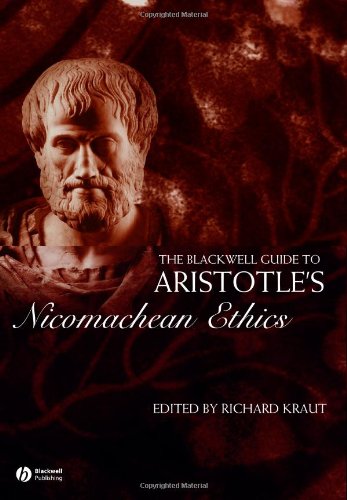
41. The Blackwell Guide to Aristotle's Nicomachean Ethics (Blackwell Guides to Great Works)
Paperback: 384 Pages (2006-02-06)
list price: US$36.95 -- used & new: US$27.71
(price subject to change: see help)
Asin: 1405120215
Canada | United Kingdom | Germany | France | Japan
Editorial Review

Book Description
The Blackwell Guide to Aristotle’s Nicomachean Ethics illuminates Aristotle’s ethics for both academics and students new to the work, with sixteen newly commissioned essays by distinguished international scholars.


  • The structure of the book mirrors the organization of the Nichomachean Ethics itself.
  • Discusses the human good, the general nature of virtue, the distinctive characteristics of particular virtues, voluntariness, self-control, and pleasure.
... Read more

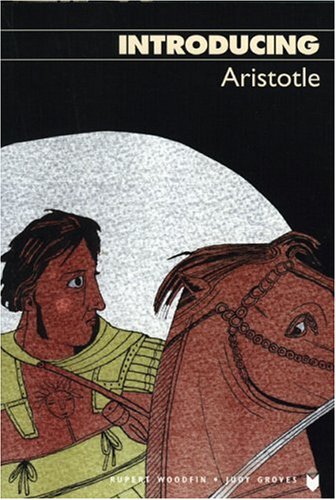
42. Introducing Aristotle, New Edition (Introducing (Icon))
by Rupert Woodfin
Paperback: 176 Pages (2006-11-25)
list price: US$12.95 -- used & new: US$3.98
(price subject to change: see help)
Asin: 1840467592
Average Customer Review: 5.0 out of 5 stars
Canada | United Kingdom | Germany | France | Japan
Editorial Review

Book Description
Aristotle was named the 'master of those who know.' He is a foundational thinker in every field of inquiry. He established logic as a systematic discipline, conceived the earliest rules of science, developed a rational psychology, a political science and an outline of sociology, and gave us a virtue theory of ethics that is still a model today. His contributions to metaphysics continue to permeate modern philosophy. He supplied the first theory of aesthetics, which still provides the basis of debates today. Aristotle's authority extended beyond his time to influence Islamic society and medieval scholasticism. For fifteen hundred years he remained the paradigm of knowledge itself, until scientific empiricism in the 17th century is said to have discredited his methods. Is this true? How 'scientific' is Aristotle? ... Read more

Customer Reviews (2)

5-0 out of 5 stars Really liked it
Quite good book in the Introducing... series, and if you like this one, make sure to pick up the Plato book also, it needs to be read after this one.

5-0 out of 5 stars A simple yet helpful introduction to Aristotle.
Let me begin by saying that this book is far from an in-depth examination of Aristotle. It is, rather, a very elementary introduction to the philosopher and his philosophy. I rejected the idea of buying the book many times, because of it's approach; there are illustrations in pictographic form on every page. It is almost like the old "Classics Illustrated" comic books. I resented the facile approach to profound philosophy. However, the paucity of elementary introductions to Aristotle drove me to relent, and I bought it. The book is exactly what it claims to be...an introduction to Aristotle. In simple, non-philosophical language it gives an elementary introduction to the great philosopher. If you have become exasperated (as I had) at the unavailability of basic intro's to Aristotle, buy the book. Since reading the book, I have undertaken more challenging books about Aristotle, because this one gave me the elements I needed to move forward. ... Read more


43. Aristotle's Physics
by Aristotle
 Paperback: 386 Pages (1980-05)
list price: US$19.00
Isbn: 0960287035
Average Customer Review: 5.0 out of 5 stars
Canada | United Kingdom | Germany | France | Japan

Customer Reviews (1)

5-0 out of 5 stars Ancient Philosophy at its Best
Aristotle's Physics is a brilliant compilation of his notes that he lectured from.This translation is stunning, with lots of commentaries and clarifications.This book encompasses everything from space, biology, potentiality, being, and luck, and much more.Whether reading for knowledge or pleasure, I would recommend this book. ... Read more


44. A Guided Tour of Selections from Aristotle's Nicomachean Ethics
by Christopher Biffle
Paperback: 167 Pages (1990-10-15)
list price: US$30.94 -- used & new: US$10.40
(price subject to change: see help)
Asin: 0874848954
Canada | United Kingdom | Germany | France | Japan
Editorial Review

Book Description
This "guided tour" actively engages students with Aristotle's work through a variety of tasks that help them develop their critical thinking, reading, and writing skills. The text provides complete discussion of books 1-4 and 10 and offers summaries and excerpts of Books 2, 3, and 5 through 9. ... Read more


45. Aristotle: The Desire to Understand
by Jonathan Lear
Paperback: 352 Pages (1988-02-26)
list price: US$31.99 -- used & new: US$15.95
(price subject to change: see help)
Asin: 0521347629
Average Customer Review: 4.5 out of 5 stars
Canada | United Kingdom | Germany | France | Japan
Editorial Review

Book Description
This is a philosophical introduction to Aristotle, and Professor Lear starts where Aristotle himself started. He introduces us to the essence of Aristotle's philosophy and guides us through all the central Aristotelian texts--selected from the Physics, Metaphysics, Ethics, Politicsand the biological and logical works.The book is written in a direct, lucid style that engages the reader with the themes in an active and participatory manner. It will prove a stimulating introduction for all students of Greek philosophy and for a wide range of others interested in Aristotle as a giant figure in Western intellectual history. ... Read more

Customer Reviews (5)

5-0 out of 5 stars A superb overview of Aristotle's full range of thought in all its subtlety
Absolutely outstanding. I read Philosophy over thirty years ago at the University of Wales, making a detailed study of Aristotle's concept of matter. Since then I have read many books on Aristotle and have only just got around to reading this one. It has to be about the best single study available of Aristotle's thought (of course I have not read them all!) Jonathan Lear never wavers from expressing very carefully the exact and subtle points that Aristotle made, never papers over any cracks, never says anything that Aristotle did not say. This should have a position of importance in any philosopher's library.

5-0 out of 5 stars A book with real insights into Aristotle
Jonathan Lear gives us a truthful and insightful look at Aristotle's thoughts.As opposed to many so-called commentators and experts on Aristotle's theories (including W.D.Ross and J.L.Ackrill) Lear attempts at explaining what Aristotle was saying, not an elaborate re-interpretation and argumentation.Questions and certain problems are not, however, ignored.And Lear's approach to Hume's problem of cause/effect when discussing Aristotle's four causes is to be much admired (as is his whole understanding of the causes.)Kant is as well not ignored when his ideas are relevent (or contradictory.)But Lear has a knack for explaining each philosopher in itself and this explaining as to what it was that Aristotle said (in contradistinction to Kant's ideas), but not in a judgmental sort of manner.

After looking at many (if not almost all) books on Aristotle's theories, I was suprised to find a book with clear,lucid, and straightforward ideas.This is most probably the best book on this subject.

4-0 out of 5 stars Excellent explication of Aristotle
As the author notes, there is a common tendency to describe 'old' philosophies such as Aristotles in an historical manner: to treat his ideas as tacitly dead and gone, with the value of the works deriving from either locating Aristotle's ideas in the context of the history of philosophy, or via some rather facile 'compare and contrast with modern views' approach.

Instead, Lear is "...primarily concerned with the truth about Aristotle, not the truth of Aristotle's views per se...". This frees him up to spend most of his ink on explicating and clarifying the views of Aristotle. Where contrasts do appear, they are intended to "...bring to light how different Aristotle's world is from the modern, not to show how Aristotle's beliefs fall short of what we now take to be the truth."

The organization is by concepts, so within one section there are often references to various books on Aristotle. This is much more helpful than simply attempting to narrate, or move in lockstep, with Aristotle's sequence of writings.

The references are generally sufficient, footnoted at the bottom of the pages. Occasionally, the original Greek words or phrases are also footnoted. (I would have preferred more of the latter, but that is a quibble.)

The author is neither pretentious nor superficial. His writing is that of a patient tutor who is willing to explain, but also not willing to oversimplify. In so doing, the book comes across as being ardently respectful of Aristotle, and it is an excellent companion to reading Aristotle's works.

5-0 out of 5 stars Author stayed on the subject
Jonathon Lear explains and describes Aristotle's point of view and concepts.The book is easy to read and clearly presents the material.I thoroughly enjoyed it.

4-0 out of 5 stars Very clear and fresh look at Aristotle's thought
A simply excellent book introducing the philosophy of Aristotle byJonathan Lear. Lear accesses the original ancient Greek and as such avoidssome of the errors which creep into accounts of ancient philosophy using acontemporary mind-set. A very clear account of Aristotle's many works,excerpts from the metaphysics, ethics andothers explaining the somewhatdifficult concepts in a fresh way that is free of extraneous interpretationand captures Aristotle's own way of understanding, or at least as close asseems possible given the intervening time.Just when you thought a concepthad been understood along comes a new and invigorating idea to surprise youas you proceed through the book. This is not a simple book, neither is itintended to be. I would think it is just about Aristotelian thought and itsauthentic meaning. Not only does it show the depth of his ideas but givesyou an insight into Aristotle's astonishing talents, his thought spanningtopics from ethics and politics to biology, it gives the impression thatthe word polymath was created to describe Aristotle and that any comingafter him would try to approach his intellect and insight into the world.The book demonstrates some of Aristotle's greatest solutions to thechallenges proposed by Plato's thought as well as Zeno. All in all anexceptional book in the practise of Aristotle's philosophy. It is a pitythat the older book by Lear on Aristotelian Logic is now out of print,hopefully this situation is only temporary. ... Read more


46. Ethics With Aristotle
by Sarah Broadie
Paperback: 480 Pages (1993-09-30)
list price: US$60.00 -- used & new: US$42.70
(price subject to change: see help)
Asin: 0195085604
Canada | United Kingdom | Germany | France | Japan
Editorial Review

Book Description
This is a close and comprehensive study of the main themes of Aristotle's ethics. Sarah Broadie concentrates on what he has to teach about happiness, virtue, voluntary agency, practical reason, incontinence, pleasure, and the place of theoria in the best life. Never forgetting that ethics for Aristotle is above all a practical enterprise, she sheds new light on ways in which this practical orientation affects both content and method of his inquiry. The book culminates in a sustained argument showing how even Aristotle's ideal of theoretic contemplation in integral to his essentially practical vision of human nature. Ethics with Aristotle is a major contribution toward the further understanding of Aristotle's ethics. ... Read more


47. The Emotions of the Ancient Greeks: Studies in Aristotle and Classical Literature (Robson Classical Lectures)
by David Konstan
Paperback: 428 Pages (2007-12-22)
list price: US$39.95 -- used & new: US$32.50
(price subject to change: see help)
Asin: 0802095585
Canada | United Kingdom | Germany | France | Japan
Editorial Review

Book Description

It is generally assumed that whatever else has changed about the human condition since the dawn of civilization, basic human emotions – love, fear, anger, envy, shame – have remained constant.David Konstan, however, argues that the emotions of the ancient Greeks were in some significant respects different from our own, and that recognizing these differences is important to understanding ancient Greek literature and culture.

With The Emotions of the Ancient Greeks, Konstan reexamines the traditional assumption that the Greek terms designating the emotions correspond more or less to those of today.Beneath the similarities, there are striking discrepancies.References to Greek ‘anger’ or ‘love’ or ‘envy,’ for example, commonly neglect the fact that the Greeks themselves did not use these terms, but rather words in their own language, such as orgê and philia and phthonos, which do not translate neatly into our modern emotional vocabulary. Konstan argues that classical representations and analyses of the emotions correspond to a world of intense competition for status, and focused on the attitudes, motives, and actions of others rather than on chance or natural events as the elicitors of emotion.Konstan makes use of Greek emotional concepts to interpret various works of classical literature, including epic, drama, history, and oratory.Moreover, he illustrates how the Greeks' conception of emotions has something to tell us about our own views, whether about the nature of particular emotions or of the category of emotion itself.

... Read more

48. Aristotle (Historical Biographies)
by Brian Williams
 Paperback: 32 Pages (2002-05)
list price: US$7.99 -- used & new: US$7.99
(price subject to change: see help)
Asin: 1588109976
Canada | United Kingdom | Germany | France | Japan

49. Aristotle's Metaphysics
by Aristotle, Joe Sachs
Paperback: 303 Pages (1999-03-12)
list price: US$24.95 -- used & new: US$24.95
(price subject to change: see help)
Asin: 1888009039
Average Customer Review: 3.5 out of 5 stars
Canada | United Kingdom | Germany | France | Japan

Customer Reviews (3)

3-0 out of 5 stars A Word or Two on This Translation
I preface this with one caveat: I am not a Greek scholar. I have, however, read this book, in toto, in this translation. I have also read, though not in its entirety, another translation.Joe Sachs, positively a very intelligent scholar of these texts, has tried to put it into what he considers to be true to the Greek. Again, I am not a scholar of the Greek language, but I think that Sachs goes 'overboard,' if you will, in presenting to us, the laypeople, a translation beyond what is really necessary to get the job done. By that, I mean that a traditional translation is more than adequate, so long as you don't try to get at the Thomistic textual analysis at first go-round, or so I'm told. There are several chapters (keeping in mind, this is Aristotle's Metaphysics we're talking about) where I had trouble discerning pages at a time, reading and re-reading just for an objective account of what Aristotle was saying, or trying to say through Dr. Sachs.The Metaphysics should be read; that is not the question. The question is whether this is the translation for you. I, for one, will say that it is not. Not because of uncanny foresight, but due to the difficult readability of such a complex exposition on reality, being, and, in the concluding chapters of course, God.So, I give this version 3 stars: as a text in itself, it is good; it is not a wonderfully understandable translation, however.I hope that this verbose review has been beneficial for you.

4-0 out of 5 stars Meticulous translator of Aristotle
I've not read Sachs's translation of the Metaphysics, though I did work through his version of the Physics during a summer at St. John's College (where he teaches).His Metaphysics was circulating as a xerox copy at the college bookstore; I'm glad to see it in print.

Anyone unfortunate enough (as I am) to read Aristotle in English rather than ancient Greek, can benefit from Sachs's translations, though it remains worthwhile to have something like the classic Oxford translation alongside, to compare their senses of the Greek text.Sachs's object is to recover what Aristotle may've been up to, by avoiding the Latinate terminology that haunts Aristotle studies and trying to find more "authentic" meanings for the Greek words.Whatever his ultimate success or failure, it's wonderful to have such a fresh approach to the translation of Aristotle available.

3-0 out of 5 stars Maybe Aristotle wasn't interested in philosophy
This translation of Aristotle from the Greek directly into modern English makes use of the scholarship surrounding the efforts which have been most successful with Heidegger.

`Thus, the way I understand *to ti en einai* departs from, but is rooted in, Owen's understanding of it.The same is true of my rendering *ousia* as "thinghood," when it is used in a general sense, and as "an independent thing" when it is used of singulars.I have heard two sorts or criticism of my use of the word thinghood in Aristotle's PHYSICS.The one sort, that it occasions laughter or embarrassment, is a general instance of Heidegger's observation in WHAT IS A THING? that philosophy is that at which thoughtless people laugh.Let the laughter or embarrassment subside, and then judge the meaning carried by the word, both on its own and in its context, on its merits.The other sort of criticism regrets the fact that thinghood is not as closely related to being as *ousia* is to *to on.* . . .' (p. xxxvii).

"Lassie is an *ousia,* and the *ousia* of Lassie is dog."(p. xxxviii).

Intellectuals need to pay attention to the concepts that are used in their own fields, if nowhere else, and Aristotle was close to the peak of ancient Greek intellectual attainment.

"Aristotle invents a second word, being-at-work-staying-itself (entelecheia), converging with it in meaning, to sharpen and clarify his use of being-at-work, and he gives an array of examples in which we are meant to `see at a glance by means of analogy,' what it means (1048a 39)."(p. xxxix).

In the beginning of this book, ARISTOTLE'S METAPHYSICS, Translated by Joe Sachs, there is a Greek Glossary with 49 words or phrases on three pages, followed by an English Glossary of 43 words or phrases on eleven pages."This is a slightly revised version of the glossary that appears with the translation of the PHYSICS, based upon those passages in which Aristotle explains and clarifies his own usage.Bekker page numbers from 184 to 267 refer to the PHYSICS; those from 980 to 1093 are in the METAPHYSICS."(p. xlix).

Chapters are short, especially in Book V (Book Delta), which Joe Sachs calls "Things Meant in More than One Way."This has usually been considered "a dictionary, but Aristotle himself, at the beginnings of Books VII and X, says that it is about the various ways things are meant.The point is not to define words but to collect and organize the distinct senses of important words meant in more than one way.These ambiguities are not verbal but inherent in things, and Aristotle steadfastly preserves them."(p. 77, n. 1).

I am not particularly fond of this book.If undergraduate college courses are meant to provide students with general outlook on likely events, and graduate schools at major universities are intended to select those students who want to qualify for cutting edge work in a highly specialized professional discipline, the works of Aristotle seem to be the high point of a Greek attempt to create an upper level above anything that had previously been considered possible.Alexander the Great, as a student of Aristotle, might be faulted for aspiring to far more than what could be useful, just as Heidegger seemed to be pushing for a German spirit that was sure to damn the rest of the world to misery when he assumed a place in the leadership of a German university backing Hitler and the Nazi party.

I did not find Aristotle's approach to religion in Book VI to be inspiring, though it does seem to be intellectual."But if there is anything that is everlasting and motionless and separate, . . .

"And while it is necessary that all causes be everlasting, these are so most of all, since they are responsible for what appears to us of the divine.Therefore there would be three sorts of contemplative philosophy, the mathematical, the natural, and the theological; for it is not hard to see that if the divine is present anywhere, it is present in a nature of this kind, and that the most honorable study must be about the most honorable class of things.The contemplative studies, then, are more worthy of choice than are the other kinds of knowledge, and this one is more worthy of choice than are the other contemplative studies."(pp. 110-111).

This is a nice priority for an established church to maintain its dignity, but it is far more ancient than modern.It is not clear how infinite his "triangle containing two right angles" (p. 112) is supposed to be.Even his attempts to tiptoe around the major stereotypes of ancient bookworms seem limp."For instance, it is neither always nor for the most part that someone pale has a refined education, but since it sometimes happens, it will be incidental (or if not, everything would be by necessity)."(p. 113).

The Index only mentions three pages in Aristotle's text for Socrates, though Aristotle often uses his name as an example:"And since Socrates exerted himself about ethical matters and not at all about the whole of nature," (p. 14) and "so that whether Socrates is or is not, one might become like Socrates, and it is obvious that it would be the same even if Socrates were everlasting."(p. 23).Two generations of seeking lessons from Socrates, ignoring whatever meaning the hemlock had, took place before we find Aristotle finally admitting "For there are two things one might justly credit Socrates with, arguments by example and universal definition,"(p. 260).A real philosopher ought to do better than that. ... Read more


50. Aristotle, XIX, Nicomachean Ethics (Loeb Classical Library®)
by Aristotle
 Hardcover: 704 Pages (1934-06-10)
list price: US$24.00 -- used & new: US$21.50
(price subject to change: see help)
Asin: 0674990811
Average Customer Review: 4.5 out of 5 stars
Canada | United Kingdom | Germany | France | Japan
Editorial Review

Book Description

Aristotle, great Greek philosopher, researcher, reasoner, and writer, born at Stagirus in 384 BCE, was the son of Nicomachus, a physician, and Phaestis. He studied under Plato at Athens and taught there (367-347); subsequently he spent three years at the court of a former pupil, Hermeias, in Asia Minor and at this time married Pythias, one of Hermeias's relations. After some time at Mitylene, in 343-2 he was appointed by King Philip of Macedon to be tutor of his teen-aged son Alexander. After Philip's death in 336, Aristotle became head of his own school (of 'Peripatetics'), the Lyceum at Athens. Because of anti-Macedonian feeling there after Alexander's death in 323, he withdrew to Chalcis in Euboea, where he died in 322.

Nearly all the works Aristotle prepared for publication are lost; the priceless ones extant are lecture-materials, notes, and memoranda (some are spurious). They can be categorized as follows: I Practical: Nicomachean Ethics; Great Ethics (Magna Moralia); Eudemian Ethics; Politics; Economics (on the good of the family); On Virtues and Vices. II Logical: Categories; Analytics (Prior and Posterior); Interpretation; Refutations used by Sophists; Topica. III Physical: Twenty-six works (some suspect) including astronomy, generation and destruction, the senses, memory, sleep, dreams, life, facts about animals, etc. IV Metaphysics: on being as being. V Art: Rhetoric and Poetics. VI Other works including the Constitution of Athens; more works also of doubtful authorship. VII Fragments of various works such as dialogues on philosophy and literature; and of treatises on rhetoric, politics and metaphysics.

The Loeb Classical Library edition of Aristotle is in twenty-three volumes.

... Read more

Customer Reviews (3)

5-0 out of 5 stars about halfway through it.
this book is beautiful for context when reading kierkegaard or thomas aquinas. for instance, take patience; where on the scale between passivity and wrath does turning the other cheek fit in? it is necessary to understand this in order to understand the teleological suspension of the ethical or to understand the theological virtues, faith, hope and charity, as departures from ethics. btw, father messick in an earlier review writes that the writers of the declaration of independence had an aristotelian mindset and i will not argue that point. i would just like to point out that life, liberty and the pursuit of happiness is commandeered, so to speak, from the writings of adam smith, i.e., life, liberty and the pursuit of property. also that thomas jefferson much preferred continental philosophers, such as locke and rousseau, to the ancient greeks as is evident in his letters. loeb library is the right choice for poor students of greek such as myself. i also have homer and hesiod.

5-0 out of 5 stars Doing the right thing
Aristotle was a philosopher in search of the chief good for human beings. This chief good is eudaimonia, which is often translated as 'happiness' (but can also be translated as 'thriving' or 'flourishing'). Aristotle sees pleasure, honour and virtue as significant 'wants' for people, and then argues that virtue is the most important of these.

In the Nicomachean Ethics, Aristotle makes the claim that happiness is something which is both precious and final. This seems to be so because it is a first principle or ultimate starting point. For, it is for the sake of happiness that we do everything else, and we regard the cause of all good things to be precious and divine. Moreover, since happiness is an activity of the soul in accordance with complete and perfect virtue, it is necessary to consider virtue, as this will be the best way of studying happiness.

How many of us today speak of happiness and virtue in the same breath? Aristotle's work in the Nicomachean Ethics is considered one of his greatest achievements, and by extension, one of the greatest pieces of philosophy from the ancient world. When the framers of the American Declaration of Independence were thinking of life, liberty, and the pursuit of happiness, there is little doubt they had an acquaintance with Aristotle's work connecting happiness, virtue, and ethics together.

When one thinks of ethical ideas such as an avoidance of extremes, of taking the tolerant or middle ground, or of taking all things in moderation, one is tapping into Aristotle's ideas. It is in the Nicomachean Ethics that Aristotle proposes the Doctrine of the Mean - he states that virtue is a 'mean state', that is, it aims for the mean or middle ground. However, Aristotle is often misquoted and misinterpreted here, for he very quickly in the text disallows the idea of the mean to be applied in all cases. There are things, actions and emotions, that do not allow the mean state. Thus, Aristotle tends to view virtue as a relative state, making the analogy with food - for some, two pounds of meat might be too much food, but for others, it might be too little. The mean exists between the state of deficiency, too little, and excessiveness, too much.

Aristotle proposes many different examples of virtues and vices, together with their mean states. With regard to money, being stingy and being illiberal with generosity are the extremes, the one deficient and the other excessive. The mean state here would be liberality and generosity, a willingness to buy and to give, but not to extremes. Anger, too, is highlighted as having a deficient state (too much passivity), an excessive state (too much passion) and a mean state (a gentleness but firmness with regard to emotions).

Aristotle states that one of the difficulties with leading a virtuous life is that it takes a person of science to find the mean between the extremes (or, in some cases, Aristotle uses the image of a circle, the scientist finding the centre). Many of us, being imperfect humans, err on one side or the other, choosing in Aristotle's words, the lesser of two evils. Aristotle's wording here, that a scientist is the only one fully capable of virtue, has a different meaning for scientist - this is a pre-modern, pre-Enlightenment view; for Aristotle, the person of science is one who is capable of observation and calculation, and this can take many different forms.

Aristotle uses different kinds of argumentation in the Nicomachean Ethics. He uses a dialectical method, as well as a functional method. In the dialectical method, there are opposing ideas held in tension, whose interactions against each other yield a result - this is often how the mean between extremes is derived. However, there are other times that Aristotle seems to prefer a more direct, functional approach. Both of these methods lead to the same understanding for Aristotle's sense of the rational - that humanity's highest or final good is happiness.

There is a discussion of the human soul (for this is where virtue and happiness reside). Aristotle argues that virtue is not a natural state; we are not born with nor do we acquire through any natural processes virtue, but rather through 'habitation', an embedding process or enculturation that makes these a part of our soul. However, it is not sufficient for Aristotle's virtue that one merely function as a virtuous person or that virtuous things be done. This is not a skill, but rather an art, and to be virtuous, one must live virtuously and act virtuously with intention as well as form.

Of course, one of the implications here is that virtue is a quantifiable thing, that periodically resurfaces in later philosophies. How do we calculate virtue?

This is a difficult question, and not one that Aristotle answers in any definitive way. However, more important than this is the key difference that Aristotle displayed setting himself apart from his tutor Plato; rather than seeing the possession of 'the good' or 'virtue' as the highest ideal, Aristotle is concerned with the practical aspects, the ethics of this. Based on Aristotle's lectures in Athens in the fourth century BCE, this remains one of the most important works on ethical and moral philosophy in history.

4-0 out of 5 stars Aristotle's Ethics: The Art of Living
I bought this book almost accidentaly, for having nothing better to do one night on a business trip to Pretoria.Being Greek, I have a love-hate relationship with the Ancients:brought up to marvel at their genius, butfeeling alienated by an education system that force-fed us with sterile,badly translated texts, which always seemed irrelevant to our lifes. Thisbook opened my eyes to the true meaning of "Philosophy". Thetranslation is in modern English, free from the back-to-front syntax of theAncient Greek text (which makes it impossible to understand the meaning ofa sentence until you reach the end of it!).

The subject matter is"Ethics".However, a modern author may have called it somethingmore akin to "The Meaning of Life" or "The Art ofLiving". Aristotle proceeds with simple and clear logic, to reveal theobjective of human struggle in this life. He demonstrates a deepunderstanding of the Human Being, what we are and what we are not, whatmakes us act in one way or another and what makes us feel joy or distress. He addresses anxienties of the modern human, such as the question of natureor nurture, the moral action versus the practical, violence versusnon-violence. His recommendations for living this life in a manner thatis meaningfull and rewarding are profound yet simple.I found myselfshaking my head in recognition at every example or conclusion.I felt afresh wind in my chest, as if it was I who was discovering this knowledge,not some 2.5 thousand year old man.

I recommend this book to anyone whowants to discover more about how to live this life, but feels foreign tocurrent eastern-derived, philosophical/religious fashions which, even whenilluminating, can appear alien to the western way of thinking. ... Read more


51. Aristotle:Poetics.; Longinus: On the Sublime; Demetrius: On Style (Loeb Classical Library No. 199)
by Aristotle, Longinus, Demetrius
Hardcover: 560 Pages (1996-03)
list price: US$24.00 -- used & new: US$23.90
(price subject to change: see help)
Asin: 0674995635
Average Customer Review: 5.0 out of 5 stars
Canada | United Kingdom | Germany | France | Japan
Editorial Review

Book Description

This volume brings together the three most influential ancient Greek treatises on literature. Aristotle's Poetics contains his treatment of Greek tragedy: its history, nature, and conventions, with details on poetic diction. Stephen Halliwell makes this seminal work newly accessible with a reliable text and a translation that is both accurate and readable. His authoritative introduction traces the work's debt to earlier theorists (especially Plato), its distinctive argument, and the reasons behind its enduring relevance.

The essay On the Sublime, usually attributed to "Longinus" (identity uncertain), was probably composed in the first century CE; its subject is the appreciation of greatness ("the sublime") in writing, with analysis of illustrative passages ranging from Homer and Sappho to Plato. In this edition, Donald Russell has revised and newly annotated the text and translation by W. Hamilton Fyfe, and supplied a new introduction.

The treatise On Style, ascribed to an (again unidentifiable) Demetrius, was perhaps composed during the second century BCE. It is notable particularly for its theory and analysis of four distinct styles (grand, elegant, plain, and forceful). Doreen Innes' fresh rendering of the work is based on the earlier Loeb translation by W. Rhys Roberts. Her new introduction and notes represent the latest scholarship.

... Read more

Customer Reviews (1)

5-0 out of 5 stars EXCELLENT TRANSLATION - EXCELLENT STUDY GUIDE
I certainly refuse to be presumptuous enough to write a critique addressing the works of Aristotle, but do give this particular translation and particular publication five stars.It is an excellent study guide.It is quite superior to the Classics Club Edition. Recommend it highly.The cross references to the orginal greek are wonderful and quite useful.You need to add this one to your library if your interest points in this direction. ... Read more


52. Greek Science After Aristotle
by G. E. R. Lloyd
 Paperback: 189 Pages (1975-08)
list price: US$14.20 -- used & new: US$8.75
(price subject to change: see help)
Asin: 0393007804
Average Customer Review: 5.0 out of 5 stars
Canada | United Kingdom | Germany | France | Japan

Customer Reviews (1)

5-0 out of 5 stars Greek Science the second time around.
I'd read this book some years ago, but found it difficult going at the time.I decided to re-read it recently, as it was on the wish list of a friend which reminded me I still had the volume.This time around I foundit much more interesting and more understandable.There definitely seemsto be a time for everything, and apparently this was the time for GreekScience for me.What I found of particular interest was a new perspectivethat I acheived in a novel way. I recently attended a MinneapolisChildrens' Theater production featuring events from the life of Galileo. It was pointed out in the playbill that what seems to us in retrospect apatent persecution of a new concept by jealous intellectuals and religiousauthorities was not quite so clear cut at the time.In fact the scientificthinkers of Galileo's time, as those of the Hellanistic Greek and Romantimes, labored with the technological inability to test the validity ofscientific observations. Much that passed for science during those timesmight be considered philosophy or metaphysics in our own.Without themeans of externally testing opposing explanations of natural phenomenonlittle of definitive worth could be said about any given observation.Itthen became a matter of philosophical orientation, of reputation and ofreligious sanction.It was in fact anybody's guess.We who are used tomeasuring equipment as simple as a thermometer and as complex as an earthorbiting satelite often forget that these devices were not yet available tothe researchers of ancient or even medieaval times. Some of the simplerdevices were only just being introduced in Galileo's time and wereconsidered untested and highly suspect themselves.Given that a number ofingeneous inventions of early times were engineered with the specificintent to mislead or impress the public, the scepticism with whichsomething like the telescope or the microscope were greeted is notsurprising.To the early critic, one could not necessarily believe oneseyes; it was better to believe what the Holy Book or a learned philosopherhad to say with respect to nature than what a "conjurer" mightsay.Greek Science After Aristotle makes this point apparent, explaningthat only in the area of mathematics and in applied physics (engineering,especially military engineering) could anything like trustworthy precisionbe achieved.It also points out that though modern science valuesobservation and experiment, the neglect of these was not necessarily due toa laziness or disregard for precision, but due to a lack of technologicalmeans.In fact, much was done and some very ingeneous devices toaccomplish it were invented to perform it.The researchers of the timeshad to be very innovative and original in their approach to problemsolving; something which we with our computerized devices are rarely calledupon to do a such basic levels.Rereading the book from this perspectivedefinitely gave me a greater appreciation for the achievments of ourintellectual predecessors. ... Read more


53. Aristotle: On Sophistical Refutations. On Coming-to-be and Passing Away. On the Cosmos. (Loeb Classical Library No. 400)
by Aristotle
 Hardcover: 448 Pages (1987-06)
list price: US$24.00 -- used & new: US$24.00
(price subject to change: see help)
Asin: 0674994418
Canada | United Kingdom | Germany | France | Japan
Editorial Review

Book Description

Aristotle, great Greek philosopher, researcher, reasoner, and writer, born at Stagirus in 384 BCE, was the son of Nicomachus, a physician, and Phaestis. He studied under Plato at Athens and taught there (367-347); subsequently he spent three years at the court of a former pupil, Hermeias, in Asia Minor and at this time married Pythias, one of Hermeias's relations. After some time at Mitylene, in 343-2 he was appointed by King Philip of Macedon to be tutor of his teen-aged son Alexander. After Philip's death in 336, Aristotle became head of his own school (of 'Peripatetics'), the Lyceum at Athens. Because of anti-Macedonian feeling there after Alexander's death in 323, he withdrew to Chalcis in Euboea, where he died in 322.

Nearly all the works Aristotle prepared for publication are lost; the priceless ones extant are lecture-materials, notes, and memoranda (some are spurious). They can be categorized as follows: I Practical: Nicomachean Ethics; Great Ethics (Magna Moralia); Eudemian Ethics; Politics; Economics (on the good of the family); On Virtues and Vices. II Logical: Categories; Analytics (Prior and Posterior); Interpretation; Refutations used by Sophists; Topica. III Physical: Twenty-six works (some suspect) including astronomy, generation and destruction, the senses, memory, sleep, dreams, life, facts about animals, etc. IV Metaphysics: on being as being. V Art: Rhetoric and Poetics. VI Other works including the Constitution of Athens; more works also of doubtful authorship. VII Fragments of various works such as dialogues on philosophy and literature; and of treatises on rhetoric, politics and metaphysics.

The Loeb Classical Library edition of Aristotle is in twenty-three volumes.

... Read more

54. A New Aristotle Reader
 Paperback: 600 Pages (1988-01-01)
list price: US$29.95 -- used & new: US$18.99
(price subject to change: see help)
Asin: 0691020434
Average Customer Review: 4.5 out of 5 stars
Canada | United Kingdom | Germany | France | Japan

Customer Reviews (2)

4-0 out of 5 stars Very usable and useful
This volume contains a well-chosen selection of Aristotle's works. As another reviewer suggests, this book is a welcome middle ground between 'pocket' editions and a full blown Oxford edition.

The translations (though I am by no means a scholar of Greek) seem to be quite proper, and despite the fact that different sections may be translated by different people, there is no apparent unevenness.

Ackrill laments in the introduction that it would have been more proper to leave about 30-40 Greek words (such as 'logos', 'aitia', 'ousia') untranslated, since no single English word does them justice. But that since there aretranslations by several people involved, that was not possible.

All in all, this would be a very handy book for anyone interested in Aristotle.

5-0 out of 5 stars An Excellent Compendium
For students who desire neither the whole Oxford corpus or who need a more condensed version of the Oxford translation, this edition, edited by the renowned Aristotlean scholar Ackrill, will be pleasantly kept in good company.

I own both books, and oddly find myself picking up this volume rather than the two-volume set, for easy reference. All the essential material is here, and none of the important elements are injudiciously edited. Thus for a single volume, it does double duty -- providing the most current translation of Aristotle, while appropriately editing the most salient parts for the specialist and non-specialist alike.

The book is appropriate for undergraduate and graduate semester courses as a complete enough text for either venue. It also has a nice topical index in the back that refers the reader to many essays written in the scondary literature. ... Read more


55. Aristotle's Ethics (Cliffs Notes)
by Charles H. Patterson
Paperback: 112 Pages (1966-03-25)
list price: US$5.99 -- used & new: US$1.00
(price subject to change: see help)
Asin: 0822008890
Canada | United Kingdom | Germany | France | Japan
Editorial Review

Book Description
The original CliffsNotes study guides offer expert commentary on major themes, plots, characters, literary devices, and historical background.

People have not changed significantly in the many years since Aristotle first lectured on ethics at the Lyceum in Athens. The human types and problems covered in CliffsNotes on Aristotle’s Ethics are familiar to everyone. The rules of conduct and explanations of virtue and goodness that he proposes can help people of all eras better understand their role in society.

This study guide allows you to make your way through Aristotle’s famous essays with confidence. You’ll find clear summaries and explanations of each major theme. Other features that help you study include

  • Introduction to the life of Aristotle
  • Overview of the main points of Aristotle’s ethical philosophy
  • Summaries and critical commentaries of the complete Nichomachean Ethics
  • Review questions

Classic literature or modern modern-day treasure — you'll understand it all with expert information and insight from CliffsNotes study guides. ... Read more


56. Aristotle: On the Soul. Parva Naturalia. On Breath. (Loeb Classical Library No. 288)
by Aristotle
Hardcover: 544 Pages (1975-06)
list price: US$24.00 -- used & new: US$19.85
(price subject to change: see help)
Asin: 0674993187
Canada | United Kingdom | Germany | France | Japan
Editorial Review

Book Description

Aristotle, great Greek philosopher, researcher, reasoner, and writer, born at Stagirus in 384 BCE, was the son of Nicomachus, a physician, and Phaestis. He studied under Plato at Athens and taught there (367-347); subsequently he spent three years at the court of a former pupil, Hermeias, in Asia Minor and at this time married Pythias, one of Hermeias's relations. After some time at Mitylene, in 343-2 he was appointed by King Philip of Macedon to be tutor of his teen-aged son Alexander. After Philip's death in 336, Aristotle became head of his own school (of 'Peripatetics'), the Lyceum at Athens. Because of anti-Macedonian feeling there after Alexander's death in 323, he withdrew to Chalcis in Euboea, where he died in 322.

Nearly all the works Aristotle prepared for publication are lost; the priceless ones extant are lecture-materials, notes, and memoranda (some are spurious). They can be categorized as follows: I Practical: Nicomachean Ethics; Great Ethics (Magna Moralia); Eudemian Ethics; Politics; Economics (on the good of the family); On Virtues and Vices. II Logical: Categories; Analytics (Prior and Posterior); Interpretation; Refutations used by Sophists; Topica. III Physical: Twenty-six works (some suspect) including astronomy, generation and destruction, the senses, memory, sleep, dreams, life, facts about animals, etc. IV Metaphysics: on being as being. V Art: Rhetoric and Poetics. VI Other works including the Constitution of Athens; more works also of doubtful authorship. VII Fragments of various works such as dialogues on philosophy and literature; and of treatises on rhetoric, politics and metaphysics.

The Loeb Classical Library edition of Aristotle is in twenty-three volumes.

... Read more

57. The Athenian Constitution
by Aristotle
Paperback: 64 Pages (2004-06-30)
list price: US$16.95 -- used & new: US$10.03
(price subject to change: see help)
Asin: 1419152785
Canada | United Kingdom | Germany | France | Japan
Editorial Review

Book Description
[They were tried] by a court empanelled from among the noble families, and sworn upon the sacrifices. The part of accuser was taken by Myron. They were found guilty of the sacrilege, and their bodies were cast out of their graves and their race banished for evermore. In view of this expiation, Epimenides the Cretan performed a purification of the city.Download Description
[They were tried] by a court empanelled from among the noble families, and sworn upon the sacrifices. The part of accuser was taken by Myron. They were found guilty of the sacrilege, and their bodies were cast out of their graves and their race banished for evermore. In view of this expiation, Epimenides the Cretan performed a purification of the city. ... Read more


58. Student's Quest Guide: Aristotle Leads the Way
by Johns Hopkins University
 Paperback: 112 Pages (2007-12-01)
list price: US$12.95 -- used & new: US$8.81
(price subject to change: see help)
Asin: 1588342549
Canada | United Kingdom | Germany | France | Japan

59. Thank You for Arguing: What Aristotle, Lincoln, and Homer Simpson Can Teach Us About the Art of Persuasion
by Jay Heinrichs
Paperback: 336 Pages (2007-02-27)
list price: US$13.95 -- used & new: US$7.70
(price subject to change: see help)
Asin: 0307341445
Average Customer Review: 4.5 out of 5 stars
Canada | United Kingdom | Germany | France | Japan
Editorial Review

Book Description
Thank You for Arguing is your master class in the art of persuasion, taught by professors ranging from Bart Simpson to Winston Churchill. The time-tested secrets the book discloses include Cicero’s three-step strategy for moving an audience to actionÑas well as Honest Abe’s Shameless Trick of lowering an audience’s expectations by pretending to be unpolished. But it’s also replete with contemporary techniques such as politicians’ use of “code” language to appeal to specific groups and an eye-opening assortment of popular-culture dodges, including:

The Eddie Haskell Ploy
Eminem’s Rules of Decorum
The Belushi Paradigm
Stalin’s Timing Secret
The Yoda Technique

Whether you’re an inveterate lover of language books or just want to win a lot more anger-free arguments on the page, at the podium, or over a beer, Thank You for Arguing is for you. Written by one of today’s most popular online language mavens, it’s warm, witty, erudite, and truly enlightening. It not only teaches you how to recognize a paralipsis and a chiasmus when you hear them, but also how to wield such handy and persuasive weapons the next time you really, really want to get your own way. ... Read more

Customer Reviews (19)

5-0 out of 5 stars Use this kind of argument in your marriage.
When couples come to me for marriage counseling, they typically violate Heinrichs' most elementary principles. After reading this book, I realize that an important aspect of my counseling has been teaching rhetoric--the art of polite arguing.

For most couples, the idea of arguing politely seems like a joke or at least a myth until they learn to do it. The book will help with your understanding, but probably won't be enough to provide actual marriage help to put anger management into practice.

Heinrichs' style of writing makes rhetoric easy to learn, and some people will be able to put it into practice just using the book. However, in my experience with marriage counseling, I find that couples need practical exercises to make the process really easy and natural in everyday life.

You should know that my first copy was from the library. Half-way through, I realized I wanted my own copy.Then, when I was reading my own copy, I noticed my bookmark was mysteriously changing.The mystery was solved when my 22-year-old son announced he had been reading it and wanted to "borrow" it--and now I am buying my second copy.

Heinrichs has a light and humorous style. He brings stories from his own life, and he makes very complex concepts understandable through modern-day examples. I recommend this book for anyone wanting to improve his or her relationships.

4-0 out of 5 stars Great for Marriage Enrichment
This book review will be sent to the publication we get because we are a leader couple with ACME (Association for Couples in Marriage Enrichment).We've done a book review or two and have been asked to do more, so this review will be geared toward the audience of other couples leading marriage retreats.
On a whim, I picked up the book Thank You for Arguing: What Aristotle, Lincoln, and Homer Simpson Can Teach Us About the Art of Persuasion by Jay Heinrichs after hearing an interview with the author on NPR.As I read through the book, I found more and more example of skills that we can utilize in the weekend retreats for married couples.The quote at the beginning of the book aptly describes the benefit of conflict in marriage: Truth springs from argument among friends. -David HumeI can't think of any more fitting picture of healthy argument, especially in marriage.
As Mr. Heinrichs points out, the point of argument is consensus, not winning.Good argument is respectful, even if heated.Mr. Heinrichs mentions the research of Dr. John Gottman at the University of Washington who showed that successful couples didn't argue less often, but in a different way and with a different purpose than unsuccessful couples.He guesses that the happy couples seduced (he calls it good manipulation) each other with the full knowledge of both parties.People who fight will often win the battle, but lose the war.
He gives valuable skills for successful argument.According to Aristotle, all issues boil down to blame, values, and choice.Blame is based on the past and is least useful.Values are about the present and generally end with people bonding or separating.These can be moral values, or just preferences.Choice is about the future and about action.This is the "What do we want from this?" issue and the one most useful for resolving conflict.
Mr. Heinrichs gives some good advice for handling conflict and maintaining marital harmony simultaneously.He reminds us that "winning an argument may not be your best goal.Relationships and values occasionally trump the advantageous and a rational decision."Also, "many arguments fail simply because of bad timing."He recommends setting, or at least waiting for, a favorable mood before launching into discussion of an issue.He recommends fostering good will with such phrases as "What do you need?"He advocates using "code words" in relationships to foster a feeling of being the only two in a very exclusive club.These code words can even be used to diffuse tense situations by helping both spouses feel that they are on the same side.
Mr. Heinrichs also gives some warnings about improper techniques of argument.One is to never block the argument so that no solution can be reached.He warns against making threats, creating negative labels, or rejecting choices out of hand.He reminds us that "A person who desires something is especially susceptible to anger," and the poor and sick are also prone to anger.If you really want a person to become angry, belittling them will do it very efficiently.He states that "In most cases, there is no right or wrong decisions in argument."
I would recommend this book to any couple leading other couples in dialogue.If you're not interested in reading the whole book, the best chapters with regard to marriage are chapters 1, 2, 3, 18, 19, and 21.Mr. Heinrichs uses many examples from his own marriage and kids on how to successfully use the techniques he teaches.The book is very entertaining and engaging.On a final note, he observes that people who are skilled at argument are not easily offended or beguiled, and isn't that what we all need in marriage and in life?

5-0 out of 5 stars Thank You for Exisiting!
An excellent book!Many extra tidbits of knowledge. Very well organized.Overall inspiring!

5-0 out of 5 stars An Excellent Book for The Writer or Public Speaker
I would recommend this book to anyone who is interested in Public Speaking or persuasive writing.Heinrichs keeps his readers interested in everything he has to say through the use of real-world and pop culture references.Random bits of information in the margins keep every page interesting and well worth your time.

5-0 out of 5 stars Good but a lot of information
This is a great book if you like the subject matter. But don't think you are going to walk away ready to put all this into practice in your next public address or debate with a recalcitrant teen. Keep in mind the author's subtle point that the book effectively represents a summary session on a discipline that is thousands of years old. Not that you won't have fun trying it out though. ... Read more


60. Harry Potter and Philosophy: If Aristotle Ran Hogwarts
Paperback: 250 Pages (2004-09-10)
list price: US$17.95 -- used & new: US$7.75
(price subject to change: see help)
Asin: 0812694554
Average Customer Review: 4.0 out of 5 stars
Canada | United Kingdom | Germany | France | Japan
Editorial Review

Book Description

Harry Potter has put a spell on millions of readers, and they all want to find out more about the deeper meaning of his adventures. In Harry Potter and Philosophy, 17 experts in the field of philosophy unlock some of Hogwarts' secret panels, uncovering surprising insights that are enlightening both for wizards and for the most discerning muggles. Individual chapters look at such topics as life revealed in the Mirror of Erised; the ethics of magic; Moaning Myrtle, Nearly Headless Nick, and the relation of the mind to the brain; and the character of Hermione as a case of "sublimated feminism." Also examined in this witty collection are how Aristotle would have run a school for wizards; whether the Potter stories undermine religion and morality; how to tell good people from evil ones through the characters in these novels; and what dementors and boggarts can teach readers about happiness, fear, and the soul.
... Read more

Customer Reviews (16)

2-0 out of 5 stars 1 great essay, 1 good essay, and 14 essays to waste your time
After finishing book 7, but before rereading all of the HP books, I wanted to read something that was about the HP books, to see what other people had to say.

This book, consisting of 16 essays, is not about the Harry Potter books. Rather, it uses the characters and events in the Harry Potter books to illustrate the philosophical arguments that are studied at University level in Philosophy 101. For the most part, it won't add to you knowledge of Harry Potter, but it will make you glad you don't have to take Philosophy 101 again (or for the first time).

The essay "Magic, Science, and the Ethics of Technology" is an exception to the overall quality of the book. This is an outstanding essay, that focuses on magic in the HP books and its relationship to science and technology. The authors have thought out the issues very clearly, and this essay does shed significant light on the HP books. In brief, magic is seen as a proto-science, roughly comparable to the field of 'Natural Philosophy' as was studied in Europe just before the dawn of the scientific age. Magic has natural laws that are followed, and the students at Hogwarts have to learn these laws. It's not just waving a wand and having any desire 'magically' brought about. And they also have to learn the ethical principles involved in using magic. A brilliant, wonderful essay here.

The good essay is "Feminism and Equal Opportunity: Hermione and the Women of Hogwarts". In brief, this essay discusses how the Wizarding world is one in which there is pretty much full equality between the sexes, and everyone in the books just assumes it. As but one example, several of the players on the Irish Quidditch World Cup team are women, but this is only mentioned in passing, since it's no big deal that women are on the same world championship team with men.

The rest of the essays are a complete waste of time. They are nothing but empty philosophical concepts, basically empty words chasing other empty words in circles. (In the philosophical debate on whether ethics and metaphysics are worth studying or are the results of linguistic errors, I come down on the side of the Ordinary Language Philosophers like Wittgenstein.) As examples, taking several pages to discuss the real-world possibility of apparating as traveling through 'real' worm-holes, and discussing the paradoxes of time travel misses the point of Harry Potter.

If you want to know more about HP, read 'Unlocking Harry Potter' by John Granger.

Without the essay on Magic and Science, I would have given the book a 1. But I don't think one excellent essay out of 16 can raise the rating to a 3. So I'll leave it at 2.

4-0 out of 5 stars A Good Excuse to Enjoy Harry Potter as an Adult
I very much enjoyed reading "Harry Potter and Philosophy: If Aristotle Ran Hogwarts".As one who reads the Potter books mostly for the escapism, it was interesting to have the help of professional philosophers help me delve into the deeper meanings contained in the books.This book also helped me to appreciate JKR's talent even more.I believe she must have more than a cursery knowledge of philosophy herself. My favorite essays were "Feminism and Equal Opportunity:Herminone and the Women of Hogwarts", "Heaven, Hell and Harry Potter" "Magic,Muggles and Moral Imagination" and "The Prophecy-Driven Life: Foreknowledge and Freedom at Hogwarts"All of the essays had at least one "ah HA" moment where the brain went into high gear and really started purring.The essay "Space, Time and Magic" caused the usual brain cramp that all time travel conundrums do and I enjoyed it as much as I always enjoy such discussions with the addition that new concepts were introduced of which I had previously been unaware. I was not aquainted with the terms "tensed" and "tenseless" time.This book is probably not for the expert philosopher as these concepts will be basics but for someone of my experience (almost none) studying philosophy,it was a great read.Just like a good movie, don't leave before the credits are done; the bios at the end are amusing.

4-0 out of 5 stars Common Sense Revealed
To begin with, the subtitle should read:
If Aristotle Ran Hogwarts he wouldn't change a thing.

These Philosophers praise J.K. Rowlings for her character development of both the good and bad people in the books. They recognise, describe and praise her treatment of them and find her ideas mirrored in other philosphers.It's a fun read most of the time but to me the praise of that most uncommon of all qualities 'Common Sense' found in Rowlings was a pleasure.

4-0 out of 5 stars Interesting perspective
I read this book not expecting any great new philosophies or insights into old ones.I was pleasantly surprised.As a person that has read many of the older philosophical texts, I know how hard it is to sometimes understand the reasonings and logic presented.I think this book presents its ideas in a very clear way that even the youngest audiences of Harry Potter would be able to have a good introduction to philosophical thought.

5-0 out of 5 stars Entertaining enlightenment
As a Harry Potter fan, I pick up almost anything with Harry in the title.Often, I put it back down after a cursory glance.Not this time!

This book is a collection of essays on philosophical questions raised in the Harry Potter series.It would be a good adjunct for anyone taking a college level philosophy course, to see a practical application of using philosophy to aid in understanding literature - or the use of literature to understand philosophy!

... Read more


  Back | 41-60 of 100 | Next 20
A  B  C  D  E  F  G  H  I  J  K  L  M  N  O  P  Q  R  S  T  U  V  W  X  Y  Z  

Prices listed on this site are subject to change without notice.
Questions on ordering or shipping? click here for help.

site stats