e99 Online Shopping Mall

Geometry.Net - the online learning center Help  
Home  - Philosophers - Bataille Georges (Books)

  1-20 of 100 | Next 20
A  B  C  D  E  F  G  H  I  J  K  L  M  N  O  P  Q  R  S  T  U  V  W  X  Y  Z  

click price to see details     click image to enlarge     click link to go to the store

$9.30
1. Erotism: Death and Sensuality
$7.21
2. My Mother, Madame Edwarda and
$17.11
3. The Accursed Share, Vols. 2 and
$9.50
4. The Impossible: A Story of Rats
 
5. Guilty
$5.30
6. Story of the Eye
$23.50
7. The Unfinished System Of Nonknowledge
$19.50
8. Visions of Excess: Selected Writings,
$43.99
9. The Collected Poems of Georges
$8.65
10. Blue of Noon
$11.46
11. The Tears of Eros
$11.88
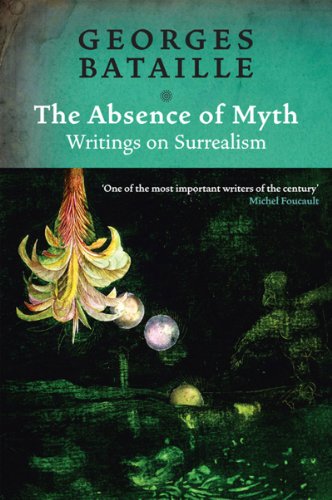
12. The Absence of Myth: Writings
$70.15
13. Choix De Lettres (Les cahiers
$16.95
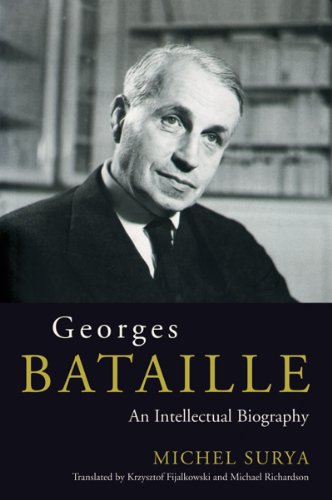
14. Georges Bataille: An Intellectual
$31.43
15. Encyclopaedia Acephalica: Comprising
$9.00
16. Theory of Religion
$9.75
17. On Nietzsche
$8.75
18. Literature and Evil
$20.88
19. Inner Experience (Suny Series
$58.59
20. The Bataille Reader (Blackwell

1. Erotism: Death and Sensuality
by Georges Bataille
Paperback: 188 Pages (1986-10)
list price: US$16.95 -- used & new: US$9.30
(price subject to change: see help)
Asin: 0872861902
Average Customer Review: 5.0 out of 5 stars
Canada | United Kingdom | Germany | France | Japan
Editorial Review

Book Description

Taboo and sacrifice, transgression and language, death and sensuality-Georges Bataille pursues these themes with an original, often startling perspective. He challenges any single discourse on the erotic. The scope of his inquiry ranges from Emily Bronte to Sade, from St. Therese to Claude Levi-Strauss and Dr. Kinsey; and the subjects he covers include prostitution, mythical ecstasy, cruelty, and organized war. Investigating desire prior to and extending beyond the realm of sexuality, he argues that eroticism is "a psychological quest not alien to death.

... Read more

Customer Reviews (5)

5-0 out of 5 stars Sex, death, and violence--a high-falutin' theory of the good stuff...


If I had to pick one book for the Bataille newbie, it would be this one. *Erotism* puts forth the crux of Georges Bataille's critical thought in what is its clearest and most forthright expression. Here the man once called "the theoretician of evil" lays out for the educated layman his controversial and challenging views of the interrelationship of sexuality, violence, taboo, suffering, mysticism, and death. Most of the major ideas found in Bataille's more complicated philosophical works such as *The Accursed Share* are distilled here, as well as the philosophical underpinning of the infamous novels *Madame Edwarda* and *The Dead Man.*

Bataille is always perversely entertaining, if sometimes frustrating, having a facility to cast even the most lurid subjects in a language that can render pornography intellectually impenetrable. The problem is partly due to the fact that Bataille's main concern is to elucidate what he calls "extreme states of being," those experiences at the very limit of human possibility such as orgasm, visions, and death--phenomenon that philosophy has traditionally left out of the equation when considering human life. Because these extreme experiences are often irrational--or transcend rationality, as Bataille would prefer it--they usually fall outside the natural scope of philosophy, as well as language itself. Bataille, who tries to write about these inner states on the outer edge, can only do so by ultimately failing, which he readily acknowledges is necessarily the fate of anyone who tries to express the inexpressible.

In *Erotism,* Bataille, for the most part, confines himself to saying what can be said before it becomes unspeakable and that's what makes this book so much more readable than most of his other texts. Taboo as that which sets us apart from the animal and yet is meant to be transgressed in order that we may know the sacred. Sacrifice as a communal "crime" by which we contemplate the deathless state of continuity that is death itself. Work as the dike that keeps humanity from being swept away in a flood of sex and violence. Bataille follows the red thread that zig-zaggedly stitches together man's age-old fascination with sexual transgression and violent death. From the cave paintings of prehistory to the novels of Sade, from Saint Theresa's pseudo-sexual ecstasy to the Kinsey Report, the result is a wide-ranging and fascinating re-interpretation of the religious instinct in man from the point of view of our mortal obsession with filth and degradation. What Bataille has wrought is a philosophy of "evil" that itself is a thing of transgression, overturning much of what we thought we knew about morality, love, civilization, god, and all the rest of it, but most of all ourselves.

A sort of primer to Bataille, *Erotism* can be used as a skeleton key to access the treasures locked away in his more inaccessible works. A must-read for any philosophically inclined renegade interested in sex and death, *Erotism* justifies your morbid penchant for the corrupt and obscene. You really shouldn't have another orgasm without being cognizant of the insights to be found in this life-warping and mind-bending book.

5-0 out of 5 stars Freud transcended
Bataille's text represents a cogent, penetrating examination of the topics of eroticism and death, as well as the violence that connects them. He explores some of the links between erotic activity and violence, providing a refreshingly intellectual perspective on subjects typically ruled by silence.

Where Freud noted a connection between sex and violence, Bataille explores this connection in light of its broader philosophical implications. His section on Christianity is particularly helpful in understanding how that religion has rendered an entire sphere of sacred experience unto the profane world, with grave consequences for human culture. Never indicting Christianity or condemning it outright, Bataille instead seeks to explain the condition of humanity in the mid- to late-twentieth century--a condition that still very much troubles us today.

5-0 out of 5 stars A WORK OF ART
This is, with no dout, one of the best books in the genre. It is decadentjet avant grade. If you like erotic literature and taboo this book is amust.

5-0 out of 5 stars A compelling addition to the discourse of sex and religion.
Before Foucault ruined the game, this was the cutting edge of theoretical musings on sex.Bataille's "continuity" concept of the erotic still seems fascinating (if not slightly intuitive), especially in thechapters on war and mysticism.Beware of the difficult language, but oncethis hurdle is cleared you're in for a delightful read.

5-0 out of 5 stars This book made me feel dizzy
This is one of the most amazing books I've ever read. Bataille contemplates humanity by means of erotism. He deals with love, sex, death and spirituality. He quests what makes human distinguished from otheranimals. He is vague sometimes, and leaps amazingly. Actually, I read thebook in Korean, but I'd like to share the feeling with anyone who'd loveto. If you liked this book, please write to me! ... Read more


2. My Mother, Madame Edwarda and the Dead Man
by Georges Bataille, Yukio Mishima, Ken Hollings
Paperback: 224 Pages (1995)
list price: US$14.95 -- used & new: US$7.21
(price subject to change: see help)
Asin: 0714530042
Average Customer Review: 4.5 out of 5 stars
Canada | United Kingdom | Germany | France | Japan
Editorial Review

Book Description
My Mother is a unique bildungsroman of a young man's sexual initiation and corruption by his mother.?Publishers Weekly

My Mother, Madame Edwarda and The Dead Man comprises three short pieces of erotic prose that fuse elements of sex and spirituality in a highly personal vision of the flesh. They present a world of sensation in which only the vaulting demands of disruptive excess and the anguish of heightened awareness can combat the stultifying world of reason and social order. Each of the narratives contains a sense of intoxication and insanity so carefully delineated by the author that it seems to infect the reader.

Philosopher, novelist and critic, Georges Bataille is a major figure in twentieth-century literature whose startling and original ideas increasingly exert a vital influence on the shaping of thought, language and experience. Best known outside France for the vertiginous sexual delirium of his short novel, Story of the Eye, the vast scope of Bataille's interests and intellect made him a major force in many spheres.

Bataille's essays range over such diverse topics as economics, psychoanalysis, Marxism, yoga and anthropology. His critical essays, Literature and Evil and his complex meditations on the dark coupling of sex and death, Eroticism, are both available from Marion Boyars. Bataille's available fiction includes L'Abbe C, a twisted document detailing the holy horrors of sex and Blue of Noon, now an established modern classic in its seventh printing. ... Read more

Customer Reviews (3)

4-0 out of 5 stars My vote
No need to sum up the book, the other reviewers did it nicely. I'll just say its a great book, dark and exciting and perverse. If you're into it, buy it. You wont be disappointed.

5-0 out of 5 stars Unbelievable...
(Before I get into my review of this book, I would like to point out that some of the unheralded treasures in this collection are found in the extra pieces. These include the prefaces written by Bataille for "Madame Edwarda" and the "Dead Man", and two critical essays, one of which was written by another equally intriguing author, Yukio Mishima, who wrote The Sailor Who Fell from Grace with the Sea and The Sound of Waves, among other things. The information in these pieces is quite helpful in understanding the philosophy and intent of Bataille's three short stories, and also serves as a great springboard to his other writings. I would also like to mention that I stumbled upon Bataille through the movie "Before Sunrise" - this was the book she was reading on the train - so if you like this book, you might like that movie.)
To start my review, I would like to say that the previous reviewer appears to have understood the broad strokes of Bataille's writing, but failed to see the finer points of it. Their descriptions are accurate, but the conclusions they draw seem to be results of their own moralizing and do not necessarily reflect the basic themes of the stories.
For example, while "My Mother" is a study of the mother's search for destruction and the influence of this on her son (as mygotta has pointed out) it is not a moralistic fable revealing the inevitable pitfalls of a profligate life. This kind of puritanical idea in regards to human sexuality is completely antithetical to the philosphy Bataille espoused in this and other texts. In the case of "My Mother," the libertine lifestyle and sexual openness of the characters is not the result of a slow, fatalistic slumping towards the gutter, but rather is a quest for transcendence through intense experience, especially sexual experience. This attitude is revealed, for example, when the mother writes to her son, telling him that, "I have absolutely no interest in this world where they scratch about, patiently waiting for death to enlighten them. As for me, it is the wind of death that sustains the life in me," or when the son realizes that, "Again and again during those interminable days of my solitude and of my sinfulness I would stiffen as though from an electric shock when the thought thrilled through me that my mother's crime elevated her into God, in the very way in which terror and the vertiginous idea of God became identified. And, wanting to find God, I wanted to burrow down and cover myself with mud, so as not to be more unworthy of Him than my mother." The juxtaposing of base sensuality with divinity, and the constant invocation of taboos in this story are interwoven with what seems to be an ultimate moral ambiguity. And these themes are continued in the other two stories as well.
Bataille's writing is terrific stuff if you can handle its pornographic imagery and blasphemous intonations. His stories and essays question not only the foundations of religion, morality and social norms, but also the fabric of reality itself. This stuff is not just well-written erotica: it is profound and provocative philosophy .

5-0 out of 5 stars Destruction and Hedonism
Sometimes erotic, other time incestial, and more times than not this book is shocking and curious. The narratives of a boy, Pierre, and his minglings with his mothers reckless lifestyle. The book is a study of a mothersdestruction after she was raped at a young age. It is also a study of thecontradictions of the hedonic world how it creates problems and destroysrather than forgets. Its not always a passive life. Pierre learns aboutthis and we see how it hampers his psyche into being passivle controlled,not just by mother, but by women in general. The lack of the father figure,and the hatred towards him allowed him to feel worthless. The second andthird story, Madame Edwards and Dead Man are shorter variations on the sametheme. A different type of storytelling than I am used to reading,nonetheless I found it completely intriguing (despite at times I did yawn).Once you read this, it will be one of those books that you will remember. ... Read more


3. The Accursed Share, Vols. 2 and 3: The History of Eroticism and Sovereignty
by Georges Bataille
Paperback: 404 Pages (1993-10-04)
list price: US$26.95 -- used & new: US$17.11
(price subject to change: see help)
Asin: 0942299213
Average Customer Review: 5.0 out of 5 stars
Canada | United Kingdom | Germany | France | Japan
Editorial Review

Book Description
The three volumes of The Accursed Share address what Georges Bataille sees as the paradox of utility: namely, if being useful means serving a further end, then the ultimate end of utility can only be uselessness. The first volume of The Accursed Share, the only one published before Bataille's death, treated this paradox in economic terms, showing that "it is not necessity but its contrary, luxury, that presents living matter and mankind with their fundamental problems."

In the second and third volumes, The History of Eroticism and Sovereignty, Bataille explores the same paradox of utility from an anthropological and an ethical perspective, respectively. The History of Eroticism analyzes the fears and fascination, the prohibitions and transgressions attached to the realm of eroticism as so many expressions of the "uselessness" of erotic life. In the third volume, Batille raises the ethical problems of sovereignty, of "the independence of man relative to useful ends." ... Read more

Customer Reviews (3)

5-0 out of 5 stars still relevant geopolitically
I am taking an extremely dim view (I was thinking about theology, but the final sentence of volume 1 mentions teleology, an antiquated teleology, at that, instead) of THE ACCURSED SHARE by Georges Bataille by limiting my review to those issues that were mentioned in Ezra, which I believe was written at the time that the earliest books of the Bible, Genesis, Exodus, and Leviticus, were compiled in the form some people are familiar with today. The first section of Leviticus, The Ritual of Sacrifice, in chapters 1-7, concludes with a portion for Aaron and his sons by orders of Yahweh binding the sons of Israel for all generations. Ezra opens with Cyrus King of Persia declaring that the temple in Jerusalem should be rebuilt and returning vessels of the temple which Nebuchadnezzar had carried away from Jerusalem. The greatness and glory associated with this effort is a triumph like "Mankind's Accomplishments Linked to that of the American Economy" on pages 188-189 of ACCURSED SHARE and the final sentence of volume one, "More open, the mind discerns, instead of an antiquated theology, the truth that silence alone does not betray." (p. 190).

The book was written in France to offer support for the American Marshall Plan to rebuild a prosperous global economy after World War II. On the final page of notes, the question, "Why deny the fact that there can no longer be a true initiative toward independence on the part of countries other than the USSR or the USA?" (n. 17, p. 197), states the geopolitical frame of reference that millionaires and billionaires with global interests seem to have risen above today, with the greatness of America as a superpower driving economic expansion in those areas where natural resources, access to capital, and wage levels allow maximum profits to appear when money can flow to those areas where it will accomplish the most. As the millionaire who has spent the most to advertise his views in the states with early presidential primaries, Mitt Romney has proudly proclaimed the greatness of America, but the underlying structure of the political hierarchy is similar in nature to the parallels between Ezra and Bataille's ACCRSED SHARE.

Chapters 9 and 10 of Ezra deal with a problem like the desire of people to move to the United States in order to make more money today. It was reported, "The people of Israel, the priests and the Levites, have not broken with the natives of the countries who are steeped in abominations--Canaanites, Hittites, Perizzites, Jebusites, Ammonites, Moabites, Egyptians and Amorites--but have found wives among these foreign women for themselves and for their sons; the holy race has been mingling with the natives of the countries; in this act of treachery the chief men and officials have led the way." (Ezra 9:1-2). It was such a massive problem that it took from the first day of the tenth month to the first day of the first month to officially process all the separations from foreign wives. This reminded me of Aztec customs which linked the victims to "The individual who brought back a captive had just as much of a share in the sacred office as the priest. A first bowl of the victim's blood, drained from the wound, was offered to the sun by the priests. A second bowl was collected by the sacrificer. The latter would go before the images of the gods and wet their lips with the warm blood. The body of the sacrificed was his by right; he would carry it home, setting aside the head, and the rest would be eaten at a banquet, cooked without salt or spices -- but eaten by the invited guests, not by the sacrificer, who regarded his victim as a son, as a second self. At the dance that ended the feast, the warrior would hold the victim's head in his hand." (Bataille, pp. 53-54).

Certainly the Aztecs were more harsh than the restrictions which the federal government wishes to put on drivers licenses in New York for those who are not American citizens or authorized by the United States government to live within the United States. The question of who is who here can have numerous answers, like questions about whether waterboarding is torture, or how people detained in Iraq compare to illegal combatants. Even a nominee for Attorney General might wish to equivocate about certain questions. Bataille picture people in Tibet willing to maintain a large number of monasteries to keep the young men from serving in an army. "In Tibet, even more so than in China, the military profession is held in contempt. Even after the reforms of the thirteenth Dalai Lama, a family of nobles complained of having had a son commissioned as an officer." (p. 110).

I was drafted once myself, so I read about these things after years of not knowing if I would serve in Nam; then, after I got to Nam, I was even told to go to Cambodia. Though Nixon thought sending troops into Cambodia might make Vietnam safer in 1970, it was also a risky move for those who were on helicopters that crashed. The feeling generated by such changes in the expectations associated with my ultimate objective is described by Bataille:

The victim is a surplus taken from the mass of useful wealth. And he can only be withdrawn from it in order to be consumed profitlessly, and therefore utterly destroyed. Once chosen, he is the accursed share, destined for violent consumption. But the curse tears him away from the order of things; it gives him a recognizable figure, which now radiates intimacy, anguish, the profundity of living beings. (p. 59).

In modern society, people who are not talented enough to be known by millions of people are nobodies. John Lennon was not entirely unwelcome in New York City; he was merely shot down in the street. Government has become so awful at facing any kind of issue, Congress after World War II attempted to define a c.o. as someone who believed in a Supreme Being who prohibits a c.o. from taking part in any war. The Department of Justice was not generous in denying the status to boxer Cassius Clay all the way up to the Supreme Court, where most justices finally agreed that the Department of Justice was wrong about when Cassius Clay needed to file for a determination. Such questions plague anyone who has rules like the clean and unclean beasts in chapter 11 of Leviticus, which then considers leprosy in chapter 13, sexual impurities in chapter 15, nakedness in chapter 18, and handing over any children to Moloch in chapter 20. There are things which must not be worshiped:

"You must make no idols; you must set up neither carved image nor standing stone, set up no sculptured stone in your land, to prostrate yourself in front of it; for it is I, Yahweh, who am your God." (Leviticus 26:1).

It does not directly prohibit saluting the flag or pledging allegiance, but anyone who doesn't is likely to be sacrificed in some other way, like John Lennon certainly was, and Martin Luther King, Jr., both of whom opposed certain aspects of the Vietnam war. The call to support the troops is like something in THE ACCURSED SHARE for me, but so much so that my list will not go on.

5-0 out of 5 stars a work of genius
Read both books that contain all three volumes: in a way, the summation of Bataille's thoughts and written with clarity. It's not just the consumption-expenditure approach to analysing human activity that'sorginial, he is (as he states towards the end of vol. 3) the closestthinker to Nietzsche. That is an assertion that bears merit as Batailleexamines in as thorough a way possible (and in many ways supplements and isa good commentary on) Nietzsche's ideas of the overman, which he calls thesovereign man. At the core of his thoughts is Hamlet's last line, 'The restis silence'. Sovereignty is NOTHING. A brilliant and vital contribution tothe century's history of ideas.

5-0 out of 5 stars A thought provoking work connecting religion and economics.
In this book, Georges Bataille explores the connection between man's religious and economic pursuits.By focusing in on such divergent practices as human sacrifice and ritualized warfare in Aztec society, the practice of "potlach" in native American tribes of the Pacific Northwest, Tibetan Lamaism, and the conflagrations of our most recent World Wars, the author seeks to overturn classical models of economics. Instead of economics being driven by individuals seeking to satisfy their personal needs, Bataille proposes that economics is actually a social process that seeks to destroy, excrete, and expend excess goods and services.His unique perspective centers around the ideathat the systematic destruction and loss of goods and services is intimately connected to our age old struggle to attain the Beyond.The French philosopher Michel Foucault once stated that Bataille said what had never been said before.After reading this first volume of Bataille's three volume work "The Accursed Share", you can begin to understand why Foucault believed as he did. ... Read more


4. The Impossible: A Story of Rats Followed by Dianus and by the Oresteia
by Georges Bataille
Paperback: 144 Pages (1991-12)
list price: US$12.95 -- used & new: US$9.50
(price subject to change: see help)
Asin: 0872862623
Average Customer Review: 5.0 out of 5 stars
Canada | United Kingdom | Germany | France | Japan
Editorial Review

Book Description

In a philosophical erotic narrative, an essay on poetry, and in poems Georges Bataille pursues his guiding concept, the impossible. The narrator engages in a journey, one reminiscent of the Grail quest; failing, he experiences truth. He describes a movement toward a disappearing object, the same elusive object that moved Theresa of Avila and Catherine of Siena to ecstasy.

... Read more

Customer Reviews (2)

5-0 out of 5 stars a 'better book' may be unimaginable...
...in terms of unpredictability, uniqueness,
confessional-poetic-mystic-debauchery and
edge-thriving elan
(some call it true amour)--
Bataille's work here as in
La Somme atheologique trilogy
(GUILTY, ON NIETZSCHE, INNER EXPERIENCE)
takes la frigging Cake!

the last coolest Frenchman, 'e wuz!

5-0 out of 5 stars Beyond And Before The Erotic
Note from personal experience (the only way to comment): Passing through the seemingly simple sexual plays of The Father, The Son or Daughter, and The Stark Flesh, one may finally attain a sense of lost freedom in a short excursion into self-conscious poetry forced back on itself. However, dropping the issue and/or the book leaves one caught in the cliche of feeling that one understands. This may require a Quixotic reenactment in order to survive this forgetting --- necessarily not only in the world of one's imagination. This transcendence is then achieved again by that fold and feedback of sacrificing to oneself all that one holds dearly and holy --- reason, despair, and perhaps folly. Only in this way can a true confrontation be finally and for the first time attempted and accomplished. ... Read more


5. Guilty
by Georges Bataille
 Paperback: 161 Pages (1988-10)
list price: US$12.95
Isbn: 0932499600
Canada | United Kingdom | Germany | France | Japan

6. Story of the Eye
by Georges Bataille
Paperback: 104 Pages (1987-09)
list price: US$9.95 -- used & new: US$5.30
(price subject to change: see help)
Asin: 0872862097
Average Customer Review: 4.0 out of 5 stars
Canada | United Kingdom | Germany | France | Japan
Editorial Review

Amazon.com
Only Georges Bataille could write, of an eyeball removed from a corpse, that "the caress of the eye over the skin is so utterly, so extraordinarily gentle, and the sensation is so bizarre that it has something of a rooster's horrible crowing." Bataille has been called a "metaphysician of evil," specializing in blasphemy, profanation, and horror. Story of the Eye, written in 1928, is his best-known work; it is unashamedly surrealistic, both disgusting and fascinating, and packed with seemingly endless violations. It's something of an underground classic, rediscovered by each new generation. Most recently, the Icelandic pop singer Björk Guðdmundsdóttir cites Story of the Eye as a major inspiration: she made a music video that alludes to Bataille's erotic uses of eggs, and she plans to read an excerpt for an album. Warning: Story of the Eye is graphically sexual, and is only for adults who are not easily offended.Book Description

In 1928, Georges Bataille published this first novel under a pseudonym, a legendary shocker that uncovers the dark side of the erotic by means of forbidden obsessive fantasies of excess and sexual extremes. A classic of pornographic literature, Story of the Eye finds the parallels in Sade and Nietzsche and in the investigations of contemporary psychology; it also forecasts Bataille's own theories of ecstasy, death and transgression which he developed in later work.

... Read more

Customer Reviews (49)

5-0 out of 5 stars Not for Kids!
I found this book looking through my wife's "recently viewed" list and thought it would be an excellent gift for our 12year old niece who loves R.L. Stein's "Goosebumps" and "Fear Street" series. Boy, was I wrong! I thought the spooky cover, title, and foreign name of the author indicated a classic horror novel in the vein of Frankenstein or Dracula. I naturally assumed that my wife had found a book for our niece and I would handle the financial end. Unfortunately I found out I had misjudged the book a few weeks later when my sister-in-law called in hysterics, accusing me of sending their daughter pornography! I told her I did no such thing and suggested maybe there was a mix up in shipping as I had sent her a book and not a movie. She told me that they had indeed received the book and was certain it was porn as they owned the book. I apologized profusely and asked my wife about the book. She explained that her sister had recommended it as an inspirational tool forthebedroom. we eventually got around to reading the book and found that these kids are quite imaginative, insane maybe, but very imaginative! Five Stars.

4-0 out of 5 stars Nope, haven't read it yet.
Hiya folks, this is Susan the Puddle Jumper. Story of the Eye sounds like a very good book, and I'm tempted to get myself a copy. But I'd rather wait until Björk buys me a copy herself. Have a good one.

4-0 out of 5 stars Don't get caught up in the hype
I decided to read "Story of the Eye" after seeing it placed on a reading list with a sidenote remarking, "if you enjoy reading it, you are in no danger of being normal".Taking the bait to see if I was in any certain danger, I ordered it off amazon and dove head first into the small erotic novella.
I think it might be my age and the way our culture today has stiffened us, but it was not as shocking as many of the reviews I had claimed it would be, and in that way I was most definitely let down.Yeah, the characters have some fetishes, but I can't imagine anyone in the generation who has touched even a Chuck Palahniuk book to be fazed by the actions of the characters.
At some points, it does feel like the plot is a bit dry, they often are just traveling from one setting to another where they perform yet another random sex act driven by fetish.
The good points of the book are that I was when I would often laugh out loud at some of the actions(the sitting in milk, the inverted sexual positions, the priest they essentially rape), and that gives the book its real entertainment value.Also parts of the book are beautifully written, my only issue with that is it seems that those beautifully written slots with the philosophical overtone's did sometimes seemed forced into the story, but i'm still glad they have been put in.
Overall, worth the five bucks it is going to cost you to get used on here, and the couple hours you'll kill on the chair reading it.

Best read while eating boiled eggs and drinking milk.

4-0 out of 5 stars What is this?
There are two ways of looking at this extraordinary book:

1. It is one of the most intensely perverse pornographic books ever written, one in which normal sexuality takes a decidedly back seat to urolagnia, necrophilia, and other conditions with Greek names. Its main distinctions are that it is highly compact, unusually well-written, tightly structured in its use of recurring imagery, and so quickly moves from titillation to excess that it distances itself from the rest of the genre.

2. It is a seminal work by a major figure in 20th-century French culture, with significant ties to surrealism, deconstructionism, and psycholanalysis. Seen in this light, its cultural ties are significant and far-reaching. Indeed, one of the most interesting parts of the book is the postlude in which Bataille comments on the connections between this early novella and traumatic incidents in his own childhood, connections that he says he was unaware of at the time of writing. In effect, therefore, he is performing psychoanalysis on himself.

The trouble is that it takes somebody with considerable knowledge of mid-twentieth-century French thought to see #2 in #1. I imagine that the notes and essays in the Penguin Classics edition would be helpful in this respect; the City Lights Press edition, while attractively produced, just gives you the text (though usefully in the first edition, which most accurately shows the book's place at the start of Bataille's career). As a cultural artifact, this probably merits 5 stars, but I just don't think that most readers will see it as that kind of masterpiece.

4-0 out of 5 stars Brilliant,,,
I decided to read this book out of curiosity when I read that Bjork had recommended everyone to read it. I knew that i was in for a shocking treat. Is it shocking? Yes, indeed. I personally wasn't too shocked by the erotic acts itself in the book, since none of it was new to me. I found it more shocking by how beautifully and yet frightful the narrative was...its such a page turner and definitely worth reading! ... Read more


7. The Unfinished System Of Nonknowledge
by Georges Bataille
Paperback: 305 Pages (2004-11-15)
list price: US$23.50 -- used & new: US$23.50
(price subject to change: see help)
Asin: 0816635056
Canada | United Kingdom | Germany | France | Japan
Editorial Review

Book Description
A deft reconstruction of what Georges Bataille envisioned as a continuation of his work La Somme Athéologique, this volume brings together the writings of one of the foremost French thinkers of the twentieth century on the central topic of his oeuvre. Gathering Bataille's most intimate writings, these essays, aphorisms, notes, and lectures on nonknowledge, sovereignty, and sacrifice clarify and extend Bataille's radical theology, his philosophy of history, and his ecstatic method of meditation.

Following Bataille's lead, as laid out in his notebooks, editor Stuart Kendall assembles the fragments that Bataille anticipated collecting for his summa. Kendall's introduction offers a clear picture of the author's overall project, its historical and biographical context, and the place of these works within it. The "system" that emerges from these articles, notes, and lectures is "atheology," understood as a study of the effects of nonknowledge.

At the other side of realism, Bataille's writing in La Somme pushes language to its silent end. And yet, writing toward the ruin of language, in search of words that slip from their meanings, Bataille uses language-and the discourses of theology, philosophy, and literature-against itself to return us to ourselves, endlessly. The system against systems is in fact systematic, using systems and depending on discourses to achieve its own ends-the end of systematic thought.

A medievalist librarian by training, Georges Bataille (1897-1962) was active in the French intellectual scene from the 1920s through the 1950s. He founded the journal Critique and was a member of the Acéphale group and the Collège de sociologie. Among his works available in English are Visions of Excess (Minnesota, 1985), Tears of Eros (1989), and Erotism (1990).

Stuart Kendall and Michelle Kendall are freelance translators who live in Stony Brook, New York. ... Read more


8. Visions of Excess: Selected Writings, 1927-1939 (Theory and History of Literature, Vol 14)
by Georges Bataille
Paperback: 271 Pages (1985-06)
list price: US$20.00 -- used & new: US$19.50
(price subject to change: see help)
Asin: 0816612838
Average Customer Review: 5.0 out of 5 stars
Canada | United Kingdom | Germany | France | Japan

Customer Reviews (4)

5-0 out of 5 stars reductionism in a more poetic form
in reponse to stevie, i'd say that andre breton has left us infinitely more to 'go on' than the far too reductionist bataille. unlike bataille, breton was not living in the shadow of his idols (bataille:sade) but trying to generate something new.bataille's assessment of nietzsche and the surrealists as romantic icaruses also seems a self assessment; bataille could never rise above his 'need to go below'.he was guilty of precisely the same things he accused the surrealists of.

5-0 out of 5 stars Georges Bataille was NOT a surrealist
He and Breton (the dead ox, vile priest, castrated lion of surrealism) violently attacked one another precisely because Bataille was opposed to the idealism and the upstanding morals of surrealism. Bataille is probably spinning in his grave at the mere thought that his legacy would be trashed by the sloppy reference to him as a member of religion he so hated.

5-0 out of 5 stars Brilliant
Im so impresed with this mans work I am obsessed. He is a rare breed of intelligence. He has a piece in this called 'Mouth" which refers tothe position our heads take well being thrown back in a scream as that of an extension to our spines, inother words that we assume an animal architecture to our bones in the most extreme pains. Batailles constant opinions detailed here inwonderful totaly controlled short pieces , is for me, the only truly awful reading I have ever done. A music piece I often play also has this effect. It is genuis to have the power of horror in works not involving the 'supernatural". I am in awe of this odd,dead man.

5-0 out of 5 stars Disturbing and beautiful!
Bataille was French surrealist who wrote like an alien trapped on a hostile planet. In searing essays like "the Solar Anus," healmost convinces you that the end is not just near, but here. Disturbing and beautiful, this book is highly recommended. ... Read more


9. The Collected Poems of Georges Bataille
by Georges Bataille, Mark Spitzer
Paperback: 139 Pages (1999-03)
list price: US$15.95 -- used & new: US$43.99
(price subject to change: see help)
Asin: 0802313256
Average Customer Review: 4.0 out of 5 stars
Canada | United Kingdom | Germany | France | Japan

Customer Reviews (2)

4-0 out of 5 stars Cute
I'm a fan of Bataille, but I'm afraid that in most translations into English this major thinker comes across as being merely silly about sex and excrement and the Absolute.From his own febrile, pathological alluvium located in a fertile triangle between Eros and Thanatos, anus and genitals, Bataille (said in the helpful introduction by the translator to be using poetry to reach the Eternal) comes up with cuties like these:

The Wall

A hatchet
give me a hatchet
so I can frighten myself
with my shadow on the wall
ennui
feeling of emptiness
fatigue.

I have to admit feeling like that myself recently.And:

Laughing

To laugh and laugh
at the sun
at the nettles
at the pebbles
at the ducks

at the rain
at the pope's p**
at mommy
and a coffin full of sh**.

It doesn't get any better than that folks, although Bataille makes lots of references to the void, Zarathrustra, Heraclitus, and other touchstones of modern Western culture.I do admire his mixture of profundity and scatology and wish that more post-modern writers would follow Bataille's example.Why let the makers of popular movies and television sit-coms get a jump on the rest of us?

4-0 out of 5 stars Death + Sex + More Death
Bataille's poetry is often beautiful, using words and ideas to paint vague emotional pictures. You might get bored when he goes on and on about immensity or death, but it's worth it for the good parts. ... Read more


10. Blue of Noon
by Georges Bataille
Paperback: 129 Pages (2002-06)
list price: US$14.95 -- used & new: US$8.65
(price subject to change: see help)
Asin: 0714530735
Average Customer Review: 3.5 out of 5 stars
Canada | United Kingdom | Germany | France | Japan
Editorial Review

Book Description

Set against the backdrop of Europe's slide into Fascism, this twentieth-century erotic classic takes the reader on a dark journey through the psyche of the pre-war French intelligentsia, torn between identification with the victims of history and the glamour of its victors. One of Bataille's overtly political works, it explores the ambiguity of sex as a subversive force, bringing violence, power and death together in a terrifying unity.

"Georges Bataille is one of the most important writers of the century"-Michel Foucault

[box]

Also available:

My Mother Madame Edwarda and the Dead Man,

TP $14.95, 0-7145-3004-2 CUSA

Literature and Evil

TP $14.95, 0-7145-0346-0 CUSA

L'Abbe C

TP $14.95, 0-7145-2448-X CUSA

... Read more

Customer Reviews (10)

2-0 out of 5 stars More languid than arousing
Not nearly as memorable as the surrealist pornography of "The Story of an Eye," nor as thought-provoking as his study of the tangling of the great death and the "little death" of orgasm in his sex-and-mortality, violence-and-the sacred exploration "Erotism," this slim novel, as the author's uncomfortable tone betrays in its afterword, appears half-finished and abandoned rather than meant as it is for publication.

Lazare's fanatical devotion to the Left and especially Dirty's penchant for decadent and unsanitary lifestyle choices remain the most powerfully characterized moments, but too much of the novel remains as jittery and haphazard-- albeit Bataille argues in the afterword he meant it to be read as such-- as comparatively mundane next to the strong opening vignette of Troppmann and Dirty in one of literature's most effectively rendered dives, even by Parisian standards.

As one who has read plenty of Céline, a bit of Sade, and some of Sartre's fiction, this novel held some interest. Yet, it seems too slack, too dragged down by ennui. Far less erotic than a reader of "The Story of An Eye" might expect, this instead recalls Bataille's protege, Pierre Klossowski (his novels have been reviewed by me on Amazon; he's the brother of the painter Balthus) and his philosophical protagonists who also are prone more to shuffling about rather than coupling energetically. The extravagant claims left by readers here appear unfounded, given the turgid pace of its pages and the uneven tone of the narrative.

4-0 out of 5 stars A review from the author of YEARS OF RAGE
According to Georges Bataille's autobiographical note, LE BLEU DU CIEL ("The Blue of the Sky") was composed in the twilight before the occupation of Vichy France.

The descending night darkens these pages.

Dissolute journalist Henri Troppmann ("Too-Much-Man") and his lover, Dirty give way to every impulse, to every surfacing urge, no matter how vulgar.Careening from one sex-and-death spasm to the next, they deliver themselves over to infinite possibilities of debauchery.A fly drowning in a puddle of whitish fluid (or is it the thought of his mother, a woman he must not desire?) prompts Troppmann to plunge a fork into a woman's supple white thigh.The threat of Nazi terror incites a coupling in a boneyard.

Their only desire is to besmirch whatever is elevated, to vulgarize the holy, to pollute it, to corrupt it, to bring it down into the mud.

By muddying whatever is "sacred," they maintain the force of "the sacred."

As a historical document, BLEU DU CIEL is eminently interesting. It offers unforgettably vivid portraits of Colette Peignot (as Dirty) and the "red nun" Simone Weil (as Lazare).

It is also the story of a man who is fascinated with fascism and the phallus, of someone who loves war, although not for teleological reasons.It is the story of a man who celebrates war on its own terms, who nihilistically affirms its limitless power of destruction.

As the night materializes, the blue of the sky disappears.

Joseph Suglia, the author of YEARS OF RAGE

5-0 out of 5 stars a severely underrated masterpiece
I don't understand why this book is considered to be one of Bataille's [illegitimate] children. It's beautifully written. The man was capable of working miracles with words through his style and arrangement of them. Blue of Noon is definitely not an exception.

Bataille's style is always one of brutal elegance. He's like a lover who slaps you in the face, only to pull you into a gentle embrace a moment later.

The main character, Troppman, is the star here - he is a deviant trying is best not to be. Ahhhh, the internal struggles - do you stay married and live your life as a respectable, productive member of society. Or do you run off with [prostitutes] and derelicts to indulge the savage needs you've so long supressed.

Not to be outdone, his brightest co-star, is a woman named Dirty. She is a beautiful creation. She is a train wreck of a woman. She and Troppman braid themselves together in clearly conspicuous codependence of the worst sort, bawdy drunkeness paving the pathways to irrevocable damnation.

I also enjoyed Lazare; a woman Troppman finds himself thoroughly disgusted with, she has no redeeming features. Yet, he cannot stay away.

If you are a fan of the madman Bataille, don't miss out on this one. I think this is truly some of his best work.

5-0 out of 5 stars a severely underrated masterpiece
I don't understand why this book is considered to be one of Bataille's bastard children. It's beautifully written. The man was capable of working miracles with words through his style and arrangement of them. Blue of Noon is definitely not an exception.

Bataille's style is always one of brutal elegance. He's like a lover who slaps you in the face, only to pull you into a gentle embrace a moment later.

The main character, Troppman, is the star here - he is a deviant trying is best not to be. Ahhhh, the internal struggles - do you stay married and live your life as a respectable, productive member of society. Or do you run off with whores and derelicts to indulge the savage needs you've so long supressed.

Not to be outdone, his brightest co-star, is a woman named Dirty. She is a beautiful creation. She is a train wreck of a woman. She and Troppman braid themselves together in clearly conspicuous codependence of the worst sort, bawdy drunkeness paving the pathways to irrevocable damnation.

I also enjoyed Lazare; a woman Troppman finds himself thoroughly disgusted with, she has no redeeming features. Yet, he cannot stay away.

If you are a fan of the madman Bataille, don't miss out on this one. I think this is truly some of his best work.

1-0 out of 5 stars De Sade's nephew gets all sociopolitical.
"Blue of Noon" is the story of Henri, an amoral man living in Europe during the 1930s. He is supposedly married, but spends his time with similarly amoral women, lacking clothing, inhibition, shame, and even proper hygeine at times. He zips between London, Paris, Barcelona, and Frankfurt, and frankly, engages in nothing but immoral self-satisfying activities in every spot.

At various times, he agonizes over his relationships with his wife, his sexual partners, and his deceased mother. He becomes embroiled in a Communist revolutionary plot in Barcelona, with one of his sexual partners, a Jewish woman, involved in its planning and execution. He reveals his necrophilic obsession to two of his partners, further revealing the exact, even more sickening, subject of his obsession to one of them. He has sex, he gets sick, his women have sex, they get sick, everybody has sex, everybody gets sick. For the punchline, near the end of the novel, Bataille throws Nazis into the picture, showing us that all the depravity of fascism is comparable to the depravity he has shown us all along. Though published in 1957, the book was originally written in 1936.

This reviewer isn't buying it. Not a word of it. Not the story, not even the "1936" part. For one thing, the writing style is actually more mature than that of "L'Abbe C", published in 1950. Bataille is most probably trying to show off that he detected the evil inherent in the Nazis "way back when". I don't give him that much credit.

For another thing, I think he uses Nazis as an easy way to score "scary" points. One might intellectualize his choice by saying Bataille is trying to tell us that no matter how disgusting humans may act, at least we're not as bad as Nazis. Imagine a murderer begging leniency because he's not a Nazi. He's still a murderer. It seems Bataille is using Nazis to justify the pornography he just wrote, as if the world is such a horrible place that pornography is just another little bit of it, and tries to throw a philosophical wrench into the works, as if saying life is meaningless in the face of all the horrible things fascism is doing to us in Europe, but I suspect it was all done just for the hell of it. I frankly don't see any rhyme or reason to the thematic choices he makes.

I have nothing against the depravity or explicit nature of the book. "Been there, done that", right? It's not even all that explicit, there's probably less sex in this book than the average mainstream novel today, and he's certainly not advocating committing even the slightest harm to anyone. There are a few disturbing or distasteful ideas here and there, but one never gets the sense Bataille really means what he's writing. One gets the sense he's simply trying to come up with every juxtaposition of immoral behavior and social taboo he can, just to tweak the reader's moral compass a bit, trying to get a cheap rise out of his audience. Maybe this was an interesting exercise in 1957 (or "1936"), but given the state of depravity which existed in Germany during the 1920s, and the state of sexual liberation which swept Europe from the late 19th century through the early 20th century, I strongly doubt it.

Perhaps the target reader for this book will be the person interested in twisted versions of 19th-century literature (Bataille wrote like someone living 50 or 100 years before his time), or the works of De Sade (albeit in highly shortened format, this book being only 126 pages). ... Read more


11. The Tears of Eros
by Georges Bataille
Paperback: 258 Pages (1989-06)
list price: US$18.95 -- used & new: US$11.46
(price subject to change: see help)
Asin: 0872862224
Average Customer Review: 4.0 out of 5 stars
Canada | United Kingdom | Germany | France | Japan
Editorial Review

Book Description

Tears of Eros is the culmination of Georges Bataille's inquiries into the relationship between violence and the sacred. Taking up such figures as Giles de Rais, Erzebet Bathory, the Marquis de Sade, El Greco, Gustave Moreau, Andre Breton, Voodoo practitioners, and Chinese torture victims, Bataille reveals their common obsession: death.

This essay, illustrated with artwork from every era, was developed out of ideas explored in Erotism: Death and Sexuality and Prehistoric Painting: Lascaux or the Birth of Art. In it Bataille examines death-the ""little death"" that follows sexual climax, the proximate death in sadomasochistic practices, and death as part of religious ritual and sacrifice.

Georges Bataille was born in Billom, France, in 1897. He was a librarian by profession. Also a philosopher, novelist, and critic he was founder of the College of Sociology. In 1959, Bataille began Tears of Eros, and it was completed in 1961, his final work. Bataille died in 1962.

... Read more

Customer Reviews (3)

2-0 out of 5 stars why the fuss?
I cannot understand why the fuss over this book. The text is disappointing: repetitive, opinionated, insubstantial, more like desultory notes than anything else. The images are all black-and-white and poorly reproduced, and again repetitive and disconnected.

There is too much horror in it. Bataille associates violence, horror, terror, pain, cruelty, with eroticism, madness, ecstasy, the sacred. Perhaps intense cultivation of pleasure creates a corresponding accumulative cultivation of pain. Why should this be so? I don't know except that we have what it takes to explore and we can explore in all and any direction. It's as simple as that.

It's possible to write books and essays that are lucid and meaningful and it's possible to write "The Tears of Eros".

5-0 out of 5 stars An exploration of value through excessive experience
The Tears of Eros is a fitting culmination of Bataille's search for value through excess.Although Bataille addresses many of the themes touched on here in greater detail in earlier works (Eroticism, The Accursed Share),The Tears of Eros is notable for the significant amount of artwork includedto illustrate the connection Bataille develops between sex, death,expenditure, and sovereign value.This is a "must-read" for anyserious student of contemporary philosophy and--for that matter--any whowould insist that value resides elsewhere than in a petty, bourgeoisindividualism.

5-0 out of 5 stars Extraordinary treatment of sex and death, emotions and words
It is from woman, we come and to woman, we return because we all have both aspects in our being...female and maleness ... Read more


12. The Absence of Myth: Writings on Surrealism
by Georges Bataille
Paperback: 224 Pages (2006-10-19)
list price: US$19.95 -- used & new: US$11.88
(price subject to change: see help)
Asin: 1844675602
Canada | United Kingdom | Germany | France | Japan
Editorial Review

Book Description
Georges Bataille was one of the most provocative and controversial writers of his time. These essays, the result of profound reflection in the wake of World War II, comprise his most incisive study of surrealism, insisting on its importance as a cultural and social phenomenon with far-reaching consequences. They clarify Bataille's links with the surrealist movement, and shed light on his complex and greatly misunderstood relationship with André Breton. ... Read more


13. Choix De Lettres (Les cahiers de la NRF)
by Georges Bataille
Paperback: 610 Pages (1997-01-01)
-- used & new: US$70.15
(price subject to change: see help)
Asin: 2070739406
Canada | United Kingdom | Germany | France | Japan

14. Georges Bataille: An Intellectual Biography
by Michel Surya, Krzysztof Fijalkowski
Hardcover: 608 Pages (2002-09-02)
list price: US$35.00 -- used & new: US$16.95
(price subject to change: see help)
Asin: 1859848222
Average Customer Review: 4.0 out of 5 stars
Canada | United Kingdom | Germany | France | Japan

Customer Reviews (1)

4-0 out of 5 stars The Impossible Thought of Georges Bataille
This translation of Surya's 1992 biography of the notoriously contradictory French writer contains nearly 500 pages of text supported by 86 pages of notes. It is the first full-length biography in either English or French. Bataille is decidedly an acquired taste, so this book may well persuade you to admire this neo-Sadean thinker who spent his sixty-five years (1897-1962) as an archivist at the Bibliothèque Nationale and then as director of the Orléans Municipal Library.Surya weaves together Bataille's scatophilic and necrophilic obsessions and debauched private life with his literary themes in a way that is not sensationalist or prurient.The author does full justice to his subject's provocative claims concerning the role of consumption in capitalist civilization; the negative features of so-called inner experience; the alleged links between eroticism and death; and the supposed impossibility of community. Indirectly, Surya shows how Bataille's persistent preoccupation with the "informe" (formless) not only illuminates some of the most cutting-edge academic work in art history and literary criticism today, but also eerily foreshadows recent scientific theories of catastrophe, chaos and cosmic evolution.Hasty readers have long inferred a fascist moment in writings like "The Psychological Structure of Fascism" (1933), the first psychoanalytical analysis of its subject, according to Surya (177).To counter this widespread tendency, Surya is particularly good at displaying the development of Bataille's "impossible" thought against the background of French left-wing political activity and thussuccessfully distances Bataille from any easy embrace of French (or German) fascism.
Surya's book is not easy to read, however, if you're expecting the straightforward prose of Deirdre Bair's biographies of Samuel Beckett, Simone de Beauvoir and Anaïs Nin. Surya's style is that of a sophisticated literary theorist rather than a factual historian.This book is a must if you're already familiar with Bataille's work and wanted to situate it in his life and times. But for a first look, I would turn to Fred Botting and Scott Wilson's introductions to their "The Bataille Reader" (1997) and "Bataille: A Critical Reader" (1997). ... Read more


15. Encyclopaedia Acephalica: Comprising the Critical Dictionary & Related Texts (Atlas Archive, 3)
by Iain White
Paperback: 173 Pages (1996-01)
list price: US$24.99 -- used & new: US$31.43
(price subject to change: see help)
Asin: 0947757872
Average Customer Review: 4.0 out of 5 stars
Canada | United Kingdom | Germany | France | Japan
Editorial Review

Book Description
The ideas of Georges Bataille (1897-1962) are being increasingly recognised as offering vital insights into the whole areas of human existence, and over the last few years most of his important theoretical and fictional texts have appeared in English. Yet Bataille's thought is complex, and his books make few concessions to the reader. The first series of texts here, however, were written for a wider audience by Bataille and his friends, in the form of a dictionary, and they provide a witty, poetic and concise introduction to his ideas.

The Critical Dictionary appeared in the magazine edited by Bataille, Documents, the second series of texts, the Da Costa Encyclopédique was published anonymously after the liberation of Paris in 1947 by members of the Acéphale group and writers associated with Surrealists. Both cover the essential concepts of Bataille and his associates: sacred sociology; scatology, death and the erotic; base materialism; the aesthetics of the formless; sacrifice, festival and the politics of the tumult etc: a new description of the limits of being human. Humour, albeit, sardonic, is not absent from these remarkable redefinitions of the most heterogeneous objects or ideas: Camel, Church, Dust, Museum, Spittle, Skyscraper, Threshold, Work — to name but a few.

The Documents group was celebrated for joining together artists, authors, sociologists and ethnologists (among the most important of their time) in a literary and philosophical project. The Acéphale group was more mysterious, even its membership is only vaguely known, and its activities remain secret. The origins of the Da Costa only became known in 1993, the present volume reveals for the first time its principal compilers: Robert Lebel, Isabelle Waldberg and Marcel Duchamp, even so, the identity of the authors of a large part of it remain unknown. ... Read more

Customer Reviews (1)

4-0 out of 5 stars intelligently designed book, a creative and fun read too
Designed from cover to back with many diagrams, photos, etc.this is a nice piece of book.It contains writings by Bataille that were published separately in a surrealist type group's periodical which is fantastic whenput together here.From A to Z Bataille defines in adictionary/encyclopedic type style various terms, objects, actions, and inthis format really grabs a reader by his perspective and YANKS, turns yaaround to see things differently than you could've ever imagined.There'smuch more than that though, other writing, including an introduction thatmentions Bataille's attempt at creating a secret society.A great book tonot just read, BUT TO OWN, whether a frequent reader of Bataille or as justa curious soul."Acephale", by the way, means without head, andas you might know: Decapitation is really in these days so buying this Bookwill make you cool. ... Read more


16. Theory of Religion
by Georges Bataille
Paperback: 128 Pages (1992-06-29)
list price: US$16.95 -- used & new: US$9.00
(price subject to change: see help)
Asin: 0942299094
Average Customer Review: 4.0 out of 5 stars
Canada | United Kingdom | Germany | France | Japan
Editorial Review

Book Description
Theory of Religion, along with its companion volumes of The Accursed Share, forms the cornerstone of Bataille's "Copernican" project to overturn not only economic thought but its ethical foundations as well. No other work of Bataille's has managed so incisively to draw the links between man's religious and economic activities. ... Read more

Customer Reviews (4)

4-0 out of 5 stars A daring defense of religion's darker components
Known by some as the "metaphysician of evil", Bataille's book on religion is what is basically a Nietzschean approach to theology - thus much of it illustrates the importance of the darker side of faith, such as the necessity of suffering, sacrifice, and even evil itself. However, there is a lot more going on here than a simple commentary on religion. There is discussion of man's relation to animality, the lost intimacy we seek, and Bataille challenges our perception of objects. This is much broader in the scope of subjects it covers than I thought it would be, and it certainly will be confusing to some who are unfamiliar with philosophy, especially those who have no introduction to Nietzsche's works.

One thing I disliked about this book (which seems to be a recurring theme in many philosophical writings), is the author's tendency to repeat things over and over. I understand the value of restating ideas many times to impress something upon one's memory, but this does get quite redundant in some arguments and concepts Bataille presents. As another reviewer mentioned, this is purposefully vague for the fact that it does try to be everything to all religions. If Nietzsche's thoughts and assertions have captured your interest, Bataille is the next logical step. It is a sort of "re-evaluation" of the values the author sees in religion.

4-0 out of 5 stars A purposely vague and thus misunderstood book
George Bataille's "Theory of Religion" is an attempt to sum up religion in as succinct a manner as possible.To be all things to all religions, the book is very vague and difficult to understand.Bataillecreated a chart or table to explain what he was doing and to give body tothe work.ALAS!The chart is not in the book, lost to time.Thus, as itexists, Bataille's book is a glimpse into the inner workings of a geniusmind. It is a colorful attempt to understand "religion," whateverthat is.Further, it is an off-the beaten path romp through the daisies ofthe study of religion, sweet flowers that often remain unromped.

5-0 out of 5 stars Bataille's spirit is dead but his body lives on
In On Nietzsche Bataille became Nietzsche. Here Bataille becomes the reader and consumes her/him/it(the thing). Who knows why Bataille never published this mistresspiece in his lifetime. Maybe even Bataille didn'tknow....

3-0 out of 5 stars Very abstract at beginning, firms up as it goes along.
Interesting associations made by the author. The initial chapters are somewhat opaque, but careful reading will allow for understanding. Overall, pretty good, although a bit pretentious. To paraphrase the concept, 'if your deriving utility, you've lost the essence or true reality... that is, if you moved from object to subject, well you've embraced capitalism, you dog! (well, i think thats what he is trying to say...smile). ... Read more


17. On Nietzsche
by Georges Bataille
Paperback: 256 Pages (1994-03)
list price: US$12.95 -- used & new: US$9.75
(price subject to change: see help)
Asin: 1557786445
Average Customer Review: 4.0 out of 5 stars
Canada | United Kingdom | Germany | France | Japan

Customer Reviews (5)

4-0 out of 5 stars The Philosopher of the Impossible...
*On Nietzsche* really isn't a book explaining the philosophy of Nietzsche, but a personal meditation on Nietzsche's influence on Georges Bataille's own manner of thinking and living. For Bataille, it must be understood, thinking and living are inextricable; philosophy must be tested against life, and life--inner and outer--provides the raw material for philosophy. Bataille is no armchair theorist. So it is that a good portion of *On Nietzsche* consists of fragmentary entries from Bataille's own 1944 diaries which illustrated, more or less, his struggle to embody the thrust of Nietzsche's thought--the thrust of it, because Nietzsche, in Bataille's view, is a thinker who points the way beyond himself and into mankind's future. Bataille attempts to take up the torch and carry it further forward into the darkness of the not-yet-and-never-to-be-known. His method, if you want to call it that, is to leave himself open to "chance."

Well, it's something like that.

Bataille takes Nietzsche's work as a template rather than doctrine, a method for a never-ending and open-ended inquiry into what it is to be human, which in itself is a concept that is forever developing.

Bataille is often difficult reading and *On Nietzsche* is no exception. His thinking tends to turn repeatedly in on itself until you feel as if your brain is tied up into some sort of neural Gordian knot. He is also prone to verbal flights of fancy that seem a vestige of his surrealist days--he's a philosopher always straining for the inexpressible. It's all part of the appeal of Bataille, if you find that appealing. Some, most notably Jean-Paul Sartre, did not. And called Bataille a mystic, not a philosopher at all. This, coming from Sartre, was not a compliment. It strikes me that Bataille, like Jung, considered subjective states of mind as objective facts inasmuch as they are every bit as influential over us as any other objective phenomenon. So the concept "God," for instance, has a "truth" regardless of whether an actual God exists or not.

I found the first part of *On Nietzsche* to be the most coherent and most compelling part of the book. Here Bataille presents his radical theory that communication depends on an act of violence--the infliction of a sacrificial wound that breaks our own autonomy and the autonomy of another. The crucifixion of Christ being the highest example of this principle--facilitating the communication of God and Man. This transgression, which serves to make us human, thus illustrates the necessity--indeed the good--of evil.

The rest of *On Nietzsche*--the diary entries--I found much less compelling, often incomprehensibly fragmented, and of interest primarily for the copious excerpts Bataille reproduces from Nietzsche's *Gay Science* and *The Will to Power.* Bataille makes some enlightening observations in this section regarding his take on Nietzsche and, as always, provokes with the occasional stunning and illuminating aphorism, but, on the whole, I didn't feel *On Nietzsche* was one of Bataille's best works. Certainly it isn't the book I'd recommend for first time Bataille readers. *Erotism* would make a better--and more readable--choice of his nonfiction work, or, maybe, something like *The Impossible.*

But for those already familiar with Bataille, his general train of thought, and his idiosyncratic way of philosophizing, *On Nietzsche* provides a light into some of the deeper, though not the deepest, workings of Bataille's subversive oeuvre

4-0 out of 5 stars addendum
although i certainly appreciate the above reader's take on bataille's work, there really aren't that many parallels between georges bataille and friedrich nietzsche.they have a distinctly different writing style, very different ideas, and almost diametrically opposed visions of the future. (i would also say, although this would be nothing more than a personal opinion, that in terms of the quality of his prose work, bataille is nowhere near nietzsche's league, however much we may debate the legitimacy or merit of nietzsche's controversial ideas.)while bataille is more about apocalypse and exploring the possibilities of extreme decadence, nietzsche was about nothing of the sort. indeed, he would have in all likelihood abhorred bataille's work, and more than likely written him off as a "decadent" of the worst kind, although i would certainly not agree.the similarities are small, if any indeed exist at all. while nietzsche will certainly have a place in history as one of the greatest philosophers to ever live, it would not surprise me if bataille faded into obscurity, as shock value lessens as sensibilities become more hardened.

4-0 out of 5 stars idiosyncratic and cryptic, but w/ flashes of genius
bataille's "on nietzsche" is at times incomprehensible and far too much like the author talking to himself than the reader, but it is nonetheless a must-read by any standards. like heidegger, at times we find ourselves lost and simply not knowing what the hell he is talking about, but every once in awhile we achieve a moment of understanding that made all the mental confusion and frustration worth it and then some. bataille takes the death of transcendence to the ultimate conclusion, absolute meaninglessness and hedonism, reaching far different conclusions than nietzsche did about how the individual should live in the absence of any underlying metaphysical meaning. indeed, bataille, while many see him as a kind of modern nietzsche, might be called an anti-nietzschean in that he not only rejected the idea of 'the superman' but, through his novels and philosophical works, created characters for whom the ideas of discipline and so called 'becoming' flew out the window along with any sense of morality or sanctity. bataille says, 'ah, to hell with some future! the future no longer exists, anyway', and the frightening thing is that for a moment we are tempted to say it with him. as with all of bataille's work the intensity of his aggressive amorality is chilling, but it is perhaps among the best literature ever written if we want to gain insight into the nature of the intelligent rebel and the sadean libertine. to make a long story short, read it.

4-0 out of 5 stars idiosyncratic and cryptic, but w/ flashes of genius
bataille's "on nietzsche" is at times incomprehensible and far too much like the author talking to himself than the reader, but it is nonetheless a must-read by any standards. like heidegger, at times we find ourselves lost and simply not knowing what the hell he is talking about, but every once in awhile we achieve a moment of understanding that made all the mental confusion and frustration worth it and then some. bataille takes the death of transcendence to the ultimate conclusion, absolute meaninglessness and hedonism, reaching far different conclusions than nietzsche did about how the individual should live in the absence of any underlying metaphysical meaning. indeed, bataille, while many see him as a kind of modern nietzsche, might be called an anti-nietzschean in that he not only rejected the idea of 'the superman' but, through his novels and philosophical works, created characters for whom the ideas of discipline and so called 'becoming' flew out the window along with any sense of morality or sanctity. bataille says, 'ah, to hell with some future! the future no longer exists, anyway', and the frightening thing is that for a moment we are tempted to say it with him. as with all of bataille's work the intensity of his aggressive amorality is chilling, but it is perhaps among the best literature ever written if we want to gain insight into the nature of the intelligent rebel and the sadean libertine. to make a long story short, read it.

5-0 out of 5 stars A Question on the Possibility of Community
No disrespect intended, but the above review's take on this text was just so radically different than how I read it that I felt compelled to make a few comments. Bataille is in some sense writing "on Nietzsche",but more/instead of that he is using Nietzsche's work to explore thedynamics of communication and the limits of language, to question at a veryfundamental level whether communication is even possible and if so how ittakes place. In this exploration, of course, pain, suffering, loss, lack,desire, etc. all come into play, as they must since this is a work ofBataille's.But to speak of this pain as "sadistic" might bemisleading... for (to essentialize perhaps too much) Bataille's"argument" centers more on what the individual must do to itself,its own subjectivity, in order to even approach community. When oneinflicts pain on onesself, is that sadism?Masichism?The intenseintrospectivity of this work, much in tune with Nietzsche's, opens the doorfor the destruction of these very types of subject/object relationships,perhaps even to the point of obliterating the categories altogether. Sodespite the biographical and stylistic quirks of the author, which somemight find troubling, others amusing, others entirely inconsequential, andyet others absolutely essential to the questions at hand (a la F.N.), ONNIETZSCHE is quite a provoking work if any of the issues mentioned are ofconcern. ... Read more


18. Literature and Evil
by Georges Bataille
Paperback: 208 Pages (2001-04-01)
list price: US$14.95 -- used & new: US$8.75
(price subject to change: see help)
Asin: 0714503460
Average Customer Review: 4.0 out of 5 stars
Canada | United Kingdom | Germany | France | Japan
Editorial Review

Book Description

"Literature is not innocent," Bataille declares in the preface to this unique collection of literary profiles. "It is guilty and should admit itself so." The word, the flesh, and the devil are explored by this extraordinary intellect in the work of eight outstanding authors: Emily Bronte, Baudelaire, Blake, Michelet, Kafka, Proust, Genet and De Sade.

Born in France in 1897, Georges Bataille was a radical philosopher, novelist and critic whose writings continue to exert a vital influence on today's literature and thought.

... Read more

Customer Reviews (4)

5-0 out of 5 stars The postmodern canon
If you're into postmodernism and literary theory, you can't go wrong by reading this book. And what makes this book a cut above most books in po-mo literary theory is that it's got an accessibe layer that any fool can understand. There's also an esoteric underbelly that only people who've read Nietzsche closely will get. But the only time the esoteric underbelly becomes important is in the chapter on Genet.

Bataille claims Genet did not know how to give, because he liked to betray people. And since he did not know how to give, he wasn't truly evil because he sacrifices nothing. By which Bataille means that he doesn't know how to take. There's no collusion with doing a 100% gratuitous act, like committing suicide. (Let's face it: the suicide is the most selfish person around. The subway system in my city is frequently held up by them, preventing all sorts of people from going to work on time. All because their life is depressing.) Bataille's entire oeuvre is a celebration of paradoxes and the idea of give = take is not so far from his idea in Inner Experience of the subjectobject.

Apparently contemporary postmodern theory finds itself in crisis. Any outside observer could tell you why: the thinkers are opaque. The reason they are opaque is because they like to give. What Bataille knew is that in order to give, you also have to take. Hence his exoteric, loquacious facade and his esoteric, unutterable interior. If you are an American postmodernist, you ignore this advice at your peril.

5-0 out of 5 stars Literature and Evil
Georges Battaille throws down a challange to Jean-Paul Sartre, who held that "literature is inncocent". Bataille, in his examination of such figures as Emily Bronte, Sade, Baudelaire, Genet, Kafka and Michelet, and the component of "evil" in their works, argues that literature is, in fact, "guilty" and that, moreover, it must acknowledge itself as such. In his reading of these literary figures, Bataille proceeds to analyse literature's complicity with evil and how this enables it reach a fuller level of communication. Drawing on Freud, he "eroticises" literary creativity and contends that the notion of "Art for art's sake", which emerges as a reaction to a fragmented and reified social world dominated by utilitarianism and commodity fetishism, is actually a subterfuge, literature masquerading as innocent under the mantle of "pure art", in order to rechannel the forces that are dammed up owing to the repressions imposed by culture. Though elliptical and opaque, this book is a challenging and fascinating study, which has a potential for laying the foundations for a philosophy of composition that underwrites the aesthetic of evil and explores its relation to the overarching forces of institutional and administrative surveillance.

4-0 out of 5 stars The Death Drive in literature
In this short (and at times very difficult) collection of essays, Bataille challenges Sartre's view that "literature is innocent". A selective survey of key writers - including Bronte, Genet and Sade - shows that literature is a necessary antidote to the overarching Superego and Capitalism's emphasis on the Reality Principle. In this way, B