
|
Help |
| Home - Philosophers - Benjamin Walter (Books) | |
e99 Online Shopping Mall
|
|
Help |
| Home - Philosophers - Benjamin Walter (Books) | |
| Back | 21-40 of 103 | Next 20 |
click price to see details click image to enlarge click link to go to the store
| 21. Walter Benjamin: Selected Writings, Volume 1: 1913-1926 by Walter Benjamin | |
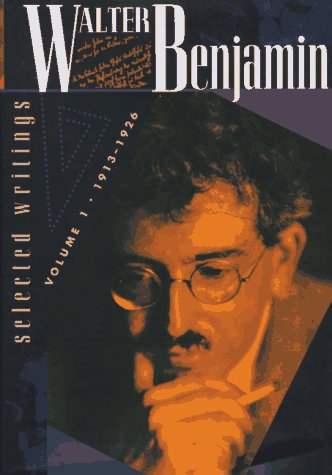 | Hardcover: 528
Pages
(1996-12-01)
list price: US$62.50 -- used & new: US$45.00 (price subject to change: see help) Asin: 0674945859 Average Customer Review: 
Canada | United Kingdom | Germany | France | Japan |
|
Editorial Review Product Description Walter Benjamin was one of the most original and important critical voices of the twentieth century, but until now only a few of his writings have been available in English. Harvard University Press has now undertaken to publish a significant portion of his work in definitive translation, under the general editorship of Michael W. Jennings. This volume, the first of three, will at last give readers of English a true sense of the man and the mans' theets of his thought. A separate volume will consist of his book The Arcades Project, the magnum opus of his Paris years. The writer Walter Benjamin emerged our of the head-on collision of an idealistic youth movement and the First World War, which Benjamin and his close friends thought immoral. He walked away from the wreck scarred yet determined "to be considered as the principal critic of German literature." But the scene as he found it was dominated by "talented fakes," so-to use his words-"only a terrorist campaign would I suffice" to effect radical change. This book offers the record of the first phase of that campaign, culminating with "One-Way Street," one of the most significant products of the German avant-garde of the Twenties. Against conformism, homogeneity, and gentrification of all life into a new world order, Benjamin made the word his sword. Volume I of the Selected Writings brings together essays long and short, academic treatises, reviews, fragments, and privately circulated pronouncements. Fully five-sixths of this material has never before been translated into English. The contents begin in 1913, when Benjamin, as an undergraduate in imperial Germany, was president of a radical youth group, and take us through 1926, when he had already begun, with his explorations of the world of mass culture, to emerge as a critical voice in Weimar Germany's most influential journals. The volume includes a number of his most important works, including "Two Poems by Friedrich Hölderlin," "Goethe's Elective Affinities," "The Concept of Criticism in German Romanticism," "The Task of the Translator," and "One-Way Street." He is as compelling and insightful when musing on riddles or children's books as he is when dealing with weightier issues such as the philosophy of language, symbolic logic, or epistemology. We meet Benjamin the youthful idealist, the sober moralist, the political theorist, the experimentalist, the translator, and, above all, the virtual king of criticism, with his magisterial exposition of the basic problems of aesthetics. Benjamin's sentences provoke us to return to them again and again, luring us as though with the promise of some final revelation that is always being postponed. He is by turns fierce and tender, melancholy and ebullient; he is at once classically rooted, even archaic, in his explorations of the human psyche and the world of things, and strikingly progressive in his attitude toward society and what he likes to call the organs of the collective (its architectures, fashions, signboards). Throughout, he displays a far-sighted urgency, judging the present on the basis of possible futures. And he is gifted with a keen sense of humor. Mysterious though he may sometimes be (his Latvian love, Asia Lacis, once described him as a visitor from another planet), Benjamin remains perhaps the most consistently surprising and challenging of critical writers. Customer Reviews (2)
This volume, along with its companion, is an excellent introduction to the style and thought of this man who, while out of step with his times, possessed the insight to give those times an original critique. Possessed of a lively style and free from the Marxist bagge that weighs down his Frankfurt School colleagues such as Adorno and Horkheimer (I think Benjamin owes much more to Heidegger than Marx), Benjamin will hook any reader who takes the time to spend an hour or two with this book. From here it's an easy step to purchase other Benjamin writings, a step I can almost guarantee.
When I think of Benjamin, I think of Emerson's famous line about Hawthorne - that he was a greater man than any of his works betray. The integrity and character of Walter Benjamin shines through his works, and is an inspiration to anyone who takes literature seriously. This first volume of Bejamin's complete works is very attractive and welcome. Some of my favorite essays are present, such as his essays on children's literature, and the nature of language. I eagerly await the other two volumes. ... Read more | |
| 22. Walter Benjamin: Or, Towards a Revolutionary Criticism (Radical Thinkers) by Terry Eagleton | |
 | Paperback: 187
Pages
(2009-06-09)
list price: US$12.95 -- used & new: US$6.59 (price subject to change: see help) Asin: 1844673502 Canada | United Kingdom | Germany | France | Japan |
|
Editorial Review Product Description | |
| 23. Walter Benjamin and Art by Andrew Benjamin | |
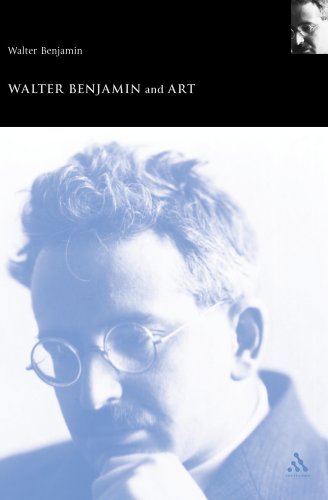 | Paperback: 272
Pages
(2005-03-18)
list price: US$55.00 -- used & new: US$21.53 (price subject to change: see help) Asin: 082646730X Canada | United Kingdom | Germany | France | Japan |
|
Editorial Review Product Description The book is structured around three distinct areas: the extension of Benjamin's work; the question of historical connection; the importance of the essay in the development of criticism of both the visual arts and literature.Contributors to the volume include major Benjamin commentators, whose work has very much defined the reception of the essay, and leading philosophers, historians and aesthetician, whose approaches open up new areas of interest and relevance. | |
| 24. The Complete Correspondence, 1928-1940 by Theodor W. Adorno, Walter Benjamin | |
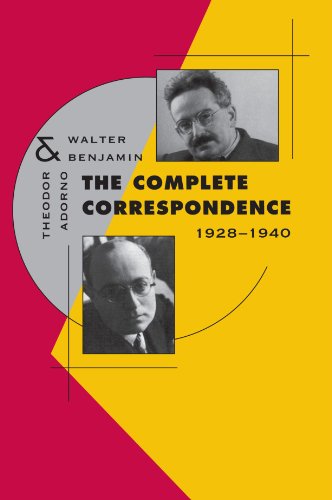 | Paperback: 400
Pages
(2001-12-07)
list price: US$36.50 -- used & new: US$32.85 (price subject to change: see help) Asin: 0674006895 Canada | United Kingdom | Germany | France | Japan |
|
Editorial Review Product Description | |
| 25. Walter Benjamin at the Dairy Queen : Reflections on Sixty and Beyond by Larry McMurtry | |
 | Paperback: 208
Pages
(2001-08-07)
list price: US$14.00 -- used & new: US$3.95 (price subject to change: see help) Asin: 0684870193 Average Customer Review: 
Canada | United Kingdom | Germany | France | Japan |
|
Editorial Review Product Description In a lucid, brilliant work of nonfiction -- as close to an autobiography as his readers are likely to get -- Larry McMurtry has written a family portrait that also serves as a larger portrait of Texas itself, as it was and as it has become. Using as a springboard an essay by the German literary critic Walter Benjamin that he first read in Archer City's Dairy Queen, McMurtry examines the small-town way of life that big oil and big ranching have nearly destroyed. He praises the virtues of everything from a lime Dr. Pepper to the lost art of oral storytelling, and describes the brutal effect of the sheer vastness and emptiness of the Texas landscape on Texans, the decline of the cowboy, and the reality and the myth of the frontier. McMurtry writes frankly and with deep feeling about his own experiences as a writer, a parent, and a heart patient, and he deftly lays bare the raw material that helped shape his life's work: the creation of a vast, ambitious, fictional panorama of Texas in the past and the present. Throughout, McMurtry leaves his readers with constant reminders of his all-encompassing, boundless love of literature and books. McMurtry's book-length essay loops outward from Archer City toencompass a polemic against computers, a foray into the world of bookcollecting, a family biography, anaccount of his soul-loss after heart surgery, and finally anelegy for the cowboy. This last lament casts a shadow back over what we'veread. Not just over this book, but over McMurtry's whole body ofwork. A man who's lived his whole life in print gives us a glimpse of whathas fed him, and, strangely, it's loss. "Because of when and where I grewup, on the Great Plains just as the herding tradition was beginning to loseits vitality, I have been interested all my life in vanishing breeds."The master of storytelling is finally revealed as a master ofmelancholy. --Claire Dederer Customer Reviews (32)
| |
| 26. Walter Benjamin: The Story of a Friendship (New York Review Books Classics) by Gershom Gerhard Scholem | |
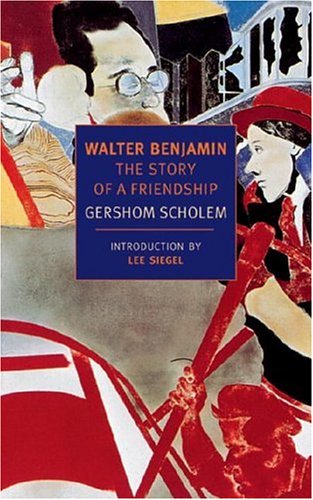 | Paperback: 328
Pages
(2003-04-30)
list price: US$17.95 -- used & new: US$10.57 (price subject to change: see help) Asin: 1590170326 Average Customer Review:
Canada | United Kingdom | Germany | France | Japan |
|
Editorial Review Product Description Customer Reviews (2)
| |
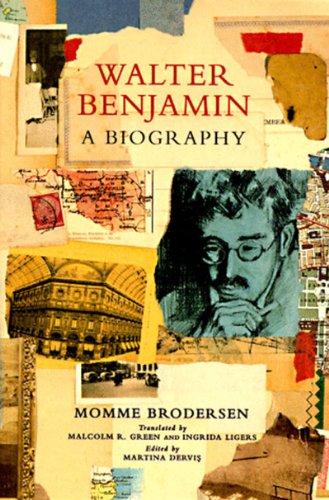
| 27. Walter Benjamin: A Biography by Momme Brodersen | |
 | Paperback: 356
Pages
(1997-12-01)
list price: US$29.95 -- used & new: US$10.00 (price subject to change: see help) Asin: 1859840825 Average Customer Review: 
Canada | United Kingdom | Germany | France | Japan |
|
Editorial Review Product Description Customer Reviews (4)
| |
| 28. Walter Benjamin: An Intellectual Biography (Kritik : German Literary Theory and Cultural Studies) by Bernd Witte | |
 | Paperback: 226
Pages
(1997-09)
list price: US$19.95 -- used & new: US$16.99 (price subject to change: see help) Asin: 081432018X Canada | United Kingdom | Germany | France | Japan |
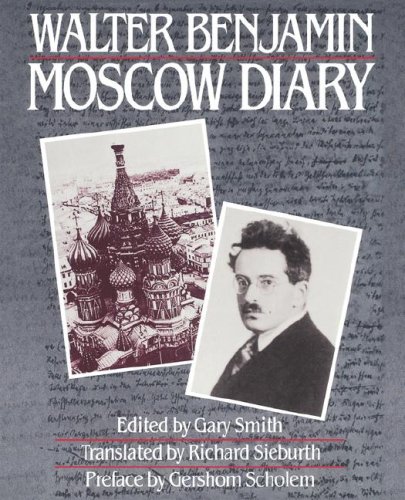
| 29. Moscow Diary by Walter Benjamin | |
 | Paperback: 156
Pages
(1986-07-01)
list price: US$25.50 -- used & new: US$21.00 (price subject to change: see help) Asin: 0674587448 Average Customer Review:
Canada | United Kingdom | Germany | France | Japan |
|
Editorial Review Product Description The life of the German-Jewish literary critic and philosopher Walter Benjamin (1892-1940) is a veritable allegory of the life of letters in the twentieth century. Benjamin's intellectual odyssey culminated in his death by suicide on the Franco-Spanish border, pursued by the Nazis, but long before he had traveled to the Soviet Union. His stunning account of that journey is unique among Benjamin's writings for the frank, merciless way he struggles with his motives and conscience. Perhaps the primary reason for his trip was his affection for Asja Lacis, a Latvian Bolshevik whom he had first met in Capri in 1924 and who would remain an important intellectual and erotic influence on him throughout the twenties and thirties. Asja Lacis resided in Moscow, eking out a living as a journalist, and Benjamin's diary is, on one level, the account of his masochistic love affair with this elusive--and rather unsympathetic--object of desire. On another level, it is the story of a failed romance with the Russian Revolution; for Benjamin had journeyed to Russia not only to inform himself firsthand about Soviet society, but also to arrive at an eventual decision about joining the Communist Party. Benjamin's diary paints the dilemma of a writer seduced by the promises of the Revolution yet unwilling to blinker himself to its human and institutional failings. Moscow Diary is more than a record of ideological ambivalence; its literary value is considerable. Benjamin is one of the great twentieth-century physiognomists of the city, and his portrait of hibernal Moscow stands beside his brilliant evocations of Berlin, Naples, Marseilles, and Paris. Students of this particularly interesting period will find Benjamin's eyewitness account of Moscow extraordinarily illuminating. Customer Reviews (1)
| |
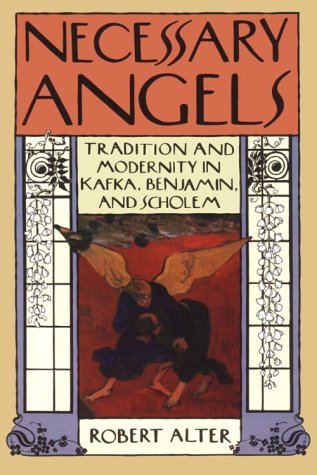
| 30. Necessary Angels: Tradition and Modernity in Kafka, Benjamin, and Scholem by Robert Alter | |
 | Hardcover: 131
Pages
(1991-03-01)
list price: US$23.00 Isbn: 0674606639 Average Customer Review:
Canada | United Kingdom | Germany | France | Japan |
|
Editorial Review Product Description In four elegant chapters, Robert Alter explains the prismlike radiance created by the association of three modern masters, Franz Kafka, Walter Benjamin, and Gershom Scholem. The volume pinpoints the intersections of these divergent witnesses to the modern condition of doubt, the no-man's-land between traditional religion and modern secular culture. Scholem, the devoted Zionist and master historian of Jewish mysticism, and Benjamin, the Marxist cultural critic, dedicated much of their thought and correspondence to Kafka, the explorer in fiction of radical alienation. Kafka's sense of spiritual complexities was an inspiration to both thinkers in their resistance to the murderous simplification of totalitarian ideology. In Necessary Angels Alter uncovers a moment when the future of modernism is revealed in its preoccupation with the past. The angel of the title is first Kafka's: on June 25, 1914, the writer recorded in his diary a dream vision of an angel that turned into the painted wooden figurehead of a ship. In 1940, at the end of his life, Walter Benjamin devoted the ninth of his Theses on the Philosophy of History to a meditation on an angel by the artist Paul Klee, first quoting a poem he had written on that painting. In Benjamin's vision, the figure from Klee becomes an angel of history, sucked into the future by the storm of progress, his face looking back to Eden. Benjamin bequeathed the Klee oil painting to Scholem; it hung in the living room of Scholem's home on Abarbanel Street in Jerusalem until 1989, when his widow placed it in the Israel Museum. Alter's focus on the epiphanic force of memory on these three great modernists shows with sometimes startling, sometimes prophetic clarity that a complete break with tradition is not essential to modernism. Necessary Angels itself continues the necessary discovery of the future in the past. Customer Reviews (1)
| |
| 31. Necessary Angels: Tradition and Modernity in Kafka, Benjamin, and Scholem by Robert Alter | |
| Hardcover: 131
Pages
(1991-03-01)
list price: US$23.00 Isbn: 0674606639 Average Customer Review:
Canada | United Kingdom | Germany | France | Japan |
|
Editorial Review Product Description In four elegant chapters, Robert Alter explains the prismlike radiance created by the association of three modern masters, Franz Kafka, Walter Benjamin, and Gershom Scholem. The volume pinpoints the intersections of these divergent witnesses to the modern condition of doubt, the no-man's-land between traditional religion and modern secular culture. Scholem, the devoted Zionist and master historian of Jewish mysticism, and Benjamin, the Marxist cultural critic, dedicated much of their thought and correspondence to Kafka, the explorer in fiction of radical alienation. Kafka's sense of spiritual complexities was an inspiration to both thinkers in their resistance to the murderous simplification of totalitarian ideology. In Necessary Angels Alter uncovers a moment when the future of modernism is revealed in its preoccupation with the past. The angel of the title is first Kafka's: on June 25, 1914, the writer recorded in his diary a dream vision of an angel that turned into the painted wooden figurehead of a ship. In 1940, at the end of his life, Walter Benjamin devoted the ninth of his Theses on the Philosophy of History to a meditation on an angel by the artist Paul Klee, first quoting a poem he had written on that painting. In Benjamin's vision, the figure from Klee becomes an angel of history, sucked into the future by the storm of progress, his face looking back to Eden. Benjamin bequeathed the Klee oil painting to Scholem; it hung in the living room of Scholem's home on Abarbanel Street in Jerusalem until 1989, when his widow placed it in the Israel Museum. Alter's focus on the epiphanic force of memory on these three great modernists shows with sometimes startling, sometimes prophetic clarity that a complete break with tradition is not essential to modernism. Necessary Angels itself continues the necessary discovery of the future in the past. Customer Reviews (1)
| |
| 32. Walter Benjamin's Philosophy: Destruction and Experience (Warwick Studies in European Philosophy) | |
| Hardcover: 312
Pages
(1993-12-13)
list price: US$135.00 -- used & new: US$131.05 (price subject to change: see help) Asin: 0415083680 Canada | United Kingdom | Germany | France | Japan | |
|
Editorial Review Product Description Contributors: Andrew Benjamin, Rebecca Comay, Howard Caygill, Alexander Garcia Duttman, Rodolphe Gasche, Werner Hamacher, Gertrud Koch, John Kraniauskas, Peter Osborne, Irving Wohlfarth. | |
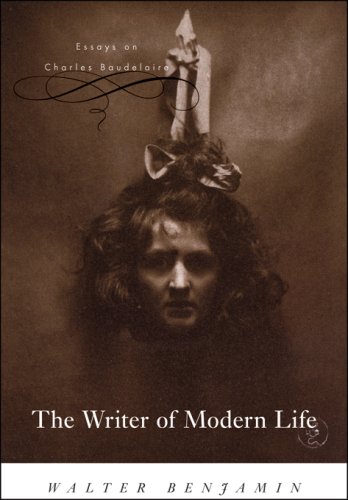
| 33. The Writer of Modern Life: Essays on Charles Baudelaire by Walter Benjamin | |
 | Paperback: 320
Pages
(2006-11-15)
list price: US$19.00 -- used & new: US$13.30 (price subject to change: see help) Asin: 0674022874 Canada | United Kingdom | Germany | France | Japan |
|
Editorial Review Product Description Walter Benjamin's essays on the great French lyric poet Charles Baudelaire revolutionized not just the way we think about Baudelaire, but our understanding of modernity and modernism as well. In these essays, Benjamin challenges the image of Baudelaire as late-Romantic dreamer, and evokes instead the modern poet caught in a life-or-death struggle with the forces of the urban commodity capitalism that had emerged in Paris around 1850. The Baudelaire who steps forth from these pages is the flâneur who affixes images as he strolls through mercantile Paris, the ragpicker who collects urban detritus only to turn it into poetry, the modern hero willing to be marked by modern life in its contradictions and paradoxes. He is in every instance the modern artist forced to commodify his literary production: "Baudelaire knew how it stood with the poet: as a flâneur he went to the market; to look it over, as he thought, but in reality to find a buyer." Benjamin reveals Baudelaire as a social poet of the very first rank. The introduction to this volume presents each of Benjamin's essays on Baudelaire in chronological order. The introduction, intended for an undergraduate audience, aims to articulate and analyze the major motifs and problems in these essays, and to reveal the relationship between the essays and Benjamin's other central statements on literature, its criticism, and its relation to the society that produces it. | |
| 34. Gesammelte Schriften. 7 Bde., in 14 Tl.-Bdn. by Walter Benjamin, Theodor W. Adorno, Gershom Scholem, Rolf Tiedemann, Hermann Schweppenhäuser | |
 | Paperback: 7854
Pages
(1991-08-01)
-- used & new: US$221.71 (price subject to change: see help) Asin: 3518098322 Canada | United Kingdom | Germany | France | Japan |
| 35. Walter Benjamin and the Antinomies of Tradition by John McCole | |
 | Paperback: 329
Pages
(1993-04)
list price: US$30.50 -- used & new: US$25.05 (price subject to change: see help) Asin: 0801497116 Canada | United Kingdom | Germany | France | Japan |
|
Editorial Review Product Description "This sophisticated yet reader-friendly study represents a significant advance in American criticism on Walter Benjamin. . . . I endorse Irving Wohlfarth's statement that this is 'the best book-length study of Benjamin yet to have appeared in English' and enthusiastically recommend it to novice and devotee alike."--Philosophy and Literature | |
| 36. The Angel of History: Rosenzweig, Benjamin, Scholem (Cultural Memory in the Present) by Stephane Moses | |
 | Paperback: 208
Pages
(2008-12-11)
list price: US$24.95 -- used & new: US$19.20 (price subject to change: see help) Asin: 0804741174 Canada | United Kingdom | Germany | France | Japan |
|
Editorial Review Product Description | |
| 37. Correspondence 1930-1940 by Gretel Adorno, Walter Benjamin | |
 | Hardcover: 336
Pages
(2008-03-11)
list price: US$34.95 -- used & new: US$26.60 (price subject to change: see help) Asin: 0745636691 Canada | United Kingdom | Germany | France | Japan |
|
Editorial Review Product Description The correspondence between Gretel Adorno and Walter Benjamin, published here in its complete form for the first time, is the document of a great friendship that existed independently of Benjamin's relationship with Theodor W. Adorno. While Benjamin, alongside his everyday worries, writes especially about those projects on which he worked so intensively in the last years of his life, it was Gretel Karplus-Adorno who did everything in her power to keep Benjamin in the world. She urged him to emigrate and told him about Adorno's plans and Bloch's movements, thus maintaining the connection between the old Berlin friends and acquaintances. She helped him through the most difficult times with regular money transfers, and organized financial support from the Saar region, which was initially still independent from the Third Reich. Once in New York, she attempted to entice Benjamin to America with her descriptions of the city and the new arrivals from Europe though ultimately to no avail. | |
| 38. Moskauer Tagebuch (Edition Suhrkamp ; n.F., Bd. 20) (German Edition) by Walter Benjamin | |
 | Perfect Paperback: 222
Pages
(1980)
-- used & new: US$10.80 (price subject to change: see help) Asin: 3518110209 Canada | United Kingdom | Germany | France | Japan |
| 39. Walter Benjamin: Selected Writings, Volume 2: Part 1: 1927-1930 by Walter Benjamin | |
 | Paperback: 480
Pages
(2005-06-15)
list price: US$23.00 -- used & new: US$19.63 (price subject to change: see help) Asin: 0674015886 Average Customer Review: 
Canada | United Kingdom | Germany | France | Japan |
|
Editorial Review Product Description In the frenzied final years of the Weimar Republic, amid economic collapse and mounting political catastrophe, Walter Benjamin emerged as the most original practicing literary critic and public intellectual in the German-speaking world. Volume 2 of the Selected Writings is now available in paperback in two parts. In Part 1, Benjamin is represented by two of his greatest literary essays, "Surrealism" and "On the Image of Proust," as well as by a long article on Goethe and a generous selection of his wide-ranging commentary for Weimar Germany's newspapers. Part 2 contains, in addition to the important longer essays, "Franz Kafka," "Karl Kraus," and "The Author as Producer," the extended autobiographical meditation "A Berlin Chronicle," and extended discussions of the history of photography and the social situation of the French writer, previously untranslated shorter pieces on such subjects as language and memory, theological criticism and literary history, astrology and the newspaper, and on such influential figures as Paul Valery, Stefan George, Hitler, and Mickey Mouse. Customer Reviews (1)
| |
| 40. Benjamin Franklin - An American Life by Walter Isaacson | |
 | Paperback: 608
Pages
(2004)
-- used & new: US$3.99 (price subject to change: see help) Asin: B0012WXAPC Average Customer Review:
Canada | United Kingdom | Germany | France | Japan |
|
Editorial Review Product Description Customer Reviews (243)
| |
| Back | 21-40 of 103 | Next 20 |
 A relaxed and informative read
 Unbias Benjamin
 Very Disappointing