e99 Online Shopping Mall

Geometry.Net - the online learning center Help  
Home  - Philosophers - Bentham Jeremy (Books)

  1-20 of 100 | Next 20
A  B  C  D  E  F  G  H  I  J  K  L  M  N  O  P  Q  R  S  T  U  V  W  X  Y  Z  

click price to see details     click image to enlarge     click link to go to the store

$6.98
1. The Principles of Morals and Legislation
$18.22
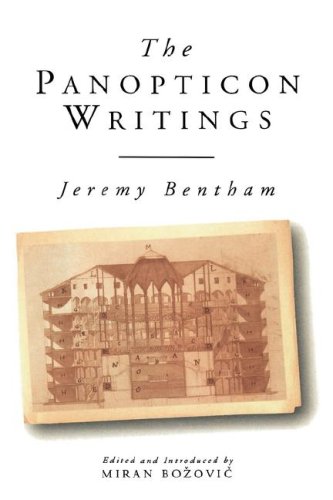
2. Panopticon Writings (Wo Es War)
$7.76
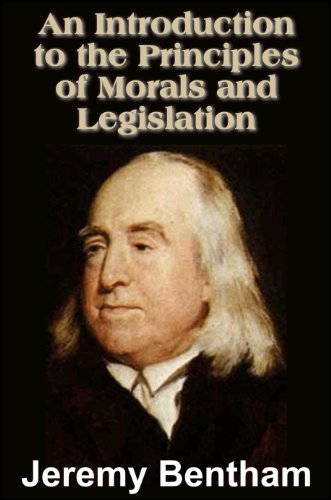
3. An Introduction to the Principles
$7.00
4. The Classical Utilitarians: Bentham
$32.99
5. The Works of Jeremy Bentham: Published
$7.02
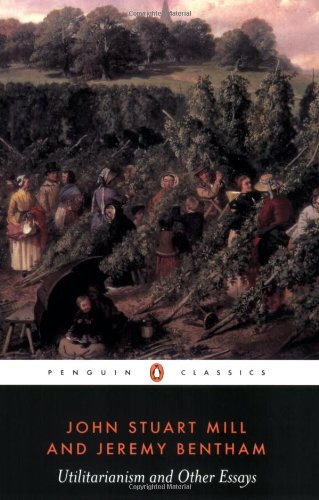
6. Utilitarianism and Other Essays
$51.40
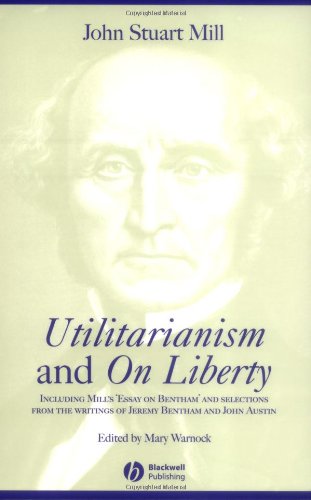
7. Utilitarianism and On Liberty:
$25.50
8. Jeremy Bentham: His Life And Work
 
9. The Mind of Jeremy Bentham
 
10. The Mind of Jeremy Bentham.
$23.60
11. Deontology; or, The Science of
$23.70
12. The Works of Jeremy Bentham: Published
 
13. Utilitarianism, On Liberty, Essay
$32.99
14. The Works of Jeremy Bentham: Published
$22.50
15. The Works of Jeremy Bentham: Published
$145.64
16. Writings on the Poor Laws, Vol.
 
17. Nonsense upon Stilts: Bentham,
$188.68
18. Deontology together with A Table
$18.41
19. A Fragment On Government (1891)
$95.74
20. Utility and Democracy: The Political

1. The Principles of Morals and Legislation (Great Books in Philosophy)
by Jeremy Bentham
Paperback: 352 Pages (1988-05)
list price: US$12.00 -- used & new: US$6.98
(price subject to change: see help)
Asin: 0879754346
Average Customer Review: 4.0 out of 5 stars
Canada | United Kingdom | Germany | France | Japan

Customer Reviews (1)

4-0 out of 5 stars Interrogation of the Principles Behind Moralsand Legislation
Jeremy Bentham's ideology on human pursuit of pleasure contains many strengths and weaknesses.Bentham's essay, An Introduction to the Principles of Morals and Legislation, separates the two root drives of human essence into categories of pleasure and pain.Bentham stresses the duality of the human mind's pursuit of pleasure, continuing from subjugation of others for ultimate attainment.He states that humans should not be grouped, due to personal conviction and perspective.Although the individual is part of a community, the individual's own pursuance of pleasure categorizes them as a utility; resulting in the term `utilitarianism.'
Several principles are listed by Bentham to support his argument that humanity has a distinct set of motives to create happiness or malcontent amongst the masses.Bentham relates these principles with empowered political bodies and why they continue to rule.One of Bentham's principles, the principle of sympathy and antipathy, praises the human ability to generally accept certain actions as an impersonal blow.Thus, if a utility does not feel threatened or in err, why relate consequences of actions to personal welfare?In turn, should that individual measure out the consequences of others' actions fearing for their own external welfare?
Bentham's perspective on human methodology as a strict functioning environment of social cues has many flaws.Determination of values as `right' or `wrong' does not review the complexities of human social environment.Empowerment was not an anti-puritanical event that occurred in society; but a constitution of human need for order.Bentham suggests that "principle is something that points out some external consideration, as a means of warranting and guiding the internal sentiments of approbation and disapprobation"(75).Assertion of principle as influence on human external action suggests a strong moral power present in an individual's everyday life.Perhaps the rebellion of moral principle has an antipathic effect on moral judgement.The pleasure produced by rebellion of principle dictates a return to instinctual roots; excluding the `civilizing' factor.
Bentham's open acknowledgement that asceticism violates the nature laws of human government, and cannot be fully pursued, illustrates the ties between the Catholicism and enlightened despotism.The origin of Catholicism and despotism, according to Bentham, stems from an unrealistic aim to impose a standard of morality on the masses.His criticizing of saints best illustrates an open reaction to the weakness of asceticism.Bentham states that, "though many persons of this class have wielded the reins (sic) of empire, we read of none who have set themselves to work, and made laws of purpose"(73).Unfortunately, his touting of utilitarianism above the principle of asceticism, as a proper way to establish a governing body, is only comparative with traditional social classification in the eighteenth century.
Bentham proposed a new way to establish morality and just governmental action from traditional monarchical rule.The imposed Rule of Right, whereas kings justified rule as eternal over his people and empowered by God, was a shifting environment that came into question in Bentham's lifetime.Utilitarianism provided an answer to strategic social problems that came with new leadership apart from a monarchy.Moral advocating by reformers as something an individual instinctually knows is right, was a key concept in utilitarianism.Therefore, pursuance of pleasure above pain would produce just results in a newly formed government.
Pleasure, in the strictest sense, took a prominent place in executive rule over a government.Bentham also writes that good tendency sometimes counteracts pursuance of pleasure in legislative and judicial matters.He best expresses this by writing, "It is not to be expected that this process should be strictly pursued previously to every moral judgement"(88).Considering the objective process of judicial decision as a moral and just environment was revolutionary.Morality, without the ties of asceticism, could and did exist in a ruling environment, ultimately usurping previous ideas that Rule of Right contained eternal, prophetic principle.Bentham's ideas set a cornerstone for other studies of social morality, thus contributing to the new field of sociology.
Bentham's idea of human pleasure and pain being either simple or complex seems very generalistic in approach.He suggests that pleasure and pain are bound into simple and complex categories, therefore never transpiring into different classifications.The elementary view on pursuance of pleasure and pain seems vague for a study of the human condition.Bentham writes that, "the simple ones are those which cannot any one of them be resolved into more," creating a moral quandary (90).For example, Bentham's idea that "the end of the law is to augment happiness" is a just principle of government (97).Unfortunately, law must sometimes contain happiness to produce security.Duality of principle is discussed in his writings, but for every dark and light area there is a gray area.
Jeremy Bentham pioneered root elements of human motivation and morality.He conceptualized a government that founded itself on pursuance of pleasure as just rule.Character of individualsis attained through positive motivation, but for every individual of good character lies the possibility of bad character.Corruption was possible, and presented itself in many forms throughout human history.Efforts to catalogue unpleasant and pleasant dispositions find that government that is founded on positive principle is always corrupted by human condition.Jeremy Bentham's approach in rediscovery of individual strains, through principles, shed a new light on morality.

I hope you enjoy this work as much as I did. ... Read more


2. Panopticon Writings (Wo Es War)
by Jeremy Bentham
Paperback: 168 Pages (1995-08-01)
list price: US$22.95 -- used & new: US$18.22
(price subject to change: see help)
Asin: 1859840833
Canada | United Kingdom | Germany | France | Japan

3. An Introduction to the Principles of Morals and Legislation (Philosophical Classics)
by Jeremy Bentham
Paperback: 416 Pages (2007-06-05)
list price: US$12.95 -- used & new: US$7.76
(price subject to change: see help)
Asin: 0486454525
Average Customer Review: 4.0 out of 5 stars
Canada | United Kingdom | Germany | France | Japan
Editorial Review

Book Description

A classic of both philosophy and jurisprudence, this 1789 work articulates an important statement of the foundations of utilitarian philosophy. It also represents a pioneering study of crime and punishment. Bentham's reasoning remains ever relevant and central to contemporary debates in moral and political philosophy, economics, and legal theory.
... Read more

Customer Reviews (3)

4-0 out of 5 stars utilitarianism
this is a readable piece of philosophy, that lays out the basics of his utilitarianism. the book itself is high quality.

5-0 out of 5 stars An intellectual feast
Jeremy Bentham (IPA: ['ben??m]) (February 15, 1748 - June 6, 1832) was an English gentleman, jurist, philosopher, and legal and social reformer. He is best known as an early advocate of utilitarianism and animal rights.

Bentham was one of the most influential (classical) liberals, partially through his writings but particularly through his students all around the world, including John Stuart Mill and several political leaders.

He argued in favor of individual and economic freedom, including the separation of church and state, freedom of expression, equal rights for women, animal rights, the end of slavery, the abolition of physical punishment (also of children), the right to divorce, free trade, and no restrictions on interest. But, he was not a libertarian, and supported inheritance tax, restrictions on monopoly power, pensions, and health insurance.

In 1776, Bentham published his Fragment on Government anonymously, a criticism of Blackstone's Commentaries, and in 1780 his Introduction to Principles of Morals and Legislation was published.

A truly influential author!

3-0 out of 5 stars It's all downhill from here.
Jeremy Bentham was an important social reformer and a major figure in the history of ethics. However you might not know it from reading this dense and forbidding tract. Even a short excerpt can be tough going. However,utilitarianism has been, and remains, one of the most influential ethicalphilosophies of all time, and this was among its modern foundingdocuments.

If one can come away from it with a general sense of whatutilitarianism is, what act utilitarianism is, and how it gets from egoismin psychology to neutralism in ethics, one has done pretty well. Thisshould help the reader start thinking about what some of the problems withthis theory are, how it measures up to its competitors, and how it can beapplied to specific problems.

The best news for those who have bravedthis text is that Mill and other later thinkers will seem like poetry inmotion by comparison. ... Read more


4. The Classical Utilitarians: Bentham and Mill
by Jeremy Bentham
Paperback: 320 Pages (2003-03)
list price: US$9.95 -- used & new: US$7.00
(price subject to change: see help)
Asin: 0872206491
Canada | United Kingdom | Germany | France | Japan
Editorial Review

Book Description
This volume includes the complete texts of two of John Stuart Mill's most important works, Utilitarianism and On Liberty, and selections from his other writings, including the complete text of his "Remarks on Bentham's Philosophy." The selection from Mill's "A System of Logic" is of special relevance to the debate between those who read Mill as an Act-Utilitarian and those who interpret him as a Rule-Utilitarian.

Also included are selections from the writings of Jeremy Bentham, founder of modern Utilitarianism and mentor (together with James Mill) of John Stuart Mill. Bentham's Principles of Morals and Legislation had important effects on political and legal reform in his own time and continues to provide insights for political theorists and philosophers of law. Seven chapters of Bentham's Principles are here in their entirety, together with a number of shorter selections, including one in which Bentham repudiates the slogan often used to characterize his philosophy: "The Greatest Happiness of the Greatest Number."

John Troyer's Introduction presents the central themes and arguments of Bentham and Mill and assesses their relevance to current discussions of Utilitarianism. The volume also provides indexes, a glossary, and notes. ... Read more


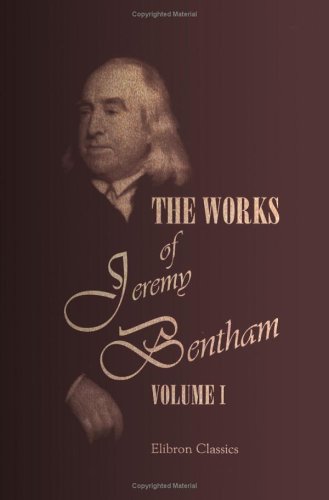
5. The Works of Jeremy Bentham: Published under the Superintendence of His Executor, John Bowring. Volume 1
by Jeremy Bentham
Paperback: 720 Pages (2001-08-23)
list price: US$32.99 -- used & new: US$32.99
(price subject to change: see help)
Asin: 1402163932
Canada | United Kingdom | Germany | France | Japan
Editorial Review

Product Description
This Elibron Classics book is a facsimile reprint of a 1859 edition by William Tait; Simpkin, Marshall, & Co., Edinburgh; London. ... Read more


6. Utilitarianism and Other Essays (Penguin Classics)
by John Stuart Mill, Jeremy Bentham
Paperback: 352 Pages (1987-08-04)
list price: US$11.95 -- used & new: US$7.02
(price subject to change: see help)
Asin: 0140432728
Average Customer Review: 4.0 out of 5 stars
Canada | United Kingdom | Germany | France | Japan

Customer Reviews (4)

4-0 out of 5 stars Still a classic after all these years
Mill's Utilitarianism is a very interesting and modern essay.It surely has endured the test of time so far and will continue to do so for many generations to come.

5-0 out of 5 stars Utilitarian philosophy explained
I read this book for a graduate Mill seminar in Philosophy.Recommended reading for anyone interested in philosophy, political science, and history.

John Stuart Mill, 1806-73, worked for the East India Co. helped run Colonial India from England.Minister of Parliament 1865-68 he served one term.

Mill develops a theory of morality in Utilitarianism.He argues against the group of people who think that morality is intuitive.Intuitionists think that God put morality in us, thus, morality is a priori.Moral rules or principles were programmed in us, we can see these rules, they are binding, however they do acknowledge that on a case by case basis we still need to use them to reason out the ultimate answer for a particular case.

Mill also believes that there are a set of moral principles that we ought to be thinking about.Intuitionists today think that case by case we can reason out what is right or wrong.However, they would be suspicious that of believing there were general moral principles.Intuitionists say it is not up to us to investigate what is right or wrong.Mill would disagree.Mill doesn't like Intuitionists theory because they can't prove their view; and they can't explain why "lying is wrong" as an example.In addition, they do not provide a list of these innate morals we are suppose to have, and they do not have a hierarchy for them to resolve the conflict between two morals when they arise.

Background on essay, written in 1861 came out in 3 magazine articles, pretty scanty which sometimes drives one crazy trying to deduce what Mill is saying.A lot of interpretation is necessary.

Chapter 2: The second paragraph is official statement of the theory.

"The creed which accepts as the foundation of morals, Utility, or the Greatest Happiness Principle, holds that actions are right in proportion as they tend to promote happiness, wrong as they tend to produce the reverse of happiness."

Happiness=pleasure and freedom from pain.This makes him a Hedonist philosophically.


Higher Pleasures Doctrine- Jeremy Bentham says how valuable pleasure was based on 2 dimensions that we evaluate our experience of pleasure by, intensity and duration.Bentham says this determines quantity in pleasure.Bentham said this determined how much a given experience adds to a person's happiness.

Mill adds a third value to evaluate pleasure by and that's its quality, how good it is.Many don't understand Mill's idea that pleasure has value and quality.Most people think that Mill is really talking about quantity, or they don't believe one can be a hedonist, that pleasure is the only thing that has value, and yet think that there is something more to judging how valuable an experience is than the intensity and the duration of the pleasure it contains.So, they say that one of two things must be going on here.Of course, some people are sure it is one thing, and some are sure it is another.Either what Mill is talking about when you get right down to it is quantity in pleasure and different experiences, or all the different things he says about quality can be somehow resolved into quantity.So that really what is going on is that when Mill talks about a pleasure being of a higher quality that just means that there is a lot more pleasure there that the quantity is much greater.Or, Mill is giving up on hedonism at this point and he is admitting that some things are valuable aside from pleasure.So, when he says an experience like reading a good book or something like that is more valuable than an experience of some kind of animalistic pleasure, that really what he is saying is this experience is more valuable for reasons that go beyond the amount of pleasure involved.In addition to how much pleasure is involved there is also that maybe the experience is more beautiful or more noble or something like that and this gives it additional value.So something other than the amount of pleasure involved gives it additional value.Mill can be a consistent hedonist and he can consistently say that pleasure is the only thing that can have value and yet it is still the case that some pleasures are just more valuable than other pleasures.


4-0 out of 5 stars The calculus of pleasure and pain is not enough
This is John Stuart Mill's restatement and qualification of the philosophical doctrine of' Utilitarianism'- the doctrine that the aim of Society is to produce the "greatest happiness for the greatest number".
The philosophy whose great inventor was Jeremy Bentham built itself upon the idea of a calculus of pleasures and pains, an almost mechanical measuring of feeling.
However the complexity, contradictory quality of our inner life suggest that any calculation of this type has a certain shallowness and illegitimacy about it.
In any case Mill's idea of utilitarianismdoes connect with his conception of Liberalism, and does have effect on his later thought even as he rejected most of it.

4-0 out of 5 stars Dogmatism at its height.
Jeremy Bentham is the father of the doctrine called Utilitarianism, and John Stuart Mill (son of the second-rank philosopher James Mill and a kind of mouthpiece for Jeremy) is his most known disciple. «Utilitarianism and other Essays » presents the reader some of the most important and exciting excerpts texts written by the two thinkers, who, despite outwardly embracing the same doctrine, had to do a lot of theoretical gymnastics to accomodate each other points of view under the same ideological umbrella, thus demonstrating that sometimes the battle is fiercest, albeit muffled, inside than outside ideological headquarters. In hindsight , it seems that John Stuart Mill, who ran the rudders of the Economic doctrine of England until the 1860's, had some scores to settle with Jeremy, who was many years his senior and had ben, by some, the person behind the culturally sophisticated (although stripped of any emotional and religious overtones) education John received as a boy,learning Greek at 3, Latin at 8 and revising at 15 (in French) the first volume of the book « Democracy in America », by Tocqueville. The outcome of all this is that Mill developed a type of melancholic character who almost pushed him to the depths ofdepression, only rescued by his second marriage in his mid-life, when he embraced a lot of libertarian and anti-establishment proposals.
The writting styles of the two are blatantly different, James being the pragmatical dogmatist who accepted no exception to his utilitarian praecepts, Mill, on the contrary, the soft-minded scholar who diligently tried to mend the many defficiencies of a theory so rigidly framed and which was supposed to answer to all demands of human action. This dogmatism by Bentham, forced Mill later in life to abscond that doctrine, althoug never converting himself to any religion creed. Worthy of mention if the superb introduction by Alan Ryan, being a book on utilitarianism in itself.

... Read more


7. Utilitarianism and On Liberty: Including 'Essay on Bentham' and Selections from the Writings of Jeremy Bentham and John Austin
by John Stuart Mill
Hardcover: 272 Pages (2003-03-14)
list price: US$68.95 -- used & new: US$51.40
(price subject to change: see help)
Asin: 0631233512
Average Customer Review: 5.0 out of 5 stars
Canada | United Kingdom | Germany | France | Japan
Editorial Review

Book Description
Including three of his most famous and important essays, Utilitarianism, On Liberty, and Essay on Bentham, along with formative selections from Jeremy Bentham and John Austin, this volume provides a uniquely perspicuous view of Mill's ethical and political thought.


  • Contains Mill's most famous and influential works, Utilitarianism and On Liberty as well as his important Essay on Bentham.
  • Uses the 1871 edition of Utilitarianism, the last to be published in Mill's lifetime.
  • Includes selections from Bentham and John Austin, the two thinkers who most influenced Mill.
  • Introduction written by Mary Warnock, a highly respected figure in 20th-century ethics in her own right.
  • Provides an extensive, up-to-date bibliography with the best scholarship on Mill, Bentham and Utilitarianism.
... Read more

Customer Reviews (2)

5-0 out of 5 stars Utilitarian philosophy explained
I read this book for a graduate Mill seminar in Philosophy.Recommended reading for anyone interested in philosophy, political science, and history.

John Stuart Mill, 1806-73, worked for the East India Co. helped run Colonial India from England.Minister of Parliament 1865-68 he served one term.

Mill develops a theory of morality in Utilitarianism.He argues against the group of people who think that morality is intuitive.Intuitionists think that God put morality in us, thus, morality is a priori.Moral rules or principles were programmed in us, we can see these rules, they are binding, however they do acknowledge that on a case by case basis we still need to use them to reason out the ultimate answer for a particular case.

Mill also believes that there are a set of moral principles that we ought to be thinking about.Intuitionists today think that case by case we can reason out what is right or wrong.However, they would be suspicious that of believing there were general moral principles.Intuitionists say it is not up to us to investigate what is right or wrong.Mill would disagree.Mill doesn't like Intuitionists theory because they can't prove their view; and they can't explain why "lying is wrong" as an example.In addition, they do not provide a list of these innate morals we are suppose to have, and they do not have a hierarchy for them to resolve the conflict between two morals when they arise.

Background on essay, written in 1861 came out in 3 magazine articles, pretty scanty which sometimes drives one crazy trying to deduce what Mill is saying.A lot of interpretation is necessary.

Chapter 2: The second paragraph is official statement of the theory.

"The creed which accepts as the foundation of morals, Utility, or the Greatest Happiness Principle, holds that actions are right in proportion as they tend to promote happiness, wrong as they tend to produce the reverse of happiness."

Happiness=pleasure and freedom from pain.This makes him a Hedonist philosophically.


Higher Pleasures Doctrine- Jeremy Bentham says how valuable pleasure was based on 2 dimensions that we evaluate our experience of pleasure by, intensity and duration.Bentham says this determines quantity in pleasure.Bentham said this determined how much a given experience adds to a person's happiness.

Mill adds a third value to evaluate pleasure by and that's its quality, how good it is.Many don't understand Mill's idea that pleasure has value and quality.Most people think that Mill is really talking about quantity, or they don't believe one can be a hedonist, that pleasure is the only thing that has value, and yet think that there is something more to judging how valuable an experience is than the intensity and the duration of the pleasure it contains.So, they say that one of two things must be going on here.Of course, some people are sure it is one thing, and some are sure it is another.Either what Mill is talking about when you get right down to it is quantity in pleasure and different experiences, or all the different things he says about quality can be somehow resolved into quantity.So that really what is going on is that when Mill talks about a pleasure being of a higher quality that just means that there is a lot more pleasure there that the quantity is much greater.Or, Mill is giving up on hedonism at this point and he is admitting that some things are valuable aside from pleasure.So, when he says an experience like reading a good book or something like that is more valuable than an experience of some kind of animalistic pleasure, that really what he is saying is this experience is more valuable for reasons that go beyond the amount of pleasure involved.In addition to how much pleasure is involved there is also that maybe the experience is more beautiful or more noble or something like that and this gives it additional value.So something other than the amount of pleasure involved gives it additional value.Mill can be a consistent hedonist and he can consistently say that pleasure is the only thing that can have value and yet it is still the case that some pleasures are just more valuable than other pleasures.


5-0 out of 5 stars Utilitarian philosophy explained
I read this book for a graduate Mill seminar in Philosophy.Recommended reading for anyone interested in philosophy, political science, and history.

John Stuart Mill, 1806-73, worked for the East India Co. helped run Colonial India from England.Minister of Parliament 1865-68 he served one term.

Mill develops a theory of morality in Utilitarianism.He argues against the group of people who think that morality is intuitive.Intuitionists think that God put morality in us, thus, morality is a priori.Moral rules or principles were programmed in us, we can see these rules, they are binding, however they do acknowledge that on a case by case basis we still need to use them to reason out the ultimate answer for a particular case.

Mill also believes that there are a set of moral principles that we ought to be thinking about.Intuitionists today think that case by case we can reason out what is right or wrong.However, they would be suspicious that of believing there were general moral principles.Intuitionists say it is not up to us to investigate what is right or wrong.Mill would disagree.Mill doesn't like Intuitionists theory because they can't prove their view; and they can't explain why "lying is wrong" as an example.In addition, they do not provide a list of these innate morals we are suppose to have, and they do not have a hierarchy for them to resolve the conflict between two morals when they arise.

Background on essay, written in 1861 came out in 3 magazine articles, pretty scanty which sometimes drives one crazy trying to deduce what Mill is saying.A lot of interpretation is necessary.

Chapter 2: The second paragraph is official statement of the theory.

"The creed which accepts as the foundation of morals, Utility, or the Greatest Happiness Principle, holds that actions are right in proportion as they tend to promote happiness, wrong as they tend to produce the reverse of happiness."

Happiness=pleasure and freedom from pain.This makes him a Hedonist philosophically.


Higher Pleasures Doctrine- Jeremy Bentham says how valuable pleasure was based on 2 dimensions that we evaluate our experience of pleasure by, intensity and duration.Bentham says this determines quantity in pleasure.Bentham said this determined how much a given experience adds to a person's happiness.

Mill adds a third value to evaluate pleasure by and that's its quality, how good it is.Many don't understand Mill's idea that pleasure has value and quality.Most people think that Mill is really talking about quantity, or they don't believe one can be a hedonist, that pleasure is the only thing that has value, and yet think that there is something more to judging how valuable an experience is than the intensity and the duration of the pleasure it contains.So, they say that one of two things must be going on here.Of course, some people are sure it is one thing, and some are sure it is another.Either what Mill is talking about when you get right down to it is quantity in pleasure and different experiences, or all the different things he says about quality can be somehow resolved into quantity.So that really what is going on is that when Mill talks about a pleasure being of a higher quality that just means that there is a lot more pleasure there that the quantity is much greater.Or, Mill is giving up on hedonism at this point and he is admitting that some things are valuable aside from pleasure.So, when he says an experience like reading a good book or something like that is more valuable than an experience of some kind of animalistic pleasure, that really what he is saying is this experience is more valuable for reasons that go beyond the amount of pleasure involved.In addition to how much pleasure is involved there is also that maybe the experience is more beautiful or more noble or something like that and this gives it additional value.So something other than the amount of pleasure involved gives it additional value.Mill can be a consistent hedonist and he can consistently say that pleasure is the only thing that can have value and yet it is still the case that some pleasures are just more valuable than other pleasures.


... Read more


8. Jeremy Bentham: His Life And Work
by Charles Milner Atkinson
Paperback: 260 Pages (2004-04-27)
list price: US$29.50 -- used & new: US$25.50
(price subject to change: see help)
Asin: 141021298X
Canada | United Kingdom | Germany | France | Japan

9. The Mind of Jeremy Bentham
by D. J. (David John Manning
 Hardcover: 118 Pages (1984-07-23)
list price: US$39.75
Isbn: 0313225796
Canada | United Kingdom | Germany | France | Japan
Editorial Review

Book Description
The author reflects on the relation between the different veins of Bentham's thought and on the various experiences which influenced them. ... Read more


10. The Mind of Jeremy Bentham.
by D J Manning
 Unknown Binding: 118 Pages (1968)

Asin: B0000CO8MR
Canada | United Kingdom | Germany | France | Japan

11. Deontology; or, The Science of Morality
by Jeremy Bentham
Paperback: 691 Pages (2000-11-17)
list price: US$32.99 -- used & new: US$23.60
(price subject to change: see help)
Asin: 1402185650
Canada | United Kingdom | Germany | France | Japan
Editorial Review

Product Description
This Elibron Classics book is a facsimile reprint of a 1834 edition by Longman, Rees, Orme, Browne, Green, and Longman, London. ... Read more


12. The Works of Jeremy Bentham: Published under the Superintendence of His Executor, John Bowring. Volume 4
by Jeremy Bentham
Paperback: 600 Pages (2001-08-23)
list price: US$32.99 -- used & new: US$23.70
(price subject to change: see help)
Asin: 1402163908
Canada | United Kingdom | Germany | France | Japan
Editorial Review

Product Description
This Elibron Classics book is a facsimile reprint of a 1843 edition by William Tait; Simpkin, Marshall, & Co., Edinburgh; London. ... Read more


13. Utilitarianism, On Liberty, Essay on Bentham: Together with Selected Writings of Jeremy Bentham and John Austin
by John Stuart Mill, Jeremy Bentham, John Austin
 Paperback: Pages (1974-03-01)
list price: US$4.95
Isbn: 0452001404
Canada | United Kingdom | Germany | France | Japan

14. The Works of Jeremy Bentham: Published under the Superintendence of His Executor, John Bowring. Volume 3
by Jeremy Bentham
Paperback: 626 Pages (2001-08-23)
list price: US$32.99 -- used & new: US$32.99
(price subject to change: see help)
Asin: 1402163916
Canada | United Kingdom | Germany | France | Japan
Editorial Review

Product Description
This Elibron Classics book is a facsimile reprint of a 1843 edition by William Tait; Simpkin, Marshall, & Co., Edinburgh; London. ... Read more


15. The Works of Jeremy Bentham: Published under the Superintendence of His Executor, John Bowring. Volume 2
by Jeremy Bentham
Paperback: 604 Pages (2001-08-23)
list price: US$32.99 -- used & new: US$22.50
(price subject to change: see help)
Asin: 1402163924
Canada | United Kingdom | Germany | France | Japan
Editorial Review

Product Description
This Elibron Classics book is a facsimile reprint of a 1843 edition by William Tait; Simpkin, Marshall, & Co., Edinburgh; London. ... Read more


16. Writings on the Poor Laws, Vol. 1(The Collected Works of Jeremy Bentham)
by Jeremy Bentham
Hardcover: 418 Pages (2001-07-12)
list price: US$199.50 -- used & new: US$145.64
(price subject to change: see help)
Asin: 0199242321
Canada | United Kingdom | Germany | France | Japan
Editorial Review

Book Description
In the essays presented in this volume Bentham lays down the theoretical principles from which he develops his proposals for reform of the English poor laws in response to the perceived crisis in poor relief in the mid-1790s.In 'Essays on the subject of the Poor Laws' Bentham seeks to justify the principles on which entitlement to relief should be grounded, while in 'Pauper Systems Compared' he presents a sustained comparison between home relief and institutional relief.The polemical 'Observations on the Poor Bill' is a lively critique of the Bill introduced into the House of Commons by William Pitt in 1796.The ideas advanced here by Bentham were a significant influence on Edwin Chadwick, and through his mediation on the Poor Law Amendment Act of 1834.The essays are based almost entirely on manuscript sources, and published here for the first time in definitive form. ... Read more


17. Nonsense upon Stilts: Bentham, Burke and Marx on the Rights of Man
 Paperback: 256 Pages (1988-01)
list price: US$15.95
Isbn: 0416918905
Canada | United Kingdom | Germany | France | Japan

18. Deontology together with A Table of the Springs of Action and the Article on Utilitarianism (Collected Works of Jeremy Bentham)
by Jeremy Bentham
Hardcover: 400 Pages (1983-08-25)
list price: US$299.00 -- used & new: US$188.68
(price subject to change: see help)
Asin: 0198226098
Canada | United Kingdom | Germany | France | Japan
Editorial Review

Book Description
A critical edition of three of Bentham's works, Deontology and The Article on Utilitarianism previously unpublished.Together with his An Introduction to the Principles of Morals and Legislation, they provide a comprehensive picture of Bentham's psychological and ethical views.This edition, based entirely on manuscripts written by Bentham of by his amanuenses, is equipped with a full introduction linking the three works.Each work is accompanied by detailed critical and explanatory notes. ... Read more


19. A Fragment On Government (1891)
by Jeremy Bentham
Paperback: 264 Pages (2007-11-03)
list price: US$27.95 -- used & new: US$18.41
(price subject to change: see help)
Asin: 0548711240
Canada | United Kingdom | Germany | France | Japan
Editorial Review

Book Description
This volume makes available one of the central texts in the development of utilitarian tradition, in the authoritative 1977 edition prepared by Professors Burns and Hart as part of Bentham's Collected Works. Certain that history was on his side, Bentham sought to rid the world of the hideous mess wrought by legal obfuscation and confusion, and to transform politics into a rational, scientific activity, premised on the fundamental axiom that "it is the greatest happiness of the greatest number that is the measure of right and wrong." ... Read more


20. Utility and Democracy: The Political Thought of Jeremy Bentham
by Philip Schofield
Hardcover: 384 Pages (2006-08-24)
list price: US$125.00 -- used & new: US$95.74
(price subject to change: see help)
Asin: 0198208561
Canada | United Kingdom | Germany | France | Japan
Editorial Review

Book Description
This book is the first comprehensive historical account of the political thought of Jeremy Bentham (1748-1832), the philosopher and reformer. Professor Schofield draws on his extensive knowledge of Bentham's unpublished manuscripts and original printed texts, and on the new, authoritative edition of The Collected Works of Jeremy Bentham. A compelling narrative charts the way in which Bentham applied his utilitarian philosophy to the rapidly changing circumstances of his age.Professor Schofield begins with a lucid account of Bentham's insights in the fields of logic and language, and in particular his theory of real and fictitious entities, which lie at the foundation of his thought. Professor Schofield proceeds to show how these insights brought Bentham to the principle of utility, which led him in turn to produce the first systematic defence of democracy from a utilitarian perspective. In contrast to previous scholarship, which claims that Bentham's 'conversion' or 'transition' to political radicalism took place either at the time of the French Revolution or following his meeting with James Mill in 1808 or 1809, Professor Schofield shows that the process began in or around 1804 when the notion of sinister interest emerged in Bentham's thought. Bentham appreciated that rulers, rather than being motivated by a desire to promote the greatest happiness of those subject to them, aimed to promote their own happiness, whatever the overall cost to the community.In his constitutional writings of the 1820s, which he addressed to 'all nations professing liberal opinions', Bentham argued that the proper end of constitutional design was to maximize official aptitude and minimize government expense, and that the publicity of official actions, within the context of a republican system of government where sovereignty lay in the people, was the means to achieve it. Bentham's commitment to radical reform led him to advocate the abolition of the British monarchy and House of Lords, the replacement of the Common Law with a codified system of law, and the 'euthanasia' of the Anglican Church. ... Read more


  1-20 of 100 | Next 20
A  B  C  D  E  F  G  H  I  J  K  L  M  N  O  P  Q  R  S  T  U  V  W  X  Y  Z  

Prices listed on this site are subject to change without notice.
Questions on ordering or shipping? click here for help.

site stats